EP0618630B1 - Metalloxidverbund-Kathodenmaterial für Batterien mit höher Energiedichte - Google Patents
Metalloxidverbund-Kathodenmaterial für Batterien mit höher Energiedichte Download PDFInfo
- Publication number
- EP0618630B1 EP0618630B1 EP94301910A EP94301910A EP0618630B1 EP 0618630 B1 EP0618630 B1 EP 0618630B1 EP 94301910 A EP94301910 A EP 94301910A EP 94301910 A EP94301910 A EP 94301910A EP 0618630 B1 EP0618630 B1 EP 0618630B1
- Authority
- EP
- European Patent Office
- Prior art keywords
- cathode
- silver
- copper
- oxide
- metal
- Prior art date
- Legal status (The legal status is an assumption and is not a legal conclusion. Google has not performed a legal analysis and makes no representation as to the accuracy of the status listed.)
- Expired - Lifetime
Links
- 239000010406 cathode material Substances 0.000 title abstract description 21
- 229910044991 metal oxide Inorganic materials 0.000 title abstract description 20
- 150000004706 metal oxides Chemical class 0.000 title abstract description 13
- 229910052751 metal Inorganic materials 0.000 claims abstract description 35
- 239000000463 material Substances 0.000 claims abstract description 34
- 239000010949 copper Substances 0.000 claims abstract description 18
- BQCADISMDOOEFD-UHFFFAOYSA-N Silver Chemical compound [Ag] BQCADISMDOOEFD-UHFFFAOYSA-N 0.000 claims abstract description 17
- 229910052709 silver Inorganic materials 0.000 claims abstract description 17
- 239000004332 silver Substances 0.000 claims abstract description 17
- RYGMFSIKBFXOCR-UHFFFAOYSA-N Copper Chemical compound [Cu] RYGMFSIKBFXOCR-UHFFFAOYSA-N 0.000 claims abstract description 15
- 229910052802 copper Inorganic materials 0.000 claims abstract description 14
- 229910001935 vanadium oxide Inorganic materials 0.000 claims abstract description 6
- XHCLAFWTIXFWPH-UHFFFAOYSA-N [O-2].[O-2].[O-2].[O-2].[O-2].[V+5].[V+5] Chemical compound [O-2].[O-2].[O-2].[O-2].[O-2].[V+5].[V+5] XHCLAFWTIXFWPH-UHFFFAOYSA-N 0.000 claims abstract description 5
- 150000001875 compounds Chemical class 0.000 claims abstract description 5
- 238000007669 thermal treatment Methods 0.000 claims abstract description 4
- 239000007795 chemical reaction product Substances 0.000 claims abstract description 3
- 238000005979 thermal decomposition reaction Methods 0.000 claims abstract description 3
- GNTDGMZSJNCJKK-UHFFFAOYSA-N divanadium pentaoxide Chemical compound O=[V](=O)O[V](=O)=O GNTDGMZSJNCJKK-UHFFFAOYSA-N 0.000 claims description 32
- 239000002184 metal Substances 0.000 claims description 32
- SQGYOTSLMSWVJD-UHFFFAOYSA-N silver(1+) nitrate Chemical compound [Ag+].[O-]N(=O)=O SQGYOTSLMSWVJD-UHFFFAOYSA-N 0.000 claims description 21
- 238000000034 method Methods 0.000 claims description 13
- 150000003839 salts Chemical class 0.000 claims description 12
- 239000000203 mixture Substances 0.000 claims description 11
- 229910017646 Cu0.16Ag0.67V2Oz Inorganic materials 0.000 claims description 9
- 239000008151 electrolyte solution Substances 0.000 claims description 9
- 229910003455 mixed metal oxide Inorganic materials 0.000 claims description 7
- 229910017651 Cu0.5Ag0.5V2Oz Inorganic materials 0.000 claims description 6
- 239000000843 powder Substances 0.000 claims description 6
- 229910001961 silver nitrate Inorganic materials 0.000 claims description 6
- 230000015572 biosynthetic process Effects 0.000 claims description 5
- OKTJSMMVPCPJKN-UHFFFAOYSA-N Carbon Chemical compound [C] OKTJSMMVPCPJKN-UHFFFAOYSA-N 0.000 claims description 4
- UNTBPXHCXVWYOI-UHFFFAOYSA-O azanium;oxido(dioxo)vanadium Chemical compound [NH4+].[O-][V](=O)=O UNTBPXHCXVWYOI-UHFFFAOYSA-O 0.000 claims description 4
- 239000011230 binding agent Substances 0.000 claims description 4
- 238000005229 chemical vapour deposition Methods 0.000 claims description 3
- XTVVROIMIGLXTD-UHFFFAOYSA-N copper(II) nitrate Chemical compound [Cu+2].[O-][N+]([O-])=O.[O-][N+]([O-])=O XTVVROIMIGLXTD-UHFFFAOYSA-N 0.000 claims description 3
- 238000005755 formation reaction Methods 0.000 claims description 3
- 238000001027 hydrothermal synthesis Methods 0.000 claims description 3
- 229910021645 metal ion Inorganic materials 0.000 claims description 3
- ZXSQEZNORDWBGZ-UHFFFAOYSA-N 1,3-dihydropyrrolo[2,3-b]pyridin-2-one Chemical compound C1=CN=C2NC(=O)CC2=C1 ZXSQEZNORDWBGZ-UHFFFAOYSA-N 0.000 claims description 2
- 239000005749 Copper compound Substances 0.000 claims description 2
- 238000007259 addition reaction Methods 0.000 claims description 2
- 229910052799 carbon Inorganic materials 0.000 claims description 2
- 239000002482 conductive additive Substances 0.000 claims description 2
- 150000001880 copper compounds Chemical class 0.000 claims description 2
- 229910001867 inorganic solvent Inorganic materials 0.000 claims description 2
- 239000003049 inorganic solvent Substances 0.000 claims description 2
- 239000003960 organic solvent Substances 0.000 claims description 2
- 239000011347 resin Substances 0.000 claims description 2
- 229920005989 resin Polymers 0.000 claims description 2
- LKZMBDSASOBTPN-UHFFFAOYSA-L silver carbonate Substances [Ag].[O-]C([O-])=O LKZMBDSASOBTPN-UHFFFAOYSA-L 0.000 claims description 2
- 229910001958 silver carbonate Inorganic materials 0.000 claims description 2
- 229940100890 silver compound Drugs 0.000 claims description 2
- 150000003379 silver compounds Chemical class 0.000 claims description 2
- KKKDGYXNGYJJRX-UHFFFAOYSA-M silver nitrite Chemical compound [Ag+].[O-]N=O KKKDGYXNGYJJRX-UHFFFAOYSA-M 0.000 claims description 2
- 239000003125 aqueous solvent Substances 0.000 claims 2
- XNEQAVYOCNWYNZ-UHFFFAOYSA-L copper;dinitrite Chemical compound [Cu+2].[O-]N=O.[O-]N=O XNEQAVYOCNWYNZ-UHFFFAOYSA-L 0.000 claims 1
- 239000002131 composite material Substances 0.000 abstract description 13
- GPPXJZIENCGNKB-UHFFFAOYSA-N vanadium Chemical compound [V]#[V] GPPXJZIENCGNKB-UHFFFAOYSA-N 0.000 abstract description 6
- 238000006243 chemical reaction Methods 0.000 abstract description 5
- 239000011159 matrix material Substances 0.000 abstract description 5
- 229910052720 vanadium Inorganic materials 0.000 abstract description 5
- 239000000126 substance Substances 0.000 abstract description 4
- RAVDHKVWJUPFPT-UHFFFAOYSA-N silver;oxido(dioxo)vanadium Chemical compound [Ag+].[O-][V](=O)=O RAVDHKVWJUPFPT-UHFFFAOYSA-N 0.000 description 15
- 238000012360 testing method Methods 0.000 description 12
- 229910052744 lithium Inorganic materials 0.000 description 10
- -1 salt compound Chemical class 0.000 description 10
- XTHFKEDIFFGKHM-UHFFFAOYSA-N Dimethoxyethane Chemical compound COCCOC XTHFKEDIFFGKHM-UHFFFAOYSA-N 0.000 description 9
- 238000002360 preparation method Methods 0.000 description 9
- WHXSMMKQMYFTQS-UHFFFAOYSA-N Lithium Chemical compound [Li] WHXSMMKQMYFTQS-UHFFFAOYSA-N 0.000 description 8
- XLYOFNOQVPJJNP-UHFFFAOYSA-N water Chemical compound O XLYOFNOQVPJJNP-UHFFFAOYSA-N 0.000 description 7
- 239000010405 anode material Substances 0.000 description 6
- 230000000052 comparative effect Effects 0.000 description 6
- 150000002739 metals Chemical class 0.000 description 6
- QPLDLSVMHZLSFG-UHFFFAOYSA-N Copper oxide Chemical compound [Cu]=O QPLDLSVMHZLSFG-UHFFFAOYSA-N 0.000 description 5
- 238000003487 electrochemical reaction Methods 0.000 description 5
- RUOJZAUFBMNUDX-UHFFFAOYSA-N propylene carbonate Chemical compound CC1COC(=O)O1 RUOJZAUFBMNUDX-UHFFFAOYSA-N 0.000 description 5
- 239000007787 solid Substances 0.000 description 5
- 239000002904 solvent Substances 0.000 description 5
- 239000003792 electrolyte Substances 0.000 description 4
- 150000002823 nitrates Chemical class 0.000 description 4
- 239000004810 polytetrafluoroethylene Substances 0.000 description 4
- 229920001343 polytetrafluoroethylene Polymers 0.000 description 4
- WEVYAHXRMPXWCK-UHFFFAOYSA-N Acetonitrile Chemical compound CC#N WEVYAHXRMPXWCK-UHFFFAOYSA-N 0.000 description 3
- DGAQECJNVWCQMB-PUAWFVPOSA-M Ilexoside XXIX Chemical compound C[C@@H]1CC[C@@]2(CC[C@@]3(C(=CC[C@H]4[C@]3(CC[C@@H]5[C@@]4(CC[C@@H](C5(C)C)OS(=O)(=O)[O-])C)C)[C@@H]2[C@]1(C)O)C)C(=O)O[C@H]6[C@@H]([C@H]([C@@H]([C@H](O6)CO)O)O)O.[Na+] DGAQECJNVWCQMB-PUAWFVPOSA-M 0.000 description 3
- ZMXDDKWLCZADIW-UHFFFAOYSA-N N,N-Dimethylformamide Chemical compound CN(C)C=O ZMXDDKWLCZADIW-UHFFFAOYSA-N 0.000 description 3
- 239000004743 Polypropylene Substances 0.000 description 3
- 150000004649 carbonic acid derivatives Chemical class 0.000 description 3
- 239000008367 deionised water Substances 0.000 description 3
- 239000012153 distilled water Substances 0.000 description 3
- 239000011521 glass Substances 0.000 description 3
- 150000002500 ions Chemical class 0.000 description 3
- 229910001540 lithium hexafluoroarsenate(V) Inorganic materials 0.000 description 3
- 150000002826 nitrites Chemical class 0.000 description 3
- 229920001155 polypropylene Polymers 0.000 description 3
- 239000002243 precursor Substances 0.000 description 3
- 239000012266 salt solution Substances 0.000 description 3
- 229910052708 sodium Inorganic materials 0.000 description 3
- 239000011734 sodium Substances 0.000 description 3
- 229910017610 Cu(NO3) Inorganic materials 0.000 description 2
- 229910016390 CuxAgyV2Oz Inorganic materials 0.000 description 2
- IAZDPXIOMUYVGZ-UHFFFAOYSA-N Dimethylsulphoxide Chemical compound CS(C)=O IAZDPXIOMUYVGZ-UHFFFAOYSA-N 0.000 description 2
- BAPJBEWLBFYGME-UHFFFAOYSA-N Methyl acrylate Chemical compound COC(=O)C=C BAPJBEWLBFYGME-UHFFFAOYSA-N 0.000 description 2
- PXHVJJICTQNCMI-UHFFFAOYSA-N Nickel Chemical compound [Ni] PXHVJJICTQNCMI-UHFFFAOYSA-N 0.000 description 2
- ZLMJMSJWJFRBEC-UHFFFAOYSA-N Potassium Chemical compound [K] ZLMJMSJWJFRBEC-UHFFFAOYSA-N 0.000 description 2
- WYURNTSHIVDZCO-UHFFFAOYSA-N Tetrahydrofuran Chemical compound C1CCOC1 WYURNTSHIVDZCO-UHFFFAOYSA-N 0.000 description 2
- YALCWJZSJOMTCG-UHFFFAOYSA-N [O--].[O--].[O--].[O--].[V+5].[Cu++].[Ag+] Chemical compound [O--].[O--].[O--].[O--].[V+5].[Cu++].[Ag+] YALCWJZSJOMTCG-UHFFFAOYSA-N 0.000 description 2
- 239000011149 active material Substances 0.000 description 2
- 229910045601 alloy Inorganic materials 0.000 description 2
- 239000000956 alloy Substances 0.000 description 2
- QVGXLLKOCUKJST-UHFFFAOYSA-N atomic oxygen Chemical compound [O] QVGXLLKOCUKJST-UHFFFAOYSA-N 0.000 description 2
- VMKYLARTXWTBPI-UHFFFAOYSA-N copper;dinitrate;hydrate Chemical compound O.[Cu+2].[O-][N+]([O-])=O.[O-][N+]([O-])=O VMKYLARTXWTBPI-UHFFFAOYSA-N 0.000 description 2
- 238000000113 differential scanning calorimetry Methods 0.000 description 2
- 230000000694 effects Effects 0.000 description 2
- 239000007772 electrode material Substances 0.000 description 2
- 239000011888 foil Substances 0.000 description 2
- 229910002804 graphite Inorganic materials 0.000 description 2
- 239000010439 graphite Substances 0.000 description 2
- 230000002687 intercalation Effects 0.000 description 2
- 238000009830 intercalation Methods 0.000 description 2
- 229910000765 intermetallic Inorganic materials 0.000 description 2
- AMXOYNBUYSYVKV-UHFFFAOYSA-M lithium bromide Chemical compound [Li+].[Br-] AMXOYNBUYSYVKV-UHFFFAOYSA-M 0.000 description 2
- KWGKDLIKAYFUFQ-UHFFFAOYSA-M lithium chloride Chemical compound [Li+].[Cl-] KWGKDLIKAYFUFQ-UHFFFAOYSA-M 0.000 description 2
- 239000012528 membrane Substances 0.000 description 2
- 239000011255 nonaqueous electrolyte Substances 0.000 description 2
- 230000003647 oxidation Effects 0.000 description 2
- 238000007254 oxidation reaction Methods 0.000 description 2
- 229910052760 oxygen Inorganic materials 0.000 description 2
- 239000001301 oxygen Substances 0.000 description 2
- 239000008188 pellet Substances 0.000 description 2
- XHXFXVLFKHQFAL-UHFFFAOYSA-N phosphoryl trichloride Chemical compound ClP(Cl)(Cl)=O XHXFXVLFKHQFAL-UHFFFAOYSA-N 0.000 description 2
- 239000004033 plastic Substances 0.000 description 2
- 229920003023 plastic Polymers 0.000 description 2
- 239000011591 potassium Substances 0.000 description 2
- 229910052700 potassium Inorganic materials 0.000 description 2
- NDVLTYZPCACLMA-UHFFFAOYSA-N silver oxide Chemical compound [O-2].[Ag+].[Ag+] NDVLTYZPCACLMA-UHFFFAOYSA-N 0.000 description 2
- 239000002002 slurry Substances 0.000 description 2
- 239000007858 starting material Substances 0.000 description 2
- 238000003860 storage Methods 0.000 description 2
- 238000003786 synthesis reaction Methods 0.000 description 2
- FYSNRJHAOHDILO-UHFFFAOYSA-N thionyl chloride Chemical compound ClS(Cl)=O FYSNRJHAOHDILO-UHFFFAOYSA-N 0.000 description 2
- SGDKTJPVCKQTHK-UHFFFAOYSA-N 5-bromo-2-fluoro-3-nitropyridine Chemical compound [O-][N+](=O)C1=CC(Br)=CN=C1F SGDKTJPVCKQTHK-UHFFFAOYSA-N 0.000 description 1
- 229910017658 Ag2Ox Inorganic materials 0.000 description 1
- 229910017748 AgV2O5.5 Inorganic materials 0.000 description 1
- 229910017988 AgVO3 Inorganic materials 0.000 description 1
- OYPRJOBELJOOCE-UHFFFAOYSA-N Calcium Chemical compound [Ca] OYPRJOBELJOOCE-UHFFFAOYSA-N 0.000 description 1
- 229920013683 Celanese Polymers 0.000 description 1
- FNGLQNMQHOAIJQ-UHFFFAOYSA-N Cl[S](Cl)Cl Chemical compound Cl[S](Cl)Cl FNGLQNMQHOAIJQ-UHFFFAOYSA-N 0.000 description 1
- VMQMZMRVKUZKQL-UHFFFAOYSA-N Cu+ Chemical compound [Cu+] VMQMZMRVKUZKQL-UHFFFAOYSA-N 0.000 description 1
- JPVYNHNXODAKFH-UHFFFAOYSA-N Cu2+ Chemical compound [Cu+2] JPVYNHNXODAKFH-UHFFFAOYSA-N 0.000 description 1
- 229910016553 CuOx Inorganic materials 0.000 description 1
- 229910007857 Li-Al Inorganic materials 0.000 description 1
- 229910010820 Li2B10Cl10 Inorganic materials 0.000 description 1
- 229910010903 Li2B12Cl12 Inorganic materials 0.000 description 1
- 229910008447 Li—Al Inorganic materials 0.000 description 1
- 229910008290 Li—B Inorganic materials 0.000 description 1
- 229910006742 Li—Si—B Inorganic materials 0.000 description 1
- FYYHWMGAXLPEAU-UHFFFAOYSA-N Magnesium Chemical compound [Mg] FYYHWMGAXLPEAU-UHFFFAOYSA-N 0.000 description 1
- 229910016978 MnOx Inorganic materials 0.000 description 1
- FXHOOIRPVKKKFG-UHFFFAOYSA-N N,N-Dimethylacetamide Chemical compound CN(C)C(C)=O FXHOOIRPVKKKFG-UHFFFAOYSA-N 0.000 description 1
- 229910003206 NH4VO3 Inorganic materials 0.000 description 1
- 229910002651 NO3 Inorganic materials 0.000 description 1
- NHNBFGGVMKEFGY-UHFFFAOYSA-N Nitrate Chemical compound [O-][N+]([O-])=O NHNBFGGVMKEFGY-UHFFFAOYSA-N 0.000 description 1
- 239000004698 Polyethylene Substances 0.000 description 1
- XBDQKXXYIPTUBI-UHFFFAOYSA-M Propionate Chemical compound CCC([O-])=O XBDQKXXYIPTUBI-UHFFFAOYSA-M 0.000 description 1
- 150000001242 acetic acid derivatives Chemical class 0.000 description 1
- KXKVLQRXCPHEJC-UHFFFAOYSA-N acetic acid trimethyl ester Natural products COC(C)=O KXKVLQRXCPHEJC-UHFFFAOYSA-N 0.000 description 1
- 150000003868 ammonium compounds Chemical class 0.000 description 1
- 150000003863 ammonium salts Chemical class 0.000 description 1
- 239000011575 calcium Substances 0.000 description 1
- 229910052791 calcium Inorganic materials 0.000 description 1
- 239000006229 carbon black Substances 0.000 description 1
- 230000000747 cardiac effect Effects 0.000 description 1
- 239000000919 ceramic Substances 0.000 description 1
- AHXGRMIPHCAXFP-UHFFFAOYSA-L chromyl dichloride Chemical compound Cl[Cr](Cl)(=O)=O AHXGRMIPHCAXFP-UHFFFAOYSA-L 0.000 description 1
- 238000010276 construction Methods 0.000 description 1
- 238000001816 cooling Methods 0.000 description 1
- 150000001879 copper Chemical class 0.000 description 1
- 238000000354 decomposition reaction Methods 0.000 description 1
- 230000003247 decreasing effect Effects 0.000 description 1
- 229940113088 dimethylacetamide Drugs 0.000 description 1
- 239000011532 electronic conductor Substances 0.000 description 1
- 238000001704 evaporation Methods 0.000 description 1
- 230000008020 evaporation Effects 0.000 description 1
- 239000003365 glass fiber Substances 0.000 description 1
- 238000010438 heat treatment Methods 0.000 description 1
- BHEPBYXIRTUNPN-UHFFFAOYSA-N hydridophosphorus(.) (triplet) Chemical compound [PH] BHEPBYXIRTUNPN-UHFFFAOYSA-N 0.000 description 1
- 230000006872 improvement Effects 0.000 description 1
- 229910001547 lithium hexafluoroantimonate(V) Inorganic materials 0.000 description 1
- MHCFAGZWMAWTNR-UHFFFAOYSA-M lithium perchlorate Chemical compound [Li+].[O-]Cl(=O)(=O)=O MHCFAGZWMAWTNR-UHFFFAOYSA-M 0.000 description 1
- 229910001486 lithium perchlorate Inorganic materials 0.000 description 1
- 229910003002 lithium salt Inorganic materials 0.000 description 1
- 159000000002 lithium salts Chemical class 0.000 description 1
- 229910001537 lithium tetrachloroaluminate Inorganic materials 0.000 description 1
- 239000011777 magnesium Substances 0.000 description 1
- 229910052749 magnesium Inorganic materials 0.000 description 1
- 239000012229 microporous material Substances 0.000 description 1
- 230000005012 migration Effects 0.000 description 1
- 238000013508 migration Methods 0.000 description 1
- 238000002156 mixing Methods 0.000 description 1
- 229910052759 nickel Inorganic materials 0.000 description 1
- QGLKJKCYBOYXKC-UHFFFAOYSA-N nonaoxidotritungsten Chemical compound O=[W]1(=O)O[W](=O)(=O)O[W](=O)(=O)O1 QGLKJKCYBOYXKC-UHFFFAOYSA-N 0.000 description 1
- 239000005486 organic electrolyte Substances 0.000 description 1
- 230000000737 periodic effect Effects 0.000 description 1
- 230000000704 physical effect Effects 0.000 description 1
- 229920000573 polyethylene Polymers 0.000 description 1
- 239000005373 porous glass Substances 0.000 description 1
- 159000000001 potassium salts Chemical class 0.000 description 1
- 238000000634 powder X-ray diffraction Methods 0.000 description 1
- 238000003825 pressing Methods 0.000 description 1
- 239000000047 product Substances 0.000 description 1
- 230000002035 prolonged effect Effects 0.000 description 1
- 238000005096 rolling process Methods 0.000 description 1
- 238000000926 separation method Methods 0.000 description 1
- 229910001923 silver oxide Inorganic materials 0.000 description 1
- 229910000108 silver(I,III) oxide Inorganic materials 0.000 description 1
- 238000003746 solid phase reaction Methods 0.000 description 1
- 238000010671 solid-state reaction Methods 0.000 description 1
- 239000000243 solution Substances 0.000 description 1
- 238000003892 spreading Methods 0.000 description 1
- 230000007480 spreading Effects 0.000 description 1
- YBBRCQOCSYXUOC-UHFFFAOYSA-N sulfuryl dichloride Chemical compound ClS(Cl)(=O)=O YBBRCQOCSYXUOC-UHFFFAOYSA-N 0.000 description 1
- YLQBMQCUIZJEEH-UHFFFAOYSA-N tetrahydrofuran Natural products C=1C=COC=1 YLQBMQCUIZJEEH-UHFFFAOYSA-N 0.000 description 1
- 238000002076 thermal analysis method Methods 0.000 description 1
- 230000010512 thermal transition Effects 0.000 description 1
- 230000007704 transition Effects 0.000 description 1
- 229910001930 tungsten oxide Inorganic materials 0.000 description 1
- 150000003681 vanadium Chemical class 0.000 description 1
Images


Classifications
-
- H—ELECTRICITY
- H01—ELECTRIC ELEMENTS
- H01M—PROCESSES OR MEANS, e.g. BATTERIES, FOR THE DIRECT CONVERSION OF CHEMICAL ENERGY INTO ELECTRICAL ENERGY
- H01M4/00—Electrodes
- H01M4/02—Electrodes composed of, or comprising, active material
- H01M4/36—Selection of substances as active materials, active masses, active liquids
- H01M4/48—Selection of substances as active materials, active masses, active liquids of inorganic oxides or hydroxides
- H01M4/483—Selection of substances as active materials, active masses, active liquids of inorganic oxides or hydroxides for non-aqueous cells
-
- C—CHEMISTRY; METALLURGY
- C01—INORGANIC CHEMISTRY
- C01G—COMPOUNDS CONTAINING METALS NOT COVERED BY SUBCLASSES C01D OR C01F
- C01G31/00—Compounds of vanadium
- C01G31/006—Compounds containing vanadium, with or without oxygen or hydrogen, and containing two or more other elements
-
- H—ELECTRICITY
- H01—ELECTRIC ELEMENTS
- H01M—PROCESSES OR MEANS, e.g. BATTERIES, FOR THE DIRECT CONVERSION OF CHEMICAL ENERGY INTO ELECTRICAL ENERGY
- H01M4/00—Electrodes
- H01M4/02—Electrodes composed of, or comprising, active material
- H01M4/36—Selection of substances as active materials, active masses, active liquids
- H01M4/58—Selection of substances as active materials, active masses, active liquids of inorganic compounds other than oxides or hydroxides, e.g. sulfides, selenides, tellurides, halogenides or LiCoFy; of polyanionic structures, e.g. phosphates, silicates or borates
- H01M4/5825—Oxygenated metallic salts or polyanionic structures, e.g. borates, phosphates, silicates, olivines
-
- C—CHEMISTRY; METALLURGY
- C01—INORGANIC CHEMISTRY
- C01P—INDEXING SCHEME RELATING TO STRUCTURAL AND PHYSICAL ASPECTS OF SOLID INORGANIC COMPOUNDS
- C01P2002/00—Crystal-structural characteristics
- C01P2002/80—Crystal-structural characteristics defined by measured data other than those specified in group C01P2002/70
- C01P2002/88—Crystal-structural characteristics defined by measured data other than those specified in group C01P2002/70 by thermal analysis data, e.g. TGA, DTA, DSC
-
- C—CHEMISTRY; METALLURGY
- C01—INORGANIC CHEMISTRY
- C01P—INDEXING SCHEME RELATING TO STRUCTURAL AND PHYSICAL ASPECTS OF SOLID INORGANIC COMPOUNDS
- C01P2006/00—Physical properties of inorganic compounds
- C01P2006/32—Thermal properties
- C01P2006/33—Phase transition temperatures
- C01P2006/36—Solid to solid transition temperatures
-
- C—CHEMISTRY; METALLURGY
- C01—INORGANIC CHEMISTRY
- C01P—INDEXING SCHEME RELATING TO STRUCTURAL AND PHYSICAL ASPECTS OF SOLID INORGANIC COMPOUNDS
- C01P2006/00—Physical properties of inorganic compounds
- C01P2006/40—Electric properties
-
- Y—GENERAL TAGGING OF NEW TECHNOLOGICAL DEVELOPMENTS; GENERAL TAGGING OF CROSS-SECTIONAL TECHNOLOGIES SPANNING OVER SEVERAL SECTIONS OF THE IPC; TECHNICAL SUBJECTS COVERED BY FORMER USPC CROSS-REFERENCE ART COLLECTIONS [XRACs] AND DIGESTS
- Y02—TECHNOLOGIES OR APPLICATIONS FOR MITIGATION OR ADAPTATION AGAINST CLIMATE CHANGE
- Y02E—REDUCTION OF GREENHOUSE GAS [GHG] EMISSIONS, RELATED TO ENERGY GENERATION, TRANSMISSION OR DISTRIBUTION
- Y02E60/00—Enabling technologies; Technologies with a potential or indirect contribution to GHG emissions mitigation
- Y02E60/10—Energy storage using batteries
Definitions
- This invention relates to the art of electrochemical cells and more particularly to a new and improved electrochemical cell and cathode therefor comprising a Group IA anode and a composite metal-metal-metal oxide cathode.
- Light metals have exceptionally high energy density when employed as the anode material in electrochemical cells owing to their low atomic weight and high standard potential.
- This high chemical activity of light metal anode material requires the use of a nonaqueous electrolyte and a cathode which meets the rigorous requirements for such a cell.
- Most cathode materials are too readily soluble in a nonaqueous electrolyte and, thereby, reduce the useful capacity of such an electrode after storage.
- the cathode material of the present invention uses a mixed-metal oxide containing copper, silver, and vanadium as an electrode material for application as a cathode in a lithium battery. This provides a new and distinct cathode material having the general formula Cu x Ag y V 2 O z ,also referred to herein as CSVO.
- the cathode material of the present invention provides an increased gravimetric energy density and an increased pulse voltage delivery capacity. This makes the cathode material of the present invention particularly useful for implantable medical applications.
- the CSVO material of the present invention is also an improvement over SVO cathode material in savings on the expense of the silver starting material.
- FR-A-2 616 013 discloses a vanadium or tungsten oxide in which one or more of lithium, sodium, potassium. calcium, magnesium, silver, copper and nickel are intercalated.
- This invention relates to electrochemical cells comprising an anode of a Group IA metal and a cathode of a composite material prepared by the chemical addition, reaction, or otherwise intimate contact of several metal oxides, metal or metal oxide/elemental metal combinations, preferably during thermal treatment, sol-gel formation, chemical vapor deposition or hydrothermal synthesis in mixed states.
- a cathode for an electrochemical cell consisting of either Cu 0.16 Ag 0.67 V 2 O z wherein z is about 5.5 or Cu 0.5 Ag 0.5 V 2 O z wherein z is about 5.75.
- the invention also provides a method of forming the cathode of the above first aspect wherein the mixed metal oxide is formed by forming a reaction product from vanadium oxide and decomposable compounds of silver and copper.
- the vanadium oxide is preferably derived from ammonium vanadate and has the formula V 2 O z where z is less than or equal to 5.
- the decomposable silver compound is preferably selected from silver nitrate, silver nitrite, silver carbonate and salts of silver oxyanions.
- the decomposable copper compound is preferably copper nitrate.
- the mixed oxide may be obtained by mixing together oxides of vanadium, silver and copper.
- an electrochemical cell having an anode of a Group IA metal which is electrochemically oxidisable to form metal ions in the cell upon discharge to generate electron flow in an external electrical circuit connected to the cell; a cathode according to the above-first aspect or made in accordance with the method of the above second aspect, the cathode comprising a mixed metal oxide of vanadium, copper and silver; and an ionic conductive electrolyte solution operatively associated with the anode and cathode.
- FIG. 1 is a voltage-time plot for a cell according to one embodiment of the present invention.
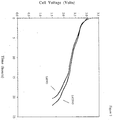
- FIG. 2 is a voltage-time plot comparing a cell according to one embodiment of the present invention and a cell made according to the prior art.
- FIG. 3 is a voltage-cumulative capacity plot for a cell according to one embodiment of the present invention showing open circuit voltage and minimum pulse voltage.
- the electrochemical cell of the present invention comprises an anode of a metal selected from Group IA of the Periodic Table of the Elements, including lithium, sodium, potassium, etc., and their alloys and intermetallic compounds including, for example, Li-Si, Li-Al, Li-B and Li-Si-B alloys and intermetallic compounds.
- the form of the anode may vary, but typically, it is made as a thin sheet or foil of the anode metal, and a current collector having an extended tab or lead affixed to the anode sheet or foil.
- the electrochemical cell of the present invention further comprises a cathode of electronically conductive composite material which serves as the other electrode of the cell.
- the electrochemical reaction at the cathode involves conversion of ions which migrate from the anode to the cathode into atomic or molecular forms.
- the composite cathode material of the present invention comprises at least one metal oxide and at least a first and a second metals, or a mixture of a first and a second metals or their metal oxides incorporated in the matrix of the host metal oxide.
- the cathode material of this invention can be constructed by the chemical addition, reaction, or otherwise intimate contact of various metal oxides and/or metal elements, preferably during -- thermal treatment, sol-gel formation, chemical vapor deposition or hydrothermal synthesis in mixed states.
- the material thereby produced contains metals and oxides of vanadium, silver and copper.
- the mixed oxide may be formed by a thermal addition reaction or a thermal decomposition reaction.
- readily decomposable compounds of the relevant metals are thermally treated so as to effect the rapid preparation of the oxides or the respective metal elements themselves to be utilized further in the preparation of suitable cathode materials.
- readily decomposable materials include, but are not limited to, those classes of compounds known as nitrates, nitrites, carbonates, and/or salts of metal oxyanions e.g. ammonium salts.
- the precursor material i.e., nitrates, nitrites, carbonates, metal ammonium compounds, etc.
- the precursor material may be decomposed in a combined state or individually decomposed and thereafter combined in an oxide/decomposable metal salt compound and subsequently decomposed to form the cathode composite matrix.
- Such composite materials may be pressed into a cathode pellet with the aid of a suitable binder material and a material having electronic conduction characteristics such as graphite.
- no binder material or electronic conductor material is required to provide a similarly suitable cathode body.
- the cathode may include at least one of (a) a binder material, such as a fluoro-resin powder, and (b) a conductive additive material, such as carbon.
- cathode matrix samples may also be prepared by rolling, spreading or pressing a mixture of the material mentioned above onto a suitable current collector such as Exmet wire mesh.
- Cathodes prepared as described above may be in the form of one or more plates operatively associated with at least one or more plates of anode material, or in the form of a strip wound with a corresponding strip of anode material in a structure similar to a "jellyroll".
- the cathode is separated in both cases from the Group IA anode material by a suitable separator material such as a porous glass woven or polypropylene or polyethylene microporous material.
- Preferred cathode composites are prepared by thermally decomposing a vanadium salt, suitably ammonium metavanadate to produce vanadium pentoxide.
- a decomposable metal salt suitably the nitrates of a second metal and a third metal, is then added to the vanadium pentoxide, thoroughly mixed therewith and thereafter ignited.
- the second and third metals are silver and copper.
- the composite cathode material may be described as a metal oxidemetal oxide-metal oxide, a metal-metal oxide-metal oxide, or a metal-metal-metal oxide
- the cathode is preferably formed by thermally treating a mixture of vanadium pentoxide, silver nitrate and copper nitrate.
- a typical form of CSVO is Cu 0.16 Ag 0.67 V 2 O z which is single phase and is characterized by a exothermic transition at 537°C in the differential scanning calorimetry data and d-spacings of 4.36, 3.75, 3.59, 3.45 3.20, 3.08, 3.03, and 2.97 in the X-ray powder diffraction pattern for the sample.
- the CSVO synthesized as described above displays a bulk density of 1.5 g/mL and displays a characteristic sloping voltage versus time curve for the discharge of a LI/CSVO cell (FIG. 1), prepared as described in detail presently.
- the sloping discharge curve is of particular importance for batteries in implantable medical applications where a state of charge indication extrapolated from cell voltage is needed.
- Another form is Cu 0.5 Ag 0.5 V 2 O z .
- the electrochemical cell of the present invention further comprises a nonaqueous, ionic conductive electrolytic solution of Group IA metal salt operatively associated with the anode and the cathode.
- the electrolytic solution serves as a medium for migration of ions between the anode and cathode during cell electrochemical reactions.
- the nonaqueous solvents suitable for the invention are chosen so as to exhibit those physical properties necessary for ionic transport (low viscosity, low surface tension, and wettability).
- the nonaqueous solvent of the electrolyte may be any one or more of the organic solvents which is substantially inert to the anode and cathode electrode materials, such as tetrahydrofuran, propylene carbonate, methyl acetate, acetonitrile, dimethyl sulfoxide, dimethyl formamide, dimethyl acetamide, 1,2-dimethoxyethane and others.
- organic solvents which is substantially inert to the anode and cathode electrode materials, such as tetrahydrofuran, propylene carbonate, methyl acetate, acetonitrile, dimethyl sulfoxide, dimethyl formamide, dimethyl acetamide, 1,2-dimethoxyethane and others.
- the nonaqueous solvent also may be one or a mixture of more than one of the inorganic solvents which can serve as both a solvent and a depolarizer, such as thionyl chloride, sulfuryl chloride, selenium oxychloride, chromyl chloride, phosphoryl chloride, phosphorous sulfur trichloride, and others.
- a depolarizer such as thionyl chloride, sulfuryl chloride, selenium oxychloride, chromyl chloride, phosphoryl chloride, phosphorous sulfur trichloride, and others.
- the Group IA metal salt of the nonaqueous electrolytic solution may be chosen from, for example, lithium halides, such as LiCl and LiBr, and lithium salts of the LiMX n type, such as LiAlCl 4 , Li 2 Al 2 Cl 6 O, LiClO 4 , LiAsF 6 , LiSbF 6 , LiSbCl 6 , Li 2 TiCl 6 , Li 2 SeCI 6 , Li 2 B 10 Cl 10 , Li 2 B 12 Cl 12 , and others.
- the corresponding sodium or potassium salts may be used.
- a separator can be employed to provide physical separation between the anode and the cathode current collectors.
- the separator is of electrically insulative material to prevent an internal electrical short circuit in the cell between the anode and the cathode current collectors.
- the separator materials also must be chemically unreactive with the materials of the anode and cathode current collectors and both chemically unreactive with and insoluble in the electrolytic solution.
- the separator material must have a degree of porosity sufficient to allow flow therethrough of the electrolytic solution during the electrochemical reaction of the cell.
- Illustrative separator materials include nonwoven glass, polytetrafluoroethylene (PTFE), glass fiber material, ceramics, and PTFE membranes commercially available under the designations ZITEX (Chemplast Inc.), polypropylene membranes, commercially available under the designation CELGARD (Celanese Plastic Company Inc.), and methyl acrylate plastic, commercially available under the designation DEXIGLAS (C.H. Dexter, Div. Dexter Corp.).
- the form of the separator typically is a sheet which is placed between the anode and the cathode of the cell in a manner preventing physical contact between the anode and cathode, and such contact also is prevented when the combination is rolled or otherwise formed into a cylindrical configuration having a jellyroll shape.
- the electrochemical cell of the present invention operates in the following manner.
- the ionic conductive electrolytic solution becomes operatively associated with the anode and cathode of the cell, an electrical potential difference is developed between terminals operatively connected to the anode and cathode.
- the electrochemical reaction at the anode includes oxidation to form metal ions during discharge of the cell.
- the electrochemical reaction at the cathode involves conversion of ions which migrate from the anode to the cathode into atomic or molecular forms. It is observed that the systems of this invention have a wide operating temperature range of about -20°C to +70°C.
- Advantages of the CSVO cathode material according to the present invention include a high delivered capacity for the intercalation of lithium and reduced voltage delay under high rate applications, such as in batteries for implanted cardiac defibrillators, together with the cost saving resulting from the reduced amount of silver as starting material.
- the electrochemical cell according to the present invention is illustrated further by the following examples.
- Copper-Silver Vanadium Oxide (CSVO) was synthesized via a solid-state reaction of thermally decomposable salts of copper and silver with vanadium pentoxide.
- the oxygen content in Cu. 0.16 Ag 0.67 V 2 O z is designated by z since the exact stoichiometry of oxygen depends on the conditions and method used in preparation of the material.
- Silver nitrate, AgNO 3 (16.73 g, 0.098 mol) and copper(ii) nitrate hydrate, Cu(NO 3) 2.3H 2 O (5.68 g, 0.024 mol) were dissolved in 25 mL of deionized/distilled water.
- the aqueous salt solution was added to the previously prepared solid vanadium pentoxide, V 2 O 5 (26.74 g, 0.147 mol), and the resulting slurry heated to 80 to 120°C to evaporate all of the water. During this time the slurry was mixed intermittently until the sample became a dry powder. This powder was ground to thoroughly mix the components. The solid was heated at 230°C under an air atmosphere for at least 30 minutes, and mixed again.
- the temperature of the oven was then increased to 260°C for at least 2 hours, followed by heating at 300°C for at least 16 hours.
- the material was then ground again, and heated at 375°C for not less than 24 hours. Upon cooling, the material was used without further preparation.
- Siver nitrate, AgNO 3 (16.63 g, 0.098 mol) and copper(II) nitrate hydrate, Cu(NO 3 )2.3H 2 O (23.66 g, 0.098 mol) were dissolved in 30 mL of deionized/distilled water.
- the aqueous salt solution was added to solid vanadium pentoxide, V 2 O 5 (35.62 g, 0.196 mol) and the material was synthesized as described in Example 1.
- V 2 O z may be synthesized from metal oxides.
- Silver oxide, Ag 2 O (2.14 g, 0.009 mol) and copper(II) oxide, CuO (0.35 g, 0.004 mol) were mixed as dry powders and added to solid vanadium pentoxide, V 2 O 5 (5.00 g, 0.028 mol).
- This dry powder sample was mixed well and thermally treated as described in Example 1.
- the metal oxides may also be taken up as aslurry in aqueous or nonaqueous solvent, mixed thoroughly and dried as described in Example 1. Additional salts may also be used for the synthesis of CSVO materials.
- silver and copper salts for the synthesis include, but are not limited to, classes of salts known as nitrites, acetates, and carbonates, as well as the above-mentioned nitrates and oxides.
- Copper materials may be used in either the copper(II), copper(I) or copper(O) oxidation state.
- AgVO 3 or other Ag x VO z precursors may be combined with V 2 O z and a salt of copper or copper metal to form the CSVO material.
- a silver or salt or silver metal may be combined with a Cu x VO z precursor and V 2 O z to form CSVO.
- Silver Vanadium Oxide (SVO,AgV 2 O z ) was synthesized to provide a comparison to the Copper-Silver Vanadium Oxides from Examples 1 to 3.
- Silver nitrate, AgNO 3 (93.4 g, 0.55 mol) was dissolved in 70 mL of deionized/distilled water.
- the aqueous salt solution was added to solid vanadium pentoxide, V 2 O 5 (100.0 g, 0.55 mol), and the mixture was synthesized-as described in Example 1.
- Test cells were constructed having a lithium anode and an electronically conductive composite cathode made according to the present invention, along with an organic electrolyte.
- the electrolyte used in these cells was comprised of, but should not be limited to, lithium hexafluoroarsenate dissolved in a mixture of propylene carbonate and 1,2-dimethoxyethane.
- These experimental cells were used to test the ability of CSVO made according to Examples 1 to 3 to intercalate lithium under constant resistance discharge, current pulse, or a combination of these test conditions.
- test cells were constructed using SVO made according to Comparative Example 1 to compare to the CSVO materials.
- the cell design utilized a cathode in the form of a pellet having a length of 3.6 cm, a width of 1.4 cm, and a thickness of about 0.06 cm.
- the cathode consisted of a mixture of 94% of active material (CSVO or SVO) by weight along with 3% PTFE, 2% graphite, and 1% carbon black. The mixture was pressed onto an expanded metal current collector, and the cathode separated from the lithium anode by a polypropylene separator. Lithium metal (1.4 x 3.6 x 0.08 cm), also in contact with an expanded metal current collector, was placed against the separator facing the CSVO cathode. Both electrodes were surrounded by glass plates and held together by small metal clamps.
- the electrodes were placed in a glass enclosure and filled with a 1 molar solution of lithium hexafluoroarsenate (LiAsF 6 ) dissolved in an equal volume mixture of propylene carbonate (PC) and 1,2-dimethoxyethane (DME) as electrolye.
- the test cell was capped to avoid the evaporation of DME electrolyte.
- test cells described in Example 5 were discharged at room temperature under a constant 200 ohm load down to a voltage of +1.5 V vs Li/Li+, corresponding to the intercalation of Li+ into the cathode material.
- the cells containing CSVO cathodes displayed an increase in delivered capacity over that seen for silver vanadium oxide (SVO), as listed in Table II.
- SVO silver vanadium oxide
- the capacity values in Table II are based on the amount of active material in the cathode.
- the voltage of a test cell using CSVO from Example 2 is plotted as a function of time during the 200 ohm discharge of FIG. 1. A comparison of the voltage-time results for the discharge of LI/CSVO from Example 2 and LI/SVO from Comparative Example 1 is presented in FIG. 2.
- Cathode Material Capacity to +2.0 V to +1.5 V AgV 2 O z ,SVO 250 Ah/kg 300 Ah/kg (610 Wh/kg) (690 Wh/kg) Cu 0.16 Ag 0.67 V 2 O z 270 Ah/kg 310 Ah/kg (650 Wh/kg) (710 Wh/kg) Cu 0.5 Ag 0.5 V 2 O z 280 Ah/kg 330 Ah/kg (680 Wh/kg) (760 Wh/kg) Pulse testing (0.19 Amp) Of experimental cells at room temperature using CSVO from Examples 1 and 2 also demonstrated substantially decreased voltage delay when compared to cells employing SVO from Comparative Example 1.
- Multi-plate batteries containing cathodes similar in construction to those described in Example 4 were built using CSVO from Examples 1 and 2 and SVO from Comparative Example 1. These batteries contained lithium anodes, 1 M LiAsF 6 PC/DME (50/50) electrolyte, and were hermetically sealed. These cells were discharged via constant current pulse testing at 37°C. current pulses of 1.5 Amps were applied for 10 seconds in duration followed by 15 seconds of open circuit rest between pulses. These pulses were applied in groups of four, with 30 minutes of open circuit rest between groups. The results of the pulse testing are presented in Table III. The open circuit voltage and minimum voltage for the fourth pulse of each group are plotted in FIG.
- CELGARD and DEXIGLAS are trade marks which may be registered in one or more of the territories designated in the application.
Landscapes
- Chemical & Material Sciences (AREA)
- Inorganic Chemistry (AREA)
- Chemical Kinetics & Catalysis (AREA)
- Electrochemistry (AREA)
- General Chemical & Material Sciences (AREA)
- Organic Chemistry (AREA)
- Crystallography & Structural Chemistry (AREA)
- Battery Electrode And Active Subsutance (AREA)
- Primary Cells (AREA)
- Secondary Cells (AREA)
- Inorganic Compounds Of Heavy Metals (AREA)
Claims (15)
- Kathode für eine elektrochemische Zelle bestehend aus Cu0,16Ag0,67V2Oz, wobei z etwa 5,5 ist, oder aus Cu0,5Ag0,5V2Oz, wobei z etwa 5,75 ist.
- Kathode gemäß Anspruch 1, in der eine Komponente des gemischten Metalloxids V2Oz umfaßt, worin z kleiner oder gleich 5 ist.
- Kathode gemäß Anspruch 1 oder 2, in der eine Komponente des gemischten Metalloxids Ag2Oz umfaßt, worin z etwa zwischen 0 und 1 liegt.
- Kathode gemäß einem der Ansprüche 1 bis 3, bei der eine Komponente des gemischten Metalloxids CuOz umfaßt, worin z etwa zwischen 0 und 1 liegt.
- Kathode gemäß einem der Ansprüche 1 bis 4, die zusätzlich mindestens (a) ein Bindemittelmaterial, z.B. ein Fluorharzpulver und/oder (b) ein leitfähigs Additivmaterial z.B. Kohlenstoff einschließt.
- Verfahren zur Herstellung einer Kathode gemäß einem der Ansprüche 1 bis 5, bei dem das gemischte Metalloxid durch Herstellen eines Vanadiumoxid-Reaktionsprodukts mit zersetzbaren Silber- und Kupferverbindungen geformt wird.
- Verfahren gemäß Anspruch 6, bei dem das Vanadiumoxid von Ammoniumvanadat abgeleitet ist und die Formel V2Oz hat, worin z kleiner oder gleich 5 ist.
- Verfahren gemäß Anspruch 6 oder 7, bei dem die zersetzbare Silberverbindung unter Silbernitrat, -nitrit, -carbonat und Salzen von Silberoxyanionen ausgewählt ist.
- Verfahren gemäß einem der Ansprüche 6 bis 8, bei dem die zersetzbare Kupferverbindung Kupfernitrat ist.
- Verfahren gemäß einem der Ansprüche 6 bis 9, bei dem das gemischte Metalloxid durch eine Behandlung gebildet wird, die unter mindestens einem aus einer thermischen Behandlung, einer Sol-Gel-Bildung, der chemischen Dampfabscheidung und/oder der hydrothermalen Synthese ausgewählt ist.
- Verfahren gemäß einem der Anbsprüche 6 bis 10, bei dem das gemischte Metalloxid über eine thermische Additions- oder eine thermische Zersetzungsreaktion gebildet wird.
- Verfahren gemäß einem der Ansprüche 6 bis 11, das die thermische Behandlung eines Gemisches aus Vanadiumpentoxid, Silbernitrat und Kupfernitrit umfaßt.
- Elektrochemische Zelle mit einer Anode aus einem Metall der Gruppe IA, die bei der Entladung chemisch oxidierbar ist zur Bildung von Metallionen in der Zelle und zur Erzeugung eines Elektronenstroms in dem an die Zelle angeschlossenen externen Stromkreis, einer Kathode gemäß einem der Ansprüche 1 bis 5 oder hergestellt nach einem Verfahren gemäß einem der Ansprüche 6 bis 12 und einer ionisch leitenden Elektrolytlösung in operativem Kontakt mit der Anode und der Kathode.
- Elektrochemische Zelle gemäß Anspruch 13, in der die Elektrolytlösung ein Salz eines Gruppe IA-Metalls, das in einem nichtwäßrigen Lösungsmittel gelöst ist, umfaßt.
- Elektrochemische Zelle gemäß Anspruch 14, bei der das nichtwäßrige Lösungsmittel ein anorganisches oder ein organisches Lösungsmittel umfaßt.
Applications Claiming Priority (2)
| Application Number | Priority Date | Filing Date | Title |
|---|---|---|---|
| US3265993A | 1993-03-17 | 1993-03-17 | |
| US32659 | 1993-03-17 |
Publications (2)
| Publication Number | Publication Date |
|---|---|
| EP0618630A1 EP0618630A1 (de) | 1994-10-05 |
| EP0618630B1 true EP0618630B1 (de) | 1998-01-28 |
Family
ID=21866113
Family Applications (1)
| Application Number | Title | Priority Date | Filing Date |
|---|---|---|---|
| EP94301910A Expired - Lifetime EP0618630B1 (de) | 1993-03-17 | 1994-03-17 | Metalloxidverbund-Kathodenmaterial für Batterien mit höher Energiedichte |
Country Status (6)
| Country | Link |
|---|---|
| US (1) | US5472810A (de) |
| EP (1) | EP0618630B1 (de) |
| JP (1) | JP3445654B2 (de) |
| AT (1) | ATE162909T1 (de) |
| AU (1) | AU669425B2 (de) |
| DE (1) | DE69408188T2 (de) |
Families Citing this family (83)
| Publication number | Priority date | Publication date | Assignee | Title |
|---|---|---|---|---|
| JP3445654B2 (ja) * | 1993-03-17 | 2003-09-08 | ウィルソン グレイトバッチ リミテッド | 電気化学電池およびそのカソード |
| JPH07142067A (ja) * | 1993-07-12 | 1995-06-02 | Wilson Greatbatch Ltd | 電気化学電池用カソードおよびその調製方法、並びに電気化学電池 |
| CA2114902C (en) * | 1994-02-03 | 2001-01-16 | David S. Wainwright | Aqueous rechargeable battery |
| US5670276A (en) * | 1995-12-04 | 1997-09-23 | Wilson Greatbatch Ltd. | Alternate synthetic method for mixed metal oxide cathode materials |
| US5639577A (en) * | 1996-04-16 | 1997-06-17 | Wilson Greatbatch Ltd. | Nonaqueous electrochemical cell having a mixed cathode and method of preparation |
| US5667916A (en) * | 1996-05-10 | 1997-09-16 | Wilson Greatbatch Ltd. | Mixed cathode formulation for achieving end-of-life indication |
| US5695892A (en) * | 1996-08-20 | 1997-12-09 | Wilson Greatbatch Ltd. | Preparation of silver vanadium oxide using nitric acid with oxide starting materials |
| US5776635A (en) * | 1996-09-16 | 1998-07-07 | Wilson Greatbatch Ltd. | Ternary solvent nonaqueous organic electrolyte for alkali metal electrochemical cells |
| US5955218A (en) * | 1996-12-18 | 1999-09-21 | Medtronic, Inc. | Heat-treated silver vanadium oxide for use in batteries for implantable medical devices |
| US5895733A (en) * | 1997-02-03 | 1999-04-20 | Medtronic, Inc. | Synthesis method for silver vanadium oxide |
| US6183908B1 (en) | 1997-03-14 | 2001-02-06 | Fuji Photo Film Co., Ltd. | Negative electrode material for nonaqueous secondary battery and nonaqueous secondary battery comprising same negative electrode material |
| DE69837368T2 (de) | 1997-08-22 | 2007-11-29 | Wilson Greatbatch, Ltd. | Kathode mit Gemischtphase-Metalloxid, Herstellungsverfahren und Elektrochemische Zelle dafür |
| US6008625A (en) * | 1998-01-16 | 1999-12-28 | Wilson Greatbatch Ltd. | Use of double cells to power an implantable medical device |
| US6350546B1 (en) | 1998-01-20 | 2002-02-26 | Wilson Greatbatch Ltd. | Sulfate additives for nonaqueous electrolyte rechargeable cells |
| US6013394A (en) * | 1998-01-20 | 2000-01-11 | Wilson Greatbatch Ltd. | Organic sulfate additives for nonaqueous electrolyte in alkali metal electrochemical cells |
| US6265106B1 (en) | 1998-01-20 | 2001-07-24 | Wilson Greatbatch Ltd. | Alkali metal electrochemical cell activated with a nonaqueous electrolyte having a sulfate additive |
| US6180283B1 (en) | 1998-01-20 | 2001-01-30 | Wilson Greatbatch Ltd. | Method for reducing voltage delay in an alkali metal electrochemical cell activated with a nonaqueous electrolyte having a sulfate additive |
| US6444360B2 (en) | 1998-01-20 | 2002-09-03 | Wilson Greatbatch Ltd. | Electrochemical cell activated with a nonaqueous electrolyte having a sulfate additive |
| US6445948B1 (en) | 1998-04-03 | 2002-09-03 | Medtronic, Inc. | Implantable medical device having a substantially flat battery |
| US6117591A (en) * | 1998-05-27 | 2000-09-12 | Wilson Greatbatch Ltd. | Hydrogen fluoride additive for nonaqueous electrolyte in alkali metal electrochemical cells |
| US6459566B1 (en) | 1998-06-24 | 2002-10-01 | Medtronic, Inc. | Implantable medical device having flat electrolytic capacitor with laser welded cover |
| US6413669B1 (en) * | 1999-06-03 | 2002-07-02 | Wilson Greatbatch Ltd. | Melt impregnation of mixed metal oxide |
| US7056358B2 (en) | 2000-04-05 | 2006-06-06 | Wilson Greatbatch Technologies, Inc. | Method for using high rate lithium electrochemical cell containing SVO/CFchi/SVo sandwich cathodes having γ-SVO and mixture of γ-SVO/ε-SVO |
| US6607861B2 (en) | 2000-04-05 | 2003-08-19 | Wilson Greatbatch Ltd. | Application of γ-SVO and mixture of γ-SVO/ε-SVO in high rate electrochemical lithium cells containing SVO/CFx/SVO sandwich cathodes |
| US6623887B2 (en) | 2000-04-06 | 2003-09-23 | Wilson Greatbatch Ltd. | Silver vanadium oxide cathode material for high discharge rate lithium cells |
| US6566007B1 (en) * | 2000-04-14 | 2003-05-20 | Wilson Greatbatch Ltd. | Synthetic method for preparation of a low surface area, single phase silver vanadium oxide |
| US6576810B1 (en) * | 2000-10-25 | 2003-06-10 | Kimberly-Clark Worldwide, Inc. | Toilet training article containing an effervescent agent |
| US6673487B2 (en) * | 2000-11-17 | 2004-01-06 | Wilson Greatbatch Ltd. | Double current collector cathode design using the same active material in varying thicknesses for alkali metal or ION electrochemical cells |
| US6692871B2 (en) * | 2000-11-17 | 2004-02-17 | Wilson Greatbatch Ltd. | Double current collector cathode design for alkali metal electrochemical cells having short circuit safety characteristics |
| US6737191B2 (en) * | 2000-11-17 | 2004-05-18 | Wilson Greatbatch Ltd. | Double current collector negative electrode design for alkali metal ion electrochemical cells |
| US6692865B2 (en) * | 2000-11-17 | 2004-02-17 | Wilson Greatbatch Ltd. | Double current collector cathode design using mixtures of two active materials for alkali metal or ion electrochemical cells |
| US6743550B2 (en) * | 2000-11-17 | 2004-06-01 | Wilson Greatbatch Ltd. | Double current collector cathode design using chemically similar active materials for alkali metal electrochemical |
| US7807300B2 (en) * | 2006-01-31 | 2010-10-05 | Medtronic, Inc. | Resistance-stabilizing additives for electrolyte |
| US6872490B2 (en) | 2001-08-09 | 2005-03-29 | Wilson Greatbatch Technologies, Inc. | Preparation for a cathode material by a two-step reduction/oxidation synthesis process |
| US6844115B2 (en) * | 2001-11-05 | 2005-01-18 | Wilson Greatbatch Technologies, Inc. | Highly conductive and stable nonaqueous electrolyte for lithium electrochemical cells |
| JP2004039610A (ja) * | 2001-11-14 | 2004-02-05 | Wilson Greatbatch Technologies Inc | アルカリ金属電気化学電池に使用される炭素で被覆されたチタン集電体 |
| US7052804B2 (en) * | 2001-12-05 | 2006-05-30 | Wilson Greatbatch Technologies, Inc. | Double current collector positive electrode for alkali metal ion electrochemical cells |
| EP1326295A3 (de) * | 2002-01-02 | 2005-08-24 | Wilson Greatbatch Technologies, Inc. | Doppelte chemische Elektrodenanordnung |
| US20100185264A1 (en) * | 2002-01-24 | 2010-07-22 | Greatbatch Ltd. | Method For Coating A Cathode Active Material With A Metal Oxide For Incorporation Into A Lithium Electrochemical Cell |
| US7211349B2 (en) | 2002-08-06 | 2007-05-01 | Wilson Greatbatch Technologies, Inc. | Silver vanadium oxide provided with a metal oxide coating |
| US20040161671A1 (en) * | 2003-02-13 | 2004-08-19 | Medtronic, Inc. | Liquid electrolyte for an electrochemical cell |
| US20040256640A1 (en) * | 2003-06-17 | 2004-12-23 | Zayatz Robert A. | Self-centering current collector for an electrochemical cell |
| US7722992B1 (en) | 2003-06-17 | 2010-05-25 | Greatbatch Ltd. | Self-centering current collector for an electrochemical cell |
| US7045249B2 (en) | 2003-07-02 | 2006-05-16 | The Gillette Company | Lithium cell with improved cathode |
| AR045347A1 (es) * | 2003-08-08 | 2005-10-26 | Rovcal Inc | Celda alcalina de alta capacidad |
| US7432001B1 (en) | 2003-12-09 | 2008-10-07 | Greatbatch Ltd. | Prevention of lithium deposition in nonaqueous electrolyte cells by electrolyte-to-cathode weight ratio |
| US20070281207A1 (en) * | 2003-12-09 | 2007-12-06 | Takeuchi Esther S | Prevention of lithium deposition in nonaqueous electrolyte cells by matching device usage to cell capacity |
| US20070279006A1 (en) * | 2004-01-09 | 2007-12-06 | Takeuchi Esther S | Method of testing electrochemical cells |
| US8241788B1 (en) | 2004-12-13 | 2012-08-14 | Greatbatch Ltd. | Method for making flat and high-density cathode for use in electrochemical cells |
| US20060260713A1 (en) | 2005-04-22 | 2006-11-23 | Pyszczek Michael F | Method and apparatus for providing a sealed container containing a detectable gas |
| US7875379B2 (en) * | 2005-07-08 | 2011-01-25 | Greatbatch Ltd. | Electrochemical cell having a pocket separator design |
| EP1768203B1 (de) | 2005-08-02 | 2011-10-05 | Greatbatch Ltd. | Batterieelektroden |
| DE602006013924D1 (de) * | 2005-09-15 | 2010-06-10 | Greatbatch Ltd | Sandwich-Kathode Bauweise für alkali-metall-elektrochemische Zelle mit spiralförmig gewickelten Elektrodenblock |
| US7776470B2 (en) * | 2005-09-28 | 2010-08-17 | Greatbatch Ltd. | Anode-to-cathode capacity ratios for SVO/CF x hybrid cathode electrochemical cells |
| US20070077488A1 (en) * | 2005-10-04 | 2007-04-05 | Kaimin Chen | Power capability of a cathode |
| WO2007084912A1 (en) * | 2006-01-17 | 2007-07-26 | Medtronic, Inc. | Implantable medical device battery |
| US20070176151A1 (en) * | 2006-01-31 | 2007-08-02 | Kaimin Chen | Electrolyte additive for performance stability of batteries |
| US20110183215A1 (en) * | 2006-04-10 | 2011-07-28 | Greatbatch Ltd. | Layered Electrode For An Electrochemical Cell |
| US8133614B1 (en) | 2006-04-12 | 2012-03-13 | Greatbatch Ltd. | Control of silver vanadium oxide surface areas as a means of controlling voltage delay and Rdc growth in an electrochemical cell |
| US7820328B1 (en) | 2006-07-27 | 2010-10-26 | Greatbatch Ltd. | Electrochemical cell electrode with improved particle-to-particle contact and method of manufacturing |
| US8192867B2 (en) * | 2006-10-03 | 2012-06-05 | Greatbatch Ltd. | Hybrid cathode design for an electrochemical cell |
| EP1914823B1 (de) | 2006-10-03 | 2010-02-24 | Greatbatch Ltd. | Hybridkathodenentwurf für eine elektrochemische Zelle |
| US7939199B1 (en) | 2006-10-17 | 2011-05-10 | Greatbatch Ltd. | Method of controlling voltage delay and RDC growth in an electrochemical cell using low basis weight cathode material |
| US7718310B1 (en) | 2006-10-24 | 2010-05-18 | Greatbatch Ltd. | Electrochemical cell having a galaxy wind design |
| US20090035652A1 (en) | 2007-07-31 | 2009-02-05 | Greatbatch Ltd. | Non-prismatic electrochemical cell |
| US20090117457A1 (en) * | 2007-11-02 | 2009-05-07 | Greatbatch Ltd. | Electrochemical Cells And Method Of Manufacturing Same |
| WO2010111567A1 (en) | 2009-03-27 | 2010-09-30 | Zpower, Inc. | Improved cathode |
| US8871379B2 (en) | 2009-10-30 | 2014-10-28 | Greatbatch Ltd. | Screen-less anode design concepts for low cost lithium electrochemical cells for use in implantable medical device applications |
| WO2011056813A1 (en) | 2009-11-03 | 2011-05-12 | Zpower, Inc. | Novel electrodes and rechargeable batteries |
| US8722238B2 (en) | 2009-11-23 | 2014-05-13 | Greatbatch Ltd. | Direct resistance welding—self brazing of aluminum to molybdenum pin |
| US8906549B1 (en) | 2010-09-24 | 2014-12-09 | Greatbatch Ltd. | Development of mixed binder system for primary cell cathodes |
| WO2012040298A1 (en) | 2010-09-24 | 2012-03-29 | Zpower, Llc | Cathode |
| US10224518B2 (en) | 2011-05-06 | 2019-03-05 | Greatbatch Ltd. | Electrochemical cell casing having an open-ended main body portion of grade 5 or 23 titanium closed by upper and lower lids of grade 1 or 2 titanium |
| US9899655B2 (en) | 2012-09-14 | 2018-02-20 | Greatbatch Ltd. | Electrochemical current collector screen designs utilizing ultrasonic welding |
| WO2014052533A1 (en) | 2012-09-27 | 2014-04-03 | Zpower, Llc | Cathode |
| US9355789B2 (en) | 2013-05-10 | 2016-05-31 | Greatbatch Ltd. | Internal insulation design using porous material for an electrochemical cell |
| EP3319145B1 (de) | 2016-11-04 | 2019-12-25 | Greatbatch Ltd. | Elektrochemische zelle mit isolierschacht |
| US10641833B2 (en) | 2016-11-18 | 2020-05-05 | Pacesetter, Inc. | Method of screening high rate electrochemical cells |
| US11114661B2 (en) | 2018-07-13 | 2021-09-07 | Greatbatch Ltd. | Electrochemical cell having a serpentine anode with a plurality of interleaved cathode plates having extending tabs stacked and connected to each other by a welded surrounding metal hoop |
| EP3614461B1 (de) | 2018-08-24 | 2023-11-15 | Greatbatch Ltd. | Eine übertragbare elektrodenspitze zum widerstandsschweissen einer anodenlasche am gehäuse einer elektrochemischen zelle |
| US11355820B2 (en) | 2018-08-24 | 2022-06-07 | Greatbatch Ltd. | Transferable electrode tip for resistance welding an anode tab to the casing of an electrochemical cell |
| CN111333110B (zh) * | 2020-02-24 | 2022-07-19 | 石家庄学院 | 银铜钒氧化合物纳米材料及其制备方法和应用 |
| US11799172B2 (en) | 2020-10-23 | 2023-10-24 | Greatbatch Ltd. | Dual separator design for medical implantable electrochemical cells |
Family Cites Families (11)
| Publication number | Priority date | Publication date | Assignee | Title |
|---|---|---|---|---|
| JPS5250615B2 (de) * | 1974-06-08 | 1977-12-26 | ||
| AU532635B2 (en) * | 1979-11-06 | 1983-10-06 | South African Inventions Development Corporation | Metal oxide cathode |
| US4310609A (en) * | 1979-12-17 | 1982-01-12 | Wilson Greatbatch Ltd. | Metal oxide composite cathode material for high energy density batteries |
| JPS5916272A (ja) * | 1982-07-19 | 1984-01-27 | Nippon Telegr & Teleph Corp <Ntt> | リチウム電池 |
| JPS59134562A (ja) * | 1983-01-24 | 1984-08-02 | Nippon Telegr & Teleph Corp <Ntt> | リチウム二次電池 |
| JPS59134561A (ja) * | 1983-01-24 | 1984-08-02 | Nippon Telegr & Teleph Corp <Ntt> | リチウム電池 |
| US4830940A (en) * | 1986-01-14 | 1989-05-16 | Wilson Greatbatch Ltd. | Non-agueous lithium battery |
| FR2616013B1 (fr) * | 1987-05-29 | 1989-08-18 | France Etat Armement | Procede de preparation de bronzes d'oxydes metalliques et leur utilisation comme electrode dans des generateurs electrochimiques |
| JPH03194857A (ja) * | 1989-12-22 | 1991-08-26 | Matsushita Electric Ind Co Ltd | 電極材料およびその製造法 |
| US5221453A (en) * | 1990-09-27 | 1993-06-22 | Medtronic, Inc. | Silver vanadium oxide cathode material and method of preparation |
| JP3445654B2 (ja) * | 1993-03-17 | 2003-09-08 | ウィルソン グレイトバッチ リミテッド | 電気化学電池およびそのカソード |
-
1994
- 1994-03-10 JP JP07915494A patent/JP3445654B2/ja not_active Expired - Fee Related
- 1994-03-16 AU AU57865/94A patent/AU669425B2/en not_active Ceased
- 1994-03-17 DE DE69408188T patent/DE69408188T2/de not_active Expired - Fee Related
- 1994-03-17 EP EP94301910A patent/EP0618630B1/de not_active Expired - Lifetime
- 1994-03-17 AT AT94301910T patent/ATE162909T1/de not_active IP Right Cessation
- 1994-06-06 US US08/254,167 patent/US5472810A/en not_active Expired - Lifetime
Also Published As
| Publication number | Publication date |
|---|---|
| JP3445654B2 (ja) | 2003-09-08 |
| AU5786594A (en) | 1994-09-22 |
| DE69408188D1 (de) | 1998-03-05 |
| AU669425B2 (en) | 1996-06-06 |
| US5472810A (en) | 1995-12-05 |
| ATE162909T1 (de) | 1998-02-15 |
| EP0618630A1 (de) | 1994-10-05 |
| JPH06342656A (ja) | 1994-12-13 |
| DE69408188T2 (de) | 1998-05-14 |
Similar Documents
| Publication | Publication Date | Title |
|---|---|---|
| US5472810A (en) | Copper, silver, vanadium oxide composite cathode material for high energy density batteries | |
| US5516340A (en) | Process for making a metal oxide composite cathode material for high energy density batteries | |
| US4310609A (en) | Metal oxide composite cathode material for high energy density batteries | |
| JP4113517B2 (ja) | 電気化学電池、カソード物質およびその製造方法 | |
| US5670276A (en) | Alternate synthetic method for mixed metal oxide cathode materials | |
| US4391729A (en) | Metal oxide composite cathode material for high energy density batteries | |
| US5695892A (en) | Preparation of silver vanadium oxide using nitric acid with oxide starting materials | |
| US5639577A (en) | Nonaqueous electrochemical cell having a mixed cathode and method of preparation | |
| US5498494A (en) | Preparation of silver vanadium oxide cathodes using AG20 and V205 as starting materials | |
| GB2033138A (en) | Nonaqueous secondary cell using vanadium oxide positive electrode | |
| EP1146581B1 (de) | Synthesemethode zur Herstellung von einphasigem Metall, Mischmetalloxid mit niedriger spezifischer Oberfläche zum Einbau in alkalische Metallelektrochemische Zelle | |
| EP1207567A2 (de) | Sandwich-Kathode Bauweise für alkali-metall-elektrochemische Zelle mit Kurzschlusssicherheiteigenschaften | |
| JPH09501257A (ja) | Ag(O)およびV▲下2▼O▲下5▼を出発物質として使用する酸化バナジウム銀カソードの調製 | |
| US6696201B2 (en) | Electrochemical cell having a cathode of a mixed phase metal oxide and method of preparation | |
| US6797017B2 (en) | Preparation of ε-phase silver vanadium oxide from γ-phase SVO starting material | |
| EP2897202A1 (de) | Neues hochkapazitives Kathodenmaterial mit verbesserter Taktkapazitätsleistung | |
| US9812710B2 (en) | Copper doped SVO compounds as high rate cathode materials | |
| US7118829B2 (en) | Preparation of copper silver vanadium oxide from γ-phase SVO starting material | |
| IE51895B1 (en) | Metal oxide composite cathode material for high density batteries |
Legal Events
| Date | Code | Title | Description |
|---|---|---|---|
| PUAI | Public reference made under article 153(3) epc to a published international application that has entered the european phase |
Free format text: ORIGINAL CODE: 0009012 |
|
| AK | Designated contracting states |
Kind code of ref document: A1 Designated state(s): AT BE CH DE DK ES FR GB GR IE IT LI NL PT SE |
|
| 17P | Request for examination filed |
Effective date: 19950404 |
|
| 17Q | First examination report despatched |
Effective date: 19951129 |
|
| GRAG | Despatch of communication of intention to grant |
Free format text: ORIGINAL CODE: EPIDOS AGRA |
|
| GRAG | Despatch of communication of intention to grant |
Free format text: ORIGINAL CODE: EPIDOS AGRA |
|
| GRAG | Despatch of communication of intention to grant |
Free format text: ORIGINAL CODE: EPIDOS AGRA |
|
| GRAH | Despatch of communication of intention to grant a patent |
Free format text: ORIGINAL CODE: EPIDOS IGRA |
|
| GRAH | Despatch of communication of intention to grant a patent |
Free format text: ORIGINAL CODE: EPIDOS IGRA |
|
| GRAA | (expected) grant |
Free format text: ORIGINAL CODE: 0009210 |
|
| AK | Designated contracting states |
Kind code of ref document: B1 Designated state(s): AT BE CH DE DK ES FR GB GR IE IT LI NL PT SE |
|
| PG25 | Lapsed in a contracting state [announced via postgrant information from national office to epo] |
Ref country code: LI Free format text: LAPSE BECAUSE OF FAILURE TO SUBMIT A TRANSLATION OF THE DESCRIPTION OR TO PAY THE FEE WITHIN THE PRESCRIBED TIME-LIMIT Effective date: 19980128 Ref country code: GR Free format text: LAPSE BECAUSE OF FAILURE TO SUBMIT A TRANSLATION OF THE DESCRIPTION OR TO PAY THE FEE WITHIN THE PRESCRIBED TIME-LIMIT Effective date: 19980128 Ref country code: ES Free format text: THE PATENT HAS BEEN ANNULLED BY A DECISION OF A NATIONAL AUTHORITY Effective date: 19980128 Ref country code: CH Free format text: LAPSE BECAUSE OF FAILURE TO SUBMIT A TRANSLATION OF THE DESCRIPTION OR TO PAY THE FEE WITHIN THE PRESCRIBED TIME-LIMIT Effective date: 19980128 Ref country code: BE Free format text: LAPSE BECAUSE OF FAILURE TO SUBMIT A TRANSLATION OF THE DESCRIPTION OR TO PAY THE FEE WITHIN THE PRESCRIBED TIME-LIMIT Effective date: 19980128 Ref country code: AT Free format text: LAPSE BECAUSE OF FAILURE TO SUBMIT A TRANSLATION OF THE DESCRIPTION OR TO PAY THE FEE WITHIN THE PRESCRIBED TIME-LIMIT Effective date: 19980128 |
|
| REF | Corresponds to: |
Ref document number: 162909 Country of ref document: AT Date of ref document: 19980215 Kind code of ref document: T |
|
| ITF | It: translation for a ep patent filed | ||
| REG | Reference to a national code |
Ref country code: CH Ref legal event code: EP |
|
| REF | Corresponds to: |
Ref document number: 69408188 Country of ref document: DE Date of ref document: 19980305 |
|
| ET | Fr: translation filed | ||
| PG25 | Lapsed in a contracting state [announced via postgrant information from national office to epo] |
Ref country code: IE Free format text: LAPSE BECAUSE OF NON-PAYMENT OF DUE FEES Effective date: 19980328 |
|
| PG25 | Lapsed in a contracting state [announced via postgrant information from national office to epo] |
Ref country code: PT Free format text: LAPSE BECAUSE OF FAILURE TO SUBMIT A TRANSLATION OF THE DESCRIPTION OR TO PAY THE FEE WITHIN THE PRESCRIBED TIME-LIMIT Effective date: 19980428 Ref country code: DK Free format text: LAPSE BECAUSE OF FAILURE TO SUBMIT A TRANSLATION OF THE DESCRIPTION OR TO PAY THE FEE WITHIN THE PRESCRIBED TIME-LIMIT Effective date: 19980428 |
|
| REG | Reference to a national code |
Ref country code: CH Ref legal event code: PL |
|
| PLBE | No opposition filed within time limit |
Free format text: ORIGINAL CODE: 0009261 |
|
| STAA | Information on the status of an ep patent application or granted ep patent |
Free format text: STATUS: NO OPPOSITION FILED WITHIN TIME LIMIT |
|
| 26N | No opposition filed | ||
| REG | Reference to a national code |
Ref country code: GB Ref legal event code: IF02 |
|
| PGFP | Annual fee paid to national office [announced via postgrant information from national office to epo] |
Ref country code: NL Payment date: 20050316 Year of fee payment: 12 |
|
| PGFP | Annual fee paid to national office [announced via postgrant information from national office to epo] |
Ref country code: SE Payment date: 20060329 Year of fee payment: 13 Ref country code: GB Payment date: 20060329 Year of fee payment: 13 |
|
| PGFP | Annual fee paid to national office [announced via postgrant information from national office to epo] |
Ref country code: IT Payment date: 20060331 Year of fee payment: 13 |
|
| PG25 | Lapsed in a contracting state [announced via postgrant information from national office to epo] |
Ref country code: NL Free format text: LAPSE BECAUSE OF NON-PAYMENT OF DUE FEES Effective date: 20061001 |
|
| NLV4 | Nl: lapsed or anulled due to non-payment of the annual fee |
Effective date: 20061001 |
|
| PG25 | Lapsed in a contracting state [announced via postgrant information from national office to epo] |
Ref country code: SE Free format text: LAPSE BECAUSE OF NON-PAYMENT OF DUE FEES Effective date: 20070318 |
|
| EUG | Se: european patent has lapsed | ||
| GBPC | Gb: european patent ceased through non-payment of renewal fee |
Effective date: 20070317 |
|
| PG25 | Lapsed in a contracting state [announced via postgrant information from national office to epo] |
Ref country code: GB Free format text: LAPSE BECAUSE OF NON-PAYMENT OF DUE FEES Effective date: 20070317 |
|
| PGFP | Annual fee paid to national office [announced via postgrant information from national office to epo] |
Ref country code: FR Payment date: 20080317 Year of fee payment: 15 Ref country code: DE Payment date: 20080430 Year of fee payment: 15 |
|
| PG25 | Lapsed in a contracting state [announced via postgrant information from national office to epo] |
Ref country code: IT Free format text: LAPSE BECAUSE OF NON-PAYMENT OF DUE FEES Effective date: 20070317 |
|
| REG | Reference to a national code |
Ref country code: FR Ref legal event code: ST Effective date: 20091130 |
|
| PG25 | Lapsed in a contracting state [announced via postgrant information from national office to epo] |
Ref country code: DE Free format text: LAPSE BECAUSE OF NON-PAYMENT OF DUE FEES Effective date: 20091001 |
|
| PG25 | Lapsed in a contracting state [announced via postgrant information from national office to epo] |
Ref country code: FR Free format text: LAPSE BECAUSE OF NON-PAYMENT OF DUE FEES Effective date: 20091123 |