EP0618906B1 - Substituierte imidazol derivate und deren herstellung und verwendung - Google Patents
Substituierte imidazol derivate und deren herstellung und verwendung Download PDFInfo
- Publication number
- EP0618906B1 EP0618906B1 EP93900200A EP93900200A EP0618906B1 EP 0618906 B1 EP0618906 B1 EP 0618906B1 EP 93900200 A EP93900200 A EP 93900200A EP 93900200 A EP93900200 A EP 93900200A EP 0618906 B1 EP0618906 B1 EP 0618906B1
- Authority
- EP
- European Patent Office
- Prior art keywords
- compound
- inden
- dihydro
- imidazole
- compound according
- Prior art date
- Legal status (The legal status is an assumption and is not a legal conclusion. Google has not performed a legal analysis and makes no representation as to the accuracy of the status listed.)
- Expired - Lifetime
Links
- 0 *C1(Cc2ccccc2C1)c1c[n]cn1 Chemical compound *C1(Cc2ccccc2C1)c1c[n]cn1 0.000 description 9
Images


Classifications
-
- C—CHEMISTRY; METALLURGY
- C07—ORGANIC CHEMISTRY
- C07D—HETEROCYCLIC COMPOUNDS
- C07D233/00—Heterocyclic compounds containing 1,3-diazole or hydrogenated 1,3-diazole rings, not condensed with other rings
- C07D233/54—Heterocyclic compounds containing 1,3-diazole or hydrogenated 1,3-diazole rings, not condensed with other rings having two double bonds between ring members or between ring members and non-ring members
- C07D233/64—Heterocyclic compounds containing 1,3-diazole or hydrogenated 1,3-diazole rings, not condensed with other rings having two double bonds between ring members or between ring members and non-ring members with substituted hydrocarbon radicals attached to ring carbon atoms, e.g. histidine
-
- A—HUMAN NECESSITIES
- A61—MEDICAL OR VETERINARY SCIENCE; HYGIENE
- A61K—PREPARATIONS FOR MEDICAL, DENTAL OR TOILETRY PURPOSES
- A61K31/00—Medicinal preparations containing organic active ingredients
- A61K31/33—Heterocyclic compounds
- A61K31/395—Heterocyclic compounds having nitrogen as a ring hetero atom, e.g. guanethidine or rifamycins
- A61K31/41—Heterocyclic compounds having nitrogen as a ring hetero atom, e.g. guanethidine or rifamycins having five-membered rings with two or more ring hetero atoms, at least one of which being nitrogen, e.g. tetrazole
- A61K31/415—1,2-Diazoles
-
- A—HUMAN NECESSITIES
- A61—MEDICAL OR VETERINARY SCIENCE; HYGIENE
- A61P—SPECIFIC THERAPEUTIC ACTIVITY OF CHEMICAL COMPOUNDS OR MEDICINAL PREPARATIONS
- A61P1/00—Drugs for disorders of the alimentary tract or the digestive system
- A61P1/18—Drugs for disorders of the alimentary tract or the digestive system for pancreatic disorders, e.g. pancreatic enzymes
-
- A—HUMAN NECESSITIES
- A61—MEDICAL OR VETERINARY SCIENCE; HYGIENE
- A61P—SPECIFIC THERAPEUTIC ACTIVITY OF CHEMICAL COMPOUNDS OR MEDICINAL PREPARATIONS
- A61P25/00—Drugs for disorders of the nervous system
- A61P25/02—Drugs for disorders of the nervous system for peripheral neuropathies
-
- A—HUMAN NECESSITIES
- A61—MEDICAL OR VETERINARY SCIENCE; HYGIENE
- A61P—SPECIFIC THERAPEUTIC ACTIVITY OF CHEMICAL COMPOUNDS OR MEDICINAL PREPARATIONS
- A61P25/00—Drugs for disorders of the nervous system
- A61P25/28—Drugs for disorders of the nervous system for treating neurodegenerative disorders of the central nervous system, e.g. nootropic agents, cognition enhancers, drugs for treating Alzheimer's disease or other forms of dementia
-
- A—HUMAN NECESSITIES
- A61—MEDICAL OR VETERINARY SCIENCE; HYGIENE
- A61P—SPECIFIC THERAPEUTIC ACTIVITY OF CHEMICAL COMPOUNDS OR MEDICINAL PREPARATIONS
- A61P3/00—Drugs for disorders of the metabolism
- A61P3/04—Anorexiants; Antiobesity agents
-
- A—HUMAN NECESSITIES
- A61—MEDICAL OR VETERINARY SCIENCE; HYGIENE
- A61P—SPECIFIC THERAPEUTIC ACTIVITY OF CHEMICAL COMPOUNDS OR MEDICINAL PREPARATIONS
- A61P9/00—Drugs for disorders of the cardiovascular system
- A61P9/12—Antihypertensives
Definitions
- the present invention relates to novel 4(5)-substituted imidazole derivatives and their non-toxic salts, to their preparation, to pharmaceutical compositions containing them, and to their use.
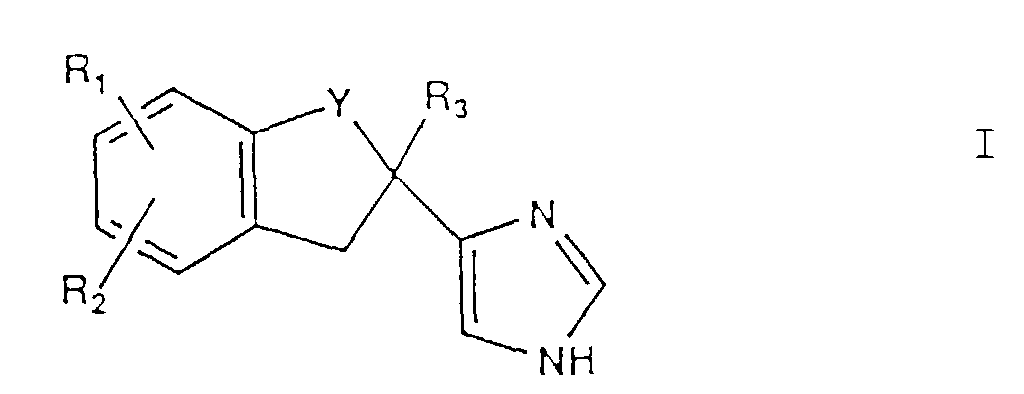
- the imidazole derivatives of this invention have the general formula: wherein
- the most preferable compounds according to the present invention are those wherein R 1 is F, R 2 is hydrogen or F, especially hydrogen. Also preferable are compounds, wherein R 3 is hydrogen or CH 2 CH 3 and Y is -CH 2 -.
- R 1 is F
- R 2 is hydrogen or F
- R 3 is hydrogen or CH 2 CH 3
- Y is -CH 2 -.
- the compounds of this invention are highly selective and long-acting antagonists of ⁇ 2 -adrenoceptors and they have good peroral bioavailability.
- the compounds are especially valuable in the treatment of cognitive disorders.
- Valuable ⁇ 2 -adrenoceptor antagonists have been disclosed earlier e.g. in the European patent publications No. 183492, 247764 and 372954.
- PCT patent application No. 91/18886 discloses the use of some indenimidazole derivatives, especially atipamezole, in the treatment of agerelated memory impairment and other cognitive disorders.
- the compounds disclosed in these earlier patent applications, though some of them are very potent and selective ⁇ 2 -adrenoceptor antagonists, compounds with longer duration of action and good peroral bioavailability are necessary to obtain sufficient patient compliance.
- indan-imidazole derivatives which have reported to have long duration of action e.g. those disclosed in EP 372954. However, such compounds are not so potent ⁇ 2 -adrenoceptor antagonists as the compounds of the present invention.
- ⁇ -Adrenoceptors can be divided on a pharmacological basis into two subclasses, viz ⁇ 1 -and ⁇ 2 -adrenoceptors (see e.g. Starke & Gamblety, J. Cardiovasc. Pharmacol., I, Suppl. 1, 514-523, 1981). It is well established that while ⁇ 1 -adrenoceptors are located postsynaptically, ⁇ 2 -adrenoceptors are situated both at presynaptic nerve terminals and postsynaptically e.g. in vascular smooth muscle, platelets, pancreatic ⁇ -cells, fat cells and central nervous system.
- the presynaptic ⁇ 2 -receptors modulate the release of noradrenaline by means of a negative feedback mechanism.
- noradrenaline release is inhibited.
- Blockade of these receptors by an ⁇ 2 -antagonist increases the release of noradrenaline.
- ⁇ 2 -Adrenoceptor antagonism at presynaptic ⁇ 2 -receptors can thus be expected to be of use in disease states which are believed to be connected with deficiency of noradrenaline available in the postsynaptic adrenoceptors.
- diseases include e.g. endogeneous depresssion, age dependent memory impairment and other cognitive disorders, particularly Alzheimer's disease.
- the best known pharmacodynamic effect mediated by postsynaptic ⁇ 2 -adrenoceptors is the contraction of vascular smooth muscle. Blockade of peripheral postsynaptic ⁇ 2 -adrenoceptors in blood vessels can thus be expected to dilate the vessel and lead to decrease in the blood pressure. ⁇ 2 -Blockers may thus be valuable as antihypertensive agents.
- Glucose and lipid metabolism are also regulated by an inhibitory mechanism involving ⁇ 2 -adrenoceptors.
- An ⁇ 2 -antagonist may thus be of use in diabetes and obesity.
- ⁇ 2 -Antagonism was determined by means of isolated, electrically stimulated mouse vas deferens preparation (Marshall et al., Br.J. Pharmac. 62, 147, 151, 1978). In this model, ⁇ 2 -agonist (detomidine) blocks electrically stimulated muscular contractions and the effect of the ⁇ 2 -antagonist is seen by administering it prior to the agonist and by determining its pA 2 value. The known ⁇ 2 -antagonist atipamezole was used as a reference substance.
- the duration of the ⁇ 2 -blocking action of the compounds was determined as follows: the antagonists were administered orally at equipotent doses to groups of 4 rats 1, 2, 4, 7 or 16 hours before induction of anaesthesia and challenge with cumulative i.v. dosing of detomidine. By calculating the percentage antagonism of the mydriatic effect of 0,1 mg/kg detomidine for each pretreatment group, a time-effect relationship was established. This in turn permitted the measurement of the time taken for the antagonist effect to fall by half. Results are shown in table 3.
- the relative bioavailability of the antagonists when administered orally was evaluated by comparing the potency of their ⁇ 2 -blocking effect after peroral and parenteral administration.
- the antagonists were administered at equipotent doses (0.3 to 3 mg/kg) to groups of rats 1 hour before induction of anaesthesia and challenge with detomidine as described above in relation to the measurement of duration of action.
- the results are shown in Table 3.
- the effects of atipamezole, MPV-1743 A III (compound 7) and MPV-1730 B III (compound 4) on learning and memory in linear arm maze task in rats were studied.
- the linear arm maze is a modified version of radial arm maze, which is a generally used memory test in rats.
- Atipamezole hydrochloride (0.3 mg/kg s.c.), MPV-1730 B III hydrochloride (3 mg/kg p.o.) and MPV-1743 A III hydrochloride (0.3 mg/kg s.c.) were dissolved in distilled water. Water was also used as control. All injections were made in a volume 1 ml/kg.
- the maze was a wooden platform in a shape of two crosses one after another.
- the stem (starting arm) was 90 cm long and 12 cm wide.
- the five other arms (goal arms) were 50 cm long and 12 cm wide.
- Four goal arms were situated perpendicularly to the stem and to the fifth arm which located opposite to the stem. On either side of the stem and the arms were edges, 2.0 cm high.
- At the end of each goal arm a hole 1 cm deep and 3 cm in diameter, served as a food cup.
- the starting platform (20 x 20 cm) was separated from the stem by a quillotine door.
- the door was 12 cm high and 7 cm wide.
- the door frame was 20 cm high and 20 cm wide.
- the maze was elevated 31 cm above the floor, in a low-lighted test room which contained other objects as well as the test apparatus.
- the holes at the end of the goal arms were baited with three pellets of prize food (45 mg pellets Bio Serve Inc.).
- test days 1 to 4 The time to find all the baits and reentries made into already visited arms was recorded. This time every rat was allowed to stay in the maze at least for five minutes. On the next day the proper memory and learning testing began and continued for four days (testing days 1 to 4). Rats were given eight trials, two per day. Inter trial interval was 50 minutes. Drugs or distilled water were administered 30 minutes before the first trial of the day. Otherwise testing trials were identical to the teaching trial. All the observations were done blind so that test solutions were in coded flasks.
- the compounds of this invention react with organic and inorganic acids to form many pharmaceutically usable acid addition salts, as, for instance, chlorides, bromides, sulfates, nitrates, phosphates, sulfonates, formates, tartrates, maleates, citrates, benzoates, salicylates, ascorbates and the like.
- the salts have the same therapeutic activity as the base.
- the compounds and their non-toxic, pharmaceutically acceptable acid addition salts may be administered orally, parenterally or intravenously.
- the compounds are preferably administered orally at a daily dose of 0,1 to 10 mg/kg, preferably 0.2 to 1 mg/kg.
- the pharmaceutical carriers which are typically employed with the compound of the invention may be solid or liquid and are generally selected with the planned manner of administration in mind. Choosing the auxiliary ingredients for the formulation is routine for those of ordinary skill in the art. It is evident that suitable solvents, gel forming ingredients, dispersion forming ingredients, colors etc are used in a normal way.
- mice for the compounds of the invention is below 50 mg/kg (p.o.).
- the LD50 for 7-(4-(5-fluoro-2,3-dihydro-1H-inden-2-yl)-1H-imidazole) is 100 mg/kg (p.o.).
- the compounds of formula (I) can be prepared according to the following methods:
- a compound of formula (II) where R 3 is as defined above is nitrated with strong nitrating agent able to form the nitronium ion + NO 2 , preferably with ureanitrate (H 2 NCONH 2 x HNO 3 ) in the presence of sulfuric acid, to give mainly the compound of formula (III) but also a small amount of the compound of formula (IV), which compounds may be optionally separated
- the nitro group of compounds (III) or (IV) is further reduced to the corresponding NH 2 group e.g. by catalytic hydrogenation using molecular hydrogen.
- Preferable catalysts are e.g. PtO 2 or Pd/C.
- the amino-substituted compounds so obtained can be separated from each other.
- the amino substituted compounds and are converted to their corresponding diazonium salts with nitrous acid which reagent is generated in the presence of the amine (V or VI) by the action of mineralic acid, preferably fluoroboric acid (HBF 4 ) on sodium nitrite at lowered temperature, preferably at about 0°C.
- the diazonium fluoroborate so formed can be termally decomposed to yield the fluoride (VII) or (VIII), boron trifluoride and nitrogen. wherein X is F.
- the corresponding chlorosubstituted compounds can be formed by reacting the amine (V or VI) with hydrochloric acid and sodium nitrite at lowered temperature and then by reacting the diazonium group with a metal chloride, preferably copper(I) chloride, in concentrated hydrochloric acid at elevated temperature.
- a metal chloride preferably copper(I) chloride
- the monohalogenated compound of formula (VII) where X is F or Cl can further be nitrated by reaction with e.g. ureanitrate in sulfuric acid to give compound (IX) where the nitro group further can be replaced by a halogen via an amino group as described above to give a compound of formula (I) where R 1 and R 2 both are halogen.
- a compound of the formula XII can be prepared by reacting the compound of formula (V) e.g. with sodium nitrite in the presence of concentrated sulfuric acid at low temperature. The diazonium salt is then termally decomposed to yield the compound of formula (XII).
- the NMR spectra were obtained on a Bruker AC 300 P spectrometer using tetramethylsilane as the internal reference, from which the presented chemical shifts ( ⁇ , ppm) were measured downfield.
- the letters s, d, t, q and m are used to indicate a singlet, doublet, triplet, quartet or multiplet, respectively. In the same connection, the number of hydrogen atoms is also stated.
- the spectra of the compounds as bases were recorded in deuterium methanol or deuterium chloroform, while the values for compounds as hydrochlorides were determined in deuterium methanol.
- the mass spectra were recorded on a Kratos MS 80 RF Autoconsole mass spectrometer.
- the yield of 4-(2-ethyl-2,3-dihydro-5-nitro-1H-inden-2-yl)-1H-imidazole was 3.59 g (99 %).
- the hydrochloride salt of the product was prepared in dry hydrogen chloride - ethyl acetate.
- the product was purified by flash chromatography eluting with methylene chloride - methanol mixture (9.5:0.5).
- the hydrochloride salt of the product was made with dry hydrogen chloride in dry ethyl acetate - ether; mp. 145-152°C.
- the thermal decomposition was carried out in the flask which was heated with an electric heating mantle. When the generation of white fumes of boron trifluoride ceased the heating was stopped.
- the product was purified by flash chromatography (the eluent methylene chloride - methanol 9.5:0.5).
- the hydrochloride salt of the product was prepared in ethyl acetate; mp. 152-154°C.
- Example 1 The procedure of Example 1 was also used to synthesize 4-(5-fluoro-2,3-dihydro-2-methyl-1 H-inden-2-yl)-1H-imidazole and its intermediates from 4-(2,3-dihydro-2-methyl-1H-inden-2-yl)-1H-imidazole (Karjalainen, A. J. et.al. U.S. 4,689,339).
- 6-Fluoro-2,3-dihydro-2-(1H-imidazol-4-yl)-2-methyl-1H-inden-1-one and its intermediates were synthesized from 2,3-dihydro-2-(1H-imidazol-4-yl)-2-methyl-1H-inden-1-one (Karjalainen, A. J. et.al. U.S. 4,689,339) according to the procedure used in Example 4.
- the ice-cold diazonium solution was added, with stirring, to the copper(I) chloride solution while the temperature was kept at 0°C. After the addition the stirring was continued for thirty minutes at 0°C. The temperature was then let to increase slowly to the room temperature. After this the mixture was heated for 1.5 hours at 70°C.
- 4-(5-Fluoro-2,3-dihydro-1H-inden-2-yl)-1H-imidazole was prepared from 4-(5-amino-2,3-dihydro-1H-inden-2-yl)-1H-imidazole in the way described in Example 1. The yield of the crude product was 99 %. The product was purified by flash chromatography (the eluent methylene chloride - methanol 9.5:0.5). The hydrochloride salt of the product was prepared in ethyl acetate; mp. 189-191°C.
- 4-(4-Fluoro-2,3-dihydro-1H-inden-2-yl)-1H-imidazole was prepared according to the fluorination method of Example 1.
- the product was purified by flash chromatography (the eluent methylene chloride methanol 9.5:0.5).
- the hydrochloride salt of the product was prepared in ethyl acetate; mp. 180-183°C.
- 4-(5-chloro-2-ethyl-2,3-dihydro-1H-inden-2-yl)-1H-imidazole was preoared through diazotization of 4-(5-amino-2-ethyl-2,3-dihydro-1H-inden-2-yl)-1H-imidazole in the way described in example 6.
- the procedure of example 9 was used for the synthesis of the nitro and amino derivatives of 4-(5-chloro-2-ethyl-2,3-dihydro-1H-inden-2-yl)-1H-imidazole. Chlorination was carried out as described in example 6
Landscapes
- Health & Medical Sciences (AREA)
- Chemical & Material Sciences (AREA)
- Organic Chemistry (AREA)
- Life Sciences & Earth Sciences (AREA)
- General Health & Medical Sciences (AREA)
- Veterinary Medicine (AREA)
- Public Health (AREA)
- Animal Behavior & Ethology (AREA)
- Pharmacology & Pharmacy (AREA)
- Medicinal Chemistry (AREA)
- Engineering & Computer Science (AREA)
- Bioinformatics & Cheminformatics (AREA)
- General Chemical & Material Sciences (AREA)
- Nuclear Medicine, Radiotherapy & Molecular Imaging (AREA)
- Chemical Kinetics & Catalysis (AREA)
- Neurosurgery (AREA)
- Neurology (AREA)
- Biomedical Technology (AREA)
- Epidemiology (AREA)
- Heart & Thoracic Surgery (AREA)
- Cardiology (AREA)
- Hematology (AREA)
- Obesity (AREA)
- Diabetes (AREA)
- Hospice & Palliative Care (AREA)
- Psychiatry (AREA)
- Child & Adolescent Psychology (AREA)
- Pharmaceuticals Containing Other Organic And Inorganic Compounds (AREA)
- Plural Heterocyclic Compounds (AREA)
- Epoxy Resins (AREA)
Claims (26)
- Verbindung, bei der es sich um ein substituiertes Imidazol mit der allgemeinen Formelhandelt, in der Y für -CH2- oder -CO- steht,

R1 für F, Cl oder OH steht, R2 für H, F oder Cl steht und R3 für H, CH3 oder CH2CH3 steht, oder ein pharmazeutisch annehmbares Salz davon mit Ausnahme von 4-(5-Chlor-2,3-dihydro-1H-inden-2-yl)-1H-imidazol und 4-(4-Chlor-2,3-dihydro-1H-inden-2-yl)-1H-imidazol. - Verbindung nach Anspruch 1, worin R1 für F und R2 für H oder F steht.
- Verbindung nach Anspruch 2, worin R2 für H steht.
- Verbindung nach Anspruch 1, worin R3 für Wasserstoff oder CH2CH3 steht.
- Verbindung nach Anspruch 1, worin Y für -CH2- steht.
- Verbindung nach Anspruch 1, worin die Verbindung 4-(2-Ethyl-5-fluor-2,3-dihydro-1H-inden-2-yl)-1H-imidazol oder sein pharmazeutisch annehmbares nichttoxisches Salz ist.
- Verbindung nach Anspruch 1, worin die Verbindung 4-(5-Fluor-2,3-dihydro-2-methyl-1H-inden-2-yl)-1H-imidazol oder sein pharmazeutisch annehmbares nichttoxisches Salz ist.
- Verbindung nach Anspruch 1, worin die Verbindung 4-(2-Ethyl-5,6-difluor-2,3-dihydro-1H-inden-2-yl)-1H-imidazol oder sein pharmazeutisch annehmbares nichttoxisches Salz ist.
- Verbindung nach Anspruch 1, worin die Verbindung 2-Ethyl-6-fluor-2,3-dihydro-2-(1H-imidazol-4-yl)-1H-inden-1-on oder sein pharmazeutisch annehmbares nichttoxisches Salz ist.
- Verbindung nach Anspruch 1, worin die Verbindung 6-Chlor-2-ethyl-2,3-dihydro-2-(1H-imidazol-4-yl)-1H-inden-1-on oder sein pharmazeutisch annehmbares nichttoxisches Salz ist.
- Verbindung nach Anspruch 1, worin die Verbindung 4-(4-Fluor-2,3-dihydro-1H-inden-2-yl)-1H-imidazol oder sein pharmazeutisch annehmbares nichttoxisches Salz ist.
- Verbindung nach Anspruch 1, worin die Verbindung 4-(5-Fluor-2,3-dihydro-1H-inden-2-yl)-1H-imidazol oder sein pharmazeutisch annehmbares nichttoxisches Salz ist.
- Verbindung nach Anspruch 1, worin die Verbindung 2-Ethyl-2-(1H-imidazol-4-yl)-5-indanol oder sein pharmazeutisch annehmbares nichttoxisches Salz ist.
- Verbindung nach Anspruch 1, worin die Verbindung 4-(5,6-Dichlor-2-ethyl-2,3-dihydro-1H-inden-2-yl)-1H-imida-zol oder sein pharmazeutisch annehmbares nichtoxisches Salz ist.
- Verbindung nach Anspruch 1, worin die Verbindung 4-(5-Chlor-2-ethyl-2,3-dihydro-1H-inden-2-yl)-1H-imidazol oder sein pharmazeutisch annehmbares nichttoxisches Salz ist.
- Verfahren zur Herstellung der Verbindung mit der allgemeinen Formel (I)in der
 in denen X für F oder Cl steht.Y für -CH2- steht,R1 für F oder Cl steht, R2 für H und R3 für H, CH3 oder CH2CH3 steht, mit Ausnahme von 4-(5-Chlor-2,3-dihydro-1H-inden-2-yl)-1H-imidazol und 4-(4-Chlor-2,3-dihydro-1H-inden-2-yl)-1H-imidazol, dadurch gekennzeichnet, daß eine Verbindung der Formel (II)in der R3 wie oben definiert ist, nitriert wird, um die Verbindungen der Formeln (III) und (IV) zu ergeben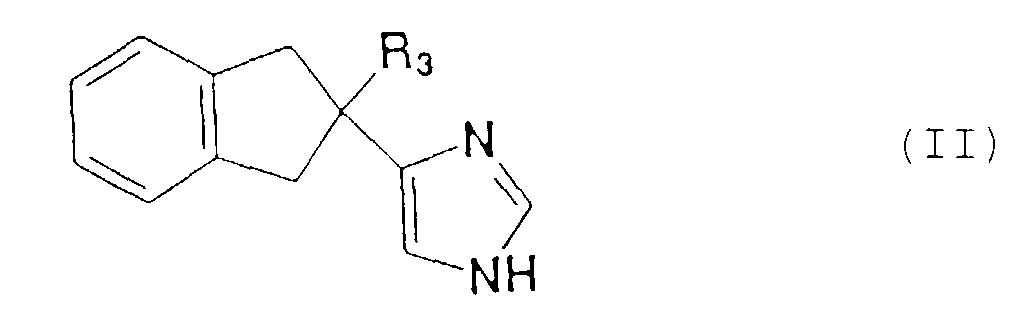
 die gegebenenfalls voneinander getrennt werden und weiter zu den entsprechenden aminosubstituierten Verbindungen der Formeln (V) und (VI) reduziert werden
 die gegebenenfalls voneinander getrennt werden und in die entsprechenden Diazoniumsalze umgewandelt werden, wonach die Diazoniumgruppen durch das entsprechende Halogen ersetzt werden, um die Verbindungen der Formeln (VII) und (VIII) zu ergeben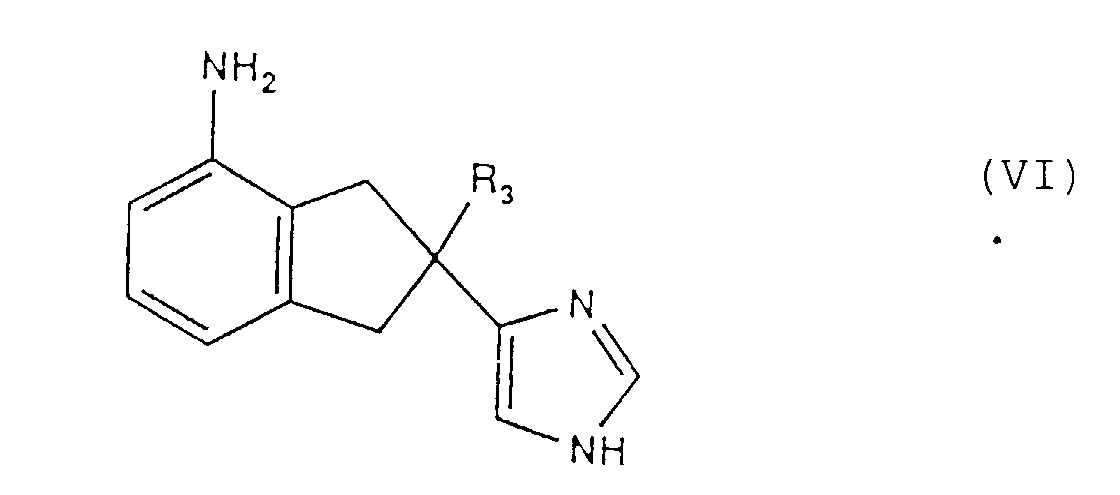


- Verfahren nach Anspruch 16, dadurch gekennzeichnet, daß in den Formeln VII und VIII X für F steht.
- Verfahren nach Anspruch 17, dadurch gekennzeichnet, daß die Diazoniumsalze durch Umsetzung des Amins der Formel V und/oder VI mit Mineralsäure auf Natriumnitrit bei erniedrigter Temperatur erzeugt werden.
- Verfahren nach Anspruch 16, dadurch gekennzeichnet, daß in den Formeln VII und VIII X für Cl steht.
- Verfahren nach Anspruch 19, dadurch gekennzeichnet, daß die Diazoniumsalze durch Umsetzung des Amins der Formel V und/oder VI mit Salzsäure und Natriumnitrit bei erniedrigter Temperatur gebildet werden.
- Verfahren zur Herstellung der Verbindung mit der allgemeinen Formelin der
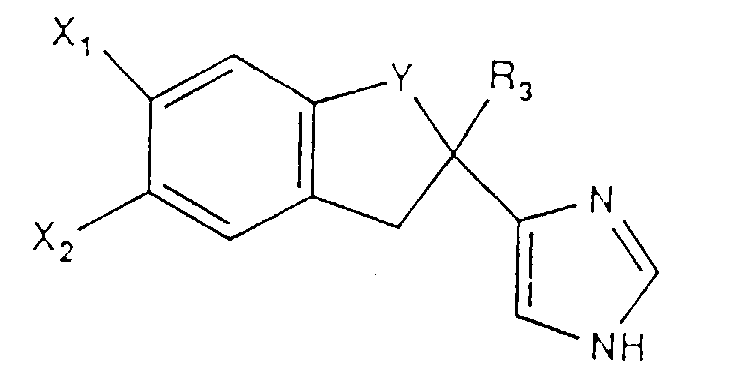 dadurch gekennzeichnet, daß eine Verbindung der Formel (VII)Y für -CH2- steht,X1 für F oder Cl steht,X2 für F oder Cl steht und R3 für H, CH3 oder CH2CH3 steht,in der X für F oder Cl steht und R3 wie oben definiert ist, nitriert wird, um eine Verbindung der Formel (IX)
 zu ergeben, und daß die Nitrogruppe weiter zu der entsprechenden Aminogruppe reduziert wird
 wonach die Aminogruppe in die entsprechende Diazoniumgruppe umgewandelt wird, die zum entsprechendcn Halogen umgewandelt wird.
- Verfahren zur Herstellung einer Verbindung mit der allgemeinen Formel (X)in der

X für F oder Cl steht und R3 für H, CH3 oder CH2CH3 steht, dadurch gekennzeichnet, daß eine Verbindung der Formel (XI)in der R3 wie oben definiert ist, nitriert wird und die Nitrogruppe zu der entsprechenden Aminogruppe reduziert wird
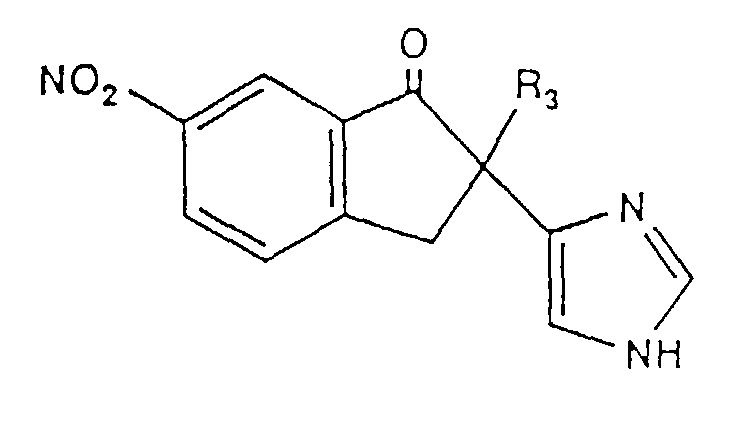 die weiter in eine Diazoniumgruppe umgewandelt wird, die danach in das entsprechende Halogen umgewandelt wird.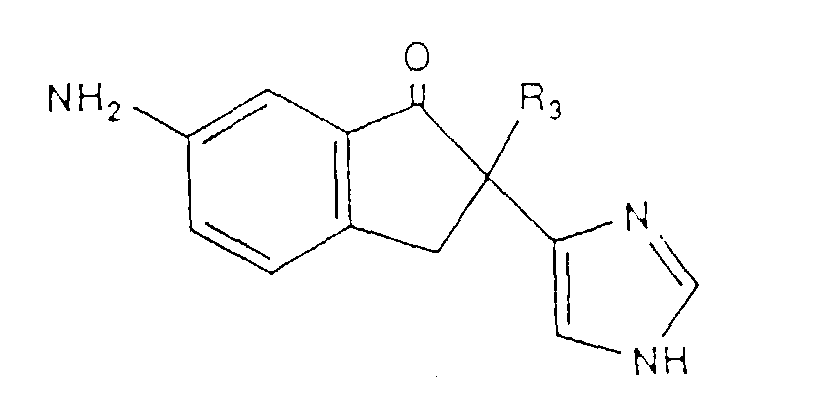
- Verfahren zur Herstellung der Verbindung mit der allgemeinen Formelin der X1 für F oder Cl steht, X2 für F oder Cl steht und R3 für H, CH3 oder CH2CH3 steht, dadurch gekennzeichnet, daß eine Verbindung der Formel
 in der X1 und R3 wie oben definiert sind, nitriert wird, um die Verbindung der Formel
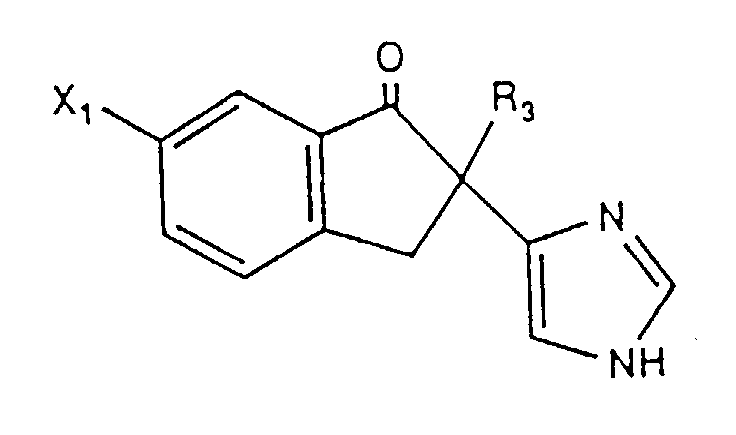 zu ergeben und daß die Nitrogruppe zu einer Aminogruppe reduziert wird
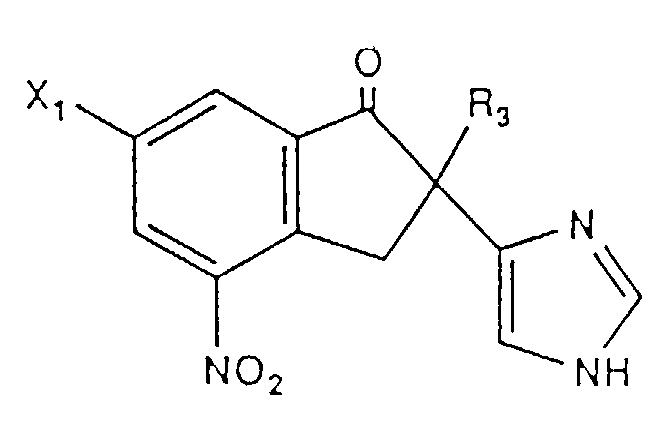 wonach die Aminogruppe in die entsprechende Diazoniumgruppe umgewandelt wird und die Diazoniumgruppe in das entsprechende Halogen umgewandelt wird.
- Verfahren zur Herstellung einer Verbindung mit der allgemeinen Formel (XII)in der R3 für H, CH3 oder CH2CH3 steht, dadurch gekennzeichnet, daß eine Verbindung der allgemeinen Formel (V)
 in der R3 die oben gegebene Bedeutung besitzt, mit Natriumnitrit in Gegenwart konzentrierter Schwefelsäure bei erniedrigter Temperatur umgesetzt wird und das so erhaltene Diazoniumsalz zersetzt wird, um die Verbindung der Formel (XII) zu ergeben.
- Verbindung nach einem der Anspruche 1 bis 15 zur Verwendung in einem medizinischen Behandlungsverfahren.
- Verwendung eines substituierten Imidazols mit der allgemeinen Formelin der
 Y für -CH2- oder -CO- steht,R1 für F oder Cl oder OH steht, R2 für H, F oder Cl steht und R3 für H steht, oder eines pharmazeutisch annehmbaren Salzes davon, mit Ausnahme von 4-(5-Chlor-2,3-dihydro-1H-inden-2-yl)-1H-imidazol und 4-(4-Chlor-2,3-dihydro-1H-inden-2-yl)-1H-imidazol zur Herstellung eines Medikaments zur Verwendung für die Behandlung von kognitiven Erkrankungen.
Applications Claiming Priority (3)
| Application Number | Priority Date | Filing Date | Title |
|---|---|---|---|
| GB9127050 | 1991-12-12 | ||
| GB919127050A GB9127050D0 (en) | 1991-12-20 | 1991-12-20 | Substituted imidazole derivatives and their preparation and use |
| PCT/FI1992/000349 WO1993013074A1 (en) | 1991-12-20 | 1992-12-18 | Substituted imidazole derivatives and their preparation and use |
Publications (2)
| Publication Number | Publication Date |
|---|---|
| EP0618906A1 EP0618906A1 (de) | 1994-10-12 |
| EP0618906B1 true EP0618906B1 (de) | 1998-04-22 |
Family
ID=10706581
Family Applications (1)
| Application Number | Title | Priority Date | Filing Date |
|---|---|---|---|
| EP93900200A Expired - Lifetime EP0618906B1 (de) | 1991-12-20 | 1992-12-18 | Substituierte imidazol derivate und deren herstellung und verwendung |
Country Status (16)
| Country | Link |
|---|---|
| US (1) | US5498623A (de) |
| EP (1) | EP0618906B1 (de) |
| JP (1) | JP3276371B2 (de) |
| AT (1) | ATE165350T1 (de) |
| AU (1) | AU664584B2 (de) |
| CA (1) | CA2117305C (de) |
| DE (1) | DE69225240T2 (de) |
| DK (1) | DK0618906T3 (de) |
| ES (1) | ES2115046T3 (de) |
| FI (1) | FI104968B (de) |
| GB (1) | GB9127050D0 (de) |
| HU (1) | HU220043B (de) |
| NO (1) | NO304227B1 (de) |
| PL (1) | PL172532B1 (de) |
| RU (1) | RU2120440C1 (de) |
| WO (1) | WO1993013074A1 (de) |
Families Citing this family (19)
| Publication number | Priority date | Publication date | Assignee | Title |
|---|---|---|---|---|
| GB9312669D0 (en) * | 1993-06-18 | 1993-08-04 | Orion Yhtymae Oy | New opticla isomers |
| FR2735776B1 (fr) * | 1995-06-22 | 1997-07-18 | Synthelabo | Derives de 2,3-dihydro-1h-indole, leur preparation et leur application en therapeutique |
| GB9520150D0 (en) * | 1995-10-03 | 1995-12-06 | Orion Yhtymae Oy | New imidazole derivatives |
| US20020143007A1 (en) * | 1996-02-02 | 2002-10-03 | Garvey David S. | Nitrosated and nitrosylated alpha-adrenergic receptor antagonists, compositions and methods of use |
| US6469065B1 (en) | 1996-02-02 | 2002-10-22 | Nitromed, Inc. | Nitrosated and nitrosylated α-adrenergic receptor antagonist, compositions and methods of use |
| FI20000073A0 (fi) * | 2000-01-14 | 2000-01-14 | Orion Yhtymae Oy | Uusia imidatsolijohdannaisia |
| US6388090B2 (en) | 2000-01-14 | 2002-05-14 | Orion Corporation | Imidazole derivatives |
| US8188126B2 (en) | 2002-05-16 | 2012-05-29 | Pierre Fabre Medicament | Imidazolic compounds and use thereof as alpha-2 adrenergic receptors |
| GB0226076D0 (en) * | 2002-11-08 | 2002-12-18 | Rp Scherer Technologies Inc | Improved formulations containing substituted imidazole derivatives |
| FI20022007A0 (fi) * | 2002-11-08 | 2002-11-08 | Juvantia Pharma Ltd Oy | Oromukosaalinen valmiste ja menetelmä sen valmistamiseksi |
| FI116292B (fi) * | 2003-01-08 | 2005-10-31 | Juvantia Pharma Ltd Oy | Menetelmä substituoitujen imidatsolijohdannaisten valmistamiseksi ja menetelmässä käytettäviä välituotteita |
| BRPI0411841A (pt) * | 2003-06-17 | 2006-08-08 | Hoffmann La Roche | cis-2,4,5-triaril-imidazolinas |
| EP2456749B1 (de) | 2009-07-24 | 2016-03-30 | DSM Pharma Chemicals Regensburg GmbH | Indanderivate zur verwendung als zwischenprodukte |
| WO2011014613A2 (en) * | 2009-07-31 | 2011-02-03 | Dr. Reddy's Laboratories Ltd. | Preparation of fipamezole |
| EP2502917A1 (de) | 2011-03-17 | 2012-09-26 | Santhera Pharmaceuticals (Schweiz) AG | Im Festzustand kristalline Formen von 4-(2-Ethyl-5-fluor-2,3-dihydro-1H-inden-2-yl)-1H-imidazol |
| WO2017079734A1 (en) * | 2015-11-05 | 2017-05-11 | University Of Louisville Research Foundation, Inc. | Local and regional anesthesia and analgesia |
| LU103072B1 (en) * | 2023-02-15 | 2024-08-19 | Univ Ljubljani | N,N-DIALKYL-4-(2-ETHYLINDAN-2-YL)-lH-IMIDAZOLE-l-CARBOXAMIDES AND RELATED COMPOUNDS FOR TREATMENT OF NEURODEGENERATIVE DISEASES |
| EP4658639A1 (de) * | 2023-02-01 | 2025-12-10 | Univerza V Ljubljani | N,n-dialkyl-4-(2-ethylindan-2-yl)-1h-imidazol-1-carboxamide und verwandte verbindungen zur behandlung neurodegenerativer erkrankungen |
| CN117186010B (zh) * | 2023-08-15 | 2026-04-14 | 厦门欧瑞捷生物科技有限公司 | 一种盐酸阿替美唑的合成方法 |
Family Cites Families (15)
| Publication number | Priority date | Publication date | Assignee | Title |
|---|---|---|---|---|
| GB1282535A (en) * | 1970-03-02 | 1972-07-19 | Pfizer | (2-IMIDAZOLIN-2-YLAMINO)SUBSTITUTED BENZO[b]THIOPHENES |
| US3927023A (en) * | 1974-05-24 | 1975-12-16 | Warner Lambert Co | Imidazolyl benzofurans |
| US3927018A (en) * | 1974-12-23 | 1975-12-16 | Sandoz Ag | 3-(2-Methyl-1-imidazolyl)-3-phenyl-1-(3H)isobenzofuranones |
| IL66242A0 (en) * | 1981-07-23 | 1982-11-30 | Erba Farmitalia | N-imidazolyl derivatives of 1,2,3,4-tetrahydro-naphthalene,indan and 2-substituted-1-chroman,their preparation and pharmaceutical compositions containing them |
| ZW13782A1 (en) * | 1981-07-28 | 1982-10-06 | Reckitt & Colmann Prod Ltd | Imidazoline derivatives |
| ES8503669A1 (es) * | 1982-07-05 | 1985-03-01 | Erba Farmitalia | Procedimiento para preparar derivados n-imidazolilicos de compuestos biciclicos. |
| GB8409884D0 (en) * | 1984-04-17 | 1984-05-31 | Detexomat Machinery Ltd | Transporting fabric pieces |
| GB2167408B (en) * | 1984-11-23 | 1988-05-25 | Farmos Oy | Substituted imidazole derivatives and their preparation and use |
| FI81092C (fi) * | 1986-05-15 | 1990-09-10 | Farmos Oy | Foerfarande foer framstaellning av terapeutiskt aktiva 4(5)-(2,3-dihydro-1h-inden-2-yl)-imidazolderivat. |
| JP2855341B2 (ja) * | 1988-06-10 | 1999-02-10 | 武田薬品工業株式会社 | 新規2―置換クマラン誘導体 |
| IL91542A0 (en) * | 1988-10-06 | 1990-04-29 | Erba Carlo Spa | N-imidazolyl-and n-imidazolyl-methyl derivatives of substituted bicyclic compounds,their preparation and pharmaceutical compositions containing them |
| GB2225782A (en) * | 1988-12-09 | 1990-06-13 | Farmos Group Limited | Imidazole derivatives useful for treatment of diabetes |
| GB9020128D0 (en) * | 1990-09-14 | 1990-10-24 | Reckitt & Colmann Prod Ltd | Imidazoline derivatives |
| EP0618864A1 (de) * | 1991-12-23 | 1994-10-12 | Mobil Oil Corporation | Film mit geringer sauerstoffdurchlässigkeit |
| GB9127430D0 (en) * | 1991-12-27 | 1992-02-19 | Scras | Benzofuranylimidazole derivatives |
-
1991
- 1991-12-20 GB GB919127050A patent/GB9127050D0/en active Pending
-
1992
- 1992-12-18 WO PCT/FI1992/000349 patent/WO1993013074A1/en not_active Ceased
- 1992-12-18 JP JP51146093A patent/JP3276371B2/ja not_active Expired - Lifetime
- 1992-12-18 DE DE69225240T patent/DE69225240T2/de not_active Expired - Lifetime
- 1992-12-18 US US08/244,932 patent/US5498623A/en not_active Expired - Lifetime
- 1992-12-18 CA CA002117305A patent/CA2117305C/en not_active Expired - Lifetime
- 1992-12-18 DK DK93900200T patent/DK0618906T3/da active
- 1992-12-18 RU RU94031215/04A patent/RU2120440C1/ru active
- 1992-12-18 ES ES93900200T patent/ES2115046T3/es not_active Expired - Lifetime
- 1992-12-18 AT AT93900200T patent/ATE165350T1/de active
- 1992-12-18 AU AU31605/93A patent/AU664584B2/en not_active Expired
- 1992-12-18 HU HU9401823A patent/HU220043B/hu unknown
- 1992-12-18 EP EP93900200A patent/EP0618906B1/de not_active Expired - Lifetime
- 1992-12-18 PL PL92304150A patent/PL172532B1/pl unknown
-
1994
- 1994-06-16 FI FI942882A patent/FI104968B/fi not_active IP Right Cessation
- 1994-06-17 NO NO942335A patent/NO304227B1/no not_active IP Right Cessation
Also Published As
| Publication number | Publication date |
|---|---|
| JP3276371B2 (ja) | 2002-04-22 |
| NO304227B1 (no) | 1998-11-16 |
| JPH07506087A (ja) | 1995-07-06 |
| FI942882A0 (fi) | 1994-06-16 |
| CA2117305C (en) | 2003-11-25 |
| CA2117305A1 (en) | 1993-07-08 |
| FI104968B (fi) | 2000-05-15 |
| HK1008962A1 (en) | 1999-05-21 |
| DE69225240D1 (de) | 1998-05-28 |
| ES2115046T3 (es) | 1998-06-16 |
| HU220043B (hu) | 2001-10-28 |
| NO942335L (no) | 1994-06-20 |
| WO1993013074A1 (en) | 1993-07-08 |
| PL172532B1 (en) | 1997-10-31 |
| GB9127050D0 (en) | 1992-02-19 |
| DE69225240T2 (de) | 1998-08-27 |
| HUT67548A (en) | 1995-04-28 |
| DK0618906T3 (da) | 1999-01-25 |
| RU2120440C1 (ru) | 1998-10-20 |
| EP0618906A1 (de) | 1994-10-12 |
| HU9401823D0 (en) | 1994-09-28 |
| AU664584B2 (en) | 1995-11-23 |
| FI942882A7 (fi) | 1994-06-16 |
| AU3160593A (en) | 1993-07-28 |
| RU94031215A (ru) | 1996-04-20 |
| ATE165350T1 (de) | 1998-05-15 |
| US5498623A (en) | 1996-03-12 |
| NO942335D0 (no) | 1994-06-17 |
Similar Documents
| Publication | Publication Date | Title |
|---|---|---|
| US5498623A (en) | 4(5) substituted imidazoles and their preparation and use | |
| DE69922024T2 (de) | Pyrrolochinoline zur Behandlung von Fettleibigkeit | |
| FI67543C (fi) | Foerfarande foer framstaellning av farmakologiskt aktiv 2-(2-(1,4-benzodioxanyl))-2-imidazolin | |
| AU592765B2 (en) | New dopamine derivatives, process for their production, and their use as medicinal products | |
| US5925665A (en) | Imidazoline compounds | |
| JP2868813B2 (ja) | 置換イミダゾール、その製造法およびそれを有効成分とするα2−受容体拮抗医薬組成物 | |
| FI67544C (fi) | Foerfarande foer framstaellning av farmakologiskt vaerdefullt imidazolinderivat | |
| HK1008962B (en) | Substituted imidazole derivatives and their preparation and use | |
| SI9300034A (sl) | Substituirani derivati imidazola in njihova priprava in uporaea | |
| CZ332195A3 (en) | (+)- and (-)-enantiomer of 4-(5-fluoro-2,3-dihydro-1h-inden-2-yl)-1h-imidazole and process for preparing thereof | |
| HU211151A9 (hu) | Szubsztituált imidazolszármazékok, előállításuk és alkalmazásuk | |
| JPS5826871A (ja) | 新規ヘテロアリールオキシプロパノールアミンおよびその製法 | |
| JPS6130588A (ja) | ベンゾ〔c〕〔1,8〕ナフチリジン、その製造方法及びその使用、並びにこれらの化合物を含有する調製剤 | |
| KR100408364B1 (ko) | 3(2에이치)-피리다지논유도체및이들화합물을함유하는제약학적인조성물 | |
| HRP930139A2 (en) | Substituted imidazole derivatives and their preparation and use |
Legal Events
| Date | Code | Title | Description |
|---|---|---|---|
| PUAI | Public reference made under article 153(3) epc to a published international application that has entered the european phase |
Free format text: ORIGINAL CODE: 0009012 |
|
| 17P | Request for examination filed |
Effective date: 19940613 |
|
| AK | Designated contracting states |
Kind code of ref document: A1 Designated state(s): AT BE CH DE DK ES FR GB GR IE IT LI LU MC NL PT SE |
|
| 17Q | First examination report despatched |
Effective date: 19951110 |
|
| GRAG | Despatch of communication of intention to grant |
Free format text: ORIGINAL CODE: EPIDOS AGRA |
|
| GRAG | Despatch of communication of intention to grant |
Free format text: ORIGINAL CODE: EPIDOS AGRA |
|
| GRAH | Despatch of communication of intention to grant a patent |
Free format text: ORIGINAL CODE: EPIDOS IGRA |
|
| RAP1 | Party data changed (applicant data changed or rights of an application transferred) |
Owner name: ANTII SAKARI HAAPALINNA |
|
| GRAH | Despatch of communication of intention to grant a patent |
Free format text: ORIGINAL CODE: EPIDOS IGRA |
|
| GRAA | (expected) grant |
Free format text: ORIGINAL CODE: 0009210 |
|
| RAP1 | Party data changed (applicant data changed or rights of an application transferred) |
Owner name: OY JUVANTIA PHARMA LTD |
|
| RIN1 | Information on inventor provided before grant (corrected) |
Inventor name: HAAPALINNA, ANTTI, SAKARI Inventor name: SIPILAE, HANNU, TAPANI Inventor name: SALONEN, JARMO, SAKARI Inventor name: ELORANTA, MAIRE, MARJATTA Inventor name: KARJALAINEN, ARJA, LEENA Inventor name: VIRTANEN, RAIMO, EINARI Inventor name: KARJALAINEN, ARTO, JOHANNES |
|
| AK | Designated contracting states |
Kind code of ref document: B1 Designated state(s): AT BE CH DE DK ES FR GB GR IE IT LI LU MC NL PT SE |
|
| REF | Corresponds to: |
Ref document number: 165350 Country of ref document: AT Date of ref document: 19980515 Kind code of ref document: T |
|
| ITF | It: translation for a ep patent filed | ||
| REG | Reference to a national code |
Ref country code: CH Ref legal event code: EP |
|
| REF | Corresponds to: |
Ref document number: 69225240 Country of ref document: DE Date of ref document: 19980528 |
|
| ET | Fr: translation filed | ||
| REG | Reference to a national code |
Ref country code: CH Ref legal event code: NV Representative=s name: BOVARD AG PATENTANWAELTE |
|
| REG | Reference to a national code |
Ref country code: ES Ref legal event code: FG2A Ref document number: 2115046 Country of ref document: ES Kind code of ref document: T3 |
|
| REG | Reference to a national code |
Ref country code: PT Ref legal event code: SC4A Free format text: AVAILABILITY OF NATIONAL TRANSLATION Effective date: 19980625 |
|
| REG | Reference to a national code |
Ref country code: DK Ref legal event code: T3 |
|
| PLBE | No opposition filed within time limit |
Free format text: ORIGINAL CODE: 0009261 |
|
| STAA | Information on the status of an ep patent application or granted ep patent |
Free format text: STATUS: NO OPPOSITION FILED WITHIN TIME LIMIT |
|
| 26N | No opposition filed | ||
| REG | Reference to a national code |
Ref country code: GB Ref legal event code: IF02 |
|
| PGFP | Annual fee paid to national office [announced via postgrant information from national office to epo] |
Ref country code: DK Payment date: 20101222 Year of fee payment: 19 Ref country code: AT Payment date: 20101223 Year of fee payment: 19 |
|
| REG | Reference to a national code |
Ref country code: CH Ref legal event code: PFA Owner name: OY JUVANTIA PHARMA LTD Free format text: OY JUVANTIA PHARMA LTD#MELTOISTENTIE 29#20900 TURKU (FI) -TRANSFER TO- OY JUVANTIA PHARMA LTD#MELTOISTENTIE 29#20900 TURKU (FI) |
|
| PGFP | Annual fee paid to national office [announced via postgrant information from national office to epo] |
Ref country code: GR Payment date: 20101229 Year of fee payment: 19 Ref country code: IT Payment date: 20101218 Year of fee payment: 19 Ref country code: GB Payment date: 20101229 Year of fee payment: 19 |
|
| PGFP | Annual fee paid to national office [announced via postgrant information from national office to epo] |
Ref country code: CH Payment date: 20111214 Year of fee payment: 20 Ref country code: SE Payment date: 20111221 Year of fee payment: 20 Ref country code: PT Payment date: 20111202 Year of fee payment: 20 Ref country code: IE Payment date: 20111223 Year of fee payment: 20 Ref country code: NL Payment date: 20111221 Year of fee payment: 20 Ref country code: LU Payment date: 20111222 Year of fee payment: 20 Ref country code: MC Payment date: 20111219 Year of fee payment: 20 Ref country code: ES Payment date: 20111221 Year of fee payment: 20 |
|
| PGFP | Annual fee paid to national office [announced via postgrant information from national office to epo] |
Ref country code: BE Payment date: 20111216 Year of fee payment: 20 |
|
| PGFP | Annual fee paid to national office [announced via postgrant information from national office to epo] |
Ref country code: FR Payment date: 20120118 Year of fee payment: 20 |
|
| PGFP | Annual fee paid to national office [announced via postgrant information from national office to epo] |
Ref country code: DE Payment date: 20111227 Year of fee payment: 20 |
|
| REG | Reference to a national code |
Ref country code: DE Ref legal event code: R071 Ref document number: 69225240 Country of ref document: DE |
|
| REG | Reference to a national code |
Ref country code: DE Ref legal event code: R071 Ref document number: 69225240 Country of ref document: DE |
|
| REG | Reference to a national code |
Ref country code: NL Ref legal event code: V4 Effective date: 20121218 Ref country code: PT Ref legal event code: MM4A Free format text: MAXIMUM VALIDITY LIMIT REACHED Effective date: 20121218 |
|
| BE20 | Be: patent expired |
Owner name: OY *JUVANTIA PHARMA LTD Effective date: 20121218 |
|
| REG | Reference to a national code |
Ref country code: CH Ref legal event code: PL |
|
| REG | Reference to a national code |
Ref country code: DK Ref legal event code: EUP |
|
| REG | Reference to a national code |
Ref country code: GB Ref legal event code: PE20 Expiry date: 20121217 |
|
| REG | Reference to a national code |
Ref country code: SE Ref legal event code: EUG |
|
| PG25 | Lapsed in a contracting state [announced via postgrant information from national office to epo] |
Ref country code: GB Free format text: LAPSE BECAUSE OF EXPIRATION OF PROTECTION Effective date: 20121217 |
|
| REG | Reference to a national code |
Ref country code: AT Ref legal event code: MK07 Ref document number: 165350 Country of ref document: AT Kind code of ref document: T Effective date: 20121218 |
|
| PG25 | Lapsed in a contracting state [announced via postgrant information from national office to epo] |
Ref country code: PT Free format text: LAPSE BECAUSE OF EXPIRATION OF PROTECTION Effective date: 20121227 |
|
| REG | Reference to a national code |
Ref country code: GR Ref legal event code: MA Ref document number: 980400996 Country of ref document: GR Effective date: 20121219 |
|
| REG | Reference to a national code |
Ref country code: IE Ref legal event code: MM4A |
|
| PG25 | Lapsed in a contracting state [announced via postgrant information from national office to epo] |
Ref country code: IE Free format text: LAPSE BECAUSE OF EXPIRATION OF PROTECTION Effective date: 20121218 |
|
| REG | Reference to a national code |
Ref country code: ES Ref legal event code: FD2A Effective date: 20140827 |
|
| PG25 | Lapsed in a contracting state [announced via postgrant information from national office to epo] |
Ref country code: ES Free format text: LAPSE BECAUSE OF EXPIRATION OF PROTECTION Effective date: 20121219 |