EP0618931B2 - Modifizierte monocyclopentadienyl-uebergangsmetal/aluminoxan katalysatorsystem fuer olefinpolymerisation - Google Patents
Modifizierte monocyclopentadienyl-uebergangsmetal/aluminoxan katalysatorsystem fuer olefinpolymerisation Download PDFInfo
- Publication number
- EP0618931B2 EP0618931B2 EP93902669A EP93902669A EP0618931B2 EP 0618931 B2 EP0618931 B2 EP 0618931B2 EP 93902669 A EP93902669 A EP 93902669A EP 93902669 A EP93902669 A EP 93902669A EP 0618931 B2 EP0618931 B2 EP 0618931B2
- Authority
- EP
- European Patent Office
- Prior art keywords
- catalyst system
- transition metal
- group
- radical
- radicals
- Prior art date
- Legal status (The legal status is an assumption and is not a legal conclusion. Google has not performed a legal analysis and makes no representation as to the accuracy of the status listed.)
- Expired - Lifetime
Links
- 239000003054 catalyst Substances 0.000 title claims abstract description 91
- 150000003624 transition metals Chemical class 0.000 title claims abstract description 43
- 229910052723 transition metal Inorganic materials 0.000 title claims abstract description 32
- 238000006116 polymerization reaction Methods 0.000 title description 32
- 150000001336 alkenes Chemical class 0.000 title description 10
- 150000003623 transition metal compounds Chemical class 0.000 claims abstract description 36
- VGGSQFUCUMXWEO-UHFFFAOYSA-N Ethene Chemical compound C=C VGGSQFUCUMXWEO-UHFFFAOYSA-N 0.000 claims abstract description 26
- 239000005977 Ethylene Substances 0.000 claims abstract description 26
- 239000000178 monomer Substances 0.000 claims abstract description 23
- 238000000034 method Methods 0.000 claims abstract description 22
- 239000003607 modifier Substances 0.000 claims abstract description 22
- 229920000098 polyolefin Polymers 0.000 claims abstract description 20
- XAGFODPZIPBFFR-UHFFFAOYSA-N aluminium Chemical compound [Al] XAGFODPZIPBFFR-UHFFFAOYSA-N 0.000 claims abstract description 11
- 239000003446 ligand Substances 0.000 claims description 38
- RTZKZFJDLAIYFH-UHFFFAOYSA-N Diethyl ether Chemical compound CCOCC RTZKZFJDLAIYFH-UHFFFAOYSA-N 0.000 claims description 36
- 125000000058 cyclopentadienyl group Chemical group C1(=CC=CC1)* 0.000 claims description 31
- 150000001875 compounds Chemical class 0.000 claims description 22
- ZSWFCLXCOIISFI-UHFFFAOYSA-N endo-cyclopentadiene Natural products C1C=CC=C1 ZSWFCLXCOIISFI-UHFFFAOYSA-N 0.000 claims description 21
- IJGRMHOSHXDMSA-UHFFFAOYSA-N nitrogen Substances N#N IJGRMHOSHXDMSA-UHFFFAOYSA-N 0.000 claims description 18
- 125000005842 heteroatom Chemical group 0.000 claims description 14
- 125000004435 hydrogen atom Chemical group [H]* 0.000 claims description 13
- 229910052736 halogen Inorganic materials 0.000 claims description 12
- JLTDJTHDQAWBAV-UHFFFAOYSA-N N,N-dimethylaniline Chemical compound CN(C)C1=CC=CC=C1 JLTDJTHDQAWBAV-UHFFFAOYSA-N 0.000 claims description 11
- 229910052757 nitrogen Inorganic materials 0.000 claims description 11
- 125000001424 substituent group Chemical group 0.000 claims description 11
- XLYOFNOQVPJJNP-ZSJDYOACSA-N Heavy water Chemical compound [2H]O[2H] XLYOFNOQVPJJNP-ZSJDYOACSA-N 0.000 claims description 10
- XLYOFNOQVPJJNP-UHFFFAOYSA-N water Substances O XLYOFNOQVPJJNP-UHFFFAOYSA-N 0.000 claims description 10
- LFQSCWFLJHTTHZ-UHFFFAOYSA-N Ethanol Chemical compound CCO LFQSCWFLJHTTHZ-UHFFFAOYSA-N 0.000 claims description 9
- ZMANZCXQSJIPKH-UHFFFAOYSA-N Triethylamine Chemical compound CCN(CC)CC ZMANZCXQSJIPKH-UHFFFAOYSA-N 0.000 claims description 9
- 125000001183 hydrocarbyl group Chemical group 0.000 claims description 9
- 230000000737 periodic effect Effects 0.000 claims description 9
- RMVRSNDYEFQCLF-UHFFFAOYSA-N thiophenol Chemical compound SC1=CC=CC=C1 RMVRSNDYEFQCLF-UHFFFAOYSA-N 0.000 claims description 9
- 125000000129 anionic group Chemical group 0.000 claims description 8
- 230000003647 oxidation Effects 0.000 claims description 8
- 238000007254 oxidation reaction Methods 0.000 claims description 8
- 239000002879 Lewis base Substances 0.000 claims description 7
- 150000007527 lewis bases Chemical class 0.000 claims description 7
- 229910052726 zirconium Inorganic materials 0.000 claims description 7
- QUSNBJAOOMFDIB-UHFFFAOYSA-N Ethylamine Chemical compound CCN QUSNBJAOOMFDIB-UHFFFAOYSA-N 0.000 claims description 6
- ISWSIDIOOBJBQZ-UHFFFAOYSA-N Phenol Chemical compound OC1=CC=CC=C1 ISWSIDIOOBJBQZ-UHFFFAOYSA-N 0.000 claims description 6
- BOTDANWDWHJENH-UHFFFAOYSA-N Tetraethyl orthosilicate Chemical compound CCO[Si](OCC)(OCC)OCC BOTDANWDWHJENH-UHFFFAOYSA-N 0.000 claims description 6
- 150000001408 amides Chemical class 0.000 claims description 6
- MDFFNEOEWAXZRQ-UHFFFAOYSA-N aminyl Chemical compound [NH2] MDFFNEOEWAXZRQ-UHFFFAOYSA-N 0.000 claims description 6
- QVGXLLKOCUKJST-UHFFFAOYSA-N atomic oxygen Chemical compound [O] QVGXLLKOCUKJST-UHFFFAOYSA-N 0.000 claims description 6
- 125000004432 carbon atom Chemical group C* 0.000 claims description 6
- ZZNQQQWFKKTOSD-UHFFFAOYSA-N diethoxy(diphenyl)silane Chemical compound C=1C=CC=CC=1[Si](OCC)(OCC)C1=CC=CC=C1 ZZNQQQWFKKTOSD-UHFFFAOYSA-N 0.000 claims description 6
- 229910052752 metalloid Inorganic materials 0.000 claims description 6
- 230000007935 neutral effect Effects 0.000 claims description 6
- JRZJOMJEPLMPRA-UHFFFAOYSA-N olefin Natural products CCCCCCCC=C JRZJOMJEPLMPRA-UHFFFAOYSA-N 0.000 claims description 6
- 229910052760 oxygen Inorganic materials 0.000 claims description 6
- 239000001301 oxygen Substances 0.000 claims description 6
- NLZUEZXRPGMBCV-UHFFFAOYSA-N Butylhydroxytoluene Chemical compound CC1=CC(C(C)(C)C)=C(O)C(C(C)(C)C)=C1 NLZUEZXRPGMBCV-UHFFFAOYSA-N 0.000 claims description 5
- 229960004132 diethyl ether Drugs 0.000 claims description 5
- 150000004820 halides Chemical class 0.000 claims description 5
- 125000000325 methylidene group Chemical group [H]C([H])=* 0.000 claims description 5
- JCVQKRGIASEUKR-UHFFFAOYSA-N triethoxy(phenyl)silane Chemical compound CCO[Si](OCC)(OCC)C1=CC=CC=C1 JCVQKRGIASEUKR-UHFFFAOYSA-N 0.000 claims description 5
- RIOQSEWOXXDEQQ-UHFFFAOYSA-N triphenylphosphine Chemical compound C1=CC=CC=C1P(C=1C=CC=CC=1)C1=CC=CC=C1 RIOQSEWOXXDEQQ-UHFFFAOYSA-N 0.000 claims description 5
- 150000004703 alkoxides Chemical class 0.000 claims description 4
- ZVJXKUWNRVOUTI-UHFFFAOYSA-N ethoxy(triphenyl)silane Chemical compound C=1C=CC=CC=1[Si](C=1C=CC=CC=1)(OCC)C1=CC=CC=C1 ZVJXKUWNRVOUTI-UHFFFAOYSA-N 0.000 claims description 4
- 229910052735 hafnium Inorganic materials 0.000 claims description 4
- DOIRQSBPFJWKBE-UHFFFAOYSA-N phthalic acid di-n-butyl ester Natural products CCCCOC(=O)C1=CC=CC=C1C(=O)OCCCC DOIRQSBPFJWKBE-UHFFFAOYSA-N 0.000 claims description 4
- 229920006395 saturated elastomer Polymers 0.000 claims description 4
- 125000006659 (C1-C20) hydrocarbyl group Chemical group 0.000 claims description 3
- 125000001118 alkylidene group Chemical group 0.000 claims description 3
- 229910052796 boron Inorganic materials 0.000 claims description 3
- DAKRXZUXJUPCOF-UHFFFAOYSA-N diethyl(dihydroxy)silane Chemical compound CC[Si](O)(O)CC DAKRXZUXJUPCOF-UHFFFAOYSA-N 0.000 claims description 3
- HPNMFZURTQLUMO-UHFFFAOYSA-N diethylamine Chemical compound CCNCC HPNMFZURTQLUMO-UHFFFAOYSA-N 0.000 claims description 3
- 150000004678 hydrides Chemical class 0.000 claims description 3
- 150000002738 metalloids Chemical class 0.000 claims description 3
- YCWSUKQGVSGXJO-NTUHNPAUSA-N nifuroxazide Chemical group C1=CC(O)=CC=C1C(=O)N\N=C\C1=CC=C([N+]([O-])=O)O1 YCWSUKQGVSGXJO-NTUHNPAUSA-N 0.000 claims description 3
- 229910000077 silane Inorganic materials 0.000 claims description 3
- 238000006467 substitution reaction Methods 0.000 claims description 3
- 229910052717 sulfur Inorganic materials 0.000 claims description 3
- 239000011593 sulfur Substances 0.000 claims description 3
- ODHXBMXNKOYIBV-UHFFFAOYSA-N triphenylamine Chemical compound C1=CC=CC=C1N(C=1C=CC=CC=1)C1=CC=CC=C1 ODHXBMXNKOYIBV-UHFFFAOYSA-N 0.000 claims description 3
- 229910052720 vanadium Inorganic materials 0.000 claims description 3
- BLRPTPMANUNPDV-UHFFFAOYSA-N Silane Chemical compound [SiH4] BLRPTPMANUNPDV-UHFFFAOYSA-N 0.000 claims description 2
- NINIDFKCEFEMDL-UHFFFAOYSA-N Sulfur Chemical compound [S] NINIDFKCEFEMDL-UHFFFAOYSA-N 0.000 claims description 2
- 229910052799 carbon Inorganic materials 0.000 claims description 2
- XVDBWWRIXBMVJV-UHFFFAOYSA-N n-[bis(dimethylamino)phosphanyl]-n-methylmethanamine Chemical compound CN(C)P(N(C)C)N(C)C XVDBWWRIXBMVJV-UHFFFAOYSA-N 0.000 claims description 2
- BHEPBYXIRTUNPN-UHFFFAOYSA-N hydridophosphorus(.) (triplet) Chemical compound [PH] BHEPBYXIRTUNPN-UHFFFAOYSA-N 0.000 claims 2
- QJGQUHMNIGDVPM-UHFFFAOYSA-N nitrogen group Chemical group [N] QJGQUHMNIGDVPM-UHFFFAOYSA-N 0.000 claims 2
- KPUWHANPEXNPJT-UHFFFAOYSA-N disiloxane Chemical class [SiH3]O[SiH3] KPUWHANPEXNPJT-UHFFFAOYSA-N 0.000 claims 1
- 150000002367 halogens Chemical class 0.000 claims 1
- 150000004291 polyenes Chemical class 0.000 claims 1
- 230000000379 polymerizing effect Effects 0.000 claims 1
- -1 polyethylene Polymers 0.000 abstract description 99
- 239000004711 α-olefin Substances 0.000 abstract description 24
- 238000004519 manufacturing process Methods 0.000 abstract description 16
- 229910052782 aluminium Inorganic materials 0.000 abstract description 11
- 229910052751 metal Inorganic materials 0.000 abstract description 11
- 239000002184 metal Substances 0.000 abstract description 10
- 229920001577 copolymer Polymers 0.000 abstract description 6
- 150000001993 dienes Chemical class 0.000 abstract description 5
- 229920000573 polyethylene Polymers 0.000 abstract description 3
- 239000004698 Polyethylene Substances 0.000 abstract description 2
- 229920013639 polyalphaolefin Polymers 0.000 abstract description 2
- 150000003254 radicals Chemical class 0.000 description 23
- YXFVVABEGXRONW-UHFFFAOYSA-N Toluene Chemical compound CC1=CC=CC=C1 YXFVVABEGXRONW-UHFFFAOYSA-N 0.000 description 21
- 241000894007 species Species 0.000 description 17
- AQZWEFBJYQSQEH-UHFFFAOYSA-N 2-methyloxaluminane Chemical compound C[Al]1CCCCO1 AQZWEFBJYQSQEH-UHFFFAOYSA-N 0.000 description 13
- 239000000047 product Substances 0.000 description 13
- 238000006243 chemical reaction Methods 0.000 description 12
- VLKZOEOYAKHREP-UHFFFAOYSA-N n-Hexane Chemical compound CCCCCC VLKZOEOYAKHREP-UHFFFAOYSA-N 0.000 description 12
- 239000000203 mixture Substances 0.000 description 11
- 239000002904 solvent Substances 0.000 description 11
- 238000009826 distribution Methods 0.000 description 10
- OFBQJSOFQDEBGM-UHFFFAOYSA-N n-pentane Natural products CCCCC OFBQJSOFQDEBGM-UHFFFAOYSA-N 0.000 description 10
- 229920000642 polymer Polymers 0.000 description 9
- 239000007788 liquid Substances 0.000 description 8
- 239000000470 constituent Substances 0.000 description 7
- 239000003085 diluting agent Substances 0.000 description 7
- 239000007789 gas Substances 0.000 description 7
- 239000000243 solution Substances 0.000 description 7
- 150000001412 amines Chemical group 0.000 description 6
- KWGKDLIKAYFUFQ-UHFFFAOYSA-M lithium chloride Chemical compound [Li+].[Cl-] KWGKDLIKAYFUFQ-UHFFFAOYSA-M 0.000 description 6
- VXNZUUAINFGPBY-UHFFFAOYSA-N 1-Butene Chemical compound CCC=C VXNZUUAINFGPBY-UHFFFAOYSA-N 0.000 description 5
- 229910003074 TiCl4 Inorganic materials 0.000 description 5
- QCWXUUIWCKQGHC-UHFFFAOYSA-N Zirconium Chemical compound [Zr] QCWXUUIWCKQGHC-UHFFFAOYSA-N 0.000 description 5
- 239000007791 liquid phase Substances 0.000 description 5
- 229910052744 lithium Inorganic materials 0.000 description 5
- 239000003208 petroleum Substances 0.000 description 5
- 229910052719 titanium Inorganic materials 0.000 description 5
- 239000010936 titanium Substances 0.000 description 5
- XJDNKRIXUMDJCW-UHFFFAOYSA-J titanium tetrachloride Chemical compound Cl[Ti](Cl)(Cl)Cl XJDNKRIXUMDJCW-UHFFFAOYSA-J 0.000 description 5
- LIKMAJRDDDTEIG-UHFFFAOYSA-N 1-hexene Chemical compound CCCCC=C LIKMAJRDDDTEIG-UHFFFAOYSA-N 0.000 description 4
- 229920000089 Cyclic olefin copolymer Polymers 0.000 description 4
- PPBRXRYQALVLMV-UHFFFAOYSA-N Styrene Chemical compound C=CC1=CC=CC=C1 PPBRXRYQALVLMV-UHFFFAOYSA-N 0.000 description 4
- 229910007928 ZrCl2 Inorganic materials 0.000 description 4
- 239000000460 chlorine Substances 0.000 description 4
- 230000000694 effects Effects 0.000 description 4
- 229930195733 hydrocarbon Natural products 0.000 description 4
- 125000002496 methyl group Chemical group [H]C([H])([H])* 0.000 description 4
- 239000002002 slurry Substances 0.000 description 4
- 239000007787 solid Substances 0.000 description 4
- 238000003756 stirring Methods 0.000 description 4
- ZWYDDDAMNQQZHD-UHFFFAOYSA-L titanium(ii) chloride Chemical compound [Cl-].[Cl-].[Ti+2] ZWYDDDAMNQQZHD-UHFFFAOYSA-L 0.000 description 4
- 241000349731 Afzelia bipindensis Species 0.000 description 3
- 229910018516 Al—O Inorganic materials 0.000 description 3
- PAYRUJLWNCNPSJ-UHFFFAOYSA-N Aniline Chemical compound NC1=CC=CC=C1 PAYRUJLWNCNPSJ-UHFFFAOYSA-N 0.000 description 3
- UHOVQNZJYSORNB-UHFFFAOYSA-N Benzene Chemical compound C1=CC=CC=C1 UHOVQNZJYSORNB-UHFFFAOYSA-N 0.000 description 3
- YMWUJEATGCHHMB-UHFFFAOYSA-N Dichloromethane Chemical compound ClCCl YMWUJEATGCHHMB-UHFFFAOYSA-N 0.000 description 3
- VYPSYNLAJGMNEJ-UHFFFAOYSA-N Silicium dioxide Chemical compound O=[Si]=O VYPSYNLAJGMNEJ-UHFFFAOYSA-N 0.000 description 3
- RTAQQCXQSZGOHL-UHFFFAOYSA-N Titanium Chemical compound [Ti] RTAQQCXQSZGOHL-UHFFFAOYSA-N 0.000 description 3
- 230000002378 acidificating effect Effects 0.000 description 3
- 150000001335 aliphatic alkanes Chemical class 0.000 description 3
- 125000000217 alkyl group Chemical group 0.000 description 3
- 239000007795 chemical reaction product Substances 0.000 description 3
- 239000003153 chemical reaction reagent Substances 0.000 description 3
- 238000007334 copolymerization reaction Methods 0.000 description 3
- 125000001495 ethyl group Chemical group [H]C([H])([H])C([H])([H])* 0.000 description 3
- 238000012685 gas phase polymerization Methods 0.000 description 3
- 125000005843 halogen group Chemical group 0.000 description 3
- 150000002430 hydrocarbons Chemical class 0.000 description 3
- DLEDOFVPSDKWEF-UHFFFAOYSA-N lithium butane Chemical compound [Li+].CCC[CH2-] DLEDOFVPSDKWEF-UHFFFAOYSA-N 0.000 description 3
- IHLVCKWPAMTVTG-UHFFFAOYSA-N lithium;carbanide Chemical compound [Li+].[CH3-] IHLVCKWPAMTVTG-UHFFFAOYSA-N 0.000 description 3
- GYNNXHKOJHMOHS-UHFFFAOYSA-N methyl-cycloheptane Natural products CC1CCCCCC1 GYNNXHKOJHMOHS-UHFFFAOYSA-N 0.000 description 3
- MZRVEZGGRBJDDB-UHFFFAOYSA-N n-Butyllithium Substances [Li]CCCC MZRVEZGGRBJDDB-UHFFFAOYSA-N 0.000 description 3
- 239000002245 particle Substances 0.000 description 3
- 239000011541 reaction mixture Substances 0.000 description 3
- JLTRXTDYQLMHGR-UHFFFAOYSA-N trimethylaluminium Chemical compound C[Al](C)C JLTRXTDYQLMHGR-UHFFFAOYSA-N 0.000 description 3
- 239000012808 vapor phase Substances 0.000 description 3
- AFFLGGQVNFXPEV-UHFFFAOYSA-N 1-decene Chemical compound CCCCCCCCC=C AFFLGGQVNFXPEV-UHFFFAOYSA-N 0.000 description 2
- KWKAKUADMBZCLK-UHFFFAOYSA-N 1-octene Chemical compound CCCCCCC=C KWKAKUADMBZCLK-UHFFFAOYSA-N 0.000 description 2
- WSSSPWUEQFSQQG-UHFFFAOYSA-N 4-methyl-1-pentene Chemical compound CC(C)CC=C WSSSPWUEQFSQQG-UHFFFAOYSA-N 0.000 description 2
- 239000004215 Carbon black (E152) Substances 0.000 description 2
- ZAMOUSCENKQFHK-UHFFFAOYSA-N Chlorine atom Chemical compound [Cl] ZAMOUSCENKQFHK-UHFFFAOYSA-N 0.000 description 2
- XDTMQSROBMDMFD-UHFFFAOYSA-N Cyclohexane Chemical compound C1CCCCC1 XDTMQSROBMDMFD-UHFFFAOYSA-N 0.000 description 2
- VQTUBCCKSQIDNK-UHFFFAOYSA-N Isobutene Chemical compound CC(C)=C VQTUBCCKSQIDNK-UHFFFAOYSA-N 0.000 description 2
- IMNFDUFMRHMDMM-UHFFFAOYSA-N N-Heptane Chemical compound CCCCCCC IMNFDUFMRHMDMM-UHFFFAOYSA-N 0.000 description 2
- WYURNTSHIVDZCO-UHFFFAOYSA-N Tetrahydrofuran Chemical compound C1CCOC1 WYURNTSHIVDZCO-UHFFFAOYSA-N 0.000 description 2
- 229910010068 TiCl2 Inorganic materials 0.000 description 2
- 239000011954 Ziegler–Natta catalyst Substances 0.000 description 2
- 239000012190 activator Substances 0.000 description 2
- 125000003118 aryl group Chemical group 0.000 description 2
- 230000015572 biosynthetic process Effects 0.000 description 2
- 239000001273 butane Substances 0.000 description 2
- 125000000484 butyl group Chemical group [H]C([*])([H])C([H])([H])C([H])([H])C([H])([H])[H] 0.000 description 2
- 230000003197 catalytic effect Effects 0.000 description 2
- 229910052801 chlorine Inorganic materials 0.000 description 2
- 238000001816 cooling Methods 0.000 description 2
- 150000001923 cyclic compounds Chemical class 0.000 description 2
- 125000004122 cyclic group Chemical group 0.000 description 2
- DMEGYFMYUHOHGS-UHFFFAOYSA-N cycloheptane Chemical compound C1CCCCCC1 DMEGYFMYUHOHGS-UHFFFAOYSA-N 0.000 description 2
- LPIQUOYDBNQMRZ-UHFFFAOYSA-N cyclopentene Chemical compound C1CC=CC1 LPIQUOYDBNQMRZ-UHFFFAOYSA-N 0.000 description 2
- 230000009849 deactivation Effects 0.000 description 2
- 239000000706 filtrate Substances 0.000 description 2
- 239000012530 fluid Substances 0.000 description 2
- VBJZVLUMGGDVMO-UHFFFAOYSA-N hafnium atom Chemical compound [Hf] VBJZVLUMGGDVMO-UHFFFAOYSA-N 0.000 description 2
- 239000001307 helium Substances 0.000 description 2
- 229910052734 helium Inorganic materials 0.000 description 2
- SWQJXJOGLNCZEY-UHFFFAOYSA-N helium atom Chemical compound [He] SWQJXJOGLNCZEY-UHFFFAOYSA-N 0.000 description 2
- VKYKSIONXSXAKP-UHFFFAOYSA-N hexamethylenetetramine Chemical compound C1N(C2)CN3CN1CN2C3 VKYKSIONXSXAKP-UHFFFAOYSA-N 0.000 description 2
- 229910052739 hydrogen Inorganic materials 0.000 description 2
- 239000001257 hydrogen Substances 0.000 description 2
- 238000010348 incorporation Methods 0.000 description 2
- AFRJJFRNGGLMDW-UHFFFAOYSA-N lithium amide Chemical compound [Li+].[NH2-] AFRJJFRNGGLMDW-UHFFFAOYSA-N 0.000 description 2
- 229910003002 lithium salt Inorganic materials 0.000 description 2
- 159000000002 lithium salts Chemical class 0.000 description 2
- DBKDYYFPDRPMPE-UHFFFAOYSA-N lithium;cyclopenta-1,3-diene Chemical compound [Li+].C=1C=C[CH-]C=1 DBKDYYFPDRPMPE-UHFFFAOYSA-N 0.000 description 2
- 239000012968 metallocene catalyst Substances 0.000 description 2
- UAEPNZWRGJTJPN-UHFFFAOYSA-N methylcyclohexane Chemical compound CC1CCCCC1 UAEPNZWRGJTJPN-UHFFFAOYSA-N 0.000 description 2
- IJDNQMDRQITEOD-UHFFFAOYSA-N n-butane Chemical compound CCCC IJDNQMDRQITEOD-UHFFFAOYSA-N 0.000 description 2
- TVMXDCGIABBOFY-UHFFFAOYSA-N octane Chemical compound CCCCCCCC TVMXDCGIABBOFY-UHFFFAOYSA-N 0.000 description 2
- 239000003960 organic solvent Substances 0.000 description 2
- 239000012071 phase Substances 0.000 description 2
- 125000001997 phenyl group Chemical group [H]C1=C([H])C([H])=C(*)C([H])=C1[H] 0.000 description 2
- 238000001556 precipitation Methods 0.000 description 2
- 238000002360 preparation method Methods 0.000 description 2
- 125000001436 propyl group Chemical group [H]C([*])([H])C([H])([H])C([H])([H])[H] 0.000 description 2
- 229910052710 silicon Inorganic materials 0.000 description 2
- 239000010703 silicon Substances 0.000 description 2
- 150000003377 silicon compounds Chemical class 0.000 description 2
- 239000000126 substance Substances 0.000 description 2
- YWWDBCBWQNCYNR-UHFFFAOYSA-N trimethylphosphine Chemical compound CP(C)C YWWDBCBWQNCYNR-UHFFFAOYSA-N 0.000 description 2
- PRBHEGAFLDMLAL-GQCTYLIASA-N (4e)-hexa-1,4-diene Chemical compound C\C=C\CC=C PRBHEGAFLDMLAL-GQCTYLIASA-N 0.000 description 1
- 125000006527 (C1-C5) alkyl group Chemical group 0.000 description 1
- QFMZQPDHXULLKC-UHFFFAOYSA-N 1,2-bis(diphenylphosphino)ethane Chemical compound C=1C=CC=CC=1P(C=1C=CC=CC=1)CCP(C=1C=CC=CC=1)C1=CC=CC=C1 QFMZQPDHXULLKC-UHFFFAOYSA-N 0.000 description 1
- KVXKXUJAIKWPHT-UHFFFAOYSA-N 1,4,7,10,13,16-hexamethyl-1,4,7,10,13,16-hexazacyclooctadecane Chemical compound CN1CCN(C)CCN(C)CCN(C)CCN(C)CCN(C)CC1 KVXKXUJAIKWPHT-UHFFFAOYSA-N 0.000 description 1
- HELCSRZMDRYPIJ-UHFFFAOYSA-N 1,4,7,10,13,16-hexathiacyclooctadecane Chemical compound C1CSCCSCCSCCSCCSCCS1 HELCSRZMDRYPIJ-UHFFFAOYSA-N 0.000 description 1
- 238000001644 13C nuclear magnetic resonance spectroscopy Methods 0.000 description 1
- VFTFKUDGYRBSAL-UHFFFAOYSA-N 15-crown-5 Chemical compound C1COCCOCCOCCOCCO1 VFTFKUDGYRBSAL-UHFFFAOYSA-N 0.000 description 1
- XEZNGIUYQVAUSS-UHFFFAOYSA-N 18-crown-6 Chemical compound C1COCCOCCOCCOCCOCCO1 XEZNGIUYQVAUSS-UHFFFAOYSA-N 0.000 description 1
- 238000005160 1H NMR spectroscopy Methods 0.000 description 1
- YBYIRNPNPLQARY-UHFFFAOYSA-N 1H-indene Natural products C1=CC=C2CC=CC2=C1 YBYIRNPNPLQARY-UHFFFAOYSA-N 0.000 description 1
- AUFVJZSDSXXFOI-UHFFFAOYSA-N 2.2.2-cryptand Chemical compound C1COCCOCCN2CCOCCOCCN1CCOCCOCC2 AUFVJZSDSXXFOI-UHFFFAOYSA-N 0.000 description 1
- LDTAOIUHUHHCMU-UHFFFAOYSA-N 3-methylpent-1-ene Chemical compound CCC(C)C=C LDTAOIUHUHHCMU-UHFFFAOYSA-N 0.000 description 1
- WKBOTKDWSSQWDR-UHFFFAOYSA-N Bromine atom Chemical compound [Br] WKBOTKDWSSQWDR-UHFFFAOYSA-N 0.000 description 1
- OITZGVRJLYKFQL-UHFFFAOYSA-N CC(C(C(C)(C)C)(C)P(C(C)(C)C)[Hf](C)(C)C1C=CC=C1)C Chemical compound CC(C(C(C)(C)C)(C)P(C(C)(C)C)[Hf](C)(C)C1C=CC=C1)C OITZGVRJLYKFQL-UHFFFAOYSA-N 0.000 description 1
- MXBIEKXIBJBZTJ-UHFFFAOYSA-N CC(C([Hf](CP(C(C)(C)C)C(C)(C)C)C1C=CC=C1)(C)C)(C)C Chemical compound CC(C([Hf](CP(C(C)(C)C)C(C)(C)C)C1C=CC=C1)(C)C)(C)C MXBIEKXIBJBZTJ-UHFFFAOYSA-N 0.000 description 1
- LKBQSYFYMDCVHX-UHFFFAOYSA-N C[Ti+2]C.C1(C=CC=C1)C([O-])C(CC)C.C1(C=CC=C1)C([O-])C(CC)C Chemical compound C[Ti+2]C.C1(C=CC=C1)C([O-])C(CC)C.C1(C=CC=C1)C([O-])C(CC)C LKBQSYFYMDCVHX-UHFFFAOYSA-N 0.000 description 1
- ROSDSFDQCJNGOL-UHFFFAOYSA-N Dimethylamine Chemical compound CNC ROSDSFDQCJNGOL-UHFFFAOYSA-N 0.000 description 1
- PXGOKWXKJXAPGV-UHFFFAOYSA-N Fluorine Chemical compound FF PXGOKWXKJXAPGV-UHFFFAOYSA-N 0.000 description 1
- PGTKVMVZBBZCKQ-UHFFFAOYSA-N Fulvene Chemical compound C=C1C=CC=C1 PGTKVMVZBBZCKQ-UHFFFAOYSA-N 0.000 description 1
- UFHFLCQGNIYNRP-UHFFFAOYSA-N Hydrogen Chemical compound [H][H] UFHFLCQGNIYNRP-UHFFFAOYSA-N 0.000 description 1
- 239000002841 Lewis acid Substances 0.000 description 1
- WHXSMMKQMYFTQS-UHFFFAOYSA-N Lithium Chemical compound [Li] WHXSMMKQMYFTQS-UHFFFAOYSA-N 0.000 description 1
- KWYHDKDOAIKMQN-UHFFFAOYSA-N N,N,N',N'-tetramethylethylenediamine Chemical compound CN(C)CCN(C)C KWYHDKDOAIKMQN-UHFFFAOYSA-N 0.000 description 1
- CTQNGGLPUBDAKN-UHFFFAOYSA-N O-Xylene Chemical compound CC1=CC=CC=C1C CTQNGGLPUBDAKN-UHFFFAOYSA-N 0.000 description 1
- XYFCBTPGUUZFHI-UHFFFAOYSA-N Phosphine Natural products P XYFCBTPGUUZFHI-UHFFFAOYSA-N 0.000 description 1
- OAICVXFJPJFONN-UHFFFAOYSA-N Phosphorus Chemical compound [P] OAICVXFJPJFONN-UHFFFAOYSA-N 0.000 description 1
- UCKMPCXJQFINFW-UHFFFAOYSA-N Sulphide Chemical compound [S-2] UCKMPCXJQFINFW-UHFFFAOYSA-N 0.000 description 1
- 239000007983 Tris buffer Substances 0.000 description 1
- BARUNXKDFNLHEV-UHFFFAOYSA-N [3-diphenylphosphanyl-2-(diphenylphosphanylmethyl)-2-methylpropyl]-diphenylphosphane Chemical compound C=1C=CC=CC=1P(C=1C=CC=CC=1)CC(CP(C=1C=CC=CC=1)C=1C=CC=CC=1)(C)CP(C=1C=CC=CC=1)C1=CC=CC=C1 BARUNXKDFNLHEV-UHFFFAOYSA-N 0.000 description 1
- 125000002877 alkyl aryl group Chemical group 0.000 description 1
- 150000001491 aromatic compounds Chemical class 0.000 description 1
- 150000004945 aromatic hydrocarbons Chemical class 0.000 description 1
- 125000004429 atom Chemical group 0.000 description 1
- GDTBXPJZTBHREO-UHFFFAOYSA-N bromine Substances BrBr GDTBXPJZTBHREO-UHFFFAOYSA-N 0.000 description 1
- 229910052794 bromium Inorganic materials 0.000 description 1
- 238000012662 bulk polymerization Methods 0.000 description 1
- HQABUPZFAYXKJW-UHFFFAOYSA-N butan-1-amine Chemical compound CCCCN HQABUPZFAYXKJW-UHFFFAOYSA-N 0.000 description 1
- IAQRGUVFOMOMEM-UHFFFAOYSA-N butene Natural products CC=CC IAQRGUVFOMOMEM-UHFFFAOYSA-N 0.000 description 1
- 239000003426 co-catalyst Substances 0.000 description 1
- 229910000365 copper sulfate Inorganic materials 0.000 description 1
- ARUVKPQLZAKDPS-UHFFFAOYSA-L copper(II) sulfate Chemical compound [Cu+2].[O-][S+2]([O-])([O-])[O-] ARUVKPQLZAKDPS-UHFFFAOYSA-L 0.000 description 1
- 239000012043 crude product Substances 0.000 description 1
- 125000001485 cycloalkadienyl group Chemical group 0.000 description 1
- 150000001924 cycloalkanes Chemical class 0.000 description 1
- 230000003247 decreasing effect Effects 0.000 description 1
- 125000002704 decyl group Chemical group [H]C([H])([H])C([H])([H])C([H])([H])C([H])([H])C([H])([H])C([H])([H])C([H])([H])C([H])([H])C([H])([H])C([H])([H])* 0.000 description 1
- PBGGNZZGJIKBMJ-UHFFFAOYSA-N di(propan-2-yl)azanide Chemical compound CC(C)[N-]C(C)C PBGGNZZGJIKBMJ-UHFFFAOYSA-N 0.000 description 1
- UZBQIPPOMKBLAS-UHFFFAOYSA-N diethylazanide Chemical compound CC[N-]CC UZBQIPPOMKBLAS-UHFFFAOYSA-N 0.000 description 1
- SMBQBQBNOXIFSF-UHFFFAOYSA-N dilithium Chemical class [Li][Li] SMBQBQBNOXIFSF-UHFFFAOYSA-N 0.000 description 1
- JGHYBJVUQGTEEB-UHFFFAOYSA-M dimethylalumanylium;chloride Chemical compound C[Al](C)Cl JGHYBJVUQGTEEB-UHFFFAOYSA-M 0.000 description 1
- QKIUAMUSENSFQQ-UHFFFAOYSA-N dimethylazanide Chemical compound C[N-]C QKIUAMUSENSFQQ-UHFFFAOYSA-N 0.000 description 1
- DMBHHRLKUKUOEG-UHFFFAOYSA-N diphenylamine Chemical compound C=1C=CC=CC=1NC1=CC=CC=C1 DMBHHRLKUKUOEG-UHFFFAOYSA-N 0.000 description 1
- LIWAQLJGPBVORC-UHFFFAOYSA-N ethylmethylamine Chemical compound CCNC LIWAQLJGPBVORC-UHFFFAOYSA-N 0.000 description 1
- 238000001914 filtration Methods 0.000 description 1
- 238000005243 fluidization Methods 0.000 description 1
- 125000003983 fluorenyl group Chemical group C1(=CC=CC=2C3=CC=CC=C3CC12)* 0.000 description 1
- 239000011737 fluorine Substances 0.000 description 1
- 229910052731 fluorine Inorganic materials 0.000 description 1
- 229910052732 germanium Inorganic materials 0.000 description 1
- 125000003187 heptyl group Chemical group [H]C([*])([H])C([H])([H])C([H])([H])C([H])([H])C([H])([H])C([H])([H])C([H])([H])[H] 0.000 description 1
- HTDJPCNNEPUOOQ-UHFFFAOYSA-N hexamethylcyclotrisiloxane Chemical compound C[Si]1(C)O[Si](C)(C)O[Si](C)(C)O1 HTDJPCNNEPUOOQ-UHFFFAOYSA-N 0.000 description 1
- 125000004051 hexyl group Chemical group [H]C([H])([H])C([H])([H])C([H])([H])C([H])([H])C([H])([H])C([H])([H])* 0.000 description 1
- 229920006158 high molecular weight polymer Polymers 0.000 description 1
- 229920001519 homopolymer Polymers 0.000 description 1
- 230000007062 hydrolysis Effects 0.000 description 1
- 238000006460 hydrolysis reaction Methods 0.000 description 1
- 238000011065 in-situ storage Methods 0.000 description 1
- 125000003454 indenyl group Chemical group C1(C=CC2=CC=CC=C12)* 0.000 description 1
- 239000003701 inert diluent Substances 0.000 description 1
- 239000004615 ingredient Substances 0.000 description 1
- PNDPGZBMCMUPRI-UHFFFAOYSA-N iodine Chemical compound II PNDPGZBMCMUPRI-UHFFFAOYSA-N 0.000 description 1
- 125000000959 isobutyl group Chemical group [H]C([H])([H])C([H])(C([H])([H])[H])C([H])([H])* 0.000 description 1
- 125000001972 isopentyl group Chemical group [H]C([H])([H])C([H])(C([H])([H])[H])C([H])([H])C([H])([H])* 0.000 description 1
- 150000007517 lewis acids Chemical class 0.000 description 1
- 239000006193 liquid solution Substances 0.000 description 1
- 239000000463 material Substances 0.000 description 1
- NBTOZLQBSIZIKS-UHFFFAOYSA-N methoxide Chemical compound [O-]C NBTOZLQBSIZIKS-UHFFFAOYSA-N 0.000 description 1
- 125000000740 n-pentyl group Chemical group [H]C([H])([H])C([H])([H])C([H])([H])C([H])([H])C([H])([H])* 0.000 description 1
- CATWEXRJGNBIJD-UHFFFAOYSA-N n-tert-butyl-2-methylpropan-2-amine Chemical compound CC(C)(C)NC(C)(C)C CATWEXRJGNBIJD-UHFFFAOYSA-N 0.000 description 1
- 125000004433 nitrogen atom Chemical group N* 0.000 description 1
- 125000001400 nonyl group Chemical group [H]C([*])([H])C([H])([H])C([H])([H])C([H])([H])C([H])([H])C([H])([H])C([H])([H])C([H])([H])C([H])([H])[H] 0.000 description 1
- 125000002347 octyl group Chemical group [H]C([*])([H])C([H])([H])C([H])([H])C([H])([H])C([H])([H])C([H])([H])C([H])([H])C([H])([H])[H] 0.000 description 1
- 238000006384 oligomerization reaction Methods 0.000 description 1
- 125000002524 organometallic group Chemical group 0.000 description 1
- IWDCLRJOBJJRNH-UHFFFAOYSA-N p-cresol Chemical compound CC1=CC=C(O)C=C1 IWDCLRJOBJJRNH-UHFFFAOYSA-N 0.000 description 1
- 125000000913 palmityl group Chemical group [H]C([*])([H])C([H])([H])C([H])([H])C([H])([H])C([H])([H])C([H])([H])C([H])([H])C([H])([H])C([H])([H])C([H])([H])C([H])([H])C([H])([H])C([H])([H])C([H])([H])C([H])([H])C([H])([H])[H] 0.000 description 1
- RGSFGYAAUTVSQA-UHFFFAOYSA-N pentamethylene Natural products C1CCCC1 RGSFGYAAUTVSQA-UHFFFAOYSA-N 0.000 description 1
- 125000001147 pentyl group Chemical group C(CCCC)* 0.000 description 1
- ISWSIDIOOBJBQZ-UHFFFAOYSA-M phenolate Chemical compound [O-]C1=CC=CC=C1 ISWSIDIOOBJBQZ-UHFFFAOYSA-M 0.000 description 1
- 229910052698 phosphorus Inorganic materials 0.000 description 1
- 239000011574 phosphorus Substances 0.000 description 1
- 229910000073 phosphorus hydride Inorganic materials 0.000 description 1
- QQONPFPTGQHPMA-UHFFFAOYSA-N propylene Natural products CC=C QQONPFPTGQHPMA-UHFFFAOYSA-N 0.000 description 1
- 125000004805 propylene group Chemical group [H]C([H])([H])C([H])([*:1])C([H])([H])[*:2] 0.000 description 1
- OSFBJERFMQCEQY-UHFFFAOYSA-N propylidene Chemical group [CH]CC OSFBJERFMQCEQY-UHFFFAOYSA-N 0.000 description 1
- 238000010926 purge Methods 0.000 description 1
- 230000035484 reaction time Effects 0.000 description 1
- 238000004064 recycling Methods 0.000 description 1
- 238000010992 reflux Methods 0.000 description 1
- 230000001105 regulatory effect Effects 0.000 description 1
- 150000003839 salts Chemical class 0.000 description 1
- 238000000926 separation method Methods 0.000 description 1
- 150000004756 silanes Chemical class 0.000 description 1
- 150000003440 styrenes Chemical class 0.000 description 1
- 239000000725 suspension Substances 0.000 description 1
- 125000000999 tert-butyl group Chemical group [H]C([H])([H])C(*)(C([H])([H])[H])C([H])([H])[H] 0.000 description 1
- YMBCJWGVCUEGHA-UHFFFAOYSA-M tetraethylammonium chloride Chemical compound [Cl-].CC[N+](CC)(CC)CC YMBCJWGVCUEGHA-UHFFFAOYSA-M 0.000 description 1
- YLQBMQCUIZJEEH-UHFFFAOYSA-N tetrahydrofuran Natural products C=1C=COC=1 YLQBMQCUIZJEEH-UHFFFAOYSA-N 0.000 description 1
- MCULRUJILOGHCJ-UHFFFAOYSA-N triisobutylaluminium Chemical compound CC(C)C[Al](CC(C)C)CC(C)C MCULRUJILOGHCJ-UHFFFAOYSA-N 0.000 description 1
- 125000000026 trimethylsilyl group Chemical group [H]C([H])([H])[Si]([*])(C([H])([H])[H])C([H])([H])[H] 0.000 description 1
- CNWZYDSEVLFSMS-UHFFFAOYSA-N tripropylalumane Chemical compound CCC[Al](CCC)CCC CNWZYDSEVLFSMS-UHFFFAOYSA-N 0.000 description 1
- MBYLVOKEDDQJDY-UHFFFAOYSA-N tris(2-aminoethyl)amine Chemical compound NCCN(CCN)CCN MBYLVOKEDDQJDY-UHFFFAOYSA-N 0.000 description 1
- TVLNGWSWPKIYAO-UHFFFAOYSA-N tris(2-diphenylphosphanylethyl)phosphane Chemical compound C=1C=CC=CC=1P(C=1C=CC=CC=1)CCP(CCP(C=1C=CC=CC=1)C=1C=CC=CC=1)CCP(C=1C=CC=CC=1)C1=CC=CC=C1 TVLNGWSWPKIYAO-UHFFFAOYSA-N 0.000 description 1
- 230000008016 vaporization Effects 0.000 description 1
- 238000013022 venting Methods 0.000 description 1
- 239000008096 xylene Substances 0.000 description 1
- VPGLGRNSAYHXPY-UHFFFAOYSA-L zirconium(2+);dichloride Chemical compound Cl[Zr]Cl VPGLGRNSAYHXPY-UHFFFAOYSA-L 0.000 description 1
Classifications
-
- C—CHEMISTRY; METALLURGY
- C08—ORGANIC MACROMOLECULAR COMPOUNDS; THEIR PREPARATION OR CHEMICAL WORKING-UP; COMPOSITIONS BASED THEREON
- C08F—MACROMOLECULAR COMPOUNDS OBTAINED BY REACTIONS ONLY INVOLVING CARBON-TO-CARBON UNSATURATED BONDS
- C08F10/00—Homopolymers and copolymers of unsaturated aliphatic hydrocarbons having only one carbon-to-carbon double bond
-
- C—CHEMISTRY; METALLURGY
- C08—ORGANIC MACROMOLECULAR COMPOUNDS; THEIR PREPARATION OR CHEMICAL WORKING-UP; COMPOSITIONS BASED THEREON
- C08F—MACROMOLECULAR COMPOUNDS OBTAINED BY REACTIONS ONLY INVOLVING CARBON-TO-CARBON UNSATURATED BONDS
- C08F10/00—Homopolymers and copolymers of unsaturated aliphatic hydrocarbons having only one carbon-to-carbon double bond
- C08F10/02—Ethene
-
- C—CHEMISTRY; METALLURGY
- C08—ORGANIC MACROMOLECULAR COMPOUNDS; THEIR PREPARATION OR CHEMICAL WORKING-UP; COMPOSITIONS BASED THEREON
- C08F—MACROMOLECULAR COMPOUNDS OBTAINED BY REACTIONS ONLY INVOLVING CARBON-TO-CARBON UNSATURATED BONDS
- C08F210/00—Copolymers of unsaturated aliphatic hydrocarbons having only one carbon-to-carbon double bond
- C08F210/16—Copolymers of ethene with alpha-alkenes, e.g. EP rubbers
-
- C—CHEMISTRY; METALLURGY
- C08—ORGANIC MACROMOLECULAR COMPOUNDS; THEIR PREPARATION OR CHEMICAL WORKING-UP; COMPOSITIONS BASED THEREON
- C08F—MACROMOLECULAR COMPOUNDS OBTAINED BY REACTIONS ONLY INVOLVING CARBON-TO-CARBON UNSATURATED BONDS
- C08F4/00—Polymerisation catalysts
- C08F4/42—Metals; Metal hydrides; Metallo-organic compounds; Use thereof as catalyst precursors
- C08F4/44—Metals; Metal hydrides; Metallo-organic compounds; Use thereof as catalyst precursors selected from light metals, zinc, cadmium, mercury, copper, silver, gold, boron, gallium, indium, thallium, rare earths or actinides
- C08F4/60—Metals; Metal hydrides; Metallo-organic compounds; Use thereof as catalyst precursors selected from light metals, zinc, cadmium, mercury, copper, silver, gold, boron, gallium, indium, thallium, rare earths or actinides together with refractory metals, iron group metals, platinum group metals, manganese, rhenium technetium or compounds thereof
- C08F4/62—Refractory metals or compounds thereof
- C08F4/64—Titanium, zirconium, hafnium or compounds thereof
- C08F4/659—Component covered by group C08F4/64 containing a transition metal-carbon bond
- C08F4/65912—Component covered by group C08F4/64 containing a transition metal-carbon bond in combination with an organoaluminium compound
-
- C—CHEMISTRY; METALLURGY
- C08—ORGANIC MACROMOLECULAR COMPOUNDS; THEIR PREPARATION OR CHEMICAL WORKING-UP; COMPOSITIONS BASED THEREON
- C08F—MACROMOLECULAR COMPOUNDS OBTAINED BY REACTIONS ONLY INVOLVING CARBON-TO-CARBON UNSATURATED BONDS
- C08F4/00—Polymerisation catalysts
- C08F4/42—Metals; Metal hydrides; Metallo-organic compounds; Use thereof as catalyst precursors
- C08F4/44—Metals; Metal hydrides; Metallo-organic compounds; Use thereof as catalyst precursors selected from light metals, zinc, cadmium, mercury, copper, silver, gold, boron, gallium, indium, thallium, rare earths or actinides
- C08F4/60—Metals; Metal hydrides; Metallo-organic compounds; Use thereof as catalyst precursors selected from light metals, zinc, cadmium, mercury, copper, silver, gold, boron, gallium, indium, thallium, rare earths or actinides together with refractory metals, iron group metals, platinum group metals, manganese, rhenium technetium or compounds thereof
- C08F4/62—Refractory metals or compounds thereof
- C08F4/64—Titanium, zirconium, hafnium or compounds thereof
- C08F4/659—Component covered by group C08F4/64 containing a transition metal-carbon bond
- C08F4/6592—Component covered by group C08F4/64 containing a transition metal-carbon bond containing at least one cyclopentadienyl ring, condensed or not, e.g. an indenyl or a fluorenyl ring
Definitions
- This invention relates to unsupported systems, and to a process using such catalyst systems for the production of high molecular weight polymers, particularly polyolefins.
- the catalyst systems comprise a monocyclopentadienyl transition metal compound, an alumoxane, and a modifier.
- the catalyst system is highly active, at low ratios of aluminum to the transition metal, hence catalyzes the production of a polyolefin product containing low levels of catalyst metal residue.
- transition metal compound has two or more cyclopentadienyl ring ligands -- such transition metal compound being referred to as a metallocene -- which catalyzes the production of olefin monomers to polyolefins.
- metallocene compounds of a Group IV B metal particularly, titanocenes and zirconocenes, have been utilized as the transition metal component in such "metallocene" containing catalyst system for the production of polyolefins and ethylene- ⁇ -olefin copolymers.
- metallocenes are cocatalyzed with an aluminum alkyl -- as is the case with a traditional type Ziegler-Natta catalyst system -- the catalytic activity of such metallocene catalyst system is generally too low to be of any commercial interest.
- metallocenes may be cocatalyzed with an alumoxane -- rather than an aluminum alkyl -- to provide a metallocene catalyst system of high activity for the production of polyolefins.
- a metallocene-alumoxane catalyst system generally produces polyolefins of a narrow molecular weight distribution.
- zirconium metallocene species as cocatalyzed or activated with an alumoxane, are commonly more active than their hafnium or titanium analogous for the polymerization of ethylene alone or together with an ⁇ -olefin comonomer.
- alumoxane activator sufficient to provide an aluminum atom (Al) to transition metal atom (TM) ratio (A1: TM) of at least greater than 1000:1; often greater than 5000:1, and frequently on the order of 10,000:1.
- Such quantities of alumoxane impart to a polymer produced with such catalyst system an undesirable content of catalyst metal residue, i.e., an undesirable "ash" content (the nonvolatile metal content).
- Titanium species of metallocenes are generally unstable at such high pressure reactor conditions unless deposited upon a catalyst support.
- Group IV B transition metal compounds have been named as possible candidates for an alumoxane cocatalyzed catalyst system.
- bis(cyclopentadienyl) Group IV B transition metal compounds have been the most preferred and heavily investigated for use in an alumoxane activated catalyst systems for polyolefin production, suggestions have appeared that mono and tris(cyclopentadienyl) transition metal compounds may also be useful. See, for example U.S. Patent Nos. 4,522,982; 4,530,914 and 4,701,431.
- Such mono(cyclopentadienyl) transition metal compounds as are suggested as candidates for an alumoxane activated catalyst system are mono(cyclopentadienyl) transition metal trihalides and trialkyls.
- compositions comprising a transition metal coordinated to at least one cyclopentadienyl and at least one heteroatom ligand as a transition metal component for use in an alumoxane activated catalyst system for ⁇ -olefin polymerization.
- the composition is broadly defined as a transition metal, preferably of Group IV B of the Periodic Table, which is coordinated with at least one cyclopentadienyl ligand and one to three heteroatom ligands, the balance of the transition metal coordination requirement being satisfied with cyclopentadienyl or hydrocarbyl ligands.
- Catalyst systems described by this reference are illustrated solely with reference to transition metal compounds which are metallocenes, i.e., bis(cyclopentadienyl) Group IV B transition metal compounds.
- U.S. Patent No. 4,931,517 discloses a process for the polymerization of ethylene which comprises bringing ethylene, or ethylene and at least one ⁇ -olefin in contact with a catalyst comprising a metallocene compound of a transition metal selected from Groups IV B, V B and VI B, an alumoxane and a silicon compound having a Si-O-C bond for polymerization.
- a catalyst comprising a metallocene compound of a transition metal selected from Groups IV B, V B and VI B, an alumoxane and a silicon compound having a Si-O-C bond for polymerization.
- the use of the silicon compound by the '517 patent results in the production of ethylene polymers having a lower melt flow rate due to the reduced content of the low-molecular weight matters produced.
- U.S. Patent Application Serial Nos. 406,945; 533,245; 581,841; and EP A 0420436 (commonly owned) and, more recently European Patent Application 416815A2 describe an alumoxane activated catalyst system for olefin polymerization wherein the transition metal component comprises a Group IV B metal atom coordinated to a single cyclopentadienyl ligand, at least one heteroatom containing ligand wherein the heteratom and cyclopentadienyl ligand may be (and in EPO 416815A2 must be) bridged together through a bridging group containing a Group IV A or V A element, and the balance of the valence of the transition metal atom comprises univalent anionic ligands.
- the transition metal component comprises a Group IV B metal atom coordinated to a single cyclopentadienyl ligand, at least one heteroatom containing ligand wherein the heteratom and cyclopenta
- WO-A-92/14766 discloses a reaction mixture which may include a metallocene as catalyst, an alumoxane as co-catalyst and water as a catalyst killer component. A part of said water may remain in the reaction mixture when returning the recycling material to the polymerization reactor.
- the metallocene component contain 1, 2 or 3 cycloalkadienyl groups and a hetero atom containing ligand, or, if there is one such alkadienyl group, this alkadienyl group may be bridged to another substituent.
- the unsupported catalyst system of this invention comprises a transition metal component of Group IV B metal of the Periodic Table of the Elements (the CAS version of CRC Handbook of Chemistry and Physics , 68th ed. 1987-1988), an alumoxane component, and a modifier.
- the catalyst of this invention may be employed in liquid solution, slurry, high pressure fluid, bulk, or gas phase polymerization reactors to produce a polyolefin of high weight average molecular weight and relatively narrow molecular weight distribution.
- the "Group IV B transition metal component" of the catalyst system is represented by the formula: or wherein M is a transition metal atom;
- the alumoxane component of the catalyst may be represented by the formulas: (R 3 -Al-O) m ; R 4 (R 5 -Al-O) m -AlR 2 6 or mixtures thereof, wherein R 3 -R 6 are, independently, a C 1 -C 5 alkyl group or halide and "m" is an integer ranging from 1 to about 50 and preferably is from about 13 to about 25.
- transition metal and alumoxane components together form an active catalyst for olefin polymerization as described in commonly-owned U.S. Patent Application Serial Nos. 406,945; 533,245 and 581,841.
- a third component or modifier is added to the transition metal and alumoxane components to form a catalyst system of superior properties compared to that of a two component catalyst.
- the addition of the modifier is important in the operation of the catalyst system of the present invention for several reasons. First, the addition of the modifier increases catalyst activity. Secondly, addition of the modifier component typically increases comonomer incorporation.
- the modifier component is selected from N,N-dimethylaniline, ethylamine, diethylamine, triethylamine, triphenylamine, triphenylphosphine, hexa-methylphosphorous triamide, diethylether, water, deuterium oxide, ethanol, phenol, thiophenol, 2,6-di-t-butyl-4-methylphenol), tetraethoxysilane, phenyltriethoxysilane, diphenyldiethoxysilane, triphenylethoxysilane, or diethyldihydroxysilane or dimeric, trimeric, tetrameric or oligomeric versions of these compounds.
- C 12 H 23 is a single C 12 alicyclic ring as transition metal compound (A)
- a MAO with 15% unconverted TMA as alumoxane (B) and water or deuterium oxide as modifier (C) does not belong to the present invention.
- This invention relates to a catalyst system in unsupported form, comprising, a monocyclopentadienyl transition metal compound, an alumoxane, and a modifier.
- This invention further relates to a process using such catalyst systems for the production of high molecular weight polyolefins, particularly polyethylene and higher poly- ⁇ -olefins, and copolymers of ethylene and/or ⁇ -olefins with other unsaturated monomers, including diolefins, acetylenically unsaturated monomers and cyclic olefins.
- the catalyst system is highly active at low ratios of aluminum to the transition metal, hence catalyzes the production of a polyolefin product containing low levels of catalyst metal residue.
- the transition metal compound is of the general formula or wherein M is a transition metal atom of Groups IV B, V B, VI B, VII B, VIII B (C 5 H 5-y-x R x ) is a cyclopentadienyl ligand which may be unsubstituted or substituted; (JR' z-1-y ) is a heteroatom ligand in which J is a Group V A or VI A element; the cyclopentadienyl and heteroatom ligands may be bridged together by a covalent bridging group T when "y" is 1; each Q is a univalent anionic ligand and "n +2" equals the oxidation state of M; and L is a neutral Lewis base or L can be a second transition metal compound of the same type such that two metal centers M and M' are bridged by Q and Q', wherein M' has the same meaning as M and Q' has the same meaning as Q, and p + 3 equals the oxidation state of M.
- the reduction of this bonding angle by such a bridging group T exposes the transition metal atom to a greater accessibility by a monomer.
- Illustrative, but not limiting, examples of specific T, (C 5 H 5-y-x R x ), (JR'z-1-y) and Q constituents, are given in Table 1.
- those of Group IV B are preferred.
- the Group IV B transition metal component of the catalyst system is represented by the general formula: wherein M is Zr, Hf or Ti in its highest formal oxidation state (+4, d 0 complex):
- T group which are suitable as a constituent group of the Group IV B transition metal component of the catalyst system are identified in column 1 of Table 1 under the heading "T".
- Exemplary hydrocarbyl radicals for Q are methyl, ethyl, propyl, butyl, amyl, isoamyl, hexyl, isobutyl, heptyl, octyl, nonyl, decyl, cetyl, 2-ethylhexyl, and phenyl, with methyl being preferred.
- Exemplary halogen atoms for Q include chlorine, bromine, fluorine and iodine, with chlorine being preferred.
- Exemplary alkoxides and aryloxides for Q are methoxide, phenoxide and substituted phonoxides such as 4-methylphenoxide.
- Exemplary amides of Q are dimethylamide, diethylamide, methylethylamide, di-t-butylamide. and diisopropylamide.
- Exemplary aryl amides are diphenylamide and any other substituted phenyl amides.
- Exemplary phosphides of Q are diphenylphosphide, dicyclohexylphosphide, diethylphosphide, and dimethylphosphide.
- Exemplary alkylidene radicals for both Q together are methylidene, ethylidene and propylidene. Examples at the Q group which are suitable as a constituent group or element of the Group IV B transition metal component of the catalyst system are identified in column 4 of Table 1 under the heading "Q".
- Suitable hydrocarbyl and substituted hydrocarbyl radicals which may be substituted as an R group for at least one hydrogen atom in the cyclopentadienyl ring, will contain from 1 to about 20 carbon atoms and include straight and branched alkyl radicals, cyclic hydrocarbon radicals, alkyl-substituted cyclic hydrocarbon radicals, aromatic radicals and alkyl-substituted armotic radicals, alkyl-substituted aromatic radicals, amido-substituted hydrocarbyl radicals, phosphide-substituted hydrocarbyl radicals, and alkoxy-substituted hydrocarbyl radicals and cyclopentadienyl rings containing one or more fused saturated or unsaturated rings.
- Suitable organometallic radicals which may be substituted as a R group for at least one hydrogen atom in the cyclopentadienyl ring, include, but are not limited to, trimethylsilyl, triethylsilyl, ethyldimethylsilyl, methyldiethylsilyl, triphenylgermyl, and trimethylgermyl.
- Other suitable radicals that may be substituted for one or more hydrogen atoms in the cyclopentadienyl ring include, but are not limited to, halogen radicals, amido radicals, phosphido radicals, alkoxy radicals, and alkylborido radicals.
- Suitable hydrocarbyl and substituted hydrocarbyl radicals which may be substituted as an R' group for at least one hydrogen atom in the heteroatom J ligand group, contain from 1 to about 20 carbon atoms and include, but are not limited to, straight and branched alkyl radicals, cyclic hydrocarbon radicals, alkyl-substituted cyclic hydrocarbon radicals, aromatic radicals, halogen radicals, amido radicals, and phosphido radicals.
- heteroatom ligand groups JR' z-1-y
- heteroatom ligand groups which are suitable as a constituent group of the Group IV B transition metal component of the catalyst system are identified in column 3 of Table 1 under the heading (JR' z-1-y ).
- Table 1 depicts representative constituent moieties for the "Group IV B transition metal component", the list is for illustrative purposes only and should not be construed lobe limiting in any way A number of final components may be formed by permuting all possible combinations of the constituent moieties with each other.
- Illustrative compounds are: dimethylsilyltetramethylcyclopentadienyl- tert -butylamido zirconium dichloride, methylphenylsilyltetramethylcyclopentadienyl- tert -butylamido titanium dichloride, and dimethylsilyltetramethylcyclopentadienylcyclododecylamido titanium dichloride.
- the above compounds and those permuted from Table 1 do not include the neutral Lewis base ligand (L).
- the conditions under which complexes containing neutral Lewis base ligands such as ether are formed or those which form dimeric compounds are determined by the steric bulk of the ligands about the metal center.
- the t-butyl group in Me 2 Si(Me 4 C 5 )(N- t -Bu)ZrCl 2 has greater steric requirements than the phenyl group in Me 2 Si(Me 4 C 5 ) (NPh)ZrCl 2 .Et 2 O thereby not permitting ether coordination in the former compound.
- the so substituted cyclopentadienyl reaction product is next reacted with a lithium salt of a phosphide, oxide, sulfide or amide (for the sake of illustrative purposes, a lithium amide) whereupon the halo element of the monohalo substituent group of the reaction product reacts to liberate a lithium halide salt and the amine moiety of the lithium amide salt is covalently bound to the substituent of the cyclopentadienyl reaction product.
- a lithium salt of a phosphide, oxide, sulfide or amide for the sake of illustrative purposes, a lithium amide
- the resulting amine derivative of the cyclopentadienyl product is then reacted with an alkyl lithium reagent whereupon the labile hydrogen atoms, at the carbon atom of the cyclopentadienyl compound and at the nitrogen atom of the amine moiety covalently bound to the substituent group, react with the alkyl of the lithium alkyl reagent to liberate the alkane and produce a dilithium salt of the cyclopentadienyl compound.
- the bridged species of the Group IV B transition metal compound is produced by reacting the dilithium salt cyclopentadienyl compound with a Group IV B transition metal preferably a Group IV B transition metal halide.
- Unbridged species of the Group IV B transition metal compound can be prepared from the reaction of a cyclopentadienyl lithium compound and a lithium salt of an amine with a Group IV B transition metal halide.
- Exemplary of the more preferred species of bridged Group IV B transition metal compounds are dimethylsilyl, methylphenylsilyl, diethylsilyl, ethylphenylsilyl, diphenylsilyl, ethylene or methylene bridged compounds.
- Most preferred of the bridged species are dimethylsilyl, diethylsilyl and methylphenylsilyl bridged compounds.
- the species of Group IV B transition metal compound preferred is one of titanium.
- the most preferred species of titanium metal compounds are represented by the formula: wherein Q, L, R', R, "x" and "w” are as previously defined and R 1 and R 2 are each independently C 1 to C 20 hydrocarbyl radicals, substituted c 1 to C 20 hydrocarbyl radicals wherein one or more hydrogen atom is replaced by a halogen atom; R 1 and R 2 may also be joined forming a C 3 to C 20 ring which incorporates the silicon bridge.
- the alumoxane component of the catalyst system is an oligomeric compound which may be represented by the general formula (R 3 -Al-O) m which is a cyclic compound, or may be R 4 (R 5 -Al-O-) m -AlR 6 2 which is a linear compound.
- An alumoxane is generally a mixture of both the linear and cyclic compounds.
- R 3 , R 4 , R 5 and R 6 are, independently a C 1 -C 5 alkyl radical, for example, methyl, ethyl, propyl, butyl or pentyl and "m" is an integer from 1 to about 50.
- R 3 , R 4 , R 5 and R 6 are each methyl and "m" is at least 4.
- R 3-6 groups may be halide.
- alumoxanes can be prepared by various procedures.
- a trialkyl aluminum may be reacted with water, in the form of a moist inert organic solvent; or the trialkyl aluminum may be contacted with a hydrated salt, such as hydrated copper sulfate suspended in an inert organic solvent, to yield an alumoxane.
- a hydrated salt such as hydrated copper sulfate suspended in an inert organic solvent
- Suitable alumoxanes which may be utilized in the catalyst systems of this invention are those prepared by the hydrolysis of a trialkylaluminum; such as, but not limited to, trimethylaluminum, triethyaluminum, tripropylaluminum; triisobutylaluminum, and dimethylaluminumchloride.
- a trialkylaluminum such as, but not limited to, trimethylaluminum, triethyaluminum, tripropylaluminum; triisobutylaluminum, and dimethylaluminumchloride.
- the most preferred alumoxane for use is methylalumoxane (MAO).
- the modifier component is a Lewis base or a compound containing one or more Lewis basic functionalities which are capable of reacting with a Lewis acid such as trimethylaluminum and is N,N-dimethylaniline, ethylamine, diethylamine, triethylamine, triphenylamine, triphenylphospine, hexamethylphosporous triamide, diethylether, water, deuterium oxide, ethanol, phenol, thiophenol, 2,6-di- t -butyl-4-methylphenol), tetraethoxysilane, phenyltriethoxysilane, diphenyldiethoxysilane, triphenylethoxysilane, or diethyldihydroxysilane.
- a Lewis acid such as trimethylaluminum and is N,N-dimethylaniline, ethylamine, diethylamine, triethylamine, triphenylamine, triphenylphos
- dimeric. trimeric, tetrameric or oligomeric versions of these compounds could be used.
- examples of such compounds include, but are not limited to, N,N,N',N'-tetramethylethylenediamine, 2,2',2''-triaminotriethylamine, hexamethylenetetraamine, 1,4,7,10,13,16-hexamethyl-1,4,7,10,13,16-hexaazacyclooctadecane, 1,2-bis(diphenylphosphino)ethane, tris (2-diphenylphosphinoethyl)phosphine, 1,1,1-tris(diphenylphosphinomethyl)ethane, 4,7,13,16,21,24-hexaoxa-1,10-diazabicyclo[8.8.8]hexacosane, 12-crown-4,15-crown-5, 18-crown-6, 1,4,7,10,13,16
- the catalyst system is prepared by comixing the transition metal compound, alumoxane and modifier component in any order of addition or simultaneously in a hydrocarbon solvent which, preferably is suitable for use as a polymerization diluent.
- the catalyst system may be prepared in situ in the polymerization reactor.
- the catalyst system may be separately prepared, in concentrated form, and added to the polymerization diluent in a reactor.
- the components of the catalyst system may be prepared as separate solutions and added to the polymerization diluent in a reactor, in appropriate ratios, as is suitable for a continuous liquid phase polymerization reaction procedure.
- Alkane and aromatic hydrocarbons suitable as solvents for formation of the catalyst system and also as a polymerization diluent are exemplified by, but are not necessarily limited to, straight and branched chain hydrocarbons such as isobutene, butane, pentane, hexane, heptane, and octane, cyclic and alicyclic hydrocarbons such as cyclohexane, cycloheptane, methylcyclohexane, and methylcycloheptane, and aromatic and alkyl-substituted aromatic compounds such as benzene, toluene, and xylene.
- Suitable solvents also include, but are not limited to, liquid olefins which may act as monomers or comonomers including ethylene, propylene, 1-butene, and 1-hexene.
- the transition metal compound and alumoxane are employed in quantified such that the transition metal compound is present in solution in a concentration of from about 0.00001 to about 1.0 millimoles/liter and the alumoxane is present in an amount to provide a ratio of aluminum atom to transition metal atom of from about 1:1 to about 20,000:1.
- the modifier is employed in an amount to provide a mole ratio of modifier to transition metal compound of from about 1:1 to about 5,000:1.
- the catalyst system ingredients that is, the Group IV B transition metal compound, the alumoxane, the modifier and polymerization diluent (optional) -- can be added to the reaction vessel rapidly or slowly.
- the temperature maintained during the contact of the catalyst components can vary widely, such as, for example, from -100° C to 300° C. Greater or lesser temperatures can also be employed.
- the reaction is maintained within a temperature of from about 25° C to 100° C, most preferably about 25° C.
- the individual catalyst system components, as well as the catalyst system once formed, are protected from oxygen and moisture. Therefore, the reactions to prepare the catalyst system are performed in an oxygen and moisture free atmosphere and, where the catalyst system is recovered separately it is recovered in an oxygen and moisture free atmosphere. Preferably, therefore, the reactions are performed in the presence of an inert dry gas such as, for example, helium or nitrogen.
- an inert dry gas such as, for example, helium or nitrogen.
- the catalyst system may be most usefully employed in liquid, solution, slurry, high pressure fluid, bulk or gas phase processes, all of which are known to those of skill in the art. These processes may be employed singularly or in series. Thus, polymerizations using the invention catalyst system may be conducted by any of these processes, generally at a temperature in the range of about 0° to about 220°C or even higher, and under atmospheric, subatmospheric or superatmospheric pressure conditions.
- a slurry polymerization process can utilize sub-or super-atmospheric pressures and temperatures in the range of -80 to 250°C.
- a suspension of solid, particulate polymer is formed in a liquid polymerization medium to which ethylene, ⁇ -olefin, diolefin, cyclic olefin or acetylenically unsaturated comonomer, hydrogen (optional) and catalyst are added.
- Alkanes and cycloalkanes such as butane, pentane, hexane, or cyclohexane, are preferred with C 4 to C 20 alkanes especially preferred.
- Preferred solvents also include liquid olefins which may act as monomers or comonomers including, but not limited to, ethylene, propylene, butadiene, cyclopentene, 1-hexene, 3-methyl-1-pentene, 4-methyl-1-pentene, 1,4-hexadiene, 1-octene, 1-decene, styrene, and substituted styrenes.
- liquid olefins which may act as monomers or comonomers including, but not limited to, ethylene, propylene, butadiene, cyclopentene, 1-hexene, 3-methyl-1-pentene, 4-methyl-1-pentene, 1,4-hexadiene, 1-octene, 1-decene, styrene, and substituted styrenes.
- a gas-phase polymerization process utilizes superatmospheric pressure and temperatures in the range of about 50°C - 120°C.
- Gas-phase polymerization can be performed in a stirred or fluidized bed of catalyst and product particles in a pressure vessel adapted to permit the separation of product particles from unreacted gases.
- Thermostated ethylene, comonomer, including ⁇ -olefins, diolefins, cyclic olefins or acetylenically unsaturated comonomer, hydrogen and an inert diluent gas such as nitrogen can be introduced or recirculated so as to maintain the particles at a temperature of 50° - 120°C.
- the polymer product can be withdrawn continuously or semi-continuously at a rate such as to maintain a constant product inventory in the reactor.
- the product polymer can be recovered by any suitable means.
- the polymer product can be recovered directly from the gas phase reactor, freed of residual monomer with a nitrogen purge, and used without further deactivation or catalyst removal.
- the liquid phase process comprises the steps of contacting an olefin monomer with the catalyst system in a suitable polymerization diluent and reacting said monomer in the presence of said catalyst system for a time and at a temperature sufficient to produce a polyolefin of high molecular weight.
- the monomer for such process may comprise ethylene alone, for the production of a homopolyethytene, or ethylene in combination with an ⁇ -olefin having 3 to 20 carbon atoms for the production of an ethylene- ⁇ -olefin copolymer.
- Homopolymers of higher ⁇ -olefin such as propylene, butene, styrene and copolymers thereat with ethylene and/or C 4 or higher ⁇ -olefins and diolefins can also be prepared.
- Conditions most preferred for the homo-or copolymerization of ethylene are those wherein ethylene is submitted to the reaction zone at pressures of from about 344,738 kPa (0.019 psia) to about 131 kPa (50,000 psia) and the reaction temperature is maintained at from about -100° to about 300°C.
- the aluminum to transition metal molar ratio is preferably from about 1:1 to 20,000 to 1. A more preferable range would be 1:1 to 2000:1.
- the reaction time is preferably from about 10 seconds to about 1 hour.
- one means for carrying out the process of the present invention for production of a copolymer is as follows: in a stirred-tank reactor liquid ⁇ -olefin monomer is introduced, such as 1-butene.
- the catalyst system is introduced via nozzles in either the vapor or liquid phase.
- Feed ethylene gas is introduced either into the vapor phase of the reactor, or sparged into the liquid phase as is well known in the art.
- the reactor contains a liquid phase composed substantially of liquid ⁇ -olefin comonomer, together with dissolved ethylene gas, and a vapor phase containing vapors of all monomers.
- the reactor temperature and pressure may be controlled via reflux of vaporizing ⁇ -olefin monomer (autorefrigeration), as well as by cooling coils, jackets etc.
- the polymerization rate is controlled by the concentration of catalyst.
- the ethylene content of the polymer product is determined by the ratio of ethylene to ⁇ -olefin comonomer in the reactor, which is controlled by manipulating the relative feed rates of these components to the reactor.
- broad molecular weight distribution polymers may be produced by using two or more transition metal compounds or two or more activators.
- lithiated substituted cyclopentadienyl compounds are typically prepared from the corresponding cyclopentadienyl ligand and n-BuLi or MeLi, or by reaction of MeLi with the proper fulvene.
- TiCl 4 was purchased from either Aldrich Chemical Company or Cerac. TiCl 4 was typically used in its etherate form. The etherate, TiCl 4 ⁇ 2Et 2 O, can be prepared by gingerly adding TiCl 4 to diethylether.
- Amines, silanes and lithium reagents were purchased from Aldrich Chemical Company or Petrarch Systems. Methylalumoxane was supplied by either Schering or Ethyl Corp.
- the examples are all based on the transition metal compound (MePhSi(Me 4 C 5 )(N- t -Bu)TiCl 2 ) with methylalumoxane (MAO).
- the polymerization run was performed in a 1-liter autoclave reactor equipped with a paddle stirrer, an external water jacket for temperature control, a regulated supply of dry nitrogen, ethylene, propylene, 1-butene and hexane, and a septum inlet for introduction of other solvents or comonomers, transition metal compound and alumoxane solutions.
- the reactor was dried and degassed thoroughly prior to use.
- a typical run consisted of injecting into the reactor 300 ml of toluene, 100 ml of 1-butene, the specified amount of 1.0 M methylalumoxane (MAO) which had been mixed with the specified modifier (MOD), and 1 ml of a toluene solution of the transition metal compound.
- MAO 1.0 M methylalumoxane
Landscapes
- Chemical & Material Sciences (AREA)
- Health & Medical Sciences (AREA)
- Chemical Kinetics & Catalysis (AREA)
- Medicinal Chemistry (AREA)
- Polymers & Plastics (AREA)
- Organic Chemistry (AREA)
- Transition And Organic Metals Composition Catalysts For Addition Polymerization (AREA)
- Addition Polymer Or Copolymer, Post-Treatments, Or Chemical Modifications (AREA)
Claims (11)
- Träagerloses Katalysatorsystem, dasausgenommen eine Kombination aus(A) eine Übergangsmetallverbindung mit der Formeloder
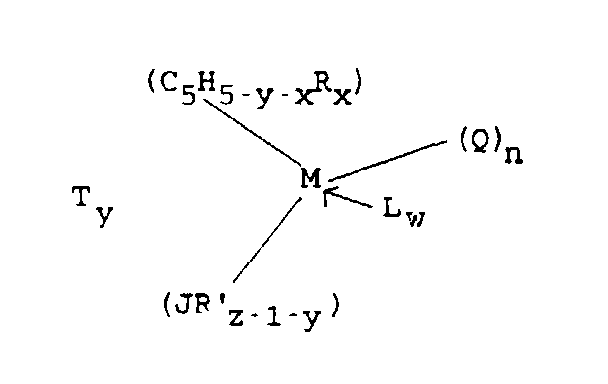 wobei M ein Übergangsmetallatom ist,
 (C5H5-y-xRx) ein Cyclopentadienylring ist, der mit null bis fünf Substituentengruppen R substituiert ist, "x" 0, 1, 2, 3, 4 oder 5 ist und den Substitutionsgrad bezeichnet, und jede Substituentengruppe R unabhängig ein Rest ausgewählt aus einer Gruppe bestehend aus C1- bis C20-Kohlenwasserstoffresten, substituierten C1- bis C20-Kohlenwasserstoffresten, in denen ein oder mehrere Wasserstoffatome durch einen Halogenrest, einen Amidorest, einen Phosphidorest, einen Alkoxyrest oder einen Alkylboridorest ersetzt sind, mit C1- bis C20-Kohlenwasserstoff substituierten Metalloidresten, bei denen das Metalloid aus der Gruppe IV-A des Periodensystems der Elemente ausgewählt ist, und Halogenresten, Amidoresten, Phosphidoresten, Alkoxyresten oder Alkylboridoresten, oder(C5H5-y-xRx) ein Cyclopentadienylring ist, bei dem zwei benachbarte R-Gruppen unter Bildung eines C4- bis C20-Rings verbunden sind, um einen gesättigten oder ungesättigten polycyclischen Cyclopentadienylliganden zu ergeben;(JR'z-1-y) ein Heteroatomligand ist, in dem J ein Element mit einer Koordinationszahl von drei aus der Gruppe V-A oder ein Element mit einer Koordinationszahl von zwei aus der Gruppe VI-A des Periodensystems der Elemente ist, jedes R' unabhängig ein Rest ausgewählt aus einer Gruppe bestehend aus C1- bis C20-Kohlenwasserstoffresten und substituierten C1- bis C20-Kohlenwasserstoffresten ist, in denen ein oder mehrere Wasserstoffatome durch einen Halogenrest, einen Amidorest, einen Phosphidorest, einen Alkoxyrest oder einen Alkylboridorest ersetzt sind, und "z" die Koordinationszahl des Elements J ist;jedes Q unabhängig ein einwertiger anionischer Ligand ausgewählt aus Halogenid, Hydrid oder einem substituierten oder unsubstituierten C1- bis C20-Kohlenwasserstoffrest, Alkoxid, Aryloxid, Amid oder Phosphid ist, mit der Maßgabe, daß, wenn Q ein Kohlenwasserstoffligand ist, dieses Q nicht durch die Formel (C5H5-y-xRx) wiedergegeben werden kann, oder beide Q zusammen ein Alkyliden, cyclometallierter Kohlenwasserstoff oder ein zweiwertiger anionischer chelierender Ligand sind;"n" und "p" eine solche Zahl sind, daß n + 2 und p + 3 gleich dem Oxidationszustand von M sind und der Oxidationszustand von M 3 oder höher ist,"y" 0 oder 1 ist, wenn "w" größer als 0 ist; "y" 1 ist, wenn "w" 0 ist; T ein Dialkyl-, Diaryl- oder Alkylarylsilan oder Methylen oder Ethylen ist, wenn "y" 1 ist;L eine neutrale Lewisbase ist, wobei "w" eine Zahl von 0 bis 3 bedeutet;M' die gleiche Bedeutung wie "M" hat und Q' die gleiche Bedeutung wie Q' hat, und(B) ein Alumoxan und(C) ein den Übergangsmetall- und Alumoxan-Komponenten zugesetztes Modifizierungsmittel umfaßt, das aus N,N-Dimethylanilin, Ethylamin, Diethylamin, Triethylamin, Triphenylamin, Triphenylphosphin, Hexamethylphosphorigsäuretriamid, Diethylether, Wasser, Deuteriumoxid, Ethanol, Phenol, Thiophenol, 2,6-Di-tert.-butyl-4-methylphenol, Tetraethoxysilan, Phenyltriethoxysilan, Diphenyldiethoxysilan, Triphenylethoxysilan und Diethyldihydroxysilan oder dimeren, trimeren, tetrameren oder oligomeren Versionen dieser Verbindungen besteht,wobei C12H23 ein einzelner alicyclischer C12-Ring ist, als Übergangsmetallverbindung (A), einem MAO mit 15% nichtumgewandeltem TMA als Alumoxan (B) und Wasser oder Deuteriumoxid als Modifizierungsmittel (C).
- Katalysatorsystem nach Anspruch 1, bel dem das Übergangsmetallatom aus der Gruppe IV-B, V-B oder VI-B des Periodensystems der Elemente ist.
- Katalysatorsystem nach Anspruch 2, bel dem M Zr, Hf oder Ti in seinem höchsten formalen Oxidationszustand ist und p gleich 0 ist.
- Katalysatorsystem nach Anspruch 1, 2 oder 3, bei dem das Element J der Heteroatomligandengruppe Stickstoff, Phosphor, Sauerstoff oder Schwefel ist.
- Katalysatorsystem nach einem der vorhergehenden Ansprüche, bei dem Q Halogen oder ein Kohlenwasserstoffrest ist.
- Katalysatorsystem nach einem der vorhergehenden Ansprüche, bel dem das Molverhältnis von Aluminiumatom zu Übergangsmetallatom 10:1 bis 3 000:1 beträgt.
- Katalysatorsystem nach einem der vorhergehenden Ansprüche, bei dem das Modifizierungsmittel ein Siloxan, Tetraethoxysilan, Triphenylethoxysilan, Diphenyldiethoxysilan, Phenyltriethoxysilan, N,N-Dimethylanilin oder 2,6-Di-tert.-butyl-4-methylphenol umfaßt.
- Katalysatorsystem nach einem der vorhergehenden Ansprüche, bel dem y gleich 1 ist.
- Katalysatorsystem nach Anspruch 8, bel dem das Element J der Heteroatomligandengruppe Stickstoff oder Phosphor ist.
- Verfahren zur Herstellung von Polyolefinen, bel dem ein olefinisches Monomer und gegebenenfalls ein oder mehrere Comonomere in Gegenwart eines Katalysatorsystems gemäß einem der vorhergehenden Ansprüche Polymerisierungsbedingungen unterworfen werden.
- Verfahren nach Anspruch 10, bei dem das olefinische Monomer 2 bis 20 Kohlenstoffatome aufweist und die gegebenenfalls vorhandenen Comonomere ein von dem olefinischen Monomer verschiedenes C2- bis C20-Olefin und/oder Polyen umfassen.
Applications Claiming Priority (3)
| Application Number | Priority Date | Filing Date | Title |
|---|---|---|---|
| US81243291A | 1991-12-23 | 1991-12-23 | |
| US812432 | 1991-12-23 | ||
| PCT/US1992/011039 WO1993013140A1 (en) | 1991-12-23 | 1992-12-21 | A modified monocyclopentadienyl transition metal/alumoxane catalyst system for polymerization of olefins |
Publications (3)
| Publication Number | Publication Date |
|---|---|
| EP0618931A1 EP0618931A1 (de) | 1994-10-12 |
| EP0618931B1 EP0618931B1 (de) | 1997-07-02 |
| EP0618931B2 true EP0618931B2 (de) | 2000-11-02 |
Family
ID=25209551
Family Applications (1)
| Application Number | Title | Priority Date | Filing Date |
|---|---|---|---|
| EP93902669A Expired - Lifetime EP0618931B2 (de) | 1991-12-23 | 1992-12-21 | Modifizierte monocyclopentadienyl-uebergangsmetal/aluminoxan katalysatorsystem fuer olefinpolymerisation |
Country Status (6)
| Country | Link |
|---|---|
| EP (1) | EP0618931B2 (de) |
| JP (1) | JP2816766B2 (de) |
| CA (1) | CA2126317C (de) |
| DE (1) | DE69220676T3 (de) |
| ES (1) | ES2104122T5 (de) |
| WO (1) | WO1993013140A1 (de) |
Families Citing this family (21)
| Publication number | Priority date | Publication date | Assignee | Title |
|---|---|---|---|---|
| USRE37788E1 (en) * | 1987-01-30 | 2002-07-09 | Exxon Chemical Patents, Inc. | Monocyclopentadienyl metal compounds for ethylene-α-olefin-copolymer production catalysts |
| US5264405A (en) | 1989-09-13 | 1993-11-23 | Exxon Chemical Patents Inc. | Monocyclopentadienyl titanium metal compounds for ethylene-α-olefin-copolymer production catalysts |
| US5621126A (en) * | 1987-01-30 | 1997-04-15 | Exxon Chemical Patents Inc. | Monocyclopentadienyl metal compounds for ethylene-α-olefin-copolymer production catalysts |
| ES2156153T3 (es) * | 1993-06-15 | 2001-06-16 | Idemitsu Kosan Co | Procedimiento de produccion de polimero olefinico, y catalizador para la polimerizacion de una olefina. |
| JP3216748B2 (ja) | 1993-07-23 | 2001-10-09 | 出光興産株式会社 | 芳香族ビニル化合物重合体組成物の製造触媒及びそれを用いた芳香族ビニル化合物重合体組成物の製造方法 |
| JP3180523B2 (ja) | 1993-09-13 | 2001-06-25 | 出光興産株式会社 | スチレン系重合体製造用触媒の選択方法 |
| EP0664304B1 (de) * | 1993-12-27 | 1999-08-04 | Mitsui Chemicals, Inc. | Katalysator und Verfahren zur Olefinpolymerisation |
| US5464906A (en) * | 1994-11-21 | 1995-11-07 | The Dow Chemical Company | Ethylene homopolymerization using group 3 metal complexes |
| EP0805826B1 (de) * | 1995-01-24 | 2003-04-23 | E.I. Du Pont De Nemours And Company | Polyolefine |
| US6897272B1 (en) | 1995-01-24 | 2005-05-24 | E.I. Du Pont De Nemours And Company | α-olefins and olefin polymers and processes therefor |
| US5880241A (en) * | 1995-01-24 | 1999-03-09 | E. I. Du Pont De Nemours And Company | Olefin polymers |
| JPH08253522A (ja) * | 1995-03-14 | 1996-10-01 | Idemitsu Kosan Co Ltd | オレフィン重合用触媒及びそれを用いたオレフィン系重合体の製造方法 |
| US6759499B1 (en) | 1996-07-16 | 2004-07-06 | Exxonmobil Chemical Patents Inc. | Olefin polymerization process with alkyl-substituted metallocenes |
| JPH1112289A (ja) * | 1997-06-19 | 1999-01-19 | Sumitomo Chem Co Ltd | 架橋型遷移金属錯体の製造方法 |
| DE19804970A1 (de) * | 1998-02-07 | 1999-08-12 | Aventis Res & Tech Gmbh & Co | Katalysatorsystem |
| US6281320B1 (en) | 1999-02-04 | 2001-08-28 | Union Carbide Chemicals & Plastics Technology Corporation | Use of chelatable phenols with metallocene- aluminoxane catalyst systems |
| JP2000351813A (ja) | 1999-04-09 | 2000-12-19 | Mitsui Chemicals Inc | エチレン・α−オレフィン共重合体およびその製造方法ならびにその用途 |
| EP1253158A1 (de) * | 1999-12-10 | 2002-10-30 | Dow Global Technologies Inc. | Substituierte Gruppe 4-Metallkomplexe, Katalysatoren und Verfahren zur Olefinpolymerisation |
| ES2379243T3 (es) * | 1999-12-10 | 2012-04-24 | Dow Global Technologies Llc | Complejos de metal del grupo 4 sustituidos, catalizadores y procedimiento de polimerización de olefinas |
| GB0220681D0 (en) * | 2002-09-05 | 2002-10-16 | Borealis Tech Oy | Process |
| WO2008052673A1 (en) * | 2006-10-30 | 2008-05-08 | Basell Polyolefine Gmbh | Process for the polymerization of olefins using catalyst systems based on an organic transition metal complex |
Citations (5)
| Publication number | Priority date | Publication date | Assignee | Title |
|---|---|---|---|---|
| EP0279863A1 (de) † | 1986-08-26 | 1988-08-31 | Mitsui Chemicals, Inc. | Katalysator zur polymerisierung von alpha-olefin und verfahren |
| EP0328348A2 (de) † | 1988-02-12 | 1989-08-16 | Mitsui Petrochemical Industries, Ltd. | Olefinpolymerisationskatalysator und Verfahren zur Olefinpolymerisation |
| WO1991004257A1 (en) † | 1989-09-13 | 1991-04-04 | Exxon Chemical Patents Inc. | Monocyclopentadienyl transition metal olefin polymerization catalysts |
| WO1992005203A1 (en) † | 1990-09-13 | 1992-04-02 | Exxon Chemical Patents Inc. | Supported monocyclopentadienyl transition metal olefin polymerization catalysts |
| WO1992014766A1 (en) † | 1991-02-20 | 1992-09-03 | Exxon Chemical Patents Inc. | Hp catalyst killer |
Family Cites Families (2)
| Publication number | Priority date | Publication date | Assignee | Title |
|---|---|---|---|---|
| JPH0780930B2 (ja) * | 1985-12-26 | 1995-08-30 | 三井石油化学工業株式会社 | α−オレフインの重合方法 |
| JP2573613B2 (ja) * | 1987-08-14 | 1997-01-22 | 三菱化学株式会社 | エチレンの重合法 |
-
1992
- 1992-12-21 EP EP93902669A patent/EP0618931B2/de not_active Expired - Lifetime
- 1992-12-21 ES ES93902669T patent/ES2104122T5/es not_active Expired - Lifetime
- 1992-12-21 JP JP5511808A patent/JP2816766B2/ja not_active Ceased
- 1992-12-21 WO PCT/US1992/011039 patent/WO1993013140A1/en not_active Ceased
- 1992-12-21 DE DE69220676T patent/DE69220676T3/de not_active Expired - Fee Related
- 1992-12-21 CA CA002126317A patent/CA2126317C/en not_active Expired - Fee Related
Patent Citations (5)
| Publication number | Priority date | Publication date | Assignee | Title |
|---|---|---|---|---|
| EP0279863A1 (de) † | 1986-08-26 | 1988-08-31 | Mitsui Chemicals, Inc. | Katalysator zur polymerisierung von alpha-olefin und verfahren |
| EP0328348A2 (de) † | 1988-02-12 | 1989-08-16 | Mitsui Petrochemical Industries, Ltd. | Olefinpolymerisationskatalysator und Verfahren zur Olefinpolymerisation |
| WO1991004257A1 (en) † | 1989-09-13 | 1991-04-04 | Exxon Chemical Patents Inc. | Monocyclopentadienyl transition metal olefin polymerization catalysts |
| WO1992005203A1 (en) † | 1990-09-13 | 1992-04-02 | Exxon Chemical Patents Inc. | Supported monocyclopentadienyl transition metal olefin polymerization catalysts |
| WO1992014766A1 (en) † | 1991-02-20 | 1992-09-03 | Exxon Chemical Patents Inc. | Hp catalyst killer |
Non-Patent Citations (1)
| Title |
|---|
| J.Pol.Sc.Part A, Polymer Chemistry, Vol 29, 1991, pp. 1595-1601 † |
Also Published As
| Publication number | Publication date |
|---|---|
| DE69220676D1 (de) | 1997-08-07 |
| EP0618931A1 (de) | 1994-10-12 |
| JP2816766B2 (ja) | 1998-10-27 |
| EP0618931B1 (de) | 1997-07-02 |
| CA2126317A1 (en) | 1993-07-08 |
| ES2104122T5 (es) | 2001-03-01 |
| WO1993013140A1 (en) | 1993-07-08 |
| CA2126317C (en) | 2000-03-14 |
| DE69220676T3 (de) | 2001-05-17 |
| JPH07501846A (ja) | 1995-02-23 |
| ES2104122T3 (es) | 1997-10-01 |
| DE69220676T2 (de) | 1997-12-11 |
Similar Documents
| Publication | Publication Date | Title |
|---|---|---|
| US5547675A (en) | Modified monocyclopentadienyl transition metal/alumoxane catalyst system for polymerization of olefins | |
| US5096867A (en) | Monocyclopentadienyl transition metal olefin polymerization catalysts | |
| US5055438A (en) | Olefin polymerization catalysts | |
| EP0618931B2 (de) | Modifizierte monocyclopentadienyl-uebergangsmetal/aluminoxan katalysatorsystem fuer olefinpolymerisation | |
| EP0548277B1 (de) | Verfahren zur herstellung kristalliner poly-alpha-olefine mit monozyklopentadienylkompex von übergangsmetallen | |
| EP0548257B2 (de) | Trägerkatalysator für olefinpolymerisation mit monozyklopentadienylkomplexen von übergangsmetallen | |
| US5227440A (en) | Mono-Cp heteroatom containing Group IVB transition metal complexes with MAO: supported catalysts for olefin polymerization | |
| USRE37400E1 (en) | Monocyclopentadienyl titanium metal compounds for ethylene-α-olefin-copolymer production catalysts | |
| US6265338B1 (en) | Monocyclopentadienyl titanium metal compounds for ethylene-α-olefin copolymer production catalysts | |
| EP0705283B1 (de) | Verfahren zur herstellung von poly-alpha-olefinen mit monozyklopentadienylkomplexen von übergangsmetallen | |
| JP2002524621A (ja) | 機能化した触媒担体及び担持触媒系 | |
| US20050176578A1 (en) | Supported catalyst systems | |
| AU643237C (en) | Monocyclopentadienyl transition metal olefin polymerization catalysts | |
| AU656498C (en) | Supported monocyclopentadienyl transition metal olefin polymerization catal ysts | |
| CA2219816C (en) | Azaborolinyl metal complexes as olefin polymerization catalysts |
Legal Events
| Date | Code | Title | Description |
|---|---|---|---|
| PUAI | Public reference made under article 153(3) epc to a published international application that has entered the european phase |
Free format text: ORIGINAL CODE: 0009012 |
|
| 17P | Request for examination filed |
Effective date: 19940713 |
|
| AK | Designated contracting states |
Kind code of ref document: A1 Designated state(s): BE DE ES FR GB IT NL |
|
| GRAG | Despatch of communication of intention to grant |
Free format text: ORIGINAL CODE: EPIDOS AGRA |
|
| 17Q | First examination report despatched |
Effective date: 19960523 |
|
| GRAH | Despatch of communication of intention to grant a patent |
Free format text: ORIGINAL CODE: EPIDOS IGRA |
|
| GRAH | Despatch of communication of intention to grant a patent |
Free format text: ORIGINAL CODE: EPIDOS IGRA |
|
| GRAA | (expected) grant |
Free format text: ORIGINAL CODE: 0009210 |
|
| AK | Designated contracting states |
Kind code of ref document: B1 Designated state(s): BE DE ES FR GB IT NL |
|
| PG25 | Lapsed in a contracting state [announced via postgrant information from national office to epo] |
Ref country code: IT Free format text: LAPSE BECAUSE OF FAILURE TO SUBMIT A TRANSLATION OF THE DESCRIPTION OR TO PAY THE FEE WITHIN THE PRE;WARNING: LAPSES OF ITALIAN PATENTS WITH EFFECTIVE DATE BEFORE 2007 MAY HAVE OCCURRED AT ANY TIME BEFORE 2007. THE CORRECT EFFECTIVE DATE MAY BE DIFFERENT FROM THE ONE RECORDED.SCRIBED TIME-LIMIT Effective date: 19970702 Ref country code: BE Effective date: 19970702 |
|
| REF | Corresponds to: |
Ref document number: 69220676 Country of ref document: DE Date of ref document: 19970807 |
|
| ET | Fr: translation filed | ||
| REG | Reference to a national code |
Ref country code: ES Ref legal event code: FG2A Ref document number: 2104122 Country of ref document: ES Kind code of ref document: T3 |
|
| PLBQ | Unpublished change to opponent data |
Free format text: ORIGINAL CODE: EPIDOS OPPO |
|
| PLBI | Opposition filed |
Free format text: ORIGINAL CODE: 0009260 |
|
| PLBF | Reply of patent proprietor to notice(s) of opposition |
Free format text: ORIGINAL CODE: EPIDOS OBSO |
|
| 26 | Opposition filed |
Opponent name: THE DOW CHEMICAL COMPANY Effective date: 19980402 |
|
| NLR1 | Nl: opposition has been filed with the epo |
Opponent name: THE DOW CHEMICAL COMPANY |
|
| PLBF | Reply of patent proprietor to notice(s) of opposition |
Free format text: ORIGINAL CODE: EPIDOS OBSO |
|
| PLBF | Reply of patent proprietor to notice(s) of opposition |
Free format text: ORIGINAL CODE: EPIDOS OBSO |
|
| PLBF | Reply of patent proprietor to notice(s) of opposition |
Free format text: ORIGINAL CODE: EPIDOS OBSO |
|
| PLBF | Reply of patent proprietor to notice(s) of opposition |
Free format text: ORIGINAL CODE: EPIDOS OBSO |
|
| PLBF | Reply of patent proprietor to notice(s) of opposition |
Free format text: ORIGINAL CODE: EPIDOS OBSO |
|
| PLAW | Interlocutory decision in opposition |
Free format text: ORIGINAL CODE: EPIDOS IDOP |
|
| PLAW | Interlocutory decision in opposition |
Free format text: ORIGINAL CODE: EPIDOS IDOP |
|
| PUAH | Patent maintained in amended form |
Free format text: ORIGINAL CODE: 0009272 |
|
| STAA | Information on the status of an ep patent application or granted ep patent |
Free format text: STATUS: PATENT MAINTAINED AS AMENDED |
|
| 27A | Patent maintained in amended form |
Effective date: 20001102 |
|
| AK | Designated contracting states |
Kind code of ref document: B2 Designated state(s): BE DE ES FR GB IT NL |
|
| NLR2 | Nl: decision of opposition | ||
| REG | Reference to a national code |
Ref country code: ES Ref legal event code: DC2A Kind code of ref document: T5 Effective date: 20010201 |
|
| ET3 | Fr: translation filed ** decision concerning opposition | ||
| NLR3 | Nl: receipt of modified translations in the netherlands language after an opposition procedure | ||
| REG | Reference to a national code |
Ref country code: GB Ref legal event code: IF02 |
|
| PGFP | Annual fee paid to national office [announced via postgrant information from national office to epo] |
Ref country code: NL Payment date: 20071109 Year of fee payment: 16 Ref country code: ES Payment date: 20071219 Year of fee payment: 16 |
|
| PGFP | Annual fee paid to national office [announced via postgrant information from national office to epo] |
Ref country code: GB Payment date: 20071106 Year of fee payment: 16 |
|
| PGFP | Annual fee paid to national office [announced via postgrant information from national office to epo] |
Ref country code: DE Payment date: 20071228 Year of fee payment: 16 |
|
| PGFP | Annual fee paid to national office [announced via postgrant information from national office to epo] |
Ref country code: FR Payment date: 20071204 Year of fee payment: 16 |
|
| GBPC | Gb: european patent ceased through non-payment of renewal fee |
Effective date: 20081221 |
|
| NLV4 | Nl: lapsed or anulled due to non-payment of the annual fee |
Effective date: 20090701 |
|
| REG | Reference to a national code |
Ref country code: FR Ref legal event code: ST Effective date: 20090831 |
|
| PG25 | Lapsed in a contracting state [announced via postgrant information from national office to epo] |
Ref country code: DE Free format text: LAPSE BECAUSE OF NON-PAYMENT OF DUE FEES Effective date: 20090701 |
|
| PG25 | Lapsed in a contracting state [announced via postgrant information from national office to epo] |
Ref country code: NL Free format text: LAPSE BECAUSE OF NON-PAYMENT OF DUE FEES Effective date: 20090701 Ref country code: GB Free format text: LAPSE BECAUSE OF NON-PAYMENT OF DUE FEES Effective date: 20081221 |
|
| REG | Reference to a national code |
Ref country code: ES Ref legal event code: FD2A Effective date: 20081222 |
|
| PG25 | Lapsed in a contracting state [announced via postgrant information from national office to epo] |
Ref country code: FR Free format text: LAPSE BECAUSE OF NON-PAYMENT OF DUE FEES Effective date: 20081231 Ref country code: ES Free format text: LAPSE BECAUSE OF NON-PAYMENT OF DUE FEES Effective date: 20081222 |