EP0548257B2 - Trägerkatalysator für olefinpolymerisation mit monozyklopentadienylkomplexen von übergangsmetallen - Google Patents
Trägerkatalysator für olefinpolymerisation mit monozyklopentadienylkomplexen von übergangsmetallen Download PDFInfo
- Publication number
- EP0548257B2 EP0548257B2 EP91917626A EP91917626A EP0548257B2 EP 0548257 B2 EP0548257 B2 EP 0548257B2 EP 91917626 A EP91917626 A EP 91917626A EP 91917626 A EP91917626 A EP 91917626A EP 0548257 B2 EP0548257 B2 EP 0548257B2
- Authority
- EP
- European Patent Office
- Prior art keywords
- catalyst system
- radical
- group
- transition metal
- support
- Prior art date
- Legal status (The legal status is an assumption and is not a legal conclusion. Google has not performed a legal analysis and makes no representation as to the accuracy of the status listed.)
- Expired - Lifetime
Links
- -1 transition metal olefin Chemical class 0.000 title claims description 96
- 229910052723 transition metal Inorganic materials 0.000 title abstract description 52
- JRZJOMJEPLMPRA-UHFFFAOYSA-N olefin Natural products CCCCCCCC=C JRZJOMJEPLMPRA-UHFFFAOYSA-N 0.000 title description 8
- 239000002685 polymerization catalyst Substances 0.000 title 1
- 239000003054 catalyst Substances 0.000 claims abstract description 145
- 150000003624 transition metals Chemical class 0.000 claims abstract description 53
- 239000000463 material Substances 0.000 claims abstract description 26
- VYPSYNLAJGMNEJ-UHFFFAOYSA-N Silicium dioxide Chemical class O=[Si]=O VYPSYNLAJGMNEJ-UHFFFAOYSA-N 0.000 claims description 84
- 239000000203 mixture Substances 0.000 claims description 53
- 238000000034 method Methods 0.000 claims description 49
- 239000002904 solvent Substances 0.000 claims description 41
- 150000003623 transition metal compounds Chemical class 0.000 claims description 38
- 239000000377 silicon dioxide Substances 0.000 claims description 29
- AQZWEFBJYQSQEH-UHFFFAOYSA-N 2-methyloxaluminane Chemical compound C[Al]1CCCCO1 AQZWEFBJYQSQEH-UHFFFAOYSA-N 0.000 claims description 28
- IJGRMHOSHXDMSA-UHFFFAOYSA-N nitrogen Substances N#N IJGRMHOSHXDMSA-UHFFFAOYSA-N 0.000 claims description 26
- 238000006243 chemical reaction Methods 0.000 claims description 25
- 150000001875 compounds Chemical class 0.000 claims description 24
- 125000000058 cyclopentadienyl group Chemical group C1(=CC=CC1)* 0.000 claims description 24
- 239000002002 slurry Substances 0.000 claims description 24
- VGGSQFUCUMXWEO-UHFFFAOYSA-N Ethene Chemical compound C=C VGGSQFUCUMXWEO-UHFFFAOYSA-N 0.000 claims description 22
- 239000005977 Ethylene Substances 0.000 claims description 22
- 239000003446 ligand Substances 0.000 claims description 22
- 229910052782 aluminium Inorganic materials 0.000 claims description 19
- 230000008569 process Effects 0.000 claims description 19
- 229920000098 polyolefin Polymers 0.000 claims description 18
- 239000004711 α-olefin Substances 0.000 claims description 17
- 229910052757 nitrogen Inorganic materials 0.000 claims description 15
- XLYOFNOQVPJJNP-UHFFFAOYSA-N water Substances O XLYOFNOQVPJJNP-UHFFFAOYSA-N 0.000 claims description 15
- 239000007789 gas Substances 0.000 claims description 14
- 239000000178 monomer Substances 0.000 claims description 14
- XAGFODPZIPBFFR-UHFFFAOYSA-N aluminium Chemical group [Al] XAGFODPZIPBFFR-UHFFFAOYSA-N 0.000 claims description 13
- 125000004435 hydrogen atom Chemical group [H]* 0.000 claims description 13
- 239000003607 modifier Substances 0.000 claims description 11
- 230000002378 acidificating effect Effects 0.000 claims description 9
- 239000003085 diluting agent Substances 0.000 claims description 9
- 125000001424 substituent group Chemical group 0.000 claims description 9
- 229910052736 halogen Inorganic materials 0.000 claims description 8
- 125000005842 heteroatom Chemical group 0.000 claims description 8
- 229910052726 zirconium Inorganic materials 0.000 claims description 8
- PNEYBMLMFCGWSK-UHFFFAOYSA-N aluminium oxide Inorganic materials [O-2].[O-2].[O-2].[Al+3].[Al+3] PNEYBMLMFCGWSK-UHFFFAOYSA-N 0.000 claims description 7
- 229930195733 hydrocarbon Natural products 0.000 claims description 7
- 125000001183 hydrocarbyl group Chemical group 0.000 claims description 7
- 239000010936 titanium Substances 0.000 claims description 7
- VOITXYVAKOUIBA-UHFFFAOYSA-N triethylaluminium Chemical compound CC[Al](CC)CC VOITXYVAKOUIBA-UHFFFAOYSA-N 0.000 claims description 7
- JLTRXTDYQLMHGR-UHFFFAOYSA-N trimethylaluminium Chemical group C[Al](C)C JLTRXTDYQLMHGR-UHFFFAOYSA-N 0.000 claims description 7
- QVGXLLKOCUKJST-UHFFFAOYSA-N atomic oxygen Chemical compound [O] QVGXLLKOCUKJST-UHFFFAOYSA-N 0.000 claims description 6
- 150000002430 hydrocarbons Chemical class 0.000 claims description 6
- 229910052809 inorganic oxide Inorganic materials 0.000 claims description 6
- 229910052760 oxygen Inorganic materials 0.000 claims description 6
- 239000001301 oxygen Substances 0.000 claims description 6
- 230000000737 periodic effect Effects 0.000 claims description 6
- 239000011240 wet gel Substances 0.000 claims description 6
- 239000004215 Carbon black (E152) Substances 0.000 claims description 5
- BOTDANWDWHJENH-UHFFFAOYSA-N Tetraethyl orthosilicate Chemical compound CCO[Si](OCC)(OCC)OCC BOTDANWDWHJENH-UHFFFAOYSA-N 0.000 claims description 5
- 150000001408 amides Chemical class 0.000 claims description 5
- 125000005843 halogen group Chemical group 0.000 claims description 5
- 239000002879 Lewis base Substances 0.000 claims description 4
- CPLXHLVBOLITMK-UHFFFAOYSA-N Magnesium oxide Chemical compound [Mg]=O CPLXHLVBOLITMK-UHFFFAOYSA-N 0.000 claims description 4
- GWEVSGVZZGPLCZ-UHFFFAOYSA-N Titan oxide Chemical compound O=[Ti]=O GWEVSGVZZGPLCZ-UHFFFAOYSA-N 0.000 claims description 4
- MCMNRKCIXSYSNV-UHFFFAOYSA-N Zirconium dioxide Chemical compound O=[Zr]=O MCMNRKCIXSYSNV-UHFFFAOYSA-N 0.000 claims description 4
- MDFFNEOEWAXZRQ-UHFFFAOYSA-N aminyl Chemical compound [NH2] MDFFNEOEWAXZRQ-UHFFFAOYSA-N 0.000 claims description 4
- 125000000129 anionic group Chemical group 0.000 claims description 4
- 150000001993 dienes Chemical class 0.000 claims description 4
- 229910052735 hafnium Inorganic materials 0.000 claims description 4
- 150000004820 halides Chemical class 0.000 claims description 4
- 150000007527 lewis bases Chemical class 0.000 claims description 4
- 229910052752 metalloid Inorganic materials 0.000 claims description 4
- 230000007935 neutral effect Effects 0.000 claims description 4
- 150000004703 alkoxides Chemical class 0.000 claims description 3
- 125000000118 dimethyl group Chemical group [H]C([H])([H])* 0.000 claims description 3
- 229920006395 saturated elastomer Polymers 0.000 claims description 3
- ZCBSOTLLNBJIEK-UHFFFAOYSA-N silane titanium Chemical compound [SiH4].[Ti] ZCBSOTLLNBJIEK-UHFFFAOYSA-N 0.000 claims description 3
- 229910052710 silicon Inorganic materials 0.000 claims description 3
- 239000010703 silicon Substances 0.000 claims description 3
- 239000000454 talc Substances 0.000 claims description 3
- 229910052623 talc Inorganic materials 0.000 claims description 3
- 125000006659 (C1-C20) hydrocarbyl group Chemical group 0.000 claims description 2
- NINIDFKCEFEMDL-UHFFFAOYSA-N Sulfur Chemical compound [S] NINIDFKCEFEMDL-UHFFFAOYSA-N 0.000 claims description 2
- 125000001118 alkylidene group Chemical group 0.000 claims description 2
- 150000004678 hydrides Chemical class 0.000 claims description 2
- 239000000395 magnesium oxide Substances 0.000 claims description 2
- 150000002738 metalloids Chemical class 0.000 claims description 2
- QJGQUHMNIGDVPM-UHFFFAOYSA-N nitrogen group Chemical group [N] QJGQUHMNIGDVPM-UHFFFAOYSA-N 0.000 claims description 2
- 230000003647 oxidation Effects 0.000 claims description 2
- 238000007254 oxidation reaction Methods 0.000 claims description 2
- 238000006467 substitution reaction Methods 0.000 claims description 2
- 229910052717 sulfur Inorganic materials 0.000 claims description 2
- 239000011593 sulfur Substances 0.000 claims description 2
- SMURBMZQUJHLJV-UHFFFAOYSA-L [Cl-].[Cl-].[Ti+2].C1(C=CC=C1)[SiH3] Chemical compound [Cl-].[Cl-].[Ti+2].C1(C=CC=C1)[SiH3] SMURBMZQUJHLJV-UHFFFAOYSA-L 0.000 claims 1
- AZDRQVAHHNSJOQ-UHFFFAOYSA-N alumane Chemical group [AlH3] AZDRQVAHHNSJOQ-UHFFFAOYSA-N 0.000 claims 1
- BHEPBYXIRTUNPN-UHFFFAOYSA-N hydridophosphorus(.) (triplet) Chemical compound [PH] BHEPBYXIRTUNPN-UHFFFAOYSA-N 0.000 claims 1
- 125000003367 polycyclic group Chemical group 0.000 claims 1
- 230000000379 polymerizing effect Effects 0.000 claims 1
- 150000001336 alkenes Chemical class 0.000 abstract description 12
- 229920006158 high molecular weight polymer Polymers 0.000 abstract 1
- YXFVVABEGXRONW-UHFFFAOYSA-N Toluene Chemical compound CC1=CC=CC=C1 YXFVVABEGXRONW-UHFFFAOYSA-N 0.000 description 66
- RTZKZFJDLAIYFH-UHFFFAOYSA-N Diethyl ether Chemical compound CCOCC RTZKZFJDLAIYFH-UHFFFAOYSA-N 0.000 description 51
- IMNFDUFMRHMDMM-UHFFFAOYSA-N N-Heptane Chemical compound CCCCCCC IMNFDUFMRHMDMM-UHFFFAOYSA-N 0.000 description 42
- VLKZOEOYAKHREP-UHFFFAOYSA-N n-Hexane Chemical compound CCCCCC VLKZOEOYAKHREP-UHFFFAOYSA-N 0.000 description 36
- 238000006116 polymerization reaction Methods 0.000 description 35
- OFBQJSOFQDEBGM-UHFFFAOYSA-N n-pentane Natural products CCCCC OFBQJSOFQDEBGM-UHFFFAOYSA-N 0.000 description 32
- 239000000047 product Substances 0.000 description 24
- 239000000243 solution Substances 0.000 description 23
- 238000003756 stirring Methods 0.000 description 23
- 241000894007 species Species 0.000 description 20
- 235000010210 aluminium Nutrition 0.000 description 19
- 229920000642 polymer Polymers 0.000 description 18
- KWGKDLIKAYFUFQ-UHFFFAOYSA-M lithium chloride Chemical compound [Li+].[Cl-] KWGKDLIKAYFUFQ-UHFFFAOYSA-M 0.000 description 16
- ZSWFCLXCOIISFI-UHFFFAOYSA-N endo-cyclopentadiene Natural products C1C=CC=C1 ZSWFCLXCOIISFI-UHFFFAOYSA-N 0.000 description 15
- 150000003254 radicals Chemical class 0.000 description 15
- 239000004698 Polyethylene Substances 0.000 description 13
- 238000009826 distribution Methods 0.000 description 13
- 239000002245 particle Substances 0.000 description 13
- 239000012071 phase Substances 0.000 description 13
- 229920000573 polyethylene Polymers 0.000 description 13
- 239000007787 solid Substances 0.000 description 13
- 229910010068 TiCl2 Inorganic materials 0.000 description 10
- 238000002360 preparation method Methods 0.000 description 10
- ZWYDDDAMNQQZHD-UHFFFAOYSA-L titanium(ii) chloride Chemical compound [Cl-].[Cl-].[Ti+2] ZWYDDDAMNQQZHD-UHFFFAOYSA-L 0.000 description 10
- YMWUJEATGCHHMB-UHFFFAOYSA-N Dichloromethane Chemical compound ClCCl YMWUJEATGCHHMB-UHFFFAOYSA-N 0.000 description 9
- 239000007788 liquid Substances 0.000 description 9
- 229910052751 metal Inorganic materials 0.000 description 9
- 229910007928 ZrCl2 Inorganic materials 0.000 description 8
- 239000000460 chlorine Substances 0.000 description 8
- 238000004519 manufacturing process Methods 0.000 description 8
- 239000002184 metal Substances 0.000 description 8
- 239000003208 petroleum Substances 0.000 description 8
- 241000349731 Afzelia bipindensis Species 0.000 description 7
- 230000000694 effects Effects 0.000 description 7
- IHLVCKWPAMTVTG-UHFFFAOYSA-N lithium;carbanide Chemical compound [Li+].[CH3-] IHLVCKWPAMTVTG-UHFFFAOYSA-N 0.000 description 7
- 239000000741 silica gel Substances 0.000 description 7
- 229910002027 silica gel Inorganic materials 0.000 description 7
- 229910003074 TiCl4 Inorganic materials 0.000 description 6
- QCWXUUIWCKQGHC-UHFFFAOYSA-N Zirconium Chemical compound [Zr] QCWXUUIWCKQGHC-UHFFFAOYSA-N 0.000 description 6
- 150000001412 amines Chemical group 0.000 description 6
- 239000000470 constituent Substances 0.000 description 6
- 239000000706 filtrate Substances 0.000 description 6
- 229910052744 lithium Inorganic materials 0.000 description 6
- 229910052719 titanium Inorganic materials 0.000 description 6
- XJDNKRIXUMDJCW-UHFFFAOYSA-J titanium tetrachloride Chemical compound Cl[Ti](Cl)(Cl)Cl XJDNKRIXUMDJCW-UHFFFAOYSA-J 0.000 description 6
- 238000001914 filtration Methods 0.000 description 5
- 239000000843 powder Substances 0.000 description 5
- LIKMAJRDDDTEIG-UHFFFAOYSA-N 1-hexene Chemical compound CCCCC=C LIKMAJRDDDTEIG-UHFFFAOYSA-N 0.000 description 4
- XKRFYHLGVUSROY-UHFFFAOYSA-N Argon Chemical compound [Ar] XKRFYHLGVUSROY-UHFFFAOYSA-N 0.000 description 4
- WYURNTSHIVDZCO-UHFFFAOYSA-N Tetrahydrofuran Chemical compound C1CCOC1 WYURNTSHIVDZCO-UHFFFAOYSA-N 0.000 description 4
- RTAQQCXQSZGOHL-UHFFFAOYSA-N Titanium Chemical compound [Ti] RTAQQCXQSZGOHL-UHFFFAOYSA-N 0.000 description 4
- 150000001335 aliphatic alkanes Chemical class 0.000 description 4
- 239000007795 chemical reaction product Substances 0.000 description 4
- 239000000499 gel Substances 0.000 description 4
- 238000010348 incorporation Methods 0.000 description 4
- 125000002496 methyl group Chemical group [H]C([H])([H])* 0.000 description 4
- 239000000725 suspension Substances 0.000 description 4
- PBKONEOXTCPAFI-UHFFFAOYSA-N 1,2,4-trichlorobenzene Chemical compound ClC1=CC=C(Cl)C(Cl)=C1 PBKONEOXTCPAFI-UHFFFAOYSA-N 0.000 description 3
- 229910018516 Al—O Inorganic materials 0.000 description 3
- PAYRUJLWNCNPSJ-UHFFFAOYSA-N Aniline Chemical compound NC1=CC=CC=C1 PAYRUJLWNCNPSJ-UHFFFAOYSA-N 0.000 description 3
- UHOVQNZJYSORNB-UHFFFAOYSA-N Benzene Chemical compound C1=CC=CC=C1 UHOVQNZJYSORNB-UHFFFAOYSA-N 0.000 description 3
- 229920000089 Cyclic olefin copolymer Polymers 0.000 description 3
- JLTDJTHDQAWBAV-UHFFFAOYSA-N N,N-dimethylaniline Chemical compound CN(C)C1=CC=CC=C1 JLTDJTHDQAWBAV-UHFFFAOYSA-N 0.000 description 3
- 125000000217 alkyl group Chemical group 0.000 description 3
- 238000004458 analytical method Methods 0.000 description 3
- 239000003849 aromatic solvent Substances 0.000 description 3
- 125000004432 carbon atom Chemical group C* 0.000 description 3
- 230000003197 catalytic effect Effects 0.000 description 3
- 239000003153 chemical reaction reagent Substances 0.000 description 3
- 229920001577 copolymer Polymers 0.000 description 3
- 125000001495 ethyl group Chemical group [H]C([H])([H])C([H])([H])* 0.000 description 3
- 238000012685 gas phase polymerization Methods 0.000 description 3
- 239000001257 hydrogen Substances 0.000 description 3
- 229910052739 hydrogen Inorganic materials 0.000 description 3
- 239000007791 liquid phase Substances 0.000 description 3
- 239000012968 metallocene catalyst Substances 0.000 description 3
- 239000011148 porous material Substances 0.000 description 3
- 238000001556 precipitation Methods 0.000 description 3
- 239000011949 solid catalyst Substances 0.000 description 3
- 239000000126 substance Substances 0.000 description 3
- AFFLGGQVNFXPEV-UHFFFAOYSA-N 1-decene Chemical compound CCCCCCCCC=C AFFLGGQVNFXPEV-UHFFFAOYSA-N 0.000 description 2
- KWKAKUADMBZCLK-UHFFFAOYSA-N 1-octene Chemical compound CCCCCCC=C KWKAKUADMBZCLK-UHFFFAOYSA-N 0.000 description 2
- WSSSPWUEQFSQQG-UHFFFAOYSA-N 4-methyl-1-pentene Chemical compound CC(C)CC=C WSSSPWUEQFSQQG-UHFFFAOYSA-N 0.000 description 2
- ZAMOUSCENKQFHK-UHFFFAOYSA-N Chlorine atom Chemical compound [Cl] ZAMOUSCENKQFHK-UHFFFAOYSA-N 0.000 description 2
- 229940126062 Compound A Drugs 0.000 description 2
- XDTMQSROBMDMFD-UHFFFAOYSA-N Cyclohexane Chemical compound C1CCCCC1 XDTMQSROBMDMFD-UHFFFAOYSA-N 0.000 description 2
- NLDMNSXOCDLTTB-UHFFFAOYSA-N Heterophylliin A Natural products O1C2COC(=O)C3=CC(O)=C(O)C(O)=C3C3=C(O)C(O)=C(O)C=C3C(=O)OC2C(OC(=O)C=2C=C(O)C(O)=C(O)C=2)C(O)C1OC(=O)C1=CC(O)=C(O)C(O)=C1 NLDMNSXOCDLTTB-UHFFFAOYSA-N 0.000 description 2
- UFHFLCQGNIYNRP-UHFFFAOYSA-N Hydrogen Chemical compound [H][H] UFHFLCQGNIYNRP-UHFFFAOYSA-N 0.000 description 2
- 229910007932 ZrCl4 Inorganic materials 0.000 description 2
- 239000012190 activator Substances 0.000 description 2
- 229910052786 argon Inorganic materials 0.000 description 2
- 239000012298 atmosphere Substances 0.000 description 2
- 239000001273 butane Substances 0.000 description 2
- 125000000484 butyl group Chemical group [H]C([*])([H])C([H])([H])C([H])([H])C([H])([H])[H] 0.000 description 2
- 229910052801 chlorine Inorganic materials 0.000 description 2
- 238000007334 copolymerization reaction Methods 0.000 description 2
- 238000012937 correction Methods 0.000 description 2
- 150000001923 cyclic compounds Chemical class 0.000 description 2
- 125000004122 cyclic group Chemical group 0.000 description 2
- DMEGYFMYUHOHGS-UHFFFAOYSA-N cycloheptane Chemical compound C1CCCCCC1 DMEGYFMYUHOHGS-UHFFFAOYSA-N 0.000 description 2
- LPIQUOYDBNQMRZ-UHFFFAOYSA-N cyclopentene Chemical compound C1CC=CC1 LPIQUOYDBNQMRZ-UHFFFAOYSA-N 0.000 description 2
- 230000009849 deactivation Effects 0.000 description 2
- 230000008021 deposition Effects 0.000 description 2
- 229960004132 diethyl ether Drugs 0.000 description 2
- 238000001035 drying Methods 0.000 description 2
- 238000001704 evaporation Methods 0.000 description 2
- 230000008020 evaporation Effects 0.000 description 2
- 238000005227 gel permeation chromatography Methods 0.000 description 2
- VBJZVLUMGGDVMO-UHFFFAOYSA-N hafnium atom Chemical compound [Hf] VBJZVLUMGGDVMO-UHFFFAOYSA-N 0.000 description 2
- 238000010438 heat treatment Methods 0.000 description 2
- 239000001307 helium Substances 0.000 description 2
- 229910052734 helium Inorganic materials 0.000 description 2
- SWQJXJOGLNCZEY-UHFFFAOYSA-N helium atom Chemical compound [He] SWQJXJOGLNCZEY-UHFFFAOYSA-N 0.000 description 2
- 238000011065 in-situ storage Methods 0.000 description 2
- 239000011261 inert gas Substances 0.000 description 2
- 229910003480 inorganic solid Inorganic materials 0.000 description 2
- NNPPMTNAJDCUHE-UHFFFAOYSA-N isobutane Chemical compound CC(C)C NNPPMTNAJDCUHE-UHFFFAOYSA-N 0.000 description 2
- QWTDNUCVQCZILF-UHFFFAOYSA-N isopentane Chemical compound CCC(C)C QWTDNUCVQCZILF-UHFFFAOYSA-N 0.000 description 2
- AFRJJFRNGGLMDW-UHFFFAOYSA-N lithium amide Chemical compound [Li+].[NH2-] AFRJJFRNGGLMDW-UHFFFAOYSA-N 0.000 description 2
- DLEDOFVPSDKWEF-UHFFFAOYSA-N lithium butane Chemical compound [Li+].CCC[CH2-] DLEDOFVPSDKWEF-UHFFFAOYSA-N 0.000 description 2
- 229910003002 lithium salt Inorganic materials 0.000 description 2
- 159000000002 lithium salts Chemical class 0.000 description 2
- DBKDYYFPDRPMPE-UHFFFAOYSA-N lithium;cyclopenta-1,3-diene Chemical compound [Li+].C=1C=C[CH-]C=1 DBKDYYFPDRPMPE-UHFFFAOYSA-N 0.000 description 2
- 238000003760 magnetic stirring Methods 0.000 description 2
- UAEPNZWRGJTJPN-UHFFFAOYSA-N methylcyclohexane Chemical compound CC1CCCCC1 UAEPNZWRGJTJPN-UHFFFAOYSA-N 0.000 description 2
- 125000000325 methylidene group Chemical group [H]C([H])=* 0.000 description 2
- MZRVEZGGRBJDDB-UHFFFAOYSA-N n-Butyllithium Substances [Li]CCCC MZRVEZGGRBJDDB-UHFFFAOYSA-N 0.000 description 2
- IJDNQMDRQITEOD-UHFFFAOYSA-N n-butane Chemical compound CCCC IJDNQMDRQITEOD-UHFFFAOYSA-N 0.000 description 2
- TVMXDCGIABBOFY-UHFFFAOYSA-N octane Chemical compound CCCCCCCC TVMXDCGIABBOFY-UHFFFAOYSA-N 0.000 description 2
- 239000003960 organic solvent Substances 0.000 description 2
- 125000002524 organometallic group Chemical group 0.000 description 2
- 125000001997 phenyl group Chemical group [H]C1=C([H])C([H])=C(*)C([H])=C1[H] 0.000 description 2
- 125000001436 propyl group Chemical group [H]C([*])([H])C([H])([H])C([H])([H])[H] 0.000 description 2
- LVTJOONKWUXEFR-FZRMHRINSA-N protoneodioscin Natural products O(C[C@@H](CC[C@]1(O)[C@H](C)[C@@H]2[C@]3(C)[C@H]([C@H]4[C@@H]([C@]5(C)C(=CC4)C[C@@H](O[C@@H]4[C@H](O[C@H]6[C@@H](O)[C@@H](O)[C@@H](O)[C@H](C)O6)[C@@H](O)[C@H](O[C@H]6[C@@H](O)[C@@H](O)[C@@H](O)[C@H](C)O6)[C@H](CO)O4)CC5)CC3)C[C@@H]2O1)C)[C@H]1[C@H](O)[C@H](O)[C@H](O)[C@@H](CO)O1 LVTJOONKWUXEFR-FZRMHRINSA-N 0.000 description 2
- 238000010926 purge Methods 0.000 description 2
- 230000035945 sensitivity Effects 0.000 description 2
- 238000000926 separation method Methods 0.000 description 2
- 239000011343 solid material Substances 0.000 description 2
- YLQBMQCUIZJEEH-UHFFFAOYSA-N tetrahydrofuran Natural products C=1C=COC=1 YLQBMQCUIZJEEH-UHFFFAOYSA-N 0.000 description 2
- YWWDBCBWQNCYNR-UHFFFAOYSA-N trimethylphosphine Chemical compound CP(C)C YWWDBCBWQNCYNR-UHFFFAOYSA-N 0.000 description 2
- DUNKXUFBGCUVQW-UHFFFAOYSA-J zirconium tetrachloride Chemical compound Cl[Zr](Cl)(Cl)Cl DUNKXUFBGCUVQW-UHFFFAOYSA-J 0.000 description 2
- PRBHEGAFLDMLAL-GQCTYLIASA-N (4e)-hexa-1,4-diene Chemical compound C\C=C\CC=C PRBHEGAFLDMLAL-GQCTYLIASA-N 0.000 description 1
- 125000006527 (C1-C5) alkyl group Chemical group 0.000 description 1
- 238000005160 1H NMR spectroscopy Methods 0.000 description 1
- YBYIRNPNPLQARY-UHFFFAOYSA-N 1H-indene Natural products C1=CC=C2CC=CC2=C1 YBYIRNPNPLQARY-UHFFFAOYSA-N 0.000 description 1
- KNENSDLFTGIERH-UHFFFAOYSA-N 2,2,4,4-tetramethyl-3-phenylpentan-3-ol Chemical compound CC(C)(C)C(O)(C(C)(C)C)C1=CC=CC=C1 KNENSDLFTGIERH-UHFFFAOYSA-N 0.000 description 1
- LDTAOIUHUHHCMU-UHFFFAOYSA-N 3-methylpent-1-ene Chemical compound CCC(C)C=C LDTAOIUHUHHCMU-UHFFFAOYSA-N 0.000 description 1
- WKBOTKDWSSQWDR-UHFFFAOYSA-N Bromine atom Chemical compound [Br] WKBOTKDWSSQWDR-UHFFFAOYSA-N 0.000 description 1
- DMYRMUXMBFXHRP-UHFFFAOYSA-N C(C)(C)(C)C(C1=CC=CC=C1)(O)C(C)(C)C.C1(=CC=CC=C1)[Si](OCC)(OCC)OCC Chemical compound C(C)(C)(C)C(C1=CC=CC=C1)(O)C(C)(C)C.C1(=CC=CC=C1)[Si](OCC)(OCC)OCC DMYRMUXMBFXHRP-UHFFFAOYSA-N 0.000 description 1
- OITZGVRJLYKFQL-UHFFFAOYSA-N CC(C(C(C)(C)C)(C)P(C(C)(C)C)[Hf](C)(C)C1C=CC=C1)C Chemical compound CC(C(C(C)(C)C)(C)P(C(C)(C)C)[Hf](C)(C)C1C=CC=C1)C OITZGVRJLYKFQL-UHFFFAOYSA-N 0.000 description 1
- MXBIEKXIBJBZTJ-UHFFFAOYSA-N CC(C([Hf](CP(C(C)(C)C)C(C)(C)C)C1C=CC=C1)(C)C)(C)C Chemical compound CC(C([Hf](CP(C(C)(C)C)C(C)(C)C)C1C=CC=C1)(C)C)(C)C MXBIEKXIBJBZTJ-UHFFFAOYSA-N 0.000 description 1
- LKBQSYFYMDCVHX-UHFFFAOYSA-N C[Ti+2]C.C1(C=CC=C1)C([O-])C(CC)C.C1(C=CC=C1)C([O-])C(CC)C Chemical compound C[Ti+2]C.C1(C=CC=C1)C([O-])C(CC)C.C1(C=CC=C1)C([O-])C(CC)C LKBQSYFYMDCVHX-UHFFFAOYSA-N 0.000 description 1
- PXGOKWXKJXAPGV-UHFFFAOYSA-N Fluorine Chemical compound FF PXGOKWXKJXAPGV-UHFFFAOYSA-N 0.000 description 1
- PGTKVMVZBBZCKQ-UHFFFAOYSA-N Fulvene Chemical compound C=C1C=CC=C1 PGTKVMVZBBZCKQ-UHFFFAOYSA-N 0.000 description 1
- 239000002841 Lewis acid Substances 0.000 description 1
- WHXSMMKQMYFTQS-UHFFFAOYSA-N Lithium Chemical compound [Li] WHXSMMKQMYFTQS-UHFFFAOYSA-N 0.000 description 1
- CTQNGGLPUBDAKN-UHFFFAOYSA-N O-Xylene Chemical compound CC1=CC=CC=C1C CTQNGGLPUBDAKN-UHFFFAOYSA-N 0.000 description 1
- ISWSIDIOOBJBQZ-UHFFFAOYSA-N Phenol Chemical class OC1=CC=CC=C1 ISWSIDIOOBJBQZ-UHFFFAOYSA-N 0.000 description 1
- XYFCBTPGUUZFHI-UHFFFAOYSA-N Phosphine Natural products P XYFCBTPGUUZFHI-UHFFFAOYSA-N 0.000 description 1
- OAICVXFJPJFONN-UHFFFAOYSA-N Phosphorus Chemical compound [P] OAICVXFJPJFONN-UHFFFAOYSA-N 0.000 description 1
- 239000004793 Polystyrene Substances 0.000 description 1
- UCKMPCXJQFINFW-UHFFFAOYSA-N Sulphide Chemical compound [S-2] UCKMPCXJQFINFW-UHFFFAOYSA-N 0.000 description 1
- 239000007983 Tris buffer Substances 0.000 description 1
- 239000011954 Ziegler–Natta catalyst Substances 0.000 description 1
- 239000000654 additive Substances 0.000 description 1
- 125000002877 alkyl aryl group Chemical group 0.000 description 1
- IYABWNGZIDDRAK-UHFFFAOYSA-N allene Chemical group C=C=C IYABWNGZIDDRAK-UHFFFAOYSA-N 0.000 description 1
- 239000003963 antioxidant agent Substances 0.000 description 1
- 238000000149 argon plasma sintering Methods 0.000 description 1
- 150000001491 aromatic compounds Chemical class 0.000 description 1
- 125000003118 aryl group Chemical group 0.000 description 1
- 230000009286 beneficial effect Effects 0.000 description 1
- HQMRIBYCTLBDAK-UHFFFAOYSA-M bis(2-methylpropyl)alumanylium;chloride Chemical compound CC(C)C[Al](Cl)CC(C)C HQMRIBYCTLBDAK-UHFFFAOYSA-M 0.000 description 1
- 238000009835 boiling Methods 0.000 description 1
- GDTBXPJZTBHREO-UHFFFAOYSA-N bromine Substances BrBr GDTBXPJZTBHREO-UHFFFAOYSA-N 0.000 description 1
- 229910052794 bromium Inorganic materials 0.000 description 1
- HQABUPZFAYXKJW-UHFFFAOYSA-N butan-1-amine Chemical compound CCCCN HQABUPZFAYXKJW-UHFFFAOYSA-N 0.000 description 1
- 229910052799 carbon Inorganic materials 0.000 description 1
- 239000003795 chemical substances by application Substances 0.000 description 1
- KOPOQZFJUQMUML-UHFFFAOYSA-N chlorosilane Chemical compound Cl[SiH3] KOPOQZFJUQMUML-UHFFFAOYSA-N 0.000 description 1
- 238000001816 cooling Methods 0.000 description 1
- 229910000365 copper sulfate Inorganic materials 0.000 description 1
- ARUVKPQLZAKDPS-UHFFFAOYSA-L copper(II) sulfate Chemical compound [Cu+2].[O-][S+2]([O-])([O-])[O-] ARUVKPQLZAKDPS-UHFFFAOYSA-L 0.000 description 1
- 239000012043 crude product Substances 0.000 description 1
- 150000001924 cycloalkanes Chemical class 0.000 description 1
- SRKKQWSERFMTOX-UHFFFAOYSA-N cyclopentane;titanium Chemical compound [Ti].[CH]1C=CC=C1 SRKKQWSERFMTOX-UHFFFAOYSA-N 0.000 description 1
- 238000010908 decantation Methods 0.000 description 1
- 230000003247 decreasing effect Effects 0.000 description 1
- 125000002704 decyl group Chemical group [H]C([H])([H])C([H])([H])C([H])([H])C([H])([H])C([H])([H])C([H])([H])C([H])([H])C([H])([H])C([H])([H])C([H])([H])* 0.000 description 1
- 239000012024 dehydrating agents Substances 0.000 description 1
- 238000006297 dehydration reaction Methods 0.000 description 1
- YNLAOSYQHBDIKW-UHFFFAOYSA-M diethylaluminium chloride Chemical compound CC[Al](Cl)CC YNLAOSYQHBDIKW-UHFFFAOYSA-M 0.000 description 1
- UZBQIPPOMKBLAS-UHFFFAOYSA-N diethylazanide Chemical compound CC[N-]CC UZBQIPPOMKBLAS-UHFFFAOYSA-N 0.000 description 1
- SMBQBQBNOXIFSF-UHFFFAOYSA-N dilithium Chemical class [Li][Li] SMBQBQBNOXIFSF-UHFFFAOYSA-N 0.000 description 1
- AFABGHUZZDYHJO-UHFFFAOYSA-N dimethyl butane Natural products CCCC(C)C AFABGHUZZDYHJO-UHFFFAOYSA-N 0.000 description 1
- JGHYBJVUQGTEEB-UHFFFAOYSA-M dimethylalumanylium;chloride Chemical compound C[Al](C)Cl JGHYBJVUQGTEEB-UHFFFAOYSA-M 0.000 description 1
- QKIUAMUSENSFQQ-UHFFFAOYSA-N dimethylazanide Chemical compound C[N-]C QKIUAMUSENSFQQ-UHFFFAOYSA-N 0.000 description 1
- LIKFHECYJZWXFJ-UHFFFAOYSA-N dimethyldichlorosilane Chemical compound C[Si](C)(Cl)Cl LIKFHECYJZWXFJ-UHFFFAOYSA-N 0.000 description 1
- DMBHHRLKUKUOEG-UHFFFAOYSA-N diphenylamine Chemical compound C=1C=CC=CC=1NC1=CC=CC=C1 DMBHHRLKUKUOEG-UHFFFAOYSA-N 0.000 description 1
- SDIXRDNYIMOKSG-UHFFFAOYSA-L disodium methyl arsenate Chemical compound [Na+].[Na+].C[As]([O-])([O-])=O SDIXRDNYIMOKSG-UHFFFAOYSA-L 0.000 description 1
- 238000010828 elution Methods 0.000 description 1
- LIWAQLJGPBVORC-UHFFFAOYSA-N ethylmethylamine Chemical compound CCNC LIWAQLJGPBVORC-UHFFFAOYSA-N 0.000 description 1
- 239000002360 explosive Substances 0.000 description 1
- 239000012467 final product Substances 0.000 description 1
- 239000010419 fine particle Substances 0.000 description 1
- 125000003983 fluorenyl group Chemical group C1(=CC=CC=2C3=CC=CC=C3CC12)* 0.000 description 1
- 239000011737 fluorine Substances 0.000 description 1
- 229910052731 fluorine Inorganic materials 0.000 description 1
- 229910052732 germanium Inorganic materials 0.000 description 1
- 125000003187 heptyl group Chemical group [H]C([*])([H])C([H])([H])C([H])([H])C([H])([H])C([H])([H])C([H])([H])C([H])([H])[H] 0.000 description 1
- 125000004051 hexyl group Chemical group [H]C([H])([H])C([H])([H])C([H])([H])C([H])([H])C([H])([H])C([H])([H])* 0.000 description 1
- 239000002815 homogeneous catalyst Substances 0.000 description 1
- 230000007062 hydrolysis Effects 0.000 description 1
- 238000006460 hydrolysis reaction Methods 0.000 description 1
- 125000002887 hydroxy group Chemical group [H]O* 0.000 description 1
- 239000012535 impurity Substances 0.000 description 1
- 125000003454 indenyl group Chemical group C1(C=CC2=CC=CC=C12)* 0.000 description 1
- 239000003701 inert diluent Substances 0.000 description 1
- 238000002347 injection Methods 0.000 description 1
- 239000007924 injection Substances 0.000 description 1
- PNDPGZBMCMUPRI-UHFFFAOYSA-N iodine Chemical compound II PNDPGZBMCMUPRI-UHFFFAOYSA-N 0.000 description 1
- 239000001282 iso-butane Substances 0.000 description 1
- 125000000959 isobutyl group Chemical group [H]C([H])([H])C([H])(C([H])([H])[H])C([H])([H])* 0.000 description 1
- 125000001972 isopentyl group Chemical group [H]C([H])([H])C([H])(C([H])([H])[H])C([H])([H])C([H])([H])* 0.000 description 1
- 150000007517 lewis acids Chemical class 0.000 description 1
- 238000004811 liquid chromatography Methods 0.000 description 1
- NBTOZLQBSIZIKS-UHFFFAOYSA-N methoxide Chemical compound [O-]C NBTOZLQBSIZIKS-UHFFFAOYSA-N 0.000 description 1
- GYNNXHKOJHMOHS-UHFFFAOYSA-N methyl-cycloheptane Natural products CC1CCCCCC1 GYNNXHKOJHMOHS-UHFFFAOYSA-N 0.000 description 1
- 238000002156 mixing Methods 0.000 description 1
- 125000000740 n-pentyl group Chemical group [H]C([H])([H])C([H])([H])C([H])([H])C([H])([H])C([H])([H])* 0.000 description 1
- CATWEXRJGNBIJD-UHFFFAOYSA-N n-tert-butyl-2-methylpropan-2-amine Chemical compound CC(C)(C)NC(C)(C)C CATWEXRJGNBIJD-UHFFFAOYSA-N 0.000 description 1
- YCWSUKQGVSGXJO-NTUHNPAUSA-N nifuroxazide Chemical group C1=CC(O)=CC=C1C(=O)N\N=C\C1=CC=C([N+]([O-])=O)O1 YCWSUKQGVSGXJO-NTUHNPAUSA-N 0.000 description 1
- 125000004433 nitrogen atom Chemical group N* 0.000 description 1
- 125000001400 nonyl group Chemical group [H]C([*])([H])C([H])([H])C([H])([H])C([H])([H])C([H])([H])C([H])([H])C([H])([H])C([H])([H])C([H])([H])[H] 0.000 description 1
- 125000002347 octyl group Chemical group [H]C([*])([H])C([H])([H])C([H])([H])C([H])([H])C([H])([H])C([H])([H])C([H])([H])C([H])([H])[H] 0.000 description 1
- 238000006384 oligomerization reaction Methods 0.000 description 1
- IWDCLRJOBJJRNH-UHFFFAOYSA-N p-cresol Chemical compound CC1=CC=C(O)C=C1 IWDCLRJOBJJRNH-UHFFFAOYSA-N 0.000 description 1
- 125000000913 palmityl group Chemical group [H]C([*])([H])C([H])([H])C([H])([H])C([H])([H])C([H])([H])C([H])([H])C([H])([H])C([H])([H])C([H])([H])C([H])([H])C([H])([H])C([H])([H])C([H])([H])C([H])([H])C([H])([H])C([H])([H])[H] 0.000 description 1
- 239000013618 particulate matter Substances 0.000 description 1
- 239000008188 pellet Substances 0.000 description 1
- RGSFGYAAUTVSQA-UHFFFAOYSA-N pentamethylene Natural products C1CCCC1 RGSFGYAAUTVSQA-UHFFFAOYSA-N 0.000 description 1
- 125000001147 pentyl group Chemical group C(CCCC)* 0.000 description 1
- ISWSIDIOOBJBQZ-UHFFFAOYSA-M phenolate Chemical compound [O-]C1=CC=CC=C1 ISWSIDIOOBJBQZ-UHFFFAOYSA-M 0.000 description 1
- 239000011574 phosphorus Substances 0.000 description 1
- 229910052698 phosphorus Inorganic materials 0.000 description 1
- 229910000073 phosphorus hydride Inorganic materials 0.000 description 1
- 239000000049 pigment Substances 0.000 description 1
- 229920013639 polyalphaolefin Polymers 0.000 description 1
- 229920001195 polyisoprene Polymers 0.000 description 1
- 229920002223 polystyrene Polymers 0.000 description 1
- OSFBJERFMQCEQY-UHFFFAOYSA-N propylidene Chemical group [CH]CC OSFBJERFMQCEQY-UHFFFAOYSA-N 0.000 description 1
- 239000002516 radical scavenger Substances 0.000 description 1
- 239000011541 reaction mixture Substances 0.000 description 1
- 238000001953 recrystallisation Methods 0.000 description 1
- 230000001105 regulatory effect Effects 0.000 description 1
- 150000003839 salts Chemical class 0.000 description 1
- 210000002966 serum Anatomy 0.000 description 1
- 229910000077 silane Inorganic materials 0.000 description 1
- 150000004756 silanes Chemical class 0.000 description 1
- 238000003892 spreading Methods 0.000 description 1
- 230000007480 spreading Effects 0.000 description 1
- 230000003068 static effect Effects 0.000 description 1
- 125000000999 tert-butyl group Chemical group [H]C([H])([H])C(*)(C([H])([H])[H])C([H])([H])[H] 0.000 description 1
- YMBCJWGVCUEGHA-UHFFFAOYSA-M tetraethylammonium chloride Chemical compound [Cl-].CC[N+](CC)(CC)CC YMBCJWGVCUEGHA-UHFFFAOYSA-M 0.000 description 1
- 150000003608 titanium Chemical class 0.000 description 1
- JCVQKRGIASEUKR-UHFFFAOYSA-N triethoxy(phenyl)silane Chemical compound CCO[Si](OCC)(OCC)C1=CC=CC=C1 JCVQKRGIASEUKR-UHFFFAOYSA-N 0.000 description 1
- MCULRUJILOGHCJ-UHFFFAOYSA-N triisobutylaluminium Chemical compound CC(C)C[Al](CC(C)C)CC(C)C MCULRUJILOGHCJ-UHFFFAOYSA-N 0.000 description 1
- 125000000026 trimethylsilyl group Chemical group [H]C([H])([H])[Si]([*])(C([H])([H])[H])C([H])([H])[H] 0.000 description 1
- 238000007738 vacuum evaporation Methods 0.000 description 1
- 238000013022 venting Methods 0.000 description 1
- 239000003643 water by type Substances 0.000 description 1
- 239000008096 xylene Substances 0.000 description 1
- VPGLGRNSAYHXPY-UHFFFAOYSA-L zirconium(2+);dichloride Chemical compound Cl[Zr]Cl VPGLGRNSAYHXPY-UHFFFAOYSA-L 0.000 description 1
Classifications
-
- C—CHEMISTRY; METALLURGY
- C08—ORGANIC MACROMOLECULAR COMPOUNDS; THEIR PREPARATION OR CHEMICAL WORKING-UP; COMPOSITIONS BASED THEREON
- C08F—MACROMOLECULAR COMPOUNDS OBTAINED BY REACTIONS ONLY INVOLVING CARBON-TO-CARBON UNSATURATED BONDS
- C08F10/00—Homopolymers and copolymers of unsaturated aliphatic hydrocarbons having only one carbon-to-carbon double bond
-
- C—CHEMISTRY; METALLURGY
- C07—ORGANIC CHEMISTRY
- C07F—ACYCLIC, CARBOCYCLIC OR HETEROCYCLIC COMPOUNDS CONTAINING ELEMENTS OTHER THAN CARBON, HYDROGEN, HALOGEN, OXYGEN, NITROGEN, SULFUR, SELENIUM OR TELLURIUM
- C07F17/00—Metallocenes
-
- C—CHEMISTRY; METALLURGY
- C07—ORGANIC CHEMISTRY
- C07F—ACYCLIC, CARBOCYCLIC OR HETEROCYCLIC COMPOUNDS CONTAINING ELEMENTS OTHER THAN CARBON, HYDROGEN, HALOGEN, OXYGEN, NITROGEN, SULFUR, SELENIUM OR TELLURIUM
- C07F7/00—Compounds containing elements of Groups 4 or 14 of the Periodic Table
- C07F7/02—Silicon compounds
- C07F7/08—Compounds having one or more C—Si linkages
- C07F7/10—Compounds having one or more C—Si linkages containing nitrogen having a Si-N linkage
-
- C—CHEMISTRY; METALLURGY
- C08—ORGANIC MACROMOLECULAR COMPOUNDS; THEIR PREPARATION OR CHEMICAL WORKING-UP; COMPOSITIONS BASED THEREON
- C08F—MACROMOLECULAR COMPOUNDS OBTAINED BY REACTIONS ONLY INVOLVING CARBON-TO-CARBON UNSATURATED BONDS
- C08F10/00—Homopolymers and copolymers of unsaturated aliphatic hydrocarbons having only one carbon-to-carbon double bond
- C08F10/04—Monomers containing three or four carbon atoms
- C08F10/06—Propene
-
- C—CHEMISTRY; METALLURGY
- C08—ORGANIC MACROMOLECULAR COMPOUNDS; THEIR PREPARATION OR CHEMICAL WORKING-UP; COMPOSITIONS BASED THEREON
- C08F—MACROMOLECULAR COMPOUNDS OBTAINED BY REACTIONS ONLY INVOLVING CARBON-TO-CARBON UNSATURATED BONDS
- C08F210/00—Copolymers of unsaturated aliphatic hydrocarbons having only one carbon-to-carbon double bond
- C08F210/16—Copolymers of ethene with alpha-alkenes, e.g. EP rubbers
-
- C—CHEMISTRY; METALLURGY
- C08—ORGANIC MACROMOLECULAR COMPOUNDS; THEIR PREPARATION OR CHEMICAL WORKING-UP; COMPOSITIONS BASED THEREON
- C08F—MACROMOLECULAR COMPOUNDS OBTAINED BY REACTIONS ONLY INVOLVING CARBON-TO-CARBON UNSATURATED BONDS
- C08F110/00—Homopolymers of unsaturated aliphatic hydrocarbons having only one carbon-to-carbon double bond
- C08F110/02—Ethene
-
- C—CHEMISTRY; METALLURGY
- C08—ORGANIC MACROMOLECULAR COMPOUNDS; THEIR PREPARATION OR CHEMICAL WORKING-UP; COMPOSITIONS BASED THEREON
- C08F—MACROMOLECULAR COMPOUNDS OBTAINED BY REACTIONS ONLY INVOLVING CARBON-TO-CARBON UNSATURATED BONDS
- C08F110/00—Homopolymers of unsaturated aliphatic hydrocarbons having only one carbon-to-carbon double bond
- C08F110/04—Monomers containing three or four carbon atoms
- C08F110/06—Propene
-
- C—CHEMISTRY; METALLURGY
- C08—ORGANIC MACROMOLECULAR COMPOUNDS; THEIR PREPARATION OR CHEMICAL WORKING-UP; COMPOSITIONS BASED THEREON
- C08F—MACROMOLECULAR COMPOUNDS OBTAINED BY REACTIONS ONLY INVOLVING CARBON-TO-CARBON UNSATURATED BONDS
- C08F210/00—Copolymers of unsaturated aliphatic hydrocarbons having only one carbon-to-carbon double bond
- C08F210/04—Monomers containing three or four carbon atoms
- C08F210/06—Propene
-
- C—CHEMISTRY; METALLURGY
- C08—ORGANIC MACROMOLECULAR COMPOUNDS; THEIR PREPARATION OR CHEMICAL WORKING-UP; COMPOSITIONS BASED THEREON
- C08F—MACROMOLECULAR COMPOUNDS OBTAINED BY REACTIONS ONLY INVOLVING CARBON-TO-CARBON UNSATURATED BONDS
- C08F210/00—Copolymers of unsaturated aliphatic hydrocarbons having only one carbon-to-carbon double bond
- C08F210/16—Copolymers of ethene with alpha-alkenes, e.g. EP rubbers
- C08F210/18—Copolymers of ethene with alpha-alkenes, e.g. EP rubbers with non-conjugated dienes, e.g. EPT rubbers
-
- C—CHEMISTRY; METALLURGY
- C08—ORGANIC MACROMOLECULAR COMPOUNDS; THEIR PREPARATION OR CHEMICAL WORKING-UP; COMPOSITIONS BASED THEREON
- C08F—MACROMOLECULAR COMPOUNDS OBTAINED BY REACTIONS ONLY INVOLVING CARBON-TO-CARBON UNSATURATED BONDS
- C08F4/00—Polymerisation catalysts
- C08F4/42—Metals; Metal hydrides; Metallo-organic compounds; Use thereof as catalyst precursors
- C08F4/44—Metals; Metal hydrides; Metallo-organic compounds; Use thereof as catalyst precursors selected from light metals, zinc, cadmium, mercury, copper, silver, gold, boron, gallium, indium, thallium, rare earths or actinides
- C08F4/60—Metals; Metal hydrides; Metallo-organic compounds; Use thereof as catalyst precursors selected from light metals, zinc, cadmium, mercury, copper, silver, gold, boron, gallium, indium, thallium, rare earths or actinides together with refractory metals, iron group metals, platinum group metals, manganese, rhenium technetium or compounds thereof
- C08F4/62—Refractory metals or compounds thereof
- C08F4/64—Titanium, zirconium, hafnium or compounds thereof
- C08F4/659—Component covered by group C08F4/64 containing a transition metal-carbon bond
- C08F4/65908—Component covered by group C08F4/64 containing a transition metal-carbon bond in combination with an ionising compound other than alumoxane, e.g. (C6F5)4B-X+
-
- C—CHEMISTRY; METALLURGY
- C08—ORGANIC MACROMOLECULAR COMPOUNDS; THEIR PREPARATION OR CHEMICAL WORKING-UP; COMPOSITIONS BASED THEREON
- C08F—MACROMOLECULAR COMPOUNDS OBTAINED BY REACTIONS ONLY INVOLVING CARBON-TO-CARBON UNSATURATED BONDS
- C08F4/00—Polymerisation catalysts
- C08F4/42—Metals; Metal hydrides; Metallo-organic compounds; Use thereof as catalyst precursors
- C08F4/44—Metals; Metal hydrides; Metallo-organic compounds; Use thereof as catalyst precursors selected from light metals, zinc, cadmium, mercury, copper, silver, gold, boron, gallium, indium, thallium, rare earths or actinides
- C08F4/60—Metals; Metal hydrides; Metallo-organic compounds; Use thereof as catalyst precursors selected from light metals, zinc, cadmium, mercury, copper, silver, gold, boron, gallium, indium, thallium, rare earths or actinides together with refractory metals, iron group metals, platinum group metals, manganese, rhenium technetium or compounds thereof
- C08F4/62—Refractory metals or compounds thereof
- C08F4/64—Titanium, zirconium, hafnium or compounds thereof
- C08F4/659—Component covered by group C08F4/64 containing a transition metal-carbon bond
- C08F4/65912—Component covered by group C08F4/64 containing a transition metal-carbon bond in combination with an organoaluminium compound
-
- C—CHEMISTRY; METALLURGY
- C08—ORGANIC MACROMOLECULAR COMPOUNDS; THEIR PREPARATION OR CHEMICAL WORKING-UP; COMPOSITIONS BASED THEREON
- C08F—MACROMOLECULAR COMPOUNDS OBTAINED BY REACTIONS ONLY INVOLVING CARBON-TO-CARBON UNSATURATED BONDS
- C08F4/00—Polymerisation catalysts
- C08F4/42—Metals; Metal hydrides; Metallo-organic compounds; Use thereof as catalyst precursors
- C08F4/44—Metals; Metal hydrides; Metallo-organic compounds; Use thereof as catalyst precursors selected from light metals, zinc, cadmium, mercury, copper, silver, gold, boron, gallium, indium, thallium, rare earths or actinides
- C08F4/60—Metals; Metal hydrides; Metallo-organic compounds; Use thereof as catalyst precursors selected from light metals, zinc, cadmium, mercury, copper, silver, gold, boron, gallium, indium, thallium, rare earths or actinides together with refractory metals, iron group metals, platinum group metals, manganese, rhenium technetium or compounds thereof
- C08F4/62—Refractory metals or compounds thereof
- C08F4/64—Titanium, zirconium, hafnium or compounds thereof
- C08F4/659—Component covered by group C08F4/64 containing a transition metal-carbon bond
- C08F4/65916—Component covered by group C08F4/64 containing a transition metal-carbon bond supported on a carrier, e.g. silica, MgCl2, polymer
-
- C—CHEMISTRY; METALLURGY
- C08—ORGANIC MACROMOLECULAR COMPOUNDS; THEIR PREPARATION OR CHEMICAL WORKING-UP; COMPOSITIONS BASED THEREON
- C08F—MACROMOLECULAR COMPOUNDS OBTAINED BY REACTIONS ONLY INVOLVING CARBON-TO-CARBON UNSATURATED BONDS
- C08F4/00—Polymerisation catalysts
- C08F4/42—Metals; Metal hydrides; Metallo-organic compounds; Use thereof as catalyst precursors
- C08F4/44—Metals; Metal hydrides; Metallo-organic compounds; Use thereof as catalyst precursors selected from light metals, zinc, cadmium, mercury, copper, silver, gold, boron, gallium, indium, thallium, rare earths or actinides
- C08F4/60—Metals; Metal hydrides; Metallo-organic compounds; Use thereof as catalyst precursors selected from light metals, zinc, cadmium, mercury, copper, silver, gold, boron, gallium, indium, thallium, rare earths or actinides together with refractory metals, iron group metals, platinum group metals, manganese, rhenium technetium or compounds thereof
- C08F4/62—Refractory metals or compounds thereof
- C08F4/64—Titanium, zirconium, hafnium or compounds thereof
- C08F4/659—Component covered by group C08F4/64 containing a transition metal-carbon bond
- C08F4/6592—Component covered by group C08F4/64 containing a transition metal-carbon bond containing at least one cyclopentadienyl ring, condensed or not, e.g. an indenyl or a fluorenyl ring
-
- Y—GENERAL TAGGING OF NEW TECHNOLOGICAL DEVELOPMENTS; GENERAL TAGGING OF CROSS-SECTIONAL TECHNOLOGIES SPANNING OVER SEVERAL SECTIONS OF THE IPC; TECHNICAL SUBJECTS COVERED BY FORMER USPC CROSS-REFERENCE ART COLLECTIONS [XRACs] AND DIGESTS
- Y10—TECHNICAL SUBJECTS COVERED BY FORMER USPC
- Y10S—TECHNICAL SUBJECTS COVERED BY FORMER USPC CROSS-REFERENCE ART COLLECTIONS [XRACs] AND DIGESTS
- Y10S526/00—Synthetic resins or natural rubbers -- part of the class 520 series
- Y10S526/943—Polymerization with metallocene catalysts
Definitions
- This invention relates to a supported catalyst system comprising an inert support, a monocyclopentadienyl Group IV B transition metal compound and an alumoxane, and to a process using such supported catalyst system for the production of high molecular weight polyolefins, particularly polyethylene and higher poly- ⁇ -olefins, and copolymers of ethylene and/or ⁇ -olefins with other unsaturated monomers, including diolefins, acetylenically unsaturated monomers and cyclic olefins.
- the supported catalyst system is highly active at low ratios of aluminum to the Group IV B transition metal, hence catalyzes the production of a polyolefin product containing low levels of catalyst metal residue.
- transition metal compound has two or more cyclopentadienyl ring ligands -- such transition metal compound being referred to as a metallocene -- vhich catalyzes the polymerisation of olefin monomers to polyolefins.
- metallocene compounds of a Group IV B metal particularly, titanocenes and zirconocenes, have been utilized as the transition metal component in such "metallocene" containing catalyst system for the production of polyolefins and ethylene- ⁇ -olefin copolymers.
- metallocenes may be cocatalyzed with an alumoxane -- rather than an aluminum alkyl -- to provide a metallocene catalyst system of high activity for the production of polyolefins.
- the zirconium metallocene species as cocatalyzed or activated with an alumoxane, are commonly more active than their hafnium or titanium analogues for the polymerization of ethylene alone or together with an ⁇ -olefin comonomer.
- alumoxane activator sufficient to provide an aluminum atom to transition metal atom ratio (Al:TM) of at least greater than 1000:1; often greater than 5000:1, and frequently on the order of 10,000:1.
- Such quantities of alumoxane impart to a polymer produced with such catalyst system an undesirable content of catalyst metal residue, i.e., an undesirable "ash" content (the nonvolatile metal content).
- an undesirable "ash” content the nonvolatile metal content.
- the reactor pressure exceeds about 500 bar only the zirconium or hafnium species of metallocenes may be used. Titanium species of metallocenes are generally unstable at such high pressures unless deposited upon a catalyst support.
- Group IV B transition metal compounds have been named as possible candidates for an alumoxane cocatalyzed catalyst system.
- bis(cyclopentadienyl) Group IV B transition metal compounds have been the most preferred and heavily investigated for use in alumoxane activated catalyst systems for polyolefin production, suggestions have appeared that mono and tris(cyclopentadienyl) transition metal compounds may also be useful. See, for example U.S. Patent Nos. 4,522,982; 4,530,914 and 4,701,431.
- Such mono(cyclopentadienyl) transition metal compounds as have heretofore been suggested as candidates for an alumoxane activated catalyst system are mono(cyclopentadienyl) transition metal trihalides and trialkyls.
- WO 87/03887 describes the use of a composition comprising a transition metal coordinated to at least one cyclopentadienyl and at least one heteroatom ligand as a transition metal component for use in an alumoxane activated catalyst system for ⁇ -olefin polymerization.
- the composition is broadly defined as a transition metal, preferably of Group IV B of the Periodic Table, which is coordinated with at least one cyclopentadienyl ligand and one to three heteroatom ligands, the balance of the transition metal coordination requirement being satisfied with cyclopentadienyl or hydrocarbyl ligands.
- Catalyst systems described by this reference are illustrated solely with reference to transition metal compounds which are metallocenes, i.e., bis(cyclopentadienyl) Group IV B transition metal compounds.
- the new metallocene catalyst of the copending application is, however, a homogeneous catalyst and generally cannot be practically used for gas phase polymerization.
- the use of a supported catalyst offers the possibility of gas phase compatibility. Control of the particle size distribution of the polymeric product in the various polymerization processes eliminates or reduces the extent of reactor fouling.
- Supported catalysts for olefin polymerization are well known in the art. These catalysts offer, among others, the advantages of being usable in gas or slurry phase reactors allowing the control of polymer particle size and thereby the control of product bulk density Gas phase reactors also eliminate the need for a solvent and the equipment for solvent handling and separation.
- the known Ziegler-Natta olefin polymerization supported catalysts also present disadvantages which include broad MWD and composition distribution (CD), inefficient incorporation of comonomers, poor sequence distribution and, in the case of lower activity catalysts, the need for a product deashing step.
- Supported metallocene-alumoxane catalysts for olefin polymerisation are described in US. Patent 4,701,432 of Welborn. These supported metallocene-alumoxane catalysts are obtained by reacting a metallocene and an alumoxane in the presence of the solid support material. The supported catalyst may then be employed either as the sole catalyst component or Amy be employed in combination with an organometallic cocatalyst. The supported metallocene-alumoxane catalyst, however, still produced polymers of generally lower molecular weight and comonomer incorporation than desired for certain applications.
- EP 416815 discloses the support in general of a catalyst of a constrained geometry, monocyclopentadienyl compound and deactivating cocatalyst to provide a heterogeneous supported catalyst.
- Example 78 discloses one specific supported catalyst which is prepared by combining dehydroxylated silica with (tert-butylamido)dimethyl(tetramethyl- ⁇ 5-cyclopentadienyl) silane titanium dichloride and then adding methyl alumoxane.
- the supported catalyst system of this invention comprises an inert support of a resinous support material or an inorganic oxide, a transition metal component from the Group IVB of the Periodic Table of the Elements, CRC Handbook of Chemistry and Physics, 68th ed. 1987-1988) and an alumoxane component which may be employed in solution, slurry, gas-phase, or bulk phase polymerisation procedures, or combinations thereof, to produce a polyolefin of high average molecular weight and relatively narrow molecular weight distribution.
- the "Group IV B transition metal component" of the catalyst system is preferably represented by the formula: wherein: M is Zr, Hf or Ti in its highest formal oxidation state (+4, d° complex):
- the inert support component may be any finely divided solid porous support, including, but not limited to inorganic oxides such as talc, silica, alumina, silica-alumina, or resinous support materials such as polyolefins or mixtures thereof.
- Supported catalyst systems of the invention may be prepared by several methods in which an alumoxane is either deposited on the support by combining the transition metal compound (B), the alumoxane (C) and the support (A) in any order in one or more suitable solvents or diluent but excluding combining dehydroxylated silica with (tert-butylamido)dimet.hyl(tetramethyl- ⁇ 5 -cyolopentadienyl silane titanium dichloride and then adding methylalumoxane or by direct reaction of trialkylaluminum or trialkylaluminum mixtures with a wet gel.
- the "Group IV B transition metal component" and the alumoxane component can be mixed together before the addition of the support material, or the mixture can be added to the support material.
- the mixture may be prepared in common solution in a normally liquid alkane or aromatic solvent, which solvent is preferably suitable for use as a polymerization diluent for the liquid phase polymerization of an olefin monomer.
- the alumoxane can be placed on the support material followed by the addition of the transition metal component or conversely, the transition metal may be applied to the support material followed by the addition of the alumoxane.
- the alumoxane can be used as commercially supplied, or may be generated in situ on the solid support, for example, by the addition of a trialkylaluminium to a wet support, for example by the addition of trimethylaluminum to wet or undehydrated silica.
- the supported catalyst may be prepolymerized.
- third components can be added in any stage of the preparation of the supported catalyst.
- Third components can be defined as compounds containing Lewis acidic or basic functionalities exemplified but not limited to compounds such as N,N-dimethylaniline, tetraethoxysilane, phenyltriethoxysilane, bis-tert-butylhydroxy toluene (BHT) and the like.
- Those species of the Group IV B transition metal component wherein the metal is titanium have been found to impart beneficial properties to a catalyst system which are unexpected in view of what is known about the properties of bis (cyclopentadienyl) titanium compounds which are cocatalyzed by alumoxanes.
- titanocenes in their soluble form are generally unstable in the presence of aluminum alkyls
- the monocyclopentadienyl titanium metal components of this invention, particularly those wherein the heteroatom is nitrogen generally exhibit greater stability in the presence of aluminum alkyls, higher catalyst activity rates and higher ⁇ -olefin comonomer incorporation.
- titanium species of the Group IV B transition metal component catalyst of this invention generally produce polymers of greater molecular weight and of higher ⁇ -olefin comonomer content than catalyst systems prepared with the zirconium species of the Group IV B transition metal component.
- a methylalumoxane in an amount to provide a molar aluminum to transition metal ratio of from 1:1 to 20,000:1 or more; and reacting such monomer in the presence of such supported catalyst system at a temperature of from -100°C to 300°C for a time of from 1 second to 10 hours to produce a polyolefin having a weight average molecular weight of from 1,000 or less to 5,000,000 or more and a molecular weight distribution of from 1.5 to 15.0.
- the Group IV B transition metal component of the catalyst system is represented by the general formula (I) or (II) above. J is preferably nitrogen.
- T may be a bridging group wherein the Group IV A or V A element which forms the bridge also carries substituents R 1 and R 2 where is each independently a C 1 to C 20 hydrocarbyl radical or a substituted C 1 to C 20 hydrocarbyl radical wherein one or more hydrogen atom is replaced by a halogen atom; or R 1 and R 2 are joined to form a C 3 to C 20 ring which incorporates the bridge element.
- substituents R 1 and R 2 wherein each independently a C 1 to C 20 hydrocarbyl radical or a substituted C 1 to C 20 hydrocarbyl radical wherein one or more hydrogen atom is replaced by a halogen atom; or R 1 and R 2 are joined to form a C 3 to C 20 ring which incorporates the bridge element.
- T group which are suitable as a constituent group of the Group IV B transition metal component of the catalyst system are identified in column 1 of Table 1 under the heading "T".
- Exemplary hydrocarbyl radicals for Q are methyl, ethyl, propyl, butyl, amyl, isoamyl, hexyl, isobutyl, heptyl, octyl, nonyl, decyl, cetyl, 2-ethylhexyl, phenyl and the like, with methyl being preferred.
- Exemplary halogen atoms for Q include chlorine, bromine, fluorine and iodine, with chlorine being preferred.
- Exemplary alkoxides and aryloxides for Q are methoxide, phenoxide and substituted phenoxides such as 4-methylphenoxide.
- Exemplary amides of Q are dimethylamide, diethylamide, methylethylamide, di- t -butylamide, diisoproylamide and the like.
- Exemplary aryl amides are diphenylamide and any other substituted phenyl amides.
- Exemplary phosphides of Q are diphenylphosphide , dicyclohexylphosphide, diethylphosphide and dimethylphosphide.
- Exemplary alkylidene radicals for both Q together are methylidene, ethylidene and propylidene. Examples of the Q group which are suitable as a constituent group or element of the Group IV B transition metal component of the catalyst system are identified in column 4 of Table 1 under the heading "Q".
- Suitable hydrocarbyl and substituted hydrocarbyl radicals which may be substituted as an R group for at least one hydrogen atom in the cyclopentadienyl ring, will contain from 1 to 20 carbon atoms and include straight and branched alkyl radicals, cyclic hydrocarbon radicals, alkyl-substituted cyclic hydrocarbon radicals, aromatic radicals and alkyl-substituted aromatic radicals, amido-substituted hydrocarbyl radicals, phosphido-substituted hydrocarbyl radicals, and alkoxy-substituted hydrocarbyl radicals and cyclopentadienyl rings containing one or more fused saturated or unsaturated rings.
- Suitable organometallic radicals which may be substituted as an R group for at least one hydrogen atom in the cyclopentadienyl ring, include trimethylsilyl, triethylsilyl, ethyldimethylsilyl, methyldiethylsilyl, triphenylgermyl, trimethylgermyl and the like.
- Other suitable radicals that may be substituted for one or more hydrogen atoms in the cyclopentadienyl ring include halogen radicals, amido radicals, phosphido radicals, alkoxy radicals, alkylboride radicals, and the like.
- C 5 H 5-y-x R x cyclopentadienyl ring groups
- Examples of cyclopentadienyl ring groups (C 5 H 5-y-x R x ) which are suitable as a constituent group of the Group IV B transition metal component of the catalyst system are identified in column 2 of Table 1 under the heading (C 5 H 5-y-x R x ).
- Suitable hydrocarbyl and substituted hydrocarbyl radicals which may be substituted as an R' group for at least one hydrogen atom in the heteroatom J ligand group, will contain from 1 to 20 carbon atoms and include straight and branched alkyl radicals, cyclic hydrocarbon radicals, alkyl-substituted cyclic hydrocarbon radicals, aromatic radicals, halogen radicals, amido radicals and phosphido radicals.
- heteroatom ligand groups JR' z-1-y
- heteroatom ligand groups which are suitable as a constituent group of the Group IV B transition metal component of the catalyst system are identified in column 3 of Table 1 under the heading (JR' z-1-y ).
- Table 1 depicts representative constituent moieties for the "Group IV B transition metal component"; the list is for illustrative purposes only and should not be construed to be limiting in any way. A number of final components may be formed by permuting all possible combinations of the constituent moieties with each other.
- Illustrative compounds are : dimethylsilyltetramethylcyclopentadienyl- tert -butylamido zirconium dichloride, methylphenyl-silyltetramethylcyclopentadienyl- tert -butylamido titanium dichloride, and dimethylsilyltetramethyl-cyclopentadienylcyclododecylamido titanium dichloride.
- the above compounds and those permuted from Table 1 do not include the neutral Lewis base ligand (L).
- the conditions under which complexes containing neutral Lewis base ligands such as ether or those which form dimeric compounds are formed, are determined by the steric bulk of the ligands about the metal center.
- the t -butyl group in Me 2 Si(Me 4 C 5 )(N- t -Bu)ZrCl 2 has greater steric requirements than the phenyl group in Me 2 Si(Me 4 C 5 )(NPh)ZrCl 2 ⁇ Et 2 O thereby not permitting ether coordination in the former compound.
- the so substituted cyclopentadienyl reaction product is next reacted with a lithium salt of a phosphide, oxide, sulfide or amide (for the sake of illustrative purposes, a lithium amide) whereupon the halo element of the monohalo substituent group of the reaction product reacts to liberate a lithium halide salt and the amine moiety of the lithium amide salt becomes covalently bound to the substituent of the cyclopentadienyl reaction product.
- a lithium salt of a phosphide, oxide, sulfide or amide for the sake of illustrative purposes, a lithium amide
- the resulting amine derivative of the cyclopentadienyl product is then reacted with an alkyl lithium reagent whereupon the labile hydrogen atoms, at the carbon atom of the cyclopentadienyl compound and at the nitrogen atom of the amine moiety covalently bound to the substituent group, react with the alkyl of the lithium alkyl reagent to liberate the alkane and produce a dilithium salt of the cyclopentadienyl compound.
- the bridged species of the Group IV B transition metal compound is produced by reacting the dilithium salt cyclopentadienyl compound with a Group IV B transition metal preferably a Group IV B transition metal halide.
- Unbridged species of the Group IV B transition metal compound can be prepared from the reaction of a cyclopentadienyl lithium compound and a lithium salt of an amine with a Group IV B transition metal halide.
- Exemplary of the more preferred species of bridged Group IV B transition metal compounds are dimethylsilyl, methylphenylsilyl, diethylsilyl, ethylphenylsilyl, diphenylsilyl, ethylene or methylene bridged compounds.
- Most preferred of the bridged species are dimethylsilyl, diethylsilyl and methylphenylsilyl bridged compounds.
- the species of Group IV B transition metal compound preferred is one of titanium.
- the most preferred species of titanium metal compounds are represented by the formula: wherein Q, L, R', H, "x" and "w” are as previously defined and R 1 and R 2 are each independently a C 1 to C 20 hydrocarbyl radicals, substituted C 1 to C 20 hydrocarbyl radicals wherein one or more hydrogen atom is replaced by a halogen atom; R 1 and R 2 may also be joined forming a C 3 to C 20 ring which incorporates the silicon bridge.
- the alumoxane component of the catalyst system is an oligomeric compound which may be represented e.g. by the general formula (R 3 -Al-O) m Which is a cyclic compound, or may be R 4 (R 5 -Al-O-) m -AlR 6 2 which is a linear compound.
- An alumoxane is generally a mixture of both the linear and cyclic compounds.
- R 3 , R 4 , R 5 and R 6 are, independently a C 1 -C 5 alkyl radical, for example, methyl, ethyl, propyl, butyl or pentyl and "m" is an integer from 1 to 50.
- R 3 , R 4 , R 5 and R 6 are each methyl and "m" is at least 4.
- R 3-6 groups may be halide.
- alumoxanes can be prepared by various procedures.
- a trialkyl aluminum may be reacted with water, in the form of a moist inert organic solvent; or the trialkyl aluminum may be contacted with a hydrated salt, such as hydrated copper sulfate suspended in an inert organic solvent, to yield an alumoxane.
- a hydrated salt such as hydrated copper sulfate suspended in an inert organic solvent
- non-dehydrated or wet gels such as wet silica gels may be reacted with trialkyl aluminums.
- the reaction of a trialkyl aluninum with a limited amount of water yields a mixture of both linear and cyclic species of alumoxane.
- Suitable alumoxanes which may be utilized in the supported catalyst systems of this invention are those prepared by the hydrolysis of a trialkylaluminun; such as trimethylaluminum, triethyaluminum, tripropylaluminun; triisobutylaluminun, dimethylaluminumchloride, diisobutylaluminumchloride, diethylaluminumchloride, and the like.
- the most preferred alumoxane for use is methylalumoxane (MAO).
- the normally hydrocarbon soluble transition metal component and alumoxane are prepared as a supported catalyst by deposition on a support material.
- the support material for preparing the supported catalyst may be any resinous support material such as a polyolefin or any finely divided inorganic solid porous support, such as talc, silica, alumina, silica-alumina, or mixtures thereof.
- Other inorganic oxides that may be employed either alone or in combination with silica or silica-alumina are magnesia, titania, zirconia, and the like.
- the inorganic oxides may be dehydrated, as is well known in the art, to remove water.
- the residual surface hydroxyl groups in the inorganic solid porous support may be removed by additional heating or by reaction with chemical dehydrating agents such as lithium alkyl, silylchloride, aluninum aklyls, or preferably with alumoxane.
- Preferred catalyst supports include dehydrated inorganic oxide treated with an alumoxane, more preferably with methylalumoxane.
- a suitable support material of this type is a dehydrated silica gel treated with methylalumoxane.
- a catalyst support is a wet gel, more preferably a wet silica gel, containing up to 20% by weight absorbed water.
- Wet gels may be directly mixed with trialkyl aluminums to form the alumoxane component of the catalyst system.
- the specific particle size, surface area and pore volume of the inorganic support material determine the amount of inorganic support material that is desirable to employ in preparing the catalyst compositions, as well as affecting the properties of polymers formed with the aid of the catalyst compositions. These properties must frequently be taken into consideration in choosing an inorganic support material for use in a particular aspect of the invention.
- a suitable inorganic support such as silica would have a particle diameter in the range of 0.1-600 ⁇ m, preferably 0.3-100 ⁇ m; a surface area of 50-1000 m 2 /g, preferably 100-500 m 2 /g; and a pore volume of 0.5 - 3.5 cm 3 /g.
- the support material may be heat treated at 100-1000°C for a period of 1-100 hours, preferably 3-24 hours.
- the treatment may be carried out in a vacuum or while purging with a dry inert gas such as nitrogen.
- the support material may be chemically dehydrated.
- the chemical dehydration is accomplished by slurrying the support in an inert low boiling solvent such as, for example, heptane, in the presence of the dehydrating agent such as for example, triethylaluminum in a moisture and oxygen-free atmosphere.
- the Supported catalyst - Preparation Method 1 can be prepared by combining in any order the Group IV B transition metal component, an alumoxane component, and the support in one or more suitable solvents or diluent.
- suitable solvents and/or diluents include, but are not necessarily limited to, straight and branched-chain hydrocarbons such as isobutane, butane, pentane, hexane, heptane, octane and the like; cyclic and alicyclic hydrocarbons such as cyclohexane, cycloheptane, methylcyclohexane, methylcyclopeptane and the like; and aromatic and alky-substituted aromatic compounds such as benzene, toluene, xylene and the like.
- the catalyst components be handled in an inert, moisture-free, oxygen free environment such as argon, nitrogen or helium because of the sensitivity of the catalyst components to moisture and oxygen.
- the Group IV B transition metal component and alumoxane are combined in a first step in a suitable solvent such as an aromatic solvent to produce a solution of the reaction product.
- a suitable solvent such as an aromatic solvent
- This reaction may be carried out in the temperature range of -100°C to about 300°C, preferably 0°C to 100°C. Holding times to allow for the completion of the reaction may range from 10 seconds to 60 minutes depending on the reaction variables.
- the solution produced by combining the Group IV B transition metal component and alumoxane is then contacted with the support.
- the method of contact may vary, but it is preferred that the support be added to the catalyst solution with vigorous stirring. Again contact temperatures may range from 0°C to 100°C depending upon the solvents used. Contact times may vary from 10 seconds to 60 minutes or longer.
- the solvent can then be removed, typically by applying a vacuum.
- the solution may or may not be heated in order to aid in the removal of the solvent.
- the active supported catalyst can be recovered by evaporation of the solvent to obtain a free-flowing solid or alternatively, the active supported catalyst can be maintained in its slurry state for direct use.
- the alumoxane to Group IV B transition metal compound molar ratio is from 1:1 to 20,000:1, preferably for 10:1 to 1000:1.
- the Group IV B transition metal compound concentration on the support is typically between 0.01 wt% to 100 wt%, preferably 0.1 wt% to 20 wt% based upon the weight of the support.
- the modified supported catalyst of this invention can be prepared by combining in any order the Group IV B transition metal component, an alumoxane component, a modifier and the support in one or more suitable solvents or diluent.
- a modifier may be defined as a compound containing a Lewis acid or basic functionality, such as, for example, tetraethoxysilane, phenyltriethoxysilane bis-tert-butylhydroxytoluene (BHT) and N,N-dilmethylanaline.
- BHT phenyltriethoxysilane bis-tert-butylhydroxytoluene
- Suitable solvents and/or diluents are the same as those described above.
- the catalyst components be handled in an inert, moisture-free, oxygen free environment such as argon, nitrogen or helium because of the sensitivity of the catalyst components to moisture and oxygen.
- the alumoxane and the modifier are combined in a first step in a suitable solvent such as an aromatic solvent to produce a solution.
- a suitable solvent such as an aromatic solvent
- the Group IV B transition metal compound is then added to this solution.
- These combined steps may be carried out in the temperature range of -100°C to 300°C, preferably 0°C to 100°C. Holding times to allow for the completion of the reaction may range from 10 seconds to 60 minutes depending on the reaction variables.
- the solution produced by combining the Group IV B transition metal component, the alumoxane and the modifier is then contacted with the support.
- the method of contact may vary, but it is preferred that the support be added to the catalyst solution without vigorous stirring. Again contact temperatures may range from 0°C to 100°C depending upon the solvents used. Contact times may vary from 10 seconds to 60 minutes or longer.
- the solvent can then be removed, typically by applying a vacuum.
- the solution may or may not be heated in order to aid in the removal of the solvent.
- the active supported catalyst can be recovered by evaporation of the solvent to obtain a free-flowing solid or alternatively, the active supported catalyst can be maintained in its slurry state for direct use.
- the alumoxane to Group IV B transition metal compound molar ratio is from 1:1 to 20,000:1, preferably from 10:1 to 1000:1 and the alumoxane to modifier molar ratio is from 1:1 to 20,000:1, preferably from 10:1 to 1000:1.
- the Group IV B transition metal compound concentration on the support is typically between 0.01 wt% to 100 wt%, preferably 0.1 wt% to 20 wt% based upon the weight of the support.
- the alumoxane component of the catalyst complex is prepared by direct reaction of a trialkyl aluminun or trialkyl aluminun mixtures with the material utilized as the catalyst support, such as an undehydrated silica gel.
- Silica useful as the catalyst support is that which has a surface area in the range of 10 to 700m 2 /g, preferably 100-500 and desirably 200-400m 2 , a pore volume of 3 to 0.5 cm 3 /g and preferably 2-1 cm 3 /g, and an adsorbed water content of from 6 to 20 weight percent, preferably from 9 to 15 weight percent.
- the particle size of the silica should range from 0.3 to no greater than 10 ⁇ m.
- silica having the above identified properties is referred to as undehydrated silica gel.
- Undehydrated silica gel is added over time, about a few minutes, to a stirred solution of trialkyl aluminum, in an amount sufficient to provide a mole ratio of trialkyl aluminun to water of from 3:1 to 1:2, preferably 1.2:1 to 0.8:1.
- the trialkyl aluminum preferred for use in forming the alumoxane is trimethylaluminum. Next in order of preference, is triethylaluminum.
- the water content of the silica gel controllably reacts with the trialkyl aluminum to produce an alumoxane which is deposited onto the surface of the silica gel particles.
- the reaction of the trialkyl aluminum with the water content of the silica gel proceeds relatively quickly, that is, it is generally completed within the time of 5 minutes, it does not occur with the explosive quickness of that which occurs with free water.
- the reaction may be safely conducted in conventional mixing equipment under a mantle of inert gas.
- a transition metal component is added to the stirred suspension of alumoxane silica gel product in an amount sufficient to provide a mole ratio of aluminum to transition metal of e.g. from 1000:1 to 1:1, preferably from 300:1 to 10:1 and most preferably from 150:1 to 30:1.
- the mixture is stirred for 30 minutes to one hour at ambient or an elevated temperature to permit the transition metal component to undergo complete reaction with the adsorbed alumoxane.
- the solvent is removed and the residual solids are dried, preferably at a temperature of 25°C or greater, to a free flowing powder.
- the free flowing powder comprises a silica gel supported transition metal alumoxane catalyst complex of sufficiently high catalytic activity for use in the polymerization of olefins by conventional gas phase or liquid phase polymerization procedures.
- the solid material can be treated with a small amount of monomer, e.g. ethylene, to form an amount of polymer on the solid catalyst materials to increase the catalyst weight at least 50%, desirably from 100 to 500% based on the total weight of catalyst and support material.
- a small amount of monomer e.g. ethylene
- prepolymerization of the catalyst is hereafter referred to as prepolymerization of the catalyst.
- the solid material as such or as prepolymerized, can be recovered by any well-known technique.
- the solid catalyst material can be recovered from the liquid by filtration, by vacuum evaporation, or by decantation. The solid is thereafter dried under a stream of pure dry nitrogen or dried under vacuum.
- Prepolymerization of the prepolymerized solid catalyst material aids in obtaining a polyolefin produced therefrom during slurry polymerization in well-defined particle form.
- the prepolymerized catalyst may be rinsed with a hydrocarbon to provide the good granular particle form.
- Prepolymerization also greatly reduces the requirement for alumoxane.
- an Al:Transition Metal Component ratio of 1000:1 or greater for alumoxane:Transition Metal Component is usually needed for high activity when the alumoxane is added to the liquid phase of the reactor, but a ratio less than 1000:1 is sufficient when the alumoxane is incorporated into the prepolymerized catalyst.
- the ratio of aluminum to transition metal may range from 1:1 to 500:1, preferably from 20:1 to 100:1, and high activities will still be obtained.
- the prepolymerized supported catalyst is prepared in the following manner 1) forming a slurry by the addition of the alumoxane dissolved in a suitable solvent, toluene for example, to the support; 2) stirring the slurry at 60-80°C for 30-60 minutes; 3) removal of solvent under vacuum with heating sufficient to produce a dry powder; 4) adding a light hydrocarbon, pentane for example, to slurry the powder; 5) adding a solution of the transition metal component in pentane or a minimum amount of toluene and stirring for 15-60 minutes at 20-60°C; 6) prepolymerizing with ethylene or other olefin in the pentane slurry; and 7) then collecting, rinsing and drying the supported catalyst.
- alumoxane for best particle form, it is preferred to add no alumoxane to the reactor beyond what is on the prepolymerized catalyst.
- Sufficient aluminum alkyl, such as triethylaluminum or triisobutylaluminum, to scavenge impurities in the feeds may be added, but not an excess.
- the supported catalysts may be most usefully employed in gas or slurry phase processes, both of which are known to those of skill in the art.
- polymerizations using the invention supported catalysts may be conducted by either of these processes, generally at a temperature in the range of 0°-160°C or even higher, and under atmospheric, subatmospheric or superatmospheric pressure conditions.
- a slurry polymerization process can utilize sub-or super-atmospheric pressures and temperatures in the range of -80 - 250°C.
- a suspension of solid, particulate polymer is formed in a liquid polymerization maximn to which ethylene, ⁇ -olefin, diolefin, cyclic olefin or acetylenically unsaturated comonomer, hydrogen and catalyst are added.
- Alkanes and cycloalkanes such as butane, pentane, hexane, or cyclohexane, are preferred with C 4 to C 10 alkanes especially preferred.
- Preferred solvents also include liquid olefins which may act as monomers or comonomers including ethylene, propylene, butadiene, cyclopentene, 1-hexene, 3-methyl-1-pentene, 4-methyl-1-pentene, 1,4-hexadiene, 1-octene and 1-decene.
- liquid olefins which may act as monomers or comonomers including ethylene, propylene, butadiene, cyclopentene, 1-hexene, 3-methyl-1-pentene, 4-methyl-1-pentene, 1,4-hexadiene, 1-octene and 1-decene.
- a gas-phase polymerization process utilizes superatmospheric pressure and temperatures in the range of 50°C - 120°C.
- Gas-phase polymerization can be performed in a stirred or fluidized bed of catalyst and product particles in a pressure vessel adapted to permit the separation of product particles from unreacted gases.
- Thermostated ethylene, comonomer, including ⁇ -olefins, diolefins, cyclic olefins or acetylenically unsaturated comonomer, hydrogen and an inert diluent gas such as nitrogen can be introduced or recirculated so as to maintain the particles at a temperature of 50° - 120°C.
- Polymer product can be withdrawn continuously or semi-continuously at a rate such as to maintain a constant product inventory in the reactor.
- the product polymer can be recovered by any suitable means.
- the polymer product can be recovered directly from the gas phase reactor, freed of residual monomer with a nitrogen purge, and used without further deactivation or catalyst removal.
- the polymer obtained can be extruded into water and cut into pellets or other suitable comminuted shapes. Pigments, antioxidants and other additives, as is know in the art, may be added to the polymer.
- broad molecular weight distribution polymers may be produced by using two or more metallocenes or two or more activators.
- lithiated substituted cyclopentadienyl compounds are typically prepared from the corresponding cyclopentadienyl ligand and n -BuLi or MeLi, or by reaction of MeLi with the proper fulvene.
- TiCl 4 and ZrCl 4 were purchased from either Aldrich Chemical Company or Cerac.
- TiCl 4 was typically used in its etherate form.
- the etherate, TiCl 4 ⁇ 2Et 2 O can be prepared by gingerly adding TiCl 4 to diethylether.
- Amines, silanes, and lithium reagents were purchased from Aldrich Chemical Company or Petrarch Systems.
- Methylalumoxane (MAO) solutions were either toluene or heptane based and were supplied by either Sherring or Ethyl Corp. The silica used was Davidson 948 grade, and was dried at 800°C. Triethylalumina (TEAL), supplied by Texas Alkyls as a 1.6 M solution in heptane, was used as a scavenger in the polymerizations.
- TEAL Triethylalumina
- Me 2 Si(Me 4 C 5 )(N- t -Bu)ZrCl 2 (1.07 g, 0.0026 mole) was recovered. Additional Me 2 Si(Me 4 C 5 )(N- t -Bu)ZrCl 2 was recovered from the filtrate by repeating the recrystallization procedure. Total yield, 1.94 g, 0.0047 mol.
- Dried silica (2.5 g) was slurried with 10 ml of 1.0 M methylalumoxane (MAO) in toluene, and stirred for 0.5 hours. The slurry was then filtered and washed five times with 10 ml portions of pentane. The washed slurry was then dried under vacuum.
- MAO methylalumoxane
- transition metal compound, A Me 2 Si(Me 4 C 5 )(N-t-Bu)ZrCl 2 (0.063 g, 0.153 mmole) prepared as described for Example A, was combined with 35 ml of 1.0 M MAO in toluene. The solution was stirred for five minutes prior to the addition of the treated silica (2.5 g). The mixture was then stirred for 5 minutes, after which time the toluene was removed via vacuum, and the prepared supported catalyst was recovered.
- a polymerization run was performed in a 1 liter autoclave reactor equipped with a paddle stirrer, an external water jacket for temperature control, a regulated supply of dry nitrogen, ethylene, propylene, 1-butene and hexane, and a septum inlet for introduction of other solvents or comonomers, transition metal compound, and alumoxane solutions.
- the reactor was dried and degassed thoroughly prior to use.
- a typical run consisted of injecting 400 ml of hexane, 0.2 ml TEAL (1.6 M in heptane), and 0.5 g of the prepared supported catalyst into the reactor.
- the polymerization reaction was limited to 30 minutes. The reaction was stopped by rapidly cooling and venting the system.
- Example 2 Using the same general polymerization procedure as described for Example 1, 400 ml of hexane, 0.20 ml of triethylaluminum (TEAL) (1.6M in heptane), 0.50 g of the prepared supported catalyst, and 60 psi of ethylene were added to the reactor at 80°C and allowed to react for 20 minutes. A mass of 1.9 g of polyethylene was recovered having a molecular weight of 170,900, and a MWD of 2.992.
- TEAL triethylaluminum
- Dried silica was pretreated with methylalumoxane as described for Example 1.
- the transition metal compound B MePhSi(Me 4 C 5 )(N-t-Bu)TiCl 2 (0.015 g, 0.035 mmol), prepared as described for Example B, was combined with 7.5 ml of 1.0 M MAO in toluene and stirred for five minutes.
- Pretreated silica (0.5 g) was then added to this mixture with stirring for 5 minutes. The toluene was then removed via vacuum and the prepared supported catalyst was recovered.
- Example 2 Using the same general polymerization procedure as described for Example 1, 400 ml of hexane, 0.20 ml of TEAL (1.6 M in heptane), 0.50 g of the prepared supported catalyst and 65 psi of ethylene were added to the reactor at 80°C and allowed to react for 10 minutes. A mass of 10.7 g of polyethylene was recovered, having a molecular weight of 189,900, and a MWD of 3.652.
- transition metal compound B MePhSi(Me 4 C 5 ) (N-t-Bu)TiCl 2 (0.015 g, 0.035 mmol), prepared as described for Example B, was combined with 5.0 ml of 1.5 M MAO in heptane and stirred for five minutes. Dried silica, which had not been pretreated (0.5 g) was then added to this mixture with stirring for 5 minutes. The heptane was removed via vacuum and the prepared supported catalyst was recovered.
- Example 2 Using the same general polymerization procedure as described for Example 1, 400 ml of hexane, 0.20 ml of TEAL (1.6 M in heptane), 0.50 g of the prepared supported catalyst and 65 psi of ethylene were added to the reactor at 80°C and allowed to react for 15 minutes. A mass of 0.5 g of polyethylene was recovered having a molecular weight of 175,600 and a MWD of 2.801.
- transition metal compound B MePhSi(Me 4 C 5 ) (N-t-Bu)TiCl 2 (0.015 g, 0.035 mmol), prepared as described for Example B, was combined with 7.5 ml of 1.0 M MAO in toluene and stirred for five minutes. Dried silica (0.5 g) , which had not been pretreated, was then added to this mixture with stirring for 5 minutes. The toluene was then removed via vacuum and the prepared supported catalyst was recovered.
- Example 2 Using the same general polymerization procedure as described for Example 1, 400 ml of hexane, 0.20 ml of TEAL (1.6 M in heptane), 0.50 g of the prepared supported catalyst and 65 psi of ethylene were added to the reactor at 80°C and allowed to react for 10 minutes. A mass of 3.1 g of polyethylene was recovered having a molecular weight of 313,900 and a MWD of 3.175.
- Dried silica (2.5 g) was slurried with 10 ml of 1.5 M MAO in heptane and stirred for 0.5 hours. This slurry was then filtered, and washed five times with 10 ml portions of pentane, followed by drying in vacuo.
- transition metal compound B MePhSi(Me 4 C 5 ) (N-t-Bu)TiCl 2 (0.015 g, 0.035 mmol), prepared as described for Example B, was combined with 5.0 ml of 1.5 M MAO in heptane and stirred for five minutes. Pretreated silica, (0.5 g) was then added to this mixture with stirring for 5 minutes. The heptane was removed via vacuum and the prepared supported catalyst was recovered.
- Example 2 Using the same general polymerization procedure as described for Example 1, 400 ml of hexane, 0.20 ml of TEAL (1.6 M in heptane), 0.50 g of the prepared supported catalyst and 65 psi of ethylene were added to the reactor at 80°C and allowed to react for 10 minutes. A mass of 2.0 g of polyethylene was recovered having a molecular weight of 365,900 and a MWD of 4.845.
- Dried silica (2.5 g) was slurried with 10 ml of 1.5 M MAO in heptane and stirred for 0.5 hours. This slurry was then filtered, and washed five times with 10 ml portions of pentane. The washed slurry was dried under vacuum.
- transition metal compound C Me 2 Si(Me 4 C 5 )(NC 12 H 23 )TiCl 2 (40 mg, 0.084 mmol), prepared as described for Example C, was dissolved in 12.3 ml of 1.5 M MAO in heptane and was permitted to stir 0.5 hours. Pretreated silica (2.5 g) was added, and the mixture stirred for an additional 0.5 hours. Solvent was then thoroughly removed via vacuum and the prepared supported catalyst was recovered.
- the prepared supported catalyst (0.60 g), was placed in a 30 ml serum vial equipped with a magnetic stirring bar. While stirring, ethylene (5 psi) was allowed to flow into the vial forming a static pressure, and the reaction was permitted to proceed for 2.8 days. The vial was then vented and weighed. A mass of 5.5 g of polyethylene was recovered, having a molecular weight of 732,900 and an MWD of 2.980.
- a gas phase laboratory reactor was utilized with the following reactor conditions: 74°C, 300 psi, 50 mole% ethylene, 1 mole% hexene, 400 ppm hydrogen, cycle gas velocity 0.7 feet/sec, and TEAL feed rate (1% in isopentane) of 1 ml/hr.
- Polyethylene was recovered, (productivity 49 g/g) having the following properties: a molecular weight of 153,000, MWD of 4.817, 9 mole % hexene (as determined by 1 H NMR), and density of 0.916.
- Dried silica (2.5 g) was slurried in 10 ml of 1.6 M triethylaluminum (TEAL) in heptane and stirred for 0.50 hours. The slurry was then filtered and washed five times with 20 ml portions of pentane. The washed slurry was then dried under vacuum.
- TEAL triethylaluminum
- TEOS tetraethoxysilane
- Pretreated silica (0.50 g) was added to this mixture with stirring for 5 additional minutes. Toluene was removed from the mixture via vacuum and the prepared supported catalyst was recovered.
- Example 2 Using the same general polymerization procedure described for Example 1, 400 ml of hexane, 0.50 g of the prepared supported catalyst and 65 psi of ethylene were added to the reactor at 80°C and allowed to react for 0.50 hours. A mass of 13.2 g of polyethylene in fine particulate matter, was recovered, having a molecular weight of 221,055, and an MWD of 2.670.
- Dried silica (2.5 g) was slurried in 10 ml of 1.6 M triethylaluminum (TEAL) in heptane and stirred for 0.50 hours. The slurry was then filtered and washed five times with 20 ml portions of pentane. The washed slurry was then dried under vacuum.
- TEAL triethylaluminum
- Example 2 Using the same general polymerization procedure described for Example 1, 400 ml of hexane, 0.50 g of the prepared supported catalyst and 65 psi of ethylene were added to the reactor at 80°C and allowed to react for 0.50 hours. A mass of 7.2 g of polyethylene in clusters of fine particles was recovered, having a molecular weight of 169,340, and a MWD of 4.999.
- Table 2 summarizes the polymerization conditions employed and the properties obtained in the polymer products. Summary of Polyethylene Polymerization Results Transition Metal (TM) Example Type mmole AT (MAO) mmole Molar AL/TM Ratio RXN Time (hr) Yield (g) Activity g/mmole TM.
- Group IV B transition metal component for use in the catalyst system; (2) the type and amount of alumoxane used whether preformed or generated in situ; (3) the choice of support material; (4) the method of support; (5) the choice of a modifier if used; (6) the polymerization diluent type and amount if used; (7) the reaction temperature; (8) the reaction pressure and (9) the process used whether it be slurry, bulk or gas phase, polymers of a desired combination of properties are produced.
Landscapes
- Chemical & Material Sciences (AREA)
- Organic Chemistry (AREA)
- Health & Medical Sciences (AREA)
- Chemical Kinetics & Catalysis (AREA)
- Medicinal Chemistry (AREA)
- Polymers & Plastics (AREA)
- Transition And Organic Metals Composition Catalysts For Addition Polymerization (AREA)
Claims (23)
- Katalysatorsystem, das(A) einen inerten Träger aus einem harzartigem Trägermaterial oder einem anorganischen Oxid;(B) eine Übergangsmetallverbindung mit der Formel:in der M Zr, Hf oder Ti in seiner höchsten formalen Oxidationsstufe ist;
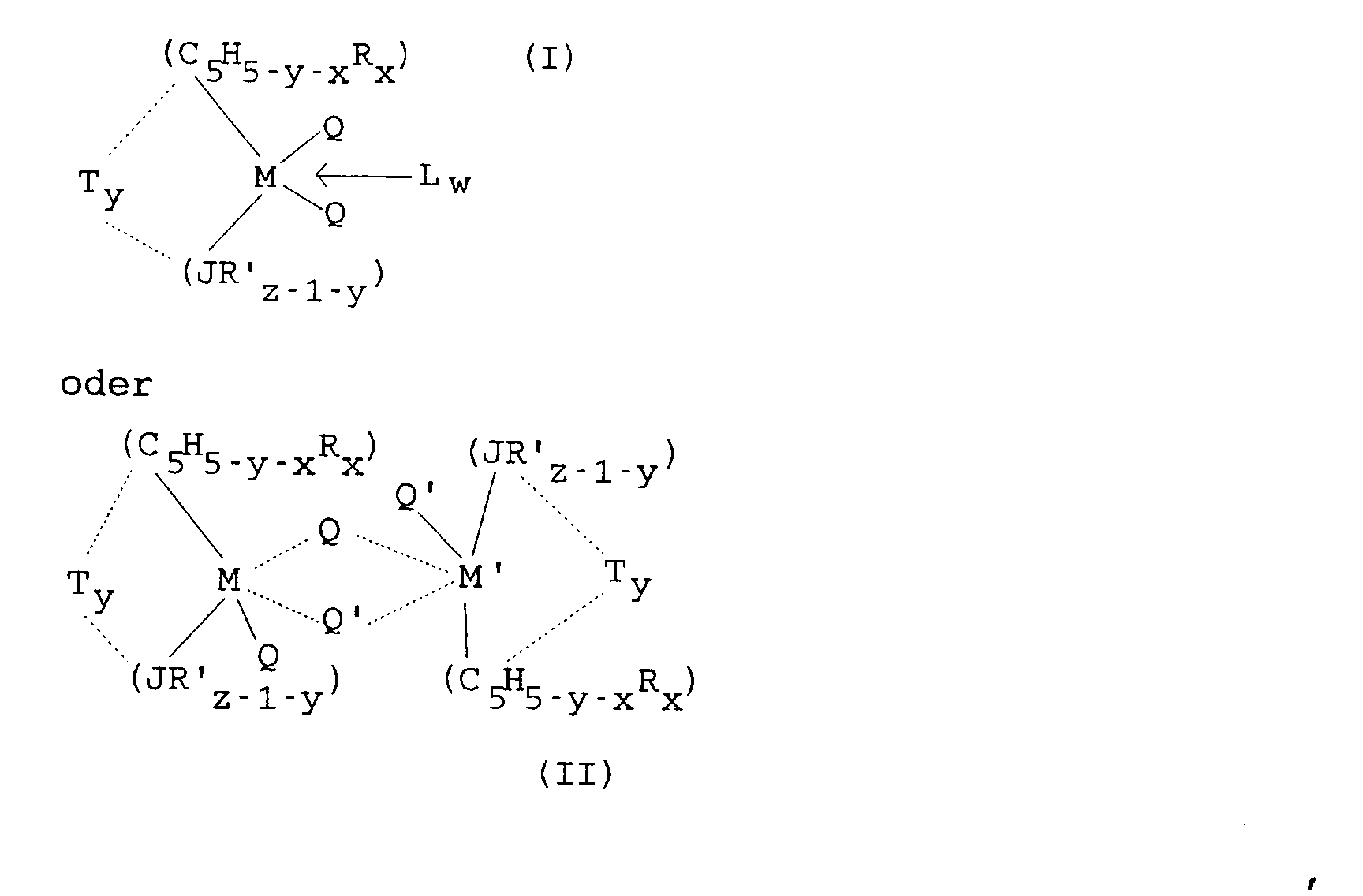 (C5H5-y-xRx) ein Cyclopentadienylring ist, der mit null bis fünf Substituentengruppen R substituiert ist, wobei "x" 0, 1, 2, 3, 4 oder 5 ist und den Substitutionsgrad angibt, und jede Substituentengruppe R unabhängig ein Rest ausgewählt aus einer Gruppe bestehend aus C1- bis C20-Kohlenwasserstoffresten; substituierten C1- bis C20-Kohlenwasserstoffresten, in denen ein oder mehrere Wasserstoffatome durch einen Halogenrest, einen Amidorest, einen Phosphidorest, einen Alkoxyrest, einen Alkylboridorest oder einen Rest, der eine Lewis-saure oder -basische Funktionalität enthält, ersetzt ist bzw. sind; mit C1- bis C20-Kohlenwasserstoff substituierten Metallaidresten, bei denen das Metalloid ausgewählt ist aus der Gruppe IV A des Periodensystems der Elemente; und Halogenresten, Amidoresten, Phosphidoresten, Alkoxyresten, Alkylboridoresten, oder einem Rest, der eine Lewis-saure oder -basische Funktionalität enthält; oder (C5H5-x-yRx) ein Cyclopentadienylring ist, bei dem zwei benachbarte R-Gruppen unter Bildung eines C4- bis C20-Rings miteinander verbunden sind, um einen gesättigten oder ungesättigten polycyclischen Cyclopentadienyl-Liganden zu ergeben;(JR'z-1-y) ein Heteroatom-Ligand ist, in dem J ein Element mit einer Koordinationszahl von drei aus der Gruppe V A oder ein Element mit einer Koordinationszahl von zwei aus der Gruppe VI A des Periodensystems der Elemente ist, jedes R' unabhängig ein Rest ausgewählt aus einer Gruppe bestehend aus C1- bis C20-Kohlenwasserstoffresten; substituierten C1- bis C20-Kohlenwasserstoffresten, in denen ein oder mehrere Wasserstoffatome durch einen Halogenrest, einen Amidorest, einen Phosphidorest, einen Alkoxyrest, einen Alkylboridorest oder einem Rest, der eine Lewis-saure oder -basische Funktionalität enthält, ersetzt ist bzw. sind; und "z" die Koordinationszahl des Elements J ist;jedes Q unabhängig ein einwertiger anionischer Ligand einschließlich Halogenid, Hydrid oder ein substituierter oder nicht substituierter C1- bis C20-Kohlenwasserstoff-, Alkoxid-, Aryloxid-, Amid-, Arylamid-, Phosphid- oder Arylphosphidrest ist, vorausgesetzt, daß wenn Q ein Kohlenwasserstoff-Ligand ist, dann dieses Q von (C5H5-y-xRx) verschieden ist, oder beide Q zusammen ein Alkyliden, ein cyclometallierter Kohlenwasserstoffrest oder ein zweiwertiger anionischer chelierender Ligand sind;"y" 0 oder 1 ist, wenn "w" größer als 0 ist; "y" gleich 1 ist, wenn "w" gleich 0 ist; wenn "y" gleich 1 ist, T eine kovalente Brückengruppe ist, die ein Element aus der Gruppe IV A oder V A enthält;L eine neutrale Lewisbase ist, wobei "w" eine Zahl von 0 bis 3 bedeutet oder (in Formel II) L eine zweite Verbindung der allgemeinen Formel vom Typ I bedeutet, in der M' und Q' die gleiche Definition wie M beziehungsweise Q haben, so daß M und M' durch Q und Q' verbrückt sind; und(C) ein Alumoxan entweder aufgebracht auf dem Träger durch Kombination der Übergangsmetallverbindung (B), des Alumoxans (C) und des Trägers (A) in irgendeiner Reihenfolge, aber ausgenommen eine Kombination von dehydroxyliertem Siliciumdioxid mit (tert.-Butylamido)dimethyl(tetramethyl-¶5-cyclopentadienyl)silantitandichlorid und anschließende Zugabe von Methylalumoxan, oder durch direkte Reaktion von Trialkylaluminium or Trialkylaluminiummischungen mit einem nassen Gel umfaßt.
 - Katalysatorsystem nach Anspruch 1, bei dem das Heteroelement der Ligandengruppe J Stickstoff, Phosphor, Sauerstoff oder Schwefel ist.
- Katalysatorsystem nach Anspruch 1 oder 2, bei dem das Molverhältnis von Aluminiumatom zu Übergangsmetallatom 1:1 bis 20 000:1, vorzugsweise 10:1 bis 1 000:1 beträgt.
- Katalysatorsystem nach einem der vorhergehenden Ansprüche, bei dem der Träger einen anorganischen Träger ausgewählt aus der Gruppe bestehend aus Talkum, Siliciumdioxid, Aluminiumoxid, Siliciumdioxid-Aluminiumoxid, Magnesiumoxid, Titandioxid, Zirkoniumoxid oder Mischungen aus zwei oder mehreren derselben umfaßt.
- Katalysatorsystem nach einem der vorhergehenden Ansprüche, bei dem der Träger mit einem Alumoxan oder einem Trialkylaluminium behandelt ist.
- Katalysatorsystem nach einem der vorhergehenden Ansprüche, bei dem der Träger dehydratisiert ist.
- Katalysatorsystem nach Anspruch 6, bei dem der Träger dehydratisiertes Siliciumdioxid ist, das mit Methylalumoxan oder Trimethyl- oder Triethylaluminium behandelt ist.
- Katalysatorsystem nach einem der Ansprüche 1 bis 5, bei dem das Alumoxan durch Umsetzung eines hydratisierten Trägers mit einem Trialkylaluminium auf dem Träger gebildet wird.
- Katalysatorsystem nach Anspruch 8, bei dem der hydratisierte Träger Siliciumdioxid ist, das 6 bis 20 Gew.% Wasser enthält und mit Trimethylaluminium umgesetzt wird.
- Katalysatorsystem nach einem der vorhergehenden Ansprüche, das außerdem eine Modifizierungsverbindung umfaßt, die eine Lewis-saure oder -basische Funktionalität enthält, vorzugsweise Tetraethoxysilan.
- Katalysatorsystem nach Anspruch 10, bei dem das Verhältnis von Aluminiumatomen zu Molekülen der Modifizierungsverbindung 1:1 bis 20 000:1 beträgt.
- Katalysatorsystem nach einem der vorhergehenden Ansprüche in vorpolymerisierter Form.
- Katalysatorsystem nach einem der vorhergehenden Ansprüche, das 0,01 bis 100 Gew.%, vorzugsweise 0,1 bis 20 Gew.% der Komponente (B) umfaßt, bezogen auf das Gewicht des Trägers.
- Katalysatorsystem nach einem der vorhergehenden Ansprüche, bei dem Komponente (B) durch die Formelwiedergegeben wird, in der Q, L, R', R, "x" und "w" wie zuvor definiert sind und R1 und R2 jeweils unabhängig ein C1-bis C20-Kohlenwasserstoffrest oder substituierter C1- bis C20-Kohlenwasserstoffrest sind, bei dem ein oder mehrere Wasserstoffatome durch ein Halogenatom ersetzt ist bzw. sind, oder R1 und R2 miteinander unter Bildung eines C3- bis C20-Rings verbunden sind, der die Siliciumbrücke mit einbezieht.

- Verfahren zur Herstellung eines mit einem Träger versehenen Katalysatorsystems gemäß Anspruch 1, bei dem (A), (B) und (C) in irgendeiner Reihenfolge in einem oder mehreren geeigneten Lösungsmitteln oder Verdünnungsmitteln kombiniert werden, aber ausgenommen eine Kombination von dehydroxyliertem Siliciumdioxid mit (tert.-Butylamido) dimethyl(tetramethyl-¶5-cyclopentadienyl)silantitandichlorid und anschließende Zugabe von Methylalumoxan, oder durch direkte Reaktion von Trialkylaluminium or Trialkylaluminiummischungen mit einem nassen Gel, um das gewünschte, mit einem Träger versehene Katalysatorsystem zu bilden.
- Verfahren nach Anspruch 15, bei dem (A) und (C) mit einer Lösung von (B) in einem Kohlenwasserstofflösungsmittel kombiniert werden.
- Verfahren nach Anspruch 15, bei dem (A) und (B) mit einer Lösung von (C) in einem Kohlenwasserstofflösungsmittel kombiniert werden.
- Verfahren nach Anspruch 15, bei dem (A) Wasser enthält und (C) auf (A) durch Reaktion dieses Wassers mit einer Trialkylaluminiumverbindung gebildet wird.
- Verfahren nach einem der Ansprüche 15 bis 18, bei dem während des Verfahrens eine Modifizierungsverbindung eingebracht wird, die eine Lewis-saure oder -basische Funktionalität enthält.
- Verfahren nach einem der Ansprüche 15 bis 19, bei dem in einer zusätzlichen Stufe das mit einem Träger versehene Katalysatorsystemprodukt einer Vorpolymerisation unterworfen wird.
- Verfahren zur Herstellung eines Polyolefins, bei dem ein oder mehrere olefinisch ungesättigte Monomere in Gegenwart eines mit einem Träger versehenen Katalysatorsystems gemäß einem der Ansprüche 1 bis 14 oder hergestellt gemäß einem der Ansprüche 15 bis 20 polymerisiert werden.
- Verfahren nach Anspruch 21, bei dem das Monomer bzw. die Monomere eines oder mehrere von Ethylen, α-Olefinen, Diolefinen, cyclischen Olefinen umfaßt bzw. umfassen.
- Verfahren nach Anspruch 21 oder 22, das in der Gasphase oder Aufschlämmungsphase durchgeführt wird.
Applications Claiming Priority (3)
| Application Number | Priority Date | Filing Date | Title |
|---|---|---|---|
| US07/581,869 US5057475A (en) | 1989-09-13 | 1990-09-13 | Mono-Cp heteroatom containing group IVB transition metal complexes with MAO: supported catalyst for olefin polymerization |
| US581869 | 1990-09-13 | ||
| PCT/US1991/006669 WO1992005203A1 (en) | 1990-09-13 | 1991-09-13 | Supported monocyclopentadienyl transition metal olefin polymerization catalysts |
Publications (3)
| Publication Number | Publication Date |
|---|---|
| EP0548257A1 EP0548257A1 (de) | 1993-06-30 |
| EP0548257B1 EP0548257B1 (de) | 1996-01-03 |
| EP0548257B2 true EP0548257B2 (de) | 2000-10-04 |
Family
ID=24326901
Family Applications (1)
| Application Number | Title | Priority Date | Filing Date |
|---|---|---|---|
| EP91917626A Expired - Lifetime EP0548257B2 (de) | 1990-09-13 | 1991-09-13 | Trägerkatalysator für olefinpolymerisation mit monozyklopentadienylkomplexen von übergangsmetallen |
Country Status (9)
| Country | Link |
|---|---|
| US (1) | US5057475A (de) |
| EP (1) | EP0548257B2 (de) |
| JP (1) | JP2944212B2 (de) |
| AT (1) | ATE132507T1 (de) |
| BR (1) | BR9106841A (de) |
| CA (1) | CA2090972C (de) |
| DE (1) | DE69116157T3 (de) |
| ES (1) | ES2082233T5 (de) |
| WO (1) | WO1992005203A1 (de) |
Families Citing this family (362)
| Publication number | Priority date | Publication date | Assignee | Title |
|---|---|---|---|---|
| US5055438A (en) * | 1989-09-13 | 1991-10-08 | Exxon Chemical Patents, Inc. | Olefin polymerization catalysts |
| US5264405A (en) * | 1989-09-13 | 1993-11-23 | Exxon Chemical Patents Inc. | Monocyclopentadienyl titanium metal compounds for ethylene-α-olefin-copolymer production catalysts |
| US5621126A (en) | 1987-01-30 | 1997-04-15 | Exxon Chemical Patents Inc. | Monocyclopentadienyl metal compounds for ethylene-α-olefin-copolymer production catalysts |
| USRE37788E1 (en) * | 1987-01-30 | 2002-07-09 | Exxon Chemical Patents, Inc. | Monocyclopentadienyl metal compounds for ethylene-α-olefin-copolymer production catalysts |
| NZ235032A (en) | 1989-08-31 | 1993-04-28 | Dow Chemical Co | Constrained geometry complexes of titanium, zirconium or hafnium comprising a substituted cyclopentadiene ligand; use as olefin polymerisation catalyst component |
| US6025448A (en) | 1989-08-31 | 2000-02-15 | The Dow Chemical Company | Gas phase polymerization of olefins |
| US6686488B2 (en) | 1989-08-31 | 2004-02-03 | The Dow Chemical Company | Constrained geometry addition polymerization catalysts |
| US5763547A (en) * | 1992-10-02 | 1998-06-09 | The Dow Chemical Company | Supported catalyst complexes for olefin in polymerization |
| US6825369B1 (en) * | 1989-09-14 | 2004-11-30 | The Dow Chemical Company | Metal complex compounds |
| US6294625B1 (en) | 1990-03-20 | 2001-09-25 | Exxonmobil Chemical Patents Inc. | Catalyst system of enhanced productivity and its use in polymerization process |
| EP0452840B1 (de) * | 1990-04-18 | 1998-10-28 | Mitsui Chemicals, Inc. | Syndiotaktisches Propylencopolymer, Herstellung davon und dieses Copolymer enthaltende Zusammensetzung |
| US5801113A (en) * | 1990-06-22 | 1998-09-01 | Exxon Chemical Patents, Inc. | Polymerization catalyst systems, their production and use |
| US6538080B1 (en) | 1990-07-03 | 2003-03-25 | Bp Chemicals Limited | Gas phase polymerization of olefins |
| US5272236A (en) * | 1991-10-15 | 1993-12-21 | The Dow Chemical Company | Elastic substantially linear olefin polymers |
| DE4119343A1 (de) * | 1991-06-12 | 1992-12-17 | Basf Ag | Isolierbares, getraegertes katalysatorsystem zur polymerisation von c(pfeil abwaerts)2(pfeil abwaerts)- bis c(pfeil abwaerts)1(pfeil abwaerts)(pfeil abwaerts)0(pfeil abwaerts)-alk-1-enen |
| US5594078A (en) * | 1991-07-23 | 1997-01-14 | Phillips Petroleum Company | Process for producing broad molecular weight polyolefin |
| US5783638A (en) * | 1991-10-15 | 1998-07-21 | The Dow Chemical Company | Elastic substantially linear ethylene polymers |
| US5525695A (en) * | 1991-10-15 | 1996-06-11 | The Dow Chemical Company | Elastic linear interpolymers |
| ES2108861T3 (es) * | 1991-11-25 | 1998-01-01 | Exxon Chemical Patents Inc | Composiciones cataliticas polionicas de metales de transicion. |
| DE4139262A1 (de) * | 1991-11-29 | 1993-06-03 | Basf Ag | Getraegerte katalysatorsysteme zur polymerisation von c(pfeil abwaerts)2(pfeil abwaerts)- bis c(pfeil abwaerts)1(pfeil abwaerts)(pfeil abwaerts)0(pfeil abwaerts)-alkenen |
| EP0618931B2 (de) † | 1991-12-23 | 2000-11-02 | Exxon Chemical Patents Inc. | Modifizierte monocyclopentadienyl-uebergangsmetal/aluminoxan katalysatorsystem fuer olefinpolymerisation |
| US6545088B1 (en) | 1991-12-30 | 2003-04-08 | Dow Global Technologies Inc. | Metallocene-catalyzed process for the manufacture of EP and EPDM polymers |
| US6143854A (en) * | 1993-08-06 | 2000-11-07 | Exxon Chemical Patents, Inc. | Polymerization catalysts, their production and use |
| EP0578838A1 (de) * | 1992-04-29 | 1994-01-19 | Hoechst Aktiengesellschaft | Katalysator für die Olefinpolymerisation, Verfahren zu seiner Herstellung und seine Verwendung |
| US5240894A (en) * | 1992-05-18 | 1993-08-31 | Exxon Chemical Patents Inc. | Method for making and using a supported metallocene catalyst system |
| BE1005957A5 (fr) | 1992-06-05 | 1994-04-05 | Solvay | Procede de preparation d'un systeme catalytique, procede de (co)polymerisation d'olefines et (co)polymeres d'au moins une olefine. |
| JPH061803A (ja) * | 1992-06-18 | 1994-01-11 | Mitsubishi Petrochem Co Ltd | オレフィンの重合法 |
| DE69312306T2 (de) * | 1992-10-02 | 1997-11-13 | Dow Chemical Co | Aufträger homogener komplexkatalysator für olefinpolymerisation |
| ES2136132T3 (es) * | 1992-10-05 | 1999-11-16 | Exxon Chemical Patents Inc | Procedimiento de polimerizacion que emplea un sistema catalizador con productividad mejorada. |
| US5317036A (en) * | 1992-10-16 | 1994-05-31 | Union Carbide Chemicals & Plastics Technology Corporation | Gas phase polymerization reactions utilizing soluble unsupported catalysts |
| EP0597502B1 (de) | 1992-11-13 | 2005-03-16 | Cryovac, Inc. | Wärmeschrumpfbare, durch Single-site-Katalyse hergestellte Copolymere enthaltende Folien. |
| US5322728A (en) * | 1992-11-24 | 1994-06-21 | Exxon Chemical Patents, Inc. | Fibers of polyolefin polymers |
| US5604043A (en) * | 1993-09-20 | 1997-02-18 | W.R. Grace & Co.-Conn. | Heat shrinkable films containing single site catalyzed copolymers having long chain branching |
| US5859159A (en) * | 1992-12-17 | 1999-01-12 | Exxon Chemical Patents Inc. | Dilute process for the polymerization of non-ethylene α-olefin homopolymers and copolymers using metallocene catalyst systems |
| US5554310A (en) | 1992-12-17 | 1996-09-10 | Exxon Chemical Patents Inc. | Trisubstituted unsaturated polymers |
| CA2085813C (en) * | 1992-12-18 | 2001-06-12 | Bankim B. Desai | Formulation of high abuse, high shrink barrier bags for meat packaging |
| US5602067A (en) * | 1992-12-28 | 1997-02-11 | Mobil Oil Corporation | Process and a catalyst for preventing reactor fouling |
| US5420220A (en) * | 1993-03-25 | 1995-05-30 | Mobil Oil Corporation | LLDPE films |
| US5332706A (en) * | 1992-12-28 | 1994-07-26 | Mobil Oil Corporation | Process and a catalyst for preventing reactor fouling |
| GB9300934D0 (en) * | 1993-01-19 | 1993-03-10 | Bp Chem Int Ltd | Metallocene complexes |
| BR9405715A (pt) * | 1993-01-29 | 1995-11-28 | Dow Chemical Co | Processo para preparar um composição de interpolímero de etileno/a-olefina e composição de interpolímero de etileno/a-olefina |
| US5391529A (en) * | 1993-02-01 | 1995-02-21 | Albemarle Corporation | Siloxy-aluminoxane compositions, and catalysts which include such compositions with a metallocene |
| ES2156153T3 (es) * | 1993-06-15 | 2001-06-16 | Idemitsu Kosan Co | Procedimiento de produccion de polimero olefinico, y catalizador para la polimerizacion de una olefina. |
| US7316833B1 (en) | 1993-06-24 | 2008-01-08 | Penchiney Emballage Flexible Europe | Multi-layer thermoplastic films and packages made therefrom |
| US5414180A (en) * | 1993-07-14 | 1995-05-09 | Phillips Petroleum Company | Organo-aluminoxy product and use |
| JPH0733821A (ja) * | 1993-07-22 | 1995-02-03 | Nippon Oil Co Ltd | オレフィン類重合用触媒成分 |
| DE69427095T2 (de) | 1993-09-17 | 2001-11-15 | Exxonmobil Chemical Patents Inc., Baytown | Polymerisations katalysator systeme, ihre herstellung und verwendung |
| US5455741A (en) * | 1993-10-26 | 1995-10-03 | Pulse Engineering, Inc. | Wire-lead through hole interconnect device |
| FI96866C (fi) * | 1993-11-05 | 1996-09-10 | Borealis As | Tuettu olefiinipolymerointikatalyytti, sen valmistus ja käyttö |
| WO1995013317A1 (en) * | 1993-11-08 | 1995-05-18 | Mobil Oil Corporation | A composition comprising a blend of an ethylene polymer or copolymer with sorbitol or a sorbitol derivative |
| US5614456A (en) * | 1993-11-15 | 1997-03-25 | Mobil Oil Corporation | Catalyst for bimodal molecular weight distribution ethylene polymers and copolymers |
| US5672669A (en) * | 1993-12-23 | 1997-09-30 | Union Carbide Chemicals & Plastics Technology Corporation | Spray dried, filled metallocene catalyst composition for use in polyolefin manufacture |
| US5648310A (en) * | 1993-12-23 | 1997-07-15 | Union Carbide Chemicals & Plastics Technology Corporation | Spray dried, filled metallocene catalyst composition for use in polyolefin manufacture |
| CA2180180C (en) * | 1994-01-11 | 2006-03-14 | Jeffrey Harold Butler | Alumoxanes and catalysts comprising alumoxanes |
| US5691422A (en) * | 1994-03-07 | 1997-11-25 | Exxon Chemical Patents Inc. | Saturated polyolefins having terminal aldehyde or hydroxy substituents and derivatives thereof |
| US5674950A (en) * | 1994-03-07 | 1997-10-07 | Exxon Chemical Patents Inc. | Polymers having terminal hydroxyl aldehyde, or alkylamino substitutents and derivatives thereof |
| US5496781A (en) * | 1994-05-16 | 1996-03-05 | Phillips Petroleum Company | Metallocene catalyst systems, preparation, and use |
| WO1995033776A1 (en) * | 1994-06-07 | 1995-12-14 | Specs And Biospecs B.V. | Novel organo-metallic compounds, methods for preparing same, and a method for the polymerization of unsaturated hydrocarbons using said organo-metallic compounds as catalysts, as well as novel semi-products and catalyst preparations |
| US5936041A (en) * | 1994-06-17 | 1999-08-10 | Exxon Chemical Patents Inc | Dispersant additives and process |
| AU686836B2 (en) * | 1994-06-24 | 1998-02-12 | Exxon Chemical Patents Inc. | Polymerization catalyst systems, their production and use |
| US6160066A (en) | 1994-06-24 | 2000-12-12 | Exxon Chemical Patents, Inc. | Monocyclopentadienyl metal compounds for ethylene-α-olefin-copolymer production catalysts |
| US5955625A (en) * | 1995-01-31 | 1999-09-21 | Exxon Chemical Patents Inc | Monocyclopentadienyl metal compounds for ethylene-α-olefin-copolymer production catalysts |
| US5486632A (en) * | 1994-06-28 | 1996-01-23 | The Dow Chemical Company | Group 4 metal diene complexes and addition polymerization catalysts therefrom |
| AU712427B2 (en) * | 1994-07-11 | 1999-11-04 | Exxon Chemical Patents Inc. | Lubricating oil succinimide dispersants derived from heavy polyamine |
| CA2195879C (en) * | 1994-08-03 | 2001-01-09 | John Flexer Walzer Jr. | Supported ionic catalyst composition |
| US5643847A (en) * | 1994-08-03 | 1997-07-01 | Exxon Chemical Patents Inc. | Supported ionic catalyst composition |
| US6143686A (en) * | 1994-08-03 | 2000-11-07 | Exxon Chemical Patents, Inc. | Supported ionic catalyst compositions |
| US6111020A (en) * | 1994-09-02 | 2000-08-29 | The Dow Chemical Company | Crosslinked foams from blends of ethylene vinyl acetate and ethylene-styrene interpolymers |
| US5541349A (en) * | 1994-09-12 | 1996-07-30 | The Dow Chemical Company | Metal complexes containing partially delocalized II-bound groups and addition polymerization catalysts therefrom |
| US5495036A (en) * | 1994-09-12 | 1996-02-27 | The Dow Chemical Company | Metal (III) complexes containing conjugated, non-aromatic anionic II-bound groups and addition polymerization catalysts therefrom |
| EP0701897B1 (de) | 1994-09-16 | 2001-04-18 | Cryovac, Inc. | Thermoplastischer Mehrschichtfilm zum Verpacken von Wasser |
| US5525678A (en) * | 1994-09-22 | 1996-06-11 | Mobil Oil Corporation | Process for controlling the MWD of a broad/bimodal resin produced in a single reactor |
| US5834077A (en) * | 1994-10-04 | 1998-11-10 | W. R. Grace & Co.-Conn. | High shrink multilayer film which maintains optics upon shrinking |
| US5837335A (en) * | 1994-10-04 | 1998-11-17 | Cryovac, Inc. | High shrink multilayer film which maintains optics upon shrinking |
| US5565128A (en) * | 1994-10-12 | 1996-10-15 | Exxon Chemical Patents Inc | Lubricating oil mannich base dispersants derived from heavy polyamine |
| EP0785956B1 (de) * | 1994-10-13 | 1999-04-28 | Exxon Chemical Patents Inc. | Polymerisation Katalysatorsysteme, ihre Herstellung und ihre Verwendung |
| US6140432A (en) * | 1995-07-13 | 2000-10-31 | Exxon Chemical Patents Inc. | Polymerization catalyst systems, their production and use |
| EP0785955B1 (de) * | 1994-10-13 | 1999-07-14 | Exxon Chemical Patents Inc. | Verfahren zur herstellung von polymerisationskatalysatorsystemen und ihre verwendung |
| US5792534A (en) | 1994-10-21 | 1998-08-11 | The Dow Chemical Company | Polyolefin film exhibiting heat resistivity, low hexane extractives and controlled modulus |
| US6043180A (en) * | 1994-11-17 | 2000-03-28 | The Dow Chemical Company | Supported catalyst component, supported catalyst, their preparation, and addition polymerization process |
| US6506866B2 (en) * | 1994-11-17 | 2003-01-14 | Dow Global Technologies Inc. | Ethylene copolymer compositions |
| US7153909B2 (en) * | 1994-11-17 | 2006-12-26 | Dow Global Technologies Inc. | High density ethylene homopolymers and blend compositions |
| US5625015A (en) | 1994-11-23 | 1997-04-29 | Exxon Chemical Patents Inc. | Method for making supported catalyst systems and catalyst systems therefrom |
| US5512693A (en) * | 1994-12-07 | 1996-04-30 | The Dow Chemical Company | Preparation of titanium (II) or zirconium (II) complexes |
| US6287613B1 (en) | 1994-12-12 | 2001-09-11 | Cryovac Inc | Patch bag comprising homogeneous ethylene/alpha-olefin copolymer |
| DE69520370T2 (de) * | 1994-12-15 | 2001-10-31 | Exxon Chemical Patents, Inc. | Polymerisationskatalysatorsysteme, ihre herstellung und ihre verwendung |
| US5939347A (en) * | 1995-01-25 | 1999-08-17 | W.R. Grace & Co. -Conn. | Supported catalytic activator |
| US5895770A (en) * | 1995-02-28 | 1999-04-20 | Pq Corporation | Olefin polymerization catalysts with specific silica supports |
| BR9604776A (pt) * | 1995-03-10 | 1998-06-23 | Dow Chemical Co | Componente de catalisador sustentado catalisador sustentado processo para preparar um componente de catalisador sustentado e um catalisador sustentado aduto de um composto organometálico processo de polimerizaçao por adiç o composto complexo e método para preparar um composto complexo |
| US5491246A (en) * | 1995-04-24 | 1996-02-13 | The Dow Chemical Company | Synthesis of group 4 metal diene complexes |
| US5882750A (en) * | 1995-07-03 | 1999-03-16 | Mobil Oil Corporation | Single reactor bimodal HMW-HDPE film resin with improved bubble stability |
| US5731253A (en) * | 1995-07-27 | 1998-03-24 | Albemarle Corporation | Hydrocarbylsilloxy - aluminoxane compositions |
| US5869575A (en) * | 1995-08-02 | 1999-02-09 | The Dow Chemical Company | Ethylene interpolymerizations |
| ES2120868B1 (es) * | 1995-08-03 | 2000-09-16 | Repsol Quimica Sa | Sistema de catalizadores hetereogeneos tipo metalogeno, para procesos de obtencion de poliolefinas. |
| US5648308A (en) * | 1995-08-10 | 1997-07-15 | Albemarle Corporation | Process for upgrading metallocene catalysts |
| EP0843687B1 (de) | 1995-08-10 | 2002-06-12 | ExxonMobil Chemical Patents Inc. | Mit metallocen stabilisiertes alumoxan |
| US5652202A (en) * | 1995-08-15 | 1997-07-29 | Exxon Chemical Patents Inc. | Lubricating oil compositions |
| US5558802A (en) * | 1995-09-14 | 1996-09-24 | Exxon Chemical Patents Inc | Multigrade crankcase lubricants with low temperature pumpability and low volatility |
| US6063725A (en) * | 1995-11-07 | 2000-05-16 | Mitsui Chemicals, Inc. | Olefin polymerization catalyst system |
| US6486089B1 (en) | 1995-11-09 | 2002-11-26 | Exxonmobil Oil Corporation | Bimetallic catalyst for ethylene polymerization reactions with uniform component distribution |
| US5856255A (en) * | 1996-01-22 | 1999-01-05 | Albemarle Corporation | Preparation of supported auxiliary catalysts at elevated temperature and pressure in a closed vessel |
| AT403919B (de) * | 1996-02-02 | 1998-06-25 | Danubia Petrochem Polymere | Verfahren zur herstellung von katalysatorträgern und geträgerter polyolefin-katalysatoren sowie deren verwendung für die herstellung von polyolefinen |
| US6417130B1 (en) | 1996-03-25 | 2002-07-09 | Exxonmobil Oil Corporation | One pot preparation of bimetallic catalysts for ethylene 1-olefin copolymerization |
| ES2129323B1 (es) * | 1996-04-18 | 2000-09-16 | Repsol Quimica Sa | Procedimiento para la obtencion de un sistema catalitico para la polimerizacion de alpha-olefinas en suspension en fase gas a bajas y altas temperaturas o en masa a altas presiones y altas o bajas temperaturas |
| US6218330B1 (en) * | 1996-05-09 | 2001-04-17 | Fina Research, S. A. | Process for preparing and using a supported metallocene-alumoxane catalyst |
| JPH09309926A (ja) * | 1996-05-17 | 1997-12-02 | Dow Chem Co:The | エチレン共重合体の製造方法 |
| US5723402A (en) * | 1996-05-30 | 1998-03-03 | Pq Corporation | Silicas with specific contents of cations as supports for olefin polymerization catalysts |
| HU223533B1 (hu) | 1996-06-17 | 2004-08-30 | Exxonmobil Chemical Patents Inc. | Vegyes átmenetifém katalizátor-rendszer olefinek polimerizálására |
| ATE200785T1 (de) * | 1996-07-04 | 2001-05-15 | Basf Ag | Verfahren zur herstellung von geträgerten übergangsmetallkatalysatoren |
| US5959044A (en) * | 1996-07-08 | 1999-09-28 | Villar; Juan Carlos | Method of controlling continuous ethylene-limited metallocene-catalyzed copolymerization systems |
| WO1998002247A1 (en) * | 1996-07-15 | 1998-01-22 | Mobil Oil Corporation | Comonomer pretreated bimetallic catalyst for blow molding and film applications |
| CA2260985A1 (en) * | 1996-07-22 | 1998-01-29 | Richard D. Ernst | Metal complexes containing bridged, non-aromatic, anionic, dienyl groups and addition polymerization catalysts therefrom |
| HU223376B1 (hu) * | 1996-07-23 | 2004-06-28 | Dow Global Technologies Inc. | A 13. csoport vegyületét tartalmazó olefin polimerizációs katalizátor készítmények |
| ES2224266T3 (es) | 1996-08-08 | 2005-03-01 | Dow Global Technologies Inc. | Copmplejos metalicos que contienen ciclopentadienilo sustituido en la posicion 3 con un heteroatomo y procedimiento de polimerizacion de olefinas. |
| WO1998010160A1 (en) | 1996-09-04 | 1998-03-12 | The Dow Chemical Company | Floor, wall or ceiling covering |
| ZA977909B (en) | 1996-09-04 | 1999-03-03 | Dow Chemical Co | Compositions comprising a substantially random interpolymer of at least one alpha-olefin and at least one vinylidene aromatic monomer or hindered aliphatic vinylidene monomer |
| US6271322B1 (en) * | 1996-10-02 | 2001-08-07 | Mccullough Laughlin Gerard | Monocyclopentadienyl transition metal catalyst and olefin polymerization process |
| US6015868A (en) * | 1996-10-03 | 2000-01-18 | The Dow Chemical Company | Substituted indenyl containing metal complexes and olefin polymerization process |
| US5847177A (en) * | 1996-10-10 | 1998-12-08 | Albemarle Corporation | Production of hydrocarbon-soluble hydrocarbylaluminoxanes |
| EP0839835B1 (de) * | 1996-10-30 | 2000-02-16 | Repsol Quimica S.A. | Organometallische Katalysatoren für die Polymerisation und die Copolymerisation von Alpha-Olefinen |
| US6635778B1 (en) | 1996-10-30 | 2003-10-21 | Repsol Quimica S.A. | Catalysts systems for the polymerization and copolymerization of alpha-olefins |
| DE69703728T2 (de) * | 1996-10-31 | 2001-06-28 | Repsol Quimica S.A., Madrid | Katalysatorsysteme für die Polymerisation und Copolymerisation von Alpha-Olefinen |
| US6812289B2 (en) | 1996-12-12 | 2004-11-02 | Dow Global Technologies Inc. | Cast stretch film of interpolymer compositions |
| US6245856B1 (en) | 1996-12-17 | 2001-06-12 | Exxon Chemical Patents, Inc. | Thermoplastic olefin compositions |
| US5965756A (en) * | 1996-12-19 | 1999-10-12 | The Dow Chemical Company | Fused ring substituted indenyl metal complexes and polymerization process |
| US6005463A (en) * | 1997-01-30 | 1999-12-21 | Pulse Engineering | Through-hole interconnect device with isolated wire-leads and component barriers |
| EP0856524A1 (de) | 1997-02-01 | 1998-08-05 | Repsol Quimica S.A. | Heterogene Katalysatorzusammensetzungen zur Polymerisation von Olefinen, Verfahren zu deren Herstellung und deren Verwendung |
| DE69809192T2 (de) | 1997-02-07 | 2003-07-24 | Exxonmobil Chemical Patents Inc., Baytown | Propylenpolymere enthaltend polyethylenmakromonomere |
| US5851945A (en) * | 1997-02-07 | 1998-12-22 | Exxon Chemical Patents Inc. | Olefin polymerization catalyst compositions comprising group 5 transition metal compounds stabilized in their highest metal oxidation state |
| EP0878486B1 (de) * | 1997-02-21 | 2006-01-25 | Council of Scientific and Industrial Research | Verfahren zur Herstellung eines geträgerten Metallocen-Katalysators |
| CA2200373C (en) * | 1997-03-19 | 2005-11-15 | Rupert Edward Von Haken Spence | Heteroligand |
| AR012582A1 (es) | 1997-04-14 | 2000-11-08 | Dow Global Technologies Inc | Composiciones polimericas de elongacion mejorada y formulaciones adhesivas de fusion en caliente que incluyen dicha composicion |
| US6420507B1 (en) | 1997-05-01 | 2002-07-16 | The Dow Chemical Company | Olefin polymers prepared with substituted indenyl containing metal complexes |
| US6228795B1 (en) | 1997-06-05 | 2001-05-08 | Exxon Chemical Patents, Inc. | Polymeric supported catalysts |
| US6319969B1 (en) | 1997-06-26 | 2001-11-20 | The Dow Chemical Company | Interpolymer compositions for use in sound management |
| US6262161B1 (en) | 1997-06-26 | 2001-07-17 | The Dow Chemical Company | Compositions having improved ignition resistance |
| US6153551A (en) | 1997-07-14 | 2000-11-28 | Mobil Oil Corporation | Preparation of supported catalyst using trialkylaluminum-metallocene contact products |
| US6051525A (en) * | 1997-07-14 | 2000-04-18 | Mobil Corporation | Catalyst for the manufacture of polyethylene with a broad or bimodal molecular weight distribution |
| EP1002014A1 (de) | 1997-08-08 | 2000-05-24 | The Dow Chemical Company | Folienmaterialien für boden-, wand- und deckenbekleidung, und verfahren und zwischenprodukte zu ihrer herstellung |
| US7026404B2 (en) * | 1997-08-12 | 2006-04-11 | Exxonmobil Chemical Patents Inc. | Articles made from blends made from propylene ethylene polymers |
| US6635715B1 (en) | 1997-08-12 | 2003-10-21 | Sudhin Datta | Thermoplastic polymer blends of isotactic polypropylene and alpha-olefin/propylene copolymers |
| US7232871B2 (en) | 1997-08-12 | 2007-06-19 | Exxonmobil Chemical Patents Inc. | Propylene ethylene polymers and production process |
| US6921794B2 (en) * | 1997-08-12 | 2005-07-26 | Exxonmobil Chemical Patents Inc. | Blends made from propylene ethylene polymers |
| JP2001515114A (ja) | 1997-08-15 | 2001-09-18 | ザ ダウ ケミカル カンパニー | 実質的に線状の均一なオレフィン重合体組成物から製造されるフィルム |
| DE69807708T2 (de) | 1997-08-27 | 2003-01-02 | The Dow Chemical Co., Midland | Elastomere mit verbesserter verarbeitbarkeit |
| US6235917B1 (en) | 1998-08-28 | 2001-05-22 | The Dow Chemical Company | Dinuclear complexes and polymerization catalysts therefrom |
| EP1015462B1 (de) * | 1997-09-15 | 2002-08-28 | The Dow Chemical Company | Bimetallische komplexe und diese enthaltende polymerisationskatalysatoren |
| US6284698B1 (en) | 1997-09-15 | 2001-09-04 | The Dow Chemical Company | Highly activated bimetallic complexes and polymerization process |
| CA2215444C (en) * | 1997-09-15 | 2005-08-02 | Stephen John Brown | Catalyst having a ketimide ligand |
| JP2001520291A (ja) | 1997-10-17 | 2001-10-30 | ザ ダウ ケミカル カンパニー | アルファ−オレフィンモノマーと1種以上のビニルもしくはビニリデン芳香族モノマーから作られたインターポリマー類の組成物 |
| US6184327B1 (en) | 1997-12-10 | 2001-02-06 | Exxon Chemical Patents, Inc. | Elastomeric propylene polymers |
| US6117962A (en) * | 1997-12-10 | 2000-09-12 | Exxon Chemical Patents Inc. | Vinyl-containing stereospecific polypropylene macromers |
| US6197910B1 (en) | 1997-12-10 | 2001-03-06 | Exxon Chemical Patents, Inc. | Propylene polymers incorporating macromers |
| WO1999036427A1 (en) * | 1998-01-14 | 1999-07-22 | Montell Technology Company B.V. | Process for the preparation of metallocene compounds |
| US6177375B1 (en) | 1998-03-09 | 2001-01-23 | Pq Corporation | High activity olefin polymerization catalysts |
| ZA991938B (en) * | 1998-03-11 | 2000-09-10 | Dow Chemical Co | Structures and fabricated articles having shape memory made from alpha-olefin/vinyl or vinylidene aromatic and/or hindered aliphatic vinyl or vinylidene interpolymers. |
| BR9908805A (pt) | 1998-03-11 | 2000-10-31 | Dow Chemical Co | Composições termoplásticas de misturas de materiais poliméricos com termoplásticos de engenharia |
| AU755566B2 (en) | 1998-03-11 | 2002-12-12 | Dow Global Technologies Inc. | Fibers made from alpha-olefin/vinyl or vinylidene aromatic and/or hindered cycloaliphatic or aliphatic vinyl or vinylidene interpolymers |
| AU747560B2 (en) * | 1998-03-16 | 2002-05-16 | Dow Chemical Company, The | Open-cell foam and method of making |
| KR100380018B1 (ko) | 1998-04-09 | 2003-10-04 | 주식회사 엘지화학 | 메탈로센담지촉매및이를이용한올레핀중합방법 |
| KR100358225B1 (ko) | 1998-04-09 | 2003-01-24 | 주식회사 엘지화학 | 조촉매의 재순환이 가능한 메탈로센 촉매 중합 방법 |
| DE69914012T2 (de) | 1998-04-27 | 2004-12-09 | Repsol Quimica S.A. | Katalysatorsysteme für die Polymerisation und Copolymerisation von Alpha-Olefinen |
| DE69916358T2 (de) * | 1998-04-29 | 2005-04-21 | Repsol Quimica Sa | Verfahren und Verwendung von heterogenen Katalysatorbestandteilen für die Olefinpolymerisation |
| US6001764A (en) * | 1998-05-08 | 1999-12-14 | Pq Corporation | Olefin polymerization catalysts with specific silica supports |
| US6784269B2 (en) | 1998-05-13 | 2004-08-31 | Exxonmobil Chemical Patents Inc. | Polypropylene compositions methods of making the same |
| US6306960B1 (en) | 1998-05-13 | 2001-10-23 | Exxonmobil Chemical Patents Inc. | Articles formed from foamable polypropylene polymer |
| EP1078009B1 (de) | 1998-05-13 | 2004-06-16 | ExxonMobil Chemical Patents Inc. | Propylenhomopolymere und herstellungsverfahren |
| AU4962399A (en) | 1998-07-01 | 2000-01-24 | Exxon Chemical Patents Inc. | Elastic blends comprising crystalline polymer and crystallizable polymers of propylene |
| US6395846B1 (en) * | 1998-08-20 | 2002-05-28 | Idemitsu Petrochemical Co., Ltd. | Catalysts for olefin polymer production |
| EP1115761B1 (de) | 1998-08-26 | 2013-09-18 | ExxonMobil Chemical Patents Inc. | Verzweigte polypropylenzusammensetzungen |
| US6403773B1 (en) | 1998-09-30 | 2002-06-11 | Exxon Mobil Chemical Patents Inc. | Cationic group 3 catalyst system |
| US6087515A (en) | 1998-10-07 | 2000-07-11 | Solvay Polyolefins Europe-Belgium (Societe Anonyme) | Metallocenes and process for the preparation of metallocenes |
| AU1241600A (en) | 1998-11-02 | 2000-05-22 | Dupont Dow Elastomers L.L.C. | Shear thinning ethylene/alpha-olefin interpolymers and their preparation |
| US6048909A (en) * | 1998-12-04 | 2000-04-11 | The Dow Chemical Company | Foams having increased heat distortion temperature made from blends of alkenyl aromatic polymers and alpha-olefin/vinyl or vinylidene aromatic and/or sterically hindered aliphatic or cycloaliphatic vinyl or vinylidene interpolymers |
| US6231795B1 (en) | 1998-12-04 | 2001-05-15 | The Dow Chemical Company | Soft and flexible foams made from blends of alkenyl aromatic polymers and alpha-olefin/vinyl or vinylidene aromatic and/or sterically hindered aliphatic or cycloaliphatic vinyl or vinylidene interpolymers |
| US6187232B1 (en) * | 1998-12-04 | 2001-02-13 | The Dow Chemical Company | Acoustical insulation foams |
| US5993707A (en) * | 1998-12-04 | 1999-11-30 | The Dow Chemical Company | Enlarged cell size foams made from blends of alkenyl aromatic polymers and alpha-olefin/vinyl or vinylidene aromatic and/or sterically hindered aliphatic or cycloaliphatic vinyl or vinylidene interpolymers |
| GB9826874D0 (en) * | 1998-12-07 | 1999-01-27 | Borealis As | Process |
| KR20010093810A (ko) | 1998-12-08 | 2001-10-29 | 그래햄 이. 테일러 | 용융결합가능한 폴리프로필렌/에틸렌 중합체 섬유 및 이를제조하기 위한 조성물 |
| US6174471B1 (en) | 1999-03-15 | 2001-01-16 | The Dow Chemical Company | Open-cell foam and method of making |
| US6410124B1 (en) | 1999-03-30 | 2002-06-25 | Exxonmobil Oil Corporation | Films with improved metallizable surfaces |
| US6174930B1 (en) | 1999-04-16 | 2001-01-16 | Exxon Chemical Patents, Inc. | Foamable polypropylene polymer |
| JP2002543208A (ja) | 1999-04-29 | 2002-12-17 | ザ ダウ ケミカル カンパニー | ビス(n、n−ジヒドロカルビルアミノ)置換シクロペンタジエン及びそれらの金属錯体 |
| US6339134B1 (en) | 1999-05-06 | 2002-01-15 | Univation Technologies, Llc | Polymerization process for producing easier processing polymers |
| US6750284B1 (en) | 1999-05-13 | 2004-06-15 | Exxonmobil Chemical Patents Inc. | Thermoplastic filled membranes of propylene copolymers |
| DE60001558T2 (de) | 1999-05-13 | 2004-01-08 | Dow Global Technologies, Inc., Midland | Di- und tri-heteroatom-substituierte metall-indenylkomplexe |
| US6500563B1 (en) | 1999-05-13 | 2002-12-31 | Exxonmobil Chemical Patents Inc. | Elastic films including crystalline polymer and crystallizable polymers of propylene |
| ATE412793T1 (de) | 1999-05-13 | 2008-11-15 | Exxonmobil Chem Patents Inc | Elastische fasern und daraus hergestellte artikel,die kristalline und kristallisierbare propylenpolymere enthalten |
| DE60001557T2 (de) | 1999-05-13 | 2004-01-08 | Dow Global Technologies, Inc., Midland | Metallkomplexe mit heteroatom-enthaltende brücke für olefinpolymerisationsverfahren |
| DE60020968T2 (de) | 1999-06-04 | 2006-05-11 | Dow Global Technologies, Inc., Midland | Borsubstituierte cyclopentadiene und metallkomplexe dieser liganden |
| US6524702B1 (en) | 1999-08-12 | 2003-02-25 | Dow Global Technologies Inc. | Electrical devices having polymeric members |
| US6362270B1 (en) | 1999-08-12 | 2002-03-26 | The Dow Chemical Company | Thermoplastic compositions for durable goods applications |
| ES2570753T3 (es) | 1999-08-17 | 2016-05-20 | Dow Global Technologies Llc | Composición polimérica fluida |
| US6369176B1 (en) | 1999-08-19 | 2002-04-09 | Dupont Dow Elastomers Llc | Process for preparing in a single reactor polymer blends having a broad molecular weight distribution |
| US6444302B1 (en) | 1999-09-01 | 2002-09-03 | Exxonmobil Chemical Patents Inc. | Breathable films and method for making |
| US6809168B2 (en) * | 1999-12-10 | 2004-10-26 | Exxonmobil Chemical Patents Inc. | Articles formed from propylene diene copolymers |
| US6977287B2 (en) * | 1999-12-10 | 2005-12-20 | Exxonmobil Chemical Patents Inc. | Propylene diene copolymers |
| JP2003516440A (ja) * | 1999-12-10 | 2003-05-13 | エクソンモービル・ケミカル・パテンツ・インク | プロピレンジエン共重合ポリマー |
| US6281306B1 (en) | 1999-12-16 | 2001-08-28 | Univation Technologies, Llc | Method of polymerization |
| EP1263909A2 (de) * | 1999-12-22 | 2002-12-11 | ExxonMobil Chemical Patents Inc. | Polypropylen klebstoffe |
| WO2001051547A1 (en) | 2000-01-07 | 2001-07-19 | Dow Global Technologies Inc. | Thermoformable ethylene/styrene interpolymer-based polymer blend film for three-dimensional transfer finish foil |
| US6160029A (en) * | 2000-03-08 | 2000-12-12 | The Dow Chemical Company | Olefin polymer and α-olefin/vinyl or α-olefin/vinylidene interpolymer blend foams |
| US6649671B2 (en) | 2000-03-13 | 2003-11-18 | Dow Global Technologies Inc. | Concrete and process to make same |
| US6767931B2 (en) | 2000-07-20 | 2004-07-27 | Dow Global Technologies Inc. | Foam compositions from blend of alkenyl aromatic polymers and alpha-olefin/vinyl or vinylidene aromatic interpolymers |
| US6777510B1 (en) | 2000-09-12 | 2004-08-17 | California Institute Of Technology | Internal Lewis acid single site catalyst family for polymerization of polar monomers |
| US6559230B2 (en) | 2000-09-29 | 2003-05-06 | Dupont Dow Elastomers L.L.C. | Thermosetting ethylene/alpha-olefin composition and safety glass interlayer film made from the composition |
| US7220804B1 (en) * | 2000-10-13 | 2007-05-22 | Univation Technologies, Llc | Method for preparing a catalyst system and its use in a polymerization process |
| US6555495B2 (en) * | 2000-12-06 | 2003-04-29 | Univation Technologies, Llc | Catalyst support method and polymerization with supported catalysts |
| WO2002068529A2 (en) * | 2001-02-27 | 2002-09-06 | Dow Global Technologies Inc. | Fabricated articles prepared from blends of substantially random ethylene/propylene/vinyl aromatic interpolymers with polypropylene |
| MY137183A (en) * | 2001-03-16 | 2009-01-30 | Dow Global Technologies Inc | Method of making interpolymers and products made therefrom |
| EP1390417B1 (de) | 2001-04-12 | 2010-10-20 | ExxonMobil Chemical Patents Inc. | Verfahren zur Polymerisation von Propylen und Ethylen in Lösung |
| US7220801B2 (en) * | 2001-06-22 | 2007-05-22 | Exxonmobil Chemical Patents Inc. | Metallocene-produced very low density polyethylenes or linear low density polyethylenes as impact modifiers |
| JP2004535505A (ja) * | 2001-07-17 | 2004-11-25 | バセル ポリオレフィン ジーエムビーエイチ | オレフィン(共)重合のための多工程方法 |
| US7053157B2 (en) * | 2001-07-20 | 2006-05-30 | University Of Maryland, College Park | Method for production of multimodal polyolefins of tunable composition, molecular weight, and polydispersity |
| WO2003013806A1 (en) | 2001-08-10 | 2003-02-20 | Dow Global Technologies Inc. | Wood treatment composition and method of use |
| MY139205A (en) * | 2001-08-31 | 2009-08-28 | Pennzoil Quaker State Co | Synthesis of poly-alpha olefin and use thereof |
| US6960635B2 (en) * | 2001-11-06 | 2005-11-01 | Dow Global Technologies Inc. | Isotactic propylene copolymers, their preparation and use |
| US6943215B2 (en) | 2001-11-06 | 2005-09-13 | Dow Global Technologies Inc. | Impact resistant polymer blends of crystalline polypropylene and partially crystalline, low molecular weight impact modifiers |
| US6927256B2 (en) | 2001-11-06 | 2005-08-09 | Dow Global Technologies Inc. | Crystallization of polypropylene using a semi-crystalline, branched or coupled nucleating agent |
| US6906160B2 (en) * | 2001-11-06 | 2005-06-14 | Dow Global Technologies Inc. | Isotactic propylene copolymer fibers, their preparation and use |
| WO2003040201A1 (en) * | 2001-11-06 | 2003-05-15 | Dow Global Technologies Inc. | Isotactic propylene copolymers, their preparation and use |
| BR0214577A (pt) | 2001-11-30 | 2004-11-03 | Exxonmobil Chem Patents Inc | Copolìmero de etileno/alfa-olefina feito com uma combinação de um catalisador de sìtio-único/sìtio-não-único, sua preparação e uso |
| US6916892B2 (en) * | 2001-12-03 | 2005-07-12 | Fina Technology, Inc. | Method for transitioning between Ziegler-Natta and metallocene catalysts in a bulk loop reactor for the production of polypropylene |
| US20040106739A1 (en) * | 2002-02-19 | 2004-06-03 | Cheung Yunwa Wilson | Blends of substantially random interpolymers with enhanced thermal performance |
| ATE369396T1 (de) * | 2002-06-04 | 2007-08-15 | Union Carbide Chem Plastic | Polymerzusammensetzungen und verfahren zum herstellen von rohren daraus |
| US20030236365A1 (en) * | 2002-06-24 | 2003-12-25 | Fina Technology, Inc. | Polyolefin production with a high performance support for a metallocene catalyst system |
| ATE377033T1 (de) * | 2002-07-31 | 2007-11-15 | Exxonmobil Chem Patents Inc | Silanvernetztes polyethylen |
| ATE395379T1 (de) * | 2002-09-05 | 2008-05-15 | Exxonmobil Chem Patents Inc | Schrumpffolie |
| EP1539866B1 (de) * | 2002-09-05 | 2011-01-05 | ExxonMobil Chemical Patents Inc. | Stretchfoliewickelverfahren |
| EP1554320B2 (de) | 2002-10-02 | 2011-07-13 | Dow Global Technologies LLC | Flüssige und gelartige niedermolekulare ethylenpolymere |
| BR0315341B1 (pt) | 2002-10-15 | 2014-02-18 | Adesivos compreendendo poliolefina. | |
| US7223822B2 (en) | 2002-10-15 | 2007-05-29 | Exxonmobil Chemical Patents Inc. | Multiple catalyst and reactor system for olefin polymerization and polymers produced therefrom |
| WO2004035680A1 (en) * | 2002-10-17 | 2004-04-29 | Dow Global Technologies Inc. | Highly filled polymer compositions |
| US7459500B2 (en) | 2002-11-05 | 2008-12-02 | Dow Global Technologies Inc. | Thermoplastic elastomer compositions |
| US7579407B2 (en) * | 2002-11-05 | 2009-08-25 | Dow Global Technologies Inc. | Thermoplastic elastomer compositions |
| ATE472562T1 (de) * | 2002-12-13 | 2010-07-15 | Dow Global Technologies Inc | Olefinpolymerisationskatalysatorzusammensetzung gruppe 13-amid derivate enthaltend |
| US7195806B2 (en) * | 2003-01-17 | 2007-03-27 | Fina Technology, Inc. | High gloss polyethylene articles |
| US7037989B2 (en) * | 2003-05-27 | 2006-05-02 | Exxonmobil Chemical Patents Inc. | Copolymers of ethylene and/or α-olefins and vicinally disubstituted olefins |
| ES2293344T3 (es) | 2003-08-19 | 2008-03-16 | Dow Global Technologies Inc. | Interpolimeros adecuados para usar en colas termoplasticas y procesos para prepararlos. |
| JP2005099712A (ja) * | 2003-08-28 | 2005-04-14 | Sharp Corp | 表示装置の駆動回路および表示装置 |
| GB0329348D0 (en) * | 2003-12-18 | 2004-01-21 | Bp Chem Int Ltd | Polymerisation process |
| US7985811B2 (en) * | 2004-01-02 | 2011-07-26 | Univation Technologies, Llc | Method for controlling sheeting in gas phase reactors |
| US20050148742A1 (en) * | 2004-01-02 | 2005-07-07 | Hagerty Robert O. | Method for controlling sheeting in gas phase reactors |
| US20070073012A1 (en) * | 2005-09-28 | 2007-03-29 | Pannell Richard B | Method for seed bed treatment before a polymerization reaction |
| US20050234198A1 (en) * | 2004-04-20 | 2005-10-20 | Fina Technology, Inc. | Heterophasic copolymer and metallocene catalyst system and method of producing the heterophasic copolymer using the metallocene catalyst system |
| GB0411742D0 (en) | 2004-05-26 | 2004-06-30 | Exxonmobil Chem Patents Inc | Transition metal compounds for olefin polymerization and oligomerization |
| ES2341977T3 (es) * | 2004-06-28 | 2010-06-30 | Dow Global Technologies Inc. | Promotores de adhesion para materiales estratificados multiestructurales. |
| CA2473378A1 (en) * | 2004-07-08 | 2006-01-08 | Nova Chemicals Corporation | Novel borate activator |
| KR100690345B1 (ko) * | 2004-09-03 | 2007-03-09 | 주식회사 엘지화학 | 담지 메탈로센 촉매, 그 제조방법 및 이를 이용한폴리올레핀의 제조방법 |
| US20060052540A1 (en) | 2004-09-09 | 2006-03-09 | Maria Ellul | Thermoplastic vulcanizates |
| EP1805229A1 (de) | 2004-10-28 | 2007-07-11 | Dow Gloval Technologies Inc. | Verfahren zur steuerung eines polymerisierungsreaktors |
| US7169864B2 (en) * | 2004-12-01 | 2007-01-30 | Novolen Technology Holdings, C.V. | Metallocene catalysts, their synthesis and their use for the polymerization of olefins |
| US7232869B2 (en) * | 2005-05-17 | 2007-06-19 | Novolen Technology Holdings, C.V. | Catalyst composition for olefin polymerization |
| MY148274A (en) * | 2005-07-08 | 2013-03-29 | Dow Global Technologies Inc | Layered film compositions, packages prepared therefrom, and methods of use |
| WO2007008765A2 (en) * | 2005-07-11 | 2007-01-18 | Dow Global Technologies Inc. | Silane-grafted olefin polymers, compositions and articles prepared therefrom, and methods for making the same |
| KR101141359B1 (ko) * | 2005-09-09 | 2012-05-03 | 에스케이이노베이션 주식회사 | 에틸렌 단독중합체 또는 α-올레핀과의 공중합체 제조용균일 촉매계 |
| US7709577B2 (en) | 2005-12-07 | 2010-05-04 | Exxonmobil Chemical Patents Inc. | Process of making polymer blends |
| EP1803747A1 (de) | 2005-12-30 | 2007-07-04 | Borealis Technology Oy | Oberflächemodifizierte Polymerisationskatalysatoren zur Herstellung von Polyolefinfilmen mit niedrigem Gelgehalt |
| DE102006020486A1 (de) | 2006-04-28 | 2007-10-31 | Basell Polyolefine Gmbh | Geträgerte Metallalkylverbindung und Verfahren zur Polymerisation von Olefinen in deren Gegenwart |
| WO2007130277A1 (en) * | 2006-05-05 | 2007-11-15 | Exxonmobil Chemical Patents Inc. | Linear low density polymer blends and articles made therefrom |
| KR101513733B1 (ko) | 2006-06-15 | 2015-04-21 | 다우 글로벌 테크놀로지스 엘엘씨 | 관능화된 올레핀 혼성중합체, 조성물 및 이로부터 제조된 제품, 및 이의 제조 방법 |
| DE102006035773A1 (de) * | 2006-08-01 | 2008-02-07 | Bayer Technology Services Gmbh | Verfahren zur Herstellung von Kohlenstoffnanorörchen-Polymer-Mischungen mittels Gasphasenpolymerisation |
| WO2008052673A1 (en) * | 2006-10-30 | 2008-05-08 | Basell Polyolefine Gmbh | Process for the polymerization of olefins using catalyst systems based on an organic transition metal complex |
| US7256240B1 (en) | 2006-12-22 | 2007-08-14 | Exxonmobil Chemical Patents Inc. | Process of making polymer blends |
| WO2008124040A1 (en) | 2007-04-09 | 2008-10-16 | Exxonmobil Chemical Patents Inc. | Soft heterogeneous isotactic polyroplene compositions |
| US9096747B2 (en) * | 2007-04-09 | 2015-08-04 | Exxonmobil Chemical Patents Inc. | Isotactic polypropylene nucleation |
| US8487033B2 (en) * | 2007-05-16 | 2013-07-16 | Exxonmobil Chemical Patents Inc. | Thermoplastic elastomer compositions, methods for making the same, and articles made therefrom |
| WO2008154068A1 (en) * | 2007-06-13 | 2008-12-18 | Advanced Elastomer Systems, L.P. | Thermoplastic polymer compositions, methods for making the same, and articles made therefrom |
| US20090053959A1 (en) * | 2007-08-21 | 2009-02-26 | Sudhin Datta | Soft and Elastic Nonwoven Polypropylene Compositions |
| WO2009050025A1 (en) * | 2007-10-17 | 2009-04-23 | Basell Poliolefine Italia S.R.L. | Heterophasic polyolefin compositions having improved tensile properties |
| TW200932762A (en) | 2007-10-22 | 2009-08-01 | Univation Tech Llc | Polyethylene compositions having improved properties |
| US7906588B2 (en) * | 2007-10-26 | 2011-03-15 | Exxonmobil Chemical Patents Inc. | Soft heterogeneous isotactic polypropylene compositions |
| US8138285B2 (en) * | 2007-10-26 | 2012-03-20 | Fina Technology, Inc. | Fluorinated impregnated catalyst systems and methods of forming the same |
| EP2112173A1 (de) | 2008-04-16 | 2009-10-28 | ExxonMobil Chemical Patents Inc. | Katalysatorverbindungen und ihre Verwendung |
| US9938400B2 (en) * | 2008-04-23 | 2018-04-10 | Exxonmobil Chemical Patents Inc. | Propylene copolymers in soft thermoplastic blends |
| US9168718B2 (en) | 2009-04-21 | 2015-10-27 | Exxonmobil Chemical Patents Inc. | Method for producing temperature resistant nonwovens |
| US9498932B2 (en) | 2008-09-30 | 2016-11-22 | Exxonmobil Chemical Patents Inc. | Multi-layered meltblown composite and methods for making same |
| US8664129B2 (en) | 2008-11-14 | 2014-03-04 | Exxonmobil Chemical Patents Inc. | Extensible nonwoven facing layer for elastic multilayer fabrics |
| US10161063B2 (en) | 2008-09-30 | 2018-12-25 | Exxonmobil Chemical Patents Inc. | Polyolefin-based elastic meltblown fabrics |
| US8748693B2 (en) | 2009-02-27 | 2014-06-10 | Exxonmobil Chemical Patents Inc. | Multi-layer nonwoven in situ laminates and method of producing the same |
| EP2172490A1 (de) | 2008-10-03 | 2010-04-07 | Ineos Europe Limited | Polimerisationsverfahren |
| CN102292356B (zh) * | 2008-11-21 | 2013-09-04 | 陶氏环球技术有限责任公司 | 包含基于烯烃的聚合物的中电压缆线外皮 |
| US9127151B2 (en) | 2009-04-28 | 2015-09-08 | Exxonmobil Chemical Patents Inc. | Polymer compositions having improved properties as viscosity index improvers and use thereof in lubricating oils |
| RU2549541C2 (ru) | 2009-07-28 | 2015-04-27 | Юнивейшн Текнолоджиз, Ллк | Способ полимеризации с использованием нанесенного катализатора с затрудненной геометрией |
| US8668975B2 (en) | 2009-11-24 | 2014-03-11 | Exxonmobil Chemical Patents Inc. | Fabric with discrete elastic and plastic regions and method for making same |
| CA2688217C (en) * | 2009-12-11 | 2016-07-12 | Nova Chemicals Corporation | Multi reactor process |
| WO2011078923A1 (en) | 2009-12-23 | 2011-06-30 | Univation Technologies, Llc | Methods for producing catalyst systems |
| JP5575267B2 (ja) | 2009-12-24 | 2014-08-20 | エクソンモービル・ケミカル・パテンツ・インク | 新規合成ベースストックの製造方法 |
| EP2357035A1 (de) | 2010-01-13 | 2011-08-17 | Ineos Europe Limited | Polymerpulveraufbewahrungs- und/oder -transport- und/oder -entgasungsgefäßen |
| US8058461B2 (en) | 2010-03-01 | 2011-11-15 | Exxonmobil Chemical Patents Inc. | Mono-indenyl transition metal compounds and polymerization therewith |
| EP2383301A1 (de) | 2010-04-30 | 2011-11-02 | Ineos Europe Limited | Polymerisierungsverfahren |
| EP2383298A1 (de) | 2010-04-30 | 2011-11-02 | Ineos Europe Limited | Polymerisierungsverfahren |
| CN102971454B (zh) | 2010-06-15 | 2015-05-27 | 埃克森美孚化学专利公司 | 由聚合物共混物制造的非织造织物及其制造方法 |
| CA2713042C (en) | 2010-08-11 | 2017-10-24 | Nova Chemicals Corporation | Method of controlling polymer architecture |
| EP2623522B1 (de) * | 2010-09-29 | 2018-08-29 | LG Chem, Ltd. | Verfahren zur herstellung eines geträgerten hybrid-metallocenkatalysators |
| EP2643409B1 (de) | 2010-11-24 | 2016-06-08 | ExxonMobil Chemical Patents Inc. | Polymerzusammensetzung mit hohem füllstoffgehalt |
| US9394381B2 (en) | 2010-11-29 | 2016-07-19 | Ineos Sales (Uk) Limited | Polymerisation control process |
| CA2724943A1 (en) | 2010-12-10 | 2012-06-10 | Nova Chemicals Corporation | Catalyst activation in a dual reactor process |
| CA2739969C (en) | 2011-05-11 | 2018-08-21 | Nova Chemicals Corporation | Improving reactor operability in a gas phase polymerization process |
| US8383740B1 (en) | 2011-08-12 | 2013-02-26 | Ineos Usa Llc | Horizontal agitator |
| CA2752407C (en) | 2011-09-19 | 2018-12-04 | Nova Chemicals Corporation | Polyethylene compositions and closures for bottles |
| US9371442B2 (en) | 2011-09-19 | 2016-06-21 | Nova Chemicals (International) S.A. | Polyethylene compositions and closures made from them |
| EP2573091A1 (de) | 2011-09-23 | 2013-03-27 | Lummus Novolen Technology Gmbh | Verfahren zur Wiedergewinnung freier Liganden aus ihren jeweiligen Metallocenkomplexen |
| US9181367B2 (en) | 2011-10-17 | 2015-11-10 | Ineos Europe Ag | Polymer degassing process control |
| US8841379B2 (en) | 2011-11-07 | 2014-09-23 | E I Du Pont De Nemours And Company | Method to form an aqueous dispersion of an ionomer-polyolefin blend |
| CA2760264C (en) | 2011-12-05 | 2018-08-21 | Nova Chemicals Corporation | Passivated supports for use with olefin polymerization catalysts |
| US9139794B2 (en) | 2012-02-03 | 2015-09-22 | Exxonmobil Chemical Patents Inc. | Process for the production of polymeric compositions useful as oil modifiers |
| EP2809716B1 (de) | 2012-02-03 | 2018-01-24 | ExxonMobil Chemical Patents Inc. | Verfahren zur herstellung von polymerzusammensetzungen zur verwendung als ölmodifikatoren |
| US10316176B2 (en) | 2012-02-03 | 2019-06-11 | Exxonmobil Chemical Patents Inc. | Polymer compositions and methods of making them |
| CA2798855C (en) | 2012-06-21 | 2021-01-26 | Nova Chemicals Corporation | Ethylene copolymers having reverse comonomer incorporation |
| US9115233B2 (en) | 2012-06-21 | 2015-08-25 | Nova Chemicals (International) S.A. | Ethylene copolymer compositions, film and polymerization processes |
| CA2783494C (en) | 2012-07-23 | 2019-07-30 | Nova Chemicals Corporation | Adjusting polymer composition |
| US9475927B2 (en) | 2012-12-14 | 2016-10-25 | Nova Chemicals (International) S.A. | Polyethylene compositions having high dimensional stability and excellent processability for caps and closures |
| CA2798854C (en) | 2012-12-14 | 2020-02-18 | Nova Chemicals Corporation | Polyethylene compositions having high dimensional stability and excellent processability for caps and closures |
| US9783663B2 (en) | 2012-12-14 | 2017-10-10 | Nova Chemicals (International) S.A. | Polyethylene compositions having high dimensional stability and excellent processability for caps and closures |
| CA2800056A1 (en) | 2012-12-24 | 2014-06-24 | Nova Chemicals Corporation | Polyethylene blend compositions |
| KR101623485B1 (ko) | 2013-08-01 | 2016-05-23 | 주식회사 엘지화학 | 메탈로센 화합물, 이를 포함하는 촉매 조성물 및 이를 이용하는 올레핀계 중합체의 제조방법 |
| KR101650092B1 (ko) | 2013-08-01 | 2016-08-22 | 주식회사 엘지화학 | 메탈로센 화합물, 이를 포함하는 촉매 조성물 및 이를 이용하는 올레핀계 중합체의 제조방법 |
| EP3078680B8 (de) | 2013-12-05 | 2025-01-15 | Braskem S.A. | Metallocenkatalysator auf basis eines übergangsmetalls der gruppe 4 oder 5 des periodensystems, immobilisiert auf einem mit löslicher hybrid-kieselsäure modifizierten träger sowie verfahren zur herstellung und verwendung davon |
| CN105916888B (zh) | 2014-02-13 | 2018-03-16 | 三井化学株式会社 | 乙烯/α‑烯烃共聚物的制造方法 |
| BR112016018907B1 (pt) | 2014-02-28 | 2021-07-06 | Mitsui Chemicals, Inc | método para a produção de um produto reticulado, artigo moldado laminado, copolímero de etileno (a) e composição de copolímero de etileno |
| JP6618891B2 (ja) | 2014-03-28 | 2019-12-11 | 三井化学株式会社 | エチレン/α−オレフィン共重合体および潤滑油 |
| WO2015147186A1 (ja) | 2014-03-28 | 2015-10-01 | 三井化学株式会社 | オレフィン系樹脂およびその製造方法 |
| KR101970078B1 (ko) | 2014-09-10 | 2019-04-17 | 미쓰이 가가쿠 가부시키가이샤 | 윤활유 조성물 |
| CN106715487B (zh) | 2014-09-11 | 2021-02-26 | 三井化学株式会社 | 包含来源于1-丁烯的构成单元的烯烃(共)聚合物的制造方法 |
| CA2864573C (en) | 2014-09-22 | 2021-07-06 | Nova Chemicals Corporation | Shrink film from single site catalyzed polyethylene |
| CN107001504B (zh) | 2014-11-25 | 2020-07-17 | 尤尼威蒂恩技术有限责任公司 | 控制聚烯烃熔融指数的方法 |
| WO2016093266A1 (ja) | 2014-12-09 | 2016-06-16 | 三井化学株式会社 | プロピレン系樹脂組成物 |
| US10351639B2 (en) | 2014-12-12 | 2019-07-16 | Exxonmobil Research And Engineering Company | Organosilica materials for use as adsorbents for oxygenate removal |
| US10294312B2 (en) | 2014-12-12 | 2019-05-21 | Exxonmobil Research And Engineering Company | Olefin polymerization catalyst system comprising mesoporous organosilica support |
| WO2016171807A1 (en) | 2015-04-20 | 2016-10-27 | Exxonmobil Chemical Patents Inc. | Catalyst composition comprising fluorided support and processes for use thereof |
| WO2016135590A1 (en) | 2015-02-24 | 2016-09-01 | Nova Chemicals (International) S.A. | Bottle cap |
| CN107428956B (zh) | 2015-03-20 | 2022-05-17 | 三井化学株式会社 | 热塑性弹性体组合物、其用途、其制造方法、乙烯-α-烯烃-非共轭多烯共聚物及其用途 |
| EP3274381B1 (de) | 2015-04-20 | 2019-05-15 | ExxonMobil Chemical Patents Inc. | Katalysatorzusammensetzung mit fluoridiertem träger und verfahren zur verwendung davon |
| CA2891693C (en) | 2015-05-21 | 2022-01-11 | Nova Chemicals Corporation | Controlling the placement of comonomer in an ethylene copolymer |
| CA2892552C (en) | 2015-05-26 | 2022-02-15 | Victoria Ker | Process for polymerization in a fluidized bed reactor |
| CA2892882C (en) | 2015-05-27 | 2022-03-22 | Nova Chemicals Corporation | Ethylene/1-butene copolymers with enhanced resin processability |
| US9758653B2 (en) | 2015-08-19 | 2017-09-12 | Nova Chemicals (International) S.A. | Polyethylene compositions, process and closures |
| CA2914353C (en) | 2015-12-10 | 2023-01-24 | Nova Chemicals Corp. | Hot fill process with closures made from high density polyethylene compositions |
| CA2914354C (en) | 2015-12-10 | 2022-11-08 | Nova Chemicals Corp. | Hot fill process with closures made frm bimodal polyethylene compositions |
| US9783664B1 (en) | 2016-06-01 | 2017-10-10 | Nova Chemicals (International) S.A. | Hinged component comprising polyethylene composition |
| WO2018102080A1 (en) | 2016-12-02 | 2018-06-07 | Exxonmobil Chemical Patens Inc. | Olefin polymerization catalyst systems and methods for making the same |
| CN110072981B (zh) | 2017-01-16 | 2022-02-25 | 三井化学株式会社 | 汽车齿轮用润滑油组合物 |
| JP6792649B2 (ja) | 2017-02-20 | 2020-11-25 | 三井化学株式会社 | 積層体 |
| CA3022700A1 (en) | 2017-11-27 | 2019-05-27 | Nova Chemicals Corporation | Bottle closure assembly comprising a polyethylene composition having good dimensional stability |
| CA3022996A1 (en) | 2017-12-04 | 2019-06-04 | Nova Chemicals Corporation | Bottle closure assembly comprising a polyethylene composition |
| KR102520290B1 (ko) | 2018-03-20 | 2023-04-10 | 미쓰이 가가쿠 가부시키가이샤 | 에틸렌·α-올레핀·비공액 폴리엔 공중합체, 그의 제조 방법 및 용도 |
| CA3009299C (en) | 2018-06-26 | 2026-03-31 | Nova Chemicals Corporation | Catalyst injection system for an olefin polymerization reactor |
| WO2020056119A1 (en) | 2018-09-14 | 2020-03-19 | Fina Technology, Inc. | Polyethylene and controlled rheology polypropylene polymer blends and methods of use |
| CA3026095A1 (en) | 2018-12-03 | 2020-06-03 | Nova Chemicals Corporation | Polyethylene homopolymer compositions having good barrier properties |
| CA3026098A1 (en) | 2018-12-03 | 2020-06-03 | Nova Chemicals Corporation | Narrow polyethylene homopolymer compositions having good barrier properties |
| CA3028148A1 (en) | 2018-12-20 | 2020-06-20 | Nova Chemicals Corporation | Polyethylene copolymer compositions and articles with barrier properties |
| CA3028157A1 (en) | 2018-12-20 | 2020-06-20 | Nova Chemicals Corporation | Polyethylene copolymer compositions and their barrier properties |
| CA3032082A1 (en) | 2019-01-31 | 2020-07-31 | Nova Chemicals Corporation | Polyethylene compositions and articles with good barrier properties |
| JP7572961B2 (ja) | 2019-02-20 | 2024-10-24 | フイナ・テクノロジー・インコーポレーテツド | 低い反りを有するポリマー組成物 |
| BR112022000360A2 (pt) | 2019-07-25 | 2022-05-10 | Nova Chem Int Sa | Peças rotomoldadas preparadas a partir de polietileno bimodal |
| MX2022004229A (es) | 2019-10-16 | 2022-05-03 | Nova Chem Int Sa | Uso de polietileno reciclado en tapones para botellas. |
| WO2021144615A1 (en) | 2020-01-17 | 2021-07-22 | Nova Chemicals (International) S.A. | Polyethylene copolymer compositions and articles with barrier properties |
| US12559599B2 (en) | 2021-04-26 | 2026-02-24 | Fina Technology, Inc. | Thin single-site catalyzed polymer sheets |
| US20240209124A1 (en) | 2021-04-30 | 2024-06-27 | Exxonmobil Chemical Patents Inc. | Processes for transitioning between different polymerization catalysts in a polymerization reactor |
| CN118202023A (zh) | 2021-11-05 | 2024-06-14 | 埃克森美孚化学专利公司 | 聚丙烯粘度改性剂及其润滑油 |
| WO2025163458A1 (en) | 2024-01-31 | 2025-08-07 | Nova Chemicals (International) S.A. | Machine direction oriented film |
Family Cites Families (4)
| Publication number | Priority date | Publication date | Assignee | Title |
|---|---|---|---|---|
| US4701432A (en) * | 1985-11-15 | 1987-10-20 | Exxon Chemical Patents Inc. | Supported polymerization catalyst |
| JPH0780930B2 (ja) * | 1985-12-26 | 1995-08-30 | 三井石油化学工業株式会社 | α−オレフインの重合方法 |
| US5055438A (en) * | 1989-09-13 | 1991-10-08 | Exxon Chemical Patents, Inc. | Olefin polymerization catalysts |
| US4935397A (en) * | 1988-09-28 | 1990-06-19 | Exxon Chemical Patents Inc. | Supported metallocene-alumoxane catalyst for high pressure polymerization of olefins and a method of preparing and using the same |
-
1990
- 1990-09-13 US US07/581,869 patent/US5057475A/en not_active Expired - Lifetime
-
1991
- 1991-09-13 DE DE69116157T patent/DE69116157T3/de not_active Expired - Lifetime
- 1991-09-13 WO PCT/US1991/006669 patent/WO1992005203A1/en not_active Ceased
- 1991-09-13 AT AT91917626T patent/ATE132507T1/de not_active IP Right Cessation
- 1991-09-13 CA CA002090972A patent/CA2090972C/en not_active Expired - Fee Related
- 1991-09-13 JP JP3516279A patent/JP2944212B2/ja not_active Expired - Fee Related
- 1991-09-13 ES ES91917626T patent/ES2082233T5/es not_active Expired - Lifetime
- 1991-09-13 EP EP91917626A patent/EP0548257B2/de not_active Expired - Lifetime
- 1991-09-13 BR BR919106841A patent/BR9106841A/pt not_active IP Right Cessation
Also Published As
| Publication number | Publication date |
|---|---|
| ATE132507T1 (de) | 1996-01-15 |
| EP0548257B1 (de) | 1996-01-03 |
| AU8651891A (en) | 1992-04-15 |
| WO1992005203A1 (en) | 1992-04-02 |
| US5057475A (en) | 1991-10-15 |
| DE69116157D1 (de) | 1996-02-15 |
| CA2090972C (en) | 2001-04-24 |
| CA2090972A1 (en) | 1992-03-14 |
| AU656498B2 (en) | 1995-02-02 |
| ES2082233T5 (es) | 2001-02-16 |
| EP0548257A1 (de) | 1993-06-30 |
| JP2944212B2 (ja) | 1999-08-30 |
| DE69116157T2 (de) | 1996-05-02 |
| DE69116157T3 (de) | 2001-05-17 |
| BR9106841A (pt) | 1993-07-20 |
| ES2082233T3 (es) | 1996-03-16 |
| JPH06501037A (ja) | 1994-01-27 |
Similar Documents
| Publication | Publication Date | Title |
|---|---|---|
| EP0548257B1 (de) | Trägerkatalysator für olefinpolymerisation mit monozyklopentadienylkomplexen von übergangsmetallen | |
| US5227440A (en) | Mono-Cp heteroatom containing Group IVB transition metal complexes with MAO: supported catalysts for olefin polymerization | |
| US5547675A (en) | Modified monocyclopentadienyl transition metal/alumoxane catalyst system for polymerization of olefins | |
| EP0548277B1 (de) | Verfahren zur herstellung kristalliner poly-alpha-olefine mit monozyklopentadienylkompex von übergangsmetallen | |
| EP0420436B2 (de) | Katalysatoren zur Polymerisation von Olefinen | |
| US5096867A (en) | Monocyclopentadienyl transition metal olefin polymerization catalysts | |
| US5504169A (en) | Process for producing amorphous poly-α-olefins with a monocyclopentadienyl transition metal catalyst system | |
| US5420217A (en) | Process for producing amorphous poly-α-olefins with a monocyclopentadienyl transition metal catalyst system | |
| EP0618931B1 (de) | Modifizierte monocyclopentadienyl-uebergangsmetal/aluminoxan katalysatorsystem fuer olefinpolymerisation | |
| AU5095499A (en) | Aluminum-based lewis acid cocatalysts for olefin polymerization | |
| CA2166055C (en) | Process for producing amorphous poly-.alpha.-olefins with a monocyclopentadienyl transition metal catalyst system | |
| US7041841B1 (en) | Process for producing crystalline poly-α-olefins with a monocyclopentadienyl transition metal catalyst system | |
| AU656498C (en) | Supported monocyclopentadienyl transition metal olefin polymerization catal ysts | |
| AU667292C (en) | Process for producing crystalline poly-alpha-olefins with a monocyclopentadienyl transition metal catalyst system | |
| AU643237C (en) | Monocyclopentadienyl transition metal olefin polymerization catalysts |
Legal Events
| Date | Code | Title | Description |
|---|---|---|---|
| PUAI | Public reference made under article 153(3) epc to a published international application that has entered the european phase |
Free format text: ORIGINAL CODE: 0009012 |
|
| 17P | Request for examination filed |
Effective date: 19930408 |
|
| AK | Designated contracting states |
Kind code of ref document: A1 Designated state(s): AT BE CH DE DK ES FR GB IT LI NL SE |
|
| 17Q | First examination report despatched |
Effective date: 19940125 |
|
| GRAA | (expected) grant |
Free format text: ORIGINAL CODE: 0009210 |
|
| ITF | It: translation for a ep patent filed | ||
| AK | Designated contracting states |
Kind code of ref document: B1 Designated state(s): AT BE CH DE DK ES FR GB IT LI NL SE |
|
| PG25 | Lapsed in a contracting state [announced via postgrant information from national office to epo] |
Ref country code: DK Effective date: 19960103 Ref country code: AT Effective date: 19960103 Ref country code: NL Free format text: LAPSE BECAUSE OF FAILURE TO SUBMIT A TRANSLATION OF THE DESCRIPTION OR TO PAY THE FEE WITHIN THE PRESCRIBED TIME-LIMIT Effective date: 19960103 |
|
| REF | Corresponds to: |
Ref document number: 132507 Country of ref document: AT Date of ref document: 19960115 Kind code of ref document: T |
|
| REF | Corresponds to: |
Ref document number: 69116157 Country of ref document: DE Date of ref document: 19960215 |
|
| REG | Reference to a national code |
Ref country code: CH Ref legal event code: NV Representative=s name: E. BLUM & CO. PATENTANWAELTE |
|
| REG | Reference to a national code |
Ref country code: ES Ref legal event code: FG2A Ref document number: 2082233 Country of ref document: ES Kind code of ref document: T3 |
|
| ET | Fr: translation filed | ||
| PG25 | Lapsed in a contracting state [announced via postgrant information from national office to epo] |
Ref country code: SE Effective date: 19960403 |
|
| NLV1 | Nl: lapsed or annulled due to failure to fulfill the requirements of art. 29p and 29m of the patents act | ||
| PLBI | Opposition filed |
Free format text: ORIGINAL CODE: 0009260 |
|
| PLBQ | Unpublished change to opponent data |
Free format text: ORIGINAL CODE: EPIDOS OPPO |
|
| PLBF | Reply of patent proprietor to notice(s) of opposition |
Free format text: ORIGINAL CODE: EPIDOS OBSO |
|
| 26 | Opposition filed |
Opponent name: THE DOW CHEMICAL COMPANY Effective date: 19961003 |
|
| PLBF | Reply of patent proprietor to notice(s) of opposition |
Free format text: ORIGINAL CODE: EPIDOS OBSO |
|
| PLBF | Reply of patent proprietor to notice(s) of opposition |
Free format text: ORIGINAL CODE: EPIDOS OBSO |
|
| PLBF | Reply of patent proprietor to notice(s) of opposition |
Free format text: ORIGINAL CODE: EPIDOS OBSO |
|
| PLBO | Opposition rejected |
Free format text: ORIGINAL CODE: EPIDOS REJO |
|
| APAC | Appeal dossier modified |
Free format text: ORIGINAL CODE: EPIDOS NOAPO |
|
| APAE | Appeal reference modified |
Free format text: ORIGINAL CODE: EPIDOS REFNO |
|
| APAC | Appeal dossier modified |
Free format text: ORIGINAL CODE: EPIDOS NOAPO |
|
| PLBQ | Unpublished change to opponent data |
Free format text: ORIGINAL CODE: EPIDOS OPPO |
|
| PLAB | Opposition data, opponent's data or that of the opponent's representative modified |
Free format text: ORIGINAL CODE: 0009299OPPO |
|
| R26 | Opposition filed (corrected) |
Opponent name: THE DOW CHEMICAL COMPANY Effective date: 19961003 |
|
| APAC | Appeal dossier modified |
Free format text: ORIGINAL CODE: EPIDOS NOAPO |
|
| PLAW | Interlocutory decision in opposition |
Free format text: ORIGINAL CODE: EPIDOS IDOP |
|
| PUAH | Patent maintained in amended form |
Free format text: ORIGINAL CODE: 0009272 |
|
| STAA | Information on the status of an ep patent application or granted ep patent |
Free format text: STATUS: PATENT MAINTAINED AS AMENDED |
|
| 27A | Patent maintained in amended form |
Effective date: 20001004 |
|
| AK | Designated contracting states |
Kind code of ref document: B2 Designated state(s): AT BE CH DE DK ES FR GB IT LI NL SE |
|
| REG | Reference to a national code |
Ref country code: CH Ref legal event code: AEN Free format text: MAINTIEN DU BREVET DONT L'ETENDUE A ETE MODIFIEE |
|
| ITF | It: translation for a ep patent filed | ||
| ET3 | Fr: translation filed ** decision concerning opposition | ||
| REG | Reference to a national code |
Ref country code: ES Ref legal event code: DC2A Kind code of ref document: T5 Effective date: 20010104 |
|
| REG | Reference to a national code |
Ref country code: GB Ref legal event code: IF02 |
|
| APAH | Appeal reference modified |
Free format text: ORIGINAL CODE: EPIDOSCREFNO |
|
| PGFP | Annual fee paid to national office [announced via postgrant information from national office to epo] |
Ref country code: CH Payment date: 20060707 Year of fee payment: 16 |
|
| REG | Reference to a national code |
Ref country code: CH Ref legal event code: PFA Owner name: EXXON CHEMICAL PATENTS INC. Free format text: EXXON CHEMICAL PATENTS INC.#1900 EAST LINDEN AVENUE#LINDEN, NEW JERSEY 07036-0710 (US) -TRANSFER TO- EXXON CHEMICAL PATENTS INC.#1900 EAST LINDEN AVENUE#LINDEN, NEW JERSEY 07036-0710 (US) |
|
| REG | Reference to a national code |
Ref country code: CH Ref legal event code: PL |
|
| PG25 | Lapsed in a contracting state [announced via postgrant information from national office to epo] |
Ref country code: CH Free format text: LAPSE BECAUSE OF NON-PAYMENT OF DUE FEES Effective date: 20070930 Ref country code: LI Free format text: LAPSE BECAUSE OF NON-PAYMENT OF DUE FEES Effective date: 20070930 |
|
| PGFP | Annual fee paid to national office [announced via postgrant information from national office to epo] |
Ref country code: DE Payment date: 20090930 Year of fee payment: 19 |
|
| PGFP | Annual fee paid to national office [announced via postgrant information from national office to epo] |
Ref country code: IT Payment date: 20090912 Year of fee payment: 19 |
|
| PGFP | Annual fee paid to national office [announced via postgrant information from national office to epo] |
Ref country code: BE Payment date: 20091022 Year of fee payment: 19 |
|
| PGFP | Annual fee paid to national office [announced via postgrant information from national office to epo] |
Ref country code: ES Payment date: 20100909 Year of fee payment: 20 |
|
| PGFP | Annual fee paid to national office [announced via postgrant information from national office to epo] |
Ref country code: GB Payment date: 20100809 Year of fee payment: 20 |
|
| BERE | Be: lapsed |
Owner name: *EXXON CHEMICAL PATENTS INC. Effective date: 20100930 |
|
| PG25 | Lapsed in a contracting state [announced via postgrant information from national office to epo] |
Ref country code: IT Free format text: LAPSE BECAUSE OF NON-PAYMENT OF DUE FEES Effective date: 20100913 |
|
| REG | Reference to a national code |
Ref country code: FR Ref legal event code: ST Effective date: 20110531 |
|
| REG | Reference to a national code |
Ref country code: DE Ref legal event code: R119 Ref document number: 69116157 Country of ref document: DE Effective date: 20110401 |
|
| PG25 | Lapsed in a contracting state [announced via postgrant information from national office to epo] |
Ref country code: DE Free format text: LAPSE BECAUSE OF NON-PAYMENT OF DUE FEES Effective date: 20110401 Ref country code: BE Free format text: LAPSE BECAUSE OF NON-PAYMENT OF DUE FEES Effective date: 20100930 Ref country code: FR Free format text: LAPSE BECAUSE OF NON-PAYMENT OF DUE FEES Effective date: 20100930 |
|
| PGFP | Annual fee paid to national office [announced via postgrant information from national office to epo] |
Ref country code: FR Payment date: 20090916 Year of fee payment: 19 |
|
| REG | Reference to a national code |
Ref country code: GB Ref legal event code: PE20 Expiry date: 20110912 |
|
| PG25 | Lapsed in a contracting state [announced via postgrant information from national office to epo] |
Ref country code: GB Free format text: LAPSE BECAUSE OF EXPIRATION OF PROTECTION Effective date: 20110912 |
|
| REG | Reference to a national code |
Ref country code: ES Ref legal event code: FD2A Effective date: 20120206 |
|
| PG25 | Lapsed in a contracting state [announced via postgrant information from national office to epo] |
Ref country code: ES Free format text: LAPSE BECAUSE OF EXPIRATION OF PROTECTION Effective date: 20110914 |