EP0619319B1 - Derive de 5-o-desosaminylerythronolide - Google Patents
Derive de 5-o-desosaminylerythronolide Download PDFInfo
- Publication number
- EP0619319B1 EP0619319B1 EP93900446A EP93900446A EP0619319B1 EP 0619319 B1 EP0619319 B1 EP 0619319B1 EP 93900446 A EP93900446 A EP 93900446A EP 93900446 A EP93900446 A EP 93900446A EP 0619319 B1 EP0619319 B1 EP 0619319B1
- Authority
- EP
- European Patent Office
- Prior art keywords
- formula
- reacting
- compound
- defined above
- temperature
- Prior art date
- Legal status (The legal status is an assumption and is not a legal conclusion. Google has not performed a legal analysis and makes no representation as to the accuracy of the status listed.)
- Expired - Lifetime
Links
- 0 CCC(CC)OC(C(C)C(C(C)C(C(C)(*)CC(C)C(C(C)C(*)C*)N)OC1OC(C)CC(*(C)C)C1*)O)=O Chemical compound CCC(CC)OC(C(C)C(C(C)C(C(C)(*)CC(C)C(C(C)C(*)C*)N)OC1OC(C)CC(*(C)C)C1*)O)=O 0.000 description 6
- MJZNDLJSIVPUOC-UHFFFAOYSA-N CC(C(C)(C)O1)OC1=O Chemical compound CC(C(C)(C)O1)OC1=O MJZNDLJSIVPUOC-UHFFFAOYSA-N 0.000 description 1
Classifications
-
- C—CHEMISTRY; METALLURGY
- C07—ORGANIC CHEMISTRY
- C07H—SUGARS; DERIVATIVES THEREOF; NUCLEOSIDES; NUCLEOTIDES; NUCLEIC ACIDS
- C07H17/00—Compounds containing heterocyclic radicals directly attached to hetero atoms of saccharide radicals
- C07H17/04—Heterocyclic radicals containing only oxygen as ring hetero atoms
- C07H17/08—Hetero rings containing eight or more ring members, e.g. erythromycins
-
- A—HUMAN NECESSITIES
- A61—MEDICAL OR VETERINARY SCIENCE; HYGIENE
- A61P—SPECIFIC THERAPEUTIC ACTIVITY OF CHEMICAL COMPOUNDS OR MEDICINAL PREPARATIONS
- A61P31/00—Antiinfectives, i.e. antibiotics, antiseptics, chemotherapeutics
- A61P31/04—Antibacterial agents
Definitions
- the present invention relates to novel derivatives of an antibiotic erythromycin. More particularly, it relates to novel derivatives of 5-O-desosaminylerythronolide derivatives and pharmaceutically acceptable acid addition salts thereof.
- Erythromycin is an antibiotic clinically widely used as an agent for curing infectious diseases caused by Gram-positive bacteria, some Gram-negative bacteria, mycoplasmas, etc. Many derivatives of erythromycin have been produced for improving the biological and/or pharmacodynamic characteristics of erythromycin.
- 5-O-desosaminylerythronolide derivatives 3-O-acyl-5-O-desosaminylerythronolide derivatives, for example, have been disclosed in U.S. Patent 3,923,784.
- 5-O-desosaminylerythronolide derivatives however, have been generally considered to be poor in antibacterial activity, and the antibacterial activity of the above-exemplified derivatives is also very weak.
- EP-A-0 487 411 discloses several erythromycin derivatives, a process for their preparation and their application as a medicament.
- An object of the present invention is to provide novel antibiotics having a strong antibacterial activity.
- the present inventors conducted various research on the antibacterial activity of 5-O-desosaminylerythronolide derivatives and consequently found that compounds obtained by introducing a carbamoyl group into 5-O-desosaminylerythronolide derivatives at the 3-position have an unexpectedly strong antibacterial activity, whereby the present invention has been accomplished.
- the halogen atoms are fluorine, chlorine, bromine and iodine atoms.
- alkyl group means a linear one or a branched one.
- the C 2 -C 15 alkyl group containing at least one nitrogen atom, oxygen atom or sulfur atom there can be exemplified aminoethyl group, dimethylaminoethyl group, benzylaminoethyl group, N-benzyl-N-methylaminoethyl group, dibenzylaminoethyl group, 2,3-dihydroxypropyl group, 3-aminopropyl group and 2-hydroxy-3-aminopropyl group.
- C 7 -C 15 aralkyl group there can be exemplified benzyl group, phenethyl group and diphenylmethyl group.
- C 7 -C 15 aralkyl group containing at least one nitrogen atom, oxygen atom or sulfur atom there can be exemplified nitrobenzyl group, methoxybenzyl group, methylthiobenzyl group, aminobenzyl group and dimethylaminobenzyl group.
- C 2 -C 15 alkoxycarbonyl group means a substituted carbonyl group having an alkoxy group as the substituent, and there can be exemplified methoxycarbonyl group .
- the C 2 -C 15 alkoxycarbonyl group containing at least one oxygen atom in its alkyl moiety there can be exemplified 2-methoxyethoxycarbonyl group, 2-[2-(2-methoxyethoxy)ethoxy]ethoxycarbonyl group and 2-[2-(2-ethoxyethoxy)ethoxy]ethoxycarbonyl group.
- the C 2 -C 15 acyl group there can be exemplified acetyl group, propionyl group and benzoyl group.
- C 2 -C 15 acyl group containing at least one oxygen atom means a substituted acyl group having, for example, an alkoxycarbonyl group as the substituent, and ethylsuccinyl group can be exemplified.
- the compounds of the present invention include both those in which the coordination at the 3-position is natural (3S forms) and those in which the coordination at the 3-position is not natural (3R forms).
- the compounds of the present invention can be produced, for example, as follows.
- Step (1)
- 5-O-desosaminyl-6-O-methylerythronolide A is reacted with an acid anhydride of the formula R 2 O (wherein R is as defined above except for hydrogen atom) or a halide of the formula R-X (wherein R is as defined above except for hydrogen atom, and X is a halogen atom) and a base in an inert solvent at a temperature from 0°C to 30°C, whereby there can be obtained a compound of the formula (a): wherein R is as defined above.
- the suitable inert solvent there can be used dichloromethane, dichloroethane, acetone, pyridine, ethyl acetate, tetrahydrofuran, etc.
- the acid anhydride or the halide there can be used anhydrides and halides of acetic acid, propionic acid, benzoic acid and pyridinecarboxylic acid, and carbonic acid ester halides such as 2-[2-(2-methoxyethoxy)ethoxy]ethyl chloroformate.
- the base there can be used sodium hydrogencarbonate, sodium carbonate, potassium carbonate, triethylamine, pyridine, tributylamine, etc.
- Step (2)
- step (1) The compound obtained in step (1) is reacted with 1,1'-carbonyldiimidazole in an inert solvent at a temperature from 0°C to 80°C, after which an amine of the formula: (wherein R 1 and R 2 are as defined above) is added and the reaction is carried out at a temperature from 0°C to 30°C, whereby there can be obtained a compound of the present invention of the formula (b): wherein R is as defined above.
- the compound of the formula (b) can be obtained also by using a suitable isocyanate and a base.
- Step (3)
- step (2) The compound obtained in step (2) is reacted in a lower alcohol at room temperature to 100°C, whereby there can be obtained a compound of the present invention of the formula (c):
- the lower alcohol there can be used methanol, ethanol, propanol, butanol, etc.
- step (2) The compound obtained in step (2) is reacted with a reagent such as phosgene dimer or phosgene trimer under ice-cooling in a suitable inert solvent in the presence of a base such as pyridine, whereby there can be obtained a compound of the formula (d): wherein R is as defined above.
- a reagent such as phosgene dimer or phosgene trimer under ice-cooling in a suitable inert solvent in the presence of a base such as pyridine, whereby there can be obtained a compound of the formula (d): wherein R is as defined above.
- the suitable inert solvent is the same as used in step (1).
- the compound of the formula (d) can be produced also by reacting the compound obtained in step (1), in the same manner as in step (4), adding an amine of the formula: (wherein R 1 and R 2 are as defined above) in the same reactor, and then carrying out the reaction at a temperature from 0°C to room temperature. Then, the compound (d) is reacted in the same manner as in step (3), whereby there can be produced a compound of the present invention of the formula (e):
- 6-O-methylerythromycin A 9-oxime is reacted with an acid in a lower alcohol at a temperature from 0°C to 30°C to obtain a compound of the formula (f):
- the lower alcohol is the same as used in step (3).
- the acid there can be used hydrochloric acid, hydrobromic acid, sulfuric acid, etc.
- step (6) The compound obtained in step (6) is reacted with a reagent of the formula R 3 D (wherein R 3 is as defined above, and D is a halogen atom) and a base in an inert solvent at a temperature from 0°C to 30°C to obtain a compound of the formula (g): wherein R 3 is as defined above. Subsequently, this compound is reacted in the same manner as in steps (1), (2) and (3), whereby there can be produced a compound of the present invention of the formula (h): wherein R 3 is as defined above.
- the inert solvent there can be used dimethylformamide, N-methylpyrrolidone, tetrahydrofuran, acetonitrile and mixed solvents thereof.
- base there can be used sodium hydride, potassium hydroxide, sodium bistrimethylsilylamide, etc.
- Step (8) (is an alternative to step (7))
- Step (9) (is an alternative to step (7))
- step (6) The compound obtained in step (6) is reacted in the same manner as in step (1) to protect the hydroxyl group at the 2'-position and the hydroxyl group of the oxime at the 9-position, after which the reaction product is reacted in the same manner as in steps (2) and then (3), whereby there can be produced a compound of the present invention of the formula (j):
- Step (10) (is an alternative to step (7))
- step (6) The compound obtained in step (6) is reacted in the same manner as in step (1) to protect the hydroxyl group at the 2'-position and the hydroxyl group of the oxime at the 9-position, after which the reaction product is reacted in the same manner as in steps (2), (4) and then (3), whereby there can be produced a compound of the present invention of the formula (k):
- the compounds of the present invention can be administered orally or parenterally.
- Their pharmaceutical forms for administration are tablets, capsules, powders, troches (lozenges), ointments, suspensions, suppositories, injections, etc. These can be prepared by conventional preparation techniques.
- the compounds of the present invention have a strong antibacterial activity against erythromycin-sensitive bacteria and resistant bacteria. Therefore, the compounds of the present invention are useful as antibacterial agents for curing infectious diseases caused by bacteria in human beings and animals (including farm animals).
- the in vitro antibacterial activity of the compound of the present invention against various test bacteria was measured according to the MIC measuring method of Japanese Chemotherapeutic Association by using sensitive disc media (available from Eiken Chemical, Co.). 6-O-methylerythromycin A was used as a reference agent. The results are expressed in MIC values (minimum inhibitory concentration; ⁇ g/ml).
Landscapes
- Chemical & Material Sciences (AREA)
- Organic Chemistry (AREA)
- Health & Medical Sciences (AREA)
- Life Sciences & Earth Sciences (AREA)
- General Health & Medical Sciences (AREA)
- Engineering & Computer Science (AREA)
- Biochemistry (AREA)
- Biotechnology (AREA)
- Genetics & Genomics (AREA)
- Molecular Biology (AREA)
- Chemical Kinetics & Catalysis (AREA)
- Animal Behavior & Ethology (AREA)
- Communicable Diseases (AREA)
- General Chemical & Material Sciences (AREA)
- Medicinal Chemistry (AREA)
- Nuclear Medicine, Radiotherapy & Molecular Imaging (AREA)
- Pharmacology & Pharmacy (AREA)
- Oncology (AREA)
- Public Health (AREA)
- Veterinary Medicine (AREA)
- Saccharide Compounds (AREA)
- Pharmaceuticals Containing Other Organic And Inorganic Compounds (AREA)
- Nitrogen Condensed Heterocyclic Rings (AREA)
- Plural Heterocyclic Compounds (AREA)
Claims (8)
- Dérivé de 5-O-désosaminylérythronolide représenté par la formule:


- Procédé de préparation d'un composé représenté par la formule (b)
 i) faire réagir le 5-O-désoaminyl-6-O-méthylérythronolide A avec un anhydride d'acide de formule R2O (dans laquelle R est tel que défini ci-dessus sauf pour l'atome d'hydrogène) ou un halogénure de formule R-X (dans laquelle R est tel que défini ci-dessus sauf pour l'atome d'hydrogène, et X est un atome d'halogène) et une base dans un solvant inerte à température de 0°C à 30°C, pour obtenir ainsi un composé de formule (a):
 ii) faire réagir le composé (a) avec du 1,1'-carbonyldiimidazole dans un solvant inerte à une température de 0°C à 80°C, après quoi une amine de formule:
 iii) et éventuellement transformer le composé obtenu dans l'étape ii) en son sel d'addition d'acide pharmaceutiquement acceptable en le faisant réagir avec un acide approprié.
 - Procédé de préparation d'un composé représenté par la formule (e):
 i) faire réagir le composé (b):
 ii) chauffer le composé (d) dans un alcool inférieur à une température depuis la température ambiante jusqu'à 100°C.iii) et éventuellement convertir le composé obtenu dans l'étape ii) en son sel d'addition d'acide pharmaceutiquement acceptable en le faisant réagir avec un acide approprié.
 - Procédé de préparation d'un composé représenté par la formule (e):
 i) faire réagir le 5-O-désoaminyl-6-O-méthylérythronolide A avec un anhydride d'acide de formule R2O (dans laquelle R est tel que défini ci-dessus sauf pour l'atome d'hydrogène) ou un halogénure de formule R-X (dans laquelle R est tel que défini ci-dessus sauf pour l'atome d'hydrogène, et X est un atome d'halogène) et une base dans un solvant inerte à une température de 0°C à 30°C, pour obtenir un composé de formule (a):
 ii) faire réagir le produit obtenu avec un réactif tel que le dimère du phosgène ou le trimère du phosgène sous refroidissement avec de la glace dans un solvant inerte approprié en présence d'une base, ajouter une amine de formule:
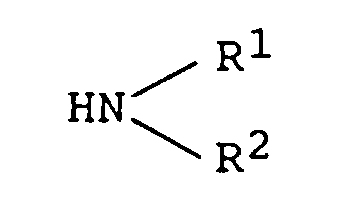 iii) chauffer le composé obtenu dans l'étape ii) dans un alcool inférieur à une température depuis la température ambiante jusqu'à 100°C.iv) et éventuellement convertir le compose obtenu dans l'étape iii) en son sel d'addition d'acide pharmaceutiquement acceptable en le faisant réagir avec un acide approprié.
 - Procédé pour la préparation d'un composé représenté par la formule (h):
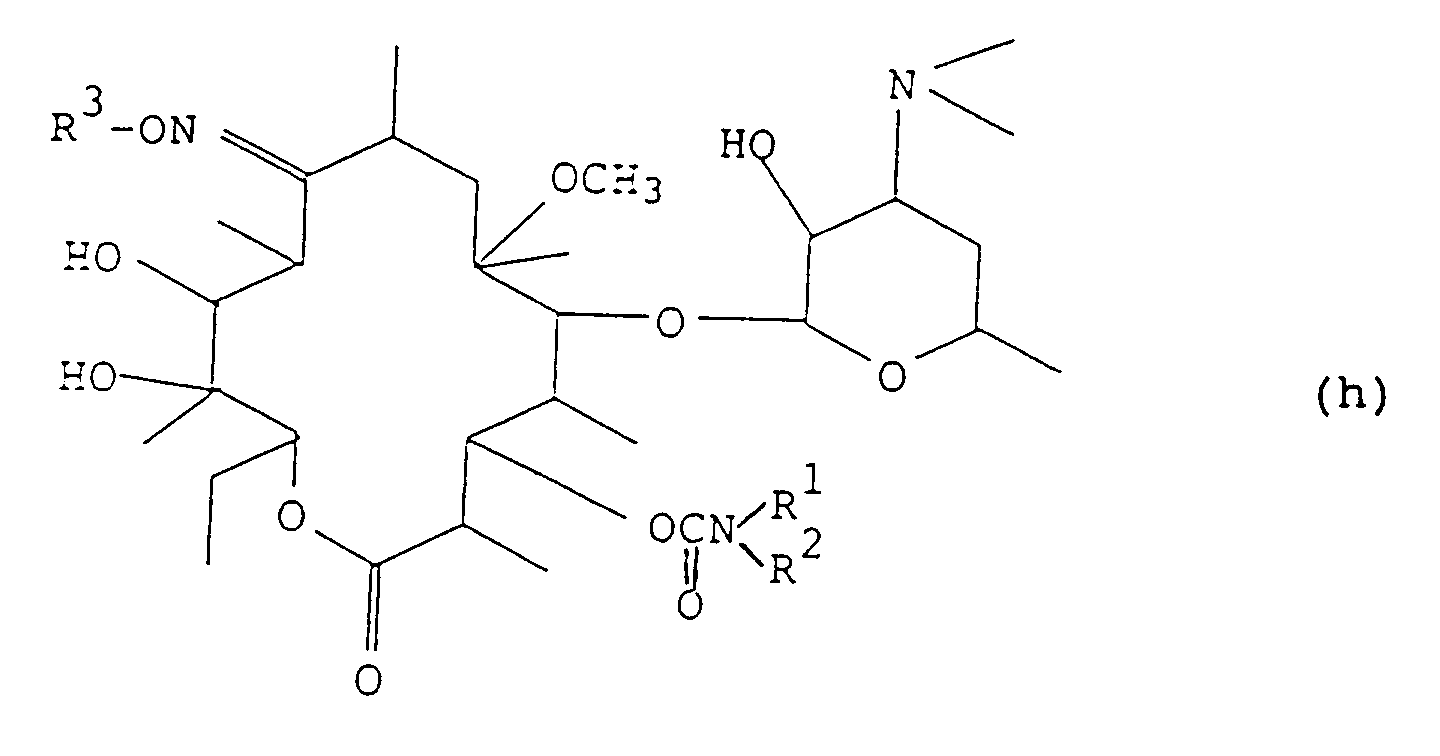 i) faire réagir la 9-oxime de la 6-O-méthylérythromycine A avec un acide dans un alcool inférieur à une température de 0°C à 30°C pour obtenir un composé de formule (f):
 ii) faire réagir le composé (f) avec un réactif de formule R3D (dans laquelle R3 est tel que défini ci-dessus, et D est un atome d'halogène) et une base dans un solvant inerte à une température de 0°C à 30°C pour obtenir un composé de formule (g) :
 iii) faire réagir le produit obtenu dans l'étape ii) avec un anhydride d'acide de formule R2O (dans laquelle R est tel que défini ci-dessus sauf pour l'atome d'hydrogène) ou un halogénure de formule R-X (dans laquelle R est tel que défini ci-dessus sauf pour l'atome d'hydrogène, et X est un atome d'halogène) et une base dans un solvant inerte à une température de 0°C à 30°C,iv) faire réagir le composé obtenu dans l'étape iii) avec du 1,1'-carbonyldiimidazole dans un solvant inerte à une température de 0°C à 80°C, après quoi une amine de formule:
 v) chauffer le composé obtenu dans l'étape iv) dans un alcool inférieur à une température depuis la température ambiante jusqu'à 100°C,vi) et éventuellement transformer le composé obtenu dans l'étape v) en son sel d'addition d'acide pharmaceutiquement acceptable en le faisant réagir avec un acide approprié.
 - Procédé pour la préparation d'un composé représenté par la formule (i):
 i) faire réagir un composé de formule (g):
 iv) faire réagir le composé obtenu dans l'étape i) avec du 1,1'-carbonyldiimidazole dans un solvant inerte à une température de 0°C à 80°C, après quoi une amine de formule:
 iii) faire réagir le composé obtenu dans l'étape ii) avec un réactif tel que le dimère du phosgène ou le trimère du phosgène sous refroidissement avec de la glace dans un solvant inerte approprié en présence d'une base pour obtenir un carbonate 11,12 cyclique,iv) chauffer ledit carbonate 11,12-cyclique dans un alcool inférieur à une température depuis la température ambiante jusqu'à 100°C,v) et éventuellement transformer le composé obtenu dans l'étape iv) en son sel d'addition d'acide pharmaceutiquement acceptable en le faisant réagir avec un acide approprié.
 - Procédé pour la préparation d'un composé représenté par la formule (j):
 i) faire réagir la 9-oxime de la 6-O-méthylérythromycine A avec un acide dans un alcool inférieur à une température de 0°C à 30°C pour obtenir un composé de formule (f):
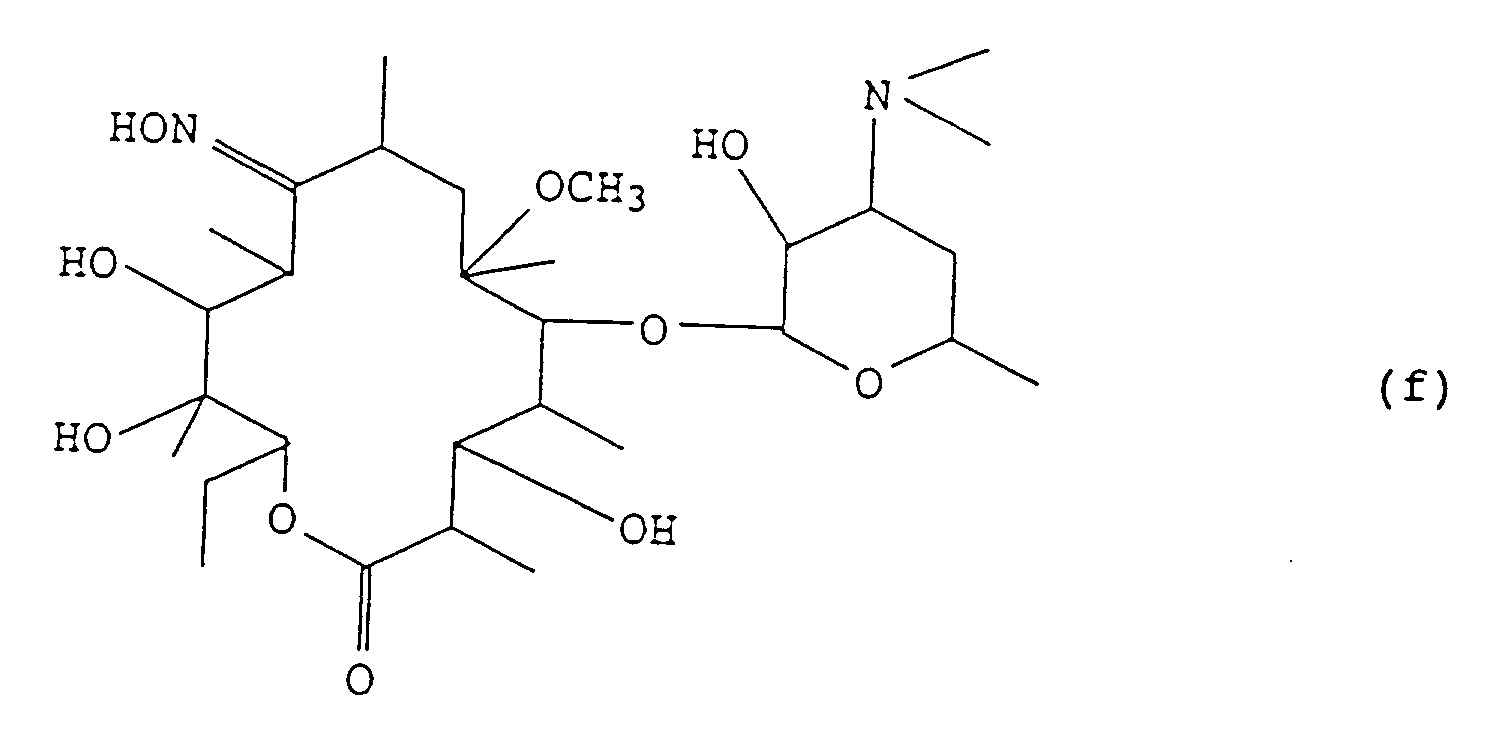 ii) faire réagir le composé obtenu dans l'étape i) avec un anhydride d'acide de formule R2O (dans laquelle R est tel que défini ci-dessus sauf pour l'atome d'hydrogène) ou un halogénure de formule R-X (dans laquelle R est tel que défini ci-dessus sauf pour l'atome d'hydrogène, et X est un atome d'halogène) et une base dans un solvant inerte à une température de 0°C à 30°C pour protéger le groupe hydroxyle en position 2' et le groupe hydroxyle de l'oxime en position 9,iii) faire réagir le composé obtenu dans l'étape ii) avec du 1,1'-carbonyldiimidazole dans un solvant inerte à une température de 0°C à 80°C, après quoi une amine de formule:
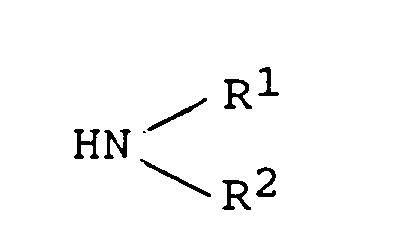 iv) chauffer le composé obtenu dans l'étape iii) dans un alcool inférieur à une température depuis la température ambiante jusqu'à 100°C,v) et éventuellement transformer le composé obtenu dans l'étape iv) en son sel d'addition d'acide pharmaceutiquement acceptable en le faisant réagir avec un acide approprié.
 - Procédé pour la préparation d'un composé représenté par la formule (k):
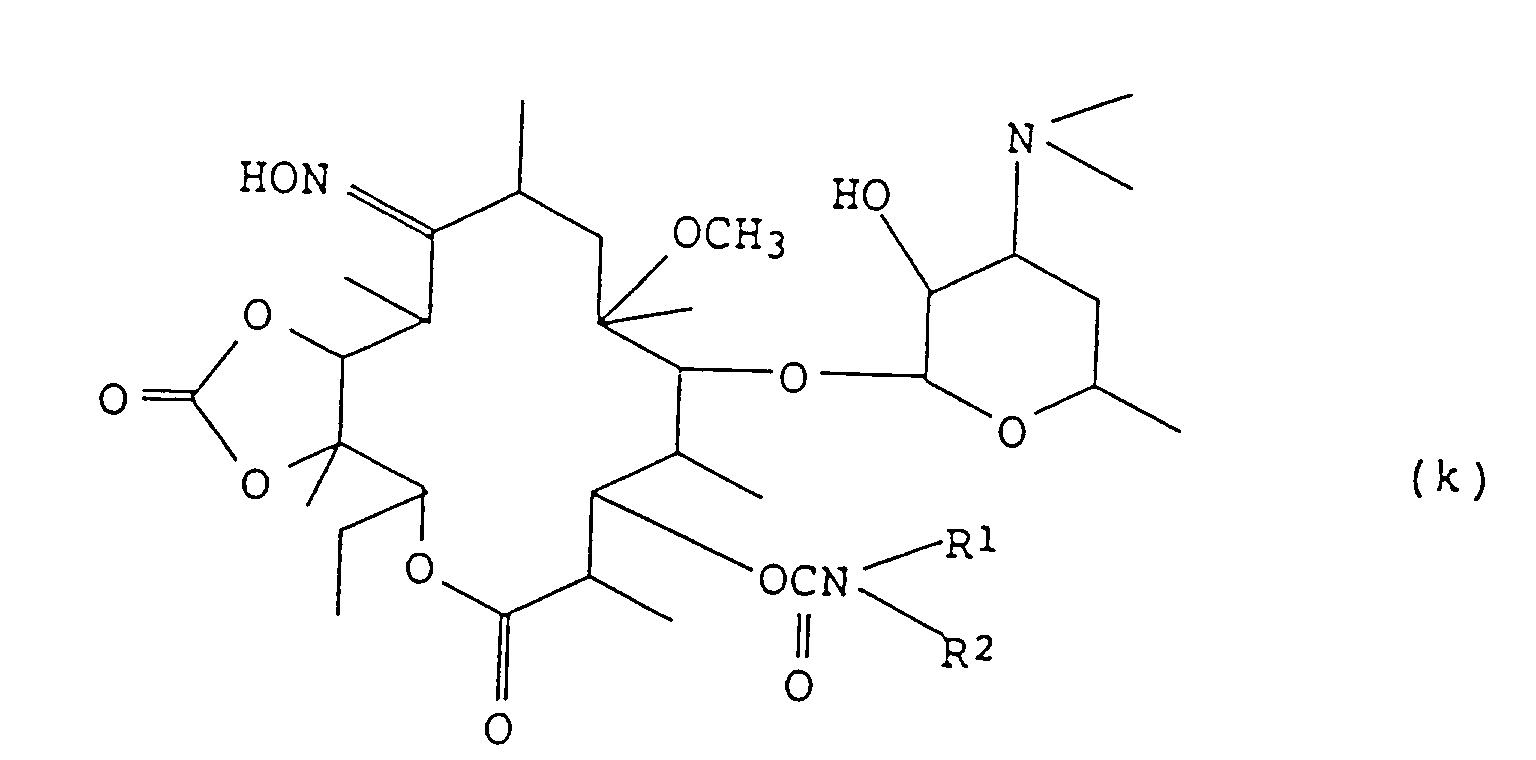 i) faire réagir le composé (f)
 ii) faire réagir le composé obtenu dans l'étape i) avec du 1,1'-carbonyldiimidazole dans un solvant inerte à une température de 0°C à 80°C, après quoi une amine de formule:
 iii) faire réagir le composé obtenu dans l'étape ii) avec un réactif tel que le dimère du phosgène ou le trimère du phosgène sous refroidissement avec de la glace dans un solvant inerte approprié en présence d'une base,iv) chauffer le composé obtenu dans l'étape iii) dans un alcool inférieur à une température depuis la température ambiante jusqu'à 100°C,v) et éventuellement transformer le composé obtenu dans l'étape iv) en son sel d'addition d'acide pharmaceutiquement acceptable en le faisant réagir avec un acide approprié.
Applications Claiming Priority (7)
| Application Number | Priority Date | Filing Date | Title |
|---|---|---|---|
| JP346826/91 | 1991-12-27 | ||
| JP34682691 | 1991-12-27 | ||
| JP199368/92 | 1992-07-27 | ||
| JP19936892 | 1992-07-27 | ||
| JP27986792 | 1992-10-19 | ||
| JP279867/92 | 1992-10-19 | ||
| PCT/JP1992/001713 WO1993013115A1 (fr) | 1991-12-27 | 1992-12-25 | Derive de 5-o-desosaminylerythronolide |
Publications (3)
| Publication Number | Publication Date |
|---|---|
| EP0619319A1 EP0619319A1 (fr) | 1994-10-12 |
| EP0619319A4 EP0619319A4 (fr) | 1994-11-02 |
| EP0619319B1 true EP0619319B1 (fr) | 1997-03-05 |
Family
ID=27327638
Family Applications (2)
| Application Number | Title | Priority Date | Filing Date |
|---|---|---|---|
| EP93900447A Expired - Lifetime EP0619320B1 (fr) | 1991-12-27 | 1992-12-25 | Derive de 5-o-desosaminylerythronolide |
| EP93900446A Expired - Lifetime EP0619319B1 (fr) | 1991-12-27 | 1992-12-25 | Derive de 5-o-desosaminylerythronolide |
Family Applications Before (1)
| Application Number | Title | Priority Date | Filing Date |
|---|---|---|---|
| EP93900447A Expired - Lifetime EP0619320B1 (fr) | 1991-12-27 | 1992-12-25 | Derive de 5-o-desosaminylerythronolide |
Country Status (10)
| Country | Link |
|---|---|
| US (2) | US5523399A (fr) |
| EP (2) | EP0619320B1 (fr) |
| JP (2) | JP3132002B2 (fr) |
| KR (2) | KR100265916B1 (fr) |
| AT (2) | ATE153341T1 (fr) |
| AU (2) | AU663145B2 (fr) |
| CA (2) | CA2126665A1 (fr) |
| DE (2) | DE69217989T2 (fr) |
| ES (2) | ES2104118T3 (fr) |
| WO (2) | WO1993013115A1 (fr) |
Families Citing this family (43)
| Publication number | Priority date | Publication date | Assignee | Title |
|---|---|---|---|---|
| US5631355A (en) * | 1992-04-22 | 1997-05-20 | Taisho Pharmaceutical Co., Ltd. | 5-O-desosaminylerythronolide a derivatives |
| KR960700258A (ko) * | 1993-01-26 | 1996-01-19 | 우에하라 아키라 | 5-0-데소사미닐에리쓰로노라이드 유도체 |
| KR970704455A (ko) * | 1994-08-12 | 1997-09-06 | 우에하라 아끼라 | 인터류킨 5 생성 억제제(Interleukin 5 Production Inhibitor) |
| FR2738571B1 (fr) * | 1995-09-11 | 1997-10-17 | Roussel Uclaf | Nouveaux derives de la 5-0-desosaminyl 6-0-methyl- erythronolide a, leur procede de preparation et leur application a la preparation de produits biologiquement actifs |
| FR2739620B1 (fr) * | 1995-10-09 | 1997-12-19 | Roussel Uclaf | Nouveaux derives de la 5-0-desosaminyl 6-o-methyl erythronolide a, leur procede de preparation et leur application a la preparation de produits biologiquement actifs |
| USRE38426E1 (en) | 1995-10-09 | 2004-02-10 | Aventis Pharma S.A. | 5-O-deosaminyl 6-O-methyl erythronolide A derivatives, preparation method therefor and use thereof for preparing biologically active materials |
| US6274715B1 (en) | 1995-11-08 | 2001-08-14 | Abbott Laboratories | Tricyclic erythromycin derivatives |
| KR19990067333A (ko) * | 1995-11-08 | 1999-08-16 | 스티븐 에프. 웨인스톡 | 에리트로마이신 a 및 b의 3-데옥시-3-데스클라디노즈 유도체 |
| ES2218604T3 (es) * | 1995-11-08 | 2004-11-16 | Abbott Laboratories | Derivados triciclicos de eritromicina. |
| US5747466A (en) * | 1995-11-08 | 1998-05-05 | Abbott Laboratories | 3-deoxy-3-descladinose derivatives of erythromycins A and B |
| UA51730C2 (uk) * | 1996-09-04 | 2002-12-16 | Ебботт Лабораторіз | 6-o-заміщені кетоліди з антибактеріальною активністю, спосіб їх одержання (варіанти), фармацевтична композиція та спосіб регулювання бактеріальної інфекції у ссавців |
| SK285534B6 (sk) * | 1996-09-04 | 2007-03-01 | Abbott Laboratories | 6-O-substituované ketolidy s antibakteriálnou aktivitou, farmaceutická kompozícia s ich obsahom, ich použitie a spôsob ich prípravy |
| US5804565A (en) * | 1996-09-24 | 1998-09-08 | Taisho Pharmaceutical Co., Ltd. | Erythromycin A derivatives |
| CA2272620A1 (fr) | 1996-11-27 | 1998-06-04 | Taisho Pharmaceutical Co., Ltd. | Derives de l'erythromycine a |
| WO1998042720A1 (fr) * | 1997-03-24 | 1998-10-01 | Taisho Pharmaceutical Co., Ltd. | Derives d'erythromycine a |
| US6169168B1 (en) | 1997-10-29 | 2001-01-02 | Taisho Pharmaceuticals Co., Ltd. | Erythromycin A derivatives |
| AU9645998A (en) * | 1997-10-29 | 1999-05-17 | Taisho Pharmaceutical Co., Ltd. | Erythromycin a derivatives |
| WO1999021870A1 (fr) * | 1997-10-29 | 1999-05-06 | Taisho Pharmaceutical Co., Ltd. | Derives de l'erythromycine a 11,12-carbamate |
| AU1504899A (en) * | 1997-12-11 | 1999-06-28 | Hokuriku Seiyaku Co. Ltd | Erythromycin derivatives |
| AP1060A (en) * | 1998-01-02 | 2002-04-23 | Pfizer Prod Inc | Novel erythromycin derivatives. |
| AP9801420A0 (en) * | 1998-01-02 | 1998-12-31 | Pfizer Prod Inc | Novel macrolides. |
| FR2777282B1 (fr) * | 1998-04-08 | 2001-04-20 | Hoechst Marion Roussel Inc | Nouveaux derives de la 2-fluoro 3-de((2,6-dideoxy 3-c-methyl 3-0-methyl-alpha-l-ribohexopyranosyl) oxyl) 6-o-methyl 3-oxo erythromycine, leur procede de preparation et leur application a la synthese de principes actifs de medicaments |
| US6054435A (en) * | 1999-03-19 | 2000-04-25 | Abbott Laboratories | 6-O-substituted macrolides having antibacterial activity |
| US6395710B1 (en) * | 1999-04-16 | 2002-05-28 | Kosan Biosciences, Inc. | Macrolide antiinfective agents |
| IL145739A0 (en) * | 1999-05-24 | 2002-07-25 | Pfizer Prod Inc | 13-methyl-erythromycin derivatives |
| US6420535B1 (en) * | 1999-06-07 | 2002-07-16 | Abbott Laboratories | 6-O-carbamate ketolide derivatives |
| US6946446B2 (en) | 2000-02-24 | 2005-09-20 | Abbott Laboratories | Anti-infective agents useful against multidrug-resistant strains of bacteria |
| EP1146051A3 (fr) * | 2000-04-10 | 2001-10-31 | Pfizer Products Inc. | Dérivées de l' érythromycine A |
| US20020115621A1 (en) * | 2000-08-07 | 2002-08-22 | Wei-Gu Su | Macrolide antibiotics |
| WO2005012322A1 (fr) * | 2003-08-05 | 2005-02-10 | Taisho Pharmaceutical Co., Ltd. | Procede de production carbonate 11,12-cyclique d'erythromycine a |
| WO2005030227A1 (fr) | 2003-09-23 | 2005-04-07 | Enanta Pharmaceuticals, Inc. | Derives 9a-azalide 11-3c-bicycliques |
| EP1781679A1 (fr) * | 2004-07-28 | 2007-05-09 | Ranbaxy Laboratories Limited | Agents antibactériens |
| US7402568B2 (en) | 2004-09-29 | 2008-07-22 | Enanta Pharmaceuticals, Inc. | Bicyclic 9a-azalide derivatives |
| EP2233493A1 (fr) | 2004-12-21 | 2010-09-29 | Pfizer Products Inc. | Macrolides |
| US7271155B2 (en) | 2005-01-07 | 2007-09-18 | Enanta Pharmaceuticals, Inc. | 9A, 11-2C-bicyclic 9a-azalide derivatives |
| WO2006077501A2 (fr) * | 2005-01-13 | 2006-07-27 | Glaxosmithkline Istrazivacki Centar Zagreb D.O.O. | Decladinosyl-macrolides presentant une activite anti-inflammatoire |
| WO2009019868A1 (fr) | 2007-08-06 | 2009-02-12 | Taisho Pharmaceutical Co., Ltd. | Composé 10a-azalide réticulé en position 10a et en position 12 |
| EP2188281A1 (fr) * | 2007-08-10 | 2010-05-26 | Y's Therapeutics Co, Ltd. | Modulation des réponses immunes par administration de roxithromycine ou de ses dérivés |
| WO2009139181A1 (fr) | 2008-05-15 | 2009-11-19 | 大正製薬株式会社 | Composé 10a-azalide ayant une structure de cycle à 4 chaînons |
| US8143369B2 (en) * | 2009-06-02 | 2012-03-27 | International Business Machines Corporation | Polymers bearing pendant pentafluorophenyl ester groups, and methods of synthesis and functionalization thereof |
| CN101863941A (zh) * | 2010-06-03 | 2010-10-20 | 武汉大学 | 3-氧-取代的6,11-二-氧-甲基红霉素a的衍生物 |
| CN104961785B (zh) * | 2015-06-19 | 2019-01-11 | 北京理工大学 | 一种新型酰内酯衍生物及其制备方法 |
| IL303173A (en) | 2023-05-23 | 2024-12-01 | Yeda Res & Dev | Active macrolide antibiotic compounds against pathogens |
Family Cites Families (8)
| Publication number | Priority date | Publication date | Assignee | Title |
|---|---|---|---|---|
| US3923784A (en) * | 1973-09-10 | 1975-12-02 | Hoffmann La Roche | Erythromycin a derivatives |
| US4512982A (en) * | 1984-04-13 | 1985-04-23 | Pfizer Inc. | 9α-Aza-9α-homoerythromycin compounds, pharmaceutical composition and therapeutic method |
| US4518590A (en) * | 1984-04-13 | 1985-05-21 | Pfizer Inc. | 9α-Aza-9α-homoerythromycin compounds, pharmaceutical compositions and therapeutic method |
| GB8521402D0 (en) * | 1985-08-28 | 1985-10-02 | Beecham Group Plc | Chemical compounds |
| US4742049A (en) * | 1986-06-04 | 1988-05-03 | Abbott Laboratories | Semisynthetic erythromycin antibiotics |
| KR880009960A (ko) * | 1987-02-24 | 1988-10-06 | 데이빗 로버츠 | 화학적 화합물 |
| JPH0196190A (ja) * | 1987-10-07 | 1989-04-14 | Toyo Jozo Co Ltd | 6−0−アルキル−エリスロマイシンa サイクリック11,12−カーボネート |
| IL99995A (en) * | 1990-11-21 | 1997-11-20 | Roussel Uclaf | Erythromycin derivatives, their preparation and pharmaceutical compositions containing them |
-
1992
- 1992-12-15 US US08/244,981 patent/US5523399A/en not_active Expired - Fee Related
- 1992-12-25 DE DE69217989T patent/DE69217989T2/de not_active Expired - Fee Related
- 1992-12-25 KR KR1019940702223A patent/KR100265916B1/ko not_active Expired - Fee Related
- 1992-12-25 ES ES93900447T patent/ES2104118T3/es not_active Expired - Lifetime
- 1992-12-25 AT AT93900447T patent/ATE153341T1/de not_active IP Right Cessation
- 1992-12-25 AU AU31727/93A patent/AU663145B2/en not_active Ceased
- 1992-12-25 EP EP93900447A patent/EP0619320B1/fr not_active Expired - Lifetime
- 1992-12-25 US US08/256,124 patent/US5631354A/en not_active Expired - Fee Related
- 1992-12-25 KR KR1019940702222A patent/KR100266183B1/ko not_active Expired - Fee Related
- 1992-12-25 JP JP05511558A patent/JP3132002B2/ja not_active Expired - Fee Related
- 1992-12-25 DE DE69219900T patent/DE69219900T2/de not_active Expired - Fee Related
- 1992-12-25 ES ES93900446T patent/ES2101290T3/es not_active Expired - Lifetime
- 1992-12-25 WO PCT/JP1992/001713 patent/WO1993013115A1/fr not_active Ceased
- 1992-12-25 JP JP05511557A patent/JP3099366B2/ja not_active Expired - Fee Related
- 1992-12-25 EP EP93900446A patent/EP0619319B1/fr not_active Expired - Lifetime
- 1992-12-25 AU AU31728/93A patent/AU667334B2/en not_active Ceased
- 1992-12-25 WO PCT/JP1992/001714 patent/WO1993013116A1/fr not_active Ceased
- 1992-12-25 AT AT93900446T patent/ATE149508T1/de not_active IP Right Cessation
- 1992-12-25 CA CA002126665A patent/CA2126665A1/fr not_active Abandoned
- 1992-12-25 CA CA002126664A patent/CA2126664A1/fr not_active Abandoned
Also Published As
| Publication number | Publication date |
|---|---|
| DE69217989T2 (de) | 1997-06-12 |
| EP0619319A1 (fr) | 1994-10-12 |
| US5631354A (en) | 1997-05-20 |
| KR940703842A (ko) | 1994-12-12 |
| ES2104118T3 (es) | 1997-10-01 |
| AU667334B2 (en) | 1996-03-21 |
| DE69219900D1 (de) | 1997-06-26 |
| KR100265916B1 (ko) | 2000-09-15 |
| CA2126665A1 (fr) | 1993-07-08 |
| AU3172793A (en) | 1993-07-28 |
| CA2126664A1 (fr) | 1993-07-08 |
| WO1993013115A1 (fr) | 1993-07-08 |
| US5523399A (en) | 1996-06-04 |
| ATE149508T1 (de) | 1997-03-15 |
| WO1993013116A1 (fr) | 1993-07-08 |
| EP0619320B1 (fr) | 1997-05-21 |
| ATE153341T1 (de) | 1997-06-15 |
| KR100266183B1 (ko) | 2000-09-15 |
| AU663145B2 (en) | 1995-09-28 |
| EP0619320A4 (fr) | 1994-11-02 |
| DE69219900T2 (de) | 1997-09-11 |
| DE69217989D1 (de) | 1997-04-10 |
| EP0619319A4 (fr) | 1994-11-02 |
| JP3099366B2 (ja) | 2000-10-16 |
| KR940703841A (ko) | 1994-12-12 |
| JP3132002B2 (ja) | 2001-02-05 |
| ES2101290T3 (es) | 1997-07-01 |
| AU3172893A (en) | 1993-07-28 |
| EP0619320A1 (fr) | 1994-10-12 |
Similar Documents
| Publication | Publication Date | Title |
|---|---|---|
| US5523399A (en) | 5-O-desosaminylerythronolide derivatives | |
| EP0638584B1 (fr) | Derive de 5-o-desosaminylerythronolide | |
| EP0559896B1 (fr) | Derive de 6-o-methylerythromycine a | |
| JPWO1993013115A1 (ja) | 5−o−デソサミニルエリスロノライド誘導体 | |
| JPWO1993013116A1 (ja) | 5−o−デソサミニルエリスロノライド誘導体 | |
| KR850000965B1 (ko) | 4"-에피 에리스로마이신 a 및 그의 유도체의 제조방법 | |
| EP0124216B1 (fr) | Dérivés de macrolides modifiés en C-20 et C-23 | |
| US4833236A (en) | Erythromycin derivatives | |
| US4920103A (en) | Modifications of mycinose and 3-O-demethylmycinose in tylosin-type macrolides | |
| US6140479A (en) | Erythromycin a derivatives | |
| US4935504A (en) | Epipodophyllotoxin glucoside 4'-acyl derivatives | |
| US5602239A (en) | 5-O-desosaminylerythronolide derivatives | |
| CN101906125A (zh) | 4″-苯并咪唑-5-甲酰基-肼基甲酸酯克拉霉素衍生物及中间体 | |
| ES2208334T3 (es) | Derivados cetolida de 6-0 carbamato. | |
| EP0262903A2 (fr) | Dérivés acylés des composés tylosine et desmycosine modifiés en position 20 | |
| US4579940A (en) | 14-de(hydroxymethyl)-mycaminosyltylonolide derivatives | |
| JPWO1993021199A1 (ja) | 5−0−デソサミニルエリスロノライドa誘導体 |
Legal Events
| Date | Code | Title | Description |
|---|---|---|---|
| PUAI | Public reference made under article 153(3) epc to a published international application that has entered the european phase |
Free format text: ORIGINAL CODE: 0009012 |
|
| 17P | Request for examination filed |
Effective date: 19940624 |
|
| AK | Designated contracting states |
Kind code of ref document: A1 Designated state(s): AT BE CH DE DK ES FR GB GR IE IT LI LU MC NL PT SE |
|
| A4 | Supplementary search report drawn up and despatched | ||
| AK | Designated contracting states |
Kind code of ref document: A4 Designated state(s): AT BE CH DE DK ES FR GB GR IE IT LI LU MC NL PT SE |
|
| 17Q | First examination report despatched |
Effective date: 19941116 |
|
| GRAH | Despatch of communication of intention to grant a patent |
Free format text: ORIGINAL CODE: EPIDOS IGRA |
|
| GRAH | Despatch of communication of intention to grant a patent |
Free format text: ORIGINAL CODE: EPIDOS IGRA |
|
| GRAH | Despatch of communication of intention to grant a patent |
Free format text: ORIGINAL CODE: EPIDOS IGRA |
|
| GRAH | Despatch of communication of intention to grant a patent |
Free format text: ORIGINAL CODE: EPIDOS IGRA |
|
| GRAA | (expected) grant |
Free format text: ORIGINAL CODE: 0009210 |
|
| AK | Designated contracting states |
Kind code of ref document: B1 Designated state(s): AT BE CH DE DK ES FR GB GR IE IT LI LU MC NL PT SE |
|
| PG25 | Lapsed in a contracting state [announced via postgrant information from national office to epo] |
Ref country code: NL Free format text: LAPSE BECAUSE OF FAILURE TO SUBMIT A TRANSLATION OF THE DESCRIPTION OR TO PAY THE FEE WITHIN THE PRESCRIBED TIME-LIMIT Effective date: 19970305 Ref country code: GR Free format text: LAPSE BECAUSE OF FAILURE TO SUBMIT A TRANSLATION OF THE DESCRIPTION OR TO PAY THE FEE WITHIN THE PRESCRIBED TIME-LIMIT Effective date: 19970305 Ref country code: DK Effective date: 19970305 Ref country code: BE Effective date: 19970305 Ref country code: AT Effective date: 19970305 |
|
| REF | Corresponds to: |
Ref document number: 149508 Country of ref document: AT Date of ref document: 19970315 Kind code of ref document: T |
|
| ITF | It: translation for a ep patent filed | ||
| REG | Reference to a national code |
Ref country code: CH Ref legal event code: EP |
|
| REG | Reference to a national code |
Ref country code: CH Ref legal event code: NV Representative=s name: NOVAPAT INTERNATIONAL S.A. |
|
| REF | Corresponds to: |
Ref document number: 69217989 Country of ref document: DE Date of ref document: 19970410 |
|
| ET | Fr: translation filed | ||
| PG25 | Lapsed in a contracting state [announced via postgrant information from national office to epo] |
Ref country code: SE Effective date: 19970605 Ref country code: PT Effective date: 19970605 |
|
| REG | Reference to a national code |
Ref country code: ES Ref legal event code: FG2A Ref document number: 2101290 Country of ref document: ES Kind code of ref document: T3 |
|
| NLV1 | Nl: lapsed or annulled due to failure to fulfill the requirements of art. 29p and 29m of the patents act | ||
| PG25 | Lapsed in a contracting state [announced via postgrant information from national office to epo] |
Ref country code: LU Free format text: LAPSE BECAUSE OF NON-PAYMENT OF DUE FEES Effective date: 19971225 Ref country code: IE Free format text: LAPSE BECAUSE OF NON-PAYMENT OF DUE FEES Effective date: 19971225 |
|
| PLBE | No opposition filed within time limit |
Free format text: ORIGINAL CODE: 0009261 |
|
| STAA | Information on the status of an ep patent application or granted ep patent |
Free format text: STATUS: NO OPPOSITION FILED WITHIN TIME LIMIT |
|
| 26N | No opposition filed | ||
| PG25 | Lapsed in a contracting state [announced via postgrant information from national office to epo] |
Ref country code: MC Free format text: LAPSE BECAUSE OF NON-PAYMENT OF DUE FEES Effective date: 19980630 |
|
| PGFP | Annual fee paid to national office [announced via postgrant information from national office to epo] |
Ref country code: CH Payment date: 19981123 Year of fee payment: 7 |
|
| PGFP | Annual fee paid to national office [announced via postgrant information from national office to epo] |
Ref country code: DE Payment date: 19981218 Year of fee payment: 7 |
|
| PGFP | Annual fee paid to national office [announced via postgrant information from national office to epo] |
Ref country code: GB Payment date: 19981224 Year of fee payment: 7 |
|
| PGFP | Annual fee paid to national office [announced via postgrant information from national office to epo] |
Ref country code: FR Payment date: 19981229 Year of fee payment: 7 |
|
| PGFP | Annual fee paid to national office [announced via postgrant information from national office to epo] |
Ref country code: ES Payment date: 19981230 Year of fee payment: 7 |
|
| PG25 | Lapsed in a contracting state [announced via postgrant information from national office to epo] |
Ref country code: GB Free format text: LAPSE BECAUSE OF NON-PAYMENT OF DUE FEES Effective date: 19991225 |
|
| PG25 | Lapsed in a contracting state [announced via postgrant information from national office to epo] |
Ref country code: LI Free format text: LAPSE BECAUSE OF NON-PAYMENT OF DUE FEES Effective date: 19991231 Ref country code: CH Free format text: LAPSE BECAUSE OF NON-PAYMENT OF DUE FEES Effective date: 19991231 |
|
| GBPC | Gb: european patent ceased through non-payment of renewal fee |
Effective date: 19991225 |
|
| PG25 | Lapsed in a contracting state [announced via postgrant information from national office to epo] |
Ref country code: FR Free format text: LAPSE BECAUSE OF NON-PAYMENT OF DUE FEES Effective date: 20000831 |
|
| PG25 | Lapsed in a contracting state [announced via postgrant information from national office to epo] |
Ref country code: DE Free format text: LAPSE BECAUSE OF NON-PAYMENT OF DUE FEES Effective date: 20001003 |
|
| REG | Reference to a national code |
Ref country code: FR Ref legal event code: ST |
|
| PG25 | Lapsed in a contracting state [announced via postgrant information from national office to epo] |
Ref country code: ES Free format text: LAPSE BECAUSE OF NON-PAYMENT OF DUE FEES Effective date: 20001226 |
|
| REG | Reference to a national code |
Ref country code: ES Ref legal event code: FD2A Effective date: 20010113 |
|
| PG25 | Lapsed in a contracting state [announced via postgrant information from national office to epo] |
Ref country code: IT Free format text: LAPSE BECAUSE OF NON-PAYMENT OF DUE FEES;WARNING: LAPSES OF ITALIAN PATENTS WITH EFFECTIVE DATE BEFORE 2007 MAY HAVE OCCURRED AT ANY TIME BEFORE 2007. THE CORRECT EFFECTIVE DATE MAY BE DIFFERENT FROM THE ONE RECORDED. Effective date: 20051225 |