EP0619501A2 - Système de sonar - Google Patents
Système de sonar Download PDFInfo
- Publication number
- EP0619501A2 EP0619501A2 EP94301363A EP94301363A EP0619501A2 EP 0619501 A2 EP0619501 A2 EP 0619501A2 EP 94301363 A EP94301363 A EP 94301363A EP 94301363 A EP94301363 A EP 94301363A EP 0619501 A2 EP0619501 A2 EP 0619501A2
- Authority
- EP
- European Patent Office
- Prior art keywords
- slope
- sonar
- cell
- data
- slope profile
- Prior art date
- Legal status (The legal status is an assumption and is not a legal conclusion. Google has not performed a legal analysis and makes no representation as to the accuracy of the status listed.)
- Withdrawn
Links
- XLYOFNOQVPJJNP-UHFFFAOYSA-N water Substances O XLYOFNOQVPJJNP-UHFFFAOYSA-N 0.000 claims description 13
- 238000012545 processing Methods 0.000 claims description 7
- 230000008859 change Effects 0.000 claims description 6
- 238000010521 absorption reaction Methods 0.000 claims description 4
- 230000007480 spreading Effects 0.000 claims description 4
- 230000007704 transition Effects 0.000 claims description 2
- 230000004044 response Effects 0.000 abstract description 27
- 238000000034 method Methods 0.000 description 37
- 230000008569 process Effects 0.000 description 35
- 238000001514 detection method Methods 0.000 description 23
- 238000010586 diagram Methods 0.000 description 12
- 230000000875 corresponding effect Effects 0.000 description 6
- 101100272667 Xenopus laevis ripply2.2 gene Proteins 0.000 description 3
- 230000006870 function Effects 0.000 description 3
- 239000011159 matrix material Substances 0.000 description 3
- CIWBSHSKHKDKBQ-JLAZNSOCSA-N Ascorbic acid Chemical compound OC[C@H](O)[C@H]1OC(=O)C(O)=C1O CIWBSHSKHKDKBQ-JLAZNSOCSA-N 0.000 description 2
- 238000001914 filtration Methods 0.000 description 2
- 238000013507 mapping Methods 0.000 description 2
- 238000012935 Averaging Methods 0.000 description 1
- XUIMIQQOPSSXEZ-UHFFFAOYSA-N Silicon Chemical compound [Si] XUIMIQQOPSSXEZ-UHFFFAOYSA-N 0.000 description 1
- 230000004397 blinking Effects 0.000 description 1
- 238000004364 calculation method Methods 0.000 description 1
- 238000006243 chemical reaction Methods 0.000 description 1
- 230000002596 correlated effect Effects 0.000 description 1
- 230000007123 defense Effects 0.000 description 1
- 231100001261 hazardous Toxicity 0.000 description 1
- 238000003384 imaging method Methods 0.000 description 1
- 230000003993 interaction Effects 0.000 description 1
- 238000013178 mathematical model Methods 0.000 description 1
- 238000005259 measurement Methods 0.000 description 1
- 238000010606 normalization Methods 0.000 description 1
- 239000003921 oil Substances 0.000 description 1
- 229910052710 silicon Inorganic materials 0.000 description 1
- 239000010703 silicon Substances 0.000 description 1
- 239000011800 void material Substances 0.000 description 1
Images




Classifications
-
- G—PHYSICS
- G01—MEASURING; TESTING
- G01S—RADIO DIRECTION-FINDING; RADIO NAVIGATION; DETERMINING DISTANCE OR VELOCITY BY USE OF RADIO WAVES; LOCATING OR PRESENCE-DETECTING BY USE OF THE REFLECTION OR RERADIATION OF RADIO WAVES; ANALOGOUS ARRANGEMENTS USING OTHER WAVES
- G01S15/00—Systems using the reflection or reradiation of acoustic waves, e.g. sonar systems
- G01S15/88—Sonar systems specially adapted for specific applications
- G01S15/93—Sonar systems specially adapted for specific applications for anti-collision purposes
-
- G—PHYSICS
- G01—MEASURING; TESTING
- G01S—RADIO DIRECTION-FINDING; RADIO NAVIGATION; DETERMINING DISTANCE OR VELOCITY BY USE OF RADIO WAVES; LOCATING OR PRESENCE-DETECTING BY USE OF THE REFLECTION OR RERADIATION OF RADIO WAVES; ANALOGOUS ARRANGEMENTS USING OTHER WAVES
- G01S15/00—Systems using the reflection or reradiation of acoustic waves, e.g. sonar systems
-
- Y—GENERAL TAGGING OF NEW TECHNOLOGICAL DEVELOPMENTS; GENERAL TAGGING OF CROSS-SECTIONAL TECHNOLOGIES SPANNING OVER SEVERAL SECTIONS OF THE IPC; TECHNICAL SUBJECTS COVERED BY FORMER USPC CROSS-REFERENCE ART COLLECTIONS [XRACs] AND DIGESTS
- Y10—TECHNICAL SUBJECTS COVERED BY FORMER USPC
- Y10S—TECHNICAL SUBJECTS COVERED BY FORMER USPC CROSS-REFERENCE ART COLLECTIONS [XRACs] AND DIGESTS
- Y10S367/00—Communications, electrical: acoustic wave systems and devices
- Y10S367/909—Collision avoidance
Definitions
- This invention relates generally to sonar systems and more particularly to sonar systems adapted to aid in the detection and avoidance of sea bottom hazards which could damage a sea going vessel's hull.
- charted depth data is used as a primary navigation aid in avoiding reef and other sea bottom hazards.
- this charted depth information changes over time because earth disturbances may create new, previously uncharted hazards.
- current underwater hazard avoidance techniques are supplemented with on-board sonar mapping of the sea's bottom.
- Current sonar imaging provides high resolution of the sea bottom profile when using a vertical, or substantially vertical, depth measurement.
- early warning of forward navigational hazards is required because of the relatively long intervals of time which are required either to slow down or to change course.
- a system for providing advance warning of underwater navigation hazards that threaten safe ship passage includes a sonar transmitter/receiver adapted for mounting on the ship in a forward looking direction.
- a processor in response to sonar returns produced by the sonar transmitter/receiver, produces a sonar produced slope profile of a region of the sea bottom in front of the path of the vessel.
- a charted data produced slope profile is developed from charted depth data. The charted depth data developed slope profile is compared with the sonar return produced slope profile to determine whether the sonar produced slope profile and the charted depth data slope profile are consistent with each other.
- the sonar return produced slope profile in a region of the sea bottom is greater that a predetermined threshold level (selected to identify a potential forward undersea hazard) and, if the charted depth data generated profile of such region does not indicate this potential hazard, an anomaly is identified and a signal indicating such anomaly is produced.
- a predetermined threshold level selected to identify a potential forward undersea hazard
- the system estimates the energy in sonar returns from a sea having a substantially flat bottom.
- the energy in sonar returns are then normalized by the estimated flat sea bottom energy to enhance the identification of hazardous high slope sea bottom profile regions.
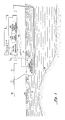
- a ship 10 is shown navigating through a body of water 12.
- the ship 10 carries on board an anti-collision sonar system 14.
- the system 14 provides advance warning of underwater navigation hazards that threaten safe passage for ship 10, particularly hazards in shallow water (i.e., between 10 - 20 fathoms).
- the system 14 includes a sonar transmitter/receiver section 16 mounted in a forward position of ship 10, as shown.
- the transmitter/receiver section 16 includes an array 18, here a cylindrical array of conventional transmitting/receiving transducers mounted in the hull section 19 of ship 10 a sufficient distance below the surface 22 (FIG. 1) of the body of water 12 so that high level sonar pressures can be produced without cavitation.
- the sonar transmitter/receiver 16 is adapted for mounting on a sea going vessel, here ship 10, in a forward looking direction 21 (FIG.1).
- the system 10 includes a digital computer 24 for sending ping trigger pulses, via line 25, to a conventional sonar transmitter waveform and (inverse) beamforming computer 20.
- Digital signals produced by computer 20 are converted into analog signals by analog to digital converters (not shown), such converted analog signals being amplified by power amplifiers (not shown), such amplified signals being fed to a transmit/receive switching network 23, in a conventional manner.
- the transmitter waveform and (inverse) beamforming computer 20 transmits an electrical pulse on line 21 initially places the transit/receive (T/R) switching network 23 in a transmit mode.
- the output of the transmitter and waveform (inverse) beamforming computer 20 is coupled to the array 18 of transmitting/receiving transducers 18 so that a ping of sonar energy introduced into the body of water 12. Subsequently, the signal on line 21 changes, and the T/R switching network 23 is placed in the receive mode.
- the array 18 of transmitting/receiving transducers is coupled to a conventional receiving beam forming network 29 through amplifiers 26 and analog to digital converters (A/D) 27.
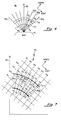
- the receiving beamforming network 29 produces, in a conventional manner, a plurality of, here nine for example, simultaneously existing receiving beams 301 - 309 arranged to cover a ninety degree sector 32 in front of the ship 10 (i.e., forty-five degrees on either side of bow line 36). (It should be understood that a larger number of beams than 9 beams, for example 12 beams may be preferable in which case a planar array of transducers may be used). Thus, each one of the beams 301 - 309 has a different angular direction.
- the horizontal beam width of each beam is here 10 degrees (i.e. ⁇ 5 degrees about the beam centerline).
- the centerlines of the beams 301 - 309 are substantially parallel with the surface of the body of water.
- the transmitted acoustic power is here in the order of 10,000 watts.
- the digital computer 24 (FIG. 2) includes a program or instruction memory 40, a processor 42 and a data memory 44, all arranged in a conventional manner.
- the digital computer 24 is a Silicon Graphics workstation, Model 4D-35.
- the program memory 40 stores a set of computer instruction for execution by the processor 42 in a manner to be described.
- the processor 42 in response to the instructions, processes data stored in one, or more memory sections of the data memory 44 and stores processed data in one, or more, other memory sections of the data memory 44 in a manner to be described in detail hereinafter.
- the processor 42 in response to sonar returns produced by the sonar transmitter/receiver 16, global position information (X, Y) of ship 10 supplied by a global positioning system (GPS) 45, ship 10 heading information relative to North, ⁇ , provided by the ship's gyro compass 46 and the instructions stored in program memory 40, calculates a sonar generated data (i.e., echo return generated data) profile of the slope of the sea bottom 48 (FIG.
- GPS global positioning system
- the processor 42 produces a sonar data generated slope profile of a region of the sea bottom 48 in front of the path of the ship based on the sonar return data.
- This sonar produced slope data is stored in sonar data slope memory section 49 of data memory 44, in a manner to be described. Suffice it to say here, however, that clusters, or regions, in sector 32 are identified as having relatively large, hazard potential, slope profiles.
- a charted depth memory 50 is provided for storing charted sea bottom depth information as a function of the global position (X,Y) of the ship 10.
- the charted depth data information is loaded in the charted depth memory 50 prior to the ship 10's voyage.
- Such data base is generated by converting paper charts available from the National Oceanographic and Atmospheric Administration (N.O.A.A.) or the Defense Mapping Agency (D.M.A.) into digital information in a form to be described hereinafter.
- charted depth information of the sector 32 in front of ship 10 is read from charted depth memory 50 by the processor 42.
- the processor 42 calculates a charted depth data generated slope profile of the sea bottom 48 (FIG. 1) in the sector 32. That is, a slope profile of the sector 32 of the sea bottom 48 in front of the ship 10 based on charted depth data.
- Such computed, charted depth data generated slope profile is stored in memory section 52 of the data memory 44.
- the processor 42 in response to instructions stored in the program memory 40 correlates, or compares, the stored charted data generated slope profile information with the sonar generated slope profile information stored in the sonar data slope memory section 49 to determine whether the latter slope profile is consistent with the former slope profile. If they are not correlated (i.e., consistent one with the other), an anomaly is identified and ship 10 must proceed with caution. Information produced by the computer 24 is fed to a display 51.
- an echo return is received and converted into electrical signals by array 18 in a conventional manner.
- the electrical signals pass through the T/R switching network 23, amplifiers 26, A/D converters 27 are combined, in a conventional manner, by the receiving beam forming computer 29 to produce digital words on lines 541 - 549.
- the envelope of the digitized signals on lines 541 - 549, respectively represent the intensities, I(r, ⁇ 1) - I(r, ⁇ 9), of the sonar returns received by beams 301 - 309, respectively, as a function of range, r, measured from the bow 19 of ship 10.
- Each one of the digital words in each of the series represents the intensity of the echo return signal at a corresponding range, r, from the bow 19 of ship 10.
- the series of digital words I(r1, ⁇ 1) - I(r76, ⁇ 1) on line 561 through the series of digital words I(r1, ⁇ 9) - I(r76, ⁇ 9) on line 569, respectively, are fed to the data memory 44, as shown.
- memory section 60 may be considered as having a matrix of memory locations, here a matrix of nine column (i.e., one column for each one of the beams 301 - 309) and 76 rows (i.e., one row for each of the 76 range samples).
- the intensity data stored in a typical position (i,j) in sector 32 is therefore, as shown in FIG. 4, I(r i , ⁇ j ), where, here, i is an integer from 1 to 76 and j is an integer from 1 to 9.
- the intensity data I(r i , ⁇ j ) stored in memory section 60 is next read therefrom by processor 42 in response to instructions stored in the program memory 40.
- the calculated energy, E(r i , ⁇ j ) for each of the, here 9 x 76 684 range - beams positions, is stored in a corresponding one of 684 memory locations of position energy memory section 62 of data memory 44.
- sonar echo returns in the general case, are made up of both current sea bottom reverberations and non-sea bottom reverberations.
- r range
- r O is the transition range from the source necessary for distributed backscattering
- I T (r O ) is the transmitted sound intensity at r O
- ⁇ is the attenuation factor resulting from forward scattering losses at the boundaries and absorption loss in the water column
- ⁇ is the horizontal beamwidth
- ⁇ z(r)/ ⁇ r is the slope of the vertical
- the sonar detected energy E(i,j) for each position (i,j) is subtracted from an estimated energy, ⁇ R (r i , ⁇ j ), for the corresponding position (i,j) and the difference, ⁇ (r i , ⁇ j ), for each position (i,j) is evaluated.
- the parameters r ⁇ O , r ⁇ d , and ⁇ are adjusted to minimize the root mean square error (RMS) ⁇ (r i , ⁇ j ) for each position (i,j), using conventional (RMS) estimation processing techniques.
- RMS root mean square error
- the estimate, ⁇ R (r i , ⁇ j ), of flat bottom "shallow" water reverberation in the region in front of ship 10 (i.e. sector 32, FIG. 2) for each of the 9 x 76 positions (i,j) is stored in a corresponding memory location of a flat bottom reverberation memory section 64 (FIG. 3A).
- the processor 42 in response to instructions in the program memory 40, reads the sonar return energy E(r i , ⁇ j ) stored in the position energy memory section 62 and the estimated flat bottom reverberation energy, ⁇ R (r i , ⁇ j ) data stored in the flat bottom reverberation energy memory section 64.
- the normalized energy E'(r i , ⁇ j ) for each position (i,j) is stored in a normalized energy position memory section 66.
- Next processor 42 in response to the instructions stored in the program memory 40, reads the normalized energy data, E'(r i , ⁇ j ), from the normalized energy memory section 66 and increases the number of beam data points from nine to, here, forty-nine, using a conventional interpolation process. That is, the normalized energy E'(r i , ⁇ j ) is subtracted from the normalized energy, E'(r i , ⁇ (j+1) ) (i.e. energy at the same range,r i , but at an adjacent beam angle, ⁇ (j+1) . The difference, ⁇ , in energy (i.e.
- the interpolated energy data, E'(r i , ⁇ k ), stored in memory section 68 is in polar (i.e. r, ⁇ ) coordinates.
- the processor 42 in response to instructions stored in the program memory 40, the global position, X,Y of ship 10, and the bearing, ⁇ , of ship 10 relative to north, N, (FIG. 4), converts the energy data, E(r i , ⁇ k ), into Cartesian coordinates (i.e. into E'(x m ,y n )).
- there are 64 x 64 cells i.e. m is an integer from 1 to 64 and n is an integer from 1 to 64).
- a region 70 of sector 32 Referring to FIG. 7, a region 70 of sector 32 (FIG.
- the region 70 is generally near a pair of "actual” sonar beams, here beams 307 and 308.
- the region 70 is also near a pair of ranges r i , r (i+1) , as shown.
- forty addition "synthesized beams" shown in FIG. 7 were added by an interpolation process.
- the data points at positions (i, j) associated with the actual beam positions are shown by the symbol (.); here positions P A and P B , (along range r (i+1) ) and positions P C and P D (along range r i ).
- the interpolated data is represented by the symbol (x); here positions P E , P F , P G , P H , P r (along range r (i+1) ), and positions P J , P K , P L , P M , and P N (along range r i ).
- the polar coordinate positions of the normalized energy E'(r i , ⁇ k ) for both the actual and "synthesized" beams are converted to Cartesian coordinate positions.
- the Cartesian coordinates is referenced to the bow of ship 10 and here has its Y-axis aligned in the North direction and its X-axis aligned in the East direction.
- a rectangular Cartesian coordinate grid is shown in FIG. 7 superimposed on the polar plotted position points P A to P N , range line along ranges r i , r (i+1) , and the beams 307 and 308.
- the grid has East/West grid lines E1 to E4, as shown, and North/South grid lines N1 - N4, as shown.
- the North/South grid lines N1 - N4 and East/West grid lines E1 - E4 define an N x M matrix of row and columns of cells C m,n .
- N and M are each 64.
- the grid is square having 64 columns of North/South grid lines and 64 rows of East/West grid lines.
- Each cell C m,n is the region bounded by a pair of successive row grid lines and a pair of successive column grid lines.
- each cell C m,n is square in shape, here having a length ⁇ and a width ⁇ .
- FIG. 7 shows cells C1 - C5 between North/South grid lines N1 - N6 and East/West grid lines E2, E3, for example.
- the global position of the grid lines, N1 - N6, E1 - E4 (and hence the global position of the cells, C m,n ) is known since the global position of ship 10 is known from the global positioning system 44 (FIG. 2).
- FIG. 2 shows an exemplary one of the cells C1 - C4, here cell C2
- it is first noted that such cell C2 is bounded by the pair of North/South grid lines N2, N3 and the pair of East/West grid lines E2, E3, as shown .
- the grid lines N2, and N3 are at x-axis (i.e. East/West) positions x (m- ⁇ /2) , x (m+ ⁇ /2) , respectively and the grid lines E2, E3 are at y-axis (i.e. North/South) positions y (n- ⁇ /2) , y (n+ ⁇ /2) , respectively.
- cell C2, i.e. C m,n)
- the processor 42 in response to instructions stored in the program memory 40, stores the calculated x,y position for all 3,724 normalized energy data, E'(r i , ⁇ k ), and stores the results in a memory section, not shown, of the data memory 44. Thus, for each normalized energy data E'(r i , ⁇ k ), the x,y position thereof is stored in such memory section.
- the processor 42 in response to stored instructions, reads such memory section and determines which one of the 4,096 cells C m,n , includes such x,y position.
- the processor 42 also counts the number, N m,n of normalized energy data points (i.e. samples) in each one of the cells (i.e.
- N m,n is the number of samples in cell C m,n ).
- N m,n 2 samples
- the 3,724 normalized energy samples, E' ⁇ (x m ,y n ) and the number of samples, N m,n in each of the 4,096 cells, C m,n, , are stored as data in normalized global position energy memory section 72.
- processor 42 in response to instructions stored in program memory 40, reads the 3,724 normalized energy samples, E' ⁇ (x m ,y n ) and the number of samples, N m,n in each of the 4,096 cells, C m,n, , from the normalized global position energy memory section 72. From such read data the processor 42 computes, for each of the 4,096 cell, C m,n , a statistically space and time averaged slope detection characteristic, Y m,n .
- the slope detection statistic,Y m,n is calculated in accordance with the following equation: From the equation above it is first observed that the normalized energy samples, E' ⁇ (x m ,y n ), represent the sonar energy level normalized by the estimated energy level for a flat sea bottom. Thus, if the level of the normalized energy sample, E' ⁇ (x m ,y n ) is one (i.e. 1) from the equation above
- the parameter a varies linearly with the speed of ship 10.
- Processor 42 in response to instructions stored in the program memory 40, reads the average slope detection statistic, Y ⁇ m,n (g), from memory section 76 and determines, for each cell C(m,n), whether the sonar has detected a statistically significant slope in such cell C(m,n) of concern to the safety of the ship. More particularly, the average slope detection statistic [ Y ⁇ m,n (g) ] is compared with a threshold level, TH. A typical default threshold level is 1; however, the threshold level can be operator selected.
- FIG. 8 shows a portion of the 4,096 cells, here a six by six cell array portion (i.e. cells C m,n to C (m+5,n+5) ).
- the detection signals S m,n to S (m+5,n+5) are here indicated as 0 except for the following cells where the detection signals are indicated as 1: C m,n ; C m,(n+1) ; C (m+1),n ; C (m+2),n ; C (m+3),n ; C (m+4),n ; C (m+2),(n+2) ; C (m+2),(n+4) ; C (m+3),(n+2) ; C (m+3),(n+3) ; C (m+4),(n+2) ; and, C (m+4),(n+4) , as shown.
- the processor 42 in response to instructions stored in program memory 40 and data read from the detection signal [S m,n ] memory section 78, associates detected cell slopes into clusters, or regions, R j .
- clusters or regions, R j .
- Region R1 is made up of cells: C m,n ; C m,(n+1) ; C (m+1),n ; C (m+1),n ; C (m+3),n ; and, C (m+4),n and region R2 is made up of cells: C (m+2),(n+2) ; C (m+2),(n+4) ; C (m+3),(n+2) ; C (m+3),(n+3) ; C (m+4),(n+2) ; and, C (m+4),(n+4) .
- the regions, R j are stored in the sonar data slope memory section 49, as shown in FIGs 3B and 9. Thus each region, R j , is indexed and the Cartesian coordinate positions of the regions are stored, as indicated.
- the processor 42 examines in sequence each of the cells C m,n to C (m+5),(n+5) on a row by row basis.
- the process starts with the cell in the lower left hand corner (i.e. Cell (m+5),n ) and continues from left to right (i.e. to Cell (m+5),(n+5) ), then progresses upward to the next higher row, to Cell (m+4),n , and continues, on a row by row basis, until Cell m,(n+5) , in this example, is examined.
- the examination process is summarized by the flow diagram in FIG 8A and is as follows: If the sonar energy slope.
- the cells to the left, bottom left, bottom, and bottom right of the C (m+3),(n+3) are: C (m+3),(n+2) , C (m+4),(n+2) , C (m+4),(n+3) , C (m+4),(n+4) , respectively).
- the ID#s of the cells of the "neighboring" cells are "looked at” in the following sequence: first the cell to the left of the examined cell is “looked at”, next the cell to the bottom of the examined cell is “looked at”, next the cell to the bottom left of the examined cell is “looked at”, and finally the cell to the bottom right of the examined cell is “looked at”. If none of the "neighboring" cell to the cell being examined have a non-zero ID#, the cell being examined is given the next successive, non-zero ID#.
- the cell under examination is assigned the ID# of first non-zero ID# in the sequence of "neighboring" cells "looked at” (i.e. the sequence of: left, bottom, bottom left, and finally the bottom right of the examined cell, as discussed above). If the ID# assigned to the cell under examination is the same as the ID# of all cells "neighboring" cell being "looked at”, the processor 42 examines the next cell in the process. If, however, a sequentially "looked at", "neighboring" cell, has an ID# different from the ID# assigned to the cell under examination, then each previously examined cell having this different ID# is reassigned the ID# of the cell being examined.
- a zero ID# is assigned for cells C (m+5,n) , C (m+5,n+1) , C (m+5,n+2) , C (m+5,n+3) , C (m+5,n+4) , C (m+5,n+5) , as shown in FIG. 8B, because none of these cells had a level that crossed the threshold level, TH.
- the next cell examined (FIG. 8) is cell C (m+4),n . This cell had a level that did cross the threshold level. Further there are no cells to the left, bottom left, bottom or bottom right of the examined cell that has been assigned a non-zero ID#.
- the examined cell, C (m+4),n is assigned the next consecutive ID#, here ID#1, as shown in FIG. 8B.
- the next cell examined (FIG. 8), C (m+4),(n+1) did not cross the threshold TH and therefore is assigned a zero ID#, as shown in FIG. 8B.
- the next examined cell (FIG. 8), cell C (m+4),(n+2) has a level that crossed the threshold level. None of the cells to the left, bottom left, bottom, or bottom right to the examined cell has been assigned a non-zero ID#. Therefore the examined cell, here cell C (m+4),(n+2) , is assigned the next consecutive non-zero ID#, here ID#2, as shown in FIG. 8B.
- the next examined cell is cell C (m+4),(n+3) . This cell did not cross the threshold level and therefore it is assigned a zero ID#, as shown in FIG. 8B.
- the next cell examined is cell C (m+4),(n+4) . This cell had a level that crossed the threshold level. None of the cells to the left, bottom left, bottom, or bottom right of the examined cell has been assigned a non-zero ID#. Therefore cell C (m+4),(n+4) , is assigned the next consecutive non-zero ID#. Thus, cell C (m+4),(n+4) is assigned ID#3, as shown in FIG. 8B.
- the next examined cell is cell C (m+4),(n+5) . This cell did not cross the threshold level and therefore it is assigned a zero ID#, as shown in FIG. 8B.
- cell C (m+3),n The next cell examined (FIG. 8) is cell C (m+3),n .
- This cell had a level that crossed the threshold level. Only one of the cells to the left, bottom left, bottom, or bottom right of the examined cell, here the cell to the bottom of the examined cell (i.e. cell C (m+4),n has been assigned a non-zero ID#, here ID#1. Therefore cell C (m+3),n , is assigned the same non-zero ID# as cell C (m+4),n . Thus, examined cell C (m+3),n assigned ID#1, as shown in FIG. 8B.
- cell C (m+3),(n+3) is examined, the processor 42 "looks at" the "neighboring" cells in the sequence discussed above.
- the first "neighboring" cell looked at” is cell C (m+3),(n+2) , which here has an ID#2.
- cell C (m+3),(n+3) is assigned ID#2.
- the next cell in the sequence "looked at” is cell C (m+4),(n+2) , which has the same ID# as that assigned to cell C (m+3),(n+3) , i.e. ID#2.
- the next cell in the sequence "looked at” is cell C (m+4),(n+3) ; however this cell has a zero ID# so that the processor 42 skips this zero ID# cell and "looks at” the next, "neighboring" cell in the sequence, here cell C (m+4),(n+4) .
- Cell C (m+4),(n+4) was previously assigned an ID# of ID#3.
- the ID# assigned to "neighboring" cell C (m+4),(n+4) is different from the ID# of the cell, C (m+3),(n+3) currently being examined.
- the processor 42 reassigns all cells having the ID# of the "looked at", "neighboring" cell C (m+4),(n+4) (i.e. the ID#3) to the ID# of the cell being examined (i.e. the ID# of the cell C (m+3),(n+3) ), as shown.
- the processor 42 continues, as discussed, to assign the cells ID#'s, as shown for the example in FIG. 8C.
- processor 42 groups all cells having the same ID#'s into a common region, R(j), as discussed above in connection with FIG. 9.
- R(j) a common region
- Region R1 is made up of cells: C m,n ; C m,(n+1) ; C (m+1),n ; C (m+2),n ; C (m+3),n ; and, C (m+4),n (because all these cells have a common ID#, here all have an ID#1) and region R2 is made up of cells: C (m+2),n+2) ; C (m+2),(n+4) ; C (m+3),(n+2) ; C (m+3),(n+3) ; C (m+4),(n+2) ; and, C (m+4),(n+4) (because all these cells have a common ID#, here all have an ID#2).
- Processor 42 in response to instructions stored in the program memory 40, charted depth data stored in charted depth data memory 50, the ship 10 global position (X, Y) obtained from the global position system 44 and the ship 10 heading, ⁇ , relative to North, calculates the slope profile of the sea bottom in front of the ship 10. (It is noted that the slope profile is in the same, Earth, or global, position coordinates as the sonar data slope profile stored in the sonar data slope memory section 49).
- FIG. 10A a chart, of the of the area where the ship is presently located and called up from the charted depth data base memory 50, is shown.
- the chart shows depth contour lines, here a pair of contour lines C1 and C2 as well as depth soundings, here seven depth soundings D1 - D7.
- the data representing these contours lines C1, C2 is stored in the data base memory 50 as X,Y positions having the same depth. More particularly, all positions on line C1 have the same depth and all positions on line C2 have the same depth, but the depth of positions on line C1 is different from the depth of positions on line C2.
- data from contour lines are stored with an index indicating the data is from a contour line.
- Each sounding data, D1 - D7 is stored as a X,Y position, a depth, and an index indicating the data is from a sounding.
- the processor 50 in response to instructions stored in the program memory 40 stores the contour data and the sounding data, together with their contour/sounding index, in a random access memory (RAM), not shown, but which is here a section of the data memory.
- the RAM is adapted to stored 1,000 x 1,000 positions of pixels of data; however in the example shown in FIG. 10A a 22 by 16 array of pixels is shown.
- the contour lines C1 and C2 together with sounding D1 - D7 are shown superimposed on the array of pixels.
- the processor 42 reads the data stored in the pixels on a row by row basis until a pixel storing sounding data (as distinguished from contour data) is detected.
- the first sounding pixel meeting this criteria is the data at sounding D1.
- the processor 42 selects this pixel for further examination.
- the processor 42 determines whether there is any data, from either a neighboring sounding or contour, within a square, eleven by eleven pixel window, W, centered at the pixel under examination. If there are no pixels with data within the window, the process goes to the next sounding. If, on the other hand, there is data within the window, the processor 42 continues to do further processing with the selected pixel.
- the processor 42 identifies the nearest pixel (or pixels if more that one pixel are equidistant from the pixel under examination). The processor 42 then interpolates between the depth of the pixel under examination and the depth of the neighboring pixel and fills with the interpolated data the empty pixels intersected by a line passing between the pixel under examination and the neighboring pixel. If there is data in any pixel intersected by the line, the data in such pixel is not changed.
- an eleven by eleven window, W1 is placed around the first selected cell, here the cell having the sounding D1.
- the window is truncated, as shown along the top boundary.
- contour C1 i.e. data in pixels P1, P2 and P3
- contour C2 i.e. data in pixels P4 - P10
- pixels P1 and P5 are equidistant from sounding D1.
- processor 42 interpolates between the depth at pixel D1 and the depth at pixel P1 to thereby fill-in depth data into pixel disposed along (i.e. intersected by) a line L1 between the two pixels D1 and P1 (i.e. pixels F1, F2, F3) and also interpolates along line L2 to fill-in depth data into pixels intersected by line L2 (i.e. pixels F4 and F5).
- the processor 42 then continues to scan row by row until another sounding is detected, here sounding D2 (see also FIG. 10B). Again the selected sounding D2.
- An eleven by eleven pixel window, W2 is placed around the selected pixel, here the pixel having the sounding D2.
- the window W2 encloses pixels having data are those associated with contour C1, sounding D3, and pixels F1 - F5 which have interpolated data.
- Two of the pixels, here pixels P11 and P12 are closet to the selected pixel D2. (Here the two pixels P11 and P12 are equidistant from the selected pixel D2).
- pixels intersected by lines L3 and L4 i.e. pixels F6 - F9 are filled in with interpolated data.
- the distance from the pixel having sounding D2 to the pixel having sounding D3 is greater than the distance between sounding D2 and the pixels P11 and P12 and thus is not a "nearest neighbor" to be included in the interpolation process.
- the process continues until all sounding in the chart have been selected. After the first pass through, the chart fills in pixels intersected by lines L1 - L9, as shown in FIG. 10C.
- the processor 42 After having selected all soundings, the processor 42 makes a second pass through the chart and again selects the first sounding, here sounding D1. Now, however, the window is increased in size to a thirteen by thirteen pixel window. This process continues until the second pass is completed. The process here fills data into pixels along lines L9, L10, L11 and L12, as shown in FIG. 10D. If the second pass increases the number of previously un-filled pixels by more than two percent, a third pass is made. The process continues and subsequent passes are made through the chart until there is less then a two percent increase in the number of unfilled pixels being filled with interpolated data. When there is less then a two percent increase the second, " rectangular interpolation" is used to complete the interpolation process.
- FIG. 10E shows the lines added as a result of the "nearest neighbor" interpolation process, for purposes of illustration.
- the processor 42 scans the stored data row by row, as before. Now, however, the memory also has data interpolated from the "nearest neighbor” process.
- the processor 42 detects a filled pixel, here whether the pixel has data from a sounding, or the contour, or from interpolated data, a ten pixel window is searched along a row of the detected cell, beginning at the next pixel after the detected cell.
- the processor 42 examines all cells in the same row as the detected cell and fills in all the cells therebetween with interpolated data. After the chart is searched row by row, it is then searched column by column.
- a ten pixel window is searched along a column of the detected cell, beginning at the next pixel after the detected cell.
- the processor 42 examines all cells in the same column as the detected cell and fills in all the cells therebetween with interpolated data.
- the window length is increased from a five pixel length to a ten pixel length. The process is successively repeated with window lengths of 20, 50 and 100. The process continues until the window reaches the boundary of the chart.
- the interpolated charted depth data of the portion of the sea bottom in front of the ship (i.e. in sector 32, FIG. 1) is shown for as an array of rows and columns of cells C 1,1 to C (6,6) as depths D 1,1 to D 6,6 , respectively, as shown.
- the columns of the cells are in the North/South direction and the rows of the cells are in the East/West direction. (This is the same as the rows and columns of cells shown in FIG. 7 for the sonar data produced slopes).
- Each computed slope vector, (m,n) is stored as a complex number in a charted data slope vector memory section 80 (FIG. 3B). Here the data stored in memory section 80 is computed and stored prior to the voyage of ship 10.
- the processor 42 in response to the instructions stored in the program memory 40 and the slope vector data stored in the charted data slope vector memory section 80, calculates the charted data based slope in the direction of the one of the 49 sonar beams, 30 k , where k is an integer from 1 to 49 (i.e. beams 301 - 309 as well as the forty "synthesized" beams).
- k is an integer from 1 to 49 (i.e. beams 301 - 309 as well as the forty "synthesized" beams).
- beam 30 k is shown to pass through such cell C 3,4 .
- beam 30 k is at an angle ⁇ k from the bow line 36 (FIG. 1) of ship 10. Further, ship 10 has a heading of ⁇ from North, as shown.
- the North/South components, s NS (3,4), of the slope vector (3,4) and the East/West components s EW (m,n) of such vector (3,4) are shown, along with the resultant slope vector, (3,4).
- the angle between the slope vector, (3,4), and the beam 30 k is ⁇ . If the direction of the beam 30 k is defined by the unit vector , the portion of the slope vector slope, (m,n) as "seem” by beam 30 k , but produced by the chart (i.e. the slope S CHART ) is equal to: [ ⁇ (m,n); that is, the dot product of and (m,n).
- the slope S CHART is therefore the projection of the resultant slope vector, (m,n), onto the direction of the beam 30 k .
- the slope S CHART for each of the 64 x 64 cells (m,n) is stored in a charted data slope memory section 52 of the data memory 44 (FIG. 3B) at the address location of the cell corresponding thereto.
- the processor 42 in response to instructions stored in the program memory 40, determines whether there is an anomaly. That is, for each cluster, or region, R j , stored in the sonar data slope memory section 49, the processor 42 uses the cells in the cluster as an address for the charted data slope memory section 52 to read the chart slope data S CHART in the addressed cluster.
- the processor 42 determines whether any read chart slope data S CHART contained in any cell in the addressed cluster has a level greater than a S CHART slope threshold, ST, here a slope of 0.5. If so, the cluster and the chart data are consistent and the chart data is considered reliable. On the other hand, if the chart data does not indicate a slope, s CHART , greater than the S CHART slope threshold, ST, here 0.5, there is an anomaly between the chart data and the sonar data. Thus, there may be an underwater hazard detected by the sonar that is not on the chart.
- One possible explanation for the anomaly is the presence of a surface ship. That kind of anomaly is resolved by the ship radar.
- Information produced by the computer is fed to display 51 (FIG.1), as shown in FIG. 12.
- An anomaly is indicated by a circle, 90, as shown.
- the circle 90 can be displayed in a different color than the regions R j , for example, and /or may be displayed in a "blinking" format.
Landscapes
- Engineering & Computer Science (AREA)
- Radar, Positioning & Navigation (AREA)
- Remote Sensing (AREA)
- Physics & Mathematics (AREA)
- Computer Networks & Wireless Communication (AREA)
- General Physics & Mathematics (AREA)
- Acoustics & Sound (AREA)
- Measurement Of Velocity Or Position Using Acoustic Or Ultrasonic Waves (AREA)
- Navigation (AREA)
- Traffic Control Systems (AREA)
Applications Claiming Priority (2)
| Application Number | Priority Date | Filing Date | Title |
|---|---|---|---|
| US24546 | 1993-03-01 | ||
| US08/024,546 US5309408A (en) | 1993-03-01 | 1993-03-01 | Sonar system |
Publications (2)
| Publication Number | Publication Date |
|---|---|
| EP0619501A2 true EP0619501A2 (fr) | 1994-10-12 |
| EP0619501A3 EP0619501A3 (en) | 1995-12-06 |
Family
ID=21821164
Family Applications (1)
| Application Number | Title | Priority Date | Filing Date |
|---|---|---|---|
| EP94301363A Withdrawn EP0619501A3 (en) | 1993-03-01 | 1994-02-25 | Sonar system. |
Country Status (4)
| Country | Link |
|---|---|
| US (2) | US5309408A (fr) |
| EP (1) | EP0619501A3 (fr) |
| JP (1) | JPH075257A (fr) |
| KR (1) | KR940022105A (fr) |
Cited By (1)
| Publication number | Priority date | Publication date | Assignee | Title |
|---|---|---|---|---|
| EP1612580A1 (fr) * | 2004-07-01 | 2006-01-04 | DaimlerChrysler AG | Procédé de reconnaissance d'objet pour véhicules |
Families Citing this family (29)
| Publication number | Priority date | Publication date | Assignee | Title |
|---|---|---|---|---|
| US5309408A (en) * | 1993-03-01 | 1994-05-03 | Raytheon Company | Sonar system |
| US5606533A (en) * | 1994-04-14 | 1997-02-25 | The United States Of America As Represented By The Secretary Of The Navy | Data acquisition system and method |
| US6269763B1 (en) * | 1998-02-20 | 2001-08-07 | Richard Lawrence Ken Woodland | Autonomous marine vehicle |
| US6469664B1 (en) * | 1999-10-05 | 2002-10-22 | Honeywell International Inc. | Method, apparatus, and computer program products for alerting surface vessels to hazardous conditions |
| US6734808B1 (en) * | 1999-10-05 | 2004-05-11 | Honeywell International Inc. | Method, apparatus and computer program products for alerting submersible vessels to hazardous conditions |
| US6341661B1 (en) | 2000-04-19 | 2002-01-29 | L3 Communications Corporation | Bow dome sonar |
| US6758158B2 (en) * | 2000-12-11 | 2004-07-06 | Jitendra Lakram | Unsinkable vessel system |
| KR20020088094A (ko) * | 2001-05-17 | 2002-11-27 | 위즈정보기술주식회사 | 컴퓨터 클러스터링 및 개방형 컴퓨터 네트워크 기반의실시간 수중 감시 시스템 |
| JP3939700B2 (ja) * | 2002-03-25 | 2007-07-04 | 日本パーカライジング株式会社 | 金属石けん被覆粒子及びそれを用いる物及び製法、並びに潤滑皮膜剤及び潤滑皮膜 |
| US7016767B2 (en) * | 2003-09-15 | 2006-03-21 | Cummins-Allison Corp. | System and method for processing currency and identification cards in a document processing device |
| US7289390B2 (en) | 2004-07-19 | 2007-10-30 | Furuno Electric Company, Limited | Ultrasonic transmitting/receiving apparatus and scanning sonar employing same |
| JP4513455B2 (ja) * | 2004-08-05 | 2010-07-28 | 株式会社日立製作所 | 3次元海底地形図表示装置及び方法 |
| US7139221B1 (en) | 2004-08-11 | 2006-11-21 | The United States Of America As Represented By The Secretary Of The Navy | Close range sonar system and method |
| RU2348054C1 (ru) * | 2007-08-27 | 2009-02-27 | Закрытое акционерное общество "Гранит-7" | Эхолот для распознавания аномалий водной среды |
| JP5369412B2 (ja) * | 2007-09-13 | 2013-12-18 | 日本電気株式会社 | アクティブソーナー装置およびアクティブソーナー装置による残響除去方法 |
| US8082100B2 (en) | 2007-10-19 | 2011-12-20 | Grace Ted V | Watercraft automation and aquatic effort data utilization |
| US7940602B1 (en) * | 2008-09-29 | 2011-05-10 | The United States Of America As Represented By The Secretary Of The Navy | Real-time system and method of underwater depth discrepancy detection, recordation and alarm notification |
| US8463470B2 (en) * | 2009-09-03 | 2013-06-11 | Johnson Outdoors Marine Electronics, Inc. | Shallow water highlight method and display systems |
| WO2011084483A2 (fr) * | 2009-12-16 | 2011-07-14 | Shb Instruments, Inc. | Systèmes et procédés de navigation acoustique sous-marine |
| US8761976B2 (en) | 2010-07-16 | 2014-06-24 | Johnson Outdoors Inc. | System and method for controlling a trolling motor |
| US8645012B2 (en) | 2010-08-20 | 2014-02-04 | Johnson Outdoors Inc. | System and method for automatically navigating a depth contour |
| US8543269B1 (en) | 2010-08-20 | 2013-09-24 | Johnson Outdoors Marine Electronics, Inc. | Digital mapping display functions for a GPS/sonar unit |
| RU2461845C1 (ru) * | 2011-04-28 | 2012-09-20 | Российская Федерация, От Имени Которой Выступает Министерство Промышленности И Торговли Российской Федерации | Гидроакустическая система для визуализации подводного пространства |
| US9405445B2 (en) | 2012-12-21 | 2016-08-02 | Navionics Spa | Apparatus and methods for routing |
| US9086278B2 (en) | 2012-12-21 | 2015-07-21 | Navionics Spa | Apparatus and methods for routing |
| US10094918B2 (en) * | 2014-09-13 | 2018-10-09 | Navico Holding As | Alert zones for a marine environment |
| RU2625716C1 (ru) * | 2016-09-08 | 2017-07-18 | Акционерное Общество "Концерн "Океанприбор" | Способ измерения скорости звука по трассе |
| GB2580621A (en) * | 2019-01-17 | 2020-07-29 | Bae Systems Plc | Echo sounder callibration |
| KR102854458B1 (ko) * | 2025-01-24 | 2025-09-03 | (주)미래해양 | 수심 데이터의 밀집도를 개선할 수 있는 해도제작시스템 |
Family Cites Families (9)
| Publication number | Priority date | Publication date | Assignee | Title |
|---|---|---|---|---|
| US3716825A (en) * | 1970-07-30 | 1973-02-13 | Raytheon Co | Contour measuring apparatus especially for use in a sea bottom elevation measurement |
| US3886487A (en) * | 1973-05-31 | 1975-05-27 | Raytheon Corp | Anti-collision sonar system |
| US4207620A (en) * | 1974-09-26 | 1980-06-10 | Raytheon Company | Oceanographic mapping system |
| DE3710239A1 (de) * | 1987-03-27 | 1988-10-06 | Siemens Ag | Verfahren zur objekterfassung |
| FR2646925B1 (fr) * | 1989-05-10 | 1992-03-20 | Thomson Csf | Sonar d'evitement d'objets sous-marins sub-surface |
| GB8922324D0 (en) * | 1989-10-04 | 1989-11-22 | Ulvertech Ltd | Underwater profile detector device |
| DE4030607A1 (de) * | 1990-09-27 | 1992-04-16 | Siemens Ag | Nach dem radarprinzip konzipiertes ueberwachungssystem zur ueberwachung eines objektes |
| FR2689981A1 (fr) * | 1992-04-14 | 1993-10-15 | Inst Fs Rech Expl Mer | Procédé d'identification des fonds marins superficiels, susceptible d'être mis en Óoeuvre à l'aide d'un sondeur acoustique. |
| US5309408A (en) * | 1993-03-01 | 1994-05-03 | Raytheon Company | Sonar system |
-
1993
- 1993-03-01 US US08/024,546 patent/US5309408A/en not_active Expired - Fee Related
-
1994
- 1994-02-25 EP EP94301363A patent/EP0619501A3/en not_active Withdrawn
- 1994-03-01 JP JP6031643A patent/JPH075257A/ja active Pending
- 1994-03-02 KR KR1019940003925A patent/KR940022105A/ko not_active Ceased
- 1994-03-09 US US08/209,042 patent/US5400300A/en not_active Expired - Fee Related
Cited By (1)
| Publication number | Priority date | Publication date | Assignee | Title |
|---|---|---|---|---|
| EP1612580A1 (fr) * | 2004-07-01 | 2006-01-04 | DaimlerChrysler AG | Procédé de reconnaissance d'objet pour véhicules |
Also Published As
| Publication number | Publication date |
|---|---|
| EP0619501A3 (en) | 1995-12-06 |
| JPH075257A (ja) | 1995-01-10 |
| US5309408A (en) | 1994-05-03 |
| US5400300A (en) | 1995-03-21 |
| KR940022105A (ko) | 1994-10-20 |
Similar Documents
| Publication | Publication Date | Title |
|---|---|---|
| EP0619501A2 (fr) | Système de sonar | |
| US7035166B2 (en) | 3-D forward looking sonar with fixed frame of reference for navigation | |
| Renard et al. | Sea Beam, Multi-Beam Echo-Sounding in" Jean Charcot"-Description, Evaluation and First Results | |
| CA2266946C (fr) | Appareil pour la detection d'objets sous l'eau | |
| AU760693B2 (en) | Method for producing a 3D image | |
| US6868041B2 (en) | Compensation of sonar image data primarily for seabed classification | |
| US8593909B2 (en) | Method and apparatus for passive determination of target parameters | |
| US10359508B2 (en) | System and method for calibration of echo sounding systems and improved seafloor imaging using such systems | |
| US5077699A (en) | Digital bottom mapping | |
| US5663930A (en) | Signal processing system and method for use in multibeam sensing systems | |
| Wales et al. | Ambient noise vertical directionality in the northwest Atlantic | |
| JPH0679065B2 (ja) | 海底探索装置 | |
| JP3583908B2 (ja) | 目標計測装置 | |
| JPS6132200A (ja) | 船舶の航路監視装置 | |
| Talukdar et al. | Sidescan survey results from a multibeam sonar system—SEA BEAM 2000 | |
| Jantti | Trials and experimental results of the ECHOS XD multibeam echo sounder | |
| GB2516292A (en) | Navigation sonar | |
| JPH0313552B2 (fr) | ||
| JPS6093317A (ja) | レ−ダ波高測定装置 | |
| Brissette et al. | Detecting small seabed targets using a high frequency multibeam sonar: geometric models and test results | |
| JPH03197889A (ja) | 信号処理方法および装置 | |
| JPS63286706A (ja) | 水底の深浅測定方法 | |
| Kelly et al. | Measurements of High Frequency Reverberation in Shallow Water | |
| Parthiot et al. | Seafloor spatial representation and bathymetry data quality | |
| Rottler | Ambient noise system (ANS) |
Legal Events
| Date | Code | Title | Description |
|---|---|---|---|
| PUAI | Public reference made under article 153(3) epc to a published international application that has entered the european phase |
Free format text: ORIGINAL CODE: 0009012 |
|
| AK | Designated contracting states |
Kind code of ref document: A2 Designated state(s): DE ES FR GB IT |
|
| PUAL | Search report despatched |
Free format text: ORIGINAL CODE: 0009013 |
|
| AK | Designated contracting states |
Kind code of ref document: A3 Designated state(s): DE ES FR GB IT |
|
| 17P | Request for examination filed |
Effective date: 19960603 |
|
| GRAG | Despatch of communication of intention to grant |
Free format text: ORIGINAL CODE: EPIDOS AGRA |
|
| 17Q | First examination report despatched |
Effective date: 20001227 |
|
| GRAG | Despatch of communication of intention to grant |
Free format text: ORIGINAL CODE: EPIDOS AGRA |
|
| GRAG | Despatch of communication of intention to grant |
Free format text: ORIGINAL CODE: EPIDOS AGRA |
|
| GRAH | Despatch of communication of intention to grant a patent |
Free format text: ORIGINAL CODE: EPIDOS IGRA |
|
| STAA | Information on the status of an ep patent application or granted ep patent |
Free format text: STATUS: THE APPLICATION IS DEEMED TO BE WITHDRAWN |
|
| 18D | Application deemed to be withdrawn |
Effective date: 20020604 |