EP0620103A2 - Méthode de réparation d'un conduit tubulaire - Google Patents
Méthode de réparation d'un conduit tubulaire Download PDFInfo
- Publication number
- EP0620103A2 EP0620103A2 EP94302267A EP94302267A EP0620103A2 EP 0620103 A2 EP0620103 A2 EP 0620103A2 EP 94302267 A EP94302267 A EP 94302267A EP 94302267 A EP94302267 A EP 94302267A EP 0620103 A2 EP0620103 A2 EP 0620103A2
- Authority
- EP
- European Patent Office
- Prior art keywords
- hose
- liner bag
- heat
- tubular
- closed space
- Prior art date
- Legal status (The legal status is an assumption and is not a legal conclusion. Google has not performed a legal analysis and makes no representation as to the accuracy of the status listed.)
- Granted
Links
Images
Classifications
-
- B—PERFORMING OPERATIONS; TRANSPORTING
- B29—WORKING OF PLASTICS; WORKING OF SUBSTANCES IN A PLASTIC STATE IN GENERAL
- B29C—SHAPING OR JOINING OF PLASTICS; SHAPING OF MATERIAL IN A PLASTIC STATE, NOT OTHERWISE PROVIDED FOR; AFTER-TREATMENT OF THE SHAPED PRODUCTS, e.g. REPAIRING
- B29C63/00—Lining or sheathing, i.e. applying preformed layers or sheathings of plastics; Apparatus therefor
- B29C63/26—Lining or sheathing of internal surfaces
- B29C63/34—Lining or sheathing of internal surfaces using tubular layers or sheathings
-
- B—PERFORMING OPERATIONS; TRANSPORTING
- B29—WORKING OF PLASTICS; WORKING OF SUBSTANCES IN A PLASTIC STATE IN GENERAL
- B29C—SHAPING OR JOINING OF PLASTICS; SHAPING OF MATERIAL IN A PLASTIC STATE, NOT OTHERWISE PROVIDED FOR; AFTER-TREATMENT OF THE SHAPED PRODUCTS, e.g. REPAIRING
- B29C63/00—Lining or sheathing, i.e. applying preformed layers or sheathings of plastics; Apparatus therefor
- B29C63/0065—Heat treatment
- B29C63/0069—Heat treatment of tubular articles
-
- F—MECHANICAL ENGINEERING; LIGHTING; HEATING; WEAPONS; BLASTING
- F16—ENGINEERING ELEMENTS AND UNITS; GENERAL MEASURES FOR PRODUCING AND MAINTAINING EFFECTIVE FUNCTIONING OF MACHINES OR INSTALLATIONS; THERMAL INSULATION IN GENERAL
- F16L—PIPES; JOINTS OR FITTINGS FOR PIPES; SUPPORTS FOR PIPES, CABLES OR PROTECTIVE TUBING; MEANS FOR THERMAL INSULATION IN GENERAL
- F16L55/00—Devices or appurtenances for use in, or in connection with, pipes or pipe systems
- F16L55/16—Devices for covering leaks in pipes or hoses, e.g. hose-menders
- F16L55/162—Devices for covering leaks in pipes or hoses, e.g. hose-menders from inside the pipe
- F16L55/165—Devices for covering leaks in pipes or hoses, e.g. hose-menders from inside the pipe a pipe or flexible liner being inserted in the damaged section
- F16L55/1651—Devices for covering leaks in pipes or hoses, e.g. hose-menders from inside the pipe a pipe or flexible liner being inserted in the damaged section the flexible liner being everted
Definitions
- the present invention relates to a method for repairing a tubular conduit by lining the inner wall of the tubular conduit with a tubular liner bag.
- this method of conduit repair comprises inserting a sufficiently long tubular flexible liner bag into the tubular conduit to be repaired by means of a pressurized fluid, like air and water.
- the tubular liner bag is made of a flexible resin-absorbent material impregnated with a thermosetting liquid resin, and has the outer surface covered with an impermeable plastic film.
- the tubular flexible liner bag is closed at one end and open at the other; the tubular flexible liner bag is first flattened, then, the closed end of the tubular liner bag is tied to a control rope; the open end of the tubular liner bag is made to gape wide and hooked (anchored) at the end of the defective or old tubular conduit in a manner such that the wide-opened end of the liner completely and fixedly covers and closes the conduit end; a portion of the liner is pushed into the conduit; then, the pressurized fluid is applied to the said portion of the tubular liner such that the fluid urges the tubular liner to enter the conduit.
- the everted tubular liner is pressed against the inner wall of the conduit by the said pressurized fluid, and the tubular flexible liner is hardened as the thermosetting liquid resin impregnated in the liner is heated, which is effected by heating the fluid filling the tubular liner bag by means of a hot steam, etc. It is thus possible to line the inside wall of the defective or old conduit with a rigid liner without digging the ground and disassembling the conduit sections.
- the tubular liner bag 102 pressed against the inner wall of the conduit 101 was uniformly heated by the hot water sprinkled on it by the sprinkler hose 107 whereby the thermosetting resin impregnated in the tubular liner bag was caused to uniformly harden, so that the heat energy required was only that used to heat up the water for sprinkling and not the bulky volume of the water that would have filled the tubular liner bag 102 in the case of the conventional method, and since the volume of the water used was much smaller, the boiler 122, the hot water pump 121, and other heating and circulation devices could be ones of small sizes and low capacities, and the repair of the conduit 101 could be accomplished in a relatively short time and at a reduced cost even when the conduit 101 had a large diameter or a large length.
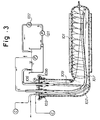
- the sprinkler hose 107 was directly fastened to one of guide tubes 105, which were formed integrally with a lid member 103b of an anchor frame 103, as shown in Fig. 3, so that the length of the sprinkler hose inside the tubular liner bag 102 was not controllable. Therefore, it was necessary to predetermine the length of the sprinkler hose 107 in precise relation to the length of the tubular conduit 101, because when the sprinkler hose 107 was too long, it could be sucked by a suction hose 109 and plug the latter, or it could bend acutely to stop the flow of the hot water therein whereby the proper sprinkling would not occur.
- the sprinkler hose 107 when the sprinkler hose 107 was too short, the head portion of the tubular liner bag 102 could not be sprinkled with hot water. However, it was in practice impossible to measure the length of an underground conduit with high precision, and furthermore, the sprinkler hose 107 would necessarily expand and its length would increase when hot water was passed in it. Therefore, it was very difficult to predetermine the optimum length of the sprinkler hose 107 to be used, and in most instances, the length is selected to be greater than an apparently sufficient value to be on the safer side.
- the present invention was contrived in view of the above problems, and it is, therefore, an object of the invention to provide a new method for repairing a tubular conduit which method is so contrived that the length of the sprinkler hose inside the tubular liner bag can be controlled to an optimum value such that a proper sprinkling of hot water occurs throughout the length of the tubular liner bag so that the repair work becomes more economical and effective.
- an improved method for repairing a tubular conduit by lining the inner wall of the tubular conduit with a tubular liner bag impregnated with thermosetting liquid resin comprising the steps of: (a) everting the tubular liner bag in the tubular conduit; (b) closing the open end of the tubular liner bag with a stationary lid means thereby forming a closed space inside the tubular liner bag and the lid means; (c) inserting a heat-resistive hose into said closed space through said lid means; (d) inflating said tubular liner bag by charging a pressurized fluid into the closed space; and (e) supplying hot water via said heat-resistive hose to thereby heat and harden said liner bag; said method being characterized by that said heat-resistive hose is slidably inserted through said lid means, and is connected to said lid means via a flexible inflatable sealing device such that when said pressurized fluid is charged into said closed space said
- said flexible inflatable sealing device is a tube with one end connected to the outer surface of said heat-resistive hose and the other end everted and anchored to said lid means.
- said heat-resistive hose is a sprinkler hose and as hot water is sprinkled through this hose, the hose is turned about its center axis right and left alternately.
- This invention also provides a flexible inflatable sealing device used in the method of the invention as the sealant between said heat-resistive hose and said lid means: this sealing device has its one part connected to said heat-resistive hose and another part connected to said lid means, and said sealing device is designed such that when said pressurized fluid is charged into said closed space said sealing device is inflated externally from said stationary lid means.
- the heat-resistive hose is connected to the stationary lid means via the flexible inflatable sealing device, so that even when an excessive length of the heat-resistive hose is inserted into the closed space such that the heat-resistive hose is bent and lax, it is possible to pull out the hose from the closed space S until the hose inside the closed space S becomes fairly tight, by supplying pressurized air, for example, into the closed space to thereby force the flexible inflatable sealing device to inflate externally (evert) and pull the hose upward; as the result, the bending and lax of the hose is completely removed and a suitable supply of hot water is achieved and the thermosetting liquid in the tubular liner bag is uniformly hardened, and the tubular conduit is repaired well.
- the heat-resistive sprinkler hose is supported flexibly relative to the stationary lid means by means of the flexible inflatable sealing device, so that it is possible to turn the hose about its axis by virtue of the flexibility of the sealing device; therefore, by turning the hose right and left alternately, it is possible to swing the hot water streams shot out from the sprinkler hose.
- the tubular liner bag is hardened uniformly not only lengthwise but also circumferentially
- the present invention attains the above-mentioned objects.
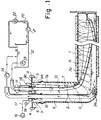
- Fig. 1 is a sectional view of a site in which a conduit is repaired, useful to explain the method of the invention
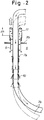
- Fig. 2 is a sectional view useful to explain the movement of the sprinkler hose.
- a tubular liner bag 2 soaked with thermosetting liquid resin is inserted by eversion into a tubular conduit 1 laid under the ground.
- this tubular liner bag 2 is prepared in the following manner. A rectangular nonwoven resin-absorbable fabric of polyester felt is sewed into a tubular shape. This tubular pipe liner is then impregnated with the thermosetting liquid resin and is coated with an air- and water-tight film which hermetically covers at least the outer surface of the tubular pipe liner.
- This hermetic film may be made of polyurethane, polyethylene or any other plastic material that forms an air- and water-tight film. When this tubular liner bag 2 is everted the hermetic film comes inner side of the bag 2.
- the tubular liner bag 2 inserted in the conduit 1 has its one end closed by sewing; the other end of the tubular liner bag 2 is gaped wide and fastened about the lower periphery of a cylindrical part 3a of an anchor frame 3, which is installed on the ground.
- the upper face of the cylindrical part 3a of the anchor frame 3 is covered up with a lid member 3b, which is fixed on the anchor frame 3 by means of a plurality of G clamps 4, and cylindrical guide tubes 5, 6 are formed integrally with and through the lid member 3b.
- the tubular lining bag 2 is formed a closed space S surrounded by the tubular liner bag 2 and the anchor frame 3, and, as shown in Fig. 1, when the tubular liner bag 2 has been everted into the tubular conduit 1, a heat-resistive sprinkler hose 7 and a belt-type rope 8, whose ends are connected to the front end of the tubular liner bag 2, are drawn inside the closed space S, and at the same time, a suction hose 9 is lowered to reach the floor of the everted tubular liner bag 2.
- the belt-type rope 8 is intended to smooth out the bend portion of the tubular liner bag 2 at which the bag 2 tends to fold itself. The other end of the belt-type rope 8 is connected to the lid member 3b.
- the sprinkler hose 7 consists of an upper hose 7a, which penetrates through the lid member 3b at the guide tube 5 and is disposed in the tubular liner bag 2, and a flexible plastic hose 7b, which is connected to the lower end of the upper hose 7a by means of one-touch joints 10 and is made with a plurality of holes at appropriate intervals. These holes are of such sizes that they enable the pressurized hot water in the hose 7 to shoot out powerfully enough to hit the inner walls of the liner bag 2.
- That part of the anchor frame 3 where the upper hose 7a penetrates is hermetically sealed by means of a flexible air-tight tube 11. More particularly, the upper hose 7a penetrates the air-tight tube 11, and the lower end of the latter 11 is attached to the outer surface of the upper hose 7a. Also, that part of the flexible air-tight tube 11 which is disposed outside the anchor frame 3 (outside the closed space S) is turned inside out and its end is fastened to the outer surface of the upper end of the guide tube 5. Accordingly, the upper hose 7a is hermetically and flexibly supported by the stationary guide tube 5 by means of the flexible air-tight tube 11.
- the upper end of the upper hose 7a is connected to a hot water pump 13 provided in a water tank 12 installed on the ground.
- the suction hose 9 has its lower open end lying on the floor of the closed space S in the tubular liner bag 2, as shown in Fig. 1, and the other end extends outside the closed space S through the guide tube 6, passes through a hot water pump 14 installed on the ground, and is disposed to open above the water tank 12.
- the guide tube 6 is provided with a flexible valve 15, which resiliently attaches itself to the suction hose 9, so as to maintain the airtightness of the closed space S.
- the lower end portion of the suction hose 9 which lies on the floor of the closed space S is formed with a plurality of side holes 9a as the supplementary suction holes.
- an air compressor 16 for supplying compressed air to the closed space S by way of a conduit pipe 17, which extends from the compressor 16 and is connected to the lid member 3b to open into the closed space S.
- the lid member 3b is provided with a pressure gauge 18 and a relief valve 19.
- a hot water pipe 20 extends from the bottom of the water tank 12, passes through a hot water pump 21 and a boiler 22, and opens above the water tank 12, so that the pipe 20 constitutes a water circulation system.
- the compressor 16 When the compressor 16 is driven to supply compressed air to the closed space S via the pipe 17, the internal pressure of the closed space S is increased, and the tubular liner bag 2 is inflated by the air pressure to pressed against the inner walls of the tubular conduit 1, as shown in Fig. 1.
- the flexible air-tight tube 11 is everted as it is pressed by the increasing internal pressure of the closed space S and rises together with the sprinkler hose 7 until the latter is fairly tight and stops yielding.
- the flexible air-tight tube 11 has everted by a distance of ⁇ h rising from the position drawn in broken line to the position drawn in solid line, thereby pulling the sprinkler hose 7 upward by a height of ⁇ h from the broken line position to the solid line position.
- the hot water pump 13 in the water tank 12 is driven to cause the hot water in the water tank 12 to rush in the hot water hose 7 in the direction of the arrows shown in Fig. 1, and the hot water shoots out from the holes punctuated through the hose 7 (plastic hose 7b).
- the inner wall of the tubular liner bag 2 is thus showered with the hot water, and the thermosetting resin impregnated in the tubular liner bag 2 is heated and prompted to undergo an exothermic reaction to harden, whereby the inner wall of the conduit 1 is uniformly lined with the hardened lining material 2.
- the hot water that has heated the tubular liner bag 2 falls and gathers on the floor of the liner bag 2 in the closed space S, as shown in Fig. 1.
- this lukewarm water is sucked up through the suction hose 9 and sent back to the water tank 12. Therefore, the water is recirculated within the closed system.
- the hot water in the water tank 12 is drawn to the boiler 22 by means of the hot water pump 21 to be heated to a predetermined temperature, and returned to the water tank 12. Since, in this manner, the hot water in the water tank 12 is circulated in this heating system through the hot water pipe 20 over and over again the temperature of the hot water in the tank 12 is maintained at a value suitable for hardening the thermosetting liquid resin in the tubular liner bag 2.
- the sprinkler hose 7 is hermetically and flexibly supported by the stationary guide tube 5 by means of the flexible air-tight tube 11, so that even when such an excessive length of the sprinkler hose 7 is inside the closed space S that the sprinkler hose 7 is bent and lax and liable to choke itself or be sucked by the suction hose 9 to plug it, it is possible to pull back the sprinkler hose 7 from the closed space S until the sprinkler hose 7 inside the closed space S becomes fairly tight by supplying pressurized air into the closed space S to thereby force the flexible air-tight tube 11 to evert and draw up the sprinkler hose 7. As the result, the bending of the sprinkler hose 7 is completely removed and a suitable sprinkling of hot water is achieved and the thermosetting liquid in the tubular liner bag 2 is uniformly hardened, and the tubular conduit 1 is repaired well.
- the sprinkler hose 7 is supported flexibly relative to the anchor frame 3 by means of the flexible air-tight tube 11, so that it is possible to turn the sprinkler hose 7 about its axis by virtue of the flexibility of the air-tight tube 11; therefore, by turning the sprinkler hose 7 right and left alternately, it is possible to swing the hot water streams shot out from the sprinkler hose 7.
- the tubular liner bag 2 is hardened uniformly not only lengthwise but also circumferentially.
- Both ends of the tubular liner bag 2 are cut off at the ends of the tubular conduit 1 after removing all the devices.
Landscapes
- Engineering & Computer Science (AREA)
- General Engineering & Computer Science (AREA)
- Manufacturing & Machinery (AREA)
- Mechanical Engineering (AREA)
- Physics & Mathematics (AREA)
- Thermal Sciences (AREA)
- Lining Or Joining Of Plastics Or The Like (AREA)
- Pipe Accessories (AREA)
- Protection Of Pipes Against Damage, Friction, And Corrosion (AREA)
Applications Claiming Priority (2)
| Application Number | Priority Date | Filing Date | Title |
|---|---|---|---|
| JP86456/93 | 1993-04-13 | ||
| JP5086456A JPH08425B2 (ja) | 1993-04-13 | 1993-04-13 | 管路補修工法 |
Publications (3)
| Publication Number | Publication Date |
|---|---|
| EP0620103A2 true EP0620103A2 (fr) | 1994-10-19 |
| EP0620103A3 EP0620103A3 (en) | 1994-11-17 |
| EP0620103B1 EP0620103B1 (fr) | 1998-05-13 |
Family
ID=13887453
Family Applications (1)
| Application Number | Title | Priority Date | Filing Date |
|---|---|---|---|
| EP94302267A Expired - Lifetime EP0620103B1 (fr) | 1993-04-13 | 1994-03-29 | Méthode de réparation d'un conduit tubulaire |
Country Status (7)
| Country | Link |
|---|---|
| US (1) | US5490964A (fr) |
| EP (1) | EP0620103B1 (fr) |
| JP (1) | JPH08425B2 (fr) |
| KR (1) | KR0178139B1 (fr) |
| DE (1) | DE69410157T2 (fr) |
| DK (1) | DK0620103T3 (fr) |
| TW (1) | TW245764B (fr) |
Cited By (4)
| Publication number | Priority date | Publication date | Assignee | Title |
|---|---|---|---|---|
| US7121766B2 (en) | 2000-06-27 | 2006-10-17 | Terre Hill Silo Company | Inflatable underground structure liner |
| CN103968185A (zh) * | 2014-04-23 | 2014-08-06 | 江苏心日源建筑节能科技股份有限公司 | 隐蔽管道修补系统 |
| EP2598787A4 (fr) * | 2010-07-30 | 2017-11-01 | Perma-Liner Industries, LLC | Appareil et procédé de durcissement thermique de gaines de tuyaux |
| EP3797240A4 (fr) * | 2018-05-23 | 2022-03-02 | Nu Flow Technologies 2000 Inc. | Ensemble de doublure pour pipelines et procédé associé |
Families Citing this family (24)
| Publication number | Priority date | Publication date | Assignee | Title |
|---|---|---|---|---|
| JP2725742B2 (ja) * | 1994-09-28 | 1998-03-11 | 株式会社湘南合成樹脂製作所 | マンホールライニング工法 |
| JP2702086B2 (ja) * | 1995-02-13 | 1998-01-21 | 株式会社湘南合成樹脂製作所 | 管ライニング材の製造方法 |
| US5606997A (en) * | 1995-04-28 | 1997-03-04 | Advance Trenchless Rehabilitation Systems | Method for rehabilitating pipe line and resin impregnated lining having an integral heating element |
| JP2667796B2 (ja) * | 1995-07-07 | 1997-10-27 | 株式会社湘南合成樹脂製作所 | 管ライニング工法 |
| US5816293A (en) * | 1996-03-27 | 1998-10-06 | Kiest, Jr.; Larry W. | Apparatus for installation of a liner within a pipeline |
| JP2927407B2 (ja) * | 1996-06-06 | 1999-07-28 | 株式会社湘南合成樹脂製作所 | 管ライニング工法 |
| JPH1128766A (ja) * | 1997-07-11 | 1999-02-02 | Shonan Gosei Jushi Seisakusho:Kk | 管ライニング材の反転方法 |
| US6390795B1 (en) | 2000-06-21 | 2002-05-21 | Repipe Holdings, Inc. | Apparatus for everting a tube |
| US20040020544A1 (en) * | 2002-04-05 | 2004-02-05 | Takao Kamiyama | Pressure bag and method of lining branch pipe |
| US6701966B1 (en) * | 2003-04-22 | 2004-03-09 | Infrastructure Repair Systems, Inc. | Apparatus for lateral line repair |
| US20050016450A1 (en) * | 2003-06-13 | 2005-01-27 | Underground Solutions Technologies Group, Inc. | System and arrangement for conduit reparation |
| US7000643B2 (en) | 2003-06-13 | 2006-02-21 | Underground Solutions Technologies Group, Inc. | Bladder system for conduit expansion |
| CA2529389C (fr) | 2003-06-13 | 2012-09-25 | Underground Solutions Technologies Group, Inc. | Systeme et mecanisme de reparation de conduite |
| US20050016608A1 (en) * | 2003-06-13 | 2005-01-27 | Underground Solutions Technologies Group, Inc. | Fluid system for conduit expansion and mobile arrangement therefor |
| US7476348B2 (en) * | 2005-03-04 | 2009-01-13 | High Bar, Llc | Liner installation in pipes |
| JP4847239B2 (ja) * | 2006-07-20 | 2011-12-28 | 株式会社カンドー | 屈曲管路のホース材引き込みライニング工法 |
| US8608888B2 (en) * | 2010-03-09 | 2013-12-17 | Michels Corporation | Method and apparatus for stretching a liner and everting the liner into a pipe |
| US9074719B2 (en) * | 2010-07-30 | 2015-07-07 | Perma-Liner Industries, Llc | Apparatus and method for heat curing of pipe liners |
| US8807171B1 (en) * | 2011-01-31 | 2014-08-19 | Jeffrey M. Tanner | Method and system for lining pipes |
| CN103216704B (zh) * | 2013-04-22 | 2016-01-06 | 中国建筑第七工程局有限公司 | 既有管道修复方法 |
| US9851041B2 (en) | 2015-03-04 | 2017-12-26 | Emagineered Solutions, Inc. | Tubing everting apparatus, assemblies, and methods |
| DE102017113666A1 (de) | 2017-06-21 | 2018-12-27 | Schmale-Holding Gmbh & Co. | Verfahren zur Herstellung von Spannbetttüchern |
| BR102018013965B1 (pt) * | 2018-07-09 | 2022-03-29 | Petróleo Brasileiro S.A. - Petrobras | Dispositivo e método para reparo de mangueira de umbilicais |
| US11254045B2 (en) | 2019-08-26 | 2022-02-22 | Jeffrey M. Tanner | Method and system for lining pipes |
Family Cites Families (11)
| Publication number | Priority date | Publication date | Assignee | Title |
|---|---|---|---|---|
| FR2480901B1 (fr) * | 1980-04-18 | 1985-10-11 | Coopetanche Sa | Procede de garnissage interne d'une conduite |
| JPS63254025A (ja) * | 1987-04-13 | 1988-10-20 | Toubu Kuriinaa Service:Kk | 老朽管の枝管内張法 |
| JPH01182025A (ja) * | 1988-01-18 | 1989-07-19 | Toubu Kuriinaa Service:Kk | 管路補修工法 |
| GB9009073D0 (en) * | 1990-04-23 | 1990-06-20 | Insituform Group Ltd | Improvements relating to the lining of pipelines or passageways |
| US5167901A (en) * | 1990-10-05 | 1992-12-01 | Driver F Thomas | Method of everting a tube |
| US5154936A (en) * | 1990-10-05 | 1992-10-13 | Insituform Licensees B.V. | Apparatus for everting a tube |
| SE9100524D0 (sv) * | 1991-02-22 | 1991-02-22 | Inpipe Sweden Ab | Matare |
| JP2501048B2 (ja) * | 1991-05-14 | 1996-05-29 | 康弘 横島 | 管路補修工法 |
| JP2554417B2 (ja) * | 1991-10-03 | 1996-11-13 | 有限会社横島 | 管ライニング材及びこれの反転方法 |
| US5358359A (en) * | 1993-04-30 | 1994-10-25 | Insituform (Netherlands) B.V. | Apparatus for everting a tube |
| JP6021529B2 (ja) | 2012-08-31 | 2016-11-09 | 帝人フィルムソリューション株式会社 | 積層フィルム |
-
1993
- 1993-04-13 JP JP5086456A patent/JPH08425B2/ja not_active Expired - Fee Related
- 1993-07-06 KR KR1019930012633A patent/KR0178139B1/ko not_active Expired - Lifetime
- 1993-09-02 TW TW082107163A patent/TW245764B/zh active
-
1994
- 1994-03-15 US US08/212,778 patent/US5490964A/en not_active Expired - Fee Related
- 1994-03-29 EP EP94302267A patent/EP0620103B1/fr not_active Expired - Lifetime
- 1994-03-29 DE DE69410157T patent/DE69410157T2/de not_active Expired - Fee Related
- 1994-03-29 DK DK94302267.3T patent/DK0620103T3/da active
Cited By (6)
| Publication number | Priority date | Publication date | Assignee | Title |
|---|---|---|---|---|
| US7121766B2 (en) | 2000-06-27 | 2006-10-17 | Terre Hill Silo Company | Inflatable underground structure liner |
| EP2598787A4 (fr) * | 2010-07-30 | 2017-11-01 | Perma-Liner Industries, LLC | Appareil et procédé de durcissement thermique de gaines de tuyaux |
| CN103968185A (zh) * | 2014-04-23 | 2014-08-06 | 江苏心日源建筑节能科技股份有限公司 | 隐蔽管道修补系统 |
| CN103968185B (zh) * | 2014-04-23 | 2016-09-07 | 江苏心日源建筑节能科技股份有限公司 | 隐蔽管道修补系统 |
| EP3797240A4 (fr) * | 2018-05-23 | 2022-03-02 | Nu Flow Technologies 2000 Inc. | Ensemble de doublure pour pipelines et procédé associé |
| EP4336093A3 (fr) * | 2018-05-23 | 2024-06-19 | Nu Flow Technologies 2000 Inc. | Ensemble de revêtement pour pipelines et procédé associé |
Also Published As
| Publication number | Publication date |
|---|---|
| JPH06297573A (ja) | 1994-10-25 |
| DE69410157T2 (de) | 1998-10-22 |
| JPH08425B2 (ja) | 1996-01-10 |
| US5490964A (en) | 1996-02-13 |
| TW245764B (fr) | 1995-04-21 |
| KR0178139B1 (ko) | 1999-05-15 |
| EP0620103A3 (en) | 1994-11-17 |
| DK0620103T3 (da) | 1998-06-02 |
| DE69410157D1 (de) | 1998-06-18 |
| EP0620103B1 (fr) | 1998-05-13 |
Similar Documents
| Publication | Publication Date | Title |
|---|---|---|
| US5490964A (en) | Method and device for repairing a tubular conduit | |
| US5700110A (en) | Method for lining a bent pipe | |
| EP0518521B1 (fr) | Assemblage de revêtement pour tuyaux de dérivation et méthode pour fabriquer l'assemblage de revêtement | |
| US5454401A (en) | Method of lining a branch pipe | |
| US5598873A (en) | Branch pipe lining method and liner | |
| US5520484A (en) | Eversion nozzle, and a method for repairing an underground tubular conduit | |
| US7311121B2 (en) | Lateral pipe lining material and lateral pipe lining method | |
| US5225121A (en) | Method for repairing a pipe | |
| US6024910A (en) | Method for lining a tubular conduit | |
| EP0691507A1 (fr) | Procédé pour revêtir une conduite latérale d'une tuyauterie enterrée | |
| EP0650006A1 (fr) | Procédé de revêtement d'une conduite latérale | |
| EP0938964B1 (fr) | Revêtement pour une conduite de dérivation et procédé de revêtement d'une conduite de dérivation | |
| EP0620100B1 (fr) | Procédé d'inversion d'un revêtement tubulaire | |
| EP0704294A2 (fr) | Procédé de revêtement d'un trou d'homme | |
| US5503190A (en) | Method for repairing a tubular conduit | |
| EP0620101B1 (fr) | Procédé et appareil pour le revêtement d'un tuyau de dérivation | |
| EP0797042B1 (fr) | Dispositif et procédé de revêtement d'une conduite enterrée | |
| JP2635515B2 (ja) | 管ライニング工法 | |
| JP2678133B2 (ja) | 管ライニング工法 | |
| EP0725246A1 (fr) | Buse d'éversion et procédé de réparation d'un tube souterrain | |
| JPH11268129A (ja) | 管ライニング工法 | |
| JP2000246800A (ja) | 管路補修工法における管状ライナーの反転方法 |
Legal Events
| Date | Code | Title | Description |
|---|---|---|---|
| PUAI | Public reference made under article 153(3) epc to a published international application that has entered the european phase |
Free format text: ORIGINAL CODE: 0009012 |
|
| PUAL | Search report despatched |
Free format text: ORIGINAL CODE: 0009013 |
|
| AK | Designated contracting states |
Kind code of ref document: A2 Designated state(s): DE DK FR GB |
|
| AK | Designated contracting states |
Kind code of ref document: A3 Designated state(s): DE DK FR GB |
|
| 17P | Request for examination filed |
Effective date: 19950317 |
|
| GRAG | Despatch of communication of intention to grant |
Free format text: ORIGINAL CODE: EPIDOS AGRA |
|
| 17Q | First examination report despatched |
Effective date: 19970211 |
|
| GRAG | Despatch of communication of intention to grant |
Free format text: ORIGINAL CODE: EPIDOS AGRA |
|
| GRAG | Despatch of communication of intention to grant |
Free format text: ORIGINAL CODE: EPIDOS AGRA |
|
| GRAH | Despatch of communication of intention to grant a patent |
Free format text: ORIGINAL CODE: EPIDOS IGRA |
|
| GRAH | Despatch of communication of intention to grant a patent |
Free format text: ORIGINAL CODE: EPIDOS IGRA |
|
| GRAA | (expected) grant |
Free format text: ORIGINAL CODE: 0009210 |
|
| AK | Designated contracting states |
Kind code of ref document: B1 Designated state(s): DE DK FR GB |
|
| REG | Reference to a national code |
Ref country code: DK Ref legal event code: T3 |
|
| REF | Corresponds to: |
Ref document number: 69410157 Country of ref document: DE Date of ref document: 19980618 |
|
| ET | Fr: translation filed | ||
| PLBE | No opposition filed within time limit |
Free format text: ORIGINAL CODE: 0009261 |
|
| STAA | Information on the status of an ep patent application or granted ep patent |
Free format text: STATUS: NO OPPOSITION FILED WITHIN TIME LIMIT |
|
| 26N | No opposition filed | ||
| REG | Reference to a national code |
Ref country code: GB Ref legal event code: IF02 |
|
| PGFP | Annual fee paid to national office [announced via postgrant information from national office to epo] |
Ref country code: DK Payment date: 20040123 Year of fee payment: 11 |
|
| PGFP | Annual fee paid to national office [announced via postgrant information from national office to epo] |
Ref country code: FR Payment date: 20040309 Year of fee payment: 11 |
|
| PGFP | Annual fee paid to national office [announced via postgrant information from national office to epo] |
Ref country code: GB Payment date: 20040324 Year of fee payment: 11 |
|
| PGFP | Annual fee paid to national office [announced via postgrant information from national office to epo] |
Ref country code: DE Payment date: 20040408 Year of fee payment: 11 |
|
| PG25 | Lapsed in a contracting state [announced via postgrant information from national office to epo] |
Ref country code: GB Free format text: LAPSE BECAUSE OF NON-PAYMENT OF DUE FEES Effective date: 20050329 |
|
| PG25 | Lapsed in a contracting state [announced via postgrant information from national office to epo] |
Ref country code: DK Free format text: LAPSE BECAUSE OF NON-PAYMENT OF DUE FEES Effective date: 20050331 |
|
| PG25 | Lapsed in a contracting state [announced via postgrant information from national office to epo] |
Ref country code: DE Free format text: LAPSE BECAUSE OF NON-PAYMENT OF DUE FEES Effective date: 20051001 |
|
| GBPC | Gb: european patent ceased through non-payment of renewal fee |
Effective date: 20050329 |
|
| PG25 | Lapsed in a contracting state [announced via postgrant information from national office to epo] |
Ref country code: FR Free format text: LAPSE BECAUSE OF NON-PAYMENT OF DUE FEES Effective date: 20051130 |
|
| REG | Reference to a national code |
Ref country code: DK Ref legal event code: EBP |
|
| REG | Reference to a national code |
Ref country code: FR Ref legal event code: ST Effective date: 20051130 |