EP0620106A1 - Verfahren zum Herstellen eines Schwingungsisolators - Google Patents
Verfahren zum Herstellen eines Schwingungsisolators Download PDFInfo
- Publication number
- EP0620106A1 EP0620106A1 EP19940302264 EP94302264A EP0620106A1 EP 0620106 A1 EP0620106 A1 EP 0620106A1 EP 19940302264 EP19940302264 EP 19940302264 EP 94302264 A EP94302264 A EP 94302264A EP 0620106 A1 EP0620106 A1 EP 0620106A1
- Authority
- EP
- European Patent Office
- Prior art keywords
- cylindrical member
- rubber block
- outer cylindrical
- adhesive
- high frequency
- Prior art date
- Legal status (The legal status is an assumption and is not a legal conclusion. Google has not performed a legal analysis and makes no representation as to the accuracy of the status listed.)
- Ceased
Links
- 238000000034 method Methods 0.000 title claims abstract description 39
- 239000012212 insulator Substances 0.000 title claims abstract description 33
- 229920001971 elastomer Polymers 0.000 claims abstract description 77
- 239000005060 rubber Substances 0.000 claims abstract description 77
- 239000000853 adhesive Substances 0.000 claims abstract description 48
- 230000001070 adhesive effect Effects 0.000 claims abstract description 48
- 238000010438 heat treatment Methods 0.000 claims abstract description 35
- 239000002184 metal Substances 0.000 claims abstract description 13
- 229910052751 metal Inorganic materials 0.000 claims abstract description 13
- 229920002430 Fibre-reinforced plastic Polymers 0.000 claims description 14
- 239000011151 fibre-reinforced plastic Substances 0.000 claims description 14
- 230000004913 activation Effects 0.000 claims description 7
- 229920003023 plastic Polymers 0.000 claims description 4
- 239000004033 plastic Substances 0.000 claims description 4
- 229920000642 polymer Polymers 0.000 claims description 4
- 238000000354 decomposition reaction Methods 0.000 claims description 2
- 238000012360 testing method Methods 0.000 description 24
- 239000000463 material Substances 0.000 description 11
- 239000004809 Teflon Substances 0.000 description 7
- 229920006362 Teflon® Polymers 0.000 description 7
- 230000000630 rising effect Effects 0.000 description 7
- 239000000843 powder Substances 0.000 description 5
- 229910001369 Brass Inorganic materials 0.000 description 4
- 239000010951 brass Substances 0.000 description 4
- 239000003822 epoxy resin Substances 0.000 description 4
- 229920000647 polyepoxide Polymers 0.000 description 4
- 239000004020 conductor Substances 0.000 description 3
- 230000005684 electric field Effects 0.000 description 3
- 239000003302 ferromagnetic material Substances 0.000 description 3
- 238000011179 visual inspection Methods 0.000 description 3
- 229920000049 Carbon (fiber) Polymers 0.000 description 2
- XLOMVQKBTHCTTD-UHFFFAOYSA-N Zinc monoxide Chemical compound [Zn]=O XLOMVQKBTHCTTD-UHFFFAOYSA-N 0.000 description 2
- IISBACLAFKSPIT-UHFFFAOYSA-N bisphenol A Chemical compound C=1C=C(O)C=CC=1C(C)(C)C1=CC=C(O)C=C1 IISBACLAFKSPIT-UHFFFAOYSA-N 0.000 description 2
- 239000004917 carbon fiber Substances 0.000 description 2
- 239000003795 chemical substances by application Substances 0.000 description 2
- 230000007423 decrease Effects 0.000 description 2
- 239000007788 liquid Substances 0.000 description 2
- VNWKTOKETHGBQD-UHFFFAOYSA-N methane Chemical compound C VNWKTOKETHGBQD-UHFFFAOYSA-N 0.000 description 2
- 238000011056 performance test Methods 0.000 description 2
- QIVUCLWGARAQIO-OLIXTKCUSA-N (3s)-n-[(3s,5s,6r)-6-methyl-2-oxo-1-(2,2,2-trifluoroethyl)-5-(2,3,6-trifluorophenyl)piperidin-3-yl]-2-oxospiro[1h-pyrrolo[2,3-b]pyridine-3,6'-5,7-dihydrocyclopenta[b]pyridine]-3'-carboxamide Chemical compound C1([C@H]2[C@H](N(C(=O)[C@@H](NC(=O)C=3C=C4C[C@]5(CC4=NC=3)C3=CC=CN=C3NC5=O)C2)CC(F)(F)F)C)=C(F)C=CC(F)=C1F QIVUCLWGARAQIO-OLIXTKCUSA-N 0.000 description 1
- NLZUEZXRPGMBCV-UHFFFAOYSA-N Butylhydroxytoluene Chemical compound CC1=CC(C(C)(C)C)=C(O)C(C(C)(C)C)=C1 NLZUEZXRPGMBCV-UHFFFAOYSA-N 0.000 description 1
- RYGMFSIKBFXOCR-UHFFFAOYSA-N Copper Chemical compound [Cu] RYGMFSIKBFXOCR-UHFFFAOYSA-N 0.000 description 1
- -1 Polytetrafluoroethylene Polymers 0.000 description 1
- 235000021355 Stearic acid Nutrition 0.000 description 1
- NINIDFKCEFEMDL-UHFFFAOYSA-N Sulfur Chemical compound [S] NINIDFKCEFEMDL-UHFFFAOYSA-N 0.000 description 1
- 230000005540 biological transmission Effects 0.000 description 1
- 229940106691 bisphenol a Drugs 0.000 description 1
- 238000009529 body temperature measurement Methods 0.000 description 1
- 239000006229 carbon black Substances 0.000 description 1
- 239000000919 ceramic Substances 0.000 description 1
- 230000002860 competitive effect Effects 0.000 description 1
- 238000013329 compounding Methods 0.000 description 1
- 238000007796 conventional method Methods 0.000 description 1
- 229910052802 copper Inorganic materials 0.000 description 1
- 239000010949 copper Substances 0.000 description 1
- 239000003431 cross linking reagent Substances 0.000 description 1
- 230000006866 deterioration Effects 0.000 description 1
- 238000001035 drying Methods 0.000 description 1
- 239000012777 electrically insulating material Substances 0.000 description 1
- 238000009413 insulation Methods 0.000 description 1
- 238000004519 manufacturing process Methods 0.000 description 1
- 239000000203 mixture Substances 0.000 description 1
- QIQXTHQIDYTFRH-UHFFFAOYSA-N octadecanoic acid Chemical compound CCCCCCCCCCCCCCCCCC(O)=O QIQXTHQIDYTFRH-UHFFFAOYSA-N 0.000 description 1
- OQCDKBAXFALNLD-UHFFFAOYSA-N octadecanoic acid Natural products CCCCCCCC(C)CCCCCCCCC(O)=O OQCDKBAXFALNLD-UHFFFAOYSA-N 0.000 description 1
- 230000035699 permeability Effects 0.000 description 1
- 229920001343 polytetrafluoroethylene Polymers 0.000 description 1
- 239000004810 polytetrafluoroethylene Substances 0.000 description 1
- 230000005855 radiation Effects 0.000 description 1
- 230000003014 reinforcing effect Effects 0.000 description 1
- 239000002904 solvent Substances 0.000 description 1
- 239000008117 stearic acid Substances 0.000 description 1
- 238000003756 stirring Methods 0.000 description 1
- 239000000126 substance Substances 0.000 description 1
- 229910052717 sulfur Inorganic materials 0.000 description 1
- 239000011593 sulfur Substances 0.000 description 1
- 238000004073 vulcanization Methods 0.000 description 1
- 239000011787 zinc oxide Substances 0.000 description 1
Images


Classifications
-
- F—MECHANICAL ENGINEERING; LIGHTING; HEATING; WEAPONS; BLASTING
- F16—ENGINEERING ELEMENTS AND UNITS; GENERAL MEASURES FOR PRODUCING AND MAINTAINING EFFECTIVE FUNCTIONING OF MACHINES OR INSTALLATIONS; THERMAL INSULATION IN GENERAL
- F16F—SPRINGS; SHOCK-ABSORBERS; MEANS FOR DAMPING VIBRATION
- F16F1/00—Springs
- F16F1/36—Springs made of rubber or other material having high internal friction, e.g. thermoplastic elastomers
- F16F1/38—Springs made of rubber or other material having high internal friction, e.g. thermoplastic elastomers with a sleeve of elastic material between a rigid outer sleeve and a rigid inner sleeve or pin, i.e. bushing-type
- F16F1/3842—Method of assembly, production or treatment; Mounting thereof
-
- B—PERFORMING OPERATIONS; TRANSPORTING
- B29—WORKING OF PLASTICS; WORKING OF SUBSTANCES IN A PLASTIC STATE IN GENERAL
- B29C—SHAPING OR JOINING OF PLASTICS; SHAPING OF MATERIAL IN A PLASTIC STATE, NOT OTHERWISE PROVIDED FOR; AFTER-TREATMENT OF THE SHAPED PRODUCTS, e.g. REPAIRING
- B29C65/00—Joining or sealing of preformed parts, e.g. welding of plastics materials; Apparatus therefor
- B29C65/02—Joining or sealing of preformed parts, e.g. welding of plastics materials; Apparatus therefor by heating, with or without pressure
- B29C65/04—Dielectric heating, e.g. high-frequency welding, i.e. radio frequency welding of plastic materials having dielectric properties, e.g. PVC
-
- B—PERFORMING OPERATIONS; TRANSPORTING
- B29—WORKING OF PLASTICS; WORKING OF SUBSTANCES IN A PLASTIC STATE IN GENERAL
- B29C—SHAPING OR JOINING OF PLASTICS; SHAPING OF MATERIAL IN A PLASTIC STATE, NOT OTHERWISE PROVIDED FOR; AFTER-TREATMENT OF THE SHAPED PRODUCTS, e.g. REPAIRING
- B29C65/00—Joining or sealing of preformed parts, e.g. welding of plastics materials; Apparatus therefor
- B29C65/48—Joining or sealing of preformed parts, e.g. welding of plastics materials; Apparatus therefor using adhesives, i.e. using supplementary joining material; solvent bonding
- B29C65/4805—Joining or sealing of preformed parts, e.g. welding of plastics materials; Apparatus therefor using adhesives, i.e. using supplementary joining material; solvent bonding characterised by the type of adhesives
- B29C65/483—Reactive adhesives, e.g. chemically curing adhesives
- B29C65/4835—Heat curing adhesives
-
- B—PERFORMING OPERATIONS; TRANSPORTING
- B29—WORKING OF PLASTICS; WORKING OF SUBSTANCES IN A PLASTIC STATE IN GENERAL
- B29C—SHAPING OR JOINING OF PLASTICS; SHAPING OF MATERIAL IN A PLASTIC STATE, NOT OTHERWISE PROVIDED FOR; AFTER-TREATMENT OF THE SHAPED PRODUCTS, e.g. REPAIRING
- B29C66/00—General aspects of processes or apparatus for joining preformed parts
- B29C66/01—General aspects dealing with the joint area or with the area to be joined
- B29C66/05—Particular design of joint configurations
- B29C66/10—Particular design of joint configurations particular design of the joint cross-sections
- B29C66/11—Joint cross-sections comprising a single joint-segment, i.e. one of the parts to be joined comprising a single joint-segment in the joint cross-section
- B29C66/112—Single lapped joints
- B29C66/1122—Single lap to lap joints, i.e. overlap joints
-
- B—PERFORMING OPERATIONS; TRANSPORTING
- B29—WORKING OF PLASTICS; WORKING OF SUBSTANCES IN A PLASTIC STATE IN GENERAL
- B29C—SHAPING OR JOINING OF PLASTICS; SHAPING OF MATERIAL IN A PLASTIC STATE, NOT OTHERWISE PROVIDED FOR; AFTER-TREATMENT OF THE SHAPED PRODUCTS, e.g. REPAIRING
- B29C66/00—General aspects of processes or apparatus for joining preformed parts
- B29C66/01—General aspects dealing with the joint area or with the area to be joined
- B29C66/05—Particular design of joint configurations
- B29C66/10—Particular design of joint configurations particular design of the joint cross-sections
- B29C66/12—Joint cross-sections combining only two joint-segments; Tongue and groove joints; Tenon and mortise joints; Stepped joint cross-sections
- B29C66/122—Joint cross-sections combining only two joint-segments, i.e. one of the parts to be joined comprising only two joint-segments in the joint cross-section
- B29C66/1222—Joint cross-sections combining only two joint-segments, i.e. one of the parts to be joined comprising only two joint-segments in the joint cross-section comprising at least a lapped joint-segment
-
- B—PERFORMING OPERATIONS; TRANSPORTING
- B29—WORKING OF PLASTICS; WORKING OF SUBSTANCES IN A PLASTIC STATE IN GENERAL
- B29C—SHAPING OR JOINING OF PLASTICS; SHAPING OF MATERIAL IN A PLASTIC STATE, NOT OTHERWISE PROVIDED FOR; AFTER-TREATMENT OF THE SHAPED PRODUCTS, e.g. REPAIRING
- B29C66/00—General aspects of processes or apparatus for joining preformed parts
- B29C66/01—General aspects dealing with the joint area or with the area to be joined
- B29C66/05—Particular design of joint configurations
- B29C66/10—Particular design of joint configurations particular design of the joint cross-sections
- B29C66/12—Joint cross-sections combining only two joint-segments; Tongue and groove joints; Tenon and mortise joints; Stepped joint cross-sections
- B29C66/122—Joint cross-sections combining only two joint-segments, i.e. one of the parts to be joined comprising only two joint-segments in the joint cross-section
- B29C66/1224—Joint cross-sections combining only two joint-segments, i.e. one of the parts to be joined comprising only two joint-segments in the joint cross-section comprising at least a butt joint-segment
-
- B—PERFORMING OPERATIONS; TRANSPORTING
- B29—WORKING OF PLASTICS; WORKING OF SUBSTANCES IN A PLASTIC STATE IN GENERAL
- B29C—SHAPING OR JOINING OF PLASTICS; SHAPING OF MATERIAL IN A PLASTIC STATE, NOT OTHERWISE PROVIDED FOR; AFTER-TREATMENT OF THE SHAPED PRODUCTS, e.g. REPAIRING
- B29C66/00—General aspects of processes or apparatus for joining preformed parts
- B29C66/01—General aspects dealing with the joint area or with the area to be joined
- B29C66/05—Particular design of joint configurations
- B29C66/20—Particular design of joint configurations particular design of the joint lines, e.g. of the weld lines
- B29C66/24—Particular design of joint configurations particular design of the joint lines, e.g. of the weld lines said joint lines being closed or non-straight
- B29C66/242—Particular design of joint configurations particular design of the joint lines, e.g. of the weld lines said joint lines being closed or non-straight said joint lines being closed, i.e. forming closed contours
- B29C66/2422—Particular design of joint configurations particular design of the joint lines, e.g. of the weld lines said joint lines being closed or non-straight said joint lines being closed, i.e. forming closed contours being circular, oval or elliptical
- B29C66/24221—Particular design of joint configurations particular design of the joint lines, e.g. of the weld lines said joint lines being closed or non-straight said joint lines being closed, i.e. forming closed contours being circular, oval or elliptical being circular
-
- B—PERFORMING OPERATIONS; TRANSPORTING
- B29—WORKING OF PLASTICS; WORKING OF SUBSTANCES IN A PLASTIC STATE IN GENERAL
- B29C—SHAPING OR JOINING OF PLASTICS; SHAPING OF MATERIAL IN A PLASTIC STATE, NOT OTHERWISE PROVIDED FOR; AFTER-TREATMENT OF THE SHAPED PRODUCTS, e.g. REPAIRING
- B29C66/00—General aspects of processes or apparatus for joining preformed parts
- B29C66/50—General aspects of joining tubular articles; General aspects of joining long products, i.e. bars or profiled elements; General aspects of joining single elements to tubular articles, hollow articles or bars; General aspects of joining several hollow-preforms to form hollow or tubular articles
- B29C66/51—Joining tubular articles, profiled elements or bars; Joining single elements to tubular articles, hollow articles or bars; Joining several hollow-preforms to form hollow or tubular articles
- B29C66/53—Joining single elements to tubular articles, hollow articles or bars
- B29C66/534—Joining single elements to open ends of tubular or hollow articles or to the ends of bars
-
- B—PERFORMING OPERATIONS; TRANSPORTING
- B29—WORKING OF PLASTICS; WORKING OF SUBSTANCES IN A PLASTIC STATE IN GENERAL
- B29C—SHAPING OR JOINING OF PLASTICS; SHAPING OF MATERIAL IN A PLASTIC STATE, NOT OTHERWISE PROVIDED FOR; AFTER-TREATMENT OF THE SHAPED PRODUCTS, e.g. REPAIRING
- B29C66/00—General aspects of processes or apparatus for joining preformed parts
- B29C66/50—General aspects of joining tubular articles; General aspects of joining long products, i.e. bars or profiled elements; General aspects of joining single elements to tubular articles, hollow articles or bars; General aspects of joining several hollow-preforms to form hollow or tubular articles
- B29C66/51—Joining tubular articles, profiled elements or bars; Joining single elements to tubular articles, hollow articles or bars; Joining several hollow-preforms to form hollow or tubular articles
- B29C66/54—Joining several hollow-preforms, e.g. half-shells, to form hollow articles, e.g. for making balls, containers; Joining several hollow-preforms, e.g. half-cylinders, to form tubular articles
- B29C66/542—Joining several hollow-preforms, e.g. half-shells, to form hollow articles, e.g. for making balls, containers; Joining several hollow-preforms, e.g. half-cylinders, to form tubular articles joining hollow covers or hollow bottoms to open ends of container bodies
-
- B—PERFORMING OPERATIONS; TRANSPORTING
- B29—WORKING OF PLASTICS; WORKING OF SUBSTANCES IN A PLASTIC STATE IN GENERAL
- B29C—SHAPING OR JOINING OF PLASTICS; SHAPING OF MATERIAL IN A PLASTIC STATE, NOT OTHERWISE PROVIDED FOR; AFTER-TREATMENT OF THE SHAPED PRODUCTS, e.g. REPAIRING
- B29C66/00—General aspects of processes or apparatus for joining preformed parts
- B29C66/70—General aspects of processes or apparatus for joining preformed parts characterised by the composition, physical properties or the structure of the material of the parts to be joined; Joining with non-plastics material
- B29C66/71—General aspects of processes or apparatus for joining preformed parts characterised by the composition, physical properties or the structure of the material of the parts to be joined; Joining with non-plastics material characterised by the composition of the plastics material of the parts to be joined
-
- B—PERFORMING OPERATIONS; TRANSPORTING
- B29—WORKING OF PLASTICS; WORKING OF SUBSTANCES IN A PLASTIC STATE IN GENERAL
- B29C—SHAPING OR JOINING OF PLASTICS; SHAPING OF MATERIAL IN A PLASTIC STATE, NOT OTHERWISE PROVIDED FOR; AFTER-TREATMENT OF THE SHAPED PRODUCTS, e.g. REPAIRING
- B29C66/00—General aspects of processes or apparatus for joining preformed parts
- B29C66/70—General aspects of processes or apparatus for joining preformed parts characterised by the composition, physical properties or the structure of the material of the parts to be joined; Joining with non-plastics material
- B29C66/72—General aspects of processes or apparatus for joining preformed parts characterised by the composition, physical properties or the structure of the material of the parts to be joined; Joining with non-plastics material characterised by the structure of the material of the parts to be joined
- B29C66/721—Fibre-reinforced materials
-
- B—PERFORMING OPERATIONS; TRANSPORTING
- B29—WORKING OF PLASTICS; WORKING OF SUBSTANCES IN A PLASTIC STATE IN GENERAL
- B29C—SHAPING OR JOINING OF PLASTICS; SHAPING OF MATERIAL IN A PLASTIC STATE, NOT OTHERWISE PROVIDED FOR; AFTER-TREATMENT OF THE SHAPED PRODUCTS, e.g. REPAIRING
- B29C66/00—General aspects of processes or apparatus for joining preformed parts
- B29C66/90—Measuring or controlling the joining process
- B29C66/91—Measuring or controlling the joining process by measuring or controlling the temperature, the heat or the thermal flux
- B29C66/912—Measuring or controlling the joining process by measuring or controlling the temperature, the heat or the thermal flux by measuring the temperature, the heat or the thermal flux
- B29C66/9121—Measuring or controlling the joining process by measuring or controlling the temperature, the heat or the thermal flux by measuring the temperature, the heat or the thermal flux by measuring the temperature
- B29C66/91211—Measuring or controlling the joining process by measuring or controlling the temperature, the heat or the thermal flux by measuring the temperature, the heat or the thermal flux by measuring the temperature with special temperature measurement means or methods
- B29C66/91216—Measuring or controlling the joining process by measuring or controlling the temperature, the heat or the thermal flux by measuring the temperature, the heat or the thermal flux by measuring the temperature with special temperature measurement means or methods enabling contactless temperature measurements, e.g. using a pyrometer
-
- B—PERFORMING OPERATIONS; TRANSPORTING
- B29—WORKING OF PLASTICS; WORKING OF SUBSTANCES IN A PLASTIC STATE IN GENERAL
- B29C—SHAPING OR JOINING OF PLASTICS; SHAPING OF MATERIAL IN A PLASTIC STATE, NOT OTHERWISE PROVIDED FOR; AFTER-TREATMENT OF THE SHAPED PRODUCTS, e.g. REPAIRING
- B29C66/00—General aspects of processes or apparatus for joining preformed parts
- B29C66/90—Measuring or controlling the joining process
- B29C66/91—Measuring or controlling the joining process by measuring or controlling the temperature, the heat or the thermal flux
- B29C66/912—Measuring or controlling the joining process by measuring or controlling the temperature, the heat or the thermal flux by measuring the temperature, the heat or the thermal flux
- B29C66/9121—Measuring or controlling the joining process by measuring or controlling the temperature, the heat or the thermal flux by measuring the temperature, the heat or the thermal flux by measuring the temperature
- B29C66/91221—Measuring or controlling the joining process by measuring or controlling the temperature, the heat or the thermal flux by measuring the temperature, the heat or the thermal flux by measuring the temperature of the parts to be joined
-
- B—PERFORMING OPERATIONS; TRANSPORTING
- B29—WORKING OF PLASTICS; WORKING OF SUBSTANCES IN A PLASTIC STATE IN GENERAL
- B29C—SHAPING OR JOINING OF PLASTICS; SHAPING OF MATERIAL IN A PLASTIC STATE, NOT OTHERWISE PROVIDED FOR; AFTER-TREATMENT OF THE SHAPED PRODUCTS, e.g. REPAIRING
- B29C66/00—General aspects of processes or apparatus for joining preformed parts
- B29C66/90—Measuring or controlling the joining process
- B29C66/91—Measuring or controlling the joining process by measuring or controlling the temperature, the heat or the thermal flux
- B29C66/914—Measuring or controlling the joining process by measuring or controlling the temperature, the heat or the thermal flux by controlling or regulating the temperature, the heat or the thermal flux
- B29C66/9141—Measuring or controlling the joining process by measuring or controlling the temperature, the heat or the thermal flux by controlling or regulating the temperature, the heat or the thermal flux by controlling or regulating the temperature
- B29C66/91411—Measuring or controlling the joining process by measuring or controlling the temperature, the heat or the thermal flux by controlling or regulating the temperature, the heat or the thermal flux by controlling or regulating the temperature of the parts to be joined, e.g. the joining process taking the temperature of the parts to be joined into account
-
- B—PERFORMING OPERATIONS; TRANSPORTING
- B29—WORKING OF PLASTICS; WORKING OF SUBSTANCES IN A PLASTIC STATE IN GENERAL
- B29C—SHAPING OR JOINING OF PLASTICS; SHAPING OF MATERIAL IN A PLASTIC STATE, NOT OTHERWISE PROVIDED FOR; AFTER-TREATMENT OF THE SHAPED PRODUCTS, e.g. REPAIRING
- B29C66/00—General aspects of processes or apparatus for joining preformed parts
- B29C66/90—Measuring or controlling the joining process
- B29C66/91—Measuring or controlling the joining process by measuring or controlling the temperature, the heat or the thermal flux
- B29C66/914—Measuring or controlling the joining process by measuring or controlling the temperature, the heat or the thermal flux by controlling or regulating the temperature, the heat or the thermal flux
- B29C66/9141—Measuring or controlling the joining process by measuring or controlling the temperature, the heat or the thermal flux by controlling or regulating the temperature, the heat or the thermal flux by controlling or regulating the temperature
- B29C66/91431—Measuring or controlling the joining process by measuring or controlling the temperature, the heat or the thermal flux by controlling or regulating the temperature, the heat or the thermal flux by controlling or regulating the temperature the temperature being kept constant over time
-
- B—PERFORMING OPERATIONS; TRANSPORTING
- B29—WORKING OF PLASTICS; WORKING OF SUBSTANCES IN A PLASTIC STATE IN GENERAL
- B29C—SHAPING OR JOINING OF PLASTICS; SHAPING OF MATERIAL IN A PLASTIC STATE, NOT OTHERWISE PROVIDED FOR; AFTER-TREATMENT OF THE SHAPED PRODUCTS, e.g. REPAIRING
- B29C66/00—General aspects of processes or apparatus for joining preformed parts
- B29C66/90—Measuring or controlling the joining process
- B29C66/91—Measuring or controlling the joining process by measuring or controlling the temperature, the heat or the thermal flux
- B29C66/914—Measuring or controlling the joining process by measuring or controlling the temperature, the heat or the thermal flux by controlling or regulating the temperature, the heat or the thermal flux
- B29C66/9161—Measuring or controlling the joining process by measuring or controlling the temperature, the heat or the thermal flux by controlling or regulating the temperature, the heat or the thermal flux by controlling or regulating the heat or the thermal flux, i.e. the heat flux
- B29C66/91651—Measuring or controlling the joining process by measuring or controlling the temperature, the heat or the thermal flux by controlling or regulating the temperature, the heat or the thermal flux by controlling or regulating the heat or the thermal flux, i.e. the heat flux by controlling or regulating the heat generated by Joule heating or induction heating
- B29C66/91655—Measuring or controlling the joining process by measuring or controlling the temperature, the heat or the thermal flux by controlling or regulating the temperature, the heat or the thermal flux by controlling or regulating the heat or the thermal flux, i.e. the heat flux by controlling or regulating the heat generated by Joule heating or induction heating by controlling or regulating the current intensity
-
- B—PERFORMING OPERATIONS; TRANSPORTING
- B29—WORKING OF PLASTICS; WORKING OF SUBSTANCES IN A PLASTIC STATE IN GENERAL
- B29C—SHAPING OR JOINING OF PLASTICS; SHAPING OF MATERIAL IN A PLASTIC STATE, NOT OTHERWISE PROVIDED FOR; AFTER-TREATMENT OF THE SHAPED PRODUCTS, e.g. REPAIRING
- B29C66/00—General aspects of processes or apparatus for joining preformed parts
- B29C66/70—General aspects of processes or apparatus for joining preformed parts characterised by the composition, physical properties or the structure of the material of the parts to be joined; Joining with non-plastics material
- B29C66/72—General aspects of processes or apparatus for joining preformed parts characterised by the composition, physical properties or the structure of the material of the parts to be joined; Joining with non-plastics material characterised by the structure of the material of the parts to be joined
- B29C66/721—Fibre-reinforced materials
- B29C66/7212—Fibre-reinforced materials characterised by the composition of the fibres
-
- B—PERFORMING OPERATIONS; TRANSPORTING
- B29—WORKING OF PLASTICS; WORKING OF SUBSTANCES IN A PLASTIC STATE IN GENERAL
- B29C—SHAPING OR JOINING OF PLASTICS; SHAPING OF MATERIAL IN A PLASTIC STATE, NOT OTHERWISE PROVIDED FOR; AFTER-TREATMENT OF THE SHAPED PRODUCTS, e.g. REPAIRING
- B29C66/00—General aspects of processes or apparatus for joining preformed parts
- B29C66/70—General aspects of processes or apparatus for joining preformed parts characterised by the composition, physical properties or the structure of the material of the parts to be joined; Joining with non-plastics material
- B29C66/73—General aspects of processes or apparatus for joining preformed parts characterised by the composition, physical properties or the structure of the material of the parts to be joined; Joining with non-plastics material characterised by the intensive physical properties of the material of the parts to be joined, by the optical properties of the material of the parts to be joined, by the extensive physical properties of the parts to be joined, by the state of the material of the parts to be joined or by the material of the parts to be joined being a thermoplastic or a thermoset
- B29C66/739—General aspects of processes or apparatus for joining preformed parts characterised by the composition, physical properties or the structure of the material of the parts to be joined; Joining with non-plastics material characterised by the intensive physical properties of the material of the parts to be joined, by the optical properties of the material of the parts to be joined, by the extensive physical properties of the parts to be joined, by the state of the material of the parts to be joined or by the material of the parts to be joined being a thermoplastic or a thermoset characterised by the material of the parts to be joined being a thermoplastic or a thermoset
- B29C66/7394—General aspects of processes or apparatus for joining preformed parts characterised by the composition, physical properties or the structure of the material of the parts to be joined; Joining with non-plastics material characterised by the intensive physical properties of the material of the parts to be joined, by the optical properties of the material of the parts to be joined, by the extensive physical properties of the parts to be joined, by the state of the material of the parts to be joined or by the material of the parts to be joined being a thermoplastic or a thermoset characterised by the material of the parts to be joined being a thermoplastic or a thermoset characterised by the material of at least one of the parts being a thermoset
-
- B—PERFORMING OPERATIONS; TRANSPORTING
- B29—WORKING OF PLASTICS; WORKING OF SUBSTANCES IN A PLASTIC STATE IN GENERAL
- B29C—SHAPING OR JOINING OF PLASTICS; SHAPING OF MATERIAL IN A PLASTIC STATE, NOT OTHERWISE PROVIDED FOR; AFTER-TREATMENT OF THE SHAPED PRODUCTS, e.g. REPAIRING
- B29C66/00—General aspects of processes or apparatus for joining preformed parts
- B29C66/80—General aspects of machine operations or constructions and parts thereof
- B29C66/83—General aspects of machine operations or constructions and parts thereof characterised by the movement of the joining or pressing tools
- B29C66/832—Reciprocating joining or pressing tools
- B29C66/8322—Joining or pressing tools reciprocating along one axis
-
- B—PERFORMING OPERATIONS; TRANSPORTING
- B29—WORKING OF PLASTICS; WORKING OF SUBSTANCES IN A PLASTIC STATE IN GENERAL
- B29K—INDEXING SCHEME ASSOCIATED WITH SUBCLASSES B29B, B29C OR B29D, RELATING TO MOULDING MATERIALS OR TO MATERIALS FOR MOULDS, REINFORCEMENTS, FILLERS OR PREFORMED PARTS, e.g. INSERTS
- B29K2021/00—Use of unspecified rubbers as moulding material
-
- B—PERFORMING OPERATIONS; TRANSPORTING
- B29—WORKING OF PLASTICS; WORKING OF SUBSTANCES IN A PLASTIC STATE IN GENERAL
- B29K—INDEXING SCHEME ASSOCIATED WITH SUBCLASSES B29B, B29C OR B29D, RELATING TO MOULDING MATERIALS OR TO MATERIALS FOR MOULDS, REINFORCEMENTS, FILLERS OR PREFORMED PARTS, e.g. INSERTS
- B29K2105/00—Condition, form or state of moulded material or of the material to be shaped
- B29K2105/06—Condition, form or state of moulded material or of the material to be shaped containing reinforcements, fillers or inserts
-
- F—MECHANICAL ENGINEERING; LIGHTING; HEATING; WEAPONS; BLASTING
- F16—ENGINEERING ELEMENTS AND UNITS; GENERAL MEASURES FOR PRODUCING AND MAINTAINING EFFECTIVE FUNCTIONING OF MACHINES OR INSTALLATIONS; THERMAL INSULATION IN GENERAL
- F16F—SPRINGS; SHOCK-ABSORBERS; MEANS FOR DAMPING VIBRATION
- F16F2226/00—Manufacturing; Treatments
Definitions
- the present invention relates in general to a method of producing vibration insulators, and more particularly, to a method of producing vibration insulators used in motor vehicles or the like. More specifically, the present invention is concerned with a method of producing the vibration insulators of a type which comprises an outer cylindrical member of fiber-reinforced plastic, an inner cylindrical member of metal received in the outer cylindrical member, and a compounded rubber block interposed therebetween.
- vibration insulators Hitherto, various types of vibration insulators have been proposed and put into practical use particularly in the field of motor vehicles.
- One of them is of a type which comprises an outer cylindrical member of fiber-reinforced plastic, an inner cylindrical member of metal received in the outer cylindrical member and a compounded rubber block interposed therebetween.
- two methods For production of the vibration insulators of such type, two methods have been commonly used.
- an adhesive is applied to both an inner surface of the outer cylindrical member and an outer surface of the inner cylindrical member.
- the adhesive is of a type which becomes activated when heated to a certain level.
- the inner cylindrical member is coaxially received in the outer cylindrical member and they are put into a mold which has been heated to about 150°C to 170°C.
- a liquid state (or insufficiently vulcanized) rubber material is poured into the mold and thus into a cylindrical clearance defined between the inner and outer cylindrical members.
- the temperature of the mold is kept at 150°C to 170°C for a certain time.
- curing of the adhesive and that of the rubber material are achieved at the same time.
- the bonding between the outer cylindrical member and the compounded rubber block and that between the inner cylindrical member and the rubber block are achieved at the same time.
- this method will be named as "one-step bonding method”.
- an inner unit is produced by forming a compounded rubber block around the outer surface of the inner cylindrical member using the above-mentioned one step bonding method. That is, by this first step, the bonding between the rubber block thus formed and the inner cylindrical member is achieved. Then, the inner unit thus produced is press-fitted in the outer cylindrical member whose inner surface has been applied with an adhesive, and then, the entire structure is heated to a certain temperature to cure the adhesive. Thus, by this second step, the bonding between the compounded rubber block and the outer cylindrical member is achieved.
- Japanese Patent First Provisional Publication 3-221434 That is, in this method, powder of ferroelectric material, ferromagnetic material or electrically conductive material is dispersed in the adhesive, and the adhesive is heated by means of a high frequency heating.
- the mold is kept heated within the range from 150°C to 170°C for curing or vulcanizing the rubber material.
- temperature range affects the mechanical strength of the plastic (viz., FRP) which constitutes the outer cylindrical member.
- FRP mechanical strength of the plastic
- the strength of the plastic at such high temperature becomes very low. Accordingly, there arises a possibility that the outer cylindrical member heated to such high degree is deformed and/or cracked due to a marked pressure produced by the rubber material poured into and cured in the mold.
- the length of the mold must be matched with the longer one. This however induces an ill-matched increase in weight of the mold.
- the inner unit is press-fitted in the outer cylindrical member applying a marked stress to the outer cylindrical member.
- the press-fitting however affects the heat resistance of the outer cylindrical member constructed of FRP. That is, due to a marked stress applied to the outer cylindrical member, the heat resistance of the same is lowered to the level of 100°C to 120°C which is very low as compared with the activation temperature (viz., 130°C to 200°C) of the adhesive.
- the temperature suitable for the outer cylindrical member and the temperature suitable for the adhesive are not obtained by means of a simple heating method. If such simple heating method is actually used, deformation and/or poor bonding of the outer cylindrical member tends to occur.
- a compounded rubber is mainly composed of polar rubbers whose basic polymer or polymers have SP value (viz., solubility parameter) larger than 8.6, a partial heating of the rubber is possible by means of the high frequency heating.
- SP value viz., solubility parameter
- the compounded rubbers having such polar rubbers fail to have a satisfied vibration insulation ability.
- the vibration insulators including them would have a poor competitive position in markets even though the bonding by the adhesive is made well.
- the insulator comprises an outer cylindrical member of fiber-reinforced plastic, an inner cylindrical member of metal received in the outer cylindrical member in a manner to define a cylindrical space therebetween, and a. compounded rubber block intimately disposed in the cylindrical space.
- the method comprises the steps of: (a) producing an inner unit which includes the inner cylindrical member and the compounded rubber block which is disposed about the inner cylindrical member; (b) applying an adhesive to an inner surface of the outer cylindrical member, the adhesive being of a type which is cured and hardened when heated; (c) press-fitting the inner unit in the outer cylindrical member; (d) putting an electrode plate around the outer cylindrical member near the inner unit; and (e) applying a high frequency current to the electrode plate to induce a high frequency dielectric heating by which the adhesive and the compounded rubber block are heated, the high frequency current having a frequency lower than 100 MHz.
- the dielectric loss of a compounded rubber block is very small as compared with that of common plastics. Accordingly, when, in high frequency dielectric heating, adequate heating of the compounded rubber block is intended by using an AC current whose frequency is lower than 100 MHz, it is necessary to greatly increase the electric field strength at the rubber. The demand for increasing the electric field strength is much severe in nonpolar rubber blocks whose SP value (viz., Solubility Parameter) is very small.
- heating by using such low frequency current has not been practically used.
- heating of the nonpolar rubber block has been made by using a microwave.
- the microwave belongs to a troublesome electromagnetic wave which should be handled with care due to its very high permeability. While, as is known, a high frequency current having a frequency lower than 100 MHz is harmless.
- the present invention is provided by embodying the above-mentioned theories.
- the inventors produced eight types of vibration insulators as test pieces and carried out various examinations and tests on them.
- Example-1 As is seen from Table-1 (see page 17), the eight types were Example-1, Example-2, Example-3, Example-4, Reference-1, Reference-2, Reference-3 and Reference-4.
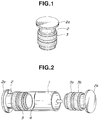
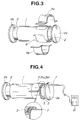
- each type vibration insulator was an outer cylindrical member 1, two inner cylindrical members 2, two compounded rubber blocks 3 and an adhesive 4 of chloric system.
- Each vibration insulator E-1, E-2, E-3, E-4, R-1, R-2, R-3 or R-4 was produced in the following manner.
- the outer cylindrical member 1 was constructed of an epoxy resin of bisphenol-A type and contained therein about 60% by volume of carbon fiber of pitch type. The epoxy resin was cured at 100 °C for 3 hours. The outer diameter, inner diameter and length of the outer cylindrical member 1 were 82.6 mm, 76.6 mm and 200 mm respectively. The cylindrical wall of the outer cylindrical member 1 had thus a thickness of 3 mm therethroughout.
- Each inner cylindrical member 2 was constructed of metal of STKM12B (JIS, Japanese Industrial Standard). The outer diameter, inner diameter and length of the inner cylindrical member 2 were 68.9 mm, 64.3 mm and 200 mm respectively. As is seen from Fig. 1, each inner cylindrical member 2 had a metal disc 2a of SS41 (JIS) welded to one end thereof. The diameter and thickness of the metal disc 2a were 130 mm and 15 mm respectively.
- the compounding agents of the rubber blocks 3 for each vibration insulator are shown in Table-1.
- the outer and inner cylindrical members 1 and 2 were applied at their inner and outer cylindrical surfaces with a primer of chloric system and, after drying the primer, with an adhesive 4.
- the outer and inner cylindrical members 1 and 2 were then left in a curing oven and heated at 80 °C to 100 °C for a certain time. With this, solvent of the adhesive 4 was removed and the adhesive 4 was cured or hardened to a certain degree.
- the activation temperature Ta of the adhesive 4 of chloric system was about 160 °C to 170 °C.
- a mold heated to about 150 °C was prepared.
- the inner cylindrical member 2 was put in the mold, and a liquid state (or insufficiently vulcanized) rubber material for the rubber block 3 was poured into the mold and compressed for about 10 minutes.
- two inner units as shown in Figs. 1 and 2 were produced, each including a sufficiently cured cylindrical rubber block 3 mounted on and bonded to the inner cylindrical member 2.
- the cylindrical rubber block 3 was shaped to have two identical ring-shaped portions 3a and 3b each being 20 mm in width and 5.2 mm in thickness.
- each ring-shaped portion 3a or 3b of the cylindrical rubber blocks 3 was about 4 mm. That is, the ring-shaped portion 3a or 3b was compressed by about 1.2 mm or by about 23 %.
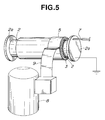
- a sheet 6 of Teflon (Trade Name: Polytetrafluoroethylene) of 70 mm in width and 0.2 mm in thickness was put around one end of the outer cylindrical member 1 and two semicircular brass plates 5a and 5b were put around the end of the outer cylindrical member 1 with the Teflon sheet 6 intimately interposed between.
- Each semicircular brass plate 5a or 5b was 70 mm in width and 1 mm in thickness.
- These brass plates 5a and 5b were combined to constitute a circular electrode 5.
- each brass plate 5a or 5b was formed with bent flange portions.
- a temperature sensor 7 was set in the rubber block 3 of one inner unit.
- the sensor 7 was connected to a temperature meter 10.
- the sensor 7 was of an infrared radiation sensing type which was not affected by high frequency noises.
- the circular electrode 5 (viz., 5a and 5b) was connected through a copper plate 9 to a high frequency oscillator 8 which used a triode bulb for effecting 3 KW output.
- a high frequency oscillator 8 which used a triode bulb for effecting 3 KW output.
- 40 MHz and 0.5 A high frequency current was applied to the circular electrode 5.
- the rubber block 3 was bonded to the inner surface of the outer cylindrical member 1.
- the temperature of the adhesive 4 was monitored by the temperature meter 10.
- the high frequency dielectric heating was stopped and instantly the electrode 5 and the Teflon sheet 6 were dismantled from the outer cylindrical member 1 and the temperature of the outer cylindrical member 1 was measured.
- each vibration insulator E-1, E-2, E-3, E-4, R-1, R-2, R-3 or R-4 was left in an open air until the outer cylindrical member 1 was cooled to a room temperature. Then, visual inspection test was made to the insulators E-1, E-2, E-3 and E-4. Then, all vibration insulators were subjected to a twisting test. This twisting test was carried out twice for each insulator E-1, E-2, E-3, E-4, R-1, R-2, R-3 or R-4. That is, at first, one metal disc 2a and the outer cylindrical member 1 were grasped by respective chucks of a twisting tester and forced to twist in opposite directions at a speed of 5 deg/min. With this, the maximum torque exhibited by the insulator was measured. The same test was applied to the bonding made between the other inner unit and the outer cylindrical member 1. The two data of the maximum torque were averaged to provide a mean value which is shown in Table-1.
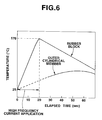
- the temperature of the adhesive reached to the activation level (viz., 160 °C to 170 °C) of the adhesive. That is, the adequate heating of the adhesive could be made within such a very short time, which induces a high productivity of the vibration insulator.
- the outer cylindrical members (FRP) 1 showed their temperature within a range from 70 °C to 75 °C. Of course, at such lower temperature, the outer cylindrical members 1 constructed of the above-mentioned FRP were not softened and/or deteriorated.
- the temperature of the rubber block 3 was instantly lowered to a level below 100 °C. This was because of heat transmission from the rubber block 3 to the outer and inner cylindrical members 1 and 2 which had a lower temperature.
- a broken line in Fig. 6 is an estimated temperature of the outer cylindrical member 1. This was because the actual temperature measurement of the outer cylindrical member 1 had to be made after the electrode 5 was removed from the outer cylindrical member 1.
- the rubber blocks 3 used in the examples E-1, E-2, E-3 and E-4 and those used in the references R-1, R-2, R-3 and R-4 were of a nonpolar type having the SP value lower than 8.6. However, as is understood from Table-1, all the examples E-1, E-2, E-3 and E-4 showed a satisfied bonding between the rubber block 3 and the outer cylindrical member 1.
- Teflon sheet 6 may be replaced with other electrically insulating materials, such as ceramics, paper and the like.
- test piece (E-5) which is as follows.
- a rectangular compounded rubber block 30 was produced.
- the composition of the rubber block is shown in Table-2.
- Table 2 NR 65 BR 35 Zinc Oxide 5 Stearic Acid 1 Antioxidant 4 Carbon Black 40 Oil 20 Sulfur 1.5 Vulcanization Accelerator 0.6 (parts by weight)
- a rectangular fiber-reinforced plastic block 10 was prepared, which comprised epoxy resin as a base and carbon fiber as a reinforcing member.
- An adhesive 40 of chloric system was prepared and a high frequency oscillator 80 capable of outputting a high frequency current of 40.6 MHz was prepared.
- the thickness of the fiber-reinforced plastic block 10 was 2.2 mm and that of the rubber block 30 was 5.7 mm.
- the adhesive 40 was applied to a given rectangular area of a lower surface of the fiber-reinforced plastic block 10, which area was 25.4 mm x 25.4 mm.
- the two blocks 10 and 30 were put together and put in a rectangular case 60a constructed of Teflon.
- a Teflon cover 60b of 3.0 mm in thickness was put on the rectangular case 60a to press the two blocks 10 and 30 uniformly therethroughout.
- a rectangular electrode 50 was put on the Teflon cover 60b and a rectangular metal plate 100 was attached to the bottom of the rectangular case 60a.
- the distance from the electrode 50 to the outer surface of the fiber-reinforced plastic block 10 was 3.0 mm and that from the electrode 50 to the outer surface of the rubber block 30 was 5.2 mm.
- the electrode 50 was connected to the high frequency oscillator 80 and the rectangular metal plate 100 was grounded. The oscillator 80 was then energized to apply a high frequency current to the electrode 50.
- the temperature of the fiber-reinforced plastic block 10, the adhesive 40 and the rubber block 30 was measured by a temperature sensor. The sensor was of a type not affected by the high frequency.
- the arrangement of the two blocks 10 and 30 was opposite to that of the above-mentioned example test piece (E-5) of Fig. 7. That is, in the reference test piece (R-5), the distance from the electrode 50 to the outer surface of the fiber-reinforced plastic block 10 was 8.7 mm and that from the electrode 50 to the outer surface of the rubber block was 3 mm.
- the external appearance of the example test piece (E-5) was not affected by the high frequency dielectric heating.
- the rubber block 30 became somewhat inflated at the time when the high frequency heating time counted 180 seconds.
- the reference piece (R-5) showed a lower resistance against the peeling.
Landscapes
- Engineering & Computer Science (AREA)
- Mechanical Engineering (AREA)
- Physics & Mathematics (AREA)
- Thermal Sciences (AREA)
- General Engineering & Computer Science (AREA)
- Manufacturing & Machinery (AREA)
- Chemical & Material Sciences (AREA)
- Chemical Kinetics & Catalysis (AREA)
- General Chemical & Material Sciences (AREA)
- Insulators (AREA)
- Lining Or Joining Of Plastics Or The Like (AREA)
- Laminated Bodies (AREA)
Applications Claiming Priority (2)
| Application Number | Priority Date | Filing Date | Title |
|---|---|---|---|
| JP6895993A JPH06278210A (ja) | 1993-03-29 | 1993-03-29 | 樹脂複合体と加硫ゴムとの接合方法 |
| JP68959/93 | 1993-03-29 |
Publications (1)
| Publication Number | Publication Date |
|---|---|
| EP0620106A1 true EP0620106A1 (de) | 1994-10-19 |
Family
ID=13388726
Family Applications (1)
| Application Number | Title | Priority Date | Filing Date |
|---|---|---|---|
| EP19940302264 Ceased EP0620106A1 (de) | 1993-03-29 | 1994-03-29 | Verfahren zum Herstellen eines Schwingungsisolators |
Country Status (3)
| Country | Link |
|---|---|
| US (1) | US5575869A (de) |
| EP (1) | EP0620106A1 (de) |
| JP (1) | JPH06278210A (de) |
Cited By (4)
| Publication number | Priority date | Publication date | Assignee | Title |
|---|---|---|---|---|
| WO1997035123A1 (en) * | 1996-03-21 | 1997-09-25 | The Boler Company | Voided bushing for vehicle suspensions |
| GB2343137A (en) * | 1998-09-17 | 2000-05-03 | Avon Vibration Man Syst Ltd | Curing the rubber of an article by heat transfer |
| CN102371678A (zh) * | 2010-08-11 | 2012-03-14 | 纬创资通股份有限公司 | 压合方法及其压合设备 |
| EP3135463A3 (de) * | 2015-08-24 | 2017-06-14 | EFFBE GmbH | Verfahren zur herstellung eines lagerelements sowie lagerelement |
Families Citing this family (4)
| Publication number | Priority date | Publication date | Assignee | Title |
|---|---|---|---|---|
| US5750970A (en) * | 1996-07-03 | 1998-05-12 | Ford Global Technologies, Inc. | Method for dielectrically heating an adhesive |
| SE519248C2 (sv) * | 2001-06-18 | 2003-02-04 | Abb Ab | Anordning för upptagande av kortslutningskrafter i en kabellindad induktor, metod samt induktor |
| JPWO2007094475A1 (ja) * | 2006-02-14 | 2009-07-09 | 味の素株式会社 | 繊維強化プラスチック製品 |
| DE102016205039A1 (de) | 2016-03-24 | 2017-09-28 | Fraunhofer-Gesellschaft zur Förderung der angewandten Forschung e.V. | Verfahren zum Verbinden zweier Fügeelemente |
Citations (6)
| Publication number | Priority date | Publication date | Assignee | Title |
|---|---|---|---|---|
| US2019052A (en) * | 1931-07-31 | 1935-10-29 | Hugh C Lord | Joint |
| FR2442991A1 (fr) * | 1978-11-30 | 1980-06-27 | Vibrachoc Sa | Isolateur de vibrations |
| US4385025A (en) * | 1979-10-22 | 1983-05-24 | Barry Wright Corporation | Method of coinjection molding of thermoplastic and thermoplastic elastomer |
| JPH0257736A (ja) * | 1988-08-22 | 1990-02-27 | Hokushin Ind Inc | 防振ブッシュの製造方法 |
| EP0492789A1 (de) * | 1990-12-24 | 1992-07-01 | Ford Motor Company Limited | Verfahren und Vorrichtung zum Verbinden eines leitenden Gegenstandes mit einem nichtleitenden Gegenstand |
| FR2679485A1 (fr) * | 1991-07-26 | 1993-01-29 | Socratech | Procede de soudage a haute frequence d'articles en elastomere. |
Family Cites Families (4)
| Publication number | Priority date | Publication date | Assignee | Title |
|---|---|---|---|---|
| US2472370A (en) * | 1945-01-08 | 1949-06-07 | Cutler Hammer Inc | Electrode for high-frequency heating of insulation preforms |
| JPS63139726A (ja) * | 1986-12-01 | 1988-06-11 | Nitsushiyoo:Kk | 医療用バッグのポート取り付け方法 |
| JP2880226B2 (ja) * | 1990-01-29 | 1999-04-05 | 鬼怒川ゴム工業株式会社 | Frp材料と加硫ゴムとの接合方法 |
| JPH05162207A (ja) * | 1991-12-17 | 1993-06-29 | Kinugawa Rubber Ind Co Ltd | Cfrp構造体と加硫ゴムとの接合方法 |
-
1993
- 1993-03-29 JP JP6895993A patent/JPH06278210A/ja active Pending
-
1994
- 1994-03-28 US US08/218,521 patent/US5575869A/en not_active Expired - Fee Related
- 1994-03-29 EP EP19940302264 patent/EP0620106A1/de not_active Ceased
Patent Citations (6)
| Publication number | Priority date | Publication date | Assignee | Title |
|---|---|---|---|---|
| US2019052A (en) * | 1931-07-31 | 1935-10-29 | Hugh C Lord | Joint |
| FR2442991A1 (fr) * | 1978-11-30 | 1980-06-27 | Vibrachoc Sa | Isolateur de vibrations |
| US4385025A (en) * | 1979-10-22 | 1983-05-24 | Barry Wright Corporation | Method of coinjection molding of thermoplastic and thermoplastic elastomer |
| JPH0257736A (ja) * | 1988-08-22 | 1990-02-27 | Hokushin Ind Inc | 防振ブッシュの製造方法 |
| EP0492789A1 (de) * | 1990-12-24 | 1992-07-01 | Ford Motor Company Limited | Verfahren und Vorrichtung zum Verbinden eines leitenden Gegenstandes mit einem nichtleitenden Gegenstand |
| FR2679485A1 (fr) * | 1991-07-26 | 1993-01-29 | Socratech | Procede de soudage a haute frequence d'articles en elastomere. |
Non-Patent Citations (1)
| Title |
|---|
| PATENT ABSTRACTS OF JAPAN vol. 14, no. 228 (M - 973)<4171> 15 May 1990 (1990-05-15) * |
Cited By (5)
| Publication number | Priority date | Publication date | Assignee | Title |
|---|---|---|---|---|
| WO1997035123A1 (en) * | 1996-03-21 | 1997-09-25 | The Boler Company | Voided bushing for vehicle suspensions |
| GB2343137A (en) * | 1998-09-17 | 2000-05-03 | Avon Vibration Man Syst Ltd | Curing the rubber of an article by heat transfer |
| GB2343137B (en) * | 1998-09-17 | 2001-05-02 | Avon Vibration Man Syst Ltd | Manufacture of moulded articles |
| CN102371678A (zh) * | 2010-08-11 | 2012-03-14 | 纬创资通股份有限公司 | 压合方法及其压合设备 |
| EP3135463A3 (de) * | 2015-08-24 | 2017-06-14 | EFFBE GmbH | Verfahren zur herstellung eines lagerelements sowie lagerelement |
Also Published As
| Publication number | Publication date |
|---|---|
| JPH06278210A (ja) | 1994-10-04 |
| US5575869A (en) | 1996-11-19 |
Similar Documents
| Publication | Publication Date | Title |
|---|---|---|
| EP0620106A1 (de) | Verfahren zum Herstellen eines Schwingungsisolators | |
| EP0492789B1 (de) | Verfahren und Vorrichtung zum Verbinden eines leitenden Gegenstandes mit einem nichtleitenden Gegenstand | |
| EP0647002A1 (de) | Zündkerzenkappe | |
| US20200370237A1 (en) | Methods For Modification Of Aramid Fibers | |
| US4721474A (en) | High tension feeding cable and a method of manufacturing the same | |
| JP2024141001A (ja) | 脆弱部を有する樹脂成形品の局所ひずみを制御する方法、応力緩和試験方法、定ひずみサイクル試験方法、定ひずみ疲労曲線取得方法、応力緩和破壊寿命予測方法、ヒートショック破壊寿命予測方法 | |
| KR20010020548A (ko) | 적층체의 예열방법, 적층체의 제조방법 및 제조장치 | |
| US4068168A (en) | Electrical resistivity probe means | |
| EP0404380A1 (de) | Verfahren zum Formen und Vulkanisieren von Kautschuk | |
| JPH06134870A (ja) | ゴム配合物と樹脂複合体との接合方法 | |
| Lima et al. | Characterization of Classical and Extruded Enamelled Wires | |
| Chottiner et al. | Monitoring cure of autoclave‐molded parts by dielectric analysis | |
| JP6416166B2 (ja) | 電気特性測定装置、ゴム組成物の検査方法およびゴム製品の製造方法 | |
| CN115403874B (zh) | 一种兼具高耐电强度和电导非线性乙丙橡胶复合材料及其制备方法 | |
| JPH06344510A (ja) | 厚肉未加硫ゴム複合体の加硫成形方法 | |
| Ungarish et al. | Dielectric cure monitoring and optimization of film adhesives | |
| JPH06279622A (ja) | ノンセラミック碍子のハウジングに用いられる電気絶縁物 | |
| Yilmaz et al. | Dielectric properties of aged polyester films | |
| Tung | Effect of processing variables on the mechanical and thermal properties of sheet molding compound | |
| Statnett | Quality Control of Extruded HVDC Cables: Comparison of AC, VLF and DC Voltage Stress on Flat Samples with Contamination | |
| JPH10309725A (ja) | 厚肉複層構造ゴム物品の加硫成形方法 | |
| Du et al. | Estimation of Insulating Performance Degradation in Anhydride-Cured Epoxy Resin by Thermal Aging Using Current Integrated Charge Method | |
| Chang Xu et al. | A poling technique for piezoelectric fibers and fiber property characterization | |
| Prabhu et al. | Studies of recovery—A new dimension in understanding the viscoelasticity of elastomers | |
| JPH04298347A (ja) | 防振体構造及び該防振体の製造方法 |
Legal Events
| Date | Code | Title | Description |
|---|---|---|---|
| PUAI | Public reference made under article 153(3) epc to a published international application that has entered the european phase |
Free format text: ORIGINAL CODE: 0009012 |
|
| 17P | Request for examination filed |
Effective date: 19940426 |
|
| AK | Designated contracting states |
Kind code of ref document: A1 Designated state(s): DE FR GB IT |
|
| 17Q | First examination report despatched |
Effective date: 19960111 |
|
| GRAG | Despatch of communication of intention to grant |
Free format text: ORIGINAL CODE: EPIDOS AGRA |
|
| STAA | Information on the status of an ep patent application or granted ep patent |
Free format text: STATUS: THE APPLICATION HAS BEEN REFUSED |
|
| 18R | Application refused |
Effective date: 19971226 |