EP0620588A2 - Verfahren zur Herstellung von einem Feldeffekthalbleiterbauelement mit einem eingefügten isolierten Gatter - Google Patents
Verfahren zur Herstellung von einem Feldeffekthalbleiterbauelement mit einem eingefügten isolierten Gatter Download PDFInfo
- Publication number
- EP0620588A2 EP0620588A2 EP94200834A EP94200834A EP0620588A2 EP 0620588 A2 EP0620588 A2 EP 0620588A2 EP 94200834 A EP94200834 A EP 94200834A EP 94200834 A EP94200834 A EP 94200834A EP 0620588 A2 EP0620588 A2 EP 0620588A2
- Authority
- EP
- European Patent Office
- Prior art keywords
- region
- layer
- define
- conductivity type
- insulated gate
- Prior art date
- Legal status (The legal status is an assumption and is not a legal conclusion. Google has not performed a legal analysis and makes no representation as to the accuracy of the status listed.)
- Granted
Links
Images



Classifications
-
- H—ELECTRICITY
- H10—SEMICONDUCTOR DEVICES; ELECTRIC SOLID-STATE DEVICES NOT OTHERWISE PROVIDED FOR
- H10D—INORGANIC ELECTRIC SEMICONDUCTOR DEVICES
- H10D30/00—Field-effect transistors [FET]
- H10D30/60—Insulated-gate field-effect transistors [IGFET]
- H10D30/64—Double-diffused metal-oxide semiconductor [DMOS] FETs
- H10D30/66—Vertical DMOS [VDMOS] FETs
- H10D30/668—Vertical DMOS [VDMOS] FETs having trench gate electrodes, e.g. UMOS transistors
-
- H—ELECTRICITY
- H10—SEMICONDUCTOR DEVICES; ELECTRIC SOLID-STATE DEVICES NOT OTHERWISE PROVIDED FOR
- H10D—INORGANIC ELECTRIC SEMICONDUCTOR DEVICES
- H10D12/00—Bipolar devices controlled by the field effect, e.g. insulated-gate bipolar transistors [IGBT]
- H10D12/01—Manufacture or treatment
- H10D12/031—Manufacture or treatment of IGBTs
- H10D12/032—Manufacture or treatment of IGBTs of vertical IGBTs
- H10D12/038—Manufacture or treatment of IGBTs of vertical IGBTs having a recessed gate, e.g. trench-gate IGBTs
-
- H—ELECTRICITY
- H10—SEMICONDUCTOR DEVICES; ELECTRIC SOLID-STATE DEVICES NOT OTHERWISE PROVIDED FOR
- H10D—INORGANIC ELECTRIC SEMICONDUCTOR DEVICES
- H10D12/00—Bipolar devices controlled by the field effect, e.g. insulated-gate bipolar transistors [IGBT]
- H10D12/411—Insulated-gate bipolar transistors [IGBT]
- H10D12/441—Vertical IGBTs
- H10D12/461—Vertical IGBTs having non-planar surfaces, e.g. having trenches, recesses or pillars in the surfaces of the emitter, base or collector regions
- H10D12/481—Vertical IGBTs having non-planar surfaces, e.g. having trenches, recesses or pillars in the surfaces of the emitter, base or collector regions having gate structures on slanted surfaces, on vertical surfaces, or in grooves, e.g. trench gate IGBTs
-
- H—ELECTRICITY
- H10—SEMICONDUCTOR DEVICES; ELECTRIC SOLID-STATE DEVICES NOT OTHERWISE PROVIDED FOR
- H10D—INORGANIC ELECTRIC SEMICONDUCTOR DEVICES
- H10D30/00—Field-effect transistors [FET]
- H10D30/01—Manufacture or treatment
- H10D30/021—Manufacture or treatment of FETs having insulated gates [IGFET]
- H10D30/028—Manufacture or treatment of FETs having insulated gates [IGFET] of double-diffused metal oxide semiconductor [DMOS] FETs
- H10D30/0291—Manufacture or treatment of FETs having insulated gates [IGFET] of double-diffused metal oxide semiconductor [DMOS] FETs of vertical DMOS [VDMOS] FETs
- H10D30/0293—Manufacture or treatment of FETs having insulated gates [IGFET] of double-diffused metal oxide semiconductor [DMOS] FETs of vertical DMOS [VDMOS] FETs using formation of insulating sidewall spacers
-
- H—ELECTRICITY
- H10—SEMICONDUCTOR DEVICES; ELECTRIC SOLID-STATE DEVICES NOT OTHERWISE PROVIDED FOR
- H10D—INORGANIC ELECTRIC SEMICONDUCTOR DEVICES
- H10D30/00—Field-effect transistors [FET]
- H10D30/01—Manufacture or treatment
- H10D30/021—Manufacture or treatment of FETs having insulated gates [IGFET]
- H10D30/028—Manufacture or treatment of FETs having insulated gates [IGFET] of double-diffused metal oxide semiconductor [DMOS] FETs
- H10D30/0291—Manufacture or treatment of FETs having insulated gates [IGFET] of double-diffused metal oxide semiconductor [DMOS] FETs of vertical DMOS [VDMOS] FETs
- H10D30/0295—Manufacture or treatment of FETs having insulated gates [IGFET] of double-diffused metal oxide semiconductor [DMOS] FETs of vertical DMOS [VDMOS] FETs using recessing of the source electrodes
-
- H—ELECTRICITY
- H10—SEMICONDUCTOR DEVICES; ELECTRIC SOLID-STATE DEVICES NOT OTHERWISE PROVIDED FOR
- H10D—INORGANIC ELECTRIC SEMICONDUCTOR DEVICES
- H10D62/00—Semiconductor bodies, or regions thereof, of devices having potential barriers
- H10D62/10—Shapes, relative sizes or dispositions of the regions of the semiconductor bodies; Shapes of the semiconductor bodies
- H10D62/124—Shapes, relative sizes or dispositions of the regions of semiconductor bodies or of junctions between the regions
- H10D62/126—Top-view geometrical layouts of the regions or the junctions
- H10D62/127—Top-view geometrical layouts of the regions or the junctions of cellular field-effect devices, e.g. multicellular DMOS transistors or IGBTs
-
- H—ELECTRICITY
- H10—SEMICONDUCTOR DEVICES; ELECTRIC SOLID-STATE DEVICES NOT OTHERWISE PROVIDED FOR
- H10P—GENERIC PROCESSES OR APPARATUS FOR THE MANUFACTURE OR TREATMENT OF DEVICES COVERED BY CLASS H10
- H10P32/00—Diffusion of dopants within, into or out of wafers, substrates or parts of devices
- H10P32/10—Diffusion of dopants within, into or out of semiconductor bodies or layers
- H10P32/14—Diffusion of dopants within, into or out of semiconductor bodies or layers within a single semiconductor body or layer in a solid phase; between different semiconductor bodies or layers, both in a solid phase
- H10P32/1408—Diffusion of dopants within, into or out of semiconductor bodies or layers within a single semiconductor body or layer in a solid phase; between different semiconductor bodies or layers, both in a solid phase from or through or into an external applied layer, e.g. photoresist or nitride layers
- H10P32/141—Diffusion of dopants within, into or out of semiconductor bodies or layers within a single semiconductor body or layer in a solid phase; between different semiconductor bodies or layers, both in a solid phase from or through or into an external applied layer, e.g. photoresist or nitride layers the applied layer comprising oxides only
-
- H—ELECTRICITY
- H10—SEMICONDUCTOR DEVICES; ELECTRIC SOLID-STATE DEVICES NOT OTHERWISE PROVIDED FOR
- H10P—GENERIC PROCESSES OR APPARATUS FOR THE MANUFACTURE OR TREATMENT OF DEVICES COVERED BY CLASS H10
- H10P32/00—Diffusion of dopants within, into or out of wafers, substrates or parts of devices
- H10P32/10—Diffusion of dopants within, into or out of semiconductor bodies or layers
- H10P32/14—Diffusion of dopants within, into or out of semiconductor bodies or layers within a single semiconductor body or layer in a solid phase; between different semiconductor bodies or layers, both in a solid phase
- H10P32/1408—Diffusion of dopants within, into or out of semiconductor bodies or layers within a single semiconductor body or layer in a solid phase; between different semiconductor bodies or layers, both in a solid phase from or through or into an external applied layer, e.g. photoresist or nitride layers
- H10P32/1414—Diffusion of dopants within, into or out of semiconductor bodies or layers within a single semiconductor body or layer in a solid phase; between different semiconductor bodies or layers, both in a solid phase from or through or into an external applied layer, e.g. photoresist or nitride layers the applied layer being silicon, silicide or SIPOS, e.g. polysilicon or porous silicon
-
- H—ELECTRICITY
- H10—SEMICONDUCTOR DEVICES; ELECTRIC SOLID-STATE DEVICES NOT OTHERWISE PROVIDED FOR
- H10P—GENERIC PROCESSES OR APPARATUS FOR THE MANUFACTURE OR TREATMENT OF DEVICES COVERED BY CLASS H10
- H10P32/00—Diffusion of dopants within, into or out of wafers, substrates or parts of devices
- H10P32/10—Diffusion of dopants within, into or out of semiconductor bodies or layers
- H10P32/17—Diffusion of dopants within, into or out of semiconductor bodies or layers characterised by the semiconductor material
- H10P32/171—Diffusion of dopants within, into or out of semiconductor bodies or layers characterised by the semiconductor material being group IV material
-
- Y—GENERAL TAGGING OF NEW TECHNOLOGICAL DEVELOPMENTS; GENERAL TAGGING OF CROSS-SECTIONAL TECHNOLOGIES SPANNING OVER SEVERAL SECTIONS OF THE IPC; TECHNICAL SUBJECTS COVERED BY FORMER USPC CROSS-REFERENCE ART COLLECTIONS [XRACs] AND DIGESTS
- Y10—TECHNICAL SUBJECTS COVERED BY FORMER USPC
- Y10S—TECHNICAL SUBJECTS COVERED BY FORMER USPC CROSS-REFERENCE ART COLLECTIONS [XRACs] AND DIGESTS
- Y10S148/00—Metal treatment
- Y10S148/126—Power FETs
Definitions
- This invention relates to a method of manufacturing a semiconductor device comprising an insulated gate field effect device, in particular an insulated gate field effect device in which the insulated gate is formed within a groove or recess.
- US-A-4967245 describes a so-called trench power MOSFET which is an insulated gate field effect transistor formed of very many, typically hundreds of thousands, of parallel-connected insulated gate field effect device cells (generally referred to as source cells) sharing a common drain region.
- a semiconductor body is provided which has a first region of one conductivity type, n conductivity type in the case of an n channel device, which in the case of a power MOSFET will form the drain drift region.
- the first region is separated from a first major surface of the semiconductor body by a second region of the opposite conductivity type which is itself separated from the first major surface by a layer of the one conductivity type.
- a mask is provided on the first major surface to define at least one window through which the semiconductor body is then etched to define a groove extending through the second region into the first region so that the groove is bounded by surface areas of the second region.
- a relatively thin gate insulating layer is then provided on the surface of the groove and doped polycrystalline silicon is deposited and then etched back to expose the groove mask and define a gate conductive region within the groove.
- the mask used to define the groove is formed of a material which resists oxidation, as described in US-A-4967245 silicon nitride.
- the exposed surface areas of the polycrystalline silicon are oxidised to define a protective insulating capping region over the gate conductive region.
- LOC local oxidation of silicon
- the capping region and adjoining bird's beaks regions are then used as a mask to etch through the first region to expose the second region leaving third regions of the one conductivity type beneath the bird's beak region.
- These third regions will form the source regions of a power MOSFET while the areas of the second region adjacent the insulated gate structure will define channel areas through which conduction occurs when an inversion channel is induced by the application of an appropriate voltage to the insulated gate.
- a conductive layer is then deposited to form the source electrode which contacts the edges of the source regions defined by the etching process and also shorts the surrounding areas of the second region to the source regions so as to avoid parasitic bipolar action.
- the precise shape and size of the bird's beak regions depends on the degree to which oxidation occurs under the edges of the anti-oxidation mask which may depend upon, for example, the degree of adhesion of the anti-oxidation mask to the first major surface which in turn may depend upon the surface states and cleanliness of the first major surface.
- the necessary presence of the anti-oxidation mask on the first major surface during the formation of the gate insulating layer may result in some contamination of the gate insulating layer which could affect the device performance characteristics.
- a method of manufacturing a semiconductor device comprising an insulated gate field effect device, which method comprises providing a semiconductor body having first and second major surfaces with a first region of one conductivity type separated from the first major surface by a second region of the opposite conductivity type, providing on the one major surface a mask defining at least one window, etching the semiconductor body through the window to define a groove extending through the second region into the first region, providing a relatively thin layer of gate insulator on the surface of the groove, providing a gate conductive region of an oxidisable conductive material within the groove to define with the gate insulator layer an insulated gate structure bounded by a conduction channel-defining area of the second region, causing the insulated gate structure to extend beyond the surrounding semiconductor surface to define a step in the surface structure by oxidising the exposed conductive material to define an insulating capping region over the exposed surface of the gate conductive region and then providing a layer over the surface structure, etching the layer anisotropically to leave portions of
- a layer is then deposited and anisotropically etched to leave portions or spacers on the exposed areas of the side walls of the insulated gate structure.
- the spacers are then used to define the third regions which are thus formed so as to be self-aligned to the insulated gate structure without the need for a local oxidation technique to define the third regions. This allows the size of the spacers and thus of the third regions to be determined simply by controlling the thickness of the layer provided over the surface structure.
- the present invention does not rely on a local oxidation technique to define the third regions, the layer which is etched back to define the spacers need not necessarily be an oxide which should increase the flexibility of the method.
- the semiconductor body need not necessarily be made of a semiconductor, such as silicon, which is readily oxidisable.
- the step of causing the insulated gate structure to extend beyond the surrounding semiconductor surface to define a step in the surface structure may further comprise etching back the first major surface using the capping region as a mask to leave areas of the side wall of the insulated gate structure exposed and projecting beyond the etched-back surface.
- the layer may be an insulating layer.
- a layer of the one conductivity type is formed to separate the second regions from the first major surface and the anisotropic etching is continued so as to etch through the layer of the one conductivity type to define the third regions.
- the layer of the one conductivity type separating the second region from the first major surface may be formed either before or after oxidising the exposed conductive material. Forming the layer of one conductivity type after any etching back of the semiconductor surface may have advantages in that the thickness of the layer of one conductivity will not be affected by the etch-back step.
- the layer may be provided as a layer doped with impurities of the one conductivity type and the third region may be formed by causing impurities to diffuse out of the portions of the layer left after the anisotropic etching into the second region.
- the gate conductive region is formed of doped polycrystalline silicon.
- an anti-oxidation layer may be provided on the first major surface before forming the gate conductive region.
- the gate insulator may be formed as an oxide layer covering the first major surface and the anti-oxidation layer formed by introducing nitrogen to cover at least a surface region of the gate oxide layer to a nitrogen oxide layer. This provides a relatively simply way of forming an anti-oxidation layer which is automatically aligned to the conductive gate region once that is formed.
- the use of an anti-oxidation layer facilities selective oxidation of the gate conductive region and avoids having to rely on the difference in the rates and degrees to which the gate conductive material and the gate insulating material can be oxidised.
- An electrically conductive layer may be provided on the second major surface so that in operation of the device the main current path is between the first and second major surfaces through the first region, that is so that the insulated gate field effect device is a vertical device.
- the present invention could however also be applied to lateral devices and to top drain or anode contact vertical devices.
- the insulated gate field effect device may be an insulated gate field effect transistor or any other MOS-controlled device such as a MOS-gated thyristor.
- At least one fourth region of the opposite conductivity type may be provided spaced from the second region by the first region for injecting charge carriers of the opposite conductivity type into the first region during operation of the device so that the insulated gate field effect device forms an insulated gate bipolar transistor.
- the window in the mask may be defined so that the groove forms a grid-like trench. This has particular advantages in the case of vertical power insulated gate field effect devices.
- a semiconductor device comprising an insulated gate field effect device
- methods comprise providing a semiconductor body 1 having first and second major surfaces 1a and 1b with a first region 2 of one conductivity type separated from the first major surface 1a by a second region 3 of the opposite conductivity type, providing on the one major surface 1a a mask 4 defining at least one window 4a, etching the semiconductor body 1 through the window 4a to define a groove 5 extending through the second region 3 into the first region 2, providing a relatively thin layer of gate insulator 6 on the surface 5a of the groove 5 providing a gate conductive region 7 of an oxidisable conductive material within the groove 5 to define with the gate insulator layer an insulated gate structure 8 bounded by a conduction channel-defining area 30 of the second region 3, causing the insulated gate structure 8 to extend beyond the surrounding semiconductor surface to define a step 15 in the surface structure by oxidising the exposed 7a gate conductive material to define an insulating capping region 9 over the exposed
- a layer 10 is then deposited and anisotropically etched to leave portions or spacers 10a on the exposed areas 8a' of the side walls 8 of the insulated gate structure 8.
- the spacers 10a are then used to define the third regions 11 which are thus formed so as to be self-aligned to the insulated gate structure 8 without relying on using a mask defined by a local oxidation technique. This allows the size of the spacers 10a and thus of the third regions 11 to be determined simply by controlling the thickness of the layer 10.
- the layer 10 which is etched back to define the spacers 10a need not necessarily be an oxide which should increase the flexibility of the method and, of course, means that the semiconductor body 1 need not necessarily to made of a semiconductor, such as silicon, which is readily oxidisable.
- An insulated gate field effect device in accordance with the invention may be, for example, a power MOSFET which consists of many hundreds of parallel-connected insulated gate field effect transistors having a common drain region or any other MOS-controlled device such as an insulated gate bipolar transistor (IGBT).
- a power MOSFET which consists of many hundreds of parallel-connected insulated gate field effect transistors having a common drain region or any other MOS-controlled device such as an insulated gate bipolar transistor (IGBT).
- IGBT insulated gate bipolar transistor
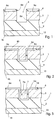
- Figures 1 to 8 are cross-sectional views through part of a semiconductor body 1 for illustrating a first example of a method in accordance with the invention. It will of course be appreciated that, in the case of a power device, the structure being formed within the semiconductor body 1 will consist of many hundreds of parallel identical structures but that, in the interests of simplicity, only one of these structures is shown.
- the semiconductor body 1 consists in this example of a relatively highly doped single crystal silicon substrate 13 onto which the first region 2 is formed as an epitaxial layer that is relatively lowly doped with impurities of one conductivity type.
- the semiconductor device is to be a power MOSFET then the substrate 13 and first region or epitaxial layer 2 will be of the same conductivity type, n conductivity type for an n-channel MOSFET, whereas where the semiconductor device is to be, for example, an IGBT the substrate 13 will be of the opposite conductivity type, p conductivity type in the case of an n-channel IGBT.
- the present invention could of course also be applied to so-called anode-shorted IGBTs as described in, for example, US-A-4969028 in which the opposite conductivity type injector regions are formed not by an oppositely doped substrate but by spaced doped injector regions extending into the relatively highly doped substrate of the one conductivity type from the second major surface 1b.
- the second region 3 that will define the conduction channel regions of the insulated gate field effect device may be formed either as a second epitaxial layer of the opposite conductivity type deposited onto the epitaxial layer 2 or may be formed by introducing impurities of the opposite conductivity type into the epitaxial layer 2.
- a mask 4 is provided on the first major surface 1a.
- the mask 4 may be formed of any suitable material, for example, a photosensitive resist, and a window 4a is opened in the mask using conventional photolithographic and etching techniques to expose an area of the first major surface 1a.
- the exposed semiconductor material is then anisotropically etched to define a groove 5 extending through the third region 3 into the second region 2.
- a relatively thin layer of gate insulating material 6 is provided on the first major surface 1a and the surface 5a of the groove 5.
- the gate insulating layer 6 is normally formed by a conventional thermal oxidation process carried out in a special furnace so as to avoid contamination of the gate insulating. This should result in a high purity date oxide.
- the exposed surface 7a of the gate conductive region 7 is then oxidised using one of the methods to be described below to form, as illustrated in Figure 4, a protective capping oxide region 9 which is thicker than the gate insulating layer 6.
- the insulating material is then etched back using a conventional etchant so that the exposed region of the gate insulating layer but only a slight thickness of the capping oxide region 9 are removed as shown in Figure 5.
- the oxidation of the gate conductive region 7 may form a capping region 9 of sufficient thickness to provide a suitable step 15 in the surface structure
- the size of this step 15 may be increased by using an appropriate etchant which etches the semiconductor body 1 selectively with respect to the protective capping oxide region 9 to etch back the surface areas 3a of the second region 3 to define a new etched back surface 3b as shown in Figure 5.
- the insulated gate structure 8 extends beyond and thus stands proud of the etched back surface 3b so that areas 8a' of the side walls 8 of the insulated gate structure are exposed and define with the etched back surface areas 3b the step 15 in the surface structure.
- impurities of the one conductivity type are then introduced, generally implanted and diffused to define areas 11' of the one conductivity type bounding the capped insulated gate structure.
- insulating material such as a silicon oxide (or other insulating material which can be selectively etched with respect to the semiconductor surface) is then deposited over the surface to produce the structure shown in Figure 6.
- the insulating layer 10 is then etched anisotropically until the surface areas 3b are exposed.
- the width that is the lateral extent of the spacers 10a on the surface areas 3b, is determined by the initial thickness of the layer 10 which, as will be appreciated by those skilled in the art, can be controlled relatively easily.
- the spacers 10a and the capping region 9 are then used as a mask to enable the areas 11' to be etched anisotropically until the underlying second region 3 is exposed so as to define the third regions 11 beneath the insulating spacers 10a.
- a layer of metallisation generally aluminium, is then deposited and patterned to define a first electrode 12 contacting the third regions 11 and shorting the third regions 11 to the second regions to inhibit potential parasitic bipolar action and a second gate electrode (not shown) contacting the insulated gate structure through an appropriate contact window (not shown).
- Another layer 16 of metallisation is provided on the second major surface to form a third electrode contacting the substrate 13.
- the third regions 11 form source regions of the transistor and the second region 3 defines adjacent the insulated gate structure a conduction channel area 30 within which a conduction channel can be defined by the application of an appropriate voltage to the insulated gate structure 8 to enable conduction between the source region 11 and the second region 3 which forms the drain drift region of the transistor 1a this case the third electrode forms the drain electrode.
- the situation is similar for an IGBT except that the source 12 and drain electrodes 16 are normally known as the cathode and anode electrodes.
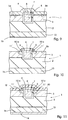
- Figures 9 to 11 illustrate another example of a method in accordance with the invention. This method proceeds in a manner similar to that described above with reference to Figures 1 to 5. However, in this example, as shown in Figure 9, a layer 10' of doped material, for example doped polycrystalline silicon or a doped oxide or glass, is provided using a low temperature deposition technique on the etched back semiconductor surface 3b.
- doped material for example doped polycrystalline silicon or a doped oxide or glass
- the doped layer 10' is anisotropically etched to define the doped spacers 10'a as shown in Figure 10 and the structure is then heated to, for example, about 1000 o C (degrees Celsius) to cause impurities to diffuse out of the doped spacers 10'a into the underlying portion of the second region 3 to define the third regions 11. If necessary, a short dip etch may then be carried out to remove any slight amount of impurities which may have diffused out of the doped layer 10' into the semiconductor surface 3a before definition of the spacers 10'a.
- the lateral diffusion of the impurities causes the third regions 11 to extend beyond the spacers 10'a so that when the metallisation is deposited as described above to define the first and gate (not shown) electrodes, the first electrode 12 contacts the third regions 11.
- This method has the advantage of providing a flatter, in comparison to the first-described method, surface onto which to deposit the metallisation.
- the present invention requires that the protective capping oxide region 9 formed over the gate conductive region 7 be thicker than the gate insulator so that the gate conductive region 7 remains encapsulated when the exposed areas of the gate insulator are removed.
- This could be achieved simply by relying on the fact that very heavily doped, particularly phosphorus-doped, polycrystalline silicon oxidises much more rapidly than thermal or gate oxide but such a method may be very sensitive to actual process conditions and may not be particularly reproduceable.
- the gate insulating layer may be covered by a layer which is resistant to oxidation.
- the normal gate oxide could be covered by a layer of silicon nitride.
- the gate insulating layer 6 could be formed of a material, other than silicon oxide, which is resistant to oxidation.
- Figures 12 and 13 illustrate one other way of enhancing the oxidation rate of the doped polycrystalline silicon relative to the gate insulating layer 6 where the gate insulating layer is a thermally grown silicon oxide layer.
- the exposed silicon surface is oxidised using conventional techniques to define a thermal gate oxide layer 6.
- the gate oxide layer 6 is then subjected to a nitridation treatment by for example implantation of nitrogen into the gate oxide layer 6 or by heating the semiconductor body in ammonia (both of which techniques are described in a paper entitled selective oxidation technologies for high density MOS by J. Hui, T.Y. Chiu, S. Wong and W.G. Oldham published in IEEE Electron Device letters Volume EOL.2, No. 10, October 1981 at pages 244 to 247).
- This nitridation treatment results in an oxynitride layer 6' (shown schematically in Figure 13 by way of a dashed line) at the top of the gate oxide layer 6.
- the oxynitride layer is resistant to oxidation so that during the subsequent oxidation of the exposed gate conductive region, the gate oxide layer is not significantly oxidised so resulting in the structure shown in Figure 13.
- the semiconductor device may be a power semiconductor device consisting of many hundreds of parallel-connected source cells with a common drain drift region.
- Figure 14 is a top plan view of part of a semiconductor device manufactured using a method in accordance with the invention with the metallisation forming the source and gate electrodes omitted in order to show the structure.
- the groove 5 is formed as a regular grid-like trench so as to divide the second region 3 into a number of regularly shaped, as shown square, second cell regions 31 each of which is associated with an annular third region 11 bounded by the grid-like trench or groove 5.
- any suitable layout for the geometry of the semiconductor device may be adopted.
- the power semiconductor device may be integrated in the same semiconductor body as various logic components, for example low and/or high voltage lateral transistors, so as to form a power integrated circuit, an intelligent power switch or a smart power device, depending upon the degree and complexity of the integrated logic.
- the present invention may of course be applied to discrete power semiconductor devices and to lateral as well as vertical current flow devices. Furthermore, the present invention may be applied to semiconductor devices, other than power semiconductor devices, which consist of only one or a few insulated gate field effect device cells.
Landscapes
- Insulated Gate Type Field-Effect Transistor (AREA)
Priority Applications (1)
| Application Number | Priority Date | Filing Date | Title |
|---|---|---|---|
| EP99200133A EP0918353A1 (de) | 1993-04-01 | 1994-03-29 | Verfahren zur Herstellung von einem Feldeffekthalbleiterbauelement mit einem eingefügten isolierten Gatter |
Applications Claiming Priority (2)
| Application Number | Priority Date | Filing Date | Title |
|---|---|---|---|
| GB939306895A GB9306895D0 (en) | 1993-04-01 | 1993-04-01 | A method of manufacturing a semiconductor device comprising an insulated gate field effect device |
| GB9306895 | 1993-04-01 |
Related Child Applications (1)
| Application Number | Title | Priority Date | Filing Date |
|---|---|---|---|
| EP99200133A Division EP0918353A1 (de) | 1993-04-01 | 1994-03-29 | Verfahren zur Herstellung von einem Feldeffekthalbleiterbauelement mit einem eingefügten isolierten Gatter |
Publications (3)
| Publication Number | Publication Date |
|---|---|
| EP0620588A2 true EP0620588A2 (de) | 1994-10-19 |
| EP0620588A3 EP0620588A3 (de) | 1996-08-14 |
| EP0620588B1 EP0620588B1 (de) | 2007-04-11 |
Family
ID=10733222
Family Applications (2)
| Application Number | Title | Priority Date | Filing Date |
|---|---|---|---|
| EP99200133A Withdrawn EP0918353A1 (de) | 1993-04-01 | 1994-03-29 | Verfahren zur Herstellung von einem Feldeffekthalbleiterbauelement mit einem eingefügten isolierten Gatter |
| EP94200834A Expired - Lifetime EP0620588B1 (de) | 1993-04-01 | 1994-03-29 | Verfahren zur Herstellung von einem Feldeffekthalbleiterbauelement mit einem versenkten isolierten Gate |
Family Applications Before (1)
| Application Number | Title | Priority Date | Filing Date |
|---|---|---|---|
| EP99200133A Withdrawn EP0918353A1 (de) | 1993-04-01 | 1994-03-29 | Verfahren zur Herstellung von einem Feldeffekthalbleiterbauelement mit einem eingefügten isolierten Gatter |
Country Status (6)
| Country | Link |
|---|---|
| US (1) | US5378655A (de) |
| EP (2) | EP0918353A1 (de) |
| JP (1) | JPH06350090A (de) |
| KR (1) | KR100296805B1 (de) |
| DE (1) | DE69434948D1 (de) |
| GB (1) | GB9306895D0 (de) |
Cited By (17)
| Publication number | Priority date | Publication date | Assignee | Title |
|---|---|---|---|---|
| WO1996035230A1 (en) * | 1995-05-01 | 1996-11-07 | National Semiconductor Corporation | Method of fabricating self-aligned contact trench dmos transistors |
| WO2000003427A1 (en) * | 1998-07-11 | 2000-01-20 | Koninklijke Philips Electronics N.V. | Semiconductor power device manufacture |
| EP1403914A3 (de) * | 2002-09-24 | 2006-03-15 | Vishay-Siliconix | Verfahren zur Herstellung einer Halbleiteranordnung mit Gräben |
| EP1014450B1 (de) * | 1998-11-25 | 2007-05-16 | Siliconix Incorporated | Graben-MOSFET mit verbesserten Durchbruchspannung- und Anschaltwiderstand-Charakteristiken und Verfahren zur Herstellung |
| US8080459B2 (en) | 2002-09-24 | 2011-12-20 | Vishay-Siliconix | Self aligned contact in a semiconductor device and method of fabricating the same |
| EP1978562A3 (de) * | 2007-04-03 | 2012-06-13 | Vishay-Siliconix | MOSFET mit Graben-Gate und Verfahren zu dessen Herstellung |
| US9111754B2 (en) | 2005-07-26 | 2015-08-18 | Vishay-Siliconix | Floating gate structure with high electrostatic discharge performance |
| CN105304626A (zh) * | 2014-07-23 | 2016-02-03 | 意法半导体(图尔)公司 | 双向开关 |
| US9425306B2 (en) | 2009-08-27 | 2016-08-23 | Vishay-Siliconix | Super junction trench power MOSFET devices |
| US9431550B2 (en) | 2005-12-28 | 2016-08-30 | Vishay-Siliconix | Trench polysilicon diode |
| US9614043B2 (en) | 2012-02-09 | 2017-04-04 | Vishay-Siliconix | MOSFET termination trench |
| US9842911B2 (en) | 2012-05-30 | 2017-12-12 | Vishay-Siliconix | Adaptive charge balanced edge termination |
| US9882044B2 (en) | 2014-08-19 | 2018-01-30 | Vishay-Siliconix | Edge termination for super-junction MOSFETs |
| US9887259B2 (en) | 2014-06-23 | 2018-02-06 | Vishay-Siliconix | Modulated super junction power MOSFET devices |
| US10234486B2 (en) | 2014-08-19 | 2019-03-19 | Vishay/Siliconix | Vertical sense devices in vertical trench MOSFET |
| US10546750B2 (en) | 2009-09-03 | 2020-01-28 | Vishay-Siliconix | System and method for substrate wafer back side and edge cross section seals |
| US10600902B2 (en) | 2008-02-13 | 2020-03-24 | Vishay SIliconix, LLC | Self-repairing field effect transisitor |
Families Citing this family (57)
| Publication number | Priority date | Publication date | Assignee | Title |
|---|---|---|---|---|
| US5283201A (en) * | 1988-05-17 | 1994-02-01 | Advanced Power Technology, Inc. | High density power device fabrication process |
| US6603173B1 (en) | 1991-07-26 | 2003-08-05 | Denso Corporation | Vertical type MOSFET |
| JP3481287B2 (ja) * | 1994-02-24 | 2003-12-22 | 三菱電機株式会社 | 半導体装置の製造方法 |
| US5583065A (en) * | 1994-11-23 | 1996-12-10 | Sony Corporation | Method of making a MOS semiconductor device |
| JP3319215B2 (ja) * | 1995-03-31 | 2002-08-26 | 株式会社豊田中央研究所 | 絶縁ゲート型半導体装置およびその製造方法 |
| US5648670A (en) * | 1995-06-07 | 1997-07-15 | Sgs-Thomson Microelectronics, Inc. | Trench MOS-gated device with a minimum number of masks |
| JPH11204782A (ja) * | 1998-01-08 | 1999-07-30 | Toshiba Corp | 半導体装置およびその製造方法 |
| US6097061A (en) * | 1998-03-30 | 2000-08-01 | Advanced Micro Devices, Inc. | Trenched gate metal oxide semiconductor device and method |
| US6225659B1 (en) | 1998-03-30 | 2001-05-01 | Advanced Micro Devices, Inc. | Trenched gate semiconductor device and method for low power applications |
| US6285054B1 (en) | 1998-03-30 | 2001-09-04 | Advanced Micro Devices, Inc. | Trenched gate non-volatile semiconductor device with the source/drain regions spaced from the trench by sidewall dopings |
| GB9808234D0 (en) * | 1998-04-17 | 1998-06-17 | Koninkl Philips Electronics Nv | Mnufacture of trench-gate semiconductor devices |
| GB9808237D0 (en) | 1998-04-17 | 1998-06-17 | Koninkl Philips Electronics Nv | Mnufacture of field-effect semiconductor devices |
| EP0981166A3 (de) * | 1998-08-17 | 2000-04-19 | ELMOS Semiconductor AG | JFET Transistor |
| GB9826041D0 (en) | 1998-11-28 | 1999-01-20 | Koninkl Philips Electronics Nv | Trench-gate semiconductor devices and their manufacture |
| JP3924975B2 (ja) * | 1999-02-05 | 2007-06-06 | 富士電機デバイステクノロジー株式会社 | トレンチ型絶縁ゲートバイポーラトランジスタ |
| GB9906247D0 (en) | 1999-03-18 | 1999-05-12 | Koninkl Philips Electronics Nv | An electronic device comprising a trench gate field effect device |
| GB9907184D0 (en) | 1999-03-30 | 1999-05-26 | Philips Electronics Nv | A method of manufacturing a semiconductor device |
| US6373098B1 (en) * | 1999-05-25 | 2002-04-16 | Fairchild Semiconductor Corporation | Trench-gated device having trench walls formed by selective epitaxial growth and process for forming device |
| GB9922764D0 (en) | 1999-09-28 | 1999-11-24 | Koninkl Philips Electronics Nv | Manufacture of trench-gate semiconductor devices |
| GB9928285D0 (en) * | 1999-11-30 | 2000-01-26 | Koninkl Philips Electronics Nv | Manufacture of trench-gate semiconductor devices |
| US6921939B2 (en) * | 2000-07-20 | 2005-07-26 | Fairchild Semiconductor Corporation | Power MOSFET and method for forming same using a self-aligned body implant |
| JP4906184B2 (ja) * | 2000-11-17 | 2012-03-28 | オンセミコンダクター・トレーディング・リミテッド | 絶縁ゲート型半導体装置の製造方法 |
| GB0101695D0 (en) * | 2001-01-23 | 2001-03-07 | Koninkl Philips Electronics Nv | Manufacture of trench-gate semiconductor devices |
| US7132712B2 (en) * | 2002-11-05 | 2006-11-07 | Fairchild Semiconductor Corporation | Trench structure having one or more diodes embedded therein adjacent a PN junction |
| JP4932088B2 (ja) | 2001-02-19 | 2012-05-16 | ルネサスエレクトロニクス株式会社 | 絶縁ゲート型半導体装置の製造方法 |
| US7061066B2 (en) | 2001-10-17 | 2006-06-13 | Fairchild Semiconductor Corporation | Schottky diode using charge balance structure |
| KR100511590B1 (ko) * | 2003-01-30 | 2005-09-02 | 동부아남반도체 주식회사 | 반도체 소자 및 그의 제조 방법 |
| US7352036B2 (en) * | 2004-08-03 | 2008-04-01 | Fairchild Semiconductor Corporation | Semiconductor power device having a top-side drain using a sinker trench |
| US7667264B2 (en) * | 2004-09-27 | 2010-02-23 | Alpha And Omega Semiconductor Limited | Shallow source MOSFET |
| US8283723B2 (en) * | 2005-02-11 | 2012-10-09 | Alpha & Omega Semiconductor Limited | MOS device with low injection diode |
| US7948029B2 (en) | 2005-02-11 | 2011-05-24 | Alpha And Omega Semiconductor Incorporated | MOS device with varying trench depth |
| US8362547B2 (en) | 2005-02-11 | 2013-01-29 | Alpha & Omega Semiconductor Limited | MOS device with Schottky barrier controlling layer |
| US7285822B2 (en) * | 2005-02-11 | 2007-10-23 | Alpha & Omega Semiconductor, Inc. | Power MOS device |
| US8093651B2 (en) | 2005-02-11 | 2012-01-10 | Alpha & Omega Semiconductor Limited | MOS device with integrated schottky diode in active region contact trench |
| AT504998A2 (de) | 2005-04-06 | 2008-09-15 | Fairchild Semiconductor | Trenched-gate-feldeffekttransistoren und verfahren zum bilden derselben |
| US7488647B1 (en) | 2005-08-11 | 2009-02-10 | National Semiconductor Corporation | System and method for providing a poly cap and a no field oxide area to prevent formation of a vertical bird's beak structure in the manufacture of a semiconductor device |
| US7446374B2 (en) * | 2006-03-24 | 2008-11-04 | Fairchild Semiconductor Corporation | High density trench FET with integrated Schottky diode and method of manufacture |
| DE102006030631B4 (de) * | 2006-07-03 | 2011-01-05 | Infineon Technologies Austria Ag | Halbleiterbauelementanordnung mit einem Leistungsbauelement und einem Logikbauelement |
| DE102006047244B4 (de) * | 2006-10-04 | 2018-01-18 | Infineon Technologies Austria Ag | Halbleiterbauelement mit einem monokristallinen Halbleiterkörper und Verfahren zur Herstellung desselben |
| US7531888B2 (en) * | 2006-11-30 | 2009-05-12 | Fairchild Semiconductor Corporation | Integrated latch-up free insulated gate bipolar transistor |
| TWI360864B (en) * | 2006-12-06 | 2012-03-21 | Promos Technologies Inc | Gate structure and method of fabriacting the same, |
| US9437729B2 (en) | 2007-01-08 | 2016-09-06 | Vishay-Siliconix | High-density power MOSFET with planarized metalization |
| US20080296673A1 (en) * | 2007-05-29 | 2008-12-04 | Alpha & Omega Semiconductor, Ltd | Double gate manufactured with locos techniques |
| US9484451B2 (en) | 2007-10-05 | 2016-11-01 | Vishay-Siliconix | MOSFET active area and edge termination area charge balance |
| US20090242973A1 (en) | 2008-03-31 | 2009-10-01 | Alpha & Omega Semiconductor, Ltd. | Source and body contact structure for trench-dmos devices using polysilicon |
| US7867852B2 (en) * | 2008-08-08 | 2011-01-11 | Alpha And Omega Semiconductor Incorporated | Super-self-aligned trench-dmos structure and method |
| US8426275B2 (en) * | 2009-01-09 | 2013-04-23 | Niko Semiconductor Co., Ltd. | Fabrication method of trenched power MOSFET |
| JP5472862B2 (ja) * | 2009-03-17 | 2014-04-16 | 三菱電機株式会社 | 電力用半導体装置の製造方法 |
| US9443974B2 (en) | 2009-08-27 | 2016-09-13 | Vishay-Siliconix | Super junction trench power MOSFET device fabrication |
| US9431530B2 (en) | 2009-10-20 | 2016-08-30 | Vishay-Siliconix | Super-high density trench MOSFET |
| JP5662865B2 (ja) | 2010-05-19 | 2015-02-04 | ルネサスエレクトロニクス株式会社 | 半導体装置およびその製造方法 |
| US9431249B2 (en) | 2011-12-01 | 2016-08-30 | Vishay-Siliconix | Edge termination for super junction MOSFET devices |
| CN103367145A (zh) * | 2012-03-27 | 2013-10-23 | 北大方正集团有限公司 | 一种沟槽型vdmos器件及其制造方法 |
| JP5622814B2 (ja) * | 2012-08-29 | 2014-11-12 | 三菱電機株式会社 | 半導体装置及びその製造方法 |
| US9508596B2 (en) | 2014-06-20 | 2016-11-29 | Vishay-Siliconix | Processes used in fabricating a metal-insulator-semiconductor field effect transistor |
| CN106898549A (zh) * | 2015-12-21 | 2017-06-27 | 株洲南车时代电气股份有限公司 | 沟槽栅igbt及沟槽栅igbt制作方法 |
| CN114093768A (zh) * | 2022-01-20 | 2022-02-25 | 威海银创微电子技术有限公司 | Trench VDMOS中Gate的保护方法、装置、电子设备及介质 |
Family Cites Families (11)
| Publication number | Priority date | Publication date | Assignee | Title |
|---|---|---|---|---|
| US4767722A (en) * | 1986-03-24 | 1988-08-30 | Siliconix Incorporated | Method for making planar vertical channel DMOS structures |
| US4967245A (en) * | 1988-03-14 | 1990-10-30 | Siliconix Incorporated | Trench power MOSFET device |
| JPH0783118B2 (ja) * | 1988-06-08 | 1995-09-06 | 三菱電機株式会社 | 半導体装置およびその製造方法 |
| JPH023980A (ja) * | 1988-06-22 | 1990-01-09 | Nissan Motor Co Ltd | 縦型電界効果トランジスタ |
| JP2689606B2 (ja) * | 1989-05-24 | 1997-12-10 | 富士電機株式会社 | 絶縁ゲート電界効果型トランジスタの製造方法 |
| US4992390A (en) * | 1989-07-06 | 1991-02-12 | General Electric Company | Trench gate structure with thick bottom oxide |
| US5132238A (en) * | 1989-12-28 | 1992-07-21 | Nissan Motor Co., Ltd. | Method of manufacturing semiconductor device utilizing an accumulation layer |
| JP2606404B2 (ja) * | 1990-04-06 | 1997-05-07 | 日産自動車株式会社 | 半導体装置 |
| KR940002400B1 (ko) * | 1991-05-15 | 1994-03-24 | 금성일렉트론 주식회사 | 리세스 게이트를 갖는 반도체장치의 제조방법 |
| JP2837014B2 (ja) * | 1992-02-17 | 1998-12-14 | 三菱電機株式会社 | 半導体装置及びその製造方法 |
| US5275965A (en) * | 1992-11-25 | 1994-01-04 | Micron Semiconductor, Inc. | Trench isolation using gated sidewalls |
-
1993
- 1993-04-01 GB GB939306895A patent/GB9306895D0/en active Pending
-
1994
- 1994-03-29 DE DE69434948T patent/DE69434948D1/de not_active Expired - Lifetime
- 1994-03-29 EP EP99200133A patent/EP0918353A1/de not_active Withdrawn
- 1994-03-29 EP EP94200834A patent/EP0620588B1/de not_active Expired - Lifetime
- 1994-03-31 KR KR1019940006662A patent/KR100296805B1/ko not_active Expired - Fee Related
- 1994-03-31 JP JP6063339A patent/JPH06350090A/ja active Pending
- 1994-03-31 US US08/221,293 patent/US5378655A/en not_active Expired - Lifetime
Cited By (30)
| Publication number | Priority date | Publication date | Assignee | Title |
|---|---|---|---|---|
| WO1996035230A1 (en) * | 1995-05-01 | 1996-11-07 | National Semiconductor Corporation | Method of fabricating self-aligned contact trench dmos transistors |
| WO2000003427A1 (en) * | 1998-07-11 | 2000-01-20 | Koninklijke Philips Electronics N.V. | Semiconductor power device manufacture |
| EP1014450B1 (de) * | 1998-11-25 | 2007-05-16 | Siliconix Incorporated | Graben-MOSFET mit verbesserten Durchbruchspannung- und Anschaltwiderstand-Charakteristiken und Verfahren zur Herstellung |
| US8367500B1 (en) | 2002-09-24 | 2013-02-05 | Vishay-Siliconix | Method of forming self aligned contacts for a power MOSFET |
| US7642164B1 (en) | 2002-09-24 | 2010-01-05 | Vishay-Siliconix | Method of forming self aligned contacts for a power MOSFET |
| US8080459B2 (en) | 2002-09-24 | 2011-12-20 | Vishay-Siliconix | Self aligned contact in a semiconductor device and method of fabricating the same |
| EP1403914A3 (de) * | 2002-09-24 | 2006-03-15 | Vishay-Siliconix | Verfahren zur Herstellung einer Halbleiteranordnung mit Gräben |
| CN100511575C (zh) * | 2002-09-24 | 2009-07-08 | 维西埃-硅化物公司 | 在半导体器件设置中提供自对准接点的方法 |
| US8629019B2 (en) | 2002-09-24 | 2014-01-14 | Vishay-Siliconix | Method of forming self aligned contacts for a power MOSFET |
| US9111754B2 (en) | 2005-07-26 | 2015-08-18 | Vishay-Siliconix | Floating gate structure with high electrostatic discharge performance |
| US9431550B2 (en) | 2005-12-28 | 2016-08-30 | Vishay-Siliconix | Trench polysilicon diode |
| US9947770B2 (en) | 2007-04-03 | 2018-04-17 | Vishay-Siliconix | Self-aligned trench MOSFET and method of manufacture |
| EP1978562A3 (de) * | 2007-04-03 | 2012-06-13 | Vishay-Siliconix | MOSFET mit Graben-Gate und Verfahren zu dessen Herstellung |
| US9761696B2 (en) | 2007-04-03 | 2017-09-12 | Vishay-Siliconix | Self-aligned trench MOSFET and method of manufacture |
| US10600902B2 (en) | 2008-02-13 | 2020-03-24 | Vishay SIliconix, LLC | Self-repairing field effect transisitor |
| US9425306B2 (en) | 2009-08-27 | 2016-08-23 | Vishay-Siliconix | Super junction trench power MOSFET devices |
| US10546750B2 (en) | 2009-09-03 | 2020-01-28 | Vishay-Siliconix | System and method for substrate wafer back side and edge cross section seals |
| US9614043B2 (en) | 2012-02-09 | 2017-04-04 | Vishay-Siliconix | MOSFET termination trench |
| US9935193B2 (en) | 2012-02-09 | 2018-04-03 | Siliconix Technology C. V. | MOSFET termination trench |
| US10229988B2 (en) | 2012-05-30 | 2019-03-12 | Vishay-Siliconix | Adaptive charge balanced edge termination |
| US9842911B2 (en) | 2012-05-30 | 2017-12-12 | Vishay-Siliconix | Adaptive charge balanced edge termination |
| US9887259B2 (en) | 2014-06-23 | 2018-02-06 | Vishay-Siliconix | Modulated super junction power MOSFET devices |
| US10283587B2 (en) | 2014-06-23 | 2019-05-07 | Vishay-Siliconix | Modulated super junction power MOSFET devices |
| CN105304626B (zh) * | 2014-07-23 | 2018-11-02 | 意法半导体(图尔)公司 | 双向开关 |
| CN105304626A (zh) * | 2014-07-23 | 2016-02-03 | 意法半导体(图尔)公司 | 双向开关 |
| US9882044B2 (en) | 2014-08-19 | 2018-01-30 | Vishay-Siliconix | Edge termination for super-junction MOSFETs |
| US10234486B2 (en) | 2014-08-19 | 2019-03-19 | Vishay/Siliconix | Vertical sense devices in vertical trench MOSFET |
| US10340377B2 (en) | 2014-08-19 | 2019-07-02 | Vishay-Siliconix | Edge termination for super-junction MOSFETs |
| US10444262B2 (en) | 2014-08-19 | 2019-10-15 | Vishay-Siliconix | Vertical sense devices in vertical trench MOSFET |
| US10527654B2 (en) | 2014-08-19 | 2020-01-07 | Vishay SIliconix, LLC | Vertical sense devices in vertical trench MOSFET |
Also Published As
| Publication number | Publication date |
|---|---|
| US5378655A (en) | 1995-01-03 |
| KR100296805B1 (ko) | 2001-11-30 |
| EP0620588B1 (de) | 2007-04-11 |
| DE69434948D1 (de) | 2007-05-24 |
| JPH06350090A (ja) | 1994-12-22 |
| GB9306895D0 (en) | 1993-05-26 |
| EP0918353A1 (de) | 1999-05-26 |
| EP0620588A3 (de) | 1996-08-14 |
Similar Documents
| Publication | Publication Date | Title |
|---|---|---|
| US5378655A (en) | Method of manufacturing a semiconductor device comprising an insulated gate field effect device | |
| US6498071B2 (en) | Manufacture of trench-gate semiconductor devices | |
| EP1393362B1 (de) | Verfahren zur Herstellung einer Halbleiteranordnung mit Graben-Gate | |
| US5814859A (en) | Self-aligned transistor device including a patterned refracting dielectric layer | |
| US6518127B2 (en) | Trench DMOS transistor having a double gate structure | |
| US6144065A (en) | MOS gated device with self aligned cells | |
| US5970329A (en) | Method of forming power semiconductor devices having insulated gate electrodes | |
| US6660591B2 (en) | Trench-gate semiconductor devices having a channel-accommodating region and their methods of manufacture | |
| KR20010048716A (ko) | 자기 정렬 기술을 이용한 트렌치 게이트 전력 소자 제조방법 | |
| US20040053448A1 (en) | Power MOSFET with ultra-deep base and reduced on resistance | |
| US6040212A (en) | Methods of forming trench-gate semiconductor devices using sidewall implantation techniques to control threshold voltage | |
| US6087224A (en) | Manufacture of trench-gate semiconductor devices | |
| JP3965027B2 (ja) | トレンチ底部に厚いポリシリコン絶縁層を有するトレンチゲート型misデバイスの製造方法 | |
| KR100272051B1 (ko) | 접점윈도우를통해베이스주입한p-채널mos게이트소자제조공정 | |
| KR19990051079A (ko) | 절연막 경사식각을 이용한 전력소자 제조방법 | |
| KR100492981B1 (ko) | 래터럴 이중확산 모스 트랜지스터 및 그 제조방법 | |
| US20020137322A1 (en) | Reduced mask count process for manufacture of mosgated device | |
| KR950000104B1 (ko) | 반도체 소자 격리 방법 및 셀 구조 | |
| KR19990000113A (ko) | 박막트랜지스터 및 그 제조방법 | |
| JPH0571191B2 (de) | ||
| JP2001515658A (ja) | 集積可能な平面状半導体装置のための接点配置と、この接点配置を形成する方法 | |
| JPH0637109A (ja) | 半導体素子の製造方法 |
Legal Events
| Date | Code | Title | Description |
|---|---|---|---|
| PUAI | Public reference made under article 153(3) epc to a published international application that has entered the european phase |
Free format text: ORIGINAL CODE: 0009012 |
|
| AK | Designated contracting states |
Kind code of ref document: A2 Designated state(s): DE FR GB IT |
|
| PUAL | Search report despatched |
Free format text: ORIGINAL CODE: 0009013 |
|
| AK | Designated contracting states |
Kind code of ref document: A3 Designated state(s): DE FR GB IT |
|
| 17P | Request for examination filed |
Effective date: 19970214 |
|
| RAP3 | Party data changed (applicant data changed or rights of an application transferred) |
Owner name: KONINKLIJKE PHILIPS ELECTRONICS N.V. Owner name: PHILIPS ELECTRONICS UK LIMITED |
|
| 17Q | First examination report despatched |
Effective date: 19981009 |
|
| GRAH | Despatch of communication of intention to grant a patent |
Free format text: ORIGINAL CODE: EPIDOS IGRA |
|
| GRAS | Grant fee paid |
Free format text: ORIGINAL CODE: EPIDOSNIGR3 |
|
| GRAL | Information related to payment of fee for publishing/printing deleted |
Free format text: ORIGINAL CODE: EPIDOSDIGR3 |
|
| GRAP | Despatch of communication of intention to grant a patent |
Free format text: ORIGINAL CODE: EPIDOSNIGR1 |
|
| GRAS | Grant fee paid |
Free format text: ORIGINAL CODE: EPIDOSNIGR3 |
|
| GRAA | (expected) grant |
Free format text: ORIGINAL CODE: 0009210 |
|
| AK | Designated contracting states |
Kind code of ref document: B1 Designated state(s): DE FR GB IT |
|
| REG | Reference to a national code |
Ref country code: GB Ref legal event code: FG4D |
|
| RIC2 | Information provided on ipc code assigned after grant |
Ipc: H01L 29/78 20060101ALI20070308BHEP Ipc: H01L 21/336 20060101AFI20070308BHEP |
|
| REF | Corresponds to: |
Ref document number: 69434948 Country of ref document: DE Date of ref document: 20070524 Kind code of ref document: P |
|
| EN | Fr: translation not filed | ||
| PLBE | No opposition filed within time limit |
Free format text: ORIGINAL CODE: 0009261 |
|
| STAA | Information on the status of an ep patent application or granted ep patent |
Free format text: STATUS: NO OPPOSITION FILED WITHIN TIME LIMIT |
|
| 26N | No opposition filed |
Effective date: 20080114 |
|
| PG25 | Lapsed in a contracting state [announced via postgrant information from national office to epo] |
Ref country code: IT Free format text: LAPSE BECAUSE OF FAILURE TO SUBMIT A TRANSLATION OF THE DESCRIPTION OR TO PAY THE FEE WITHIN THE PRESCRIBED TIME-LIMIT Effective date: 20070411 Ref country code: FR Free format text: LAPSE BECAUSE OF FAILURE TO SUBMIT A TRANSLATION OF THE DESCRIPTION OR TO PAY THE FEE WITHIN THE PRESCRIBED TIME-LIMIT Effective date: 20071207 Ref country code: DE Free format text: LAPSE BECAUSE OF FAILURE TO SUBMIT A TRANSLATION OF THE DESCRIPTION OR TO PAY THE FEE WITHIN THE PRESCRIBED TIME-LIMIT Effective date: 20070712 |
|
| PG25 | Lapsed in a contracting state [announced via postgrant information from national office to epo] |
Ref country code: FR Free format text: LAPSE BECAUSE OF FAILURE TO SUBMIT A TRANSLATION OF THE DESCRIPTION OR TO PAY THE FEE WITHIN THE PRESCRIBED TIME-LIMIT Effective date: 20070411 |
|
| REG | Reference to a national code |
Ref country code: FR Ref legal event code: TP |
|
| PGFP | Annual fee paid to national office [announced via postgrant information from national office to epo] |
Ref country code: GB Payment date: 20100322 Year of fee payment: 17 |
|
| GBPC | Gb: european patent ceased through non-payment of renewal fee |
Effective date: 20110329 |
|
| PG25 | Lapsed in a contracting state [announced via postgrant information from national office to epo] |
Ref country code: GB Free format text: LAPSE BECAUSE OF NON-PAYMENT OF DUE FEES Effective date: 20110329 |