EP0622969A2 - Système pour dialoguer et surveiller en vidéo - Google Patents
Système pour dialoguer et surveiller en vidéo Download PDFInfo
- Publication number
- EP0622969A2 EP0622969A2 EP94106582A EP94106582A EP0622969A2 EP 0622969 A2 EP0622969 A2 EP 0622969A2 EP 94106582 A EP94106582 A EP 94106582A EP 94106582 A EP94106582 A EP 94106582A EP 0622969 A2 EP0622969 A2 EP 0622969A2
- Authority
- EP
- European Patent Office
- Prior art keywords
- video
- station terminal
- conversation
- end station
- terminal system
- Prior art date
- Legal status (The legal status is an assumption and is not a legal conclusion. Google has not performed a legal analysis and makes no representation as to the accuracy of the status listed.)
- Granted
Links
Images









Classifications
-
- H—ELECTRICITY
- H04—ELECTRIC COMMUNICATION TECHNIQUE
- H04N—PICTORIAL COMMUNICATION, e.g. TELEVISION
- H04N7/00—Television systems
- H04N7/14—Systems for two-way working
- H04N7/141—Systems for two-way working between two video terminals, e.g. videophone
- H04N7/147—Communication arrangements, e.g. identifying the communication as a video-communication, intermediate storage of the signals
-
- H—ELECTRICITY
- H04—ELECTRIC COMMUNICATION TECHNIQUE
- H04M—TELEPHONIC COMMUNICATION
- H04M3/00—Automatic or semi-automatic exchanges
- H04M3/42—Systems providing special services or facilities to subscribers
- H04M3/56—Arrangements for connecting several subscribers to a common circuit, i.e. affording conference facilities
- H04M3/567—Multimedia conference systems
-
- H—ELECTRICITY
- H04—ELECTRIC COMMUNICATION TECHNIQUE
- H04N—PICTORIAL COMMUNICATION, e.g. TELEVISION
- H04N1/00—Scanning, transmission or reproduction of documents or the like, e.g. facsimile transmission; Details thereof
- H04N1/42—Systems for two-way working, e.g. conference systems
-
- H—ELECTRICITY
- H04—ELECTRIC COMMUNICATION TECHNIQUE
- H04Q—SELECTING
- H04Q11/00—Selecting arrangements for multiplex systems
- H04Q11/04—Selecting arrangements for multiplex systems for time-division multiplexing
- H04Q11/0428—Integrated services digital network, i.e. systems for transmission of different types of digitised signals, e.g. speech, data, telecentral, television signals
- H04Q11/0435—Details
- H04Q11/0457—Connection protocols
-
- H—ELECTRICITY
- H04—ELECTRIC COMMUNICATION TECHNIQUE
- H04M—TELEPHONIC COMMUNICATION
- H04M2201/00—Electronic components, circuits, software, systems or apparatus used in telephone systems
- H04M2201/50—Telephonic communication in combination with video communication
-
- H—ELECTRICITY
- H04—ELECTRIC COMMUNICATION TECHNIQUE
- H04Q—SELECTING
- H04Q2213/00—Indexing scheme relating to selecting arrangements in general and for multiplex systems
- H04Q2213/13034—A/D conversion, code compression/expansion
-
- H—ELECTRICITY
- H04—ELECTRIC COMMUNICATION TECHNIQUE
- H04Q—SELECTING
- H04Q2213/00—Indexing scheme relating to selecting arrangements in general and for multiplex systems
- H04Q2213/13091—CLI, identification of calling line
-
- H—ELECTRICITY
- H04—ELECTRIC COMMUNICATION TECHNIQUE
- H04Q—SELECTING
- H04Q2213/00—Indexing scheme relating to selecting arrangements in general and for multiplex systems
- H04Q2213/13092—Scanning of subscriber lines, monitoring
-
- H—ELECTRICITY
- H04—ELECTRIC COMMUNICATION TECHNIQUE
- H04Q—SELECTING
- H04Q2213/00—Indexing scheme relating to selecting arrangements in general and for multiplex systems
- H04Q2213/13104—Central control, computer control
-
- H—ELECTRICITY
- H04—ELECTRIC COMMUNICATION TECHNIQUE
- H04Q—SELECTING
- H04Q2213/00—Indexing scheme relating to selecting arrangements in general and for multiplex systems
- H04Q2213/13174—Data transmission, file transfer
-
- H—ELECTRICITY
- H04—ELECTRIC COMMUNICATION TECHNIQUE
- H04Q—SELECTING
- H04Q2213/00—Indexing scheme relating to selecting arrangements in general and for multiplex systems
- H04Q2213/13179—Fax, still picture
-
- H—ELECTRICITY
- H04—ELECTRIC COMMUNICATION TECHNIQUE
- H04Q—SELECTING
- H04Q2213/00—Indexing scheme relating to selecting arrangements in general and for multiplex systems
- H04Q2213/13206—User-to-user signaling, UUS
-
- H—ELECTRICITY
- H04—ELECTRIC COMMUNICATION TECHNIQUE
- H04Q—SELECTING
- H04Q2213/00—Indexing scheme relating to selecting arrangements in general and for multiplex systems
- H04Q2213/13209—ISDN
-
- H—ELECTRICITY
- H04—ELECTRIC COMMUNICATION TECHNIQUE
- H04Q—SELECTING
- H04Q2213/00—Indexing scheme relating to selecting arrangements in general and for multiplex systems
- H04Q2213/13337—Picturephone, videotelephony
-
- H—ELECTRICITY
- H04—ELECTRIC COMMUNICATION TECHNIQUE
- H04Q—SELECTING
- H04Q2213/00—Indexing scheme relating to selecting arrangements in general and for multiplex systems
- H04Q2213/13376—Information service, downloading of information, 0800/0900 services
-
- H—ELECTRICITY
- H04—ELECTRIC COMMUNICATION TECHNIQUE
- H04Q—SELECTING
- H04Q2213/00—Indexing scheme relating to selecting arrangements in general and for multiplex systems
- H04Q2213/174—Data transmission
-
- H—ELECTRICITY
- H04—ELECTRIC COMMUNICATION TECHNIQUE
- H04Q—SELECTING
- H04Q2213/00—Indexing scheme relating to selecting arrangements in general and for multiplex systems
- H04Q2213/179—Facsimile; Fax, e.g. still picture
-
- H—ELECTRICITY
- H04—ELECTRIC COMMUNICATION TECHNIQUE
- H04Q—SELECTING
- H04Q2213/00—Indexing scheme relating to selecting arrangements in general and for multiplex systems
- H04Q2213/337—Picturephone
Definitions
- This invention relates to a multi-media communication system using the Integrated Service Digital Network (ISDN), and particularly to a video conversation/monitoring system applicable to a complex conversation service system that includes a remote monitoring function.
- ISDN Integrated Service Digital Network
- a conventional guidance system, conversation system and monitoring system based on the communication of images, sounds and data, and a complex system that integrates these system have been using an analog telephone line or a dedicated communication line based on optical fiber or the like.
- An example of these systems is described in Japanese patent publication JP-A-4-21095 and JP-A-4-315351.
- This invention is intended to overcome the foregoing prior art deficiencies, and first object thereof is to provide a compact, simple and economical video conversation/monitoring system capable of performing the conversation and monitoring through the bidirectional transmission of sounds, images and data among stations.
- a second object of this invention is to provide a simple and reliable video conversation/monitoring system having an enhanced ability of secrecy protection and performance of conversation and monitoring.
- a third object of this invention is to provide a video conversation/monitoring system that can be used easily by the user for carrying out the conversation and monitoring.
- a fourth object of this invention is to provide a video conversation/monitoring system that offers an unlimited service range in terms of time and people for carrying out the conversation.
- a fifth object of this invention is to provide a video conversation/monitoring system that can be arranged flexibly by including various peripheral devices to accomplish a versatile utility in addition to offering the bidirectional conversation for the user.
- this invention resides in a video conversation/monitoring system that is based on the application of desk-top videoconference unit, for example, as video-phonic conversation means installed in a center station and end stations, and on the bidirectional communication through the existing ISDN public line for the image, voice and data signals inclusive of the facsimile.
- the center station equipment includes a video-phonic conversation means, video input means, video output means, audio input means, audio output means, system controller, facsimile and ISDN line terminating unit, and each end station equipment includes a video-phonic conversation means, system controller, first video input means, second video input means, video output means, audio input means, audio output means, calling means, first notification means, second notification means, detection means, facsimile and ISDN line terminating unit.
- the center and terminal stations are given individual registered dial numbers so that the equipments having the registered numbers are linked exclusively, while disallowing the linkage of unlicensed terminal stations, and therefore the system has enhanced information secrecy protection.
- the video conversation/monitoring system can be designed to suit for various guidance services besides the service of video-phonic conversation function.
- a line controller operates to communicate in the form of image, sound and various data signals with the center station equipment through the ISDN network.
- the first video input means operate to input an image of the whole interior of the end station
- the second video input means operates to input the image of a visitor or the like
- the audio input means operates to input the sound.
- These means send the entered images and sound to the center station equipment.
- the video output means releases the video signal received from the center station
- the audio output means releases the audio signal received from the center station.
- the calling means detects the visitor's request of conversation with the center station
- the first notification means detects the presence or absence the keeper or other person
- the second notification means detects the abnormality of the keeper or other person
- the detection means detects the entry or exit of a visitor to/from the room.
- These means sends the detected signals to the center station equipment through the line controller.
- the facsimile receives through the line controller text and graphic information sent from the center station, and releases the information.
- the video input means and audio input means operate to input the image and sound, respectively, of the center station and send the signals to the end station equipment.
- the video output means and audio output means receive an image and sound, respectively, from the end station and release them.
- the facsimile sends text and graphic information to the end station through the line controller.
- the system controller includes a control panel on which the video and audio signals of the whole system are switched, calls to end stations are controlled and notification signals provided by the calling means, first notification means, second notification means and detection means of end stations are displayed.
- the inventive video conversation/monitoring system can be organized by using commercialized videoconference unit and existing ISDN public line, instead of constructing dedicated facilities, and consequently a simple and economical video conversation/monitoring system that performs the bidirectional transmission of sounds, images and data can be offered.
- the system is designed to link equipments that have been registered in advance, with the center station equipment controlling the the overall system, and consequently a video conversation/monitoring system with a high secrecy protection ability against violation can be offered.
- a video conversation/monitoring system in which a person who has come to an end station to get a service of conversation or monitoring is not require to take intricate operations on the equipment, but instead can communicate with another person in the center station through a simple operation, can be offered.
- a general-purpose video conversation/monitoring system useful for any person, in which terminal units included in the system are so designed and the camera angle is so set as to meet extensive body sizes of people, can be offered.
- a simple and economical video conversation/monitoring system in which various peripheral devices can be included so that communication of high-grade information can be performed during the monitoring operation, can be offered
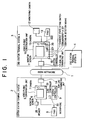
- Fig. 1 is a block diagram showing the overall arrangement of the video conversation/monitoring system based on this invention.
- the system consists of a center station terminal system 2 installed in a center station and end station terminal systems A 3 and B 4 installed in end stations located in several places remote from the center station, all linked through an Integrated Service Digital Network (ISDN) 1 that is a public communication line.
- ISDN Integrated Service Digital Network
- the system of this embodiment includes two end station terminal systems, the system may include three or more terminal systems.
- the center station terminal system 2 consists of a video-phonic conversation unit 5 as the video-phonic conversation means, a system controller 9, a facsimile 8 as the data communication terminal and an ISDN line terminating unit 14, and the video-phonic conversation unit 5 includes a monitor screen 6 as the video output means and a conversation camera 7 as the video input means, with these devices being connected as shown in the figure.
- the end station terminal system 3 consists of a monitor screen 11 for providing a video guidance service for the visitor, a conversation camera 15 as the second video input means, a video-phonic conversation unit 10 that incorporates a system controller 16, a monitoring camera 12 as the first video input means for imaging the whole room where the end station terminal system is installed, a come-in detection means 108 for detecting the entry or exit of a visitor to/from the system installation room, an absence state setting switch 110 as the first notification means for setting that no person exists in the installation room, an emergency-A key 109 as the second notification means for notifying the state of emergency to the center station, a facsimile 13, and an ISDN line terminating unit 14, with these devices being connected as shown in the figure.
- the video-phonic conversation unit 10 of the end station terminal system consists of the integral system controller 16 which implements the selection control between a conversation image taken by the conversation camera 15 and a room monitoring image taken by the monitoring camera 12 and various signal controls for the come-in detection means 108, absence state setting switch 110 and emergency-A key 109.
- the end station terminal system B 4 has the same arrangement as the end station terminal system A 3.
- the video-phonic conversation unit of the center station and end stations perform the coding and decoding of still image, moving image, sound and data signals, multiplex separation control and bidirectional communication by using the desk-top videoconference unit as described in Japanese patent publications JP-A-5-207449, JP-A-5-22720 (U.S.
- Fig. 2 is an external view of the video conversation/monitoring system based on this invention.
- the figure shows the case of the end station terminal system installed in the room of an automatic trading machine (ATM) 111.
- the monitoring camera 12 mounted on the ceiling of the terminal facility operates to shoot the whole interior of the facility.
- the monitoring camera 12 may be provided with a fish-eye lens so that the whole space is shot efficiently.
- items 102, 103 and 104 of the center station are a controller main unit, display unit and control panel that constitute the system controller 9. These devices will be explained in detail in connection with Fig. 3.
- Fig. 3 is a block diagram showing the detailed arrangement of the video conversation/monitoring system shown in Fig. 1.
- the center station terminal system 2 consists of a system controller 9 including a system controller main unit 102, a system control display unit 103 and a system control panel 104, a facsimile 8, and an ISDN line terminating unit 14.
- the video-phonic conversation unit 5 includes a line controller 31, a conversation monitor screen 6, a conversation camera 7, a conversation microphone 30 and a conversation speaker 28, and these devices are accommodated in an integrated unit as shown in Fig. 4.
- the video-phonic conversation unit 5 may be connected on its external video signal input terminal an image input device such as a drawing device.
- the end station terminal system A 3 consists of an ISDN line terminating unit 14, a video-phonic conversation unit 10, a come-in detection means 108, an emergency-A key 109, an absence state setting switch 110, a monitoring camera 12, a facsimile 13, and a digital line terminating unit 14.
- the video-phonic conversation unit 10 consists of a system controller 16 including a line controller 17, a unit controller 310 and a video-phonic signal controller 317, a conversation monitor screen 11, a conversation camera 15, a conversation microphone 321 and a conversation speaker 322 and a sending key set 29, and these devices are accommodated in an integrated unit as shown in Fig. 4.
- the sending key set 29 includes a conversation key 323 used to make a call to have a conversation and an emergency-B key 324 used by the visitor to make a call at the occurrence of a state of emergency.
- a video-phonic recorder such as a VTR or a video output device such as a monitor television unit may be connected by providing an additional video signal input/output interface for the video-phonic signal controller 317.
- a guidance talking unit may be connected by providing an additional peripheral device interface for the come-in detection means 108 of the system controller so that the voiced announcement is offered at the beginning or during the service.
- a number of systems identical to the foregoing end station terminal system A 3 can be connected to the ISDN network 1.
- Fig. 4 is a diagram showing an example of the external view of the video-phonic conversation unit 10 used in the video conversation/monitoring system, and it is used for the end station terminal system 3 or 4.
- the video-phonic conversation unit 10 consists of a video-phonic conversation main unit 401 incorporating a conversation monitor screen 11 that displays an image such as a guidance service image for example sent from the center station, a conversation camera 15 that shoots the visitor who faces the video-phonic conversation unit 10 in the end station and a speaker 372 that provides a voiced guidance service for example sent from the center station, and a video-phonic conversation unit base 404 incorporating a conversation microphone 321 that inputs a voice sound of the visitor and a signal interface circuit (system controller 16, etc.
- system controller 16 a signal interface circuit
- the unit 10 is arranged as shown in Fig. 4 so that it can be placed on the desk top.
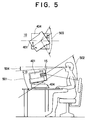
- Fig. 5 is a diagram showing an example of the manner of use of the video-phonic conversation unit 10 shown in Fig. 4.
- the video-phonic conversation unit 10 has its video-phonic conversation main unit 401 designed swingable against the video-phonic conversation unit base 404 by a maximum of 60° (angle 503) right and left from the center and by a maximum of 8° upward (angle 504) so that the operationability is improved.
- a visitor is sitting in front of the video-phonic conversation unit 10, and the conversation camera 15 shoots the visitor at a field angle 502.
- the field angle 502 is set to about 56° that is optimal to cover wide ranges of position and size of the object.
- the camera shoots the visitor who views the conversation monitor screen 11 in the range of angle 501 that is slightly downward with respect to the horizontal direction (angle 504) as shown in the figure, the visitor can have a conversation with a person in the center station through a virtually correct line of sight. Since the main unit 401 is swingable horizontally and upwardly as mentioned above, the visitor can have a conversation in the best condition by adjusting the shooting range.
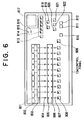
- Fig. 6 shows the external view of the control panel 104 of the system controller of the center station.
- the control panel 104 includes indicator lamps 801-806 corresponding to the come-in detection means 108, absence state setting switch 110, emergency-A key 109, visitor's conversation key 323 and emergency-B key 324 of each end station, a key 808 used to control the connection and disconnection between the center station and the end station, a key 814 used to switch cameras of the end station in communication, a switch key 818 used to switch between the outgoing image to the incoming image from an external video input device that is represented by a drawing device (indicated by 203 in Fig.
- a facsimile communication start key 819 a facsimile communication start key 819, a sub-screen display key 820, a center station video-phonic data transmission key 822, a mute key 821 used to turn off the sound transmission from the center station during the communication, a buzzer turn-off key 810 used to turn off the buzzer that notifies an incoming call or the like, a poling key 809 used to carry out the automatic state monitoring for all end stations that constitute the system, a telescope key 811 and wide-angle key 812 used to adjust the field angle of the camera, a speaker 817 that releases the received sound signal, a power lamp 815 that indicates the power turn-on state, an alarm indicator lamp 816 that indicates the abnormality of the video conversation/monitoring system, and a cable (not shown) that connects the control panel to the video conversation/monitoring system.
- Fig. 7 is a block diagram showing the arrangement of the system controller 16 and line controller 17 of the video-phonic conversation unit used in the end station.
- the line controller 17 receives a digital signal including an audio, video and control data signals from the ISDN network 1 through the ISDN line terminating unit 14, and transmits a digital signal including an audio, video and control data signals to the ISDN network 1.
- the line controller 17 operates based on the means as shown in the Japanese patent publication JP-A-5-207449 mentioned previously such that its receiving circuit separates the line digital signal into a video signal, audio signal and control data signal and converts the video and audio signals into analog signals. Its sending circuit converts the video and audio signals into digital signals, multiplexes the video, audio and control data signals, and sends the signals onto the line.
- the system controller 16 consists of a video-phonic signal controller 317 including a video signal switch circuit 25 and audio signal switch circuit 26, and a unit controller 310.
- the controller 310 consists of a data signal input/output circuit 23 that implements the control data signal input and output with the line controller 17 and unit control circuit 24 that implements the coding and decoding for the data signal, controls the internal circuits of the controller and inputs the signals from the detection means.
- the unit control circuit 24 receives the control data signal from the data signal input/output circuit 23 and produces control signals for operating the audio signal switch circuit 26 and video signal switch circuit 25 so that a video and audio signals are selected from among input signals and delivers the selected signals to the center station.
- the circuit has a contact-mode signal input/output function for interfacing with peripheral devices such as the come-in detection means 108, and it delivers the signals from these peripheral devices to the line controller 17, which then sends a certain code signal depending on the states of these signals to the center station by using the D channel of the ISDN line.
- the audio signal switch circuit 26 is a circuit for implementing the audio signal input and output with the audio input and output means of the line controller 17, and it consists of an outgoing audio signal selecting circuit 22 and an audio signal merging circuit 21.
- the audio signal selecting circuit 22 operates to deliver the audio signal received from the center station equipment through the line controller 17 to the conversation speaker 322, deliver the audio signal from the conversation microphone 321 to the line controller 17, and deliver the received audio signal to the VTR 315.
- the audio signal merging circuit 21 merges the received audio signal and the audio signal from the conversation microphone 321, and accordingly it is possible to record a bidirectional conversation on a VTR for example.
- the video signal switch circuit 25 implements the video signal input and output with the video input and output means of the line controller 17, and it consists of a display video signal selecting circuit 18, a sending video signal selecting circuit 20 and a text merging circuit 19.
- the outgoing video signal selecting circuit 20 selects one video signal out of the video signal of the monitoring camera 12 as the first video input means and the video signal of the conversation camera 15 as the second video input means, and delivers the selected signal to the line controller 17.
- the outgoing video signal selecting circuit 20 may be arranged to select one of three or more video signals inclusive of a video signal from a third video input means.
- the display video signal selecting circuit 18 selects a video signal to be fed to the conversation monitor screen 11 as the video output means from among the video signal received from the center station, the video signal of the monitoring camera 12 as the first video input means, the composed video signal produced by the text merging circuit 19 and the text signal produced by the unit controller 27.
- the text merging circuit 19 merges the text signal produced by the unit controller 27 and the video signal from the center station to produce a composed video signal for displaying a text such as a guidance message superimposed on the received image.
- Fig. 8 is a diagram showing the procedure of normal conversation between a calling end station 3 and the center station 2.
- the detection means 108 located at the entry detects the movement of the visitor (step 1001)
- the controller 310 sends a call establishment signal including the come-in notification signal to the center station (step 1002)
- the center station 2 receives the come-in notification signal included in the call establishment signal (step 1003), and it turns on the lamp 804 of the relevant end station in the come-in information display area of the control panel 104 (step 1004).
- a buzzer may be activated to notify the visitor's entry instead of turning on the lamp.
- the system controller 310 sends a call establishment signal including a conversation request notification signal to the center station (step 1007), the center station receives the conversation request notification signal included in the call establishment signal (step 1008), it turns on the lamp 805 of the relevant end station in the conversation request information display area of the control panel 104 (steps 1009, 1010), and it connects the B-channel signal so that the video-phonic bidirectional conversation begins between the visitor and the guide in the center station (steps 10111-1013).
- the visitor talks to the guide to give a message, inquiry, etc. and the guide responds to the request to provide a service based on the voice or image, and the demand of the visitor is fulfilled by the video conversation/monitoring system of this invention.
- the control data is sent to the end station through the system controller 102 (step 1015), and the image of the visitor, i.e., the image produced by the camera 15 of the video-phonic conversation unit, is displayed in the sub-screen located at the bottom right corner 1702 of the monitor screen of the video-phonic conversation unit as shown in Fig. 15 (step 1016).
- the facsimile sending key 819 provided on the system control panel of the center station is pressed (step 1021), the line controller and facsimile are controlled so that the facsimile signal is sent to the facsimile of the end station during the video-phonic conversation (step 1022), and the text or graphic information such as a map can be offered to the visitor (step 1023).
- the guide of the center station confirms the completion of conversation service and presses the call disconnection key 808 provided on the control panel 104 (step 1017), and the communication with this end station is terminated (step 1018, 1019). Following the termination of conversation, the center station system enters the wait state again for a call from an arbitrary end station among a plurality of end stations (step 1020).
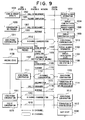
- Fig. 9 is a diagram showing the procedure of conversation service between multiple end stations and the center station of the case of an example of two end stations.
- a visitor enters the room and presses the conversation key 323 on the base 401 of the video-phonic conversation unit 10 and begins a conversation with the guide in the center station 2 (step 1001-1013) in the same manner as explained on Fig. 8.
- the center station terminal system 2 detects the conversation request of the end station B based on the call establishment signal including the conversation request information carried by the D-channel signal (step 1103), and it turns on the lamp relevant to the end station in the conversation request information display area 104 on the control panel 104 (step 1104).
- the guide of the center station tells the visitor of the end station A that the conversation needs to be suspended temporarily and switched to the conversation with the end station B, and thereafter presses the communication key 808 relevant to the end station B on the control panel 104 (step 1106).
- the video-phonic conversation unit 5 of the center station sends the control information so as to make holding the video-phonic conversation unit 10 of the end station A and disconnects the communication with the end station A (step 1107).
- the communication state indicator lamp on the control panel 104 keeps blinking so that it is possible for the center station to known that the end station A is in the state of holding (step 1108).
- the video-phonic conversation unit of the center station makes an automatic call to the end station B (step 1109), and begins a conversation (step 1110-1113).
- the visitor of the end station B gives a message, inquiry, etc. through the conversation with the center station, and the demand is fulfilled.
- the video-phonic conversation unit 10 of the end station A On receiving the control information of holding from the center station, the video-phonic conversation unit 10 of the end station A displays a screen indicative of the state of holding as shown in Fig. 18 on the monitor screen 111.
- the communication key 808 for the end station B is pressed on the control panel 104 of the center station (step 1114) and the communication with the end station B is terminated (step 1115), and a call is made from the center station to the end station A (step 1116) and the conversation begins (step 1117, 1011-1013).
- the visitor of the end station A resumes the conversation with the center station to continue the suspended service, and the demand of the visitor is fulfilled.
- the communication key 808 on the control panel 104 is pressed (step 1017), and the communication with this end station is terminated (step 1018, 1019).
- the center station system enters the wait state again for a call from an arbitrary end station among a plurality of end stations (step 1020).
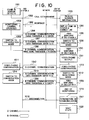
- Fig. 10 is a diagram showing the procedure of system operation for enabling the center station to automatically begin a conversation with an end station by using the come-in notification signal.
- the detection means 108 detects the entry of the visitor (step 1001) and the system controller 310 transmits a call establishment signal including a code indicative of the come-in notification (step 1002), as has been explained on Fig. 8.
- the center station receives the come-in notification signal included in the call establishment signal (step 1003), turns on a lamp relevant to the end station in the come-in information display area of the control panel 104 and connects the line (step 1201), and enables the B-channel signal communication.
- the monitoring camera 12 is operated to send the video input signal from the end station to the center station (step 1203), and at the same time the sound in the end station picked up with the microphone 321 mounted on the video-phonic conversation unit is also sent to the center station (step 1204).
- the monitor screen of the video-phonic conversation unit 10 of the end station displays a guide screen as shown in Fig. 17.
- the center station checks the state of the interior of the end station A based on the audio and video information, and if a service based on conversation deems to be needed, the video-phonic output key 822 on the control panel 104 is pressed (step 1206) and the video-phonic signal of the video-phonic conversation unit 5 of the center station is sent out.
- the video signal of the end station is the one produced by the monitoring camera 12, and by pressing the conversation camera key 813 among the camera selection keys on the control panel 104, information for switching the video input means of end station is transferred to the video-phonic signal controller 317 of the end station through the system controller (step 1207), and the video signal to be sent from the end station is switched to the output signal of the camera mounted on the video-phonic conversation unit (step 1208). Consequently, it becomes possible to have a bidirectional video-phonic conversation between the visitor and the guide in the center station (steps 1209-1211). The visitor receives a video-phonic service of the guide of the center station (steps 1011-1013), and the demand of the visitor is fulfilled.
- the monitoring camera key 814 among the camera selection keys on the control panel 104 is pressed (step 1212), and information for switching the video input means of the end station is transferred to the video-phonic signal controller 317 of the end station through the system controller 310 (step 1213), and the video signal to be transmitted from the end station is switched to the output signal of the monitoring camera (steps 1214, 1204, 1205).
- the call disconnection key 808 on the control panel 104 is pressed (step 1017), and the communication with the end station is terminated (step 1018).
- a call may be disconnected by the end station terminal system on expiration of a certain time length following the detection of the exit of the visitor by the detection means 108.
- the center station system enters the wait state again for a call from an arbitrary end station among a plurality of end stations (step 1020).
- the monitoring camera 12 which is the first video input means of the end station, may be provided with a zoom control mechanism and field angle control mechanism based on servo motors, with an interface circuit for controlling the field angle or shooting direction of the monitoring camera 12 based on a digital signal being added, so that the center station sends a call control signal that controls the field angle or shooting angle of the monitoring camera 12 as the first video input means of the end station to the end station through the line controller 17, thereby carrying out the remote control of the end station monitoring image.
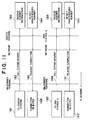
- Fig. 11 is a diagram showing the communication procedure of the case of a call from an unlicensed terminal station, such as a digital videophone, operating on the ISDN line to the inventive system, the procedure being based on the function of detecting a call to be from an unlicensed terminal station and disabling the connection of it to the system.
- the center station system controller 102 and end station system controller 310 have a record of registered numbers of the center station and end stations that constitute the video conversation/monitoring system.
- a call establishment signal is sent from an unlicensed terminal station to the center station 2 or end station 3 or 4 of this system through the D-channel of ISDN (steps 1301, 1302, 1307, 1308)
- the system controller 310 of the center station or end station receives the number information included in the call establishment signal (steps 1303, 1309), collates it with the registered numbers (steps 1304, 1310) and stores the call establishment signal, and if it is found to be not registered, a release completion signal is sent to the unlicensed terminal station (steps 1305, 1311) and a process for preventing the connection is carried out (steps 1306, 1312).
- the terminal system of each end station may send the number information from the non-registered station to the center station terminal system. Consequently, it is possible to prevent the leak of service activities of the guidance system to which this system is applied and also prevent the violation against the system.
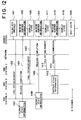
- Fig. 12 and Fig. 13 are diagrams showing the operational procedure of the poling monitoring function of the video conversation/monitoring system that connects the center station sequentially to all end station terminal systems to receive information on the state of the end stations and implements the automatic video monitoring of the interior of end stations by means of the monitoring camera 12 installed in each end station.
- Fig. 12 shows the operational procedure of the case of monitoring only information on the state of each end station.
- the poling key 809 on the control panel 104 is pressed (step 1401) to send at first a call establishment signal to the end station A (step 1402), and in response to this signal, the end station A sends a D-channel signal including a code indicative of the absence of the keeper in the end station, for example, to the center station (step 1403).
- the center station receives the code indicative of the absence of the keeper in the end station, for example, included in the D-channel signal (step 1405) and turns on the lamp relevant to the end station in the state display area of the control panel 104 (step 1406).
- the D-channel signal sent from the end station A to the center station is a signal that signifies the release completion (step 1404), and the communication between the center station and the end station A is terminated without having a line connection of the B-channel.
- communication with the end stations B and C takes place sequentially by following the same procedure as that for the end station A to receive the state information of all end stations that constitute the system, with the results being displayed at once on the control panel 104, and it is possible for the center station to monitor the state of all end stations in an integral manner (steps 1407-1416).
- Fig. 13 shows the operational procedure of the case of carrying out the video monitoring of each end station.
- the poling key 809 on the control panel 104 is pressed (step 1401) to send at first a call establishment signal to the end station A (step 1402), and in response to this signal, the end station A sends a D-channel signal including a code indicative of the state of the end station to the center station (steps 1403, 1501).
- the center station receives the code indicative of the state of the end station included in the D-channel signal (step 1502) and turns on the lamp relevant to the end station in the state display area of the control panel 104 (step 1503), and connects the line to enable the B-channel signal communication (step 1504).
- the monitoring camera 12 is operated to send the video input signal from the end station to the center station (step 1203), and at the same time the sound in the end station picked up with the microphone 321 mounted on the base 401 of the video-phonic conversation unit 10 is also sent to the center station (step 1204).
- the monitor screen of the video-phonic conversation unit 10 of the end station displays a guidance screen as shown in Fig. 18 (step 1205).
- the B-channel signal communication begins and it lasts for a time length, e.g., 20 sec, set on a timer since the beginning of image reception from the monitoring camera 12 (step 1505), the line is disconnected on expiration of the set time (step 1506), and subsequently connection is made to the end stations B and C sequentially to carry out the same procedure as for the end station A to receive the state information and monitor images of all end stations that constitute the system, and it is possible for the center station to monitor the state of all end stations in an integral manner as in the case explained on Fig. 12.
- the poling monitoring function based on another operational procedure different from the foregoing will be explained.
- the center station terminal system 2 transmits a call establishment signal including information of state notification request of the end station terminal system A; (1-2) the end station receives the call establishment signal, confirms the state notification request of the end station terminal system and thereafter transmits a release completion signal including information of acknowledgement indicative of the normal reception of information. The center station confirms the normal information transmission from the end station based on the information included in the release completion signal. (1-3) After transmitting the release completion signal, the end station sends a call establishment signal including the state information of the end station terminal system to the center station.
- the center station receives the call establishment signal including the state information of the end station, confirms the state information of end station included in the call establishment signal, and thereafter transmits a release completion signal including the information of acknowledgement indicative of the normal reception.
- the end station confirms the normal information transmission from the center station based on the information included in the release completion signal.
- the center station terminal system 2 repeats the same operational procedure as that of the end station A for the remaining end stations B and C connected to the ISDN network, thereby implementing the state monitoring for all end station terminal systems.
- the failure of normal notification is detected based on the release completion signal including the signal indicative of the failure of reception, and a procedure of recurrent communication is started so that the state information of all end station terminal systems is transmitted normally.
- Fig. 14 through Fig. 16 are diagrams showing displays on the monitor screen of the video-phonic conversation unit 10 installed in the end station.
- Fig. 14 shows, as an example, map information 1601 as a guidance screen produced by using the drawing device 203 that is the second video input means of the center station and displayed on the monitor screen of the video-phonic conversation unit 10 of the end station.
- Fig. 15 shows a display of an image produced by the camera as the second video input means incorporated in the video-phonic conversation unit 10 of the end station displayed on the sub-screen 1702 that is superimposed on an image 1701 produced by the camera as the first video input means incorporated in the video-phonic conversation unit 10 of the center station.
- Fig. 16 shows a display of an image 1801 produced by the camera as the first video input means incorporated in the video-phonic conversation unit of the center station displayed on the overall monitor screen.
- Fig. 17 shows a display 1901 on the monitor screen of the video-phonic conversation unit 10 of the end station of the case when the conversation function is not operating.
- Fig. 18 shows a display 2001 on the monitor screen of the video-phonic conversation unit 10 of the case when the center station terminal system 2 is amid communication with other end station.
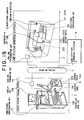
- Fig. 19 is a diagram showing the external view of the video conversation/monitoring system based on another embodiment of this invention.
- the center station terminal system has the additional provision of a drawing device 203 for entering characters and figures as image signals and a facsimile 8, in addition to the arrangement shown in Fig. 3, with the intention of enhancing the usefulness of the video conversation/monitoring system by offering more detailed information based on texts, characters and figures to visitors of the end stations.
- ATM111 an Auto Teller Machine or a Cash Dispenser
- the function for the visitor and the function for the manager of the end station terminal system are separated as shown in Fig. 20 and Fig.
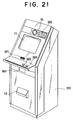
- a floor-stand conversation unit 201 on which a monitoring camera 102 and come-in detection means 108 are equipped as shown in Fig. 21, installed in the room where the visitor enters.
- the function for the terminal system control implemented by the system controller 16 is integrated in a cabinet 202 shown in Fig. 20, and it is installed in another room.
- Fig. 20 shows the controller of the end station terminal system integrated in the cabinet 202, in which are included the function of system control that is not accessed directly by the visitor who has entered the room of end station to get various conversation services, among various functions that constitute the end station terminal system shown in Fig. 3.
- the controller includes a system controller 16 consisting of a unit controller 310 and video-phonic controller 317 and a line controller 17, which are housed in the cabinet 202 by being separated from the video-phonic conversation unit 10 (shown in Fig.
- monitor screen 2101 used to view the same screen as the monitor screen 11 provided for the visitor
- display unit 2104 used to display the system management result or the like.
- 2102 denotes an interface for connecting the separated functional blocks.
- Fig. 21 is a diagram showing the external view of the floor-stand video-phonic conversation unit 201, which consists of a monitor screen 11 that displays images, e.g., guidance service images, sent from the center station, a camera 15 that shoots a visitor who faces this video-phonic conversation unit in the end station, a microphone 321 that picks up the voice of the visitor, sending keys 323 and 324 used by the visitor to make transmission from the end station to the center station, a speaker 322 that delivers sounds, e.g., guidance service, sent from the center station, a facsimile unit 13, a detection means 601 for detecting that a visitor exists in front of the video-phonic conversation unit, and a video-phonic signal interface circuit explained on Fig. 3, with all these devices being accommodated in a floor-stand cabinet.
- images e.g., guidance service images
- a camera 15 that shoots a visitor who faces this video-phonic conversation unit in the end station
- a microphone 321 that picks up the
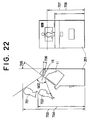
- Fig. 22 is a diagram showing an example of the manner of use of the video-phonic conversation unit shown in Fig. 21.
- a visitor is standing in front of the video-phonic conversation unit 201 as shown in Fig. 22, and the camera 15 shoots the visitor 701 or 702 in the range of field angle 502.
- the field angle 502 is set to about 56° and the position is so set that the camera can shoot the face of the visitor who can be as tall as 120-180 cm approximately.
- the camera angle is optimized to allow some variation of position of the visitor. Based on this setting of the height and field angle of the camera, it can shoot hoth a tall visitor 701 and a short visitor 702 and even a visitor who is sitting in a wheelchair.
- the conversation call key 323 and emergency-B key 324 have their height set as shown by 708 in Fig. 22 and the monitor screen 320 has its position set so that the visitor's sight line has a height as shown by 707 in Fig. 22, and the unit can be operated by visitors of the range of tallness mentioned above.
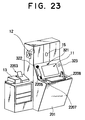
- Figs. 23, 24 and 25 are diagrams showing the arrangement of the apparatus with the extended performance through the addition of functions to the video conversation/monitoring system described above in consideration of the operationability.
- Fig. 23 shows the arrangement of the apparatus used in the end station, in which the end station equipment 201 includes a monitoring camera 12 as the first video input means, a conversation camera 15 as the second video input means, a conversation monitor screen 11 as the video output means, a conversation microphone 321 as the audio input means, a speaker 322 as the audio output means, a conversation key 323 as the calling means and a facsimile 13, which are all explained on Fig. 3, and it further includes a hand-write input device 2208, a selection key set 2207, a conversation handset 2205 and a screen printer 2203.
- the equipment incorporates the system controller main unit 310.
- the selection keys 2207 are switching means for selecting whether or not the hand-write input device 2208 and conversation handset 2205 are used.
- the hand-write input device 2208 is connected to the line controller 307 through a serial communication means, and it is used to send a visitor's message, state or will in the form of characters or figures to a receiving party of communication.
- the hand-write input device 2208 digitizes the entered character and figure information, and the resulting data signal is transmitted through the serial communication means to the center station by way of the line controller 307 and ISDN network, and the information is delivered to the guide as the receiving party in the center station.
- the hand-write input device 2208 has a display screen, on which prerecorded guidance information (e.g., operational guidance) of each service item is displayed in various forms in advance and characters and figures can be written in certain portions of the screen.
- prerecorded guidance information e.g., operational guidance
- the display screen of the hand-write input device 2208 has an area for entering the selection of service by the visitor.
- the service selection function is included in the hand-write input device 2208. It is also possible for the visitor to use the hand-write input device 2208 as a substitution of memo during the conversation.
- the use of the hand-write input device 2208 enables dumb persons and foreigners to make easy access to the system by use of characters and figures.
- the conversation handset 2205 is used in place of the microphone 321 and speaker 322 in the noisy environment, and in this case by selecting the use of the handset 2205 through the operation of the selection key 2207, a message "use the handset" for example is displayed on the conversation monitor screen and the conversation handset 2205 becomes operative.
- the screen printer 2203 receives in parallel the video output signal to the conversation monitor screen 11 and it operates to print the screen information of the moment when the print key on the screen printer is pressed. Consequently, it is possible to copy various guidance service screens sent from the center station. By placing the printer on the top of the unit as shown in the figure, the interior wiring of the room can be eliminated.
- the end station facility 2313 has a box-like structure that can accommodate the end station equipment 201 and several people including visitors, and it has a front and side walls made of semi-transparent glass so that the interior can be seen easily from the outside.
- the use of the semi-transparent glass is effective for blocking the sun light and other external light thereby to alleviate the temperature rise inside the facility when it is placed outdoors.
- a thermal sensor 2304 and an air conditioning device 2303 that maintains the air temperature automatically in response to thermal data provided by the thermal sensor so that the visitor is comfortable.
- the thermal data detected by the thermal sensor 2304 may be sent to the center station through the line controller 307 so that it monitors the interior temperature of the end station.
- the end station facility 2313 has an automatic front door, which opens on detecting the presence of a visitor by means of an automatic door sensor 2308.
- a visitor's tallness sensor 2310 Provided inside the automatic door 2311 is a visitor's tallness sensor 2310, which measures the tallness of the visitor who is going to enter the facility at a resolution of 5 cm for example, so that the field angle of the conversation camera 15 as the second video input means is adjusted.
- the end station equipment 201 is provided at the bottom with a height control mechanism that moves the equipment up and down by means of a motor or the like so that the visitor can easily operate the equipment.
- a voice guidance unit 2314 Placed at the top of the facility is a voice guidance unit 2314 having several kinds of voiced guidance messages recorded on a recording medium such as a ROM device so that a voiced message for each service item is offed to the visitor. Consequently, the guidance of service items, the guidance of service commencement, the guidance of service completion at the end of conversation, and the guidance at at the occurrence of fault of the conversation service function can be offered in response to the automatic door sensor 2308.
- Several lamps that indicate the state of use of the facility may be provided. A lamp may be attached to the ceiling of the facility.
- fence rails 2315 may be fitted as shown in the figure so that the chance of erroneous detection of the automatic door sensor 2308 in response to passersby decreases.
- the center station equipment 2 includes a conversation camera 7 as the video input means of the video-phonic conversation unit, a conversation monitor screen 6 as the video video output means, a conversation speaker 28 as the audio output means, a conversation microphone 30 as the audio input means, a control panel 104 of the system controller 9, a display screen 103, a drawing device 203 and a facsimile 8, and it additionally includes a second monitor screen 2404 as the second video output means for displaying the image of the conversation camera 7 or drawing device 203, a hand-write input device 2408, a conversation handset 2405 and a conversation information recorder 2416, with all these devices being disposed integrally as shown in Fig. 25.
- the video-phonic conversation unit of the center station uses three kinds of monitor screens as the video output means.
- the first monitor screen 6 displays a conversation and monitoring images as the main screen
- the second monitor screen 2404 displays an image of the conversation camera 7 or drawing device 203, enabling the guide of the center station to known what image is being sent to the end station
- the third monitor screen 103 may be used as the display panel of the system controller 9 for verifying the communication log information and the system operation.
- an image of the self station produced by the conversation camera 7 or the like may be displayed as a sub-screen on the main screen, or it is also possible provide an independent second monitor screen 2404 to display the content of the sub-screen so that the whole main screen 6 is used for the conversation or monitoring.
- the hand-write input device 2408 consists of a display screen and a writing means, and it is connected to the hand-write input device 2208 of the end station by the data signal interface by way of the line controller.
- the display screen displays prerecorded guidance information for each service item in various display forms, and characters and figures can be written by the writing means in certain portions of the screen.
- an intended service screen will appear.
- the service item selecting function is included in the hand-write input device 2408. It is also possible for the guide of the center station to use the hand-write input device 2408 as a momo during a conversation. This function supplements the video-phonic conversation service, and more satisfactory services can be offered. By superimposing an image of the display screen on the video signal of the second monitor screen 2402, with a map being set in the drawing device for example, it is possible to perform a guidance service while pointing a position on the screen with the writing means. In case more than one center station equipment is installed in the center station, the conversation handset 2405 is used when an equipment is located in a noisy environment, and in this case a hand-free conversation based on the speaker 28 and microphone 30 is suspended during a conversation using the conversation handset 2405.
- the conversation information recorder 2416 connected to the video-phonic conversation unit operates to record images and sounds of conversation and monitoring.
- the conversation information recorder 2416 has the same interface condition as the video-phonic conversation unit, and one or a combination of writable laser disk, CD-ROM and long-time recording VTR can be used for it depending on the system service items.
- the extended video conversation/monitoring system explained on Figs. 23, 24 and 25 is a system that can offer detailed and easy guidance services through the combination of proper image, character, figure and sound information. It can also offer proper guidance services for handicapped people and foreigners.
- the video conversation/monitoring system explained above for the embodiments of this invention can be applied to a variety of guidance service systems through the optimization of application and system control software resources depending on the purpose and items of service.
- inventive system include guidance systems for local public and governmental facilities, e.g., power supply firm, post office, police station and fire fighting station, guidance systems for semi-public facilities, e.g., railroad and other transport station, bank, leisure facility, department store and other commercial facilities, service guidance systems for hospitals and other medical facilities, and service guidance systems for individuals, e.g., videophone, information retrieval, etc.
- the present invention arranged as explained above has the following effectiveness.
Landscapes
- Engineering & Computer Science (AREA)
- Multimedia (AREA)
- Signal Processing (AREA)
- Computer Networks & Wireless Communication (AREA)
- Telephonic Communication Services (AREA)
- Closed-Circuit Television Systems (AREA)
- Computer And Data Communications (AREA)
- Two-Way Televisions, Distribution Of Moving Picture Or The Like (AREA)
Applications Claiming Priority (3)
| Application Number | Priority Date | Filing Date | Title |
|---|---|---|---|
| JP10217793 | 1993-04-28 | ||
| JP102177/93 | 1993-04-28 | ||
| JP10217793A JP3472594B2 (ja) | 1993-04-28 | 1993-04-28 | テレビ対話システム及び中央局 |
Publications (3)
| Publication Number | Publication Date |
|---|---|
| EP0622969A2 true EP0622969A2 (fr) | 1994-11-02 |
| EP0622969A3 EP0622969A3 (fr) | 1998-01-14 |
| EP0622969B1 EP0622969B1 (fr) | 2001-10-17 |
Family
ID=14320409
Family Applications (1)
| Application Number | Title | Priority Date | Filing Date |
|---|---|---|---|
| EP94106582A Expired - Lifetime EP0622969B1 (fr) | 1993-04-28 | 1994-04-27 | Système pour dialoguer et surveiller en vidéo |
Country Status (6)
| Country | Link |
|---|---|
| US (2) | US5585839A (fr) |
| EP (1) | EP0622969B1 (fr) |
| JP (1) | JP3472594B2 (fr) |
| KR (1) | KR0142505B1 (fr) |
| CN (1) | CN1065705C (fr) |
| DE (1) | DE69428622T2 (fr) |
Cited By (4)
| Publication number | Priority date | Publication date | Assignee | Title |
|---|---|---|---|---|
| EP1139661A2 (fr) | 2000-03-28 | 2001-10-04 | Omnivision Technologies Inc. | Système de visiophone à distance |
| FR2842687A1 (fr) * | 2002-07-19 | 2004-01-23 | France Telecom | Poste visiophonique et procede de mise en relation visiophonique |
| EP1246084A3 (fr) * | 1995-03-15 | 2004-05-26 | Kabushiki Kaisha Toshiba | Un procédé de communication et le système correspondant, appliqué pour le réseau qui a plusieurs systèmes clients et systèmes serveur |
| CN113923416A (zh) * | 2021-10-19 | 2022-01-11 | 黑龙江费米科技有限公司 | 一种工程监理监控系统 |
Families Citing this family (69)
| Publication number | Priority date | Publication date | Assignee | Title |
|---|---|---|---|---|
| JP3167865B2 (ja) * | 1994-07-28 | 2001-05-21 | 株式会社半導体エネルギー研究所 | 情報処理装置 |
| US6707484B1 (en) | 1994-07-28 | 2004-03-16 | Semiconductor Energy Laboratory Co., Ltd. | Information processing system |
| US5802281A (en) | 1994-09-07 | 1998-09-01 | Rsi Systems, Inc. | Peripheral audio/video communication system that interfaces with a host computer and determines format of coded audio/video signals |
| JPH08111858A (ja) * | 1994-10-12 | 1996-04-30 | Hitachi Ltd | テレビ対話監視システム |
| US6549948B1 (en) * | 1994-10-18 | 2003-04-15 | Canon Kabushiki Kaisha | Variable frame rate adjustment in a video system |
| JPH08163522A (ja) * | 1994-11-30 | 1996-06-21 | Canon Inc | テレビ会議システムおよび端末装置 |
| DE19505692A1 (de) * | 1995-02-20 | 1996-08-22 | Roland Man Druckmasch | Druckmaschine |
| US5929897A (en) * | 1995-07-12 | 1999-07-27 | Ncr Corporation | Automated distribution of video telephone calls |
| JPH09191350A (ja) * | 1996-01-10 | 1997-07-22 | Canon Inc | マルチメディア通信装置 |
| DE19610010A1 (de) * | 1996-03-14 | 1997-09-18 | Sel Alcatel Ag | Einrichtung und Dienst zur Übertragung von Videobilddaten sowie Einrichtung zur Übertragung von Anforderungssignalen |
| US7304662B1 (en) * | 1996-07-10 | 2007-12-04 | Visilinx Inc. | Video surveillance system and method |
| JPH10150485A (ja) * | 1996-11-16 | 1998-06-02 | Sony Corp | テレビジョン一体型電話機 |
| US20030179290A1 (en) * | 1997-05-07 | 2003-09-25 | Diebold, Incorporated | Transaction system |
| US7932921B1 (en) * | 1997-05-07 | 2011-04-26 | Diebold, Incorporated | Transaction system |
| US6449001B1 (en) * | 1997-11-21 | 2002-09-10 | William W. Levy | Video teleconferencing assembly and process |
| US6272214B1 (en) | 1997-11-24 | 2001-08-07 | Telefonaktiebolaget Lm Ericsson (Publ) | Automatic control of participation in telemeetings |
| US5914747A (en) * | 1998-06-17 | 1999-06-22 | Dialogic Corporation | Automatic control of video conference membership |
| JP4633207B2 (ja) * | 1998-09-08 | 2011-02-16 | ソニー株式会社 | 画像表示装置 |
| USD442155S1 (en) | 1998-10-24 | 2001-05-15 | Vtel Corporation | Video teleconferencing center with full screen display |
| US6731324B2 (en) | 1998-11-18 | 2004-05-04 | William W. Levy | Video teleconferencing assembly and process |
| US6950126B1 (en) * | 1998-11-19 | 2005-09-27 | Nikon Corporation | Camera capable of communicating with other communication device |
| USD440545S1 (en) | 1999-04-20 | 2001-04-17 | Vtel Corporation | Video teleconferencing center |
| US8004572B2 (en) * | 1999-05-17 | 2011-08-23 | Zin Stai Pte. In, Llc | System for transmitting a video stream over a computer network to a remote receiver |
| DE19932662A1 (de) * | 1999-07-15 | 2001-01-18 | Bosch Gmbh Robert | Verfahren zur Erkennung von Szenenänderungen und Überwachungseinrichtung hierzu |
| US6117010A (en) * | 1999-08-05 | 2000-09-12 | Wms Gaming, Inc. | Gaming device with a serial connection |
| US9355352B1 (en) | 2000-02-24 | 2016-05-31 | Richard Paiz | Personal search results |
| US8977621B1 (en) | 2000-02-24 | 2015-03-10 | Richard Paiz | Search engine optimizer |
| US6369847B1 (en) | 2000-03-17 | 2002-04-09 | Emtel, Inc. | Emergency facility video-conferencing system |
| US6980526B2 (en) * | 2000-03-24 | 2005-12-27 | Margalla Communications, Inc. | Multiple subscriber videoconferencing system |
| JP2001352536A (ja) * | 2000-06-07 | 2001-12-21 | Hitachi Ltd | 音声画像通信装置およびテレビ対話システム |
| US20030167176A1 (en) * | 2001-03-22 | 2003-09-04 | Knudson Natalie A. | System and method for greeting a visitor |
| US6980333B2 (en) * | 2001-04-11 | 2005-12-27 | Eastman Kodak Company | Personalized motion imaging system |
| US6641484B2 (en) * | 2001-09-21 | 2003-11-04 | Igt | Gaming machine including security data collection device |
| US6907387B1 (en) * | 2002-08-05 | 2005-06-14 | Bellsouth Intellectual Property Corporation | Systems and methods for remote monitoring of a facility location |
| US6980259B2 (en) * | 2002-09-20 | 2005-12-27 | Strollo Giacomo M | Videoconferencing carrel |
| JP4485150B2 (ja) * | 2003-05-29 | 2010-06-16 | 三菱電機株式会社 | 遠隔通話システム |
| US20050135458A1 (en) * | 2003-11-26 | 2005-06-23 | Sovus Media, Inc. | System and method for distance assistance and coaching |
| WO2006016437A1 (fr) * | 2004-08-11 | 2006-02-16 | Ginganet Corporation | Systeme de poste de police visiophonique |
| US10959090B1 (en) | 2004-08-25 | 2021-03-23 | Richard Paiz | Personal search results |
| US11468128B1 (en) | 2006-10-20 | 2022-10-11 | Richard Paiz | Search engine optimizer |
| US7256816B2 (en) * | 2004-10-25 | 2007-08-14 | 3V Technologies Incorporated | Systems and processes for scheduling and conducting audio/video communications |
| US20060149815A1 (en) * | 2004-12-30 | 2006-07-06 | Sean Spradling | Managing participants in an integrated web/audio conference |
| US8069206B2 (en) * | 2005-03-18 | 2011-11-29 | Clearone Communications, Inc. | System and method for real-time feedback with conservative network usage in a teleconferencing system |
| US8457614B2 (en) * | 2005-04-07 | 2013-06-04 | Clearone Communications, Inc. | Wireless multi-unit conference phone |
| US8139097B2 (en) | 2005-04-20 | 2012-03-20 | Sharp Kabushiki Kaisha | Information-processing device with calling function and application execution method |
| KR100856403B1 (ko) * | 2006-03-03 | 2008-09-04 | 삼성전자주식회사 | 화상 회의 기록 방법 및 이에 적합한 화상 회의 단말기 |
| US8601054B2 (en) * | 2006-12-07 | 2013-12-03 | International Business Machines Corporation | Project-related communications |
| CN101206747B (zh) * | 2006-12-18 | 2016-11-23 | 北京银融科技有限责任公司 | 远程交易系统的方法及装置 |
| US8817951B2 (en) | 2006-12-27 | 2014-08-26 | Motorola Mobility Llc | Method and system for monitoring a location |
| US8833639B1 (en) | 2007-04-24 | 2014-09-16 | United Services Automobile Association (Usaa) | System and method for financial transactions |
| US7857207B1 (en) | 2007-04-24 | 2010-12-28 | United Services Automobile Association (Usaa) | System and method for financial transactions |
| US10922363B1 (en) | 2010-04-21 | 2021-02-16 | Richard Paiz | Codex search patterns |
| US10915523B1 (en) | 2010-05-12 | 2021-02-09 | Richard Paiz | Codex search patterns |
| US11048765B1 (en) | 2008-06-25 | 2021-06-29 | Richard Paiz | Search engine optimizer |
| US20110191117A1 (en) * | 2008-08-15 | 2011-08-04 | Mohammed Hashim-Waris | Systems and methods for delivering medical consultation at pharmacies |
| US20100289906A1 (en) * | 2009-05-13 | 2010-11-18 | Einstruction Corporation | Interactive Student Response And Content Sharing System |
| CN102215378B (zh) * | 2010-04-12 | 2016-03-09 | 江苏联优信息科技有限公司 | 一种动态组网的多媒体传感网络系统 |
| US11423018B1 (en) | 2010-04-21 | 2022-08-23 | Richard Paiz | Multivariate analysis replica intelligent ambience evolving system |
| US11379473B1 (en) | 2010-04-21 | 2022-07-05 | Richard Paiz | Site rank codex search patterns |
| US10936687B1 (en) | 2010-04-21 | 2021-03-02 | Richard Paiz | Codex search patterns virtual maestro |
| US20130286200A1 (en) * | 2012-04-25 | 2013-10-31 | Kabushiki Kaisha Toshiba | Television receiver and electronic device |
| US11809506B1 (en) | 2013-02-26 | 2023-11-07 | Richard Paiz | Multivariant analyzing replicating intelligent ambience evolving system |
| US11741090B1 (en) | 2013-02-26 | 2023-08-29 | Richard Paiz | Site rank codex search patterns |
| US9621771B2 (en) * | 2013-03-14 | 2017-04-11 | Pelco, Inc. | System and method for imaging utility panel elements |
| US9684354B2 (en) | 2013-07-31 | 2017-06-20 | Conduent Business Services, Llc | Remote customer relationship management activity workspace |
| US10257473B2 (en) | 2015-01-27 | 2019-04-09 | Sercomm Corporation | Doorbell device and method thereof |
| US10645137B2 (en) * | 2015-12-28 | 2020-05-05 | Facebook, Inc. | Systems and methods to create composite videos |
| CN109345651A (zh) * | 2018-08-31 | 2019-02-15 | 安徽恒杰保安服务有限公司 | 一种小区门岗区的登记装置 |
| JP7331167B2 (ja) * | 2022-01-31 | 2023-08-22 | キヤノン株式会社 | 通知システム、通知方法、及びプログラム |
Family Cites Families (16)
| Publication number | Priority date | Publication date | Assignee | Title |
|---|---|---|---|---|
| US4511886A (en) * | 1983-06-01 | 1985-04-16 | Micron International, Ltd. | Electronic security and surveillance system |
| JPH0771279B2 (ja) * | 1988-08-17 | 1995-07-31 | 富士通株式会社 | テレビ会議用画像処理装置 |
| US5003532A (en) * | 1989-06-02 | 1991-03-26 | Fujitsu Limited | Multi-point conference system |
| JPH0421095A (ja) * | 1990-05-14 | 1992-01-24 | Toshiba Corp | インテリジェント交番システム |
| JPH05508759A (ja) * | 1990-10-12 | 1993-12-02 | ティーピーアイ,インコーポレイテッド | テレコミュニケーションブースと利用方法 |
| JP3279581B2 (ja) * | 1991-02-20 | 2002-04-30 | 株式会社日立製作所 | 一体型テレビ電話装置 |
| JPH04265087A (ja) * | 1991-02-20 | 1992-09-21 | Hitachi Ltd | テレビ電話装置およびテレビ電話装置における画像表示方法 |
| JPH05207449A (ja) * | 1992-01-24 | 1993-08-13 | Hitachi Ltd | ディスクトップ型テレビ会議端末 |
| JPH0530502A (ja) * | 1991-07-24 | 1993-02-05 | Hitachi Ltd | 一体型テレビ電話機 |
| JPH04286293A (ja) * | 1991-03-15 | 1992-10-12 | Fujitsu Ltd | 映像蓄積機能付の会議端末装置 |
| JPH04315351A (ja) * | 1991-04-15 | 1992-11-06 | Mitsubishi Electric Corp | 交番支援システム |
| US5418560A (en) * | 1991-05-21 | 1995-05-23 | Canon Kabushiki Kaisha | Voice and image data communication apparatus |
| JP3308562B2 (ja) * | 1991-07-15 | 2002-07-29 | 株式会社日立製作所 | テレビ会議端末 |
| EP0523618B1 (fr) * | 1991-07-15 | 1997-10-08 | Hitachi, Ltd. | Codeur/décodeur d'image et équipement terminal de téléconférence |
| JP3330183B2 (ja) * | 1993-04-13 | 2002-09-30 | 松下電器産業株式会社 | 画像通信端末装置 |
| JPH0738861A (ja) * | 1993-07-20 | 1995-02-07 | Matsushita Electric Ind Co Ltd | テレビ電話装置 |
-
1993
- 1993-04-28 JP JP10217793A patent/JP3472594B2/ja not_active Expired - Fee Related
-
1994
- 1994-04-26 US US08/233,746 patent/US5585839A/en not_active Expired - Fee Related
- 1994-04-27 EP EP94106582A patent/EP0622969B1/fr not_active Expired - Lifetime
- 1994-04-27 KR KR1019940008903A patent/KR0142505B1/ko not_active Expired - Fee Related
- 1994-04-27 DE DE69428622T patent/DE69428622T2/de not_active Expired - Fee Related
- 1994-04-28 CN CN94106946A patent/CN1065705C/zh not_active Expired - Fee Related
-
1996
- 1996-08-29 US US08/705,314 patent/US5745160A/en not_active Expired - Fee Related
Cited By (7)
| Publication number | Priority date | Publication date | Assignee | Title |
|---|---|---|---|---|
| EP1246084A3 (fr) * | 1995-03-15 | 2004-05-26 | Kabushiki Kaisha Toshiba | Un procédé de communication et le système correspondant, appliqué pour le réseau qui a plusieurs systèmes clients et systèmes serveur |
| EP1139661A2 (fr) | 2000-03-28 | 2001-10-04 | Omnivision Technologies Inc. | Système de visiophone à distance |
| EP1139661A3 (fr) * | 2000-03-28 | 2002-11-20 | Omnivision Technologies Inc. | Système de visiophone à distance |
| US6909452B1 (en) | 2000-03-28 | 2005-06-21 | Omnivision Technologies, Inc. | Remote video telephone system |
| FR2842687A1 (fr) * | 2002-07-19 | 2004-01-23 | France Telecom | Poste visiophonique et procede de mise en relation visiophonique |
| WO2004014078A3 (fr) * | 2002-07-19 | 2004-04-08 | France Telecom | Poste visiophonique et procede de mise en relation visiophonique |
| CN113923416A (zh) * | 2021-10-19 | 2022-01-11 | 黑龙江费米科技有限公司 | 一种工程监理监控系统 |
Also Published As
| Publication number | Publication date |
|---|---|
| US5745160A (en) | 1998-04-28 |
| US5585839A (en) | 1996-12-17 |
| JPH06315052A (ja) | 1994-11-08 |
| JP3472594B2 (ja) | 2003-12-02 |
| EP0622969A3 (fr) | 1998-01-14 |
| CN1098840A (zh) | 1995-02-15 |
| KR0142505B1 (ko) | 1998-07-15 |
| DE69428622T2 (de) | 2002-08-08 |
| DE69428622D1 (de) | 2001-11-22 |
| EP0622969B1 (fr) | 2001-10-17 |
| CN1065705C (zh) | 2001-05-09 |
Similar Documents
| Publication | Publication Date | Title |
|---|---|---|
| EP0622969B1 (fr) | Système pour dialoguer et surveiller en vidéo | |
| US5786746A (en) | Child care communication and surveillance system | |
| KR100821030B1 (ko) | 인터넷을 통해 텔레비젼 인터폰 모니터 시스템을 관리국에접속하는 방법 및 장치 | |
| US7425978B2 (en) | Videophone system for scrutiny monitoring with computer control | |
| US5751339A (en) | Television conversation/monitoring system changing transmission capacity responsive to state change in remote location | |
| US6937265B2 (en) | Telecommunications installation | |
| JP3493331B2 (ja) | テレビ対話監視方法 | |
| EA010602B1 (ru) | Система связи с функцией надзора, предназначенная для абонентов с ограниченной свободой совершения вызовов | |
| JPH04315351A (ja) | 交番支援システム | |
| JP2818234B2 (ja) | 交番システム | |
| JP2001008182A (ja) | テレビ対話監視システム | |
| JPH0421095A (ja) | インテリジェント交番システム | |
| JPH03135196A (ja) | 交番システム | |
| JP2818232B2 (ja) | 交番端末装置 | |
| JP2818233B2 (ja) | 交番端末装置 | |
| KR20010077903A (ko) | 집합주택용 인터폰 시스템 | |
| JPH04133588A (ja) | 映像モニタシステム及び集合住宅の映像モニタシステム | |
| JP3016384U (ja) | 撮像装置を用いたマンション管理システム | |
| JP3331551B2 (ja) | 街頭設置型テレビ電話システム | |
| JP2002290627A (ja) | セキュリティ装置及びセキュリティ方法 | |
| JP2001024991A (ja) | テレビ電話装置 | |
| JPH1042263A (ja) | テレビ電話システム | |
| JPH08273081A (ja) | 撮像装置を用いたマンション管理方法及び管理システム | |
| JPH05183647A (ja) | 交番システム | |
| JP2001202578A (ja) | 防犯監視用カメラシステム |
Legal Events
| Date | Code | Title | Description |
|---|---|---|---|
| PUAI | Public reference made under article 153(3) epc to a published international application that has entered the european phase |
Free format text: ORIGINAL CODE: 0009012 |
|
| 17P | Request for examination filed |
Effective date: 19940427 |
|
| AK | Designated contracting states |
Kind code of ref document: A2 Designated state(s): DE FR GB |
|
| PUAL | Search report despatched |
Free format text: ORIGINAL CODE: 0009013 |
|
| RHK1 | Main classification (correction) |
Ipc: H04N 7/14 |
|
| AK | Designated contracting states |
Kind code of ref document: A3 Designated state(s): DE FR GB |
|
| 17Q | First examination report despatched |
Effective date: 19990517 |
|
| GRAG | Despatch of communication of intention to grant |
Free format text: ORIGINAL CODE: EPIDOS AGRA |
|
| GRAG | Despatch of communication of intention to grant |
Free format text: ORIGINAL CODE: EPIDOS AGRA |
|
| GRAH | Despatch of communication of intention to grant a patent |
Free format text: ORIGINAL CODE: EPIDOS IGRA |
|
| GRAH | Despatch of communication of intention to grant a patent |
Free format text: ORIGINAL CODE: EPIDOS IGRA |
|
| GRAA | (expected) grant |
Free format text: ORIGINAL CODE: 0009210 |
|
| AK | Designated contracting states |
Kind code of ref document: B1 Designated state(s): DE FR GB |
|
| REF | Corresponds to: |
Ref document number: 69428622 Country of ref document: DE Date of ref document: 20011122 |
|
| REG | Reference to a national code |
Ref country code: GB Ref legal event code: IF02 |
|
| ET | Fr: translation filed | ||
| PLBE | No opposition filed within time limit |
Free format text: ORIGINAL CODE: 0009261 |
|
| STAA | Information on the status of an ep patent application or granted ep patent |
Free format text: STATUS: NO OPPOSITION FILED WITHIN TIME LIMIT |
|
| 26N | No opposition filed | ||
| PGFP | Annual fee paid to national office [announced via postgrant information from national office to epo] |
Ref country code: GB Payment date: 20070326 Year of fee payment: 14 |
|
| PGFP | Annual fee paid to national office [announced via postgrant information from national office to epo] |
Ref country code: DE Payment date: 20070606 Year of fee payment: 14 |
|
| PGFP | Annual fee paid to national office [announced via postgrant information from national office to epo] |
Ref country code: FR Payment date: 20070320 Year of fee payment: 14 |
|
| GBPC | Gb: european patent ceased through non-payment of renewal fee |
Effective date: 20080427 |
|
| PG25 | Lapsed in a contracting state [announced via postgrant information from national office to epo] |
Ref country code: DE Free format text: LAPSE BECAUSE OF NON-PAYMENT OF DUE FEES Effective date: 20081101 |
|
| REG | Reference to a national code |
Ref country code: FR Ref legal event code: ST Effective date: 20081231 |
|
| PG25 | Lapsed in a contracting state [announced via postgrant information from national office to epo] |
Ref country code: FR Free format text: LAPSE BECAUSE OF NON-PAYMENT OF DUE FEES Effective date: 20080430 |
|
| PG25 | Lapsed in a contracting state [announced via postgrant information from national office to epo] |
Ref country code: GB Free format text: LAPSE BECAUSE OF NON-PAYMENT OF DUE FEES Effective date: 20080427 |