EP0626773B1 - Handfunktelefon mit davon getrenntem Lautsprecher - Google Patents
Handfunktelefon mit davon getrenntem Lautsprecher Download PDFInfo
- Publication number
- EP0626773B1 EP0626773B1 EP93107857A EP93107857A EP0626773B1 EP 0626773 B1 EP0626773 B1 EP 0626773B1 EP 93107857 A EP93107857 A EP 93107857A EP 93107857 A EP93107857 A EP 93107857A EP 0626773 B1 EP0626773 B1 EP 0626773B1
- Authority
- EP
- European Patent Office
- Prior art keywords
- hand
- held
- radio telephone
- electroacoustic
- held radiotelephone
- Prior art date
- Legal status (The legal status is an assumption and is not a legal conclusion. Google has not performed a legal analysis and makes no representation as to the accuracy of the status listed.)
- Expired - Lifetime
Links
Images
Classifications
-
- H—ELECTRICITY
- H04—ELECTRIC COMMUNICATION TECHNIQUE
- H04M—TELEPHONIC COMMUNICATION
- H04M1/00—Substation equipment, e.g. for use by subscribers
- H04M1/60—Substation equipment, e.g. for use by subscribers including speech amplifiers
- H04M1/6033—Substation equipment, e.g. for use by subscribers including speech amplifiers for providing handsfree use or a loudspeaker mode in telephone sets
- H04M1/6041—Portable telephones adapted for handsfree use
- H04M1/6058—Portable telephones adapted for handsfree use involving the use of a headset accessory device connected to the portable telephone
- H04M1/6066—Portable telephones adapted for handsfree use involving the use of a headset accessory device connected to the portable telephone including a wireless connection
-
- H—ELECTRICITY
- H04—ELECTRIC COMMUNICATION TECHNIQUE
- H04M—TELEPHONIC COMMUNICATION
- H04M1/00—Substation equipment, e.g. for use by subscribers
- H04M1/02—Constructional features of telephone sets
- H04M1/04—Supports for telephone transmitters or receivers
- H04M1/05—Supports for telephone transmitters or receivers specially adapted for use on head, throat or breast
-
- H—ELECTRICITY
- H04—ELECTRIC COMMUNICATION TECHNIQUE
- H04M—TELEPHONIC COMMUNICATION
- H04M1/00—Substation equipment, e.g. for use by subscribers
- H04M1/60—Substation equipment, e.g. for use by subscribers including speech amplifiers
- H04M1/6033—Substation equipment, e.g. for use by subscribers including speech amplifiers for providing handsfree use or a loudspeaker mode in telephone sets
- H04M1/6041—Portable telephones adapted for handsfree use
- H04M1/6058—Portable telephones adapted for handsfree use involving the use of a headset accessory device connected to the portable telephone
-
- H—ELECTRICITY
- H04—ELECTRIC COMMUNICATION TECHNIQUE
- H04M—TELEPHONIC COMMUNICATION
- H04M1/00—Substation equipment, e.g. for use by subscribers
- H04M1/72—Mobile telephones; Cordless telephones, i.e. devices for establishing wireless links to base stations without route selection
- H04M1/725—Cordless telephones
- H04M1/737—Characterised by transmission of electromagnetic waves other than radio waves, e.g. infrared waves
-
- H—ELECTRICITY
- H04—ELECTRIC COMMUNICATION TECHNIQUE
- H04N—PICTORIAL COMMUNICATION, e.g. TELEVISION
- H04N7/00—Television systems
- H04N7/14—Systems for two-way working
- H04N7/141—Systems for two-way working between two video terminals, e.g. videophone
- H04N7/142—Constructional details of the terminal equipment, e.g. arrangements of the camera and the display
- H04N2007/145—Handheld terminals
Definitions
- the invention relates to a hand-held radio telephone with the features of the preamble according to patent claim 1.
- Such a hand-held radio telephone is known from EP-A-04 64 011.
- a hand-held radio telephone is described there, which has the shape of a handset and must therefore be held close to the head during operation, which leads to radiation exposure there.
- EP-A-04 64 011 also describes a hands-free module which is connected to the hand-held radio telephone via a plug connection.
- the hands-free device contains an earphone ("external phone unit”) and a microphone (“external microphone”), which are connected to the audio level of the transceiver in addition to the internal loudspeaker or the internal microphone of the hand-held radio telephone. Accordingly, the hands-free device is designed as an additional device for the hand-held radio telephone. The additional volume that the hands-free system takes up makes handling of the hand-held radio telephone more difficult, particularly during transport.
- a hand-held radio telephone is known from DE 34 01 518 C2.
- a hand-held radio telephone is described there, which can be folded into a small-volume structure. When unfolded, it takes on the shape of a handset.
- the antenna is integrated in the housing of the hand-held radio telephone and is in the operating state in close proximity to the user's head. It extends from the ear to the mouth area, so that the corresponding head areas are directly in the Radiation field of the antenna.
- the health effects of RF radiation on the human organism are currently being intensively researched and discussed (see article “Radio Frequency Radiation and its Potential Hazards” by W. Mansfeld in “Communication Technology, Electronics” Issue 42, 1992, Berlin). Although no clear results are yet available, preventive solutions for reducing such radiation exposure are sought.
- DE 38 36 406 discloses a hand-held radio control unit which is integrated in a collapsible housing and is therefore very compact for transportation.
- the housing is ergonomically formed into a hand-shaped structure so that it adapts to the shape of the user's head.
- the transmitting / receiving antenna is in the immediate vicinity of the user's upper head area.
- the known handheld radio telephones e.g.
- the so-called “hand-helds” for mobile radio or cordless telephones are designed due to the shape of the human head so that they assume at least the size of a conventional handset in the operating state and the antenna is in close proximity to the user's head.
- the object of the invention is to design a hand-held radio telephone which is distinguished from its user by compactness, full usability and low RF radiation.
- a hand-held radio telephone in which at least one of the electroacoustic components is spatially separated from the other components of the hand-held radio telephone. Due to this spatial separation, the shape of the hand-held radio telephone is independent of the shape of the head, so that the hand-held radio telephone is not Must take the form of a handset and is very compact. Furthermore, all operating means as well as the electro-optical display and recording means are fully accessible even in the operating state. This ensures full operability of the handheld radio telephone.
- the spatial subdivision of the hand-held radio telephone allows its unrestricted use, in which the high-frequency radiating components of the hand-held radio telephone are not in the immediate vicinity of the user's body. This reduces the intensity of the RF radiation, particularly in the user's head area.
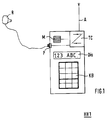
- FIG. 1 shows a hand-held radio telephone HH1 with an HF transceiver TC, an antenna A connected to it, an operating keyboard KB, an alphanumeric display field DIS, a microphone M and an earphone R.
- the hand-held radio telephone HH1 shown is a so-called hand-held for mobile radio.
- the invention is not limited to mobile telephones, but also includes, for example, cordless telephones.
- the earpiece R is spatially separated from the other components of the handheld radio telephone HH1, so that the handheld radio telephone is constructed in two parts.
- the hand-held radio telephone thus has a housing which comprises all components except for the earphone R.
- the housing is designed to be very compact for the following reasons: on the one hand, the housing does not include a loudspeaker, and on the other hand, the shape of the housing is not restricted by the mouth-to-ear distance of humans, as is the case with conventional hand-held radio telephones.
- the earphone R is connected to the internal circuit of the hand-held radio telephone HH1 by means of an AF line and a detachable plug connection P.
- the microphone M is located in the housing of the hand-held radio telephone and is preferably designed as a directional microphone. A good acoustic connection of the user is thus also provided when the user holds the hand-held radio telephone far from the body or places it on a surface.
- the high-frequency radiating antenna is then at a distance from the body that is at least one arm length, i.e. about 60 cm, measures.
- KB keypad and reading of the DIS display field is also possible without restrictions during calls.
- the user can e.g. read incoming text messages, as they are known in mobile communications as so-called short messages.
- stored data such as phone numbers, addresses, appointments, etc. can be queried at any time using the keyboard.
- the spatial separation of the microphone M is also conceivable, so that the housing of the hand-held radio telephone could be made even more compact.
- the user would be e.g. acoustically very tightly coupled by means of speaking and hearing dishes.
- the hand-held radio telephone HH1 shown in FIG. 1 is a very simple and inexpensive embodiment of the invention.
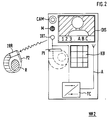
- FIG. 2 shows a hand-held radio telephone HH2 which, in addition to the components described in the previous example, additionally comprises an LCD screen DIS and a CCD camera CAM.
- the electroacoustic reproduction means is designed here as an earpiece R, which is spatially separated from the other components and contains an infrared receiver IRR for wireless connection to the hand-held radio telephone HH2.
- the housing of the hand-held radio telephone contains a corresponding infrared transmitter IRT, which is connected to the LF output of the HF receiver TC.
- IRT infrared transmitter
- the wireless connection between the housing of the HH2 handheld radio telephone and the earpiece R gives the user great freedom of movement.
- the full operability of the handheld radio telephone is given.
- the necessary distance from the user to the DIS screen and to the camera CAM in this example would not be possible with a handheld radio telephone of a known type.
- the earpiece R has an electromechanical connector P2 and the housing of the handheld radio telephone HH2 has a corresponding electromechanical socket P1, so that an integration of the earpiece R into the housing of the handheld radio telephone is possible. This enables both easy transport and hands-free operation of the HH2 handheld radio telephone.
- the antenna A of the HH2 handheld radio telephone is fully integrated in the housing.
- the housing is designed so that it is both hand-held and on a surface such as e.g. a desk that can be placed.
- the hand-held radio telephone shown in FIG. 2 could also be changed in such a way that only the microphone M would be set apart from the other components. This would be advantageous for video conferencing applications.
- a hand-held radio telephone for mobile radio such as a hand-held device for GSM mobile radio.
- the invention is not limited to these statements.
- a hand-held radio telephone according to the invention is also conceivable, which is designed as a cordless telephone according to the CT1, CT2 or DECT standard (CT: Cordless Telephone; DECT: Digital European Cordless Telephone).
- CT1, CT2 or DECT standard CT: Cordless Telephone
- DECT Digital European Cordless Telephone
Landscapes
- Engineering & Computer Science (AREA)
- Signal Processing (AREA)
- Computer Networks & Wireless Communication (AREA)
- Health & Medical Sciences (AREA)
- Otolaryngology (AREA)
- Physics & Mathematics (AREA)
- Electromagnetism (AREA)
- Telephone Set Structure (AREA)
- Mobile Radio Communication Systems (AREA)
- Telephone Function (AREA)
- Transceivers (AREA)
- Input Circuits Of Receivers And Coupling Of Receivers And Audio Equipment (AREA)
Description
- Die Erfindung betrifft ein Handfunktelefon mit den Merkmalen des Oberbegriffs nach Patentanspruch 1.
- Ein solches Handfunktelefon ist aus EP-A-04 64 011 bekannt. Dort wird ein Handfunktelefon beschrieben, das die Form eines Handapparates aufweist und somit im Betrieb in der Nähe des Kopfes gehalten werden muß, was dort zu einer Strahlungsbelastung führt. In EP-A-04 64 011 wird weiterhin eine Freisprecheinrichtung ("hands-free module") beschrieben, die über eine Steckverbindung an das Handfunktelefon angeschlossen ist. Die Freisprecheinrichtung enthält einen Ohrhörer ("external phone unit") und ein Mikrofon ("external microphone"), welche zusätzlich zum internen Lautsprecher bzw. zum internen Mikrofon des Handfunktelefons an die Audiostufe des Sendeempfängers angeschlossen sind. Demnach ist die Freisprecheinrichtung als Zusatzgerät für das Handfunktelefon ausgeführt. Das zusätzliche Volumen, das die Freisprecheinrichtung einnimmt, erschwert die Handhabung des Handfunktelefons, insbesondere beim Transport.
- Ein weiteres Handfunktelefon ist aus DE 34 01 518 C2 bekannt. Dort wird ein Handfunktelefon beschrieben, das zu einem kleinvolumigen Gebilde zusammengeklappt werden kann. Im auseinandergeklappten Betriebszustand nimmt es die körpergerechte Form eines Handapparates an. Die Antenne ist im Gehäuse des Handfunktelefons integriert und befindet sich im Betriebszustand in unmittelbarer Nähe zum Kopf des Benutzers. Sie erstreckt sich vom Ohr- bis zum Mundbereich, so daß die entsprechenden Kopfpartien sich direkt im Strahlungsfeld der Antenne befinden. Derzeit werden die gesundheitlichen Auswirkungen von HF-Strahlung auf den menschlichen Organismus intensiv erforscht und diskutiert (s. Artikel "Hochfrequente Strahlung und ihr Gefährdungspotential" von W. Mansfeld in "Nachrichtentechnik, Elektronik" Heft 42, 1992, Berlin). Obwohl noch keine eindeutigen Ergebnisse vorliegen, werden präventiv Lösungen zur Reduzierung derartiger Strahlungsbelastung gesucht.
- Weiterhin ist aus DE 38 36 406 ist ein handapparatförmiges Funkbedienteil bekannt, das in ein zusammenschiebbares Gehäuse integriert ist und dadurch für den Transport sehr kompakt ausgeführt ist. Für den Betrieb wird das Gehäuse zu einem handapparatförmigen Gebilde ergonomisch so ausgebildet, daß es sich der Kopfform des Benutzers anpaßt. Die Sende-/Empfangsantenne befindet sich in unmittelbarer Nähe zum oberen Kopfbereich des Benutzers.
- Die bekannten Handfunktelefone, z.B. die sogenannten "Hand-Helds" für Mobilfunk oder schnurlose Telefone sind aufgrund der Kopfform des Menschen so gestaltet, daß sie im Betriebszustand zumindest die Größe eines herkömmlichen Handapparates annehmen und die Antenne sich in unmittelbarer Nähe zum Kopf des Benutzers befindet.
- Aufgabe der Erfindung ist es, ein Handfunktelefon zu gestalten, das sich seinem Benutzer gegenüber durch Kompaktheit, volle Bedienbarkeit und geringe HF-Strahlung auszeichnet.
- Gelöst wird die Aufgabe durch die Merkmale des Anspruchs 1.
- Es wird ein Handfunktelefon bereitgestellt, bei dem mindestens eines der elektroakustischen Komponenten räumlich getrennt von den anderen Komponenten des Handfunktelefons ist. Durch diese räumliche Trennung ist die Gestalt des Handfunktelefons unabhängig von der Kopfform, so daß das Handfunktelefon nicht die Form eines Handapparates annehmen muß und sehr kompakt ausführbar ist. Weiterhin sind alle Bedienmittel sowie die elektrooptischen Anzeige- und Aufnahmemittel auch im Betriebszustand uneingeschränkt zugänglich. Somit ist eine volle Bedienbarkeit des Handfunktelefons gegeben. Die räumliche Unterteilung des Handfunktelefons erlaubt seine uneingeschränkte Benutzung, bei der die hochfrequent abstrahlenden Komponenten des Handfunktelefons sich nicht in unmittelbarer Nähe zum Körper des Benutzers befinden. Dadurch wird die Intensität der HF-Strahlung insbesondere im Kopfbereich des Benutzers verringert.
- Vorteilhafte Weiterbildungen der Erfindung sind den Unteransprüchen zu entnehmen.
- Es folgt die genaue Beschreibung zweier Ausführungsbeispiele der Erfindung anhand der Zeichnungen:
- Fig. 1,
- die ein sehr kompaktes Handfunktelefon schematisch darstellt, und
- Fig. 2,
- die ein Handfunktelefon für Audio- und Videokommunikation schematisch darstellt.
- In Fig. 1 ist ein Handfunktelefon HH1 mit einem HF-Sendeempfänger TC, einer daran angeschlossenen Antenne A, einer Bedientastatur KB, einem alphanumerischen Anzeigefeld DIS, einem Mikrofon M und einer Hörkapsel R dargestellt.
- In diesem Beispiel ist das gezeigte Handfunktelefon HH1 ein sogennantes Hand-Held für den Mobilfunk. Die Erfindung ist aber nicht auf Mobilfunktelefone beschränkt, sondern umfaßt z.B. auch schnurlose Telefone.
- Die detaillierte Schaltung und Funktion eines Handfunktelefons sind nicht Gegenstand der Erfindung. Um jedoch beispielhaft die Hardware- und Software-Architektur eines herkömmlichen Handfunktelefons aufzuzeigen, wird auf den Artikel von P. Schöffel et. al. "Architektur eines Mobilfunkgerätes für das Netz D" in der Zeitschrift Philips Innovation 1/1991 verwiesen.
- Die Hörkapsel R ist räumlich von den übrigen Komponenten des Handfunktelefons HH1 getrennt, so daß das Handfunktelefon zweiteilig aufgebaut ist.
- Das Handfunktelefon weist somit ein Gehäuse auf, das alle Komponenten bis auf die Hörkapsel R umfaßt. Das Gehäuse ist aus folgenden Gründen sehr kompakt gestaltet: Zum einen umfaßt das Gehäuse keinen Lautsprecher, zum anderen ist die Formgebung des Gehäuses nicht wie bei herkömmlichen Handfunktelefonen vom Mund-zu-Ohr-Abstand des Menschen eingeschränkt.
- Die Hörkapsel R ist mittels einer NF-Leitung und einer lösbaren Steckverbindung P an die interne Schaltung des Handfunktelefons HH1 angeschlossen. Das Mikrofon M befindet sich im Gehäuse des Handfunktelefons und ist vorzugsweise als Richtmikrofon ausgeführt. Somit ist eine gute akustische Anbindung des Benutzers auch dann gegeben, wenn dieser das Handfunktelefon weit vom Körper hält oder auf einer Unterlage abstellt.
- Die hochfrequent abstrahlende Antenne befindet sich dann in einem Abstand zum Körper, der mindestens eine Armlänge, d.h. etwa 60 cm, mißt. Bei der Benutzung der bekannten Handfunktelefone befindet sich die Antenne in einem Abstand von etwa 2 cm zum Kopf. Demnach ist der Benutzer des erfindungsgemäßen Handfunktelefons einer Funkfeldstärke ausgesetzt, die etwa im Verhältnis 1/30 = 2 cm/60 cm reduziert ist.
- Weiterhin ist der Zugriff auf die Bedientastatur KB und das Ablesen des Anzeigefeldes DIS auch während des Telefonierens uneingeschränkt möglich. Somit kann der Benutzer z.B. eintreffende Textnachrichten lesen, wie sie etwa im Mobilfunk als sogenannte Short-Messages bekannt sind. Weiterhin ist die Abfrage von abgespeicherten Daten, wie etwa Rufnummern, Adressen, Termine etc. jederzeit mittels Tastatureingabe möglich.
- Um das gezeigte Handfunktelefon HH1 noch kompakter zu gestalten, wäre eine Integration der Antenne in das Gehäuse denkbar.
- Neben der Hörkapsel R ist auch die räumliche Ausgliederung des Mikrofons M denkbar, so daß das Gehäuse des Handfunktelefons noch kompakter ausgeführt werden könnte. Gleichfalls wäre der Benutzer z.B. mittels eines Sprech- und Hörgeschirrs akustisch sehr eng angekoppelt.
- Das in Fig. 1 gezeigte Handfunktelefon HH1 ist eine sehr einfache und kostengünstige Ausführung der Erfindung.
- Im weiteren wird eine Ausführung eines Handfunktelefons beschrieben, das für die Audio- und Video-Kommunikation geeignet ist.
- In Fig. 2 ist ein Handfunktelefon HH2 dargestellt, das neben den im vorherigen Beispiel beschriebenen Komponenten noch zusätzlich einen LCD-Bildschirm DIS und eine CCD-Kamera CAM umfaßt.
- Das elektroakustische Wiedergabemittel ist hier als Hörmuschel R ausgeführt, die von den übrigen Komponenten räumlich abgesetzt ist und einen Infrarotempfänger IRR zum drahtlosen Anschluß an das Handfunktelefon HH2 enthält.
- Das Gehäuse des Handfunktelefons enthält einen entsprechenden Infrarotsender IRT, der an dem NF-Ausgang des HF-Empfängers TC angeschlossen ist. Durch die drahtlose Verbindung zwischen dem Gehäuse des Handfunktelefons HH2 und der Hörmuschel R ist eine große Bewegungsfreiheit für den Benutzer gegeben.
- Weiterhin ist auch hier durch die räumliche Trennung die volle Bedienbarkeit des Handfunktelefons gegeben. Der in diesem Beispiel notwendige Abstand vom Benutzer zum Bildschirm DIS und zur Kamera CAM wäre bei einem Handfunktelefon bekannter Bauart nicht zu realisieren.
- Die Hörmuschel R hat einen elektromechanischen Stecker P2 und das Gehäuse des Handfunktelefons HH2 verfügt über ein entsprechende elektromechanische Buchse P1, so daß eine Integration der Hörmuschel R in das Gehäuse des Handfunktelefons möglich ist. Dadurch wird sowohl ein einfacher Transport sowie ein Freisprechbetrieb des Handfunktelefons HH2 ermöglicht.
- Die Antenne A des Handfunktelefons HH2 ist vollständig in das Gehäuse integriert. Das Gehäuse ist so gestaltet, daß es sowohl in der Hand gehalten als auch auf eine Unterlage, wie z.B. einen Schreibtisch, gestellt werden kann.
- Das in Fig. 2 gezeigte Handfunktelefon könnte auch derart verändert werden, daß nur das Mikrofon M räumlich zu den anderen Komponenten abgesetzt wäre. Dieses wäre etwa für Videokonferenzanwendungen vorteilhaft. Hier sind hohe Qualitätsanforderungen an die Sprachaufnahme gestellt, um z.B. Simultanübersetzungen mittels Fachpersonal oder Sprachcomputern zu ermöglichen.
- Die beschriebenen Ausführungen beziehen sich insbesondere auf ein Handfunktelefon für den Mobilfunk, wie beispielsweise ein Hand-Held für den GSM-Mobilfunk. Die Erfindung ist jedoch nicht auf diese Ausführungen beschränkt. Es ist insbesondere auch ein erfindungsgemäßes Handfunktelefon denkbar, das als schnurloses Telefon nach dem CT1-, dem CT2- oder DECT-Standard ausgeführt ist (CT: Cordless Telephone; DECT: Digital European Cordless Telephone). Diesbezüglich ist der Einsatz im Freien als sogenanntes Telepoint-Telefon vorteilhaft, da das Handfunktelefon für Transport und Betrieb sehr kompakt ausgeführt ist.
Claims (9)
- Handfunktelefon (HH1; HH2) mit Komponenten, die HF-Sende-/Empfangs-Mittel (TC, A) zum drahtlosen Nachrichtenaustausch innerhalb eines Telekommunikationssystems, Bedien-Mittel (KB) zum Aufbau einer Nachrichtenverbindung, nur ein elektroakustisches Wiedergabe-Mittel (R) und nur ein elektroakustisches Aufnahme-Mittel (M) umfassen,
gekennzeichnet durch ein Gehäuse, das alle Komponenten des Handfunktelefons (HH1; HH2) bis auf zumindest eines der elektroakustischen Mittel (R) umfaßt, wodurch dieses zumindest eine elektroakustische Mittel (R) räumlich getrennt von den anderen Mitteln (TC, A, KB, DIS, CAM) angeordnet ist. - Handfunktelefon (HH2), nach Anspruch 1,
dadurch gekennzeichnet, daß die Komponenten noch zusätzlich elektrooptische Anzeige- und/oder Aufnahme-Mittel (DIS, CAM) umfassen und daß nur eines der elektroakustischen Mittel (R) räumlich getrennt von den anderen Mitteln (TC, A, DIS, CAM) angeordnet ist. - Handfunktelefon (HH1) nach Anspruch 1,
dadurch gekennzeichnet, daß diejenigen elektroakustischen Mittel (R), die räumlich getrennt von den anderen Mitteln (TC, A, KB) angeordnet sind, mittels mindestens einer lösbaren Steckverbindung (P) drahtgebunden mit den HF-Sende-/Empfangs-Mitteln (TC, A) verbunden sind. - Handfunktelefon (HH2) nach Anspruch 1,
dadurch gekennzeichnet, daß diejenigen elektroakustischen Mittel (R), die räumlich getrennt von den anderen Mitteln (TC, A, DIS, CAM) angeordnet sind, mittels mindestens einem Sendemittel (IRT) und mindestens einem Empfangsmittel (IRR) drahtlos mit den HF-Sende-/Empfangs-Mitteln (TC, A) verbunden sind. - Handfunktelefon (HH2) nach Anspruch 4,
dadurch gekennzeichnet, daß die Sendemittel (IRT) und die Empfangsmittel (IRR) Infrarotsignale senden bzw. empfangen. - Handfunktelefon (HH2) nach Anspruch 4,
dadurch gekennzeichnet, daß mechanische und/oder elektromechanische Verbindungsmittel (P1, P2) so vorgesehen sind, daß die räumlich voneinander getrennten Mittel (R, TC) wieder zusammenfügbar sind. - Handfunktelefon (HH1) nach Anspruch 1,
dadurch gekennzeichnet, daß das elektroakustische Aufnahmemittel (M) ein Richtmikrofon ist, das sich im Gehäuse des Handfunktelefons (HH1) befindet. - Handfunktelefon nach Anspruch 1 oder 2,
dadurch gekennzeichnet, daß nur das elektroakustische Aufnahme-Mittel räumlich getrennt von den anderen Mitteln angeordnet ist, wobei das elektroakustische Aufnahme-Mittel ein räumlich zu den anderen Komponenten abgesetztes Mikrofon ist. - Handfunktelefon (HH2) nach Anspruch 1 oder 2,
dadurch gekennzeichnet, daß das Gehäuse des Handfunktelefons (HH2) so gestaltet ist, daß es in der Hand gehalten und auf eine Unterlage gestellt werden kann.
Priority Applications (9)
| Application Number | Priority Date | Filing Date | Title |
|---|---|---|---|
| AT93107857T ATE134096T1 (de) | 1993-05-14 | 1993-05-14 | Handfunktelefon mit davon getrenntem lautsprecher |
| DE59301601T DE59301601D1 (de) | 1993-05-14 | 1993-05-14 | Handfunktelefon mit davon getrenntem Lautsprecher |
| ES93107857T ES2086152T3 (es) | 1993-05-14 | 1993-05-14 | Radiotelefono de mano con altavoz separado. |
| EP93107857A EP0626773B1 (de) | 1993-05-14 | 1993-05-14 | Handfunktelefon mit davon getrenntem Lautsprecher |
| DK93107857.0T DK0626773T3 (da) | 1993-05-14 | 1993-05-14 | Bærbar radiotelefon med separat højttaler |
| CA002123461A CA2123461A1 (en) | 1993-05-14 | 1994-05-12 | Hand-held radiotelephone |
| FI942241A FI108766B (fi) | 1993-05-14 | 1994-05-13 | Käsimatkaviestin |
| JP6101413A JPH0775160A (ja) | 1993-05-14 | 1994-05-16 | 携帯型無線電話機 |
| US08/615,362 US5966643A (en) | 1993-05-14 | 1996-03-13 | Hand-held radiotelephone having two-part construction |
Applications Claiming Priority (1)
| Application Number | Priority Date | Filing Date | Title |
|---|---|---|---|
| EP93107857A EP0626773B1 (de) | 1993-05-14 | 1993-05-14 | Handfunktelefon mit davon getrenntem Lautsprecher |
Publications (2)
| Publication Number | Publication Date |
|---|---|
| EP0626773A1 EP0626773A1 (de) | 1994-11-30 |
| EP0626773B1 true EP0626773B1 (de) | 1996-02-07 |
Family
ID=8212905
Family Applications (1)
| Application Number | Title | Priority Date | Filing Date |
|---|---|---|---|
| EP93107857A Expired - Lifetime EP0626773B1 (de) | 1993-05-14 | 1993-05-14 | Handfunktelefon mit davon getrenntem Lautsprecher |
Country Status (9)
| Country | Link |
|---|---|
| US (1) | US5966643A (de) |
| EP (1) | EP0626773B1 (de) |
| JP (1) | JPH0775160A (de) |
| AT (1) | ATE134096T1 (de) |
| CA (1) | CA2123461A1 (de) |
| DE (1) | DE59301601D1 (de) |
| DK (1) | DK0626773T3 (de) |
| ES (1) | ES2086152T3 (de) |
| FI (1) | FI108766B (de) |
Cited By (6)
| Publication number | Priority date | Publication date | Assignee | Title |
|---|---|---|---|---|
| US6421031B1 (en) | 1993-10-22 | 2002-07-16 | Peter A. Ronzani | Camera display system |
| US6545654B2 (en) | 1996-10-31 | 2003-04-08 | Kopin Corporation | Microdisplay for portable communication systems |
| US6677936B2 (en) | 1996-10-31 | 2004-01-13 | Kopin Corporation | Color display system for a camera |
| US6909419B2 (en) | 1997-10-31 | 2005-06-21 | Kopin Corporation | Portable microdisplay system |
| US7321354B1 (en) | 1996-10-31 | 2008-01-22 | Kopin Corporation | Microdisplay for portable communication systems |
| US7372447B1 (en) | 1996-10-31 | 2008-05-13 | Kopin Corporation | Microdisplay for portable communication systems |
Families Citing this family (49)
| Publication number | Priority date | Publication date | Assignee | Title |
|---|---|---|---|---|
| US6448944B2 (en) | 1993-10-22 | 2002-09-10 | Kopin Corporation | Head-mounted matrix display |
| US5815126A (en) * | 1993-10-22 | 1998-09-29 | Kopin Corporation | Monocular portable communication and display system |
| US6424321B1 (en) | 1993-10-22 | 2002-07-23 | Kopin Corporation | Head-mounted matrix display |
| DE69632102T2 (de) * | 1995-01-06 | 2005-03-03 | Koninklijke Philips Electronics N.V. | Tragbare kommunikationseinrichtung |
| US6122526A (en) * | 1997-04-24 | 2000-09-19 | Eastman Kodak Company | Cellular telephone and electronic camera system with programmable transmission capability |
| US5666159A (en) | 1995-04-24 | 1997-09-09 | Eastman Kodak Company | Electronic camera system with programmable transmission capability |
| JPH08307942A (ja) * | 1995-05-02 | 1996-11-22 | Sony Corp | コードレス電話機、電子機器および番組選択方法 |
| EP0824820B1 (de) * | 1995-05-03 | 2003-11-05 | Siemens Aktiengesellschaft | Tragbares funkkommunikations gerät mit integrierter kamera und bildanzeigevorrichtung |
| WO1997016912A1 (en) * | 1995-11-02 | 1997-05-09 | Philips Electronics N.V. | Wrist-watch wireless telephone |
| US5768397A (en) * | 1996-08-22 | 1998-06-16 | Siemens Hearing Instruments, Inc. | Hearing aid and system for use with cellular telephones |
| US6486862B1 (en) * | 1996-10-31 | 2002-11-26 | Kopin Corporation | Card reader display system |
| DE19645259C2 (de) * | 1996-11-02 | 2001-02-08 | Juergen Prelle | Einrichtung für ein Mobilfunktelefon |
| JP3062135B2 (ja) | 1997-09-25 | 2000-07-10 | 静岡日本電気株式会社 | イヤホンシステム |
| WO1999031858A1 (de) * | 1997-12-15 | 1999-06-24 | Siemens Aktiengesellschaft | Kommunikationssystem |
| US6181956B1 (en) * | 1998-08-03 | 2001-01-30 | Motorola, Inc. | Communication device with selective message transfer to earpiece |
| DE19840366A1 (de) | 1998-09-04 | 2000-03-09 | Deutsche Telekom Ag | Freisprechvorrichtung zum schnurlosen Verbinden mit einer Basisstation eines Telefonsystems |
| TW472992U (en) * | 1999-02-01 | 2002-01-11 | Cotron Corp | Transferring device for telephone |
| KR100314661B1 (ko) * | 1999-02-05 | 2001-12-28 | 김형태 | 휴대용 원격제어 무선 영상 및 음성 통신시스템 |
| US6434403B1 (en) * | 1999-02-19 | 2002-08-13 | Bodycom, Inc. | Personal digital assistant with wireless telephone |
| GB2347817B (en) * | 1999-03-10 | 2001-02-21 | Cotron Corp | Communication system for telephone |
| CA2279685A1 (en) * | 1999-08-05 | 2001-02-05 | Vtech Communications, Ltd. | Method and apparatus for controlling a cordless telephone headset |
| US6792148B1 (en) | 1999-10-18 | 2004-09-14 | Telefonaktiebolaget Lm Ericsson (Publ) | Method and apparatus for providing a camera accessory with compression |
| JP3963205B2 (ja) * | 2000-03-30 | 2007-08-22 | パイオニア株式会社 | 移動体用無線端末 |
| GB2367443A (en) * | 2000-04-04 | 2002-04-03 | Hassan Paddy Abdel Salam | Means of reducing radiation in a mobile phone earpiece by the use of ferrite beads |
| US7095981B1 (en) | 2000-04-04 | 2006-08-22 | Great American Technologies | Low power infrared portable communication system with wireless receiver and methods regarding same |
| GB2361827A (en) * | 2000-04-25 | 2001-10-31 | Liu Kuo Shen | Mobile telephone with wireless earpiece and wired microphone |
| WO2001089179A2 (de) * | 2000-05-16 | 2001-11-22 | Wolf Bunzel | Kabellose freisprechvorrichtung, insbesondere für mobiltelefone und computer |
| US7231367B1 (en) | 2000-06-29 | 2007-06-12 | Eastman Kodak Company | Electronic imaging capture and billing distribution system |
| IL137290A0 (en) * | 2000-07-13 | 2001-07-24 | Asher Eldad Ben | An electronic circuit for reducing the danger of exposure to radiation from a transmitter |
| GB2365249B (en) * | 2000-07-18 | 2004-04-14 | Michael David Spencer | Mobile phone headset |
| DE10039775B4 (de) * | 2000-08-16 | 2004-04-01 | Robert Bosch Gmbh | Lautsprechervorrichtung und Gerät |
| GB2369744B (en) * | 2000-08-31 | 2002-11-13 | Lightwire Comm Ltd | Hands-free kit for mobile radio-telephone handset |
| GB0021238D0 (en) * | 2000-08-31 | 2000-10-18 | Lewis Marcus | Hands-free kit for mobile radio telephone handset |
| DE20018241U1 (de) * | 2000-10-20 | 2002-02-28 | Ahrens, Hans-Joachim, 38855 Wernigerode | Mobiltelefon |
| US6748210B2 (en) | 2000-12-07 | 2004-06-08 | International Business Machines Corporation | Method and apparatus for automatically terminating to a voice mail an incoming call made to a radio telephone |
| DE10114109A1 (de) * | 2001-03-22 | 2002-09-26 | Siemens Ag | Funkkopfsprech-System |
| US6748223B2 (en) * | 2001-03-23 | 2004-06-08 | Nokia Corporation | Apparatus, and associated method, for providing a digital image generated at a mobile station to an assistance center |
| USD462952S1 (en) | 2001-04-03 | 2002-09-17 | Voice And Wireless Corporation | Transmitter apparatus |
| US7466992B1 (en) | 2001-10-18 | 2008-12-16 | Iwao Fujisaki | Communication device |
| US6879828B2 (en) * | 2002-09-09 | 2005-04-12 | Nokia Corporation | Unbroken primary connection switching between communications services |
| US20050026560A1 (en) * | 2003-07-28 | 2005-02-03 | Fellowes Inc. | Audio communications system including wireless microphone and wireless speaker |
| US7650170B2 (en) | 2004-03-01 | 2010-01-19 | Research In Motion Limited | Communications system providing automatic text-to-speech conversion features and related methods |
| US11011153B2 (en) | 2004-03-01 | 2021-05-18 | Blackberry Limited | Communications system providing automatic text-to-speech conversion features and related methods |
| US8538386B2 (en) * | 2004-03-01 | 2013-09-17 | Blackberry Limited | Communications system providing text-to-speech message conversion features using audio filter parameters and related methods |
| GB2400773B (en) * | 2004-06-23 | 2005-04-13 | Neil Callan | Wireless stereo badge |
| US7433672B2 (en) | 2004-06-29 | 2008-10-07 | Nokia Corporation | Apparatus and system for emergency recording and notification and associated method |
| US20070153081A1 (en) * | 2005-12-29 | 2007-07-05 | Manchev Peter B | Method and apparatus for initiating support request from mobile station |
| GB2451831B (en) * | 2007-08-13 | 2010-02-10 | Samsung Electronics Co Ltd | Telephone call enhancement |
| US8996064B2 (en) * | 2011-07-29 | 2015-03-31 | Safer Technologies, LLC | Health risk, mitigating, retractable, wired headset and protective case platform for wireless communication devices |
Family Cites Families (21)
| Publication number | Priority date | Publication date | Assignee | Title |
|---|---|---|---|---|
| US3476882A (en) * | 1965-10-23 | 1969-11-04 | Chromalloy American Corp | Remote telephone extension system |
| DE2820096A1 (de) * | 1978-05-09 | 1979-11-15 | Standard Elektrik Lorenz Ag | Anordnung fuer einen fernsprechapparat mit einer freisprecheinrichtung |
| DE2830096A1 (de) * | 1978-07-08 | 1980-01-17 | Raymond A Fa | Elastische halteklammer fuer rundstaebe mit variablen durchmessern |
| US4450319A (en) * | 1981-07-31 | 1984-05-22 | Controlonics Corporation | Infrared telephone extension control system |
| US4543665A (en) * | 1982-07-13 | 1985-09-24 | Plantronics, Inc. | Speakerphone with wireless infrared microphone |
| JPS5923950A (ja) * | 1982-07-30 | 1984-02-07 | Toshiba Corp | 電話自動応対装置 |
| JPS5932542A (ja) * | 1982-08-17 | 1984-02-22 | Aisin Seiki Co Ltd | ステアリング操作ボ−ド信号伝送装置 |
| DE3401518A1 (de) * | 1984-01-18 | 1985-07-25 | Ant Nachrichtentech | Tragbares funktelefon |
| US4591661A (en) * | 1984-08-15 | 1986-05-27 | Joseph A. Benedetto | Portable cordless telephone transceiver-radio receiver |
| US4752949A (en) * | 1984-12-05 | 1988-06-21 | Jay Steinbeck | Corded/cordless telephone |
| JPS61144130A (ja) * | 1984-12-18 | 1986-07-01 | Nec Corp | コ−ドレステレホン |
| US4659878A (en) * | 1985-09-11 | 1987-04-21 | General Electric Company | Method and apparatus for interference free communications between a remote handset and a host subscriber unit in a Cellular Radio Telephone System |
| JPS6420159A (en) * | 1987-07-16 | 1989-01-24 | Fuji Xerox Co Ltd | Printing recording head |
| US4905270A (en) * | 1987-12-18 | 1990-02-27 | Mitsubishi Denki Kabushiki Kaisha | Vehicular hands-free telephone system |
| DE3836406A1 (de) * | 1988-10-26 | 1990-05-03 | Bosch Gmbh Robert | Handapparatfoermiges funkbedienteil |
| US4930148A (en) * | 1989-10-23 | 1990-05-29 | Lee Hsiao Chung | Headband radiophone combination set |
| JPH03160851A (ja) * | 1989-11-20 | 1991-07-10 | Fujitsu Ltd | 携帯電話機 |
| US5251329A (en) * | 1990-03-07 | 1993-10-05 | Sony Corporation | Radio telephone apparatus with microphone mounted in battery case |
| SE466427B (sv) * | 1990-06-25 | 1992-02-10 | Ericsson Telefon Ab L M | Handfrigoeringsmodul foer en mobiltelefon |
| DE9200683U1 (de) * | 1992-01-22 | 1992-04-23 | Groneberg, Michael, 6253 Hadamar | Drahtloser Telefonhörer |
| FR2706103B1 (fr) * | 1993-06-03 | 1997-01-31 | Ericsson Ge Mobile Communicat | Appareil radiotéléphonique. |
-
1993
- 1993-05-14 ES ES93107857T patent/ES2086152T3/es not_active Expired - Lifetime
- 1993-05-14 DE DE59301601T patent/DE59301601D1/de not_active Expired - Fee Related
- 1993-05-14 DK DK93107857.0T patent/DK0626773T3/da active
- 1993-05-14 AT AT93107857T patent/ATE134096T1/de active
- 1993-05-14 EP EP93107857A patent/EP0626773B1/de not_active Expired - Lifetime
-
1994
- 1994-05-12 CA CA002123461A patent/CA2123461A1/en not_active Abandoned
- 1994-05-13 FI FI942241A patent/FI108766B/fi not_active IP Right Cessation
- 1994-05-16 JP JP6101413A patent/JPH0775160A/ja active Pending
-
1996
- 1996-03-13 US US08/615,362 patent/US5966643A/en not_active Expired - Fee Related
Cited By (8)
| Publication number | Priority date | Publication date | Assignee | Title |
|---|---|---|---|---|
| US6421031B1 (en) | 1993-10-22 | 2002-07-16 | Peter A. Ronzani | Camera display system |
| US6683584B2 (en) | 1993-10-22 | 2004-01-27 | Kopin Corporation | Camera display system |
| US6545654B2 (en) | 1996-10-31 | 2003-04-08 | Kopin Corporation | Microdisplay for portable communication systems |
| US6677936B2 (en) | 1996-10-31 | 2004-01-13 | Kopin Corporation | Color display system for a camera |
| US7321354B1 (en) | 1996-10-31 | 2008-01-22 | Kopin Corporation | Microdisplay for portable communication systems |
| US7372447B1 (en) | 1996-10-31 | 2008-05-13 | Kopin Corporation | Microdisplay for portable communication systems |
| US6909419B2 (en) | 1997-10-31 | 2005-06-21 | Kopin Corporation | Portable microdisplay system |
| US7242383B2 (en) | 1997-10-31 | 2007-07-10 | Kopin Corporation | Portable microdisplay system |
Also Published As
| Publication number | Publication date |
|---|---|
| CA2123461A1 (en) | 1994-11-15 |
| FI108766B (fi) | 2002-03-15 |
| FI942241A7 (fi) | 1994-11-15 |
| ATE134096T1 (de) | 1996-02-15 |
| JPH0775160A (ja) | 1995-03-17 |
| DE59301601D1 (de) | 1996-03-21 |
| EP0626773A1 (de) | 1994-11-30 |
| FI942241A0 (fi) | 1994-05-13 |
| ES2086152T3 (es) | 1996-06-16 |
| DK0626773T3 (da) | 1996-03-11 |
| US5966643A (en) | 1999-10-12 |
Similar Documents
| Publication | Publication Date | Title |
|---|---|---|
| EP0626773A1 (de) | Handfunktelefon mit davon getrenntem Lautsprecher | |
| DE19726602B4 (de) | Kommunikationsvorrichtung | |
| US6882726B2 (en) | Apparatus for mounting a rotational lens housing in a folder-type telephone | |
| EP1551155B1 (de) | Kommunikationsendgerät | |
| US20060183433A1 (en) | Wireless communication apparatus | |
| DE10335617A1 (de) | Armband-Mobiltelefongerät mit einer sprachbetriebenen, drahtlosen Sprechgarnitur | |
| KR100703317B1 (ko) | 휴대 단말기의 안테나 장치 | |
| WO1998057824A1 (de) | Kraftfahrzeug-einbauvorrichtung für mobiltelefon | |
| WO2003094373A1 (en) | Integrated antenna assembly | |
| DE60029044T2 (de) | Tragbares schnurloses Kommunikationsgerät | |
| DE102007059693B4 (de) | Tragbares Endgerät | |
| US7283098B2 (en) | Antenna apparatus for portable terminal | |
| US6941117B2 (en) | Portable radio having pivotable antenna | |
| DE4406507C2 (de) | Personalcomputer mit einer Verbindung zu einem Kommunikationsendgerät eines drahtlosen Fernsprechsystems | |
| KR100461769B1 (ko) | 외장형 카메라 렌즈 모듈이 장착된 스타일러스 및 이를채용한 무선 단말기 | |
| EP1359675A1 (de) | Integrierte Antennenanordnung | |
| EP1121784B1 (de) | Basisstation für ein nahbereichsfunksystem sowie datenkommunikationssystem | |
| JPH10209905A (ja) | 携帯無線装置およびアンテナ装置 | |
| CN115377660B (zh) | 一种天线模组和终端设备 | |
| KR100761271B1 (ko) | 내장형 안테나 장치를 갖는 슬라이드형 이동통신 단말기 | |
| DE19600119C2 (de) | Tragbares Teilnehmerendgerät für den Mobilfunk | |
| KR101046032B1 (ko) | 화상 통신 가능한 분리형 휴대용 단말기 | |
| DE29519570U1 (de) | Mobiler, modularer Computer mit Telekommunikationseinrichtungen | |
| JPH02149003A (ja) | 無線機器 | |
| KR100584349B1 (ko) | 휴대용 단말기의 팝 업 타입 스피커/마이크 장치 |
Legal Events
| Date | Code | Title | Description |
|---|---|---|---|
| PUAI | Public reference made under article 153(3) epc to a published international application that has entered the european phase |
Free format text: ORIGINAL CODE: 0009012 |
|
| 17P | Request for examination filed |
Effective date: 19940316 |
|
| AK | Designated contracting states |
Kind code of ref document: A1 Designated state(s): AT BE CH DE DK ES FR GB GR IT LI NL SE |
|
| 17Q | First examination report despatched |
Effective date: 19941220 |
|
| GRAA | (expected) grant |
Free format text: ORIGINAL CODE: 0009210 |
|
| AK | Designated contracting states |
Kind code of ref document: B1 Designated state(s): AT BE CH DE DK ES FR GB IT LI NL SE |
|
| REF | Corresponds to: |
Ref document number: 134096 Country of ref document: AT Date of ref document: 19960215 Kind code of ref document: T |
|
| REG | Reference to a national code |
Ref country code: DK Ref legal event code: T3 |
|
| REF | Corresponds to: |
Ref document number: 59301601 Country of ref document: DE Date of ref document: 19960321 |
|
| REG | Reference to a national code |
Ref country code: CH Ref legal event code: NV Representative=s name: JUERG ULRICH C/O ALCATEL STR AG |
|
| GBT | Gb: translation of ep patent filed (gb section 77(6)(a)/1977) |
Effective date: 19960307 |
|
| ITF | It: translation for a ep patent filed | ||
| ET | Fr: translation filed | ||
| REG | Reference to a national code |
Ref country code: ES Ref legal event code: FG2A Ref document number: 2086152 Country of ref document: ES Kind code of ref document: T3 |
|
| PLBE | No opposition filed within time limit |
Free format text: ORIGINAL CODE: 0009261 |
|
| 26N | No opposition filed | ||
| PGFP | Annual fee paid to national office [announced via postgrant information from national office to epo] |
Ref country code: CH Payment date: 20000412 Year of fee payment: 8 |
|
| PGFP | Annual fee paid to national office [announced via postgrant information from national office to epo] |
Ref country code: AT Payment date: 20000418 Year of fee payment: 8 |
|
| PGFP | Annual fee paid to national office [announced via postgrant information from national office to epo] |
Ref country code: BE Payment date: 20000428 Year of fee payment: 8 |
|
| PG25 | Lapsed in a contracting state [announced via postgrant information from national office to epo] |
Ref country code: AT Free format text: LAPSE BECAUSE OF NON-PAYMENT OF DUE FEES Effective date: 20010514 |
|
| PG25 | Lapsed in a contracting state [announced via postgrant information from national office to epo] |
Ref country code: BE Free format text: LAPSE BECAUSE OF NON-PAYMENT OF DUE FEES Effective date: 20010531 |
|
| PG25 | Lapsed in a contracting state [announced via postgrant information from national office to epo] |
Ref country code: LI Free format text: LAPSE BECAUSE OF NON-PAYMENT OF DUE FEES Effective date: 20010613 Ref country code: CH Free format text: LAPSE BECAUSE OF NON-PAYMENT OF DUE FEES Effective date: 20010613 |
|
| BERE | Be: lapsed |
Owner name: ALCATEL N.V. Effective date: 20010531 |
|
| REG | Reference to a national code |
Ref country code: GB Ref legal event code: IF02 |
|
| REG | Reference to a national code |
Ref country code: CH Ref legal event code: PL |
|
| PGFP | Annual fee paid to national office [announced via postgrant information from national office to epo] |
Ref country code: SE Payment date: 20030505 Year of fee payment: 11 Ref country code: DK Payment date: 20030505 Year of fee payment: 11 |
|
| PGFP | Annual fee paid to national office [announced via postgrant information from national office to epo] |
Ref country code: NL Payment date: 20030506 Year of fee payment: 11 |
|
| PG25 | Lapsed in a contracting state [announced via postgrant information from national office to epo] |
Ref country code: SE Free format text: LAPSE BECAUSE OF NON-PAYMENT OF DUE FEES Effective date: 20040515 |
|
| PG25 | Lapsed in a contracting state [announced via postgrant information from national office to epo] |
Ref country code: DK Free format text: LAPSE BECAUSE OF NON-PAYMENT OF DUE FEES Effective date: 20040601 |
|
| PG25 | Lapsed in a contracting state [announced via postgrant information from national office to epo] |
Ref country code: NL Free format text: LAPSE BECAUSE OF NON-PAYMENT OF DUE FEES Effective date: 20041201 |
|
| EUG | Se: european patent has lapsed | ||
| REG | Reference to a national code |
Ref country code: DK Ref legal event code: EBP |
|
| NLV4 | Nl: lapsed or anulled due to non-payment of the annual fee |
Effective date: 20041201 |
|
| REG | Reference to a national code |
Ref country code: FR Ref legal event code: TP |
|
| REG | Reference to a national code |
Ref country code: ES Ref legal event code: PC2A |
|
| PGFP | Annual fee paid to national office [announced via postgrant information from national office to epo] |
Ref country code: DE Payment date: 20070522 Year of fee payment: 15 |
|
| PGFP | Annual fee paid to national office [announced via postgrant information from national office to epo] |
Ref country code: ES Payment date: 20070529 Year of fee payment: 15 |
|
| PGFP | Annual fee paid to national office [announced via postgrant information from national office to epo] |
Ref country code: GB Payment date: 20070522 Year of fee payment: 15 |
|
| PGFP | Annual fee paid to national office [announced via postgrant information from national office to epo] |
Ref country code: IT Payment date: 20070525 Year of fee payment: 15 |
|
| PGFP | Annual fee paid to national office [announced via postgrant information from national office to epo] |
Ref country code: FR Payment date: 20070516 Year of fee payment: 15 |
|
| GBPC | Gb: european patent ceased through non-payment of renewal fee |
Effective date: 20080514 |
|
| REG | Reference to a national code |
Ref country code: FR Ref legal event code: ST Effective date: 20090119 |
|
| PG25 | Lapsed in a contracting state [announced via postgrant information from national office to epo] |
Ref country code: FR Free format text: LAPSE BECAUSE OF NON-PAYMENT OF DUE FEES Effective date: 20080602 Ref country code: DE Free format text: LAPSE BECAUSE OF NON-PAYMENT OF DUE FEES Effective date: 20081202 |
|
| PG25 | Lapsed in a contracting state [announced via postgrant information from national office to epo] |
Ref country code: GB Free format text: LAPSE BECAUSE OF NON-PAYMENT OF DUE FEES Effective date: 20080514 |
|
| REG | Reference to a national code |
Ref country code: ES Ref legal event code: FD2A Effective date: 20080516 |
|
| PG25 | Lapsed in a contracting state [announced via postgrant information from national office to epo] |
Ref country code: IT Free format text: LAPSE BECAUSE OF NON-PAYMENT OF DUE FEES Effective date: 20080514 |
|
| PG25 | Lapsed in a contracting state [announced via postgrant information from national office to epo] |
Ref country code: ES Free format text: LAPSE BECAUSE OF NON-PAYMENT OF DUE FEES Effective date: 20080516 |