EP0627324B1 - Support d'impression par jet d'encre - Google Patents
Support d'impression par jet d'encre Download PDFInfo
- Publication number
- EP0627324B1 EP0627324B1 EP19940108527 EP94108527A EP0627324B1 EP 0627324 B1 EP0627324 B1 EP 0627324B1 EP 19940108527 EP19940108527 EP 19940108527 EP 94108527 A EP94108527 A EP 94108527A EP 0627324 B1 EP0627324 B1 EP 0627324B1
- Authority
- EP
- European Patent Office
- Prior art keywords
- weight
- synthesis example
- water
- ink
- parts
- Prior art date
- Legal status (The legal status is an assumption and is not a legal conclusion. Google has not performed a legal analysis and makes no representation as to the accuracy of the status listed.)
- Expired - Lifetime
Links
Classifications
-
- B—PERFORMING OPERATIONS; TRANSPORTING
- B41—PRINTING; LINING MACHINES; TYPEWRITERS; STAMPS
- B41M—PRINTING, DUPLICATING, MARKING, OR COPYING PROCESSES; COLOUR PRINTING
- B41M5/00—Duplicating or marking methods; Sheet materials for use therein
- B41M5/50—Recording sheets characterised by the coating used to improve ink, dye or pigment receptivity, e.g. for ink-jet or thermal dye transfer recording
- B41M5/52—Macromolecular coatings
- B41M5/5245—Macromolecular coatings characterised by the use of polymers containing cationic or anionic groups, e.g. mordants
-
- B—PERFORMING OPERATIONS; TRANSPORTING
- B41—PRINTING; LINING MACHINES; TYPEWRITERS; STAMPS
- B41M—PRINTING, DUPLICATING, MARKING, OR COPYING PROCESSES; COLOUR PRINTING
- B41M5/00—Duplicating or marking methods; Sheet materials for use therein
- B41M5/50—Recording sheets characterised by the coating used to improve ink, dye or pigment receptivity, e.g. for ink-jet or thermal dye transfer recording
- B41M5/502—Recording sheets characterised by the coating used to improve ink, dye or pigment receptivity, e.g. for ink-jet or thermal dye transfer recording characterised by structural details, e.g. multilayer materials
- B41M5/508—Supports
-
- B—PERFORMING OPERATIONS; TRANSPORTING
- B41—PRINTING; LINING MACHINES; TYPEWRITERS; STAMPS
- B41M—PRINTING, DUPLICATING, MARKING, OR COPYING PROCESSES; COLOUR PRINTING
- B41M5/00—Duplicating or marking methods; Sheet materials for use therein
- B41M5/50—Recording sheets characterised by the coating used to improve ink, dye or pigment receptivity, e.g. for ink-jet or thermal dye transfer recording
- B41M5/52—Macromolecular coatings
- B41M5/5227—Macromolecular coatings characterised by organic non-macromolecular additives, e.g. UV-absorbers, plasticisers, surfactants
-
- B—PERFORMING OPERATIONS; TRANSPORTING
- B41—PRINTING; LINING MACHINES; TYPEWRITERS; STAMPS
- B41M—PRINTING, DUPLICATING, MARKING, OR COPYING PROCESSES; COLOUR PRINTING
- B41M5/00—Duplicating or marking methods; Sheet materials for use therein
- B41M5/50—Recording sheets characterised by the coating used to improve ink, dye or pigment receptivity, e.g. for ink-jet or thermal dye transfer recording
- B41M5/52—Macromolecular coatings
- B41M5/5254—Macromolecular coatings characterised by the use of polymers obtained by reactions only involving carbon-to-carbon unsaturated bonds, e.g. vinyl polymers
-
- Y—GENERAL TAGGING OF NEW TECHNOLOGICAL DEVELOPMENTS; GENERAL TAGGING OF CROSS-SECTIONAL TECHNOLOGIES SPANNING OVER SEVERAL SECTIONS OF THE IPC; TECHNICAL SUBJECTS COVERED BY FORMER USPC CROSS-REFERENCE ART COLLECTIONS [XRACs] AND DIGESTS
- Y10—TECHNICAL SUBJECTS COVERED BY FORMER USPC
- Y10T—TECHNICAL SUBJECTS COVERED BY FORMER US CLASSIFICATION
- Y10T428/00—Stock material or miscellaneous articles
- Y10T428/27—Web or sheet containing structurally defined element or component, the element or component having a specified weight per unit area [e.g., gms/sq cm, lbs/sq ft, etc.]
- Y10T428/273—Web or sheet containing structurally defined element or component, the element or component having a specified weight per unit area [e.g., gms/sq cm, lbs/sq ft, etc.] of coating
- Y10T428/277—Cellulosic substrate
-
- Y—GENERAL TAGGING OF NEW TECHNOLOGICAL DEVELOPMENTS; GENERAL TAGGING OF CROSS-SECTIONAL TECHNOLOGIES SPANNING OVER SEVERAL SECTIONS OF THE IPC; TECHNICAL SUBJECTS COVERED BY FORMER USPC CROSS-REFERENCE ART COLLECTIONS [XRACs] AND DIGESTS
- Y10—TECHNICAL SUBJECTS COVERED BY FORMER USPC
- Y10T—TECHNICAL SUBJECTS COVERED BY FORMER US CLASSIFICATION
- Y10T428/00—Stock material or miscellaneous articles
- Y10T428/31504—Composite [nonstructural laminate]
- Y10T428/31511—Of epoxy ether
-
- Y—GENERAL TAGGING OF NEW TECHNOLOGICAL DEVELOPMENTS; GENERAL TAGGING OF CROSS-SECTIONAL TECHNOLOGIES SPANNING OVER SEVERAL SECTIONS OF THE IPC; TECHNICAL SUBJECTS COVERED BY FORMER USPC CROSS-REFERENCE ART COLLECTIONS [XRACs] AND DIGESTS
- Y10—TECHNICAL SUBJECTS COVERED BY FORMER USPC
- Y10T—TECHNICAL SUBJECTS COVERED BY FORMER US CLASSIFICATION
- Y10T428/00—Stock material or miscellaneous articles
- Y10T428/31504—Composite [nonstructural laminate]
- Y10T428/31725—Of polyamide
-
- Y—GENERAL TAGGING OF NEW TECHNOLOGICAL DEVELOPMENTS; GENERAL TAGGING OF CROSS-SECTIONAL TECHNOLOGIES SPANNING OVER SEVERAL SECTIONS OF THE IPC; TECHNICAL SUBJECTS COVERED BY FORMER USPC CROSS-REFERENCE ART COLLECTIONS [XRACs] AND DIGESTS
- Y10—TECHNICAL SUBJECTS COVERED BY FORMER USPC
- Y10T—TECHNICAL SUBJECTS COVERED BY FORMER US CLASSIFICATION
- Y10T428/00—Stock material or miscellaneous articles
- Y10T428/31504—Composite [nonstructural laminate]
- Y10T428/31855—Of addition polymer from unsaturated monomers
Definitions
- the present invention relates to an ink jet recording medium to which an aqueous ink is applied for carrying out recording. More particularly, it relates to a recording medium which is suitable for use to carry out color image recording thereon with an aqueous ink and which comprises a paper, a resin coated paper or a film as a support.
- the ink jet recording method performs recording of letters or images by allowing ink droplets ejected by various working principles on a recording medium.
- Ink jet printers have such favorable features that there is no limitation as to kind of recording patterns, that they can easily perform multi-color recording and that the maintenance thereof is easy. Therefore, the ink jet printers are rapidly becoming widespread as devices for producing hard copies of image information.
- the image information recorded on ink jet recording media which comprise a transparent film as a support is utilized as originals for presentation in conferences, lecture meetings, etc. by using overhead projectors together with photographic slides. Recording of image information by ink jet recording method for overhead projectors provides many merits.
- Japanese Patent Kokai No.53-49113 discloses an ink jet recording sheet containing urea-formaldehyde resin powder and impregnated with a water-soluble polymer, but the ink jet recording sheets of this type suffer from the problems that the circumference of dots is apt to get blurred and besides, density of dots is low.
- Japanese Patent Kokai No.55-5830 discloses an ink jet recording sheet comprising a support and an ink absorbing coating layer provided thereon;
- Japanese Patent Kokai No.55-51583 discloses to use an amorphous silica powder as a pigment in the coating layer;
- Japanese Patent Kokai Nos.59-174381, 60-44389, 60-132785 and 60-171143 disclose ink jet recording sheets which have a transparent ink-receiving layer.
- the ink jet recording media comprising a transparent support on which image information used for overhead projectors is recorded
- ink absorbing inorganic pigment cannot be used in a large amount because use of the pigment generally damages transparency and in many cases, the ink absorbabiltiy depends on the properties of the resin layer formed on the surface of the transparent support.
- the resins conventionally used for this purpose are polyvinyl pyrrolidone and polyvinyl pyrrolidone-vinyl acetate copolymer disclosed in Japanese Patent Kokai No. 57-38185, copolymers of polyvinyl alcohol and olefins or styrene and maleic anhydride disclosed in Japanese Patent Kokai No.
- FR-A-2 605 934 discloses a receiving layer for ink jet printing comprising as a water-soluble polymer a mixture of a quaternary alkyl ammonium acrylate or methacrylate and a quaternary alkyl ammonium acrylamide or methacrylamide.
- the object of the present invention is to solve the above problems and the object has been accomplished by the following ink jet recording medium.
- the recording medium comprises a support such as a paper, an RC paper (a paper laminated with polyethylene on one or both sides), a light transmitting support, for example, a polyester sheet, a film support or the like and at least one ink-receiving layer provided on the support, an image being formable on the ink-receiving layer using an aqueous ink containing a water-soluble dye.
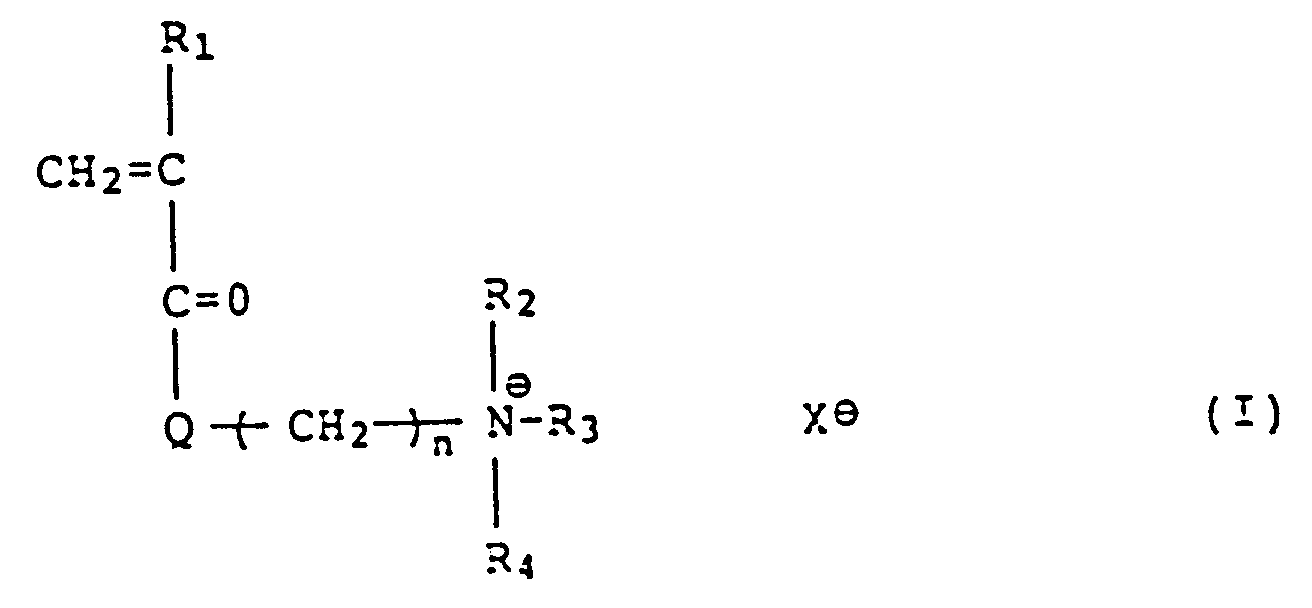
- the ink jet recording medium is characterized in that said ink-receiving layer contains a water-soluble polymer which is obtainable by copolymerizing 10-50 parts by weight of at least one monomer selected from the quaternary salt monomers represented by the following formulas (I), (II) and (III), 1-30 parts by weight of at least one monomer selected from the monomers represented by the following formulas (IV), (V), (VI) and (VII), and 20-80 parts by weight of at least one monomer selected from acrylamide, methacrylamide, N,N-dimethylacrylamide, N-isopropylacrylamide, diacetone acrylamide, N-methylolacrylamide, 2-hydroxyethyl (meth)acrylate and N-vinylpyrrolidone as a water-soluble monomer and in that the recording medium being obtainable by coating on said support a mixture comprising 100 parts by weight of said water-soluble polymer and 0.1-30 parts by weight of a crosslinking agent for curing the water-soluble poly
- R 1 represents hydrogen or a methyl group
- Q represents oxygen or an NH group
- R 2 , R 3 and R4 each represents a methyl group or an ethyl group and may be the same or different
- X represents a halogen ion, a sulfonate ion, an alkylsulfonate ion, an acetate ion or an alkylcarboxylate ion
- n represents an integer of 2 or 3
- R 5 , R 6 and R 7 each represents a methyl group or an ethyl group and may be the same or different and X is as defined above
- R 8 , R 9 and R 10 each represents a methyl group, an ethyl group or an allyl group and may be the same or different and X is as defined above
- R 11 represents hydrogen or a methyl group
- R 12 and R 13 each represents a methyl group or an ethyl group and may be the same or different
- the monomers selected from those represented by the formulas (I), (II) and (III) are quaternary salts.
- the amount of the quaternary salt type monomer selected from those represented by the formulas (I), (II) and (III) and introduced as a comonomer into the above water-soluble polymer must be in the range of 10-50 parts by weight. If the amount is less than 10 parts by weight, fixability of the dye contained in the ink is insufficient and the image readily disappears when washed with water. If it exceeds 50 parts by weight, hygroscopicity of the coating film formed of the water-soluble polymer is very high to result in the problems that the surface of the film becomes tacky or blocking of the surface occurs.
- monomers represented by the formulas (I), (II) and (III) preferred are, for example, trimethyl-2-(methacryloyloxy)ethylammonium chloride, triethyl-2-(methacryloyloxy)ethylammonium chloride, trimethyl-2-(acryloyloxy)ethylammonium chloride, triethyl-2-(acryloyloxy)ethylammonium chloride, trimethyl-3-(methacryloyloxy)propylammonium chloride, triethyl-3-(methacryloyloxy)propylammonium chloride, trimethyl-2-(methacryloylamino)ethylammonium chloride, triethyl-2-(methacryloylamino)ethylammonium chloride, trimethyl-2-(acryloylamino)ethylammonium chloride, triethyl-2-(methacryloylamino
- the fixability of the dye contained in the ink can be further enhanced and the dye is fixed in the vicinity of the surface and therefore, image density increases and simultaneously the shape of ink dots which form the image can be made uniform and the unevenness in solid print portion can be inhibited.
- the amount of the monomer selected from those represented by the formulas (IV), (V) and (VI) in the water-soluble polymer is less than 1 part by weight, the function to enhance the fixability of the dye contained in the ink cannot be recognized and such defects as occurrence of unevenness in the solid print portions are often brought about. If the amount is more than 30 parts by weight, the interaction with the dye is too strong, resulting in change of color tone and deterioration of color reproducibility.
- the ink-receiving layer contains the water-soluble polymer containing 1-30 parts by weight of the monomer component selected from those represented by the formulas (IV)-(VI), it is especially preferred to use a crosslinking agent together with the water-soluble polymer because it cures the water-soluble polymer thereby markedly enhancing the water resistance of recorded image and simultaneously blocking can be inhibited, tackiness of the surface can be removed and besides, absorbing speed and absorbing capacity for ink can be increased.
- the amino group-containing monomers represented by the formulas (IV)-(VI) are functional groups which serve as reaction sites for the crosslinking agent.
- neutralization may be carried out using inorganic acids or organic acids for adjustment of pH, but preferably the monomers are not completely neutralized and some amino groups are left in a free state to retain the reactivity with the crosslinking agent.
- the ink-receiving layer is formed using the water-soluble polymer without the crosslinking agent, water resistance of the ink-receiving layer per se cannot be obtained and the desired ink jet recording medium of the present invention excellent in water resistance cannot be obtained.
- Preferable examples of the monomers represented by the formulas (IV)-(VI) are N,N-dimethylaminoethyl (meth)acrylate, N,N-diethylaminoethyl (meth)acrylate, and N,N-dimethylaminopropylacrylamide.
- the monomer having carboxyl group represented by the formula (VII) in an amount of 1-30 parts by weight into the water-soluble polymer, a reaction site for the crosslinking agent can be given to the polymer, and when a coating film is formed by adding a crosslinking agent together with the water-soluble polymer, an ink-receiving layer excellent in water resistance can be formed with proceeding of the crosslinking reaction.
- the monomers are acrylic acid, methacrylic acid, crotonic acid, maleic acid, itaconic acid and fumaric acid.
- the amount of the monomer represented by the formula (VII) in the water-soluble polymer is less than 1 part by weight, the degree of crosslinking effected by the crosslinking agent is insufficient and a coating film excellent in water resistance cannot be formed. If the amount is more than 30 parts by weight, the effect to fix the ink by the quaternary salt group, namely, the fixability of the dye in the ink-receiving layer is damaged due to the increase of anionic property caused by carboxyl group and as a result, the dye is easily washed away with water. This is not preferred.
- the ink-receiving layer contains the water-soluble polymer containing 1-30 parts by weight of the monomer component represented by the formulas (VII), it is especially preferred to use a crosslinking agent together with the water-soluble polymer because it cures the water-soluble polymer thereby markedly enhancing the water resistance of recorded image and simultaneously blocking can be inhibited, tackiness of the surface can be removed and besides, absorbing speed and absorbing capacity for ink can be increased.
- the compounds of the formulas (IV)-(VII) can be used each alone or in combination.
- crosslinking agents used in the present invention compounds of epoxy type, triazine type, azidine type, vinyl sulfone type and active ester type can be used advantageously.
- the compounds of epoxy type and triazine type are especially preferred in practicality.
- epoxy type crosslinking agents are the following exemplified compounds Nos.1-9 and those of the triazine type crosslinking agents are the following compound Nos.10 and 11.
- the amount of these epoxy or triazine type crosslinking agents for the water-soluble polymer is preferably in the range of 0.1-30 parts by weight for 100 parts by weight of the water-soluble polymer. If it is less than the above range, crosslinking of the water-soluble polymer film per se which forms the ink-receiving layer containing the crosslinking agent is insufficient and water resistance of the film is insufficient and in addition, blocking is apt to occur. If the amount of the crosslinking agent is more than 30 parts by weight, a polymer film having a sufficient water resistance can be formed, but ink is absorbed with difficulty and unabsorbed ink stains the guide rolls of ink jet recording devices and furthermore, quality of the printed image is seriously deteriorated.
- the drying temperature is lower than this range, the crosslinking reaction of the water-soluble polymer with the crosslinking agent does not proceed and if it is higher than 130°C, side reactions other than the crosslinking reaction take place, which sometimes cause coloration of the coating film.
- the coating film is further left to stand for several days to one week at a temperature higher than room temperature thereby allowing the crosslinking reaction to proceed to a further complete extent. This is preferred.
- At least one monomer selected from acrylamide, methacrylamide, N,N-dimethylacrylamide, N-isopropylacrylamide, diacetone acrylamide, N-methylolacrylamide, 2-hydroxyethyl (meth)acrylate and N-vinylpyrrolidone in an amount of 20-80 parts by weight is copolymerized as a comonomer into the water-soluble polymer.
- the introduction of the comonomer exhibits the preferable action to enhance the ink absorbability of the coating film formed, especially the absorbability for alcohols such as glycerin, isopropyl alcohol and diethylene glycol and other organic solvents which are usually added to inks. Furthermore, the introduction of the comonomer exerts very effective actions such as decrease of tackiness of the film, inhibition of blocking, proper adjustment of dot diameter of the print images, increase in uniformity of the solid print portion, improvement in sharpness of the image, and improvement in gloss of printed image and surface gloss.
- the amount of the third component in the water-soluble polymer is less than 20 parts by weight, the above preferable actions are exhibited with difficulty and if it is more than 80 parts by weight, fixability of the dye in the ink is damaged and the above actions are not exerted.
- the object of the present invention can be achieved by introducing the water-soluble polymer having the above-mentioned composition, but it is also preferred to introduce various other monomers in addition to those referred to hereabove as comonomers, thereby to exhibit printing characterisitcs in correspondence to the characteristics of the ink jet recording devices used.
- these other monomers include, for example, alkyl (meth)acrylate esters, styrenesulfonates, styrene, allylsulfonates, methallylsulfonates and vinyl acetate are used. These monomers can be used depending on the purpose irrespective of hydrophilic nature or hydrophobic nature of the monomers per se.
- the object of the present invention such as improvement of print quality and enhancement of water resistance of recorded images can be attained by coating the water-soluble polymer solution alone on a support such as paper, film or the like to form the ink-receiving layer.
- a support such as paper, film or the like
- water-soluble polymers such as polyvinyl alcohol, starch, carboxymethyl cellulose, cationized gelatin, cationized polyvinyl alcohol, and cationized starch are mixed with the water-soluble polymer of the present invention and the mixture can be used as a coating liquid.
- latexes such as acrylic latexes, SBR latexes and polyvinyl acetate latexes
- surface active agents such as polyalkylene oxides, inorganic pigments such as alumina sol and cationic colloidal silica
- polymer particles such as micron-size polystyrene fine particles.
- amount of the water-soluble polymer in the ink-receiving layer formed on the surface of the support is preferably 0.1-20 g/m 2 in terms of solid content and the coating amount of 0.1 g/m 2 or more gives good ink absorbability.
- the coating amount exceeds 20 g/m 2 , the function as an ink-receiving layer undergoes no change, but curling of recording medium sometimes occurs.
- the copolymers having the compositions as aforementioned are used preferably, but such polymers as containing one of the comonomer component as a graft chain can also be used preferably.
- a water-soluble polymer formed by copolymerizing 10-50 parts by weight of a monomer component selected from those of the formulas (I)-(III) and 1-30 parts by weight of a monomer component selected from those of the formulas (IV)-(VII) 20-80 parts by weight of the above-mentioned monomer such as acrylamide, methacrylamide or the like as a third component is polymerized to form a graft polymer.
- a graft polymer can also be synthesized by previously synthesizing a macro-monomer from either one of the monomer components and copolymerizing this macro-monomer with other monomers.
- the composition of the backbone and branch components in the graft polymer can be in various combinations.
- wettability of the surface of ink-receiving layer with ink can be properly controlled and the diameter of dots can be controlled to preferable size. This is preferred.
- the graft polymer can be used alone or together with the copolymer ane the above-mentioned various additives such as various water-soluble polymers, latexes, surface active agents, inorganic pigments and polymer fine particles.
- the inks used for printing using the ink jet recording material of the present invention are not limitative as far as they are aqueous inks, but preferred are those which contain acid dyes or food dyes for sufficiently ensuring the water resistance of the recorded images.
- the polymerization was initiated by adding thereto 0.9 g of V-50 (2,2'-azobis(2-methylpropionamidine) dihydrochloride manufactured by Wako Jun-yaku Co., Ltd.) with stirring under heating for 4 hours on a water bath to obtain a colorless and viscous polymer solution.
- V-50 2,2'-azobis(2-methylpropionamidine) dihydrochloride manufactured by Wako Jun-yaku Co., Ltd.
- the polymerization was initiated by adding 0.9 g of V-50 (2,2'-azobis(2-methylpropionamidine) dihydrochloride manufactured by Wako Jun-yaku Co., Ltd.) with stirring under heating for 4 hours on a water bath to obtain a colorless and viscous polymer solution.
- V-50 2,2'-azobis(2-methylpropionamidine) dihydrochloride manufactured by Wako Jun-yaku Co., Ltd.
- 35 g of trimethyl-3-(acryloylamino)propylammonium chloride, 10 g of dimethylaminopropylacrylamide and 55 g of N,N-dimethylacrylamide were charged in a 1 liter four-necked flask equipped with a thermometer, a stirrer, a nitrogen introducing pipe and a reflux condenser and furthermore, 200 g of distilled water and 100 g of ethanol were added thereto to dissolve the monomers. The solution was stirred on a water bath of 50°C in a nitrogen atmosphere.
- the polymerization was initiated by adding 0.9 g of V-50 (2,2'-azobis(2-methylpropionamidine) dihydrochloride manufactured by Wako Jun-yaku Co., Ltd.) with stirring under heating for 4 hours on a water bath to obtain a colorless and viscous polymer solution.
- V-50 2,2'-azobis(2-methylpropionamidine) dihydrochloride manufactured by Wako Jun-yaku Co., Ltd.
- 35 g of trimethyl-3-(acryloylamino)propylammonium chloride, 10 g of dimethylaminopropylacrylamide and 55 g of 2-hydroxyethyl methacrylate were charged in a 1 liter four-necked flask equipped with a thermometer, a stirrer, a nitrogen introducing pipe and a reflux condenser and furthermore, 200 g of distilled water and 100 g of ethanol were added thereto to dissolve the monomers. The solution was stirred on a water bath of 50°C in a nitrogen atmosphere.
- the polymerization was initiated by adding 0.9 g of V-50 (2,2'-azobis(2-methylpropionamidine) dihydrochloride manufactured by Wako Jun-yaku Co., Ltd.), followed by stirring under heating for 4 hours on a water bath to obtain a colorless and viscous polymer solution.
- V-50 2,2'-azobis(2-methylpropionamidine) dihydrochloride manufactured by Wako Jun-yaku Co., Ltd.
- 35 g of trimethyl-3-(acryloylamino)propylammonium chloride, 10 g of dimethylaminopropylacrylamide and 55 g of diacetone acrylamide were charged in a 1 liter four-necked flask equipped with a thermometer, a stirrer, a nitrogen introducing pipe and a reflux condenser and furthermore, 200 g of distilled water and 100 g of ethanol were added thereto to dissolve the monomers. The solution was stirred on a water bath of 50°C in a nitrogen atmosphere.
- the polymerization was initiated by adding 0.9 g of V-50 (2,2'-azobis(2-methylpropionamidine) dihydrochloride manufactured by Wako Jun-yaku Co., Ltd.), followed by stirring under heating for 4 hours on a water bath to obtain a colorless and viscous polymer solution.
- V-50 2,2'-azobis(2-methylpropionamidine) dihydrochloride manufactured by Wako Jun-yaku Co., Ltd.
- 35 g of trimethyl-3-(acryloylamino)propylammonium chloride, 10 g of dimethylaminopropylacrylamide and 55 g of methacrylamide were charged in a 1 liter four-necked flask equipped with a thermometer, a stirrer, a nitrogen introducing pipe and a reflux condenser and furthermore, 200 g of distilled water and 100 g of ethanol were added thereto to dissolve the monomers.
- the solution was stirred on a water bath of 50°C in a nitrogen atmosphere.
- the polymerization was initiated by adding 0.9 g of V-50 (2,2'-azobis(2-methylpropionamidine) dihydrochloride manufactured by Wako Jun-yaku Co., Ltd.), followed by stirring under heating for 4 hours on a water bath to obtain a colorless and viscous polymer solution.
- V-50 2,2'-azobis(2-methylpropionamidine) dihydrochloride manufactured by Wako Jun-yaku Co., Ltd.
- 35 g of trimethyl-2-(methacryloyloxy)ethylammonium chloride (monomer of the formula (I)), 10 g of dimethylaminoethyl methacrylate (monomer of the formula (IV)) and 55 g of acrylamide were charged in a 1 liter four-necked flask equipped with a thermometer, a stirrer, a nitrogen introducing pipe and a reflux condenser and furthermore, 200 g of distilled water and 100 g of ethanol were added thereto to dissolve the monomers.
- the solution was adjusted to pH 8 with 2N aqueous hydrochloric acid solution under cooling and then, stirred on a water bath of 50°C in a nitrogen atmosphere.
- the polymerization was initiated by adding 0.9 g of V-50 (2,2'-azobis(2-methylpropionamidine) dihydrochloride manufactured by Wako Jun-yaku Co., Ltd.), followed by stirring under heating for 4 hours on a water bath to obtain a colorless and viscous polymer solution.
- V-50 2,2'-azobis(2-methylpropionamidine) dihydrochloride manufactured by Wako Jun-yaku Co., Ltd.
- the polymerization was initiated by adding 0.9 g of V-50 (2,2'-azobis(2-methylpropionamidine) dihydrochloride manufactured by Wako Jun-yaku Co., Ltd.), followed by stirring under heating for 4 hours on a water bath to obtain a colorless and viscous polymer solution.
- V-50 2,2'-azobis(2-methylpropionamidine) dihydrochloride manufactured by Wako Jun-yaku Co., Ltd.
- the polymerization was initiated by adding 0.9 g of V-50 (2,2'-azobis(2-methylpropionamidine) dihydrochloride manufactured by Wako Jun-yaku Co., Ltd.), followed by stirring under heating for 4 hours on a water bath to obtain a colorless and viscous polymer solution.
- V-50 2,2'-azobis(2-methylpropionamidine) dihydrochloride manufactured by Wako Jun-yaku Co., Ltd.
- the polymerization was initiated by adding 0.9 g of V-50 (2,2'-azobis(2-methylpropionamidine) dihydrochloride manufactured by Wako Jun-yaku Co., Ltd.), followed by stirring under heating for 4 hours on a water bath to obtain a colorless and viscous polymer solution.
- V-50 2,2'-azobis(2-methylpropionamidine) dihydrochloride manufactured by Wako Jun-yaku Co., Ltd.
- the polymerization was initiated by adding 0.9 g of V-50 (2,2'-azobis(2-methylpropionamidine) dihydrochloride manufactured by Wako Jun-yaku Co., Ltd.), followed by stirring under heating for 4 hours on a water bath to obtain a colorless and viscous polymer solution.
- V-50 2,2'-azobis(2-methylpropionamidine) dihydrochloride manufactured by Wako Jun-yaku Co., Ltd.
- the polymerization was initiated by adding 0.9 g of V-50 (2,2'-azobis(2-methylpropionamidine) dihydrochloride manufactured by Wako Jun-yaku Co., Ltd.), followed by stirring under heating for 4 hours on a water bath to obtain a colorless and viscous polymer solution.
- V-50 2,2'-azobis(2-methylpropionamidine) dihydrochloride manufactured by Wako Jun-yaku Co., Ltd.
- the polymerization was initiated by adding 0.9 g of V-50 (2,2'-azobis(2-methylpropionamidine) dihydrochloride manufactured by Wako Jun-yaku Co., Ltd.), followed by stirring under heating for 4 hours on a water bath to obtain a colorless and viscous polymer solution.
- V-50 2,2'-azobis(2-methylpropionamidine) dihydrochloride manufactured by Wako Jun-yaku Co., Ltd.
- Example 1 was repeated except that the dichlorotriazine sodium salt of the Exemplified Compound No. 10 was used in place of the epoxy crosslinking agent, thereby to obtain the same good results.
- This coating liquid was coated at a dry film thickness of 12 microns on an RC paper comprising a paper laminated with polyethylene and dried in a dryer adjusted to 75°C for 3 hours. Printing was carried out on the resulting sheet using an ink jet printer Picsel Jet manufactured by Canon, Inc. to obtain the results as shown in Tables 3 and 4.
- the water resistance was evaluated in the following manner. That is, the printed samples were dipped in a warm water of 40°C and when the printed image did not change, these samples are shown by " ⁇ ” and other samples are shown by "X”.
- the uniformity of solid portion was evaluated in the following manner. That is, a solid image of each color was printed and the degree of uniformity of the printed image was visually inspected. When uniform solid image was printed on the sheet, these samples are shown by " ⁇ ” and other samples are shown by "X”.
- the ink absorbability was evaluated in the following manner. That is, the image just after printed was touched by finger and when the ink dried and did not transfer to the finger, this is shown by " ⁇ ” and when the ink transferred to the finger, this is shown by "X”.
- the blocking was evaluated in the following manner. That is, the samples before or after subjected to printing were put together and left to stand in a room adjusted to 35°C and 80% in humidity for 24 hours. When the samples put together adhered to each other, this is shown by "X” and when the samples did not adhere to each other and easily separated from each other, this is shown by " ⁇ ".
- the dot reproducibility was evaluated by the diameter of dots and the circumferential sharpness of dots when the printed dots were observed under a light microscope.
- the polymerization was initiated by adding thereto 0.9 g of V-50 (2,2'-azobis(2-methylpropionamidine) dihydrochloride manufactured by Wako Jun-yaku Co., Ltd.), followed by stirring with heating for 4 hours on a water bath to obtain a colorless and viscous polymer solution.
- V-50 2,2'-azobis(2-methylpropionamidine) dihydrochloride manufactured by Wako Jun-yaku Co., Ltd.
- the polymerization was initiated by adding thereto 0.9 g of V-50 (2,2'-azobis(2-methylpropionamidine) dihydrochloride manufactured by Wako Jun-yaku Co., Ltd.), followed by stirring with heating for 4 hours on a water bath to obtain a colorless and viscous polymer solution.
- V-50 2,2'-azobis(2-methylpropionamidine) dihydrochloride manufactured by Wako Jun-yaku Co., Ltd.
- the polymerization was initiated by adding thereto 0.9 g of V-50 (2,2'-azobis(2-methylpropionamidine) dihydrochloride manufactured by Wako Jun-yaku Co., Ltd.), followed by stirring with heating for 4 hours on a water bath to obtain a colorless and viscous polymer solution.
- V-50 2,2'-azobis(2-methylpropionamidine) dihydrochloride manufactured by Wako Jun-yaku Co., Ltd.
- the polymerization was initiated by adding thereto 0.9 g of V-50 (2,2'-azobis(2-methylpropionamidine) dihydrochloride manufactured by Wako Jun-yaku Co., Ltd.), followed by stirring with heating for 4 hours on a water bath to obtain a colorless and viscous polymer solution.
- V-50 2,2'-azobis(2-methylpropionamidine) dihydrochloride manufactured by Wako Jun-yaku Co., Ltd.
- the polymerization was initiated by adding thereto 0.9 g of V-50 (2,2'-azobis(2-methylpropionamidine) dihydrochloride manufactured by Wako Jun-yaku Co., Ltd.), followed by stirring with heating for 4 hours on a water bath to obtain a colorless and viscous polymer solution.
- V-50 2,2'-azobis(2-methylpropionamidine) dihydrochloride manufactured by Wako Jun-yaku Co., Ltd.
- the polymerization was initiated by adding thereto 0.9 g of V-50 (2,2'-azobis(2-methylpropionamidine) dihydrochloride manufactured by Wako Jun-yaku Co., Ltd.), followed by stirring with heating for 4 hours on a water bath to obtain a colorless and viscous polymer solution.
- V-50 2,2'-azobis(2-methylpropionamidine) dihydrochloride manufactured by Wako Jun-yaku Co., Ltd.
- the polymerization was initiated by adding thereto 0.9 g of V-50 (2,2'-azobis(2-methylpropionamidine) dihydrochloride manufactured by Wako Jun-yaku Co., Ltd.), followed by stirring with heating for 4 hours on a water bath to obtain a colorless and viscous polymer solution.
- V-50 2,2'-azobis(2-methylpropionamidine) dihydrochloride manufactured by Wako Jun-yaku Co., Ltd.
- the polymerization was initiated by adding thereto 0.9 g of V-50 (2,2'-azobis(2-methylpropionamidine) dihydrochloride manufactured by Wako Jun-yaku Co., Ltd.), followed by stirring with heating for 4 hours on a water bath to obtain a colorless and viscous polymer solution.
- V-50 2,2'-azobis(2-methylpropionamidine) dihydrochloride manufactured by Wako Jun-yaku Co., Ltd.
- diallyldimethylammonium chloride (monomer of the formula (III)), 10 g of methacrylic acid, 20 g of N,N-dimethylacrylamide and 30 g of acrylamide were charged in a 1 liter four-necked flask equipped with a stirrer, a thermometer, a nitrogen introducing pipe and a reflux condenser and furthermore, 200 g of distilled water and 100 g of ethanol were added thereto to dissolve the monomers. The solution was stirred on a water bath of 50°C in a nitrogen atmosphere.
- the polymerization was initiated by adding thereto 0.9 g of V-50 (2,2'-azobis(2-methylpropionamidine) dihydrochloride manufactured by Wako Jun-yaku Co., Ltd.), followed by stirring with heating for 4 hours on a water bath to obtain a colorless and viscous polymer solution.
- V-50 2,2'-azobis(2-methylpropionamidine) dihydrochloride manufactured by Wako Jun-yaku Co., Ltd.
- the polymerization was initiated by adding thereto 0.9 g of V-50 (2,2'-azobis(2-methylpropionamidine) dihydrochloride manufactured by Wako Jun-yaku Co., Ltd.), followed by stirring with heating for 4 hours on a water bath to obtain a colorless and viscous polymer solution.
- V-50 2,2'-azobis(2-methylpropionamidine) dihydrochloride manufactured by Wako Jun-yaku Co., Ltd.
- the polymerization was initiated by adding thereto 0.9 g of V-50 (2,2'-azobis(2-methylpropionamidine) dihydrochloride manufactured by Wako Jun-yaku Co., Ltd.), followed by stirring with heating for 4 hours on a water bath to obtain a colorless and viscous polymer solution.
- V-50 2,2'-azobis(2-methylpropionamidine) dihydrochloride manufactured by Wako Jun-yaku Co., Ltd.
- the polymerization was initiated by adding thereto 0.9 g of V-50 (2,2'-azobis(2-methylpropionamidine) dihydrochloride manufactured by Wako Jun-yaku Co., Ltd.), followed by stirring with heating for 4 hours on a water bath to obtain a colorless and viscous polymer solution.
- V-50 2,2'-azobis(2-methylpropionamidine) dihydrochloride manufactured by Wako Jun-yaku Co., Ltd.
- Example 4 was repeated except that the hydroxydichlorotriazine sodium salt of the Exemplified Compound No.10 was used in place of the epoxy crosslinking agent, thereby to obtain the same good results.
- This coating liquid was coated at a dry film thickness of 12 microns on an RC paper comprising a paper laminated with polyethylene and dried in a dryer adjusted to 75°C for 3 hours. Printing was carried out on the resulting sheet using an ink jet printer Picsel Jet manufactured by Canon, Inc. to obtain the results as shown in Tables 7 and 8.
- the water resistance was evaluated in the following manner. That is, the printed samples were dipped in a warm water of 40°C and when the printed image did not change, these samples are shown by " ⁇ ” and other samples are shown by "X”.
- the uniformity of solid portion was evaluated in the following manner. That is, a solid image of each color was printed and the degree of uniformity of the printed image was visually inspected. When uniform solid image was printed on the sheet, these samples are shown by " ⁇ ” and other samples are shown by "X”.
- the ink absorbability was evaluated in the following manner. That is, the image just after printed was touched by finger and when the ink dried and did not transfer to the finger, this is shown by " ⁇ ” and when the ink transferred to the finger, this is shown by "X”.
- the blocking was evaluated in the following manner. That is, the samples before or after subjected to printing were put together and left to stand in a room adjusted to 35°C and 80% in humidity for 24 hours. When the samples adhered to each other, this is shown by "X” and when the samples did not adhere to each other and easily separated from each other, this is shown by " ⁇ ".
- the dot reproducibility was evaluated by the diameter of dots and the circumferential sharpness of dots when the printed dots were observed under a light microscope.
- an ink jet recording medium which is excellent in ink absorbability and can give printed images having good quality, namely, sharp in dots and uniform in solid portion and having markedly improved water resistance.
Landscapes
- Ink Jet Recording Methods And Recording Media Thereof (AREA)
Claims (6)
- Milieu d'enregistrement par jet d'encre, comprenant un support et au moins une couche réceptrice d'encre, sur laquelle une image enregistrée peut être formée par utilisation d'une encre aqueuse contenant un colorant hydrosoluble, où ladite couche réceptrice d'encre contient un polymère hydrosoluble pouvant être obtenu par copolymérisation de 10 à 50 parties en poids d'au moins un monomère choisi parmi les sels quaternaires monomères représentés par les formules (I), (II) et (III) suivantes, 1 à 30 parties en poids d'au moins un monomère choisi parmi les monomères représentés par les formules (IV), (V), (VI) et (VII) suivantes et 20 à 80 parties en poids d'au moins un monomère choisi parmi l'acrylamide, le méthacrylamide, le N,N-diméthylacrylamide, le N-isopropylacrylamide, le diacétone-acrylamide, le N-méthylolacrylamide, le (méth)acrylate de 2-hydroxyéthyle et la N-vinylpyrrolidone, en tant que monomère hydrosoluble, le milieu d'enregistrement pouvant être obtenu par revêtement du support avec un liquide de revêtement contenant 100 parties en poids dudit polymère hydrosoluble et 0,1 à 30 parties en poids d'un agent réticulant pour durcir le polymère hydrosoluble et séchage du revêtement :


- Milieu d'enregistrement par jet d'encre selon la revendication 1, où l'agent réticulant est un composé époxy ou un composé triazine.
- Milieu d'enregistrement par jet d'encre selon la revendication 1, où la quantité du polymère hydrosoluble dans la couche réceptrice d'encre est de 0,1 à 20 g/m2 exprimée en matières sèches.
- Milieu d'enregistrement par jet d'encre selon la revendication 1, où le support est un papier, un papier plastifié, une feuille transmettant la lumière ou un film.
- Procédé pour la production d'un milieu d'enregistrement par jet d'encre, comprenant les étapes suivantes :i) copolymérisation de 10 à 50 parties en poids d'au moins un monomère choisi parmi les sels quaternaires monomères représentés par les formules (I), (II) et (III) telles que définies dans la revendication 1, 1 à 30 parties en poids d'un monomère choisi parmi les monomères représentés par les formules (IV), (V), (VI) et (VII) telles que définies dans la revendication 1 et 20 à 80 parties en poids d'au moins un monomère choisi parmi l'acrylamide, le méthacrylamide, le N,N-diméthylacrylamide, le N-isopropylacrylamide, le diacétone-acrylamide, le N-méthylolacrylamide, le (méth)acrylate de 2-hydroxyéthyle et la N-vinylpyrrolidone ;ii) revêtement du support avec un liquide de revêtement contenant 100 parties en poids du polymère obtenu dans l'étape (i) et 0,1 à 30 parties en poids d'un agent réticulant ; etiii) séchage du revêtement.
- Utilisation d'un milieu d'enregistrement par jet d'encre tel que défini dans l'une quelconque des revendications 1 à 4 pour l'enregistrement d'images et d'images en couleurs.
Applications Claiming Priority (4)
| Application Number | Priority Date | Filing Date | Title |
|---|---|---|---|
| JP5133151A JPH06340163A (ja) | 1993-06-03 | 1993-06-03 | インキジェット被記録媒体 |
| JP5133152A JPH06340164A (ja) | 1993-06-03 | 1993-06-03 | インキジェット被記録媒体 |
| JP133151/93 | 1993-06-03 | ||
| JP133152/93 | 1993-06-03 |
Publications (2)
| Publication Number | Publication Date |
|---|---|
| EP0627324A1 EP0627324A1 (fr) | 1994-12-07 |
| EP0627324B1 true EP0627324B1 (fr) | 1997-01-02 |
Family
ID=26467565
Family Applications (1)
| Application Number | Title | Priority Date | Filing Date |
|---|---|---|---|
| EP19940108527 Expired - Lifetime EP0627324B1 (fr) | 1993-06-03 | 1994-06-03 | Support d'impression par jet d'encre |
Country Status (3)
| Country | Link |
|---|---|
| US (1) | US5439739A (fr) |
| EP (1) | EP0627324B1 (fr) |
| DE (1) | DE69401305T2 (fr) |
Families Citing this family (58)
| Publication number | Priority date | Publication date | Assignee | Title |
|---|---|---|---|---|
| DE9409735U1 (de) * | 1994-06-20 | 1995-07-20 | Bielefelder Küchenmaschinen- und Transportgerätefabrik vom Braucke GmbH, 33739 Bielefeld | Zweirädrige Steckkarre mit Vertikalrahmen und Schüppe als Lastaufnahmemittel |
| US5683855A (en) * | 1995-03-09 | 1997-11-04 | Tdk Corporation | Printable members |
| US5554483A (en) * | 1995-04-20 | 1996-09-10 | Polaroid Corporation | Photographic image including an ink-acceptable surface |
| JP3586032B2 (ja) * | 1995-04-20 | 2004-11-10 | キヤノン株式会社 | 硬化性組成物、及びこれを用いた印字用媒体の製造方法 |
| JP3943159B2 (ja) * | 1995-05-31 | 2007-07-11 | 三菱製紙株式会社 | インクジェット記録シート |
| JP3141753B2 (ja) * | 1995-10-06 | 2001-03-05 | 王子製紙株式会社 | インクジェット記録用シート |
| US6565951B1 (en) | 1995-10-06 | 2003-05-20 | Oji Paper Co., Ltd. | Ink jet recording sheet |
| JP3559679B2 (ja) * | 1996-07-18 | 2004-09-02 | キヤノン株式会社 | インクジェット用記録媒体及びこれを用いたインクジェット記録方法 |
| CA2209470A1 (fr) * | 1996-08-16 | 1998-02-16 | Francis Joseph Kronzer | Revetement fusible imprimable permettant l'impression d'images durables |
| US6010790A (en) * | 1997-01-07 | 2000-01-04 | Polaroid Corporation | Ink jet recording sheet |
| US5856023A (en) * | 1997-01-07 | 1999-01-05 | Polaroid Corporation | Ink jet recording sheet |
| JPH10212323A (ja) * | 1997-01-31 | 1998-08-11 | Soken Chem & Eng Co Ltd | 親水性アクリル共重合体、親水性アクリル樹脂粒子およびインクジェット用記録媒体 |
| DE19715187C2 (de) * | 1997-04-11 | 2000-06-29 | Few Chemicals Gmbh | Aufzeichnungsmaterial für wasserverdünnbare Tinten |
| US6455169B1 (en) | 1997-05-13 | 2002-09-24 | Tomoegawa Paper Co., Ltd. | Inkjet recording sheet |
| JP3242349B2 (ja) * | 1997-05-13 | 2001-12-25 | 株式会社巴川製紙所 | インクジェット用記録シート |
| US6074761A (en) * | 1997-06-13 | 2000-06-13 | Ppg Industries Ohio, Inc. | Inkjet printing media |
| US6632510B1 (en) | 1997-07-14 | 2003-10-14 | 3M Innovative Properties Company | Microporous inkjet receptors containing both a pigment management system and a fluid management system |
| US6153288A (en) * | 1997-07-24 | 2000-11-28 | Avery Dennison Corporation | Ink-receptive compositions and coated products |
| US6036808A (en) * | 1997-07-31 | 2000-03-14 | Eastman Kodak Company | Low heat transfer material |
| US6120900A (en) * | 1998-01-06 | 2000-09-19 | Arkwright Incorporated | Liquid absorbent material |
| AU4339699A (en) * | 1998-06-11 | 1999-12-30 | Lexmark International Inc. | Coating system for ink jet applications |
| US6537650B1 (en) | 1998-06-19 | 2003-03-25 | 3M Innovative Properties Company | Inkjet receptor medium having ink migration inhibitor and method of making and using same |
| US6383612B1 (en) | 1998-06-19 | 2002-05-07 | 3M Innovative Properties Company | Ink-drying agents for inkjet receptor media |
| US6703112B1 (en) | 1998-06-19 | 2004-03-09 | 3M Innovative Properties Company | Organometallic salts for inkjet receptor media |
| JP2000052647A (ja) * | 1998-08-04 | 2000-02-22 | Esprit Chemical Co | インクジェット記録材料用コ―ティング剤およびインクジェット記録材料 |
| US6616981B1 (en) * | 1998-08-26 | 2003-09-09 | Meadwestvaco Corporation | Ink-jet printing method |
| US6086985A (en) * | 1998-10-19 | 2000-07-11 | Eastman Kodak Company | Ink jet recording element |
| WO2000047421A1 (fr) | 1999-02-12 | 2000-08-17 | 3M Innovative Properties Company | Support recepteur d'image et procede de production et d'utilisation de ce dernier |
| US6503977B1 (en) | 1999-03-25 | 2003-01-07 | Kimberly-Clark Worldwide, Inc. | Substrate coatings, methods for treating substrates for ink jet printing, and articles produced therefrom |
| EP1177104B1 (fr) | 1999-04-16 | 2007-03-28 | 3M Innovative Properties Company | Moyen recepteur de jet d'encre dote d'un inhibiteur de migration d'encre a etages multiples |
| US6565949B1 (en) * | 1999-06-11 | 2003-05-20 | Arkwright Incorporated | Ink jet recording media having a coating comprising alumina particulate |
| US6406775B1 (en) * | 1999-07-12 | 2002-06-18 | Brady Worldwide, Inc. | Modifiers for outdoor durable ink jet media |
| US6838498B1 (en) | 1999-11-04 | 2005-01-04 | Kimberly-Clark Worldwide, Inc. | Coating for treating substrates for ink jet printing including imbibing solution for enhanced image visualization and retention |
| WO2001045957A1 (fr) * | 1999-12-21 | 2001-06-28 | Citizen Watch Co., Ltd. | Element de reception d'encre et procede d'impression |
| US6528119B1 (en) | 2000-01-18 | 2003-03-04 | Lexmark International, Inc. | Paper coating for ink jet printing |
| US6585365B1 (en) | 2000-01-18 | 2003-07-01 | Lexmark International, Inc. | Paper coating for ink jet printing |
| KR100805584B1 (ko) | 2000-01-19 | 2008-02-20 | 킴벌리-클라크 월드와이드, 인크. | 잉크젯 인쇄 물질을 위한 내수성 잉크 수용성 코팅제 및이를 이용한 코팅 방법 |
| US6481843B1 (en) * | 2000-07-27 | 2002-11-19 | Eastman Kodak Company | Ink jet printing method |
| EP1188571B1 (fr) * | 2000-09-19 | 2005-05-11 | Meadwestvaco Corporation | Procédé d'impression à jet d'encre |
| US6936648B2 (en) * | 2000-10-30 | 2005-08-30 | Kimberly-Clark Worldwide, Inc | Coating for treating substrates for ink jet printing including imbibing solution for enhanced image visualization and retention, method for treating said substrates, and articles produced therefrom |
| US6554418B2 (en) * | 2001-01-26 | 2003-04-29 | Eastman Kodak Company | Ink jet printing method |
| EP1238815A3 (fr) * | 2001-03-06 | 2003-11-19 | Eastman Kodak Company | Matériau pour l'impression a jet d'encre et procédé d'impression |
| DE60217630T2 (de) * | 2001-12-12 | 2007-10-25 | Eastman Kodak Co. | Tintenstrahl-Aufzeichnungselement und Druckverfahren |
| FR2836564B1 (fr) * | 2002-02-25 | 2006-12-22 | Eastman Kodak Co | Materiau destine a la formation ou a l'edition d'images et son procede de fabrication |
| BR0308669A (pt) * | 2002-06-12 | 2005-02-01 | Meadwestvaco Corp | Partìcula catiÈnica de núcleo-casca, látex, revestimento receptivo a jato de tinta, e, produto imprimìvel a jato de tinta |
| US6924011B2 (en) * | 2002-08-27 | 2005-08-02 | Agfa Gevaert | Ink jet recording material |
| EP1393922B1 (fr) * | 2002-08-27 | 2007-06-06 | Agfa-Gevaert | Matériau pour l'enregistrement par jet d'encre |
| JP4048101B2 (ja) | 2002-11-19 | 2008-02-13 | 富士フイルム株式会社 | インクジェット記録用シート |
| US7381443B2 (en) * | 2002-12-03 | 2008-06-03 | Fuji Photo Film Co., Ltd. | Method for forming print with surface textures corresponding to printed image |
| US20040142122A1 (en) * | 2003-01-08 | 2004-07-22 | Fuji Photo Film Co., Ltd. | Ink jet printing sheet |
| GB0302790D0 (en) * | 2003-02-07 | 2003-03-12 | Eastman Kodak Co | Material and manufacturing method thereof |
| US20050083386A1 (en) * | 2003-10-16 | 2005-04-21 | Samaranayake Gamini S. | Cationic swellable dispersion polymers for ink jet coatings |
| US20050248645A1 (en) * | 2004-04-30 | 2005-11-10 | Videojet Technologies Inc. | Method for improving the quality of ink jet printed images |
| SE0401834D0 (sv) | 2004-07-09 | 2004-07-09 | Gambro Lundia Ab | A continuous method for production of a regioselective porous hollow fibre membrane |
| JP5389120B2 (ja) * | 2011-08-24 | 2014-01-15 | 富士フイルム株式会社 | 画像形成方法 |
| EP2945994B1 (fr) | 2013-01-18 | 2018-07-11 | Basf Se | Compositions de revêtement à base de dispersion acrylique |
| US9453301B2 (en) * | 2014-07-25 | 2016-09-27 | Kornit Digital Ltd. | In-line digital printing system for textile materials |
| CN119431658B (zh) * | 2023-08-02 | 2026-04-21 | 中国石油天然气股份有限公司 | 共聚物及其制备方法、聚乳酸纤维及其制备方法、共聚物纤维组合物和压裂液及应用 |
Family Cites Families (3)
| Publication number | Priority date | Publication date | Assignee | Title |
|---|---|---|---|---|
| GB1465496A (en) * | 1973-12-06 | 1977-02-23 | Ici Ltd | Coated films |
| JPS5736692A (en) * | 1980-08-14 | 1982-02-27 | Fuji Photo Film Co Ltd | Sheet for ink jet recording |
| JP2667162B2 (ja) * | 1986-11-04 | 1997-10-27 | 日本製紙株式会社 | インクジエツト記録用シート |
-
1994
- 1994-06-01 US US08/251,842 patent/US5439739A/en not_active Expired - Fee Related
- 1994-06-03 EP EP19940108527 patent/EP0627324B1/fr not_active Expired - Lifetime
- 1994-06-03 DE DE69401305T patent/DE69401305T2/de not_active Expired - Lifetime
Also Published As
| Publication number | Publication date |
|---|---|
| DE69401305D1 (de) | 1997-02-13 |
| EP0627324A1 (fr) | 1994-12-07 |
| US5439739A (en) | 1995-08-08 |
| DE69401305T2 (de) | 1997-05-15 |
Similar Documents
| Publication | Publication Date | Title |
|---|---|---|
| EP0627324B1 (fr) | Support d'impression par jet d'encre | |
| EP0672539B1 (fr) | Moyen d'impression, méthode de sa production et méthode d'impression à jet d'encre en utilisant cela | |
| EP0693385B1 (fr) | Matériau d'enregistrement, procédé pour la formation d'images et article imprimé utilisant le matériau | |
| EP0286427B1 (fr) | Matériau d'enregistrement | |
| EP0947350B1 (fr) | Matériau pour l'impression par jet d'encre | |
| US5418078A (en) | Ink receiving layers | |
| US6165606A (en) | Ink jet recording paper and ink jet recording method | |
| EP0983867B1 (fr) | Elément pour l'enregistrement par jet d'encre contenant de la silice colloidale | |
| EP1048479A2 (fr) | Matériau d'enregistrement par jet d'encre et procédé pour sa fabrication | |
| JPH11501584A (ja) | インク受容シート | |
| EP0819546B1 (fr) | Matériau d'impression, et son utilisation dans une méthode d'impression par jet d'encre et méthode de formation d'image | |
| JPH1148600A (ja) | インクジェット記録用フィルム | |
| EP1633571B1 (fr) | Support d'enregistrement a jet d'encre | |
| JPS63176174A (ja) | 耐水性に優れたインクジエツト記録用シ−ト | |
| JPS61163886A (ja) | インクジェット記録用紙 | |
| JPH05124330A (ja) | 被記録材 | |
| EP0919399B1 (fr) | Couche dorsale pour feuille réceptrice utilisée dans l'impression par transfert thermique | |
| EP1187723B1 (fr) | Support d'enregistrement jet d'encre et procede de production | |
| GB2380695A (en) | Recording material | |
| JPH0755580B2 (ja) | インクジェット記録媒体 | |
| JP3200319B2 (ja) | 記録媒体、その製造方法及びこれを用いたインクジェット記録方法 | |
| EP1170146B1 (fr) | Méthode pour l'impression à jet d'encre | |
| JPH06340163A (ja) | インキジェット被記録媒体 | |
| JPH08142496A (ja) | インクジェット用被記録材 | |
| JPH06340164A (ja) | インキジェット被記録媒体 |
Legal Events
| Date | Code | Title | Description |
|---|---|---|---|
| PUAI | Public reference made under article 153(3) epc to a published international application that has entered the european phase |
Free format text: ORIGINAL CODE: 0009012 |
|
| 17P | Request for examination filed |
Effective date: 19940603 |
|
| AK | Designated contracting states |
Kind code of ref document: A1 Designated state(s): DE FR GB |
|
| GRAG | Despatch of communication of intention to grant |
Free format text: ORIGINAL CODE: EPIDOS AGRA |
|
| 17Q | First examination report despatched |
Effective date: 19960326 |
|
| GRAH | Despatch of communication of intention to grant a patent |
Free format text: ORIGINAL CODE: EPIDOS IGRA |
|
| GRAH | Despatch of communication of intention to grant a patent |
Free format text: ORIGINAL CODE: EPIDOS IGRA |
|
| GRAA | (expected) grant |
Free format text: ORIGINAL CODE: 0009210 |
|
| AK | Designated contracting states |
Kind code of ref document: B1 Designated state(s): DE FR GB |
|
| REF | Corresponds to: |
Ref document number: 69401305 Country of ref document: DE Date of ref document: 19970213 |
|
| ET | Fr: translation filed | ||
| PLBE | No opposition filed within time limit |
Free format text: ORIGINAL CODE: 0009261 |
|
| STAA | Information on the status of an ep patent application or granted ep patent |
Free format text: STATUS: NO OPPOSITION FILED WITHIN TIME LIMIT |
|
| 26N | No opposition filed | ||
| REG | Reference to a national code |
Ref country code: GB Ref legal event code: IF02 |
|
| PGFP | Annual fee paid to national office [announced via postgrant information from national office to epo] |
Ref country code: GB Payment date: 20070530 Year of fee payment: 14 |
|
| PGFP | Annual fee paid to national office [announced via postgrant information from national office to epo] |
Ref country code: FR Payment date: 20070608 Year of fee payment: 14 |
|
| GBPC | Gb: european patent ceased through non-payment of renewal fee |
Effective date: 20080603 |
|
| REG | Reference to a national code |
Ref country code: FR Ref legal event code: ST Effective date: 20090228 |
|
| PG25 | Lapsed in a contracting state [announced via postgrant information from national office to epo] |
Ref country code: GB Free format text: LAPSE BECAUSE OF NON-PAYMENT OF DUE FEES Effective date: 20080603 |
|
| PG25 | Lapsed in a contracting state [announced via postgrant information from national office to epo] |
Ref country code: FR Free format text: LAPSE BECAUSE OF NON-PAYMENT OF DUE FEES Effective date: 20080630 |
|
| PGFP | Annual fee paid to national office [announced via postgrant information from national office to epo] |
Ref country code: DE Payment date: 20130529 Year of fee payment: 20 |
|
| REG | Reference to a national code |
Ref country code: DE Ref legal event code: R071 Ref document number: 69401305 Country of ref document: DE |
|
| PG25 | Lapsed in a contracting state [announced via postgrant information from national office to epo] |
Ref country code: DE Free format text: LAPSE BECAUSE OF EXPIRATION OF PROTECTION Effective date: 20140604 |