EP0627954B1 - Procede pour l'electroelution d'un gel contenant des macromolecules chargees separees, telles que des proteines, de l'adn ou de l'arn, appareil et moyens pour mettre en oeuvre le procede - Google Patents
Procede pour l'electroelution d'un gel contenant des macromolecules chargees separees, telles que des proteines, de l'adn ou de l'arn, appareil et moyens pour mettre en oeuvre le procede Download PDFInfo
- Publication number
- EP0627954B1 EP0627954B1 EP92905561A EP92905561A EP0627954B1 EP 0627954 B1 EP0627954 B1 EP 0627954B1 EP 92905561 A EP92905561 A EP 92905561A EP 92905561 A EP92905561 A EP 92905561A EP 0627954 B1 EP0627954 B1 EP 0627954B1
- Authority
- EP
- European Patent Office
- Prior art keywords
- gel
- chambers
- elution
- buffer
- open side
- Prior art date
- Legal status (The legal status is an assumption and is not a legal conclusion. Google has not performed a legal analysis and makes no representation as to the accuracy of the status listed.)
- Expired - Lifetime
Links
- 238000000034 method Methods 0.000 title claims abstract description 46
- 230000008569 process Effects 0.000 title claims abstract description 28
- 102000004169 proteins and genes Human genes 0.000 title claims abstract description 20
- 108090000623 proteins and genes Proteins 0.000 title claims abstract description 20
- 229920002521 macromolecule Polymers 0.000 title claims abstract description 19
- 238000010828 elution Methods 0.000 claims abstract description 31
- 239000012528 membrane Substances 0.000 claims abstract description 22
- 239000000872 buffer Substances 0.000 claims abstract description 21
- OKTJSMMVPCPJKN-UHFFFAOYSA-N Carbon Chemical compound [C] OKTJSMMVPCPJKN-UHFFFAOYSA-N 0.000 claims abstract description 9
- 239000010439 graphite Substances 0.000 claims abstract description 9
- 229910002804 graphite Inorganic materials 0.000 claims abstract description 9
- 239000003599 detergent Substances 0.000 claims description 5
- 238000007373 indentation Methods 0.000 claims description 5
- 239000008363 phosphate buffer Substances 0.000 claims description 2
- 238000009966 trimming Methods 0.000 claims description 2
- 239000012149 elution buffer Substances 0.000 claims 5
- 150000001875 compounds Chemical class 0.000 abstract description 14
- 238000000502 dialysis Methods 0.000 abstract description 7
- 238000011067 equilibration Methods 0.000 abstract description 3
- 238000000926 separation method Methods 0.000 abstract description 3
- 239000000499 gel Substances 0.000 description 51
- 238000012546 transfer Methods 0.000 description 11
- 239000000047 product Substances 0.000 description 9
- 239000000706 filtrate Substances 0.000 description 5
- 231100000252 nontoxic Toxicity 0.000 description 5
- 230000003000 nontoxic effect Effects 0.000 description 5
- 239000000463 material Substances 0.000 description 4
- 239000000203 mixture Substances 0.000 description 4
- 210000004027 cell Anatomy 0.000 description 3
- 238000010790 dilution Methods 0.000 description 3
- 239000012895 dilution Substances 0.000 description 3
- 238000005194 fractionation Methods 0.000 description 3
- 239000011159 matrix material Substances 0.000 description 3
- 230000009696 proliferative response Effects 0.000 description 3
- 241000187479 Mycobacterium tuberculosis Species 0.000 description 2
- DBMJMQXJHONAFJ-UHFFFAOYSA-M Sodium laurylsulphate Chemical compound [Na+].CCCCCCCCCCCCOS([O-])(=O)=O DBMJMQXJHONAFJ-UHFFFAOYSA-M 0.000 description 2
- 238000000423 cell based assay Methods 0.000 description 2
- 238000001962 electrophoresis Methods 0.000 description 2
- 238000003306 harvesting Methods 0.000 description 2
- 238000011835 investigation Methods 0.000 description 2
- 230000004807 localization Effects 0.000 description 2
- 229920003023 plastic Polymers 0.000 description 2
- 230000000063 preceeding effect Effects 0.000 description 2
- 238000000746 purification Methods 0.000 description 2
- 238000011084 recovery Methods 0.000 description 2
- 150000003839 salts Chemical class 0.000 description 2
- 238000012216 screening Methods 0.000 description 2
- 238000002415 sodium dodecyl sulfate polyacrylamide gel electrophoresis Methods 0.000 description 2
- 238000010186 staining Methods 0.000 description 2
- 201000008827 tuberculosis Diseases 0.000 description 2
- 238000010600 3H thymidine incorporation assay Methods 0.000 description 1
- 229920002972 Acrylic fiber Polymers 0.000 description 1
- 208000002109 Argyria Diseases 0.000 description 1
- VEXZGXHMUGYJMC-UHFFFAOYSA-M Chloride anion Chemical compound [Cl-] VEXZGXHMUGYJMC-UHFFFAOYSA-M 0.000 description 1
- 241000699670 Mus sp. Species 0.000 description 1
- 210000001744 T-lymphocyte Anatomy 0.000 description 1
- 238000004026 adhesive bonding Methods 0.000 description 1
- 239000011543 agarose gel Substances 0.000 description 1
- 230000005875 antibody response Effects 0.000 description 1
- 239000000427 antigen Substances 0.000 description 1
- 230000036755 cellular response Effects 0.000 description 1
- 230000006835 compression Effects 0.000 description 1
- 238000007906 compression Methods 0.000 description 1
- 238000009792 diffusion process Methods 0.000 description 1
- 231100000673 dose–response relationship Toxicity 0.000 description 1
- 239000012634 fragment Substances 0.000 description 1
- 239000011521 glass Substances 0.000 description 1
- 230000003993 interaction Effects 0.000 description 1
- 238000005567 liquid scintillation counting Methods 0.000 description 1
- 210000004698 lymphocyte Anatomy 0.000 description 1
- 230000005012 migration Effects 0.000 description 1
- 238000013508 migration Methods 0.000 description 1
- 238000012856 packing Methods 0.000 description 1
- 230000002093 peripheral effect Effects 0.000 description 1
- 229920002401 polyacrylamide Polymers 0.000 description 1
- 230000002062 proliferating effect Effects 0.000 description 1
- 230000035755 proliferation Effects 0.000 description 1
- 238000001742 protein purification Methods 0.000 description 1
- 238000004080 punching Methods 0.000 description 1
- 230000009257 reactivity Effects 0.000 description 1
- 230000004044 response Effects 0.000 description 1
- 239000000523 sample Substances 0.000 description 1
- 235000019333 sodium laurylsulphate Nutrition 0.000 description 1
- 239000000243 solution Substances 0.000 description 1
- 210000000952 spleen Anatomy 0.000 description 1
- 230000004936 stimulating effect Effects 0.000 description 1
- 239000000126 substance Substances 0.000 description 1
Images

Classifications
-
- G—PHYSICS
- G01—MEASURING; TESTING
- G01N—INVESTIGATING OR ANALYSING MATERIALS BY DETERMINING THEIR CHEMICAL OR PHYSICAL PROPERTIES
- G01N27/00—Investigating or analysing materials by the use of electric, electrochemical, or magnetic means
- G01N27/26—Investigating or analysing materials by the use of electric, electrochemical, or magnetic means by investigating electrochemical variables; by using electrolysis or electrophoresis
- G01N27/416—Systems
- G01N27/447—Systems using electrophoresis
- G01N27/44704—Details; Accessories
- G01N27/44717—Arrangements for investigating the separated zones, e.g. localising zones
- G01N27/44739—Collecting the separated zones, e.g. blotting to a membrane or punching of gel spots
Definitions
- the present invention concerns a novel process for electroelution of a gel containing separated charged macromolecules, such as proteins or DNA/RNA, and an apparatus and means for use in the process.
- Electrophoresis of proteins or DNA/RNA in gels is widely used to separate compounds which differ in size and/or charge. Such compounds exhibit different migration distances and can be investigated by staining the gel or by transfer to a membrane suited for the study of antibody-antigen or other affinity interactions.
- Recovery of individual protein bands is a laborious and time consuming procedure which generally has been based on cutting the gel into segments containing a single band, followed by homogenizing and elution, either by electroelution or by simple diffusion. Such a process is often ineffective and yields very high dilutions.
- EP Published Application No. 0 361 062 discloses a method for electrophoretically separating, purifying and concentrating charged or polarized macromolecules, said method comprising the steps of separating the macromolecules in a separation column containing a plate or bar gel as support medium; migrating the separated macromolecules out of the support medium using electrophoretic current; feeding the separated macromolecules into a molecule detector; feeding the separated macromolecules from the molecule detector into a distributor; and collecting the separated macromolecules in a multielectrode collector, each of the electrodes of said collector being individually activatable by a signal from the molecule detector.
- This method requires a complicated system comprising a molecule detector and multielectrode collector for sequentially collecting the separated macromolecules.
- US Patent Specification No. 3 956 099 discloses a complex system suited for continuous operations, which system separates components into separate compartments during the electrophoretic run. The procedure is not based on the elution of macromolecules already separated in a conventional gel, but includes instead a separating unit suited for large scale purification of proteins.
- EP Published Application No. 0 380 313 discloses a field inversion electroblotting and elution device specially suited for transfer of high molecular mass compounds.
- the procedure includes a preceeding identification of the band of interest and therefore has the same limitations as mentioned in relation to the methods described in the above-mentioned US Patent Specifications No. 4 049 534, No. 4 725 348 and No. 4 747 918.
- US Patent Specification No. 4 181 594 discloses a matrix recovery apparatus wherein compounds contained in a slap gel are electroeluted directly upwards into multiple wells. Each compound is eluted into several wells separated by walls of a considerable thickness. This thickness presumably leads to an uneven and inefficient transfer. The wells are filled with different protein indicators. The apparatus does not involve a dialysis membrane and the products obtained therefore contain salts and detergents from the gel.
- the Blotelutor® apparatus (manufactured by Biometra, Göttingen, Germany) provides a unit which is exclusively suited for the elution of proteins from two-dimensional gels.
- the proteins are eluted into wells separated by walls of a considerable thickness, which may lead to an uneven transfer.
- the method underlying this apparatus is not based on a physiological buffer and does not include a pre-equilibration step to ensure a fixed positioning of the gel during elution.
- a simultaneous elution of the separated charged macromolecules, such as proteins, in an entire gel, such as a polyacrylamide or agarose gel is performed as claimed in claim 1.
- the separated charged macromolecules are divided into narrow fractions each containing single or closely located compounds, and the greater part of the present sodium dodecyl sulphate (SDS) is removed.
- SDS sodium dodecyl sulphate
- the novelty according to the process of the invention is the collective elution of an entire gel.
- the hitherto known methods have generally been based on a direct cutting of the gel matrix upon the termination of the electrophoresis. After homogenizing the material has been transferred to an electroelution apparatus. As mentioned such a method is very laborious and time consuming, especially in cases where a collective screening of the entire protein content of the gel is desirable (typically 20-30 individual fractions).
- the present invention additionally provides an apparatus for use in carrying out for the simultaneous elution of all compounds separated in a whole gel by the process of the invention as claimed in claim 9.
- the unit very efficiently elutes ordinary gels (0.5-1 mm thick), but is also suitable for the elution of very thick gels (3-4 mm).
- the entire instrument for carrying out the electroelution is constructed in a detergent resistant plastic material, except for the graphite electrodes and their terminals.
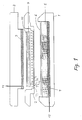
- the apparatus is composed of a base (1) containing a graphite anode (4) and a sponge (5) filled with buffer.
- a base containing a graphite anode (4) and a sponge (5) filled with buffer.
- a reservoir which receives excess buffer generated as the sponge is compressed during mounting of the frame (2).
- a sheet of a semipermeable membrane, such as a dialysis membrane, is placed on top of the sponge, and the frame is tightly connected to the base by means of finger screws.
- the dialysis membrane may be fixed to the sponge, e.g. by glueing.
- the graphite cathode (3) is built into a safety cover (8).
- the frame contains multiple parallel chambers (7) of a trapezoidal shape consisting of a first open side (71), a second open side (72) which is shorter than the first open side (71) and opposite to it, and two closed sides (73,74) opposite each other, said chambers (7) being closed downwards by the close surface to surface contact with the dialysis membrane (6).
- the volume of each chamber is less than 15 ml, preferably about 3 ml.
- the frame contains an indentation in which the gel (9) is placed.
- a sheet of filter paper (10) wetted with buffer is preferably placed between the gel (9) and the graphite cathode (3).
- a template which ensures a precise trimming of the gel according to the size of the indentation is a part of the unit.
- the template is made of clear acrylic plastic and each well is indicated.
- the template is furthermore equipped with adjustment lines which are used to orientate the template before excision.
- a voltage potential of about 40 volts is provided, and the power supply should be adjustable to provide such a voltage.
- the power supply is connected to the cathode (3) and the anode (4) by means of cables (11 and 12, respectively).
- the power supply can be built into the safety cover (8).
- the necessary period for complete elution is generally between 8 and 15 minutes for a 0.75 mm gel. After elution the current is reversed for 10 seconds to loosen material sticking to the membrane. The product obtained is harvested by a plastic pipette through the harvesting side vents on the apparatus.
- the gel containing the separated molecules is pre-equilibrated in a buffer, preferably for about 30-40 minutes.
- the buffer is changed three times to ensure the removal of excess salt and ionic detergents from the gel.
- the gel is removed from the buffer and placed on a clean glass plate, and then the part which is to be eluted is excised by the aid of the template.
- gels are run with pre-stained molecular weight markers in the peripheral lanes.
- a precise orientation and reproducible excision of the gel can be obtained. This method guarantees the important parallel course of gel bands and elution chambers.
- the sponge in the base of the apparatus is filled with buffer.
- a dialysis membrane soaked in the buffer is placed on top of the sponge and the frame is mounted by means of the finger screws.
- the sponge functions as a support for the membrane and its compression ensures a tight closing of each chamber.
- the chambers are filled with buffer and the template is used to assist transfer of gels to the indentation of the frame.
- Two sheets of thick filter paper adjusted to the size of the gel are soaked in buffer and placed on top of the gel.
- the graphite cathode is mounted and a voltage potential of preferentially about 40 volts is provided. During the elution charged molecules will migrate from the gel into the buffer contained in the chambers.
- Ionic detergents will migrate towards the anode through the dialysis membrane, and then they can be effectively removed in the buffer.
- the period necessary for complete elution depends on the compounds under investigation and the gel matrix used, but is preferably between 8 and 16 minutes.
- the elution is followed by reversal of the current for a short period of time, preferentially about 10 seconds, to loosen molecules sticking to the membrane.
- the product is recovered by aspirating with a pipette through the vents on the side of the frame. After harvesting of the product the apparatus is disassembled and the gel is stained for protein/DNA to check whether the transfer was complete. Before the product is used in cellular assays all fractions are made isotonic by addition of a sufficient volume of PBS x 10.
- a different aspect of the present invention is the use of this apparatus for the simultaneous electroelution and electroblotting.
- a sheet of suitable membrane is inserted in one side of the apparatus, thereby covering a variable part of all chambers.
- molecules can be transferred into solution and simultaneously blotted onto a membrane.
- T cell reactivity and antibody response towards separated protein mixtures can be investigated simultaneoulsy in a simple and accurate way.
- a method for purification of single compounds in a simple and quick way comprises the step of removing a narrow strip of gel or electroblotted membrane containing the separated material and localizing the compounds of interest by staining or by reaction with specific probes, which in a preferred embodiment could be monoclonal antibodies.
- Each elution chamber is indicated on the membrane by impressions from the pointed chamber walls. If a gel strip is stained, a number of 2-3 mm holes are punched to indicate the localization of the elution chambers. A precise punching is easily done by the aid of the template which carry a precise marking for each elution chamber. These reference strips enable a precise identification of the chamber which contains the relevant compound.
- the process and the apparatus according to the invention provides effective elution of all parts of the gel.
- the gel is divided into two areas, A and B:
- Part A of the gel was removed before elution and stained for protein.
- the eluted gel (part B) was stained for protein after termination of the elution process to evaluate if the transfer was complete.
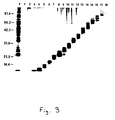
- the photograph in fig. 3 shows the fractionation of a complex mixture of proteins.
- Mycobacterium tuberculosis culture filtrate was separated in 10-20% SDS-PAGE and fractionated with the multichamber electroelution apparatus of the invention.
- the filtrate and the obtained fractions were analyzed by SDS-PAGE and silver staining.
- Lane F is the Mycobacterium tuberculosis filtrate. Lanes 1-18 are the fractions 1 through 18.
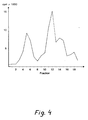
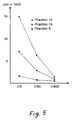
- Fig. 4 shows the proliferative responses of spleen lymphocytes obtained from mice infected with M. tuberculosis.
- the cells were grown in cultures stimulated with fractions of M. tuberculosis culture filtrate in a dilution of 1:5.
- the proliferative response obtained with intact filtrate was 18600 cpm and the response of unstimulated cells was 500 cpm, the proliferation being measured by liquid scintillation counting of 3H thymidine incorporation in the DNA of proliferative cells.
- the process and the apparatus according to the invention provide several great advantages: First of all it is possible in a quick and simple way to obtain a simultaneous elution of all components separated in a one-dimensional gel which as a routine is commonly used. Moreover it is possible to use one-dimensional gels of varying thickness ensuring maximum flexibility of the invention.
- the electroelution apparatus can therefore form a part of an ordinary protein purification procedure and the yield can be quantitatively and qualitatively analyzed.
- the trapezoidal wells provide an even transfer of all protein bands.
- the buffer is non-toxic and free of chloride ions which might otherwise cause problems during the elution.
- the same buffer is used in all parts of the electroelution apparatus, which is labor saving.
Landscapes
- Health & Medical Sciences (AREA)
- Life Sciences & Earth Sciences (AREA)
- Molecular Biology (AREA)
- Chemical & Material Sciences (AREA)
- Chemical Kinetics & Catalysis (AREA)
- Electrochemistry (AREA)
- Physics & Mathematics (AREA)
- Analytical Chemistry (AREA)
- Biochemistry (AREA)
- General Health & Medical Sciences (AREA)
- General Physics & Mathematics (AREA)
- Immunology (AREA)
- Pathology (AREA)
- Investigating Or Analysing Biological Materials (AREA)
- Peptides Or Proteins (AREA)
- Apparatus Associated With Microorganisms And Enzymes (AREA)
- Saccharide Compounds (AREA)
- Electrostatic Separation (AREA)
Abstract
Claims (14)
- Procédé d'électroélution d'un gel contenant des macromolécules chargées séparées, telles que des protéines ou de l'ADN/ARN ; ledit procédé comprenant les étapes consistant à :(a) placer le gel sur le premier côté ouvert (71) d'un certain nombre de chambres parallèles adjacentes (7), chaque chambre ayant une section transversale trapézoïdale et étant constituée d'un premier côté ouvert (71), d'un second côté ouvert (72) dont la longueur est inférieure à celle du premier côté ouvert (71) et qui est opposé à ce dernier, et deux côtés fermés (73,74) opposés entre eux ;(b) placer une membrane semi-perméable sur le second côté ouvert (72) desdites chambres (7) ;(c) remplir les chambres fermées (7) avec un tampon d'élution ; et(d) appliquer une différence de potentiel aux chambres (7), de façon que les macromolécules chargées séparées présentes dans le gel migrent dans les tampons d'élution situés dans les chambres.
- Procédé selon la revendication 1, caractérisé par le fait que les deux côtés fermés (73,74) d'une chambre forment des triangles à angle aigü avec les deux côtés adjacents fermés des chambres adjacentes.
- Procédé selon la revendication 1, caractérisé par le fait que le gel (9) est placé de façon que les bandes de gel et les chambres soient parallèles.
- Procédé selon la revendication 1, caractérisé par le fait que la différence de potentiel est appliquée pendant une période suffisamment longue pour éliminer les détergents ioniques du tampon d'élution à travers la membrane semi-perméable (6), de préférence pendant une période comprise entre 8 et 16 minutes.
- Procédé selon la revendication 1, caractérisé par le fait qu'après l'élution, la différence de potentiel est inversée pendant une brève période, de préférence pendant une période d'environ 10 secondes.
- Procédé selon la revendication 1, caractérisé par le fait que le tampon d'élution présente une faible force ionique.
- Procédé selon la revendication 6, caractérisé par le fait que le tampon d'élution est un tampon phosphate à environ 2 mM.
- Procédé selon la revendication 1, pour l'électroélution et la réalisation d'une empreinte par électrophorèse simultanées de macromolécules chargées séparées, caractérisé par le fait qu'une partie variable de toutes les chambres est recouverte d'une membrane appropriée pour la réalisation sur celle-ci d'une empreinte avec les molécules.
- Dispositif destiné à la mise en oeuvre du procédé revendiqué à la revendication 1, caractérisé par le fait qu'il comprend :a) une base (1) comprenant :i) une anode en graphite (4),ii) une éponge (5) qui doit absorber le tampon,iii) une membrane semi-perméable (6) placée au-dessus de ladite éponge (5), etiv) un réservoir destiné à recevoir le tampon en excès de l'éponge (5) ;b) un cadre (2) comprenant :i) un certain nombre de chambres parallèles adjacentes (7), chaque chambre ayant une section transversale trapézoïdale et étant constituée d'un premier côté ouvert (71), d'un second côté ouvert (72) dont la longueur est inférieure à celle du premier côté ouvert (71) et qui est opposé au premier côté ouvert (71), et de deux côtés fermés (73,74) opposés entre eux ; ledit second côté ouvert (72) étant fermé par la membrane semiperméable (6) lorsque le cadre (2) est raccordé à la base (1) ; etii) un renfoncement destiné à recevoir le gel (9) ; etc) un couvercle de sécurité (8) comprenant une cathode en graphite (3) ;
ledit gel (9) fermant le premier côté ouvert des chambres (7) lorsque le couvercle de sécurité (8), le cadre (2) et la base (1) sont raccordés. - Dispositif selon la revendication (9), caractérisé par le fait que les deux côtés fermés (73,74) d'une chambre forment des triangles à angle aigü avec les deux côtés fermés adjacents des chambres adjacentes.
- Dispositif selon la revendication (9), caractérisé par le fait que le cadre (2) comprend en outre des orifices latéraux destinés à aspirer le produit récupéré.
- Dispositif selon la revendication (9), caractérisé par le fait que le couvercle de sécurité (8) comprend en outre une source d'énergie qui est capable d'inverser automatiquement le courant.
- Dispositif selon la revendication (9), caractérisé par le fait qu'il comprend en outre une membrane pour l'élution et la réalisation d'une empreinte simultanées.
- Matrice destinée au découpage précis d'un gel suivant la taille du renfoncement du cadre (2) du dispositif de la revendication (9),
caractérisé par le fait qu'il comprend en outre :
des lignes d'ajustement destinées à l'orientation de la matrice avant l'excision, et
des chambres d'identification correspondant aux molécules concernées qui doivent être contenues dans chaque chambre.
Priority Applications (1)
| Application Number | Priority Date | Filing Date | Title |
|---|---|---|---|
| DK92905561.4T DK0627954T3 (da) | 1992-02-25 | 1992-02-25 | Fremgangsmåde til elektroeluering af en gel indeholdende adskilte ladede makromolekyler såsom proteiner eller DNA/RNA og et apparat og midler til brug ved fremgangsmåden |
Applications Claiming Priority (2)
| Application Number | Priority Date | Filing Date | Title |
|---|---|---|---|
| CA002130751A CA2130751C (fr) | 1992-02-25 | 1992-02-25 | Appareil et processus d'electroelution d'un gel contenant des macromolecules chargees |
| PCT/DK1992/000058 WO1993016788A1 (fr) | 1992-02-25 | 1992-02-25 | Procede pour l'electroelution d'un gel contenant des macromolecules chargees separees, telles que des proteines, de l'adn ou de l'arn, appareil et moyens pour mettre en oeuvre le procede |
Publications (2)
| Publication Number | Publication Date |
|---|---|
| EP0627954A1 EP0627954A1 (fr) | 1994-12-14 |
| EP0627954B1 true EP0627954B1 (fr) | 1996-04-17 |
Family
ID=25677447
Family Applications (1)
| Application Number | Title | Priority Date | Filing Date |
|---|---|---|---|
| EP92905561A Expired - Lifetime EP0627954B1 (fr) | 1992-02-25 | 1992-02-25 | Procede pour l'electroelution d'un gel contenant des macromolecules chargees separees, telles que des proteines, de l'adn ou de l'arn, appareil et moyens pour mettre en oeuvre le procede |
Country Status (7)
| Country | Link |
|---|---|
| US (1) | US5840169A (fr) |
| EP (1) | EP0627954B1 (fr) |
| AU (1) | AU1324192A (fr) |
| CA (1) | CA2130751C (fr) |
| DE (1) | DE69210048T2 (fr) |
| DK (1) | DK0627954T3 (fr) |
| WO (1) | WO1993016788A1 (fr) |
Cited By (3)
| Publication number | Priority date | Publication date | Assignee | Title |
|---|---|---|---|---|
| DE19939730A1 (de) * | 1999-08-21 | 2001-02-22 | Wilhelm Breuer | Vorrichtung zur Verwendung bei der Elektroelution von Makromolekülen und ein Verfahren zur Elektroelution von Makromolekülen aus Gelen unter Minimierung des Elutionsvolumens |
| WO2023164488A1 (fr) * | 2022-02-25 | 2023-08-31 | Life Technologies Corporation | Système et procédés de transfert de biomolécules |
| USD1061937S1 (en) | 2022-02-25 | 2025-02-11 | Life Technologies Corporation | Biomolecule transfer device |
Families Citing this family (20)
| Publication number | Priority date | Publication date | Assignee | Title |
|---|---|---|---|---|
| US6602391B2 (en) | 2001-03-05 | 2003-08-05 | Vladimir B. Serikov | Apparatus and method for combined capillary separation and blotting of biological macromolecules |
| US7217513B2 (en) * | 2001-07-10 | 2007-05-15 | Massachusetts Institute Of Technology | Apparatus and method for isolating a nucleic acid from a sample |
| WO2003016896A1 (fr) * | 2001-08-10 | 2003-02-27 | Flesher Robert W | Procede et dispositif d'electrophorese et de transfert |
| DE10149875A1 (de) * | 2001-10-10 | 2003-07-03 | Alpha Technology Ges Fuer Ange | Vorrichtung zur Extraktion elektrisch geladener Moleküle |
| US20040126783A1 (en) * | 2002-07-10 | 2004-07-01 | Massachusetts Institute Of Technology | Apparatus and method for isolating a nucleic acid from a sample |
| US7250100B2 (en) * | 2003-06-17 | 2007-07-31 | Duke University | Two dimensional electrophoresis cassette |
| AU2006261309A1 (en) * | 2005-06-18 | 2006-12-28 | Ge Healthcare Bio-Sciences Ab | Methods and systems for adding a reagent to an analyte in a gel |
| WO2006136296A1 (fr) * | 2005-06-18 | 2006-12-28 | Ge Healthcare Bio-Sciences Ab | Méthode et dispositifs pour former une multitude de puits sur un gel |
| US7641778B2 (en) * | 2006-03-23 | 2010-01-05 | Protea Biosciences, Inc. | Gel electroelution and sample separation devices and associated processes |
| US7528368B2 (en) * | 2006-03-23 | 2009-05-05 | Protea Biosciences, Inc. | Electrospray ionization process and add-on device with sample injection tip |
| US20080296158A1 (en) | 2007-05-31 | 2008-12-04 | Sharp Kabushiki Kaisha | Device for electrophoresis, device for transfer, device for electrophoresis and transfer, chip for electrophoresis and transfer, and method for electrophoresis, method for transfer, and method for electrophoresis and transfer |
| US20090250345A1 (en) * | 2008-04-03 | 2009-10-08 | Protea Biosciences, Inc. | Microfluidic electroelution devices & processes |
| US20090250347A1 (en) * | 2008-04-03 | 2009-10-08 | Protea Biosciences, Inc. | Microfluidic devices & processes for electrokinetic transport |
| US8361299B2 (en) * | 2008-10-08 | 2013-01-29 | Sage Science, Inc. | Multichannel preparative electrophoresis system |
| JP5562342B2 (ja) * | 2008-10-08 | 2014-07-30 | セージ サイエンス, インコーポレイテッド | 多重チャネルの分取用電気泳動システム |
| ES2668797T3 (es) * | 2011-06-16 | 2018-05-22 | British Columbia Cancer Agency Branch | Selección automatizada por tamaños de ácidos nucleicos |
| AU2013329110B2 (en) | 2012-10-12 | 2017-05-04 | Sage Science, Inc. | Side-eluting molecular fractionator |
| US10131901B2 (en) | 2014-10-15 | 2018-11-20 | Sage Science, Inc. | Apparatuses, methods and systems for automated processing of nucleic acids and electrophoretic sample preparation |
| AU2016357319B2 (en) | 2015-11-20 | 2022-03-10 | Sage Science, Inc. | Preparative electrophoretic method for targeted purification of genomic DNA fragments |
| WO2018187779A1 (fr) | 2017-04-07 | 2018-10-11 | Sage Science, Inc. | Systèmes et procédés de détection d'une variation structurale génétique à l'aide d'une purification d'adn électrophorétique intégrée |
Family Cites Families (9)
| Publication number | Priority date | Publication date | Assignee | Title |
|---|---|---|---|---|
| US3956099A (en) * | 1972-10-30 | 1976-05-11 | Louis Israel | Continuous preparative electrophoresis apparatus |
| US4049534A (en) * | 1976-04-12 | 1977-09-20 | E-C Apparatus Corporation | Electrophorectic apparatus for elution from preparative gels |
| US4181594A (en) * | 1979-03-27 | 1980-01-01 | University Of Pittsburgh | Matrix recovery electrophoresis apparatus |
| DE3337669C2 (de) * | 1983-10-17 | 1989-09-21 | Carl Schleicher & Schuell Gmbh & Co Kg, 3352 Einbeck | Gerät zur Elektroelution elektrisch geladener Makromoleküle |
| GB8331514D0 (en) * | 1983-11-25 | 1984-01-04 | Janssen Pharmaceutica Nv | Visualization method |
| DE3417180C1 (de) * | 1984-05-09 | 1985-05-15 | Max-Planck-Gesellschaft zur Förderung der Wissenschaften e.V., 3400 Göttingen | Vorrichtung zum Eluieren von elektrisch geladenen Makromolekuelen,insbesondere Biopolymeren |
| US4747918A (en) * | 1986-06-18 | 1988-05-31 | William Bellomy | Electroelution apparatus and method of using same |
| DE3829111A1 (de) * | 1988-08-27 | 1990-03-01 | Hoechst Ag | Verfahren und vorrichtung zum elektrophoretischen trennen, reinigen und anreichern von geladenen oder polarisierbaren makromolekuelen |
| US4959133A (en) * | 1989-01-23 | 1990-09-25 | Eastman Kodak Company | Field inversion electroblotting & electroelution |
-
1992
- 1992-02-25 AU AU13241/92A patent/AU1324192A/en not_active Abandoned
- 1992-02-25 US US08/290,993 patent/US5840169A/en not_active Expired - Lifetime
- 1992-02-25 CA CA002130751A patent/CA2130751C/fr not_active Expired - Fee Related
- 1992-02-25 EP EP92905561A patent/EP0627954B1/fr not_active Expired - Lifetime
- 1992-02-25 DE DE69210048T patent/DE69210048T2/de not_active Expired - Lifetime
- 1992-02-25 WO PCT/DK1992/000058 patent/WO1993016788A1/fr not_active Ceased
- 1992-02-25 DK DK92905561.4T patent/DK0627954T3/da active
Cited By (4)
| Publication number | Priority date | Publication date | Assignee | Title |
|---|---|---|---|---|
| DE19939730A1 (de) * | 1999-08-21 | 2001-02-22 | Wilhelm Breuer | Vorrichtung zur Verwendung bei der Elektroelution von Makromolekülen und ein Verfahren zur Elektroelution von Makromolekülen aus Gelen unter Minimierung des Elutionsvolumens |
| DE19939730C2 (de) * | 1999-08-21 | 2003-04-30 | Wilhelm Breuer | Vorrichtung zur Verwendung bei der Elektroelution von Makromolekülen und ein Verfahren zur Elektroelution von Makromolekülen aus Gelen unter Minimierung des Elutionsvolumens |
| WO2023164488A1 (fr) * | 2022-02-25 | 2023-08-31 | Life Technologies Corporation | Système et procédés de transfert de biomolécules |
| USD1061937S1 (en) | 2022-02-25 | 2025-02-11 | Life Technologies Corporation | Biomolecule transfer device |
Also Published As
| Publication number | Publication date |
|---|---|
| DK0627954T3 (da) | 1996-08-26 |
| US5840169A (en) | 1998-11-24 |
| AU1324192A (en) | 1993-09-13 |
| CA2130751A1 (fr) | 1993-08-26 |
| WO1993016788A1 (fr) | 1993-09-02 |
| CA2130751C (fr) | 2000-01-25 |
| EP0627954A1 (fr) | 1994-12-14 |
| DE69210048D1 (de) | 1996-05-23 |
| DE69210048T2 (de) | 1996-08-29 |
Similar Documents
| Publication | Publication Date | Title |
|---|---|---|
| US5840169A (en) | Apparatus and process for electroelution of a gel containing charged macromolecules | |
| US4088561A (en) | Apparatus for electrophoresis separation | |
| US5209831A (en) | Bufferless electrophoresis system and method | |
| KR0172620B1 (ko) | 정제전기영동장치 및 방법 | |
| US4707233A (en) | Device for extraction of electrophoretic fractions | |
| US3719580A (en) | Electrophoretic apparatus | |
| GB2169703A (en) | Horizontal electroblotting | |
| US4948481A (en) | Process and device for the electrophoretic separation, purification and concentration of charged or polarizable macromolecules | |
| EP1442156A1 (fr) | Appareil pour electrophorese | |
| Melachouris | Discontinuous gel electrophoresis of whey proteins, casein, and clotting enzymes | |
| JP2002525191A (ja) | 巨大分子の分離方法 | |
| US7320747B2 (en) | Gel for electrophoresis | |
| JP2665992B2 (ja) | 分離されたタンパク質類またはdna/rnaなどの荷電巨大分子類を含有するゲルの電気溶出法およびこれに用いる装置と手段 | |
| WO2005029061A1 (fr) | Extraction de molecules au moyen d'une structure | |
| US20050072674A1 (en) | Method and device for introducing a sample into an electrophoretic apparatus | |
| SU616568A1 (ru) | Устройство дл электрофоретического разделени веществ | |
| US3962058A (en) | Flat bed isoelectric focusing device | |
| EP0019001A1 (fr) | Appareil a concentration electrophoretique | |
| US3491883A (en) | Gel tray assembly | |
| GB2177211A (en) | Electroelution device | |
| EP0320937B1 (fr) | Méthode pour l'éléctrophorèse | |
| JPH081496Y2 (ja) | 電気泳動ゲルからの核酸若しくは蛋白質の回収装置 | |
| US5344534A (en) | Gel electrophoresis measurement of dynamic reaction product by continuous sampling | |
| IT1153797B (it) | Apparecchio per la lettura ottico-densitometrica di campioni, in specie elettroforetici, con supporto discoidale porta-campioni | |
| Balsano et al. | Modification of Acrylamide Electrophoresis for Microspectrophotometric Analysis of Fish Plasma Proteins |
Legal Events
| Date | Code | Title | Description |
|---|---|---|---|
| PUAI | Public reference made under article 153(3) epc to a published international application that has entered the european phase |
Free format text: ORIGINAL CODE: 0009012 |
|
| 17P | Request for examination filed |
Effective date: 19940908 |
|
| AK | Designated contracting states |
Kind code of ref document: A1 Designated state(s): DE DK FR GB IT |
|
| 17Q | First examination report despatched |
Effective date: 19950130 |
|
| GRAA | (expected) grant |
Free format text: ORIGINAL CODE: 0009210 |
|
| ITF | It: translation for a ep patent filed | ||
| AK | Designated contracting states |
Kind code of ref document: B1 Designated state(s): DE DK FR GB IT |
|
| REF | Corresponds to: |
Ref document number: 69210048 Country of ref document: DE Date of ref document: 19960523 |
|
| ET | Fr: translation filed | ||
| GRAH | Despatch of communication of intention to grant a patent |
Free format text: ORIGINAL CODE: EPIDOS IGRA |
|
| REG | Reference to a national code |
Ref country code: DK Ref legal event code: T3 |
|
| PLBE | No opposition filed within time limit |
Free format text: ORIGINAL CODE: 0009261 |
|
| STAA | Information on the status of an ep patent application or granted ep patent |
Free format text: STATUS: NO OPPOSITION FILED WITHIN TIME LIMIT |
|
| 26N | No opposition filed | ||
| REG | Reference to a national code |
Ref country code: GB Ref legal event code: IF02 |
|
| PGFP | Annual fee paid to national office [announced via postgrant information from national office to epo] |
Ref country code: FR Payment date: 20050208 Year of fee payment: 14 |
|
| PGFP | Annual fee paid to national office [announced via postgrant information from national office to epo] |
Ref country code: IT Payment date: 20060228 Year of fee payment: 15 |
|
| REG | Reference to a national code |
Ref country code: FR Ref legal event code: ST Effective date: 20061031 |
|
| PG25 | Lapsed in a contracting state [announced via postgrant information from national office to epo] |
Ref country code: FR Free format text: LAPSE BECAUSE OF NON-PAYMENT OF DUE FEES Effective date: 20060228 |
|
| PG25 | Lapsed in a contracting state [announced via postgrant information from national office to epo] |
Ref country code: IT Free format text: LAPSE BECAUSE OF NON-PAYMENT OF DUE FEES Effective date: 20070225 |
|
| PGFP | Annual fee paid to national office [announced via postgrant information from national office to epo] |
Ref country code: DK Payment date: 20110224 Year of fee payment: 20 |
|
| PGFP | Annual fee paid to national office [announced via postgrant information from national office to epo] |
Ref country code: DE Payment date: 20110225 Year of fee payment: 20 |
|
| PGFP | Annual fee paid to national office [announced via postgrant information from national office to epo] |
Ref country code: GB Payment date: 20110223 Year of fee payment: 20 |
|
| REG | Reference to a national code |
Ref country code: DE Ref legal event code: R071 Ref document number: 69210048 Country of ref document: DE |
|
| REG | Reference to a national code |
Ref country code: DE Ref legal event code: R071 Ref document number: 69210048 Country of ref document: DE |
|
| REG | Reference to a national code |
Ref country code: DK Ref legal event code: EUP |
|
| REG | Reference to a national code |
Ref country code: GB Ref legal event code: PE20 Expiry date: 20120224 |
|
| PG25 | Lapsed in a contracting state [announced via postgrant information from national office to epo] |
Ref country code: DE Free format text: LAPSE BECAUSE OF EXPIRATION OF PROTECTION Effective date: 20120226 |
|
| PG25 | Lapsed in a contracting state [announced via postgrant information from national office to epo] |
Ref country code: GB Free format text: LAPSE BECAUSE OF EXPIRATION OF PROTECTION Effective date: 20120224 |