EP0628600B1 - Faserverstärkte, schlagzäh modifizierte Polyestercarbonatmischungen - Google Patents
Faserverstärkte, schlagzäh modifizierte Polyestercarbonatmischungen Download PDFInfo
- Publication number
- EP0628600B1 EP0628600B1 EP94303577A EP94303577A EP0628600B1 EP 0628600 B1 EP0628600 B1 EP 0628600B1 EP 94303577 A EP94303577 A EP 94303577A EP 94303577 A EP94303577 A EP 94303577A EP 0628600 B1 EP0628600 B1 EP 0628600B1
- Authority
- EP
- European Patent Office
- Prior art keywords
- percent
- weight
- impact
- carbonate
- composition
- Prior art date
- Legal status (The legal status is an assumption and is not a legal conclusion. Google has not performed a legal analysis and makes no representation as to the accuracy of the status listed.)
- Expired - Lifetime
Links
Classifications
-
- C—CHEMISTRY; METALLURGY
- C08—ORGANIC MACROMOLECULAR COMPOUNDS; THEIR PREPARATION OR CHEMICAL WORKING-UP; COMPOSITIONS BASED THEREON
- C08L—COMPOSITIONS OF MACROMOLECULAR COMPOUNDS
- C08L69/00—Compositions of polycarbonates; Compositions of derivatives of polycarbonates
- C08L69/005—Polyester-carbonates
Definitions
- the invention relates to thermoplastic molding compositions and more particularly to molding compositions which are formulated from polyester-carbonate resins.
- Polyester-carbonates also known as “copoly(ester-carbonates)” or “polyester-polycarbonates”
- thermoplastic resin as is their preparation; see for example the descriptions given in U.S. Patents 3,169,121 and 4,487,896.
- Polyester-carbonate (PEC) resins have been useful thermoplastic molding resins, to mold particular articles of certain physical properties.
- the polyester-carbonate resins have had limited use for molding some articles, being characterized as yielding molded articles having little resistance to impact when subjected to testing for notched Izod impact strengths.
- Van Abeelen et al teaches the use of unsized glass fibers as the reinforcement, and the addition of minor proportions of poly C 1 -C 10 alkyl (or phenyl) hydrogen siloxanes "having a substantial content of Si-H bonds".
- polyester-carbonate resin based molding blends containing fibrous reinforcement and a so-called "conventional" impact modifier (not necessarily a polystyrene resin), can be used to thermally mold articles exhibiting acceptable elastic modulus and high impact strength (with other desired properties), without addition of the above-described polysiloxane ingredient.
- the improvement is particularly advantageous in respect to aromatic polyester-carbonate resins having aliphatic diester chain units. This improvement is unexpected, in view of the prior art teachings and further does not detract from flame retardance when flame retardants are also added to the blends.
- the invention comprises a thermoplastic molding composition, which consists essentially of;
- compositions of the invention are useful to thermoplastically mold articles such as structural panels and the like, which are useful in the fabrication of housings, interior furnishings and the like.
- polyester-carbonates used as ingredient (A) in the compositions of the invention may be prepared by interfacial polymerization technique, well known to those skilled in the art; see for example the U.S. patents 3,169,121 and 4,487,896.
- the method of interfacial polymerization comprises the reaction of a dihydric phenol with a carbonyl halide (the carbonate precursor) in the presence of a dicarboxylic acid (ester precursor).
- reaction conditions of the preparative processes may vary, several of the preferred processes typically involve dissolving or dispersing the diphenol reactants in aqueous caustic, adding the resulting mixture to a suitable water immiscible solvent medium and contacting the reactants with the carbonate and ester precursors, under controlled pH conditions.
- suitable water immiscible solvents include methylene chloride, 1,2-dichloroethane, chlorobenzene, toluene, and the like.
- a catalyst is added to the reaction mixture to promote the reaction.
- the catalyst employed accelerates the rate of polymerization of the dihydric phenol reactant with the carbonate precursor.
- Representative catalysts include but are not limited to tertiary amines such as triethylamine, quaternary phosphonium compounds, quaternary ammonium compounds, and the like.
- the preferred process for preparing polyester-carbonate resins comprises a phosgenation reaction.
- the temperature at which the phosgenation reaction proceeds may vary from below 0°C, to above 100°C.
- the phosgenation reaction preferably proceeds at temperatures of from about room temperatures (25°C) to 50°C. Since the reaction is exothermic, the rate of phosgene addition may be used to control the reaction temperature.
- the amount of phosgene required will generally depend upon the amount of the dihydric phenol reactant added.
- the dihydric phenol employed is 2,2-bis(4-hydroxyphenyl)propane (also known as bisphenol-A).
- the carbonate precursor can be either a carbonyl halide, a diarylcarbonate or a bishaloformate.
- the carbonyl halides include carbonyl bromide, carbonyl chloride, and mixtures thereof.
- the bishaloformates include the bishaloformates such as bischloroformates of 2,2-bis(4-hydroxyphenyl)propane. While the above carbonate precursors are useful, carbonyl chloride, also known as phosgene, is preferred.
- any dicarboxylic acid conventionally used in the preparation of linear polyesters may be utilized as the ester precursor in the preparation of the polyester-carbonate resins used in the instant invention.
- the dicarboxylic acids which may be utilized include the aliphatic dicarboxylic acids, the aromatic dicarboxylic acids, and the aliphatic-aromatic dicarboxylic acids. These acids are well known and are disclosed for example in U.S. Pat. No. 3,169,121.
- Representative of dicarboxylic acids are those represented by the general formula: HOOC-R 1 -COOH wherein R 1 represents a divalent alkylene radical having 2 to 16 carbon atoms, inclusive.
- aliphatic dicarboxylic acids within the formula given above wherein R 1 is alkylene are butanedioic acid, hexanedioic acid, octanedioic acid, decanedioic acid, dodecanedioic acid and the like.
- R 1 is an alkylene radical such as ethylene, nonylene, decylene, or substituted alkylene.
- dicarboxylic acid is used herein it is to be understood that this term includes mixtures of two or more dicarboxylic acids.
- the reactive derivatives of said acid Rather than utilizing the dicarboxylic acid per se, it is possible, and sometimes most convenient, to employ the reactive derivatives of said acid.
- Illustrative of these reactive derivatives are the acid halides.
- the preferred acid halides are the acid dichlorides and the acid dibromides.
- the proportions of reactants employed to prepare the polyester-carbonate resins used in the invention will vary in accordance with the proposed use of the product composition. Those skilled in the art are aware of useful proportions, as described in the U.S. patents referred to above.
- the amount of the ester bonds may be from about 5 to about 90 mole percent, relative to the carbonate bonds. For example, 5 moles of bisphenol A reacting completely with 4 moles of isophthaloyl dichloride and 1 mole of phosgene would give a polyester-carbonate of 80 mole percent ester bonds.
- polyester-carbonates for use in the present invention are those derived from bisphenol A and phosgene and having an intrinsic viscosity of about 0.3 to about 1.5 deciliters per gram in methylene chloride at 25°C.
- a molecular weight regulator (a chain stopper) is generally added to the reaction mixture prior to or during the contacting with carbonate and ester precursors.
- Useful molecular weight regulators include, but are not limited to, monohydric phenols such as phenol, chroman-I, paratertiarybutylphenol, p-cumylphenol and the like. Techniques for the control of molecular weight are well known in the art and are used for controlling the molecular weight of the polyester-carbonate resins used in the present invention.
- polyester-carbonates described herein may be characterized as containing recurring polycarbonate chain units of the formula:- wherein D is a divalent aromatic radical of the dihydric phenol employed in the resin preparation; and repeating or recurring carboxylic chain units of the formula:- wherein D and R 1 have the meanings previously ascribed to them.
- Fibrous reinforcing agents (B) employed in plastic molding compositions are glass fibers, such as cut glass filaments (long glass fiber and short glass fiber) rovings and staple fiber.
- the filamentous glass that may be used in the embodiments of this invention are well known to those skilled in the art and is widely available from a number of manufacturers.
- the glass may be untreated or, preferably, treated with silane or titanate coupling agents.
- fibrous glass filaments comprised of lime-aluminum borosilicate glass that is relatively soda free. This is known as "E" glass.
- E lime-aluminum borosilicate glass
- C soda glass
- the filaments are made by known processes, e.g., by steam or air blowing, flame blowing and mechanical pulling.
- the preferred filaments for plastic reinforcement are made by mechanical pulling.
- the length of the glass filaments and whether or not they are bundled into fibers and the fibers bundled in turn to yarns, ropes or rovings, or woven into mats, and the like, are also not critical to the invention.
- the filamentous glass in the form of chopped strands of from about 0.25 cm to about 5 cm long.
- articles molded from the compositions on the other hand, even shorter lengths will be encountered because, during compounding, considerable fragmentation will occur. This is desirable, however, because the best properties are exhibited by thermoplastic injection molded articles in which the filament lengths lie between about 0.0005 to 0.05 cm.
- compositions of the invention include an impact-modifying proportion of an impact modifier (C).
- KM653 is an MBS (methacrylate-butadienestyrene polymer) with about 70-73 wt. percent butadiene in the core, 12 wt. percent methyl methacrylate, and 15 wt. percent styrene. There is a sufficient amount of crosslinker to give at least 96.9 percent insolubles in acetone.
- Kane Ace® B-56 available from Kaneka America or Kanegafuchi, is an MBS with about 66 wt. percent butadiene, 20 wt.
- MBS polymers include the Metablen® C Series of impact modifiers (C-201, C-202, C-202C and C-223) commercially available from M&T Chemicals Inc., and the Acryloid® KM and EXL Series of impact modifiers (KM581, KM436, KM680, EXL2691, EXL2607, and EXL2647) available from Rohm & Haas Chemical Co.
- Metablen® C Series of impact modifiers C-201, C-202, C-202C and C-223
- Acryloid® KM and EXL Series of impact modifiers KM581, KM436, KM680, EXL2691, EXL2607, and EXL2647) available from Rohm & Haas Chemical Co.
- the MBS rubber and methods for making same, as described above, are discussed in greater detail in U.S. Pat. No. 4,243,481, U.S. Pat.
- the preferred core/shell polymers are methyl methacrylate-butadiene-styrene core/shell polymer.
- the specifically preferred polymer being Kane Ace® B-56 as described above.
- the core/shell polymer is employed in the compositions of the invention in an effective amount sufficient to bring about high impact strength in the room temperature (RT) 1/8-inch Notched Izod test, ASTM D-256.
- the amount of the shell/core polymer will generally be below 20% (by weight) and preferably below about 10%.
- impact modifiers which may be added to the compositions of the invention are copolymers made from an olefin, e.g., ethylene, propylene, or the like, copolymerized with one or more of a comonomer comprising a C 1 -C 6 alkyl acrylate, e.g., methyl acrylate, ethyl acrylate, hexyl acrylate and the like; a C 1 -C 6 alkyl methacrylate, e.g., methyl methacrylate, ethyl methacrylate, hexyl methacrylate, and the like; acrylic acid; or methacrylic acid.
- a comonomer comprising a C 1 -C 6 alkyl acrylate, e.g., methyl acrylate, ethyl acrylate, hexyl acrylate and the like
- a C 1 -C 6 alkyl methacrylate e.g
- the well known copolymers of ethylene with an alkyl ester of acrylic acid are disclosed in U.S. Patent No. 2,953,551.
- the acrylate or methacrylate portion of the copolymer can range from about 10 to about 30 weight percent.
- the olefin portion of the copolymer can range from about 70 to about 90 weight percent.
- the preferred copolymer is an ethylene-ethyl acrylate (EEA) copolymer in which the weight ratio of the ethylene fraction to the ethyl acrylate fraction is about 4.5 to 1.
- ESA ethylene-ethyl acrylate
- Suitable olefin-acrylate copolymers, as defined above, can be prepared by methods well known to those skilled in the art or can be obtained commercially.
- Union Carbide's Bakelite ® DPD-6169 ethylene-ethyl acrylate copolymer is advantageous for use in the present invention, when used in a proportion of from 0.1 to 10 percent by weight
- Linear low density polyethylene resins are also advantageous impact-modifiers for the present invention and are well known materials, they are available commercially, e.g. from Exxon under the tradename Escorene or from Dow Chemicals under the tradename DOWLEX. Alternatively, they may readily be prepared by state of the art polymerization processes such as those described in U.S. Pat. Nos. 4,354,009, 4,076,698 and U.S. Pat. No. 4,128,607. These polymers have a density between about 0.89 and about 0.96 gram/cc, preferably between about 0.915 and 0.945 grams/cc.
- the linear low density polyethylene polymers are actually co-polymers of ethylene and a minor amount, less than 20 mole percent, preferably less than 15 mole percent, of an alpha olefin of 3 to 18 carbon atoms, preferably 3 to 10 carbon atoms, most preferably 4 to 8 carbon atoms.
- the linear low density polyethylenes are distinguishable from polymers such as high pressure low density polyethylene and high density polyethylene made from Zeigler catalyst systems in that they are substantially free of side chain branching, having a controlled concentration of simple side chain branching as opposed to random branching.
- the preferred linear low density polyethylene copolymers are prepared from ethylene and one or more alpha olefins selected from the group consisting of propylene, butene-l, pentene-l,4 methyl pentene-l, hexene-l and octene-l, most preferably butene-l and octene-l.
- Polymers of desired density may be obtained by controlling the co-polymerization ratio of alpha olefin and the formation proportion of the polymer during co-polymerization. The addition of increasing amounts of the co-monomers to the co-polymers results in lowering the density of the co-polymer.
- the melt indices of the linear low density polyethylenes useful for the present invention may vary widely. However, when using linear low density polyethylene derived from ethylene and a short chain, e.g. butene-l, monomer, it is preferred that such linear low density polyethylenes have melt indices of at least 5, preferably at least 10, most preferably at least about 20 gm/10 min. With linear low density polyethylenes derived from longer chain, e.g. octene-l, monomers the melt indices of the linear low density polyethylenes may be even lower.
- the co-polymerization of linear low density polyethylene can take place in either a gas phase fluidized bed reaction or liquid phase solution process reactor, preferably the former, at pressures ranging from normal to 5000 psi, preferably less than 1000 psi and at temperatures of from 20° C. to 310° C., preferably 30° C. to 115° C. in the presence of a suitable high activity catalysts.
- Typical catalyst systems comprise transition metal complex catalyst preferably composed of at least one compound of a transition element of groups IVa, Va, and Vla of the periodic chart of the elements Merck Index, 8th Ed., having a halide and/or hydrocarbon group attached to said transition metal and a reducing component such as a metal halide or a compound having metal attached directly to carbon, e.g. metal alkyl.
- a metal complex catalyst preferably composed of at least one compound of a transition element of groups IVa, Va, and Vla of the periodic chart of the elements Merck Index, 8th Ed., having a halide and/or hydrocarbon group attached to said transition metal and a reducing component such as a metal halide or a compound having metal attached directly to carbon, e.g. metal alkyl.
- Highly satisfactory catalyst systems have a halide on titanium and wherein the effective organo metallic components are metal alkyl compounds having aluminum as the metal, especially Li Al(hydrocarbon) 4 .
- Such systems include for example TiCl 4 and LiAl(alkyl) 4 , VOCl 3 and Li(alkyl), MoCl 3 and Al(Alkyl) 3 , TiCl 4 and alkyl Mg Br.
- Catalyst systems such as these as well as other useful catalyst systems are disclosed in U.S. Pat. Nos. 4,354,009, 4,076,698 and 4,128,607.
- the linear low density polyethylene resins may be added as impact-modifiers to the compositions of the invention in proportions of from 0.1 to 15 percent by weight of the total composition.
- Impact modifiers which may also be added to the compositions of the invention are organopolysiloxane-polycarbonate block co-polymers. They are highly compatible with the major ingredients of the compositions of the invention. These block copolymers are generally well known resins as are methods of their preparation; see for example preparative descriptions given in the U.S. Patents 4,027,072, 4,123,588 and 4,569,970. Such resins are also commercially available (LR 3320, General Electric Co., Mount Vernon, Indiana).
- the polysiloxane-polycarbonate copolymers employed as impact-modifiers in the compositions of the invention are those prepared by reacting (A) a halogen chain-stopped polydiorgano-siloxane composed of from 5 to 200 chemically combined diorganosiloxy units consisting essentially of dialkylsiloxy units which are connected to each other by silicon-oxygen-silicon linkages wherein each of the silicon atoms has two organo radicals attached through a carbon-silicon bond, and (B) a dihydric phenol having the formula:- wherein Z is a member selected from the class consisting of hydrogen, alkyl radicals having from 1 to 4 carbon atoms, and halogen radicals and combinations thereof, and R 5 is a member selected from the class consisting of hydrogen, hydrocarbyl and halogenated hydrocarbyl radicals; and phosgenating the purified reaction product until the resulting copolymer achieves a maximum intrinsic viscosity.
- the organopolysiloxane-polycarbonate block copolymers used as impact-modifiers in the compositions of the invention generally comprise 0.1 to 20 weight percent of the total composition.
- halogen as used herein is embracive of chlorine, bromine, iodine and fluorine.
- hydrocarbyl as used herein means the monovalent moiety obtained upon removal of a hydrogen atom from a parent hydrocarbon.
- hydrocarbyl are alkyl of 1 to 20 carbon atoms, inclusive, such as methyl, ethyl, propyl, butyl, pentyl, hexyl, heptyl, octyl, nonyl, undecyl, decyl, dodecyl, tridecyl, tetradecyl, pentadecyl, hexadecyl, heptadecyl, octadecyl, nonodecyl, eicosyl, and isomeric forms thereof; cycloalkyl of 3 to 8 carbon atoms, inclusive, such as cyclopropyl, cyclobutyl, cyclopentyl, cyclohexyl, cycloheptyl, cyclooctyl and the
- compositions of the invention include as an additive ingredient (D) flame retarding agents.
- D additive ingredient
- the presence of impact-modifiers in polycarbonate based molding compositions is degradative to the action of fire retardants.
- reductions in flame-retardance due to presence of the impact-modifier is unexpectedly not significant.
- Some particularly useful flame retardants are the alkali and alkaline earth metal salts of sulfonic acids. These types of flame retardants are disclosed in U.S. Pats. Nos. 3,933,734; 3,931,100; 3,978,024; 3,948,851; 3,926,980; 3,919,167; 3,909,490; 3,953,396; 3,953,300; 3,917,559; 3,951,910 and 3,940,366.
- Preferred as a flame retarding additive for use in the compositions of the invention are the halogenated polycarbonate resins such as tetrabromobisphenol polycarbonate.
- the tetrabromobisphenol polycarbonate can be any of the homopolycarbonates made from tetrabromobisphenol A and phosgene or the copolycarbonates made using partly tetrabromobisphenol A and partly bisphenol A.
- the homopolycarbonates are available for example from Great Lakes Chemical Corp. as BC-52 and BC-58; BC-52 is an oligomer of tetrabromobisphenol A polycarbonate with phenoxy end groups on the chain; BC-58 is similar but with 2,4,6-tribromophenoxy end groups on the chain.
- the copolymers of tetrabromobisphenol A and bisphenol A are described and their preparation given by Womback, U. S. Pat. 3,915,926.
- the preferred tetrabromobisphenol A polycarbonate is one having about 50% tetrabromobisphenol A and 50% bisphenol A units on a molar basis.
- Flame-retarding component (D) may also be a flame retardant sulfonate salt such as those described in U.S. Patent 3,775,367 or the aromatic sulfonate salts such as those described in U.S. Patents 3,940,366, 3,933,734, 3,948,851, 3,926,908, and 3,909,490.
- the preferred salts are the alkali metal salts.
- the perfluoroalkylsulfonate salt of an alkali metal can be any of those disclosed by Nouvertne, U. S. Pat. 3,775,367 (1973). Thus for example they can be the sodium or potassium salts of trifluoromethanesulfonic acid, nonafluorobutane-1-sulfonic acid, heptadecafluorooctanesulfonic acid, or the like.
- the preferred salt of this class is potassium nonafluorobutane-1-sulfonate.
- Flame-retarding proportions of flame retardants vary in accordance with the specific flame retardant. In general, a flame-retarding proportion comprises from 0.01 to 20 weight percent of the total composition.
- compositions of the invention is done by any of the blending operations known for the blending of thermoplastics, for example blending in a kneading machine such as a Banbury mixer or an extruder.
- a kneading machine such as a Banbury mixer or an extruder.
- the sequence of addition is not critical but all components should be thoroughly blended together.
- Blending can be done continuously or batchwise. Melt blending can also be employed.
- SP G Specific Gravity
- Dynatup impact measurements were made in a Dynatup autoloader machine using 3.175 mm (125 mil) thick 10.16 cm discs.
- the tup impact velocity was 3.7 m/sec (12.2 ft/sec) giving an impact energy of 20.5 kg ⁇ m (148 ft-lb). The average energy to maximum load of three measurements is reported. All specimens were 100% ductile at failure, unless otherwise noted.
- the resin is injection molded at about 600° C. into test bars of about 12.7 cm. by 1.27 cm. by 1.175 mm. in thickness. These test bars are subjected to the test procedure set forth in underwriters' Laboratories, Inc. Bulletin UL-94, Burning Test for Classified Materials. The test results are reported as V-O, V-1 or V-2 ratings based on the results of 5 test bar specimens. The criteria for each V (for vertical) rating per UL-94 is briefly as follows:
- a rating of "HB" is given when a 12.7 cm long test piece held horizontally exhibits a burning rate of 7.6 cm/minute.
- Average flame out times (avg. FOT) are given in seconds.
- compositions of the invention were prepared by blending together various proportions of a copolyester-carbonate resin [Lexan ® SP, a polyester-carbonate (PEC) based on bisphenol A (BPA) and 9 mole percent of dodecanedioic acid (DDDA)], which displays a glass transition temperature (Tg) of 127° C; General Electric Co., Mount Vernon, Indiana) and various proportions of an MBS (B-56) impact modifier (KANE ACE® B56 a core-shell copolymer of about 66% butadiene, 20% methyl methacrylate, about 14% styrene, and a sufficient amount of crosslinker to give at least 92% insolubles in acetone; made by Kanegafuchi, Japan).
- a copolyester-carbonate resin [Lexan ® SP, a polyester-carbonate (PEC) based on bisphenol A (BPA) and 9 mole percent of dodecanedioic acid (DDDA)
- compositions also contained varying proportions of a flame-retarding additive TB-50 (tetrabromobisphenol-A/bisphenol-A; 50:50 oligomeric copolycarbonate, a flame retardant polymeric additive made by General Electric Co., Mount Vernon, Indiana), 9.0 percent by weight of chopped glass fibers (OCF 415 BB; Owens-Corning Fiberglass Co.; E glass, 3.175 mm), 1.5 phr of drip inhibitor concentrate (20% polytetrafluoroethylene mixed with 80% by weight of polycarbonate resin), 0.5 phr of potassium diphenyl sulfone-3-sulfonate fire retardant and 0.7 phr of polyalphaolefin mold release additive (Emery 3004, Emery Chemical Company).
- TB-50 tetrabromobisphenol-A/bisphenol-A; 50:50 oligomeric copolycarbonate, a flame retardant polymeric additive made by General Electric Co., Mount Vernon, Indiana
- the blend was then fed to an extruder at a temperature of about 340° C. to extrude the blend into strands.
- the strands were chopped into pellets and injection molded into test samples measuring 6.35 cm X 1.27 cm X 0.317 cm.
- the samples were tested for physical properties.
- the composition formulations together with test results are set forth in the Table I , below.
Landscapes
- Chemical & Material Sciences (AREA)
- Health & Medical Sciences (AREA)
- Chemical Kinetics & Catalysis (AREA)
- Medicinal Chemistry (AREA)
- Polymers & Plastics (AREA)
- Organic Chemistry (AREA)
- Compositions Of Macromolecular Compounds (AREA)
- Manufacture Of Macromolecular Shaped Articles (AREA)
Claims (4)
- Thermoplastische Formmassenzusammensetzung bestehend im wesentlichen aus;(A) einem thermoplastischen Polyestercarbonatharz mit wiederkehrenden Carbonatketteneinheiten der Formel:worin D ein divalenter aromatischer Rest der Formel ist:
 unterbrochen durch wiederkehrende carboxylische Ketteneinheiten der Formel:
 worin D wie oben definiert ist und R1 ein divalenter Alkylenrest mit 2 bis 16 Kohlenstoffatomen ist, inklusive;
wobei das Verhältnis der Carbonatketteneinheiten zu carboxylischen Ketteneinheiten innerhalb des Bereiches von 10 bis 95 Molprozent ist;(B) von 0,01 bis 29 Gewichtsprozent der Zusammensetzung aus Glasfaserverstärkungsmitteln;(C) einem die Schlagzähigkeit modifizierenden Anteil eines Schlagzähmodifizierers ausgewählt aus der Gruppe bestehend aus: weniger als 20 Gewichtsprozent Methacrylat-Butadien-Styrolcopolymer, 0,1 bis 15 Gewichtsprozent Polyethylenharz niedriger Dichte mit linearer Struktur, 0,1 bis 10 Gewichtsprozent Ethylen-Ethylacrylatcopolymer, 0,1 bis 20 Gewichtsprozent Polysiloxan-Polycarbonatblockcopolymer, das hergestellt ist indem man reagieren läßt (1) ein mit Halogen kettengestopptes Polydiorganosiloxan, das sich aus zwischen 5 bis 200 chemisch kombinierten Dialkylsiloxyeinheiten zusammensetzt, die im wesentlichen aus Diorganosiloxyeinheiten bestehen, welche miteinander durch SiliziumSauerstoff-Silizium-Verknüpfungen verbunden sind, wobei an jedes der Siliziumatome zwei organische Reste über eine Kohlenstoff-Siliziumbindung gebunden sind, und (2) ein zweiwertiges Phenol mit der Formel:wobei Z ein Element ist, ausgewählt aus der Klasse bestehend aus Wasserstoff, Alkylresten mit 1 bis 4 Kohlenstoffatomen und Halogenresten und Kombinationen davon, und R5 ein Element ist ausgewählt aus der Klasse bestehend aus Wasserstoff, Kohlenwasserstoff, und halogenierten Kohlenwasserstoffresten; und man das Reaktionsprodukt solange phosgeniert bis das resultierende Copolymer eine maximale Grenzviskositätszahl erreicht; und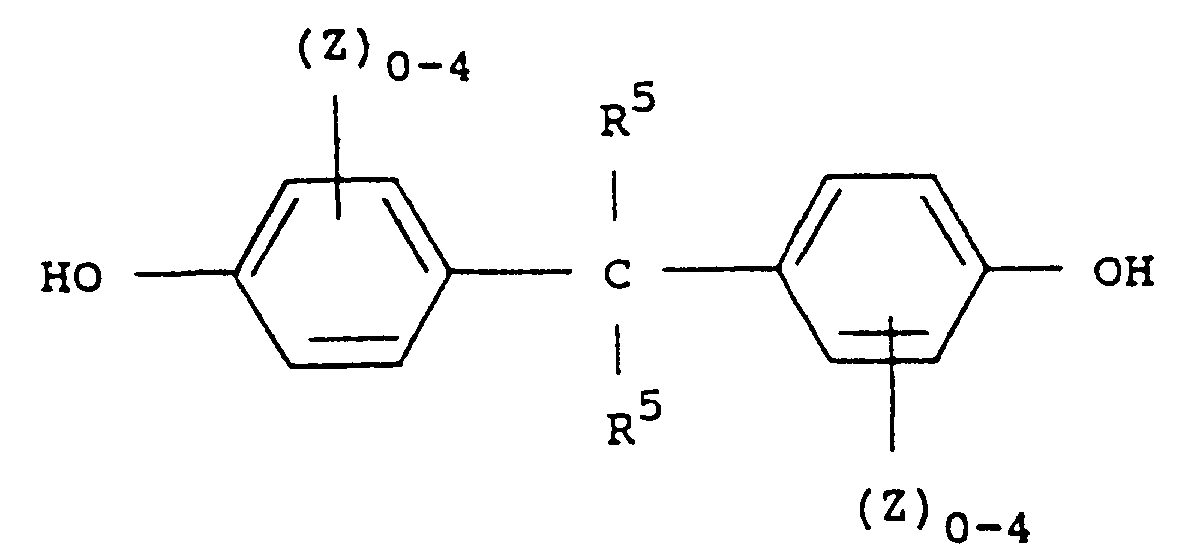 (D) von 0,01 bis 20 Gewichts % eines flammhemmenden Mittels.
 - Zusammensetzung nach Anspruch 1, dadurch gekennzeichnet, daß R1 Dodecylen darstellt.
- Zusammensetzung nach Anspruch 2, dadurch gekennzeichnet, daß der Flammhemmer ein Copolycarbonatoligomer ist, hergestellt durch Phosgenierung einer äquimolaren Mischung von Bisphenol-A und Tetrabromobisphenol-A.
- Gegenstand thermoplastisch geformt aus der Zusammensetzung gemäß einem der vorhergehenden Ansprüche.
Applications Claiming Priority (2)
| Application Number | Priority Date | Filing Date | Title |
|---|---|---|---|
| US69908 | 1987-07-06 | ||
| US08/069,908 US5360861A (en) | 1993-05-28 | 1993-05-28 | Polyester-carbonate resin compositions of improved impact-resistance |
Publications (3)
| Publication Number | Publication Date |
|---|---|
| EP0628600A2 EP0628600A2 (de) | 1994-12-14 |
| EP0628600A3 EP0628600A3 (de) | 1995-03-29 |
| EP0628600B1 true EP0628600B1 (de) | 2000-08-30 |
Family
ID=22091956
Family Applications (1)
| Application Number | Title | Priority Date | Filing Date |
|---|---|---|---|
| EP94303577A Expired - Lifetime EP0628600B1 (de) | 1993-05-28 | 1994-05-19 | Faserverstärkte, schlagzäh modifizierte Polyestercarbonatmischungen |
Country Status (4)
| Country | Link |
|---|---|
| US (1) | US5360861A (de) |
| EP (1) | EP0628600B1 (de) |
| JP (1) | JPH07133418A (de) |
| DE (1) | DE69425690D1 (de) |
Cited By (3)
| Publication number | Priority date | Publication date | Assignee | Title |
|---|---|---|---|---|
| US7119140B2 (en) | 2004-07-22 | 2006-10-10 | Ronald Basham | Transparent films, compositions, and method of manufacture thereof |
| US7498401B2 (en) | 2005-03-03 | 2009-03-03 | Sabic Innovative Plastics Ip B.V. | Thermoplastic polycarbonate compositions, articles made therefrom and method of manufacture |
| US7799855B2 (en) | 2001-11-12 | 2010-09-21 | Sabic Innovative Plastics Ip B.V. | Flame retardant thermoplastic polycarbonate compositions, use and method thereof |
Families Citing this family (28)
| Publication number | Priority date | Publication date | Assignee | Title |
|---|---|---|---|---|
| JPH07102162A (ja) * | 1993-10-06 | 1995-04-18 | Nippon G Ii Plast Kk | ガラス強化ポリカーボネート系樹脂組成物 |
| US5714419A (en) * | 1994-08-04 | 1998-02-03 | Fiberite, Inc. | Composite material suitable for aircraft interiors |
| US5607769A (en) * | 1994-08-04 | 1997-03-04 | Fiberite, Inc. | Composite material |
| US6013686A (en) * | 1998-02-13 | 2000-01-11 | General Electric Company | Blowing agent concentrate |
| US7169859B2 (en) * | 1999-05-18 | 2007-01-30 | General Electric Company | Weatherable, thermostable polymers having improved flow composition |
| US7605221B2 (en) | 1999-05-18 | 2009-10-20 | Sabic Innovative Plastics Ip B.V. | Weatherable, thermostable polymers having improved flow composition |
| US7790292B2 (en) * | 1999-05-18 | 2010-09-07 | Sabic Innovative Plastics Ip B.V. | Polysiloxane copolymers, thermoplastic composition, and articles formed therefrom |
| EP1167448A3 (de) * | 2000-06-28 | 2002-05-15 | Idemitsu Petrochemical Co., Ltd. | Polyestercarbonatharz-Zusammensetzung und geformter Gegenstand |
| US6448334B1 (en) | 2000-12-19 | 2002-09-10 | General Electric Company | Translucent polycarbonate composition, method for preparation thereof, and articles derived therefrom |
| DE10118787A1 (de) * | 2001-04-17 | 2002-10-24 | Bayer Ag | Flammwidrige und anti-elektrostatisch ausgerüstete Polycarbonat-Formmassen |
| US7649040B2 (en) * | 2002-04-11 | 2010-01-19 | Sabic Innovative Plastics Ip B.V. | Flame retardant fiber reinforced composition with improved flow |
| US20050038145A1 (en) * | 2003-08-11 | 2005-02-17 | General Electric Company | Flame retardant fiber reinforced composition with improved flow |
| US7018567B2 (en) * | 2002-07-22 | 2006-03-28 | General Electric Company | Antistatic flame retardant resin composition and methods for manufacture thereof |
| US7223804B2 (en) * | 2003-12-30 | 2007-05-29 | General Electric Company | Polycarbonate composition |
| US20060030647A1 (en) * | 2004-08-05 | 2006-02-09 | Thomas Ebeling | Flame retardant thermoplastic polycarbonate compositions, use, and method of manufacture thereof |
| US20060142486A1 (en) * | 2004-12-23 | 2006-06-29 | Derudder James L | Thermoplastic polycarbonate compositions, articles made therefrom and method of manufacture |
| US7321014B2 (en) * | 2004-12-29 | 2008-01-22 | General Electric Company | Transparent compositions, methods for the preparation thereof, and articles derived therefrom |
| US7432327B2 (en) * | 2004-12-30 | 2008-10-07 | Sabic Innovative Plastics Ip B.V. | Transparent polymeric compositions comprising polysiloxane-polycarbonate copolymer, articles made therefrom and methods of making same |
| US7728059B2 (en) * | 2006-02-14 | 2010-06-01 | Sabic Innovative Plastics Ip B.V. | Polycarbonate compositions and articles formed therefrom |
| JP5340558B2 (ja) * | 2007-05-17 | 2013-11-13 | 日東電工株式会社 | 半導体封止用エポキシ樹脂組成物およびそれを用いて得られる半導体装置 |
| CN101688099B (zh) * | 2007-08-08 | 2016-08-03 | 日立化成株式会社 | 粘接剂组合物、膜状粘接剂和电路部件的连接结构 |
| US8552096B2 (en) * | 2009-07-31 | 2013-10-08 | Sabic Innovative Plastics Ip B.V. | Flame-retardant reinforced polycarbonate compositions |
| EP2496636B1 (de) * | 2009-11-05 | 2019-05-15 | Covestro Deutschland AG | Polycarbonatzusammensetzung mit verbesserter flammwidrigkeit für extrusionsanwendungen |
| KR101035116B1 (ko) * | 2010-01-26 | 2011-05-19 | 주식회사 엘지화학 | 편평 유리섬유 강화 내충격성 폴리카보네이트 수지 조성물 |
| EP2640782B1 (de) * | 2010-11-15 | 2021-04-07 | SHPP Global Technologies B.V. | Siloxanhaltige zusammensetzungen und artikel |
| WO2013079630A1 (de) * | 2011-11-30 | 2013-06-06 | Bayer Intellectual Property Gmbh | Ethylen-alkyl(meth)acrylat-block-copolymere als schlagzahmodifikator in glasfaserverstärkten flammgeschützten polycarbonaten für den ee-bereich |
| US9758670B2 (en) | 2012-05-16 | 2017-09-12 | Sabic Global Technologies B.V. | Polycarbonate composition |
| WO2013170456A1 (en) * | 2012-05-16 | 2013-11-21 | Sabic Innovative Plastics Ip B.V. | Polycarbonate composition |
Family Cites Families (16)
| Publication number | Priority date | Publication date | Assignee | Title |
|---|---|---|---|---|
| US4224215A (en) * | 1979-04-20 | 1980-09-23 | General Electric Company | Filled polycarbonate compositions |
| US4358556A (en) * | 1980-12-08 | 1982-11-09 | General Electric Company | High impact, high modulus fiber reinforced aromatic carbonate polymers |
| US4393161A (en) * | 1981-07-09 | 1983-07-12 | General Electric Company | High impact, high modulus reinforced aromatic carbonate polymeric mixtures |
| US4621132A (en) * | 1982-12-22 | 1986-11-04 | General Electric Company | Branched copolyester-carbonate resins |
| US4522980A (en) * | 1982-12-27 | 1985-06-11 | General Electric Company | Impact modified copolyester carbonate compositions |
| US4481331A (en) * | 1983-03-22 | 1984-11-06 | Gen Electric | Polycarbonate resin mixture |
| US5116905A (en) * | 1983-08-30 | 1992-05-26 | General Electric Company | Polycarbonate resin mixtures |
| US4487917A (en) * | 1983-12-21 | 1984-12-11 | General Electric Company | Copolyester-carbonate resins exhibiting improved processability |
| US4804700A (en) * | 1985-07-11 | 1989-02-14 | General Electric Company | Resinous compositions |
| US4918125A (en) * | 1988-12-27 | 1990-04-17 | General Electric Company | Flame retardant carbonate polymer blends |
| US5023297A (en) * | 1989-12-22 | 1991-06-11 | General Electric Company | Impact and solvent resistant polycarbonate composition |
| DE69124154T2 (de) * | 1990-07-10 | 1997-08-07 | Gen Electric | Copolyestercarbonatharzzusammensetzung |
| DE4026475A1 (de) * | 1990-08-22 | 1992-02-27 | Bayer Ag | Ternaere mischungen |
| JPH04249569A (ja) * | 1990-12-28 | 1992-09-04 | Nippon G Ii Plast Kk | 熱可塑性樹脂組成物 |
| EP0524731B1 (de) * | 1991-07-01 | 2002-03-13 | General Electric Company | Mischungen aus Polycarbonat-Polysiloxan-Blockcopolymeren und Polycarbonaten oder Polyestercarbonatcopolymeren |
| JPH05125260A (ja) * | 1991-11-05 | 1993-05-21 | Nippon G Ii Plast Kk | ポリカーボネート系樹脂組成物 |
-
1993
- 1993-05-28 US US08/069,908 patent/US5360861A/en not_active Expired - Fee Related
-
1994
- 1994-05-19 DE DE69425690T patent/DE69425690D1/de not_active Expired - Lifetime
- 1994-05-19 EP EP94303577A patent/EP0628600B1/de not_active Expired - Lifetime
- 1994-05-27 JP JP6115703A patent/JPH07133418A/ja active Pending
Cited By (3)
| Publication number | Priority date | Publication date | Assignee | Title |
|---|---|---|---|---|
| US7799855B2 (en) | 2001-11-12 | 2010-09-21 | Sabic Innovative Plastics Ip B.V. | Flame retardant thermoplastic polycarbonate compositions, use and method thereof |
| US7119140B2 (en) | 2004-07-22 | 2006-10-10 | Ronald Basham | Transparent films, compositions, and method of manufacture thereof |
| US7498401B2 (en) | 2005-03-03 | 2009-03-03 | Sabic Innovative Plastics Ip B.V. | Thermoplastic polycarbonate compositions, articles made therefrom and method of manufacture |
Also Published As
| Publication number | Publication date |
|---|---|
| DE69425690D1 (de) | 2000-10-05 |
| EP0628600A3 (de) | 1995-03-29 |
| JPH07133418A (ja) | 1995-05-23 |
| US5360861A (en) | 1994-11-01 |
| EP0628600A2 (de) | 1994-12-14 |
Similar Documents
| Publication | Publication Date | Title |
|---|---|---|
| EP0628600B1 (de) | Faserverstärkte, schlagzäh modifizierte Polyestercarbonatmischungen | |
| EP0899306B1 (de) | Modifizierte und witterungsbeständige thermoplastische Formharzzusammensetzungen und daraus geformte Gegenstände | |
| EP0111179B1 (de) | Formmassen aus thermoplastischem Polyester und linearem Polyethylen mit geringer Dichte | |
| US4430476A (en) | Resinous composition comprising a polycarbonate resin, a linear low density polyolefin and an alkenyl aromatic copolymer | |
| GB2047723A (en) | Process for obtaining copolyester-carbonates | |
| EP0615533A1 (de) | Flammhemmende thermoplastische mischungen mit vermindertem tropfen | |
| WO1980000084A1 (en) | Ductile and solvent resistant polycarbonate compositions having improved flame resistance | |
| EP0154097A1 (de) | Modifizierte Polycarbonatzusammensetzungen | |
| JPS5876450A (ja) | 組成物 | |
| EP0375942A2 (de) | Flammenthemmende Polycarbonatmischungen | |
| US4783494A (en) | Thermoplastic compositions of polycarbonate resin and copolymers of ethylene and acrylic or methacrylic acid | |
| US4438231A (en) | High impact strength, flame retardant polycarbonate composition | |
| US4749738A (en) | Polycarbonate compositions exhibiting improved wear resistance | |
| EP0266596B1 (de) | Aromatisches Polycarbonat mit verbesserter Schlagfestigkeit | |
| EP0111849A1 (de) | Verzweigte Copolyester-Carbonat-Harze | |
| US5605980A (en) | Copolyestercarbonate and polycarbonate | |
| JPH0912853A (ja) | 高反射性芳香族ポリカーボネート樹脂組成物及びその成形品 | |
| JPS6366261A (ja) | 難燃性化合物およびこれを含有する熱可塑性組成物 | |
| EP0109449B1 (de) | Polycarbonatzusammensetzungen | |
| US4563502A (en) | Composition | |
| US4490504A (en) | Flame retardant non-dripping polycarbonate compositions | |
| US4464512A (en) | Composition comprising an aromatic polyester-carbonate resin and a linear low density polyolefin polymer | |
| US5106904A (en) | Composition containing an aromatic copolyestercarbonate and an inert filler | |
| US4448950A (en) | Polycarbonate having improved critical thickness | |
| US4469852A (en) | Composition comprising graft polycarbonates |
Legal Events
| Date | Code | Title | Description |
|---|---|---|---|
| PUAI | Public reference made under article 153(3) epc to a published international application that has entered the european phase |
Free format text: ORIGINAL CODE: 0009012 |
|
| AK | Designated contracting states |
Kind code of ref document: A2 Designated state(s): DE ES FR GB IT NL |
|
| PUAL | Search report despatched |
Free format text: ORIGINAL CODE: 0009013 |
|
| AK | Designated contracting states |
Kind code of ref document: A3 Designated state(s): DE ES FR GB IT NL |
|
| 17P | Request for examination filed |
Effective date: 19950929 |
|
| 17Q | First examination report despatched |
Effective date: 19971223 |
|
| GRAG | Despatch of communication of intention to grant |
Free format text: ORIGINAL CODE: EPIDOS AGRA |
|
| GRAG | Despatch of communication of intention to grant |
Free format text: ORIGINAL CODE: EPIDOS AGRA |
|
| GRAH | Despatch of communication of intention to grant a patent |
Free format text: ORIGINAL CODE: EPIDOS IGRA |
|
| GRAH | Despatch of communication of intention to grant a patent |
Free format text: ORIGINAL CODE: EPIDOS IGRA |
|
| GRAA | (expected) grant |
Free format text: ORIGINAL CODE: 0009210 |
|
| AK | Designated contracting states |
Kind code of ref document: B1 Designated state(s): DE ES FR GB IT NL |
|
| PG25 | Lapsed in a contracting state [announced via postgrant information from national office to epo] |
Ref country code: IT Free format text: LAPSE BECAUSE OF FAILURE TO SUBMIT A TRANSLATION OF THE DESCRIPTION OR TO PAY THE FEE WITHIN THE PRE;WARNING: LAPSES OF ITALIAN PATENTS WITH EFFECTIVE DATE BEFORE 2007 MAY HAVE OCCURRED AT ANY TIME BEFORE 2007. THE CORRECT EFFECTIVE DATE MAY BE DIFFERENT FROM THE ONE RECORDED.SCRIBED TIME-LIMIT Effective date: 20000830 Ref country code: FR Free format text: LAPSE BECAUSE OF FAILURE TO SUBMIT A TRANSLATION OF THE DESCRIPTION OR TO PAY THE FEE WITHIN THE PRESCRIBED TIME-LIMIT Effective date: 20000830 Ref country code: ES Free format text: THE PATENT HAS BEEN ANNULLED BY A DECISION OF A NATIONAL AUTHORITY Effective date: 20000830 |
|
| REF | Corresponds to: |
Ref document number: 69425690 Country of ref document: DE Date of ref document: 20001005 |
|
| PG25 | Lapsed in a contracting state [announced via postgrant information from national office to epo] |
Ref country code: DE Free format text: LAPSE BECAUSE OF FAILURE TO SUBMIT A TRANSLATION OF THE DESCRIPTION OR TO PAY THE FEE WITHIN THE PRESCRIBED TIME-LIMIT Effective date: 20001201 |
|
| EN | Fr: translation not filed | ||
| PG25 | Lapsed in a contracting state [announced via postgrant information from national office to epo] |
Ref country code: GB Free format text: LAPSE BECAUSE OF NON-PAYMENT OF DUE FEES Effective date: 20010519 |
|
| PLBE | No opposition filed within time limit |
Free format text: ORIGINAL CODE: 0009261 |
|
| STAA | Information on the status of an ep patent application or granted ep patent |
Free format text: STATUS: NO OPPOSITION FILED WITHIN TIME LIMIT |
|
| 26N | No opposition filed | ||
| PG25 | Lapsed in a contracting state [announced via postgrant information from national office to epo] |
Ref country code: NL Free format text: LAPSE BECAUSE OF NON-PAYMENT OF DUE FEES Effective date: 20011201 |
|
| GBPC | Gb: european patent ceased through non-payment of renewal fee |
Effective date: 20010519 |
|
| NLV4 | Nl: lapsed or anulled due to non-payment of the annual fee |
Effective date: 20011201 |