EP0629237B1 - Vorrichtung zur behandlung von zellkulturen - Google Patents
Vorrichtung zur behandlung von zellkulturen Download PDFInfo
- Publication number
- EP0629237B1 EP0629237B1 EP93906477A EP93906477A EP0629237B1 EP 0629237 B1 EP0629237 B1 EP 0629237B1 EP 93906477 A EP93906477 A EP 93906477A EP 93906477 A EP93906477 A EP 93906477A EP 0629237 B1 EP0629237 B1 EP 0629237B1
- Authority
- EP
- European Patent Office
- Prior art keywords
- cell culture
- slides
- oxygen
- disposed
- collagen layer
- Prior art date
- Legal status (The legal status is an assumption and is not a legal conclusion. Google has not performed a legal analysis and makes no representation as to the accuracy of the status listed.)
- Expired - Lifetime
Links
- 238000004113 cell culture Methods 0.000 title claims abstract description 110
- 108010035532 Collagen Proteins 0.000 claims abstract description 48
- 102000008186 Collagen Human genes 0.000 claims abstract description 48
- 229920001436 collagen Polymers 0.000 claims abstract description 48
- QVGXLLKOCUKJST-UHFFFAOYSA-N atomic oxygen Chemical compound [O] QVGXLLKOCUKJST-UHFFFAOYSA-N 0.000 claims abstract description 44
- 239000001301 oxygen Substances 0.000 claims abstract description 44
- 229910052760 oxygen Inorganic materials 0.000 claims abstract description 44
- 239000001963 growth medium Substances 0.000 claims abstract description 25
- 210000003494 hepatocyte Anatomy 0.000 claims abstract description 21
- 210000004027 cell Anatomy 0.000 claims description 29
- 238000007789 sealing Methods 0.000 claims description 11
- 239000000126 substance Substances 0.000 claims description 10
- 239000002609 medium Substances 0.000 claims description 9
- 239000012528 membrane Substances 0.000 claims description 9
- 235000015097 nutrients Nutrition 0.000 claims description 8
- 229920003023 plastic Polymers 0.000 claims description 8
- 239000002184 metal Substances 0.000 claims description 7
- 239000004033 plastic Substances 0.000 claims description 7
- 125000006850 spacer group Chemical group 0.000 claims description 6
- 238000010276 construction Methods 0.000 claims description 5
- 210000004738 parenchymal cell Anatomy 0.000 claims description 5
- 239000004743 Polypropylene Substances 0.000 claims description 2
- -1 polypropylene Polymers 0.000 claims description 2
- 229920001155 polypropylene Polymers 0.000 claims description 2
- 230000002093 peripheral effect Effects 0.000 claims 1
- 229910052710 silicon Inorganic materials 0.000 claims 1
- 239000010703 silicon Substances 0.000 claims 1
- 239000007789 gas Substances 0.000 abstract description 10
- 239000011248 coating agent Substances 0.000 abstract 3
- 238000000576 coating method Methods 0.000 abstract 3
- 239000010410 layer Substances 0.000 description 57
- 210000004185 liver Anatomy 0.000 description 27
- 239000000969 carrier Substances 0.000 description 12
- 241001465754 Metazoa Species 0.000 description 11
- 210000000056 organ Anatomy 0.000 description 11
- 239000012071 phase Substances 0.000 description 11
- 230000006870 function Effects 0.000 description 9
- CURLTUGMZLYLDI-UHFFFAOYSA-N Carbon dioxide Chemical compound O=C=O CURLTUGMZLYLDI-UHFFFAOYSA-N 0.000 description 8
- 241000282414 Homo sapiens Species 0.000 description 8
- 238000002474 experimental method Methods 0.000 description 8
- 239000003814 drug Substances 0.000 description 7
- 239000002207 metabolite Substances 0.000 description 7
- IAZDPXIOMUYVGZ-UHFFFAOYSA-N Dimethylsulphoxide Chemical compound CS(C)=O IAZDPXIOMUYVGZ-UHFFFAOYSA-N 0.000 description 6
- 238000001727 in vivo Methods 0.000 description 6
- 238000000034 method Methods 0.000 description 6
- 229920001296 polysiloxane Polymers 0.000 description 6
- 241000282412 Homo Species 0.000 description 5
- 210000005229 liver cell Anatomy 0.000 description 5
- 239000011159 matrix material Substances 0.000 description 5
- 238000012360 testing method Methods 0.000 description 5
- 230000008901 benefit Effects 0.000 description 4
- 229910002092 carbon dioxide Inorganic materials 0.000 description 4
- 239000001569 carbon dioxide Substances 0.000 description 4
- 238000011161 development Methods 0.000 description 4
- 230000018109 developmental process Effects 0.000 description 4
- 229940079593 drug Drugs 0.000 description 4
- 239000011521 glass Substances 0.000 description 4
- 238000006213 oxygenation reaction Methods 0.000 description 4
- 102000015081 Blood Coagulation Factors Human genes 0.000 description 3
- 108010039209 Blood Coagulation Factors Proteins 0.000 description 3
- 206010019663 Hepatic failure Diseases 0.000 description 3
- 230000015572 biosynthetic process Effects 0.000 description 3
- 239000008280 blood Substances 0.000 description 3
- 210000004369 blood Anatomy 0.000 description 3
- 239000003114 blood coagulation factor Substances 0.000 description 3
- 238000013461 design Methods 0.000 description 3
- 238000009826 distribution Methods 0.000 description 3
- 208000015181 infectious disease Diseases 0.000 description 3
- 102000004169 proteins and genes Human genes 0.000 description 3
- 108090000623 proteins and genes Proteins 0.000 description 3
- 231100000419 toxicity Toxicity 0.000 description 3
- 230000001988 toxicity Effects 0.000 description 3
- 206010039491 Sarcoma Diseases 0.000 description 2
- 239000004809 Teflon Substances 0.000 description 2
- 229920006362 Teflon® Polymers 0.000 description 2
- 229940019700 blood coagulation factors Drugs 0.000 description 2
- 238000009792 diffusion process Methods 0.000 description 2
- 238000001914 filtration Methods 0.000 description 2
- 239000003102 growth factor Substances 0.000 description 2
- 208000006454 hepatitis Diseases 0.000 description 2
- 231100000283 hepatitis Toxicity 0.000 description 2
- 239000007791 liquid phase Substances 0.000 description 2
- 231100000835 liver failure Toxicity 0.000 description 2
- 208000007903 liver failure Diseases 0.000 description 2
- 108010082117 matrigel Proteins 0.000 description 2
- 230000002503 metabolic effect Effects 0.000 description 2
- 230000007102 metabolic function Effects 0.000 description 2
- 231100000252 nontoxic Toxicity 0.000 description 2
- 230000003000 nontoxic effect Effects 0.000 description 2
- 231100000590 oncogenic Toxicity 0.000 description 2
- 230000002246 oncogenic effect Effects 0.000 description 2
- 230000010412 perfusion Effects 0.000 description 2
- 231100000614 poison Toxicity 0.000 description 2
- 239000002574 poison Substances 0.000 description 2
- 239000002344 surface layer Substances 0.000 description 2
- 238000001356 surgical procedure Methods 0.000 description 2
- 238000003786 synthesis reaction Methods 0.000 description 2
- 238000009827 uniform distribution Methods 0.000 description 2
- 210000003462 vein Anatomy 0.000 description 2
- 208000030507 AIDS Diseases 0.000 description 1
- PMATZTZNYRCHOR-CGLBZJNRSA-N Cyclosporin A Chemical compound CC[C@@H]1NC(=O)[C@H]([C@H](O)[C@H](C)C\C=C\C)N(C)C(=O)[C@H](C(C)C)N(C)C(=O)[C@H](CC(C)C)N(C)C(=O)[C@H](CC(C)C)N(C)C(=O)[C@@H](C)NC(=O)[C@H](C)NC(=O)[C@H](CC(C)C)N(C)C(=O)[C@H](C(C)C)NC(=O)[C@H](CC(C)C)N(C)C(=O)CN(C)C1=O PMATZTZNYRCHOR-CGLBZJNRSA-N 0.000 description 1
- 108010036949 Cyclosporine Proteins 0.000 description 1
- LFQSCWFLJHTTHZ-UHFFFAOYSA-N Ethanol Chemical compound CCO LFQSCWFLJHTTHZ-UHFFFAOYSA-N 0.000 description 1
- 102000010834 Extracellular Matrix Proteins Human genes 0.000 description 1
- 108010037362 Extracellular Matrix Proteins Proteins 0.000 description 1
- 206010019695 Hepatic neoplasm Diseases 0.000 description 1
- 206010019851 Hepatotoxicity Diseases 0.000 description 1
- 206010067125 Liver injury Diseases 0.000 description 1
- 206010028980 Neoplasm Diseases 0.000 description 1
- 208000012868 Overgrowth Diseases 0.000 description 1
- 241001504519 Papio ursinus Species 0.000 description 1
- 206010057249 Phagocytosis Diseases 0.000 description 1
- 241000288906 Primates Species 0.000 description 1
- 230000009471 action Effects 0.000 description 1
- 239000004480 active ingredient Substances 0.000 description 1
- 230000001154 acute effect Effects 0.000 description 1
- 210000004102 animal cell Anatomy 0.000 description 1
- 238000010171 animal model Methods 0.000 description 1
- 230000001174 ascending effect Effects 0.000 description 1
- 230000004888 barrier function Effects 0.000 description 1
- 210000000941 bile Anatomy 0.000 description 1
- 210000000988 bone and bone Anatomy 0.000 description 1
- 238000009395 breeding Methods 0.000 description 1
- 230000001488 breeding effect Effects 0.000 description 1
- 230000023852 carbohydrate metabolic process Effects 0.000 description 1
- 235000021256 carbohydrate metabolism Nutrition 0.000 description 1
- 239000012876 carrier material Substances 0.000 description 1
- 210000000845 cartilage Anatomy 0.000 description 1
- 230000030833 cell death Effects 0.000 description 1
- 238000006243 chemical reaction Methods 0.000 description 1
- 239000003795 chemical substances by application Substances 0.000 description 1
- 229960001265 ciclosporin Drugs 0.000 description 1
- 238000003501 co-culture Methods 0.000 description 1
- 239000000470 constituent Substances 0.000 description 1
- 238000012258 culturing Methods 0.000 description 1
- 230000006378 damage Effects 0.000 description 1
- 230000001419 dependent effect Effects 0.000 description 1
- 238000001784 detoxification Methods 0.000 description 1
- 238000010586 diagram Methods 0.000 description 1
- 238000000502 dialysis Methods 0.000 description 1
- 231100000673 dose–response relationship Toxicity 0.000 description 1
- 230000008030 elimination Effects 0.000 description 1
- 238000003379 elimination reaction Methods 0.000 description 1
- 230000002124 endocrine Effects 0.000 description 1
- 238000005516 engineering process Methods 0.000 description 1
- 210000002744 extracellular matrix Anatomy 0.000 description 1
- 239000011888 foil Substances 0.000 description 1
- 238000010353 genetic engineering Methods 0.000 description 1
- 230000035876 healing Effects 0.000 description 1
- 231100000234 hepatic damage Toxicity 0.000 description 1
- 231100000334 hepatotoxic Toxicity 0.000 description 1
- 230000003082 hepatotoxic effect Effects 0.000 description 1
- 239000012510 hollow fiber Substances 0.000 description 1
- 229940088597 hormone Drugs 0.000 description 1
- 239000005556 hormone Substances 0.000 description 1
- 210000005260 human cell Anatomy 0.000 description 1
- 238000009776 industrial production Methods 0.000 description 1
- 208000028867 ischemia Diseases 0.000 description 1
- 238000002955 isolation Methods 0.000 description 1
- 210000003734 kidney Anatomy 0.000 description 1
- 150000002605 large molecules Chemical class 0.000 description 1
- 230000008818 liver damage Effects 0.000 description 1
- 208000019423 liver disease Diseases 0.000 description 1
- 208000014018 liver neoplasm Diseases 0.000 description 1
- 229920002521 macromolecule Polymers 0.000 description 1
- 239000000463 material Substances 0.000 description 1
- 230000006386 memory function Effects 0.000 description 1
- 230000004060 metabolic process Effects 0.000 description 1
- 230000004048 modification Effects 0.000 description 1
- 238000012986 modification Methods 0.000 description 1
- 230000008520 organization Effects 0.000 description 1
- 230000002572 peristaltic effect Effects 0.000 description 1
- 230000008782 phagocytosis Effects 0.000 description 1
- 238000002360 preparation method Methods 0.000 description 1
- 238000004321 preservation Methods 0.000 description 1
- 230000008569 process Effects 0.000 description 1
- 230000000750 progressive effect Effects 0.000 description 1
- 230000000541 pulsatile effect Effects 0.000 description 1
- 230000008929 regeneration Effects 0.000 description 1
- 238000011069 regeneration method Methods 0.000 description 1
- 230000001105 regulatory effect Effects 0.000 description 1
- 238000002271 resection Methods 0.000 description 1
- 230000028327 secretion Effects 0.000 description 1
- 239000002356 single layer Substances 0.000 description 1
- 210000003491 skin Anatomy 0.000 description 1
- 241000894007 species Species 0.000 description 1
- 230000003319 supportive effect Effects 0.000 description 1
- 231100000331 toxic Toxicity 0.000 description 1
- 230000002588 toxic effect Effects 0.000 description 1
- 239000003053 toxin Substances 0.000 description 1
- 231100000765 toxin Toxicity 0.000 description 1
- 108700012359 toxins Proteins 0.000 description 1
- 238000012546 transfer Methods 0.000 description 1
- 230000007704 transition Effects 0.000 description 1
- 230000032258 transport Effects 0.000 description 1
- 230000000472 traumatic effect Effects 0.000 description 1
- XLYOFNOQVPJJNP-UHFFFAOYSA-N water Substances O XLYOFNOQVPJJNP-UHFFFAOYSA-N 0.000 description 1
Images


Classifications
-
- C—CHEMISTRY; METALLURGY
- C12—BIOCHEMISTRY; BEER; SPIRITS; WINE; VINEGAR; MICROBIOLOGY; ENZYMOLOGY; MUTATION OR GENETIC ENGINEERING
- C12M—APPARATUS FOR ENZYMOLOGY OR MICROBIOLOGY; APPARATUS FOR CULTURING MICROORGANISMS FOR PRODUCING BIOMASS, FOR GROWING CELLS OR FOR OBTAINING FERMENTATION OR METABOLIC PRODUCTS, i.e. BIOREACTORS OR FERMENTERS
- C12M23/00—Constructional details, e.g. recesses, hinges
- C12M23/24—Gas permeable parts
-
- C—CHEMISTRY; METALLURGY
- C12—BIOCHEMISTRY; BEER; SPIRITS; WINE; VINEGAR; MICROBIOLOGY; ENZYMOLOGY; MUTATION OR GENETIC ENGINEERING
- C12M—APPARATUS FOR ENZYMOLOGY OR MICROBIOLOGY; APPARATUS FOR CULTURING MICROORGANISMS FOR PRODUCING BIOMASS, FOR GROWING CELLS OR FOR OBTAINING FERMENTATION OR METABOLIC PRODUCTS, i.e. BIOREACTORS OR FERMENTERS
- C12M23/00—Constructional details, e.g. recesses, hinges
- C12M23/02—Form or structure of the vessel
- C12M23/04—Flat or tray type, drawers
-
- C—CHEMISTRY; METALLURGY
- C12—BIOCHEMISTRY; BEER; SPIRITS; WINE; VINEGAR; MICROBIOLOGY; ENZYMOLOGY; MUTATION OR GENETIC ENGINEERING
- C12M—APPARATUS FOR ENZYMOLOGY OR MICROBIOLOGY; APPARATUS FOR CULTURING MICROORGANISMS FOR PRODUCING BIOMASS, FOR GROWING CELLS OR FOR OBTAINING FERMENTATION OR METABOLIC PRODUCTS, i.e. BIOREACTORS OR FERMENTERS
- C12M23/00—Constructional details, e.g. recesses, hinges
- C12M23/34—Internal compartments or partitions
-
- C—CHEMISTRY; METALLURGY
- C12—BIOCHEMISTRY; BEER; SPIRITS; WINE; VINEGAR; MICROBIOLOGY; ENZYMOLOGY; MUTATION OR GENETIC ENGINEERING
- C12M—APPARATUS FOR ENZYMOLOGY OR MICROBIOLOGY; APPARATUS FOR CULTURING MICROORGANISMS FOR PRODUCING BIOMASS, FOR GROWING CELLS OR FOR OBTAINING FERMENTATION OR METABOLIC PRODUCTS, i.e. BIOREACTORS OR FERMENTERS
- C12M25/00—Means for supporting, enclosing or fixing the microorganisms, e.g. immunocoatings
- C12M25/06—Plates; Walls; Drawers; Multilayer plates
-
- C—CHEMISTRY; METALLURGY
- C12—BIOCHEMISTRY; BEER; SPIRITS; WINE; VINEGAR; MICROBIOLOGY; ENZYMOLOGY; MUTATION OR GENETIC ENGINEERING
- C12M—APPARATUS FOR ENZYMOLOGY OR MICROBIOLOGY; APPARATUS FOR CULTURING MICROORGANISMS FOR PRODUCING BIOMASS, FOR GROWING CELLS OR FOR OBTAINING FERMENTATION OR METABOLIC PRODUCTS, i.e. BIOREACTORS OR FERMENTERS
- C12M29/00—Means for introduction, extraction or recirculation of materials, e.g. pumps
- C12M29/04—Filters; Permeable or porous membranes or plates, e.g. dialysis
Definitions
- the invention relates to a device for the treatment of cell cultures, in particular liver cells (hepatocytes), on cell culture supports, at least some of the surfaces of the cell culture supports being gas-permeable.
- cell cultures in particular liver cells (hepatocytes)
- hepatocytes liver cells
- cell culture supports at least some of the surfaces of the cell culture supports being gas-permeable.
- the complexity of the diverse hepatocellular metabolic functions places high demands on artificial organ replacement for the liver.
- the focus is on filtration and mass transfer tasks, which can be performed by a device in the sense of dialysis.
- the pump function in particular is replaced by a machine.
- the liver has a large number of individual functions that can be roughly divided into categories such as detoxification function, protein secretion, endocrine tasks, memory function, phagocytosis, fat and carbohydrate metabolism tasks.
- liver cells namely the hepatocytes
- DMSO dimethyl sulfoxide
- Matrigel complex matrix
- a system has also already been proposed, this generally consisting of a hepatocyte monolayer adhering to one side of glass, plastic or protein-containing extracellular matrix as a cell culture carrier.
- a so-called sandwich culture system which has a matrix-hepatocyte-matrix structure.
- this system requires an area as a base for implementation, which must be accessible for the application of the second upper layer.
- Devices based on hollow fibers or microcarriers theoretically enable mass culture, but are always used with conventional culture configurations. This leads to a rapid loss of function of the hepatocytes, which also creates significant oxygenation problems.
- a sandwich culture system cannot be realized in this way, since it would result in sticking.
- gas permeable membranes In order to avoid such oxygenation problems of cell cultures, in particular of hepatocytes in culture, gas permeable membranes have already been proposed.
- the cells lying on one side of the membrane are supplied either by transmembrane air contact or via an oxygen-enriched medium that flows past on the opposite side.
- Such single membranes are however only suitable for laboratory purposes or only for small quantities and sizes.
- EP 0 363 262 discloses a device for treating cell cultures according to a three-chamber system within a basic unit with a fixed housing. Two separate diaphragms run in this housing, creating three chambers. These membranes are anchored separately in the walls of the basic unit. The cell growing room is located in the middle chamber, while the other two chambers are supply chambers for the cell growing chambers.
- the present invention is therefore based on the object of creating a device of the type mentioned at the outset, with which a mass culture can be sensible spatial conditions and in a state that is as close as possible to an "in vivo" state.
- this object is achieved in that oxygen can be introduced into the interior of the plate-like cell culture carrier and in that a collagen layer covering the cells is applied to the cell culture carrier, the next cell culture carrier being arranged directly or at a short distance above the collagen layer and in the collagen layer or culture medium can be introduced into the space between the collagen layer and the next cell culture carrier.
- the construction principle according to the invention in the form of a bioreactor makes it possible to create an arrangement for the treatment of cell cultures in a confined space, with which a significantly higher number of cells can be cultivated than in the known solutions.
- the inventive design of the cell culture carrier also provides an adequate and essentially uniform oxygen supply to the cell culture.
- the construction principle of the bioreactor according to the invention imitates the microanatomical and functional unit of the liver parenchyma, the liver lobule. With a separate arterial and portal venous-venous phase, this enables several significant advantages over known systems and processes. For example, optimal, direct, precisely metered and evenly distributed supply of oxygen to the hepatocytes is possible. Furthermore, the total number of cells can be adapted to the respective needs (mass culture). The dead volume of the bioreactor can be kept to a minimum.
- the cell culture is arranged on a first collagen layer and that a second, upper collagen layer lies over the cell culture, then the hepatocytes are immobilized in a collagen sandwich, as a result of which an even better "in vivo" -like morphology and function of the cells is made possible.
- Another very advantageous development of the invention consists in the fact that it is also possible due to the design of the bioreactor according to the invention is to treat a second cell culture in addition to the first cell culture, eg non-parenchymal cells.
- This enables cocultivation in ordered three-dimensional structures, such as sinusoid-matrix-hepatocyte-matrix-non-parenchymal cell-sinusoid ....
- the first sinusoid represents the oxygen supply space in the cell culture carrier, while the second sinusoid is formed by the gap between the upper collagen layer and the next cell culture carrier or the next cell culture layer.
- the cell culture carrier represents a cross-section through a liver lobule.
- the liver cells hepatocytes
- the liver cells are anchored in confluent layers within the collagen matrix, consisting of the lower and upper collagen layers, analogous to the Dissesches gap space.
- Above and below the stackable cell layers there are capillary spaces that correspond to the sinusoids.
- the supply takes place via portal fields located on the periphery of the cell culture carrier.
- Oxygen also passes into the portal venous phase and flows with it into the venous phase that is formed by the gap space. Analogous to the central vein, the nutrient medium is collected and removed from all cell culture carriers that imitate the lobules or cleft spaces.
- the nutrient medium from all gap spaces can then be in one Reservoir collected and returned to the bioreactor via a pump, for example a peristaltic pump.
- a pump for example a peristaltic pump.
- substances can possibly be removed from the circuit. This applies, for example, to bile, provided that the culture medium is not easily changed in between.
- the cell culture carriers can be made from various materials. It is only essential that they are bilaminary, i.e. that at least their large, opposite surfaces are gas-permeable, but not liquid-permeable. If necessary, however, the surfaces can also be semi-permeable or liquid-permeable. In such a case, an exchange of substances by the cell culture carrier can optionally take place.
- the cell culture carrier is formed from an upper and a lower sintered metal band, which are separated from one another by spacers. Oxygen or air with carbon dioxide is then introduced between the two belts. Depending on the number and type of cell culture carrier, normal atmospheric pressure or a slight excess pressure may be sufficient to ensure that oxygen diffuses through the gas-permeable layer and thus reaches the adjacent collagen layer.
- Cell culture carriers of this type have high mechanical stability.
- cell culture carrier material instead of sintered metal are used as cell culture carrier material also suitable plastics that are gas permeable.
- Polypropylene and silicone foils, for example, are suitable for this purpose, which have the additional advantage that they are translucent. In this way, light microscopic observation of the cells is possible.
- the inventive design of the bioreactor ensures a largely uniform distribution of the oxygen supply, since each cell has its own oxygen site.
- the oxygen supply can also be metered exactly to the needs via the supply and is independent of internal fluidic conditions.
- the required total number of cells can be adapted to the needs quite simply as desired (module technology).
- the gap spaces carrying the culture medium are separated from the cell culture carriers and their oxygen supply via sealing rings.
- the importance of this direct oxygenation by means of bilaminar membranes and their stacking mode becomes clear when one considers that for the first time even large cell aggregates in three-dimensional structures can be evenly supplied with oxygen in a confined space.
- the spacing of the plates is regulated via the sealing rings, eg elastic silicone sealing rings, which also act as spacers and also as a separating agent between the liquid phase (venous) and gas phase (arterial).
- the sealing rings eg elastic silicone sealing rings, which also act as spacers and also as a separating agent between the liquid phase (venous) and gas phase (arterial).
- the plate-shaped cell culture supports can optionally also be formed entirely from a non-toxic plastic, a transparent plastic preferably being used for this, since in this case simple observation of the culture is possible.
- a possible configuration for this can consist in that the cell culture supports are each formed from a supporting frame, on or over which a gas-permeable membrane is stretched.
- the supporting frame can consist of an outer ring body and an inner ring body surrounding the central bore, both ring bodies being connected to one another by spoke-shaped ribs.
- the gas permeable membrane can e.g. be a Teflon film with a thickness of 0.0025 mm.
- the air guide channels ensure the distribution of the supplied oxygen inside the cell culture carrier.
- a hepatocyte cultivation according to the invention achieves stable function for up to 7 weeks.
- Cell layers that lie between the plates can be fully oxygenated from two sides. This enables the three-dimensional reconstruction of a normal liver architecture: sinusoid - matrix - hepatocyte - matrix - non-parenchymal cell - sinusoid etc. without ischemia problems.
- a free gas exchange with the arterial and portal venous-venous phase occurs across the cell layers.
- a complete double unit can also be arranged on the top of a cell culture support if necessary.
- the layer structure on the top of a cell culture carrier is in the following order: first collagen layer - cell culture - second collagen layer - cell culture - third collagen layer.
- the next cell culture carrier is then placed on the third, ie the upper collagen layer.
- the culture medium is then introduced into this gap.
- a fourth collagen layer is thus omitted, since the middle collagen layer follows both cell cultures outside closes. Culture medium is therefore not supplied centrally between the two middle collagen layers, but since the collagen layers can be penetrated by the culture medium without any problems, there is sufficient supply for the lower cell culture in this case too.
- the gas or oxygen can be supplied to the bilaminar cell culture carriers on the periphery of the cell culture according to the arterial supply in the portal field of a liver lobule.
- the cell culture carriers can be located in a glass vessel as a housing.
- Culture medium can also be added peripherally and from below (portal venous inflow) and is then distributed in ascending order at the circumference of the plates and flows to a central opening above and below each individual bilaminar cell culture support. There is e.g. a cone tapering upwards. This leads to an upward lumen increase or enlargement of the clear width of the gap of the "central vein” and enables an orderly flow of the culture medium from the periphery to the center and then upwards when there is no unnecessary dead volume.
- the bioreactor empties at the top and medially (venous phase). When the cell layers overflow, the transition from the portal venous and arterial phase to the venous phase takes place. This corresponds to the "in vivo" organization of the
- the bioreactor according to the invention has many possible uses in medicine and pharmacy.
- One of his focal points is the use as an artificial liver or as a liver replacement.
- Lipophilic drugs such as Ciclosporin or FK 506 are metabolized to various metabolites depending on the species. These metabolites are partly responsible for the action of the substance but also for its toxicity. It was only through clinical testing that the different metabolite pattern and its toxicity in humans, in contrast to animal experiments, could be shown.
- the pulsatile properties of the bioreactor circuit can be exploited and metabolites of pharmaceuticals can be detected.
- Drugs and hormones reach the liver pulsatil "in vivo".
- Liver diseases which can lead to complete failure of the organ, are widespread and can affect everyone acutely and unexpectedly. These include hepatitis as well as liver tumors, as well as liver damage from poisons (tuber agaric, alcohol), as well as accidents.
- Previous methods of treatment include removal of metabolic poisons and a filtration of the blood. Unfortunately, this also removes the growth factors and hinders healing.
- bioreactor according to the invention Another possible application of the bioreactor according to the invention is in the industrial production of blood coagulation factors, e.g. Liver synthesis products. So far, blood coagulation factors have been obtained from human blood from blood donors. However, there is a risk of hepatitis infection or AIDS infection. With the bioreactor according to the invention, infection-free e.g. Win coagulation factors. This is an alternative solution to the complex genetic engineering of liver synthesis products.
- the core of the bioreactor is formed by a multiplicity of cell culture carriers 1 which are arranged at a distance from one another and which are designed as silicone-coated plates made of sintered metal.
- each plate is made of a thin surface layer, e.g. a sintered metal or plastic tape 1A is formed, which is bent on the outer periphery and returned inwards. A spacer is created by spacers 2, not shown, which thus form a free interior space between the upper band part and the lower band part.
- each plate is provided with a central opening 3. Furthermore, there are two diametrically opposite bores 4, the bores 4 being located between the outer circumference and the central opening 3.
- the holes 4 serve to supply oxygen into the interior of the plates 1. For this reason, the holes 4 should be arranged in such a distribution in each plate 1 that an adequate and uniform oxygen distribution can take place.
- a first hydrogenated collagen layer 5 (eg protein from skin, bone and cartilage) is applied to the top of the upper band 1A in a thickness of approximately 0.5 mm.
- a second, upper collagen layer 7 is applied to the cell culture layer 6. If necessary, you can do it again a layer of, for example, non-parenchymal cells 8 can be applied (see dashed line in FIG. 1).
- the two collagen layers 5 and 7 do not represent an essential barrier for the gas or air supply and the nutrient diffusion to the hepatocytes. Even large molecules can easily pass through this layer.
- the cells 6 lie directly on the cell culture carrier 1 as an oxygen carrier by means of the first collagen layer 5, this results in a situation with regard to gas diffusion as in an incubator after the medium has been removed. This is the prerequisite for optimizing an oxygen supply when culturing large numbers of cells in confluent layers.
- the nutrient-carrying culture medium is not dispensed with in the bioreactor. This is fed through the small distance or gap between the upper collagen layer 7 and a further support unit.
- the further (and following) support unit in turn consists of a lower or inner collagen layer 5 'which is applied to the further cell culture carrier 1' which is arranged at a distance above the first cell culture carrier 1.
- the inner collagen layer 5 ' is in turn followed by the cell culture layer 6', which is covered on the outside by the second or outer collagen layer 7 '.
- This unit is arranged practically overhead and the supply of, for example, nutrient or plasma takes place via the common gap space 9.
- the illustrated double unit with two layers of cell cultures 6 and 6 ', which are each arranged between two cell culture carriers 1 and 1', can also be seen from the top of the lower cell culture carrier 1 be completely built up.
- This method is particularly useful when there is a risk that the collagen layer 5 'will not adhere or only adhere poorly to the underside of the cell culture carrier 1' arranged above it. It may also make working on or building the bioreactor easier.
- the upper cell culture 6 ' is placed directly on the upper collagen layer 7, as is e.g. is represented by the non-parenchymal cell culture layer 8.
- the upper collagen layer 5 ' is then applied to the upper cell culture layer 6' and then the next cell culture carrier 1 'is placed. It is only necessary to ensure that when assembling between the upper collagen layer 5 'and the underside of the cell culture carrier 1' there is a small space for the supply of culture medium. In this case, the nutrient supply of the cell culture layers 6 and 6 'takes place from above through the collagen layer 5'.
- the collagen layer 7 ' is omitted and there is now a middle collagen layer 7.
- the oxygen requirement of metabolically active hepatocytes is guaranteed regardless of the medium and the flow rate of the medium.
- the cell culture carriers 1 themselves represent the oxygenator, as a result of which even confluent cell layers 6 can be supplied with oxygen in precisely metered amounts using the capillary network.
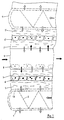
- FIG. 2 The structure of the bioreactor is shown schematically in FIG. 2.
- the black arrows represent represents the path or the direction of flow of the culture medium, while the white arrows represent the course of the oxygen. The same applies to the other arrow representations in FIGS. 1 and 4.
- Oxygen is introduced via a common oxygen line 23, which is explained in more detail in connection with FIG. 4.
- Culture medium is also supplied to all gap spaces 9 in a uniform distribution via a common line 18.
- FIG. 4 The overall structure of the bioreactor can be seen from FIG. 4. As shown, a plurality of cell culture carriers 1 are spaced one above the other, sealing rings in the form of silicone sealing rings 10, which are placed around the oxygen bores 4 of each plate, both for maintaining a distance between the plates 1 and for sealing between the liquid phase (venous) and the gas phase (arterial).
- the choice of the size or the thickness of the silicone sealing rings 10, which are pressed during the assembly of the plates, also ensures that a capillary gap 9 remains between the plates and thus forms the "sinusoid".
- the supply of oxygen into the housing 11 of the bioreactor takes place via an oxygen line 23 into the oxygen bores 4 of the cell culture carriers 1, which are aligned one above the other. In this way, there is sufficient space between the bore walls of the oxygen bores 4 and the rod 12 for introducing oxygen (see FIG. 3).
- the staff 12 is provided with a central bore 13 through which a clamping screw is inserted, which, in a manner not shown, together with a lock nut or counter plate 14 on the underside, ensures a connection and a gas-tight bracing of the silicone sealing rings 10.
- a cone for example a glass cone 15, is inserted into the free space created by the central openings 3 of the cell culture carrier 1 lying one above the other in alignment.
- the glass cone 15 has a smaller diameter than the diameter of the central openings 3, which creates a gap 16. Since the cone 15 tapers upwards, the gap 16 is enlarged in this way, which ensures a good and uniform drainage of the culture medium via a common drain line 17.
- the culture medium flows on both sides of the bioreactor via inlet lines 18 into the housing 11 and from there peripherally along the gap space 9 inwards, where it flows out via the gap space 16.
- the culture medium can be circulated, a collection reservoir 19 and a subsequent pump 20 being provided, which leads the culture medium back to the feed lines 18 via the line shown in broken lines.
- a filter device for separating undesired constituents from the culture medium occurring from the bioreactor can also be arranged in the circuit line.
- the oxygen, 5% carbon dioxide can be added to the bioreactor via a preheater 21 and a humidifier 22.
- the air leaving the bioreactor can be passed through a water column. In this way, an exchange of carbon dioxide with the surrounding air is prevented, whereby the desired high carbon dioxide content can be practically stabilized in a kind of closed system.
- FIG. 5 shows a constructive embodiment of a disk-shaped cell culture carrier 1, which preferably consists of a non-toxic plastic.
- An outer ring body 24 and an inner ring body 25, which surrounds the central bore 3, serve as the supporting frame.
- the connection of the two ring bodies 24 and 25 to one another takes place by means of spoke-shaped ribs 26.
- the supply openings 4 for oxygen are arranged in two opposite ribs 26.
- This support frame is covered on the top and on the bottom by a transparent membrane, e.g. a Teflon film, spanned. So that the oxygen is evenly distributed in the interior of the cell culture carrier 1, the ribs 26 are each provided with one or more air guiding channels 27 on their surfaces (top and bottom), which each penetrate the width of the ribs.
- the thicknesses or spacings of the individual layers are to be selected depending on the cell cultures to be treated. For the cultivation of hepatocytes, thicknesses of approximately 0.5 mm have proven to be very suitable for the cell culture carrier 1, the gas-permeable surface layer or the sintered band possibly being only 0.1 mm or less. For the two collagen layers have been found to be suitable in each case thicknesses of 0.4 to 0.6 mm, preferably 0.5 mm.
- the cell culture layer can have a thickness of 0.002 to 0.003 mm. A few tenths of a millimeter are also sufficient for gap space 9.
- the liver of a 250 g rat would contain 800 million to 1 billion hepatocytes in 8 to 10 g.
- the capacity of a bioreactor with an internal height of approx. 30 mm and a diameter of the plate-shaped cell culture supports of approx. 10 to 15 cm is sufficient for this.
Landscapes
- Health & Medical Sciences (AREA)
- Wood Science & Technology (AREA)
- Organic Chemistry (AREA)
- Life Sciences & Earth Sciences (AREA)
- Engineering & Computer Science (AREA)
- Bioinformatics & Cheminformatics (AREA)
- Chemical & Material Sciences (AREA)
- Zoology (AREA)
- Biomedical Technology (AREA)
- Sustainable Development (AREA)
- Microbiology (AREA)
- Biotechnology (AREA)
- Biochemistry (AREA)
- General Engineering & Computer Science (AREA)
- General Health & Medical Sciences (AREA)
- Genetics & Genomics (AREA)
- Clinical Laboratory Science (AREA)
- Immunology (AREA)
- Apparatus Associated With Microorganisms And Enzymes (AREA)
- Micro-Organisms Or Cultivation Processes Thereof (AREA)
- Cultivation Receptacles Or Flower-Pots, Or Pots For Seedlings (AREA)
Applications Claiming Priority (3)
| Application Number | Priority Date | Filing Date | Title |
|---|---|---|---|
| DE4206585 | 1992-03-03 | ||
| DE4206585A DE4206585C2 (de) | 1992-03-03 | 1992-03-03 | Vorrichtung zur Massenkultur von Zellen |
| PCT/EP1993/000468 WO1993018133A1 (de) | 1992-03-03 | 1993-03-02 | Vorrichtung zur behandlung von zellkulturen |
Publications (2)
| Publication Number | Publication Date |
|---|---|
| EP0629237A1 EP0629237A1 (de) | 1994-12-21 |
| EP0629237B1 true EP0629237B1 (de) | 1995-12-20 |
Family
ID=6453071
Family Applications (1)
| Application Number | Title | Priority Date | Filing Date |
|---|---|---|---|
| EP93906477A Expired - Lifetime EP0629237B1 (de) | 1992-03-03 | 1993-03-02 | Vorrichtung zur behandlung von zellkulturen |
Country Status (12)
| Country | Link |
|---|---|
| US (1) | US5658797A (da) |
| EP (1) | EP0629237B1 (da) |
| JP (1) | JP3176628B2 (da) |
| AT (1) | ATE131867T1 (da) |
| AU (1) | AU668922B2 (da) |
| CA (1) | CA2129648C (da) |
| DE (2) | DE4206585C2 (da) |
| DK (1) | DK0629237T3 (da) |
| ES (1) | ES2083851T3 (da) |
| GR (1) | GR3019255T3 (da) |
| NO (1) | NO315005B1 (da) |
| WO (1) | WO1993018133A1 (da) |
Cited By (1)
| Publication number | Priority date | Publication date | Assignee | Title |
|---|---|---|---|---|
| DE102010064098A1 (de) | 2010-12-23 | 2012-06-28 | Universität Rostock | Zellreaktor |
Families Citing this family (61)
| Publication number | Priority date | Publication date | Assignee | Title |
|---|---|---|---|---|
| US5595909A (en) * | 1988-05-23 | 1997-01-21 | Regents Of The University Of Minnesota | Filter device |
| ATE225847T1 (de) * | 1992-03-04 | 2002-10-15 | Univ Michigan | Verfahren,zusammensetzungen und vorrichtungen zur erhaltung und zur züchtung menschlicher stammzellen und/oder hämatopoetischer zellen |
| DE4222345A1 (de) * | 1992-07-08 | 1994-01-13 | Augustinus Dr Med Bader | Verfahren zum Züchten einer Zellart im Kokulturverfahren mit Leberzellen |
| DE4322746A1 (de) * | 1993-07-08 | 1995-01-12 | Augustinus Dr Med Bader | Verfahren und Vorrichtung zur Behandlung von Zellkulturen |
| DE4336399A1 (de) * | 1993-10-26 | 1995-04-27 | Augustinus Dr Med Bader | Verfahren zur Verbesserung der Matrixbedingungen bipolar adhärierter Hepatozyten und zur Herstellung eines entsprechend konfigurierten Zellkulturkits |
| BE1009306A5 (fr) * | 1995-04-28 | 1997-02-04 | Baxter Int | Bioreacteur. |
| US7266725B2 (en) | 2001-09-03 | 2007-09-04 | Pact Xpp Technologies Ag | Method for debugging reconfigurable architectures |
| DE19704728A1 (de) | 1997-02-08 | 1998-08-13 | Pact Inf Tech Gmbh | Verfahren zur Selbstsynchronisation von konfigurierbaren Elementen eines programmierbaren Bausteines |
| US5955353A (en) * | 1997-05-22 | 1999-09-21 | Excorp Medical, Inc. | Hollow fiber bioreactor with an extrafilament flow plug |
| US6107085A (en) * | 1997-07-11 | 2000-08-22 | Corning Incorporated | Self contained cell growth system |
| DE69903800T2 (de) | 1998-03-18 | 2003-10-02 | Massachusetts Institute Of Technology, Cambridge | Vaskularisierte perfundierte anordnungen für mikrogewebe und mikroorgane |
| AT407047B (de) * | 1998-08-03 | 2000-11-27 | Pfaller Walter Dr | Zellkulturvorrichtung |
| DE19919242A1 (de) * | 1999-04-28 | 2000-11-02 | Creavis Tech & Innovation Gmbh | Modulare Zellträgersysteme für dreidimensionales Zellwachstum |
| DE19919241A1 (de) * | 1999-04-28 | 2000-11-02 | Creavis Tech & Innovation Gmbh | 3D Zellträgersystem für Zell-, Gewebe- und Organkulturen |
| WO2000078920A1 (en) * | 1999-06-21 | 2000-12-28 | The General Hospital Corporation | Methods and devices for cell culturing and organ assist systems |
| DE60036385T2 (de) | 1999-06-21 | 2008-06-26 | The General Hospital Corp., Boston | Zellkultursysteme und verfahren für einrichtungen zur organunterstützung |
| EP1200110B1 (en) | 1999-07-22 | 2014-04-23 | Organogenesis Inc. | In vivo induction for enhanced function of isolated hepatocytes |
| JP3865354B2 (ja) | 2000-03-02 | 2007-01-10 | 高木産業株式会社 | 細胞又は組織の培養方法 |
| KR100404296B1 (ko) * | 2000-06-26 | 2003-11-07 | 임승완 | 맥류 배지 조직 배양 방법 및 맥류 배지 조직 배양 장치 |
| EP1174497B1 (fr) * | 2000-07-19 | 2004-09-08 | Technodop Ltd. (Société de Droit Irlandais) | Chambre de culture cellulaire et bioréacteur pour la culture extracorporelle de cellules animales |
| US7581076B2 (en) * | 2001-03-05 | 2009-08-25 | Pact Xpp Technologies Ag | Methods and devices for treating and/or processing data |
| WO2003060061A1 (en) * | 2001-12-21 | 2003-07-24 | Organogenesis Inc. | Chamber with adjustable volume for cell culture and organ assist |
| WO2003071432A2 (de) | 2002-02-18 | 2003-08-28 | Pact Xpp Technologies Ag | Bussysteme und rekonfigurationsverfahren |
| EP1490520A4 (en) * | 2002-03-12 | 2006-06-07 | Surface Logix Inc | TEST APPARATUS ANALYZING THE ABSORPTION, METABOLISM, PERMEABILITY AND / OR TOXICITY OF A CANDIDATE COMPOUND |
| US7160719B2 (en) * | 2002-06-07 | 2007-01-09 | Mayo Foundation For Medical Education And Research | Bioartificial liver system |
| CN101120083B (zh) | 2003-10-08 | 2013-03-27 | 威尔森沃尔夫制造公司 | 利用透气性材料进行细胞培养的方法及装置 |
| US7951555B2 (en) * | 2004-05-18 | 2011-05-31 | Australian Nuclear Science And Technology Organisation | Membrane bioreactor |
| CN101061213B (zh) * | 2004-05-19 | 2012-12-19 | 麻省理工学院 | 灌注的三维细胞/组织疾病模型 |
| US7531351B2 (en) * | 2004-06-14 | 2009-05-12 | Probiogen Ag | Liquid-gas-phase exposure reactor for cell culturing |
| US8257964B2 (en) | 2006-01-04 | 2012-09-04 | Cell ASIC | Microwell cell-culture device and fabrication method |
| US9637715B2 (en) | 2005-07-07 | 2017-05-02 | Emd Millipore Corporation | Cell culture and invasion assay method and system |
| US9354156B2 (en) | 2007-02-08 | 2016-05-31 | Emd Millipore Corporation | Microfluidic particle analysis method, device and system |
| US9388374B2 (en) | 2005-07-07 | 2016-07-12 | Emd Millipore Corporation | Microfluidic cell culture systems |
| EP3029135B1 (en) | 2005-07-07 | 2021-03-17 | The Regents of the University of California | Apparatus for cell culture array |
| US7745209B2 (en) * | 2005-07-26 | 2010-06-29 | Corning Incorporated | Multilayered cell culture apparatus |
| EP1913126B1 (en) | 2005-08-12 | 2019-09-25 | Clemson University Research Foundation | Co-culture bioreactor system |
| US7745210B2 (en) * | 2006-06-30 | 2010-06-29 | Corning Incorporated | Fluid flow diverter for cell culture vessel |
| US20080176318A1 (en) | 2006-12-07 | 2008-07-24 | Wilson John R | Highly efficient devices and methods for culturing cells |
| US7897379B2 (en) * | 2007-02-26 | 2011-03-01 | Corning Incorporated | Device and method for reducing bubble formation in cell culture |
| US9309491B2 (en) * | 2007-05-29 | 2016-04-12 | Corning Incorporated | Cell culture apparatus for co-culture of cells |
| EP3173787B1 (en) | 2008-01-03 | 2021-06-02 | EMD Millipore Corporation | Cell culture array system for automated assays and methods of operation and manufacture thereof |
| WO2009108654A2 (en) * | 2008-02-25 | 2009-09-03 | Clemson University | Differential pressure pump system |
| CN102421467B (zh) | 2009-03-13 | 2015-04-22 | 梅约医学教育与研究基金会 | 生物人工肝 |
| US8778669B2 (en) * | 2009-07-22 | 2014-07-15 | Corning Incorporated | Multilayer tissue culture vessel |
| US9353342B2 (en) | 2010-01-21 | 2016-05-31 | Emd Millipore Corporation | Cell culture and gradient migration assay methods and devices |
| DE102010005415B4 (de) | 2010-01-22 | 2015-07-16 | Zellwerk Gmbh | Verfahren und Vorrichtung zur dynamischen Expansion und/oder Differenzierung von suspendierten primären Zellen oder Stammzellen humanen und tierischen Ursprungs |
| WO2011141512A2 (en) * | 2010-05-11 | 2011-11-17 | Artelis S.A. | Apparatus and methods for cell culture |
| US10526572B2 (en) | 2011-04-01 | 2020-01-07 | EMD Millipore Corporaticn | Cell culture and invasion assay method and system |
| DE102011106914B4 (de) | 2011-07-08 | 2015-08-27 | Zellwerk Gmbh | Mäander- Bioreaktor und Verfahren zu dynamischen Expansion, Differenzierung und Ernte von hämatopoetischen Zellen |
| NL2007734C2 (nl) * | 2011-11-07 | 2013-05-08 | Tulip Life Science Products B V | Inrichting voor het kweken van cellen. |
| CN107345204B (zh) | 2011-12-03 | 2021-02-12 | Emd密理博公司 | 用于微流体细胞培养的微型培育系统和方法 |
| US9005550B2 (en) | 2012-10-29 | 2015-04-14 | Corning Incorporated | Multi-layered cell culture vessel with manifold grips |
| US11136542B2 (en) | 2016-02-23 | 2021-10-05 | Corning Incorporated | Perfusion bioreactor and method for using same to perform a continuous cell culture |
| WO2020069607A1 (en) | 2018-10-01 | 2020-04-09 | Membio Inc. | Cell culture bioreactor |
| WO2020177789A1 (de) | 2019-03-06 | 2020-09-10 | Zellwerk Gmbh | Zellkulturträger für bioreaktoren |
| DE202019001093U1 (de) | 2019-03-06 | 2019-04-11 | Zellwerk Gmbh | Zellkulturträger für Bioreaktoren |
| DE102019001604B4 (de) | 2019-03-06 | 2020-12-24 | Zellwerk Gmbh | Zellkulturträger für Bioreaktoren |
| WO2021155469A1 (en) | 2020-02-05 | 2021-08-12 | Membio Inc. | Cell culture bioreactor with zone control |
| DE102022000456B3 (de) | 2022-02-05 | 2023-04-20 | Zellwerk Gmbh | Plattenmäander- Bioreaktor für die Isolierung und Vermehrung von Zellen, insbesondere von adhärent wachsenden mesenchymalen Stoma-Zellen |
| DE102023002232B3 (de) | 2023-06-01 | 2024-06-13 | Zellwerk Gmbh | Perfusions- Plattenmäander- Bioreaktor für die Expansion von Zellen |
| WO2025235426A1 (en) * | 2024-05-06 | 2025-11-13 | Sunflower Therapeutics, Pbc | Internal support system for a stirred tank reactor |
Family Cites Families (14)
| Publication number | Priority date | Publication date | Assignee | Title |
|---|---|---|---|---|
| US3948732A (en) * | 1973-05-31 | 1976-04-06 | Instrumentation Laboratory, Inc. | Cell culture assembly |
| US4201845A (en) * | 1976-04-12 | 1980-05-06 | Monsanto Company | Cell culture reactor |
| DE2726313C3 (de) * | 1977-06-10 | 1980-02-07 | Battelle-Institut E.V., 6000 Frankfurt | Verfahren zur in-vitro-Biosynthese von Hormonen, insbesondere von Insulin |
| US4661458A (en) * | 1983-08-31 | 1987-04-28 | Cell Environmental Systems, Ltd. | Cell culture system |
| US4748124A (en) * | 1984-10-30 | 1988-05-31 | E. I. Du Pont De Nemours And Company | Compartmentalized cell-culture device and method |
| US4661455A (en) * | 1986-01-16 | 1987-04-28 | Dorr-Oliver Incorporated | Membrane cell culturing device |
| US6022742A (en) * | 1986-11-26 | 2000-02-08 | Kopf; Henry B. | Culture device and method |
| US5037656A (en) * | 1986-12-04 | 1991-08-06 | Millipore Corporation | Porous membrane having hydrophilic and cell growth promotions surface and process |
| KR0131822B1 (ko) * | 1988-05-23 | 1998-04-11 | 죤 에프. 튜은트 | 바이오 반응기 장치 |
| JPH0292270A (ja) * | 1988-09-30 | 1990-04-03 | Terumo Corp | 細胞培養装置 |
| WO1990012604A1 (en) * | 1989-04-25 | 1990-11-01 | Vacanti Joseph P | Method for implanting large volumes of cells on polymeric matrices |
| US4996154A (en) * | 1989-05-04 | 1991-02-26 | Millipore Corporation | Method for growing cellular tissue |
| US5316945A (en) * | 1991-12-14 | 1994-05-31 | Will Minuth | Cell carrier arrangement |
| DE4200446C2 (de) * | 1991-12-14 | 1994-04-07 | Will Prof Dr Minuth | Zellträgeranordnung |
-
1992
- 1992-03-03 DE DE4206585A patent/DE4206585C2/de not_active Expired - Fee Related
-
1993
- 1993-03-02 EP EP93906477A patent/EP0629237B1/de not_active Expired - Lifetime
- 1993-03-02 AU AU37456/93A patent/AU668922B2/en not_active Ceased
- 1993-03-02 DE DE59301218T patent/DE59301218D1/de not_active Expired - Fee Related
- 1993-03-02 DK DK93906477.0T patent/DK0629237T3/da active
- 1993-03-02 AT AT93906477T patent/ATE131867T1/de not_active IP Right Cessation
- 1993-03-02 ES ES93906477T patent/ES2083851T3/es not_active Expired - Lifetime
- 1993-03-02 US US08/295,732 patent/US5658797A/en not_active Expired - Lifetime
- 1993-03-02 CA CA002129648A patent/CA2129648C/en not_active Expired - Lifetime
- 1993-03-02 JP JP51530693A patent/JP3176628B2/ja not_active Expired - Fee Related
- 1993-03-02 WO PCT/EP1993/000468 patent/WO1993018133A1/de not_active Ceased
-
1994
- 1994-09-01 NO NO19943242A patent/NO315005B1/no unknown
-
1996
- 1996-03-11 GR GR960400654T patent/GR3019255T3/el unknown
Cited By (1)
| Publication number | Priority date | Publication date | Assignee | Title |
|---|---|---|---|---|
| DE102010064098A1 (de) | 2010-12-23 | 2012-06-28 | Universität Rostock | Zellreaktor |
Also Published As
| Publication number | Publication date |
|---|---|
| JPH07504325A (ja) | 1995-05-18 |
| CA2129648C (en) | 2009-08-11 |
| JP3176628B2 (ja) | 2001-06-18 |
| ES2083851T3 (es) | 1996-04-16 |
| AU668922B2 (en) | 1996-05-23 |
| NO315005B1 (no) | 2003-06-23 |
| GR3019255T3 (en) | 1996-06-30 |
| US5658797A (en) | 1997-08-19 |
| DE4206585C2 (de) | 1994-11-24 |
| NO943242D0 (no) | 1994-09-01 |
| DK0629237T3 (da) | 1996-04-09 |
| WO1993018133A1 (de) | 1993-09-16 |
| DE59301218D1 (de) | 1996-02-01 |
| ATE131867T1 (de) | 1996-01-15 |
| CA2129648A1 (en) | 1993-09-16 |
| DE4206585A1 (de) | 1993-09-09 |
| NO943242L (no) | 1994-09-01 |
| AU3745693A (en) | 1993-10-05 |
| EP0629237A1 (de) | 1994-12-21 |
Similar Documents
| Publication | Publication Date | Title |
|---|---|---|
| EP0629237B1 (de) | Vorrichtung zur behandlung von zellkulturen | |
| EP0983341B1 (de) | Vorrichtung zum züchten und/oder behandeln von zellen | |
| DE2715821C2 (de) | Verfahren zur in vitro-Zellkultur und Zellkultur-Reaktionsgefäß zur Durchführung dieses Verfahrens | |
| DE69608437T2 (de) | Bioreaktor | |
| EP0590341B1 (de) | Modul zur Züchtung und zur Nutzung der Stoffwechselleistung und/oder zum Erhalt von Mikroorganismen | |
| DE3837226C2 (de) | Perfusionsgerät zum Züchten und Erhalten von Hepatocyten | |
| EP1319062B1 (de) | Verfahren und vorrichtung zum züchten und/oder behandeln von zellen | |
| EP0605527B1 (de) | Substrat für zellkulturen | |
| DE69214391T2 (de) | Zellkultur Apparat | |
| DE60037370T2 (de) | Sinusförmiges Zellkulturmodul zur Kultivierung von Hepatozyten | |
| DE69810740T2 (de) | Bioreaktor | |
| DE2128744C3 (de) | Verfahren zur Massenkultivation von Zellen und Geweben | |
| EP1152053B1 (de) | Verfahren und Vorrichtung zur Herstellung eines vaskularisierten bioartifiziellen Gewebes | |
| DE19537774C2 (de) | Verfahren zur Zellkultivierung und Vorrichtung zur Durchführung des Verfahrens | |
| DE68926858T2 (de) | Zellkultureinheit mit OXYGENATOR FÜR ZUCHTMEDIUM | |
| AT506826B1 (de) | Bioreaktor und verfahren zum kultivieren von zellen und geweben | |
| DE60013277T2 (de) | Design eines bioreaktors und verfahren zur manipulation von zellgewebe | |
| DE69303779T2 (de) | Biologische künstliche leber | |
| EP1198555B1 (de) | Vorrichtung zum züchten und/oder behandeln von zellen | |
| DE68921974T2 (de) | Bioreaktor. | |
| DE19919242A1 (de) | Modulare Zellträgersysteme für dreidimensionales Zellwachstum | |
| DE19919241A1 (de) | 3D Zellträgersystem für Zell-, Gewebe- und Organkulturen | |
| DE29923810U1 (de) | Vorrichtung zum Züchten und/oder Behandeln von Zellen | |
| DE102023201202A1 (de) | Vorrichtung zur Kultivierung eines Gewebeschnitts |
Legal Events
| Date | Code | Title | Description |
|---|---|---|---|
| PUAI | Public reference made under article 153(3) epc to a published international application that has entered the european phase |
Free format text: ORIGINAL CODE: 0009012 |
|
| 17P | Request for examination filed |
Effective date: 19940802 |
|
| AK | Designated contracting states |
Kind code of ref document: A1 Designated state(s): AT BE CH DE DK ES FR GB GR IE IT LI LU MC NL PT SE |
|
| 17Q | First examination report despatched |
Effective date: 19950228 |
|
| GRAA | (expected) grant |
Free format text: ORIGINAL CODE: 0009210 |
|
| AK | Designated contracting states |
Kind code of ref document: B1 Designated state(s): AT BE CH DE DK ES FR GB GR IE IT LI LU MC NL PT SE |
|
| REF | Corresponds to: |
Ref document number: 131867 Country of ref document: AT Date of ref document: 19960115 Kind code of ref document: T |
|
| REG | Reference to a national code |
Ref country code: IE Ref legal event code: FG4D Free format text: 66636 |
|
| REF | Corresponds to: |
Ref document number: 59301218 Country of ref document: DE Date of ref document: 19960201 |
|
| PGFP | Annual fee paid to national office [announced via postgrant information from national office to epo] |
Ref country code: MC Payment date: 19960222 Year of fee payment: 4 |
|
| PGFP | Annual fee paid to national office [announced via postgrant information from national office to epo] |
Ref country code: PT Payment date: 19960229 Year of fee payment: 4 |
|
| PGFP | Annual fee paid to national office [announced via postgrant information from national office to epo] |
Ref country code: LU Payment date: 19960301 Year of fee payment: 4 |
|
| PGFP | Annual fee paid to national office [announced via postgrant information from national office to epo] |
Ref country code: GR Payment date: 19960311 Year of fee payment: 4 |
|
| PGFP | Annual fee paid to national office [announced via postgrant information from national office to epo] |
Ref country code: ES Payment date: 19960318 Year of fee payment: 4 |
|
| ITF | It: translation for a ep patent filed | ||
| GBT | Gb: translation of ep patent filed (gb section 77(6)(a)/1977) |
Effective date: 19960226 |
|
| REG | Reference to a national code |
Ref country code: DK Ref legal event code: T3 |
|
| ET | Fr: translation filed | ||
| PGFP | Annual fee paid to national office [announced via postgrant information from national office to epo] |
Ref country code: CH Payment date: 19960415 Year of fee payment: 4 |
|
| REG | Reference to a national code |
Ref country code: CH Ref legal event code: NV Representative=s name: CABINET ROLAND NITHARDT CONSEILS EN PROPRIETE INDU |
|
| REG | Reference to a national code |
Ref country code: ES Ref legal event code: FG2A Ref document number: 2083851 Country of ref document: ES Kind code of ref document: T3 |
|
| REG | Reference to a national code |
Ref country code: GR Ref legal event code: FG4A Free format text: 3019255 |
|
| SC4A | Pt: translation is available |
Free format text: 960216 AVAILABILITY OF NATIONAL TRANSLATION |
|
| PLBE | No opposition filed within time limit |
Free format text: ORIGINAL CODE: 0009261 |
|
| STAA | Information on the status of an ep patent application or granted ep patent |
Free format text: STATUS: NO OPPOSITION FILED WITHIN TIME LIMIT |
|
| 26N | No opposition filed | ||
| PG25 | Lapsed in a contracting state [announced via postgrant information from national office to epo] |
Ref country code: LU Free format text: LAPSE BECAUSE OF NON-PAYMENT OF DUE FEES Effective date: 19970302 |
|
| PG25 | Lapsed in a contracting state [announced via postgrant information from national office to epo] |
Ref country code: ES Free format text: LAPSE BECAUSE OF NON-PAYMENT OF DUE FEES Effective date: 19970303 |
|
| PG25 | Lapsed in a contracting state [announced via postgrant information from national office to epo] |
Ref country code: LI Effective date: 19970331 Ref country code: CH Effective date: 19970331 |
|
| PG25 | Lapsed in a contracting state [announced via postgrant information from national office to epo] |
Ref country code: PT Effective date: 19970930 Ref country code: MC Effective date: 19970930 Ref country code: GR Free format text: THE PATENT HAS BEEN ANNULLED BY A DECISION OF A NATIONAL AUTHORITY Effective date: 19970930 |
|
| REG | Reference to a national code |
Ref country code: GR Ref legal event code: MM2A Free format text: 3019255 |
|
| REG | Reference to a national code |
Ref country code: CH Ref legal event code: PL |
|
| REG | Reference to a national code |
Ref country code: PT Ref legal event code: MM4A Free format text: LAPSE DUE TO NON-PAYMENT OF FEES Effective date: 19970930 |
|
| REG | Reference to a national code |
Ref country code: ES Ref legal event code: FD2A Effective date: 19990503 |
|
| NLS | Nl: assignments of ep-patents |
Owner name: ORGANOGENESIS INC.;BAXTER HEALTHCARE CORPORATION |
|
| REG | Reference to a national code |
Ref country code: GB Ref legal event code: 732E |
|
| BECA | Be: change of holder's address |
Free format text: 20000921 *ORGANOGENESIS INC.:150 DAN ROAD, CANTON MASSACHUSETTS |
|
| BECH | Be: change of holder |
Free format text: 20000921 *ORGANOGENESIS INC.:150 DAN ROAD, CANTON MASSACHUSETTS |
|
| REG | Reference to a national code |
Ref country code: GB Ref legal event code: IF02 |
|
| REG | Reference to a national code |
Ref country code: FR Ref legal event code: TP |
|
| REG | Reference to a national code |
Ref country code: FR Ref legal event code: TP |
|
| PGFP | Annual fee paid to national office [announced via postgrant information from national office to epo] |
Ref country code: AT Payment date: 20060321 Year of fee payment: 14 |
|
| PGFP | Annual fee paid to national office [announced via postgrant information from national office to epo] |
Ref country code: SE Payment date: 20060329 Year of fee payment: 14 Ref country code: IE Payment date: 20060329 Year of fee payment: 14 |
|
| PGFP | Annual fee paid to national office [announced via postgrant information from national office to epo] |
Ref country code: DK Payment date: 20060331 Year of fee payment: 14 |
|
| PGFP | Annual fee paid to national office [announced via postgrant information from national office to epo] |
Ref country code: BE Payment date: 20060427 Year of fee payment: 14 |
|
| PGFP | Annual fee paid to national office [announced via postgrant information from national office to epo] |
Ref country code: NL Payment date: 20060515 Year of fee payment: 14 |
|
| PG25 | Lapsed in a contracting state [announced via postgrant information from national office to epo] |
Ref country code: SE Free format text: LAPSE BECAUSE OF NON-PAYMENT OF DUE FEES Effective date: 20070303 |
|
| PGFP | Annual fee paid to national office [announced via postgrant information from national office to epo] |
Ref country code: DE Payment date: 20070831 Year of fee payment: 15 |
|
| REG | Reference to a national code |
Ref country code: DK Ref legal event code: EBP |
|
| EUG | Se: european patent has lapsed | ||
| PG25 | Lapsed in a contracting state [announced via postgrant information from national office to epo] |
Ref country code: AT Free format text: LAPSE BECAUSE OF NON-PAYMENT OF DUE FEES Effective date: 20070302 |
|
| NLV4 | Nl: lapsed or anulled due to non-payment of the annual fee |
Effective date: 20071001 |
|
| REG | Reference to a national code |
Ref country code: IE Ref legal event code: MM4A |
|
| BERE | Be: lapsed |
Owner name: *ORGANOGENESIS INC. Effective date: 20070331 |
|
| PG25 | Lapsed in a contracting state [announced via postgrant information from national office to epo] |
Ref country code: BE Free format text: LAPSE BECAUSE OF NON-PAYMENT OF DUE FEES Effective date: 20070331 |
|
| PGFP | Annual fee paid to national office [announced via postgrant information from national office to epo] |
Ref country code: GB Payment date: 20070830 Year of fee payment: 15 |
|
| PG25 | Lapsed in a contracting state [announced via postgrant information from national office to epo] |
Ref country code: NL Free format text: LAPSE BECAUSE OF NON-PAYMENT OF DUE FEES Effective date: 20071001 Ref country code: IE Free format text: LAPSE BECAUSE OF NON-PAYMENT OF DUE FEES Effective date: 20070302 |
|
| PGFP | Annual fee paid to national office [announced via postgrant information from national office to epo] |
Ref country code: IT Payment date: 20070830 Year of fee payment: 15 |
|
| PG25 | Lapsed in a contracting state [announced via postgrant information from national office to epo] |
Ref country code: DK Free format text: LAPSE BECAUSE OF NON-PAYMENT OF DUE FEES Effective date: 20070402 |
|
| PGFP | Annual fee paid to national office [announced via postgrant information from national office to epo] |
Ref country code: FR Payment date: 20070817 Year of fee payment: 15 |
|
| GBPC | Gb: european patent ceased through non-payment of renewal fee |
Effective date: 20080302 |
|
| REG | Reference to a national code |
Ref country code: FR Ref legal event code: ST Effective date: 20081125 |
|
| PG25 | Lapsed in a contracting state [announced via postgrant information from national office to epo] |
Ref country code: DE Free format text: LAPSE BECAUSE OF NON-PAYMENT OF DUE FEES Effective date: 20081001 |
|
| PG25 | Lapsed in a contracting state [announced via postgrant information from national office to epo] |
Ref country code: FR Free format text: LAPSE BECAUSE OF NON-PAYMENT OF DUE FEES Effective date: 20080331 |
|
| PG25 | Lapsed in a contracting state [announced via postgrant information from national office to epo] |
Ref country code: GB Free format text: LAPSE BECAUSE OF NON-PAYMENT OF DUE FEES Effective date: 20080302 |
|
| PG25 | Lapsed in a contracting state [announced via postgrant information from national office to epo] |
Ref country code: IT Free format text: LAPSE BECAUSE OF NON-PAYMENT OF DUE FEES Effective date: 20080302 |