EP0631468B2 - Appareil de traite a dispositif a pression variable - Google Patents
Appareil de traite a dispositif a pression variable Download PDFInfo
- Publication number
- EP0631468B2 EP0631468B2 EP92925466A EP92925466A EP0631468B2 EP 0631468 B2 EP0631468 B2 EP 0631468B2 EP 92925466 A EP92925466 A EP 92925466A EP 92925466 A EP92925466 A EP 92925466A EP 0631468 B2 EP0631468 B2 EP 0631468B2
- Authority
- EP
- European Patent Office
- Prior art keywords
- pressure
- pulsation
- during
- liner
- milking interval
- Prior art date
- Legal status (The legal status is an assumption and is not a legal conclusion. Google has not performed a legal analysis and makes no representation as to the accuracy of the status listed.)
- Expired - Lifetime
Links
- 230000010349 pulsation Effects 0.000 claims abstract description 236
- 230000007704 transition Effects 0.000 claims abstract description 107
- 230000008859 change Effects 0.000 claims abstract description 56
- 230000035515 penetration Effects 0.000 claims abstract description 8
- 210000004080 milk Anatomy 0.000 claims description 52
- 239000008267 milk Substances 0.000 claims description 52
- 235000013336 milk Nutrition 0.000 claims description 52
- 238000000034 method Methods 0.000 claims description 23
- 241000124008 Mammalia Species 0.000 claims description 14
- 230000007423 decrease Effects 0.000 claims description 11
- 230000003247 decreasing effect Effects 0.000 claims description 9
- 230000004044 response Effects 0.000 claims description 4
- 230000000977 initiatory effect Effects 0.000 claims description 2
- 238000004904 shortening Methods 0.000 abstract description 3
- 210000002445 nipple Anatomy 0.000 description 68
- 210000000078 claw Anatomy 0.000 description 6
- 230000019989 milk ejection Effects 0.000 description 5
- 230000011514 reflex Effects 0.000 description 5
- 239000012530 fluid Substances 0.000 description 4
- 230000002045 lasting effect Effects 0.000 description 3
- 238000012163 sequencing technique Methods 0.000 description 3
- 230000008961 swelling Effects 0.000 description 3
- 210000001519 tissue Anatomy 0.000 description 3
- 241000283690 Bos taurus Species 0.000 description 2
- 230000009471 action Effects 0.000 description 2
- 210000003484 anatomy Anatomy 0.000 description 2
- 230000001934 delay Effects 0.000 description 2
- 230000000694 effects Effects 0.000 description 2
- 210000004907 gland Anatomy 0.000 description 2
- 230000009467 reduction Effects 0.000 description 2
- 230000003248 secreting effect Effects 0.000 description 2
- 206010030113 Oedema Diseases 0.000 description 1
- 238000013459 approach Methods 0.000 description 1
- 230000009286 beneficial effect Effects 0.000 description 1
- 239000008280 blood Substances 0.000 description 1
- 210000004369 blood Anatomy 0.000 description 1
- 210000000481 breast Anatomy 0.000 description 1
- 230000001419 dependent effect Effects 0.000 description 1
- 238000005516 engineering process Methods 0.000 description 1
- 210000002751 lymph Anatomy 0.000 description 1
- QSHDDOUJBYECFT-UHFFFAOYSA-N mercury Chemical compound [Hg] QSHDDOUJBYECFT-UHFFFAOYSA-N 0.000 description 1
- 229910052753 mercury Inorganic materials 0.000 description 1
- 238000012986 modification Methods 0.000 description 1
- 230000004048 modification Effects 0.000 description 1
- 238000012544 monitoring process Methods 0.000 description 1
- 230000003252 repetitive effect Effects 0.000 description 1
- 238000007493 shaping process Methods 0.000 description 1
- 230000000638 stimulation Effects 0.000 description 1
- 230000036962 time dependent Effects 0.000 description 1
- 238000002604 ultrasonography Methods 0.000 description 1
Images



Classifications
-
- A—HUMAN NECESSITIES
- A01—AGRICULTURE; FORESTRY; ANIMAL HUSBANDRY; HUNTING; TRAPPING; FISHING
- A01J—MANUFACTURE OF DAIRY PRODUCTS
- A01J5/00—Milking machines or devices
- A01J5/007—Monitoring milking processes; Control or regulation of milking machines
Definitions
- the invention relates to a method and apparatus for milking mammals, including cows.
- Milking systems withdraw milk from the milk secreting glands of mammals by applying negative pressure (pressure below atmospheric pressure), i.e. vacuum, to the teat.
- a plurality of teat cups are provided, each having a liner, or inflation, around a respective teat, and defining a milk flow passage within the liner below the teat, and a pulsation chamber outside the liner between the liner and the teat cup.
- the milk flow passage within the liner supplies milk to a milking claw which also receives milk from the milk flow passages of the other liners of the other teat cups.
- a two-way valve alternates between a first condition connecting a negative pressure source, i.e. vacuum, to the pulsation chamber, and a second condition supplying atmospheric or higher pressure to the pulsation chamber.
- the two-way valve provides a pulsation cycle having an on portion during the first condition of the valve, and an off portion during the second condition of the valve.
- the valve or pulsator simply transfers the pulsation chamber connection between two alternative sources, namely vacuum and atmosphere.
- milking apparatus for milking a mammal, comprising the features of claim 20.
- the pulsator is replaced with a variable pressure source, and a controllably variable pressure is supplied to the pulsation chamber.
- the pressure is varied along a controllably variable pressure curve of selectable waveshape.
- the pulsation cycle is shortened by shortening the transition time between first and second pressure levels providing on and off portions of the pulsation cycle.
- the shape and slope of the transition pressure waveform between the noted first and second levels is controlled along a selected pattern.
- the pressure is varied at sequenced rates which reduces delay in liner movement and which generate a change in internal liner volume at a maximum desired rate. This is accomplished by varying the rate of pressure change.
- the pressure is maintained at one of the noted pressure levels until the liner is ready to move, and then the pressure is abruptly changed to an intermediate level to begin liner movement, and then the pressure is changed at a slower rate to complete liner movement, and then the pressure is abruptly changed to the other of the noted pressure levels, all during the transition between the on and off portions of the pulsation cycle.
- pressure is initially applied to the pulsation chamber at a first rate of change, and then applied at a second rate of change which is less than the first rate of change, and then applied at a third rate of change which is greater than the second rate of change, such that during the transition, the pulsation chamber is sequenced through changing pressure rates, including from the first rate to the second rate, and from the second rate to the third rate, all during the transition between the on and off portions of the pulsation cycle.
- the invention enables the noted transition time to be reduced from 0.2 second to 0.05 second, and the pulsation cycle to be reduced from 0.9 second to 0.6 second, while still withdrawing the same amount of milk, i.e. the same amount of milk is withdrawn in one-third less time, or stated another way, fifty percent more milk is withdrawn in the same amount of time.
- a milking interval having a plurality of pulsation cycles, and the pressure change transition time from an upper pressure level to a lower pressure level during pulsation cycles at the end of the milking interval is lengthened to provide a decreasing-pressure transition time during pulsation cycles at the end of the milking interval which is longer than the decreasing-pressure transition time during pulsation cycles in the middle of the milking interval, to provide a slower rate of liner opening movement during pulsation cycles at the end of the milking interval than the rate of liner opening movement during pulsation cycles in the middle of the milking interval, to open the liner more slowly at the end of the milking interval than during the middle of the milking interval, to limit loss of adhesion between a less than full teat and the interior of the liner at the end of the milking interval.
- the pressure change transition time from the upper pressure level to the lower pressure level during pulsation cycles at the beginning of the milking interval is shortened to provide a decreasing-pressure transition time during pulsation cycles at the beginning of the milking interval which is shorter than the decreasing-pressure transition time during pulsation cycles in the middle of the milking interval, to provide a faster rate of liner opening movement during pulsation cycles at the beginning of the milking interval than the rate of liner opening movement during pulsation cycles in the middle of the milking interval, to open the liner more rapidly at the beginning of the milking interval than during the middle of the milking interval, to provide deeper teat penetration into the liner and faster milking.
- the pressure change transition time from the upper pressure level to the lower pressure level is varied to provide a first decreasing-pressure transition time from the upper pressure level to the lower pressure level during pulsation cycles at the beginning of the milking interval, a second decreasing-pressure transition time from the upper pressure level to the lower pressure level during pulsation cycles in the middle of the milking interval, and a third decreasing-pressure transition time from the upper pressure level to the lower pressure level during pulsation cycles at the end of the milking interval, wherein the first transition time is shorter than the second transition time, and the third transition time is longer than the second transition time.
- the pressure applied to the pulsation chamber during on portions of the pulsation cycles is varied during the milking interval to open the liner at a first rate of liner opening movement during pulsation cycles at the beginning of the milking interval, a second rate of liner opening movement during pulsation cycles in the middle of the milking interval, and a third rate of liner opening movement during pulsation cycles at the end of the milking interval, wherein the first rate is faster than the second rate, and the third rate is slower than the second rate.
- a milking interval having a plurality of pulsation cycles, and the pressure applied to the pulsation chamber by the variable pressure source is varied during on portions of pulsation cycles at the end of the milking interval to open the liner less at the end of the milking interval than during the middle of the milking interval, to limit loss of adhesion between a less than full teat and the interior of the liner at the end of the milking interval.
- the pressure is varied during on portions of pulsation cycles at the beginning of the milking interval to open the liner more at the beginning of the milking interval than during the middle of the milking interval, to provide deeper teat penetration into the liner and faster milking.
- the pressure is varied to open the liner to a first diameter at the beginning of the milking interval, and to a second diameter during the middle of the milking interval, and to a third diameter at the end of the milking interval, the first diameter being greater than the second diameter, and the second diameter being greater than the third diameter.
- the pressure applied to the pulsation chamber during the off portion of the pulsation cycle is controllingly varied to vibrate and massage the teat during the off portion by alternately increasing and decreasing the pressure applied to the pulsation chamber during the off portion at a higher frequency than the repetition frequency of the pulsation cycle.
- the pressure applied to the pulsation chamber during the on portion of the pulsation cycle is controllingly varied to alternately increase and decrease the pressure at a higher frequency than the repetition frequency of the pulsation cycle, to bump and vibrate the teat and further stimulate the milk ejection reflex of the mammal.
- the length of the on portion of the pulsation cycle is changed during the milking interval to accommodate the nonsteady rate of milk flow inherently resulting from the anatomical structure of the teat, and the reduced supply from the milk secreting glands which occur as milking progresses.
- FIG. 1 shows a milking system 10 having a plurality of teat cups such as 12, 14 connected to respective teats such as 16, 18 depending from the udder 20 of a mammal 22 such as a cow.
- Each teat cup has a liner or inflation such as 24, 26 around a respective teat, and defining a milk flow passage such as 28, 30 within the liner below the teat, and a pulsation chamber such as 32, 34 outside the liner between the liner and the teat cup.
- the teat cup and liner are shown and described in U.S. Patent 4,530,307, incorporated herein by reference.
- a milking claw 36 for example as shown in U.S.
- Patent 4,537,152 has a plurality of inlets receiving milk through tubes such as 38, 40 connected to respective teat cups to receive milk from respective milk flow passages such as 28, 30.
- the daw has a discharge tube 42 connected to milk collection container 44 having a vacuum connection tube 46 connected to a source of negative pressure 48.
- Negative pressure source 48 applies substantially constant negative pressure (vacuum), relative to atmospheric pressure, through claw 36 to milk flow passages 28, 30.
- the system has a pulsation cycle with an on portion and an off portion. Milk flows from the teat towards claw 36 during the on portion.
- a two-way valve or pulsator 50 is connected to each of the teat cups at a connection tube such as 52 and has first and second conditions alternately and cyclicly connecting the teat cup to the negative pressure source 48 through connection tube 54 during the on portion of the pulsation cycle, and connecting the teat cup to atmosphere through connection tube 56 during the off portion of the pulsation cycle.
- connection tube 56 With connection tube 56 with a source of positive pressure.
- connection tube 56, valve 50, and connection tube 52 to pulsation chamber 32 of teat cup 12 collapses and closes liner 24 below teat 16, FIG. 3, to block milk flow, and to relieve the teat from the negative pressure applied from source 48 through connection tube 46, container 44, connection tube 42, claw 36, and connection tube 38 to milk flow passage 28 at the lower end of liner 24.
- connection tube 54 During the on portion of the pulsation cycle, negative pressure from source 48 is applied through connection tube 54, valve 50, and connection tube 52 to pulsation chamber 32 of teat cup 12, such that liner 24 opens to its normally open position, FIG. 2, and milk is withdrawn from teat 16.
- FIG. 4 the pressure in pulsation chamber 32 is shown at solid line 58.
- FIG. 5 the movement of liner 24 is shown at solid line 60.
- the period of the pulsation cycle is about 0.9 second.
- Pulsator valve 50 is switched to its alternate condition to initiate the transition from the off portion to the on portion of the pulsation cycle. Switching of valve 50 to its alternate condition connects negative pressure source 48 through connection tube 54, valve 50, and connection tube 52 to pulsation chamber 32, such that the pressure in pulsation chamber 32 falls as shown at 70, FIG.
- the pressure in pulsation chamber 32 is at level 72, and the position of liner 24 is fully open as shown in FIG. 2, which is illustrated at 76 in FIG. 5.
- the duration of the on portion of the pulsation cycle varies greatly from one system to the next, but in this example is 0.4 second.
- pulsator valve 50 is switched back to its other position, to connect atmospheric connection tube 56 through valve 50 and connection tube 52 to pulsation chamber 32, such that the pressure in pulsation chamber 32 rises as shown at 78, FIG. 4, to level 64, and the cycle is repeated.
- transition 78 the liner moves as shown at 80, FIG. 5, to its closed position at 68.
- the duration of pressure change transition 78 varies greatly from one system to the next, but in this example is 0.2 second.
- the duration of the off portion of the pulsation cycle at 64 varies greatly from one system to the next, but in this example is 0.1 second.
- a milking interval lasts about four to five minutes and is composed of a plurality of pulsation cycles, for instance about 250 to 350 cycles in the example given.
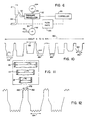
- FIGS. 6-12 illustrate the present invention and use like reference numerals from FIGS. 1-5 where appropriate to facilitate understanding.
- the two-way valve or pulsator 50 of FIG. 1 is replaced by a variable pressure source 82 in FIG. 6, and controllably variable pressure is supplied to pulsation chamber 32.
- the variable pressure source is preferably a transducer, such as provided by a Bellofram Type 1000 Transducer Model 961-116-000, available from Bellofram Corporation, State Route 2, P.O. Box 305, Newell, West Virginia 26050.
- the transducer as connected between positive and negative pressure sources 84 and 48 at respective connection tubes 86 and 54, and supplies output pressure at connection tube 52 to pulsation chamber 32 of teat cup 12.
- the positive pressure port of the transducer is connected by connection tube 86 to positive pressure source 84.
- the vent port of the transducer is not connected to atmosphere, but instead is connected by connection tube 54 to negative pressure source 48 as a reference.
- the transducer controls the output pressure along a controllably variable pressure curve of selectable waveshape as set by controller or timer 88 providing a time dependent pattern, though other alternatives are possible, to be described.
- a pulsation cycle is provided by applying a first pressure level 90, FIG. 7, from the variable pressure source to pulsation chamber 32 to open liner 24, FIG. 2, below teat 16 to provide an on portion of the pulsation cycle, and applying a second pressure level 92, higher than level 90, from the variable pressure source to pulsation chamber 32 to collapse and close liner 24, FIG. 3, below teat 16 to provide an off portion of the pulsation cycle.
- the pressure supplied to pulsation chamber 32 is controllingly varied during the transition 94 from the off portion 96 to the on portion 90 of the pulsation cycle, and during the transition 98 from the on portion 90 to the off portion 92 of the pulsation cycle. During these transitions, the rate of change of pressure supplied by the variable pressure source to pulsation chamber 32 is varied.
- the pressure is abruptly changed at 100 at the beginning of the transition, and then varied at a slower rate of change at 102, and then abruptly changed at 104 at the end of the transition, such that there is a first abrupt pressure change 100 followed by a slower rate of pressure change 102 followed by a second abrupt pressure change 104, all during transition 94.
- transition 98 there is a first abrupt pressure change 106 followed by a slower rate of pressure change 108 followed by a second abrupt pressure change 110, all during transition 98.
- liner 24 is in its closed position of FIG. 3, as illustrated at 112 in FIG. 8.
- the liner moves as shown at 114, FIG. 8, to its open position 116 during on portion 90 of the pulsation cycle.
- transition 98 the liner moves as shown at 118 back to its closed position as shown at 120.
- Pressure levels 50 and 92 are alternately and repetitively applied to pulsation chamber 32 to provide a plurality of repetitive pulsation cycles, FIGS. 9 and 10, each cycle having an on portion during application of pressure level 90, and an off portion during application of pressure level 92. It is recognized that the instantaneous pressure changes 100, 104, 106, and 110 in FIG. 7 are idealized, and in fact some small amount of time elapses during these changes.
- the pulsation cycle is shortened by shortening the transition time between pressure levels 90 and 92.
- the transition time of each of transitions 94 and 98 is 0.05 second, as compared to 0.2 second of FIG. 4.
- the shortened transition time in turn provides a shortened pulsation cycle time of 0.6 second in FIG. 7, as compared to 0.9 second in FIG. 4.
- the length of the on portion of the pulsation cycle is 0.4 second in each of FIGS. 7 and 4.
- the length of the off portion of the pulsation cycle is 0.1 second in each of FIGS. 7 and 4.
- the transition time between pressure levels 90 and 92 is shortened by varying the rate of change of pressure applied to pulsation chamber 32 during the transition between on and off portions of the pulsation cycle. At least two different rates of change of pressure are provided during the transition, and pressure is applied to the pulsation chamber at each of such rates of change during the transition. It is preferred that the pressure be sequenced through changing pressure rates during the transition, including from a first rate such as 100 to a second rate such as 102, and from the second rate 102 to a third rate such as 104, all during transition 94. It is preferred that the first and third rates 100 and 104 be substantially instantaneous, and that the second rate 102 be substantially linear.
- the pressure applied to pulsation chamber 32 is abruptly decreased at 100, and then is decreased at 102 at a rate providing substantially constant rate of volume change within liner 24 as it opens at 114, and then the pressure is abruptly decreased at 104 to level 90.
- the pressure is abruptly increased at 106, and then the pressure is increased at 108 at a rate providing a substantially constant rate of volume change within liner 24 as it closes at 118, and then the pressure is abruptly increased at 110 to upper level 92.
- transition 94 generates a linear change in internal liner volume at a maximum desired rate and reduces delays in liner movement by maintaining the pressure at upper level 96, FIG. 7, until it is desired to cause liner 24 to move, then abruptly changing the pressure to an intermediate level at 122 at which liner movement will begin as shown at 114, FIG. 8, then changing the pressure at a slower rate at 102 to an intermediate level at 124 to complete liner movement, and then abruptly changing the pressure at 104 to lower level 90.
- the sequencing generates a linear change in internal liner volume at a maximum desired rate and reduces delays in liner movement by maintaining the pressure at lower level 90 until it is desired to cause liner 24 to move, then abruptly changing the pressure to an intermediate level at 126 at which liner movement will begin, then changing the pressure at a slower rate at 108 to an intermediate level at 128 to complete liner movement at 118, and then abruptly changing the pressure at 110 to higher level 92.
- the sequencing and pressure change rates are preferably chosen such that the transition time between on and off portions of the pulsation cycle is limited only, or at least primarily, by the desired rate of movement of the liner between open and closed conditions, typically about 0.05 second, to in turn generate the maximum desired rate of movement of the liner.
- transition points, 122, 124, 126, 128, FIG. 7, correspond to those pressure levels at which liner movement actually begins or ends.
- the efficiency of the waveform at FIG. 7 over that of FIG. 4 comes from the reduction in time wasted in the prior art waiting for the pressure to move from level 96 to 122, 124 to 90, 90 to 126, and 128 to 92, all of which used substantial time in the prior art.
- a milking interval 130 is composed of a plurality of pulsation cycles 132. As noted above, the length of each pulsation cycle is about 0.6 second. The length of milking interval 130 is typically about four to five minutes, though may be shorter or longer depending on when milk flow rate decreases below a given level, and the amount of milk to be removed.
- the milking interval 130 may simply consist of repetition of cycles such as 132, or the individual cycles may be varied as milking progresses.
- One example of this, also shown in FIG. 9, utilizes the fact, previously known in the art, that rapid opening of the liner tends to decrease friction between liner and teat. This is desirable at the start of milking because it enhances penetration of the teat into the liner. Near the end point of milking, however, pressure of milk inside the teat is reduced, reducing friction between teat and liner, and in this condition, opening the liner more slowly is beneficial.
- the present invention allows utilization of this knowledge by opening the liner rapidly at the beginning of milking, but slowly at the end of milking.
- Milking interval 130 has a first or initial sub-interval 134, for example lasting for about the first fifteen seconds, a second or main sub-interval 136, for example lasting about three to four minutes, and a third or final sub-interval 138, for example lasting about a minute.
- the decreasing-pressure transition time is shown at 140.
- the pressure decreases at 142 from upper pressure level 144 to lower pressure level 146.
- the decreasing-pressure transition time is shown at 148.
- the pressure decreases at 150 from the upper pressure level 144 to the lower pressure level 146.
- Transition time 148 is the same as the transition time for transition 94 in FIG. 7.
- the decreasing-pressure transition time is shown at 152.
- the pressure decreases at 154 from the upper pressure level 144 to the lower pressure level 146.
- Transition time 140 is less than transition time 148.
- Transition time 152 is greater than transition time 148.
- the pressure change transition time 152, FIG. 9, from the upper pressure level to the lower pressure level during pulsation cycles at the end of the milking interval is lengthened to provide a decreasing-pressure transition time 152 during pulsation cycles at the end of the milking interval which is longer than the decreasing-pressure transition time 148 during pulsation cycles in the middle of the milking interval, to provide a slower rate of liner opening movement during pulsation cycles at the end of the milking interval than the rate of liner opening movement during pulsation cycles in the middle of the milking interval, to open the liner more slowly at the end of the milking interval than during the middle of the milking interval, to limit loss of adhesion between a less than full teat and the interior of the liner at the end of the milking interval.
- Pressure change transition time 140 from the upper pressure level to the lower pressure level during pulsation cydes at the beginning of the milking interval is shortened to provide a decreasing-pressure transition time 140 during pulsation cycles at the beginning of the milking interval which is shorter than the decreasing-pressure transition time 148 during pulsation cydes in the middle of the milking interval, to provide a faster rate of liner opening movement during pulsation cycles at the beginning of the milking interval than the rate of liner opening movement during pulsation cycles in the middle of the milking interval, to open the liner more rapidly at the beginning of the milking interval than during the middle of the milking interval, to provide deeper teat penetration into the liner and faster milking.
- the pressure applied to the pulsation chamber is varied during the decreasing pressure portions of the pulsation cycles to open the liner at a first rate of liner opening movement corresponding to pressure change rate 142 during pulsation cycles at the beginning of the milking interval, a second rate of liner opening movement corresponding to pressure change rate 150 during pulsation cycles in the middle of the milking interval, and a third rate of liner opening movement corresponding to pressure change rate 154 during pulsation cycles at the end of the milking interval.
- Rate 142 is faster than rate 150.
- Rate 154 is slower than rate 150.
- a milking interval 156 is composed of a plurality of pulsation cycles 158.
- the length of each pulsation cycle 158 is about 0.6 second.
- the length of milking interval 156 is typically about four to five minutes, through may be shorter or longer depending on when milking flow rate decreases below a given level.
- the pressure applied to pulsation chamber 32 is varied to provide a higher pressure level 162 than the pressure level such as 164 during on portions of pulsation cycles such as 166 during the middle of milking interval 156, such that liner 24 opens less at the end of milking interval 156 than during the middle of milking interval 156, to limit loss of adhesion between a less than full teat and the interior of liner 24 at the end of milking interval 156.
- the pressure applied to pulsation chamber 32 is varied to a lower pressure level 170 than pressure level 164 during on portion 166 of pulsation cycles during the middle of milking interval 156, to open liner 24 more at the beginning of milking interval 156 than during the middle of milking interval 156, to provide deeper teat penetration into liner 24 and faster milking.
- Pressure level 170 opens liner 24 to diameter 172, FIG. 11, at the beginning of milking interval 156.
- Pressure level 164 opens liner 24 to diameter 174 during the middle of milking interval 156.
- Pressure level 162 opens liner 24 to diameter 176 at the end of milking interval 156.
- Diameter 172 is greater than diameter 174.
- Diameter 174 is greater than diameter 176.
- the pressure applied to pulsation chamber 32 is varied during the off portion 178, FIG. 12, of the pulsation cycle, including increasing the pressure, as at 180, 182, applied to the pulsation chamber during the off portion of the pulsation cycle to increase the massage force of liner 24 on teat 16.
- the teat is vibrated and massaged during off portion 178 of the pulsation cycle by alternately increasing and decreasing the pressure applied to pulsation chamber 32 during off portion 178 at a higher frequency than the repetition frequency of the pulsation cycle.
- the pressure applied to pulsation chamber 32 is also varied during the on portion 184, FIG. 12, of the pulsation cycle by alternately increasing and decreasing the pressure at a higher frequency than the repetition frequency of the pulsation cycle to bump and vibrate teat 16 and further stimulate the milk ejection reflex of the mammal.
- the transducer, 82 in FIG. 6, is actually a non-ideal device and therefore its output may not exactly follow the input electrical signal.
- the present invention permits partially correcting for this non-ideal characteristic by incorporating a feedback signal from the transducer output to modify its input, or more simply by overdriving the transducer to increase the rate of change of output pressure that can be achieved.
- the thin liner disclosed in commonly owned co-pending U.S. application Serial No. 07/714,491, filed June 13, 1991 is ideally suited to control by the pulsation system of this invention.
- the thin liner transmits pulsation chamber pressure to the teat with little distortion caused by the stiffness of the liner wall. Therefore the electrical signal to the transducer may be a direct representation of the pressure waveform desired to be imposed upon the teat.
- Controller 88 is preferably provided by a Compaq computer programmed by the "Asystant +" program by MacMillan Software Company and interfaced to the Bellofram Type 1000 transducer through an AD694 current transmitter available from Analog Devices, One Technology Way, P.O. Box 9106, Norwood, Maine 02062-9106.
- the pressure may be varied according to milk flow rate as monitored by sensor 186, which may be provided as disclosed in "Monitoring The Flow Of Milk Within Machine Milked Teat By Observing Doppler Shift Of Back-Scattered Ultrasound", P. Thompson and L. Campbell, Transactions of the ASAE, American Society of Agricultural Engineers, Vol. 17, No. 3, pp.
- controller 88 in addition to acting as a timer, controller 88 also responds to reduced milk flow rate as indicated by sensor 186, and shortens the duration of the on portion of the pulsation cycle, by terminating the on portion and initiating the off portion of the pulsation cycle.
- the duration of an on portion 188, FIG. 10, of a pulsation cycle occurring later in a milking interval may be shorter than the duration of an on portion 166 of a pulsation cycle occurring earlier in the milking interval.
- milk will not flow at a steady rate during the time that the liner is open. Rather, milk will flow at a relatively constant rate beginning when the liner first opens, but this rate will decline.
- the reason for the decline is the swelling of the tissue surrounding the teat canal as a reaction to the application of milking vacuum, i.e. the negative pressure in milk flow passage 28.
- the collapse of the liner around the teat during the off portion of the pulsation cycle removes physiological fluids from the teat end, reducing its swelling, and enabling the resumption of higher rate milk flow when the on portion of the next pulsation cyde begins.
- negative pressure level 90 FIG. 7.
- a fixed port pulsator such as 50 does not permit the transition slope to be modified or otherwise shaped as desired.
- On-off cycle times, and upper and lower limits of pulsation, can be varied with a two-way valve, but transitional slopes cannot be changed or shaped or otherwise controlled unless the fixed port size is changed.
- the timing pattern provided by controller 88 and/or the flow rate provided by sensor 186 may vary the repetition rate of the pressure curve waveshape, to provide a plurality of pulsation cycles of variable duration during the milking interval, or may vary the pressure levels.
- the variable pressure source can be provided by various combinations of two-position valves connected to synthesize a desirable waveshape, particularly the slope providing the desired rates of change during the noted transitions.
- the variable pressure source is provided by a pressure source and a valve with a variable orifice.
Landscapes
- Life Sciences & Earth Sciences (AREA)
- Animal Husbandry (AREA)
- Environmental Sciences (AREA)
- External Artificial Organs (AREA)
- Infusion, Injection, And Reservoir Apparatuses (AREA)
- Heterocyclic Carbon Compounds Containing A Hetero Ring Having Nitrogen And Oxygen As The Only Ring Hetero Atoms (AREA)
Abstract
Claims (28)
- Procédé de traite d'un mammifère, comprenant les étapes qui consistent à
prévoir un gobelet trayeur (12, 14) comportant un manchon (24, 26) destiné à être positionné autour d'un trayon du mammifère
définir un passage d'écoulement de lait à l'intérieur dudit manchon et une chambre de pulsation (32, 34) entre ledit manchon et ledit gobelet trayeur (12, 14)
appliquer une pression négative inférieure à la pression atmosphérique audit passage (28, 30) d'écoulement de lait ;
fournir une pression négative à ladite chambre de pulsation(32, 34) au cours d'une partie de travail d'un cycle de pulsation ;
fournir une pression plus élevée à ladite chambre de pulsation au cours d'une partie de repos dudit cycle de pulsation ;
caractérisé par l'emploi d'une source de pression (82) variable pour faire varier de manière contrôlable la vitesse de changement de pression dans ladite chambre de pulsation (32, 34) sans utilisation d'un pulsateur à soupape à deux voies alternant entre une premier état de connexion d' une source de pression négative à la chambre de pulsation et un deuxième état fournissant une pression atmosphérique ou supérieure en tant que partie de travail ou de repos d'un cycle de pulsation;
la méthode comprenant la fourniture d'une pression variable de manière contrôlée à ladite chambre de pulsation (32, 24) et la variation de la pression fournie à ladite chambre de pulsation (32,34) suivant une courbe de pression variable de manière contrôlable ayant une forme d'onde sélectionnable, la méthode comportant de plus le changement brusque de la pression au début de ladite transition entre l'une au moins desdites parties de travail et de repos dudit cycle de pulsation et l'autre desdites parties de travail et de repos dudit cycle de pulsation, puis la variation de la pression à une vitesse plus lente, le tout pendant ladite transition. - Procédé tel que défini dans l'une quelconque des revendications précédentes, selon lequel une source de pression négative (48) fournit conjointement ladite pression négative appliquée audit passage d'écoulement de lait (28, 30) et ladite pression négative appliquée à ladite chambre de pulsation (32, 34).
- Procédé tel que défini dans l'une quelconque des revendications précédentes, comprenant la variation contrôlable de la pression appliquée à ladite chambre de pulsation au cours de ladite partie de travail dudit cycle de pulsation.
- Procédé selon n'importe laquelle des revendications précédentes, comprenant le changement brusque de la pression à la fin de ladite transition suivant ledit changement de pression à une vitesse plus lente, de façon à créer un premier changement de pression brusque, suivi d'un changement de pression à une vitesse plus lente, suivi d'un second changement de pression brusque, le tout pendant ladite transition.
- Procédé tel que défini dans l'une quelconque des revendications précédentes, comprenant le changement brusque de la pression appliquée à ladite chambre de pulsation à une vitesse suffisamment rapide pour que la période de transition entre lesdites parties de travail et de repos dudit cycle de pulsation soit limitée uniquement par la vitesse de mouvement souhaitée dudit manchon entre des états ouvert et fermé.
- Procédé tel que défini dans la revendication 5, comprenant le changement de la pression appliquée à ladite chambre de pulsation à une vitesse engendrant la vitesse de mouvement maximale souhaitée dudit manchon.
- Procédé tel que défini dans l'une quelconque des revendications précédentes, comprenant l'augmentation et la diminution alternées et répétées de la pression appliquée à ladite chambre de pulsation (32, 34) au cours de ladite partie de repos dudit cycle de pulsation.
- Procédé tel que défini dans l'une quelconque des revendications précédentes, comprenant également l'augmentation et la diminution alternées et répétées de la pression appliquée à ladite chambre de pulsation au cours de ladite partie de travail dudit cycle de pulsation.
- Procédé tel que défini dans l'une quelconque des revendications précédentes, selon lequel un cycle de pulsation est établi par l'application à ladite chambre de pulsation (32, 34) d'un premier niveau de pression pour ouvrir ledit manchon (24, 26) au-dessous du trayon au cours de la partie de travail dudit cycle de pulsation, et d'un second niveau de pression, supérieur audit premier niveau de pression, pour écraser et fermer ledit manchon au dessous du trayon au cours de la partie de repos dudit cycle de pulsation.
- Procédé tel que défini dans la revendication 9, comprenant plusieurs cycles de pulsation qui définissent un intervalle de traite, selon lequel la période de transition de changement de pression entre ledit second niveau de pression et ledit premier niveau de pression au cours de cycles de pulsation qui ont lieu à la fin dudit intervalle de traite est rallongée pour définir pendant ceux-ci une période de transition à pression décroissante, plus longue que la période de transition à pression décroissante au cours de cycles de pulsation qui ont lieu au milieu dudit intervalle de traite, afin de permettre au cours des cycles de pulsation qui ont lieu à la fin dudit intervalle de traite une vitesse de mouvement d'ouverture du manchon plus lente qu'au cours des cycles de pulsation qui ont lieu au milieu dudit intervalle de traite, pour ouvrir ledit manchon plus lentement à la fin dudit intervalle de traite qu'au milieu de celui-ci, en vue de limiter une perte d'adhérence entre un trayon moins que plein et l'intérieur dudit manchon à la fin dudit intervalle de traite.
- Procédé tel que défini dans la revendication 9, comprenant plusieurs cycles de pulsation qui définissent un intervalle de traite, selon lequel la période de transition de changement de pression entre ledit second niveau de pression et ledit premier niveau de pression au cours de cycles de pulsation qui ont lieu au début dudit intervalle de traite est raccourcie pour définir pendant ceux-ci une période de transition à pression décroissante, plus courte que la période de transition à pression décroissante au cours de cycles de pulsation qui ont lieu au milieu dudit intervalle de traite, afin de permettre au cours des cycles de pulsation qui ont lieu au début dudit intervalle de traite une vitesse de mouvement d'ouverture du manchon plus rapide qu'au cours des cycles de pulsation qui ont lieu au milieu dudit intervalle de traite, pour ouvrir ledit manchon plus rapidement au début dudit intervalle de traite qu'au milieu de celui-ci, de façon à permettre une pénétration plus profonde du trayon dans le manchon au début dudit intervalle de traite.
- Procédé tel que défini dans la revendication 9, comprenant plusieurs cycles de pulsation qui définissent un intervalle de traite, selon lequel la période de transition de changement de pression entre ledit second niveau et ledit premier niveau varie pour définir une première période de transition à pression décroissante entre ledit second niveau et ledit premier niveau au cours de cycles de pulsation qui ont lieu au début dudit intervalle de traite, une deuxième période de transition à pression décroissante entre ledit second niveau et ledit premier niveau au cours de cycles de pulsation qui ont lieu au milieu dudit intervalle de traite, et une troisième période de transition à pression décroissante entre ledit second niveau et ledit premier niveau au cours de cycles de pulsation qui ont lieu à la fin dudit intervalle de traite, ladite première période de transition étant inférieure à ladite deuxième période de transition, et ladite troisième période de transition étant supérieure à ladite deuxième période de transition.
- Procédé tel que défini dans l'une quelconque des revendications 1 à 8, comprenant plusieurs cycles de pulsation qui définissent un intervalle de traite, selon lequel la pression appliquée à ladite chambre de pulsation au cours de parties de travail de cycles de pulsation qui ont lieu à la fin dudit intervalle de traite pour ouvrir ledit manchon est plus faible à la fin dudit intervalle de traite qu'au milieu de celui-ci, en vue de limiter une perte d'adhérence entre un trayon moins que plein et l'intérieur dudit manchon à la fin dudit intervalle de traite.
- Procédé tel que défini dans l'une quelconque des revendications 1 à 8, comprenant plusieurs cycles de pulsation qui définissent un intervalle de traite, selon lequel la pression appliquée à ladite chambre de pulsation au cours de parties de travail de cycles de pulsation qui ont lieu au début dudit intervalle de traite pour ouvrir ledit manchon est plus élevée au début dudit intervalle de traite qu'au milieu de calui-ci, en vue de permettre une pénétration plus profonde du trayon dans le manchon au début dudit intervalle de traite.
- Procédé tel que défini dans l'une quelconque des revendications 1 à 8, comprenant plusieurs cycles de pulsation qui définissent un intervalle de traite selon lequel la pression appliquée à ladite chambre de pulsation au cours de parties de travail de cycles de pulsation pendant ledit intervalle de traite ouvre ledit manchon à un premier diamètre au début dudit intervalle de traite, à un deuxième diamètre au milieu dudit intervalle de traite, et à un troisième diamètre à la fin dudit intervalle de traite, ledit premier diamètre étant supérieur audit deuxième diamètre, et ledit deuxième diamètre étant supérieur audit troisième diamètre.
- Procédé tel que défini dans l'une quelconque des revendications 1 à 15, comprenant la terminaison de ladite partie de travail dudit cycle de pulsation et le commencement de ladite partie de repos dudit cycle de pulsation en réponse à une diminution d'un débit de lait.
- Procédé selon l'une quelconque des revendications 1 à 12, comprenant la variation de la pression fournie à ladite chambre de pulsation en réponse à un paramètre donné.
- Procédé selon la revendication 17, suivant lequel ledit paramètre donné est un temps.
- Procédé selon la revendication 17, suivant lequel ledit paramètre donné est un débit de lait.
- Appareil de traite pour traire un mammifère, comprenant
un gobelet trayeur (12, 14) comportant un manchon (24, 26) destiné à être positionné autour d'un trayon du mammifère;
un passage d'écoulement de lait (28,30) prévu à l'intérieur dudit manchon (24, 26), et une chambre de pulsation (32, 34) située entre ledit manchon (24,26) et ledit gobelet trayeur (12, 14);
une source de pression négative (48) destinée à appliquer audit passage (28, 30) d'écoulement de lait une pression négative inférieure à la pression atmosphérique; et
une source de pression variable (82) destinée à fournir à ladite chambre de pulsation (32,34) une pression négative au cours d'une partie de travail d'un cycle de pulsation afin d'ouvrir ledit manchon (24, 26) au-dessous du trayon, et une pression plus élevée à ladite chambre de pulsation (32, 34) au cours d'une partie de repos dudit cycle de pulsation afin de fermer ledit manchon (24, 26) au-dessous du trayon,
caractérisé en ce que la source de pression variable (82) est conçue pour faire varier de manière contrôlable la vitesse de changement de pression appliquée à ladite chambre de pulsation (32, 34) sans un pulsateur à soupape à deux voies, alternant entre un premier état de connexion d' une source de pression négative à la chambre de pulsation et un deuxième état fournissant une pression atmosphérique ou supérieure en tant que partie de travail ou de repos d'un cycle de pulsation;
dans lequel ladite source de pression variable (82) est conçue pour fournir une pression variable de manière contrôlable à ladite chambre de pulsation (32, 34) et pour faire varier la pression fournie à ladite chambre de pulsation (32, 34) suivant une courbe de pression variable de manière contrôlable ayant une forme d'onde sélectionnable, et
dans lequel ladite source de pression variable (82) est de plus conçue pour créer un changement de pression brusque au début de ladite transition entre l'une au moins desdites parties de travail et de repos dudit cycle de pulsation et l'autre desdites parties de travail et de repos dudit cycle de pulsation, suivi d'un changement de pression à une vitesse plus lente. - Appareil selon la revendication 20 dans lequel le changement brusque de la pression à la fin de ladite transition suivant ledit changement de pression à une vitesse plus lente, de façon à créer un premier changement de pression brusque, suivi d'un changement de pression à une vitesse plus lente, suivi d'un second changement de pression brusque, le tout pendant ladite transition.
- Appareil selon l'une quelconque des revendications 20 à 21, dans lequel ladite source de pression variable est conçue pour changer brusquement la pression appliquée à ladite chambre de pulsation à une vitesse suffisamment rapide pour que la période de transition entre lesdites parties de travail et de repos dudit cycle de pulsation soit limitée principalement par la vitesse de mouvement souhaitée dudit manchon entre des états ouvert et fermé.
- Appareil selon l'une quelconque des revendications 20 à 22, dans lequel ladite source de pression variable est conçue pour faire varier la pression fournie à ladite chambre de pulsation à une vitesse de répétition variable de manière contrôlable afin de définir plusieurs cycles de pulsation de durée variable.
- Appareil selon la revendication 23, dans lequel ladite source de pression variable est conçue pour faire varier ladite forme d'onde d'un cycle à l'autre.
- Appareil selon l'une quelconque des revendications 20 à 24, dans lequel ladite source de pression variable est conçue pour fournir une pression à ladite chambre de pulsation en réponse à un paramètre donné.
- Appareil selon la revendication 25, dans lequel ledit paramètre donné est un temps.
- Appareil selon la revendication 25, dans lequel ledit paramètre donné est un débit de lait.
- Appareil selon l'une quelconque des revendications 20 à 27, dans lequel ladite source de pression variable comprend un transducteur de pression.
Applications Claiming Priority (3)
| Application Number | Priority Date | Filing Date | Title |
|---|---|---|---|
| US853924 | 1992-03-19 | ||
| US07/853,924 US5218924A (en) | 1992-03-19 | 1992-03-19 | Milking system with variable pressure source |
| PCT/US1992/010345 WO1993018644A1 (fr) | 1992-03-19 | 1992-12-01 | Appareil de traite a dispositif a pression variable |
Publications (4)
| Publication Number | Publication Date |
|---|---|
| EP0631468A1 EP0631468A1 (fr) | 1995-01-04 |
| EP0631468A4 EP0631468A4 (fr) | 1995-04-26 |
| EP0631468B1 EP0631468B1 (fr) | 2000-03-08 |
| EP0631468B2 true EP0631468B2 (fr) | 2006-12-13 |
Family
ID=25317237
Family Applications (1)
| Application Number | Title | Priority Date | Filing Date |
|---|---|---|---|
| EP92925466A Expired - Lifetime EP0631468B2 (fr) | 1992-03-19 | 1992-12-01 | Appareil de traite a dispositif a pression variable |
Country Status (9)
| Country | Link |
|---|---|
| US (1) | US5218924A (fr) |
| EP (1) | EP0631468B2 (fr) |
| AU (1) | AU665161B2 (fr) |
| CA (1) | CA2130484C (fr) |
| DE (1) | DE69230765T3 (fr) |
| DK (1) | DK0631468T3 (fr) |
| ES (1) | ES2145751T3 (fr) |
| NZ (1) | NZ245449A (fr) |
| WO (1) | WO1993018644A1 (fr) |
Cited By (1)
| Publication number | Priority date | Publication date | Assignee | Title |
|---|---|---|---|---|
| US7972297B2 (en) | 2008-11-07 | 2011-07-05 | Simplisse, Inc. | Breast cup assembly for a breast pump |
Families Citing this family (64)
| Publication number | Priority date | Publication date | Assignee | Title |
|---|---|---|---|---|
| SE9100242D0 (sv) * | 1991-01-25 | 1991-01-25 | Alfa Laval Agri Int | Saett att mjoelka |
| IT1270881B (it) * | 1993-10-01 | 1997-05-13 | S El Pro Di Visigalli Ercolino | Mungitrice automatica |
| NL9401937A (nl) * | 1994-04-27 | 1995-12-01 | Maasland Nv | Werkwijze voor het automatisch melken van dieren en inrichting waarin deze werkwijze kan worden toegepast. |
| US5697325A (en) * | 1995-02-13 | 1997-12-16 | Gehm; Lanny | Milking system |
| US5586518A (en) * | 1995-03-27 | 1996-12-24 | Dec International, Inc. | Milking cluster air fork |
| SE504429C2 (sv) * | 1995-05-17 | 1997-02-10 | Tetra Laval Holdings & Finance | Sätt att styra mjölkning med hjälp av spengummits abrupta rörelse jämte mjölkningsmaskin med avkännare härför |
| SE505351C2 (sv) * | 1995-05-17 | 1997-08-11 | Alfa Laval Agri Ab | Sätt att övervaka funktionen hos en mjölkningsmaskin jämte mjölkningsmaskin |
| SE504427C2 (sv) * | 1995-05-17 | 1997-02-10 | Tetra Laval Holdings & Finance | Sätt och anordning att mjölka ett djur genom bestämning av pulseringsvakuumets nivå när spengummit öppnar eller stänger abrupt |
| US6547756B1 (en) | 1999-12-10 | 2003-04-15 | Medela Holding Ag | Programmable breastpump |
| US8282596B2 (en) * | 1999-12-10 | 2012-10-09 | Medela Holding Ag | Breastpump with letdown feature |
| US6481986B1 (en) | 1995-08-03 | 2002-11-19 | Medela Holding Ag | Vacuum adjustment mechanism particularly adapted for a breastpump |
| US6257847B1 (en) | 1995-08-03 | 2001-07-10 | Medela, Inc. | Diaphragm pump and pump for double-breast pumping |
| US6808517B2 (en) * | 1999-12-10 | 2004-10-26 | Medela Holding Ag | Suction sequences for a breastpump |
| US5776098A (en) * | 1995-08-03 | 1998-07-07 | Medela, Incorporated | Diaphragm pump and pump mounted in a carrying case useful in breast pumping |
| SE511014C2 (sv) * | 1995-12-22 | 1999-07-19 | Alfa Laval Agri Ab | Sätt att mjölka ett djur med hjälp av två olika tryck och mjölkningsmaskin med två tryckkällor |
| US5720236A (en) * | 1996-01-16 | 1998-02-24 | Dec International, Inc. | Milk meter |
| DE19614376A1 (de) * | 1996-04-11 | 1997-10-16 | Laub Maier Maria | Verfahren und Vorrichtung zum automatischen Milchentzug |
| DE59610174D1 (de) * | 1996-04-14 | 2003-04-03 | Medela Ag Baar | Einrichtung zum Absaugen von Muttermilch |
| US6139521A (en) * | 1996-06-03 | 2000-10-31 | Medela Holding Ag | Breastpump having particular application as a small motorized pump capable of double-breast pumping |
| NL1009052C2 (nl) * | 1998-05-01 | 1999-11-02 | Maasland Nv | Werkwijze en inrichting voor het automatisch melken van dieren. |
| US6055931A (en) * | 1998-10-13 | 2000-05-02 | Dec International, Inc. | Clog resistant air vent plug for teatcup liner |
| US5960738A (en) * | 1998-12-07 | 1999-10-05 | Dec International, Inc. | Milking cluster hose positioner |
| US20030111017A1 (en) * | 2001-12-13 | 2003-06-19 | Wartenhorst Bernhard Schulze | Mechanical milking procedure for animals, especially cows |
| DE19926957A1 (de) * | 1999-06-14 | 2001-01-04 | Westfalia Landtechnik Gmbh | Verfahren zum maschinellen Melken von Tieren, insbesondere von Kühen |
| EP1163915A3 (fr) * | 2000-06-12 | 2003-08-27 | Clute, Lorne Jason | Appareil d'aspiration de lait |
| US6439156B1 (en) | 2000-11-13 | 2002-08-27 | Dec International, Inc. | Milking vacuum fluctuation filter |
| DE10110473B4 (de) * | 2001-03-05 | 2005-02-03 | Maier Jun., Jakob | Automatische Melkvorrichtung mit steuerbarer Stimulationsvorrichtung und System zur Stimulation |
| US6745718B1 (en) | 2002-02-08 | 2004-06-08 | Mofazzal H. Chowdhury | Anti-slip and faster milking teatcup liner |
| US6631694B1 (en) | 2002-02-08 | 2003-10-14 | Mofazzal H. Chowdhury | Teatcup liner series |
| US6776120B1 (en) | 2002-02-08 | 2004-08-17 | Mofazzal H. Chowdhury | Controlled collapse teatcup liner |
| US6755153B1 (en) | 2002-02-08 | 2004-06-29 | Mofazzal H. Chowdhury | Teatcup liner mouthpiece lip with controlled deflection and slip reduction |
| US6749582B2 (en) | 2002-04-30 | 2004-06-15 | The First Years Inc. | Pumping breast milk |
| NL1020785C2 (nl) * | 2002-06-06 | 2003-12-09 | Lely Entpr Ag | Inrichting voor het melken van dieren. |
| GB0408968D0 (en) * | 2004-04-22 | 2004-05-26 | Duke James R J | Milking equipment |
| US20050208271A1 (en) * | 2004-03-17 | 2005-09-22 | Fasching Rainer J | Bonding method for micro-structured polymers |
| US6981468B1 (en) | 2004-04-20 | 2006-01-03 | Bou-Matic Technologies Corp. | Milking claw bottom |
| US7396339B2 (en) * | 2004-04-30 | 2008-07-08 | The First Years Inc. | Pumping breast milk |
| US10874084B2 (en) | 2004-06-12 | 2020-12-29 | Gea Farm Technologies, Inc. | Safety valve for a dairy system component |
| US8033247B2 (en) | 2004-06-12 | 2011-10-11 | Gea Farm Technologies, Inc. | Automatic dairy animal milker unit backflusher and teat dip applicator system and method |
| US8342125B2 (en) | 2004-06-12 | 2013-01-01 | Gea Farm Technologies, Inc. | Safety valve for an automatic dairy animal milker unit backflusher and teat dip applicator |
| US8117989B2 (en) | 2008-06-27 | 2012-02-21 | Gea Farm Technologies, Inc. | Milk tube dome with flow controller |
| WO2007060003A1 (fr) | 2005-11-25 | 2007-05-31 | Westfaliasurge Gmbh | Procede et dispositif de traite d'animaux |
| EP1795068A1 (fr) | 2005-12-06 | 2007-06-13 | Bou-Matic Technologies Corporation | Agencement de gobelet trayeur comportant une valve |
| ATE417500T1 (de) * | 2006-01-06 | 2009-01-15 | Bou Matic Technologies Corp | Melkbecher |
| US20070227452A1 (en) * | 2006-03-31 | 2007-10-04 | Tucker George H | Adaptive milking system |
| DE102007014535B4 (de) * | 2006-09-13 | 2010-12-09 | Gea Westfaliasurge Gmbh | Zitzengummi sowie Melkbecher mit einer Belüftungsdüse |
| US9162016B2 (en) * | 2006-09-22 | 2015-10-20 | Medela Holding Ag | Breastpump with irregular milk expression sequences |
| NZ570296A (en) * | 2007-09-07 | 2009-08-28 | Delaval Holding Ab | Method and arrangement for controlling the milking by a milking machine |
| NZ586308A (en) * | 2008-01-24 | 2012-12-21 | Delaval Holding Ab | Method for controlling milking where milking vacuum and maximum pulsation vacuum are lowered during a termination phase |
| WO2010083485A2 (fr) | 2009-01-16 | 2010-07-22 | Learning Curve Brands, Inc. | Tire-lait et procédé d'utilisation associé |
| US8770146B2 (en) | 2009-09-04 | 2014-07-08 | Gea Farm Technologies, Inc. | Methods and apparatus for applying teat dip to a dairy animal |
| US11723341B2 (en) | 2009-09-04 | 2023-08-15 | Gea Farm Technologies, Inc. | Safety valve for an automated milker unit backflushing and teat dip applicator system |
| US20120097107A1 (en) | 2010-02-22 | 2012-04-26 | Gea Farm Technologies, Inc. | Dairy animal milking preparation system and methods |
| GB201213231D0 (en) | 2012-07-25 | 2012-09-05 | An Udder Company Ltd | Milking equipment |
| US9526224B2 (en) | 2013-12-20 | 2016-12-27 | Gea Farm Technologies Gmbh | Safety valve device |
| DE102013114595B4 (de) | 2013-12-20 | 2026-01-15 | Gea Farm Technologies Gmbh | Sicherheitsventil |
| WO2016033107A1 (fr) | 2014-08-26 | 2016-03-03 | Mimeo Labs, Inc. | Dispositif d'expression de fluide mammaire |
| CA3000995C (fr) * | 2015-10-08 | 2023-12-12 | Delaval Holding Ab | Appareil de diagnostic et procede de test |
| NL2015944B1 (nl) * | 2015-12-11 | 2017-07-05 | Lely Patent Nv | Melkinrichting. |
| DE102016108300A1 (de) | 2016-05-04 | 2017-11-09 | Gea Farm Technologies Gmbh | Sicherheitsventil |
| US10542723B2 (en) | 2016-07-21 | 2020-01-28 | Lanny Gehm | Milking system |
| NL2017992B1 (nl) * | 2016-12-14 | 2018-06-26 | Lely Patent Nv | Melksysteem |
| WO2019090136A1 (fr) | 2017-11-03 | 2019-05-09 | Gea Farm Technologies, Inc. | Agencement de soupape de sécurité de système de traite automatique |
| AU2019219875A1 (en) * | 2018-02-15 | 2020-10-08 | Bullseye Australia Pty Ltd | Milking system and method |
Family Cites Families (17)
| Publication number | Priority date | Publication date | Assignee | Title |
|---|---|---|---|---|
| US3172391A (en) * | 1962-09-28 | 1965-03-09 | Laval Separator Co De | High speed milking system |
| GB1450169A (en) * | 1973-09-14 | 1976-09-22 | Phillips E M | Method of milking |
| US4061904A (en) * | 1976-03-03 | 1977-12-06 | Electronic Associates, Inc. | Variable analog function generator |
| US4041904A (en) * | 1976-05-14 | 1977-08-16 | The De Laval Separator Company | Pneumatic pulsator for teat cups |
| DE2844562C2 (de) * | 1978-10-12 | 1983-01-05 | Bio-Melktechnik Swiss Hoefelmayr & Co, 9052 Niederteufen, Aargau | Verfahren zum selbsttätigen Ausmelken beim maschinellen Milchentzug |
| SU1135467A1 (ru) * | 1979-08-07 | 1985-01-23 | Днепропетровский сельскохозяйственный институт | Способ доени животных доильным аппаратом |
| DK152321C (da) * | 1980-01-21 | 1988-07-11 | Hoefelmayr Bio Melktech | Fremgangsmaade og apparat til maskinel udmalkning |
| SU1091885A1 (ru) * | 1980-02-07 | 1984-05-15 | Опытное Проектно-Конструкторское Технологическое Бюро Сибирского Ордена "Знак Почета" Научно-Исследовательского И Проектно-Технологического Института Животноводства | Способ доени животных |
| NZ199721A (en) * | 1981-02-13 | 1987-07-31 | Thomas Leslie Seaborne | Pulsator with pulsation ratio adjusting valve |
| US4530307A (en) * | 1982-10-06 | 1985-07-23 | Dec International, Inc. | Teat cup inflation |
| US4570104A (en) * | 1982-11-02 | 1986-02-11 | U.S. Philips Corporation | Electric lamp having a fuse in a feed-through molding |
| US4572104A (en) * | 1983-12-01 | 1986-02-25 | Babson Bros. Co. | Method of milking |
| US4537152A (en) * | 1984-06-01 | 1985-08-27 | Dec International, Inc. | Milking claw |
| SU1271461A1 (ru) * | 1985-05-23 | 1986-11-23 | Центральный Научно-Исследовательский Институт Механизации И Электрификации Сельского Хозяйства Нечерноземной Зоны Ссср | Пульсатор доильного аппарата |
| DE3609275A1 (de) * | 1986-03-19 | 1987-09-24 | Werner Ludwig Schmidt | Verfahren zum maschinellen milchentzug |
| SU1512533A1 (ru) * | 1988-01-04 | 1989-10-07 | Всесоюзный научно-исследовательский и конструкторско-технологический институт резиновой промышленности | Пульсатор доильного аппарата - "Ахтуба |
| US5178095A (en) * | 1991-06-13 | 1993-01-12 | Dec International, Inc. | Milking system with positive pressure on thin liner |
-
1992
- 1992-03-19 US US07/853,924 patent/US5218924A/en not_active Expired - Lifetime
- 1992-12-01 ES ES92925466T patent/ES2145751T3/es not_active Expired - Lifetime
- 1992-12-01 DE DE69230765T patent/DE69230765T3/de not_active Expired - Fee Related
- 1992-12-01 CA CA002130484A patent/CA2130484C/fr not_active Expired - Fee Related
- 1992-12-01 DK DK92925466T patent/DK0631468T3/da active
- 1992-12-01 EP EP92925466A patent/EP0631468B2/fr not_active Expired - Lifetime
- 1992-12-01 WO PCT/US1992/010345 patent/WO1993018644A1/fr not_active Ceased
- 1992-12-01 AU AU31507/93A patent/AU665161B2/en not_active Ceased
- 1992-12-11 NZ NZ245449A patent/NZ245449A/en unknown
Cited By (3)
| Publication number | Priority date | Publication date | Assignee | Title |
|---|---|---|---|---|
| US7972297B2 (en) | 2008-11-07 | 2011-07-05 | Simplisse, Inc. | Breast cup assembly for a breast pump |
| US8109901B2 (en) | 2008-11-07 | 2012-02-07 | Simplisse, Inc. | Breast pump |
| US8323235B2 (en) | 2008-11-07 | 2012-12-04 | Handi-Craft Company | Liner for use with a breast pump |
Also Published As
| Publication number | Publication date |
|---|---|
| AU3150793A (en) | 1993-10-21 |
| ES2145751T3 (es) | 2000-07-16 |
| DE69230765D1 (de) | 2000-04-13 |
| EP0631468A1 (fr) | 1995-01-04 |
| EP0631468B1 (fr) | 2000-03-08 |
| EP0631468A4 (fr) | 1995-04-26 |
| DE69230765T3 (de) | 2008-02-07 |
| WO1993018644A1 (fr) | 1993-09-30 |
| NZ245449A (en) | 1994-10-26 |
| US5218924A (en) | 1993-06-15 |
| AU665161B2 (en) | 1995-12-14 |
| CA2130484C (fr) | 2002-06-11 |
| DE69230765T2 (de) | 2000-07-06 |
| CA2130484A1 (fr) | 1993-09-30 |
| DK0631468T3 (da) | 2000-08-21 |
Similar Documents
| Publication | Publication Date | Title |
|---|---|---|
| EP0631468B1 (fr) | Appareil de traite a dispositif a pression variable | |
| EP0593563B1 (fr) | Machine a traire a pression positive sur manchons de faible epaisseur | |
| US4011838A (en) | Electronic milker | |
| US4391221A (en) | Method for mechanical milk removal | |
| US4292926A (en) | Method for the automatic finish milking during a mechanical milk removal procedure | |
| US4572104A (en) | Method of milking | |
| EP0954962B1 (fr) | Procédé et dispositif de traite automatique d'animaux | |
| US7162970B2 (en) | Automatic milking device with a controllable stimulation device and stimulation system | |
| ES2013097A6 (es) | Maquina ordenadora y su metodo correspondiente. | |
| US5697323A (en) | Method and machine for milking | |
| WO2008051137A1 (fr) | Procédé et agencement de contrôle de la traite par trayeuse | |
| US6170434B1 (en) | Method of and an implement for milking and/or treating animals | |
| US6428507B1 (en) | Method and device for rinsing | |
| JP2008509697A (ja) | 搾乳カップライナ | |
| US5419280A (en) | Milking machine | |
| US6860228B2 (en) | Milking cup for milking machines | |
| JPS638729B2 (fr) | ||
| US8567345B2 (en) | Method and device for milking an animal | |
| RU2120742C1 (ru) | Доильный стакан | |
| SU725628A1 (ru) | Пневматический генератор импульсов доильных аппаратов | |
| RU2236783C1 (ru) | Доильный аппарат выжимающего действия | |
| SU1660638A1 (ru) | Доильный аппарат | |
| JPS63112937A (ja) | パイプライン式乳牛搾乳装置 |
Legal Events
| Date | Code | Title | Description |
|---|---|---|---|
| PUAI | Public reference made under article 153(3) epc to a published international application that has entered the european phase |
Free format text: ORIGINAL CODE: 0009012 |
|
| 17P | Request for examination filed |
Effective date: 19940930 |
|
| AK | Designated contracting states |
Kind code of ref document: A1 Designated state(s): BE CH DE DK ES FR GB IT LI NL SE |
|
| A4 | Supplementary search report drawn up and despatched |
Effective date: 19950310 |
|
| AK | Designated contracting states |
Kind code of ref document: A4 Designated state(s): BE CH DE DK ES FR GB IT LI NL SE |
|
| 17Q | First examination report despatched |
Effective date: 19970630 |
|
| GRAG | Despatch of communication of intention to grant |
Free format text: ORIGINAL CODE: EPIDOS AGRA |
|
| GRAG | Despatch of communication of intention to grant |
Free format text: ORIGINAL CODE: EPIDOS AGRA |
|
| GRAG | Despatch of communication of intention to grant |
Free format text: ORIGINAL CODE: EPIDOS AGRA |
|
| GRAH | Despatch of communication of intention to grant a patent |
Free format text: ORIGINAL CODE: EPIDOS IGRA |
|
| GRAH | Despatch of communication of intention to grant a patent |
Free format text: ORIGINAL CODE: EPIDOS IGRA |
|
| GRAA | (expected) grant |
Free format text: ORIGINAL CODE: 0009210 |
|
| AK | Designated contracting states |
Kind code of ref document: B1 Designated state(s): BE CH DE DK ES FR GB IT LI NL SE |
|
| REG | Reference to a national code |
Ref country code: CH Ref legal event code: EP |
|
| REF | Corresponds to: |
Ref document number: 69230765 Country of ref document: DE Date of ref document: 20000413 |
|
| ITF | It: translation for a ep patent filed | ||
| REG | Reference to a national code |
Ref country code: CH Ref legal event code: NV Representative=s name: KIRKER & CIE SA |
|
| ET | Fr: translation filed | ||
| REG | Reference to a national code |
Ref country code: ES Ref legal event code: FG2A Ref document number: 2145751 Country of ref document: ES Kind code of ref document: T3 |
|
| REG | Reference to a national code |
Ref country code: DK Ref legal event code: T3 |
|
| PLAV | Examination of admissibility of opposition |
Free format text: ORIGINAL CODE: EPIDOS OPEX |
|
| PLBI | Opposition filed |
Free format text: ORIGINAL CODE: 0009260 |
|
| PLAV | Examination of admissibility of opposition |
Free format text: ORIGINAL CODE: EPIDOS OPEX |
|
| PLBF | Reply of patent proprietor to notice(s) of opposition |
Free format text: ORIGINAL CODE: EPIDOS OBSO |
|
| 26 | Opposition filed |
Opponent name: DELAVAL INTERNATIONAL AB PATENT & TRADEMARK DEPART Effective date: 20001206 |
|
| NLR1 | Nl: opposition has been filed with the epo |
Opponent name: DELAVAL INTERNATIONAL AB PATENT & TRADEMARK DEPART |
|
| PLBF | Reply of patent proprietor to notice(s) of opposition |
Free format text: ORIGINAL CODE: EPIDOS OBSO |
|
| PLBF | Reply of patent proprietor to notice(s) of opposition |
Free format text: ORIGINAL CODE: EPIDOS OBSO |
|
| PLBF | Reply of patent proprietor to notice(s) of opposition |
Free format text: ORIGINAL CODE: EPIDOS OBSO |
|
| REG | Reference to a national code |
Ref country code: GB Ref legal event code: IF02 |
|
| PLBQ | Unpublished change to opponent data |
Free format text: ORIGINAL CODE: EPIDOS OPPO |
|
| PLAB | Opposition data, opponent's data or that of the opponent's representative modified |
Free format text: ORIGINAL CODE: 0009299OPPO |
|
| R26 | Opposition filed (corrected) |
Opponent name: DELAVAL INTERNATIONAL AB PATENT & TRADEMARK DEPART Effective date: 20001206 |
|
| RDAH | Patent revoked |
Free format text: ORIGINAL CODE: EPIDOS REVO |
|
| NLR1 | Nl: opposition has been filed with the epo |
Opponent name: DELAVAL INTERNATIONAL AB PATENT & TRADEMARK DEPART |
|
| APAC | Appeal dossier modified |
Free format text: ORIGINAL CODE: EPIDOS NOAPO |
|
| APAC | Appeal dossier modified |
Free format text: ORIGINAL CODE: EPIDOS NOAPO |
|
| PGFP | Annual fee paid to national office [announced via postgrant information from national office to epo] |
Ref country code: FR Payment date: 20031110 Year of fee payment: 12 |
|
| PGFP | Annual fee paid to national office [announced via postgrant information from national office to epo] |
Ref country code: DK Payment date: 20031111 Year of fee payment: 12 |
|
| PGFP | Annual fee paid to national office [announced via postgrant information from national office to epo] |
Ref country code: NL Payment date: 20031117 Year of fee payment: 12 Ref country code: CH Payment date: 20031117 Year of fee payment: 12 |
|
| PGFP | Annual fee paid to national office [announced via postgrant information from national office to epo] |
Ref country code: ES Payment date: 20031205 Year of fee payment: 12 |
|
| PGFP | Annual fee paid to national office [announced via postgrant information from national office to epo] |
Ref country code: BE Payment date: 20031217 Year of fee payment: 12 |
|
| RAP2 | Party data changed (patent owner data changed or rights of a patent transferred) |
Owner name: BOU-MATIC TECHNOLOGIES CORPORATION |
|
| NLT2 | Nl: modifications (of names), taken from the european patent patent bulletin |
Owner name: BOU-MATIC TECHNOLOGIES CORPORATION |
|
| PGFP | Annual fee paid to national office [announced via postgrant information from national office to epo] |
Ref country code: GB Payment date: 20041119 Year of fee payment: 13 |
|
| PG25 | Lapsed in a contracting state [announced via postgrant information from national office to epo] |
Ref country code: ES Free format text: LAPSE BECAUSE OF NON-PAYMENT OF DUE FEES Effective date: 20041202 |
|
| PGFP | Annual fee paid to national office [announced via postgrant information from national office to epo] |
Ref country code: SE Payment date: 20041202 Year of fee payment: 13 |
|
| PG25 | Lapsed in a contracting state [announced via postgrant information from national office to epo] |
Ref country code: LI Free format text: LAPSE BECAUSE OF NON-PAYMENT OF DUE FEES Effective date: 20041231 Ref country code: CH Free format text: LAPSE BECAUSE OF NON-PAYMENT OF DUE FEES Effective date: 20041231 Ref country code: BE Free format text: LAPSE BECAUSE OF NON-PAYMENT OF DUE FEES Effective date: 20041231 |
|
| PG25 | Lapsed in a contracting state [announced via postgrant information from national office to epo] |
Ref country code: DK Free format text: LAPSE BECAUSE OF NON-PAYMENT OF DUE FEES Effective date: 20050103 |
|
| APAA | Appeal reference recorded |
Free format text: ORIGINAL CODE: EPIDOS REFN |
|
| APBU | Appeal procedure closed |
Free format text: ORIGINAL CODE: EPIDOSNNOA9O |
|
| BERE | Be: lapsed |
Owner name: *DEC INTERNATIONAL INC. Effective date: 20041231 |
|
| PG25 | Lapsed in a contracting state [announced via postgrant information from national office to epo] |
Ref country code: NL Free format text: LAPSE BECAUSE OF NON-PAYMENT OF DUE FEES Effective date: 20050701 |
|
| REG | Reference to a national code |
Ref country code: DK Ref legal event code: EBP |
|
| REG | Reference to a national code |
Ref country code: CH Ref legal event code: PL |
|
| PG25 | Lapsed in a contracting state [announced via postgrant information from national office to epo] |
Ref country code: FR Free format text: LAPSE BECAUSE OF NON-PAYMENT OF DUE FEES Effective date: 20050831 |
|
| NLV4 | Nl: lapsed or anulled due to non-payment of the annual fee |
Effective date: 20050701 |
|
| APAH | Appeal reference modified |
Free format text: ORIGINAL CODE: EPIDOSCREFNO |
|
| REG | Reference to a national code |
Ref country code: FR Ref legal event code: ST |
|
| PG25 | Lapsed in a contracting state [announced via postgrant information from national office to epo] |
Ref country code: IT Free format text: LAPSE BECAUSE OF NON-PAYMENT OF DUE FEES Effective date: 20051201 Ref country code: GB Free format text: LAPSE BECAUSE OF NON-PAYMENT OF DUE FEES Effective date: 20051201 |
|
| PG25 | Lapsed in a contracting state [announced via postgrant information from national office to epo] |
Ref country code: SE Free format text: LAPSE BECAUSE OF NON-PAYMENT OF DUE FEES Effective date: 20051202 |
|
| REG | Reference to a national code |
Ref country code: ES Ref legal event code: FD2A Effective date: 20041202 |
|
| EUG | Se: european patent has lapsed | ||
| GBPC | Gb: european patent ceased through non-payment of renewal fee |
Effective date: 20051201 |
|
| PUAH | Patent maintained in amended form |
Free format text: ORIGINAL CODE: 0009272 |
|
| STAA | Information on the status of an ep patent application or granted ep patent |
Free format text: STATUS: PATENT MAINTAINED AS AMENDED |
|
| 27A | Patent maintained in amended form |
Effective date: 20061213 |
|
| AK | Designated contracting states |
Kind code of ref document: B2 Designated state(s): BE CH DE DK ES FR GB IT LI NL SE |
|
| REG | Reference to a national code |
Ref country code: ES Ref legal event code: FD2A Effective date: 20041202 |
|
| EN | Fr: translation not filed | ||
| BERE | Be: lapsed |
Owner name: *DEC INTERNATIONAL INC. Effective date: 20041231 |
|
| PLAB | Opposition data, opponent's data or that of the opponent's representative modified |
Free format text: ORIGINAL CODE: 0009299OPPO |
|
| PGFP | Annual fee paid to national office [announced via postgrant information from national office to epo] |
Ref country code: DE Payment date: 20081230 Year of fee payment: 17 |
|
| PG25 | Lapsed in a contracting state [announced via postgrant information from national office to epo] |
Ref country code: DE Free format text: LAPSE BECAUSE OF NON-PAYMENT OF DUE FEES Effective date: 20100701 |