EP0632083B1 - Monomères associatifs nouveaux et polymères - Google Patents
Monomères associatifs nouveaux et polymères Download PDFInfo
- Publication number
- EP0632083B1 EP0632083B1 EP94108138A EP94108138A EP0632083B1 EP 0632083 B1 EP0632083 B1 EP 0632083B1 EP 94108138 A EP94108138 A EP 94108138A EP 94108138 A EP94108138 A EP 94108138A EP 0632083 B1 EP0632083 B1 EP 0632083B1
- Authority
- EP
- European Patent Office
- Prior art keywords
- group
- copolymer
- compound
- monoethylenically unsaturated
- alpha
- Prior art date
- Legal status (The legal status is an assumption and is not a legal conclusion. Google has not performed a legal analysis and makes no representation as to the accuracy of the status listed.)
- Expired - Lifetime
Links
- 229920000642 polymer Polymers 0.000 title claims abstract description 51
- 239000000178 monomer Substances 0.000 title abstract 5
- 229920001577 copolymer Polymers 0.000 claims abstract description 61
- JOYRKODLDBILNP-UHFFFAOYSA-N Ethyl urethane Chemical compound CCOC(N)=O JOYRKODLDBILNP-UHFFFAOYSA-N 0.000 claims abstract description 12
- 125000000217 alkyl group Chemical group 0.000 claims abstract description 12
- 150000002148 esters Chemical class 0.000 claims abstract description 10
- 125000001495 ethyl group Chemical group [H]C([H])([H])C([H])([H])* 0.000 claims abstract description 10
- 125000000391 vinyl group Chemical group [H]C([*])=C([H])[H] 0.000 claims abstract description 7
- 229920001567 vinyl ester resin Polymers 0.000 claims abstract description 4
- 150000001875 compounds Chemical class 0.000 claims description 90
- -1 urethane compound Chemical class 0.000 claims description 47
- 239000002562 thickening agent Substances 0.000 claims description 27
- 239000000203 mixture Substances 0.000 claims description 17
- 238000000034 method Methods 0.000 claims description 15
- 239000000126 substance Substances 0.000 claims description 14
- 239000004816 latex Substances 0.000 claims description 12
- 229920000126 latex Polymers 0.000 claims description 12
- SNVLJLYUUXKWOJ-UHFFFAOYSA-N methylidenecarbene Chemical compound C=[C] SNVLJLYUUXKWOJ-UHFFFAOYSA-N 0.000 claims description 11
- 230000008569 process Effects 0.000 claims description 11
- 238000000576 coating method Methods 0.000 claims description 10
- 125000002947 alkylene group Chemical group 0.000 claims description 9
- 125000002877 alkyl aryl group Chemical group 0.000 claims description 8
- 125000000732 arylene group Chemical group 0.000 claims description 8
- 239000008199 coating composition Substances 0.000 claims description 8
- 239000007864 aqueous solution Substances 0.000 claims description 6
- 239000006254 rheological additive Substances 0.000 claims description 6
- UUFQTNFCRMXOAE-UHFFFAOYSA-N 1-methylmethylene Chemical compound C[CH] UUFQTNFCRMXOAE-UHFFFAOYSA-N 0.000 claims description 5
- NLHHRLWOUZZQLW-UHFFFAOYSA-N Acrylonitrile Chemical compound C=CC#N NLHHRLWOUZZQLW-UHFFFAOYSA-N 0.000 claims description 5
- 239000011248 coating agent Substances 0.000 claims description 5
- SUPCQIBBMFXVTL-UHFFFAOYSA-N ethyl 2-methylprop-2-enoate Chemical group CCOC(=O)C(C)=C SUPCQIBBMFXVTL-UHFFFAOYSA-N 0.000 claims description 5
- 239000000945 filler Substances 0.000 claims description 5
- JAHNSTQSQJOJLO-UHFFFAOYSA-N 2-(3-fluorophenyl)-1h-imidazole Chemical compound FC1=CC=CC(C=2NC=CN=2)=C1 JAHNSTQSQJOJLO-UHFFFAOYSA-N 0.000 claims description 4
- LVHBHZANLOWSRM-UHFFFAOYSA-N methylenebutanedioic acid Natural products OC(=O)CC(=C)C(O)=O LVHBHZANLOWSRM-UHFFFAOYSA-N 0.000 claims description 4
- HRPVXLWXLXDGHG-UHFFFAOYSA-N Acrylamide Chemical compound NC(=O)C=C HRPVXLWXLXDGHG-UHFFFAOYSA-N 0.000 claims description 3
- FQPSGWSUVKBHSU-UHFFFAOYSA-N methacrylamide Chemical compound CC(=C)C(N)=O FQPSGWSUVKBHSU-UHFFFAOYSA-N 0.000 claims description 3
- 238000010526 radical polymerization reaction Methods 0.000 claims description 3
- 150000003839 salts Chemical group 0.000 claims description 3
- 229920006395 saturated elastomer Polymers 0.000 claims description 3
- 125000001931 aliphatic group Chemical group 0.000 claims 4
- 125000001797 benzyl group Chemical group [H]C1=C([H])C([H])=C(C([H])=C1[H])C([H])([H])* 0.000 claims 3
- 239000011230 binding agent Substances 0.000 claims 3
- OFOBLEOULBTSOW-UHFFFAOYSA-N Malonic acid Chemical compound OC(=O)CC(O)=O OFOBLEOULBTSOW-UHFFFAOYSA-N 0.000 abstract description 3
- 150000002762 monocarboxylic acid derivatives Chemical class 0.000 abstract 2
- 125000003118 aryl group Chemical group 0.000 abstract 1
- 230000008719 thickening Effects 0.000 description 25
- 239000004094 surface-active agent Substances 0.000 description 24
- 239000000243 solution Substances 0.000 description 19
- XLYOFNOQVPJJNP-UHFFFAOYSA-N water Substances O XLYOFNOQVPJJNP-UHFFFAOYSA-N 0.000 description 17
- WYURNTSHIVDZCO-UHFFFAOYSA-N Tetrahydrofuran Chemical compound C1CCOC1 WYURNTSHIVDZCO-UHFFFAOYSA-N 0.000 description 16
- IAYPIBMASNFSPL-UHFFFAOYSA-N Ethylene oxide Chemical compound C1CO1 IAYPIBMASNFSPL-UHFFFAOYSA-N 0.000 description 12
- NIXOWILDQLNWCW-UHFFFAOYSA-N 2-Propenoic acid Natural products OC(=O)C=C NIXOWILDQLNWCW-UHFFFAOYSA-N 0.000 description 11
- 239000012948 isocyanate Substances 0.000 description 11
- SMZOUWXMTYCWNB-UHFFFAOYSA-N 2-(2-methoxy-5-methylphenyl)ethanamine Chemical compound COC1=CC=C(C)C=C1CCN SMZOUWXMTYCWNB-UHFFFAOYSA-N 0.000 description 10
- 239000000853 adhesive Substances 0.000 description 9
- 230000001070 adhesive effect Effects 0.000 description 9
- 239000000839 emulsion Substances 0.000 description 9
- 239000000047 product Substances 0.000 description 9
- 150000002513 isocyanates Chemical class 0.000 description 8
- 229920000151 polyglycol Polymers 0.000 description 8
- 239000010695 polyglycol Substances 0.000 description 8
- 150000003673 urethanes Chemical class 0.000 description 8
- 239000002253 acid Substances 0.000 description 7
- 125000004432 carbon atom Chemical group C* 0.000 description 7
- 239000007795 chemical reaction product Substances 0.000 description 7
- 238000002360 preparation method Methods 0.000 description 7
- 239000007787 solid Substances 0.000 description 6
- 238000006243 chemical reaction Methods 0.000 description 5
- 238000007720 emulsion polymerization reaction Methods 0.000 description 5
- 230000007613 environmental effect Effects 0.000 description 5
- 229920001519 homopolymer Polymers 0.000 description 5
- 239000000463 material Substances 0.000 description 5
- 239000002736 nonionic surfactant Substances 0.000 description 5
- 239000011541 reaction mixture Substances 0.000 description 5
- 229920002126 Acrylic acid copolymer Polymers 0.000 description 4
- JIGUQPWFLRLWPJ-UHFFFAOYSA-N Ethyl acrylate Chemical compound CCOC(=O)C=C JIGUQPWFLRLWPJ-UHFFFAOYSA-N 0.000 description 4
- BAPJBEWLBFYGME-UHFFFAOYSA-N Methyl acrylate Chemical compound COC(=O)C=C BAPJBEWLBFYGME-UHFFFAOYSA-N 0.000 description 4
- 229920003171 Poly (ethylene oxide) Polymers 0.000 description 4
- PPBRXRYQALVLMV-UHFFFAOYSA-N Styrene Chemical compound C=CC1=CC=CC=C1 PPBRXRYQALVLMV-UHFFFAOYSA-N 0.000 description 4
- 238000005553 drilling Methods 0.000 description 4
- 239000012530 fluid Substances 0.000 description 4
- 238000010438 heat treatment Methods 0.000 description 4
- 230000002209 hydrophobic effect Effects 0.000 description 4
- 125000002887 hydroxy group Chemical group [H]O* 0.000 description 4
- 239000002245 particle Substances 0.000 description 4
- PNJWIWWMYCMZRO-UHFFFAOYSA-N pent‐4‐en‐2‐one Natural products CC(=O)CC=C PNJWIWWMYCMZRO-UHFFFAOYSA-N 0.000 description 4
- 238000012360 testing method Methods 0.000 description 4
- VZCYOOQTPOCHFL-UHFFFAOYSA-N trans-butenedioic acid Natural products OC(=O)C=CC(O)=O VZCYOOQTPOCHFL-UHFFFAOYSA-N 0.000 description 4
- ZVEMLYIXBCTVOF-UHFFFAOYSA-N 1-(2-isocyanatopropan-2-yl)-3-prop-1-en-2-ylbenzene Chemical compound CC(=C)C1=CC=CC(C(C)(C)N=C=O)=C1 ZVEMLYIXBCTVOF-UHFFFAOYSA-N 0.000 description 3
- 239000004908 Emulsion polymer Substances 0.000 description 3
- WSFSSNUMVMOOMR-UHFFFAOYSA-N Formaldehyde Chemical compound O=C WSFSSNUMVMOOMR-UHFFFAOYSA-N 0.000 description 3
- VZCYOOQTPOCHFL-OWOJBTEDSA-N Fumaric acid Natural products OC(=O)\C=C\C(O)=O VZCYOOQTPOCHFL-OWOJBTEDSA-N 0.000 description 3
- CERQOIWHTDAKMF-UHFFFAOYSA-N Methacrylic acid Chemical compound CC(=C)C(O)=O CERQOIWHTDAKMF-UHFFFAOYSA-N 0.000 description 3
- LRHPLDYGYMQRHN-UHFFFAOYSA-N N-Butanol Chemical compound CCCCO LRHPLDYGYMQRHN-UHFFFAOYSA-N 0.000 description 3
- HEMHJVSKTPXQMS-UHFFFAOYSA-M Sodium hydroxide Chemical compound [OH-].[Na+] HEMHJVSKTPXQMS-UHFFFAOYSA-M 0.000 description 3
- XTXRWKRVRITETP-UHFFFAOYSA-N Vinyl acetate Chemical compound CC(=O)OC=C XTXRWKRVRITETP-UHFFFAOYSA-N 0.000 description 3
- 230000008901 benefit Effects 0.000 description 3
- 229920001400 block copolymer Polymers 0.000 description 3
- 230000000052 comparative effect Effects 0.000 description 3
- 238000010528 free radical solution polymerization reaction Methods 0.000 description 3
- 150000004820 halides Chemical class 0.000 description 3
- 125000002768 hydroxyalkyl group Chemical group 0.000 description 3
- 238000002844 melting Methods 0.000 description 3
- 230000008018 melting Effects 0.000 description 3
- 150000002734 metacrylic acid derivatives Chemical class 0.000 description 3
- 239000003973 paint Substances 0.000 description 3
- 239000004753 textile Substances 0.000 description 3
- 125000004178 (C1-C4) alkyl group Chemical group 0.000 description 2
- MYRTYDVEIRVNKP-UHFFFAOYSA-N 1,2-Divinylbenzene Chemical compound C=CC1=CC=CC=C1C=C MYRTYDVEIRVNKP-UHFFFAOYSA-N 0.000 description 2
- LCPVQAHEFVXVKT-UHFFFAOYSA-N 2-(2,4-difluorophenoxy)pyridin-3-amine Chemical compound NC1=CC=CN=C1OC1=CC=C(F)C=C1F LCPVQAHEFVXVKT-UHFFFAOYSA-N 0.000 description 2
- VHUUQVKOLVNVRT-UHFFFAOYSA-N Ammonium hydroxide Chemical compound [NH4+].[OH-] VHUUQVKOLVNVRT-UHFFFAOYSA-N 0.000 description 2
- KAKZBPTYRLMSJV-UHFFFAOYSA-N Butadiene Chemical compound C=CC=C KAKZBPTYRLMSJV-UHFFFAOYSA-N 0.000 description 2
- SOGAXMICEFXMKE-UHFFFAOYSA-N Butylmethacrylate Chemical compound CCCCOC(=O)C(C)=C SOGAXMICEFXMKE-UHFFFAOYSA-N 0.000 description 2
- VTYYLEPIZMXCLO-UHFFFAOYSA-L Calcium carbonate Chemical compound [Ca+2].[O-]C([O-])=O VTYYLEPIZMXCLO-UHFFFAOYSA-L 0.000 description 2
- QIGBRXMKCJKVMJ-UHFFFAOYSA-N Hydroquinone Chemical compound OC1=CC=C(O)C=C1 QIGBRXMKCJKVMJ-UHFFFAOYSA-N 0.000 description 2
- DGAQECJNVWCQMB-PUAWFVPOSA-M Ilexoside XXIX Chemical compound C[C@@H]1CC[C@@]2(CC[C@@]3(C(=CC[C@H]4[C@]3(CC[C@@H]5[C@@]4(CC[C@@H](C5(C)C)OS(=O)(=O)[O-])C)C)[C@@H]2[C@]1(C)O)C)C(=O)O[C@H]6[C@@H]([C@H]([C@@H]([C@H](O6)CO)O)O)O.[Na+] DGAQECJNVWCQMB-PUAWFVPOSA-M 0.000 description 2
- RRHGJUQNOFWUDK-UHFFFAOYSA-N Isoprene Chemical compound CC(=C)C=C RRHGJUQNOFWUDK-UHFFFAOYSA-N 0.000 description 2
- BAVYZALUXZFZLV-UHFFFAOYSA-N Methylamine Chemical compound NC BAVYZALUXZFZLV-UHFFFAOYSA-N 0.000 description 2
- CDBYLPFSWZWCQE-UHFFFAOYSA-L Sodium Carbonate Chemical compound [Na+].[Na+].[O-]C([O-])=O CDBYLPFSWZWCQE-UHFFFAOYSA-L 0.000 description 2
- DBMJMQXJHONAFJ-UHFFFAOYSA-M Sodium laurylsulphate Chemical compound [Na+].CCCCCCCCCCCCOS([O-])(=O)=O DBMJMQXJHONAFJ-UHFFFAOYSA-M 0.000 description 2
- 150000007513 acids Chemical class 0.000 description 2
- 229920006243 acrylic copolymer Polymers 0.000 description 2
- 239000000654 additive Substances 0.000 description 2
- 239000003513 alkali Substances 0.000 description 2
- 239000000908 ammonium hydroxide Substances 0.000 description 2
- 239000003599 detergent Substances 0.000 description 2
- 239000006185 dispersion Substances 0.000 description 2
- ZSIAUFGUXNUGDI-UHFFFAOYSA-N hexan-1-ol Chemical compound CCCCCCO ZSIAUFGUXNUGDI-UHFFFAOYSA-N 0.000 description 2
- 229910052739 hydrogen Inorganic materials 0.000 description 2
- 239000006115 industrial coating Substances 0.000 description 2
- VZCYOOQTPOCHFL-UPHRSURJSA-N maleic acid Chemical compound OC(=O)\C=C/C(O)=O VZCYOOQTPOCHFL-UPHRSURJSA-N 0.000 description 2
- 125000005395 methacrylic acid group Chemical group 0.000 description 2
- RBQRWNWVPQDTJJ-UHFFFAOYSA-N methacryloyloxyethyl isocyanate Chemical compound CC(=C)C(=O)OCCN=C=O RBQRWNWVPQDTJJ-UHFFFAOYSA-N 0.000 description 2
- 238000002156 mixing Methods 0.000 description 2
- 239000000123 paper Substances 0.000 description 2
- 239000006072 paste Substances 0.000 description 2
- 239000003208 petroleum Substances 0.000 description 2
- 239000000049 pigment Substances 0.000 description 2
- 238000006116 polymerization reaction Methods 0.000 description 2
- 238000010992 reflux Methods 0.000 description 2
- 238000004513 sizing Methods 0.000 description 2
- 229910052708 sodium Inorganic materials 0.000 description 2
- 239000011734 sodium Substances 0.000 description 2
- 235000019333 sodium laurylsulphate Nutrition 0.000 description 2
- CHQMHPLRPQMAMX-UHFFFAOYSA-L sodium persulfate Substances [Na+].[Na+].[O-]S(=O)(=O)OOS([O-])(=O)=O CHQMHPLRPQMAMX-UHFFFAOYSA-L 0.000 description 2
- 239000004334 sorbic acid Substances 0.000 description 2
- 235000010199 sorbic acid Nutrition 0.000 description 2
- 229940075582 sorbic acid Drugs 0.000 description 2
- 229910001220 stainless steel Inorganic materials 0.000 description 2
- 239000010935 stainless steel Substances 0.000 description 2
- 239000000725 suspension Substances 0.000 description 2
- FEIQOMCWGDNMHM-KBXRYBNXSA-N (2e,4e)-5-phenylpenta-2,4-dienoic acid Chemical compound OC(=O)\C=C\C=C\C1=CC=CC=C1 FEIQOMCWGDNMHM-KBXRYBNXSA-N 0.000 description 1
- 125000006702 (C1-C18) alkyl group Chemical group 0.000 description 1
- 125000000229 (C1-C4)alkoxy group Chemical group 0.000 description 1
- XVOUMQNXTGKGMA-OWOJBTEDSA-N (E)-glutaconic acid Chemical compound OC(=O)C\C=C\C(O)=O XVOUMQNXTGKGMA-OWOJBTEDSA-N 0.000 description 1
- 239000001124 (E)-prop-1-ene-1,2,3-tricarboxylic acid Substances 0.000 description 1
- WBYWAXJHAXSJNI-VOTSOKGWSA-M .beta-Phenylacrylic acid Natural products [O-]C(=O)\C=C\C1=CC=CC=C1 WBYWAXJHAXSJNI-VOTSOKGWSA-M 0.000 description 1
- RBACIKXCRWGCBB-UHFFFAOYSA-N 1,2-Epoxybutane Chemical compound CCC1CO1 RBACIKXCRWGCBB-UHFFFAOYSA-N 0.000 description 1
- KTZVZZJJVJQZHV-UHFFFAOYSA-N 1-chloro-4-ethenylbenzene Chemical compound ClC1=CC=C(C=C)C=C1 KTZVZZJJVJQZHV-UHFFFAOYSA-N 0.000 description 1
- OEPOKWHJYJXUGD-UHFFFAOYSA-N 2-(3-phenylmethoxyphenyl)-1,3-thiazole-4-carbaldehyde Chemical compound O=CC1=CSC(C=2C=C(OCC=3C=CC=CC=3)C=CC=2)=N1 OEPOKWHJYJXUGD-UHFFFAOYSA-N 0.000 description 1
- GOXQRTZXKQZDDN-UHFFFAOYSA-N 2-Ethylhexyl acrylate Chemical compound CCCCC(CC)COC(=O)C=C GOXQRTZXKQZDDN-UHFFFAOYSA-N 0.000 description 1
- YZBOVSFWWNVKRJ-UHFFFAOYSA-M 2-butoxycarbonylbenzoate Chemical compound CCCCOC(=O)C1=CC=CC=C1C([O-])=O YZBOVSFWWNVKRJ-UHFFFAOYSA-M 0.000 description 1
- SZTBMYHIYNGYIA-UHFFFAOYSA-N 2-chloroacrylic acid Chemical compound OC(=O)C(Cl)=C SZTBMYHIYNGYIA-UHFFFAOYSA-N 0.000 description 1
- IJVRPNIWWODHHA-UHFFFAOYSA-N 2-cyanoprop-2-enoic acid Chemical compound OC(=O)C(=C)C#N IJVRPNIWWODHHA-UHFFFAOYSA-N 0.000 description 1
- WROUWQQRXUBECT-UHFFFAOYSA-N 2-ethylacrylic acid Chemical compound CCC(=C)C(O)=O WROUWQQRXUBECT-UHFFFAOYSA-N 0.000 description 1
- NJRHMGPRPPEGQL-UHFFFAOYSA-N 2-hydroxybutyl prop-2-enoate Chemical compound CCC(O)COC(=O)C=C NJRHMGPRPPEGQL-UHFFFAOYSA-N 0.000 description 1
- OMIGHNLMNHATMP-UHFFFAOYSA-N 2-hydroxyethyl prop-2-enoate Chemical compound OCCOC(=O)C=C OMIGHNLMNHATMP-UHFFFAOYSA-N 0.000 description 1
- VHSHLMUCYSAUQU-UHFFFAOYSA-N 2-hydroxypropyl methacrylate Chemical compound CC(O)COC(=O)C(C)=C VHSHLMUCYSAUQU-UHFFFAOYSA-N 0.000 description 1
- ONPJWQSDZCGSQM-UHFFFAOYSA-N 2-phenylprop-2-enoic acid Chemical compound OC(=O)C(=C)C1=CC=CC=C1 ONPJWQSDZCGSQM-UHFFFAOYSA-N 0.000 description 1
- QZPSOSOOLFHYRR-UHFFFAOYSA-N 3-hydroxypropyl prop-2-enoate Chemical compound OCCCOC(=O)C=C QZPSOSOOLFHYRR-UHFFFAOYSA-N 0.000 description 1
- CEBRPXLXYCFYGU-UHFFFAOYSA-N 3-methylbut-1-enylbenzene Chemical compound CC(C)C=CC1=CC=CC=C1 CEBRPXLXYCFYGU-UHFFFAOYSA-N 0.000 description 1
- CYUZOYPRAQASLN-UHFFFAOYSA-N 3-prop-2-enoyloxypropanoic acid Chemical compound OC(=O)CCOC(=O)C=C CYUZOYPRAQASLN-UHFFFAOYSA-N 0.000 description 1
- QISOBCMNUJQOJU-UHFFFAOYSA-N 4-bromo-1h-pyrazole-5-carboxylic acid Chemical compound OC(=O)C=1NN=CC=1Br QISOBCMNUJQOJU-UHFFFAOYSA-N 0.000 description 1
- GXLIFJYFGMHYDY-ZZXKWVIFSA-N 4-chlorocinnamic acid Chemical compound OC(=O)\C=C\C1=CC=C(Cl)C=C1 GXLIFJYFGMHYDY-ZZXKWVIFSA-N 0.000 description 1
- NIXOWILDQLNWCW-UHFFFAOYSA-M Acrylate Chemical compound [O-]C(=O)C=C NIXOWILDQLNWCW-UHFFFAOYSA-M 0.000 description 1
- UIERETOOQGIECD-UHFFFAOYSA-N Angelic acid Natural products CC=C(C)C(O)=O UIERETOOQGIECD-UHFFFAOYSA-N 0.000 description 1
- WSNMPAVSZJSIMT-UHFFFAOYSA-N COc1c(C)c2COC(=O)c2c(O)c1CC(O)C1(C)CCC(=O)O1 Chemical compound COc1c(C)c2COC(=O)c2c(O)c1CC(O)C1(C)CCC(=O)O1 WSNMPAVSZJSIMT-UHFFFAOYSA-N 0.000 description 1
- 239000004215 Carbon black (E152) Substances 0.000 description 1
- WBYWAXJHAXSJNI-SREVYHEPSA-N Cinnamic acid Chemical compound OC(=O)\C=C/C1=CC=CC=C1 WBYWAXJHAXSJNI-SREVYHEPSA-N 0.000 description 1
- 235000011777 Corchorus aestuans Nutrition 0.000 description 1
- 240000004792 Corchorus capsularis Species 0.000 description 1
- 235000010862 Corchorus capsularis Nutrition 0.000 description 1
- XZMCDFZZKTWFGF-UHFFFAOYSA-N Cyanamide Chemical compound NC#N XZMCDFZZKTWFGF-UHFFFAOYSA-N 0.000 description 1
- LCGLNKUTAGEVQW-UHFFFAOYSA-N Dimethyl ether Chemical compound COC LCGLNKUTAGEVQW-UHFFFAOYSA-N 0.000 description 1
- LFQSCWFLJHTTHZ-UHFFFAOYSA-N Ethanol Chemical compound CCO LFQSCWFLJHTTHZ-UHFFFAOYSA-N 0.000 description 1
- VGGSQFUCUMXWEO-UHFFFAOYSA-N Ethene Chemical compound C=C VGGSQFUCUMXWEO-UHFFFAOYSA-N 0.000 description 1
- 239000005977 Ethylene Substances 0.000 description 1
- LYCAIKOWRPUZTN-UHFFFAOYSA-N Ethylene glycol Chemical compound OCCO LYCAIKOWRPUZTN-UHFFFAOYSA-N 0.000 description 1
- 239000004606 Fillers/Extenders Substances 0.000 description 1
- UFHFLCQGNIYNRP-UHFFFAOYSA-N Hydrogen Chemical class [H][H] UFHFLCQGNIYNRP-UHFFFAOYSA-N 0.000 description 1
- WOBHKFSMXKNTIM-UHFFFAOYSA-N Hydroxyethyl methacrylate Chemical compound CC(=C)C(=O)OCCO WOBHKFSMXKNTIM-UHFFFAOYSA-N 0.000 description 1
- CERQOIWHTDAKMF-UHFFFAOYSA-M Methacrylate Chemical compound CC(=C)C([O-])=O CERQOIWHTDAKMF-UHFFFAOYSA-M 0.000 description 1
- VVQNEPGJFQJSBK-UHFFFAOYSA-N Methyl methacrylate Chemical compound COC(=O)C(C)=C VVQNEPGJFQJSBK-UHFFFAOYSA-N 0.000 description 1
- GYCMBHHDWRMZGG-UHFFFAOYSA-N Methylacrylonitrile Chemical compound CC(=C)C#N GYCMBHHDWRMZGG-UHFFFAOYSA-N 0.000 description 1
- WHNWPMSKXPGLAX-UHFFFAOYSA-N N-Vinyl-2-pyrrolidone Chemical compound C=CN1CCCC1=O WHNWPMSKXPGLAX-UHFFFAOYSA-N 0.000 description 1
- 239000002174 Styrene-butadiene Substances 0.000 description 1
- XSQUKJJJFZCRTK-UHFFFAOYSA-N Urea Chemical compound NC(N)=O XSQUKJJJFZCRTK-UHFFFAOYSA-N 0.000 description 1
- BZHJMEDXRYGGRV-UHFFFAOYSA-N Vinyl chloride Chemical compound ClC=C BZHJMEDXRYGGRV-UHFFFAOYSA-N 0.000 description 1
- VJKSACYRMFFKBY-UHFFFAOYSA-M [2-hydroxy-3-(2-methylprop-2-enoyloxy)propyl]-trimethylazanium;methyl sulfate Chemical compound COS([O-])(=O)=O.CC(=C)C(=O)OCC(O)C[N+](C)(C)C VJKSACYRMFFKBY-UHFFFAOYSA-M 0.000 description 1
- 229940091181 aconitic acid Drugs 0.000 description 1
- 150000001253 acrylic acids Chemical class 0.000 description 1
- 238000007259 addition reaction Methods 0.000 description 1
- 239000013466 adhesive and sealant Substances 0.000 description 1
- 229910052783 alkali metal Inorganic materials 0.000 description 1
- 150000008044 alkali metal hydroxides Chemical class 0.000 description 1
- 150000001340 alkali metals Chemical class 0.000 description 1
- 150000001336 alkenes Chemical class 0.000 description 1
- 125000003545 alkoxy group Chemical group 0.000 description 1
- 125000005907 alkyl ester group Chemical group 0.000 description 1
- 150000001412 amines Chemical class 0.000 description 1
- UIERETOOQGIECD-ARJAWSKDSA-N angelic acid Chemical compound C\C=C(\C)C(O)=O UIERETOOQGIECD-ARJAWSKDSA-N 0.000 description 1
- 150000005840 aryl radicals Chemical class 0.000 description 1
- XDIJWRHVEDUFGP-UHFFFAOYSA-N azanium;2-phenylethenesulfonate Chemical compound [NH4+].[O-]S(=O)(=O)C=CC1=CC=CC=C1 XDIJWRHVEDUFGP-UHFFFAOYSA-N 0.000 description 1
- 239000002585 base Substances 0.000 description 1
- 239000000440 bentonite Substances 0.000 description 1
- 229910000278 bentonite Inorganic materials 0.000 description 1
- SVPXDRXYRYOSEX-UHFFFAOYSA-N bentoquatam Chemical compound O.O=[Si]=O.O=[Al]O[Al]=O SVPXDRXYRYOSEX-UHFFFAOYSA-N 0.000 description 1
- 230000015572 biosynthetic process Effects 0.000 description 1
- RLYNGYDVXRKEOO-SQQVDAMQSA-N but-2-enoic acid;(e)-but-2-enoic acid Chemical compound CC=CC(O)=O.C\C=C\C(O)=O RLYNGYDVXRKEOO-SQQVDAMQSA-N 0.000 description 1
- MTAZNLWOLGHBHU-UHFFFAOYSA-N butadiene-styrene rubber Chemical compound C=CC=C.C=CC1=CC=CC=C1 MTAZNLWOLGHBHU-UHFFFAOYSA-N 0.000 description 1
- CQEYYJKEWSMYFG-UHFFFAOYSA-N butyl acrylate Chemical compound CCCCOC(=O)C=C CQEYYJKEWSMYFG-UHFFFAOYSA-N 0.000 description 1
- 239000006227 byproduct Substances 0.000 description 1
- 229910000019 calcium carbonate Inorganic materials 0.000 description 1
- 239000004202 carbamide Substances 0.000 description 1
- 125000003178 carboxy group Chemical group [H]OC(*)=O 0.000 description 1
- 150000001735 carboxylic acids Chemical class 0.000 description 1
- 229930016911 cinnamic acid Natural products 0.000 description 1
- 235000013985 cinnamic acid Nutrition 0.000 description 1
- GTZCVFVGUGFEME-IWQZZHSRSA-N cis-aconitic acid Chemical compound OC(=O)C\C(C(O)=O)=C\C(O)=O GTZCVFVGUGFEME-IWQZZHSRSA-N 0.000 description 1
- HNEGQIOMVPPMNR-IHWYPQMZSA-N citraconic acid Chemical compound OC(=O)C(/C)=C\C(O)=O HNEGQIOMVPPMNR-IHWYPQMZSA-N 0.000 description 1
- 229940018557 citraconic acid Drugs 0.000 description 1
- 238000001816 cooling Methods 0.000 description 1
- 239000002537 cosmetic Substances 0.000 description 1
- 238000004132 cross linking Methods 0.000 description 1
- 150000001991 dicarboxylic acids Chemical class 0.000 description 1
- HPNMFZURTQLUMO-UHFFFAOYSA-N diethylamine Chemical compound CCNCC HPNMFZURTQLUMO-UHFFFAOYSA-N 0.000 description 1
- 239000002270 dispersing agent Substances 0.000 description 1
- GMSCBRSQMRDRCD-UHFFFAOYSA-N dodecyl 2-methylprop-2-enoate Chemical compound CCCCCCCCCCCCOC(=O)C(C)=C GMSCBRSQMRDRCD-UHFFFAOYSA-N 0.000 description 1
- 230000000694 effects Effects 0.000 description 1
- 230000008030 elimination Effects 0.000 description 1
- 238000003379 elimination reaction Methods 0.000 description 1
- 230000002708 enhancing effect Effects 0.000 description 1
- MEGHWIAOTJPCHQ-UHFFFAOYSA-N ethenyl butanoate Chemical compound CCCC(=O)OC=C MEGHWIAOTJPCHQ-UHFFFAOYSA-N 0.000 description 1
- BEFDCLMNVWHSGT-UHFFFAOYSA-N ethenylcyclopentane Chemical compound C=CC1CCCC1 BEFDCLMNVWHSGT-UHFFFAOYSA-N 0.000 description 1
- 238000011156 evaluation Methods 0.000 description 1
- 239000012467 final product Substances 0.000 description 1
- 238000009472 formulation Methods 0.000 description 1
- 239000013505 freshwater Substances 0.000 description 1
- 239000001530 fumaric acid Substances 0.000 description 1
- 239000003349 gelling agent Substances 0.000 description 1
- 229910052736 halogen Inorganic materials 0.000 description 1
- 150000002367 halogens Chemical class 0.000 description 1
- 229930195733 hydrocarbon Natural products 0.000 description 1
- 150000002430 hydrocarbons Chemical class 0.000 description 1
- 239000001257 hydrogen Substances 0.000 description 1
- 229920001477 hydrophilic polymer Polymers 0.000 description 1
- 230000006872 improvement Effects 0.000 description 1
- 239000004615 ingredient Substances 0.000 description 1
- 239000003999 initiator Substances 0.000 description 1
- 239000002198 insoluble material Substances 0.000 description 1
- IQPQWNKOIGAROB-UHFFFAOYSA-N isocyanate group Chemical group [N-]=C=O IQPQWNKOIGAROB-UHFFFAOYSA-N 0.000 description 1
- 239000006210 lotion Substances 0.000 description 1
- 239000011976 maleic acid Substances 0.000 description 1
- HNEGQIOMVPPMNR-NSCUHMNNSA-N mesaconic acid Chemical compound OC(=O)C(/C)=C/C(O)=O HNEGQIOMVPPMNR-NSCUHMNNSA-N 0.000 description 1
- YWGSSNZLUQRKIS-UHFFFAOYSA-N methyl hydrogen sulfate;2-methylprop-2-enoic acid Chemical compound COS(O)(=O)=O.CC(=C)C(O)=O YWGSSNZLUQRKIS-UHFFFAOYSA-N 0.000 description 1
- WBYWAXJHAXSJNI-UHFFFAOYSA-N methyl p-hydroxycinnamate Natural products OC(=O)C=CC1=CC=CC=C1 WBYWAXJHAXSJNI-UHFFFAOYSA-N 0.000 description 1
- JZMJDSHXVKJFKW-UHFFFAOYSA-M methyl sulfate(1-) Chemical compound COS([O-])(=O)=O JZMJDSHXVKJFKW-UHFFFAOYSA-M 0.000 description 1
- HNEGQIOMVPPMNR-UHFFFAOYSA-N methylfumaric acid Natural products OC(=O)C(C)=CC(O)=O HNEGQIOMVPPMNR-UHFFFAOYSA-N 0.000 description 1
- 230000004048 modification Effects 0.000 description 1
- 238000012986 modification Methods 0.000 description 1
- 150000002763 monocarboxylic acids Chemical class 0.000 description 1
- DYUWTXWIYMHBQS-UHFFFAOYSA-N n-prop-2-enylprop-2-en-1-amine Chemical compound C=CCNCC=C DYUWTXWIYMHBQS-UHFFFAOYSA-N 0.000 description 1
- 150000002894 organic compounds Chemical group 0.000 description 1
- 230000000704 physical effect Effects 0.000 description 1
- 229920001495 poly(sodium acrylate) polymer Polymers 0.000 description 1
- 229920000058 polyacrylate Polymers 0.000 description 1
- 229920001748 polybutylene Polymers 0.000 description 1
- USHAGKDGDHPEEY-UHFFFAOYSA-L potassium persulfate Chemical compound [K+].[K+].[O-]S(=O)(=O)OOS([O-])(=O)=O USHAGKDGDHPEEY-UHFFFAOYSA-L 0.000 description 1
- HJWLCRVIBGQPNF-UHFFFAOYSA-N prop-2-enylbenzene Chemical compound C=CCC1=CC=CC=C1 HJWLCRVIBGQPNF-UHFFFAOYSA-N 0.000 description 1
- 238000000746 purification Methods 0.000 description 1
- 150000003242 quaternary ammonium salts Chemical class 0.000 description 1
- 150000003254 radicals Chemical class 0.000 description 1
- 230000009467 reduction Effects 0.000 description 1
- 238000009877 rendering Methods 0.000 description 1
- 229920005989 resin Polymers 0.000 description 1
- 239000011347 resin Substances 0.000 description 1
- 238000000518 rheometry Methods 0.000 description 1
- 239000002002 slurry Substances 0.000 description 1
- 229910000029 sodium carbonate Inorganic materials 0.000 description 1
- NNMHYFLPFNGQFZ-UHFFFAOYSA-M sodium polyacrylate Chemical compound [Na+].[O-]C(=O)C=C NNMHYFLPFNGQFZ-UHFFFAOYSA-M 0.000 description 1
- 239000002904 solvent Substances 0.000 description 1
- 238000010561 standard procedure Methods 0.000 description 1
- 238000007655 standard test method Methods 0.000 description 1
- 239000011115 styrene butadiene Substances 0.000 description 1
- 229920003048 styrene butadiene rubber Polymers 0.000 description 1
- 125000001424 substituent group Chemical group 0.000 description 1
- KSBAEPSJVUENNK-UHFFFAOYSA-L tin(ii) 2-ethylhexanoate Chemical compound [Sn+2].CCCCC(CC)C([O-])=O.CCCCC(CC)C([O-])=O KSBAEPSJVUENNK-UHFFFAOYSA-L 0.000 description 1
- 239000000606 toothpaste Substances 0.000 description 1
- GTZCVFVGUGFEME-UHFFFAOYSA-N trans-aconitic acid Natural products OC(=O)CC(C(O)=O)=CC(O)=O GTZCVFVGUGFEME-UHFFFAOYSA-N 0.000 description 1
- 229920002554 vinyl polymer Polymers 0.000 description 1
- 239000012855 volatile organic compound Substances 0.000 description 1
- 229940045860 white wax Drugs 0.000 description 1
Classifications
-
- C—CHEMISTRY; METALLURGY
- C08—ORGANIC MACROMOLECULAR COMPOUNDS; THEIR PREPARATION OR CHEMICAL WORKING-UP; COMPOSITIONS BASED THEREON
- C08F—MACROMOLECULAR COMPOUNDS OBTAINED BY REACTIONS ONLY INVOLVING CARBON-TO-CARBON UNSATURATED BONDS
- C08F226/00—Copolymers of compounds having one or more unsaturated aliphatic radicals, each having only one carbon-to-carbon double bond, and at least one being terminated by a single or double bond to nitrogen or by a heterocyclic ring containing nitrogen
- C08F226/02—Copolymers of compounds having one or more unsaturated aliphatic radicals, each having only one carbon-to-carbon double bond, and at least one being terminated by a single or double bond to nitrogen or by a heterocyclic ring containing nitrogen by a single or double bond to nitrogen
-
- C—CHEMISTRY; METALLURGY
- C08—ORGANIC MACROMOLECULAR COMPOUNDS; THEIR PREPARATION OR CHEMICAL WORKING-UP; COMPOSITIONS BASED THEREON
- C08F—MACROMOLECULAR COMPOUNDS OBTAINED BY REACTIONS ONLY INVOLVING CARBON-TO-CARBON UNSATURATED BONDS
- C08F212/00—Copolymers of compounds having one or more unsaturated aliphatic radicals, each having only one carbon-to-carbon double bond, and at least one being terminated by an aromatic carbocyclic ring
- C08F212/02—Monomers containing only one unsaturated aliphatic radical
- C08F212/04—Monomers containing only one unsaturated aliphatic radical containing one ring
- C08F212/14—Monomers containing only one unsaturated aliphatic radical containing one ring substituted by heteroatoms or groups containing heteroatoms
- C08F212/26—Nitrogen
-
- C—CHEMISTRY; METALLURGY
- C08—ORGANIC MACROMOLECULAR COMPOUNDS; THEIR PREPARATION OR CHEMICAL WORKING-UP; COMPOSITIONS BASED THEREON
- C08F—MACROMOLECULAR COMPOUNDS OBTAINED BY REACTIONS ONLY INVOLVING CARBON-TO-CARBON UNSATURATED BONDS
- C08F212/00—Copolymers of compounds having one or more unsaturated aliphatic radicals, each having only one carbon-to-carbon double bond, and at least one being terminated by an aromatic carbocyclic ring
- C08F212/34—Monomers containing two or more unsaturated aliphatic radicals
-
- Y—GENERAL TAGGING OF NEW TECHNOLOGICAL DEVELOPMENTS; GENERAL TAGGING OF CROSS-SECTIONAL TECHNOLOGIES SPANNING OVER SEVERAL SECTIONS OF THE IPC; TECHNICAL SUBJECTS COVERED BY FORMER USPC CROSS-REFERENCE ART COLLECTIONS [XRACs] AND DIGESTS
- Y10—TECHNICAL SUBJECTS COVERED BY FORMER USPC
- Y10T—TECHNICAL SUBJECTS COVERED BY FORMER US CLASSIFICATION
- Y10T428/00—Stock material or miscellaneous articles
- Y10T428/23907—Pile or nap type surface or component
- Y10T428/23986—With coating, impregnation, or bond
Definitions
- This invention relates to novel non-ionic urethane compounds and emulsion and solution polymers and copolymers comprising the non-ionic urethane compounds.
- the polymers comprising these novel compounds thicken, modify rheology, stabilize, suspend particles, control viscosity and otherwise enhance the physical properties of latex systems, coating compositions, sizings and printing pastes, paints, paper coatings, industrial coatings, petroleum drilling fluids, cleaners, detergents, personal care products and other aqueous solution or emulsion products.
- surfactant compounds and copolymers prepared from such compounds which are characterized by associative thickening properties are disclosed in U.S. Patent No. -A-4,743,698, issued May 10, 1988, to Ruffner, et al., and U.S. Patent No. -A-4,600,761, issued July 15, 1986, to Ruffner, et al.
- the Ruffner compounds are copolymers prepared from an urethane reaction product of a non-ionic monohydric surfactant or a sorbitan fatty ester.
- the Barron compound and copolymers are derived from the reaction product of a non-ionic amine-containing surfactant with an unsaturated isocyanate. When preparing copolymers of these compounds with acrylic acid, the urea (or urethane) compound is incorporated into the backbone of the polymer along with the comonomers.
- An associative thickener copolymer disclosed in U.S. Patent No. -A-4,514,552, issued April 30, 1985, to Shay, et al., and reissued as U.S. Patent No. -B-Re33,156, January 30, 1990, to Shay, et al. comprises an acrylic backbone, together with urethane side chains modified with poly(alkoxy) (surfactant) moieties.
- the surfactant moieties contain C 6 -C 22 alkyl or C 8 -C 22 aryl terminal groups to provide hydrophobicity to the side chains.
- aqueous emulsion copolymer comprising about 0.5 to 40 weight percent of a monoethylenically unsaturated, hydrophobic nonionic compound which is the reaction product of a monohydric or monoamine-terminated polypropoxylated or polybutoxylated hydrophobe with a monoethylenically unsaturated compound having a single group which is reactive under the conditions employed, and provided said monoethylenically unsaturated, hydrophobic nonionic compound is not the reaction product of a monohydric or monoamine-terminated polyethoxylated hydrophobe with a monoethylenically unsaturated compound having a single group which is reactive under the conditions employed.
- the compound is the reaction product of approximately equimolar amounts of selected non-ionic, monohydric surfactants and a monoethylenically unsaturated isocyanate which reaction product may subsequently be polymerized to yield a polymer backbone comprising urethane moieties.
- selected non-ionic, multihydric surfactants are reacted with approximately two units of a monoethylenically unsaturated isocyanate to provide a multifunctional compound having associative thickening potential, as well as potential for crosslinking polymers so as to further enhance thickening efficiency.
- thickening efficiency refers to the relative increase in viscosity or thickening effect produced by the addition of a minimum amount of a thickening agent of this invention to an aqueous system, e.g., an aqueous dispersion of a polymeric material or other insoluble materials, with that produced by a same amount of another thickening agent.
- Such compounds may be advantageously produced from surfactants comprising poly(ethylene oxide) (butylene oxide) block C 1 -C 4 alkoxy-terminated chains in lieu of the C 6 -C 30 hydrocarbon terminal groups that have been traditionally used as the hydrophobe in associative compounds.
- surfactants comprising poly(ethylene oxide) (butylene oxide) block C 1 -C 4 alkoxy-terminated chains in lieu of the C 6 -C 30 hydrocarbon terminal groups that have been traditionally used as the hydrophobe in associative compounds.
- the compounds of this invention surprisingly provide associative thickening properties to their acrylic copolymers in the absence of the hydrophobic moieties used in the prior art.
- the polymers prepared from the compounds herein provide a variety of benefit in applications such as carpet backing adhesives, including a reduction in the volatile organic chemical content of the finished carpet and improve adhesive tensile strength and froth stability, relative to conventional thickeners.
- the monofunctional compound may be prepared from a monohydric surfactant and the multifunctional compound may be prepared from a di- or multi-hydric surfactant.
- the isocyanate may be selected from isocyanatoethylmethacrylate and alpha-, alpha-dimethyl-m-isopropenyl-benzylisocyanate.
- the non-ionic surfactant is a polyglycol, preferably comprising either a monohydric butylene oxide/ethylene oxide, C 1 -C 4 alkoxy-terminated block polymer, or a dihydric ethylene oxide/butylene oxide/ethylene oxide triblock polymer.
- This invention also provides solution and emulsion polymers and copolymers comprising the novel compounds of this invention.
- novel compounds used in preparing the polymers of this invention are urethane reaction products of a monoethylenically unsaturated isocyanate and non-ionic surfactants comprising C 1 -C 4 alkoxy-terminated, block copolymers of 1,2-butylene oxide and 1,2-ethylene oxide.
- Suitable isocyanates for preparing the compounds of this invention include alpha, alpha-dimethyl-m-isopropenylbenzylisocyanate (“TMI”) and isocyanatoethyl methacrylate (“IEM”).
- TMI alpha, alpha-dimethyl-m-isopropenylbenzylisocyanate
- IEM isocyanatoethyl methacrylate
- Other vinyl-substituted monoisocyanates are suitable for use herein, provided such compounds are reactive with the mono-or multi-hydric non-ionic surfactants described herein. Examples of such isocyanates are provided in U.S. Pat. Nos. 4,514,522 and 4,743,698 and U.S. Re 33,156 which are hereby incorporated by reference.
- the surfactants useful in preparing the compounds herein are butylene oxide/ethylene oxide polymers terminated with one or more hydroxy groups which are available for reaction with the isocyanate compounds.
- the monohydric butylene oxide/ethylene oxide polymers are terminated with one hydroxy group and one alkoxy group, having one to four carbon atoms.
- the multihydric butylene oxide/ethylene oxide polymers are terminated with more than one hydroxy group.
- an ethylene oxide/butylene oxide/ethylene oxide block copolymer is the surfactant used to prepare the multifunctional compounds.
- a butylene oxide/ethylene oxide block copolymer is used to prepare the monofunctional compound.
- the butylene oxide polymers and copolymers have a molecular weight range between about 500 and 6,100, preferably between 1,000 and 3,000, most preferably between 1,000 and 1,500.
- Suitable butylene oxide/ethylene oxide polymers may be obtained from the Dow Chemical Company under the tradename Polyglycol B-50-6600 (dihydric surfactant) and Polyglycol BL50-1500 (monohydric surfactant).
- Butylene oxide/ethylene oxide copolymers suitable for use herein have a molar ratio of 3 to 1, preferably 1 to 1, of butylene oxide to ethylene oxide.
- any other non-ionic surfactants comprising butylene oxide units and having the formula shown in Structures V or VI, below, may be employed herein: wherein R is a C 1 to C 4 linear or branched alkyl group; y is an integer from 1 to 50; x is an integer from 1 to 50; and the sum of x + y is less than or equal to 100; and wherein q is an integer from 1 to 50; p and r are, independently, integers from 1 to 50 and the sum of p + q + r is less than or equal to 150.
- novel compounds may be prepared using standard procedures known in the art for reaction of an alcohol with an isocyanate group (e.g., addition reaction). Suitable reactions conditions include, but are not limited to, the conditions described in the Examples herein. Using such conditions, essentially quantitative yields are obtained and no by-products are formed. Therefore, purification of the compound is an optional step which may be accomplished by any means known in the art.
- Homopolymers and copolymers comprising the novel compounds of this invention are characterized by enhanced thickening efficiency in aqueous systems and are particularly useful in commercial aqueous systems such as carpet backing coatings, adhesives, suspension and dispersion systems for pigments and paints, coatings, industrial muds, clays and ores and other slurries.
- the polymers of this invention are characterized by an extremely low volatile organic chemical content. This provides a tremendous improvement over conventional polymers used in the carpet industry which has experienced safety and environmental pressures to reduce the amount of volatile organic chemicals released from carpets into homes and offices.
- the polymers herein may be used as the sole rheology modifier or may be used in conjunction with other polymeric thickeners, whether associative in nature or traditional polymeric thickeners, and other rheology modifiers, such as surfactants.
- the polymers of this invention are useful in coatings, (e.g., paper coatings), textile sizings, textile printing pastes, paints and any industrial coatings where a water soluble resin can be utilized. They are also useful as thickening agents in latex based adhesives, where clays, other fillers, pigments and the like are present.
- alkali soluble emulsion polymers and copolymers find application in cleaners, laundry detergents, lotions, toothpastes, and other cosmetic and personal care products.
- acrylic copolymers are used as drilling fluid additives for viscosity control and as bentonite extenders for enhancing performance of the drilling fluid, e.g., water soluble alkali metal polyacrylates copolymers are useful additives in drilling fluids based on fresh water.
- the homo- and co- polymers of this invention may be prepared using conventional free-radical polymerization processes, preferably an aqueous solution polymerization process or an aqueous emulsion polymerization process, including but not limited to, the processes described in the Examples herein.
- the polymer of the invention of a non-ionic urethane compound comprises e.g. at least two repeating units of the structure: wherein R and R 1 are, independently, -H, -CH 3 or -CH 2 CH 3 ; R 2 is a C 1 -C 4 linear or branched alkyl group; y is an integer from 1 to 50; x is an integer from 1 to 50; the sum of x + y is less than or equal to 100; A is a C 2 -C 20 alkylene, arylene or alkaryl alkylene group; and n is at least 2.
- the copolymer may be hydrolyzed by treatment with alkali to form a neutralized salt of the copolymer in solution for certain adhesive, coating and particle suspension applications requiring an alkaline thickening polymer.
- an alkaline material such as an alkali metal hydroxide, sodium carbonate, or other bases such as ammonium hydroxide, methylamine or diethylamine
- an alkaline material such as an alkali metal hydroxide, sodium carbonate, or other bases such as ammonium hydroxide, methylamine or diethylamine
- the emulsion polymer exists in the form of discrete, water insoluble particles, having an average particle size of about 0.1 to 5 microns.
- Average molecular weights of the copolymers are estimated to be between about 100,000 and 5,000,000.
- Preferred copolymers have an average molecular weight of from about 500,000 to 1,000,000.
- the homopolymers comprise at least two units of the monofunctional or multi-functional associative compounds of this invention.
- the homopolymers are preferably polymerized neat, or at low solids (e.g., less than about 15%) in an aqueous polymerization process.
- copolymers comprise units derived from:
- an emulsion copolymer comprises 0.1 to 20 mole percent of compound (b) and 80 to 99 mole percent of compound (a), wherein compound (a) comprises less than 80% mono- or di-carboxylic acid.
- the emulsion copolymer is prepared from 30 to 99 mole percent alkyl esters of carboxylic acid compounds, preferably methyl acrylate or ethyl acrylate.
- hydrophobic compounds are selected for preparation of emulsion copolymers.
- the (a) compound may be selected from alpha, beta-ethylenically unsaturated carboxylic acid compounds having the general formula where R is H and R 1 is H, or an alkyl group containing from 1 to 4 carbon atoms, or -CH 2 COOX; R is -COOX and R 1 is H, and X is H or an alkyl group containing from 1 to 4 carbon atoms.
- Examples of these acid compounds include such monobasic acids as acrylic, methacrylic, crotonic, and acyloxypropionic acid.
- Dibasic acid compounds include maleic, fumaric, and itaconic acid.
- Compounds which are monoesters of dibasic acids, such as the monobutyl ester of maleic acid can also be used to advantage.
- Acrylic and methacrylic acid are preferred acid compounds.
- nonionic compounds are the C 1 -C 18 alkyl and C 2 -C 18 hydroxyalkyl esters of acrylic and methacrylic acids, such as methyl acrylate, ethyl acrylate, butyl acrylate, 2-ethyl hexyl acrylate, methyl methacrylate, ethyl methacrylate, butyl methacrylate, 2-hydroxybutyl acrylate, 2-hydroxyethyl methacrylate, 2-hydroxypropyl methacrylate, lauryl methacrylate, styrene, butadiene, isoprene, vinyl chloride, vinylidene chloride, acrylonitrile, methacrylonitrile, vinyl acetate, vinyl butyrate, vinyl caprolate, p-chloro styrene, isopropyl styrene, vinyl toluene and the like.
- the preferred compounds are acrylate and methacrylate esters alone or mixtures thereof with
- a solution copolymer is prepared from a mixture of compounds comprising 0.1 to 20 mole percent of compound (b) and 70 to 99.9 mole percent of compound (a), wherein compound (a) comprises at least 90 mole percent carboxylic acid compound most preferably acrylic acid.
- the copolymers may further comprise about 1 to 30 mole percent of at least one optional compound in addition to the (a) and (b) compound described above.
- suitable, preferred cocompounds are described above and also include any compound that is susceptible to free radical polymerization with the (a) and (b) compounds.
- Preferred optional compounds are water soluble and may be polymerized by a solution polymerization process.
- Water soluble is defined herein the mean compounds which have a minimum solubility of 5% by weight in water at 25°C.
- Such compounds include acrylic, methacrylic, and ethacrylic acid, alpha-chloro-acrylic acid, alpha-cyano-acrylic acid, beta-methyl-acrylic acid (crotonic acid), alpha-phenyl-acrylic acid, beta-acryloxy propionic acid, sorbic acid, alpha-chloro sorbic acid, angelic acid, cinnamic acid, p-chloro cinnamic acid, beta-styryl-acrylic acid (1-carboxy-4-phenyl butadiene-1,3), itaconic acid, citraconic acid, mesaconic acid, glutaconic acid, aconitic acid, fumaric acid, and tricarboxy ethylene.
- carboxylic acid compounds for use in this invention are the monoethylenically unsaturated acrylic acids having a substituent selected from hydrogen, halogen and hydroxyl groups, monovalent alkylene radicals, monovalent aryl radicals, monovalent aralkyl radicals, monovalent alkaryl radicals and monovalent cycloaliphatic radicals.
- Other compounds useful herein include acrylamide, methacrylamide, acrylonitrile, N,N-dialkylaminoalkyl acrylates and methacrylates, ethylenically unsaturated quaternary ammonium salts, such as N,N,N-trimethylaminomethyl methacrylate methylsulfate or halide, 2-hydroxy-3-methacryloxypropyltrimethylammonium methyl sulfate or halide, vinylbenzyltrialkylammonium methylsulfate or halide, sodium or ammonium styrene sulfonate, vinyl pyrrolidone, hydroxy alkyl acrylates and methacrylates, sodium 2-acrylamide-2-methylpropane sulfonate, and the like.
- Other compounds that are particularly useful herein include diallylamine, hydroxypropyl acrylate, hydroxyethylacrylate and vinyl acetate.
- cocompounds include, for example, C 2 -C 30 olefins.
- This example illustrates the preparation of a monofunctional non-ionic urethane compound from a nonionic, monohydric surfactant and a monoethylenically unsaturated aliphatic isocyanate.
- TMI alpha,alpha-dimethyl-m-isopropenyl benzyl isocyanate
- Example 1 additional compounds were prepared for comparative purposes from TMI and the group of non-ionic surfactants listed in Table I, and described below.
- Each of the compounds was copolymerized by the method of Example 6, below, with acrylic acid at a weight ratio of 5:95 compound:acrylic acid and the copolymers were tested for solids, pH, viscosity and thickening efficiency. Thickening efficiency was measured in a 82% solids, 600 load carpet precoat compound. Thickening efficiency was measured as the grams of polymer (on a dry weight basis) added to a carpet precoat compound to yield a precoat compound viscosity of 13,000 to 14,000 cps using a Brookfield RVT viscometer with a #6 spindle at 20 rpm. Results are shown in Table I.
- An urethane compound was prepared from TMI and monohydric methoxypoly (ethylene) glycol (mol. wt. about 750) (Sample TB90017, obtained from Dow Chemical). The compound was polymerized with acrylic acid (5:95 compound:acrylic acid). The thickening efficiency was only about one-half of the efficiency of a control polymer prepared from acrylic acid and the compound of Example 1 in a 5:95 weight ratio.
- An urethane compound was prepared from TMI and a monohydric, poly(butylene) oxide (mol. wt. about 750) (Polyglycol XU-13428.0, sample #92067 obtained from Dow Chemical).
- the thickening efficiency of the urethane/acrylic acid copolymer (B) was only about one-quarter of the control polymer efficiency.
- An urethane compound was prepared from TMI and 1-butanol (obtained from Aldrich Chemical Company).
- the thickening efficiency of the urethane/acrylic acid copolymer (C) was only 19.15, compared to 0.98 for the control polymer efficiency.
- An urethane compound was prepared from TMI and 1-hexanol (obtained from Aldrich Chemical Company).
- the thickening efficiency of the urethane/acrylic acid copolymer (D) was only about one-half of the control polymer efficiency.
- the exceptional thickening efficiency obtained with the control polymer requires the presence of an associative compound residue characterized by: (A) a terminal C 1 -C 4 alkyl group, (B) ethylene oxide spacers within the butylene oxide groups to move the terminal C 1 -C 4 alkyl group and the butylene oxide groups away from the hydrophilic polymer backbone, (C) more than one butylene oxide group, and (D) a polyglycol sidechain component which isolates the terminal C 1 -C 4 alkoxy group from the polymer backbone.
- This example illustrates the preparation of a multifunctional non-ionic urethane compound from one mole of a non-ionic multihydric surfactant and two moles of a monoethylenically unsaturated aliphatic isocyanate.
- a total of 210 g (0.1050 moles) of Polyglycol B50-6600 (6,600 mol. wt. dihydric, poly(ethylene oxide)poly(butylene oxide)poly(ethylene oxide) triblock surfactant, obtained from the Dow Chemical Company) was used in place of the surfactant in the process of Example 1.
- the urethane compound prepared from TMI and the Polyglycol B50-6600 surfactant was an off-white wax having a solids content of 100 percent, and a pH of 7.1.
- the preparation of acrylic acid copolymer (5:95 weight ratio) was carried out by the process described in Example 6.
- This example illustrates the preparation of homopolymers of the urethane compound of Examples 1 and 3.
- a sample of 45 g of the compound of Example 1 and 255 g of water were charged to a 1-liter reactor fitted with a thermometer, stirrer, reflux condenser and heating mantle. The compound was heated to 70°C and an azo initiator azo-bis-(2-methylpropane nitrile) was added. The reaction was permitted to continue for 2 hours during which the viscosity of the reaction mixture increased. The reaction mixture was cooled to room temperature and the product recovered.
- the product had a melting point in excess of 240°C which contrasts with the melting point of the compound of Example 1 (i.e., about 42°C) and indicates the compound had been successfully polymerized.
- the product was tested in solution at 13% solids for thickening efficiency in the precoat composition of Example 2.
- the product solution When used in the carpet precoating compound at a level of 69.04 g, the product solution exhibited a viscosity of 3,910 cps. This viscosity contrasts with that of 69.04 g of a 13% solids solution of the compound of Example 1, which was measured to be 1,830 cps, and indicates the formation of a homopolymer.
- the compound of Example 3 is polymerized by the method described in Part A.
- the product is viscous, has a higher melting point and exhibits greater thickening efficiency than the compound of Example 3.
- This example illustrates the preparation of copolymers from the urethane compounds of Examples 1 and 2 by an emulsion polymerization processes.
- a pre-emulsion of compounds was prepared in a beaker by mixing 262.7 g water, 22.8 g of urethane compound prepared according to Example 1, 91.4 g (1.06 moles) methacrylic acid, 114.1 g (1.14 moles) ethyl acrylate, 262.1 g water and 6.1 g sodium lauryl sulfate.
- the reactor charge was heated to 80°C and 0.44 g potassium persulfate in 48.46 g water was added.
- the compound pre-emulsion was added from an addition funnel at constant rates over 90 minutes while maintaining the reaction mixture at 80°C.
- the latex formed was cooked at 88°C for 1 hour, 100 g water were added, and the mixture was cooled to 30°C.
- a solution of the methacrylate/ethylacrylate/urethane copolymer emulsion was prepared by adding 145 g of a 25 percent solution of sodium hydroxide (0.906 eq.) to the latex with mixing over 10 minutes. The mixture was heated to 90 to 95°C and cooked at that temperature for 16 hours to yield a sodium polyacrylate/urethane copolymer solution.
- a solution polymerization process was used to polymerize the urethane compounds of this invention.
- a mixture of 568.5 g water and 4.5 g of the urethane compound of Example 1 was charged to a 1 liter reactor fitted with a thermometer, stirrer, condenser and heating mantle.
- the charge was heated to 80°C and a mixture of 0.45 g divinyl benzene and 105.45 g acrylic acid (95 mls) was added dropwise over about 90 minutes along with 0.23 g sodium persulfate in solution (28 mls). The temperature was maintained at 80°C and the reaction was permitted to continue for one hour with a post-addition of sodium persulfate during the first 15 minutes. Following polymerization, 91 g of water and a solution containing 40 g of ammonium hydroxide were added to the copolymer solution.
- the coating is applied to the carpet at 20 oz./sq. yd.
- the coating is aerated with 30% air prior to coating the carpet.
- the copolymer of this invention is an efficient thickener in a carpet back coating composition, having performance equivalent to a commercial thickener used in carpet coating compositions.
- the polymers remained packaged until immediately prior to chamber evaluation. At that time, the polymer was applied at a load of 0.42 m 2 /m 2 to a stainless steel plate with a 1/4" short nap roller held at a 45° angle relative to the surface of the plate. The plate was then placed in a stainless steel tray and loaded into the SA3 environmental chamber. Testing was completed at 50.0% ⁇ 2.0% relative humidity and 23.0 ⁇ 1.0°C.
Landscapes
- Chemical & Material Sciences (AREA)
- Chemical Kinetics & Catalysis (AREA)
- Medicinal Chemistry (AREA)
- Polymers & Plastics (AREA)
- Organic Chemistry (AREA)
- Health & Medical Sciences (AREA)
- Addition Polymer Or Copolymer, Post-Treatments, Or Chemical Modifications (AREA)
- Macromonomer-Based Addition Polymer (AREA)
- Paints Or Removers (AREA)
- Treatments For Attaching Organic Compounds To Fibrous Goods (AREA)
- Carpets (AREA)
- Paper (AREA)
- Organic Low-Molecular-Weight Compounds And Preparation Thereof (AREA)
- Compositions Of Macromolecular Compounds (AREA)
- Polyesters Or Polycarbonates (AREA)
- Polyurethanes Or Polyureas (AREA)
Claims (28)
- Composé d'uréthanne non ionique, comprenant la structure :dans laquelle B représente un groupe CR2=CR1- ou un groupe Z-CO-O- dans lequel R et R1 représentent, indépendamment, -H, un groupe -CH3 ou -CH2CH3 ; R2 représente un groupe alkyle linéaire ou ramifié en C1 à C4 ; y représente un nombre entier de 1 à 50 ; x représente un nombre entier de 1 à 50 ; la somme x+y est inférieure ou égale à 100 ; A représente un groupe alkylène en C2 à C20, arylène ou alkarylalkylène ; et Z représente un groupe en C2 à C5 à insaturation éthylénique choisi dans le groupe consistant en CH2=CH-, CH2=C(CH3)-, CH2=C(Cl)-, CH3CH=CH- et CH2=CH-CO-O-CH2-CH2-.

- Composé suivant la revendication 1, dans lequel B-A- représente un groupe aliphatique à insaturation mono-éthylénique, un groupe alpha-,alpha-diméthyl-m-isopropénylbenzyle ou un groupe méthacrylate d'éthyle.
- Composé suivant la revendication 1, dans lequel B-A- représente un groupe -CH2=CR1-m-C6H4-CR3R4- dans lequel R1, R3 et R4 représentent, indépendamment, -H, un groupe -CH3 ou -C2H5.
- Composé suivant la revendication 3, dans lequel B-A- représente un groupe alpha-,alpha-diméthyl-m-isopropénylbenzyle.
- Composé d'uréthanne non ionique, comprenant la structure :dans laquelle B représente un groupe CR2=CR1- ou un groupe Z-CO-O- dans lequel R et et R1 représentent, indépendamment, -H, un groupe -CH3 ou -CH2CH3 ; q représente un nombre entier de 1 à 50 ; p et r représentent, indépendamment, des nombres entiers de 1 à 50 ; la somme

- Composé suivant la revendication 5, dans lequel B-A- représente un groupe aliphatique à insaturation mono-éthylénique, un groupe méthacrylate d'éthyle ou un groupe alpha-, alpha-diméthyl-m-isopropénylbenzyle.
- Composé suivant la revendication 5, dans lequel B-A- représente un groupe CH2=CR1-m-C6H4-CR3R4- dans lequel R1, R3 et R4 représentent, indépendamment, -H, des groupes -CH3 ou -C2H5.
- Homopolymères et copolymères comprenant des motifs dérivés d'un des composés répondant aux définitions figurant dans les revendications 1 à 7 ci-dessus, pouvant être obtenus en utilisant des procédés classiques de polymérisation radicalaire.
- Polymère d'un composé d'uréthanne non ionique suivant la revendication 8, comprenant au moins deux motifs répétés de structure :dans laquelle R et R1 représentent, indépendamment, -H, un groupe -CH3 ou -CH2CH3 ; R2 représente un groupe alkyle linéaire ou ramifié en C1 à C4 ; y représente un nombre entier de 1 à 50 ; x représente un nombre entier de 1 à 50 ; la somme x+y est inférieure ou égale à 100 ; A représente un groupe alkylène en C2 à C20, arylène ou alkarylalkylène ; et n est au moins égal à 2.
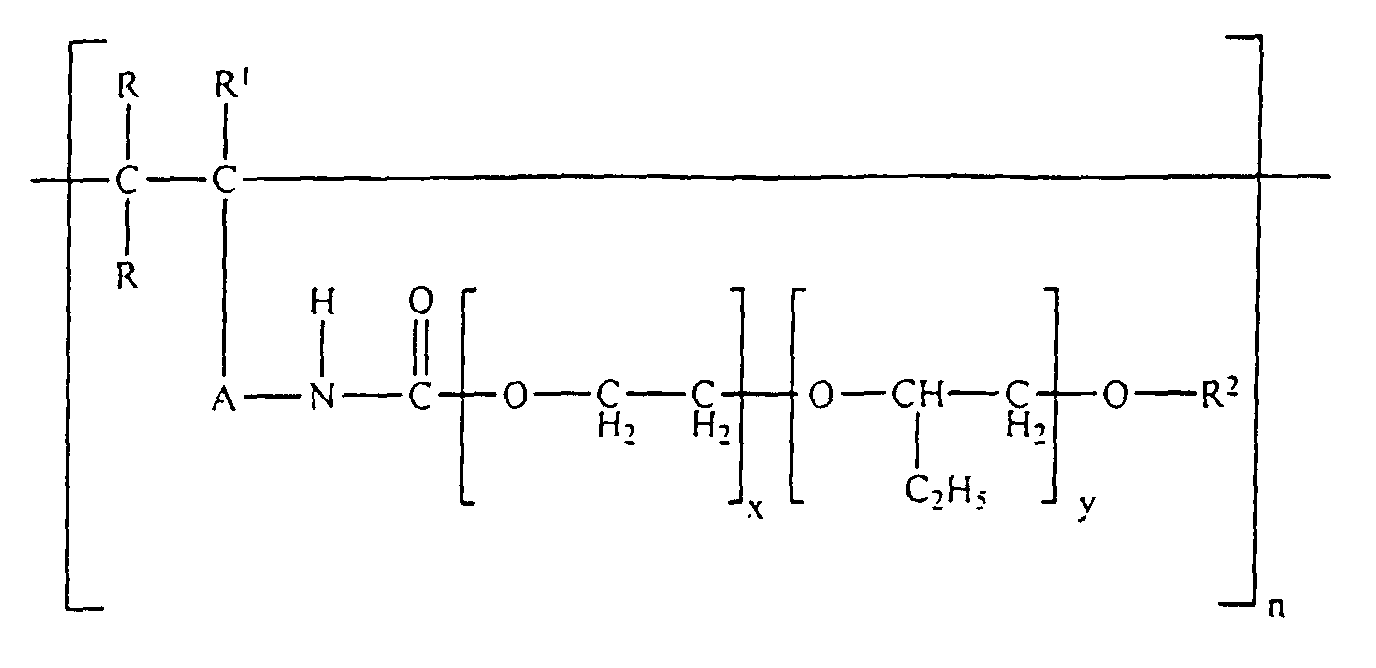
- Polymère suivant la revendication 9, dans lequel R représente -H ; R1 représente un groupe -CH3 ; et A représente un groupe

- Copolymère comprenant des motifs dérivés :a) de 30 à 99 % en mole d'un acide monocarboxylique en C3 à C8 à insaturation mono-éthylénique, d'un acide dicarboxylique en C4 à C8 à insaturation mono-éthylénique, d'esters d'acides dicarboxyliques en C4 à C8 à insaturation mono-éthylénique, d'esters d'acides monocarboxyliques en C3 à C8 à insaturation mono-éthylénique, d'esters vinyliques d'un acide monocarboxylique en C1 à C8 saturé ou d'un de leurs mélanges ; etb) de 0,1 à 70 % en mole du composé d'uréthanne non ionique suivant la revendication 1.
- Copolymère suivant la revendication 11, dans lequel le groupe B-A- du composé d'uréthanne non ionique est un groupe aliphatique à insaturation mono-éthylénique.
- Copolymère suivant la revendication 11, dans lequel le groupe B-A- du composé d'uréthanne non ionique est choisi dans le groupe consistant en un groupe méthacrylate d'éthyle et un groupe alpha-,alpha-diméthyl-m-isopropényl-benzyle.
- Solution aqueuse comprenant le copolymère suivant la revendication 11, sous forme d'un sel.
- Solution aqueuse suivant la revendication 14, comprenant en outre au moins un modificateur de rhéologie choisi dans le groupe consistant en des surfactants, des épaississants polymériques, des polymères associatifs et leurs mélanges.
- Latex comprenant le copolymère suivant la revendication 11.
- Latex suivant la revendication 16, comprenant en outre au moins un modificateur de rhéologie choisi dans le groupe consistant en des surfactants, des épaississants polymériques, des polymères associatifs et leurs mélanges.
- Copolymère suivant la revendication 11, comprenant en outre des comonomères choisis dans le groupe consistant en l'acrylamide, le méthacrylamide, l'acrylonitrile et des esters d'acide itaconique.
- Copolymère comprenant des motifs dérivés :a) de 30 à 99 % en mole d'un acide monocarboxylique en C3 à C8 à insaturation mono-éthylénique, d'un acide dicarboxylique en C4 à C8 à insaturation mono-éthylénique, d'esters d'acides dicarboxyliques en C4 à C8 à insaturation mono-éthylénique, d'esters d'acides monocarboxyliques en C3 à C8 à insaturation mono-éthylénique, d'esters vinyliques d'un acide monocarboxylique en C1 à C8 saturé ou d'un de leurs mélanges ; etb) de 0,1 à 35 % en mole du composé d'uréthanne non ionique suivant la revendication 5.
- Copolymère suivant la revendication 19, dans lequel le groupe B-A- du composé d'uréthanne non ionique est un groupe aliphatique à insaturation mono-éthylénique.
- Copolymère suivant la revendication 19, dans lequel le groupe B-A- du composé d'uréthanne non ionique est choisi dans le groupe consistant en un groupe méthacrylate d'éthyle et un groupe alpha-,alpha-diméthyl-m-isopropényl-benzyle.
- Solution aqueuse comprenant le copolymère suivant la revendication 19, sous forme d'un sel.
- Solution aqueuse suivant la revendication 22, comprenant en outre au moins un modificateur de rhéologie choisi dans le groupe consistant en des surfactants, des épaississants polymériques, des polymères associatifs et leurs mélanges.
- Latex comprenant le copolymère suivant la revendication 19.
- Latex suivant la revendication 24, comprenant en outre au moins un modificateur de rhéologie choisi dans le groupe consistant en des surfactants, des épaississants polymériques, des polymères associatifs et leurs mélanges.
- Copolymère suivant la revendication 19, comprenant en outre des comonomères choisis dans le groupe consistant en l'acrylamide, le méthacrylamide, l'acrylonitrile et des esters d'acide itaconique.
- Compositions d'enduction de tapis, comprenant 10 à 70 % en poids d'un liant à base de latex, 30 à 90 % en poids d'au moins une charge et 0,5 à 15 % en poids d'au moins un épaississant, dans lesquels l'épaississant consiste en le polymère suivant la revendication 9 ou le copolymère suivant la revendication 11 ou 19 et la somme totale des quantités du liant à base de latex, de la charge et de l'épaississant ne peut dépasser 100 % en poids.
- Procédé pour réduire les teneurs en agents chimiques organiques volatils de tapis, comprenant les étapes consistant :a) à fabriquer un tapis à partir d'une pluralité de boucles ou de touffes de fils insérées dans un dossier ; etb) à revêtir le dossier avec une composition de revêtement suivant la revendication 27, le polymère suivant la revendication 9 ou le copolymère suivant la revendication 11 ou 19 étant utilisé pour remplacer un épaississant ayant une teneur en agents chimiques organiques volatils d'au moins 1,0 mg/m2, et la somme totale des quantités du liant à base de latex, de la charge et de l'épaississant ne pouvant dépasser 100 % en poids.
Applications Claiming Priority (2)
| Application Number | Priority Date | Filing Date | Title |
|---|---|---|---|
| US08/085,851 US5294692A (en) | 1993-06-30 | 1993-06-30 | Associative monomers and polymers |
| US85851 | 1993-06-30 |
Publications (2)
| Publication Number | Publication Date |
|---|---|
| EP0632083A1 EP0632083A1 (fr) | 1995-01-04 |
| EP0632083B1 true EP0632083B1 (fr) | 2000-04-12 |
Family
ID=22194380
Family Applications (1)
| Application Number | Title | Priority Date | Filing Date |
|---|---|---|---|
| EP94108138A Expired - Lifetime EP0632083B1 (fr) | 1993-06-30 | 1994-05-26 | Monomères associatifs nouveaux et polymères |
Country Status (7)
| Country | Link |
|---|---|
| US (5) | US5294692A (fr) |
| EP (1) | EP0632083B1 (fr) |
| JP (1) | JPH0825985B2 (fr) |
| AT (1) | ATE191727T1 (fr) |
| AU (1) | AU668647B2 (fr) |
| CA (1) | CA2127032C (fr) |
| DE (1) | DE69423932D1 (fr) |
Families Citing this family (87)
| Publication number | Priority date | Publication date | Assignee | Title |
|---|---|---|---|---|
| US5639841A (en) * | 1995-02-28 | 1997-06-17 | Union Carbide Chemicals & Plastics Technology Corporation | Polymers containing macromonomer mixtures |
| US5478883A (en) * | 1995-04-11 | 1995-12-26 | Basf Corporation | Emulsion polymerization process utilizing a specifically defined ethylenically unsaturated polymerizable water-soluble nonionic surfactant formed by the reaction of a diallylamine, ethylene oxide and propylene oxide and/or butylene oxide |
| IT1277376B1 (it) * | 1995-07-28 | 1997-11-10 | Euron Spa | Copolimeri a blocchi loro preparazione e loro uso come lubrificanti |
| KR100404774B1 (ko) * | 1995-09-06 | 2004-04-01 | 아사히 덴카 고교 가부시키가이샤 | 점성조정제 |
| US5691405A (en) * | 1996-02-16 | 1997-11-25 | Westvaco Corporation | Rosin-supported urea-and urethane-modified emulsion polymers |
| US5693702A (en) * | 1996-02-16 | 1997-12-02 | Westvaco Corporation | Rosin-supported urea- and urethane-modified emulsion polymers |
| US6324872B1 (en) * | 1996-04-12 | 2001-12-04 | Corning Incorporated | Method and apparatus for introducing controlled spin in optical fibers |
| JPH10121030A (ja) * | 1996-08-16 | 1998-05-12 | Natl Starch & Chem Investment Holding Corp | ポリマーレオロジー調節剤 |
| US5990233A (en) * | 1996-08-16 | 1999-11-23 | National Starch And Chemical Investment Holding Corporation | Rheology modifiers for use in aqueous compositions |
| SG67989A1 (en) * | 1996-08-16 | 1999-10-19 | Nat Starch Chem Invest | Thickened personal care composition |
| BR9706654A (pt) * | 1996-08-16 | 2001-08-07 | Nat Starch Chem Invest | Composições aquosa espessadas com modificadores reológicos poliméricos baseados em acrilato |
| AT404730B (de) * | 1997-04-07 | 1999-02-25 | Holderchem Ag | Acryl-copolymere und polymerzusammensetzungen sowie deren verwendung als additive oder beimischungen zur verbesserung der eigenschaften von dispersionen und baustoffen |
| US5874148A (en) * | 1997-04-21 | 1999-02-23 | Reichhold Chemicals, Inc. | Water resistant textile coating and method of using the same |
| US6037014A (en) * | 1997-11-06 | 2000-03-14 | The Edgington Co. | Coating composition |
| FR2774899B1 (fr) | 1998-02-13 | 2001-08-03 | Oreal | Composition cosmetique a base de polyurethannes associatifs et de polymeres non ioniques a chaines grasses |
| FR2774902B1 (fr) * | 1998-02-13 | 2002-07-19 | Oreal | Composition cosmetique a base de polyurethannes associatifs et de silicones quaternaires |
| FR2774901B1 (fr) | 1998-02-13 | 2002-06-14 | Oreal | Compositions cosmetiques capillaires a base de polymeres cationiques et de polymeres associatifs non ioniques |
| US6762269B1 (en) * | 1998-08-13 | 2004-07-13 | National Starch And Chemical Investment Holding Corporation | High temperature viscosity stable thickener |
| US6447803B1 (en) * | 1998-08-14 | 2002-09-10 | National Starch And Chemical Investment Holding Corporation | Thickener-rheology modifier system for personal care compositions |
| EP1141032B1 (fr) * | 1998-12-14 | 2004-11-03 | Rhodia Inc. | Polymeres s'epaississant a la chaleur et leur procede de fabrication |
| FR2792932B1 (fr) * | 1999-04-30 | 2001-07-06 | Coatex Sa | Nouveaux agents de type copolymeres acryliques a base d'urethanne pour ameliorer la maniabilite des liants hydrauliques, leur procede de preparation, les liants les contenant et leurs applications |
| US6271192B1 (en) * | 1999-11-10 | 2001-08-07 | National Starch And Chemical Investment Holding Company | Associative thickener for aqueous fabric softener |
| US6518348B1 (en) * | 1999-12-14 | 2003-02-11 | Dow Global Technologies Inc. | Carpet backing compounds thickened by hydrophobically-modified ethylene-oxide-based urethane block copolymers |
| US7147978B2 (en) * | 2001-10-26 | 2006-12-12 | Samsung Electronics Co., Ltd. | Electrophotographic photoreceptors with novel overcoats |
| US7288616B2 (en) * | 2002-01-18 | 2007-10-30 | Lubrizol Advanced Materials, Inc. | Multi-purpose polymers, methods and compositions |
| US7153496B2 (en) * | 2002-01-18 | 2006-12-26 | Noveon Ip Holdings Corp. | Hair setting compositions, polymers and methods |
| WO2005003192A1 (fr) | 2003-06-26 | 2005-01-13 | Symyx Technologies, Inc. | Synthese de polymeres photosensibles |
| EP1648948B1 (fr) * | 2003-07-18 | 2012-02-08 | Agency for Science, Technology and Research | Polymeres thermosensibles a usage therapeutique et procedes de preparation |
| US7892525B2 (en) * | 2003-08-22 | 2011-02-22 | Lubrizol Advanced Materials, Inc. | Antiperspirant gel compositions |
| US20050063918A1 (en) * | 2003-09-19 | 2005-03-24 | Unilever Home & Personal Care Usa, Division Of Conopco, Inc. | Oral composition |
| WO2005027864A1 (fr) * | 2003-09-19 | 2005-03-31 | Symyx Technologies, Inc. | Materiaux conçus pour une meilleure administration d'agents actifs hydrophiles dans des preparations de soins personnels |
| US20050063920A1 (en) * | 2003-09-19 | 2005-03-24 | Unilever Home & Personal Care Usa, Division Of Conopco, Inc. | Oral composition |
| US20050063919A1 (en) * | 2003-09-19 | 2005-03-24 | Unilever Home & Personal Care Usa, Division Of Conopco, Inc. | Oral composition |
| US20050063921A1 (en) * | 2003-09-19 | 2005-03-24 | Unilever Home & Personal Care Usa, Division Of Conopco, Inc. | Oral composition |
| US20050249911A1 (en) * | 2004-05-06 | 2005-11-10 | C&A Floorcoverings, Inc. | Polyvinyl butyral backed floor covering |
| US20050249912A1 (en) * | 2004-05-06 | 2005-11-10 | C&A Floorcoverings, Inc. | Floor covering containing polyvinyl butyral and method of making same |
| US20060037544A1 (en) * | 2004-08-10 | 2006-02-23 | Hunter James A | Package for storage and distribution of wild bird seed convertible to a disposable squirrel proof wild bird feeder |
| US9668476B2 (en) * | 2006-02-23 | 2017-06-06 | Lanxess Corporation | Removable antimicrobial coating compositions and methods of use |
| CN101389694B (zh) * | 2006-02-24 | 2013-03-27 | 路博润高级材料公司 | 可聚合的硅氧烷共聚醇大分子单体和由其制成的聚合物 |
| US8021650B2 (en) * | 2006-02-24 | 2011-09-20 | Lubrizol Advanced Materials, Inc. | Polymers containing silicone copolyol macromers and personal care compositions containing same |
| US7501725B2 (en) * | 2006-08-21 | 2009-03-10 | Steve Parker | Method of converting piston driven engines to operate on electricity |
| FR2912309B1 (fr) | 2007-02-13 | 2010-06-04 | Oreal | Procede de deformation permanente des fibres keratiniques comprenant une etape d'application d'une composition oxydante contenant un polymere epaississant cationique. |
| US20100267840A1 (en) * | 2007-06-21 | 2010-10-21 | Jordan Susan L | Stabilizers for hydrophobic components in personal care compositions |
| FR2920972B1 (fr) | 2007-09-14 | 2009-12-04 | Oreal | Composition cosmetique comprenant un polymere cationique particulier et au moins un ester d'acide gras en c8-c24 et de sorbitan oxyethylene comprenant 2 a 10 motifs d'oxyethylene, et procede de traitement cosmetique. |
| FR2920986B1 (fr) | 2007-09-14 | 2010-01-15 | Oreal | Compositions cosmetiques contenant un copolymere cationique et une silicone aminee particuliere et leurs utilisations |
| FR2920970B1 (fr) | 2007-09-14 | 2010-02-26 | Oreal | Compositions cosmetiques contenant un copolymere cationique, une cyclodextrine et un tensioactif et leurs utilisations. |
| FR2920978B1 (fr) | 2007-09-14 | 2012-04-27 | Oreal | Composition cosmetique comprenant un copolymere cationique et un amidon et procede de traitement cosmetique. |
| FR2920976B1 (fr) | 2007-09-14 | 2009-12-04 | Oreal | Composition cosmetique comprenant un copolymere cationique et un polymere associatif anionique et procede de traitement cosmetique. |
| FR2920969B1 (fr) | 2007-09-14 | 2009-12-18 | Oreal | Compositions cosmetiques contenant un copolymere cationique, une silicone aminee et un polymere cationique et leurs utilisations. |
| FR2920971B1 (fr) | 2007-09-14 | 2014-03-28 | Oreal | Composition cosmetique comprenant au moins un polymere cationique particulier, au moins un agent tensioactif, au moins un polymere cationique ou amphotere et au moins une particule minerale, et procede de traitement cosmetique. |
| FR2920977B1 (fr) | 2007-09-14 | 2012-07-27 | Oreal | Compositions cosmetiques contenant un copolymere cationique et un triglyceride particulier et leurs utilisations. |
| FR2930440B1 (fr) | 2008-04-28 | 2012-12-14 | Oreal | Composition cosmetique comprenant un polyurethane cationique et un polyacrylate particulier et utilisations en coiffage |
| US7868122B2 (en) * | 2008-06-19 | 2011-01-11 | Southern Clay Products, Inc. | Tint-viscosity stabilization polymeric thickeners |
| CN102202639B (zh) | 2008-09-02 | 2013-08-14 | 巴斯夫欧洲公司 | 用作流变改性剂和家庭和个人护理组合物的共聚物 |
| US20110177146A1 (en) | 2009-07-27 | 2011-07-21 | E. I. Du Pont De Nemours And Company | Removable antimicrobial coating compositions containing cationic rheology agent and methods of use |
| US20110182959A1 (en) | 2009-07-27 | 2011-07-28 | E.I. Du Pont De Nemours And Company. | Removable antimicrobial coating compositions containing acid-activated rheology agent and methods of use |
| ES2534193T3 (es) | 2009-12-01 | 2015-04-20 | Lubrizol Advanced Materials, Inc. | Polímeros hidrolíticamente estables para múltiples fines |
| WO2011068820A1 (fr) | 2009-12-01 | 2011-06-09 | Lubrizol Advanced Materials, Inc. | Polymères polyvalents stables à l'hydrolyse |
| CN102276502B (zh) * | 2011-05-06 | 2014-03-26 | 苏州市明大高分子科技材料有限公司 | 一种紫外光固化聚氨酯丙烯酸酯低聚物的制备方法 |
| ES2554952T3 (es) | 2011-09-13 | 2015-12-28 | Lubrizol Advanced Materials, Inc. | Microgeles sensibles a tensioactivos |
| WO2013040174A1 (fr) | 2011-09-13 | 2013-03-21 | Lubrizol Advanced Materials, Inc. | Microgels polymérisés en émulsion répondant aux tensioactifs |
| JP6165735B2 (ja) | 2011-09-13 | 2017-07-19 | ルブリゾル アドバンスド マテリアルズ, インコーポレイテッド | 界面活性剤応答性分散重合ミクロゲル |
| GB201116659D0 (en) | 2011-09-28 | 2011-11-09 | Unilever Plc | Thickening vinyl copolymers |
| GB201116660D0 (en) | 2011-09-28 | 2011-11-09 | Unilever Plc | Thickening vinyl copolymers |
| WO2013067109A1 (fr) | 2011-11-01 | 2013-05-10 | Lubrizol Advanced Materials, Inc. | Copolymères d'acrylate-oléfine, procédés pour les produire et compositions les utilisant |
| KR20150095933A (ko) | 2012-12-20 | 2015-08-21 | 루브리졸 어드밴스드 머티어리얼스, 인코포레이티드 | 자극 완화 폴리머 및 이의 용도 |
| KR20150099580A (ko) | 2012-12-20 | 2015-08-31 | 루브리졸 어드밴스드 머티어리얼스, 인코포레이티드 | 자극 완화 폴리머 및 이의 용도 |
| JP2016516674A (ja) | 2013-03-08 | 2016-06-09 | ルブリゾル アドバンスド マテリアルズ, インコーポレイテッド | ケラチン基質からのシリコーン沈着の損失を低減するポリマーおよび方法 |
| WO2014138327A1 (fr) | 2013-03-08 | 2014-09-12 | Lubrizol Advanced Materials, Inc. | Performance de moussage améliorée dans des compositions de nettoyage par l'intermédiaire de l'utilisation de polymères amphiphiles, non ioniques |
| AR098786A1 (es) | 2013-12-17 | 2016-06-15 | Lubrizol Advanced Mat Inc | Microgeles polimerizados en emulsión que responden a tensioactivos |
| KR20160096204A (ko) | 2013-12-23 | 2016-08-12 | 루브리졸 어드밴스드 머티어리얼스, 인코포레이티드 | 항비듬 모발 관리 조성물용 현탁 및 안정성 작용제 |
| US10966916B2 (en) | 2014-11-10 | 2021-04-06 | The Procter And Gamble Company | Personal care compositions |
| EP3217948B1 (fr) | 2014-11-10 | 2020-09-16 | The Procter and Gamble Company | Compositions de soins personnels comportant deux phases à effet bénéfique |
| US20160128927A1 (en) | 2014-11-10 | 2016-05-12 | The Procter & Gamble Company | Personal Care Compositions With Two Benefit Phases |
| CA2967531A1 (fr) | 2014-11-24 | 2016-06-02 | Akzo Nobel Chemicals International B.V. | Agent de rupture polymere interne pour fluides a base d'un tensioactif viscoelastique |
| KR20170095373A (ko) | 2014-12-18 | 2017-08-22 | 루브리졸 어드밴스드 머티어리얼스, 인코포레이티드 | 항비듬 모발 관리 조성물용 양친매성 현탁 및 안정성 작용제 |
| BR112017013600A2 (pt) | 2014-12-23 | 2018-03-06 | Lubrizol Advanced Mat Inc | composição. |
| WO2017112586A1 (fr) | 2015-12-23 | 2017-06-29 | Lubrizol Advanced Materials, Inc. | Polymères en émulsion gonflant en milieu alcalin modifiés hydrophobiquement |
| KR102529819B1 (ko) | 2016-12-19 | 2023-05-08 | 루브리졸 어드밴스드 머티어리얼스, 인코포레이티드 | 계면활성제 반응성 에멀젼 중합된 마이크로-겔 |
| WO2019040442A1 (fr) | 2017-08-22 | 2019-02-28 | Lubrizol Advanced Materials, Inc. | Compositions de savon et méthodes de traitement pour l'atténuation du prurit hivernal |
| CN111212625B (zh) | 2017-10-20 | 2023-05-23 | 宝洁公司 | 气溶胶泡沫洁肤剂 |
| WO2019079405A1 (fr) | 2017-10-20 | 2019-04-25 | The Procter & Gamble Company | Nettoyant moussant en aérosol pour la peau |
| WO2019126162A1 (fr) | 2017-12-20 | 2019-06-27 | Lubrizol Advanced Materials, Inc. | Composition de nettoyage contenant de l'huile ayant des propriétés moussantes |
| WO2019177925A1 (fr) | 2018-03-16 | 2019-09-19 | Lubrizol Advanced Materials, Inc. | Compositions nettoyantes moussantes contenant une huile non polaire et un polymère amphiphile |
| WO2019209779A1 (fr) | 2018-04-27 | 2019-10-31 | Rohm And Haas Company | Modificateurs rhéologiques pour la maîtrise de l'entraînement par le vent dans des émulsions agrochimiques |
| WO2020112486A1 (fr) | 2018-11-29 | 2020-06-04 | The Procter & Gamble Company | Méthodes de criblage de produits de soins personnels |
| WO2020123609A1 (fr) | 2018-12-11 | 2020-06-18 | Lubrizol Advanced Materials, Inc. | Compositions et méthodes de traitement pour l'atténuation du prurit lié à la saison hivernale |
Citations (1)
| Publication number | Priority date | Publication date | Assignee | Title |
|---|---|---|---|---|
| US4514552A (en) * | 1984-08-23 | 1985-04-30 | Desoto, Inc. | Alkali soluble latex thickeners |
Family Cites Families (31)
| Publication number | Priority date | Publication date | Assignee | Title |
|---|---|---|---|---|
| US3657175A (en) * | 1969-06-26 | 1972-04-18 | Standard Brands Chem Ind Inc | Carboxylic acid latices providing unique thickening and dispersing agents |
| US4314044A (en) * | 1979-01-22 | 1982-02-02 | Rohm And Haas Company | Process for preparing low molecular weight water-soluble polymers |
| US4384096A (en) * | 1979-08-27 | 1983-05-17 | The Dow Chemical Company | Liquid emulsion polymers useful as pH responsive thickeners for aqueous systems |
| US4351754A (en) * | 1979-09-17 | 1982-09-28 | Rohm And Haas Company | Thickening agent for aqueous compositions |
| US4296159A (en) * | 1980-09-29 | 1981-10-20 | The Dow Chemical Company | Polyurethane backed carpet |
| US4394491A (en) * | 1980-10-08 | 1983-07-19 | The Dow Chemical Company | Addition polymerizable adduct of a polymeric monoahl and an unsaturated isocyanate |
| US4663385A (en) * | 1982-11-17 | 1987-05-05 | Rohm And Haas | Process for thickening with copolymers of alkyl poly (oxyalkylene) itaconic di-esters |
| DE3305637A1 (de) * | 1983-02-18 | 1984-08-23 | Basf Ag, 6700 Ludwigshafen | Copolymerisate, ihre herstellung und ihre verwendung als hilfsmittel in wasch- und reinigungsmitteln |
| DE3426368A1 (de) * | 1984-07-18 | 1986-01-23 | Basf Ag, 6700 Ludwigshafen | Copolymerisate fuer wasch- und reinigungsmittel |
| USRE33156E (en) * | 1984-08-23 | 1990-01-30 | Desoto, Inc. | Alkali soluble latex thickeners |
| US4600761A (en) * | 1985-04-04 | 1986-07-15 | Alco Chemical Corporation | Acrylic emulsion copolymers for thickening aqueous systems and copolymerizable surfactant monomers for use therein |
| USRE33008E (en) * | 1985-04-04 | 1989-08-01 | Alco Chemical Corporation | Acrylic emulsion copolymers for thickening aqueous systems and copolymerizable surfactant monomers for use therein |
| DE3680426D1 (de) * | 1985-08-12 | 1991-08-29 | Allied Colloids Ltd | Dispergiermittel. |
| US4743698A (en) * | 1985-10-01 | 1988-05-10 | Alco Chemical Corp. | Acrylic emulsion copolymers for thickening aqueous systems and copolymerizable surfactant monomers for use therein |
| GB8613408D0 (en) * | 1986-06-03 | 1986-07-09 | Crown Decorative Prod Ltd | Thickeners |
| JPH0755926B2 (ja) * | 1987-03-27 | 1995-06-14 | 日本石油株式会社 | N―アルケニルカルバミン酸エステル系マクロマー |
| US5013787A (en) * | 1987-05-06 | 1991-05-07 | National Starch And Chemical Investment Holding Corporation | Copolymers as thickeners and modifiers for latex systems |
| US4916183A (en) * | 1987-05-06 | 1990-04-10 | National Starch And Chemical Corporation | Copolymers as thickeners and modifiers for latex systems |
| NL8701548A (nl) * | 1987-07-01 | 1989-02-01 | Tno | Polymeer netwerk, werkwijze voor het bereiden daarvan alsmede, de toepassing daarvan voor het bekleden en/of impregneren of voor het vervaardigen van ooglenzen, alsmede gevormd voortbrengsel, geheel of ten dele bestaande uit een dergelijk polymeer netwerk. |
| DE68928089T2 (de) * | 1988-02-26 | 1997-12-18 | Ciba Geigy Ag | Benetzbares, biegsames, sauerstoffdurchlässiges, quellbares Polymer mit Polyoxyalkyleneinheiten in der Hauptkette und Kontaktlinse |
| JP2641763B2 (ja) * | 1988-06-09 | 1997-08-20 | 三井東圧化学株式会社 | 高硬度透明樹脂 |
| US5166285A (en) * | 1988-06-09 | 1992-11-24 | Mitsui Toatsu Chemicals, Inc. | Hard transparent resins and process for the production thereof |
| GB8813966D0 (en) * | 1988-06-13 | 1988-07-20 | Nat Starch Chem Corp | Process for manufacture of polymers |
| GB8813978D0 (en) * | 1988-06-13 | 1988-07-20 | Unilever Plc | Liquid detergents |
| DE3838093A1 (de) * | 1988-11-10 | 1990-05-17 | Basf Ag | Verwendung von copolymerisaten als zusatz zu fluessigwaschmitteln |
| US5191051A (en) * | 1989-01-09 | 1993-03-02 | Union Carbide Chemicals & Plastics Technology Corporation | Propoxylated alkali-soluble thickeners |
| US5173534A (en) * | 1989-01-30 | 1992-12-22 | Rohm And Haas Company | Emulsion and latex paint containing multipurpose binder |
| US5011978A (en) * | 1989-03-02 | 1991-04-30 | National Starch And Chemical Investment Holding Corporation | Copolymers as thickeners and modifiers for latex systems |
| DE3935137A1 (de) * | 1989-10-21 | 1991-04-25 | Hoechst Ag | Urethangruppen enthaltende copolymerisate auf der basis von ethylenisch ungesaettigten monomeren, verfahren zu ihrer herstellung und ihre verwendung |
| DE3935138A1 (de) * | 1989-10-21 | 1991-04-25 | Hoechst Ag | Ethylenisch ungesaettigte, grenzflaechenaktive urethanderivate und verfahren zu ihrer herstellung |
| DE4026239A1 (de) * | 1990-08-18 | 1992-02-20 | Hoechst Ag | Carboxylgruppenhaltige copolymerisate, ihre herstellung und ihre verwendung als verdicker |
-
1993
- 1993-06-30 US US08/085,851 patent/US5294692A/en not_active Expired - Lifetime
- 1993-12-22 US US08/172,626 patent/US5412142A/en not_active Expired - Lifetime
-
1994
- 1994-05-24 AU AU63291/94A patent/AU668647B2/en not_active Ceased
- 1994-05-26 AT AT94108138T patent/ATE191727T1/de not_active IP Right Cessation
- 1994-05-26 EP EP94108138A patent/EP0632083B1/fr not_active Expired - Lifetime
- 1994-05-26 DE DE69423932T patent/DE69423932D1/de not_active Expired - Lifetime
- 1994-06-29 CA CA002127032A patent/CA2127032C/fr not_active Expired - Fee Related
- 1994-06-30 JP JP6149496A patent/JPH0825985B2/ja not_active Expired - Lifetime
- 1994-11-15 US US08/339,612 patent/US5442091A/en not_active Expired - Lifetime
-
1995
- 1995-04-27 US US08/430,072 patent/US5478881A/en not_active Expired - Fee Related
- 1995-04-27 US US08/430,068 patent/US5532036A/en not_active Expired - Fee Related
Patent Citations (1)
| Publication number | Priority date | Publication date | Assignee | Title |
|---|---|---|---|---|
| US4514552A (en) * | 1984-08-23 | 1985-04-30 | Desoto, Inc. | Alkali soluble latex thickeners |
Also Published As
| Publication number | Publication date |
|---|---|
| AU668647B2 (en) | 1996-05-09 |
| JPH0770044A (ja) | 1995-03-14 |
| DE69423932D1 (de) | 2000-05-18 |
| US5294692A (en) | 1994-03-15 |
| CA2127032A1 (fr) | 1994-12-31 |
| US5532036A (en) | 1996-07-02 |
| AU6329194A (en) | 1995-02-02 |
| CA2127032C (fr) | 1998-05-26 |
| ATE191727T1 (de) | 2000-04-15 |
| JPH0825985B2 (ja) | 1996-03-13 |
| US5478881A (en) | 1995-12-26 |
| US5442091A (en) | 1995-08-15 |
| US5412142A (en) | 1995-05-02 |
| EP0632083A1 (fr) | 1995-01-04 |
Similar Documents
| Publication | Publication Date | Title |
|---|---|---|
| EP0632083B1 (fr) | Monomères associatifs nouveaux et polymères | |
| CA1270347A (fr) | Copolymeres acryliques d'emulsion, epaississants pour systemes aqueux; monomeres surfactifs copolymerisables, incorporables dans ces systemes | |
| CA1244188A (fr) | Copolymeres d'emulsion d'ester methylene-succinque de type acrylique pour l'epaississement de systemes aqueux | |
| US6762269B1 (en) | High temperature viscosity stable thickener | |
| US4743698A (en) | Acrylic emulsion copolymers for thickening aqueous systems and copolymerizable surfactant monomers for use therein | |
| US4892916A (en) | Polymeric thickeners and their production | |
| EP0710675B1 (fr) | Méthode améliorée pour l'obtention de polymères | |
| EP0216479B1 (fr) | Agents épaississants polymères et leur préparation | |
| EP0157928B1 (fr) | Dispersion aqueuse d'une résine vinylique copolymère | |
| EP0705852A1 (fr) | Additifs rhéologiques gonflables dans l'alkali à haute performance pour systèmes aqueux | |
| USRE33008E (en) | Acrylic emulsion copolymers for thickening aqueous systems and copolymerizable surfactant monomers for use therein | |
| EP2448983A1 (fr) | Emulsion de polymère composite | |
| US4546140A (en) | One-package aqueous latices containing alkaline-curable self-crosslinking polymers | |
| US6143817A (en) | Use of derivatives of polyamino acids as emulsifiers stabilizers in aqueous free radical emulsion polymerization | |
| CA2196908A1 (fr) | Monomeres et polymeres associatifs innovateurs | |
| US20030153675A1 (en) | Salt-free aqueous dispersions of water soluble (co) polymers based on cationic monomrs, method for making same and uses thereof | |
| JP2003212989A (ja) | オレフィン性不飽和エーテルカルボン酸及びそれを乳化重合に使用する方法 | |
| US20030166771A1 (en) | Water soluble saline aqueous dispersion of copolymers based on cationic monomers, method for making same and uses thereof | |
| CA1297124C (fr) | Copolymeres utilises comme adjuvant et agent d'epaissiseur de systemes d'enduction au latex | |
| JP2001106732A (ja) | カチオン性ポリマー、カチオン性ポリマー微粒子とその製造法 |
Legal Events
| Date | Code | Title | Description |
|---|---|---|---|
| PUAI | Public reference made under article 153(3) epc to a published international application that has entered the european phase |
Free format text: ORIGINAL CODE: 0009012 |
|
| AK | Designated contracting states |
Kind code of ref document: A1 Designated state(s): AT BE CH DE DK ES FR GB IE IT LI LU NL SE |
|
| 17P | Request for examination filed |
Effective date: 19941117 |
|
| 17Q | First examination report despatched |
Effective date: 19961106 |
|
| GRAG | Despatch of communication of intention to grant |
Free format text: ORIGINAL CODE: EPIDOS AGRA |
|
| GRAG | Despatch of communication of intention to grant |
Free format text: ORIGINAL CODE: EPIDOS AGRA |
|
| GRAH | Despatch of communication of intention to grant a patent |
Free format text: ORIGINAL CODE: EPIDOS IGRA |
|
| GRAH | Despatch of communication of intention to grant a patent |
Free format text: ORIGINAL CODE: EPIDOS IGRA |
|
| GRAA | (expected) grant |
Free format text: ORIGINAL CODE: 0009210 |
|
| AK | Designated contracting states |
Kind code of ref document: B1 Designated state(s): AT BE CH DE DK ES FR GB IE IT LI LU NL SE |
|
| PG25 | Lapsed in a contracting state [announced via postgrant information from national office to epo] |
Ref country code: NL Free format text: LAPSE BECAUSE OF FAILURE TO SUBMIT A TRANSLATION OF THE DESCRIPTION OR TO PAY THE FEE WITHIN THE PRESCRIBED TIME-LIMIT Effective date: 20000412 Ref country code: LI Free format text: LAPSE BECAUSE OF FAILURE TO SUBMIT A TRANSLATION OF THE DESCRIPTION OR TO PAY THE FEE WITHIN THE PRESCRIBED TIME-LIMIT Effective date: 20000412 Ref country code: IT Free format text: LAPSE BECAUSE OF FAILURE TO SUBMIT A TRANSLATION OF THE DESCRIPTION OR TO PAY THE FEE WITHIN THE PRE;WARNING: LAPSES OF ITALIAN PATENTS WITH EFFECTIVE DATE BEFORE 2007 MAY HAVE OCCURRED AT ANY TIME BEFORE 2007. THE CORRECT EFFECTIVE DATE MAY BE DIFFERENT FROM THE ONE RECORDED.SCRIBED TIME-LIMIT Effective date: 20000412 Ref country code: ES Free format text: THE PATENT HAS BEEN ANNULLED BY A DECISION OF A NATIONAL AUTHORITY Effective date: 20000412 Ref country code: CH Free format text: LAPSE BECAUSE OF FAILURE TO SUBMIT A TRANSLATION OF THE DESCRIPTION OR TO PAY THE FEE WITHIN THE PRESCRIBED TIME-LIMIT Effective date: 20000412 Ref country code: BE Free format text: LAPSE BECAUSE OF FAILURE TO SUBMIT A TRANSLATION OF THE DESCRIPTION OR TO PAY THE FEE WITHIN THE PRESCRIBED TIME-LIMIT Effective date: 20000412 Ref country code: AT Free format text: LAPSE BECAUSE OF FAILURE TO SUBMIT A TRANSLATION OF THE DESCRIPTION OR TO PAY THE FEE WITHIN THE PRESCRIBED TIME-LIMIT Effective date: 20000412 |
|
| REF | Corresponds to: |
Ref document number: 191727 Country of ref document: AT Date of ref document: 20000415 Kind code of ref document: T |
|
| REG | Reference to a national code |
Ref country code: CH Ref legal event code: EP |
|
| REF | Corresponds to: |
Ref document number: 69423932 Country of ref document: DE Date of ref document: 20000518 |
|
| PG25 | Lapsed in a contracting state [announced via postgrant information from national office to epo] |
Ref country code: LU Free format text: LAPSE BECAUSE OF NON-PAYMENT OF DUE FEES Effective date: 20000526 Ref country code: IE Free format text: LAPSE BECAUSE OF NON-PAYMENT OF DUE FEES Effective date: 20000526 |
|
| REG | Reference to a national code |
Ref country code: IE Ref legal event code: FG4D |
|
| ET | Fr: translation filed | ||
| PG25 | Lapsed in a contracting state [announced via postgrant information from national office to epo] |
Ref country code: SE Free format text: LAPSE BECAUSE OF FAILURE TO SUBMIT A TRANSLATION OF THE DESCRIPTION OR TO PAY THE FEE WITHIN THE PRESCRIBED TIME-LIMIT Effective date: 20000712 Ref country code: GB Free format text: LAPSE BECAUSE OF NON-PAYMENT OF DUE FEES Effective date: 20000712 Ref country code: DK Free format text: LAPSE BECAUSE OF FAILURE TO SUBMIT A TRANSLATION OF THE DESCRIPTION OR TO PAY THE FEE WITHIN THE PRESCRIBED TIME-LIMIT Effective date: 20000712 |
|
| PG25 | Lapsed in a contracting state [announced via postgrant information from national office to epo] |
Ref country code: DE Free format text: LAPSE BECAUSE OF FAILURE TO SUBMIT A TRANSLATION OF THE DESCRIPTION OR TO PAY THE FEE WITHIN THE PRESCRIBED TIME-LIMIT Effective date: 20000713 |
|
| NLV1 | Nl: lapsed or annulled due to failure to fulfill the requirements of art. 29p and 29m of the patents act | ||
| REG | Reference to a national code |
Ref country code: CH Ref legal event code: PL |
|
| PLBE | No opposition filed within time limit |
Free format text: ORIGINAL CODE: 0009261 |
|
| STAA | Information on the status of an ep patent application or granted ep patent |
Free format text: STATUS: NO OPPOSITION FILED WITHIN TIME LIMIT |
|
| GBPC | Gb: european patent ceased through non-payment of renewal fee |
Effective date: 20000712 |
|
| REG | Reference to a national code |
Ref country code: IE Ref legal event code: MM4A |
|
| 26N | No opposition filed | ||
| PG25 | Lapsed in a contracting state [announced via postgrant information from national office to epo] |
Ref country code: FR Free format text: LAPSE BECAUSE OF NON-PAYMENT OF DUE FEES Effective date: 20010330 |
|
| REG | Reference to a national code |
Ref country code: FR Ref legal event code: ST |
|
| PG25 | Lapsed in a contracting state [announced via postgrant information from national office to epo] |
Ref country code: FR Free format text: LAPSE BECAUSE OF NON-PAYMENT OF DUE FEES Effective date: 20000531 |