EP0638095B1 - Procede de preparation de fluoropolymeres - Google Patents
Procede de preparation de fluoropolymeres Download PDFInfo
- Publication number
- EP0638095B1 EP0638095B1 EP93907004A EP93907004A EP0638095B1 EP 0638095 B1 EP0638095 B1 EP 0638095B1 EP 93907004 A EP93907004 A EP 93907004A EP 93907004 A EP93907004 A EP 93907004A EP 0638095 B1 EP0638095 B1 EP 0638095B1
- Authority
- EP
- European Patent Office
- Prior art keywords
- carbon dioxide
- polymer
- monomer
- solvent
- process according
- Prior art date
- Legal status (The legal status is an assumption and is not a legal conclusion. Google has not performed a legal analysis and makes no representation as to the accuracy of the status listed.)
- Expired - Lifetime
Links
Images

Classifications
-
- C—CHEMISTRY; METALLURGY
- C08—ORGANIC MACROMOLECULAR COMPOUNDS; THEIR PREPARATION OR CHEMICAL WORKING-UP; COMPOSITIONS BASED THEREON
- C08J—WORKING-UP; GENERAL PROCESSES OF COMPOUNDING; AFTER-TREATMENT NOT COVERED BY SUBCLASSES C08B, C08C, C08F, C08G or C08H
- C08J3/00—Processes of treating or compounding macromolecular substances
- C08J3/02—Making solutions, dispersions, lattices or gels by other methods than by solution, emulsion or suspension polymerisation techniques
-
- B—PERFORMING OPERATIONS; TRANSPORTING
- B05—SPRAYING OR ATOMISING IN GENERAL; APPLYING FLUENT MATERIALS TO SURFACES, IN GENERAL
- B05D—PROCESSES FOR APPLYING FLUENT MATERIALS TO SURFACES, IN GENERAL
- B05D1/00—Processes for applying liquids or other fluent materials
- B05D1/02—Processes for applying liquids or other fluent materials performed by spraying
- B05D1/025—Processes for applying liquids or other fluent materials performed by spraying using gas close to its critical state
-
- B—PERFORMING OPERATIONS; TRANSPORTING
- B05—SPRAYING OR ATOMISING IN GENERAL; APPLYING FLUENT MATERIALS TO SURFACES, IN GENERAL
- B05D—PROCESSES FOR APPLYING FLUENT MATERIALS TO SURFACES, IN GENERAL
- B05D5/00—Processes for applying liquids or other fluent materials to surfaces to obtain special surface effects, finishes or structures
- B05D5/08—Processes for applying liquids or other fluent materials to surfaces to obtain special surface effects, finishes or structures to obtain an anti-friction or anti-adhesive surface
- B05D5/083—Processes for applying liquids or other fluent materials to surfaces to obtain special surface effects, finishes or structures to obtain an anti-friction or anti-adhesive surface involving the use of fluoropolymers
-
- C—CHEMISTRY; METALLURGY
- C08—ORGANIC MACROMOLECULAR COMPOUNDS; THEIR PREPARATION OR CHEMICAL WORKING-UP; COMPOSITIONS BASED THEREON
- C08F—MACROMOLECULAR COMPOUNDS OBTAINED BY REACTIONS ONLY INVOLVING CARBON-TO-CARBON UNSATURATED BONDS
- C08F12/00—Homopolymers and copolymers of compounds having one or more unsaturated aliphatic radicals, each having only one carbon-to-carbon double bond, and at least one being terminated by an aromatic carbocyclic ring
- C08F12/02—Monomers containing only one unsaturated aliphatic radical
- C08F12/04—Monomers containing only one unsaturated aliphatic radical containing one ring
- C08F12/14—Monomers containing only one unsaturated aliphatic radical containing one ring substituted by hetero atoms or groups containing heteroatoms
- C08F12/16—Halogens
- C08F12/20—Fluorine
-
- C—CHEMISTRY; METALLURGY
- C08—ORGANIC MACROMOLECULAR COMPOUNDS; THEIR PREPARATION OR CHEMICAL WORKING-UP; COMPOSITIONS BASED THEREON
- C08F—MACROMOLECULAR COMPOUNDS OBTAINED BY REACTIONS ONLY INVOLVING CARBON-TO-CARBON UNSATURATED BONDS
- C08F14/00—Homopolymers and copolymers of compounds having one or more unsaturated aliphatic radicals, each having only one carbon-to-carbon double bond, and at least one being terminated by a halogen
- C08F14/18—Monomers containing fluorine
-
- C—CHEMISTRY; METALLURGY
- C08—ORGANIC MACROMOLECULAR COMPOUNDS; THEIR PREPARATION OR CHEMICAL WORKING-UP; COMPOSITIONS BASED THEREON
- C08F—MACROMOLECULAR COMPOUNDS OBTAINED BY REACTIONS ONLY INVOLVING CARBON-TO-CARBON UNSATURATED BONDS
- C08F16/00—Homopolymers and copolymers of compounds having one or more unsaturated aliphatic radicals, each having only one carbon-to-carbon double bond, and at least one being terminated by an alcohol, ether, aldehydo, ketonic, acetal or ketal radical
- C08F16/12—Homopolymers and copolymers of compounds having one or more unsaturated aliphatic radicals, each having only one carbon-to-carbon double bond, and at least one being terminated by an alcohol, ether, aldehydo, ketonic, acetal or ketal radical by an ether radical
- C08F16/14—Monomers containing only one unsaturated aliphatic radical
- C08F16/16—Monomers containing no hetero atoms other than the ether oxygen
- C08F16/22—Carbocyclic compounds
-
- C—CHEMISTRY; METALLURGY
- C08—ORGANIC MACROMOLECULAR COMPOUNDS; THEIR PREPARATION OR CHEMICAL WORKING-UP; COMPOSITIONS BASED THEREON
- C08F—MACROMOLECULAR COMPOUNDS OBTAINED BY REACTIONS ONLY INVOLVING CARBON-TO-CARBON UNSATURATED BONDS
- C08F16/00—Homopolymers and copolymers of compounds having one or more unsaturated aliphatic radicals, each having only one carbon-to-carbon double bond, and at least one being terminated by an alcohol, ether, aldehydo, ketonic, acetal or ketal radical
- C08F16/12—Homopolymers and copolymers of compounds having one or more unsaturated aliphatic radicals, each having only one carbon-to-carbon double bond, and at least one being terminated by an alcohol, ether, aldehydo, ketonic, acetal or ketal radical by an ether radical
- C08F16/14—Monomers containing only one unsaturated aliphatic radical
- C08F16/24—Monomers containing halogen
-
- C—CHEMISTRY; METALLURGY
- C08—ORGANIC MACROMOLECULAR COMPOUNDS; THEIR PREPARATION OR CHEMICAL WORKING-UP; COMPOSITIONS BASED THEREON
- C08F—MACROMOLECULAR COMPOUNDS OBTAINED BY REACTIONS ONLY INVOLVING CARBON-TO-CARBON UNSATURATED BONDS
- C08F20/00—Homopolymers and copolymers of compounds having one or more unsaturated aliphatic radicals, each having only one carbon-to-carbon double bond, and only one being terminated by only one carboxyl radical or a salt, anhydride, ester, amide, imide or nitrile thereof
- C08F20/02—Monocarboxylic acids having less than ten carbon atoms, Derivatives thereof
- C08F20/10—Esters
- C08F20/22—Esters containing halogen
-
- C—CHEMISTRY; METALLURGY
- C08—ORGANIC MACROMOLECULAR COMPOUNDS; THEIR PREPARATION OR CHEMICAL WORKING-UP; COMPOSITIONS BASED THEREON
- C08J—WORKING-UP; GENERAL PROCESSES OF COMPOUNDING; AFTER-TREATMENT NOT COVERED BY SUBCLASSES C08B, C08C, C08F, C08G or C08H
- C08J2327/00—Characterised by the use of homopolymers or copolymers of compounds having one or more unsaturated aliphatic radicals, each having only one carbon-to-carbon double bond, and at least one being terminated by a halogen; Derivatives of such polymers
- C08J2327/02—Characterised by the use of homopolymers or copolymers of compounds having one or more unsaturated aliphatic radicals, each having only one carbon-to-carbon double bond, and at least one being terminated by a halogen; Derivatives of such polymers not modified by chemical after-treatment
- C08J2327/12—Characterised by the use of homopolymers or copolymers of compounds having one or more unsaturated aliphatic radicals, each having only one carbon-to-carbon double bond, and at least one being terminated by a halogen; Derivatives of such polymers not modified by chemical after-treatment containing fluorine atoms
-
- Y—GENERAL TAGGING OF NEW TECHNOLOGICAL DEVELOPMENTS; GENERAL TAGGING OF CROSS-SECTIONAL TECHNOLOGIES SPANNING OVER SEVERAL SECTIONS OF THE IPC; TECHNICAL SUBJECTS COVERED BY FORMER USPC CROSS-REFERENCE ART COLLECTIONS [XRACs] AND DIGESTS
- Y02—TECHNOLOGIES OR APPLICATIONS FOR MITIGATION OR ADAPTATION AGAINST CLIMATE CHANGE
- Y02P—CLIMATE CHANGE MITIGATION TECHNOLOGIES IN THE PRODUCTION OR PROCESSING OF GOODS
- Y02P20/00—Technologies relating to chemical industry
- Y02P20/50—Improvements relating to the production of bulk chemicals
- Y02P20/54—Improvements relating to the production of bulk chemicals using solvents, e.g. supercritical solvents or ionic liquids
-
- Y—GENERAL TAGGING OF NEW TECHNOLOGICAL DEVELOPMENTS; GENERAL TAGGING OF CROSS-SECTIONAL TECHNOLOGIES SPANNING OVER SEVERAL SECTIONS OF THE IPC; TECHNICAL SUBJECTS COVERED BY FORMER USPC CROSS-REFERENCE ART COLLECTIONS [XRACs] AND DIGESTS
- Y10—TECHNICAL SUBJECTS COVERED BY FORMER USPC
- Y10S—TECHNICAL SUBJECTS COVERED BY FORMER USPC CROSS-REFERENCE ART COLLECTIONS [XRACs] AND DIGESTS
- Y10S526/00—Synthetic resins or natural rubbers -- part of the class 520 series
- Y10S526/942—Polymerization in the presence of a liquid co2 diluent
Definitions
- the present invention relates to a method of making fluoropolymers, including copolymers thereof, in a solvent comprising a carbon dioxide fluid such as supercritical carbon dioxide.
- CFCs Chlorofluorocarbons
- a supercritical fluid is a substance above its critical temperature and critical pressure (or "critical point"). Compressing a gas normally causes a phase separation and the appearance of a separate liquid phase. However, if the fluid is in a supercritical state, compression will only result in density increases: no liquid phase will be formed.
- the physical properties of supercritical fluids are highly unpredictable, and the use of supercritical fluids for carrying out polymerization processes has received relatively little attention.
- Canadian Patent No. 1,274,942 is directed to acrylic acid polymerization by homopolymerizing carboxylic acids such as acrylic acid and methacrylic in supercritical carbon dioxide.
- carboxylic acids such as acrylic acid and methacrylic in supercritical carbon dioxide.
- fluoroacrylate or fluoromethacrylate monomers in supercritical carbon dioxide is not suggested.
- the present invention provides a process for making a fluoropolymer, comprising:
- the present invention provides a solution obtainable by the process described above comprising a fluoropolymer dissolved in a solvent comprising carbon dioxide fluid wherein the fluoropolymer is selected from the group consisting of fluoroacrylate polymers and copolymers, fluorostyrene polymers and copolymers, fluorinated vinyl ether polymers and copolymers, fluorocarbon elastomers and amorphous tetrafluoroethylene copolymers.
- a process for making a fluoropolymer comprises solubilizing a fluoromonomer in a solvent, the solvent comprising carbon dioxide fluid; and then polymerizing the fluoromonomer in said solvent to produce said fluoropolymer.
- the fluoromonomer may be a fluoroacrylate monomer, a fluorostyrene monomer, a fluorinated vinyl ether monomer, or a fluoroalkylene oxide oligomer. Fluoromonomers of the type which undergo free radical polymerization are preferred.
- the polymerization reaction is, in general, carried out in the presence of an initiator.
- the carbon dioxide fluid may be liquid carbon dioxide or supercritical carbon dioxide.
- the process may further comprise solubilizing a comonomer in the carbon dioxide fluid, with the polymerizing step comprises copolymerizing the fluoromonomer with the comonomer.
- the fluoropolymers can be used as a composition for altering surface tension properties, e.g., to create low energy surfaces such as for stain resistance properties.
- fluoropolymer has its conventional meaning in the art. See generally Fluoropolymers (L. Wall, Ed. 1972)(Wiley-Interscience Division of John Wiley & Sons); see also Fluorine-Containing Polymers, 7 Encyclopedia of Polymer Science and Engineering 256 (H. Mark et al. Eds., 2d Ed. 1985). Likewise, the term “fluoromonomer” refers to fluorinated precursor monomers employed in the synthesis of fluoropolymers.
- fluoromonomer Any suitable fluoromonomer may be used, including fluoroacrylate monomers, fluoroolefin monomers, fluorostyrene monomers, fluoroalkylene oxide monomers (e.g., perfluoropropylene oxide, perfluorocyclohexene oxide), fluorinated vinyl alkyl ether monomers, and the copolymers thereof with suitable comonomers, wherein the comonomers are fluorinated or unfluorinated. Fluoromonomers which are polymerized by a free radical polymerization process are preferred.
- Fluorostyrenes and fluorinated vinyl alkyl ether monomers which may be polymerized by the method of the present invention include ⁇ -fluorostyrene; ⁇ -fluorostyrene; ⁇ , ⁇ -difluorostyrene; ⁇ , ⁇ -difluorostyrene; ⁇ , ⁇ , ⁇ -trifluorostyrene; ⁇ -trifluoromethylstyrene; 2,4,6-Tris(trifluoromethyl)styrene; 2,3,4,5,6-pentafluorostyrene; 2,3,4,5,6-pentafluoro- ⁇ -methylstyrene; and 2,3,4,5,6-pentafluoro- ⁇ -methylstyrene. These monomers are particularly useful as comonomers in the method of the present invention.
- Tetrafluoroethylene copolymers which are amorphous or have low melting points can be prepared by the method of the present invention and include tetrafluoroethylene-hexafluoropropylene copolymers, tetrafluoroethylene-perfluorovinyl ether copolymers (e.g., copolymers of tetrafluoroethylene with perfluoropropyl vinyl ether), tetrafluoroethylene-ethylene copolymers, and perfluorinated ionomers (e.g., perfluorosulfonate ionomers; perfluorocarboxylate ionomers).
- tetrafluoroethylene-hexafluoropropylene copolymers etrafluoroethylene-perfluorovinyl ether copolymers
- tetrafluoroethylene-perfluorovinyl ether copolymers e.g., copolymers of tetraflu
- Fluorocarbon elastomers are a group of amorphous fluoroolefin polymers which can be produced by the process of the present invention and include poly(vinylidene fluoride-co-hexafluoropropylene); poly(vinylidene fluoride-co-hexafluoropropylene- co -tetrafluoroethylene); poly[vinylidene fluoride- co -tetrafluoroethylene- co -perfluoro(methyl vinyl ether)]; poly[tetrafluoroethylene- co -perfluoro(methyl vinyl ether)]; poly(tetrafluoroethylene- co -propylene; and poly(vinylidene fluoride- co -chlorotrifluoroethylene).
- R 2 is a C1 to C8 perfluoroalkyl or -CH 2 NR 3 SO 2 R 4 , wherein R 3 is C1-C2 alkyl and R 4 is C1 to C8 perfluoroalkyl.
- perfluorinated means that all or essentially all hydrogen atoms on an organic group are replaced with fluorine.
- Monomers illustrative of Formula (I) above, and their abbreviations as used herein, include the following:
- the fluoroacrylate monomers may be polymerized in the presence of a free radical polymerization initiator.
- a free radical polymerization initiator Any of the various organic and inorganic initiators which are known for the polymerization of monomers can be used, so long as it is compatible with carbon dioxide.
- the polymerization is carried out at two different temperatures by first subjecting the monomers to initial polymerization at a lower temperature, and then completing the polymerization at a substantially higher temperature.
- Organic free radical initiators are preferred and include the following:
- the process of the invention is carried out in a carbon dioxide fluid, e.g., carbon dioxide in a liquid or supercritical state.
- a carbon dioxide fluid e.g., carbon dioxide in a liquid or supercritical state.
- all gases have a critical temperature above which the gas cannot be liquified by increasing pressure, and a critical pressure or pressure which is necessary to liquify the gas at the critical temperature.
- carbon dioxide in its supercritical state exists as a form of matter in which its liquid and gaseous states are indistinguishable from one another.
- the critical temperature is about 31°C (88°F) and the critical pressure is about 73 atmospheres or about 7.5x10 5 Kg/m 2 (1070 psi).
- the term "supercritical carbon dioxide” as used herein refers to carbon dioxide at a temperature greater than about 31°C and a pressure of greater than about 7.5x10 5 kg/m 2 (1070 psi).
- Liquid carbon dioxide may be obtained at temperatures of from about -15°C to about -55°C and pressures of from about 5.4x10 4 kg/m 2 (77 psi) to about 2.36x10 5 kg/m 2 (335 psi).
- One or more solvents and blends thereof may optionally be included in the carbon dioxide.
- Illustrative solvents include tetrahydrofuran, cyclohexane, and methanol. Such solvents are typically included in an amount, by weight, of up to about 20%.
- the polymerization initiators are used in the amounts conventionally employed for polymerization.
- the initiator may be used in an amount of about 0.01 to 10, preferably about 0.01 to 5, parts by weight per 100 parts by weight monomer.
- the polymerization reaction may be carried out at a temperature of about -55°C to about 300°C, and is typically carried out at a temperature of about -30 to 100°C.
- the reaction may be carried out at a pressure ranging from about 15 psi to about 3.16x10 7 kg/m 2 (45000 psi), and is typically at a pressure of from about 3.5x10 5 kg/m 2 (500 psi) to about 7.0x10 6 kg/m 2 (10000 psi).
- At least one monomer or comonomer is solubilized in carbon dioxide and copolymerized with the fluoromonomer.
- Any suitable monomers or comonomers can be employed, including acrylate, methacrylate, acrylamide, methacrylamide, styrenics, ethylene, and vinyl ether monomers.
- the copolymerizations of the present invention may be carried out under temperature and pressure conditions similar to those given above.
- the polymerization can be carried out batchwise or continuously with thorough mixing of the reactants in any appropriately designed high pressure reaction vessel (i.e., capable of withstanding pressures up to 3.16x10 7 kg/m 2 (45000 psi)).
- the pressure apparatus includes a cooling system. Additional features of the pressure apparatus used in accordance with the invention include heating means such as an electric heating furnace to heat the reaction mixture to the desired temperature and mixing means, i.e., stirrers such as paddle stirrers, impeller stirrers, or multistage impulse countercurrent agitators, blades, and the like.
- the polymerization can be carried out, for example, by placing the monomer and initiator in the pressure apparatus and introducing carbon dioxide in liquid form.
- the reaction vessel is closed and the reaction mixture brought to the polymerization temperature and pressure.
- only a part of the reaction mixture may be introduced into an autoclave and heated to the polymerization temperature and pressure, with additional reaction mixture being pumped in at a rate corresponding to the rate of polymerization.
- some of the monomers are initially taken into the autoclave in the total amount of carbon dioxide and the monomers or comonomers are pumped into the autoclave together with the initiator at the rate at which the polymerization proceeds.
- the reaction mixture is cooled (if necessary), the carbon dioxide separated off (e.g., by simply venting to the atmosphere), and the polymer collected.
- the polymer can be collected simply by physical isolation, or by dissolution and precipitation, for example, by adding Freon-113TM or ⁇ , ⁇ , ⁇ -trifluorotoluene to the polymer to dissolve the polymer and recover it from the reaction vessel and then precipitating the same with methanol.
- SCF means supercritical fluid
- AIBN azobisisobutyronitrile
- MMA polymethylmethacrylate
- psi pounds per square inch
- g grams
- mg means milligrams
- mL means milliliters
- min means minutes
- Mw weight average molecular weight
- Mn means number average molecular weight
- MWD molecular weight distribution (Mw/Mn);
- mmol means millimoles
- dL/g means deciliters per gram
- cm means centimeters
- THF means tetrahydrofuran
- DMF means N,N-dimethylformamide
- DMAc means N,N-dimethylacetamide
- [n] means intrinsic viscosity
- NMR means nuclear magnetic resonance
- GPC means gel permeation chromatography
- FTIR means fourier transform infrared
- IR means infrared
- temperatures are given in degrees celsius.
- PMMA poly(methyl methacrylate)
- FOA 5.0 g, 11.0 mmol, purified by running through Al 2 O 3 column
- AIBN 50 mg, 0.30 mmol, recrystallized twice from methanol
- the reaction cell was purged with argon for ca. 10 minutes and then filled with carbon dioxide to a pressure of less than 7.0x10 5 kg/m 2 (1000 psi). Over a period of one hour, the cell was heated to 60°C and the pressure was increased to 2.1x10 6 kg/m 2 (3000 psi) by the addition of more CO 2 .
- the polymerization was continued at these conditions for 48 hours, during which the system was homogeneous and clear.
- the polymer was dissolved with Freon-113 and was precipitated into a large excess of methanol.
- the polymer was isolated by suction filtration, washed several times with methanol, and dried in vacuo overnight to give 2.19 g of a white powder (yield: 73%).
- MeFOSEA (5.0 g, 8.75 mmol, purified by recrystallization from methanol) and AIBN (50 mg, 0.30 mmol) were put into the 10 mL high pressure reaction cell.
- the reaction cell was purged with argon for ca. 10 minutes then filled with carbon dioxide to a pressure of less than 7.0x10 5 kg/m 2 (1000 psi). Over a period of one hour the cell was heated to 60°C and the pressure was increased to 3.5x10 6 kg/m 2 (5000 psi) by the addition of more CO 2 .
- the polymerization was continued at these conditions for 48 hours, during which the system was homogeneous and clear. At the end of the polymerization, carbon dioxide was vented slowly to leave the polymer in the cell.
- the polymer was dissolved in ⁇ , ⁇ , ⁇ -trifluorotoluene and was precipitated into a large excess of methanol.
- the polymer was isolated by suction filtration, washed several times with methanol, and dried in vacuo overnight to give 3.2 g of white powder (yield: 64%). Characterizations: FTIR spectra were consistent with those of the same polymer made in Freon-113.
- MeFOSEA 1.0 g, 1.75 mmol
- AIBN 10 mg, 0.06 mmol
- the polymerization was proceeded under 2.8x10 6 kg/m 2 (4000 psi) and 60°C for 8 hours, and 0.19 g of polymer was obtained (yield: 19%).
- FTIR spectrum were consistent with the same polymer made in Freon-113.
- the intrinsic viscosity was measured to be 0.064 in ⁇ , ⁇ , ⁇ -trifluorotoluene at 70°C.
- EtFOSEA (5.0 g, 8.53 mmol, purified by recrystallization from methanol) and AIBN (50 mg, 0.30 mmol) were put into the 10 mL high pressure view cell.
- the reaction cell was purged with argon for ca. 10 minutes then filled with carbon dioxide to a pressure of less than 7.0x10 5 kg/m 2 (1000 psi). Over a period of one hour the cell was heated to 60°C and the pressure was increased to 3.5x10 6 kg/m 2 (5000 psi) by the addition of more CO 2 .
- the polymerization was continued at these conditions for 48 hours, during which the system was homogeneous and clear. At the end of the polymerization, carbon dioxide was vented slowly to leave the polymer in the cell.
- EtFOSEMA (5.0 g, 8.33 mmol, purified by recrystallization from methanol) and AIBN (50 mg, 0.30 mmol) were put into the same reaction vessel.
- the reaction vessel was purged with argon for ca. 10 minutes then filled with carbon dioxide to a pressure of less than 7.0x10 5 kg/m 2 (1000 psi). Over a period of one hour the cell was heated to 60°C, and the pressure was increased to 3.5x10 6 kg/m 2 (5000 psi) by the addition of more CO 2 .
- the polymerization was continued at these conditions for 48 hours, during which the system was homogeneous and clear. At the end of the polymerization, carbon dioxide was vented slowly to leave the polymer in the vessel.
- the polymer was dissolved in Freon-113 and was precipitated into a large excess of methanol.
- the polymer was isolated by suction filtration, washed several times with methanol, and dried in vacuo overnight to give 3.2 g of white powder. Characterizations: 'H NMR and FTIR spectra were consistent with those of the same polymer made in Freon-113.
- the intrinsic viscosity was measured to be 0.10 dL/g in Freon-113 at 30°C.
- FOA (4.0 g, mmol, purified by running through Al 2 O 3 column), MMA (1.0 g, 10.0 mmol, purified by vacuum distillation over CaH 2 ) and AIBN (50 mg, 0.30 mmol) were put into the 10 mL high pressure view cell.
- the reaction cell was purged with argon for ca. 10 minutes then filled with carbon dioxide to less than 7.0x10 5 kg/m 2 (1000 psi). Over a period of one hour the cell was heated to 60°C and the pressure was increased to 5000 psi by the addition of more CO 2 . The polymerization was continued at these conditions for 48 hours, during which the system was homogeneous and clear.
- 1 H NMR and FTIR spectra were indicative of a statistical or random copolymer.
- Composition of the copolymer was calculated to be 58 mol% FOA from the 1 H NMR spectrum.
- IR spectrum showed two carbonyl peaks at 1758 (carbonyl of FOA segments) and 1734 cm -1 (carbonyl of MMA segments), respectively.
- the intrinsic viscosity was measured to be 0.10 dL/g in Freon-113 at 30°C.
- Solubility of PFOA-co-PMMA-2 in Different Solvents Solvent Solubility Freon-113 soluble acetone soluble THF soluble CHCl 3 soluble CH 2 Cl 2 soluble (40 °C) toluene soluble (100 °C) DMF insoluble DMAc insoluble
- FOA (4.0 g, 6.6 mmol)
- BA 1.0 g, 7.8 mmol, purified by running through Al 2 O 3 column
- AIBN 50 mg, 0.30 mmol
- the reaction cell was purged with argon for ca. 10 minutes then filled with carbon dioxide to less than 7.0x10 5 kg/m 2 (1000 psi). Over a period of one hour the cell was heated to 60°C and the pressure was increased to 3.5x10 6 kg/m 2 (5000 psi) by the addition of more CO 2 . The polymerization was continued at these conditions for 48 hours, during which the system was homogeneous and clear.
- R is C1-C4 alkyl (e.g., ethyl) and R f is (CF 2 ) n F wherein n is 1-10, (e.g., CF 3 , (CF 2 ) 2 F, (CF 2 ) 7 F, or (CF 2 ) 10 F), are polymerized in liquid or supercritical carbon dioxide under conditions using the procedure of Example 4 above.
- Functional fluoropolymers are produced in liquid or supercritical carbon dioxide by polymerizing a fluoromonomer such as FOA in carbon dioxide in the presence of a chain transfer agent such as substituted allylic sulfides. This results in fluoropolymers capped with a carboxy, hydroxy, trialkylsilyl, or amino groups.
- Block fluoropolymers are produced in liquid or supercritical carbon dioxide using the procedure of Example 4 above, using pseudo-living free radical polymerization routes.
- FOA is polymerized in carbon dioxide with nitroxides similar to that disclosed in U.S. Patent No. 4,581,429 or with oxygen-centered radical species generated from hyponitrite, arenediazoate, or cyanate anions by reaction with electron acceptors such as arenediazonium ions or activated alkyl halides with sequential monomer additions, similar to Druliner, J.D., Macromolecules 1991, 24, 6079.
- Poly(perfluoroalkyl ether)s are made in liquid or supercritical carbon dioxide using the procedure of Example 4 above.
- perfluoropropylene oxide is polymerized using initiators derived from alkali metal fluorides and an acid fluoride such as CF 3 CO-F in carbon dioxide to yield viscous oils.
- Styrene (Aldrich), methyl methacrylate (MMA) (Aldrich), acrylic acid (AA) (Aldrich) were purified by running through an alumina column and deoxygenated before polymerization.
- Vinylidene fluoride (VF 2 ) Aldrich, 99+%) and pentafluorostyrene (5FSt) (PCR Inc.) were used as received.
- the styrene-based monomer carrying a fluorocarbon segment, p -perfluoroalkylethyleneoxymethyl styrene (STF), was prepared by a phase-transfer-catalyzed etherification of fluorocarbon-substituted alcohol with p -(chloromethyl) styrene:
- a typical example of a homopolymerization in supercritical CO 2 was conducted as follows. STF (1.0 g, 1.72 mmol) and AIBN (30 mg, recrystallized twice from methanol) were put into a 10-mL high pressure view cell containing a micromagnetic stir bar. The reaction cell was purged with argon for ca. 10 minutes, and then filled with CO 2 to less than 6.9x10 5 kg/m 2 (68 bar). The cell was heated to 60°C and the pressure was increased to 3.52x10 6 kg/m 2 (345 bar) by the addition of more CO 2 . The polymerization was continued at these conditions for 3 days, during which time the system remained homogeneous and optically transparent.
- the cell was cooled to room temperature and CO 2 was vented resulting in the precipitation of the polymer.
- the unreacted monomer was extracted with dichloromethane.
- the polymer was dried to constant weight and characterized (65% yield).
- the other monomers (VF 2 , 5FSt, styrene, MMA, AA) were all homopolymerized in supercritical carbon dioxide according to a procedure similar to that above; however, these polymers precipitated during the course of the reaction in CO 2 under the conditions described.
- a copolymerization of the fluorinated monomers with non-fluorinated monomers in supercritical CO 2 was conducted as follows. 2-(N-Methylperfluoro-octanesulfonamido) ethyl acrylate (MeFOSEA, 1.3 g, 2.12 mmol), OA (0.70 g, 3.80 mmol) and AIBN (30 mg, 0.18 mmol) were put into the 10-mL high pressure view cell. Following the procedure as described above in Example 24, the copolymerization was continued at 60°C and 345 bar for 24 hours. The system was homogeneous during the entire course of the polymerization.
- MeFOSEA 2-(N-Methylperfluoro-octanesulfonamido) ethyl acrylate
- AIBN 30 mg, 0.18 mmol
- copolymer was redissolved in Freon-113 and precipitated into large excess of methanol.
- the polymer was filtered and washed with methanol several times and dried in vacuo overnight to give 1.35 g of copolymer (68% yield).
- the other non-fluorinated monomers are also copolymerized in a similar fashion.
- the 10-mL high pressure cell was loaded with 1,1-dihydroperfluorooctyl acrylate (FOA, 3.0 g, 6.6 mmol) and AIBN (50 mg, 0.30 mmol). After purging with argon thoroughly, the cell was connected to a VF 2 cylinder, 3.02 of VF 2 (47.2 mmol) was transferred into the cell by cooling down the cell in a dry ice/isopropanol bath. After warming the cell to room temperature, carbon dioxide was filled to ca. 6.9x10 5 kg/m 2 kg/m 2 (68 bar). The heating of the cell was continued and more CO 2 was added until the cell reached 60°C and 3.52x10 6 kg/m 2 (345 bar). The polymerization was continued at these conditions for ca. 50 hours during which the system was homogeneous during the entire course of the reaction. The copolymer was obtained according to the same work-up procedure.
- a low molecular weight polymer or oligomer was made in carbon dioxide by polymerizing 1,1-difluoroethylene (VF 2 ) in the presence of a perfluoroalkyliodide.
- VF 2 1,1-difluoroethylene
- 1.0 g of C 4 F 9 I and 2.0 g of VF 2 was transferred into a 10-mL stainless steel cell fitted with sapphire windows. The cell was heated to 36°C and filled to 3000 psi with carbon dioxide. The reaction was homogeneous (optically transparent and colorless). The cell was irradiated with an ultraviolet lamp for 24 hours, during which time the reaction remained homogeneous and turned color from colorless to light purple or pink.
- the product distribution was determined by gas chromatography-mass spectrometry to include the various products listed above with the various regioisomers as shown.
- a low molecular weight polymer or oligomer is made in carbon dioxide by polymerizing tetrafluoroethylene (TFE) using the concentrations and procedures of Example 28 above, but in the presence of a chain transfer agent such as trifluoromethyl iodide or IF to yield: or under homogeneous conditions in a stainless steel or Hastalloy reactor/view cell.
- TFE tetrafluoroethylene
- fluoroolefins such as tetrafluoroethylene (TFE), chlorotrifluoroethylene (CTFE), hexafluoropropylene (HFP), perfluoro-2,2-dimethyl-1,3-dioxole or mixtures of these monomers, or with the addition of ethylene monomer, are polymerized under homogeneous conditions in carbon dioxide.
- Low molecular weight polymers or oligomers are made in carbon dioxide using a process essentially as described in Examples 28, 29 and 30 above, but the reaction product is endcapped with ethylene to yield: or
- a dimer, oligomer or low molecular weight polymer of CTFE, HFP, TFE, or VF 2 is obtained by following the procedures of Example 28 above, except that the fluoroolefin or mixtures of the fluoroolefins are treated with I 2 or another Lewis acid (such as FeCl 3 ) in carbon dioxide to form a product soluble in carbon dioxide.
- Halogenated chain transfer agents or telogens such as Cl 3 CBr, CFCl 3 , CFCl 3 , CCl 4 , Br-CFCl-CF 2 -Br are optionally added.
- the reactions are optionally facilitated by UV irradiation or added peroxide.
- a fluoropolymer is made by terpolymerizing TFE, CTFE, and ethylene in carbon dioxide using a peroxide initiator and a chain transfer agent such as freon-11 and the following ratios of TFE/CTFE/Ethylene: 20/45/35; 10/55/35; and 30/30/40.
- An oligomer or low molecular weight polymer of TFE is made in carbon dioxide by treating TFE with a nucleophile in carbon dioxide oxide to form a carbon dioxide-soluble product, such as trimer, tetramer, pentamer and hexamer.
- HFP hexafluoropropylene
- a polymer is made in carbon dioxide under the homogeneous conditions by copolymerizing a fluorinated monomer, such as: with carbon monoxide using a palladium catalyst (for concentrations, see, e.g., M. Brookhart et al., J. Am. Chem. Soc. 114, pg. 5894 (1992)) to yield:
- a polymerization is carried out in essentially the same manner as described above, except that a cosolvent is added to carbon dioxide, such as less than about 5% by weight diglyme, to form a product soluble in carbon dioxide.
- a cosolvent is added to carbon dioxide, such as less than about 5% by weight diglyme, to form a product soluble in carbon dioxide.
- a process is carried out in essentially the same manner as described in Examples 23-37 above, except that the product is isolated either all at once by continuous reduction of pressure (venting) or is isolated in fractions by controlled release or step-wise reduction of pressure and subsequent collection and separation of the product.
- TFE tetrafluoroethylene
- a low molecular weight polymer or oligomer of TFE which was endcapped with ethylene, having the structure: where n 1-5, was dissolved in carbon dioxide at 1.4x10 6 kg/m 2 (2000 psi) and 60°C.
- the phase diagram at 40°C as shown in Figure 1 was determined.
- the phase diagram at 60°C as shown in Figure 2 was determined.
- a high molecular weight polymer with the structure was dissolved in carbon dioxide at 3.5x10 6 kg/m 2 (5000 psi) and 60°C.
- a high molecular weight statistical copolymer of TFE and perfluoro-2,2-dimethyl-1,3-dioxole (Teflon AF 1600) having the following structure: was heated to 80°C and pressurized to 4.22x10 6 kg/m 2 (6000 psi) with carbon dioxide. At these conditions two liquid phases formed - a polymer rich phase and a carbon dioxide rich phase. Upon venting, the carbon dioxide-rich phase turned cloudy indicating that some of the polymer dissolved in carbon dioxide.
- a high molecular weight polymer with the structure was dissolved in carbon dioxide at 2.45x10 6 kg/m 2 (3490 psi) at 60°C.
- the polymer also dissolves in freon-113, but is insoluble in common organic solvents such as THF, dichloromethane, and chloroform.
Landscapes
- Chemical & Material Sciences (AREA)
- Health & Medical Sciences (AREA)
- Chemical Kinetics & Catalysis (AREA)
- Medicinal Chemistry (AREA)
- Polymers & Plastics (AREA)
- Organic Chemistry (AREA)
- Dispersion Chemistry (AREA)
- Addition Polymer Or Copolymer, Post-Treatments, Or Chemical Modifications (AREA)
- Polymerisation Methods In General (AREA)
Claims (35)
- Procédé pour la préparation d'un fluoropolymère, comprenant:dans lequel ladite étape de polymérisation est une étape de polymérisation en solution.la solubilisation d'un fluoromonomère choisi dans le groupe constitué de monomères de fluoroacrylate, de monomères de fluorostyrène, de monomères d'éther de vinyle fluoré et de monomères d'oxyde de fluoroalkylène dans un solvant, le solvant comprenant un fluide de dioxyde de carbone, et ensuitela polymérisation du fluoromonomère dans ledit solvant pour produire ledit fluoropolymère;
- Procédé suivant la revendication 1, dans lequel ladite étape de polymérisation est réalisée en présence d'un agent de transfert de chaíne.
- Procédé pour la préparation d'un polymère de fluoroacrylate, comprenant:dans lequel ladite étape de polymérisation est une étape de polymérisation en solution.la solubilisation d'un monomère de fluoroacrylate dans un solvant, le solvant comprenant un fluide de dioxyde de carbone; et ensuitela polymérisation du monomère de fluoroacrylate dans ledit solvant pour produire ledit polymère de fluoroacrylate;
- Procédé suivant la revendication 3, dans lequel ladite étape de polymérisation est réalisée en présence d'un agent de transfert de chaíne.
- Procédé pour la préparation d'un polymère de fluoroacrylate, comprenant:dans laquelle:la solubilisation d'un monomère de fluoroacrylate dans un solvant, le solvant comprenant un fluide de dioxyde de carbone, dans lequel ledit monomère de fluoroacrylate comprend un monomère de la formule (I):n est 1 ou 2;R1 est un hydrogène ou un groupe méthyle; etR2 est un groupe aliphatique perfluoré ou aromatique perfluoré; et ensuitela polymérisation du monomère de fluoroacrylate dans ledit solvant pour produire ledit polymère de fluoroacrylate;dans lequel ladite étape de polymérisation est une étape de polymérisation en solution.
- Procédé suivant la revendication 5, dans lequel R2 est un groupe perfluoroalkyle C1 à C8 ou -CH2NR3SO2R4, où R3 est un groupe alkyle C1-C2 et R4 est un groupe perfluoroalkyle C1 à C8.
- Procédé suivant la revendication 5, dans lequel ledit monomère de fluoroacrylate est choisi dans le groupe constitué:du 2-(N-éthylperfluorooctanesulfonamido)éthylacrylate;du 2-(N-éthylperfluorooctanesulfonamido)éthylméthacrylate;du 2-(N-méthylperfluorooctanesulfonamido)éthylacrylate;du 2-(N-méthylperfluorooctanesulfonamido)éthylméthacrylate;du 1,1-dihydroperfluorooctylacrylate; etdu 1,1-dihydroperfluorooctylméthacrylate.
- Procédé suivant la revendication 5, dans lequel ladite étape de polymérisation est réalisée en présence d'un agent de transfert de chaíne.
- Procédé pour la préparation d'un polymère d'oxyde de fluoroalkylène, comprenant:dans lequel ladite étape de polymérisation est une étape de polymérisation en solution.la solubilisation d'un monomère d'oxyde de fluoroalkylène dans un solvant comprenant un fluide de dioxyde de carbone; et ensuitela polymérisation du monomère d'oxyde de fluoroalkylène dans ledit solvant pour produire ledit polymère d'oxyde de fluoroalkylène;
- Procédé suivant la revendication 9, dans lequel ledit monomère d'oxyde de fluoroalkylène est choisi dans le groupe constitué d'oxyde de perfluoropropylène et d'oxyde de perfluorocyclohexène.
- Procédé pour la préparation d'un polymère de fluorostyrène, comprenant:dans lequel ladite étape de polymérisation est une étape de polymérisation en solution.la solubilisation d'un monomère de fluorostyrène dans un solvant comprenant un fluide de dioxyde de carbone; et ensuitela polymérisation du monomère de fluorostyrène dans ledit solvant pour produire ledit polymère de fluorostyrène;
- Procédé suivant la revendication 11, dans lequel ledit monomère de fluorostyrène comprend un monomère de la formule (VI):dans laquelle:
 dans laquelle les positions 2, 3, 5 et 6 du cycle aromatique de styrène sont chacune indépendamment un hydrogène ou un fluor.R1 et R2 sont chacun indépendamment un hydrogène, un fluor ou un groupe méthyle;R3 est un hydrogène, un fluor, un groupe méthyle ou perfluorométhyle;R4 est un hydrogène, un fluor ou un groupe aliphatique perfluoré C1-C12; et
 - Procédé pour la préparation d'un polymère d'éther de vinyle fluoré comprenant:dans lequel ladite étape de polymérisation est une étape de polymérisation en solution.la solubilisation d'un monomère d'éther de vinyle fluoré dans un solvant comprenant un fluide de dioxyde de carbone; et ensuitela polymérisation du monomère d'éther de vinyle fluoré dans ledit solvant pour produire ledit polymère d'éther de vinyle fluoré;
- Procédé suivant la revendication 13, dans lequel ledit monomère d'éther de vinyle fluoré comprend un monomère de la formule (IV):n est 0, 1 ou 2;R1, R2 et R3 sont chacun indépendamment un hydrogène ou un fluor; etR est un groupe aliphatique perfluoré ou aromatique perfluoré.
- Procédé pour la préparation d'un élastomère de fluorocarbone ou d'un copolymère de tétrafluoroéthylène amorphe comprenant:dans lequel ladite étape de polymérisation est une étape de polymérisation en solution.la solubilisation d'un monomère de fluorooléfine et d'un co-monomère dans un solvant comprenant un fluide de dioxyde de carbone; et ensuitela polymérisation desdits monomères dans ledit solvant pour produire ledit élastomère de fluorocarbone ou ledit copolymère de tétrafluoroéthylène amorphe;
- Procédé suivant la revendication 15, dans lequel ledit élastomère de fluorocarbone est choisi dans le groupe constitué:du poly(fluorure de vinylidène-co-hexafluoropropylène);du poly(fluorure de vinylidène-co-hexafluoropropylène-co-tétrafluoroéthylène);du poly[fluorure de vinylidène-co-tétrafluoroéthylène-co-perfluoro(méthylvinyléther)];du poly(tétrafluoroéthylène-co-propylène); etdu poly(fluorure de vinylidène-co-chlorotrifluoroéthylène).
- Procédé suivant la revendication 15, dans lequel ledit copolymère de tétrafluoroéthylène amorphe est choisi dans le groupe constitué:d'un copolymère de tétrafluoroéthylène - hexafluoropropylène;d'un copolymère de tétrafluoroéthylène - perfluorovinyléther; etd'un copolymère de tétrafluoroéthylène - éthylène.
- Procédé pour la préparation d'un polymère de fluorooléfine comprenant:dans lequel ladite étape de polymérisation est réalisée en présence d'un agent de transfert de chaíne;la solubilisation d'un monomère de fluorooléfine dans un solvant comprenant un fluide de dioxyde de carbone; et ensuitela polymérisation du monomère de fluorooléfine dans ledit solvant pour produire ledit polymère de fluorooléfine;
et dans lequel ladite étape de polymérisation est une étape de polymérisation en solution. - Procédé suivant la revendication 15 ou 18, dans lequel ledit monomère de fluorooléfine est choisi dans le groupe constitué de difluoroéthylène, de tétrafluoroéthylène, d'hexafluoropropylène, de chlorotrifluoroéthylène, de perfluoro-2,2-diméthyl-1,3-dioxole et de mélanges de ceux-ci.
- Procédé suivant la revendication 15, dans lequel ladite étape de polymérisation est réalisée en présence d'un agent de transfert de chaíne.
- Procédé suivant la revendication 15, dans lequel ledit élastomère de fluorocarbone est un polymère de fluorooléfine amorphe.
- Procédé suivant la revendication 1, 3, 5, 9, 11, 13, 15 ou 18, dans lequel ledit fluide de dioxyde de carbone est du dioxyde de carbone liquide.
- Procédé suivant la revendication 1, 3, 5, 9, 11, 13, 15 ou 18, dans lequel ledit fluide de dioxyde de carbone est du dioxyde de carbone supercritique.
- Procédé suivant la revendication 1, 3, 5, 9, 11, 13, 15 ou 18, comprenant en outre l'étape de séparation entre ledit polymère et ledit dioxyde de carbone et de récupération dudit polymère.
- Procédé suivant la revendication 24, dans lequel ladite étape de séparation est réalisée en déchargeant ledit dioxyde de carbone dans l'atmosphère.
- Procédé suivant la revendication 1, 3, 5, 9, 11, 13, 15 ou 18, comprenant en outre:la solubilisation d'un co-monomère dans ledit fluide de dioxyde de carbone,et dans lequel ladite étape de polymérisation comprend la copolymérisation dudit fluoromonomère avec ledit co-monomère.
- Procédé suivant la revendication 1, 3, 5, 9, 11, 13, 15 ou 18, dans lequel ladite étape de polymérisation est réalisée en présence d'un initiateur.
- Procédé suivant la revendication 1, 3, 5, 9, 11, 13, 15 ou 18, dans lequel ledit solvant comprend en outre un co-solvant.
- Solution pouvant être obtenue par le procédé suivant l'une quelconque des revendications précédentes, comprenant un fluoropolymère dissous dans un solvant comprenant un fluide de dioxyde de carbone, dans laquelle le fluoropolymère est choisi dans le groupe constitué de polymères et de copolymères de fluoroacrylate, de polymères et de copolymères de fluorostyrène, de polymères et de copolymères d'éther de vinyle fluoré, d'élastomères de fluorocarbone et de copolymères de tétrafluoroéthylène amorphe.
- Solution suivant la revendication 29, dans laquelle le polymère de fluoroacrylate a été produit à partir de monomères de la formule (I):n est 1 ou 2;R1 est un hydrogène ou un groupe méthyle; etR2 est un groupe aliphatique perfluoré ou aromatique perfluoré.
- Solution suivant la revendication 30, dans laquelle R2 est un groupe perfluoroalkyle C1 à C8 ou -CH2NR3SO2R4, où R3 est un groupe alkyle C1-C2 et R4 est un groupe perfluoroalkyle C1 à C8.
- Solution suivant la revendication 29, dans laquelle le polymère de fluoroacrylate a été produit à partir de monomères choisis dans le groupe constitué:du 2-(N-éthylperfluorooctanesulfonamido)éthylacrylate;du 2-(N-éthylperfluorooctanesulfonamido)éthylméthacrylate;du 2-(N-méthylperlluorooctanesulfonamido)éthylacrylate;du 2-(N-méthylperfluorooctanesulfonamido)éthylméthacrylate;du 1,1-dihydroperfluorooctylacrylate; etdu 1,1-dihydroperfluorooctylméthacrylate.
- Solution suivant la revendication 29, dans laquelle le polymère de fluorostyrène a été produit à partir de monomères de la formule (VI):dans laquelle:
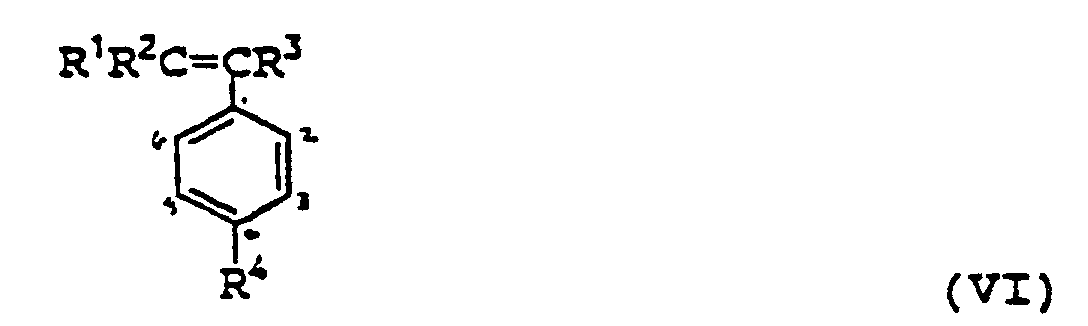 R1 et R2 sont chacun indépendamment un hydrogène, un fluor ou un groupe méthyle;R3 est un hydrogène, un fluor, un groupe méthyle ou perfluorométhyle;R4 est un hydrogène, un fluor ou un groupe aliphatique perfluoré C1-C12; etles positions 2, 3, 5 et 6 du cycle aromatique de styrène sont chacune indépendamment un hydrogène ou un fluor.
 - Solution suivant la revendication 29, dans laquelle le polymère d'éther de vinyle fluoré a été produit à partir de monomères de la formule (IV):n est 0, 1 ou 2;R1, R2 et R3 sont chacun indépendamment un hydrogène ou un fluor; etR est un groupe aliphatique perfluoré ou aromatique perfluoré.
- Solution suivant la revendication 29 ou 30, dans laquelle l'élastomère de fluorocarbone ou le copolymère de tétrafluoroéthylène amorphe a été produit à partir de monomères de fluorooléfine choisis dans le groupe constitué de difluoroéthylène, de tétrafluoroéthylène, d'hexafluoropropylène, de chlorotrifluoroéthylène, de perfluoro-2,2-diméthyl-1,3-dioxole et de mélanges de ceux-ci.
Priority Applications (1)
| Application Number | Priority Date | Filing Date | Title |
|---|---|---|---|
| EP01120010A EP1172383B1 (fr) | 1992-03-27 | 1993-02-26 | Procédé de préparation de fluoropolymères |
Applications Claiming Priority (3)
| Application Number | Priority Date | Filing Date | Title |
|---|---|---|---|
| US85815092A | 1992-03-27 | 1992-03-27 | |
| PCT/US1993/001626 WO1993020116A1 (fr) | 1992-03-27 | 1993-02-26 | Procede de preparation de fluoropolymeres |
| US858150 | 1997-05-01 |
Related Child Applications (1)
| Application Number | Title | Priority Date | Filing Date |
|---|---|---|---|
| EP01120010A Division EP1172383B1 (fr) | 1992-03-27 | 1993-02-26 | Procédé de préparation de fluoropolymères |
Publications (2)
| Publication Number | Publication Date |
|---|---|
| EP0638095A1 EP0638095A1 (fr) | 1995-02-15 |
| EP0638095B1 true EP0638095B1 (fr) | 2002-08-07 |
Family
ID=25327616
Family Applications (2)
| Application Number | Title | Priority Date | Filing Date |
|---|---|---|---|
| EP93907004A Expired - Lifetime EP0638095B1 (fr) | 1992-03-27 | 1993-02-26 | Procede de preparation de fluoropolymeres |
| EP01120010A Expired - Lifetime EP1172383B1 (fr) | 1992-03-27 | 1993-02-26 | Procédé de préparation de fluoropolymères |
Family Applications After (1)
| Application Number | Title | Priority Date | Filing Date |
|---|---|---|---|
| EP01120010A Expired - Lifetime EP1172383B1 (fr) | 1992-03-27 | 1993-02-26 | Procédé de préparation de fluoropolymères |
Country Status (6)
| Country | Link |
|---|---|
| US (3) | US5496901A (fr) |
| EP (2) | EP0638095B1 (fr) |
| JP (1) | JP3512796B2 (fr) |
| AU (1) | AU3776393A (fr) |
| DE (2) | DE69334213T2 (fr) |
| WO (1) | WO1993020116A1 (fr) |
Families Citing this family (126)
| Publication number | Priority date | Publication date | Assignee | Title |
|---|---|---|---|---|
| JP3512796B2 (ja) * | 1992-03-27 | 2004-03-31 | ザ ユニバーシティ オブ ノース カロライナ アット チャペル ヒル | フルオロポリマーの製造方法 |
| US5863612A (en) * | 1992-03-27 | 1999-01-26 | University North Carolina--Chapel Hill | Method of making fluoropolymers |
| US5611210A (en) * | 1993-03-05 | 1997-03-18 | Ikon Corporation | Fluoroiodocarbon blends as CFC and halon replacements |
| US5780553A (en) * | 1993-07-30 | 1998-07-14 | University Of North Carolina At Chapel Hill | Heterogeneous polymerizations in carbon dioxide |
| WO1995011935A1 (fr) * | 1993-10-29 | 1995-05-04 | E.I. Du Pont De Nemours And Company | Solutions de polymeres perfluores dans du co2 supercritique |
| US5559198A (en) * | 1994-07-08 | 1996-09-24 | Minnesota Mining And Manufacturing Company | Process for preparing poly(vinyl trifluoroacetate) and poly(vinyltrifluoroacetate/vinyl ester) copolymers in supercritical Co.sub. |
| CN1152318A (zh) * | 1994-07-08 | 1997-06-18 | 美国3M公司 | 超大气压反应 |
| US5618894A (en) * | 1995-03-10 | 1997-04-08 | The University Of North Carolina | Nonaqueous polymerization of fluoromonomers |
| US5674957A (en) * | 1995-03-10 | 1997-10-07 | The University Of North Carolina At Chapel Hill | Nonaqueous polymerization of fluoromonomers |
| US5527865A (en) * | 1995-03-24 | 1996-06-18 | The University Of North Carolina At Chapel Hill | Multi-phase polymerization process |
| US5840820A (en) * | 1995-04-13 | 1998-11-24 | The University Of North Carolina At Chapel Hill | Olefin metathesis reactions in carbon dioxide medium |
| DE19681433T1 (de) * | 1995-06-06 | 1998-05-07 | Univ North Carolina | Verfahren für die Herstellung von Polyester in Kohlendioxid |
| US5783082A (en) * | 1995-11-03 | 1998-07-21 | University Of North Carolina | Cleaning process using carbon dioxide as a solvent and employing molecularly engineered surfactants |
| US5696195A (en) * | 1996-06-04 | 1997-12-09 | E. I. Du Pont De Nemours And Company | Solutions of perfluorinated polymers in SF6 with or without CO2 |
| US5860467A (en) * | 1996-12-03 | 1999-01-19 | The University Of North Carolina At Chapel Hill | Use of CO2 -soluble materials in making molds |
| US6051682A (en) * | 1996-12-23 | 2000-04-18 | E. I. Du Pont De Nemours And Company | Polymerization of fluoropolymers in carbon dioxide |
| US6306564B1 (en) | 1997-05-27 | 2001-10-23 | Tokyo Electron Limited | Removal of resist or residue from semiconductors using supercritical carbon dioxide |
| US6500605B1 (en) | 1997-05-27 | 2002-12-31 | Tokyo Electron Limited | Removal of photoresist and residue from substrate using supercritical carbon dioxide process |
| TW539918B (en) | 1997-05-27 | 2003-07-01 | Tokyo Electron Ltd | Removal of photoresist and photoresist residue from semiconductors using supercritical carbon dioxide process |
| EP0986667B1 (fr) | 1997-05-30 | 2009-01-07 | Micell Integrated Systems, Inc. | Traitement de surface |
| US6344243B1 (en) | 1997-05-30 | 2002-02-05 | Micell Technologies, Inc. | Surface treatment |
| US6287640B1 (en) | 1997-05-30 | 2001-09-11 | Micell Technologies, Inc. | Surface treatment of substrates with compounds that bind thereto |
| US6165560A (en) | 1997-05-30 | 2000-12-26 | Micell Technologies | Surface treatment |
| JP3887879B2 (ja) | 1997-06-06 | 2007-02-28 | ソニーケミカル&インフォメーションデバイス株式会社 | 含フッ素(メタ)アクリル系重合体の製造方法 |
| US6127000A (en) * | 1997-10-10 | 2000-10-03 | North Carolina State University | Method and compositions for protecting civil infrastructure |
| EP1498435B1 (fr) | 1997-10-15 | 2012-05-02 | E.I. Du Pont De Nemours And Company | Copolymères à base d' anhydride maléique ou d' acide maléique et de fluoro-oléfines |
| US6034170A (en) * | 1997-10-17 | 2000-03-07 | E. I. Du Pont De Nemours And Company | Solutions of fluoropolymers in carbon dioxide |
| US6001418A (en) * | 1997-12-16 | 1999-12-14 | The University Of North Carolina At Chapel Hill | Spin coating method and apparatus for liquid carbon dioxide systems |
| US6383289B2 (en) | 1997-12-16 | 2002-05-07 | The University Of North Carolina At Chapel Hill | Apparatus for liquid carbon dioxide systems |
| US6270689B1 (en) | 1998-03-26 | 2001-08-07 | Ikon Corporation | Blend compositions of trifluoroiodomethane, tetrafluoroethane and difluoroethane |
| US6048369A (en) * | 1998-06-03 | 2000-04-11 | North Carolina State University | Method of dyeing hydrophobic textile fibers with colorant materials in supercritical fluid carbon dioxide |
| US6103844A (en) * | 1998-06-08 | 2000-08-15 | E. I. Du Pont De Nemours And Company | Polymerization of fluoromonomers in carbon dioxide |
| US6277753B1 (en) | 1998-09-28 | 2001-08-21 | Supercritical Systems Inc. | Removal of CMP residue from semiconductors using supercritical carbon dioxide process |
| US7064070B2 (en) | 1998-09-28 | 2006-06-20 | Tokyo Electron Limited | Removal of CMP and post-CMP residue from semiconductors using supercritical carbon dioxide process |
| US6497921B1 (en) * | 1998-11-06 | 2002-12-24 | North Carolina State University | Method for meniscus coating with liquid carbon dioxide |
| US6083565A (en) | 1998-11-06 | 2000-07-04 | North Carolina State University | Method for meniscus coating with liquid carbon dioxide |
| US6479708B1 (en) | 1998-11-18 | 2002-11-12 | The Regents Of The University Of California | Biphasic catalysis in water/carbon dioxide micellar systems |
| US6864301B2 (en) * | 1998-11-30 | 2005-03-08 | The Regents Of The University Of Colorado | Preparation and use of photopolymerized microparticles |
| US6403672B1 (en) * | 1998-11-30 | 2002-06-11 | University Technology Corporation | Preparation and use of photopolymerized microparticles |
| US6512062B1 (en) | 1999-04-08 | 2003-01-28 | The University Of North Carolina At Chapel Hill | Polymerization of non-fluorinated monomers in carbon dioxide |
| US6211422B1 (en) | 1999-07-13 | 2001-04-03 | North Carolina State University | Enzyme catalysis in carbon dioxide fluids |
| US6747179B1 (en) | 1999-08-20 | 2004-06-08 | North Carolina State University | Carbon dioxide-soluble polymers and swellable polymers for carbon dioxide applications |
| KR100744888B1 (ko) | 1999-11-02 | 2007-08-01 | 동경 엘렉트론 주식회사 | 소재를 초임계 처리하기 위한 장치 및 방법 |
| US6748960B1 (en) | 1999-11-02 | 2004-06-15 | Tokyo Electron Limited | Apparatus for supercritical processing of multiple workpieces |
| US6261326B1 (en) | 2000-01-13 | 2001-07-17 | North Carolina State University | Method for introducing dyes and other chemicals into a textile treatment system |
| CA2399049A1 (fr) | 2000-02-02 | 2001-08-09 | Robert D. Lousenberg | Copolymeres lineaires de monomeres de fluorocarbone-hydrocarbure synthetises dans du dioxyde de carbone |
| US6890853B2 (en) | 2000-04-25 | 2005-05-10 | Tokyo Electron Limited | Method of depositing metal film and metal deposition cluster tool including supercritical drying/cleaning module |
| JP2003534416A (ja) | 2000-05-19 | 2003-11-18 | ユニヴァーシティ・オヴ・ノース・キャロライナ・アト・チャペル・ヒル | マルチモーダルフルオロポリマーおよびその製造方法 |
| US6451287B1 (en) | 2000-05-26 | 2002-09-17 | Smithkline Beecham Corporation | Fluorinated copolymer surfactants and use thereof in aerosol compositions |
| AU2001290171A1 (en) | 2000-07-26 | 2002-02-05 | Tokyo Electron Limited | High pressure processing chamber for semiconductor substrate |
| US6764809B2 (en) | 2000-10-12 | 2004-07-20 | North Carolina State University | CO2-processes photoresists, polymers, and photoactive compounds for microlithography |
| US6676710B2 (en) | 2000-10-18 | 2004-01-13 | North Carolina State University | Process for treating textile substrates |
| DE10054114A1 (de) | 2000-10-31 | 2002-05-16 | Dupont Performance Coatings | Verfahren zur Herstellung von Pulverlackzusammensetzungen |
| US6623355B2 (en) | 2000-11-07 | 2003-09-23 | Micell Technologies, Inc. | Methods, apparatus and slurries for chemical mechanical planarization |
| US6656258B2 (en) | 2001-03-20 | 2003-12-02 | 3M Innovative Properties Company | Compositions comprising fluorinated silanes and compressed fluid CO2 |
| EP1573779A4 (fr) * | 2001-04-10 | 2006-11-15 | Tokyo Electron Ltd | Chambre de traitement haute pression pour substrat semi-conducteur comprenant des elements favorisant l'ecoulement |
| US20080033130A1 (en) * | 2001-05-18 | 2008-02-07 | University Of North Carolina At Chapel Hill | Multimodal fluoropolymers and methods of making the same |
| US6958123B2 (en) * | 2001-06-15 | 2005-10-25 | Reflectivity, Inc | Method for removing a sacrificial material with a compressed fluid |
| US6706641B2 (en) | 2001-09-13 | 2004-03-16 | Micell Technologies, Inc. | Spray member and method for using the same |
| US6782900B2 (en) | 2001-09-13 | 2004-08-31 | Micell Technologies, Inc. | Methods and apparatus for cleaning and/or treating a substrate using CO2 |
| US6666928B2 (en) | 2001-09-13 | 2003-12-23 | Micell Technologies, Inc. | Methods and apparatus for holding a substrate in a pressure chamber |
| US6619304B2 (en) | 2001-09-13 | 2003-09-16 | Micell Technologies, Inc. | Pressure chamber assembly including non-mechanical drive means |
| US6763840B2 (en) | 2001-09-14 | 2004-07-20 | Micell Technologies, Inc. | Method and apparatus for cleaning substrates using liquid carbon dioxide |
| JP2003096107A (ja) | 2001-09-27 | 2003-04-03 | Shigeo Okahata | 含フッ素ポリマーの製造方法 |
| JP2003206317A (ja) * | 2001-11-12 | 2003-07-22 | Daikin Ind Ltd | ポリビニリデンフルオライド |
| EP1454920A4 (fr) | 2001-11-12 | 2006-12-06 | Daikin Ind Ltd | Procede de production de polymeres fluores |
| US6737225B2 (en) | 2001-12-28 | 2004-05-18 | Texas Instruments Incorporated | Method of undercutting micro-mechanical device with super-critical carbon dioxide |
| JP2006508521A (ja) | 2002-02-15 | 2006-03-09 | 東京エレクトロン株式会社 | 溶剤浴と超臨界co2を用いたレジストの乾燥 |
| US6924086B1 (en) | 2002-02-15 | 2005-08-02 | Tokyo Electron Limited | Developing photoresist with supercritical fluid and developer |
| CN1296771C (zh) | 2002-03-04 | 2007-01-24 | 东京毅力科创株式会社 | 在晶片处理中低电介质材料的钝化方法 |
| US7387868B2 (en) | 2002-03-04 | 2008-06-17 | Tokyo Electron Limited | Treatment of a dielectric layer using supercritical CO2 |
| US7169540B2 (en) | 2002-04-12 | 2007-01-30 | Tokyo Electron Limited | Method of treatment of porous dielectric films to reduce damage during cleaning |
| US6846380B2 (en) * | 2002-06-13 | 2005-01-25 | The Boc Group, Inc. | Substrate processing apparatus and related systems and methods |
| GB0221150D0 (en) * | 2002-09-12 | 2002-10-23 | Matthews Siobhan O | Incorporation of functional materials into bulk materials |
| US20040112409A1 (en) * | 2002-12-16 | 2004-06-17 | Supercritical Sysems, Inc. | Fluoride in supercritical fluid for photoresist and residue removal |
| US20040154647A1 (en) * | 2003-02-07 | 2004-08-12 | Supercritical Systems, Inc. | Method and apparatus of utilizing a coating for enhanced holding of a semiconductor substrate during high pressure processing |
| EP1598374A4 (fr) | 2003-02-25 | 2008-04-02 | Japan Government | Procede pour produire un polymere |
| US6951769B2 (en) | 2003-06-04 | 2005-10-04 | Texas Instruments Incorporated | Method for stripping sacrificial layer in MEMS assembly |
| US6806993B1 (en) | 2003-06-04 | 2004-10-19 | Texas Instruments Incorporated | Method for lubricating MEMS components |
| US7163380B2 (en) | 2003-07-29 | 2007-01-16 | Tokyo Electron Limited | Control of fluid flow in the processing of an object with a fluid |
| US7652115B2 (en) * | 2003-09-08 | 2010-01-26 | 3M Innovative Properties Company | Fluorinated polyether isocyanate derived silane compositions |
| US20050170277A1 (en) * | 2003-10-20 | 2005-08-04 | Luke Zannoni | Fluorinated photoresists prepared, deposited, developed and removed in carbon dioxide |
| US7141537B2 (en) * | 2003-10-30 | 2006-11-28 | 3M Innovative Properties Company | Mixture of fluorinated polyethers and use thereof as surfactant |
| US7803894B2 (en) * | 2003-12-05 | 2010-09-28 | 3M Innovatie Properties Company | Coating compositions with perfluoropolyetherisocyanate derived silane and alkoxysilanes |
| JP4749673B2 (ja) * | 2004-01-20 | 2011-08-17 | ニチアス株式会社 | 金属非固着性パーフルオロエラストマー成形体及びその製造方法 |
| EP1571165B1 (fr) * | 2004-03-01 | 2009-01-07 | Lorenzo Toffano | Compositions pour la prépapation de revêtements hydrophobes |
| US7250374B2 (en) | 2004-06-30 | 2007-07-31 | Tokyo Electron Limited | System and method for processing a substrate using supercritical carbon dioxide processing |
| US7307019B2 (en) | 2004-09-29 | 2007-12-11 | Tokyo Electron Limited | Method for supercritical carbon dioxide processing of fluoro-carbon films |
| US7491036B2 (en) | 2004-11-12 | 2009-02-17 | Tokyo Electron Limited | Method and system for cooling a pump |
| US20060102591A1 (en) * | 2004-11-12 | 2006-05-18 | Tokyo Electron Limited | Method and system for treating a substrate using a supercritical fluid |
| US20060102590A1 (en) * | 2004-11-12 | 2006-05-18 | Tokyo Electron Limited | Method for treating a substrate with a high pressure fluid using a preoxide-based process chemistry |
| US20060102208A1 (en) * | 2004-11-12 | 2006-05-18 | Tokyo Electron Limited | System for removing a residue from a substrate using supercritical carbon dioxide processing |
| US20060102204A1 (en) * | 2004-11-12 | 2006-05-18 | Tokyo Electron Limited | Method for removing a residue from a substrate using supercritical carbon dioxide processing |
| US7434590B2 (en) | 2004-12-22 | 2008-10-14 | Tokyo Electron Limited | Method and apparatus for clamping a substrate in a high pressure processing system |
| US7140393B2 (en) | 2004-12-22 | 2006-11-28 | Tokyo Electron Limited | Non-contact shuttle valve for flow diversion in high pressure systems |
| US20060180174A1 (en) * | 2005-02-15 | 2006-08-17 | Tokyo Electron Limited | Method and system for treating a substrate with a high pressure fluid using a peroxide-based process chemistry in conjunction with an initiator |
| US7435447B2 (en) | 2005-02-15 | 2008-10-14 | Tokyo Electron Limited | Method and system for determining flow conditions in a high pressure processing system |
| US7291565B2 (en) | 2005-02-15 | 2007-11-06 | Tokyo Electron Limited | Method and system for treating a substrate with a high pressure fluid using fluorosilicic acid |
| US20060180572A1 (en) * | 2005-02-15 | 2006-08-17 | Tokyo Electron Limited | Removal of post etch residue for a substrate with open metal surfaces |
| US7588796B2 (en) * | 2005-03-11 | 2009-09-15 | Bha Group, Inc. | Method of making a composite membrane |
| US7635062B2 (en) * | 2005-03-11 | 2009-12-22 | Bha Group, Inc. | Composite membrane |
| US20060205301A1 (en) * | 2005-03-11 | 2006-09-14 | Bha Technologies, Inc. | Composite membrane having hydrophilic properties and method of manufacture |
| US7550075B2 (en) | 2005-03-23 | 2009-06-23 | Tokyo Electron Ltd. | Removal of contaminants from a fluid |
| US7399708B2 (en) | 2005-03-30 | 2008-07-15 | Tokyo Electron Limited | Method of treating a composite spin-on glass/anti-reflective material prior to cleaning |
| US7442636B2 (en) | 2005-03-30 | 2008-10-28 | Tokyo Electron Limited | Method of inhibiting copper corrosion during supercritical CO2 cleaning |
| US20060255012A1 (en) * | 2005-05-10 | 2006-11-16 | Gunilla Jacobson | Removal of particles from substrate surfaces using supercritical processing |
| US7789971B2 (en) * | 2005-05-13 | 2010-09-07 | Tokyo Electron Limited | Treatment of substrate using functionalizing agent in supercritical carbon dioxide |
| US7524383B2 (en) | 2005-05-25 | 2009-04-28 | Tokyo Electron Limited | Method and system for passivating a processing chamber |
| EP1741729B1 (fr) * | 2005-07-07 | 2008-03-12 | Solvay Solexis S.p.A. | Procédé de polymérisation |
| US20070012337A1 (en) * | 2005-07-15 | 2007-01-18 | Tokyo Electron Limited | In-line metrology for supercritical fluid processing |
| US20070292685A1 (en) * | 2006-06-15 | 2007-12-20 | Brothers Paul D | Perfluoropolymers |
| WO2008019155A1 (fr) * | 2006-08-11 | 2008-02-14 | The University Of North Carolina At Chapel Hill | Procédé de polymérisation de fluoromonomère |
| US8070355B2 (en) * | 2006-09-15 | 2011-12-06 | E. I. Du Pont De Nemours And Company | Method of detecting leaks of fluoroolefin compositions and sensors used therefor |
| WO2008033568A2 (fr) * | 2006-09-15 | 2008-03-20 | E.I. Du Pont De Nemours And Company | procédé de détermination des composants d'une composition de fluoro-oléfine, procédé de rechargement d'un système de fluide ASSOCIÉ, et capteurs utilisés DANS CES PROCÉDÉS |
| JP5162866B2 (ja) * | 2006-09-15 | 2013-03-13 | 株式会社リコー | トナーの製造方法及びトナー |
| JP5369287B2 (ja) * | 2006-09-15 | 2013-12-18 | 株式会社リコー | トナーの製造方法 |
| WO2008079937A2 (fr) * | 2006-12-20 | 2008-07-03 | Honeywell International Inc. | Simplification de traitement de polymère |
| US20090046274A1 (en) * | 2007-08-16 | 2009-02-19 | Mchugh Mark A | Light Scattering Methods and Systems Using Supercritical Fluid Solvents to Measure Polymer Molecular Weight and Molecular Weight Distribution |
| US20100167100A1 (en) * | 2008-12-26 | 2010-07-01 | David Roger Moore | Composite membrane and method for making |
| JP5605034B2 (ja) * | 2010-07-09 | 2014-10-15 | 株式会社野田スクリーン | フッ素系共重合体、フッ素系共重合体の製造方法およびコーティング剤 |
| CN103304720B (zh) * | 2012-03-14 | 2016-08-03 | 中化蓝天集团有限公司 | 超临界二氧化碳中聚氟乙烯共聚物的制备方法 |
| AU2014255642B2 (en) | 2013-04-17 | 2017-11-23 | Statoil Petroleum As | Method of storing CO2 |
| WO2016121242A1 (fr) * | 2015-01-29 | 2016-08-04 | 関西ペイント株式会社 | Composition de revêtement aqueuse |
| CN104861116B (zh) * | 2015-05-29 | 2017-05-17 | 陕西省石油化工研究设计院 | 一种含氟无皂乳液防护剂制备方法 |
| EP3950725A4 (fr) * | 2019-05-08 | 2023-07-19 | Daikin Industries, Ltd. | Procédé de production de fluoropolymère et fluoropolymère |
| CN116947613A (zh) * | 2023-07-25 | 2023-10-27 | 安徽灵达高新材料有限公司 | 一种环保高效的全氟己酮的合成方法 |
Family Cites Families (32)
| Publication number | Priority date | Publication date | Assignee | Title |
|---|---|---|---|---|
| US3294772A (en) * | 1963-06-17 | 1966-12-27 | Phillips Petroleum Co | Supercritical polymerization |
| US3471463A (en) * | 1966-04-22 | 1969-10-07 | Japan Atomic Energy Res Inst | Polymerization of ethylene by means of radical initiation using carbon dioxide as reaction medium |
| US3522228A (en) * | 1966-05-19 | 1970-07-28 | Sumitomo Chemical Co | Novel method for polymerizing a vinyl compound in the presence of a carbon dioxide medium |
| US3510836A (en) * | 1966-12-22 | 1970-05-05 | Gen Motors Corp | Fluid level detector for vehicle brake systems and the like |
| US3658717A (en) * | 1969-07-07 | 1972-04-25 | Atlas Chem Ind | Surfactants for solvent/water systems and textile treating compositions |
| CH634480A5 (de) * | 1977-11-25 | 1983-02-15 | Schwarzkopf Gmbh Hans | Unter druck stehendes aerosolpraeparat. |
| JPS57149367A (en) * | 1981-03-11 | 1982-09-14 | Shin Etsu Chem Co Ltd | Peeling and dehydrating composition |
| US4582731A (en) * | 1983-09-01 | 1986-04-15 | Battelle Memorial Institute | Supercritical fluid molecular spray film deposition and powder formation |
| US4734227A (en) * | 1983-09-01 | 1988-03-29 | Battelle Memorial Institute | Method of making supercritical fluid molecular spray films, powder and fibers |
| CA1274942A (fr) * | 1985-09-20 | 1990-10-02 | Wilfred G. Sertage, Jr. | Polymerisation de l'acide acrylique |
| FR2588561B1 (fr) * | 1985-09-25 | 1987-12-11 | Rhone Poulenc Spec Chim | Procede de polymerisation d'oligomeres de polydiorganosiloxanes dans un fluide a pression supra-atmospherique qui est un gaz dans les conditions normales |
| DE3537455A1 (de) * | 1985-10-22 | 1987-04-23 | Basf Ag | Verfahren zur herstellung von pulverfoermigen homopolymerisaten |
| DE3609829A1 (de) * | 1986-03-22 | 1987-09-24 | Basf Ag | Verfahren zur herstellung von pulverfoermigen vernetzten copolymerisaten |
| US5045220A (en) * | 1987-06-03 | 1991-09-03 | Chevron Research Company | Increasing the viscosity of CO2 solutions |
| EP0301532A3 (fr) * | 1987-07-30 | 1989-10-18 | The B.F. Goodrich Company | Agent épaississant de type acide acrylique sans solvant et procédé de leur préparation |
| US4933404A (en) * | 1987-11-27 | 1990-06-12 | Battelle Memorial Institute | Processes for microemulsion polymerization employing novel microemulsion systems |
| ATE94782T1 (de) * | 1987-12-21 | 1993-10-15 | Union Carbide Corp | Verwendung von superkritischen fluessigkeiten als verduenner beim aufspruehen von ueberzuegen. |
| US5106650A (en) * | 1988-07-14 | 1992-04-21 | Union Carbide Chemicals & Plastics Technology Corporation | Electrostatic liquid spray application of coating with supercritical fluids as diluents and spraying from an orifice |
| US5215253A (en) * | 1990-08-30 | 1993-06-01 | Nordson Corporation | Method and apparatus for forming and dispersing single and multiple phase coating material containing fluid diluent |
| US5197800A (en) * | 1991-06-28 | 1993-03-30 | Nordson Corporation | Method for forming coating material formulations substantially comprised of a saturated resin rich phase |
| WO1993004160A1 (fr) * | 1991-08-26 | 1993-03-04 | Daikin Industries, Ltd. | Composition de solvant comprenant un melange de polyfluoroalcane et d'alcool inferieur |
| US5182342A (en) * | 1992-02-28 | 1993-01-26 | E. I. Du Pont De Nemours And Company | Hydrofluorocarbon solvents for fluoromonomer polymerization |
| JP3512796B2 (ja) * | 1992-03-27 | 2004-03-31 | ザ ユニバーシティ オブ ノース カロライナ アット チャペル ヒル | フルオロポリマーの製造方法 |
| US5308648A (en) * | 1992-09-30 | 1994-05-03 | Union Carbide Chemicals & Plastics Technology Corporation | Spray application of plastics additives to polymers |
| US5407267A (en) * | 1992-12-30 | 1995-04-18 | Nordson Corporation | Method and apparatus for forming and dispensing coating material containing multiple components |
| US5286822A (en) * | 1993-02-03 | 1994-02-15 | E. I. Du Pont De Nemours And Company | Perfluoroalkyl sulfide polymer solvents for fluoromonomer polymerization |
| US5345013A (en) * | 1993-06-10 | 1994-09-06 | E. I. Du Pont De Nemours And Company | Safe handling of tetrafluoroethylene |
| JP3048292B2 (ja) * | 1993-06-11 | 2000-06-05 | 株式会社トクヤマ | 含フッ素共重合体の製造方法 |
| US5310836A (en) * | 1993-08-12 | 1994-05-10 | E. I. Du Pont De Nemours And Company | Process for synthesizing fluoropolymers |
| US5407132A (en) * | 1993-10-20 | 1995-04-18 | Nordson Corporation | Method and apparatus for spraying viscous adhesives |
| US5415897A (en) * | 1994-03-23 | 1995-05-16 | The Boc Group, Inc. | Method of depositing solid substance on a substrate |
| US5478905A (en) * | 1995-02-06 | 1995-12-26 | E. I. Du Pont De Nemours And Company | Amorphous tetrafluoroethylene/hexafluoropropylene copolymers |
-
1993
- 1993-02-26 JP JP51743493A patent/JP3512796B2/ja not_active Expired - Lifetime
- 1993-02-26 AU AU37763/93A patent/AU3776393A/en not_active Abandoned
- 1993-02-26 DE DE69334213T patent/DE69334213T2/de not_active Expired - Lifetime
- 1993-02-26 DE DE69332188T patent/DE69332188T2/de not_active Expired - Lifetime
- 1993-02-26 EP EP93907004A patent/EP0638095B1/fr not_active Expired - Lifetime
- 1993-02-26 EP EP01120010A patent/EP1172383B1/fr not_active Expired - Lifetime
- 1993-02-26 US US08/302,642 patent/US5496901A/en not_active Expired - Lifetime
- 1993-02-26 WO PCT/US1993/001626 patent/WO1993020116A1/fr not_active Ceased
-
1995
- 1995-09-18 US US08/529,873 patent/US5739223A/en not_active Expired - Lifetime
-
1997
- 1997-10-31 US US08/961,756 patent/US5922833A/en not_active Expired - Lifetime
Also Published As
| Publication number | Publication date |
|---|---|
| JP3512796B2 (ja) | 2004-03-31 |
| DE69332188T2 (de) | 2003-04-17 |
| US5739223A (en) | 1998-04-14 |
| WO1993020116A1 (fr) | 1993-10-14 |
| US5496901A (en) | 1996-03-05 |
| JPH07505429A (ja) | 1995-06-15 |
| AU3776393A (en) | 1993-11-08 |
| EP0638095A1 (fr) | 1995-02-15 |
| DE69334213D1 (de) | 2008-05-29 |
| EP1172383A2 (fr) | 2002-01-16 |
| EP1172383A3 (fr) | 2002-07-24 |
| DE69332188D1 (de) | 2002-09-12 |
| DE69334213T2 (de) | 2009-06-18 |
| US5922833A (en) | 1999-07-13 |
| EP1172383B1 (fr) | 2008-04-16 |
Similar Documents
| Publication | Publication Date | Title |
|---|---|---|
| EP0638095B1 (fr) | Procede de preparation de fluoropolymeres | |
| US5688879A (en) | Method of making fluoropolymers | |
| US5863612A (en) | Method of making fluoropolymers | |
| CA2168423C (fr) | Methode de polymerisation heterogene de composants du gaz carbonique | |
| CA2215185A1 (fr) | Procede de polymerisation multiphase | |
| EP0813548A4 (fr) | Polymerisation non aqueuse de fluoromonomeres | |
| US5780553A (en) | Heterogeneous polymerizations in carbon dioxide | |
| JPH06345824A (ja) | 含フッ素共重合体の製造方法 | |
| Pan et al. | Synthesis and characterization of block‐graft copolymers composed of poly (styrene‐b‐ethylene‐co‐propylene) and poly (ethyl methylacrylate) by atom transfer radical polymerization | |
| EP0856011A2 (fr) | Polymerisation heterogene dans le co 2? | |
| EP0957113B1 (fr) | Polymérisation non aqueuse de fluoromonomères | |
| Ameduri et al. | Synthesis and polymerization of fluorinated monomers bearing a reactive lateral group—part 7. Copolymerization of tetrafluoroethylene with ω‐hydroxy trifluorovinyl monomers | |
| Weinand et al. | Radical block polymerization of vinyl chloride. II. Synthesis and characterization of vinyl chloride block copolymers | |
| Moeller et al. | Homogeneous phase copolymerizations of vinylidene fluoride and hexafluoropropene in supercritical carbon dioxide | |
| Santos et al. | Radical polymerization of styrene initiated by poly (ethylene oxide) macroinitiators | |
| Feng | Brief review of recent development of polymer chemistry in China | |
| Yamada et al. | Preparation of monomers functioning as initiators and use of their polymers for graft copolymerization | |
| Strange | The synthesis and properties of some fluorinated block copolymers | |
| Ren | Synthesis, characterization and thermodynamics of fluorinated polymers |
Legal Events
| Date | Code | Title | Description |
|---|---|---|---|
| PUAI | Public reference made under article 153(3) epc to a published international application that has entered the european phase |
Free format text: ORIGINAL CODE: 0009012 |
|
| 17P | Request for examination filed |
Effective date: 19941031 |
|
| AK | Designated contracting states |
Kind code of ref document: A1 Designated state(s): DE FR GB IT NL |
|
| 17Q | First examination report despatched |
Effective date: 19950712 |
|
| RTI1 | Title (correction) |
Free format text: METHOD OF MAKING FLUOROPOLYMERS |
|
| GRAG | Despatch of communication of intention to grant |
Free format text: ORIGINAL CODE: EPIDOS AGRA |
|
| GRAG | Despatch of communication of intention to grant |
Free format text: ORIGINAL CODE: EPIDOS AGRA |
|
| GRAH | Despatch of communication of intention to grant a patent |
Free format text: ORIGINAL CODE: EPIDOS IGRA |
|
| GRAH | Despatch of communication of intention to grant a patent |
Free format text: ORIGINAL CODE: EPIDOS IGRA |
|
| GRAA | (expected) grant |
Free format text: ORIGINAL CODE: 0009210 |
|
| AK | Designated contracting states |
Kind code of ref document: B1 Designated state(s): DE FR GB IT NL |
|
| REG | Reference to a national code |
Ref country code: GB Ref legal event code: FG4D |
|
| REF | Corresponds to: |
Ref document number: 69332188 Country of ref document: DE Date of ref document: 20020912 |
|
| ET | Fr: translation filed | ||
| PLBE | No opposition filed within time limit |
Free format text: ORIGINAL CODE: 0009261 |
|
| STAA | Information on the status of an ep patent application or granted ep patent |
Free format text: STATUS: NO OPPOSITION FILED WITHIN TIME LIMIT |
|
| 26N | No opposition filed |
Effective date: 20030508 |
|
| PGFP | Annual fee paid to national office [announced via postgrant information from national office to epo] |
Ref country code: IT Payment date: 20100225 Year of fee payment: 18 |
|
| PG25 | Lapsed in a contracting state [announced via postgrant information from national office to epo] |
Ref country code: IT Free format text: LAPSE BECAUSE OF NON-PAYMENT OF DUE FEES Effective date: 20110226 |
|
| PGFP | Annual fee paid to national office [announced via postgrant information from national office to epo] |
Ref country code: FR Payment date: 20120306 Year of fee payment: 20 |
|
| PGFP | Annual fee paid to national office [announced via postgrant information from national office to epo] |
Ref country code: DE Payment date: 20120228 Year of fee payment: 20 |
|
| PGFP | Annual fee paid to national office [announced via postgrant information from national office to epo] |
Ref country code: GB Payment date: 20120224 Year of fee payment: 20 |
|
| PGFP | Annual fee paid to national office [announced via postgrant information from national office to epo] |
Ref country code: NL Payment date: 20120228 Year of fee payment: 20 |
|
| REG | Reference to a national code |
Ref country code: DE Ref legal event code: R071 Ref document number: 69332188 Country of ref document: DE |
|
| REG | Reference to a national code |
Ref country code: NL Ref legal event code: V4 Effective date: 20130226 |
|
| REG | Reference to a national code |
Ref country code: GB Ref legal event code: PE20 Expiry date: 20130225 |
|
| PG25 | Lapsed in a contracting state [announced via postgrant information from national office to epo] |
Ref country code: GB Free format text: LAPSE BECAUSE OF EXPIRATION OF PROTECTION Effective date: 20130225 Ref country code: DE Free format text: LAPSE BECAUSE OF EXPIRATION OF PROTECTION Effective date: 20130227 |