EP0639901A2 - Funkübertragungsgerät mit Feldstärkendetektionsschaltung - Google Patents
Funkübertragungsgerät mit Feldstärkendetektionsschaltung Download PDFInfo
- Publication number
- EP0639901A2 EP0639901A2 EP94306095A EP94306095A EP0639901A2 EP 0639901 A2 EP0639901 A2 EP 0639901A2 EP 94306095 A EP94306095 A EP 94306095A EP 94306095 A EP94306095 A EP 94306095A EP 0639901 A2 EP0639901 A2 EP 0639901A2
- Authority
- EP
- European Patent Office
- Prior art keywords
- signal
- signal path
- amplifier
- output
- radio
- Prior art date
- Legal status (The legal status is an assumption and is not a legal conclusion. Google has not performed a legal analysis and makes no representation as to the accuracy of the status listed.)
- Withdrawn
Links
Images




Classifications
-
- H—ELECTRICITY
- H04—ELECTRIC COMMUNICATION TECHNIQUE
- H04W—WIRELESS COMMUNICATION NETWORKS
- H04W52/00—Power management, e.g. Transmission Power Control [TPC] or power classes
- H04W52/04—Transmission power control [TPC]
- H04W52/06—TPC algorithms
- H04W52/08—Closed loop power control
-
- H—ELECTRICITY
- H04—ELECTRIC COMMUNICATION TECHNIQUE
- H04W—WIRELESS COMMUNICATION NETWORKS
- H04W52/00—Power management, e.g. Transmission Power Control [TPC] or power classes
- H04W52/04—Transmission power control [TPC]
- H04W52/18—TPC being performed according to specific parameters
- H04W52/24—TPC being performed according to specific parameters using SIR [Signal to Interference Ratio] or other wireless path parameters
- H04W52/245—TPC being performed according to specific parameters using SIR [Signal to Interference Ratio] or other wireless path parameters taking into account received signal strength
-
- H—ELECTRICITY
- H04—ELECTRIC COMMUNICATION TECHNIQUE
- H04W—WIRELESS COMMUNICATION NETWORKS
- H04W52/00—Power management, e.g. Transmission Power Control [TPC] or power classes
- H04W52/04—Transmission power control [TPC]
- H04W52/52—Transmission power control [TPC] using AGC [Automatic Gain Control] circuits or amplifiers
Definitions
- the present invention relates to tecnniques which are effectively applicable to radio communication apparatuses, for example to digitally controlled mobile communication apparatuses.
- Examples of the present invention are directed to techniques which are effectively utilized in portable telephones of zone selection type, i.e., so-called cellular telephones.
- a mobile radio system is disclosed in Y. Hishida et al, "Mobile Communication system: Its semiconductor Technology", HITACHI REVIEW, Vol. 42 - No. 3, pp. 95-124, June 1993. Also, a signal field strength detector circuit is disclosed in JP-A-60-70372.
- radio communication apparatuses particularly, mobile radio communication apparatuses such as a cellular telephone, a radio zone (cell), a communication channel (communication frequency), and so on may be frequently changed in accordance with transmission conditions.
- the selection of a radio zone (cell) and a communication channel (communication frequency) is made based on the field strength of a received signal. Therefore, a highly accurate function of detecting the field strength of a received signal is indispensable to a portable radio telephone such as a cellular telephone in order to constantly and properly carry out the above-mentioned control.
- a conventional signal amplification/detection output circuit having an amplifier circuit composed of a plurality of cascade connected amplifiers, each providing an amplified signal and a detection signal, adds circuit currents of the respective amplifiers, which vary in accordance with respective amplified signal amplitudes, to produce a summed detection signal which is then supplied to a signal strength detector circuit.
- the signal strength detector circuit performs processing such as smoothing on the produced detection signal and outputs a voltage signal at a DC level indicative of a detected field strength of a received signal.
- a variety of controls such as a search for an optimal received frequency are performed based on the field strength detection output thus produced.
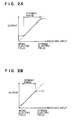
- a resistor Re is inserted at the emitter of each of a pair of transistors constituting a differential amplifier circuit as shown in Fig. 1A, a relatively large dynamic range results as shown in Fig. 2A.
- the emitters Re may be sources of noise such as heat noise, so that they may exhibit a side effect that the noise figure of the amplifier circuit is degraded. With a degraded noise figure, a noise level included in an amplified received signal may be raised to adversely affect the demodulation of received signals.
- a majority of electric power is consumed by a transmitter section, particularly, by a high frequency power amplifier.
- an output to be transmitted should be set to the smallest possible value.
- a transmitted output if set at a small value, will cause a contradiction that it is quite difficult to stably ensure a constant communication quality when the radio communication apparatus is used in mobile applications.
- the present invention may also provide a field strenth detector circuit which has a low noise figure and a wide dynamic range.
- the present invention may further provide a radio communication apparatus which utilizes an output signal of the field strength detector circuit having a low noise figure and a wide dynamic range.
- a second signal path for transmitting the received signal is provided such that a detection signal extracted from the first signal path and a detection signal extracted from the second signal path are used to detect the field strength of the received signal.
- the first signal path is composed of circuits which give priority to the communication quality
- the second signal path is composed of circuits which give priority to the width of the dynamic range.
- the present invention achieves its object of expanding the dynamic range for detecting the field strength of a received signal such that a variety of controls can be highly accurately performed based on the detected field strength, while maintaining a reduced noise figure and a high sensitivity in order to favorably perform demodulation and so on for the received signal.
- Fig. 3 shows one embodiment of a main portion (receiver section) in a radio communication apparatus, to which techniques of the present invention are applied.
- the receiver section includes an antenna 1; a front end tuner (FET section) 2; an intermediate frequency amplifier (IF section) 3 for amplifying at multiple stages a received signal, which has its frequency converted by the FET section 2, in order to demodulate the received signal; a plurality of amplifier circuits 31 - 35 constituting amplification stages in the IF section 3; a demodulator 4; a signal strength detector circuit 5; and amplifier circuits 61, 62 arranged separately from the IF section 3 for amplifying the received signal at multiple stages.
- the amplifier circuit 35 at the last stage in the IF section 3 serves as a limiter amplifier.
- the amplifier circuits 31 - 35 in the IF section 3 constitute a first signal path 100, while the amplifiers 61, 62, arranged separately from the IF section 3, constitute a second signal path 200.
- Each of the amplifier circuits 31, 32 at former stages is composed of circuits which give priority to reduced noise figure and sensitivity, i.e., circuits which give priority to the communication quality, such as that shown in Fig. 1B.
- Each of the amplifier circuits 61, 62 in the second signal path 200 in turn is composed of circuits which give priority to the width of the dynamic range, such as that shown in Fig. 1A.
- the signal strength detector circuit 5 detects the field strength of a received signal from detection signals (i3, i4, i5) extracted respectively from the amplifier circuits 33, 34, 35 at latter stages in the first signal path 100 and detection signals (i1, i2) extracted respectively from the amplifier circuits 61, 62 in the second signal path 200.
- first signal path 100 and the second signal path 200 in Fig. 3 may be formed on a single silicon semiconductor chip as a monolithic semiconductor integrated circuit device.
- Fig. 5A is circuit diagram showing in detail a circuit portion including the amplifier circuits 31, 32, 33, 61, 62 constituting the first signal path 100 and the second signal path 200.
- a signal (IN) outputted from the front end tuner 2 in Fig. 3 is supplied through a coupling capacitor C1 for cutting a direct current component to an external terminal T1 of the semiconductor integrated circuit device.
- the external terminal T1 is coupled to first input terminals of the amplifier circuit 31 at the first stage in the first signal path 100 and the amplifier circuit 61 at the first stage in the second signal path 200.
- the plurality of cascade connected amplifier circuits constituting the first signal path 100 form a direct-coupled multi stage amplifier circuit.
- the amplifier circuit 31 at the first stage is composed of a pair of differentially amplifying transistors Q1, Q2; collector load resistors R2, R3, arranged between the collectors of the respective differential amplifying transistors Q1, Q2 and a power supply terminal Vcc; a differential amplification stage including a constant current transistor Q3 and an emitter resistor R4; a pair of emitter follower transistors Q4, Q5; and an emitter follower output stage including a pair of constant current transistors Q6, Q7 and emitter resistors R5, R6.
- a constant current source composed of the constant current transistor Q3 and its emitter resistor R4; a bias current source composed of Q6 and R5; and a bias current source composed of Q7 and R6 may be all operated with a common bias voltage Vrf1.
- This bias voltage vrf1 is formed by a common reference voltage source VRF1 which is arrange within the same semiconductor integrated circuit device and operated with a power supply voltage supplied to the power supply terminal Vcc.
- the bases of the differential amplifier transistors Q1, Q2 constitute first and second input terminals Ia, Ib of the differential inputs, respectively.
- the emitter of the emitter follower transistor Q4 constitutes a first output terminal Oa for outputting a signal in a phase reverse to the first input terminal Ia, while the emitter of the transistor Q5 constitutes a second output terminal Ob for outputting a signal in phase with the first input terminal Ia.
- the differentially amplifying transistors Q1, Q2 have their emitters directly connected to the constant current source without emitter resistors, as illustrated. This configuration can prevent noise which would be generated due to emitter resistors, so that low-noise amplification can be accomplished, i.e., a good noise figure is presented.
- the amplifier circuit 32 at the next stage has the same configuration as the amplifier circuit 31, and first and second input terminals Ia, Ib thereof are connected to the first and second output terminals Oa, Ob, respectively.
- the amplifier circuit 33 at the third stage is composed of an amplification stage 33a and a detection stage 33b.
- the amplification stage 33a has a configuration of a differential amplifier circuit, and first and second input terminal Ia, Ib thereof are connected to first and second output terminals Oa, Ob of the amplifier circuit 32, respectively.
- the noise figure of the first stage amplifier circuit most largely affects the noise figure of the entire multi-stage amplifier circuit, and the noise figures of respective amplifier circuits at latter stages exert less influences on the noise figure of the entire multi-stage amplifier circuit.
- the amplification stage 33a in the third stage amplifier circuit 33 is designed in consideration of the influence of its noise figure and appropriate detection characteristics to be provided for detecting the field strength in a wide field strength changing range from a weak electric field to a strong electric field.
- the amplification stage 33a in the third stage amplifier circuit 33 is configured to form a differential amplifier identical to the amplifier circuits 31, 32 at the former stages, and is additionally provided with emitter resistors connected to the emitters of respective differentially amplifying transistors, similarly to an amplification stage 61a, later explained.
- the detection stage 33b though its details are not illustrated, has a configuration similar to that of a detection stage 61b, later explained. Specifically, the detection stage 33b receives an output of the amplification stage 33a and delivers a detection output at its output terminal DTa.
- the amplifier circuit 34 illustrated in Fig. 3 has a similar configuration as the amplifier circuit 33 in Fig. 5A. Specifically, first and second input terminals of an amplification stage thereof are connected to first and second output terminals Oa, Ob of the amplification stage in the amplifier circuit 33, respectively.
- a first bypass capacitor C3 arranged between an external terminal T3 and a reference potential point of the circuit, a bias resistor R18 having one end connected to the capacitor C3, a second bypass capacitor C2 arranged between an external terminal T2 and the reference potential point of the circuit, a bias resistor R19 having one end connected to the capacitor C2, and a bias resistor R1 constitute a bias circuit.
- the input side of the bias circuit i.e., the other terminal of the bias resistor R18 and the other terminal of the bias resistor R19 are coupled to output terminals Oa, Ob of the amplifier circuit 34 (Fig. 3) at the fourth stage, respectively.
- the first and second input terminals Ia, Ib of the first stage amplifier circuit 31 are applied with a bias voltage, thus providing a DC negative feedback bias voltage to the multi-stage amplifier circuit.
- the plurality of amplifier circuits constituting the second signal path also form a direct coupled multi-stage amplifier circuit similar to those of the first signal path.
- the amplifier circuit 61 in Fig. 5A is composed of an amplification stage 61a and a detection stage 6ab.
- the amplification stage 61a has substantially the same configuration as the amplifier circuits 31, 32, except that emitter resistors R9, R10 are inserted between the emitters of respective differentially amplifying transistors Q8, Q9 and the collector of the constant current transistor Q10. Its first input terminal Ia is coupled to the external terminal T1, while its second input terminal Ib is connected to the external terminal T2 so as to receive a bias voltage common to that applied to the second input terminal Ib of the amplifier circuit 31.
- the provision of the emitter resistors R9, R10 allows the amplification stage 61a to have a wider input dynamic range, although its signal amplification factor is limited thereby.
- the detection stage 61b is composed of differentially connected transistors Q15, Q16; a constant current transistor Q17; and an emitter resistor R14.
- the differentially connected transistors Q15, Q16 are respectively applied with their operating current by a constant current source composed of the resistor R14 and the constant current transistor Q17 which is applied with a reference voltage (bias voltage) Vrf3 from a reference voltage source VRF3.
- One of the differentially connected transistors Q15, Q16 for example, the transistor Q15, having its base coupled to the emitter of an emitter follower transistor Q12 serving as a second output terminal Ob of the amplification stage 61a, constitutes a detection input transistor, the collector of which serves as an output terminal DTa of the detection stage 61b.
- the other transistor i.e., the transistor Q16 having its base coupled to a reference voltage source VRF4 constitutes a transistor for setting a detection level.
- the value of a reference voltage Vrf4 applied from the reference voltage source VRF4 to the base of the detection level setting transistor Q16 is set to a level substantially equal to such a level that maintains the transistor Q15 in off-state and the detection level setting transistor Q16 in on-state, with respect to the output potentials at the first and second output terminals Oa, Ob of the amplification stage 61a, in a non-signal state in which no input signal is being applied to the first and second input terminals Ia, Ib of the amplification stage 61a.
- the level of the reference voltage Vrf4 causes a current to start flowing into the detection input transistor Q15 in proportion to the increase of the output potential in the positive direction.
- the reference voltage Vrf4 is different from such an ordinary bias voltage as that applied to a normal differential amplifier circuit for maintaining differential transistors in a balanced operation state, but is a bias voltage which is offset to a relatively high level side such that a signal input causes the detection input transistor, which remains in off-state while no signal is applied, to transit to on-state.
- the reference voltage source VRF4 for generating a critical bias voltage may be formed of a circuit using transistors for applying a constant voltage as shown in Fig. 5B or a resistive potential divider circuit as shown in Fig. 5C including a potential dividing resistor connected in series between a power supply terminal and a reference potential terminal.
- a constant voltage circuit as shown in Fig. 5B exhibits extremely few changes in its input operation point even with changes in operation temperature.
- a constant voltage circuit as shown in Fig. 5C may be formed of a circuit of a relatively simple configuration such as a resistive potential divider circuit, its input operation point may vary due to changes in operation temperature, so that special attention should be paid to its use.
- the detection stage 61b is operative during a one-half positive cycle period of an amplified signal appearing at the second output terminal Ob of the amplification stage 61a to permit a current having a level proportional to the level of the amplified signal to flow to its detection output terminal DTa.
- an average DC current flowing to the detection output terminal DTa has a level proportional to the level of the amplified signal.
- the amplifier circuit 62 at the next stage in the second signal path is composed of an amplification stage 62a and a detection stage 62b which are configured similarly to those of the amplifier circuit 61.
- First and second input terminals Ia, Ib of the amplification stage 62a are connected to the first and second output terminals Oa, Ob, respectively, of the amplifier circuit 61 at the previous stage.
- a current source in the amplification stage 62a has a configuration similar to that of the current source in the amplification stage 61a, that is, a circuit composed of transistors Q13, Q10, Q14 and resistors R11, R12, R13 for generating a reference voltage Vrf2 for the amplification stage 61a.
- Both the amplification stages 61a, 62a are operated with the reference voltage Vrf2 from the common reference voltage source VRF2. Since the amplification stage 62a is not connected to any circuit receiving outputs thereof, it does not require any output terminal for delivering a signal.
- the detection stages 61b, 62b have a common current source which is operated with the reference voltage Vrf3 from the common reference voltage source VRF3. A critical level required to their detection is also made common to the level Vrf4.
- a detection output terminal DTa of the detection stage 62b is commonly connected to an input terminal DTI of the signal strength detector circuit 5 together with output terminals of other detection stages.
- the first and second input terminals Ia, Ib of the first stage amplifier circuit 61 forming part of the second signal path are connected directly to the first and second input terminals Ia, Ib of the amplifier circuit 31 forming part of the first signal path, respectively.
- the first and second input terminals of the first stage amplifier circuit 61 are applied with a bias voltage from a negative feedback circuit in the first signal path.
- the respective amplifier circuits constituting the first signal path are as a whole placed in an appropriately biased state by the bias voltage produced by the negative feedback configuration as described above, irrespective of offset voltages caused by variations in the characteristics of the respective differentially amplifying transistors and of collector load resistors in the respective amplifier circuits.
- a bias voltage applied to the input of the amplifier circuit 61 forming part of the second signal path is not related to the negative feedback bias loop in the first signal path, so that the stabilization of the operating point realized by the negative feedback operation would not be expected.
- the second signal path since the second signal path has emitter resistors, it is accordingly made insensitive to small input offsets of the bias voltage delivered from the first signal path. For this reason, the bias voltage from the first signal path is additionally utilized as a bias voltage for the second signal path.
- this configuration only requires a far less number of externally connected elements such as coupling capacitors, bypass capacitors, and so on, which are added external to a semiconductor integrated circuit device, as compared with alternatively possible configurations, for example, a configuration which includes an additional negative feedback bias circuit dedicated to the second signal path, other than the negative feedback circuit in the first signal path, and inputs a signal to the second signal path through a coupling capacitor for cutting a direct current component of the signal.
- the outputs of the respective detection stages are in the form of a current, so that they may be easily combined (added) by simple wired coupling (wire connection).
- the operating currents and amplification factors have previously been set appropriately to the respective amplifier circuits in the first and second signal paths, such that when an input signal applied to the external terminal T1 is gradually increasing from a weak level, the amplifier circuit 34 at the fourth stage in the first signal path first presents an amplified output reaching its maximal amplitude; the amplifier circuit 33 at the third stage next presents an amplified output reaching its maximal amplitude; and the amplifier circuit 62 in the second stage in the second signal path presents an amplified output reaching its maximal amplitude.
- This design enables the field strength to be smoothly detected even if the field strength changes over a wide range from a low level to a high level.
- the amplifier circuit 34 at the fourth stage when the level of the signal applied to the external terminal T1 becomes a bit higher to cause an amplified output of the amplifier circuit 34 at the fourth stage to reach its maximal amplitude, the amplifier circuit 34 at the fourth stage generates a constant detection output in accordance with the maximal amplitude.
- a detection output from the amplifier circuit 33 at the third stage begins to change in proportion to the increasing input signal level.
- a detection output from the second signal path still remains at a relatively low level.
- the combined detection output produced at this point is substantially the sum of the constant detection output from the amplifier circuit 34 at the fourth stage and the detection output from the amplifier circuit 33 at the third stage which changes in proportion to the input signal level. Therefore, the level of the combined detection output is changed depending on the detection output from the amplifier circuit 33 at the third stage.
- the combined detection output is produced by the sum of the constant detection outputs of the fourth and third amplifier circuits 34, 33 and a detection output from the amplifier circuit 62 at the second stage forming part of the second signal path, which has a level proportional to the input signal level. Therefore, the level of the combined detection output is changed depending on the detection output from the amplifier circuit 62 at the second stage of the second signal path.
- the combined detection output is produced by the sum of the constant detection outputs from the respective amplifier circuits 35, 34, 33, 62 and a detection output of the amplifier circuit 61 having a level proportional to the input signal level. Therefore, the level of the combined detection output is changed in proportion to the detection output from the amplifier circuit 61.
- the signal strength detector circuit 5 is composed of a current mirror circuit including npn transistors Q18, Q19 and emitter resistors R15, R16, and a load resistor R17 thereof, as shown in Fig. 5A, so as to deliver a detection output at its output terminal DTO with a potential across the load resistor R17 being a reference potential of the circuit.
- the total detection output is produced by a wired adder circuit which commonly connects the outputs of the respective detection stages to calculate the sum of these outputs.
- the reference potential point may be set at the ground level GND as illustrated or at any other constant potential level.
- the wired adder circuit, i.e., wire connection itself may be regarded as the signal strength detector circuit 5 in Fig. 1.
- a received signal is amplified and transferred by the first signal path 100 to the demodulator 4 as well as branched to the second signal path 200 separate from the first signal path 100.
- Detection signals respectively generated from the amplifier circuits 33, 34, 35 at the latter stages among the amplifier circuits 31 - 35 in the first signal path 100, except for the amplifier circuits 31, 32 configured to give priority to reduced noise figure and higher sensitivity, and detection signals (i1, i2) generated from the amplifier circuits 61, 62 in the second signal path 200, which are configured to give priority to wider dynamic range are added to each other to produce a combined detection output which is inputted to the signal strength detector circuit 5.
- the signal strength detector circuit 5 performs processing such as smoothing and so on for the combined detection signal (i1+i2+i3+i4+i5) to output a voltage signal indicative of a detected field strength of a received signal at a DC level.
- This received field strength detection output is used for a variety of controls such as a search for an optimal received frequency and so on, though illustration is omitted.
- the amplifier circuits 31, 32 at the former stages in the first signal path 100 constitute circuits which give priority to reduced noise figure and higher sensitivity, so that a received signal to be transferred to the demodulator can be amplified by these amplifier circuits 31, 32 with a reduced noise figure and a high sensitivity, thus making it possible to favorably perform demodulation and so on for the received signal.
- the amplifier circuits 61, 62 in the second signal path 200 constitute circuits which give priority to wider dynamic range, the detection of the field strength of a received signal using the detection signals (i1, i2) from the amplifier circuits 61, 62 can be carried out over a wide dynamic range, as shown in Fig. 4.
- the radio communication apparatus of this embodiment enables the dynamic range for detecting field strength of a received signal to expand, while ensuring a reduced noise figure and a higher sensitivity for favorably performing demodulation and so on for the received signal, so that a variety of controls can be highly accurately accomplished based on the field strength thus detected over the expanded dynamic range.
- Fig. 6 shows a second embodiment of the present invention.
- a second signal path 200 dedicated to detection of the field strength of a received signal is composed of an attenuator 13 and an amplifier circuit 62 having a wide dynamic range.
- the attenuator 13 is located on the input side of a received signal transferred to the second signal path 200. This results in further expanding the dynamic range for detecting the field strength of a received signal. Particularly, the dynamic range is largely expanded in the strong field direction.
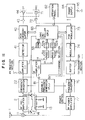
- Fig. 7 shows an embodiment of a portable cordless telephone of a zone selection type, i.e., a so-called cellular telephone to which the radio communication apparatus of the present invention is applied.
- a radio communication apparatus illustrated in Fig. 7 has a radio receiver section RX; a radio transmitter section TX; a signal strength detector circuit 5 for detecting the field strength of a received signal; a logic controller 83 for variably controlling a radio transmitted output in the radio transmitter section TX based on an output of the signal strength detector circuit 5; a power supply circuit 84 employing a battery 84 as a main power supply source; and other illustrated functional blocks.
- This radio communication apparatus is used in a communication network formed of radio zones (cells) 300 as shown in Figs. 8A and 8B.
- the radio receiver section RX is composed of a high frequency signal amplifier (RF front end) 21 for preliminarily amplifying a received signal inputted thereto from an antenna 1 through a branching filter 11; a frequency convertor (down convertor) 22 for converting the preliminarily amplified received signal to an intermediate frequency signal (IF signal) in a predetermined frequency region by a local oscillating frequency signal (local signal) applied thereto from a variable frequency signal generator circuit 81; an intermediate frequency amplifier (IF section) 3 for amplifying the converted IF signal at multiple stages; a FM detector 41 for demodulating modulated signal components from the amplified IF signal; a PCM demodulator 42 for performing demodulation of a received speech signal from the demodulated modulated signal components, discrimination of digital control signals, and so on; a low frequency power amplifier 43 for amplifying the demodulated received speech signal; a speaker 44 for generating sound reproduced from the amplified received speech signal; and so on.
- the radio transmitter section TX is composed of a PCM modulator 73 for pulse-coding a speech signal to be transmitted, which is inputted thereto from a microphone 71 through a low frequency pre-amplifier 72, and performing orthogonal amplitude modulation with this pulse-coded speech signal; a FM modulator 74 for modulating an intermediate frequency carrier (baseband carrier) with an output signal of the PCM modulator 73; an amplifier (buffer) 75 for buffering and amplifying a modulated intermediate frequency signal (IF signal); a frequency convertor (up convertor) 76 for converting the amplified IF signal to a high frequency signal in a predetermined frequency region with a local oscillating frequency signal (local signal) applied thereto from a variable frequency generator circuit 81; a high frequency power amplifier 77 for amplifying the power of the converted high frequency signal and supplying the amplified high frequency signal to the antenna 1 through the branching filter 11; and so on.
- the high frequency power amplifier 77 used in this radio transmitter section is configured to be
- the signal strength detector circuit for detecting the field strength of a received signal is composed of a first signal path 100 constituting the IF section 3 of the radio receiver section RX; a second signal path 200 formed of the IF section 6 for amplifying the received signal, separately from the IF section 3; a wired adder circuit 51 for adding a detection signal (ia) extracted from the first signal path 100 and a detection signal (ib) extracted from the second signal path 200 to produce a combined detection signal; a signal strength detector circuit 5 for performing processing such as smoothing for the combined detection signal (ia+ib) to output a voltage signal indicative of the field strength of a received signal at a DC level; and so on.
- the first signal path 100 is composed of circuits which give priority to reduced noise figure and higher sensitivity
- the second signal path 200 is composed of circuits which give priority to wider dynamic range.
- the output of the signal strength detector circuit 5 is converted to a digital signal by an A/D convertor 52 and delivered to the logic controller 83, later described.
- the logic controller 83 is formed of a computer integrated in a micro circuit and performs network controls such as selection of a radio zone and an optimal control for a radio transmitted output, based on information inputted through manipulations of an operation panel 82, digital control signals discriminated by the radio receiver section RX, and the field strength of a received signal detected by the signal strength detector circuit 5.
- the variable frequency generator circuit 81 is formed of a phase lock loop (PLL), and generates a local oscillating frequency signal (local signal) for determining a received frequency and transmitted frequency based on the frequency of a quartz oscillator (not shown) under control of the logic controller 83.
- PLL phase lock loop
- the logic controller 83 is configured to perform the selection of a radio zone and the optimal control for a radio transmitted output by using the field strength of a received signal as main control information source. More specifically, a radio zone is selected from comparison of the field strengths of received signals from base stations in several radio zones, which have been detected by the signal strength detector circuit 5. Also, a radio output to be transmitted to a base station in a selected radio zone is increased or decreased in accordance with the field strength of a received radio signal transmitted from the base station.
- the logic controller 83 performs such a control that a radio output to be transmitted is increased responsively if the field strength of a received signal, detected by the signal strength detector circuit 5, presents a low level, and that the radio output to be outputted is reduced responsively if the field strength presents a high level.
- the radio communication apparatus of this embodiment when the radio communication apparatus of this embodiment is located relatively remote from a base station, its radio transmitted output is increased to ensure a predetermined communication quality. On the other hand, when the radio communication apparatus is located relatively near a base station, its radio transmitted output is reduced to minimize the consumption of the battery 85 spent for the transmission. In addition, effective utilization of frequencies can be achieved thanks to an interference disturbed range which is narrowed on the same channel (or at the same frequency) and so on.
- the radio communication apparatus of the embodiment shown in Fig. 7 enables a stable communication quality to be ensured without difficulties in situations wherein the apparatus is used for mobile applications. Also, electric power consumed thereby is reduced, so that if a battery is used as a power source, its service life can be extended.
- the radio communication apparatus of the embodiment shown in Fig. 7 further has the following effects in addition to those described above.
- the first signal path 100 for amplifying and transferring a radio received signal from the antenna 1 and a second signal path 200 for transferring the radio received signal separately from the first signal path 100 so as to detect the field strength of the received signal from a detection signal (ia) extracted from the first signal path 100 and a detection signal (ib) extracted from the second signal path 200
- the first signal path 100 is composed of circuits which give priority to reduced noise figure and higher sensitivity, i.e., which give priority to communication quality
- the second signal path 200 is composed of circuits which give priority to wider dynamic range
- Figs. 9A, 9B, 9C respectively show the relationship between a received signal from the antenna, a field strength detection output So, and a transmitted output Po variably set based on the field strength detection output So.
- Fig. 9A shows the relationship when the field strength detecting range, i.e., dynamic range is relatively narrow; Fig. 9B when the accuracy of the field strength detection is partially bad (the linearity of the field strength detection is bad); and Fig. 9C when the dynamic range as well as the accuracy are satisfactory to the field strength detection.
- a difference (dP) between a received signal and a field strength detection output So ends up to be useless battery consumption and unnecessary radiation of radio waves.
- Fig. 9C shows that the field strength is relatively precisely detected over a wide range from a strong electric field to a weak electric field, so that an optimal transmitted output Po can be variably set in a proper quantity even if the radio communication apparatus is located near the boundary of a radio zone so that the sensitivity to received signals is low or even if the radio communication apparatus is close to a base station in a radio zone so that the sensitivity to received signals is extremely high.
- Fig. 9C the capability of precise field strength detection over a wide dynamic range, as shown in Fig. 9C, is highly advantageous in reducing the size of radio zones, as shown in Figs. 8A, 8B.
- the frequency utilization efficiency is advantageously improved. More specifically, the number of frequencies (channels) simultaneously usable in a radio zone is limited to a fixed number. Therefore, in relatively wide radio zones as shown in Fig. 8A, the fixed number of frequencies (channels) must be used in each of them. However, if narrower radio zones are provided as shown in Fig. 8B, the same number of frequencies (channels) can be used in the narrower radio zones. In other words, assuming that the size of a radio zone is reduced to a quarter of an original radio zone, the number of frequencies (channels) available in the same size of region can be increased to four times. This is extremely important to improve the utilization efficiency of frequencies which are a limited resource.
- the field strength of a received signal tends to quite largely change.
- the field strength of a received radio signal changes substantially in reciprocal proportion to a square of a distance from a transmitting base station to the radio communication apparatus.
- the radio communication apparatus is located at a distance of 1000 meters from a transmitting base station, the field strength of a received signal will not change so much even if it moves 100 meters from there.
- a transmitted output need not be corrected so much in order to remain proper for maintaining a high communication quality.
- the transmitted output should also be largely corrected in order to remain proper for maintaining the communication quality.
- an optimal transmitted output Po can be variably set neither more or less respectively in the case where the radio communication apparatus is located near the boundary of a radio zone so that the sensitivity to received signals is low and for the case where the radio communication apparatus is close to a base station in a radio zone so that the sensitivity to received signals is extremely high, a high utilization efficiency of frequencies will be realized by a transmitted output thus properly set for any case, even if narrower radio zones are provided as shown in Fig. 8B.
- Fig. 10 shows another embodiment of a portable cordless telephone of zone selection type or a so-called cellular telephone to which the radio communication apparatus of the present invention is applied.
- the radio communication apparatus shown in Fig. 10 includes a signal switching circuit 14 controlled by a controller 83 based on an output of a signal strength detector circuit 5 and an attenuator 13 coupled to a high frequency signal amplifier 21 in a receiver section RX through the signal switching circuit 14, such that the gain for the received signal from an antenna 1 is switched in accordance with the field strength thereof, to one of three paths: a path to the high frequency amplifier 21 for amplifying the received signal; a path bypassing the high frequency amplifier 21 without amplification; and a path to the attenuator 13.
- the attenuator 13 is formed of a non-inductive type resistive attenuator in consideration of impedance matching.
- the controller 83 in this case is configured to perform control operations in consideration of changes in the level of a field strength detection output caused by the switching of the high frequency gain.
- Fig. 11 shows a further embodiment of a portable cordless telephone of zone selection type, i.e., the so-called cellular telephone to which the radio communication apparatus of the present invention is applied.
- separate signal strength detector circuits 5a, 5b are provided in first and second signal paths 100, 200, respectively.
- Field strength detection outputs are digitized and delivered to a controller 83 separately through both the first and second signal paths 100, 200.
- the controller 83 combines the two digitized signal strength detection outputs by digital processing and performs controls on transmitted output and so on based on the resultant combined signal strength detection output.
- Fig. 12 shows a further embodiment of a portable cordless telephone of zone selection type, i.e., the so-called cellular telephone to which the radio communication apparatus of the present invention is applied.
- a first signal path 100 and a second signal path 200 have frequency convertors 22, 221, respectively, such that a received signal from an antenna 1 is separated prior to frequency conversion, and the two signals are transferred separately through the respective signal paths.
- the first signal path 100 is composed of circuits which give priority to the performance of the receiver
- the second signal path 200 is composed of circuits which give priority to the accuracy of the field strength of received signals in a high field strength region.
- Detection signals ia, ib respectively extracted from the two signal paths 100, 200 are combined such that the field strength of a received signal can be highly accurately detected over a wide dynamic range from a weak electric field to a strong electric field.
- the present invention is not limited to the foregoing embodiments, and may be modified in various ways without departing from the gist thereof.
- the receiver section RX has been configured as a single super-heterodyne form in the illustrated embodiments, a double super-heterodyne or triple super-heterodyne form may also be employed.
- the modulating method used by the transmitter section TX may be a single side band (SSB) or spread spectrum modulation method.
- the present invention created by the present inventors has been described for the case where it is applied to a portable telephone (cellular telephone), i.e., one of industrial fields of utilization which has required it, the present invention is not limited thereto, but may also be applied, for example, to radio communication apparatuses or systems for use in fixed telephone applications.
- cellular telephone i.e., one of industrial fields of utilization which has required it
- the present invention is not limited thereto, but may also be applied, for example, to radio communication apparatuses or systems for use in fixed telephone applications.
Landscapes
- Engineering & Computer Science (AREA)
- Computer Networks & Wireless Communication (AREA)
- Signal Processing (AREA)
- Transmitters (AREA)
- Amplifiers (AREA)
- Mobile Radio Communication Systems (AREA)
- Transceivers (AREA)
Applications Claiming Priority (4)
| Application Number | Priority Date | Filing Date | Title |
|---|---|---|---|
| JP20636593 | 1993-08-20 | ||
| JP206365/93 | 1993-08-20 | ||
| JP5281202A JPH07111484A (ja) | 1993-08-20 | 1993-11-10 | 無線通信装置 |
| JP281202/93 | 1993-11-10 |
Publications (2)
| Publication Number | Publication Date |
|---|---|
| EP0639901A2 true EP0639901A2 (de) | 1995-02-22 |
| EP0639901A3 EP0639901A3 (de) | 1998-11-18 |
Family
ID=26515616
Family Applications (1)
| Application Number | Title | Priority Date | Filing Date |
|---|---|---|---|
| EP94306095A Withdrawn EP0639901A3 (de) | 1993-08-20 | 1994-08-18 | Funkübertragungsgerät mit Feldstärkendetektionsschaltung |
Country Status (4)
| Country | Link |
|---|---|
| US (1) | US5689814A (de) |
| EP (1) | EP0639901A3 (de) |
| JP (1) | JPH07111484A (de) |
| KR (1) | KR950007323A (de) |
Cited By (19)
| Publication number | Priority date | Publication date | Assignee | Title |
|---|---|---|---|---|
| EP0687080A1 (de) * | 1994-06-01 | 1995-12-13 | Mitsubishi Denki Kabushiki Kaisha | Schaltung zur Signalstärkedetektion |
| EP0785640A1 (de) * | 1996-01-17 | 1997-07-23 | Nokia Mobile Phones Ltd. | Verfahren zur Ausdehnung des Bereichs eines Empfangssignalstärkenindikators und nach diesem Verfahren arbeitender Funksendeempfänger |
| US5790943A (en) * | 1995-10-06 | 1998-08-04 | Philips Electronics North America Corporation | Dynamic range extension of a log amplifier with temperature and process compensation |
| US6006077A (en) * | 1997-10-02 | 1999-12-21 | Ericsson Inc. | Received signal strength determination methods and systems |
| WO2000019644A1 (en) * | 1998-09-30 | 2000-04-06 | Conexant Systems, Inc. | Adaptive wireless communication receiver |
| US6348744B1 (en) | 1998-04-14 | 2002-02-19 | Conexant Systems, Inc. | Integrated power management module |
| US6448925B1 (en) | 1999-02-04 | 2002-09-10 | Conexant Systems, Inc. | Jamming detection and blanking for GPS receivers |
| US6496145B2 (en) | 1999-03-30 | 2002-12-17 | Sirf Technology, Inc. | Signal detector employing coherent integration |
| US6519277B2 (en) | 1999-05-25 | 2003-02-11 | Sirf Technology, Inc. | Accelerated selection of a base station in a wireless communication system |
| US6531982B1 (en) | 1997-09-30 | 2003-03-11 | Sirf Technology, Inc. | Field unit for use in a GPS system |
| US6714158B1 (en) | 2000-04-18 | 2004-03-30 | Sirf Technology, Inc. | Method and system for data detection in a global positioning system satellite receiver |
| US6778136B2 (en) | 2001-12-13 | 2004-08-17 | Sirf Technology, Inc. | Fast acquisition of GPS signal |
| US6788655B1 (en) | 2000-04-18 | 2004-09-07 | Sirf Technology, Inc. | Personal communications device with ratio counter |
| US6931055B1 (en) | 2000-04-18 | 2005-08-16 | Sirf Technology, Inc. | Signal detector employing a doppler phase correction system |
| US6952440B1 (en) | 2000-04-18 | 2005-10-04 | Sirf Technology, Inc. | Signal detector employing a Doppler phase correction system |
| US7002516B2 (en) | 1999-03-30 | 2006-02-21 | Sirf Technology, Inc. | Signal detector employing correlation analysis of non-uniform and disjoint sample segments |
| US7545854B1 (en) | 1998-09-01 | 2009-06-09 | Sirf Technology, Inc. | Doppler corrected spread spectrum matched filter |
| US7711038B1 (en) | 1998-09-01 | 2010-05-04 | Sirf Technology, Inc. | System and method for despreading in a spread spectrum matched filter |
| US7885314B1 (en) | 2000-05-02 | 2011-02-08 | Kenneth Scott Walley | Cancellation system and method for a wireless positioning system |
Families Citing this family (24)
| Publication number | Priority date | Publication date | Assignee | Title |
|---|---|---|---|---|
| JPH09331291A (ja) * | 1996-04-10 | 1997-12-22 | Oki Electric Ind Co Ltd | 無線通信システム及び無線通信装置 |
| KR100212055B1 (ko) * | 1996-06-24 | 1999-08-02 | 윤종용 | 이동체 통신시스템의 수신신호세기 검출회로 |
| US5875390A (en) * | 1996-12-06 | 1999-02-23 | Advanced Micro Devices, Inc. | Programmable intermediate frequency RSSI system including an adjustable rectifying stage |
| US6658239B1 (en) * | 1997-05-09 | 2003-12-02 | Micrel Incorporated | Fully integrated ALL-CMOS AM transmitter with automatic antenna tuning |
| US6253068B1 (en) * | 1997-05-09 | 2001-06-26 | Micrel, Incorporated | Fully integrated all-CMOS AM transmitter with automatic antenna tuning |
| US6327471B1 (en) | 1998-02-19 | 2001-12-04 | Conexant Systems, Inc. | Method and an apparatus for positioning system assisted cellular radiotelephone handoff and dropoff |
| US6327312B1 (en) * | 1998-06-24 | 2001-12-04 | Intermec Ip Corp. | RF narrowband/wideband discriminating system for spread spectrum signal differentiation |
| US6163708A (en) * | 1998-12-31 | 2000-12-19 | Nokia Mobile Phones Limited | Closed-loop power control method |
| US6606349B1 (en) | 1999-02-04 | 2003-08-12 | Sirf Technology, Inc. | Spread spectrum receiver performance improvement |
| US6463267B1 (en) * | 1999-04-21 | 2002-10-08 | Hitachi, Ltd. | High frequency power amplifying apparatus having amplifying stages with gain control signals of lower amplitudes applied to earlier preceding stages |
| US6987966B1 (en) * | 1999-10-21 | 2006-01-17 | Broadcom Corporation | Adaptive radio transceiver with polyphase calibration |
| KR20020001167A (ko) * | 2000-06-26 | 2002-01-09 | 서평원 | 휴대형 이동단말기의 출력제어 장치 |
| JP2003046353A (ja) * | 2001-07-27 | 2003-02-14 | Toshiba Corp | 受信装置 |
| US7010283B2 (en) * | 2002-01-16 | 2006-03-07 | Oki Electric Industry Co., Ltd. | Signal waveform detection circuit |
| US7054609B2 (en) * | 2002-04-04 | 2006-05-30 | Telefonaktiebolaget Lm Ericsson (Publ) | Linearity improvement of Gilbert mixers |
| US7133655B2 (en) * | 2004-03-23 | 2006-11-07 | Broadcom Corporation | Amplifiers and amplifying methods for use in telecommunications devices |
| JP4762504B2 (ja) * | 2004-05-07 | 2011-08-31 | 任天堂株式会社 | ゲーム装置、ゲームプログラム、ゲーム制御方法およびゲームシステム |
| US7313372B2 (en) * | 2004-07-29 | 2007-12-25 | Avago Technologies General Ip Pte Ltd | Stable process induced correction bias circuitry for receivers on single-ended applications |
| JP2007116413A (ja) * | 2005-10-20 | 2007-05-10 | Matsushita Electric Ind Co Ltd | Amラジオ受信機 |
| US8265580B2 (en) * | 2009-11-17 | 2012-09-11 | SiTune Coporation | System and method for handling strong signals and blockers in the RF front end |
| US8634766B2 (en) * | 2010-02-16 | 2014-01-21 | Andrew Llc | Gain measurement and monitoring for wireless communication systems |
| US9397935B1 (en) * | 2013-07-25 | 2016-07-19 | Sprint Communications Company L.P. | Staged signal modification |
| CN104467693B (zh) * | 2013-12-30 | 2017-11-24 | 苏州矩阵光电有限公司 | 一种通讯信号补偿器及补偿方法 |
| KR102334330B1 (ko) * | 2017-07-28 | 2021-12-02 | 삼성전자주식회사 | 안테나 스위칭을 지원하기 위한 무선 통신 회로 및 그를 포함하는 장치 |
Family Cites Families (22)
| Publication number | Priority date | Publication date | Assignee | Title |
|---|---|---|---|---|
| JPS52153610A (en) * | 1976-06-17 | 1977-12-20 | Pioneer Electronic Corp | Circuit for driving signal meter of receiver |
| JPS54128382A (en) * | 1978-03-29 | 1979-10-04 | Hitachi Ltd | Tuning signal intensity detecting circuit |
| JPH0117855Y2 (de) * | 1980-05-19 | 1989-05-24 | ||
| JPS58127741U (ja) * | 1982-02-22 | 1983-08-30 | 日本電気株式会社 | 受信機 |
| JPS59140727A (ja) * | 1983-01-31 | 1984-08-13 | Fujitsu Ltd | 周波数変換方式 |
| JPS6070372A (ja) * | 1983-09-28 | 1985-04-22 | Fujitsu Ltd | 電界強度検出回路 |
| JPS6083427A (ja) * | 1983-10-13 | 1985-05-11 | Matsushita Electric Ind Co Ltd | 感度自動切換装置 |
| JPS623536A (ja) * | 1985-06-29 | 1987-01-09 | Oki Electric Ind Co Ltd | 移動体データ通信の良否判定装置 |
| JPS6214815U (de) * | 1985-07-11 | 1987-01-29 | ||
| CA1266707A (en) * | 1985-12-16 | 1990-03-13 | Steve S. Yang | Method of calibrating and equalizing a multi-channel automatic gain control amplifier |
| CA1258499A (en) * | 1986-06-04 | 1989-08-15 | Katsuji Kimura | Intermediate frequency amplification circuit capable of detecting a field strength with low electric power |
| GB2214375A (en) * | 1987-12-24 | 1989-08-31 | Philips Electronic Associated | Amplifier circuit arrangement |
| NL8800510A (nl) * | 1988-02-29 | 1989-09-18 | Philips Nv | Schakeling voor het lineair versterken en demoduleren van een am-gemoduleerd signaal en geintegreerd halfgeleiderelement daarvoor. |
| FI80172C (fi) * | 1988-05-25 | 1990-04-10 | Nokia Mobile Phones Ltd | Fm-mellanfrekvenskrets. |
| JPH03123210A (ja) * | 1989-10-06 | 1991-05-27 | Alps Electric Co Ltd | 2段縦続差動増幅器 |
| US5125105A (en) * | 1989-11-30 | 1992-06-23 | Ford Motor Company | High-quality reception indicating circuit for fm receivers |
| JP2748656B2 (ja) * | 1990-06-19 | 1998-05-13 | ソニー株式会社 | 移動無線通信方法 |
| JPH04104505A (ja) * | 1990-08-23 | 1992-04-07 | Fujitsu Ltd | 半導体集積回路 |
| US5129098A (en) * | 1990-09-24 | 1992-07-07 | Novatel Communication Ltd. | Radio telephone using received signal strength in controlling transmission power |
| EP0517305B1 (de) * | 1991-06-03 | 1995-11-22 | Koninklijke Philips Electronics N.V. | Logarithmischer Verstärker und Detektor |
| EP0530165A3 (en) * | 1991-08-23 | 1993-08-11 | Telefonaktiebolaget L M Ericsson | Mobile station-controlled handoff |
| FR2684252A1 (fr) * | 1991-11-22 | 1993-05-28 | Thomson Composants Militaires | Amplificateur differentiel ultra-rapide. |
-
1993
- 1993-11-10 JP JP5281202A patent/JPH07111484A/ja not_active Withdrawn
-
1994
- 1994-08-16 KR KR1019940020071A patent/KR950007323A/ko not_active Withdrawn
- 1994-08-17 US US08/291,870 patent/US5689814A/en not_active Expired - Fee Related
- 1994-08-18 EP EP94306095A patent/EP0639901A3/de not_active Withdrawn
Cited By (28)
| Publication number | Priority date | Publication date | Assignee | Title |
|---|---|---|---|---|
| US5701601A (en) * | 1994-06-01 | 1997-12-23 | Mitsubishi Denki Kabushiki Kaisha | Receive signal level detection system |
| EP0687080A1 (de) * | 1994-06-01 | 1995-12-13 | Mitsubishi Denki Kabushiki Kaisha | Schaltung zur Signalstärkedetektion |
| US5790943A (en) * | 1995-10-06 | 1998-08-04 | Philips Electronics North America Corporation | Dynamic range extension of a log amplifier with temperature and process compensation |
| EP0785640A1 (de) * | 1996-01-17 | 1997-07-23 | Nokia Mobile Phones Ltd. | Verfahren zur Ausdehnung des Bereichs eines Empfangssignalstärkenindikators und nach diesem Verfahren arbeitender Funksendeempfänger |
| US5963855A (en) * | 1996-01-17 | 1999-10-05 | Nokia Mobile Phones Limited | Method for extending the RSSI range and radio transceiver operating in accordance with this method |
| US6131021A (en) * | 1996-01-17 | 2000-10-10 | Nokia Mobile Phones Limited | Method for extending the RSSI range and radio transceiver operating in accordance with this method |
| US6531982B1 (en) | 1997-09-30 | 2003-03-11 | Sirf Technology, Inc. | Field unit for use in a GPS system |
| US6006077A (en) * | 1997-10-02 | 1999-12-21 | Ericsson Inc. | Received signal strength determination methods and systems |
| US6348744B1 (en) | 1998-04-14 | 2002-02-19 | Conexant Systems, Inc. | Integrated power management module |
| US7852905B2 (en) | 1998-09-01 | 2010-12-14 | Sirf Technology, Inc. | System and method for despreading in a spread spectrum matched filter |
| US7711038B1 (en) | 1998-09-01 | 2010-05-04 | Sirf Technology, Inc. | System and method for despreading in a spread spectrum matched filter |
| US7545854B1 (en) | 1998-09-01 | 2009-06-09 | Sirf Technology, Inc. | Doppler corrected spread spectrum matched filter |
| US6693953B2 (en) | 1998-09-30 | 2004-02-17 | Skyworks Solutions, Inc. | Adaptive wireless communication receiver |
| WO2000019644A1 (en) * | 1998-09-30 | 2000-04-06 | Conexant Systems, Inc. | Adaptive wireless communication receiver |
| US6448925B1 (en) | 1999-02-04 | 2002-09-10 | Conexant Systems, Inc. | Jamming detection and blanking for GPS receivers |
| US7002516B2 (en) | 1999-03-30 | 2006-02-21 | Sirf Technology, Inc. | Signal detector employing correlation analysis of non-uniform and disjoint sample segments |
| US6496145B2 (en) | 1999-03-30 | 2002-12-17 | Sirf Technology, Inc. | Signal detector employing coherent integration |
| US6577271B1 (en) | 1999-03-30 | 2003-06-10 | Sirf Technology, Inc | Signal detector employing coherent integration |
| US6519277B2 (en) | 1999-05-25 | 2003-02-11 | Sirf Technology, Inc. | Accelerated selection of a base station in a wireless communication system |
| US7269511B2 (en) | 2000-04-18 | 2007-09-11 | Sirf Technology, Inc. | Method and system for data detection in a global positioning system satellite receiver |
| US6961660B2 (en) | 2000-04-18 | 2005-11-01 | Sirf Technology, Inc. | Method and system for data detection in a global positioning system satellite receiver |
| US6952440B1 (en) | 2000-04-18 | 2005-10-04 | Sirf Technology, Inc. | Signal detector employing a Doppler phase correction system |
| US6931055B1 (en) | 2000-04-18 | 2005-08-16 | Sirf Technology, Inc. | Signal detector employing a doppler phase correction system |
| US6788655B1 (en) | 2000-04-18 | 2004-09-07 | Sirf Technology, Inc. | Personal communications device with ratio counter |
| US6714158B1 (en) | 2000-04-18 | 2004-03-30 | Sirf Technology, Inc. | Method and system for data detection in a global positioning system satellite receiver |
| US7885314B1 (en) | 2000-05-02 | 2011-02-08 | Kenneth Scott Walley | Cancellation system and method for a wireless positioning system |
| US6778136B2 (en) | 2001-12-13 | 2004-08-17 | Sirf Technology, Inc. | Fast acquisition of GPS signal |
| US7999733B2 (en) | 2001-12-13 | 2011-08-16 | Sirf Technology Inc. | Fast reacquisition of a GPS signal |
Also Published As
| Publication number | Publication date |
|---|---|
| US5689814A (en) | 1997-11-18 |
| EP0639901A3 (de) | 1998-11-18 |
| KR950007323A (ko) | 1995-03-21 |
| JPH07111484A (ja) | 1995-04-25 |
Similar Documents
| Publication | Publication Date | Title |
|---|---|---|
| US5689814A (en) | Radio communication apparatus with expanded dynamic range | |
| EP0977354B1 (de) | Verstärker zur radioübertragung | |
| US7062236B2 (en) | Transmitter circuits | |
| EP1210766B1 (de) | Verstärkungsregelungschleife zur frequenzumsetzung von orthogonalen signalen | |
| JP3469486B2 (ja) | 可変利得回路 | |
| US20050176388A1 (en) | Transmitter and wireless communication apparatus using the transmitter | |
| US7057426B2 (en) | Frequency converter, orthogonal demodulator and orthogonal modulator | |
| GB2311670A (en) | Multistage RF amplifier with gain control of one constant drive current stage and one variable drive current stage | |
| JP2013102552A (ja) | 高周波増幅回路及びそれを用いた移動体通信端末 | |
| US6853235B2 (en) | High frequency switch, amplifying circuit, and mobile communication terminal | |
| US7030691B2 (en) | Power amplifier | |
| US6298226B1 (en) | Receiver for RF signals | |
| CA2088750C (en) | Linearized output control of a nonlinear amplifier | |
| US7555272B2 (en) | Transmission arrangement for transmitting data continuously in the time domain | |
| WO2005036765A1 (en) | Envelope error extraction in if/rf feedback loops | |
| US6591093B1 (en) | Circuit and method for frequency translation | |
| US5659263A (en) | Circuit and method for correcting phase error in a multiplier circuit | |
| JP3238931B2 (ja) | デジタル携帯電話器 | |
| MXPA96002957A (es) | Etapa de salida de un amplificador operacionaladecuado para montarse sobre un substrato y metodode amplificacion con el mismo | |
| KR20070106009A (ko) | 저잡음 혼합기 회로, 잡음 감소 회로, 수신기 회로,고주파수 수신기 및 잡음 감소 방법 | |
| EP0939486A2 (de) | Filterschaltung | |
| US5650714A (en) | Orthogonal signal generation system | |
| JP3432262B2 (ja) | 無線電話装置 | |
| EP1049249A1 (de) | Verstärker mit veränderbarer Verstärkung | |
| US6360086B2 (en) | Device for generating an AC amplitude-dependent indicator |
Legal Events
| Date | Code | Title | Description |
|---|---|---|---|
| PUAI | Public reference made under article 153(3) epc to a published international application that has entered the european phase |
Free format text: ORIGINAL CODE: 0009012 |
|
| AK | Designated contracting states |
Kind code of ref document: A2 Designated state(s): DE FR GB IT |
|
| RHK1 | Main classification (correction) |
Ipc: H04B 17/00 |
|
| PUAL | Search report despatched |
Free format text: ORIGINAL CODE: 0009013 |
|
| AK | Designated contracting states |
Kind code of ref document: A3 Designated state(s): DE FR GB IT |
|
| STAA | Information on the status of an ep patent application or granted ep patent |
Free format text: STATUS: THE APPLICATION HAS BEEN WITHDRAWN |
|
| 17P | Request for examination filed |
Effective date: 19990413 |
|
| 18W | Application withdrawn |
Withdrawal date: 19990421 |