EP0640607A1 - 2-Beta-Alkenyl-penem-Sulfonverbindungen als beta- Lactamase-Hemmer - Google Patents
2-Beta-Alkenyl-penem-Sulfonverbindungen als beta- Lactamase-Hemmer Download PDFInfo
- Publication number
- EP0640607A1 EP0640607A1 EP94112622A EP94112622A EP0640607A1 EP 0640607 A1 EP0640607 A1 EP 0640607A1 EP 94112622 A EP94112622 A EP 94112622A EP 94112622 A EP94112622 A EP 94112622A EP 0640607 A1 EP0640607 A1 EP 0640607A1
- Authority
- EP
- European Patent Office
- Prior art keywords
- methyl
- thia
- heptane
- aza
- bicyclo
- Prior art date
- Legal status (The legal status is an assumption and is not a legal conclusion. Google has not performed a legal analysis and makes no representation as to the accuracy of the status listed.)
- Granted
Links
Classifications
-
- C—CHEMISTRY; METALLURGY
- C07—ORGANIC CHEMISTRY
- C07D—HETEROCYCLIC COMPOUNDS
- C07D499/00—Heterocyclic compounds containing 4-thia-1-azabicyclo [3.2.0] heptane ring systems, i.e. compounds containing a ring system of the formula:, e.g. penicillins, penems; Such ring systems being further condensed, e.g. 2,3-condensed with an oxygen-, nitrogen- or sulfur-containing hetero ring
- C07D499/86—Heterocyclic compounds containing 4-thia-1-azabicyclo [3.2.0] heptane ring systems, i.e. compounds containing a ring system of the formula:, e.g. penicillins, penems; Such ring systems being further condensed, e.g. 2,3-condensed with an oxygen-, nitrogen- or sulfur-containing hetero ring with only atoms other than nitrogen atoms directly attached in position 6 and a carbon atom having three bonds to hetero atoms with at the most one bond to halogen, e.g. an ester or nitrile radical, directly attached in position 2
-
- C—CHEMISTRY; METALLURGY
- C07—ORGANIC CHEMISTRY
- C07D—HETEROCYCLIC COMPOUNDS
- C07D499/00—Heterocyclic compounds containing 4-thia-1-azabicyclo [3.2.0] heptane ring systems, i.e. compounds containing a ring system of the formula:, e.g. penicillins, penems; Such ring systems being further condensed, e.g. 2,3-condensed with an oxygen-, nitrogen- or sulfur-containing hetero ring
-
- A—HUMAN NECESSITIES
- A61—MEDICAL OR VETERINARY SCIENCE; HYGIENE
- A61P—SPECIFIC THERAPEUTIC ACTIVITY OF CHEMICAL COMPOUNDS OR MEDICINAL PREPARATIONS
- A61P31/00—Antiinfectives, i.e. antibiotics, antiseptics, chemotherapeutics
- A61P31/04—Antibacterial agents
-
- A—HUMAN NECESSITIES
- A61—MEDICAL OR VETERINARY SCIENCE; HYGIENE
- A61P—SPECIFIC THERAPEUTIC ACTIVITY OF CHEMICAL COMPOUNDS OR MEDICINAL PREPARATIONS
- A61P43/00—Drugs for specific purposes, not provided for in groups A61P1/00-A61P41/00
Definitions
- lower alkyl alone or in combination, such as “lower alkoxy” or “lower alkylamino” means straight-chain or branched saturated hydrocarbon radicals having at most 7, preferably at most 4 carbon atoms, such as methyl, ethyl, isopropyl or t-butyl.
- aryl-alkyl includes benzyl, benzhydryl, p-methoxybenzyl or p-nitrobenzyl.
- halogen includes fluorine, chlorine, bromine or iodine.
- N, S and / or O-containing heteroaromatic ring preferably means 2-pyridyl, 1-methylpyridin-2-ylio, 1,3-thiazol-2-yl, 1,2,4 -Oxadiazol-3-yl and the like.
- a residue which can be split off in vivo means a residue which is suitable for an orally available application and preferably contains an ester group, such as, for example, -CH 2 OOCC (CH 3) 3, or -CH (CH3) OCO-CH3.
- the present invention relates to 3 ⁇ -alkenyl-penam derivatives of the above general formula I and pharmaceutically acceptable salts thereof as such and as active pharmaceutical ingredients, the preparation of these compounds, furthermore medicaments containing a compound of general formula I or pharmaceutically acceptable salts and optionally in addition a ⁇ -lactam antibiotic and the production of such drugs, and the use of compounds of the general Formula I and pharmaceutically acceptable salts thereof in the control or prevention of diseases, in particular bacterial infections or for the production of corresponding medicaments.
- the invention furthermore relates to compounds of the general formula where R3 has the above meaning.
- the particularly preferred compounds also include: (E / Z) - (2S, 3S, 5R) -3- (2-carbamoyl-vinyl) -3-methyl-7-oxo-4-thia-1-aza-bicyclo [3.2.0] heptane-2- carboxylic acid benzhydryl ester, (E) - (2S, 3S, 5R) -3- (2-carbamoyl-vinyl) -3-methyl-4,4,7-trioxo-4-thia-1-aza-bicyclo [3.2.0] heptane 2-carboxylic acid benzhydryl ester, (Z) - (2S, 3S, 5R) -3- (2-carbamoyl-vinyl) -3-methyl-4,4,7-trioxo-4-thia-1-aza-bicyclo [3.2.0] heptane 2-carboxylic acid benzhydryl ester, (Z) - (2S, 3S, 5R) -3-
- an activating agent for example a base such as triethylamine, sodium methylate, lithium diisopropylamine or DBU (1,5-diazabicyclo [4.3.0] non-5-ene
- suitable solvents are tetrahydrofuran, toluene, dichloromethane, acetonitrile or benzene.
- the compounds of formula I can also be prepared by reacting appropriately substituted triphenylphosphonium halides with 1,2-butylene oxide as the base and solvent.
- the preferred reaction temperature is between 50 and 70 ° C.
- Compounds of the formula I are obtained in which n is 0.
- the sulfide group is oxidized to the sulfoxide or sulfone group by methods known per se.
- the reaction of the compounds of the general formula I, in which n is 0, has proven particularly suitable in a two-phase system with ruthenium tetroxide or with an aqueous potassium permanganate solution and with a hydrogen peroxide solution.
- oxidation reagents such as Na2WO4 or peracid can also be used to prepare the Penam sulfones.
- Dichloromethane is particularly suitable as a solvent.
- the compound of general formula I in which n is 0, is expediently dissolved in dichloromethane and added to an aqueous suspension consisting of sodium (meta) periodate, sodium bicarbonate and ruthenium (IV) oxide.
- aqueous suspension consisting of sodium (meta) periodate, sodium bicarbonate and ruthenium (IV) oxide.
- Whether a sulfoxide or a sulfone is formed in this oxidation depends on the nature and / or amount of the oxidizing agent.
- Ester groups for example benzyl, p-nitrobenzyl, benzhydryl, p-methoxybenzyl or allyl can be split off as follows: Benzyl and p-nitrobenzyl by hydrogenation over palladium-carbon at about 0 ° C to 80 ° C in an organic solvent such as ethyl acetate, methanol or water or by hydrolysis in the presence of sodium sulfide at about 0 ° C to room temperature in a solvent such as DMF . Allyl by palladium- (0) -catalyzed transallylation in the presence of a sodium or potassium salt of 2-ethylcaproic acid, benzhydryl with m-cresol at approx. 50 ° C within 4-5 hours.
- the compounds of general formula II used as starting materials can be obtained from corresponding alcohols in analogy to a process described in Tetrahedron 43 , No. 5, pp. 1003-1012, (1987).
- R3 has the meaning given above.
- Different ⁇ -lactamases can be isolated from penicillin- or cephalosporin-resistant bacterial strains, such as Klebsiella pneumoniae NCTC 418, Proteus vulgaris 1028, Bacillus licheniformis 749 / C, Escherichia coli SN01 and Citrobacter freundii 1203.
- the corresponding strains are cultivated in Tryptic Soy Broth (Difco) and harvested by centrifugation in the late logarithmic growth phase (if necessary, 50-100 mg / l ampicillin are added to the medium towards the end of the log phase in order to add the ⁇ -lactamase induce).
- the bacterial mass obtained in this way is mixed with 20 mM Tris-HCl buffer (pH 7.0); the cells are broken open with French Press while cooling. The mixture is centrifuged (20,000 rpm) for 20-30 minutes and a clear crude extract is obtained.
- the proteins are purified using the method of Cartwright, SJ & Waley, SG [Biochem. J. 221 , 505-512 (1980)) and, for B. licheniformis, Ellerby, LM et al. [Biochemistry 29 , 5797-5806 (1990)].
- the activity of the isolated ⁇ -lactamases can be determined by the method of O'-Callaghan, CH et al. [Antimicr. Ag. Chemother 1 , 283-288 (1972)] with the chromogenic cephalosporin nitrocefin (87/312 from Glaxo).
- the required test batch contains per ml of water: 50 mM phosphate buffer (pH 7.0), 0.1 mM nitrocefin and enough enzyme ( ⁇ -lactamase) by one ⁇ A / min. of about 0.1.
- the cleavage of the substrate which is associated with a color change, takes place at 37 ° C. and is monitored quantitatively at 482 nm with a spectrophotometer.
- cleavage of the chromogenic substrate by ⁇ -lactamases can be carried out by adding compounds of the general formula I (inhibitors) can be inhibited. Since it was found that the inhibitors irreversibly inactivate the ⁇ -lactamase in a time-dependent reaction, the reaction (cleavage of the substrate) is started by adding the substrate after a preincubation time of ⁇ -lactamase with inhibitor of 15 minutes.
- the measure of the affinity of the inhibitor tested in each case for ⁇ -lactamase which is a measure of the strength of the inhibitor, is the concentration which the cleavage of the substrate (nitrocefin) taking place under the above test conditions (test B.) in the absence of an inhibitor Inhibits 50% (IC50 in nM).
- IC50 in nM concentration which the cleavage of the substrate (nitrocefin) taking place under the above test conditions
- the products according to the invention can be used as medicaments, for example in the form of pharmaceutical preparations, which they or their salts are mixed with a pharmaceutical, organic or inorganic inert suitable for parenteral or enteral application
- Carrier material such as water, gelatin, gum arabic, milk sugar, starch, magnesium stearate, talc, vegetable oils, polyalkylene glycols, petroleum jelly, etc. contain.
- the pharmaceutical preparations can be in solid form, for example as tablets, dragées, suppositories, capsules, or in liquid form, for example as solutions, suspensions or emulsions.
- the compounds of the formula I and their salts are preferably suitable for parenteral administration and are preferably prepared for this purpose as lyophilisates or dry powder for dilution with conventional agents such as water or isotonic saline.
- the compounds of the general formula I and their pharmaceutically acceptable salts can be used according to the invention in combating or preventing diseases, in particular in combating pathogens which form ⁇ -lactamase in combination with ⁇ -lactam antibiotics, ie antibiotics, which contain a ⁇ -lactam ring, for example penicillins, such as piperacillin, mezlocillin, azlocillin, apalcillin, benzylpenicillin, phenoxymethylpenicillin, carbenicillin, methicillin, propiocillin, ticarcillin, ampicillin, amoxicillin, cecomefinetamone, cecalefinetamone, cecalefinetamone, cecalefinetamone, cecalefinetamone, cecalefinetamone, cecalefinetamone, cecalefinetamone, cecalefinetamone, cecalefinetamone, cecalefinoxamine, cecalefinetamone, cecalefinetam
- the products according to the invention are administered simultaneously with a ⁇ -lactam antibiotic, this can be done by administration as an ad hoc combination or in the form of a pharmaceutical combination which comprises a compound of the general formula I or a pharmaceutically acceptable salt thereof with base and a contains ⁇ -lactam antibiotic; pharmaceutical combinations of this type are also the subject of the present invention.
- the dosage of the compounds of general formula I and the pharmaceutically acceptable salts thereof with bases can vary within wide limits and is of course to be adapted in each individual case to the individual circumstances and the pathogen which is producing ⁇ -lactamase and is to be controlled. In general, a daily dose of about 0.1 to about 2.0 g may be appropriate.
- the ratio of ⁇ -lactamase inhibitor (compound of the formula I or pharmaceutically acceptable salt thereof with base) to ⁇ -lactam antibiotic can also vary within wide limits and must be adapted to the individual circumstances in each individual case. In general, a ratio of about 1:20 to about 1: 1 should be appropriate.
- medicaments containing a compound of the general formula I or a pharmaceutically acceptable salt thereof are also the subject of the present invention, furthermore also a process for the preparation of such medicaments, which is characterized in that one or more compounds of the general formula I or brings pharmaceutically acceptable salts thereof and optionally one or more other therapeutically valuable substances into a pharmaceutical dosage form; in this context, reference is once again made to the pharmaceutical combinations mentioned above, which are also the subject of the present invention.
- pharmaceutical combinations containing a compound of general formula I or a pharmaceutically acceptable salt thereof and a ⁇ -lactam antibiotic e.g.
- a penicillin such as piperacillin, mezlocillin, azlocillin, apalcillin, benzylpenicillin, phenoxymethylpenicillin, carbenicillin, methicillin, propicillin, ticarcillin, ampicillin, amoxicillin or mecillinam, or cephalefefimet, such as cefalosefimet, such as cephalosefimetim, cecalefinoximine, , Cefuroxime, Cephaloridin, Cephalotin, Cefazolin, Cephalexin, Cefoxitin, Cephacetril, Cefamandol, Cephapirin, Cephradin, Cephaloglycin, Cefpirom, Cefepim as well as Penems and Carbapenems like Imipenem or Meropenem the subject of the present invention.
- cephalefefimet such as cefalosefimet, such as cephalosefimetim, cecalefinoximine, , Cefur
- 0.84 ml (9.60 mmol) of oxalyl chloride are added to 100 ml of dichloromethane under argon and the mixture is cooled to -60 ° C.
- 0.73 ml (10.25 mmol) DMSO followed by 2.50 g (6.52 mmol) (2S, 3R, 5R) -3-hydroxymethyl-3-methyl-7-oxo-4-thia-1-aza-bicyclo [3.2. 0] heptane-2-carboxylic acid benzhydryl ester dissolved in 100 ml of dichloromethane was added dropwise.
- the phases are separated in a separating funnel and the water phase is extracted twice more with dichloromethane.
- the organic phase is washed with water, saturated sodium bicarbonate solution and saturated sodium chloride solution, dried over sodium sulfate, filtered and concentrated.
- the remaining oil is chromatographed on silica gel (particle size 0.040-0.063 mm) with ethyl acetate: hexane 9:16 as the eluent. Yield: 170 mg (60%) colorless foam.
- the mixture is allowed to cool to room temperature, the solvent is removed on a rotary evaporator and the red-brown oil is chromatographed on silica gel (particle size 0.040-0.063 mm) using ethyl acetate: hexane 9:16 as the eluent.
- Example 2 800 mg (1.56 mmol) of (E) - (2S, 3S, 5R) -3- (2-benzyloxycarbonyl-vinyl) -3-methyl-7-oxo-4-thia-1-aza-bicyclo [ 3.2.0] heptane-2-carboxylic acid oxidized benzhydryl ester.
- Example 2 250 mg (0.46 mmol) of (E) - (2S, 3S, 5R) -3- (2-benzyloxycarbonyl-vinyl) -3-methyl-4,4,7-trioxo-4-thia-1- aza-bicyclo [3.2.0] heptane-2-carboxylic acid benzhydryl ester.
- the two isomers can be chromatographed over silica gel (grain size 0.040-0.063 mm) with ethyl acetate: n-hexane 9:16 as the eluent.
- the Z component is eluted as the first component.
- the mixture is extracted twice with 3 ml of water each time, the combined aqueous phases are washed with 10 ml of isobutyl methyl ketone and lyophilized.
- the yellow lyophilisate is dissolved in 1.3 ml of water and chromatographed on polymeric hydrophobic gel.
- the brown oil is chromatographed on silica gel (particle size 0.040-0.063 mm) with ethyl acetate: n-hexane 1: 1 as the eluent and the two isomers separated.
- the Z isomer is eluted before the E isomer, both can be obtained as crystalline solids from CH2Cl2 / n-hexane.
- Example 2 370 mg (0.875 mmol) (Z) - (2S, 3S, 5R) -3- (2-carbamoyl-vinyl) -3-methyl-7-oxo-4-thia-1-aza-bicyclo [ 3.2.0] heptane-2-carboxylic acid oxidized benzhydryl ester.
- a mixture of ethyl acetate: n-hexane 1: 1 is used as the eluent.
- reaction solution is shaken out with sodium sulfite solution (3% in saturated aqueous sodium bicarbonate solution) and washed with saturated aqueous sodium chloride solution. It is dried over magnesium sulfate, filtered, the solvent is removed on a rotary evaporator and the remaining residue is recrystallized with methylene chloride / n-hexane.
- Example 2 350 mg (0.78 mmol) of (E) - (2S, 3S, 5R) -3- (2-carbamoyl-vinyl) -3-methyl-4,4,7-trioxo-4-thia-1- aza-bicyclo [3.2.0] heptane-2-carboxylic acid benzhydryl ester.
- the cold bath is removed and the reaction mixture is stirred until the reaction is complete (TLC control). Then 2 g of activated carbon and 20 ml of saturated sodium chloride solution are added, the mixture is stirred for 5 minutes and the reaction mixture is filtered off with suction over dicalite. The phases are in Separating funnel separated, the aqueous phase extracted twice with methylene chloride and the combined organic extracts washed with water and saturated sodium chloride solution. It is dried over magnesium sulfate / bleaching earth, filtered and rotated.
- the remaining oil is chromatographed over silica gel (particle size 0.040-0.063 mm) with ethyl acetate: n-hexane 1: 2 as the eluent, the two isomers being separated.
- the Z component is eluted as the first component.
- Example 8 400 mg (0.90 mmol) of (Z) - (2S, 3S, 5R) -3- (2-chlorovinyl) -3-methyl-4,4,7-trioxo-4-thia-1-aza- deprotected bicyclo [3.2.0] heptane-2-carboxylic acid benzhydryl ester. Yield: 176 mg (65%) colorless lyophilisate MS: (M-Na) ⁇ 278.2 IR (KBr): 1779, 1626, 1398, 1321, 1142 cm -1 Elemental analysis: C9H9ClNO5SNa (301.676) about. C 35.83 H 3.01 N 4.64 found #) C 35.72 H 3.04 N 4.65 #) Anhydrous with 5.53% water
- Example 8 221 mg (0.49 mmol) of (E) - (2S, 3S, 5R) -3-methyl-7-oxo-3- (3-oxo-but-1-enyl) -4-thia-1- aza-bicyclo [3.2.0] heptane-2-carboxylic acid oxidized benzhydryl ester. It is chromatographed once over silica gel (particle size 0.040-0.063 mm) with ethyl acetate: n-hexane 9:16 as the eluent and crystallized from methylene chloride / n-hexane.
- Example 8 280 mg (0.63 mmol) of (E) - (2S, 3S, 5R) -3-methyl-3- [2- (1,2,4-oxadiazol-3-yl) -vinyl] -7- oxo-4-thia-1-aza-bicyclo [3.2.0] heptane-2-carboxylic acid oxidized benzhydryl ester. It is chromatographed once over silica gel (particle size 0.040-0.063 mm) with ethyl acetate: n-hexane 9:16 as the eluent and crystallized from methylene chloride / n-hexane.
- Z isomer Yield: 240 mg (17%) yellow oil IR (film): 1778, 1743, 1493, 1197, 986 cm -1 MS: (M + H+) 463.5 E isomer : Yield: 855 mg (62%) yellow resin IR (KBr): 1779, 1746, 1492, 1292, 988 cm -1 MS: (M + H) + 463.5
- Example 8 210 mg (0.45 mmol) of (Z) - (2S, 3S, 5R) -3-methyl-4,4,7-trioxo-3- (2-thiazol-2-yl-vinyl) -4- thia-1-aza-bicyclo [3.2.0] heptane-2-carboxylic acid oxidized benzhydryl ester. It is chromatographed on silica gel (particle size 0.040-0.063 mm) with methylene chloride: ethyl acetate 95: 5 as the eluent. Yield: 72 mg (33%) colorless foam MS: (M + H) + 495.4 IR (KBr): 1793, 1754, 1490, 1328, 1184, 1142, 963 cm -1
- Example 8 196 mg (0.43 mmol) of (E) - (2S, 3S, 5R) -3-methyl-3- (2-pyridin-2-yl-vinyl) -7-oxo-4-thia-1- aza-bicyclo [3.2.0] heptane-2-carboxylic acid oxidized benzhydryl ester. It is chromatographed on silica gel (particle size 0.040-0.063 mm) with methylene chloride: ethyl acetate 95: 5 as the eluent. Yield: 130 mg (62%) colorless foam MS: (M + H) + 489.4 IR (KBr): 1799, 1756, 1580, 1490, 1327, 1184, 1141, 969 cm -1
- the product thus obtained (200 mg, 100%) is processed without further purification. Dissolve the brown resin in 2 mL of m-cresol and stirred for 2 hours at 50 o C. Thereafter, 10 ml of isobutyl methyl ketone and 5 ml of water, becameschuettelt, the phases separated and the organic phase extracted twice with 5 ml of water. The water phases are washed twice with 10 ml of isobutyl methyl ketone, filtered and lyophilized. The yellowish lyophilisate is chromatographed on polymeric hydrophobic gel with water as the eluent. Yield: 105 mg (72%) orange lyophilisate IR (KBr): 1778, 1627, 1377, 1185, 970 cm -1 MS: (M+) 337.4
- Example 8 770 mg (1.79 mmol) (1E, 3E) and (1E, 3Z) - (2S, 3S, 5R) -3- (4-cyano-buta-1,3-dienyl) -3-methyl- 7-oxo-4-thia-1-aza-bicyclo [3.2.0] heptane-2-carboxylic acid oxidized benzhydrylester.
- the two isomers can be separated by chromatography over silica gel (particle size 0.040-0.063 mm) with ethyl acetate: n-hexane 9:16 as the eluent.
- the Z component is eluted as the first component.
- Example 8 763 mg (1.42 mmol) (E / Z) - (2S, 3S, 5R) -3-methyl-7-oxo-3- [2-oxo-1- (2,2,2-trifluoro- ethyl) -pyrrolidin-3-ylidenmethyl] -4-thia-1-aza-bicyclo [3.2.0] heptane-2-carboxylic acid oxidized benzhydryl ester.
- the two isomers can be separated chromatographically on silica gel (particle size 0.040-0.063 mm) with ethyl acetate: n-hexane 1: 2 as the eluent.
- Example 18 According to Example 18, 381 mg (1.0 mmol) of (2S, 3R, 5R) -3-formyl-3-methyl-7-oxo-4-thia-1-aza-bicyclo [3.2.0] heptane-2-carboxylic acid benzhydryl ester reacted with 495 mg (1.1 mmol) of rac- [1-cyclopropyl-2-oxo-3-pyrrolidinyl] triphenylphosphonium bromide. It is chromatographed on silica gel (particle size 0.040-0.063 mm) with ethyl acetate: n-hexane 9:16 as the eluent.
- Example 8 500 mg (0.95 mmol) of (E) - (2S, 3S, 5R) -3-methyl-4,4,7-trioxo-3- [3 - [(R) - and (S) -tetrahydro -pyran-2-yloxyl] -propenyl] -4-thia-1-aza-bicyclo [3.2.0] heptane-2-carboxylic acid benzhydryl ester.
Landscapes
- Chemical & Material Sciences (AREA)
- Organic Chemistry (AREA)
- Health & Medical Sciences (AREA)
- General Health & Medical Sciences (AREA)
- Veterinary Medicine (AREA)
- General Chemical & Material Sciences (AREA)
- Medicinal Chemistry (AREA)
- Nuclear Medicine, Radiotherapy & Molecular Imaging (AREA)
- Chemical Kinetics & Catalysis (AREA)
- Pharmacology & Pharmacy (AREA)
- Life Sciences & Earth Sciences (AREA)
- Animal Behavior & Ethology (AREA)
- Public Health (AREA)
- Communicable Diseases (AREA)
- Oncology (AREA)
- Engineering & Computer Science (AREA)
- Bioinformatics & Cheminformatics (AREA)
- Pharmaceuticals Containing Other Organic And Inorganic Compounds (AREA)
- Acyclic And Carbocyclic Compounds In Medicinal Compositions (AREA)
- Nitrogen Condensed Heterocyclic Rings (AREA)
- Cephalosporin Compounds (AREA)
- Pyrrole Compounds (AREA)
- Hydrogenated Pyridines (AREA)
- Organic Low-Molecular-Weight Compounds And Preparation Thereof (AREA)
Abstract
Description
- Die vorliegende Erfindung betrifft Penam-Derivate, im speziellen betrifft sie 3β-Alkenyl-penam-Derivate der allgemeinen Formel

worin
eines von R¹ und R² -COR⁴, -CN, -CH₂R⁵, Halogen, -CH=CHR⁶ oder Q und das andere Wasserstoff oder niederes Alkyl oder beide zusammen einen γ-Lactamring, - R³
- Wasserstoff, niederes Alkyl, Aryl-alkyl, Allyl oder einen in vivo abspaltbaren Rest,
- R⁴
- Wasserstoff, niederes Alkyl, niederes Alkoxy, Benzyloxy, Amino, niederes Alkylamino oder niederes Alkyl-niederes Alkoxyamino,
- R⁵
- Hydroxy, -OCONHR⁷, -OCONH₂ oder einen fünf- oder sechsgliedrigen, N,S und/oder O enthaltenden hetero-aromatischen, über ein Stickstoffatom verknüpften Ring,
- R⁶
- -CN oder -CHO,
- R⁷
- -COCH₂Cl,
- Q
- einen fünf- oder sechsgliedrigen, N,S und/oder O enthaltenden hetero-aromatischen Ring und
- n
- 0, 1 oder 2 bedeuten,
- Diese Verbindungen sind neu und zeichnen sich durch therapeutisch wertvolle Eigenschaften aus. Insbesondere besitzen sie ausgeprägte β-Lactamase hemmende Wirkungen und sind somit nützlich bei der Bekämpfung von β-Lactamase bildenden Krankheitserregern in Kombination mit β-Lactam-Antibiotika, wie den Penicillinen und Cephalosporinen.
- Weiterhin weisen sie eine antibakterielle Eigenaktivität gegen einzelne Bakterienstämme, wie z. B. Acinetobacter spp., auf.
- Der Ausdruck "niederes Alkyl" für sich allein genommen oder in Kombination, wie "niederes Alkoxy" oder "niederes Alkylamino" bedeutet geradkettige oder verzweigte gesättigte Kohlenwasserstoffreste mit höchstens 7, vorzugsweise höchstens 4 Kohlenstoffatomen, wie Methyl, Ethyl, Isopropyl oder t-Butyl.
- Der Ausdruck "Aryl-alkyl" umfasst Benzyl, Benzhydryl, p-Methoxybenzyl oder p-Nitrobenzyl.
- Der Ausdruck "Halogen" umfasst Fluor, Chlor, Brom oder Jod.
- Der Ausdruck " fünf- oder sechsgliedriger, N,S und/oder O enthaltener hetero-aromatischer Ring" bedeutet vorzugsweise 2-Pyridyl, 1-Methylpyridin-2-ylio, 1,3-Thiazol-2-yl, 1,2,4-Oxadiazol-3-yl und dergleichen.
- Ein in vivo abspaltbarer Rest bedeutet einen für eine oral verfügbare Anwendung geeigneten Rest, der vorzugsweise eine Estergruppe enthält, wie beispielsweise -CH₂OOCC(CH₃)₃,

oder -CH(CH₃)OCO-CH₃. - Gegenstand der vorliegenden Erfindung sind 3β-Alkenyl-penam-Derivate der obigen allgemeinen Formel I und pharmazeutisch verträgliche Salze davon als solche und als pharmazeutische Wirkstoffe, die Herstellung dieser Verbindungen, ferner Arzneimittel, enthaltend eine Verbindung der allgemeinen Formel I oder pharmazeutisch verträgliche Salze und gegebenenfalls zusätzlich ein β-Lactam-Antibiotikum und die Herstellung solcher Arzneimittel, sowie die Verwendung von Verbindungen der allgemeinen Formel I und von pharmazeutisch verträglichen Salzen davon bei der Bekämpfung bzw. Verhütung von Krankheiten, insbesondere von bakteriellen Infektionen bzw. zur Herstellung entsprechender Arzneimittel.
- Weiterhin sind Gegenstand der Erfindung Verbindungen der allgemeinen Formel

worin R³ die obige Bedeutung hat. - Diese Verbindungen der Formel II sind wichtige Zwischenprodukte für die Herstellung der Verbindungen der allgemeinen Formel I.
- Besonders bevorzugt sind solche Verbindungen der allgemeinen Formel I, worin R¹ = CN, Halogen oder COR⁴ und R⁴ = Amino, Methyl, niederes Alkoxy oder Benzyloxy bedeuten und R² = Wasserstoffist, z.B. die folgenden Verbindungen:
(E/Z)-(2S,3S,5R)-3-(2-Cyanoethenyl)-3-methyl-7-oxo-4-thia-1-aza-bicyclo[3.2.0]heptan-2-carbonsäure-benzhydrylester,
(E)-(2S,3S,5R)-3-(2-Cyanoethenyl)-3-methyl-4,4,7-trioxo-4-thia-1-aza-bicyclo[3.2.0]heptan-2-carbonsäure-benzhydrylester,
(Z)-(2S,3S,5R)-3-(2-Cyanoethenyl)-3-methyl-4,4,7-trioxo-4-thia-1-aza-bicyclo[3.2.0]heptan-2-carbonsäure-benzhydrylester,
(E)-(2S,3S,5R)-3-(2-Cyanoethenyl)-3-methyl-4,4,7-trioxo-4-thia-1-aza-bicyclo[3.2.0]heptan-2-carbonsäure-Natriumsalz,
(Z)-(2S,3S,5R)-3-(2-Cyanoethenyl)-3-methyl-4,4,7-trioxo-4-thia-1-aza-bicyclo[3.2.0]heptan-2-carbonsäure-Natriumsalz,
(Z)-(2S,3S,5R)-3-(2-Chlor-vinyl)-3-methyl-4,4,7-trioxo-4-thia-1-aza-bicyclo[3.2.0]heptan-2-carbonsäure-Natriumsalz,
(E)-(2S,3S,5R)-3-Methyl-3-(3-oxo-but-1-enyl)-4,4,7-trioxo-4-thia-1-aza-bicyclo[3.2.0]heptan-2-carbonsäure-Natriumsalz. - Weiterhin gehören zu den besonders bevorzugten Verbindungen:
(E/Z)-(2S,3S,5R)-3-(2-Carbamoyl-vinyl)-3-methyl-7-oxo-4-thia-1-aza-bicyclo[3.2.0]heptan-2-carbonsäure-benzhydrylester,
(E)-(2S,3S,5R)-3-(2-Carbamoyl-vinyl)-3-methyl-4,4,7-trioxo-4-thia-1-aza-bicyclo[3.2.0]heptan-2-carbonsäure-benzhydrylester,
(Z)-(2S,3S,5R)-3-(2-Carbamoyl-vinyl)-3-methyl-4,4,7-trioxo-4-thia-1-aza-bicyclo[3.2.0]heptan-2-carbonsäure-benzhydrylester,
(E)-(2S,3S,5R)-3-(2-Carbamoyl-vinyl)-3-methyl-4,4,7-trioxo-4-thia-1-aza-bicyclo[3.2.0]heptan-2-carbonsäure-Natriumsalz,
(Z)-(2S,3S,5R)-3-(2-Carbamoyl-vinyl)-3-methyl-4,4,7-trioxo-4-thia-1-aza-bicyclo[3.2.0]heptan-2-carbonsäure-Natriumsalz,
(E)-(2S,3S,5R)-3-(2-Ethoxycarbonyl-vinyl)-3-methyl-7-oxo-4-thia-1-aza-bicyclo[3.2.0]heptan-2-carbonsäure-benzhydrylester,
(E)-(2S,3S,5R)-3-(2-Ethoxycarbonyl-vinyl)-3-methyl-4,4,7-trioxo-4-thia-1-aza-bicyclo[3.2.0]heptan-2-carbonsäure-benzhydrylester,
(E)-(2S,3S,5R)-3-(2-Ethoxycarbonyl-vinyl)-3-methyl-4,4,7-trioxo-4-thia-1-aza-bicyclo[3.2.0]heptan-2-carbonsäure-Natriumsalz,
(E)-(2S,3S,5R)-3-(2-Benzyloxycarbonyl-vinyl)-3-methyl-7-oxo-4-thia-1-aza-bicyclo[3.2.0]heptan-2-carbonsäure-benzhydrylester,
(E)-(2S,3S,5R)-3-(2-Benzyloxycarbonyl-vinyl)-3-methyl-4,4,7-trioxo-4-thia-1-aza-bicyclo[3.2.0]heptan-2-carbonsäure-benzhydrylester,
(E)-(2S,3S,5R)-3-(2-Benzyloxycarbonyl-vinyl)-3-methyl-4,4,7-trioxo-4-thia-1-aza-bicyclo[3.2.0]heptan-2-carbonsäure-Natriumsalz. - Die 3β-Alkenyl-penam-Derivate der allgemeinen Formel I sowie deren pharmazeutisch verträglichen Salze können erfindungsgemäss hergestellt werden, indem man
- a) eine Verbindung der allgemeinen Formel

mit einer Verbindung der allgemeinen Formel
in Gegenwart eines Aktivierungsmittels umsetzt, oder - b) eine Verbindung der allgemeinen Formel I, worin n 0 bedeutet, oxydiert oder
- c) eine Verbindung der allgemeinen Formel I, worin R³ von Wasserstoff verschieden ist, in die entsprechende freie Säure überführt und
- d) erwünschtenfalls eine saure Verbindung der Formel I in ein pharmazeutisch annehmbares Salz überführt.
- Zwei bekannte Methoden zur Durchführung von Verfahrensvariante a) zeigt das Schema 1 (Wittig- bzw. Horner-Reaktion).
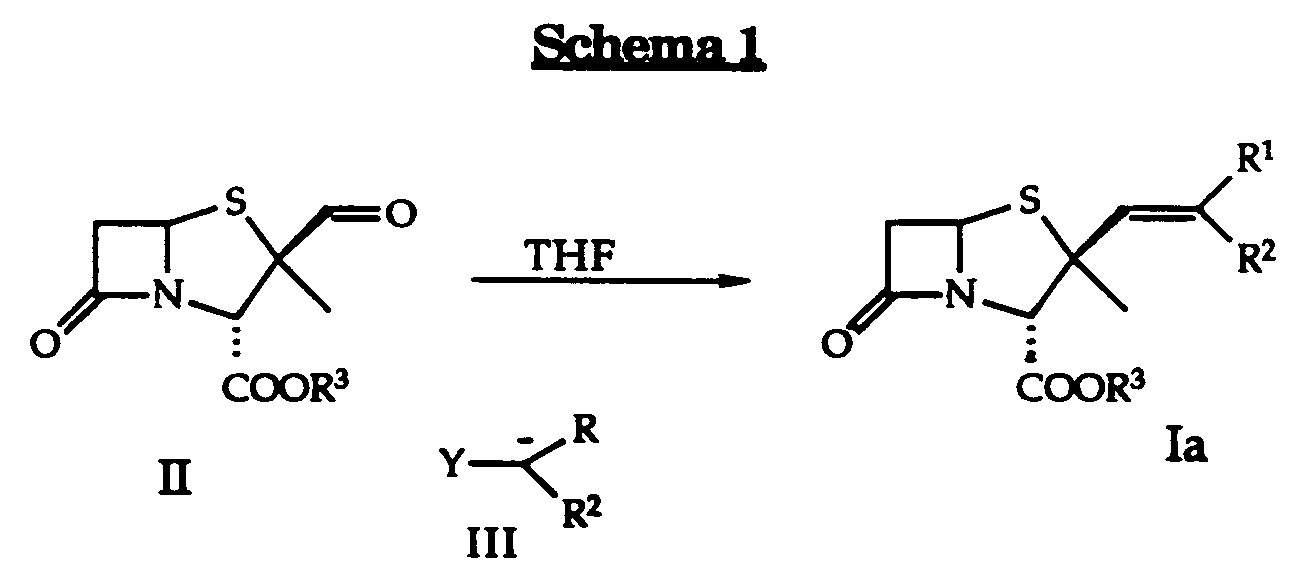
Die Substituenten R¹, R² und R³ entsprechen den obigen Bedeutungen. - Der Aldehyd der Formel II wird durch direkte Umsetzung mit einem Alkyliden-triphenylphosphoran (III; Y = P⊕(Aryl)₃, Wittig-Reaktion) bzw. mit einem Alkylphosphonat (III; Y = (AlkylO)₂PO, Horner-Reaktion) in Gegenwart eines Aktivierungsmittels, beispielsweise einer Base wie Triethylamin, Natriummethylat, Lithiumdiisopropylamin oder DBU (1,5-Diaza-bicyclo[4.3.0]non-5-en) in die Alkenyl-substituierten Pename der Formel Ia überführt. Als Lösungsmittel eignen sich z.B. Tetrahydrofuran, Toluol, Dichlormethan, Acetonitril oder Benzol. Die Reaktionstemperatur kann, je nach eingesetztem Lösungsmittel, zwischen -30° und 80°C variieren.
- Wahlweise können die Verbindungen der Formel I auch durch Umsetzung von entsprechend substituierten Triphenylphosphoniumhalogeniden mit 1,2-Butylenoxid als Base und Lösungsmittel dargestellt werden. Die bevorzugte Reaktionstemperatur liegt dabei zwischen 50 und 70°C. Man erhält Verbindungen der Formel I, worin n 0 bedeutet.
- Weitere Möglichkeiten zur Durchführung von Verfahrensvariante a) stellen die Peterson-Olefinierung sowie die Reformatsky-Synthese dar. Bei der Peterson-Olefinierung werden Lithiumsalze von Tetraalkylsilanen mit Verbindungen der Formel II umgesetzt. Das Schema 2 zeigt die Umsetzung mit einem entsprechend substituierten Lithium-trimethylsilylmethyl-Derivat der Formel IV, wobei R¹ und R³ die oben angegebenen Bedeutungen haben.

Die 3β-Alkenyl-penam-Derivate der Formel Ib entstehen aus den Verbindungen der Formel V durch spontane Dehydratisierung. Man erhält Verbindungen der Formel I, worin n 0 und R² Wasserstoff bedeuten. Bei der Reformatsky-Synthese werden Verbindungen der Formel II mit Organo-Zink-Derivaten von α-Halogenestern zu den entsprechenden β-Hydroxylestern der Formel VI kondensiert, wobei durch Wasserabspaltung Verbindungen der Formel I entstehen, worin n 0, R¹ COR⁴, R⁴ niederes Alkyl und R² Wasserstoff bedeuten, entsprechend Schema 3.
R³ hat die oben angegebene Bedeutung. - Die Oxydation der Sulfid- zur Sulfoxid- oder Sulfongruppe erfolgt nach an sich bekannten Methoden. Besonders geeignet erweist sich die Reaktion der Verbindungen der allgemeinen Formel I, worin n 0 bedeutet, in einem Zweiphasensystem mit Rutheniumtetroxid oder mit einer wässrigen Kaliumpermanganatlösung sowie mit einer Wasserstoffperoxidlösung.
- Zur Darstellung der Penam-Sulfone können auch andere Oxydationsreagentien wie Na₂WO₄ oder Persäure herangezogen werden. Als Lösungsmittel ist Dichlormethan besonders geeignet.
- Die Verbindung der allgemeinen Formel I, worin n 0 bedeutet, wird zweckmässigerweise in Dichlormethan gelöst und zu einer wässrigen Suspension, bestehend aus Natrium(meta)perjodat, Natriumbicarbonat sowie Ruthenium(IV)oxid gegeben. Nach beendeter Reaktion wird die organische Phase abgetrennt, gereinigt und getrocknet.
- Ob bei dieser Oxydation ein Sulfoxid oder ein Sulfon entsteht, hängt von Natur und/oder Menge des Oxydationsmittels ab.
- Die Ueberführung einer Verbindung der Formel I, worin R³ von Wasserstoff verschieden ist, in eine freie Säure und die Ueberführung einer freien Säure in ein pharmazeutisch annehmbares Salz kann nach an sich bekannten Methoden erfolgen, unter Umständen in einem einzigen Arbeitsgang.
- Estergruppen, z.B. Benzyl, p-Nitrobenzyl, Benzhydryl, p-Methoxybenzyl oder Allyl können wie folgt abgespalten werden:
Benzyl und p-Nitrobenzyl durch Hydrierung über Palladiumkohle bei etwa 0°C bis 80°C in einem organischen Lösungsmittel wie Aethylacetat, Methanol oder Wasser oder durch Hydrolyse in Gegenwart von Natriumsulfid bei ca. 0°C bis Zimmertemperatur in einem Lösungsmittel, wie z.B. DMF. Allyl durch Palladium-(0)-katalysierte Transallylierung in Gegenwart eines Natrium- oder Kaliumsalzes der 2-Aethylcapronsäure, Benzhydryl mit m-Kresol bei ca 50°C innerhalb von 4-5 Stunden. - Die als Ausgangsstoffe verwendeten Verbindungen der allgemeinen Formel II können in Analogie zu einem in Tetrahedron 43, Nr. 5, S. 1003-1012,(1987) beschriebenen Verfahren aus entsprechenden Alkoholen gewonnen werden.

Dabei hat R³ die oben angegebene Bedeutung. - Von Vorteil erweist sich die Umsetzung mit Oxalylchlorid in Dichlormethan, wobei man zweckmässigerweise wie folgt vorgeht: Dichlormethan und das Oxydationsmittel werden auf ca. -60°C abgekühlt, mit DMSO und einer Verbindung der Formel VIII versetzt und nach ca. 3-stündigem Reaktionsverlauf und Zugabe von Triethylamin wird das Kältebad entfernt. Der so entstandene Aldehyd der Formel II kann mit üblichen Methoden gereinigt werden.
- Analog erhält man Verbindungen der allgemeinen Formel II durch Oxydation mit PCC (Pyridin-Chlorchromat), Dess-Martin-Reagenz, MnO₂ u.a.
- Wie bereits eingangs erwähnt, zeigen die erfindungsgemässen Verbindungen der allgemeinen Formel I und pharmazeutisch verträgliche Salze davon mit Basen ausgeprägte β-Lactamase hemmende Aktivitäten gegen β-Lactamasen aus verschiedenen Bakterienstämmen. Diese therapeutisch wertvollen Eigenschaften können, wie nachstehend erläutert, an isolierten β-Lactamasen in vitro bestimmt werden.
- Verschiedene β-Lactamasen können aus penicillin- bzw. cephalosporin-resistenten Bakterienstämmen, wie Klebsiella pneumoniae NCTC 418, Proteus vulgaris 1028, Bacillus licheniformis 749/C, Escherichia coli SN01 und Citrobacter freundii 1203 isoliert werden. Hierzu werden die entsprechenden Stämme in Tryptic Soy Broth (Difco) kultiviert und durch Zentrifugation in der späten logarithmischen Wachstumsphase geerntet (wenn nötig gibt man dem Medium gegen Ende der log-Phase 50-100 mg/l Ampicillin hinzu, um die β-Lactamase zu induzieren). Die so erhaltene Bakterienmasse wird mit 20 mM Tris-HCl-Puffer (pH 7,0) versetzt; unter Kühlung werden die Zellen mit French Press aufgebrochen. Man zentrifugiert (20'000 U/min.) während 20-30 Minuten und erhält einen klaren Rohextrakt. Die Reinigung der Proteine erfolgt nach der Methode von Cartwright, S.J. & Waley, S.G. [Biochem. J. 221, 505-512(1980)) und, für B. licheniformis, Ellerby, L.M. et al. [Biochemistry 29, 5797-5806 (1990)].
- Die Bestimmung der Aktivität der isolierten β-Lactamasen kann nach der Methode von O'-Callaghan, C.H. et al. [Antimicr. Ag. Chemother 1, 283-288 (1972)] mit dem chromogenen Cephalosporin Nitrocefin (87/312 von Glaxo) durchgeführt werden. Der benötigte Versuchsansatz enthält pro ml Wasser: 50 mM Phosphatpuffer (pH 7,0), 0,1 mM Nitrocefin und genügend Enzym (β-Lactamase) um eine ΔA/min. von ca. 0,1 zu erreichen. Die Spaltung des Substrates, die mit einer Farbänderung verbunden ist, erfolgt bei 37°C und wird bei 482 nm mit einem Spektralphotometer quantitativ verfolgt.
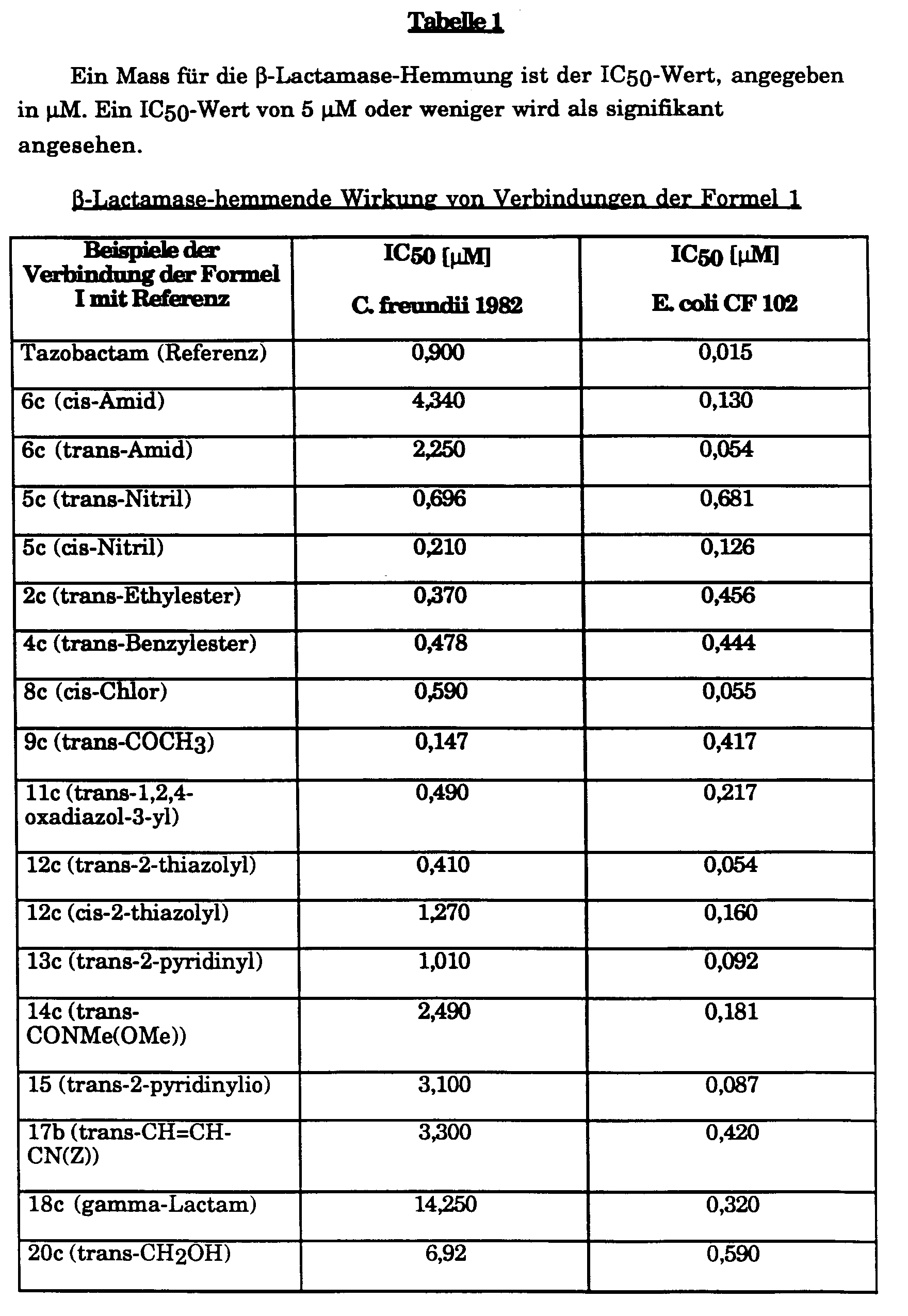
- Die oben beschriebene Spaltung des chromogenen Substrates durch β-Lactamasen (Versuch B.) kann durch Zugabe von Verbindungen der allgemeinen Formel I (Inhibitoren) gehemmt werden. Da es sich zeigte, dass die Inhibitoren die β-Lactamase in einer zeitabhängigen Reaktion irreversibel inaktivieren, wird die Reaktion (Spaltung des Substrates), jeweils nach einer Vorinkubationszeit von β-Lactamase mit Inhibitor von 15 Minuten, durch Zugabe des Substrates gestartet. Als Mass für die Affinität des jeweils getesteten Inhibitors zur β-Lactamase, die ein Mass für die Stärke des Inhibitors darstellt, dient diejenige Konzentration, welche die unter obigen Versuchsbedingungen (Versuch B.) in Abwesenheit eines Inhibitors erfolgende Spaltung des Substrates (Nitrocefin) zu 50% hemmt (IC₅₀ in nM). Zur Bestimmung der IC₅₀ wurden 4 bis 6 Versuche mit verschiedenen Konzentrationen an Inhibitor durchgeführt. Die Ermittlung der IC₅₀ erfolgte graphisch.
- Die in obigem Versuch (Versuch C) erhaltenen Resultate sind in den nachfolgenden Tabellen 1 bis 3 dargestellt.


- Die erfindungsgemässen Produkte können als Heilmittel, z.B. in Form pharmazeutischer Präparate Verwendung finden, welche sie oder ihre Salze in Mischung mit einem für die parenterale oder enterale Applikation geeigneten pharmazeutischen, organischen oder anorganischen inerten Trägermaterial, wie z.B. Wasser, Gelatine, Gummi arabicum, Milchzucker, Stärke, Magnesiumstearat, Talk, pflanzliche Oele, Polyalkylenglykole, Vaseline, usw. enthalten. Die pharmazeutischen Präparate können in fester Form, z.B. als Tabletten, Dragées, Suppositorien, Kapseln, oder in flüssiger Form, z.B. als Lösungen, Suspensionen oder Emulsionen, vorliegen. Gegebenenfalls sind sie sterilisiert und bzw. oder enthalten Hilfsstoffe, wie Konservierungs-, Stabilisierungs-, Netz- oder Emulgiermittel, Salze zur Veränderung des osmotischen Druckes, Anästhetika oder Puffer. Die Verbindungen der Formel I und ihre Salze kommen vorzugsweise für die parenterale Applikation in Betracht und werden zu diesem Zweck bevorzugt als Lyophilisate oder Trockenpulver zur Verdünnung mit üblichen Agenzien wie Wasser oder isotonischer Kochsalzlösung, zubereitet.
- Wie eingangs erwähnt, kann man die Verbindungen der allgemeinen Formel I und ihre pharmazeutisch verträglichen Salze erfindungsgemäss bei der Bekämpfung bzw. Verhütung von Krankheiten verwenden, insbesondere bei der Bekämpfung von β-Lactamase bildenden Krankheitserregern in Kombination mit β-Lactam-Antibiotika, d.h. Antibiotika, welche einen β-Lactamring enthalten, beispielsweise Penicilline, wie Piperacillin, Mezlocillin, Azlocillin, Apalcillin, Benzylpenicillin, Phenoxymethylpenicillin, Carbenicillin, Methicillin, Propiocillin, Ticarcillin, Ampicillin, Amoxicillin oder Mecillinam, und Cephalosporine, wie Ceftriaxon, Ceftazidim, Cefetamet, Cefetamet Pivoxil, Cefotaxim, Cefmenoxim, Ceftizoxim, Cefuroxim, Cephaloridin, Cephalotin, Cefazolin, Cephalexin, Cefoxitin, Cephacetril, Cefamandol, Cephapirin, Cephradin, Cephaloglycin, Cefpirom oder Cefepim, sowie Peneme und Carbapeneme wie Imipenem oder Meropenem. Dabei können die Verbindungen der allgemeinen Formel I oder pharmazeutisch verträgliche Salze davon mit Basen vor, gleichzeitig mit oder nach der Verabreichung bzw. Einnahme von β-Lactam-Antibiotika verabreicht werden. Werden die erfindungsgemässen Produkte gleichzeitig mit einem β-Lactam-Antibiotikum verabreicht, so kann dies durch Verabreichung als ad-hoc-Kombination oder in Form einer pharmazeutischen Kombination erfolgen, welche eine Verbindung der allgemeinen Formel I oder ein pharmazeutisch verträgliches Salz davon mit Base und ein β-Lactam-Antibiotikum enthält; derartige pharmazeutische Kombinationen sind ebenfalls Gegenstand der vorliegenden Erfindung.
- Die Dosierung der Verbindungen der allgemeinen Formel I und der pharmazeutisch verträglichen Salze davon mit Basen kann innerhalb weiter Grenzen variieren und ist natürlich in jedem einzelnen Fall den individuellen Gegebenheiten und dem zu bekämpfenden β-Lactamase produzierenden Krankheitserreger anzupassen. Im allgemeinen dürfte eine Tagesdosis von etwa 0,1 bis etwa 2,0 g angemessen sein. Das Verhältnis von β-Lactamase-Inhibitor (Verbindung der Formel I oder pharmazeutisch verträgliches Salz davon mit Base) zu β-Lactam-Antibiotikum kann ebenfalls innerhalb weiter Grenzen variieren und ist in jedem einzelnen Fall den individuellen Gegebenheiten anzupassen. Im allgemeinen dürfte ein Verhältnis von etwa 1:20 bis etwa 1:1 angemessen sein.
- Wie eingangs erwähnt, sind Arzneimittel enthaltend eine Verbindung der allgemeinen Formel I oder ein pharmazeutisch verträgliches Salze davon ebenfalls Gegenstand der vorliegenden Erfindung, weiterhin auch ein Verfahren zur Herstellung solcher Arzneimittel, welches dadurch gekennzeichnet ist, dass man eine oder mehrere Verbindungen der allgemeinen Formel I oder pharmazeutisch verträgliche Salze davon und gegebenenfalls eine oder mehrere andere therapeutisch wertvolle Stoffe in eine galenische Darreichungsform bringt; in diesem Zusammenhang sei nochmals auf die weiter oben erwähnten pharmazeutischen Kombinationen hingewiesen, welche ebenfalls Gegenstand der vorliegenden Erfindung sind. Insbesondere sind pharmazeutische Kombinationen enthaltend eine Verbindung der allgemeinen Formel I oder ein pharmazeutisch verträgliches Salz davon und ein β-Lactam-Antibiotikum, z.B. ein Penicillin, wie Piperacillin, Mezlocillin, Azlocillin, Apalcillin, Benzylpenicillin, Phenoxymethylpenicillin, Carbenicillin, Methicillin, Propicillin, Ticarcillin, Ampicillin, Amoxicillin oder Mecillinam, oder ein Cephalosporin, wie Ceftriaxon, Ceftazidim, Cefetamet, Cefetamet-Pivoxil, Cefotaxim, Cefmenoxim, Ceftizoxim, Cefuroxim, Cephaloridin, Cephalotin, Cefazolin, Cephalexin, Cefoxitin, Cephacetril, Cefamandol, Cephapirin, Cephradin, Cephaloglycin, Cefpirom, Cefepim sowie Peneme und Carbapeneme wie Imipenem oder Meropenem Gegenstand der vorliegenden Erfindung. Derartige Kombinationen eignen sich zur Bekämpfung von β-Lactamase bildenden Krankheitserregern.
- In den nachfolgenden Beispielen soll die vorliegende Erfindung näher erläutert werden, ohne ihren Inhalt jedoch in irgend einer Weise zu beschränken.
- 100 ml Dichlormethan werden unter Argon mit 0.84 ml (9.60 mmol) Oxalylchlorid versetzt und auf -60°C abgekühlt. Hierzu werden 0.73 ml (10.25 mmol) DMSO, gefolgt von 2.50 g (6.52 mmol) (2S,3R,5R)-3-Hydroxymethyl-3-methyl-7-oxo-4-thia-1-aza-bicyclo[3.2.0]heptan-2-carbonsäure benzhydrylester gelöst in 100 ml Dichlormethan zugetropft. Man rührt bei gleicher Temperatur 3 Stunden nach und gibt dann 3.2 ml (23.0 mmol) Triethylamin zu. Man entfernt das Kältebad und lässt auf Raumtemperatur erwärmen. Die orange Lösung wird auf 1000 ml 0.2N Salzsäure gegossen und die wässrige Phase noch zweimal mit Dichlormethan extrahiert. Die organischen Phasen werden mit Wasser und gesättigter, wässriger Natriumchloridlösung gewaschen, über Natriumsulfat getrocknet, filtriert und am Rotationsverdampfer eingeengt. Das so erhaltene Produkt (2.50 g, 100%) kann ohne weitere Reinigung weiterverarbeitet oder aus Diethylether kristallisiert werden.
Ausbeute: 2.00 g (80%) weisses Kristallpulver; Smp.: 111.8-112.8oC
IR (KBr): 2720, 1788, 1743, 1718 cm⁻¹
MS: (M-CH₂CO) 339
¹H-NMR (250MHz, CDCl₃): δ[ppm] = 1.26(s,3H), 3.06(dd,1H,J=16.2Hz, 2Hz, 6-H), 3.54(dd,1H,J=16.2Hz,4Hz,6-H), 5.34(s,1H,2-H), 5.42(dd,1H,J=2Hz, 4Hz,5-H), 6.95(s,1H,CHPh₂), 7.30-7.38(m,10H,Ph), 9.20(s,1H). - 500 mg (1.30 mmol) (2S,3R,5R)-3-Formyl-3-methyl-7-oxo-4-thia-1-aza-bicyclo[3.2.0]heptan-2-carbonsäure benzhydrylester werden unter Argon in 20 ml THF gelöst und mit 500 mg (1.40 mmol) Ethoxycarbonylmethylentriphenylphosphoran versetzt. Die gelbe Lösung wird 75 Minuten bei 50°C gerührt und anschliessend eingeengt. Der verbleibende Rückstand wird über Kieselgel (0.040-0.063 mm Korngrösse) mit Essigester : Hexan 9:16 als Laufmittel chromatographiert.
Ausbeute: 520 mg (88%) gelb-oranges Harz;
IR (Film): 1783, 1747, 1717, 1650 cm⁻¹
MS: (M-CONH) 406, (M-CHPh₂) 284
¹H-NMR (250MHz, CDCl₃): δ[ppm] = 1.31(t,3H,J=7Hz), 1.34(s,3H), 3.13(dd,1H,J=2Hz, 16Hz,6-H), 3.57(dd,1H,J=4Hz, 16Hz,6-H), 4.22(q,2H,J=7Hz), 4.78(s,1H,2-H), 5.30(dd,1H,J=4.2Hz,5-H), 5.97(d,1H,J=15Hz,=CH), 6.94(s,1H,CHPh₂), 7.07(d,1H,J=15Hz,=CH), 7.30-7.38(m,10H,Ph). - 250 mg (0.55 mmol) (E)-(2S,3S,5R)-3-(2-Ethoxycarbonyl-vinyl)-3-methyl-7-oxo-4-thia-1-aza-bicyclo[3.2.0]heptan-2-carbonsäure benzhydrylester werden in 10 ml Dichlormethan gelöst und mit 6.5 ml Eisessig versetzt. Zu der gelben Lösung tropft man 260 mg (1.66 mmol) Kaliumpermanganat in 25 ml Wasser. Nach beendeter Zugabe rührt man noch 30 Minuten nach und versetzt dann das braune Reaktionsgemisch solange mit einer 30%igen Wasserstoffperoxidlösung bis sich ein farbloses Zweiphasengemisch bildet. Man trennt die Phasen im Scheidetrichter und extrahiert die Wasserphase noch zweimal mit Dichlormethan. Die organische Phase wird mit Wasser, gesättigter Natriumhydrogencarbonatlösung sowie gesättigter Natriumchloridlösung gewaschen, über Natriumsulfat getrocknet, filtriert und eingeengt. Das verbleibende Oel wird über Kieselgel (Korngrösse 0.040-0.063 mm) mit Essigester : Hexan 9:16 als Laufmittel chromatographiert.
Ausbeute: 170 mg (60%) farbloser Schaum.
IR (KBr): 1802, 1757, 1721, 1653, 1331, 960 cm⁻¹
MS: (M-H) 482.4
¹H-NMR (250MHz, CDCl₃): δ[ppm] = 1.26(s,3H), 1.35(t,3H,J=7Hz), 3.44-3.59(pseudo-m, 2H, 6-H), 4.29(q,2H,J=7Hz), 4.60(dd,1H,J=4Hz, 2Hz,5-H), 4.61(s,1H,2-H), 5.99(d,1H,J=16Hz,=CH), 6.94(s,1H,CHPh₂), 7.07(d,1H,J=16Hz,=CH), 7.23-7.40(m,10H,Ph). - 170 mg (0.35 mmol) (E)-(2S,3S,5R)-3-(2-Ethoxycarbonyl-vinyl)-3-methyl-4,4,7-trioxo-4-thia-1-aza-bicyclo[3.2.0]heptan-2-carbonsäure benzhydrylester werden unter Argon in 3 ml m-Kresol gelöst und 4.5 Stunden bei 50°C gerührt. Danach wird mit 12.5 ml Isobutylmethylketon versetzt und die gelborange Lösung dreimal mit je 3 ml gesättigter, wässriger Natriumhydrogencarbonatlösung extrahiert. Die wässrige Phase wird zweimal mit je 5 ml Isobutylmethylketon gewaschen, über einen Faltenfilter filtriert und anschliessend mit konzentrierter Salzsäure auf pH=1 gestellt. Man extrahiert mit Essigester, wäscht die organische Phase mit gesättigter, wässriger Natriumchloridlösung, trocknet über Natriumsulfat, filtriert und engt am Rotationsverdampfer ein. Das verbleibende gelbe Harz wird in 0.5 ml Essigester gelöst und mit 108 µl 2-Ethylcapronsäure-Natriumsalz (2N Lösung in Essigester) versetzt. Man engt ein, versetzt den Rückstand mit 1.5 ml Wasser und extrahiert einmal mit n-Hexan. Anschliessend wird die wässrige Phase über polymeres hydrophobes Gel mit Wasser als Elutionsmittel chromatographiert. Die das Produkt enthaltenden Fraktionen werden vereinigt und lyophilisiert.
Ausbeute: 60 mg (50%) farbloses Lyophilisat
IR (KBr): 1782, 1715, 1627, 1396, 1192 cm⁻¹
MS: (M-Na)⁻ 316.1
¹H-NMR (250MHz, D₂O): δ[ppm] = 1.31(t,3H,J=7Hz), 1.66(s,3H), 3.46(dd,1H,J=16Hz, 2Hz,6-H), 3.71(dd,1H,J=16Hz,4Hz,6-H), 4.28(q,2H,J=7Hz), 4.62(s,1H,2-H), 5.15(dd,1H,J=2Hz,4Hz,5-H), 6.35(d,1H,J=16Hz,=CH), 7.10(d,1H,J=16Hz,=CH). - Gemaess Beispiel 2 werden 200 mg (0.52 mmol)(2S,3R,5R)-3-Formyl-3-methyl-7-oxo-4-thia-1-aza-bicyclo[3.2.0]heptan-2-carbonsäure benzhydrylester durch Umsetzung mit 193 mg (0.58 mmol) Methoxycaroonylmethylen-triphenylphosphoran in (E)-(2S,3S,5R)-3-(2-Methoxycarbonyl-vinyl)-3-methyl-7-oxo-4-thia-1-aza-bicyclo[3.2.0]heptan-2- carbonsäure benzhydrylester ueberfuehrt.
Ausbeute: 209 mg (91%) farbloser Schaum
IR (Film): 1782, 1745, 1724, 1651 cm⁻¹
MS: (M+NH₄⁺) 455.3 - 763 mg (2.0 mmol) (2S,3R,5R)-3-Formyl-3-methyl-7-oxo-4-thia-1-aza-bicyclo[3.2.0]heptan-2-carbonsäure benzhydrylester werden unter Argon in 15 ml THF gelöst, mit 821 mg (2.0 mmol) Benzyloxycarbonylmethylentriphenylphosphoran versetzt und die orange Lösung 2 Stunden bei 50°C gerührt. Man lässt auf Raumtemperatur abkühlen, entfernt das Lösungsmittel am Rotationsverdampfer und chromatographiert das rotbraune Oel über Kieselgel (Korngrösse 0.040-0.063 mm) mit Essigester : Hexan 9:16 als Laufmittel.
Ausbeute: 800 mg (78%) oranger Schaum
IR (Film): 1782, 1746, 1721, 1649, 985 cm⁻¹
MS: (M+H)⁺ 514.3
¹H-NMR (250MHz, CDCl₃): δ[ppm] = 1.33(s,3H), 3.11(dd,1H,J=16Hz, 1.6Hz,6-H), 3.56(dd,1H,J=16Hz, 4.2Hz,6-H), 4.78(s,1H,2-H), 5.20(s,2H), 5.36(dd,1H, J=1.6Hz, 4.2Hz,5-H), 6.01(d,1H,J=15Hz,=CH), 6.93(s,1H,CHPh₂), 7.12(d,1H,J=15Hz, =CH), 7.30-7.43(m,15H,Ph). - Gemäss Beispiel 2 werden 800 mg (1.56 mmol)(E)-(2S,3S,5R)-3-(2-Benzyloxycarbonyl-vinyl)-3-methyl-7-oxo-4-thia-1-aza-bicyclo[3.2.0]heptan-2-carbonsäure benzhydrylester oxidiert.
Ausbeute: 255 mg (30%) farbloser Schaum
IR(KBr): 1802, 1757, 1723, 1650, 1332 cm⁻¹
MS: (M-H)⁻ 544.2
¹H-NMR (250MHz, CDCl₃): δ[ppm] = 1.25(s,3H), 3.47(dd,1H,J=16Hz, 2Hz,6-H), 3.55(dd,1H,J=16Hz, 4Hz,6-H), 4.66(dd,1H,J=2Hz,4Hz,5-H), 4.81(s,1H,2-H), 5.26(s,2H), 6.02(d,1H,J=16Hz,=CH), 6.93(s,1H,CHPh₂), 7.22(d,1H,J=16Hz,=CH), 7.13-7.14(m,15H,Ph). - Gemäss Beispiel 2 werden 250 mg (0.46 mmol) (E)-(2S,3S,5R)-3-(2-Benzyloxycarbonyl-vinyl)-3-methyl-4,4,7-trioxo-4-thia-1-aza-bicyclo[3.2.0]heptan-2-carbonsäure benzhydrylester entschützt.
Ausbeute: 54 mg (30%) beiges Lyophilisat
IR(KBr): 1781, 1719, 1626, 1322, 1189, 979 cm⁻¹
MS: (M-H)⁻ 378.2
¹H-NMR(250MHz, D₂O): δ[ppm] = 1.65(s,3H), 3.45(dd,1H,J=17Hz,2Hz,6-H), 3.71(dd,1H,J=17Hz,4Hz,6-H), 4.63(s,1H,2-H), 5.14(dd,1H,J=4Hz, 2Hz,5-H), 5.29(s,2H), 6.42(d,1H,J=16Hz,=CH), 7.13(d,1H,J=16Hz,=CH), 7.42-7.55(m,5H,Ph). - Man gibt zu 946 mg (3.14 mmol) Cyanomethylen-triphenylphosphoran unter Argon 1.0 g (2.62 mmol) (2S,3R,5R)-3-Formyl-3-methyl-7-oxo-4-thia-1-aza-bicyclo[3.2.0]heptan-2-carbonsäure benzhydrylester und 30 ml Toluol. Die braune Suspension wird 1 Stunde gerührt, eingeengt und chromatographisch über Kieselgel (Korngrösse 0.040-0.063 mm) mit Essigester : n-Hexan 3:1 als Laufmittel gereinigt.
Ausbeute: 1.0 g (94%) Isomerengemisch, E:Z 3:1
Spektroskopische Daten des Gemisches:
IR(Film): 2224, 1781, 1744 cm⁻¹
MS: (M+Na⁺) 427.2
¹H-NMR (250MHz, CDCl₃) (E-Isomer): δ[ppm] = 1.32(s,3H), 3.13(dd,1H,J=16Hz, 1.6Hz, 6-H), 3.63(dd,1H,J=16Hz,4.4Hz,6-H), 4.74(s,1H,2-H), 5.41(dd,1H,J=4.4Hz,1.6Hz,5-H), 5.54(d,1H,J=15Hz,=CH), 6.82(d,1H,J=15Hz,=CH), 6.95(s,1H,CHPh₂), 7.30-7.44(m,10H,Ph).
¹H-NMR(250MHz, CDCl₃) (Z-Isomer): δ[ppm] = 1.61(s,3H), 3.18(dd,1H,J=16Hz,1.5Hz,6-H), 3.64(dd,1H,J=16Hz,4.6Hz,6-H), 4.86(s,1H,2-H), 5.41(d,1H,J=12Hz,=CH), 5.44(dd,1H,J=1.5Hz, 4.6Hz,5-H), 6.63(d,1H,J=12Hz,=CH), 6.95(s,1H,CHPh₂), 7.30-7.44(m,10H,Ph). - Eine Suspension von 2.88 g (9.56 mmol) Cyanomethylentriphenylphosphoran in 24 ml Lithiumperchlorat-Loesung (0.4M in Acetonitril) wird unter Argon auf -20oC abgekuehlt. Dazu tropft man eine Loesung von 3.32 g (8.70 mmol) (2S,3R,5R)-3-Formyl-3-methyl-7-oxo-4-thia-1-aza-bicyclo[3.2.0]heptan-2-carbonsäure benzhydrylester in 30 ml Acetonitril, ruehrt 4 Stunden bei gleicher Temperatur nach und entfernt das Loesungsmittel am Rotationsverdampfer. Der verbleibende Rueckstand wird in 100 ml Essigester aufgenommen, dreimal mit Wasser und einmal mit gesaettigter Kochsalzloesung ausgeschuettelt, ueber Magnesiumsulfat getrocknet, filtriert und eingeengt. Das verbleibende Oel wird ueber Kieselgel (Korngrösse 0.040-0.063 mm) mit Methylenchlorid als Laufmittel gereinigt.
Ausbeute: 3.34 g (94%) Isomerengemisch, E:Z 1:4 - (E/Z)-(2S,3S,5R)-3-(2-Cyanoethenyl)-3-methyl-4,4,7-trioxo-4-thia-1-aza-bicyclo[3.2.0]heptan-2-carbonsäure benzhydrylester wird in der gleichen Weise, wie in Beispiel 2 beschrieben, durch Oxidation von 1.02 g (2.51 mmol) (E/Z)-(2S,3S,5R)-3-(2-Cyanoethenyl)-3-methyl-7-oxo-4-thia-1-aza-bicyclo[3.2.0]heptan-2-carbonsäure benzhydrylester, hergestellt. Die beiden Isomere können dabei chromatographisch ueber Kieselgel (Korngroesse 0.040-0.063 mm) mit Essigester: n-Hexan 9:16 als Laufmittel getrennt werden. Als erste Komponente wird das Z-Isomer eluiert.
Ausbeute: Z: 76 mg (7%) farbloses Oel
E: 253 mg (23%) farbloser Schaum
Spektroskopische Daten E-Isomer:
MS: (M+NH₄)⁺ 454,2
IR (KBr): 2228, 1802, 1758, 1334, 1192, 990 cm⁻¹
¹H-NMR (250MHz, CDCl₃): δ[ppm] = 1.24(s,3H), 3.50(dd,1H,J=16Hz,2.2Hz,6-H), 3.60(dd,1H,J=16Hz,4Hz,6-H), 4.65(dd,1H,J=2Hz,4Hz,5-H), 4.75(s,1H,2-H), 5.37(d,1H,J=16Hz,=CH), 6.85(d,1H,J=16Hz,=CH), 6.98(S,1H,CHPh₂), 7.25-7.45(m,10H,Ph).
Spektroskopische Daten Z-Isomer:
MS: (M-H)⁻ 435.3
IR (KBr): 2220, 1801, 1757, 1333, 1190 cm⁻¹
1H-NMR (250MHz, CDCl₃): δ[ppm] = 1.67(s, 3H), 3.48(dd, 1H, J=16Hz, 2.4Hz,6-H), 3.64(dd, 1H, J=16Hz, 4.6Hz,6-H), 4.72(dd, 1H, J=2.4Hz, 4.6Hz,5-H), 4.85(s,1H,3-H), 5.90(d,1H,J=12Hz,=CH), 6.41(d,1H,J=12Hz, =CH), 6.97(s,1H,CHPh₂), 7.26-7.44(m,10H,Ph). - Gemäss Beispiel 2 werden 215 mg (0.5 mmol) (E)-(2S,3S,5R)-3-(2-Cyanoethenyl)-3-methyl-4,4,7-trioxo-4-thia-1-aza-bicyclo[3.2.0]heptan-2-carbonsäure benzhydrylester entschützt.
Ausbeute: 110 mg (82%) weisses Lyophilisat
IR (KBr): 2240, 1782, 1629, 1397, 1141 cm⁻¹
MS: (M-Na)⁻ 269.0
¹H-NMR (250MHz, CDCl₃): δ[ppm] = 1.64(s,3H), 3.47(dd,1H,J=16Hz,2Hz,6-H), 3.72(dd,1H,J=16Hz,4Hz,6-H), 4.62(s,1H,2-H), 5.15(dd,1H,J=2Hz,4Hz,5-H), 6.07(d,1H,J=16Hz,=CH), 7.08(d,1H,J=16Hz,=CH). - 95 mg (0.2 mmol) (Z)-(2S,3S,5R)-3-(2-Cyanoethenyl)-3-methyl-4,4,7-trioxo-4-thia-1-aza-bicyclo[3.2.0]heptan-2-carbonsaeure benzhydrylester werden in 3 ml m-Kresol geloest und 45 Minuten bei 50oC geruehrt. Das Reaktionsgemisch wird mit 10 ml Isobutylmethylketon und 120 µl 2-Ethylcapronsaeure-Natriumsalz (2N in Essigester, 1.1Aeq.) versetzt. Man extrahiert zweimal mit je 3 ml Wasser, waescht die vereinigten waessrigen Phasen mit 10 ml Isobutylmethylketon und lyophilisiert. Das gelbe Lyophilisat wird in 1.3 ml Wasser geloest und ueber polymeres hydrophobes Gel chromatographiert.
Ausbeute: 50 mg (80%) farbloses Lyophilisat
IR (KBr): 2222, 1782, 1626, 1395, 1323, 1141 cm⁻¹
¹H-NMR(250MHz, D₂O): δ[ppm] = 1.94(s,3H), 3.47(dd,1H,J=16Hz, 1.6Hz,6-H), 3.73(dd, 1H, J=16Hz, 4.4Hz,6-H), 4.80(s,1H,2-H), 5.19(dd, 1H, J=1.6Hz, 4.4Hz,5-H), 6.15(d.1H,J=12Hz,=CH), 6.68(d,1H,J=12Hz,=CH). - 2.60 g(6.86 mmol)(2S,3R,5R)-3-Formyl-3-methyl-7-oxo-4-thia-1-aza-bicyclo[3.2.0]heptan-2-carbonsäure benzhydrylester und 2.15 g (6.86 mmol) Carbamoylmethylen-triphenylphosphoran werden unter Argon in 60 ml THF suspendiert und 45 Minuten bei 50°C gerührt. Man nutscht vom Unlöslichen ab und engt das Filtrat am Rotationsverdampfer ein. Das braune Oel wird an Kieselgel (Korngrösse 0.040-0.063 mm) mit Essigester : n-Hexan 1:1 als Laufmittel chromatographiert und die beiden Isomeren getrennt. Das Z-Isomer wird dabei vor dem E-Isomer eluiert, beide können aus CH₂Cl₂/n-Hexan als kristalline Feststoffe erhalten werden.
Z-Isomer:
Ausbeute: 217 mg (7.5%) farbloser Feststoff
IR (KBr): 3441, 1777, 1743, 1678, 986 cm-1
MS: (M-CHPh₂) 255
Smp.: 188-189°C
1H-NMR (250MHz, CDCl₃): δ[ppm] = 1.58(s,3H), 3.11(dd,1H,J=16Hz, 1.60Hz,6-H), 3.57(dd,1H,J=16Hz, 4.40Hz,6-H), 5.23(s,1H,2-H), 5.36(dd,1H,J=4.40Hz, 1.60Hz,5-H), 5.58(pseudo-d,2H,NH₂), 5.75(d,1H,J=12Hz,=CH), 6.24(d,1H,J=12Hz,=CH), 6.92(s,1H,CHPh₂), 7.29-7.43(m,10H, Ph).
E-Isomer:
Ausbeute: 347 mg (12%) kristalliner Feststoff
IR (KBr): 3444, 1775, 1728, 1671 cm⁻¹
MS: (M+H)⁺ 423.4
Smp.: 142°C (Zers.)
¹H-NMR (250MHz, CDCl₃): δ = 1.36(s,3H), 3.11(dd,1H,J=16Hz, 2.0Hz,6-H), 3.56(dd,1H,J=16Hz, 4.2Hz,6-H), 4.83(s,1H,2-H), 5.37(dd,1H,J=2.0Hz, 4.2Hz,5-H), 5.55(s,br,2H,NH2), 5.97(d,1H,J=15Hz,=CH), 6.94(s,1H,CHPh₂), 6.95(d,1H,J=15Hz,=CH), 7.28-7.40(m,10H,Ph). - Gemäss Beispiel 2 werden 370 mg (0.875 mmol) (Z)-(2S,3S,5R)-3-(2-Carbamoyl-vinyl)-3-methyl-7-oxo-4-thia-1-aza-bicyclo[3.2.0]heptan-2-carbonsäure benzhydrylester oxidiert. Als Laufmittel wird ein Gemisch von Essigester : n-Hexan 1:1 verwendet.
Ausbeute: 225 mg (57%) farbloser Schaum
IR (KBr): 1799, 1750, 1678, 1326, 1188, 1140 cm⁻¹
MS: (M+H)⁺ 455,2
¹H-NMR (250MHz, CDCl₃): δ[ppm] = 1.50(s,3H), 3.45(dd,1H,J=16Hz, 2Hz,6-H), 3.56(dd,1H,J=16Hz,4Hz,6-H), 4.67(dd,1H,J=4Hz,2Hz,5-H), 5.28(s,1H,2-H), 5.63(s,br,1H,NH₂), 5.84(d,1H,J=13Hz,=CH), 6.69(s,br,1H,NH₂), 6.39(d,1H,J=13Hz,=CH), 6.93(s,1H,CHPh₂), 7.29-7.41(m,10H,Ph). - 0.64g (1.51 mmol) (E)-(2S,3R,5R)-3-(2-Carbamoyl-vinyl)-3-methyl-7-oxo-4-thia-1-aza-bicyclo[3.2.0]heptan-2-carbonsaeure benzhydrylester werden in 30 ml Methylenchlorid geloest und auf 0oC abgekuehlt. Man tropft 1.86 g (7.55 mmol) meta-Chlorperbenzoesaeure (Gehalt: 70-75%, 5Aeq.) in 30 ml Methylenchlorid zu, entfernt nach beendeter Zugabe das Kaeltebad und ruehrt 6 Stunden bei Raumtemperatur. Die Reaktionsloesung wird mit Natriumsulfitloesung (3%ig in gesaettigter waessriger Natriumbicarbonatloesung) ausgeschuettelt und mit gesaettigter waessriger Natriumchloridloesung gewaschen. Man trocknet ueber Magnesiumsulfat, filtriert, entfernt das Loesungsmittel am Rotationsverdampfer und kristallisiert den verbleibenden Rueckstand mit Methylenchlorid/n-Hexan um.
Ausbeute: 210 mg (30%) farbloser Feststoff
IR (KBr): 1799, 1756, 1686, 1329, 1143, 1191 cm⁻¹
MS: (M+H⁺) 455.3
Smp.: 186-188oC
¹H-NMR(250MHz, CDCl₃): δ[ppm] = 1.30(s,3H), 3.47(dd,1H,J=16Hz, 3.0Hz,6-H), 3.61(dd,1H,J=16Hz, 4.4Hz,6-H), 4.67(dd,1H,J=3.0Hz, 4.4Hz,5-H), 4.82(s,1H,2-H), 5.53(s,br,2H,NH2), 6.03(d,1H,J=16Hz,=CH), 6.98(d,1H,J=16Hz,=CH), 6.94(s,1H,CHPh₂), 7.26-7.40(m,10H,Ph). - Gemäss Beispiel 2 werden 135 mg (0.30 mmol) (Z)-(2S,3S,5R)-3-(2-Carbamoyl-vinyl)-3-methyl-4,4,7-trioxo-4-thia-1-aza-bicyclo[3.2.0]heptan-2-carbonsäure benzhydrylester entschützt.
Ausbeute: 67 mg (70%) farbloses Lyophilisat
IR (KBr): 3434, 1781, 1668, 1626, 1397, 1317, 1139 cm⁻¹
MS: (M-Na)⁻ 287.2
¹H-NMR (250MHz, D₂O): δ[ppm] = 1.76(s,3H), 3.44(dd,1H,J=16Hz,1.2Hz,6-H), 3.69(s,1H,J=16Hz,4Hz,6-H), 4.68(s,1H,2-H), 5.10(dd,1H,J=4Hz,1.2Hz,5-H), 5.94(d,1H,J=13Hz,=CH), 6.53(d,1H,J=13Hz,=CH). - Gemaess Beispiel 2 werden 350 mg (0.78 mmol) (E)-(2S,3S,5R)-3-(2-Carbamoyl-vinyl)-3-methyl-4,4,7-trioxo-4-thia-1-aza-bicyclo[3.2.0]heptan-2-carbonsaeure-benzhydrylester entschuetzt.
Ausbeute: 190 mg (80%)
IR (KBr): 1782, 1684, 1622, 1398, 1318, 1140 cm⁻¹
MS: (M-Na)⁻ 287.1
¹H-NMR (250MHz, D₂O): δ[ppm] = 1.66(s,3H), 3.46(dd,1H,J=17Hz, 1.4Hz,6-H), 3.71(dd, 1H, J=17Hz, 4.0Hz,6-H), 4.62(s,1H,2-H), 5.14(dd,J=1.4Hz, 4.0Hz,5-H), 6.46(d,1H,J=16Hz,=CH), 6.88(d,1H,J=16Hz,=CH). - 286 mg (0.75 mmol) (2S,3R,5R)-3-Formyl-3-methyl-7-oxo-4-thia-1-aza-bicyclo[3.2.0]heptan-2-carbonsäure benzhydrylester werden unter Argon in 12 ml THF gelöst und mit 271 mg (0.75 mmol) (1-Ethoxycarbonylethyliden)-triphenylphosphoran versetzt. Die gelbe Lösung wird 6 Stunden bei 70°C gerührt und anschliessend eingeengt. Der verbleibende Rückstand wird über Kieselgel (0.040-0.063 mm Korngrösse) mit Essigester: Hexan 9:16 als Laufmittel chromatographiert.
Ausbeute: 157 mg (45%) blassgelber Feststoff
IR (Film): 1788, 1754, 1704, 1642 cm⁻¹
MS: (M+NH₄⁺) 483.4
¹H-NMR (400MHz, CDCl₃): δ[ppm] = 1.32(t,3H,J=7.1Hz),1.38(s,3H), 2.03(d,3H,J=1.5Hz), 3.05(dd,1H,J=1.8Hz, 16Hz,6-H), 3.57(dd,1H,J=4.3Hz, 16Hz,6-H), 4.23(q,2H,J=7.1Hz), 4.89(s,1H,2-H), 5.29(dd,1H,J=4.3, 1.8Hz,5-H), 6.94(s,1H,CHPh₂), 7.20(d,1H,J=1.5Hz,=CH), 7.30-7.36(m,10H,Ph). - Die Suspension von 1.37 g (4.40 mmol) Chlormethylen-triphenylphosphoran in 25 ml Diethylether wird auf 0oC gekuehlt und mit 1.60 g (4.20 mmol) (2S,3R,5R)-3-Formyl-3-methyl-7-oxo-4-thia-1-aza-bicyclo[3.2.0]heptan-2-carbonsäure benzhydrylester versetzt. Man entfernt das Kaeltebad und ruehrt bei Raumtemperatur noch 3 Stunden nach. Die orange Suspension wird filtriert und anschliessend eingeengt. Der verbleibende Rückstand wird über Kieselgel (0.040-0.063 mm Korngrösse) mit Essigester : Hexan 1:2 als Laufmittel chromatographiert.
Ausbeute: 1.20 g (69%) gelbes Isomerengemisch, E:Z 7:9
Spektroskopische Daten des Gemisches:
IR (Film): 1782, 1747, 1590, 1496, 1251 cm⁻¹
MS: (M+NH₄⁺) 413 - Wasser und kuehlt auf 0oC. Man versetzt mit 0.93g (11.17 mmol) Natriumbicarbonat gefolgt von 45 ml Acetonitril sowie 60 ml Methylenchlorid. Zu dem Zweiphasengemisch gibt man 9 mg (0.070 mmol) Rutheniumdioxid, anschliessend die Loesung von 1.20 g (2.90 mmol) (E/Z)-(2S,3S,5R)-3-(2-Chlor-vinyl)-3-methyl-7-oxo-4-thia-1-aza-bicyclo[3.2.0]heptan-2-carbonsäure benzhydrylester. Das Kaeltebad wird entfernt und das Reaktionsgemisch bis zur vollstaendigen Umsetzung (DC-Kontrolle) geruehrt. Anschliessend wird mit 2 g Aktivkohle und 20 ml gesaetttigter Kochsalzloesung versetzt, 5 Minuten nachgeruehrt und der Reaktionsansatz ueber Dicalit abgenutscht. Die Phasen werden im Scheidetrichter getrennt, die waessrige Phase zweimal mit Methylenchlorid extrahiert und die vereinigten organischen Auszuege mit Wasser und gesaettigter Kochsalzloesung gewaschen. Man trocknet ueber Magnesiumsulfat / Bleicherde, filtriert und rotiert ein. Das verbleibende Oel wird ueber Kieselgel (Korngroesse 0.040-0.063 mm) mit Essigester : n-Hexan 1:2 als Laufmittel chromatographiert, dabei werden die beiden Isomere getrennt. Als erste Komponente wird das Z-Isomer eluiert.
Ausbeute: Z: 495 mg (38%) farbloser Schaum
E: 385 mg (30%) farbloser Schaum
Spektroskopische Daten E-Isomer:
MS: (M+NH₄)⁺ 463.4
IR (KBr): 1800, 1756, 1612, 1331, 1143, 700 cm⁻¹
Spektroskopische Daten Z-Isomer:
MS: (M+NH₄)⁺ 463.4
IR (KBr): 1800, 1755, 1630, 1330, 1143, 700 cm⁻¹ - 385 mg (0.86 mmol)(E)-(2S,3S,5R)-3-(2-Chlor-vinyl)-3-methyl-4,4,7-trioxo-4-thia-1-aza-bicyclo[3.2.0]heptan-2-carbonsäure benzhydrylester werden unter Argon in 2.3 ml m-Kresol geloest und 4 Stunden bei 50oC geruehrt. Anschliessend wird mit 15 ml Isobutylmethylketon verduennt, mit 0.50 ml 2-Ethylcapronsaeure-Natriumsalz (2N Loesung in Essigester) versetzt und dreimal mit je 8 ml Wasser extrahiert. Man waescht die vereinigten Wasserphasen noch einmal mit 10 ml Isobutylmethylketon, lyophilisiert und chromatographiert das erhaltene Lyophilisat ueber polymeres hydrophobes Gel mit Wasser als Elutionsmittel.
Ausbeute: 57 mg (32%)
MS: (M-Na)⁻ 278.2
IR (KBr): 1780, 1626, 1564, 1417, 1329, 1145 cm⁻¹ - Gemäss Beispiel 8 werden 400 mg (0.90 mmol) (Z)-(2S,3S,5R)-3-(2-Chlorvinyl)-3-methyl-4,4,7-trioxo-4-thia-1-aza-bicyclo[3.2.0]heptan-2-carbonsäure benzhydrylester entschützt.
Ausbeute: 176 mg (65%) farbloses Lyophilisat
MS: (M-Na)⁻ 278.2
IR (KBr): 1779, 1626, 1398, 1321, 1142 cm⁻¹Elementaranalyse: C₉H₉ClNO₅SNa (301.676) ber. C 35.83 H 3.01 N 4.64 gef.#) C 35.72 H 3.04 N 4.65 #) wasserfrei gerechnet mit 5.53 % Wasser - 381 mg (1.00 mmol) (2S,3R,5R)-3-Formyl-3-methyl-7-oxo-4-thia-1-aza-bicyclo[3.2.0]heptan-2-carbonsäure benzhydrylester werden unter Argon in 12 ml THF gelöst und mit 350 mg (1.10 mmol) Acetylmethylentriphenylphosphoran versetzt. Man ruehrt 6 Tage bei 50°C und engt anschliessend ein. Der verbleibende Rückstand wird über Kieselgel (0.040-0.063 mm Korngrösse) mit Essigester : Methylenchlorid 95 : 5 als Laufmittel chromatographiert.
Ausbeute: 221 mg (52%) weisses Harz
IR (Film): 1782, 1681, 1627, 1319, 1141, 980 cm⁻¹
MS: (M-Na)⁻ 286.1 -
- Gemäss Beispiel 8 werden 221 mg (0.49 mmol) (E)-(2S,3S,5R)-3-Methyl-7-oxo-3-(3-oxo-but-1-enyl)-4-thia-1-aza-bicyclo[3.2.0]heptan-2-carbonsäure benzhydrylester oxidiert. Man chromatographiert einmal ueber Kieselgel (Korngroesse 0.040-0.063 mm) mit Essigester : n-Hexan 9:16 als Laufmittel und kristallisiert aus Methylenchlorid/n-Hexan.
Ausbeute: 95 mg (40%) farblose Kristalle
MS: (M+NH₄)⁺ 471.2
IR (KBr): 1798, 1760, 1682, 1627, 1330, 1193, 1142, 976 cm⁻¹
Smp.: 183-184oC - Gemäss Beispiel 8 werden 250 mg (0.55 mmol) (E)-(2S,3S,5R)-3-Methyl-3-(3-oxo-but-1-enyl)-4,4,7-trioxo-4-thia-1-aza-bicyclo[3.2.0]heptan-2-carbonsäure benzhydrylester entschuetzt.
Ausbeute: 47 mg (27%) farbloses Lyophilisat
MS: (M-Na)⁻ 286.1
IR (KBr): 1782, 1681, 1627, 1394, 1319, 1141, 980 cm⁻¹ - 3.81 g (10.0 mmol) (2S,3R,5R)-3-Formyl-3-methyl-7-oxo-4-thia-1-aza-bicyolo[3.2.0]heptan-2-carbonsäure benzhydrylester werden unter Argon in 40 ml Methylenchlorid gelöst und mit 3.34 g (11.0 mmol) Formylmethylentriphenylphosphoran versetzt. Die gelbe Lösung wird 3 Tage bei Raumtemperatur gerührt und anschliessend eingeengt. Der verbleibende Rückstand wird über Kieselgel (0.040-0.063 mm Korngrösse) mit tert-Butylmethylether : n-Hexan 2:3 als Laufmittel chromatographiert.
Ausbeute: 528 mg (13%) farbloses Harz
IR (Film): 2738, 1781, 1744, 1717, 1690, 1496, 1178, 986 cm⁻¹
MS: (M+MH₄⁺) 425.6 - 1.14 g (3.0 mmol) (2S,3R,5R)-3-Formyl-3-methyl-7-oxo-4-thia-1-aza-bicyclo[3.2.0]heptan-2-carbonsäure benzhydrylester werden in 15 ml 1,2-Butylenoxid geloest, mit 1.38 g (3.6 mmol) (1,2,4-Oxadiazol-3-yl)methyltriphenylphosphoniumchlorid versetzt und 10 Stunden rueckflussiert. Anschliessend wird filtriert, einrotiert und das verbleibende braune Oel ueber Kieselgel (0.040-0.063 mm Korngrösse) mit Methylenchlorid als Laufmittel chromatographiert.
Ausbeute: 280 mg (21%) farblose Kristalle
MS: (M+NH₄)⁺ 465.3
IR (KBr): 1792, 1753, 1658, 1492, 1200, 991 cm⁻¹ - Gemäss Beispiel 8 werden 280 mg (0.63 mmol) (E)-(2S,3S,5R)-3-Methyl-3-[2-(1,2,4-oxadiazol-3-yl)-vinyl]-7-oxo-4-thia-1-aza-bicyclo[3.2.0]heptan-2-carbonsäure benzhydrylester oxidiert. Man chromatographiert einmal ueber Kieselgel (Korngroesse 0.040-0.063 mm) mit Essigester: n-Hexan 9:16 als Laufmittel und kristallisiert aus Methylenchlorid/n-Hexan.
Ausbeute: 95 mg (40%) farblose Kristalle
MS: (M-H)⁻ 478.3
IR (KBr): 1805, 1758, 1650, 1334, 1196 cm⁻¹
Smp.: 157oCElementaranalyse: C₂₄H₂₁N₃O₆S(479.507) ber. C 60.12 H 4.41 N 8.76 gef. C 59.94 H 4.26 N 8.55 - 355 mg (0.74 mmol) (E)-(2S,3S,5R)-3-Methyl-3-[2-(1,2,4-oxadiazol-3-yl)-vinyl]-4,4,7 -trioxo-4-thia-1-aza-bicyclo[3.2.0]heptan-2-carbonsäure benzhydrylester werden in 3 ml m-Kresol geloest und 4 Stunden bei 50oC geruehrt. Zu der hellbraunen Loesung gibt man 20 ml n-Hexan, nutscht die ausgefallenen Kristalle ab und waescht mit n-Hexan nach. Das Rohkristallisat wird aus Essigester/n-Hexan umkristallisiert.
Ausbeute: 170 mg (73%) farblose Kristalle
MS: (M-H)⁻ 312.2
IR (KBr): 2900(br), 1811, 1714, 1660, 1331, 1194, 980 cm⁻¹
Smp.: 161oC (Zers.)Elementaranalyse: C₁₁H₁₁N₃O₆S (313.284) ber. C 42.17 H 3.54 N 13.41 gef. C 42.41 H 3.64 N 13.18 - Zu der klaren Loesung von 23 mg (0.27 mmol) Natriumhydrogencarbonat in 10 ml Wasser gibt man in einer Portion 85 mg (0.27 mmol) (E)-(2S,3S,5R)-3-Methyl-3-[2-(1,2,4-oxadiazol-3-yl)-vinyl]-4,4,7-trioxo-4-thia-1-aza-bicyclo[3.2.0]heptan-2-carbonsäure, ruehrt ca. 10 Minuten nach, filtriert und lyophilisiert.
Ausbeute: 90 mg (91%) farbloses Lyophilisat
MS: (M-Na)⁻ 312.2
IR (KBr): 1787, 1627, 1395, 1321, 1192, 970 cm⁻¹Elementaranalyse: C₁₁H₁₀N₃O₆SNa (335.266) ber. C 39.41 H 3.01 N 12.53 gef.#) C 39.86 H 3.04 N 12.51 #) wasserfrei gerechnet mit 5.82% Wasser - 1.14 g (3.0 mmol) (2S,3R,5R)-3-Formyl-3-methyl-7-oxo-4-thia-1-aza-bicyclo[3.2.0]heptan-2-carbonsäure benzhydrylester werden in 50 ml 1,2-Butylenoxid geloest, mit 1.53 g (3.86 mmol) (Thiazol-2-yl)methyltriphenylphosphoniumchlorid versetzt und 40 Stunden rueckflussiert. Anschliessend wird filtriert, einrotiert und das verbleibende braune Filtrat ueber Kieselgel (0.040-0.063 mm Korngrösse) mit Methylenchlorid : Essigester 95 : 5 als Laufmittel chromatographiert. Die beiden Isomere werden dabei getrennt, als erste Komponente wird das Z-Isomer eluiert.
Z-Isomer:
Ausbeute: 240 mg (17%) gelbes Oel
IR (Film): 1778, 1743, 1493, 1197, 986 cm⁻¹
MS: (M+H⁺) 463.5
E-Isomer:
Ausbeute: 855 mg (62%) gelbes Harz
IR (KBr): 1779, 1746, 1492, 1292, 988 cm⁻¹
MS: (M+H)⁺ 463.5 - Gemaess Beispiel 8 werden 200 mg (0.43 mmol) (E)-(2S,3S,5R)-3-Methyl-3-(2-thiazol-2-yl-vinyl)-7-oxo-4-thia-1-aza-bicyclo[3.2.0]heptan-2-carbonsäure benzhydrylester oxidiert. Man chromatographiert ueber Kieselgel (Korngroesse 0.040-0.063 mm) mit Methylenchlorid : Essigester 95:5 als Laufmittel.
Ausbeute: 72 mg (33%) farbloser Schaum
MS: (M+H)⁺ 495.4
IR (KBr): 1799, 1756, 1329, 1192, 1142, 963 cm⁻¹ - Gemaess Beispiel 8 werden 210 mg (0.45 mmol) (Z)-(2S,3S,5R)-3-Methyl-4,4,7-trioxo-3-(2-thiazol-2-yl-vinyl)-4-thia-1-aza-bicyclo[3.2.0]heptan-2-carbonsäure benzhydrylester oxidiert. Man chromatographiert ueber Kieselgel (Korngroesse 0.040-0.063 mm) mit Methylenchlorid : Essigester 95:5 als Laufmittel.
Ausbeute: 72 mg (33%) farbloser Schaum
MS: (M+H)⁺ 495.4
IR (KBr): 1793, 1754, 1490, 1328, 1184, 1142, 963 cm⁻¹ - Analog Beispiel 11 werden 200 mg (0.40 mmol) (E)-(2S,3S,5R)-3-Methyl-3-(2-thiazol-2-yl-vinyl)-4,4,7-trioxo-4-thia-1-aza-bicyclo[3.2.0]heptan-2-carbonsäure benzhydrylester entschuetzt.
Ausbeute: 53 mg (40%) farblose Kristalle
MS: (M+H)⁺ 329.4
IR (KBr): 2800(br), 1791, 1740, 1634, 1321, 1142, 965 cm⁻¹ - Analog Beispiel 11 werden 53 mg (0.16 mmol) (E)-(2S,3S,5R)-3-Methyl-4,4,7-trioxo-3-(2-thiazol-2-yl-vinyl)-4-thia-1-aza-bicyclo[3.2.0]heptan-2-carbonsäure in das entsprechende Natriumsalz ueberfuehrt.
Ausbeute: 55 mg (98%) farbloses Lyophilisat
IR (KBr): 1778, 1627, 1392, 1318, 1192, 1141, 955 cm⁻¹Elementaranalyse: C₁₂H₁₁N₂O₅S₂Na (350.339) ber. C 41.14 H 3.16 N 8.00 gef.#) C 40.73 H 3.51 N 7.92 #) wasserfrei gerechnet mit 5.9% Wasser - Analog Beispiel 8 werden 160 mg (0.32 mmol) (Z)-(2S,3S,5R)-3-Methyl-4,4,7-trioxo-3-(2-thiazol-2-yl-vinyl)-4-thia-1-aza-bicyclo[3.2.0]heptan-2-carbonsäure benzhydrylester in das entsprechende Natriumsalz ueberfuehrt.
Ausbeute: 60 mg (57%) farbloses Lyophilisat
IR (KBr): 1781, 1623, 1398, 1320, 1193, 1140, 950 cm⁻¹
¹H-NMR (250MHz, CDCl₃): δ[ppm] = 1.52(s,3H), 3.42(dd,1H,J=16Hz, 1.2Hz,6-H), 3.58(dd,1H,J=16Hz, 4.1Hz,6-H), 5.04(dd,1H,J=1.2Hz, 4.1Hz,5-H), 5.19(s,1H,2-H), 6.06(d,1H,J=12.5Hz,=CH), 7.14(d,1H,J=12.5Hz,=CH), 7.75(ABSystem,2H,J=3.5Hz, Thiazol-H). - Die Suspension von 353 mg (1.0 mmol) (2-Picolyl)methylentriphenylphosphoran und 381 mg (1.00 mmol) (2S,3R,5R)-3-Formyl-3-methyl-7-oxo-4-thia-1-aza-bicyclo[3.2.0]heptan-2-carbonsäure benzhydrylester in 10 ml Diethylether wird unter Argon 2 Stunden bei Raumtemperatur geruehrt. Man versetzt mit 10 ml Methylenchlorid , nutscht vom Unloeslichen ab und engt ein. Der verbleibende Rueckstand wird ueber Kieselgel (Korngroesse 0.040-0.063 mm) mit Methylenchlorid : Essigester 95:5 als Laufmittel chromatographiert.
Ausbeute: 128 mg (28%) farbloser Schaum
MS: (M·) 456
IR (KBr): 1779, 1747, 1634, 1291, 988 cm⁻¹ -
- Gemaess Beispiel 8 werden 196 mg (0.43 mmol) (E)-(2S,3S,5R)-3-Methyl-3-(2-pyridin-2-yl-vinyl)-7-oxo-4-thia-1-aza-bicyclo[3.2.0]heptan-2-carbonsäure benzhydrylester oxidiert. Man chromatographiert ueber Kieselgel (Korngroesse 0.040-0.063 mm) mit Methylenchlorid: Essigester 95:5 als Laufmittel.
Ausbeute: 130 mg (62%) farbloser Schaum
MS: (M+H)⁺ 489.4
IR (KBr): 1799, 1756, 1580, 1490, 1327, 1184, 1141, 969 cm⁻¹ - Analog Beispiel 10 werden 200 mg (0.41 mmol) (E)-(2S,3S,5R)-3-Methyl-3-(2-pyridin-2-yl-vinyl)-4,4,7-trioxo-4-thia-1-aza-bicyclo[3.2.0]heptan-2-carbonsäure benzhydrylester entschuetzt.
Ausbeute: 85 mg (65%) hellbeiges Kristallpulver
MS: (M+H)⁺ 323.3
IR (KBr): 2700(br), 1790, 1720, 1621, 1318, 1140, 978 cm⁻¹ - Analog Beispiel 10 werden 83 mg (0.17 mmol) (E)-(2S,3S,5R)-3-Methyl-3-(2-pyridin-2-yl-vinyl)-4,4,7-trioxo-4-thia-1-aza-bicyclo[3.2.0]heptan-2-carbonsäure in das entsprechende Natriumsalz ueberfuehrt.
Ausbeute: 89 mg (100%) farbloses Lyophilisat
IR (KBr): 1784, 1629, 1587, 1478, 1396, 1320, 1187, 1141, 980 cm⁻¹Elementaranalyse: C₁₄H₁₃N₂O₅SNa (344.317) ber. C 48.84 H 3.81 N 8.14 gef.#) C 49.18 H 4.23 N 8.17 #) wasserfrei gerechnet mit 6.86% Wasser - Die orange Loesung von 1.14 g (3.0 mmol) (2S,3R,5R)-3-Formyl-3-methyl-7-oxo-4-thia-1-aza-bicyclo[3.2.0]heptan-2-carbonsäure benzhydrylester und 1.14 g (3.15 mmol) (N-Methoxymethylaminocarbonylmethylen)triphenylphosphoran wird unter Argon 3 Tage bei Raumtemperatur geruehrt. Man entfernt das Loesungsmittel am Rotationsverdampfer und chromatographiert ueber Kieselgel (Korngroesse 0.040-0.063 mm) mit Essigester : n-Hexan 1:1 als Laufmittel.
Ausbeute: 1.12 g (80%) farbloser Schaum
MS: (M+H)⁺ 467.4
IR (KBr): 1781, 1744, 1662, 1629, 995 cm⁻¹ - 0.69 g (1.48 mmol) (E)-(2S,3S,5R)-3-[2-(Methoxy-methyl-carbamoyl)-vinyl]-3-methyl-7-oxo-4-thia-1-aza-bicyclo[3.2.0]heptan-2-carbonsäure benzhydrylester werden in Analogie zu Beispiel 8 oxidiert. Man chromatographiert ueber Kieselgel (Korngroesse 0.040-0.063 mm) mit Essigester: n-Hexan 3:2 als Laufmittel.
Ausbeute: 405 mg (55%) farbloser Schaum
MS: (M+H)⁺ 499.4
IR (KBr): 1807, 1753, 1662, 1624, 1318, 1140, 1000 cm⁻¹ - Gemaess Beispiel 8 werden 200 mg (0.40 mmol) (E)-(2S,3S,5R)-3-[2-(Methoxy-methyl-carbamoyl)-vinyl]-3-methyl-4,4,7-trioxo-4-thia-1-aza-bicyclo[3.2.0]heptan-2-carbonsäure benzhydrylester entschuetzt.
Ausbeute: 95 mg (67%) farbloses Lyophilisat
MS: (M+H)⁺ 355.3
IR (KBr): 1785, 1650, 1626, 1390, 1322, 1191, 1141, 980 cm⁻¹Elementaranalyse: C₁₂H₁₅N₂O₇SNa (354.309) ber. C 40.68 H 4.27 N 7.91 gef.#) C 40.37 H 4.35 N 7.84 #) wasserfrei gerechnet mit 2.74 % Wasser - 150 mg (0.31 mmol) (E)-(2S,3S,5R)-3-Methyl-3-(2-pyridin-2-yl-vinyl)-4,4,7-trioxo-4-thia-1-aza-bicyclo[3.2.0]heptan-2-carbonsäure benzhydrylester werden in 3 ml Methylenchlorid geloest, auf 0oC gekuehlt und mit 56 µl (0.51 mmol) Trifluormethylsulfonsaeuremethylester versetzt. Man entfernt das Kaeltebad und ruehrt bei Raumtemperatur 2 Tage. Das Loesungsmittel wird am Rotationsverdampfer entfernt und der Rueckstand am Hochvakuum getrocknet. Das so erhaltene Produkt (200 mg, 100%) wird ohne weitere Reinigung weiterverarbeitet. Man loest das braune Harz in 2 ml m-Kresol und ruehrt 2 Stunden bei 50oC. Danach wird mit 10 ml Isobutylmethylketon sowie 5 ml Wasser versetzt, ausgeschuettelt, die Phasen getrennt und die organische Phase noch zweimal mit 5 ml Wasser extrahiert. Die Wasserphasen werden zweimal mit je 10 ml Isobutylmethylketon gewaschen, filtriert und lyophilisiert. Das gelbliche Lyophilisat wird über polymeres hydrophobes Gel mit Wasser als Elutionsmittel chromatographiert.
Ausbeute: 105 mg (72%) oranges Lyophilisat
IR (KBr): 1778, 1627, 1377, 1185, 970 cm⁻¹
MS: (M⁺) 337.4 - (1E,3E)-(2S,3S,5R)-3-(4-Formyl-buta-1,3-dienyl)-3-methyl-7-oxo-4-thia-1-aza-bicyclo[3.2.0]heptan-2-carbonsäure benzhydrylester wird in Analogie zu Beispiel 9 aus 3.81 g (10.0 mmol) (2S,3R,5R)-3-Formyl-3-methyl-7-oxo-4-thia-1-aza-bicyclo[3.2.0]heptan-2-carbonsäure benzhydrylester und 4.55 g (15.0 mmol) Formylmethylen-triphenylphosphoran hergestellt. Man chromatographiert über Kieselgel (0.040-0.063 mm Korngrösse) mit Methylenchlorid : Essigester 98:2 als Laufmittel.
Ausbeute: 347 mg (8%) gelbliches Harz
MS: (M+NH₄)⁺ 451.4
IR (KBr): 1779, 1745, 1680, 1637, 1201, 988 cm⁻¹ - (1E,3E) und (1E,3Z)-(2S,3S,5R)-3-(4-Cyano-buta-1,3-dienyl)-3-methyl-7-oxo-4-thia-1-aza-bicyclo[3.2.0]heptan-2-carbonsaeure benzhydrylester wird in Analogie zu Beispiel 4, Methode B, aus 815 mg (2.14 mmol) (1E,3E)-(2S,3S,5R)-3-(4-Formyl-buta-1,3-dienyl)-3-methyl-7-oxo-4-thia-1-aza-bicyclo[3.2.0]heptan-2-carbonsäure benzhydrylester hergestellt. Das verbleibende Oel wird ueber Kieselgel (Korngrösse 0.040-0.063 mm) mit Essigester: n-Hexan 1:2 als Laufmittel gereinigt.
Ausbeute: 820 mg (89%) Isomerengemisch, E:Z 2:3
Spektroskopische Daten des Gemisches:
IR (Film): 2215, 1780, 1745, 1202, 989 cm⁻¹
MS: (M+NH₄⁺) 448.5 -
- Gemaess Beispiel 8 werden 770 mg (1.79 mmol) (1E,3E) und (1E,3Z)-(2S,3S,5R)-3-(4-Cyano-buta-1,3-dienyl)-3-methyl-7-oxo-4-thia-1-aza-bicyclo[3.2.0]heptan-2-carbonsaeure benzhydrylester oxidiert. Die beiden Isomere können chromatographisch ueber Kieselgel (Korngroesse 0.040-0.063 mm) mit Essigester : n-Hexan 9:16 als Laufmittel getrennt werden. Als erste Komponente wird das Z-Isomer eluiert.
Ausbeute: Z: 430 mg (52%) farbloses Oel
E: 280 mg (34%) farbloser Schaum
Spektroskopische Daten E-Isomer:
MS: (M+NH₄)⁺ 480.5
IR (KBr): 2219, 1800, 1756, 1329, 1191, 994 cm⁻¹
Spektroskopische Daten Z-Isomer:
MS: (M+NH₄)⁺ 435.3
IR (KBr): 2210, 1800, 1756, 1330, 1192, 993 cm⁻¹ - In Analogie zu Beispiel 8 werden 250 mg (0.54 mmol) (1E,3E)-(2S,3S,5R)-3-(4-Cyano-buta-1,3-dienyl)-3-methyl-4,4,7-trioxo-4-thia-1-aza-bicyclo[3.2.0]heptan-2-carbonsaeure benzhydrylester entschuetzt.
Ausbeute: 55 mg (41%) gelbliches Lyophilisat
IR (KBr): 2221, 1781, 1631, 1397, 1319, 1139, 992 cm⁻¹
MS: (M+Na)⁺ 341.2 - In Analogie zu Beispiel 8 werden 230 mg (0.49 mmol) (1E,3E)-(2S,3S,5R)-3-(4-Cyano-buta-1,3-dienyl)-3-methyl-4,4,7-trioxo-4-thia-1-aza-bicyclo[3.2.0]heptan-2-carbonsaeure benzhydrylester entschuetzt.
Ausbeute: 84 mg (58%) gelbliches Lyophilisat
IR (KBr): 2219, 1780, 1625, 1396, 1316, 1138, 951 cm⁻¹
MS: (M+H)⁺ 319.3Elementaranalyse: C₁₂H₁₁N₂O₅SNa (318.279) ber. C 45.28 H 3.48 N 8.80 gef.#) C 45.29 H 3.63 N 8.82 #) wasserfrei gerechnet mit 6.93% Wasser - Gemaess Beispiel 12 werden 762 mg (2.0 mmol) (2S,3R,5R)-3-Formyl-3-methyl-7-oxo-4-thia-1-aza-bicyclo[3.2.0]heptan-2-carbonsäure benzhydrylester mit 1.02 g (2.0 mmol) rac-[2-Oxo-1-(2,2,2-trifluorethyl)-2-pyrrolidinyl]-triphenylphosphoniumbromid umgesetzt. Man chromatographiert über Kieselgel (Korngrösse 0.040-0.063 mm) mit Essigester : n-Hexan 9:16 als Laufmittel.
Ausbeute: 763 mg (71%) Isomerengemisch, E:Z 5:1
Spektroskopische Daten des Gemisches:
IR (Film): 1782, 1748, 1702, 1664, 1158 cm⁻¹
MS: (M-CPh₂) 363 - Gemaess Beispiel 8 werden 763 mg (1.42 mmol) (E/Z)-(2S,3S,5R)-3-Methyl-7-oxo-3-[2-oxo-1-(2,2,2-trifluoro-ethyl)-pyrrolidin-3-ylidenmethyl]-4-thia-1-aza-bicyclo[3.2.0]heptan-2-carbonsaeure benzhydrylester oxidiert. Die beiden Isomere können dabei chromatographisch ueber Kieselgel (Korngroesse 0.040-0.063 mm) mit Essigester : n-Hexan 1:2 als Laufmittel getrennt werden.
Ausbeute: E: 192 mg (24%) farbloser Schaum
Z: 32 mg (4%) farbloser Schaum
Spektroskopische Daten E-Isomer:
MS: (M+NH₄)⁺ 580.4
IR (KBr): 1801, 1759, 1706, 1667, 1329, 1144 cm⁻¹
Spektroskopische Daten Z-Isomer:
MS: (M+NH₄)⁺ 580.4
IR (KBr): 1798, 1755, 1694, 1327, 1142 cm⁻¹ - Analog zu Beispiel 11 werden 192 mg (0.34 mmol) (E)-(2S,3S,5R)-3-Methyl-3-[2-oxo-1-(2,2,2-trifluoro-ethyl)-pyrrolidin-3-ylidenmethyl]-4,4,7-trioxo-4-thia-1-aza-bicyclo[3.2.0]heptan-2-carbonsaeure benzhydrylester entschuetzt.
Ausbeute: 78 mg (59%) farbloses Kristallpulver
MS: (M+NH₄)⁺ 414.4
IR (KBr): 2800(br), 1790, 1729, 1674, 1646, 1321, 1166 cm⁻¹ - Analog Beispiel 11 werden 50 mg (0.13 mmol) (E)-(2S,3S,5R)-3-Methyl-3-[2-oxo-1-(2,2,2-trifluoro-ethyl)-pyrrolidin-3-ylidenmethyl]-4,4,7-trioxo-4-thia-1-aza-bicyclo[3.2.0]heptan-2-carbonsaeure in das entsprechende Natriumsalz umgewandelt.
Ausbeute: 52 mg (98%) farbloses Lyophilisat
IR (KBr): 1780, 1699, 1628, 1478, 1396, 1323, 1140 cm⁻¹Elementaranalyse: C₁₄H₁₄N₂O₆F₃SNa (418.318) ber. C 40.20 H 3.37 N 6.70 gef.#) C 39.80 H 3.28 N 6.62 #) wasserfrei gerechnet mit 7.24% Wasser - Gemaess Beispiel 18 werden 381 mg (1.0 mmol) (2S,3R,5R)-3-Formyl-3-methyl-7-oxo-4-thia-1-aza-bicyclo[3.2.0]heptan-2-carbonsäure benzhydrylester mit 495 mg (1.1 mmol) rac-[1-Cyclopropyl-2-oxo-3-pyrrolidinyl]-triphenylphosphoniumbromid umgesetzt. Man chromatographiert über Kieselgel (Korngrösse 0.040-0.063 mm) mit Essigester : n-Hexan 9:16 als Laufmittel.
Ausbeute: 362 mg (74%) Isomerengemisch, E:Z 5:1
Spektroskopische Daten des Gemisches:
IR (Film): 1780, 1750, 1692, 1661, 1195, 1118 cm⁻¹
MS: (M+H)⁺ 489.4 - 5.80 g (14.2 mmol) (E)-(2S,3S,5R)-3-(2-Formyl-vinyl)-3-methyl-7-oxo-4-thia-1-aza-bicyclo[3.2.0]heptan-2-carbonsäure benzhydrylester werden unter Argon in 240 ml Toluol geloest und auf 0oC abgekuehlt. Dann werden 14.2 ml (21.3 mmol) einer 20%igen Diisobutylaluminiumhydrid-Loesung (in Toluol) zugetropft und das Kaeltebad entfernt. Man ruehrt bei Raumtemperatur 6 Stunden nach, giesst das Reaktionsgemisch auf 150 ml gesaettigte Ammoniumchloridloesung und extrahiert dreimal mit je 200 ml Methylenchlorid. Die vereinigten organischen Auszuege werden einmal mit 300 ml Wasser sowie gesaettigter Natriumchloridloesung gewaschen, ueber Magnesiumsulfat getrocknet, filtriert und am Rotationsverdampfer vom Loesungsmittel befreit. Das verbleibende gelbe Oel wird ueber Kieselgel (Korngrösse 0.040-0.063 mm) mit Essigester : n-Hexan 9:16 als Laufmittel chromatographiert.
Ausbeute: 1.90 g (32%) farbloses Harz
IR (Film): 3480(br), 1778, 1750, 1202, 1080, 988 cm⁻¹
MS: (M+NH₄)⁺ 427.6 - Gemaess Beispiel 8 werden 500 mg (0.95 mmol) (E)-(2S,3S,5R)-3-Methyl-4,4,7 -trioxo-3-[3-[(R)- und (S)-tetrahydro-pyran-2-yloxyl]-propenyl]-4-thia-1-aza-bicyclo[3.2.0]heptan-2-carbonsaeure benzhydrylester entschuetzt.
Ausbeute: 165 mg (62%) farbloses Lyophilisat
MS: (M-Na)⁻ 274.3
IR (KBr): 3428, 1780, 1622, 1398, 1311, 1192, 1139, 1082 cm⁻¹Elementaranalyse: C₁₀H₁₂NO₆SNa (297.257) ber. C 40.41 H 4.07 N 4.71 gef.#) C 40.44 H 4.48 N 4.79 #) wasserfrei gerechnet mit 8.73 % Wasser - 620 mg (1.50 mmol) (E)-(2S,3S,5R)-3-(3-Hydroxy-propenyl)-3-methyl-7-oxo-4-thia-1-aza-bicyclo[3.2.0]heptan-2-carbonsaeure benzhydrylester werden in 30 ml Methylenchlorid geloest und mit 4.5 mg (0.024 mmol) p-Toluolsulfonsaeure-Monohydrat versetzt. Anschliessend werden 0.25 ml (2.70 mmol) 3,4-Dihydro-2H-pyran zugegeben und 1 Stunde weitergeruehrt. Man entfernt das Loesungsmittel am Rotationsverdampfer und chromatographiert ueber Kieselgel (Korngrösse 0.040-0.063 mm) mit Essigester: n-Hexan 9:16 als Laufmittel .
Ausbeute: 700 mg (93%) farbloses Oel, Diastereomerengemisch (1:1)
IR (Film): 3031, 1782, 1749, 1257, 1134, 967 cm⁻¹
MS: (M+NH₄)⁺ 511.6 - Gemaess Beispiel 8 werden 585 mg (1.18 mmol) (E)-(2S,3S,5R)-3-Methyl-7-oxo-3-[3-[(R)- und (S)-tetrahydro-pyran-2-yloxy]-propenyl]-4-thia-1-aza-bicyclo[3.2.0]heptan-2-carbonsaeure benzhydrylester oxidiert. Man chromatographiert ueber Kieselgel (Korngrösse 0.040-0.063 mm) mit Essigester : n-Hexan 9:16 als Laufmittel .
Ausbeute: 525 mg (84%) farbloser Schaum, Diastereomerengemisch (1:1)
IR (KBr): 1800, 1756, 1327, 1189, 1141, 969 cm⁻¹
MS: (M+NH₄)⁺ 543.5 - 300 mg (0.73 mmol) (E)-(2S,3S,5R)-3-(3-Hydroxy-propenyl)-3-methyl-7-oxo-4-thia-1-aza-bicyclo[3.2.0]heptan-2-carbonsaeure benzhydrylester werden unter Argon in 10 ml Tetrahydrofuran geloest und mit 90 µl (1.05 mmol) Chloracetylisocyanat versetzt. Man ruehrt 3 Stunden nach, rotiert ein und chromatographiert ueber Kieselgel (Korngrösse 0.040-0.063 mm) mit Essigester : n-Hexan 9:16 als Laufmittel.
Ausbeute: 300 mg (77%) farbloser Schaum
IR (KBr): 3300(br), 1779, 1753, 1730, 1495, 1203 cm⁻¹
MS: (M+NH₄)⁺ 546.4 -
- Analog Beispiel 8 werden 295 mg (0.57 mmol) (E)-(2S,3S,5R)-3-[3-(2-Chlor-acetylaminocarbonyloxy)-propenyl]-3-methyl-7-oxo-4-thia-1-aza-bicyclo[3.2.0]heptan-2-carbonsaeure benzhydrylester oxidiert. Man chromatographiert ueber Kieselgel (Korngrösse 0.040-0.063 mm) mit Essigester : n-Hexan 9:16 als Laufmittel .
Ausbeute: 216 mg (68%) farbloser Schaum
IR (KBr): 3413(br), 1798, 1758, 1730, 1705, 1326, 1198, 991 cm⁻¹
MS: (M+NH₄)⁺ 578.4 - 195 mg (0.35 mmol) (E)-(2S,3S,5R)-3-[3-(2-Chlor-acetylaminocarbonyloxy)propenyl]-3-methyl-4,4,7-trioxo-4-thia-1-aza-bicyclo[3.2.0]heptan-2-carbonsaeure benzhydrylester werden in Analogie zu Beispiel 8 entschuetzt und in das entsprechende Natriumsalz ueberfuehrt.
Ausbeute: 60 mg (49%) farbloses Lyophilisat
MS: (M-COCH₂Cl-Na)⁻ 317.3
IR (KBr): 3435, 1781, 1721, 1622, 1533, 1396, 1314, 1192, 1139 cm⁻¹
¹H-NMR (250MHz, D₂O): δ[ppm] = 1.61(s,3H), 3.42(dd,1H,J=16Hz, 1.6Hz, 6-H), 3.69(dd, 1H, J=16Hz, 4.0Hz, 6-H), 4.43(s,2H,CH₂Cl), 4.49(s,1H,2-H), 4.84(d,2H,J=4.4Hz,CH₂O), 5.08(dd,J=1.6Hz, 4.0Hz, 5-H), 6.08(d(br),1H,J=16Hz,=CH), 6.22(dt,1H,J=16Hz, 4.4Hz, =CH). - 450 mg (0.80 mmol) (E)-(2S,3S,5R)-3-[3-(2-Chlor-acetylaminocarbonyloxy)propenyl]-3-methyl-4,4,7-trioxo-4-thia-1-aza-bicyclo[3.2.0]heptan-2-carbonsaeure benzhydrylester werden unter Argon in 5 ml Tetrahydrofuran geloest und mit 1.7 ml Methanol versetzt. Zu dieser Loesung gibt man 135 mg (1.61 mmol) Natriumhydrogencarbonat in 2.8 ml Wasser. Nach beendeter Reaktion (DC-Kontrolle) wird das Loesungsmittelgemisch am Rotationsverdampfer entfernt, das verbleibende gelbe Oel in 15 ml Essigester sowie 15 ml gesaettigter Kochsalzloesung aufgenommen, ausgeschuettelt und die Phasen getrennt. Die Wasserphase wird noch zweimal mit je 15 ml Essigester nachextrahiert und die vereinigten organischen Auszuege einmal mit 15 ml gesaettigter Kochsalzloesung gewaschen. Man trocknet ueber Magnesiumsulfat, engt am Rotationsverdampfer ein und chromatographiert das verbleibende Oel ueber Kieselgel (Korngrösse 0.040-0.063 mm) mit Essigester : n-Hexan 2:1 als Laufmittel .
Ausbeute: 200 mg (78%) farbloser Schaum
IR (KBr): 3481, 1799, 1749, 1731, 1601, 1329, 1191, 996 cm⁻¹
MS: (M+NH₄)⁺ 484 - 190mg (0.60 mmol) (E)-(2S,3S,5R)-3-(Carbamoyloxypropenyl)-3-methyl-4,4,7-trioxo-4-thia-1-aza-bicyclo[3.2.0]heptan-2-carbonsaeure benzhydrylester werden in Analogie zu Beispiel 8 entschuetzt.
Ausbeute: 82 mg (62%) farbloses Lyophilisat
¹H-NMR (250MHz, D₂O): δ[ppm] = 1.61(s,3H), 3.42(dd,1H,J=17Hz,1.6Hz,6-H), 3.69(dd,1H,J=17Hz,4Hz,6-H), 4.48(s,1H,2-H), 4.70(d,2H,J=4.6Hz,CH₂), 5.08(dd,1H,J=4Hz, 1.6Hz,5-H), 5.97(d,1H,J=16Hz,=CH), 6.19(dt,1H,J=16Hz, 4.6Hz,=CH). - 410 mg (1.0 mmol) (E)-(2S,3S,5R)-3-(3-Hydroxy-propenyl)-3-methyl-7-oxo-4-thia-1-aza-bicyclo[3.2.0]heptan-2-carbonsaeure benzhydrylester werden in 6 ml Methylenchlorid geloest, auf -40oC gekuehlt und mit 250 µl (1.5 mmol) Trifluormethan-sulfonsaeureanhydrid versetzt. Nach 5 Minuten werden 200 µl (2.50 mmol) Pyridin zugegeben, eine weitere Stunde bei gleicher Temperatur nachgeruehrt und anschliessend das Kaeltebad entfernt. Bei Raumtemperatur wird das Loesungsmittel am Rotationsverdampfer entfernt, das Reaktionsgemisch in 20 ml Methylenchlorid aufgenommen und zweimal mit je 10 ml gesaettigter Kochsalzloesung gewaschen. Man trocknet ueber Magnesiumsulfat, filtriert und engt am Rotationsverdampfer ein. Das verbleibend rote Harz wird ohne weitere Reinigung oxidiert.
Ausbeute: 600 mg ( 97%) rotes Harz
MS: (M⁺) 471.6
IR (KBr): 1777, 1743, 1630, 1160, 987 cm⁻¹ - In Analogie zu Beispiel 8 werden 600 mg (0.97 mmol) (2S,3S,5R)-1-[3-(2-Benzhydryloxycarbonyl-3-methyl-7-oxo-4-thia-1-aza-bicyclo[3.2.0]heptan-3-yl)-allyl]-pyridinium trifluormethansulfonat oxidiert.
Ausbeute: 440 mg (70%) gruenes Harz
MS: (M⁺) 503.3
IR (KBr): 1797, 1753, 1632, 1167 cm⁻¹ - Die Loesung von 440 mg (0.67 mmol) (2S,3S,5R)-1-[3-(2-Benzhydryloxycarbonyl-3-methyl-4,4,7-trioxo-4-thia-1-aza-bicyclo[3.2.0]heptan-3-yl)-allyl]-pyridinium trifluormethansulfonat in 3 ml m-Kresol wird 1.5 Stunden bei 50oC geruehrt. Man verduennt bei Raumtemperatur mit 10 ml Isobutylmethylketon und extrahiert dreimal mit je 8 ml Wasser. Die vereinigten waessrigen Auszuege werden noch zweimal mit je 10 ml Isobutylmethylketon gewaschen, ueber einen Papierfilter filtriert und lyophilisiert. Das braune Lyophilisat wird anschliessend über polymeres hydrophobes Gel mit Wasser als Elutionsmittel chromatographiert.
Ausbeute: 125 mg (55%) beiges Lyophilisat
IR (KBr): 1780, 1625, 1485, 1372, 1312, 980 cm⁻¹
MS: M+H⁺ 337.4
Claims (28)
- 3β-Alkenyl-penam-Derivate der allgemeinen Formel

eines von R¹ und R² -COR⁴, -CN, -CH₂R⁵, Halogen, -CH=CHR⁶ oder Q und das andere Wasserstoff oder niederes Alkyl oder beide zusammen einen γ-Lactamring,R³ Wasserstoff, niederes Alkyl, Aryl-alkyl, Allyl oder einen in vivo abspaltbaren Rest,R⁴ Wasserstoff, niederes Alkyl, niederes Alkoxy, Benzyloxy, Amino, niederes Alkylamino oder niederes Alkyl-niederes Alkoxyamino,R⁵ Hydroxy, -OCONHR⁷, -OCONH₂ oder einen fünf- oder sechsgliedrigen, N,S und/oder O enthaltenden hetero-aromatischen, über ein Stickstoffatom verknüpften Ring,R⁶ -CN oder -CHO,R⁷ -COCH₂Cl,Q einen fünf- oder sechsgliedrigen, N,S und/oder O enthaltenden hetero-aromatischen Ring undn 0,1 oder 2 bedeuten,sowie die pharmazeutisch verträglichen Salze dieser Verbindungen. - Verbindungen gemäss Anspruch 1,
worin
eines von R¹ und R² -COR⁴, -CN, oder CH₂R⁵ und das andere Wasserstoff oder niederes Alkyl,R³ Wasserstoff, niederes Alkyl, Aryl-alkyl, Allyl oder einen in vivo abspaltbaren Rest,R⁴ Wasserstoff, niederes Alkyl, niederes Alkoxy, Benzyloxy, Amino oder niederes Alkylamino,R⁵ Hydroxy oder -OCONH₂ undn 0, 1 oder 2 bedeuten. - Verbindungen gemäss einem der Ansprüche 1 oder 2, worin R¹ CN, Halogen oder COR⁴, R² Wasserstoff und R⁴ Methyl, niederes Alkoxy, Benzyloxy oder Amino bedeuten.
- Verbindungen gemäss einem der Ansprüche 1 bis 3, worin n 0 oder 2 bedeutet.
- Verbindungen gemäss einem der Ansprüche 1 bis 4, worin R³ Wasserstoff oder Benzhydryl bedeutet.
- (E/Z)-(2S,3S,5R)-3-(2-Cyanoethenyl)-3-methyl-7-oxo-4-thia-1-aza-bicyclo[3.2.0]heptan-2-carbonsäure-benzhydrylester.
- (E)-(2S,3S,5R)-3-(2-Cyanoethenyl)-3-methyl-4,4,7-trioxo-4-thia-1-aza-bicyclo[3.2.0]heptan-2-carbonsäure-benzhydrylester.
- (Z)-(2S,3S,5R)-3-(2-Cyanoethenyl)-3-methyl-4,4,7-trioxo-4-thia-1-aza-bicyclo[3.2.0]heptan-2-carbonsäure-benzhydrylester.
- (E)-(2S,3S,5R)-3-(2-Cyanoethenyl)-3-methyl-4,4,7-trioxo-4-thia-1-aza-bicyclo[3.2.0]heptan-2-carbonsäure-Natriumsalz.
- (Z)-(2S,3S,5R)-3-(2-Cyanoethenyl)-3-methyl-4,4,7-trioxo-4-thia-1-aza-bicyclo[3.2.0]heptan-2-carbonsäure-Natriumsalz.
- (E)-(2S,3S,5R)-3-(2-Chlor-vinyl)-3-methyl-4,4,7-trioxo-4-thia-1-aza-bicyclo[3.2.0]heptan-2-carbonsäure-Natriumsalz.
- (E)-(2S,3S,5R)-3-Methyl-3-(3-oxo-but-1-enyl)-4,4,7-trioxo-4-thia-1-aza-bicyclo[3.2.0]heptan-2-carbonsäure-Natriumsalz.
- (E/Z)-(2S,3S,5R)-3-(2-Carbamoyl-vinyl)-3-methyl-7-oxo-4-thia-1-aza-bicyclo[3.2.0]heptan-2-carbonsäure-benzhydrylester,
(E)-(2S,3S,5R)-3-(2-Carbamoyl-vinyl)-3-methyl-4,4,7-trioxo-4-thia-1-aza-bicyclo[3.2.0]heptan-2-carbonsäure-benzhydrylester,
(Z)-(2S,3S,5R)-3-(2-Carbamoyl-vinyl)-3-methyl-4,4,7-trioxo-4-thia-1-aza-bicyclo[3.2.0]heptan-2-carbonsäure-benzhydrylester,
(E)-(2S,3S,5R)-3-(2-Carbamoyl-vinyl)-3-methyl-4,4,7-trioxo-4-thia-1-aza-bicyclo[3.2.0]heptan-2-carbonsäure-Natriumsalz,
(Z)-(2S,3S,5R)-3-(2-Carbamoyl-vinyl)-3-methyl-4,4,7-trioxo-4-thia-1-aza-bicyclo[3.2.0]heptan-2-carbonsäure-Natriumsalz,
(E)-(2S,3S,5R)-3-(2-Ethoxycarbonyl-vinyl)-3-methyl-7-oxo-4-thia-1-aza-bicyclo[3.2.0]heptan-2-carbonsäure-benzhydrylester,
(E)-(2S,3S,5R)-3-(2-Ethoxycarbonyl-vinyl)-3-methyl-4,4,7-trioxo-4-thia-1-aza-bicyclo[3.2.0]heptan-2-carbonsäure-benzhydrylester,
(E)-(2S,3S,5R)-3-(2-Ethoxycarbonyl-vinyl)-3-methyl-4,4,7-trioxo-4-thia-1-aza-bicyclo[3.2.0]heptan-2-carbonsäure-Natriumsalz,
(E)-(2S,3S,5R)-3-(2-Benzyloxycarbonyl-vinyl)-3-methyl-7-oxo-thia-1-aza-bicyclo[3.2.0]heptan-2-carbonsäure-benzhydrylester,
(E)-(2S,3S,5R)-3-(2-Benzyloxycarbonyl-vinyl)-3-methyl-4,4,7-trioxo-4-thia-1-aza-bicyclo[3.2.0]heptan-2-carbonsäure-benzhydrylester,
(E)-(2S,3S,5R)-3-(2-Benzyloxycarbonyl-vinyl)-3-methyl-4,4,7-trioxo-4-thia-1-aza-bicyclo[3.2.0]heptan-2-carbonsäure-Natriumsalz. - Verbindungen der allgemeinen Formel

- (2S,3R,5R)-3-Formyl-3-methyl-7-oxo-4-thia-1-azabicyclo[3.2.0]heptan-2-carbonsäure-benzyhydrylester.
- Verbindungen gemäss einem der Ansprüche 1 bis 13 zur Anwendung als therapeutische Wirkstoffe.
- Verbindungen gemäss einem der Ansprüche 1 bis 13 zur Anwendung als β-Lactamasehemmer.
- Verfahren zur Herstellung von Verbindungen gemäss einem der Ansprüche 1 bis 13, dadurch gekennzeichnet, dass mana) eine Verbindung der allgemeinen Formel


in Gegenwart eines Aktivierungsmittels umsetzt, oderb) eine Verbindung der allgemeinen Formel I, worin n 0 bedeutet, oxydiert, oderc) eine Verbindung der allgemeinen Formel I, worin R³ von Wasserstoff verschieden ist, in die entsprechende freie Säure überführt undd) erwünschtenfalls eine saure Verbindung der Formel I in ein pharmazeutisch annehmbares Salz überführt. - Arzneimittel, enthaltend eine Verbindung gemäss einem der Ansprüche 1 bis 13.
- β-Lactamase hemmende Arzneimittel, enthaltend eine Verbindung gemäss einem der Ansprüche 1 bis 13.
- Arzneimittel gemäss Anspruch 19 oder 20, enthaltend zusätzlich ein β-Lactam-Antibiotikum.
- Arzneimittel gemäss Anspruch 21, enthaltend ein Penicillin, Cephalosporin, Peneme oder Carbapeneme als β-Lactam-Antibiotikum.
- Arzneimittel gemäss Anspruch 22, enthaltend Piperacillin, Mezlocillin, Azlocillin, Apalcillin, Benzylpenicillin, Phenoxymethyl-Penicillin, Carbenicillin, Methicillin, Propicillin, Ticarcillin, Ampicillin, Amoxicillin, Mecillinam, Ceftriaxon, Ceftazidim, Cefetamet, Cefetamet-Pivoxil, Cefotaxim, Cefmenoxim, Ceftizoxim, Cefuroxim, Cephaloridin, Cephalotin, Cefazolin, Cephalexin, Cefoxitin, Cephacetril, Cefamandol, Cephapirin, Cephradin, Cephaloglycin, Cefpiron, Cefepim, Imipenem oder Meropenem oder ein pharmazeutisch verträgliches Salz einer dieser Verbindungen.
- Arzneimittel gemäss Anspruch 22, enthaltend Ceftriaxon oder eines seiner pharmazeutisch verträglichen Salze.
- Arzneimittel gemäss einem der Ansprüche 21 bis 24 als Kombinationspräparat zur gleichzeitigen, getrennten oder zeitlich abgestuften Anwendung in der antibakteriellen Therapie.
- Verwendung von Verbindungen gemäss einem der Ansprüche 1 bis 13 bei der Bekämpfung oder Verhütung von Krankheiten.
- Verwendung von Verbindungen gemäss einem der Ansprüche 1 bis 13 bei der Bekämpfung oder Verhütung von bakteriellen Infektionen.
- Verwendung von Verbindungen gemäss einem der Ansprüche 1 bis 13 bei der Herstellung von antibakteriell wirksamen Mitteln.
Applications Claiming Priority (4)
| Application Number | Priority Date | Filing Date | Title |
|---|---|---|---|
| CH251193 | 1993-08-24 | ||
| CH2511/93 | 1993-08-24 | ||
| CH168794 | 1994-05-31 | ||
| CH1687/94 | 1994-05-31 |
Publications (2)
| Publication Number | Publication Date |
|---|---|
| EP0640607A1 true EP0640607A1 (de) | 1995-03-01 |
| EP0640607B1 EP0640607B1 (de) | 1997-02-05 |
Family
ID=25688383
Family Applications (1)
| Application Number | Title | Priority Date | Filing Date |
|---|---|---|---|
| EP94112622A Expired - Lifetime EP0640607B1 (de) | 1993-08-24 | 1994-08-12 | 2-Beta-Alkenyl-penem-Sulfonverbindungen als beta- Lactamase-Hemmer |
Country Status (22)
| Country | Link |
|---|---|
| US (2) | US5637579A (de) |
| EP (1) | EP0640607B1 (de) |
| JP (1) | JP2642314B2 (de) |
| KR (1) | KR100362294B1 (de) |
| CN (1) | CN1067078C (de) |
| AT (1) | ATE148705T1 (de) |
| AU (1) | AU674768B2 (de) |
| CA (1) | CA2129564C (de) |
| CZ (1) | CZ203994A3 (de) |
| DE (1) | DE59401750D1 (de) |
| DK (1) | DK0640607T3 (de) |
| ES (1) | ES2097589T3 (de) |
| FI (1) | FI113775B (de) |
| GR (1) | GR3023228T3 (de) |
| HU (1) | HUT67880A (de) |
| IL (1) | IL110711A (de) |
| NO (1) | NO307054B1 (de) |
| NZ (1) | NZ264272A (de) |
| RU (1) | RU2139290C1 (de) |
| SG (1) | SG48064A1 (de) |
| TW (1) | TW383308B (de) |
| UA (1) | UA29435C2 (de) |
Cited By (3)
| Publication number | Priority date | Publication date | Assignee | Title |
|---|---|---|---|---|
| WO1997006172A1 (en) * | 1995-08-04 | 1997-02-20 | Synphar Laboratories, Inc. | Novel penam sulfones as beta-lactamase inhibitors |
| US6150350A (en) * | 1997-09-15 | 2000-11-21 | Hoffman-La Roche Inc. | Antimicrobial compositions |
| US8901293B2 (en) | 2005-12-07 | 2014-12-02 | Basilea Pharmaceutica Ag | Useful combinations of monobactam antibiotics with beta-lactamase inhibitors |
Families Citing this family (15)
| Publication number | Priority date | Publication date | Assignee | Title |
|---|---|---|---|---|
| US6156745A (en) | 1997-12-29 | 2000-12-05 | Research Corporation Technologies, Inc. | 2β-substituted-6-alkylidene penicillanic acid derivatives as β-lactamase inhibitors |
| CA2341650A1 (en) * | 1998-09-01 | 2000-03-09 | Merck & Co., Inc. | Carbapenem antibacterial compositions and methods of treatment |
| CN1188417C (zh) * | 1999-01-26 | 2005-02-09 | 惠氏控股有限公司 | 作为抗菌剂的3,6-二取代青霉砜衍生物 |
| US6395726B1 (en) | 1999-01-26 | 2002-05-28 | American Cyanamid Company | 3,6-disubstituted penam sulfone derivatives |
| US6407091B1 (en) | 1999-04-15 | 2002-06-18 | Research Corporation Technologies, Inc. | β-lactamase inhibiting compounds |
| US6221859B1 (en) | 1999-08-27 | 2001-04-24 | Merck & Co., Inc. | Carbapenem antibacterial compositions and methods of the treatment |
| AU2001292732A1 (en) * | 2000-09-12 | 2002-03-26 | Larry C. Blasczcak | Beta-lactam analogs and uses therefor |
| AU2002211889B2 (en) * | 2000-10-11 | 2005-07-28 | Healthtrio Llc | System for communication of health care data |
| ATE339424T1 (de) | 2001-07-24 | 2006-10-15 | Univ Southern Methodist | 3-substituierte 7-alkylidene-3-cephem-4- carbonsäuren als beta-lactamase inhibitoren |
| AU2003224874A1 (en) | 2002-04-04 | 2003-10-27 | Alamx, L.L.C. | INHIBITORS OF SERINE AND METALLO-ss-LACTAMASES |
| AU2012233003B2 (en) * | 2005-12-07 | 2014-12-18 | Basilea Pharmaceutica Ag | Useful combinations of monobactam antibiotics with beta-lactamase inhibitors |
| WO2018015279A1 (en) | 2016-07-21 | 2018-01-25 | Unilever Plc | Lactams for the treatment of respiratory tract infections |
| US11083706B2 (en) | 2016-07-21 | 2021-08-10 | Conopco, Inc. | Lactams for use in the treatment of skin lesions |
| CN109475525A (zh) | 2016-07-21 | 2019-03-15 | 荷兰联合利华有限公司 | 4-(4-氯苯基)-5-亚甲基-吡咯-2-酮和5-亚甲基-4-(对甲苯基)吡咯-2-酮用于治疗革兰氏阴性细菌感染 |
| US12329747B2 (en) * | 2019-01-22 | 2025-06-17 | Board of Regents of the Nevada System of Higher Education on behalf of Nevada State College | Use of lipophilic beta-lactam antibiotics and carboxylate esters for the treatment of bacterial infections within citrus and other plant species |
Citations (3)
| Publication number | Priority date | Publication date | Assignee | Title |
|---|---|---|---|---|
| US4356174A (en) * | 1981-09-14 | 1982-10-26 | Pfizer Inc. | Beta-lactamase inhibiting 2-beta-substituted-2-alpha-methyl-(5R)penam-3-alpha-carboxylic acid 1,1-dioxides and intermediates therefor |
| EP0236074A1 (de) * | 1986-02-27 | 1987-09-09 | Taiho Pharmaceutical Company Limited | 2-Beta-substituierte Thiomethyl-Penizillinderivate und ihre Herstellung und Verwendung |
| EP0272016A1 (de) * | 1986-12-03 | 1988-06-22 | Taiho Pharmaceutical Company Limited | 2-Beta-substituierte Methylpenicillansäure-Derivate und deren Salze und Ester |
Family Cites Families (5)
| Publication number | Priority date | Publication date | Assignee | Title |
|---|---|---|---|---|
| AT365594B (de) * | 1978-11-24 | 1982-01-25 | Erba Farmitalia | Verfahren zur herstellung von neuen 7-oxo-4-thia1-aza-bicyclo-(3,2,0)heptanderivaten |
| US4282236A (en) * | 1979-11-07 | 1981-08-04 | Beecham Group Limited | β-Lactam antibacterial agents, their use in pharmaceutical compositions, and intermediates |
| US4365174A (en) * | 1980-07-31 | 1982-12-21 | Rca Corporation | Pulse counter type circuit for power-up indication |
| GB8509180D0 (en) * | 1985-04-10 | 1985-05-15 | Erba Farmitalia | Penem derivatives |
| US5132300A (en) * | 1989-06-01 | 1992-07-21 | Pfizer Inc. | Beta-lactam elastase inhibitors |
-
1994
- 1994-07-28 TW TW083106901A patent/TW383308B/zh not_active IP Right Cessation
- 1994-08-05 CA CA002129564A patent/CA2129564C/en not_active Expired - Fee Related
- 1994-08-12 EP EP94112622A patent/EP0640607B1/de not_active Expired - Lifetime
- 1994-08-12 DE DE59401750T patent/DE59401750D1/de not_active Expired - Lifetime
- 1994-08-12 DK DK94112622.9T patent/DK0640607T3/da active
- 1994-08-12 AT AT94112622T patent/ATE148705T1/de not_active IP Right Cessation
- 1994-08-12 SG SG1996006785A patent/SG48064A1/en unknown
- 1994-08-12 ES ES94112622T patent/ES2097589T3/es not_active Expired - Lifetime
- 1994-08-18 JP JP6194133A patent/JP2642314B2/ja not_active Expired - Fee Related
- 1994-08-18 IL IL11071194A patent/IL110711A/xx not_active IP Right Cessation
- 1994-08-18 AU AU70356/94A patent/AU674768B2/en not_active Ceased
- 1994-08-18 HU HU9402391A patent/HUT67880A/hu unknown
- 1994-08-19 NZ NZ264272A patent/NZ264272A/en unknown
- 1994-08-22 US US08/293,865 patent/US5637579A/en not_active Expired - Lifetime
- 1994-08-23 CZ CZ942039A patent/CZ203994A3/cs unknown
- 1994-08-23 RU RU94030236A patent/RU2139290C1/ru active
- 1994-08-23 CN CN94115783A patent/CN1067078C/zh not_active Expired - Fee Related
- 1994-08-23 UA UA94085740A patent/UA29435C2/uk unknown
- 1994-08-23 NO NO943104A patent/NO307054B1/no not_active IP Right Cessation
- 1994-08-24 KR KR1019940020869A patent/KR100362294B1/ko not_active Expired - Fee Related
- 1994-08-24 FI FI943885A patent/FI113775B/fi not_active IP Right Cessation
-
1995
- 1995-11-16 US US08/559,104 patent/US5644053A/en not_active Expired - Lifetime
-
1997
- 1997-04-22 GR GR970400890T patent/GR3023228T3/el unknown
Patent Citations (3)
| Publication number | Priority date | Publication date | Assignee | Title |
|---|---|---|---|---|
| US4356174A (en) * | 1981-09-14 | 1982-10-26 | Pfizer Inc. | Beta-lactamase inhibiting 2-beta-substituted-2-alpha-methyl-(5R)penam-3-alpha-carboxylic acid 1,1-dioxides and intermediates therefor |
| EP0236074A1 (de) * | 1986-02-27 | 1987-09-09 | Taiho Pharmaceutical Company Limited | 2-Beta-substituierte Thiomethyl-Penizillinderivate und ihre Herstellung und Verwendung |
| EP0272016A1 (de) * | 1986-12-03 | 1988-06-22 | Taiho Pharmaceutical Company Limited | 2-Beta-substituierte Methylpenicillansäure-Derivate und deren Salze und Ester |
Non-Patent Citations (3)
| Title |
|---|
| J.E.BALDWIN ET AL: "Penicillin biosynthesis", TETRAHEDRON, vol. 46, no. 17, 1990, pages 6145 - 6154 * |
| J.E.BALDWIN: "Functionalisation of the 3-beta-methyl group of penicillin", TETRAHEDRON, vol. 43, no. 5, 1987, pages 1003 - 1012, XP002004577 * |
| S. NISHIMURA ET AL: "Synthesis and beta-lactamase inhibitory activity of 7-alpha-hydroxyethyl cephem derivatives", THE JOURNAL OF ANTIBIOTICS, vol. XLII, no. 1, January 1989 (1989-01-01), pages 159 - 162, XP002004578, DOI: doi:10.7164/antibiotics.42.159 * |
Cited By (3)
| Publication number | Priority date | Publication date | Assignee | Title |
|---|---|---|---|---|
| WO1997006172A1 (en) * | 1995-08-04 | 1997-02-20 | Synphar Laboratories, Inc. | Novel penam sulfones as beta-lactamase inhibitors |
| US6150350A (en) * | 1997-09-15 | 2000-11-21 | Hoffman-La Roche Inc. | Antimicrobial compositions |
| US8901293B2 (en) | 2005-12-07 | 2014-12-02 | Basilea Pharmaceutica Ag | Useful combinations of monobactam antibiotics with beta-lactamase inhibitors |
Also Published As
| Publication number | Publication date |
|---|---|
| JPH0782273A (ja) | 1995-03-28 |
| AU674768B2 (en) | 1997-01-09 |
| NZ264272A (en) | 1996-10-28 |
| KR100362294B1 (ko) | 2005-08-25 |
| US5644053A (en) | 1997-07-01 |
| RU94030236A (ru) | 1996-06-20 |
| ATE148705T1 (de) | 1997-02-15 |
| NO943104D0 (no) | 1994-08-23 |
| FI943885L (fi) | 1995-02-25 |
| CN1067078C (zh) | 2001-06-13 |
| ES2097589T3 (es) | 1997-04-01 |
| NO943104L (no) | 1995-02-27 |
| FI943885A0 (fi) | 1994-08-24 |
| JP2642314B2 (ja) | 1997-08-20 |
| US5637579A (en) | 1997-06-10 |
| NO307054B1 (no) | 2000-01-31 |
| AU7035694A (en) | 1995-03-09 |
| HUT67880A (en) | 1995-05-29 |
| DE59401750D1 (de) | 1997-03-20 |
| CA2129564A1 (en) | 1995-02-25 |
| CN1106408A (zh) | 1995-08-09 |
| CA2129564C (en) | 2006-07-25 |
| IL110711A (en) | 1999-08-17 |
| IL110711A0 (en) | 1994-11-11 |
| TW383308B (en) | 2000-03-01 |
| HU9402391D0 (en) | 1994-10-28 |
| CZ203994A3 (en) | 1995-03-15 |
| UA29435C2 (uk) | 2000-11-15 |
| SG48064A1 (en) | 1998-04-17 |
| GR3023228T3 (en) | 1997-07-30 |
| KR950005830A (ko) | 1995-03-20 |
| FI113775B (fi) | 2004-06-15 |
| EP0640607B1 (de) | 1997-02-05 |
| DK0640607T3 (da) | 1997-06-16 |
| RU2139290C1 (ru) | 1999-10-10 |
Similar Documents
| Publication | Publication Date | Title |
|---|---|---|
| EP0640607B1 (de) | 2-Beta-Alkenyl-penem-Sulfonverbindungen als beta- Lactamase-Hemmer | |
| EP0003960B1 (de) | 6-Substituierte Thia-Azaverbindungen, ihre Herstellung und diese enthaltende pharmazeutische Präparate | |
| LU82066A1 (de) | 2-penem-verbindungen und verfahren zu ihrer herstellung | |
| EP0508234B1 (de) | Beta-Lactame | |
| EP0671401A1 (de) | Beta-Lactame | |
| EP0050805B1 (de) | Beta-Lactame, Zwischenprodukte und Verfahren zu deren Herstellung, sowie diese enthaltende Arzneimittel | |
| DE3051038C2 (de) | ||
| EP0251330A2 (de) | Cephalosporinderivate, Verfahren zu ihrer Herstellung sowie entsprechende pharmazeutische Präparate | |
| DE69328436T2 (de) | 6-(substituiertes methylen) peneme und zwischenprodukte | |
| EP0301394B1 (de) | Stabile Oxapenem- 3-carbonsäuren | |
| EP0247431B1 (de) | Substituierte 6-Hydroxymethylcarbapenem-Antibiotika, Verfahren zu ihrer Herstellung und ihre Verwendung | |
| AT395590B (de) | 2-methoxymethylpenemverbindungen, verfahren zu deren herstellung und sie enthaltende pharmazeutische zusammensetzungen | |
| EP0362622B1 (de) | Verwendung stabiler Oxapenem-3-carbonsäuren zur Herstellung Beta-Lactamase hemmender Arzneimittel | |
| DE69625910T2 (de) | Penamsulfone als beta-laktamase inhibitoren | |
| DE3008257A1 (de) | Verfahren zur herstellung von penicillansaeure-1,1-dioxid und dessen estern sowie zwischenstufen zur durchfuehrung des verfahrens | |
| DE60029023T2 (de) | Beta-Lactamase hemmende Verbindungen | |
| DE3390137T1 (de) | Fluoralkylierte Carbapenemderivate | |
| DD211562A5 (de) | Verfahren zur herstellung von 2-heterocyclylniederalkyl-2-penem-verbindungen | |
| EP0112283B1 (de) | Heterocyclylthioverbindungen, Verfahren zu ihrer Herstellung, pharmazeutische Präparate, welche diese Verbindungen enthalten, und Verwendung von letzteren | |
| DE3302335A1 (de) | Ss-lactamverbindungen, ihre herstellung und sie enthaltendes arzneimittel | |
| DE2736071C2 (de) | α-Methoxy-cephalosporinderivate, Verfahren zu ihrer Herstellung sowie diese als Wirkstoffe enthaltende pharmazeutische Zubereitungen | |
| CH646176A5 (de) | Beta-lactam-antibiotika mit beta-lactamase-hemmwirkung. | |
| EP0098433A2 (de) | Beta-Lactamantibiotika, Verfahren zu deren Herstellung sowie sie enthaltende Mittel | |
| DD258020A5 (de) | Verfahren zur herstellung von penicillansaeurederivaten | |
| EP0201459A1 (de) | Acylaminomethylpenemverbindungen, ihre Herstellung und sie enthaltende pharmazeutische Präparate |
Legal Events
| Date | Code | Title | Description |
|---|---|---|---|
| PUAI | Public reference made under article 153(3) epc to a published international application that has entered the european phase |
Free format text: ORIGINAL CODE: 0009012 |
|
| 17P | Request for examination filed |
Effective date: 19940812 |
|
| AK | Designated contracting states |
Kind code of ref document: A1 Designated state(s): AT BE CH DE DK ES FR GB GR IE IT LI LU MC NL PT SE |
|
| 17Q | First examination report despatched |
Effective date: 19960314 |
|
| GRAG | Despatch of communication of intention to grant |
Free format text: ORIGINAL CODE: EPIDOS AGRA |
|
| GRAH | Despatch of communication of intention to grant a patent |
Free format text: ORIGINAL CODE: EPIDOS IGRA |
|
| GRAH | Despatch of communication of intention to grant a patent |
Free format text: ORIGINAL CODE: EPIDOS IGRA |
|
| GRAA | (expected) grant |
Free format text: ORIGINAL CODE: 0009210 |
|
| AK | Designated contracting states |
Kind code of ref document: B1 Designated state(s): AT BE CH DE DK ES FR GB GR IE IT LI LU MC NL PT SE |
|
| REF | Corresponds to: |
Ref document number: 148705 Country of ref document: AT Date of ref document: 19970215 Kind code of ref document: T |
|
| REG | Reference to a national code |
Ref country code: CH Ref legal event code: EP |
|
| REG | Reference to a national code |
Ref country code: IE Ref legal event code: FG4D Free format text: 71985 |
|
| REF | Corresponds to: |
Ref document number: 59401750 Country of ref document: DE Date of ref document: 19970320 |
|
| ITF | It: translation for a ep patent filed | ||
| REG | Reference to a national code |
Ref country code: ES Ref legal event code: FG2A Ref document number: 2097589 Country of ref document: ES Kind code of ref document: T3 |
|
| GBT | Gb: translation of ep patent filed (gb section 77(6)(a)/1977) |
Effective date: 19970421 |
|
| ET | Fr: translation filed | ||
| REG | Reference to a national code |
Ref country code: PT Ref legal event code: SC4A Free format text: AVAILABILITY OF NATIONAL TRANSLATION Effective date: 19970212 |
|
| REG | Reference to a national code |
Ref country code: DK Ref legal event code: T3 |
|
| REG | Reference to a national code |
Ref country code: GR Ref legal event code: FG4A Free format text: 3023228 |
|
| PLBE | No opposition filed within time limit |
Free format text: ORIGINAL CODE: 0009261 |
|
| STAA | Information on the status of an ep patent application or granted ep patent |
Free format text: STATUS: NO OPPOSITION FILED WITHIN TIME LIMIT |
|
| 26N | No opposition filed | ||
| REG | Reference to a national code |
Ref country code: CH Ref legal event code: PUE Owner name: F. HOFFMANN-LA ROCHE AG TRANSFER- BASILEA PHARMACE |
|
| NLS | Nl: assignments of ep-patents |
Owner name: BASILEA PHARMACEUTICA AG |
|
| REG | Reference to a national code |
Ref country code: GB Ref legal event code: 732E |
|
| REG | Reference to a national code |
Ref country code: ES Ref legal event code: PC2A |
|
| REG | Reference to a national code |
Ref country code: FR Ref legal event code: TP Ref country code: PT Ref legal event code: PC4A Free format text: BASILEA PHARMACEUTICA AG CH Effective date: 20010730 |
|
| BECA | Be: change of holder's address |
Free format text: 20010711 *BASILEA PHARMACEUTICA A.G.:11 NEUHOFWEG, 4102 BINNINGEN |
|
| REG | Reference to a national code |
Ref country code: GB Ref legal event code: IF02 |
|
| PGFP | Annual fee paid to national office [announced via postgrant information from national office to epo] |
Ref country code: SE Payment date: 20030806 Year of fee payment: 10 |
|
| PGFP | Annual fee paid to national office [announced via postgrant information from national office to epo] |
Ref country code: LU Payment date: 20030813 Year of fee payment: 10 |
|
| PGFP | Annual fee paid to national office [announced via postgrant information from national office to epo] |
Ref country code: GR Payment date: 20030829 Year of fee payment: 10 |
|
| PGFP | Annual fee paid to national office [announced via postgrant information from national office to epo] |
Ref country code: MC Payment date: 20030901 Year of fee payment: 10 |
|
| PGFP | Annual fee paid to national office [announced via postgrant information from national office to epo] |
Ref country code: PT Payment date: 20040802 Year of fee payment: 11 |
|
| PG25 | Lapsed in a contracting state [announced via postgrant information from national office to epo] |
Ref country code: LU Free format text: LAPSE BECAUSE OF NON-PAYMENT OF DUE FEES Effective date: 20040812 |
|
| PG25 | Lapsed in a contracting state [announced via postgrant information from national office to epo] |
Ref country code: SE Free format text: LAPSE BECAUSE OF NON-PAYMENT OF DUE FEES Effective date: 20040813 |
|
| PG25 | Lapsed in a contracting state [announced via postgrant information from national office to epo] |
Ref country code: MC Free format text: LAPSE BECAUSE OF NON-PAYMENT OF DUE FEES Effective date: 20040831 |
|
| PG25 | Lapsed in a contracting state [announced via postgrant information from national office to epo] |
Ref country code: GR Free format text: LAPSE BECAUSE OF NON-PAYMENT OF DUE FEES Effective date: 20050303 |
|
| EUG | Se: european patent has lapsed | ||
| PG25 | Lapsed in a contracting state [announced via postgrant information from national office to epo] |
Ref country code: PT Free format text: LAPSE BECAUSE OF NON-PAYMENT OF DUE FEES Effective date: 20060213 |
|
| REG | Reference to a national code |
Ref country code: CH Ref legal event code: PFA Owner name: BASILEA PHARMACEUTICA AG Free format text: BASILEA PHARMACEUTICA AG#C/O RUDOLF MAAG 11 NEUHOFWEG#4102 BINNINGEN (CH) -TRANSFER TO- BASILEA PHARMACEUTICA AG#C/O RUDOLF MAAG 11 NEUHOFWEG#4102 BINNINGEN (CH) |
|
| PGFP | Annual fee paid to national office [announced via postgrant information from national office to epo] |
Ref country code: IE Payment date: 20090818 Year of fee payment: 16 Ref country code: ES Payment date: 20090902 Year of fee payment: 16 Ref country code: DK Payment date: 20090813 Year of fee payment: 16 |
|
| PGFP | Annual fee paid to national office [announced via postgrant information from national office to epo] |
Ref country code: NL Payment date: 20090803 Year of fee payment: 16 Ref country code: AT Payment date: 20090812 Year of fee payment: 16 |
|
| PGFP | Annual fee paid to national office [announced via postgrant information from national office to epo] |
Ref country code: BE Payment date: 20090825 Year of fee payment: 16 |
|
| PGFP | Annual fee paid to national office [announced via postgrant information from national office to epo] |
Ref country code: CH Payment date: 20100812 Year of fee payment: 17 |
|
| PGFP | Annual fee paid to national office [announced via postgrant information from national office to epo] |
Ref country code: IT Payment date: 20100818 Year of fee payment: 17 Ref country code: FR Payment date: 20100824 Year of fee payment: 17 Ref country code: DE Payment date: 20100812 Year of fee payment: 17 |
|
| PGFP | Annual fee paid to national office [announced via postgrant information from national office to epo] |
Ref country code: GB Payment date: 20100811 Year of fee payment: 17 |
|
| BERE | Be: lapsed |
Owner name: *BASILEA PHARMACEUTICA A.G. Effective date: 20100831 |
|
| REG | Reference to a national code |
Ref country code: NL Ref legal event code: V1 Effective date: 20110301 |
|
| REG | Reference to a national code |
Ref country code: DK Ref legal event code: EBP |
|
| REG | Reference to a national code |
Ref country code: IE Ref legal event code: MM4A |
|
| PG25 | Lapsed in a contracting state [announced via postgrant information from national office to epo] |
Ref country code: NL Free format text: LAPSE BECAUSE OF NON-PAYMENT OF DUE FEES Effective date: 20110301 Ref country code: AT Free format text: LAPSE BECAUSE OF NON-PAYMENT OF DUE FEES Effective date: 20100812 |
|
| PG25 | Lapsed in a contracting state [announced via postgrant information from national office to epo] |
Ref country code: IE Free format text: LAPSE BECAUSE OF NON-PAYMENT OF DUE FEES Effective date: 20100812 Ref country code: BE Free format text: LAPSE BECAUSE OF NON-PAYMENT OF DUE FEES Effective date: 20100831 |
|
| PG25 | Lapsed in a contracting state [announced via postgrant information from national office to epo] |
Ref country code: DK Free format text: LAPSE BECAUSE OF NON-PAYMENT OF DUE FEES Effective date: 20100831 |
|
| REG | Reference to a national code |
Ref country code: ES Ref legal event code: FD2A Effective date: 20111019 |
|
| PG25 | Lapsed in a contracting state [announced via postgrant information from national office to epo] |
Ref country code: ES Free format text: LAPSE BECAUSE OF NON-PAYMENT OF DUE FEES Effective date: 20100813 |
|
| REG | Reference to a national code |
Ref country code: CH Ref legal event code: PL |
|
| GBPC | Gb: european patent ceased through non-payment of renewal fee |
Effective date: 20110812 |
|
| PG25 | Lapsed in a contracting state [announced via postgrant information from national office to epo] |
Ref country code: CH Free format text: LAPSE BECAUSE OF NON-PAYMENT OF DUE FEES Effective date: 20110831 Ref country code: LI Free format text: LAPSE BECAUSE OF NON-PAYMENT OF DUE FEES Effective date: 20110831 |
|
| REG | Reference to a national code |
Ref country code: FR Ref legal event code: ST Effective date: 20120430 |
|
| PG25 | Lapsed in a contracting state [announced via postgrant information from national office to epo] |
Ref country code: IT Free format text: LAPSE BECAUSE OF NON-PAYMENT OF DUE FEES Effective date: 20110812 |
|
| REG | Reference to a national code |
Ref country code: DE Ref legal event code: R119 Ref document number: 59401750 Country of ref document: DE Effective date: 20120301 |
|
| PG25 | Lapsed in a contracting state [announced via postgrant information from national office to epo] |
Ref country code: GB Free format text: LAPSE BECAUSE OF NON-PAYMENT OF DUE FEES Effective date: 20110812 Ref country code: FR Free format text: LAPSE BECAUSE OF NON-PAYMENT OF DUE FEES Effective date: 20110831 |
|
| PG25 | Lapsed in a contracting state [announced via postgrant information from national office to epo] |
Ref country code: DE Free format text: LAPSE BECAUSE OF NON-PAYMENT OF DUE FEES Effective date: 20120301 |