EP0640624B1 - Katalysator für Olefinpolymerisation und Verfahren zur Herstellung eines Olefinpolymeres - Google Patents
Katalysator für Olefinpolymerisation und Verfahren zur Herstellung eines Olefinpolymeres Download PDFInfo
- Publication number
- EP0640624B1 EP0640624B1 EP93113668A EP93113668A EP0640624B1 EP 0640624 B1 EP0640624 B1 EP 0640624B1 EP 93113668 A EP93113668 A EP 93113668A EP 93113668 A EP93113668 A EP 93113668A EP 0640624 B1 EP0640624 B1 EP 0640624B1
- Authority
- EP
- European Patent Office
- Prior art keywords
- pentane
- dimethyl
- ethyl
- component
- methyl
- Prior art date
- Legal status (The legal status is an assumption and is not a legal conclusion. Google has not performed a legal analysis and makes no representation as to the accuracy of the status listed.)
- Expired - Lifetime
Links
- 239000003054 catalyst Substances 0.000 title claims description 44
- 238000000034 method Methods 0.000 title claims description 40
- 230000008569 process Effects 0.000 title claims description 34
- 238000006116 polymerization reaction Methods 0.000 title claims description 28
- 150000001336 alkenes Chemical class 0.000 title claims description 25
- JRZJOMJEPLMPRA-UHFFFAOYSA-N olefin Natural products CCCCCCCC=C JRZJOMJEPLMPRA-UHFFFAOYSA-N 0.000 title claims description 24
- 229920000098 polyolefin Polymers 0.000 title claims description 11
- 238000002360 preparation method Methods 0.000 title description 18
- -1 aluminum compound Chemical class 0.000 claims description 42
- 229910052782 aluminium Inorganic materials 0.000 claims description 20
- 150000003377 silicon compounds Chemical class 0.000 claims description 19
- 239000010936 titanium Substances 0.000 claims description 17
- 239000011949 solid catalyst Substances 0.000 claims description 16
- 125000004432 carbon atom Chemical group C* 0.000 claims description 15
- 125000000217 alkyl group Chemical group 0.000 claims description 13
- UVGKQRAGAYVWQV-UHFFFAOYSA-N 2,3-dimethylbutan-2-yl(trimethoxy)silane Chemical compound CO[Si](OC)(OC)C(C)(C)C(C)C UVGKQRAGAYVWQV-UHFFFAOYSA-N 0.000 claims description 12
- 229910052736 halogen Inorganic materials 0.000 claims description 12
- 150000002367 halogens Chemical class 0.000 claims description 12
- 150000002430 hydrocarbons Chemical group 0.000 claims description 12
- 239000011777 magnesium Substances 0.000 claims description 12
- 229910052719 titanium Inorganic materials 0.000 claims description 12
- 239000001257 hydrogen Substances 0.000 claims description 9
- 229910052739 hydrogen Inorganic materials 0.000 claims description 9
- 229910052749 magnesium Inorganic materials 0.000 claims description 9
- 239000000203 mixture Substances 0.000 claims description 9
- QQONPFPTGQHPMA-UHFFFAOYSA-N propylene Natural products CC=C QQONPFPTGQHPMA-UHFFFAOYSA-N 0.000 claims description 9
- 125000004805 propylene group Chemical group [H]C([H])([H])C([H])([*:1])C([H])([H])[*:2] 0.000 claims description 9
- RTAQQCXQSZGOHL-UHFFFAOYSA-N Titanium Chemical compound [Ti] RTAQQCXQSZGOHL-UHFFFAOYSA-N 0.000 claims description 8
- 230000000379 polymerizing effect Effects 0.000 claims description 8
- FYYHWMGAXLPEAU-UHFFFAOYSA-N Magnesium Chemical compound [Mg] FYYHWMGAXLPEAU-UHFFFAOYSA-N 0.000 claims description 7
- INDBTEISJYRLJK-UHFFFAOYSA-N (2,4-dimethyl-3-propan-2-ylpentan-2-yl)-propan-2-yloxysilane Chemical compound CC(C)O[SiH2]C(C)(C)C(C(C)C)C(C)C INDBTEISJYRLJK-UHFFFAOYSA-N 0.000 claims description 3
- DIHFIPSCEUUFHR-UHFFFAOYSA-N (2,4-dimethyl-3-propan-2-ylpentan-2-yl)-propoxysilane Chemical compound CCCO[SiH2]C(C)(C)C(C(C)C)C(C)C DIHFIPSCEUUFHR-UHFFFAOYSA-N 0.000 claims description 3
- SDPYUWYHBJCGHW-UHFFFAOYSA-N (2,4-dimethyl-3-propan-2-ylpentan-2-yl)-triethoxysilane Chemical compound CCO[Si](OCC)(OCC)C(C)(C)C(C(C)C)C(C)C SDPYUWYHBJCGHW-UHFFFAOYSA-N 0.000 claims description 3
- MAAJLXLALAQGDM-UHFFFAOYSA-N (2,4-dimethyl-3-propan-2-ylpentan-2-yl)-trimethoxysilane Chemical compound CO[Si](OC)(OC)C(C)(C)C(C(C)C)C(C)C MAAJLXLALAQGDM-UHFFFAOYSA-N 0.000 claims description 3
- AVOFELSPLWRKLQ-UHFFFAOYSA-N (3-ethyl-2,4-dimethylpentan-2-yl)-tri(propan-2-yloxy)silane Chemical compound CCC(C(C)C)C(C)(C)[Si](OC(C)C)(OC(C)C)OC(C)C AVOFELSPLWRKLQ-UHFFFAOYSA-N 0.000 claims description 3
- XXZUXXBHGGQYGW-UHFFFAOYSA-N (3-ethyl-2,4-dimethylpentan-2-yl)-trimethoxysilane Chemical compound CCC(C(C)C)C(C)(C)[Si](OC)(OC)OC XXZUXXBHGGQYGW-UHFFFAOYSA-N 0.000 claims description 3
- YZQKZPFPYYUGJT-UHFFFAOYSA-N (3-ethyl-2,4-dimethylpentan-2-yl)-tripropoxysilane Chemical compound CCCO[Si](OCCC)(OCCC)C(C)(C)C(CC)C(C)C YZQKZPFPYYUGJT-UHFFFAOYSA-N 0.000 claims description 3
- IDEMAKGYGQJLCZ-UHFFFAOYSA-N (3-ethyl-2-methylpentan-2-yl)-tri(propan-2-yloxy)silane Chemical compound CCC(CC)C(C)(C)[Si](OC(C)C)(OC(C)C)OC(C)C IDEMAKGYGQJLCZ-UHFFFAOYSA-N 0.000 claims description 3
- SJCDPEHEEODXHF-UHFFFAOYSA-N (3-ethyl-2-methylpentan-2-yl)-trimethoxysilane Chemical compound CCC(CC)C(C)(C)[Si](OC)(OC)OC SJCDPEHEEODXHF-UHFFFAOYSA-N 0.000 claims description 3
- UIBMLNYPZVMXAV-UHFFFAOYSA-N (3-ethyl-2-methylpentan-2-yl)-tripropoxysilane Chemical compound CCCO[Si](OCCC)(OCCC)C(C)(C)C(CC)CC UIBMLNYPZVMXAV-UHFFFAOYSA-N 0.000 claims description 3
- MISFGVBDUXLMAT-UHFFFAOYSA-N 2,3-dimethylhexan-2-yl(triethoxy)silane Chemical compound CCCC(C)C(C)(C)[Si](OCC)(OCC)OCC MISFGVBDUXLMAT-UHFFFAOYSA-N 0.000 claims description 3
- DGJLOYYCPDEJFY-UHFFFAOYSA-N 2,3-dimethylhexan-2-yl(tripropoxy)silane Chemical compound CCCO[Si](OCCC)(OCCC)C(C)(C)C(C)CCC DGJLOYYCPDEJFY-UHFFFAOYSA-N 0.000 claims description 3
- SISPTKIKTWASNL-UHFFFAOYSA-N 2,3-dimethylhexan-2-yl-tri(propan-2-yloxy)silane Chemical compound CCCC(C)C(C)(C)[Si](OC(C)C)(OC(C)C)OC(C)C SISPTKIKTWASNL-UHFFFAOYSA-N 0.000 claims description 3
- KEHJMNGNVKAJRP-UHFFFAOYSA-N 2,3-dimethylpentan-2-yl(triethoxy)silane Chemical compound CCO[Si](OCC)(OCC)C(C)(C)C(C)CC KEHJMNGNVKAJRP-UHFFFAOYSA-N 0.000 claims description 3
- HRJRDUQYQXPOCX-UHFFFAOYSA-N 2,3-dimethylpentan-2-yl(trimethoxy)silane Chemical compound CCC(C)C(C)(C)[Si](OC)(OC)OC HRJRDUQYQXPOCX-UHFFFAOYSA-N 0.000 claims description 3
- GXXVHYINSLJYTI-UHFFFAOYSA-N 2,3-dimethylpentan-2-yl(tripropoxy)silane Chemical compound CCCO[Si](OCCC)(OCCC)C(C)(C)C(C)CC GXXVHYINSLJYTI-UHFFFAOYSA-N 0.000 claims description 3
- UOTYRLCIOCFGMO-UHFFFAOYSA-N 2,3-dimethylpentan-2-yl-tri(propan-2-yloxy)silane Chemical compound CCC(C)C(C)(C)[Si](OC(C)C)(OC(C)C)OC(C)C UOTYRLCIOCFGMO-UHFFFAOYSA-N 0.000 claims description 3
- VGGSQFUCUMXWEO-UHFFFAOYSA-N Ethene Chemical compound C=C VGGSQFUCUMXWEO-UHFFFAOYSA-N 0.000 claims description 3
- 239000005977 Ethylene Substances 0.000 claims description 3
- 125000005843 halogen group Chemical group 0.000 claims description 3
- LVIDQWFNJJCNAM-UHFFFAOYSA-N tri(propan-2-yloxy)-(2,3,4-trimethylpentan-2-yl)silane Chemical compound CC(C)O[Si](OC(C)C)(OC(C)C)C(C)(C)C(C)C(C)C LVIDQWFNJJCNAM-UHFFFAOYSA-N 0.000 claims description 3
- KAEYIPOZBHJMGT-UHFFFAOYSA-N triethoxy(2,3,4-trimethylpentan-2-yl)silane Chemical compound CCO[Si](OCC)(OCC)C(C)(C)C(C)C(C)C KAEYIPOZBHJMGT-UHFFFAOYSA-N 0.000 claims description 3
- RHLBSFVTOMSANQ-UHFFFAOYSA-N triethoxy-(3-ethyl-2,4-dimethylpentan-2-yl)silane Chemical compound CCO[Si](OCC)(OCC)C(C)(C)C(CC)C(C)C RHLBSFVTOMSANQ-UHFFFAOYSA-N 0.000 claims description 3
- ZRNXAQFJTLHJNJ-UHFFFAOYSA-N triethoxy-(3-ethyl-2-methylpentan-2-yl)silane Chemical compound CCO[Si](OCC)(OCC)C(C)(C)C(CC)CC ZRNXAQFJTLHJNJ-UHFFFAOYSA-N 0.000 claims description 3
- COPPWCJGNPKZCB-UHFFFAOYSA-N trimethoxy(2,3,4-trimethylpentan-2-yl)silane Chemical compound CO[Si](OC)(OC)C(C)(C)C(C)C(C)C COPPWCJGNPKZCB-UHFFFAOYSA-N 0.000 claims description 3
- UJOLFXPMWGEEIR-UHFFFAOYSA-N tripropoxy(2,3,4-trimethylpentan-2-yl)silane Chemical compound CCCO[Si](OCCC)(OCCC)C(C)(C)C(C)C(C)C UJOLFXPMWGEEIR-UHFFFAOYSA-N 0.000 claims description 3
- 239000004711 α-olefin Substances 0.000 claims description 3
- PMASDSDOYYLIGK-UHFFFAOYSA-N 2,3-dimethylhexan-2-yl(trimethoxy)silane Chemical compound CCCC(C)C(C)(C)[Si](OC)(OC)OC PMASDSDOYYLIGK-UHFFFAOYSA-N 0.000 claims 2
- 125000004435 hydrogen atom Chemical class [H]* 0.000 claims 2
- 150000001875 compounds Chemical class 0.000 description 41
- VLKZOEOYAKHREP-UHFFFAOYSA-N n-Hexane Chemical compound CCCCCC VLKZOEOYAKHREP-UHFFFAOYSA-N 0.000 description 23
- 238000006243 chemical reaction Methods 0.000 description 22
- 229920000642 polymer Polymers 0.000 description 17
- 239000007787 solid Substances 0.000 description 16
- 239000000463 material Substances 0.000 description 15
- DIOQZVSQGTUSAI-UHFFFAOYSA-N decane Chemical compound CCCCCCCCCC DIOQZVSQGTUSAI-UHFFFAOYSA-N 0.000 description 14
- 229910052799 carbon Inorganic materials 0.000 description 11
- 150000001721 carbon Chemical group 0.000 description 10
- XUIMIQQOPSSXEZ-UHFFFAOYSA-N Silicon Chemical group [Si] XUIMIQQOPSSXEZ-UHFFFAOYSA-N 0.000 description 9
- YXFVVABEGXRONW-UHFFFAOYSA-N Toluene Chemical compound CC1=CC=CC=C1 YXFVVABEGXRONW-UHFFFAOYSA-N 0.000 description 9
- 229910052710 silicon Inorganic materials 0.000 description 9
- 239000002904 solvent Substances 0.000 description 9
- 150000003609 titanium compounds Chemical class 0.000 description 9
- 239000004215 Carbon black (E152) Substances 0.000 description 8
- 125000001495 ethyl group Chemical group [H]C([H])([H])C([H])([H])* 0.000 description 8
- 239000007789 gas Substances 0.000 description 8
- 238000010438 heat treatment Methods 0.000 description 8
- 229930195733 hydrocarbon Natural products 0.000 description 8
- XJDNKRIXUMDJCW-UHFFFAOYSA-J titanium tetrachloride Chemical compound Cl[Ti](Cl)(Cl)Cl XJDNKRIXUMDJCW-UHFFFAOYSA-J 0.000 description 8
- OFBQJSOFQDEBGM-UHFFFAOYSA-N Pentane Chemical compound CCCCC OFBQJSOFQDEBGM-UHFFFAOYSA-N 0.000 description 7
- XBDQKXXYIPTUBI-UHFFFAOYSA-M Propionate Chemical compound CCC([O-])=O XBDQKXXYIPTUBI-UHFFFAOYSA-M 0.000 description 7
- 230000000694 effects Effects 0.000 description 7
- 238000002844 melting Methods 0.000 description 7
- 230000008018 melting Effects 0.000 description 7
- 239000000178 monomer Substances 0.000 description 7
- 150000002894 organic compounds Chemical class 0.000 description 7
- UHOVQNZJYSORNB-UHFFFAOYSA-N Benzene Chemical compound C1=CC=CC=C1 UHOVQNZJYSORNB-UHFFFAOYSA-N 0.000 description 6
- OKKJLVBELUTLKV-UHFFFAOYSA-N Methanol Chemical compound OC OKKJLVBELUTLKV-UHFFFAOYSA-N 0.000 description 6
- IMNFDUFMRHMDMM-UHFFFAOYSA-N N-Heptane Chemical compound CCCCCCC IMNFDUFMRHMDMM-UHFFFAOYSA-N 0.000 description 6
- 239000002253 acid Substances 0.000 description 6
- MVPPADPHJFYWMZ-UHFFFAOYSA-N chlorobenzene Chemical compound ClC1=CC=CC=C1 MVPPADPHJFYWMZ-UHFFFAOYSA-N 0.000 description 6
- 150000002680 magnesium Chemical class 0.000 description 6
- CSCPPACGZOOCGX-UHFFFAOYSA-N Acetone Chemical compound CC(C)=O CSCPPACGZOOCGX-UHFFFAOYSA-N 0.000 description 5
- UFHFLCQGNIYNRP-UHFFFAOYSA-N Hydrogen Chemical compound [H][H] UFHFLCQGNIYNRP-UHFFFAOYSA-N 0.000 description 5
- CTQNGGLPUBDAKN-UHFFFAOYSA-N O-Xylene Chemical compound CC1=CC=CC=C1C CTQNGGLPUBDAKN-UHFFFAOYSA-N 0.000 description 5
- LGRFSURHDFAFJT-UHFFFAOYSA-N Phthalic anhydride Natural products C1=CC=C2C(=O)OC(=O)C2=C1 LGRFSURHDFAFJT-UHFFFAOYSA-N 0.000 description 5
- QVGXLLKOCUKJST-UHFFFAOYSA-N atomic oxygen Chemical class [O] QVGXLLKOCUKJST-UHFFFAOYSA-N 0.000 description 5
- JHIWVOJDXOSYLW-UHFFFAOYSA-N butyl 2,2-difluorocyclopropane-1-carboxylate Chemical compound CCCCOC(=O)C1CC1(F)F JHIWVOJDXOSYLW-UHFFFAOYSA-N 0.000 description 5
- 230000000052 comparative effect Effects 0.000 description 5
- 150000002148 esters Chemical class 0.000 description 5
- 150000002681 magnesium compounds Chemical class 0.000 description 5
- TVMXDCGIABBOFY-UHFFFAOYSA-N octane Chemical compound CCCCCCCC TVMXDCGIABBOFY-UHFFFAOYSA-N 0.000 description 5
- 239000001301 oxygen Chemical class 0.000 description 5
- 229910052760 oxygen Chemical class 0.000 description 5
- 150000003608 titanium Chemical class 0.000 description 5
- 239000008096 xylene Substances 0.000 description 5
- RFFLAFLAYFXFSW-UHFFFAOYSA-N 1,2-dichlorobenzene Chemical compound ClC1=CC=CC=C1Cl RFFLAFLAYFXFSW-UHFFFAOYSA-N 0.000 description 4
- KVNYFPKFSJIPBJ-UHFFFAOYSA-N 1,2-diethylbenzene Chemical compound CCC1=CC=CC=C1CC KVNYFPKFSJIPBJ-UHFFFAOYSA-N 0.000 description 4
- WGLLSSPDPJPLOR-UHFFFAOYSA-N 2,3-dimethylbut-2-ene Chemical compound CC(C)=C(C)C WGLLSSPDPJPLOR-UHFFFAOYSA-N 0.000 description 4
- IJGRMHOSHXDMSA-UHFFFAOYSA-N Atomic nitrogen Chemical compound N#N IJGRMHOSHXDMSA-UHFFFAOYSA-N 0.000 description 4
- LFQSCWFLJHTTHZ-UHFFFAOYSA-N Ethanol Chemical compound CCO LFQSCWFLJHTTHZ-UHFFFAOYSA-N 0.000 description 4
- YNQLUTRBYVCPMQ-UHFFFAOYSA-N Ethylbenzene Chemical compound CCC1=CC=CC=C1 YNQLUTRBYVCPMQ-UHFFFAOYSA-N 0.000 description 4
- TWRXJAOTZQYOKJ-UHFFFAOYSA-L Magnesium chloride Chemical compound [Mg+2].[Cl-].[Cl-] TWRXJAOTZQYOKJ-UHFFFAOYSA-L 0.000 description 4
- 229910003074 TiCl4 Inorganic materials 0.000 description 4
- XAGFODPZIPBFFR-UHFFFAOYSA-N aluminium Chemical compound [Al] XAGFODPZIPBFFR-UHFFFAOYSA-N 0.000 description 4
- 125000000484 butyl group Chemical group [H]C([*])([H])C([H])([H])C([H])([H])C([H])([H])[H] 0.000 description 4
- 229910052801 chlorine Inorganic materials 0.000 description 4
- RWGFKTVRMDUZSP-UHFFFAOYSA-N cumene Chemical compound CC(C)C1=CC=CC=C1 RWGFKTVRMDUZSP-UHFFFAOYSA-N 0.000 description 4
- NNBZCPXTIHJBJL-UHFFFAOYSA-N decalin Chemical compound C1CCCC2CCCCC21 NNBZCPXTIHJBJL-UHFFFAOYSA-N 0.000 description 4
- MGWAVDBGNNKXQV-UHFFFAOYSA-N diisobutyl phthalate Chemical compound CC(C)COC(=O)C1=CC=CC=C1C(=O)OCC(C)C MGWAVDBGNNKXQV-UHFFFAOYSA-N 0.000 description 4
- 125000002496 methyl group Chemical group [H]C([H])([H])* 0.000 description 4
- UAEPNZWRGJTJPN-UHFFFAOYSA-N methylcyclohexane Chemical compound CC1CCCCC1 UAEPNZWRGJTJPN-UHFFFAOYSA-N 0.000 description 4
- 239000002685 polymerization catalyst Substances 0.000 description 4
- 229920001155 polypropylene Polymers 0.000 description 4
- ODLMAHJVESYWTB-UHFFFAOYSA-N propylbenzene Chemical compound CCCC1=CC=CC=C1 ODLMAHJVESYWTB-UHFFFAOYSA-N 0.000 description 4
- 239000000725 suspension Substances 0.000 description 4
- VOITXYVAKOUIBA-UHFFFAOYSA-N triethylaluminium Chemical compound CC[Al](CC)CC VOITXYVAKOUIBA-UHFFFAOYSA-N 0.000 description 4
- ZWEHNKRNPOVVGH-UHFFFAOYSA-N 2-Butanone Chemical compound CCC(C)=O ZWEHNKRNPOVVGH-UHFFFAOYSA-N 0.000 description 3
- YIWUKEYIRIRTPP-UHFFFAOYSA-N 2-ethylhexan-1-ol Chemical compound CCCCC(CC)CO YIWUKEYIRIRTPP-UHFFFAOYSA-N 0.000 description 3
- WFDIJRYMOXRFFG-UHFFFAOYSA-N Acetic anhydride Chemical compound CC(=O)OC(C)=O WFDIJRYMOXRFFG-UHFFFAOYSA-N 0.000 description 3
- WEVYAHXRMPXWCK-UHFFFAOYSA-N Acetonitrile Chemical compound CC#N WEVYAHXRMPXWCK-UHFFFAOYSA-N 0.000 description 3
- XDTMQSROBMDMFD-UHFFFAOYSA-N Cyclohexane Chemical compound C1CCCCC1 XDTMQSROBMDMFD-UHFFFAOYSA-N 0.000 description 3
- YMWUJEATGCHHMB-UHFFFAOYSA-N Dichloromethane Chemical compound ClCCl YMWUJEATGCHHMB-UHFFFAOYSA-N 0.000 description 3
- XEKOWRVHYACXOJ-UHFFFAOYSA-N Ethyl acetate Chemical compound CCOC(C)=O XEKOWRVHYACXOJ-UHFFFAOYSA-N 0.000 description 3
- 239000004743 Polypropylene Substances 0.000 description 3
- 125000001931 aliphatic group Chemical group 0.000 description 3
- AZDRQVAHHNSJOQ-UHFFFAOYSA-N alumane Chemical class [AlH3] AZDRQVAHHNSJOQ-UHFFFAOYSA-N 0.000 description 3
- 150000004945 aromatic hydrocarbons Chemical class 0.000 description 3
- JFDZBHWFFUWGJE-UHFFFAOYSA-N benzonitrile Chemical compound N#CC1=CC=CC=C1 JFDZBHWFFUWGJE-UHFFFAOYSA-N 0.000 description 3
- 239000000460 chlorine Substances 0.000 description 3
- 238000010924 continuous production Methods 0.000 description 3
- 239000012442 inert solvent Substances 0.000 description 3
- 229910010272 inorganic material Inorganic materials 0.000 description 3
- WDAXFOBOLVPGLV-UHFFFAOYSA-N isobutyric acid ethyl ester Natural products CCOC(=O)C(C)C WDAXFOBOLVPGLV-UHFFFAOYSA-N 0.000 description 3
- 239000007788 liquid Substances 0.000 description 3
- 238000004519 manufacturing process Methods 0.000 description 3
- 239000000843 powder Substances 0.000 description 3
- 239000000047 product Substances 0.000 description 3
- 229910001220 stainless steel Inorganic materials 0.000 description 3
- 239000010935 stainless steel Substances 0.000 description 3
- 238000003756 stirring Methods 0.000 description 3
- 125000001424 substituent group Chemical group 0.000 description 3
- JCVQKRGIASEUKR-UHFFFAOYSA-N triethoxy(phenyl)silane Chemical class CCO[Si](OCC)(OCC)C1=CC=CC=C1 JCVQKRGIASEUKR-UHFFFAOYSA-N 0.000 description 3
- KBPLFHHGFOOTCA-UHFFFAOYSA-N 1-Octanol Chemical compound CCCCCCCCO KBPLFHHGFOOTCA-UHFFFAOYSA-N 0.000 description 2
- JTPNRXUCIXHOKM-UHFFFAOYSA-N 1-chloronaphthalene Chemical compound C1=CC=C2C(Cl)=CC=CC2=C1 JTPNRXUCIXHOKM-UHFFFAOYSA-N 0.000 description 2
- HYFLWBNQFMXCPA-UHFFFAOYSA-N 1-ethyl-2-methylbenzene Chemical compound CCC1=CC=CC=C1C HYFLWBNQFMXCPA-UHFFFAOYSA-N 0.000 description 2
- BBMCTIGTTCKYKF-UHFFFAOYSA-N 1-heptanol Chemical compound CCCCCCCO BBMCTIGTTCKYKF-UHFFFAOYSA-N 0.000 description 2
- WNZQDUSMALZDQF-UHFFFAOYSA-N 2-benzofuran-1(3H)-one Chemical compound C1=CC=C2C(=O)OCC2=C1 WNZQDUSMALZDQF-UHFFFAOYSA-N 0.000 description 2
- GPEAZEAMTYBLFY-UHFFFAOYSA-N 2-cyclohexylethyl(dimethoxy)silane Chemical class CO[SiH](OC)CCC1CCCCC1 GPEAZEAMTYBLFY-UHFFFAOYSA-N 0.000 description 2
- CMAOLVNGLTWICC-UHFFFAOYSA-N 2-fluoro-5-methylbenzonitrile Chemical compound CC1=CC=C(F)C(C#N)=C1 CMAOLVNGLTWICC-UHFFFAOYSA-N 0.000 description 2
- XLLIQLLCWZCATF-UHFFFAOYSA-N 2-methoxyethyl acetate Chemical compound COCCOC(C)=O XLLIQLLCWZCATF-UHFFFAOYSA-N 0.000 description 2
- YEJRWHAVMIAJKC-UHFFFAOYSA-N 4-Butyrolactone Chemical compound O=C1CCCO1 YEJRWHAVMIAJKC-UHFFFAOYSA-N 0.000 description 2
- PAYRUJLWNCNPSJ-UHFFFAOYSA-N Aniline Chemical compound NC1=CC=CC=C1 PAYRUJLWNCNPSJ-UHFFFAOYSA-N 0.000 description 2
- VEXZGXHMUGYJMC-UHFFFAOYSA-M Chloride anion Chemical compound [Cl-] VEXZGXHMUGYJMC-UHFFFAOYSA-M 0.000 description 2
- ZAMOUSCENKQFHK-UHFFFAOYSA-N Chlorine atom Chemical compound [Cl] ZAMOUSCENKQFHK-UHFFFAOYSA-N 0.000 description 2
- RGSFGYAAUTVSQA-UHFFFAOYSA-N Cyclopentane Chemical compound C1CCCC1 RGSFGYAAUTVSQA-UHFFFAOYSA-N 0.000 description 2
- RTZKZFJDLAIYFH-UHFFFAOYSA-N Diethyl ether Chemical compound CCOCC RTZKZFJDLAIYFH-UHFFFAOYSA-N 0.000 description 2
- FHUODBDRWMIBQP-UHFFFAOYSA-N Ethyl p-anisate Chemical compound CCOC(=O)C1=CC=C(OC)C=C1 FHUODBDRWMIBQP-UHFFFAOYSA-N 0.000 description 2
- QUSNBJAOOMFDIB-UHFFFAOYSA-N Ethylamine Chemical compound CCN QUSNBJAOOMFDIB-UHFFFAOYSA-N 0.000 description 2
- VEXZGXHMUGYJMC-UHFFFAOYSA-N Hydrochloric acid Chemical compound Cl VEXZGXHMUGYJMC-UHFFFAOYSA-N 0.000 description 2
- NHTMVDHEPJAVLT-UHFFFAOYSA-N Isooctane Chemical compound CC(C)CC(C)(C)C NHTMVDHEPJAVLT-UHFFFAOYSA-N 0.000 description 2
- CRZQGDNQQAALAY-UHFFFAOYSA-N Methyl benzeneacetate Chemical compound COC(=O)CC1=CC=CC=C1 CRZQGDNQQAALAY-UHFFFAOYSA-N 0.000 description 2
- UUIQMZJEGPQKFD-UHFFFAOYSA-N Methyl butyrate Chemical compound CCCC(=O)OC UUIQMZJEGPQKFD-UHFFFAOYSA-N 0.000 description 2
- BAVYZALUXZFZLV-UHFFFAOYSA-N Methylamine Chemical compound NC BAVYZALUXZFZLV-UHFFFAOYSA-N 0.000 description 2
- LRHPLDYGYMQRHN-UHFFFAOYSA-N N-Butanol Chemical compound CCCCO LRHPLDYGYMQRHN-UHFFFAOYSA-N 0.000 description 2
- ISWSIDIOOBJBQZ-UHFFFAOYSA-N Phenol Chemical compound OC1=CC=CC=C1 ISWSIDIOOBJBQZ-UHFFFAOYSA-N 0.000 description 2
- NQRYJNQNLNOLGT-UHFFFAOYSA-N Piperidine Chemical compound C1CCNCC1 NQRYJNQNLNOLGT-UHFFFAOYSA-N 0.000 description 2
- ATUOYWHBWRKTHZ-UHFFFAOYSA-N Propane Chemical compound CCC ATUOYWHBWRKTHZ-UHFFFAOYSA-N 0.000 description 2
- JUJWROOIHBZHMG-UHFFFAOYSA-N Pyridine Chemical compound C1=CC=NC=C1 JUJWROOIHBZHMG-UHFFFAOYSA-N 0.000 description 2
- VYPSYNLAJGMNEJ-UHFFFAOYSA-N Silicium dioxide Chemical compound O=[Si]=O VYPSYNLAJGMNEJ-UHFFFAOYSA-N 0.000 description 2
- 239000000654 additive Substances 0.000 description 2
- 150000001338 aliphatic hydrocarbons Chemical class 0.000 description 2
- 125000003545 alkoxy group Chemical group 0.000 description 2
- 125000005234 alkyl aluminium group Chemical group 0.000 description 2
- 150000001408 amides Chemical class 0.000 description 2
- 238000013459 approach Methods 0.000 description 2
- 125000003118 aryl group Chemical group 0.000 description 2
- SESFRYSPDFLNCH-UHFFFAOYSA-N benzyl benzoate Chemical compound C=1C=CC=CC=1C(=O)OCC1=CC=CC=C1 SESFRYSPDFLNCH-UHFFFAOYSA-N 0.000 description 2
- XSIFPSYPOVKYCO-UHFFFAOYSA-N butyl benzoate Chemical compound CCCCOC(=O)C1=CC=CC=C1 XSIFPSYPOVKYCO-UHFFFAOYSA-N 0.000 description 2
- XGZGKDQVCBHSGI-UHFFFAOYSA-N butyl(triethoxy)silane Chemical class CCCC[Si](OCC)(OCC)OCC XGZGKDQVCBHSGI-UHFFFAOYSA-N 0.000 description 2
- 230000003197 catalytic effect Effects 0.000 description 2
- 230000000536 complexating effect Effects 0.000 description 2
- 150000001924 cycloalkanes Chemical class 0.000 description 2
- JWCYDYZLEAQGJJ-UHFFFAOYSA-N dicyclopentyl(dimethoxy)silane Chemical class C1CCCC1[Si](OC)(OC)C1CCCC1 JWCYDYZLEAQGJJ-UHFFFAOYSA-N 0.000 description 2
- FLKPEMZONWLCSK-UHFFFAOYSA-N diethyl phthalate Chemical compound CCOC(=O)C1=CC=CC=C1C(=O)OCC FLKPEMZONWLCSK-UHFFFAOYSA-N 0.000 description 2
- JQCXWCOOWVGKMT-UHFFFAOYSA-N diheptyl phthalate Chemical compound CCCCCCCOC(=O)C1=CC=CC=C1C(=O)OCCCCCCC JQCXWCOOWVGKMT-UHFFFAOYSA-N 0.000 description 2
- 239000003085 diluting agent Substances 0.000 description 2
- PKTOVQRKCNPVKY-UHFFFAOYSA-N dimethoxy(methyl)silicon Chemical compound CO[Si](C)OC PKTOVQRKCNPVKY-UHFFFAOYSA-N 0.000 description 2
- NHYFIJRXGOQNFS-UHFFFAOYSA-N dimethoxy-bis(2-methylpropyl)silane Chemical class CC(C)C[Si](OC)(CC(C)C)OC NHYFIJRXGOQNFS-UHFFFAOYSA-N 0.000 description 2
- VHPUZTHRFWIGAW-UHFFFAOYSA-N dimethoxy-di(propan-2-yl)silane Chemical class CO[Si](OC)(C(C)C)C(C)C VHPUZTHRFWIGAW-UHFFFAOYSA-N 0.000 description 2
- JVSWJIKNEAIKJW-UHFFFAOYSA-N dimethyl-hexane Natural products CCCCCC(C)C JVSWJIKNEAIKJW-UHFFFAOYSA-N 0.000 description 2
- USIUVYZYUHIAEV-UHFFFAOYSA-N diphenyl ether Chemical compound C=1C=CC=CC=1OC1=CC=CC=C1 USIUVYZYUHIAEV-UHFFFAOYSA-N 0.000 description 2
- OANIYCQMEVXZCJ-UHFFFAOYSA-N ditert-butyl(dimethoxy)silane Chemical class CO[Si](OC)(C(C)(C)C)C(C)(C)C OANIYCQMEVXZCJ-UHFFFAOYSA-N 0.000 description 2
- LQZZUXJYWNFBMV-UHFFFAOYSA-N dodecan-1-ol Chemical compound CCCCCCCCCCCCO LQZZUXJYWNFBMV-UHFFFAOYSA-N 0.000 description 2
- SNRUBQQJIBEYMU-UHFFFAOYSA-N dodecane Chemical compound CCCCCCCCCCCC SNRUBQQJIBEYMU-UHFFFAOYSA-N 0.000 description 2
- ZMHHTALKQQTCLQ-UHFFFAOYSA-N ethyl 2-dodecylbenzoate Chemical compound CCCCCCCCCCCCC1=CC=CC=C1C(=O)OCC ZMHHTALKQQTCLQ-UHFFFAOYSA-N 0.000 description 2
- BRUOEHVDTAORQY-UHFFFAOYSA-N ethyl 4-oxo-4-phenylbutanoate Chemical compound CCOC(=O)CCC(=O)C1=CC=CC=C1 BRUOEHVDTAORQY-UHFFFAOYSA-N 0.000 description 2
- MTZQAGJQAFMTAQ-UHFFFAOYSA-N ethyl benzoate Chemical compound CCOC(=O)C1=CC=CC=C1 MTZQAGJQAFMTAQ-UHFFFAOYSA-N 0.000 description 2
- MVLVMROFTAUDAG-UHFFFAOYSA-N ethyl octadecanoate Chemical compound CCCCCCCCCCCCCCCCCC(=O)OCC MVLVMROFTAUDAG-UHFFFAOYSA-N 0.000 description 2
- FKRCODPIKNYEAC-UHFFFAOYSA-N ethyl propionate Chemical compound CCOC(=O)CC FKRCODPIKNYEAC-UHFFFAOYSA-N 0.000 description 2
- 238000001914 filtration Methods 0.000 description 2
- WBJINCZRORDGAQ-UHFFFAOYSA-N formic acid ethyl ester Natural products CCOC=O WBJINCZRORDGAQ-UHFFFAOYSA-N 0.000 description 2
- GAEKPEKOJKCEMS-UHFFFAOYSA-N gamma-valerolactone Chemical compound CC1CCC(=O)O1 GAEKPEKOJKCEMS-UHFFFAOYSA-N 0.000 description 2
- 238000012685 gas phase polymerization Methods 0.000 description 2
- 150000008282 halocarbons Chemical class 0.000 description 2
- 230000005802 health problem Effects 0.000 description 2
- ZSIAUFGUXNUGDI-UHFFFAOYSA-N hexan-1-ol Chemical compound CCCCCCO ZSIAUFGUXNUGDI-UHFFFAOYSA-N 0.000 description 2
- 150000002431 hydrogen Chemical class 0.000 description 2
- IXCSERBJSXMMFS-UHFFFAOYSA-N hydrogen chloride Substances Cl.Cl IXCSERBJSXMMFS-UHFFFAOYSA-N 0.000 description 2
- 229910000041 hydrogen chloride Inorganic materials 0.000 description 2
- 150000002484 inorganic compounds Chemical class 0.000 description 2
- 229940057995 liquid paraffin Drugs 0.000 description 2
- HQKMJHAJHXVSDF-UHFFFAOYSA-L magnesium stearate Chemical compound [Mg+2].CCCCCCCCCCCCCCCCCC([O-])=O.CCCCCCCCCCCCCCCCCC([O-])=O HQKMJHAJHXVSDF-UHFFFAOYSA-L 0.000 description 2
- VNWKTOKETHGBQD-UHFFFAOYSA-N methane Natural products C VNWKTOKETHGBQD-UHFFFAOYSA-N 0.000 description 2
- QPJVMBTYPHYUOC-UHFFFAOYSA-N methyl benzoate Chemical compound COC(=O)C1=CC=CC=C1 QPJVMBTYPHYUOC-UHFFFAOYSA-N 0.000 description 2
- TZIHFWKZFHZASV-UHFFFAOYSA-N methyl formate Chemical compound COC=O TZIHFWKZFHZASV-UHFFFAOYSA-N 0.000 description 2
- BHIWKHZACMWKOJ-UHFFFAOYSA-N methyl isobutyrate Chemical compound COC(=O)C(C)C BHIWKHZACMWKOJ-UHFFFAOYSA-N 0.000 description 2
- GYNNXHKOJHMOHS-UHFFFAOYSA-N methyl-cycloheptane Natural products CC1CCCCCC1 GYNNXHKOJHMOHS-UHFFFAOYSA-N 0.000 description 2
- GDOPTJXRTPNYNR-UHFFFAOYSA-N methylcyclopentane Chemical compound CC1CCCC1 GDOPTJXRTPNYNR-UHFFFAOYSA-N 0.000 description 2
- 229910052757 nitrogen Inorganic materials 0.000 description 2
- IXQGCWUGDFDQMF-UHFFFAOYSA-N o-Hydroxyethylbenzene Natural products CCC1=CC=CC=C1O IXQGCWUGDFDQMF-UHFFFAOYSA-N 0.000 description 2
- GLDOVTGHNKAZLK-UHFFFAOYSA-N octadecan-1-ol Chemical compound CCCCCCCCCCCCCCCCCCO GLDOVTGHNKAZLK-UHFFFAOYSA-N 0.000 description 2
- YLYBTZIQSIBWLI-UHFFFAOYSA-N octyl acetate Chemical compound CCCCCCCCOC(C)=O YLYBTZIQSIBWLI-UHFFFAOYSA-N 0.000 description 2
- 150000002895 organic esters Chemical class 0.000 description 2
- 150000002902 organometallic compounds Chemical class 0.000 description 2
- 150000003961 organosilicon compounds Chemical class 0.000 description 2
- 230000000704 physical effect Effects 0.000 description 2
- 150000004756 silanes Chemical class 0.000 description 2
- 239000002002 slurry Substances 0.000 description 2
- 239000012265 solid product Substances 0.000 description 2
- 239000007858 starting material Substances 0.000 description 2
- 238000012721 stereospecific polymerization Methods 0.000 description 2
- ASEHKQZNVUOPRW-UHFFFAOYSA-N tert-butyl(triethoxy)silane Chemical class CCO[Si](OCC)(OCC)C(C)(C)C ASEHKQZNVUOPRW-UHFFFAOYSA-N 0.000 description 2
- HXLWJGIPGJFBEZ-UHFFFAOYSA-N tert-butyl(trimethoxy)silane Chemical class CO[Si](OC)(OC)C(C)(C)C HXLWJGIPGJFBEZ-UHFFFAOYSA-N 0.000 description 2
- AQPCDBILXLZJIX-UHFFFAOYSA-N tert-butyl-dimethoxy-[(2-methylpropan-2-yl)oxy]silane Chemical class CO[Si](OC)(C(C)(C)C)OC(C)(C)C AQPCDBILXLZJIX-UHFFFAOYSA-N 0.000 description 2
- NETBVGNWMHLXRP-UHFFFAOYSA-N tert-butyl-dimethoxy-methylsilane Chemical class CO[Si](C)(OC)C(C)(C)C NETBVGNWMHLXRP-UHFFFAOYSA-N 0.000 description 2
- CXWXQJXEFPUFDZ-UHFFFAOYSA-N tetralin Chemical compound C1=CC=C2CCCCC2=C1 CXWXQJXEFPUFDZ-UHFFFAOYSA-N 0.000 description 2
- DLFVBJFMPXGRIB-UHFFFAOYSA-N thioacetamide Natural products CC(N)=O DLFVBJFMPXGRIB-UHFFFAOYSA-N 0.000 description 2
- RMVRSNDYEFQCLF-UHFFFAOYSA-N thiophenol Chemical compound SC1=CC=CC=C1 RMVRSNDYEFQCLF-UHFFFAOYSA-N 0.000 description 2
- OMLLOLAFIFULFX-UHFFFAOYSA-N trichloro(2,3-dimethylbutan-2-yl)silane Chemical compound CC(C)C(C)(C)[Si](Cl)(Cl)Cl OMLLOLAFIFULFX-UHFFFAOYSA-N 0.000 description 2
- DENFJSAFJTVPJR-UHFFFAOYSA-N triethoxy(ethyl)silane Chemical class CCO[Si](CC)(OCC)OCC DENFJSAFJTVPJR-UHFFFAOYSA-N 0.000 description 2
- XYJRNCYWTVGEEG-UHFFFAOYSA-N trimethoxy(2-methylpropyl)silane Chemical class CO[Si](OC)(OC)CC(C)C XYJRNCYWTVGEEG-UHFFFAOYSA-N 0.000 description 2
- PYOKUURKVVELLB-UHFFFAOYSA-N trimethyl orthoformate Chemical compound COC(OC)OC PYOKUURKVVELLB-UHFFFAOYSA-N 0.000 description 2
- XLYOFNOQVPJJNP-UHFFFAOYSA-N water Substances O XLYOFNOQVPJJNP-UHFFFAOYSA-N 0.000 description 2
- HVEKSSNTLWUNNL-UHFFFAOYSA-N (2,3,4,5,6-pentamethylphenyl) 3-ethoxypropanoate Chemical compound CCOCCC(=O)OC1=C(C)C(C)=C(C)C(C)=C1C HVEKSSNTLWUNNL-UHFFFAOYSA-N 0.000 description 1
- ODHPIMWIRXVTCD-UHFFFAOYSA-N (2,3,4,5,6-pentamethylphenyl) 4-oxohexanoate Chemical compound CCC(=O)CCC(=O)OC1=C(C)C(C)=C(C)C(C)=C1C ODHPIMWIRXVTCD-UHFFFAOYSA-N 0.000 description 1
- 125000006273 (C1-C3) alkyl group Chemical group 0.000 description 1
- WSLDOOZREJYCGB-UHFFFAOYSA-N 1,2-Dichloroethane Chemical compound ClCCCl WSLDOOZREJYCGB-UHFFFAOYSA-N 0.000 description 1
- LZDKZFUFMNSQCJ-UHFFFAOYSA-N 1,2-diethoxyethane Chemical compound CCOCCOCC LZDKZFUFMNSQCJ-UHFFFAOYSA-N 0.000 description 1
- IHILHBFGMHPCDV-UHFFFAOYSA-N 1-[chloro-(2-phenylphenoxy)phosphoryl]oxy-2-phenylbenzene Chemical compound C=1C=CC=C(C=2C=CC=CC=2)C=1OP(=O)(Cl)OC1=CC=CC=C1C1=CC=CC=C1 IHILHBFGMHPCDV-UHFFFAOYSA-N 0.000 description 1
- DURPTKYDGMDSBL-UHFFFAOYSA-N 1-butoxybutane Chemical compound CCCCOCCCC DURPTKYDGMDSBL-UHFFFAOYSA-N 0.000 description 1
- LIKMAJRDDDTEIG-UHFFFAOYSA-N 1-hexene Chemical compound CCCCC=C LIKMAJRDDDTEIG-UHFFFAOYSA-N 0.000 description 1
- SQAINHDHICKHLX-UHFFFAOYSA-N 1-naphthaldehyde Chemical compound C1=CC=C2C(C=O)=CC=CC2=C1 SQAINHDHICKHLX-UHFFFAOYSA-N 0.000 description 1
- KJCVRFUGPWSIIH-UHFFFAOYSA-N 1-naphthol Chemical compound C1=CC=C2C(O)=CC=CC2=C1 KJCVRFUGPWSIIH-UHFFFAOYSA-N 0.000 description 1
- AOPDRZXCEAKHHW-UHFFFAOYSA-N 1-pentoxypentane Chemical compound CCCCCOCCCCC AOPDRZXCEAKHHW-UHFFFAOYSA-N 0.000 description 1
- HEWZVZIVELJPQZ-UHFFFAOYSA-N 2,2-dimethoxypropane Chemical compound COC(C)(C)OC HEWZVZIVELJPQZ-UHFFFAOYSA-N 0.000 description 1
- CJWNFAKWHDOUKL-UHFFFAOYSA-N 2-(2-phenylpropan-2-yl)phenol Chemical compound C=1C=CC=C(O)C=1C(C)(C)C1=CC=CC=C1 CJWNFAKWHDOUKL-UHFFFAOYSA-N 0.000 description 1
- SVONRAPFKPVNKG-UHFFFAOYSA-N 2-ethoxyethyl acetate Chemical compound CCOCCOC(C)=O SVONRAPFKPVNKG-UHFFFAOYSA-N 0.000 description 1
- KPHLTQOKDPSIGL-UHFFFAOYSA-N 2-ethoxyethyl benzoate Chemical compound CCOCCOC(=O)C1=CC=CC=C1 KPHLTQOKDPSIGL-UHFFFAOYSA-N 0.000 description 1
- ICPWFHKNYYRBSZ-UHFFFAOYSA-M 2-methoxypropanoate Chemical compound COC(C)C([O-])=O ICPWFHKNYYRBSZ-UHFFFAOYSA-M 0.000 description 1
- QTWJRLJHJPIABL-UHFFFAOYSA-N 2-methylphenol;3-methylphenol;4-methylphenol Chemical compound CC1=CC=C(O)C=C1.CC1=CC=CC(O)=C1.CC1=CC=CC=C1O QTWJRLJHJPIABL-UHFFFAOYSA-N 0.000 description 1
- BSKHPKMHTQYZBB-UHFFFAOYSA-N 2-methylpyridine Chemical compound CC1=CC=CC=N1 BSKHPKMHTQYZBB-UHFFFAOYSA-N 0.000 description 1
- XCSGHNKDXGYELG-UHFFFAOYSA-N 2-phenoxyethoxybenzene Chemical compound C=1C=CC=CC=1OCCOC1=CC=CC=C1 XCSGHNKDXGYELG-UHFFFAOYSA-N 0.000 description 1
- 125000003903 2-propenyl group Chemical group [H]C([*])([H])C([H])=C([H])[H] 0.000 description 1
- LCHYEKKJCUJAKN-UHFFFAOYSA-N 2-propylphenol Chemical compound CCCC1=CC=CC=C1O LCHYEKKJCUJAKN-UHFFFAOYSA-N 0.000 description 1
- PRRBQHNMYJRHFW-UHFFFAOYSA-M 3-oxoheptanoate Chemical compound CCCCC(=O)CC([O-])=O PRRBQHNMYJRHFW-UHFFFAOYSA-M 0.000 description 1
- BDCLDNALSPBWPQ-UHFFFAOYSA-M 3-oxohexanoate Chemical compound CCCC(=O)CC([O-])=O BDCLDNALSPBWPQ-UHFFFAOYSA-M 0.000 description 1
- VXEGSRKPIUDPQT-UHFFFAOYSA-N 4-[4-(4-methoxyphenyl)piperazin-1-yl]aniline Chemical compound C1=CC(OC)=CC=C1N1CCN(C=2C=CC(N)=CC=2)CC1 VXEGSRKPIUDPQT-UHFFFAOYSA-N 0.000 description 1
- OIGWAXDAPKFNCQ-UHFFFAOYSA-N 4-isopropylbenzyl alcohol Chemical compound CC(C)C1=CC=C(CO)C=C1 OIGWAXDAPKFNCQ-UHFFFAOYSA-N 0.000 description 1
- WSSSPWUEQFSQQG-UHFFFAOYSA-N 4-methyl-1-pentene Chemical compound CC(C)CC=C WSSSPWUEQFSQQG-UHFFFAOYSA-N 0.000 description 1
- KWOLFJPFCHCOCG-UHFFFAOYSA-N Acetophenone Chemical compound CC(=O)C1=CC=CC=C1 KWOLFJPFCHCOCG-UHFFFAOYSA-N 0.000 description 1
- KXDAEFPNCMNJSK-UHFFFAOYSA-N Benzamide Chemical compound NC(=O)C1=CC=CC=C1 KXDAEFPNCMNJSK-UHFFFAOYSA-N 0.000 description 1
- WKBOTKDWSSQWDR-UHFFFAOYSA-N Bromine atom Chemical compound [Br] WKBOTKDWSSQWDR-UHFFFAOYSA-N 0.000 description 1
- REIYHFWZISXFKU-UHFFFAOYSA-N Butyl acetoacetate Chemical compound CCCCOC(=O)CC(C)=O REIYHFWZISXFKU-UHFFFAOYSA-N 0.000 description 1
- ISBWNEKJSSLXOD-UHFFFAOYSA-N Butyl levulinate Chemical compound CCCCOC(=O)CCC(C)=O ISBWNEKJSSLXOD-UHFFFAOYSA-N 0.000 description 1
- OKJADYKTJJGKDX-UHFFFAOYSA-N Butyl pentanoate Chemical compound CCCCOC(=O)CCCC OKJADYKTJJGKDX-UHFFFAOYSA-N 0.000 description 1
- XBVQSAIISGFAAS-UHFFFAOYSA-N CC(C)O[Mg] Chemical compound CC(C)O[Mg] XBVQSAIISGFAAS-UHFFFAOYSA-N 0.000 description 1
- NTHKCSDJQGWPJY-UHFFFAOYSA-N CCCC[SiH](OC)OC Chemical compound CCCC[SiH](OC)OC NTHKCSDJQGWPJY-UHFFFAOYSA-N 0.000 description 1
- ZFAGXQVYYWOLNK-UHFFFAOYSA-N CCO[Mg] Chemical compound CCO[Mg] ZFAGXQVYYWOLNK-UHFFFAOYSA-N 0.000 description 1
- OKTJSMMVPCPJKN-UHFFFAOYSA-N Carbon Chemical group [C] OKTJSMMVPCPJKN-UHFFFAOYSA-N 0.000 description 1
- YYLLIJHXUHJATK-UHFFFAOYSA-N Cyclohexyl acetate Chemical compound CC(=O)OC1CCCCC1 YYLLIJHXUHJATK-UHFFFAOYSA-N 0.000 description 1
- OIFBSDVPJOWBCH-UHFFFAOYSA-N Diethyl carbonate Chemical compound CCOC(=O)OCC OIFBSDVPJOWBCH-UHFFFAOYSA-N 0.000 description 1
- ZAFNJMIOTHYJRJ-UHFFFAOYSA-N Diisopropyl ether Chemical compound CC(C)OC(C)C ZAFNJMIOTHYJRJ-UHFFFAOYSA-N 0.000 description 1
- LCGLNKUTAGEVQW-UHFFFAOYSA-N Dimethyl ether Chemical compound COC LCGLNKUTAGEVQW-UHFFFAOYSA-N 0.000 description 1
- ZFDIRQKJPRINOQ-HWKANZROSA-N Ethyl crotonate Chemical compound CCOC(=O)\C=C\C ZFDIRQKJPRINOQ-HWKANZROSA-N 0.000 description 1
- GMEONFUTDYJSNV-UHFFFAOYSA-N Ethyl levulinate Chemical compound CCOC(=O)CCC(C)=O GMEONFUTDYJSNV-UHFFFAOYSA-N 0.000 description 1
- ICMAFTSLXCXHRK-UHFFFAOYSA-N Ethyl pentanoate Chemical compound CCCCC(=O)OCC ICMAFTSLXCXHRK-UHFFFAOYSA-N 0.000 description 1
- PXGOKWXKJXAPGV-UHFFFAOYSA-N Fluorine Chemical compound FF PXGOKWXKJXAPGV-UHFFFAOYSA-N 0.000 description 1
- 239000007818 Grignard reagent Substances 0.000 description 1
- WVRPFQGZHKZCEB-UHFFFAOYSA-N Isopropyl 2-methylpropanoate Chemical compound CC(C)OC(=O)C(C)C WVRPFQGZHKZCEB-UHFFFAOYSA-N 0.000 description 1
- NTIZESTWPVYFNL-UHFFFAOYSA-N Methyl isobutyl ketone Chemical compound CC(C)CC(C)=O NTIZESTWPVYFNL-UHFFFAOYSA-N 0.000 description 1
- UIHCLUNTQKBZGK-UHFFFAOYSA-N Methyl isobutyl ketone Natural products CCC(C)C(C)=O UIHCLUNTQKBZGK-UHFFFAOYSA-N 0.000 description 1
- UAGJVSRUFNSIHR-UHFFFAOYSA-N Methyl levulinate Chemical compound COC(=O)CCC(C)=O UAGJVSRUFNSIHR-UHFFFAOYSA-N 0.000 description 1
- VVQNEPGJFQJSBK-UHFFFAOYSA-N Methyl methacrylate Chemical compound COC(=O)C(C)=C VVQNEPGJFQJSBK-UHFFFAOYSA-N 0.000 description 1
- WRQNANDWMGAFTP-UHFFFAOYSA-N Methylacetoacetic acid Chemical compound COC(=O)CC(C)=O WRQNANDWMGAFTP-UHFFFAOYSA-N 0.000 description 1
- KWYHDKDOAIKMQN-UHFFFAOYSA-N N,N,N',N'-tetramethylethylenediamine Chemical compound CN(C)CCN(C)C KWYHDKDOAIKMQN-UHFFFAOYSA-N 0.000 description 1
- IGFHQQFPSIBGKE-UHFFFAOYSA-N Nonylphenol Natural products CCCCCCCCCC1=CC=C(O)C=C1 IGFHQQFPSIBGKE-UHFFFAOYSA-N 0.000 description 1
- NBBJYMSMWIIQGU-UHFFFAOYSA-N Propionic aldehyde Chemical compound CCC=O NBBJYMSMWIIQGU-UHFFFAOYSA-N 0.000 description 1
- GXXFZZLGPFNITM-UHFFFAOYSA-N Propyl phenylacetate Chemical compound CCCOC(=O)CC1=CC=CC=C1 GXXFZZLGPFNITM-UHFFFAOYSA-N 0.000 description 1
- BOTDANWDWHJENH-UHFFFAOYSA-N Tetraethyl orthosilicate Chemical compound CCO[Si](OCC)(OCC)OCC BOTDANWDWHJENH-UHFFFAOYSA-N 0.000 description 1
- IKHGUXGNUITLKF-XPULMUKRSA-N acetaldehyde Chemical compound [14CH]([14CH3])=O IKHGUXGNUITLKF-XPULMUKRSA-N 0.000 description 1
- DHKHKXVYLBGOIT-UHFFFAOYSA-N acetaldehyde Diethyl Acetal Natural products CCOC(C)OCC DHKHKXVYLBGOIT-UHFFFAOYSA-N 0.000 description 1
- KXKVLQRXCPHEJC-UHFFFAOYSA-N acetic acid trimethyl ester Natural products COC(C)=O KXKVLQRXCPHEJC-UHFFFAOYSA-N 0.000 description 1
- WETWJCDKMRHUPV-UHFFFAOYSA-N acetyl chloride Chemical compound CC(Cl)=O WETWJCDKMRHUPV-UHFFFAOYSA-N 0.000 description 1
- 239000012346 acetyl chloride Substances 0.000 description 1
- 150000008065 acid anhydrides Chemical class 0.000 description 1
- 150000001298 alcohols Chemical class 0.000 description 1
- 150000001299 aldehydes Chemical class 0.000 description 1
- 150000001335 aliphatic alkanes Chemical class 0.000 description 1
- PNEYBMLMFCGWSK-UHFFFAOYSA-N aluminium oxide Inorganic materials [O-2].[O-2].[O-2].[Al+3].[Al+3] PNEYBMLMFCGWSK-UHFFFAOYSA-N 0.000 description 1
- 150000001412 amines Chemical class 0.000 description 1
- WKQKNPFAPBADII-UHFFFAOYSA-N anisole;oxolane Chemical compound C1CCOC1.COC1=CC=CC=C1 WKQKNPFAPBADII-UHFFFAOYSA-N 0.000 description 1
- FYXKZNLBZKRYSS-UHFFFAOYSA-N benzene-1,2-dicarbonyl chloride Chemical compound ClC(=O)C1=CC=CC=C1C(Cl)=O FYXKZNLBZKRYSS-UHFFFAOYSA-N 0.000 description 1
- UDEWPOVQBGFNGE-UHFFFAOYSA-N benzoic acid n-propyl ester Natural products CCCOC(=O)C1=CC=CC=C1 UDEWPOVQBGFNGE-UHFFFAOYSA-N 0.000 description 1
- PASDCCFISLVPSO-UHFFFAOYSA-N benzoyl chloride Chemical compound ClC(=O)C1=CC=CC=C1 PASDCCFISLVPSO-UHFFFAOYSA-N 0.000 description 1
- 229960002903 benzyl benzoate Drugs 0.000 description 1
- 125000001797 benzyl group Chemical group [H]C1=C([H])C([H])=C(C([H])=C1[H])C([H])([H])* 0.000 description 1
- GAHSOBODSWGWHR-UHFFFAOYSA-N bis(2,2-dimethylpropyl) benzene-1,2-dicarboxylate Chemical compound CC(C)(C)COC(=O)C1=CC=CC=C1C(=O)OCC(C)(C)C GAHSOBODSWGWHR-UHFFFAOYSA-N 0.000 description 1
- SIPUZPBQZHNSDW-UHFFFAOYSA-N bis(2-methylpropyl)aluminum Chemical compound CC(C)C[Al]CC(C)C SIPUZPBQZHNSDW-UHFFFAOYSA-N 0.000 description 1
- GDTBXPJZTBHREO-UHFFFAOYSA-N bromine Substances BrBr GDTBXPJZTBHREO-UHFFFAOYSA-N 0.000 description 1
- 229910052794 bromium Inorganic materials 0.000 description 1
- FPCJKVGGYOAWIZ-UHFFFAOYSA-N butan-1-ol;titanium Chemical compound [Ti].CCCCO.CCCCO.CCCCO.CCCCO FPCJKVGGYOAWIZ-UHFFFAOYSA-N 0.000 description 1
- YHWCPXVTRSHPNY-UHFFFAOYSA-N butan-1-olate;titanium(4+) Chemical compound [Ti+4].CCCC[O-].CCCC[O-].CCCC[O-].CCCC[O-] YHWCPXVTRSHPNY-UHFFFAOYSA-N 0.000 description 1
- 239000001273 butane Substances 0.000 description 1
- WQAQPCDUOCURKW-UHFFFAOYSA-N butanethiol Chemical compound CCCCS WQAQPCDUOCURKW-UHFFFAOYSA-N 0.000 description 1
- DPIZUUFVDYYMRJ-UHFFFAOYSA-N butyl 2-(2-methylphenyl)benzoate Chemical compound CCCCOC(=O)C1=CC=CC=C1C1=CC=CC=C1C DPIZUUFVDYYMRJ-UHFFFAOYSA-N 0.000 description 1
- ZLVSCWGUVRSQFB-UHFFFAOYSA-N butyl 2-(3-methylphenyl)butanoate Chemical compound CCCCOC(=O)C(CC)C1=CC=CC(C)=C1 ZLVSCWGUVRSQFB-UHFFFAOYSA-N 0.000 description 1
- ZAHCCDXTAQQUHL-UHFFFAOYSA-N butyl 2-ethoxy-2-phenylacetate Chemical compound CCCCOC(=O)C(OCC)C1=CC=CC=C1 ZAHCCDXTAQQUHL-UHFFFAOYSA-N 0.000 description 1
- VUEYQLJAKGLDNR-UHFFFAOYSA-N butyl 2-ethoxyacetate Chemical compound CCCCOC(=O)COCC VUEYQLJAKGLDNR-UHFFFAOYSA-N 0.000 description 1
- QACGATXPKLBHPN-UHFFFAOYSA-N butyl 2-ethoxycyclohexane-1-carboxylate Chemical compound CCCCOC(=O)C1CCCCC1OCC QACGATXPKLBHPN-UHFFFAOYSA-N 0.000 description 1
- IWPATTDMSUYMJV-UHFFFAOYSA-N butyl 2-methoxyacetate Chemical compound CCCCOC(=O)COC IWPATTDMSUYMJV-UHFFFAOYSA-N 0.000 description 1
- KQPBPGXIVNHIPD-UHFFFAOYSA-N butyl 2-propoxybutanoate Chemical compound C(CC)OC(C(=O)OCCCC)CC KQPBPGXIVNHIPD-UHFFFAOYSA-N 0.000 description 1
- MVWVAXBILFBQIZ-UHFFFAOYSA-N butyl 3-ethoxypropanoate Chemical compound CCCCOC(=O)CCOCC MVWVAXBILFBQIZ-UHFFFAOYSA-N 0.000 description 1
- RRIRSNXZGJWTQM-UHFFFAOYSA-N butyl 3-methoxypropanoate Chemical compound CCCCOC(=O)CCOC RRIRSNXZGJWTQM-UHFFFAOYSA-N 0.000 description 1
- NFUHKWCGQYFAMQ-UHFFFAOYSA-N butyl 3-octoxypropanoate Chemical compound CCCCCCCCOCCC(=O)OCCCC NFUHKWCGQYFAMQ-UHFFFAOYSA-N 0.000 description 1
- IPQVXPVTZFDVBW-UHFFFAOYSA-N butyl 3-oxopentanoate Chemical compound CCCCOC(=O)CC(=O)CC IPQVXPVTZFDVBW-UHFFFAOYSA-N 0.000 description 1
- NPCIWFUNUUCNOM-UHFFFAOYSA-N butyl 3-propoxypropanoate Chemical compound CCCCOC(=O)CCOCCC NPCIWFUNUUCNOM-UHFFFAOYSA-N 0.000 description 1
- OOJJKWFYRXWRTR-UHFFFAOYSA-N butyl 4-oxohexanoate Chemical compound CCCCOC(=O)CCC(=O)CC OOJJKWFYRXWRTR-UHFFFAOYSA-N 0.000 description 1
- 150000007942 carboxylates Chemical class 0.000 description 1
- 239000003795 chemical substances by application Substances 0.000 description 1
- 125000001309 chloro group Chemical group Cl* 0.000 description 1
- IPAIXTZQWAGRPZ-UHFFFAOYSA-N chloro-methyl-phenylsilicon Chemical compound C[Si](Cl)C1=CC=CC=C1 IPAIXTZQWAGRPZ-UHFFFAOYSA-N 0.000 description 1
- 238000006482 condensation reaction Methods 0.000 description 1
- ZYGHJZDHTFUPRJ-UHFFFAOYSA-N coumarin Chemical compound C1=CC=C2OC(=O)C=CC2=C1 ZYGHJZDHTFUPRJ-UHFFFAOYSA-N 0.000 description 1
- 229930003836 cresol Natural products 0.000 description 1
- JHIVVAPYMSGYDF-UHFFFAOYSA-N cyclohexanone Chemical compound O=C1CCCCC1 JHIVVAPYMSGYDF-UHFFFAOYSA-N 0.000 description 1
- GPQSZOFZBPJLFA-UHFFFAOYSA-N cyclohexyl 3-butoxypropanoate Chemical compound CCCCOCCC(=O)OC1CCCCC1 GPQSZOFZBPJLFA-UHFFFAOYSA-N 0.000 description 1
- XQMSFZSXOSMACU-UHFFFAOYSA-N cyclohexyl 4-ethoxybutanoate Chemical compound CCOCCCC(=O)OC1CCCCC1 XQMSFZSXOSMACU-UHFFFAOYSA-N 0.000 description 1
- IDWROPTULSCRPB-UHFFFAOYSA-N cyclohexyl 5-oxoheptanoate Chemical compound CCC(=O)CCCC(=O)OC1CCCCC1 IDWROPTULSCRPB-UHFFFAOYSA-N 0.000 description 1
- DQZKGSRJOUYVPL-UHFFFAOYSA-N cyclohexyl benzoate Chemical compound C=1C=CC=CC=1C(=O)OC1CCCCC1 DQZKGSRJOUYVPL-UHFFFAOYSA-N 0.000 description 1
- 125000000113 cyclohexyl group Chemical group [H]C1([H])C([H])([H])C([H])([H])C([H])(*)C([H])([H])C1([H])[H] 0.000 description 1
- SJJCABYOVIHNPZ-UHFFFAOYSA-N cyclohexyl-dimethoxy-methylsilane Chemical compound CO[Si](C)(OC)C1CCCCC1 SJJCABYOVIHNPZ-UHFFFAOYSA-N 0.000 description 1
- 230000009849 deactivation Effects 0.000 description 1
- 238000007033 dehydrochlorination reaction Methods 0.000 description 1
- KTQYJQFGNYHXMB-UHFFFAOYSA-N dichloro(methyl)silicon Chemical compound C[Si](Cl)Cl KTQYJQFGNYHXMB-UHFFFAOYSA-N 0.000 description 1
- ZVMRWPHIZSSUKP-UHFFFAOYSA-N dicyclohexyl(dimethoxy)silane Chemical class C1CCCCC1[Si](OC)(OC)C1CCCCC1 ZVMRWPHIZSSUKP-UHFFFAOYSA-N 0.000 description 1
- ZZNQQQWFKKTOSD-UHFFFAOYSA-N diethoxy(diphenyl)silane Chemical compound C=1C=CC=CC=1[Si](OCC)(OCC)C1=CC=CC=C1 ZZNQQQWFKKTOSD-UHFFFAOYSA-N 0.000 description 1
- LXCYSACZTOKNNS-UHFFFAOYSA-N diethoxy(oxo)phosphanium Chemical compound CCO[P+](=O)OCC LXCYSACZTOKNNS-UHFFFAOYSA-N 0.000 description 1
- DENRZWYUOJLTMF-UHFFFAOYSA-N diethyl sulfate Chemical compound CCOS(=O)(=O)OCC DENRZWYUOJLTMF-UHFFFAOYSA-N 0.000 description 1
- 229940008406 diethyl sulfate Drugs 0.000 description 1
- LJSQFQKUNVCTIA-UHFFFAOYSA-N diethyl sulfide Chemical compound CCSCC LJSQFQKUNVCTIA-UHFFFAOYSA-N 0.000 description 1
- HJXBDPDUCXORKZ-UHFFFAOYSA-N diethylalumane Chemical compound CC[AlH]CC HJXBDPDUCXORKZ-UHFFFAOYSA-N 0.000 description 1
- JJSGABFIILQOEY-UHFFFAOYSA-M diethylalumanylium;bromide Chemical compound CC[Al](Br)CC JJSGABFIILQOEY-UHFFFAOYSA-M 0.000 description 1
- YNLAOSYQHBDIKW-UHFFFAOYSA-M diethylaluminium chloride Chemical compound CC[Al](Cl)CC YNLAOSYQHBDIKW-UHFFFAOYSA-M 0.000 description 1
- HPNMFZURTQLUMO-UHFFFAOYSA-N diethylamine Chemical compound CCNCC HPNMFZURTQLUMO-UHFFFAOYSA-N 0.000 description 1
- OLLFKUHHDPMQFR-UHFFFAOYSA-N dihydroxy(diphenyl)silane Chemical compound C=1C=CC=CC=1[Si](O)(O)C1=CC=CC=C1 OLLFKUHHDPMQFR-UHFFFAOYSA-N 0.000 description 1
- AHUXYBVKTIBBJW-UHFFFAOYSA-N dimethoxy(diphenyl)silane Chemical class C=1C=CC=CC=1[Si](OC)(OC)C1=CC=CC=C1 AHUXYBVKTIBBJW-UHFFFAOYSA-N 0.000 description 1
- WOUUFVMQNDKHSY-UHFFFAOYSA-N dimethoxy(methyl)silane Chemical class CO[SiH](C)OC WOUUFVMQNDKHSY-UHFFFAOYSA-N 0.000 description 1
- VAYGXNSJCAHWJZ-UHFFFAOYSA-N dimethyl sulfate Chemical compound COS(=O)(=O)OC VAYGXNSJCAHWJZ-UHFFFAOYSA-N 0.000 description 1
- LTYMSROWYAPPGB-UHFFFAOYSA-N diphenyl sulfide Chemical compound C=1C=CC=CC=1SC1=CC=CC=C1 LTYMSROWYAPPGB-UHFFFAOYSA-N 0.000 description 1
- KZTYYGOKRVBIMI-UHFFFAOYSA-N diphenyl sulfone Chemical compound C=1C=CC=CC=1S(=O)(=O)C1=CC=CC=C1 KZTYYGOKRVBIMI-UHFFFAOYSA-N 0.000 description 1
- QILSFLSDHQAZET-UHFFFAOYSA-N diphenylmethanol Chemical compound C=1C=CC=CC=1C(O)C1=CC=CC=C1 QILSFLSDHQAZET-UHFFFAOYSA-N 0.000 description 1
- VHAAYDGQVZPDFA-UHFFFAOYSA-N dodecyl 3-ethoxypropanoate Chemical compound CCCCCCCCCCCCOC(=O)CCOCC VHAAYDGQVZPDFA-UHFFFAOYSA-N 0.000 description 1
- CQVFPGFAEPNDEH-UHFFFAOYSA-N dodecyl 4-oxohexanoate Chemical compound CCCCCCCCCCCCOC(=O)CCC(=O)CC CQVFPGFAEPNDEH-UHFFFAOYSA-N 0.000 description 1
- DNJIEGIFACGWOD-UHFFFAOYSA-N ethanethiol Chemical compound CCS DNJIEGIFACGWOD-UHFFFAOYSA-N 0.000 description 1
- FWDBOZPQNFPOLF-UHFFFAOYSA-N ethenyl(triethoxy)silane Chemical compound CCO[Si](OCC)(OCC)C=C FWDBOZPQNFPOLF-UHFFFAOYSA-N 0.000 description 1
- 150000002170 ethers Chemical class 0.000 description 1
- FIHCECZPYHVEJO-UHFFFAOYSA-N ethoxy-dimethyl-phenylsilane Chemical compound CCO[Si](C)(C)C1=CC=CC=C1 FIHCECZPYHVEJO-UHFFFAOYSA-N 0.000 description 1
- FGFVKGMHTUCFTQ-UHFFFAOYSA-N ethyl 12-ethoxydodecanoate Chemical compound CCOCCCCCCCCCCCC(=O)OCC FGFVKGMHTUCFTQ-UHFFFAOYSA-N 0.000 description 1
- IWYBVQLPTCMVFO-UHFFFAOYSA-N ethyl 2,2-dichloroacetate Chemical compound CCOC(=O)C(Cl)Cl IWYBVQLPTCMVFO-UHFFFAOYSA-N 0.000 description 1
- QCPMYKZRQSCVLP-UHFFFAOYSA-N ethyl 2-(2,4,6-trimethylbenzoyl)benzoate Chemical compound CCOC(=O)C1=CC=CC=C1C(=O)C1=C(C)C=C(C)C=C1C QCPMYKZRQSCVLP-UHFFFAOYSA-N 0.000 description 1
- JWLVYIROMAIGIL-UHFFFAOYSA-N ethyl 2-(2-methylphenyl)benzoate Chemical compound CCOC(=O)C1=CC=CC=C1C1=CC=CC=C1C JWLVYIROMAIGIL-UHFFFAOYSA-N 0.000 description 1
- HCEAVHCXNQDCKC-UHFFFAOYSA-N ethyl 2-(2-methylpropoxy)acetate Chemical compound CCOC(=O)COCC(C)C HCEAVHCXNQDCKC-UHFFFAOYSA-N 0.000 description 1
- FTYNCFAWAWSLNN-UHFFFAOYSA-N ethyl 2-(4-ethoxy-2-methylnaphthalen-1-yl)nonanoate Chemical compound C1=CC=C2C(C(C(=O)OCC)CCCCCCC)=C(C)C=C(OCC)C2=C1 FTYNCFAWAWSLNN-UHFFFAOYSA-N 0.000 description 1
- YSGGWYZJNCJPAH-UHFFFAOYSA-N ethyl 2-(cyclohexanecarbonyl)benzoate Chemical compound CCOC(=O)C1=CC=CC=C1C(=O)C1CCCCC1 YSGGWYZJNCJPAH-UHFFFAOYSA-N 0.000 description 1
- QNFLVRDIUFYERB-UHFFFAOYSA-N ethyl 2-(pyridin-2-ylmethoxymethyl)cyclohexane-1-carboxylate Chemical compound CCOC(=O)C1CCCCC1COCC1=CC=CC=N1 QNFLVRDIUFYERB-UHFFFAOYSA-N 0.000 description 1
- YCJSSCAQCRQQJT-UHFFFAOYSA-N ethyl 2-acetylbenzoate Chemical compound CCOC(=O)C1=CC=CC=C1C(C)=O YCJSSCAQCRQQJT-UHFFFAOYSA-N 0.000 description 1
- CGWFVEFHQWJOKI-UHFFFAOYSA-N ethyl 2-benzoylbenzoate Chemical compound CCOC(=O)C1=CC=CC=C1C(=O)C1=CC=CC=C1 CGWFVEFHQWJOKI-UHFFFAOYSA-N 0.000 description 1
- CKSRFHWWBKRUKA-UHFFFAOYSA-N ethyl 2-ethoxyacetate Chemical compound CCOCC(=O)OCC CKSRFHWWBKRUKA-UHFFFAOYSA-N 0.000 description 1
- OUZCDRGUTZLAGO-UHFFFAOYSA-N ethyl 2-ethoxybenzoate Chemical compound CCOC(=O)C1=CC=CC=C1OCC OUZCDRGUTZLAGO-UHFFFAOYSA-N 0.000 description 1
- XSXVXSCMWUJXOS-UHFFFAOYSA-N ethyl 2-ethylbenzoate Chemical compound CCOC(=O)C1=CC=CC=C1CC XSXVXSCMWUJXOS-UHFFFAOYSA-N 0.000 description 1
- MDLKBDQEABGPBL-UHFFFAOYSA-N ethyl 2-hexoxyacetate Chemical compound CCCCCCOCC(=O)OCC MDLKBDQEABGPBL-UHFFFAOYSA-N 0.000 description 1
- JLEKJZUYWFJPMB-UHFFFAOYSA-N ethyl 2-methoxyacetate Chemical compound CCOC(=O)COC JLEKJZUYWFJPMB-UHFFFAOYSA-N 0.000 description 1
- HIUUHGYWUQIKCH-UHFFFAOYSA-N ethyl 2-methoxycyclopentane-1-carboxylate Chemical compound CCOC(=O)C1CCCC1OC HIUUHGYWUQIKCH-UHFFFAOYSA-N 0.000 description 1
- WHRLOJCOIKOQGL-UHFFFAOYSA-N ethyl 2-methoxypropanoate Chemical compound CCOC(=O)C(C)OC WHRLOJCOIKOQGL-UHFFFAOYSA-N 0.000 description 1
- UUTIKPXUJUAYCM-UHFFFAOYSA-N ethyl 2-methyl-3-(3-methylphenyl)-3-oxopropanoate Chemical compound CCOC(=O)C(C)C(=O)C1=CC=CC(C)=C1 UUTIKPXUJUAYCM-UHFFFAOYSA-N 0.000 description 1
- SUPCQIBBMFXVTL-UHFFFAOYSA-N ethyl 2-methylprop-2-enoate Chemical compound CCOC(=O)C(C)=C SUPCQIBBMFXVTL-UHFFFAOYSA-N 0.000 description 1
- SSHDSEJBJMOEHY-UHFFFAOYSA-N ethyl 2-phenoxycyclohexane-1-carboxylate Chemical compound CCOC(=O)C1CCCCC1OC1=CC=CC=C1 SSHDSEJBJMOEHY-UHFFFAOYSA-N 0.000 description 1
- JECQALZMHMNOLO-UHFFFAOYSA-N ethyl 2-propan-2-yloxyacetate Chemical compound CCOC(=O)COC(C)C JECQALZMHMNOLO-UHFFFAOYSA-N 0.000 description 1
- QRDKCHYNPCYQCW-UHFFFAOYSA-N ethyl 2-propanoylbenzoate Chemical compound CCOC(=O)C1=CC=CC=C1C(=O)CC QRDKCHYNPCYQCW-UHFFFAOYSA-N 0.000 description 1
- ZXONMBCEAFIRDT-UHFFFAOYSA-N ethyl 2-propoxyacetate Chemical compound CCCOCC(=O)OCC ZXONMBCEAFIRDT-UHFFFAOYSA-N 0.000 description 1
- POMYZIRBBVIADX-UHFFFAOYSA-N ethyl 2-thiophen-3-yloxyacetate Chemical compound CCOC(=O)COC=1C=CSC=1 POMYZIRBBVIADX-UHFFFAOYSA-N 0.000 description 1
- WSWWYXHQJYDTJU-UHFFFAOYSA-N ethyl 3-(1h-inden-1-yloxy)propanoate Chemical compound C1=CC=C2C(OCCC(=O)OCC)C=CC2=C1 WSWWYXHQJYDTJU-UHFFFAOYSA-N 0.000 description 1
- YNVVRCKGFOQAAE-UHFFFAOYSA-N ethyl 3-(2,2-dimethylpropoxy)propanoate Chemical compound CCOC(=O)CCOCC(C)(C)C YNVVRCKGFOQAAE-UHFFFAOYSA-N 0.000 description 1
- ZOULQNKGRZMDQT-UHFFFAOYSA-N ethyl 3-(4-methylphenoxy)-2-phenylpropanoate Chemical compound C=1C=CC=CC=1C(C(=O)OCC)COC1=CC=C(C)C=C1 ZOULQNKGRZMDQT-UHFFFAOYSA-N 0.000 description 1
- WDPKCGLRXSDIJZ-UHFFFAOYSA-N ethyl 3-(furan-2-ylmethoxy)propanoate Chemical compound CCOC(=O)CCOCC1=CC=CO1 WDPKCGLRXSDIJZ-UHFFFAOYSA-N 0.000 description 1
- MNKUJUGIPMAFTO-UHFFFAOYSA-N ethyl 3-benzoyl-2-ethylbenzoate Chemical compound CCOC(=O)C1=CC=CC(C(=O)C=2C=CC=CC=2)=C1CC MNKUJUGIPMAFTO-UHFFFAOYSA-N 0.000 description 1
- CBEZHCYOWIFVRS-UHFFFAOYSA-N ethyl 3-ethoxy-2-(2-methylphenyl)propanoate Chemical compound CCOCC(C(=O)OCC)C1=CC=CC=C1C CBEZHCYOWIFVRS-UHFFFAOYSA-N 0.000 description 1
- UOYPIPDKCOSUSQ-UHFFFAOYSA-N ethyl 3-ethoxy-2-phenylpropanoate Chemical compound CCOCC(C(=O)OCC)C1=CC=CC=C1 UOYPIPDKCOSUSQ-UHFFFAOYSA-N 0.000 description 1
- BHXIWUJLHYHGSJ-UHFFFAOYSA-N ethyl 3-ethoxypropanoate Chemical compound CCOCCC(=O)OCC BHXIWUJLHYHGSJ-UHFFFAOYSA-N 0.000 description 1
- IJUHLFUALMUWOM-UHFFFAOYSA-N ethyl 3-methoxypropanoate Chemical compound CCOC(=O)CCOC IJUHLFUALMUWOM-UHFFFAOYSA-N 0.000 description 1
- UKRVECBFDMVBPU-UHFFFAOYSA-N ethyl 3-oxoheptanoate Chemical compound CCCCC(=O)CC(=O)OCC UKRVECBFDMVBPU-UHFFFAOYSA-N 0.000 description 1
- KQWWVLVLVYYYDT-UHFFFAOYSA-N ethyl 3-oxohexanoate Chemical compound CCCC(=O)CC(=O)OCC KQWWVLVLVYYYDT-UHFFFAOYSA-N 0.000 description 1
- JHAFBMLPNYJGAY-UHFFFAOYSA-N ethyl 3-phenoxyprop-2-enoate Chemical compound CCOC(=O)C=COC1=CC=CC=C1 JHAFBMLPNYJGAY-UHFFFAOYSA-N 0.000 description 1
- LLACVNYOVGHAKH-UHFFFAOYSA-N ethyl 3-propoxypropanoate Chemical compound CCCOCCC(=O)OCC LLACVNYOVGHAKH-UHFFFAOYSA-N 0.000 description 1
- HGVLORNZLGVFQR-UHFFFAOYSA-N ethyl 4-(2,4,6-trimethylbenzoyl)benzoate Chemical compound C1=CC(C(=O)OCC)=CC=C1C(=O)C1=C(C)C=C(C)C=C1C HGVLORNZLGVFQR-UHFFFAOYSA-N 0.000 description 1
- JATKHVTURSIAGS-UHFFFAOYSA-N ethyl 4-(2-methylphenyl)benzoate Chemical compound C1=CC(C(=O)OCC)=CC=C1C1=CC=CC=C1C JATKHVTURSIAGS-UHFFFAOYSA-N 0.000 description 1
- OTYJRBJRMVNCQV-UHFFFAOYSA-N ethyl 4-benzoylbenzoate Chemical compound C1=CC(C(=O)OCC)=CC=C1C(=O)C1=CC=CC=C1 OTYJRBJRMVNCQV-UHFFFAOYSA-N 0.000 description 1
- XCLDSQRVMMXWMS-UHFFFAOYSA-N ethyl 4-methyl-3-oxopentanoate Chemical compound CCOC(=O)CC(=O)C(C)C XCLDSQRVMMXWMS-UHFFFAOYSA-N 0.000 description 1
- PQKGUECTOZFPSE-UHFFFAOYSA-N ethyl 4-oxohexanoate Chemical compound CCOC(=O)CCC(=O)CC PQKGUECTOZFPSE-UHFFFAOYSA-N 0.000 description 1
- FUCPUODHDLBLAU-UHFFFAOYSA-N ethyl 5,5-dimethyl-4-oxohexanoate Chemical compound CCOC(=O)CCC(=O)C(C)(C)C FUCPUODHDLBLAU-UHFFFAOYSA-N 0.000 description 1
- WLXRVSJEIILBSD-UHFFFAOYSA-N ethyl 5-oxoheptanoate Chemical compound CCOC(=O)CCCC(=O)CC WLXRVSJEIILBSD-UHFFFAOYSA-N 0.000 description 1
- QUNFSOFFYBHDTB-UHFFFAOYSA-N ethyl 8-butoxy-1,2,3,4,4a,5,6,7,8,8a-decahydronaphthalene-1-carboxylate Chemical compound C1CCC(C(=O)OCC)C2C(OCCCC)CCCC21 QUNFSOFFYBHDTB-UHFFFAOYSA-N 0.000 description 1
- XYIBRDXRRQCHLP-UHFFFAOYSA-N ethyl acetoacetate Chemical compound CCOC(=O)CC(C)=O XYIBRDXRRQCHLP-UHFFFAOYSA-N 0.000 description 1
- JJOYCHKVKWDMEA-UHFFFAOYSA-N ethyl cyclohexanecarboxylate Chemical compound CCOC(=O)C1CCCCC1 JJOYCHKVKWDMEA-UHFFFAOYSA-N 0.000 description 1
- 239000000706 filtrate Substances 0.000 description 1
- 229910052731 fluorine Inorganic materials 0.000 description 1
- 239000011737 fluorine Substances 0.000 description 1
- 230000004927 fusion Effects 0.000 description 1
- 150000004795 grignard reagents Chemical class 0.000 description 1
- 238000000227 grinding Methods 0.000 description 1
- 150000004820 halides Chemical class 0.000 description 1
- 230000002140 halogenating effect Effects 0.000 description 1
- DMEGYFMYUHOHGS-UHFFFAOYSA-N heptamethylene Natural products C1CCCCCC1 DMEGYFMYUHOHGS-UHFFFAOYSA-N 0.000 description 1
- UQEAIHBTYFGYIE-UHFFFAOYSA-N hexamethyldisiloxane Chemical compound C[Si](C)(C)O[Si](C)(C)C UQEAIHBTYFGYIE-UHFFFAOYSA-N 0.000 description 1
- 239000012456 homogeneous solution Substances 0.000 description 1
- 238000006459 hydrosilylation reaction Methods 0.000 description 1
- FDTBETCIPGWBHK-UHFFFAOYSA-N hydroxy-dimethyl-phenylsilane Chemical compound C[Si](C)(O)C1=CC=CC=C1 FDTBETCIPGWBHK-UHFFFAOYSA-N 0.000 description 1
- 238000005805 hydroxylation reaction Methods 0.000 description 1
- 230000006872 improvement Effects 0.000 description 1
- 150000002485 inorganic esters Chemical class 0.000 description 1
- 239000011147 inorganic material Substances 0.000 description 1
- 239000000543 intermediate Substances 0.000 description 1
- PNDPGZBMCMUPRI-UHFFFAOYSA-N iodine Chemical compound II PNDPGZBMCMUPRI-UHFFFAOYSA-N 0.000 description 1
- 125000001449 isopropyl group Chemical group [H]C([H])([H])C([H])(*)C([H])([H])[H] 0.000 description 1
- 229940024423 isopropyl isobutyrate Drugs 0.000 description 1
- 239000003350 kerosene Substances 0.000 description 1
- 150000002576 ketones Chemical class 0.000 description 1
- OTCKOJUMXQWKQG-UHFFFAOYSA-L magnesium bromide Chemical compound [Mg+2].[Br-].[Br-] OTCKOJUMXQWKQG-UHFFFAOYSA-L 0.000 description 1
- 229910001623 magnesium bromide Inorganic materials 0.000 description 1
- 229910001629 magnesium chloride Inorganic materials 0.000 description 1
- 235000019359 magnesium stearate Nutrition 0.000 description 1
- YHNWUQFTJNJVNU-UHFFFAOYSA-N magnesium;butane;ethane Chemical compound [Mg+2].[CH2-]C.CCC[CH2-] YHNWUQFTJNJVNU-UHFFFAOYSA-N 0.000 description 1
- BJZBHTNKDCBDNQ-UHFFFAOYSA-L magnesium;dodecanoate Chemical compound [Mg+2].CCCCCCCCCCCC([O-])=O.CCCCCCCCCCCC([O-])=O BJZBHTNKDCBDNQ-UHFFFAOYSA-L 0.000 description 1
- XDKQUSKHRIUJEO-UHFFFAOYSA-N magnesium;ethanolate Chemical compound [Mg+2].CC[O-].CC[O-] XDKQUSKHRIUJEO-UHFFFAOYSA-N 0.000 description 1
- 239000000155 melt Substances 0.000 description 1
- 229910052751 metal Inorganic materials 0.000 description 1
- 239000002184 metal Substances 0.000 description 1
- 150000002736 metal compounds Chemical class 0.000 description 1
- MLSKXPOBNQFGHW-UHFFFAOYSA-N methoxy(dioxido)borane Chemical compound COB([O-])[O-] MLSKXPOBNQFGHW-UHFFFAOYSA-N 0.000 description 1
- BKXVGDZNDSIUAI-UHFFFAOYSA-N methoxy(triphenyl)silane Chemical compound C=1C=CC=CC=1[Si](C=1C=CC=CC=1)(OC)C1=CC=CC=C1 BKXVGDZNDSIUAI-UHFFFAOYSA-N 0.000 description 1
- REQXNMOSXYEQLM-UHFFFAOYSA-N methoxy-dimethyl-phenylsilane Chemical compound CO[Si](C)(C)C1=CC=CC=C1 REQXNMOSXYEQLM-UHFFFAOYSA-N 0.000 description 1
- AUTCCPQKLPMHDN-ONEGZZNKSA-N methyl (e)-3-methoxyprop-2-enoate Chemical compound CO\C=C\C(=O)OC AUTCCPQKLPMHDN-ONEGZZNKSA-N 0.000 description 1
- YKRKYUJYLJAEDA-UHFFFAOYSA-N methyl 2-(2-methylcyclohexyl)oxyacetate Chemical compound COC(=O)COC1CCCCC1C YKRKYUJYLJAEDA-UHFFFAOYSA-N 0.000 description 1
- BKFQHFFZHGUTEZ-UHFFFAOYSA-N methyl 2-butoxyacetate Chemical compound CCCCOCC(=O)OC BKFQHFFZHGUTEZ-UHFFFAOYSA-N 0.000 description 1
- QABLOFMHHSOFRJ-UHFFFAOYSA-N methyl 2-chloroacetate Chemical compound COC(=O)CCl QABLOFMHHSOFRJ-UHFFFAOYSA-N 0.000 description 1
- APEBQUZIAXHQNP-UHFFFAOYSA-N methyl 2-ethoxy-2-methylpropanoate Chemical compound CCOC(C)(C)C(=O)OC APEBQUZIAXHQNP-UHFFFAOYSA-N 0.000 description 1
- PPFNAOBWGRMDLL-UHFFFAOYSA-N methyl 2-ethoxyacetate Chemical compound CCOCC(=O)OC PPFNAOBWGRMDLL-UHFFFAOYSA-N 0.000 description 1
- UJSSBAAJQCBUAL-UHFFFAOYSA-N methyl 2-ethoxyprop-2-enoate Chemical compound CCOC(=C)C(=O)OC UJSSBAAJQCBUAL-UHFFFAOYSA-N 0.000 description 1
- WVWZECQNFWFVFW-UHFFFAOYSA-N methyl 2-methylbenzoate Chemical compound COC(=O)C1=CC=CC=C1C WVWZECQNFWFVFW-UHFFFAOYSA-N 0.000 description 1
- OJSYSSUGQXWWRE-UHFFFAOYSA-N methyl 2-methylidene-3-oxobutanoate Chemical compound COC(=O)C(=C)C(C)=O OJSYSSUGQXWWRE-UHFFFAOYSA-N 0.000 description 1
- BZCKRPHEZOHHBK-UHFFFAOYSA-N methyl 2-phenoxyacetate Chemical compound COC(=O)COC1=CC=CC=C1 BZCKRPHEZOHHBK-UHFFFAOYSA-N 0.000 description 1
- KIBRBMKSBVQDMK-UHFFFAOYSA-N methyl 2-phenoxypropanoate Chemical compound COC(=O)C(C)OC1=CC=CC=C1 KIBRBMKSBVQDMK-UHFFFAOYSA-N 0.000 description 1
- PPIQQNDMGXNRFA-UHFFFAOYSA-N methyl 2-phenylbutanoate Chemical compound COC(=O)C(CC)C1=CC=CC=C1 PPIQQNDMGXNRFA-UHFFFAOYSA-N 0.000 description 1
- JONOVNUKZRYJJR-UHFFFAOYSA-N methyl 3-ethoxy-3-(2-methylphenyl)propanoate Chemical compound COC(=O)CC(OCC)C1=CC=CC=C1C JONOVNUKZRYJJR-UHFFFAOYSA-N 0.000 description 1
- OUAVVPAMNVCNKW-UHFFFAOYSA-N methyl 3-ethoxybicyclo[2.2.1]heptane-2-carboxylate Chemical compound C1CC2C(C(=O)OC)C(OCC)C1C2 OUAVVPAMNVCNKW-UHFFFAOYSA-N 0.000 description 1
- HSDFKDZBJMDHFF-UHFFFAOYSA-N methyl 3-ethoxypropanoate Chemical compound CCOCCC(=O)OC HSDFKDZBJMDHFF-UHFFFAOYSA-N 0.000 description 1
- FRWFVFQRKXUIOG-UHFFFAOYSA-N methyl 4-naphthalen-2-yloxybutanoate Chemical compound C1=CC=CC2=CC(OCCCC(=O)OC)=CC=C21 FRWFVFQRKXUIOG-UHFFFAOYSA-N 0.000 description 1
- XVRCVKWYKYJEIG-UHFFFAOYSA-N methyl 4-oxo-4-phenylbutanoate Chemical compound COC(=O)CCC(=O)C1=CC=CC=C1 XVRCVKWYKYJEIG-UHFFFAOYSA-N 0.000 description 1
- GLVNZYODMKSEPS-UHFFFAOYSA-N methyl 4-oxopent-2-enoate Chemical compound COC(=O)C=CC(C)=O GLVNZYODMKSEPS-UHFFFAOYSA-N 0.000 description 1
- YGXDBCJRTOZRDO-UHFFFAOYSA-N methyl 5-methyl-4-oxodecanoate Chemical compound CCCCCC(C)C(=O)CCC(=O)OC YGXDBCJRTOZRDO-UHFFFAOYSA-N 0.000 description 1
- 229940095102 methyl benzoate Drugs 0.000 description 1
- DDIZAANNODHTRB-UHFFFAOYSA-N methyl p-anisate Chemical compound COC(=O)C1=CC=C(OC)C=C1 DDIZAANNODHTRB-UHFFFAOYSA-N 0.000 description 1
- OLXYLDUSSBULGU-UHFFFAOYSA-N methyl pyridine-4-carboxylate Chemical compound COC(=O)C1=CC=NC=C1 OLXYLDUSSBULGU-UHFFFAOYSA-N 0.000 description 1
- 239000005048 methyldichlorosilane Substances 0.000 description 1
- JCDWETOKTFWTHA-UHFFFAOYSA-N methylsulfonylbenzene Chemical compound CS(=O)(=O)C1=CC=CC=C1 JCDWETOKTFWTHA-UHFFFAOYSA-N 0.000 description 1
- MXHTZQSKTCCMFG-UHFFFAOYSA-N n,n-dibenzyl-1-phenylmethanamine Chemical compound C=1C=CC=CC=1CN(CC=1C=CC=CC=1)CC1=CC=CC=C1 MXHTZQSKTCCMFG-UHFFFAOYSA-N 0.000 description 1
- YKYONYBAUNKHLG-UHFFFAOYSA-N n-Propyl acetate Natural products CCCOC(C)=O YKYONYBAUNKHLG-UHFFFAOYSA-N 0.000 description 1
- IJDNQMDRQITEOD-UHFFFAOYSA-N n-butane Chemical compound CCCC IJDNQMDRQITEOD-UHFFFAOYSA-N 0.000 description 1
- 150000002825 nitriles Chemical class 0.000 description 1
- 239000012299 nitrogen atmosphere Substances 0.000 description 1
- QJGQUHMNIGDVPM-UHFFFAOYSA-N nitrogen group Chemical group [N] QJGQUHMNIGDVPM-UHFFFAOYSA-N 0.000 description 1
- SNQQPOLDUKLAAF-UHFFFAOYSA-N nonylphenol Chemical compound CCCCCCCCCC1=CC=CC=C1O SNQQPOLDUKLAAF-UHFFFAOYSA-N 0.000 description 1
- CXQXSVUQTKDNFP-UHFFFAOYSA-N octamethyltrisiloxane Chemical compound C[Si](C)(C)O[Si](C)(C)O[Si](C)(C)C CXQXSVUQTKDNFP-UHFFFAOYSA-N 0.000 description 1
- MVIRRFHTLGHIGO-UHFFFAOYSA-N octyl 2-hexan-2-yloxyacetate Chemical compound CCCCCCCCOC(=O)COC(C)CCCC MVIRRFHTLGHIGO-UHFFFAOYSA-N 0.000 description 1
- QOMMPHFWGZFBEJ-UHFFFAOYSA-N octyl 3-(2,6-dimethyldecoxy)propanoate Chemical compound CCCCCCCCOC(=O)CCOCC(C)CCCC(C)CCCC QOMMPHFWGZFBEJ-UHFFFAOYSA-N 0.000 description 1
- BRLXNTYBPZYPEQ-UHFFFAOYSA-N octyl 3-ethoxypropanoate Chemical compound CCCCCCCCOC(=O)CCOCC BRLXNTYBPZYPEQ-UHFFFAOYSA-N 0.000 description 1
- GUYBSSOXFDNFNI-UHFFFAOYSA-N octyl 4-oxohexanoate Chemical compound CCCCCCCCOC(=O)CCC(=O)CC GUYBSSOXFDNFNI-UHFFFAOYSA-N 0.000 description 1
- WSAWXYCGWZLSQA-UHFFFAOYSA-N octyl 5-propoxypentanoate Chemical compound CCCCCCCCOC(=O)CCCCOCCC WSAWXYCGWZLSQA-UHFFFAOYSA-N 0.000 description 1
- LWBGKJMWTHMIEL-UHFFFAOYSA-N octyl 6-oxononanoate Chemical compound CCCCCCCCOC(=O)CCCCC(=O)CCC LWBGKJMWTHMIEL-UHFFFAOYSA-N 0.000 description 1
- VECVSKFWRQYTAL-UHFFFAOYSA-N octyl benzoate Chemical compound CCCCCCCCOC(=O)C1=CC=CC=C1 VECVSKFWRQYTAL-UHFFFAOYSA-N 0.000 description 1
- 239000003960 organic solvent Substances 0.000 description 1
- 230000000737 periodic effect Effects 0.000 description 1
- 150000002989 phenols Chemical class 0.000 description 1
- GPEPPEKWYHEZSL-UHFFFAOYSA-N phenyl 2-cyclohexyloxy-3-methylbutanoate Chemical compound C=1C=CC=CC=1OC(=O)C(C(C)C)OC1CCCCC1 GPEPPEKWYHEZSL-UHFFFAOYSA-N 0.000 description 1
- HETDSEQVGCUOJR-UHFFFAOYSA-N phenyl 2-ethoxyacetate Chemical compound CCOCC(=O)OC1=CC=CC=C1 HETDSEQVGCUOJR-UHFFFAOYSA-N 0.000 description 1
- RRGKOFFIQZTPRH-UHFFFAOYSA-N phenyl 2-methoxyacetate Chemical compound COCC(=O)OC1=CC=CC=C1 RRGKOFFIQZTPRH-UHFFFAOYSA-N 0.000 description 1
- PFENPVAFZTUOOM-UHFFFAOYSA-N phenyl 3-oxobutanoate Chemical compound CC(=O)CC(=O)OC1=CC=CC=C1 PFENPVAFZTUOOM-UHFFFAOYSA-N 0.000 description 1
- KRUSVXYLZJBMBU-UHFFFAOYSA-N phenyl 3-oxopentanoate Chemical compound CCC(=O)CC(=O)OC1=CC=CC=C1 KRUSVXYLZJBMBU-UHFFFAOYSA-N 0.000 description 1
- FCJSHPDYVMKCHI-UHFFFAOYSA-N phenyl benzoate Chemical compound C=1C=CC=CC=1C(=O)OC1=CC=CC=C1 FCJSHPDYVMKCHI-UHFFFAOYSA-N 0.000 description 1
- 125000001997 phenyl group Chemical group [H]C1=C([H])C([H])=C(*)C([H])=C1[H] 0.000 description 1
- KRIOVPPHQSLHCZ-UHFFFAOYSA-N phenyl propionaldehyde Natural products CCC(=O)C1=CC=CC=C1 KRIOVPPHQSLHCZ-UHFFFAOYSA-N 0.000 description 1
- WVDDGKGOMKODPV-ZQBYOMGUSA-N phenyl(114C)methanol Chemical compound O[14CH2]C1=CC=CC=C1 WVDDGKGOMKODPV-ZQBYOMGUSA-N 0.000 description 1
- 150000003017 phosphorus Chemical class 0.000 description 1
- UHZYTMXLRWXGPK-UHFFFAOYSA-N phosphorus pentachloride Chemical compound ClP(Cl)(Cl)(Cl)Cl UHZYTMXLRWXGPK-UHFFFAOYSA-N 0.000 description 1
- FAIAAWCVCHQXDN-UHFFFAOYSA-N phosphorus trichloride Chemical compound ClP(Cl)Cl FAIAAWCVCHQXDN-UHFFFAOYSA-N 0.000 description 1
- 125000000612 phthaloyl group Chemical group C(C=1C(C(=O)*)=CC=CC1)(=O)* 0.000 description 1
- 239000002574 poison Substances 0.000 description 1
- 231100000614 poison Toxicity 0.000 description 1
- 230000037048 polymerization activity Effects 0.000 description 1
- 229920001296 polysiloxane Polymers 0.000 description 1
- BDERNNFJNOPAEC-UHFFFAOYSA-N propan-1-ol Chemical compound CCCO BDERNNFJNOPAEC-UHFFFAOYSA-N 0.000 description 1
- MTLUCJMCNVXGRB-UHFFFAOYSA-N propan-2-yl 2-[3-(ethoxymethyl)-1,2,3,4-tetrahydronaphthalen-2-yl]acetate Chemical compound C1=CC=C2CC(CC(=O)OC(C)C)C(COCC)CC2=C1 MTLUCJMCNVXGRB-UHFFFAOYSA-N 0.000 description 1
- 239000001294 propane Substances 0.000 description 1
- VEQSJUSIRWVZOI-UHFFFAOYSA-N propyl 2-phenylbutanoate Chemical compound CCCOC(=O)C(CC)C1=CC=CC=C1 VEQSJUSIRWVZOI-UHFFFAOYSA-N 0.000 description 1
- 229940090181 propyl acetate Drugs 0.000 description 1
- 125000001436 propyl group Chemical group [H]C([*])([H])C([H])([H])C([H])([H])[H] 0.000 description 1
- UMJSCPRVCHMLSP-UHFFFAOYSA-N pyridine Natural products COC1=CC=CN=C1 UMJSCPRVCHMLSP-UHFFFAOYSA-N 0.000 description 1
- 238000004064 recycling Methods 0.000 description 1
- 230000009467 reduction Effects 0.000 description 1
- 238000010992 reflux Methods 0.000 description 1
- 150000003376 silicon Chemical class 0.000 description 1
- 239000010703 silicon Substances 0.000 description 1
- 239000000377 silicon dioxide Substances 0.000 description 1
- AIFMYMZGQVTROK-UHFFFAOYSA-N silicon tetrabromide Chemical compound Br[Si](Br)(Br)Br AIFMYMZGQVTROK-UHFFFAOYSA-N 0.000 description 1
- 239000005049 silicon tetrachloride Substances 0.000 description 1
- 239000002210 silicon-based material Substances 0.000 description 1
- 239000011343 solid material Substances 0.000 description 1
- 230000000707 stereoselective effect Effects 0.000 description 1
- 150000003460 sulfonic acids Chemical class 0.000 description 1
- 239000012756 surface treatment agent Substances 0.000 description 1
- 150000003568 thioethers Chemical class 0.000 description 1
- 150000003573 thiols Chemical class 0.000 description 1
- JMXKSZRRTHPKDL-UHFFFAOYSA-N titanium ethoxide Chemical compound [Ti+4].CC[O-].CC[O-].CC[O-].CC[O-] JMXKSZRRTHPKDL-UHFFFAOYSA-N 0.000 description 1
- UBZYKBZMAMTNKW-UHFFFAOYSA-J titanium tetrabromide Chemical compound Br[Ti](Br)(Br)Br UBZYKBZMAMTNKW-UHFFFAOYSA-J 0.000 description 1
- ZLMGMVJGEULFPP-UHFFFAOYSA-J titanium(4+) trichloride phenoxide Chemical compound Cl[Ti](Cl)(Cl)OC1=CC=CC=C1 ZLMGMVJGEULFPP-UHFFFAOYSA-J 0.000 description 1
- YONPGGFAJWQGJC-UHFFFAOYSA-K titanium(iii) chloride Chemical compound Cl[Ti](Cl)Cl YONPGGFAJWQGJC-UHFFFAOYSA-K 0.000 description 1
- ZFDIRQKJPRINOQ-UHFFFAOYSA-N transbutenic acid ethyl ester Natural products CCOC(=O)C=CC ZFDIRQKJPRINOQ-UHFFFAOYSA-N 0.000 description 1
- 150000003623 transition metal compounds Chemical class 0.000 description 1
- INUOIYMEJLOQFN-UHFFFAOYSA-N tributoxy(phenyl)silane Chemical compound CCCCO[Si](OCCCC)(OCCCC)C1=CC=CC=C1 INUOIYMEJLOQFN-UHFFFAOYSA-N 0.000 description 1
- STCOOQWBFONSKY-UHFFFAOYSA-N tributyl phosphate Chemical compound CCCCOP(=O)(OCCCC)OCCCC STCOOQWBFONSKY-UHFFFAOYSA-N 0.000 description 1
- SQBBHCOIQXKPHL-UHFFFAOYSA-N tributylalumane Chemical compound CCCC[Al](CCCC)CCCC SQBBHCOIQXKPHL-UHFFFAOYSA-N 0.000 description 1
- IMFACGCPASFAPR-UHFFFAOYSA-N tributylamine Chemical compound CCCCN(CCCC)CCCC IMFACGCPASFAPR-UHFFFAOYSA-N 0.000 description 1
- ZDHXKXAHOVTTAH-UHFFFAOYSA-N trichlorosilane Chemical compound Cl[SiH](Cl)Cl ZDHXKXAHOVTTAH-UHFFFAOYSA-N 0.000 description 1
- 239000005052 trichlorosilane Substances 0.000 description 1
- GKASDNZWUGIAMG-UHFFFAOYSA-N triethyl orthoformate Chemical compound CCOC(OCC)OCC GKASDNZWUGIAMG-UHFFFAOYSA-N 0.000 description 1
- ORYGRKHDLWYTKX-UHFFFAOYSA-N trihexylalumane Chemical compound CCCCCC[Al](CCCCCC)CCCCCC ORYGRKHDLWYTKX-UHFFFAOYSA-N 0.000 description 1
- ZNOCGWVLWPVKAO-UHFFFAOYSA-N trimethoxy(phenyl)silane Chemical compound CO[Si](OC)(OC)C1=CC=CC=C1 ZNOCGWVLWPVKAO-UHFFFAOYSA-N 0.000 description 1
- JLTRXTDYQLMHGR-UHFFFAOYSA-N trimethylaluminium Chemical compound C[Al](C)C JLTRXTDYQLMHGR-UHFFFAOYSA-N 0.000 description 1
- AAPLIUHOKVUFCC-UHFFFAOYSA-N trimethylsilanol Chemical compound C[Si](C)(C)O AAPLIUHOKVUFCC-UHFFFAOYSA-N 0.000 description 1
- LFXVBWRMVZPLFK-UHFFFAOYSA-N trioctylalumane Chemical compound CCCCCCCC[Al](CCCCCCCC)CCCCCCCC LFXVBWRMVZPLFK-UHFFFAOYSA-N 0.000 description 1
- LZTRCELOJRDYMQ-UHFFFAOYSA-N triphenylmethanol Chemical compound C=1C=CC=CC=1C(C=1C=CC=CC=1)(O)C1=CC=CC=C1 LZTRCELOJRDYMQ-UHFFFAOYSA-N 0.000 description 1
- NLSXASIDNWDYMI-UHFFFAOYSA-N triphenylsilanol Chemical compound C=1C=CC=CC=1[Si](C=1C=CC=CC=1)(O)C1=CC=CC=C1 NLSXASIDNWDYMI-UHFFFAOYSA-N 0.000 description 1
- CNWZYDSEVLFSMS-UHFFFAOYSA-N tripropylalumane Chemical compound CCC[Al](CCC)CCC CNWZYDSEVLFSMS-UHFFFAOYSA-N 0.000 description 1
- NQPDZGIKBAWPEJ-UHFFFAOYSA-N valeric acid Chemical compound CCCCC(O)=O NQPDZGIKBAWPEJ-UHFFFAOYSA-N 0.000 description 1
Classifications
-
- C—CHEMISTRY; METALLURGY
- C08—ORGANIC MACROMOLECULAR COMPOUNDS; THEIR PREPARATION OR CHEMICAL WORKING-UP; COMPOSITIONS BASED THEREON
- C08F—MACROMOLECULAR COMPOUNDS OBTAINED BY REACTIONS ONLY INVOLVING CARBON-TO-CARBON UNSATURATED BONDS
- C08F10/00—Homopolymers and copolymers of unsaturated aliphatic hydrocarbons having only one carbon-to-carbon double bond
Definitions
- the present invention relates to a process for preparation of a polyolefin which can provide a polyolefin having an extremely high melting point and a high stereoregularity in a high yield and also to a catalyst suitable for the process. More particularly, the present invention relates to an olefin polymerization catalyst comprising a Ziegler catalyst-on-carrier containing as an external donor a trialkoxysilane compound having an aliphatic substituent in which the carbon atom in the ⁇ -position adjacent to a silicon atom is a tertiary carbon atom and the carbon atom in the ⁇ -position is a tertiary carbon atom and also to a process for preparation of polyolefins in the presence of such an olefin polymerization catalyst.
- Dialkoxysilane compound (R 2 Si(OMe) 2 ) (in which R represents an aromatic or aliphatic hydrocarbon group)
- dialkoxysilane compounds examples include diphenyldimethoxysilane compounds (as disclosed in JP-A-57-63310, 57-63311, 58-138708, 59-138708, 61-296006, 63-175008, 63-289004 (the term "JP-A" as used herein means an "unexamined published Japanese patent application”)), diisobutyldimethoxysilane compounds (as disclosed in JP-A-62-18406, 63-258907, 2-70708, 2-173010, 3-33103), diisopropyldimethoxysilane compounds (as disclosed in JP-A-63-258907, 2-229807, 3-33102, 3-33103), dicyclopentyldimethoxysilane compounds (as disclosed in JP-A-2-229807), di-t-butyldimethoxysilane compounds (as disclosed in JP-A-2-70708, 2-229806, 3-33102), dicyclo
- Examples of such a trialkoxysilane compound include phenyltriethoxysilane compounds (as disclosed in JP-A-57-63311, 58-83006, 62-20507, 61-296006), ethyltriethoxysilane compounds (as disclosed in JP-A-57-63310), butyltriethoxysilane compounds (as disclosed in JP-A-2-170803), t-butyltrimethoxysilane compounds (as disclosed in JP-A-63-11705, 63-92615, 63-258907, 3-33106, 3-33105, 2-70708), isobutyltrimethoxysilane compounds (as disclosed in JP-A-3-33106), t-butyltriethoxysilane compounds (as disclosed in JP-A-2-229807), and norbornanetrimethoxysilane compounds (as disclosed in JP-A-63-92615).
- a diphenyldimethoxysilane compound has a benzene ring on a silicon atom. When decomposed, such a diphenyldimethoxysilane compound releases the harmful benzene which is then left in the polymer thus produced, causing health problems.
- diisopropyldimethoxysilane, dicyclopentyldimethoxysilane, dicylcohexyldimethoxysilane, di-t-butyldimethoxysilane, t-butyl(t-butoxy)dimethoxysilane, t-butylmethyldimethoxysilane compounds, etc. have an aliphatic hydrocarbon group as a substituent on a silicon atom and thus cause no health problems.
- all these compounds, which have a bulky substituent can hardly be synthesized and thus are extremely expensive. Further, the polymer thus obtained leaves much to be desired in stereoregularity and melting point.
- Diisobutyldimethoxysilane, cyclohexylmethyldimethoxysilane, cyclohexylethyldimethoxysilane compounds, etc. can be synthesized by a hydroxylation reaction and thus are inexpensive. However, the polymer thus produced exhibits a low stereoregularity. Therefore, these compounds cannot be practical.
- organic silicon compounds are obtained by introducing a substituent onto a silicon atom in the presence of an organic metal compound such as Grignard reagent. Accordingly, trialkoxysilane compounds can be generally easily synthesized and inexpensively supplied on an industrial basis as compared with dialkoxysilane compounds.
- trialkoxysilane compounds which have heretofore been used (e.g., phenyltriethoxysilane, ethyltriethoxysilane, butyltriethoxysilane, t-butyltrimethoxysilane, isobutyltrimethoxysilane, t-butyltriethoxysilane, norbornanetrimethoxysilane) cause a remarkable drop in the catalyst activity and thus are economically disadvantageous and cannot be substantially put into industrial use.
- novel thexyl trialkoxy silanes can be synthesized by a dehydrochlorination condensation reaction between thexyl trichlorosilane and an alcohol, e.g., methyl, ethyl, isopropyl and isobutyl alcohols, the novel compounds being characterized by analytical data.
- the compounds are useful as intermediates in the synthetic preparation of other organosilicon compounds, starting materials for various silicones, surface-treatment agents for inorganic materials and additives in complex catalysts.
- EP-0488759 (A1) discloses thexyl (C 1 -C 4 ) alkyl dialkoxy silanes as a class of novel organosilicon compounds, including thexyl methyl dimethoxy silane and thexyl n-butyl dimethoxy silane, which can be synthesized by several different routes.
- thexyl methyl dimethoxy silane is prepared starting from methyl phenyl chlorosilane which is subjected to the hydrosilation reaction with 2,3-dimethyl-2-butene to introduce a thexyl group and the compound is converted by the reaction with hydrogen chloride into thexyl methyl dichlorosilane which is methoxylated by the reaction with methyl alcohol.
- Uses include water-repellant agents and additives for defin polymerisation catalysts.
- an olefin polymerization catalyst system comprises a solid, hydrocarbon-insoluble, magnesium-containing, titanium-containing, electron donor-containing component; an alkyl aluminum compound; and organosilane compound selected from the group consisting of branched C 3 -C 10 alkyl-t-butoxydimethoxysilanes.
- EP-0530814 discloses carrying out a method for producing a stereospecific polyolefin in the presence of a catalyst comprising a transition metal compound and an organometallic compound, wherein a catalyst system is used which comprises (A) a solid catalyst component prepared by reacting a homogeneous solution containing (i) at least one member selected from the group consisting of metal magnesium and a hydroxylated organic compound, and oxygen-containing organic compounds of magnesium, (ii) an oxygen-containing organic compound of aluminum and (iii) an oxygen-containing organic compound of titanium, with (iv) at least one aluminum halide compound to obtain a solid product, and further reacting to this solid product.
- a catalyst system which comprises (A) a solid catalyst component prepared by reacting a homogeneous solution containing (i) at least one member selected from the group consisting of metal magnesium and a hydroxylated organic compound, and oxygen-containing organic compounds of magnesium, (ii) an oxygen-containing organic compound of aluminum and (iii) an oxygen-containing
- an electron-donative compound and (vi) a titanium halide compound at least one member selected from the group consisting of organometallic compounds of Groups IA, IIA, IIB, IIIB and IVB of the Periodic Table, and (C) an oxygen-containing organic compound of silicon which has no aromatic substituent and which has at least one hydrocarbon group containing a secondary or tertiary carbon directly bonded to a silicon atom.
- a catalyst for polymerization of olefin for use in the process for preparation of an olefin polymer which comprises:
- the present invention made it clear that the structure of the carbon atom in the ⁇ -position adjacent to the silicon atom in an organic silcon compound as well as that in the ⁇ -position is extremely important for the preparation of an olefin polymer having a high melting point.
- an example of an extremely useful organic silcon compound in the present invention is thexyltrimethoxysilane.
- Thexyltrichlorosilane which is a starting material of thexyltrimethoxysilane, can be synthesized easily in a constant and high yield under milder conditions by an industrially known method which comprises the reaction of trichlorosilane and 2,3-dimethyl-2-butene in the presence of a catalyst (as disclosed in JP-A-4-66588) and is thus useful in the industrial application.
- magnesium compounds to be used in preparation of component (A) of the present invention include halogenated magnesium such as magnesium chloride and magnesium bromide; alkoxy magnesium such as ethoxy magnesium and isopropoxy magnesium; carboxylate of magnesium such as magnesium laurate and magnesium stearate; and alkyl magnesium such as butylethyl magnesium.
- the magnesium compound may comprise a mixture of two or more of these compounds.
- a halogenated magnesium is preferably used and the halogen is preferably a chlorine atom.
- a compound which forms a halogenated magnesium may be used.
- titanium compounds to be used in preparation of component (A) of the present invention include halogenated titanium such as titanium tetrachloride and titanium trichloride; titanium alkoxide such as titanium butoxide and titanium ethoxide; and alkoxy titanium halide such as phenoxy titanium chloride.
- the titanium compound may comprise a mixture of two or more of these compounds.
- Halogen-containing compound to be used in preparation of component (A) of the present invention has fluorine, chlorine, bromine or iodine, preferably chlorine, as a halogen.
- a halogen-containing compound include halogenated titanium such as titanium tetrachloride and titanium tetrabromide; halogenated silicon such as silicon tetrachloride and silicon tetrabromide; and halogenated phosphorus such as phosphorus trichloride and phosphorus pentachloride.
- Halogenated hydrocarbons, halogen molecules or halogenated hydro-acids e.g., HCl, HBr, HI
- the halogen-containing compound is the same as the above mentioned titanium or magnesium compound, it may be omitted.
- various electron donors are preferably added to the system.
- electron donors include oxygen-containing compounds and nitrogen-containing compounds.
- Specific examples of such compounds include (a) C 1-20 alcohols such as methanol, ethanol, propanol, butanol, heptanol, hexanol, octanol, dodecanol, octadecyl alcohol, 2-ethyl-hexyl alcohol, benzyl alcohol, cumyl alcohol, diphenyl methanol and triphenyl methanol, (b) C 6-25 phenols which may contain an alkyl substituent, such as phenol, cresol, ethylphenol, propylphenol, cumylphenol, nonylphenol and naphthol, (c) C 3-15 ketones such as acetone, methyl ethyl ketone, methyl isobutyl ketone,
- the process for preparation of the catalyst of the present invention is not specifically limited.
- examples of the process include a process which comprises bringing a halogenated magnesium, a halogenated titanium and the foregoing electron donative compounds into contact with each other by grinding or by dispersing or dissolving in a solvent to obtain a catalyst component; a process which comprises complexing a halogenated magnesium with an organic or inorganic compound (which may include the foregoing electron donative compounds), and then bringing the complex into contact with a halogenated titanium or a complex thereof with the foregoing electron donative compounds to obtain a catalyst component; a process which comprises complexing a halogenated magnesium with an organic or inorganic compound (which may include the foregoing electron donative compounds), and then bringing the complex into contact with the foregoing electron donative compound and a titanium compound in sequence (order may be reversed) to obtain a catalyst component; and a process which comprises bringing a magnesium compound (which may optionally include a titanium compound) into contact with the for
- the foregoing catalyst component may also be prepared by supporting these materials on a material commonly used as a catalyst carrier, such as silica and alumina or impregnating such a carrier with these materials.
- the relationship between the various components in component (A) in content is arbitrary so far as the effects of the present invention are recognized. In general, the following ranges are preferred.
- the molar ratio of Mg to Ti is 0.1/1 to 1,000/1, preferably 2/1 to 200/1.
- the molar ratio of halogen to Ti is 1/1 to 100/1.
- the molar ratio of an electron donative compound, if any used, to Ti is 10/1 or less, preferably 0.1/1 to 5/1.
- the average grain diameter of the solid catalyst component to be used in the present invention is arbitrary so far as the effects of the present invention are recognized but is normally in the range of 0.1 to 200 ⁇ m, preferably 1 to 100 ⁇ m, more preferably 10 to 100 ⁇ m.
- the organic aluminum compound (component (B)) is typically represented by formula (2), (3), (4) or (5): AlR 4 R 5 R 6 (2) R 7 R 8 Al-O-AlR 9 R 10 (3) wherein R 4 , R 5 and R 6 , which may be the same or different, each represents a hydrogen, a halogen atom, or an alkyl group having up to 12 carbon atoms and preferably 1 to 8 carbon atoms, provided that at least one of R 4 , R 5 and R 6 is an alkyl group; R 7 , R 8 , R 9 , R 10 , R 11 , R 12 , R 13 , and R 14 , which may be the same or different, each represents an alkyl group having up to 12 carbon atoms, preferably 1 to 8 carbon atoms; and n represents an integer of 1 or more, eg of 1 to 100.
- organic aluminum compound represented by formula (2) examples include trialkyl aluminum such as trimethyl aluminum, triethyl aluminum, tripropyl aluminum, tributyl aluminum, trihexyl aluminum and trioctyl aluminum; alkyl aluminum hydride such as diethyl aluminum hydride and diisobutyl aluminum hydride; and alkyl aluminum halide such as diethyl aluminum chloride, diethyl aluminum bromide, ethyl aluminum sesqui-chloride and ethyl aluminum sesqui-chloride.
- trialkyl aluminum such as trimethyl aluminum, triethyl aluminum, tripropyl aluminum, tributyl aluminum, trihexyl aluminum and trioctyl aluminum
- alkyl aluminum hydride such as diethyl aluminum hydride and diisobutyl aluminum hydride
- alkyl aluminum halide such as diethyl aluminum chloride, diethyl aluminum bromide, ethyl aluminum sesqui-chloride and eth
- Typical among the organic aluminum compounds represented by formula (3) are alkyldialmoxanes such as tetraethyldialmoxane and tetrabutyldialmoxane.
- Formula (4) represents an aluminoxane, which is a polymer of aluminum compounds.
- R 11 , R 12 , R 13 and R 14 each is methyl, ethyl, propyl, butyl, benzyl or the like, preferably methyl or ethyl.
- the suffix n is preferably from 1 to 10.
- trialkyl aluminum, alkyl aluminum hydride, and alkyl almoxanes are particularly preferred because they provide desirable results.
- the amount of the organic aluminum compound to be charged into the polymerization system is normally in the range of 10 -4 mmol/l or more, preferably 10 -2 mmol/l or more.
- the molar proportion of the organic aluminum compound to the titanium atom in the solid catalyst component is normally in the range of 0.5/1 or more, preferably 2/1 or more, particularly 10/1 or more. If the amount of the organic aluminum compound to be used is too small, it causes a drastic drop in the polymerization activity.
- the amount of the organic aluminum compound to be charged into the polymerization system is 20 mmol/l or more and the molar proportion of the organic aluminum compound to the titanium atom is 1,000/1 or more, the catalytic properties cannot be further enhanced even if these values are further increased.
- the compound of component (C) to be used in the present invention is an organic silicon compound having the structure represented by formula (1): wherein R 1 , R 2 and R 3 each represents a C 1-3 hydrocarbon group, preferably a C 1-3 alkyl group (e.g., methyl and ethyl).
- organic silicon compound examples include thexyltrimethoxysilane (2,3-dimethyl-2-trimethoxysilyl-butane), thexyltriethoxysilane, thexyltripropoxysilane, thexyltriisopropoxysilane, 2,3-dimethyl-2-trimethoxysilyl-pentane, 2,3-dimethyl-2-triethoxysilyl-pentane, 2,3-dimethyl-2-tripropoxysilyl-pentane, 2,3-dimethyl-2-triisopropoxysilyl-pentane, 2-methyl-3-ethyl-2-trimethoxysilyl-pentane, 2-methyl-3-ethyl-2-triethoxysilyl-pentane, 2-methyl-3-ethyl-2-tripropoxysilyl-pentane, 2-methyl-3-ethyl-2-triisopropoxysilyl-pentane, 2,3,
- organic silicon compounds is thexyltrimethoxysilane.
- the molar ratio of component (C) to component (B) is in the range of 0.001/1 to 5/1, preferably 0.01/1 to 1/1.
- olefin to be polymerized there may be used an olefin having up to 12 carbon atoms.
- Typical examples of olefin include ethylene, propylene, butene-1,4-methylpentene-1, hexene-1, and octene-1.
- the present invention is advantageous for stereospecific polymerization of an ⁇ -olefin having 3 or more carbon atoms, such as a mixure of these olefins and a mixture thereof with ethylene.
- the present invention is particularly advantageous for stereospecific polymerization of propylene or a mixture of propylene and up to 20 mol% of ethylene or a higher ⁇ -olefin (i.e., having 4 or more carbon atoms),and most advantageous for homopolymerization of propylene.
- a propylene polymer having a melting point of 164°C or higher and a xylene-soluble content (% XSRT as defined below) at room temperature of 2.0 % or less can be obtained.
- the solid catalyst component, the organic aluminum compound, and the organic silicon compound may be separately introduced into the polymerization vessel. Alternately, Two or all of these components may be previously mixed.
- an inert solvent as disclosed below an organic aluminum compound and an organic silicon compound are charged into a dropping funnel in which the air therein has been replaced by nitrogen, mixed, and then allowed to stand for over a predetermined period of time (about 1 minute or more). The mixture was brought into contact with a solid catalyst component, allowed to stand for over a predetermined period of time (about 1 minute or more), and then charged into a polymerization vessel.
- the inert solvent examples include alkane and cycloalkane such as pentane, hexane, heptane, n-octane, isooctane, cyclohexane and methylcyclohexane; alkylaromatic hydrocarbon such as toluene, xylene, ethylbenzene, isopropylbenzene, ethyltoluene, n-propylbenzene, diethylbenzene and mono- or dialkylnaphthalene; halogenated or hydrogenated aromatic hydrocarbon such as chlorobenzene, chloronaphthalene, orthodichlorobenzene, tetrahydronaphthalene and decahydronaphthalene; high molecular liquid paraffin, and mixture thereof.
- alkane and cycloalkane such as pentane, hexane, heptane, n-octane
- the olefin polymerization according to the present invention is effected at a monomer pressure of not lower than the atmospheric pressure.
- the monomer pressure In the gas phase polymerization, the monomer pressure must not fall below its vapor pressure at the polymerizing temperature and is normally in the range of about 20 to 600 PSI.
- the polymerization may be effected in an inert solvent, liquid monomer (olefin) or gas phase. Further, the polymerization may be effected in a batch-wise process, semi-continuous process or continuous process. Moreover, the polymerization may be effected in two stages under different reaction conditions.
- a molecular weight adjustor (generally hydrogen) may be present in in the system.
- the polymerizing time in the batch-wise process is normally in the range of 30 minutes to several hours. In the case of the continuous process, the same polymerizing time is taken as an average residence time. In the autoclave type reaction, the polymerizing time is typically in the range of about 1 hour to 4 hours.
- the polymerizing time is preferably in the range of 30 minutes to several hours.
- diluent solvents suitable for the slurry process include alakane and cycloalkane such as pentane, hexane, heptane, n-octane, isooctane, cyclohexane and methylcyclohexane; alkylaromatic hydrocarbon such as toluene, xylene, ethylbenzene, isopropylbenzene, ethyltoluene, n-propylbenzene, diethylbenzene and mono- or dialkylnaphthalene; halogenated or hydrogenated aromatic hydrocarbon such as chlorobenzene, chloronaphthalene, o-dichlorobenzene, tetrahydronaphthalene and decahydronaphthalene, high molecular liquid paraffin, mixture thereof, and other known diluent solvents.
- alakane and cycloalkane such as pentan
- an agitated bed reactor, fluidized bed reactor system, etc. may be used.
- an olefin monomer and catalyst components can be added to the system.
- This system comprises a reaction vessel equipped with an agitator.
- the catalyst components may be charged into the reaction vessel simultaneously or separately through one or more valve regulators.
- the olefin monomer is typically supplied into the reactor through a gas recycling system in which unreacted monomer exhaused as exhaust gas and fresh monomer to be supplied are mixed and then pressed into the reaction vessel.
- the deactivation of the catalyst of the present invention for the completion or suspension of the polymerization can be accomplished by bringing the system into contact with water, alcohol or acetone, which is known as a catalyst poison, or other suitable catalyst deactivators.
- the polymerizing temperature is normally in the range of -10 °C to 180 °C, preferably 20 °C to 100 °C, more preferably 50 °C to 80 °C, for excellent catalytic properties and high production speed.
- Prepolymerization is preferably effected.
- the foregoing solid catalyst component (A) is normally used in combination at least a part of the foregoing organic aluminum compound (B).
- an organic silicon compound or an acetal compound may be present in the system.
- Such an organic silicon compound is not limited to the compounds used as the foregoing catalyst component (C).
- the concentration of the solid catalyst component (A) in the prepolymerization process is preferably in the range of 0.01 to 200 mmol per l of inert hydrocarbon solvent as disclosed below as calculated in terms of titanium atom.
- the amount of the organic aluminum component (B) may be such that a polymer is produced in an amount of 0.1 to 500 g, preferably 0.1 to 300 g per g of solid catalyst component (A).
- the prepolymerization is preferably effected under mild conditions with an inert hydrocarbon solvent having an olefin and the foregoing catalyst component added thereto.
- an inert hydrocarbon solvent examples include aliphatic hydrocarbon such as propane, butane, pentane, hexane, heptane, octane, decane, dodecane and kerosine; alicyclic hydrocarbon such as cyclopentane, cyclohexane and methylcyclopentane; aromatic hydrocarbon such as benzene, toluene and xylene; halogenated hydrocarbon such as ethylene chloride and chlorobenzene; and mixture thereof. Particularly preferred among these inert hydrocarbon solvents is aliphatic hydrocarbon.
- the olefin to be used in the prepolymerization process may be the same as or different from that to be used in the main polymerization as described below.
- the reaction temperature in the prepolymerization process may be such that the resulting prepolymer is not substantially dissolved in an inert hydrocarbon solvent. It is normally in the range of about -10 °C to 100 °C, preferably about -10 °C to 80 °C.
- a molecular weight adjustor such as hydrogen may be used.
- the prepolymerization may be effected batch-wise or continuously.
- the polymerization controlling method, post-treatment method, etc. are not specifically limited in the catalyst of the present invention. All known methods can be applied.
- the insoluble residue substantially corresponds to an isotactic index of the polymer, and the lower % XSRT value implies the higher stereoregularity.
- the melting point (Tmp °C) of the polymer according to the present invention was determined from the fusion peak top during the secondary temperature rise (20 °C/min.) by DSC-7 available from Perkin Elmer.
- the higher Tmp implies a polymer of better physical properties.
- melt index under a load of 2.16 kg i.e., MFR
- MFR melt index under a load of 2.16 kg
- the initial flexural modulus (FM) was measured in accordance with ASTM-D-790-66.
- the higher FM implies a polymer of better physical properties.
- the preparation of the solid catalyst component and the polymerization were effected in a substantially water-free nitrogen atmosphere.
- the autoclave was heated so that the internal temperature thereof was kept at 80 °C. After 1 hour, the internal gas was then released to complete the polymerization. As a result, 160 g of a polypropylene powder was obtained.
- the product exhibited MFR of 2.5 g/10 min., Tmp of 164.9 °C, XSRT of 1.40 %, and FM of 17,000 kg/cm 2 .
- Catalysts were prepared and polymerization was effected in the same manner as in Example 1 except that the kind and amount of the catalyst component (C) used were altered as shown in Table 1.
- the material was then allowed to undergo reaction at a temperature of 120 °C for 2 hours. After completion of the reaction, the solid material thus deposited was withdrawn by filtration, washed with 200 ml of n-decane three times, and then washed with n-hexane at room temperature until no chlorine ions were detected.
- the autoclave was heated so that the internal temperature thereof was kept at 75 °C. After 1 hour, the internal gas was then released to complete the polymerization. As a result, 152 g of a polypropylene powder was obtained.
- the product exhibited MFR of 4.0 g/10 min., Tmp of 165.6 °C, XSRT of 1.90 %, and FM of 16,600 kg/cm 2 .
- Catalysts were prepared and polymerization was effected in the same manner as in Example 5 except that the kind and amount of the catalyst component (C) used were altered as shown in Table 2.
- the autoclave was heated so that the internal temperature thereof was kept at 80 °C. After 1 hour, the internal gas was then released to complete the polymerization. As a result, 122 g of a polypropylene powder was obtained.
- the product exhibited MFR of 1.8 g/10 min., Tmp of 165.0 °C, XSRT of 1.40 %, and FM of 15,900 kg/cm 2 .
- Catalysts were prepared and polymerization was effected in the same manner as in Example 9 except that the kind and amount of the catalyst component (C) used were altered as shown in Table 3.
- the process of the present invention can provide an olefin polymer having a high stereoregularity and an extremely high melting point in a remarkably high yield.
Landscapes
- Chemical & Material Sciences (AREA)
- Health & Medical Sciences (AREA)
- Chemical Kinetics & Catalysis (AREA)
- Medicinal Chemistry (AREA)
- Polymers & Plastics (AREA)
- Organic Chemistry (AREA)
- Transition And Organic Metals Composition Catalysts For Addition Polymerization (AREA)
- Addition Polymer Or Copolymer, Post-Treatments, Or Chemical Modifications (AREA)
Claims (18)
- Katalysator zur Olefinpolymerisation, umfassend(A) eine feste Katalysatorkomponente mit Titan, Magnesium und Halogen,(B) eine organische Aluminiumverbindung und(C) eine organische Siliciumverbindung der Formel (1):
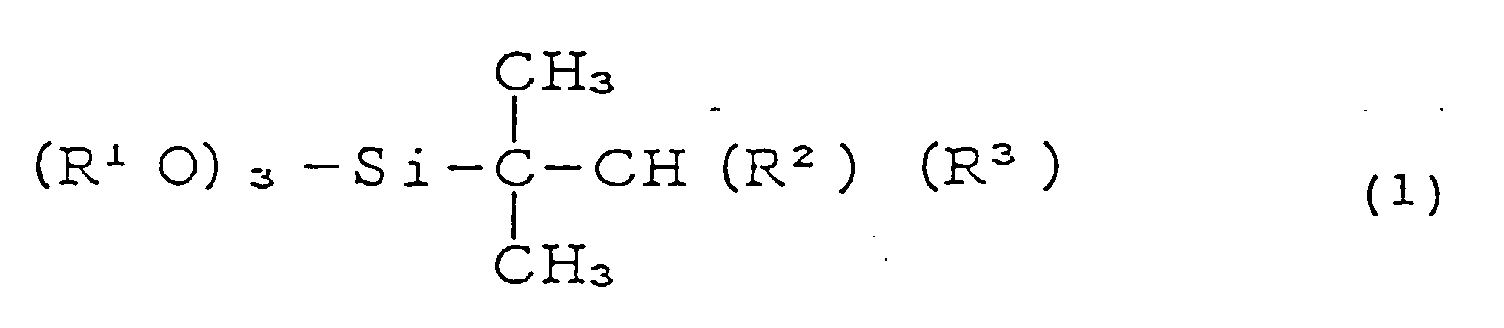
- Katalysator nach Anspruch 1, wobei R1, R2 und R3 jeweils für eine Alkylgruppe mit 1 bis 3 Kohlenstoffatom(en) stehen.
- Katalysator nach Anspruch 1, wobei die Komponente (C) aus der Gruppe: Thexyltrimethoxysilan, Thexyltriethoxysilan, Thexyltripropoxysilan, Thexyltriisopropoxysilan, 2,3-Dimethyl-2-trimethoxysilylpentan, 2,3-Dimethyl-2-triethoxysilylpentan, 2,3-Dimethyl-2-tripropoxysilylpentan, 2,3-Dimethyl-2-triisopropoxysilylpentan, 2-Methyl-3-ethyl-2-trimethoxysilylpentan, 2-Methyl-3-ethyl-2-triethoxysilylpentan, 2-Methyl-3-ethyl-2-tripropoxysilylpentan, 2-Methyl-3-ethyl-2-triisopropoxysilylpentan, 2,3,4-Trimethyl-2-trimethoxysilylpentan, 2,3,4-Trimethyl-2-triethoxysilylpentan, 2,3,4-Trimethyl-2-tripropoxysilylpentan, 2,3,4-Trimethyl-2-triisopropoxysilylpentan, 2,3-Dimethyl-2-trimethoxysilylhexan, 2,3-Dimethyl-2-triethoxysilylhexan, 2,3-Dimethyl-2-tripropoxysilylhexan, 2,3-Dimethyl-2-triisopropoxysilylhexan, 2,4-Dimethyl-3-ethyl-2-trimethoxysilylpentan, 2,4-Dimethyl-3-ethyl-2-triethoxysilylpentan, 2,4-Dimethyl-3-ethyl-2-tripropoxysilylpentan, 2,4-Dimethyl-3-ethyl-2-triisopropoxysilylpentan, 2,4-Dimethyl-3-isopropyl-2-trimethoxysilylpentan, 2,4-Dimethyl-3-isopropyl-2-triethoxysilylpentan, 2,4-Dimethyl-3-isopropyl-2-propoxysilylpentan und 2,4-Dimethyl-3-isopropyl-2-isopropoxysilylpentan ausgewählt ist.
- Katalysator nach Anspruch 3, wobei die Komponente (C) aus Thexyltrimethoxysilan besteht.
- Katalysator nach Anspruch 1, wobei die Komponente (A) ein Molverhältnis Mg/Ti von 0,1/1 bis 1000/1 und ein Molverhältnis Halogen/Ti von 1/1 bis 100/1 aufweist.
- Katalysator nach Anspruch 1, wobei die Komponente (B) aus einer organischen Aluminiumverbindung der Formeln (2), (3), (4) oder (5):
AlR4R5R6 (2)
R7R8Al-O-AlR9R10 (3)

 R4, R5 und R6, die gleich oder verschieden sein können, jeweils einen Wasserstoff, ein Halogenatom oder eine Alkylgruppe mit bis zu 12 Kohlenstoffatomen, wobei mindestens einer der Reste R4, R5 und R6 für eine Alkylgruppe steht;R7, R8, R9, R10, R11, R12, R13 und R14, die gleich oder verschieden sein können, jeweils eine Alkylgruppe mit bis zu 12 Kohlenstoffatomen undn eine ganze Zahl von 1 oder mehr,besteht.
- Katalysator nach Anspruch 1, wobei das Molverhältnis Komponente (C)/Komponente (B) im Bereich von 0,001/1 bis 5/1 liegt.
- Katalysator nach Anspruch 7, wobei das Molverhältnis Komponente (C)/Komponente (B) im Bereich von 0,01/1 bis 1/1 liegt.
- Verfahren zur Herstellung eines Polyolefins durch Polymerisieren eines Olefins in Gegenwart eines Katalysators, umfassend:(A) eine feste Katalysatorkomponente mit Titan, Magnesium und Halogen,(B) eine organische Aluminiumverbindung und(C) eine organische Siliciumverbindung der Formel (1):

- Verfahren nach Anspruch 9, wobei das Olefin 1 bis 12 Kohlenstoffatom(e) aufweist.
- Verfahren nach Anspruch 10, wobei das Olefin aus Propylen oder einem Gemisch aus Propylen mit Ethylen oder einem α-Olefin mit 4 oder mehr Kohlenstoffatomen besteht.
- Verfahren nach Anspruch 11, wobei das Olefin aus Propylen besteht.
- Verfahren nach Anspruch 9, wobei R1, R2 und R3 jeweils eine Alkylgruppe mit 1 bis 3 Kohlenstoffatom(en) darstellen.
- Verfahren nach Anspruch 9, wobei die Komponente (C) aus der Gruppe: Thexyltrimethoxysilan, Thexyltriethoxysilan, Thexyltripropoxysilan, Thexyltriisopropoxysilan, 2,3-Dimethyl-2-trimethoxysilylpentan, 2,3-Dimethyl-2-triethoxysilylpentan, 2,3-Dimethyl-2-tripropoxysilylpentan, 2,3-Dimethyl-2-triisopropoxysilylpentan, 2-Methyl-3-ethyl-2-trimethoxysilylpentan, 2-Methyl-3-ethyl-2-triethoxysilylpentan, 2-Methyl-3-ethyl-2-tripropoxysilylpentan, 2-Methyl-3-ethyl-2-triisopropoxysilylpentan, 2,3,4-Trimethyl-2-trimethoxysilylpentan, 2,3,4-Trimethyl-2-triethoxysilylpentan, 2,3,4-Trimethyl-2-tripropoxysilylpentan, 2,3,4-Trimethyl-2-triisopropoxysilylpentan, 2,3-Dimethyl-2-trimethoxysilylhexan, 2,3-Dimethyl-2-triethoxysilylhexan, 2,3-Dimethyl-2-tripropoxysilylhexan, 2,3-Dimethyl-2-triisopropoxysilylhexan, 2,4-Dimethyl-3-ethyl-2-trimethoxysilylpentan, 2,4-Dimethyl-3-ethyl-2-triethoxysilylpentan, 2,4-Dimethyl-3-ethyl-2-tripropoxysilylpentan, 2,4-Dimethyl-3-ethyl-2-triisopropoxysilylpentan, 2,4-Dimethyl-3-isopropyl-2-trimethoxysilylpentan, 2,4-Dimethyl-3-isopropyl-2-triethoxysilylpentan, 2,4-Dimethyl-3-isopropyl-2-propoxysilylpentan und 2,4-Dimethyl-3-isopropyl-2-isopropoxysilylpentan ausgewählt ist.
- Verfahren nach Anspruch 14, wobei die Komponente (C) aus Thexyltrimethoxysilan besteht.
- Verfahren nach Anspruch 9, wobei die Komponente (A) ein Molverhältnis Mg/Ti von 0,1/1 bis 1000/1 und ein Mol-verhältnis Halogen/Ti von 1/1 bis 100/1 aufweist.
- Verfahren nach Anspruch 9, wobei die Komponente (B) aus einer organischen Aluminiumverbindung der Formeln (2), (3), (4) oder (5):
AlR4R5R6 (2)
R7R8Al-O-AlR9R10 (3)

 R4, R5 und R6, die gleich oder verschieden sein können, jeweils einen Wasserstoff, ein Halogenatom oder eine Alkylgruppe mit bis zu 12 Kohlenstoffatomen, wobei mindestens einer der Reste R4, R5 und R6 für eine Alkylgruppe steht;R7, R8, R9, R10, R11, R12, R13 und R14, die gleich oder verschieden sein können, jeweils eine Alkylgruppe mit bis zu 12 Kohlenstoffatomen undn eine ganze Zahl von 1 oder mehr,besteht.
- Verfahren nach Anspruch 9, wobei das Molverhältnis Komponente (C)/Komponente (B) im Bereich von 0,001/1 bis 5/1 liegt.
Priority Applications (4)
| Application Number | Priority Date | Filing Date | Title |
|---|---|---|---|
| JP4094498A JP2879391B2 (ja) | 1992-04-14 | 1992-04-14 | オレフィン重合用触媒およびオレフィン重合体の製造法 |
| EP93113668A EP0640624B1 (de) | 1992-04-14 | 1993-08-26 | Katalysator für Olefinpolymerisation und Verfahren zur Herstellung eines Olefinpolymeres |
| DE1993611721 DE69311721T2 (de) | 1993-08-26 | 1993-08-26 | Katalysator für Olefinpolymerisation und Verfahren zur Herstellung eines Olefinpolymeres |
| US08/112,341 US5407883A (en) | 1992-04-14 | 1993-08-27 | Catalyst for polymerization of olefin and process for the preparation of olefin polymer |
Applications Claiming Priority (3)
| Application Number | Priority Date | Filing Date | Title |
|---|---|---|---|
| JP4094498A JP2879391B2 (ja) | 1992-04-14 | 1992-04-14 | オレフィン重合用触媒およびオレフィン重合体の製造法 |
| EP93113668A EP0640624B1 (de) | 1992-04-14 | 1993-08-26 | Katalysator für Olefinpolymerisation und Verfahren zur Herstellung eines Olefinpolymeres |
| US08/112,341 US5407883A (en) | 1992-04-14 | 1993-08-27 | Catalyst for polymerization of olefin and process for the preparation of olefin polymer |
Publications (2)
| Publication Number | Publication Date |
|---|---|
| EP0640624A1 EP0640624A1 (de) | 1995-03-01 |
| EP0640624B1 true EP0640624B1 (de) | 1997-06-18 |
Family
ID=27235201
Family Applications (1)
| Application Number | Title | Priority Date | Filing Date |
|---|---|---|---|
| EP93113668A Expired - Lifetime EP0640624B1 (de) | 1992-04-14 | 1993-08-26 | Katalysator für Olefinpolymerisation und Verfahren zur Herstellung eines Olefinpolymeres |
Country Status (3)
| Country | Link |
|---|---|
| US (1) | US5407883A (de) |
| EP (1) | EP0640624B1 (de) |
| JP (1) | JP2879391B2 (de) |
Cited By (1)
| Publication number | Priority date | Publication date | Assignee | Title |
|---|---|---|---|---|
| RU2318833C2 (ru) * | 2002-11-28 | 2008-03-10 | Базелль Полиолефин Италия С.П.А. | Сополимеры бутена-1 и способ их получения |
Families Citing this family (22)
| Publication number | Priority date | Publication date | Assignee | Title |
|---|---|---|---|---|
| EP0717053B1 (de) * | 1994-11-25 | 2001-03-14 | Japan Polyolefins Co., Ltd. | Katalysator zur Polymerisation von Olefinen und Verfahren zur Herstellung von Polyolefinen unter dessen Verwendung |
| US6063727A (en) * | 1996-12-19 | 2000-05-16 | Japan Polyolefins Co., Ltd. | Catalyst for olefin polymerization and method for preparing polyolefins |
| CZ34998A3 (cs) * | 1997-02-17 | 1999-08-11 | Pcd Polymere Gesellschaft M. B. H. | Způsob přípravy pevného nosiče pro katalyzátory polymerace olefinů |
| KR100334167B1 (ko) * | 1997-05-08 | 2002-11-22 | 삼성종합화학주식회사 | 알파-올레핀중합방법 |
| EP1507806B1 (de) * | 2002-05-29 | 2006-10-11 | Basell Poliolefine Italia S.r.l. | Buten-1-(co)polymere und verfahren zu ihrer herstellung |
| WO2009050045A2 (en) * | 2007-10-15 | 2009-04-23 | Basell Poliolefine Italia S.R.L. | Process for the preparation of high fluidity propylene polymers |
| US7790819B1 (en) | 2009-04-13 | 2010-09-07 | Formosa Plastics Corporation, U.S.A. | Bicyclic organosilicon compounds as electron donors for polyolefin catalysts |
| US7619049B1 (en) | 2009-04-13 | 2009-11-17 | Formosa Plastics Corporation, U.S.A. | Cyclic organosilicon compounds as electron donors for polyolefin catalysts |
| US10654947B2 (en) | 2011-10-28 | 2020-05-19 | Formosa Plastics Corporation, Usa | Cyclic organosilicon compounds as electron donors in Zeigler-Natta catalyst systems for producing propylene polymer having high melt-flowability |
| US8575283B1 (en) | 2012-06-28 | 2013-11-05 | Formosa Plastics Corporation, U.S.A. | Heterocyclic organic compounds as electron donors for polyolefin catalysts |
| US10227427B2 (en) * | 2014-01-17 | 2019-03-12 | Borealis Ag | Process for preparing propylene/1-butene copolymers |
| US9593184B2 (en) | 2014-10-28 | 2017-03-14 | Formosa Plastics Corporation, Usa | Oxalic acid diamides as modifiers for polyolefin catalysts |
| US9777084B2 (en) | 2016-02-19 | 2017-10-03 | Formosa Plastics Corporation, Usa | Catalyst system for olefin polymerization and method for producing olefin polymer |
| US11427660B2 (en) | 2016-08-17 | 2022-08-30 | Formosa Plastics Corporation, Usa | Organosilicon compounds as electron donors for olefin polymerization catalysts and methods of making and using same |
| US9815920B1 (en) | 2016-10-14 | 2017-11-14 | Formosa Plastics Corporation, Usa | Olefin polymerization catalyst components and process for the production of olefin polymers therewith |
| US10822438B2 (en) | 2017-05-09 | 2020-11-03 | Formosa Plastics Corporation | Catalyst system for enhanced stereo-specificity of olefin polymerization and method for producing olefin polymer |
| US10124324B1 (en) | 2017-05-09 | 2018-11-13 | Formosa Plastics Corporation, Usa | Olefin polymerization catalyst components and process for the production of olefin polymers therewith |
| CN116328825B (zh) * | 2023-02-22 | 2024-06-25 | 中国科学院青岛生物能源与过程研究所 | 一种催化剂,其制备方法以及采用其催化甲醇和乙酸甲酯制备3-甲氧基丙酸甲酯的方法 |
| US20250066513A1 (en) | 2023-08-23 | 2025-02-27 | Formosa Plastics Corporation, U.S.A. | Catalyst System For Enhanced Stereo-Specificity Of Olefin Polymerization |
| US20250109218A1 (en) | 2023-09-29 | 2025-04-03 | Formosa Plastics Corporation, U.S.A. | Method for preparing catalyst component for polymerization of polyolefin without the use of internal electron donors |
| US20250297039A1 (en) | 2024-03-19 | 2025-09-25 | Formosa Plastics Corporation, U.S.A. | Olefin polymerization catalyst components containing diglycidylester components and its use for the production of polypropylene having high isotacticity at high melt flow rate |
| WO2026063967A1 (en) | 2024-09-19 | 2026-03-26 | Formosa Plastics Corporation, Usa | Olefin polymerization ziegler-natta catalyst components and process for the production of olefin polymers therewith |
Family Cites Families (7)
| Publication number | Priority date | Publication date | Assignee | Title |
|---|---|---|---|---|
| JPS5975910A (ja) * | 1982-10-25 | 1984-04-28 | Mitsui Petrochem Ind Ltd | エチレン共重合体 |
| US4814314A (en) * | 1986-09-26 | 1989-03-21 | Mitsubishi Petrochemical Company Limited | Catalyst for olefin polymerization |
| US4990478A (en) * | 1989-09-21 | 1991-02-05 | Amoco Corporation | Silane-modified supported polyolefin catalyst to produce a broadened molecular weight distribution product |
| JP2874934B2 (ja) * | 1990-02-08 | 1999-03-24 | 三菱化学株式会社 | α‐オレフィン重合体の製造 |
| JPH0813826B2 (ja) * | 1990-11-29 | 1996-02-14 | 信越化学工業株式会社 | テキシルトリアルコキシシラン |
| US5136072A (en) * | 1990-11-30 | 1992-08-04 | Shin-Etsu Chemical Co., Ltd. | Thexyl C1 -C4 alkyl dialkoxy silane |
| DE69227870T2 (de) * | 1991-09-05 | 1999-05-12 | Tosoh Corp., Shinnanyo, Yamaguchi | Verfahren zur Darstellung eines stereospezifischen Polyolefins |
-
1992
- 1992-04-14 JP JP4094498A patent/JP2879391B2/ja not_active Expired - Lifetime
-
1993
- 1993-08-26 EP EP93113668A patent/EP0640624B1/de not_active Expired - Lifetime
- 1993-08-27 US US08/112,341 patent/US5407883A/en not_active Expired - Lifetime
Cited By (1)
| Publication number | Priority date | Publication date | Assignee | Title |
|---|---|---|---|---|
| RU2318833C2 (ru) * | 2002-11-28 | 2008-03-10 | Базелль Полиолефин Италия С.П.А. | Сополимеры бутена-1 и способ их получения |
Also Published As
| Publication number | Publication date |
|---|---|
| EP0640624A1 (de) | 1995-03-01 |
| JP2879391B2 (ja) | 1999-04-05 |
| US5407883A (en) | 1995-04-18 |
| JPH05287019A (ja) | 1993-11-02 |
Similar Documents
| Publication | Publication Date | Title |
|---|---|---|
| US5407883A (en) | Catalyst for polymerization of olefin and process for the preparation of olefin polymer | |
| EP0717053B1 (de) | Katalysator zur Polymerisation von Olefinen und Verfahren zur Herstellung von Polyolefinen unter dessen Verwendung | |
| US4829038A (en) | Alpha-olefin polymerization catalyst system including an advantageous modifier component | |
| US6770586B2 (en) | Solid catalyst component and catalyst for olefins polymerization | |
| US4218339A (en) | Catalyst components and catalysts for polymerizing olefins prepared from the catalysts | |
| US7009015B2 (en) | Alpha-olefin polymerization catalyst system which contains an aromatic silane compound | |
| US5244989A (en) | Method for producing a stereospecific polyolefin | |
| US6124507A (en) | Electron donors | |
| JP2557061B2 (ja) | 好適な調節剤成分を含有するアルファオレフィン重合触媒系 | |
| CA2255522C (en) | Novel electron donor containing compositions | |
| US5693729A (en) | Catalyst for polymerization of olefin and process for the preparation of olefin polymer | |
| EP0086288B1 (de) | Verfahren zur Herstellung von Polymeren von Olefinen | |
| US5354820A (en) | Process for the preparation of olefin polymer | |
| KR19990010007A (ko) | 에틸렌 중합용 촉매 | |
| EP0582278A2 (de) | Verfahren zur Herstellung eines Polyolefin | |
| EP0849291B1 (de) | Katalysator zur Polymerisation von Olefinen und Verfahren zur Herstellung von Olefinpolymeren | |
| JP3361579B2 (ja) | オレフィン重合用触媒およびオレフィン重合体の製造法 | |
| JP3284319B2 (ja) | オレフィン重合用触媒およびオレフィン重合体の製造法 | |
| JP3354729B2 (ja) | オレフィン重合用触媒およびオレフィン重合体の製造方法 | |
| JP3748968B2 (ja) | オレフィン重合用触媒及びポリオレフィンの製造方法 | |
| JP3147980B2 (ja) | オレフィン重合用触媒および当該触媒を用いたオレフィン重合体の製造方法 | |
| JP3340266B2 (ja) | プロピレン重合用触媒 | |
| JPH06271612A (ja) | オレフィン重合用触媒およびオレフィン重合体の製造方法 |
Legal Events
| Date | Code | Title | Description |
|---|---|---|---|
| PUAI | Public reference made under article 153(3) epc to a published international application that has entered the european phase |
Free format text: ORIGINAL CODE: 0009012 |
|
| AK | Designated contracting states |
Kind code of ref document: A1 Designated state(s): BE DE FR GB IT NL |
|
| 17P | Request for examination filed |
Effective date: 19950410 |
|
| 17Q | First examination report despatched |
Effective date: 19950718 |
|
| GRAG | Despatch of communication of intention to grant |
Free format text: ORIGINAL CODE: EPIDOS AGRA |
|
| GRAH | Despatch of communication of intention to grant a patent |
Free format text: ORIGINAL CODE: EPIDOS IGRA |
|
| GRAH | Despatch of communication of intention to grant a patent |
Free format text: ORIGINAL CODE: EPIDOS IGRA |
|
| GRAA | (expected) grant |
Free format text: ORIGINAL CODE: 0009210 |
|
| AK | Designated contracting states |
Kind code of ref document: B1 Designated state(s): BE DE FR GB IT NL |
|
| REF | Corresponds to: |
Ref document number: 69311721 Country of ref document: DE Date of ref document: 19970724 |
|
| ET | Fr: translation filed | ||
| PLBE | No opposition filed within time limit |
Free format text: ORIGINAL CODE: 0009261 |
|
| STAA | Information on the status of an ep patent application or granted ep patent |
Free format text: STATUS: NO OPPOSITION FILED WITHIN TIME LIMIT |
|
| 26N | No opposition filed | ||
| REG | Reference to a national code |
Ref country code: GB Ref legal event code: IF02 |
|
| REG | Reference to a national code |
Ref country code: GB Ref legal event code: 732E |
|
| NLS | Nl: assignments of ep-patents |
Owner name: SUNALLOMER LTD. |
|
| REG | Reference to a national code |
Ref country code: FR Ref legal event code: TP |
|
| PGFP | Annual fee paid to national office [announced via postgrant information from national office to epo] |
Ref country code: NL Payment date: 20080824 Year of fee payment: 16 |
|
| PGFP | Annual fee paid to national office [announced via postgrant information from national office to epo] |
Ref country code: IT Payment date: 20080828 Year of fee payment: 16 |
|
| PGFP | Annual fee paid to national office [announced via postgrant information from national office to epo] |
Ref country code: GB Payment date: 20080827 Year of fee payment: 16 |
|
| REG | Reference to a national code |
Ref country code: NL Ref legal event code: V1 Effective date: 20100301 |
|
| GBPC | Gb: european patent ceased through non-payment of renewal fee |
Effective date: 20090826 |
|
| PG25 | Lapsed in a contracting state [announced via postgrant information from national office to epo] |
Ref country code: NL Free format text: LAPSE BECAUSE OF NON-PAYMENT OF DUE FEES Effective date: 20100301 |
|
| PG25 | Lapsed in a contracting state [announced via postgrant information from national office to epo] |
Ref country code: GB Free format text: LAPSE BECAUSE OF NON-PAYMENT OF DUE FEES Effective date: 20090826 |
|
| PG25 | Lapsed in a contracting state [announced via postgrant information from national office to epo] |
Ref country code: IT Free format text: LAPSE BECAUSE OF NON-PAYMENT OF DUE FEES Effective date: 20090826 |
|
| PGFP | Annual fee paid to national office [announced via postgrant information from national office to epo] |
Ref country code: FR Payment date: 20110830 Year of fee payment: 19 Ref country code: DE Payment date: 20110830 Year of fee payment: 19 |
|
| PGFP | Annual fee paid to national office [announced via postgrant information from national office to epo] |
Ref country code: BE Payment date: 20110825 Year of fee payment: 19 |
|
| BERE | Be: lapsed |
Owner name: *SUNALLOMER LTD Effective date: 20120831 |
|
| REG | Reference to a national code |
Ref country code: FR Ref legal event code: ST Effective date: 20130430 |
|
| PG25 | Lapsed in a contracting state [announced via postgrant information from national office to epo] |
Ref country code: BE Free format text: LAPSE BECAUSE OF NON-PAYMENT OF DUE FEES Effective date: 20120831 |
|
| PG25 | Lapsed in a contracting state [announced via postgrant information from national office to epo] |
Ref country code: DE Free format text: LAPSE BECAUSE OF NON-PAYMENT OF DUE FEES Effective date: 20130301 |
|
| PG25 | Lapsed in a contracting state [announced via postgrant information from national office to epo] |
Ref country code: FR Free format text: LAPSE BECAUSE OF NON-PAYMENT OF DUE FEES Effective date: 20120831 |
|
| REG | Reference to a national code |
Ref country code: DE Ref legal event code: R119 Ref document number: 69311721 Country of ref document: DE Effective date: 20130301 |