EP0641832B1 - Compositions contenant un diorganopolysiloxane et un polymère aromatique rigide et méthode pour leur préparation - Google Patents
Compositions contenant un diorganopolysiloxane et un polymère aromatique rigide et méthode pour leur préparation Download PDFInfo
- Publication number
- EP0641832B1 EP0641832B1 EP94113203A EP94113203A EP0641832B1 EP 0641832 B1 EP0641832 B1 EP 0641832B1 EP 94113203 A EP94113203 A EP 94113203A EP 94113203 A EP94113203 A EP 94113203A EP 0641832 B1 EP0641832 B1 EP 0641832B1
- Authority
- EP
- European Patent Office
- Prior art keywords
- organopolysiloxane
- grafted
- groups
- aromatic
- polysiloxane
- Prior art date
- Legal status (The legal status is an assumption and is not a legal conclusion. Google has not performed a legal analysis and makes no representation as to the accuracy of the status listed.)
- Expired - Lifetime
Links
- 0 CC(C)(*)*NC(*(C(*)=O)(C(NC(C)(C)*)=N)IC(*)=O)=N Chemical compound CC(C)(*)*NC(*(C(*)=O)(C(NC(C)(C)*)=N)IC(*)=O)=N 0.000 description 4
Classifications
-
- C—CHEMISTRY; METALLURGY
- C08—ORGANIC MACROMOLECULAR COMPOUNDS; THEIR PREPARATION OR CHEMICAL WORKING-UP; COMPOSITIONS BASED THEREON
- C08L—COMPOSITIONS OF MACROMOLECULAR COMPOUNDS
- C08L79/00—Compositions of macromolecular compounds obtained by reactions forming in the main chain of the macromolecule a linkage containing nitrogen with or without oxygen or carbon only, not provided for in groups C08L61/00 - C08L77/00
- C08L79/04—Polycondensates having nitrogen-containing heterocyclic rings in the main chain; Polyhydrazides; Polyamide acids or similar polyimide precursors
- C08L79/08—Polyimides; Polyester-imides; Polyamide-imides; Polyamide acids or similar polyimide precursors
-
- C—CHEMISTRY; METALLURGY
- C08—ORGANIC MACROMOLECULAR COMPOUNDS; THEIR PREPARATION OR CHEMICAL WORKING-UP; COMPOSITIONS BASED THEREON
- C08L—COMPOSITIONS OF MACROMOLECULAR COMPOUNDS
- C08L79/00—Compositions of macromolecular compounds obtained by reactions forming in the main chain of the macromolecule a linkage containing nitrogen with or without oxygen or carbon only, not provided for in groups C08L61/00 - C08L77/00
- C08L79/04—Polycondensates having nitrogen-containing heterocyclic rings in the main chain; Polyhydrazides; Polyamide acids or similar polyimide precursors
-
- C—CHEMISTRY; METALLURGY
- C08—ORGANIC MACROMOLECULAR COMPOUNDS; THEIR PREPARATION OR CHEMICAL WORKING-UP; COMPOSITIONS BASED THEREON
- C08L—COMPOSITIONS OF MACROMOLECULAR COMPOUNDS
- C08L83/00—Compositions of macromolecular compounds obtained by reactions forming in the main chain of the macromolecule a linkage containing silicon with or without sulfur, nitrogen, oxygen or carbon only; Compositions of derivatives of such polymers
- C08L83/04—Polysiloxanes
-
- C—CHEMISTRY; METALLURGY
- C08—ORGANIC MACROMOLECULAR COMPOUNDS; THEIR PREPARATION OR CHEMICAL WORKING-UP; COMPOSITIONS BASED THEREON
- C08L—COMPOSITIONS OF MACROMOLECULAR COMPOUNDS
- C08L83/00—Compositions of macromolecular compounds obtained by reactions forming in the main chain of the macromolecule a linkage containing silicon with or without sulfur, nitrogen, oxygen or carbon only; Compositions of derivatives of such polymers
- C08L83/10—Block- or graft-copolymers containing polysiloxane sequences
-
- C—CHEMISTRY; METALLURGY
- C08—ORGANIC MACROMOLECULAR COMPOUNDS; THEIR PREPARATION OR CHEMICAL WORKING-UP; COMPOSITIONS BASED THEREON
- C08G—MACROMOLECULAR COMPOUNDS OBTAINED OTHERWISE THAN BY REACTIONS ONLY INVOLVING UNSATURATED CARBON-TO-CARBON BONDS
- C08G77/00—Macromolecular compounds obtained by reactions forming a linkage containing silicon with or without sulfur, nitrogen, oxygen or carbon in the main chain of the macromolecule
- C08G77/42—Block-or graft-polymers containing polysiloxane sequences
- C08G77/445—Block-or graft-polymers containing polysiloxane sequences containing polyester sequences
-
- C—CHEMISTRY; METALLURGY
- C08—ORGANIC MACROMOLECULAR COMPOUNDS; THEIR PREPARATION OR CHEMICAL WORKING-UP; COMPOSITIONS BASED THEREON
- C08G—MACROMOLECULAR COMPOUNDS OBTAINED OTHERWISE THAN BY REACTIONS ONLY INVOLVING UNSATURATED CARBON-TO-CARBON BONDS
- C08G77/00—Macromolecular compounds obtained by reactions forming a linkage containing silicon with or without sulfur, nitrogen, oxygen or carbon in the main chain of the macromolecule
- C08G77/42—Block-or graft-polymers containing polysiloxane sequences
- C08G77/452—Block-or graft-polymers containing polysiloxane sequences containing nitrogen-containing sequences
Definitions
- the present invention relates to novel diorganopolysiloxane compositions and cured products therefrom, wherein aromatic polyimide polymer or polybenzobisoxazole polymer is an essential component.
- the invention further relates to methods for the preparation of the compositions.
- Fiber-reinforced composites are one example of the conversion of polymer materials into composites with the goal of application as structural materials that must exhibit high stiffness and high strength.
- Molecular composites have been proposed for the purpose of realizing the concept of macroscopic fiber-reinforced composites on the molecular level (see, for example, Motowo Takayanagi, Kobunshi, volume 33, page 615 (1984), and Rikio Yokota, Kino Zairyo (Function and Materials), October issue, page 22 (1988)).
- Molecular composites consist of polymer with a rigid linear main chain that is molecularly dispersed in a flexible polymer matrix.
- the rigid linear polymer has a very large aspect ratio in the absence of aggregation, a reinforcing activity close to that of a fiber-reinforced composite can theoretically be obtained. Moreover, high-performance materials can be expected because, unlike fibers, there are also no defects at the level of the individual molecules.
- polydimethylsiloxanes have a low intermolecular cohesive energy
- the pure rubber has a low mechanical strength and is typically reinforced by filling with reinforcing silica (see Kunio Itoh (ed.), Shirikoon Handobukku [Silicone Handbook] , Nikkan Kogyo Shinbunsha (1990), etc.).
- An object of the present invention is to provide rigid linear polymers having compatibility with polysiloxanes and therefore to provide compositions that contain both types of polymers, as well as cured products therefrom.
- the aforesaid object is achieved by the disclosure of diorganopolysiloxane compositions comprising:
- the present invention also teaches a method for preparing the above compositions that contain polysiloxane and aromatic polyimide or polybenzobisoxazole (i.e., rigid linear polymers). A method is also provided for preparing the cured products of such compositions.
- the present invention thus makes possible the preparation of molecular composites comprising the dispersion of rigid linear aromatic polymer in diorganopolysiloxane.
- This provides a novel reinforcing method for both crosslinked and uncrosslinked silicone materials.
- Preferred organopolysiloxane-grafted aromatic polyimides suitable for use in the present invention comprise copolymers that are composed of units with formulas (I) and (II) wherein the unit (I)/unit (II) molar ratio is in the range of 100/0 to 1/99.
- a 1 denotes a tetravalent aromatic group
- a 2 denotes a divalent aromatic group on which there is bonded one or two organopolysiloxanes with formula (III) per unit with formula (I).
- R 1 denotes a divalent organic group having at least 2 carbon atoms
- R 2 through R 6 denote monovalent organic groups which may be the same or different
- n is an integer with a value of 1 or greater.
- a 3 comprises at least 1 selection from reactive side chain-free divalent aromatic groups and reactive side chain-substituted divalent aromatic groups, wherein the molar ratio of reactive side chain-free divalent aromatic groups to reactive side chain-substituted divalent aromatic groups is in the range of 100/0 to 0/100.
- the reactive side chain in A 3 preferably is an ethylenically unsaturated organic group.
- This aromatic polyimide must have a degree of polymerization (DP) based on units (I) and (II) of at least 5. A reinforcing activity is not exhibited in the corresponding molecular composites when the DP is 4 or less.
- the polyamic acid and derivatives thereof that are the precursor polymers for the subject polyimides comprise copolymers whose units can be expressed by formulas (IV) and (V) in which A 1 , A 2 , and A 3 are the same as described above, and R 7 denotes hydroxyl, alkoxy, dialkylamino, or trialkylsiloxy.
- the tetravalent aromatic group denoted by A 1 in the above formulas is exemplified by C 6 to C 30 tetravalent groups such as and combinations of these skeletons; however, the present invention is not limited to these examples.
- the divalent aromatic group moiety of A 2 (exclusive of the side chains) and the divalent aromatic group moiety of A 3 (exclusive of any reactive substituents) are exemplified by and by combinations of the preceding (groups having 6 to 60 carbon atoms are preferred). However, the present invention is not limited to these examples.
- the divalent organic group indicated by R 1 in formula ( III) is exemplified by alkylene, oxyalkylene, phenylenealkylene, and phenyleneoxyalkylene; however, oxyalkylene is preferred from the standpoint of ease of acquisition.
- R 2 through R 6 indicate monovalent organic groups, and examples include alkyl groups such as methyl, ethyl, propyl, and octyl; substituted alkyl groups such as 2-phenylethyl, 2-phenylpropyl, and 3,3,3-trifluoropropyl; aryl groups such as phenyl, etc.; and substituted aryl groups such as tolyl.
- methyl, n-butyl, sec-butyl, tert-butyl, and phenyl are desirable from the standpoint of ease of acquisition of starting material for the hydroorganopolysiloxane precursor with formula (VI) in which R 2 through R 6 have the same definitions as above and the subscript n is a positive integer, preferably 1 to 5,000.
- the reactive side chain-containing divalent aromatic groups encompassed by A 3 contain one or more groups -R 8 Q bonded as substituents on aromatic groups as described above for reactive side chain-free A 3 .
- R 0 denotes a divalent organic group and is exemplified by alkylene, oxyalkylene, phenylenealkylene, and phenyleneoxyalkylene; however, oxyalkylene is preferred from the standpoint of ease of acquisition.
- Q is exemplified by vinyl, acryloyl, methacryloyl, hydroxyl, amino, carboxyl, epoxy, SiH, SiOH, and alkoxysilyl. Vinyl, acryloyl, and methacryloyl, are preferred from the standpoint of ease of synthesis.
- polyamic acids and derivatives thereof with formulas (IV) and (V) can be prepared as follows.
- VIII tetracarboxylic dianhydride
- IX diamino compounds
- R 7 alkoxy, dialkylamino group, and so forth, the particular derivative is obtained by reacting the aromatic tetracarboxylic acid derivative with formula (X) where R 7 and A 1 are defined above, with aromatic diamino compounds with formulas (VIII) and (IX).
- the compounds with formula (VIII), which are polysiloxane chain-containing macromonomers, can be synthesized by first synthesizing a dinitro compound-containing organopolysiloxane by running a catalyzed hydrosilylation reaction between hydrogen-terminated organopolysiloxane (VI) and a compound comprising the di-nitro-substituted aromatic moiety of A 2 on which one or two organic groups having terminal ethylenic unsaturation are bonded as substituents. The synthesis is concluded by reduction of the nitro groups.
- the subject hydrosilylation reaction is run in the presence of catalyst and is preferably run in solvent.
- Suitable catalyst additions generally correspond to approximately 1/10 4 to 1/10 2 moles per 1 mole carbon-carbon double bond.
- Usable solvents are exemplified by aromatic hydrocarbon solvents such as benzene, toluene, and xylene; aliphatic hydrocarbon solvents such as hexane, and heptane; ether solvents such as diethyl ether, and tetrahydrofuran; alcohol solvents such as methanol, ethanol, and propanol; ketone solvents such as acetone, and methyl ethyl ketone; ester solvents such as ethyl acetate, and butyl acetate; halohydrocarbon solvents such as chloroform, trichloroethylene, and carbon tetrachloride; and dimethylformamide, and N,N-dimethylacetamide dimethyl sulfoxide.
- aromatic hydrocarbon solvents such as benzene, toluene, and xylene
- aliphatic hydrocarbon solvents such as hexane, and heptane
- the nitro groups in the aforementioned dinitro compound-containing organopolysiloxane can be reduced to amino groups by catalytic reduction with hydrogen using a catalyst such as platinum, Raney nickel, platinum/carbon, palladium/carbon, rhodium/alumina, and platinum sulfide/carbon sulfide.
- the reaction is preferably run in a solvent, and usable solvents listed above and by mixtures of said solvents.
- the reaction temperature is preferably in the range from room temperature to the reflux temperature of the solvent.
- the method of reduction is not limited to the method outlined above.
- the organopolysiloxane chain of the aromatic diamino compound-containing macromonomer (VIII) may also carry a reactive group or groups capable of bonding with the matrix diorganopolysiloxane.
- a reactive group or groups capable of bonding with the matrix diorganopolysiloxane instead of using the hydrogen-terminated organopolysiloxane (VI), organopolysiloxane that has the hydrosilyl group at one terminal and a reactive group at the other terminal can be prepared by known methods and the synthesis can then be run using this organopolysiloxane.
- the reactive group must not participate in the hydrosilylation or nitro group reduction reactions described above or in any reaction in the polyamic acid polymerization process.
- An example of such groups is alkoxysilyl.
- compounds bearing reactive groups on A 3 are not generally commercially available.
- compounds of this type can be synthesized by first protecting the amino groups on an aromatic diaminohydroxy compound, introducing olefin through an ether synthesis between the hydroxy group and a halogenated olefin according to the procedure described in the reference examples and then deprotecting the amino groups.
- the silylation of the aromatic diamino compounds with formulas (VIII) and (IX) is accomplished using a silylating agent.
- the silylating agent is exemplified by trialkylhalosilanes such as trimethylchlorosilane, triethylchlorosilane, triphenylchlorosilane, and methyldiethylbromosilane, and by nitrogenous silylating agents such as hexamethyldisilazane, N,N-diethylaminotrimethylsilane, N,O-bis(trimethylsilyl) carbamate, and N-trimethylsilylimidazole.
- a trialkylhalosilane is used, the addition of a base is then preferred in order to neutralize the hydrogen halide produced as by-product.
- a catalyst such as trimethylchlorosilane, or ammonium sulfate may be added when a nitrogenous silylating agent is used.
- the silylation reaction may be run in the absence of solvent or in the various solvents listed above excluding alcohols.
- the reaction temperature is 0°C to 200°C and preferably 20°C to 140°C.
- aromatic tetracarboxylic acid derivatives with formula (X) are obtained by reacting an aromatic tetracarboxylic dianhydride (VII) with an alkyl alcohol or dialkylamine, to give an aromatic tetracarboxylic acid derivative with formula (XI) wherein A 1 and R 7 have the same meaning as described above, and by then reacting (XI) with inorganic halide.
- the inorganic halide is exemplified by phosphoryl chloride, thionyl chloride, phosphorus pentachloride, phosphorus trichloride, and so forth.
- Thionyl chloride is preferred because it has a low boiling point and because the corresponding by-products are gases or low-boiling compounds, which facilitate product recovery.
- the reaction with inorganic halide preferably thionyl chloride
- Zinc chloride, pyridine, iodine, triethylamine, etc. can be used as catalyst, but the use of catalyst may be omitted.
- the reaction temperature is -50°C to 140°C and preferably -30°C to 120°C.
- the polyamic acids and derivatives thereof as described above are preferably synthesized in a dry inert gas atmosphere.
- the reaction may be run without a solvent, but is preferably carried out in a solvent.
- Usable solvents are exemplified by the various solvents listed above and by their mixtures.
- the reaction temperature is preferably -50°C to 100°C, and is even more preferably in the range of 0°C to 50°C.
- aromatic polyimides for the present invention are as follows:
- Preferred organopolysiloxane-grafted aromatic polybenzobisoxazole used in the present invention comprise units with formulas (XII) and (XIII) wherein the unit (XII)/unit (XIII) molar ratio is 100/0 to 1/99 and A 1 , A 2 and A 3 have their previously defined meanings.
- This aromatic polybenzobisoxazole must have a degree of polymerization based on units (XII) and (XIII) of at least 5. A reinforcing activity is not exhibited in the corresponding molecular composites when the DP is 4 or less.
- the polyhydroxyamide and derivatives thereof that are precursor polymers for the subject aromatic polybenzobisoxazoles comprise copolymers whose units are expressed by formulas (XIV) and (XV) in which A 1 , A 2 , and A 3 are the same as described above, and R 9 indicates H or a trialkylsilyl group.
- Polyhydroxyamides in which R 9 is H are obtained by hydrolyzing these silylated polyhydroxyamides.
- the compounds with formula (XVI), which are macromonomers that carry aromatic dicarboxylic acid halide, are prepared by first synthesizing the corresponding aromatic dicarboxylic acid-functionalized organopolysiloxane macromonomer by running a catalyzed hydrosilylation reaction between hydrogen-terminated organopolysiloxane (VI) and a compound prepared by protecting the carboxyl groups on a compound comprising the di-carboxyl-substituted aromatic group moiety of A 2 on which one or two organic groups having terminal ethylenic unsaturation,are bonded as substituents. This step concludes with deprotection of the carboxyl groups.
- the carboxyl groups are then silylated and the resulting compound is reacted with inorganic halide. If the carboxyl groups on the aromatic dicarboxylic acid carrying terminal ethylenically unsaturated organic groups (i. e., a starting compound) have been protected by silylation, the silyl dicarboxylate macromonomer produced by the hydrosilylation reaction with polysiloxane (VI) may be directly reacted with inorganic halide.
- terminal ethylenically unsaturated substituents on the above-mentioned aromatic dicarboxylic acid compounds are the same as those on the dinitro compounds used in the polyamic acid synthesis described above. These compounds are not generally commercially available, but they can be synthesized by, for example, the procedures described below in the reference examples.
- the protection step of the carboxyl group that sets up the hydrosilylation reaction is exemplified by esterification with methyl, ethyl, methoxymethyl, tert-butyl, benzyl, beta-p-toluenesulfonylethyl, trialkylsilyl, and so forth.
- Trialkylsilyl esterification is preferred for the corresponding ease of removal of the protective groups from the product.
- This silylation reaction is run in the same manner as described above.
- the hydrosilylation reaction is also the same as described above.
- the silylation of the carboxyl groups on the aromatic dicarboxylic acid-functionalized organopolysiloxane macromonomer and the reaction with inorganic halide are also the same as described above.
- the reaction between inorganic halide and carboxylic acid ordinarily produces acid, which induces main chain scission reactions in polysiloxanes.
- the reaction with inorganic halide is run after the carboxyl groups have been silylated, the by-products are trialkylhalosilanes, etc., and the acid halide can in this manner be synthesized without causing main chain scission reactions in the polysiloxane.
- the organopolysiloxane chain in the aromatic dicarboxylic acid halide-functionalized macromer (XVI) may also carry reactive groups capable of bonding with the matrix diorganopolysiloxane. Synthesis can be accomplished in the same manner as described above through the use of organopolysiloxane that has a hydrosilyl group at one terminal and a reactive group at the other terminal. Said reactive group must not participate in the above-mentioned hydrosilylation reaction or in any reaction in the reaction sequence involving the aforementioned inorganic halide. Examples of such groups include alkoxysilyl groups, etc.
- aromatic dicarboxylic acid halides with formula (XVII) aromatic dicarboxylic acid halides that carry reactive groups on A 3 are not generally commercially available. However, as shown in the reference examples below, such compounds can be obtained, for example, by reacting a terminal olefin-substituted aromatic dicarboxylic acid with inorganic halide as described above. In this case, of course, silylation of the carboxyl groups is unnecessary.
- silylated aromatic diaminodihydroxy compounds (XVIII) examples include
- the silylated polyhydroxyamide is obtained by reacting equimolar amounts of dicarboxylic acid halide (XVI) and (XVII) with compound (XVIII) in a dry inert atmosphere. This reaction may be run without a solvent, but is preferably run in a solvent. Usable solvents are exemplified by the various solvents mentioned above (excluding alcohols) and their mixtures.
- the reaction temperature is preferably -70°C to 100°C, and is even more preferably -40°C to 40°C.
- the silylated polyhydroxyamide can be hydrolyzed to give the polyhydroxyamide by pouring the reaction solution into an alcohol such as methanol, etc., or by stirring the solvent-free silylated polyhydroxyamide for several hours in an alcohol such as methanol.
- the diorganopolysiloxane of the present invention is expressed by the formula R a R' b SiO (4-a-b)/2 in which 1.9 ⁇ a + b ⁇ 2.2 and 0 ⁇ b ⁇ 0.2;
- R indicates a C 1 to C 5 alkyl group (optimally methyl), a substituted alkyl group (optimally 2-phenylethyl, 2-phenylpropyl, or 3,3,3-trifluoropropyl), an aryl group (optimally phenyl), or a substituted aryl group (optimally tolyl);
- R' indicates an ethylenically unsaturated organic group (optimally vinyl) or a reactive group (optimally silanol, alkoxysilyl, hydroxyl, or mercapto).
- the viscosity of this compound is 20 to 5,000,000 mm 2 /s (cS) at 25°C.
- the organopolysiloxane-grafted rigid linear aromatic polymer may be blended with the matrix organopolysiloxane by kneading or melt blending using a kneader.
- Solution blending may also be used which consists of removal of the solvent from a solution containing both components.
- a blend can first be prepared by the solution method between the organopolysiloxane-grafted precursor polymer and the matrix organopolysiloxane and the matrix-dispersed precursor polymer can thereafter be converted into the rigid linear polymer.
- the composition of the present invention is preferably obtained by preparing a homogeneous organic solvent solution of the diorganopolysiloxane plus precursor polymer as described above, removing the organic solvent, and then inducing thermal cyclization of the precursor polymer dispersed in the polysiloxane matrix.
- the organic solvent may be any solvent that is capable of dissolving both the organopolysiloxane-grafted precursor polymer and the diorganopolysiloxane. Examples of such organic solvents include tetrahydrofuran and mixtures of tetrahydrofuran with a polar solvent such as dimethylacetamide.
- the imidization of the polyamic acid and derivatives thereof is accomplished by heating to a temperature of 100°C to 400°C (preferably 150°C to 350°C).
- the thermally-induced cyclization of the polyhydroxamides and silylated polyhydroxyamides into polybenzobisoxazoles is accomplished by heating to a temperature of 100°C to 400°C (preferably 200°C to 350°C).
- the atmosphere may be ordinary air or an inert gas, and the pressure may be reduced if desired.
- the composition should contain 0.01 to 99 weight% organopolysiloxane-grafted aromatic polyimide or organopolysiloxane-grafted polybenzobisoxazole.
- organopolysiloxane side chains of the instant organopolysiloxane-grafted rigid linear aromatic polymers may contain functional groups capable of reacting with the diorganopolysiloxane matrix. That is, some of the groups R 2 through R 6 in formula (III) may be selected from groups such as vinyl, hydroxyl, alkoxysilyl and hydroxysilyl, inter alia. These reactive groups and/or those reactive groups present in above mentioned group A 3 allow the instant organopolysiloxane-grafted rigid linear aromatic polymers to be cured by methods well known in the art.
- Rubbery elastic material can be obtained from the organopolysiloxane-grafted rigid linear aromatic polymer and diorganopolysiloxane of the present invention through the use of curing agents.
- Usable curing methods include organoperoxide-mediated crosslinking, condensation reaction-based crosslinking, addition reaction-based crosslinking, etc.
- the selection of desirable combinations of curing agent and/or curing catalyst and functional groups on the diorganopolysiloxane base polymer as a function of the curing mechanism is well known in the art (see Kunio Itoh (ed.), Shirik oon Handobukku (Silicone Handbook) , Nikkan Kogyo Shinbunsha (1990), etc.).
- the diorganopolysiloxane matrix may contain any other known reinforcing agent.
- Cured diorganopolysiloxane products containing organopolysiloxane-grafted aromatic polyimide or organopolysiloxane-grafted polybenzobisoxazole are obtained by preparing a homogeneous organic solvent solution of the precursor polymer and diorganopolysiloxane in the same manner as described above, curing the matrix diorganopolysiloxane, either after removal of the organic solvent or in parallel with removal of the organic solvent, and then inducing cyclization of the precursor polymer by heating in the same manner as described above.
- subject cured products should contain 0.01 to 99 weight% organopolysiloxane-grafted aromatic polyimide or organopolysiloxane-grafted polybenzobisoxazole.
- a crosslinked diorganopolysiloxane molecular composite in which the aromatic polyimide or polybenzobisoxazole is dispersed at the molecular level, can still be obtained by conducting the cure in the solution and removing the solvent as curing proceeds.
- the polyamic acid film produced in Reference Example 6 was heated for 20 minutes at 60°C, 20 minutes at 100°C, and 2 hours at 200°C to give a polysiloxane-grafted polyimide film.
- a glass plate was coated with the polyamic acid solution thus produced, and the solvent was removed at 30°C under reduced pressure to give a polyamic acid copolymer film having two types of side chains with different lengths (ratio of the two types of units: 1 : 1).
- Polysiloxane-grafted polyamic acid synthesized according to Reference Example 6 or 8 and polydimethylsiloxane with an average degree of polymerization of 140 or 600 were dissolved in tetrahydrofuran, and the clear solution thus obtained was coated on a glass plate. The solvent was then removed at 30°C under reduced pressure to give a blend of the polysiloxane-grafted polyamic acid and polydimethylsiloxane. The blend was heated in an argon atmosphere for 20 minutes at 60°C, 20 minutes at 100°C and 2 hours at 200°C to give a blend of polysiloxane-grafted polyimide and polydimethylsiloxane. The production of the polyimide was confirmed from the IR spectrum. The characteristic polyimide absorptions at 1780, 1730, 1380, and 725 cm -1 were observed, and the absorptions attributable to the amic acid had disappeared. The results are reported in Table 1.
- A denotes polydimethylsiloxane with an average degree of polymerisation of 140
- B denotes polydimethylsiloxane with an average degree of polymerization of 600.
- An average value for n of 14.4/46.2 indicates the use of polyamic acid carrying side chains with respective degrees of polymerization of 14.4 and 46.2 at a ratio of 1 : 1.
- polysiloxane-grafted silylated polyhydroxyamide synthesized in Reference Example 13 and polydimethylsiloxane with an average degree of polymerization of 600 were dissolved in tetrahydrofuran, and a glass plate was coated with the clear solution thus obtained.
- the solvent was then removed at 30°C under reduced pressure to give a blend of the polysiloxane-grafted silylated polyhydroxyamide and the polydimethylsiloxane.
- This blend was subsequently heated for 19 hours at 300°C in an argon atmosphere to give a blend of polysiloxane-grafted polybenzobisoxazole and polydimethylsiloxane.
- a reaction solution as produced in Reference Example 13 was poured into a large quantity of methanol, and the precipitated polysiloxane-grafted polyhydroxyamide was recovered by filtration and drying.
- Blend 2 of polysiloxane-grafted polybenzobisoxazole with polysiloxane
- a blend (content of polybenzobisoxazole main chain: 4.0 weight%) of polysiloxane-grafted polybenzobisoxazole and polydimethylsiloxane was prepared by the procedure of Example 15 through 17 using the polysiloxane-grafted polyhydroxyamide obtained in Reference Example 14 and polydimethylsiloxane with an average degree of polymerization of 600. The compatibility of this blend was good.
- This film was heated for 19 hours at 300°C in an argon atmosphere, thus producing a film of a silicone rubber molecular composite that contained 0.3 weight% polybenzobisoxazole main chain.
- the tensile strength was 2.3 kg/cm 2 and the elongation at break was 320%.
- a terephthaloyl chloride-terminated polysiloxane with an average value for n of 6.9 was synthesized by the procedure of Reference Example 11.
- a silylated polyhydroxyamide was synthesized by the procedure of Reference Example 17.
- This silylated polyhydroxyamide had a polysiloxane-grafted monomer unit/3-butenyloxy-substituted monomer unit molar ratio of 9 : 1, and the average value of n for its side chains was 6.9.
- the procedure of Example 19 was used to prepare a film of a silicone rubber molecular composite that contained 0.3 weight% polybenzobisoxazole main chain. When this film was subjected to tensile testing, the tensile strength was 5.7 kg/cm 2 and the elongation at break was 450%.
- An unfilled silicone rubber was produced by the procedure of Example 19 using the same vinyl-endblocked polydimethylsiloxane, platinum-divinyltetramethyldisiloxane complex, 2-methyl-3-butyn-2-ol, and crosslinker as in Example 19.
- the rubber film produced by heating this unfilled silicone rubber for 19 hours at 300°C in the same manner as in Example 19 was also subjected to tensile testing: the tensile strength was 1.5 kg/cm 2 and the elongation at break was 320%.
Landscapes
- Chemical & Material Sciences (AREA)
- Health & Medical Sciences (AREA)
- Chemical Kinetics & Catalysis (AREA)
- Medicinal Chemistry (AREA)
- Polymers & Plastics (AREA)
- Organic Chemistry (AREA)
- Silicon Polymers (AREA)
- Macromolecular Compounds Obtained By Forming Nitrogen-Containing Linkages In General (AREA)
- Compositions Of Macromolecular Compounds (AREA)
Claims (6)
- Une composition comprenant :(i) 1 à 99,99 pour cent en poids d'un diorganopolysiloxane ; et(ii) 0,01 à 99 pour cent en poids d'un polymère aromatique linéaire rigide greffé par un organopolysiloxane, choisi parmi un polyimide greffé par un organopolysiloxane et un polybenzobisoxazole greffé par un organopolysiloxane.
- La composition selon la revendication 1, dans laquelle ledit polymère aromatique linéaire rigide greffé par un organopolysiloxane est un polyimide ayant les motifs récurrents représentés par les formules I et II
 dans lesquelles A1 représente un groupe aromatique tétravalent, A2 représente un groupe aromatique divalent auquel sont fixés un ou deux groupes organopolysiloxanes ayant la formule (III)
 dans laquelle R1 représente un groupe organique divalent ayant au moins 2 atomes de carbone, R2 à R6 représentent indépendamment des groupes organiques monovalents et n est un nombre entier ayant une valeur d'au moins 1, et A3 comprend au moins un groupe choisi parmi les groupes aromatiques divalents exempts de chaíne latérale réactive et les groupes aromatiques divalents substitués par une chaíne latérale réactive, avec la condition que le rapport molaire des groupes aromatiques divalents exempts de chaíne latérale réactive aux groupes aromatiques divalents substitués par une chaíne latérale réactive soit compris dans l'intervalle de 100/0 à 0/100 et avec la condition supplémentaire que le rapport molaire du motif récurrent représenté dans la formule (I) au motif récurrent représenté dans la formule (II) soit compris dans l'intervalle de 100:0 à 1:99.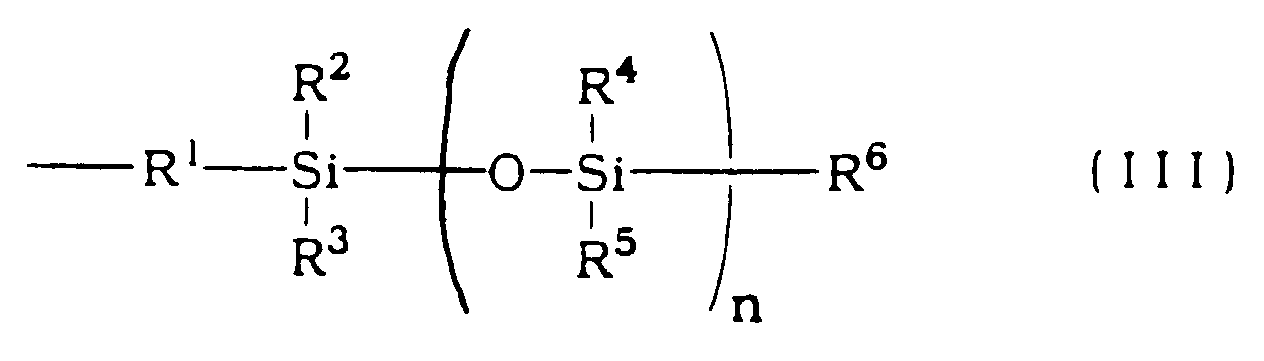
- La composition selon la revendication 1, dans laquelle ledit polymère aromatique linéaire rigide greffé par un organopolysiloxane est un polybenzobisoxazole greffé par un organopolysiloxane comprenant des motifs récurrents ayant les formules (XII) et (XIII), le rapport molaire motif récurrent (XII)/motif récurrent (XIII) étant compris dans l'intervalle de 100/0 à 1/99,
 dans lesquelles A1, A2 et A3 sont tels que définis dans la revendication 2.
- La composition selon les revendications 2 ou 3, dans laquelle R2 à R5 de la formule (III) sont des groupes méthyle.
- La composition selon la revendication 4, dans laquelle la chaíne latérale réactive dans A3 est un groupe organique éthyléniquement insaturé.
- Un procédé pour la préparation de la composition de la revendication 1, consistant à :(i) préparer une solution homogène, dans un solvant organique, dudit diorganopolysiloxane et d'un polymère, soluble dans le solvant, précurseur dudit polyimide aromatique greffé par un organopolysiloxane ou d'un polymère, soLuble dans le solvant, précurseur dudit polybenzobisoxazole greffé par un organopolysiloxane ; et(ii) cycliser thermiquement le polymère précurseur après élimination du solvant organique.
Applications Claiming Priority (4)
| Application Number | Priority Date | Filing Date | Title |
|---|---|---|---|
| JP210525/93 | 1993-08-25 | ||
| JP21052593A JPH0762236A (ja) | 1993-08-25 | 1993-08-25 | ジオルガノポリシロキサン組成物及び硬化物の製造方法 |
| JP21024893A JPH0762235A (ja) | 1993-08-25 | 1993-08-25 | ジオルガノポリシロキサン組成物および硬化物 |
| JP210248/93 | 1993-08-25 |
Publications (2)
| Publication Number | Publication Date |
|---|---|
| EP0641832A1 EP0641832A1 (fr) | 1995-03-08 |
| EP0641832B1 true EP0641832B1 (fr) | 1999-01-13 |
Family
ID=26517934
Family Applications (1)
| Application Number | Title | Priority Date | Filing Date |
|---|---|---|---|
| EP94113203A Expired - Lifetime EP0641832B1 (fr) | 1993-08-25 | 1994-08-24 | Compositions contenant un diorganopolysiloxane et un polymère aromatique rigide et méthode pour leur préparation |
Country Status (3)
| Country | Link |
|---|---|
| US (1) | US5527862A (fr) |
| EP (1) | EP0641832B1 (fr) |
| DE (1) | DE69415899T2 (fr) |
Families Citing this family (4)
| Publication number | Priority date | Publication date | Assignee | Title |
|---|---|---|---|---|
| JP5370676B2 (ja) * | 2007-08-22 | 2013-12-18 | デクセリアルズ株式会社 | 新規なアミド基含有シロキサンアミン化合物 |
| US8729178B2 (en) * | 2011-11-01 | 2014-05-20 | Chi Mei Corporation | Polysiloxane-grafted polyimide resin composition and applications thereof |
| CN103173011B (zh) * | 2011-12-23 | 2015-02-18 | 奇美实业股份有限公司 | 含聚硅氧烷的聚酰亚胺系树脂组成物及由其所形成的软性基板 |
| WO2013105814A2 (fr) * | 2012-01-13 | 2013-07-18 | 주식회사 엘지화학 | Matériau isolant pour dispositif électronique |
Family Cites Families (13)
| Publication number | Priority date | Publication date | Assignee | Title |
|---|---|---|---|---|
| NL130570C (fr) * | 1963-12-12 | |||
| US3553282A (en) * | 1969-09-08 | 1971-01-05 | Gen Electric | Siloxane containing polyamide acid blends |
| EP0067693B1 (fr) * | 1981-06-16 | 1986-09-10 | Dsm Rim Nylon V.O.F | Matières contenant des halogénures d'acide et des acyllactames fonctionnels |
| US4618534A (en) * | 1984-10-23 | 1986-10-21 | Nitto Electric Industrial Co., Ltd. | Composite membrane and process for producing the same |
| US4558110A (en) * | 1985-02-01 | 1985-12-10 | General Electric Company | Crystalline silicone-imide copolymers |
| JPS61207438A (ja) * | 1985-03-11 | 1986-09-13 | Chisso Corp | 可溶性ポリイミドシロキサン前駆体及びその製造方法 |
| US4604477A (en) * | 1985-03-29 | 1986-08-05 | General Electric Company | Method for making silylaroylhalides and reaction products |
| US4801659A (en) * | 1986-10-27 | 1989-01-31 | Hoechst Celanese Corp. | Organopolysiloxanes exhibiting nonlinear optical response |
| US5028681A (en) * | 1986-12-31 | 1991-07-02 | Peters Edward N | Novel poly(imide-siloxane) block copolymers and process for their preparation |
| JP2525026B2 (ja) * | 1988-02-10 | 1996-08-14 | 財団法人相模中央化学研究所 | シロキサン含有ポリイミドおよびシロキサン含有ポリアミド酸 |
| JP2609140B2 (ja) * | 1988-11-21 | 1997-05-14 | チッソ株式会社 | 低弾性率ポリイミドおよびその製造法 |
| JP2722915B2 (ja) * | 1992-01-17 | 1998-03-09 | 信越化学工業株式会社 | 硬化性樹脂及びその製造方法並びに電子部品用保護膜 |
| JP2983744B2 (ja) * | 1992-02-18 | 1999-11-29 | 株式会社メニコン | 眼用レンズ材料 |
-
1994
- 1994-08-24 US US08/295,447 patent/US5527862A/en not_active Expired - Fee Related
- 1994-08-24 EP EP94113203A patent/EP0641832B1/fr not_active Expired - Lifetime
- 1994-08-24 DE DE69415899T patent/DE69415899T2/de not_active Expired - Fee Related
Also Published As
| Publication number | Publication date |
|---|---|
| US5527862A (en) | 1996-06-18 |
| EP0641832A1 (fr) | 1995-03-08 |
| DE69415899D1 (de) | 1999-02-25 |
| DE69415899T2 (de) | 1999-06-24 |
Similar Documents
| Publication | Publication Date | Title |
|---|---|---|
| EP0628590B1 (fr) | Polyimide à chaíne latérale d'organopolysiloxane | |
| JP3279635B2 (ja) | ヒドロシリル基含有イミド化合物 | |
| EP0112845B1 (fr) | Procede de production d'anhydrides de silylnorbornane | |
| JPH05320515A (ja) | 硬化性組成物 | |
| CN1796441A (zh) | 一种梯形聚有机倍半硅氧烷及其制备方法 | |
| FR2563523A1 (fr) | Compositions de siloxane-imide-diols et procede de fabrication | |
| GB2152069A (en) | Ionically cross-linked siloxane polymers | |
| US4826954A (en) | Diorganopolysiloxane-azobenzene alternating copolymers and methods for their preparation | |
| US5527862A (en) | Diorganopolysiloxane-rigid aromatic polymer compositions and preparation thereof | |
| JPH03207718A (ja) | シラシクロブタン官能性ポリジオルガノシロキサン共重合体、その製造方法、及びそれを含んでなる組成物 | |
| JP3110127B2 (ja) | 分岐ポリシロキサンの製造方法 | |
| JP3226377B2 (ja) | オルガノポリシロキサン側鎖を有するポリイミドの製造方法 | |
| JPH0762236A (ja) | ジオルガノポリシロキサン組成物及び硬化物の製造方法 | |
| JP3359359B2 (ja) | 硬化性組成物 | |
| JP3017845B2 (ja) | 反応性ケイ素基含有イミド化合物の製法 | |
| EP0641831B1 (fr) | Polybenzobisoxazoles greffées par organopolysiloxane et méthode pour préparation | |
| JPH0762235A (ja) | ジオルガノポリシロキサン組成物および硬化物 | |
| JP3226376B2 (ja) | オルガノポリシロキサン側鎖を有するポリイミド | |
| JP3130568B2 (ja) | イミド化合物を含む硬化性組成物 | |
| JPH05320516A (ja) | 硬化性組成物 | |
| JPH0689099B2 (ja) | ポリシロキサン−ポリ尿素系ブロック共重合体およびその製造方法 | |
| Sakakibara et al. | Rigid‐rod polymers with polysiloxane side chains. 2. Synthesis and characterization of aromatic polybenzobisoxazoles with polysiloxane side chains and composite formation with polysiloxane matrices | |
| JPS63130631A (ja) | シリコーンを含むポリアミド組成物 | |
| JP3398425B2 (ja) | オルガノポリシロキサン側鎖を有するポリベンゾビスオキサゾールおよびその製造方法 | |
| JP4460174B2 (ja) | 硬化性樹脂組成物 |
Legal Events
| Date | Code | Title | Description |
|---|---|---|---|
| PUAI | Public reference made under article 153(3) epc to a published international application that has entered the european phase |
Free format text: ORIGINAL CODE: 0009012 |
|
| AK | Designated contracting states |
Kind code of ref document: A1 Designated state(s): DE FR GB |
|
| 17P | Request for examination filed |
Effective date: 19950509 |
|
| 17Q | First examination report despatched |
Effective date: 19970207 |
|
| GRAG | Despatch of communication of intention to grant |
Free format text: ORIGINAL CODE: EPIDOS AGRA |
|
| GRAG | Despatch of communication of intention to grant |
Free format text: ORIGINAL CODE: EPIDOS AGRA |
|
| RAP1 | Party data changed (applicant data changed or rights of an application transferred) |
Owner name: DOW CORNING ASIA, LTD. |
|
| GRAG | Despatch of communication of intention to grant |
Free format text: ORIGINAL CODE: EPIDOS AGRA |
|
| GRAH | Despatch of communication of intention to grant a patent |
Free format text: ORIGINAL CODE: EPIDOS IGRA |
|
| GRAH | Despatch of communication of intention to grant a patent |
Free format text: ORIGINAL CODE: EPIDOS IGRA |
|
| GRAA | (expected) grant |
Free format text: ORIGINAL CODE: 0009210 |
|
| AK | Designated contracting states |
Kind code of ref document: B1 Designated state(s): DE FR GB |
|
| REF | Corresponds to: |
Ref document number: 69415899 Country of ref document: DE Date of ref document: 19990225 |
|
| ET | Fr: translation filed | ||
| PLBE | No opposition filed within time limit |
Free format text: ORIGINAL CODE: 0009261 |
|
| STAA | Information on the status of an ep patent application or granted ep patent |
Free format text: STATUS: NO OPPOSITION FILED WITHIN TIME LIMIT |
|
| 26N | No opposition filed | ||
| PGFP | Annual fee paid to national office [announced via postgrant information from national office to epo] |
Ref country code: DE Payment date: 20010709 Year of fee payment: 8 |
|
| PGFP | Annual fee paid to national office [announced via postgrant information from national office to epo] |
Ref country code: GB Payment date: 20010712 Year of fee payment: 8 |
|
| PGFP | Annual fee paid to national office [announced via postgrant information from national office to epo] |
Ref country code: FR Payment date: 20010713 Year of fee payment: 8 |
|
| REG | Reference to a national code |
Ref country code: GB Ref legal event code: IF02 |
|
| PG25 | Lapsed in a contracting state [announced via postgrant information from national office to epo] |
Ref country code: GB Free format text: LAPSE BECAUSE OF NON-PAYMENT OF DUE FEES Effective date: 20020824 |
|
| PG25 | Lapsed in a contracting state [announced via postgrant information from national office to epo] |
Ref country code: DE Free format text: LAPSE BECAUSE OF NON-PAYMENT OF DUE FEES Effective date: 20030301 |
|
| GBPC | Gb: european patent ceased through non-payment of renewal fee |
Effective date: 20020824 |
|
| PG25 | Lapsed in a contracting state [announced via postgrant information from national office to epo] |
Ref country code: FR Free format text: LAPSE BECAUSE OF NON-PAYMENT OF DUE FEES Effective date: 20030430 |
|
| REG | Reference to a national code |
Ref country code: FR Ref legal event code: ST |