EP0642858A2 - Procédé et appareil pour la préparation de particules composites ultrafines - Google Patents
Procédé et appareil pour la préparation de particules composites ultrafines Download PDFInfo
- Publication number
- EP0642858A2 EP0642858A2 EP94114150A EP94114150A EP0642858A2 EP 0642858 A2 EP0642858 A2 EP 0642858A2 EP 94114150 A EP94114150 A EP 94114150A EP 94114150 A EP94114150 A EP 94114150A EP 0642858 A2 EP0642858 A2 EP 0642858A2
- Authority
- EP
- European Patent Office
- Prior art keywords
- ultrafine particles
- chamber
- deposition
- particles
- generation
- Prior art date
- Legal status (The legal status is an assumption and is not a legal conclusion. Google has not performed a legal analysis and makes no representation as to the accuracy of the status listed.)
- Withdrawn
Links
Images


Classifications
-
- C—CHEMISTRY; METALLURGY
- C23—COATING METALLIC MATERIAL; COATING MATERIAL WITH METALLIC MATERIAL; CHEMICAL SURFACE TREATMENT; DIFFUSION TREATMENT OF METALLIC MATERIAL; COATING BY VACUUM EVAPORATION, BY SPUTTERING, BY ION IMPLANTATION OR BY CHEMICAL VAPOUR DEPOSITION, IN GENERAL; INHIBITING CORROSION OF METALLIC MATERIAL OR INCRUSTATION IN GENERAL
- C23C—COATING METALLIC MATERIAL; COATING MATERIAL WITH METALLIC MATERIAL; SURFACE TREATMENT OF METALLIC MATERIAL BY DIFFUSION INTO THE SURFACE, BY CHEMICAL CONVERSION OR SUBSTITUTION; COATING BY VACUUM EVAPORATION, BY SPUTTERING, BY ION IMPLANTATION OR BY CHEMICAL VAPOUR DEPOSITION, IN GENERAL
- C23C14/00—Coating by vacuum evaporation, by sputtering or by ion implantation of the coating forming material
- C23C14/22—Coating by vacuum evaporation, by sputtering or by ion implantation of the coating forming material characterised by the process of coating
- C23C14/223—Coating by vacuum evaporation, by sputtering or by ion implantation of the coating forming material characterised by the process of coating specially adapted for coating particles
-
- B—PERFORMING OPERATIONS; TRANSPORTING
- B01—PHYSICAL OR CHEMICAL PROCESSES OR APPARATUS IN GENERAL
- B01J—CHEMICAL OR PHYSICAL PROCESSES, e.g. CATALYSIS OR COLLOID CHEMISTRY; THEIR RELEVANT APPARATUS
- B01J23/00—Catalysts comprising metals or metal oxides or hydroxides, not provided for in group B01J21/00
- B01J23/38—Catalysts comprising metals or metal oxides or hydroxides, not provided for in group B01J21/00 of noble metals
- B01J23/40—Catalysts comprising metals or metal oxides or hydroxides, not provided for in group B01J21/00 of noble metals of the platinum group metals
- B01J23/42—Platinum
-
- B—PERFORMING OPERATIONS; TRANSPORTING
- B01—PHYSICAL OR CHEMICAL PROCESSES OR APPARATUS IN GENERAL
- B01J—CHEMICAL OR PHYSICAL PROCESSES, e.g. CATALYSIS OR COLLOID CHEMISTRY; THEIR RELEVANT APPARATUS
- B01J23/00—Catalysts comprising metals or metal oxides or hydroxides, not provided for in group B01J21/00
- B01J23/38—Catalysts comprising metals or metal oxides or hydroxides, not provided for in group B01J21/00 of noble metals
- B01J23/40—Catalysts comprising metals or metal oxides or hydroxides, not provided for in group B01J21/00 of noble metals of the platinum group metals
- B01J23/44—Palladium
-
- B—PERFORMING OPERATIONS; TRANSPORTING
- B01—PHYSICAL OR CHEMICAL PROCESSES OR APPARATUS IN GENERAL
- B01J—CHEMICAL OR PHYSICAL PROCESSES, e.g. CATALYSIS OR COLLOID CHEMISTRY; THEIR RELEVANT APPARATUS
- B01J35/00—Catalysts, in general, characterised by their form or physical properties
- B01J35/40—Catalysts, in general, characterised by their form or physical properties characterised by dimensions, e.g. grain size
- B01J35/45—Nanoparticles
-
- B—PERFORMING OPERATIONS; TRANSPORTING
- B22—CASTING; POWDER METALLURGY
- B22F—WORKING METALLIC POWDER; MANUFACTURE OF ARTICLES FROM METALLIC POWDER; MAKING METALLIC POWDER; APPARATUS OR DEVICES SPECIALLY ADAPTED FOR METALLIC POWDER
- B22F1/00—Metallic powder; Treatment of metallic powder, e.g. to facilitate working or to improve properties
- B22F1/16—Metallic particles coated with a non-metal
-
- B—PERFORMING OPERATIONS; TRANSPORTING
- B22—CASTING; POWDER METALLURGY
- B22F—WORKING METALLIC POWDER; MANUFACTURE OF ARTICLES FROM METALLIC POWDER; MAKING METALLIC POWDER; APPARATUS OR DEVICES SPECIALLY ADAPTED FOR METALLIC POWDER
- B22F1/00—Metallic powder; Treatment of metallic powder, e.g. to facilitate working or to improve properties
- B22F1/18—Non-metallic particles coated with metal
-
- B—PERFORMING OPERATIONS; TRANSPORTING
- B22—CASTING; POWDER METALLURGY
- B22F—WORKING METALLIC POWDER; MANUFACTURE OF ARTICLES FROM METALLIC POWDER; MAKING METALLIC POWDER; APPARATUS OR DEVICES SPECIALLY ADAPTED FOR METALLIC POWDER
- B22F9/00—Making metallic powder or suspensions thereof
- B22F9/02—Making metallic powder or suspensions thereof using physical processes
- B22F9/12—Making metallic powder or suspensions thereof using physical processes starting from gaseous material
-
- C—CHEMISTRY; METALLURGY
- C04—CEMENTS; CONCRETE; ARTIFICIAL STONE; CERAMICS; REFRACTORIES
- C04B—LIME, MAGNESIA; SLAG; CEMENTS; COMPOSITIONS THEREOF, e.g. MORTARS, CONCRETE OR LIKE BUILDING MATERIALS; ARTIFICIAL STONE; CERAMICS; REFRACTORIES; TREATMENT OF NATURAL STONE
- C04B35/00—Shaped ceramic products characterised by their composition; Ceramics compositions; Processing powders of inorganic compounds preparatory to the manufacturing of ceramic products
- C04B35/01—Shaped ceramic products characterised by their composition; Ceramics compositions; Processing powders of inorganic compounds preparatory to the manufacturing of ceramic products based on oxide ceramics
- C04B35/10—Shaped ceramic products characterised by their composition; Ceramics compositions; Processing powders of inorganic compounds preparatory to the manufacturing of ceramic products based on oxide ceramics based on aluminium oxide
- C04B35/111—Fine ceramics
-
- C—CHEMISTRY; METALLURGY
- C04—CEMENTS; CONCRETE; ARTIFICIAL STONE; CERAMICS; REFRACTORIES
- C04B—LIME, MAGNESIA; SLAG; CEMENTS; COMPOSITIONS THEREOF, e.g. MORTARS, CONCRETE OR LIKE BUILDING MATERIALS; ARTIFICIAL STONE; CERAMICS; REFRACTORIES; TREATMENT OF NATURAL STONE
- C04B35/00—Shaped ceramic products characterised by their composition; Ceramics compositions; Processing powders of inorganic compounds preparatory to the manufacturing of ceramic products
- C04B35/01—Shaped ceramic products characterised by their composition; Ceramics compositions; Processing powders of inorganic compounds preparatory to the manufacturing of ceramic products based on oxide ceramics
- C04B35/14—Shaped ceramic products characterised by their composition; Ceramics compositions; Processing powders of inorganic compounds preparatory to the manufacturing of ceramic products based on oxide ceramics based on silica
-
- C—CHEMISTRY; METALLURGY
- C04—CEMENTS; CONCRETE; ARTIFICIAL STONE; CERAMICS; REFRACTORIES
- C04B—LIME, MAGNESIA; SLAG; CEMENTS; COMPOSITIONS THEREOF, e.g. MORTARS, CONCRETE OR LIKE BUILDING MATERIALS; ARTIFICIAL STONE; CERAMICS; REFRACTORIES; TREATMENT OF NATURAL STONE
- C04B35/00—Shaped ceramic products characterised by their composition; Ceramics compositions; Processing powders of inorganic compounds preparatory to the manufacturing of ceramic products
- C04B35/515—Shaped ceramic products characterised by their composition; Ceramics compositions; Processing powders of inorganic compounds preparatory to the manufacturing of ceramic products based on non-oxide ceramics
- C04B35/58—Shaped ceramic products characterised by their composition; Ceramics compositions; Processing powders of inorganic compounds preparatory to the manufacturing of ceramic products based on non-oxide ceramics based on borides, nitrides, i.e. nitrides, oxynitrides, carbonitrides or oxycarbonitrides or silicides
- C04B35/581—Shaped ceramic products characterised by their composition; Ceramics compositions; Processing powders of inorganic compounds preparatory to the manufacturing of ceramic products based on non-oxide ceramics based on borides, nitrides, i.e. nitrides, oxynitrides, carbonitrides or oxycarbonitrides or silicides based on aluminium nitride
-
- C—CHEMISTRY; METALLURGY
- C04—CEMENTS; CONCRETE; ARTIFICIAL STONE; CERAMICS; REFRACTORIES
- C04B—LIME, MAGNESIA; SLAG; CEMENTS; COMPOSITIONS THEREOF, e.g. MORTARS, CONCRETE OR LIKE BUILDING MATERIALS; ARTIFICIAL STONE; CERAMICS; REFRACTORIES; TREATMENT OF NATURAL STONE
- C04B35/00—Shaped ceramic products characterised by their composition; Ceramics compositions; Processing powders of inorganic compounds preparatory to the manufacturing of ceramic products
- C04B35/622—Forming processes; Processing powders of inorganic compounds preparatory to the manufacturing of ceramic products
- C04B35/626—Preparing or treating the powders individually or as batches ; preparing or treating macroscopic reinforcing agents for ceramic products, e.g. fibres; mechanical aspects section B
- C04B35/628—Coating the powders or the macroscopic reinforcing agents
-
- C—CHEMISTRY; METALLURGY
- C04—CEMENTS; CONCRETE; ARTIFICIAL STONE; CERAMICS; REFRACTORIES
- C04B—LIME, MAGNESIA; SLAG; CEMENTS; COMPOSITIONS THEREOF, e.g. MORTARS, CONCRETE OR LIKE BUILDING MATERIALS; ARTIFICIAL STONE; CERAMICS; REFRACTORIES; TREATMENT OF NATURAL STONE
- C04B35/00—Shaped ceramic products characterised by their composition; Ceramics compositions; Processing powders of inorganic compounds preparatory to the manufacturing of ceramic products
- C04B35/622—Forming processes; Processing powders of inorganic compounds preparatory to the manufacturing of ceramic products
- C04B35/626—Preparing or treating the powders individually or as batches ; preparing or treating macroscopic reinforcing agents for ceramic products, e.g. fibres; mechanical aspects section B
- C04B35/628—Coating the powders or the macroscopic reinforcing agents
- C04B35/62802—Powder coating materials
- C04B35/62805—Oxide ceramics
- C04B35/62807—Silica or silicates
-
- C—CHEMISTRY; METALLURGY
- C04—CEMENTS; CONCRETE; ARTIFICIAL STONE; CERAMICS; REFRACTORIES
- C04B—LIME, MAGNESIA; SLAG; CEMENTS; COMPOSITIONS THEREOF, e.g. MORTARS, CONCRETE OR LIKE BUILDING MATERIALS; ARTIFICIAL STONE; CERAMICS; REFRACTORIES; TREATMENT OF NATURAL STONE
- C04B35/00—Shaped ceramic products characterised by their composition; Ceramics compositions; Processing powders of inorganic compounds preparatory to the manufacturing of ceramic products
- C04B35/622—Forming processes; Processing powders of inorganic compounds preparatory to the manufacturing of ceramic products
- C04B35/626—Preparing or treating the powders individually or as batches ; preparing or treating macroscopic reinforcing agents for ceramic products, e.g. fibres; mechanical aspects section B
- C04B35/628—Coating the powders or the macroscopic reinforcing agents
- C04B35/62802—Powder coating materials
- C04B35/62805—Oxide ceramics
- C04B35/62815—Rare earth metal oxides
-
- C—CHEMISTRY; METALLURGY
- C04—CEMENTS; CONCRETE; ARTIFICIAL STONE; CERAMICS; REFRACTORIES
- C04B—LIME, MAGNESIA; SLAG; CEMENTS; COMPOSITIONS THEREOF, e.g. MORTARS, CONCRETE OR LIKE BUILDING MATERIALS; ARTIFICIAL STONE; CERAMICS; REFRACTORIES; TREATMENT OF NATURAL STONE
- C04B35/00—Shaped ceramic products characterised by their composition; Ceramics compositions; Processing powders of inorganic compounds preparatory to the manufacturing of ceramic products
- C04B35/622—Forming processes; Processing powders of inorganic compounds preparatory to the manufacturing of ceramic products
- C04B35/626—Preparing or treating the powders individually or as batches ; preparing or treating macroscopic reinforcing agents for ceramic products, e.g. fibres; mechanical aspects section B
- C04B35/628—Coating the powders or the macroscopic reinforcing agents
- C04B35/62802—Powder coating materials
- C04B35/62842—Metals
-
- C—CHEMISTRY; METALLURGY
- C04—CEMENTS; CONCRETE; ARTIFICIAL STONE; CERAMICS; REFRACTORIES
- C04B—LIME, MAGNESIA; SLAG; CEMENTS; COMPOSITIONS THEREOF, e.g. MORTARS, CONCRETE OR LIKE BUILDING MATERIALS; ARTIFICIAL STONE; CERAMICS; REFRACTORIES; TREATMENT OF NATURAL STONE
- C04B35/00—Shaped ceramic products characterised by their composition; Ceramics compositions; Processing powders of inorganic compounds preparatory to the manufacturing of ceramic products
- C04B35/622—Forming processes; Processing powders of inorganic compounds preparatory to the manufacturing of ceramic products
- C04B35/626—Preparing or treating the powders individually or as batches ; preparing or treating macroscopic reinforcing agents for ceramic products, e.g. fibres; mechanical aspects section B
- C04B35/628—Coating the powders or the macroscopic reinforcing agents
- C04B35/62884—Coating the powders or the macroscopic reinforcing agents by gas phase techniques
-
- C—CHEMISTRY; METALLURGY
- C23—COATING METALLIC MATERIAL; COATING MATERIAL WITH METALLIC MATERIAL; CHEMICAL SURFACE TREATMENT; DIFFUSION TREATMENT OF METALLIC MATERIAL; COATING BY VACUUM EVAPORATION, BY SPUTTERING, BY ION IMPLANTATION OR BY CHEMICAL VAPOUR DEPOSITION, IN GENERAL; INHIBITING CORROSION OF METALLIC MATERIAL OR INCRUSTATION IN GENERAL
- C23C—COATING METALLIC MATERIAL; COATING MATERIAL WITH METALLIC MATERIAL; SURFACE TREATMENT OF METALLIC MATERIAL BY DIFFUSION INTO THE SURFACE, BY CHEMICAL CONVERSION OR SUBSTITUTION; COATING BY VACUUM EVAPORATION, BY SPUTTERING, BY ION IMPLANTATION OR BY CHEMICAL VAPOUR DEPOSITION, IN GENERAL
- C23C14/00—Coating by vacuum evaporation, by sputtering or by ion implantation of the coating forming material
- C23C14/22—Coating by vacuum evaporation, by sputtering or by ion implantation of the coating forming material characterised by the process of coating
-
- C—CHEMISTRY; METALLURGY
- C23—COATING METALLIC MATERIAL; COATING MATERIAL WITH METALLIC MATERIAL; CHEMICAL SURFACE TREATMENT; DIFFUSION TREATMENT OF METALLIC MATERIAL; COATING BY VACUUM EVAPORATION, BY SPUTTERING, BY ION IMPLANTATION OR BY CHEMICAL VAPOUR DEPOSITION, IN GENERAL; INHIBITING CORROSION OF METALLIC MATERIAL OR INCRUSTATION IN GENERAL
- C23C—COATING METALLIC MATERIAL; COATING MATERIAL WITH METALLIC MATERIAL; SURFACE TREATMENT OF METALLIC MATERIAL BY DIFFUSION INTO THE SURFACE, BY CHEMICAL CONVERSION OR SUBSTITUTION; COATING BY VACUUM EVAPORATION, BY SPUTTERING, BY ION IMPLANTATION OR BY CHEMICAL VAPOUR DEPOSITION, IN GENERAL
- C23C14/00—Coating by vacuum evaporation, by sputtering or by ion implantation of the coating forming material
- C23C14/22—Coating by vacuum evaporation, by sputtering or by ion implantation of the coating forming material characterised by the process of coating
- C23C14/228—Gas flow assisted PVD deposition
-
- B—PERFORMING OPERATIONS; TRANSPORTING
- B01—PHYSICAL OR CHEMICAL PROCESSES OR APPARATUS IN GENERAL
- B01J—CHEMICAL OR PHYSICAL PROCESSES, e.g. CATALYSIS OR COLLOID CHEMISTRY; THEIR RELEVANT APPARATUS
- B01J21/00—Catalysts comprising the elements, oxides, or hydroxides of magnesium, boron, aluminium, carbon, silicon, titanium, zirconium, or hafnium
- B01J21/02—Boron or aluminium; Oxides or hydroxides thereof
- B01J21/04—Alumina
-
- B—PERFORMING OPERATIONS; TRANSPORTING
- B01—PHYSICAL OR CHEMICAL PROCESSES OR APPARATUS IN GENERAL
- B01J—CHEMICAL OR PHYSICAL PROCESSES, e.g. CATALYSIS OR COLLOID CHEMISTRY; THEIR RELEVANT APPARATUS
- B01J21/00—Catalysts comprising the elements, oxides, or hydroxides of magnesium, boron, aluminium, carbon, silicon, titanium, zirconium, or hafnium
- B01J21/06—Silicon, titanium, zirconium or hafnium; Oxides or hydroxides thereof
- B01J21/063—Titanium; Oxides or hydroxides thereof
-
- B—PERFORMING OPERATIONS; TRANSPORTING
- B22—CASTING; POWDER METALLURGY
- B22F—WORKING METALLIC POWDER; MANUFACTURE OF ARTICLES FROM METALLIC POWDER; MAKING METALLIC POWDER; APPARATUS OR DEVICES SPECIALLY ADAPTED FOR METALLIC POWDER
- B22F2999/00—Aspects linked to processes or compositions used in powder metallurgy
-
- C—CHEMISTRY; METALLURGY
- C04—CEMENTS; CONCRETE; ARTIFICIAL STONE; CERAMICS; REFRACTORIES
- C04B—LIME, MAGNESIA; SLAG; CEMENTS; COMPOSITIONS THEREOF, e.g. MORTARS, CONCRETE OR LIKE BUILDING MATERIALS; ARTIFICIAL STONE; CERAMICS; REFRACTORIES; TREATMENT OF NATURAL STONE
- C04B2235/00—Aspects relating to ceramic starting mixtures or sintered ceramic products
- C04B2235/02—Composition of constituents of the starting material or of secondary phases of the final product
- C04B2235/30—Constituents and secondary phases not being of a fibrous nature
- C04B2235/32—Metal oxides, mixed metal oxides, or oxide-forming salts thereof, e.g. carbonates, nitrates, (oxy)hydroxides, chlorides
- C04B2235/3217—Aluminum oxide or oxide forming salts thereof, e.g. bauxite, alpha-alumina
-
- C—CHEMISTRY; METALLURGY
- C04—CEMENTS; CONCRETE; ARTIFICIAL STONE; CERAMICS; REFRACTORIES
- C04B—LIME, MAGNESIA; SLAG; CEMENTS; COMPOSITIONS THEREOF, e.g. MORTARS, CONCRETE OR LIKE BUILDING MATERIALS; ARTIFICIAL STONE; CERAMICS; REFRACTORIES; TREATMENT OF NATURAL STONE
- C04B2235/00—Aspects relating to ceramic starting mixtures or sintered ceramic products
- C04B2235/02—Composition of constituents of the starting material or of secondary phases of the final product
- C04B2235/30—Constituents and secondary phases not being of a fibrous nature
- C04B2235/32—Metal oxides, mixed metal oxides, or oxide-forming salts thereof, e.g. carbonates, nitrates, (oxy)hydroxides, chlorides
- C04B2235/3224—Rare earth oxide or oxide forming salts thereof, e.g. scandium oxide
- C04B2235/3225—Yttrium oxide or oxide-forming salts thereof
-
- C—CHEMISTRY; METALLURGY
- C04—CEMENTS; CONCRETE; ARTIFICIAL STONE; CERAMICS; REFRACTORIES
- C04B—LIME, MAGNESIA; SLAG; CEMENTS; COMPOSITIONS THEREOF, e.g. MORTARS, CONCRETE OR LIKE BUILDING MATERIALS; ARTIFICIAL STONE; CERAMICS; REFRACTORIES; TREATMENT OF NATURAL STONE
- C04B2235/00—Aspects relating to ceramic starting mixtures or sintered ceramic products
- C04B2235/02—Composition of constituents of the starting material or of secondary phases of the final product
- C04B2235/30—Constituents and secondary phases not being of a fibrous nature
- C04B2235/40—Metallic constituents or additives not added as binding phase
- C04B2235/405—Iron group metals
Definitions
- This invention relates to a method and apparatus for the production of composite ultrafine particles, and more particularly to a method and apparatus for the production of composite ultrafine particles by the deposition of various materials on ultrafine particles of a varying substance.
- ultrafine particles have been manufactured by vaporizing a matrix as by means of resistance heating, arc melting, plasma heating, etc.
- a gas such as N 2 or CH 4 thereby nitriding or carbonizing the surfaces or interiors of the ultrafine particles.
- an object of the present invention to provide a method and apparatus for permitting efficient production of such composite ultrafine particles with a comparatively simple construction thereby allowing development and manufacture of novel materials endowed with various useful properties.
- the present invention provides a method for the production of composite ultrafine particles by the steps of thermally melting an evaporation source of ultrafine particles in a gaseous atmosphere in a chamber for the generation of ultrafine particles thereby generating ultrafine particles, introducing the consequently generated ultrafine particles into a chamber for the deposition of ultrafine particles by virtue of a pressure difference between the chamber for the generation of ultrafine particles and the chamber for the deposition of ultrafine particles, and thermally vaporizing an evaporation source of particles for deposition in the chamber for the deposition of ultrafine particles thereby generating particles for deposition therein and allowing the particles for deposition to coat the introduced ultrafine particles.
- an apparatus for the production of composite ultrafine particles which is suitably used for implementing the method described above.
- This apparatus comprises (A) a chamber for the generation of ultrafine particles possessed of a gas inlet and provided therein with a hearth for seating an evaporation source of ultrafine particles, (B) a differential exhaust chamber possessed of a gas outlet and adapted to communicate with the chamber for the generation of ultrafine particles through the medium of a nozzle, and (C) a chamber for the deposition of ultrafine particles possessed of a gas outlet, provided therein with a hearth for seating an evaporation source of particles for deposition and a substrate, and adapted to communicate with the differential exhaust chamber through the medium of a communicating hole, the nozzle being so disposed as to have the leading end thereof positioned inside the differential exhaust chamber as opposed to the communicating hole.
- the apparatus is so operated that the inner pressures of the component chambers thereof may satisfy the relation, P A > P B > P c , wherein P A stands for the inner pressure of the chamber for the generation of ultrafine particles, P B for the inner pressure of the differential exhaust chamber, and P c for the inner pressure of the chamber for the deposition of ultrafine particles.
- the composite ultrafine particles according to the present invention are produced by thermally melting an evaporation source of ultrafine particles in a gaseous atmosphere within a chamber for the generation of ultrafine particles thereby generating very minute particles, introducing the produced ultrafine particles into a chamber for the deposition of ultrafine particles by virtue of a pressure difference between the chamber for the generation of ultrafine particles and the chamber for the deposition of ultrafine particles, heating the evaporation source of particles for deposition within the chamber for the deposition thereby generating a vapor of particles for deposition, and causing the introduced ultrafine particles to be coated with the particles for deposition and then deposited on a substrate.
- the apparatus for the production of composite ultrafine particles according to the present invention therefore, comprises the three chambers, i.e.
- the generation chamber is possessed of an inlet for introducing such gases as Ar, He, N 2 , 0 2 , and CH 4 which depend on the kind of ultrafine particles intended to be generated and adapted to generate ultrafine particles by thermally melting the evaporation source of ultrafine particles placed in a hearth disposed inside the chamber.
- the differential exhaust chamber is adapted to separate the ultrafine particles generated in the generation chamber from the gas of the gaseous atmosphere, introduce the separated ultrafine particles into the deposition chamber, and discharge the gas remaining after the separation.
- the deposition chamber is adapted to generate particles for deposition by heating the evaporation source of particles for deposition placed in a hearth inside the chamber and enable the ultrafine particles introduced from the differential exhaust chamber to be coated with the particles for deposition and deposited on a substrate.
- the generation chamber and the differential exhaust chamber are allowed to intercommunicate through the medium of a nozzle, and the differential exhaust chamber and the deposition chamber are allowed to intercommunicate through the medium of a communicating hole disposed preferably at a position opposite the substrate.
- the nozzle has the leading end thereof disposed inside the differential exhaust chamber as opposed to the communicating hole.
- the ultrafine particles generated in the generation chamber are allowed to flow smoothly without requiring any mechanical force toward the substrate set in place inside the deposition chamber and, in the process of this flow, are coated with the particles for deposition generated in the deposition chamber and eventually deposited on the substrate.
- the nozzle for introducing the ultrafine particles generated in the generation chamber into the deposition chamber has the leading end thereof disposed inside the differential exhaust chamber and also since the differential exhaust chamber has the interior thereof kept constantly in a state of exhaust, the ultrafine particles and the gas of the gaseous atmosphere which have been aspirated together into the nozzle are separated from each other at the time they are blown out of the leading end of the nozzle. The ultrafine particles thus separated are consequently allowed to flow toward the substrate through the communicating hole.
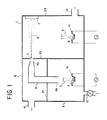
- Fig. 1 schematically represents the construction of an apparatus for the production of composite ultrafine particles contemplated by the present invention.
- A stands for a generation chamber
- B for a differential exhaust chamber
- C for a deposition chamber.
- the generation chamber A has disposed therein a hearth 1 a for seating an evaporation source 2 of ultrafine particles of a composition desired to be generated and has connected thereto a gas inlet pipe 10 for introducing such gases as Ar, He, N 2 , 0 2 , and CH 4 which are used to form a gaseous atmosphere inside the chamber A.
- a wall 21 which intervenes between the generation chamber A and the differential exhaust chamber B has a nozzle 4 disposed therethrough in such a manner that a trailing end 4a of the nozzle 4 may be positioned inside the generation chamber A and a leading end 4b thereof may be positioned inside the differential exhaust chamber B as opposed to a communicating hole 5 formed in a wall 22 partitioning the differential exhaust chamber B and the deposition chamber C.
- the differential exhaust chamber B has connected thereto an exhaust pipe 11 so adapted as to enable a gas introduced into the differential exhaust chamber B via a nozzle 4 to be discharged as by means of a mechanical booster pump (MBP).
- MBP mechanical booster pump
- a substrate 7 is disposed on a lateral wall 23 opposite the communicating hole 5 and a hearth 1 for seating an evaporation source 8 of a desired material to be coated on the ultrafine particles is set in place.
- Numeral 6 denotes a ray or flow of ultrafine particles just blown out of the leading end 4b of nozzle and numeral 12 an exhaust pipe connected to the deposition chamber C. Via this exhaust pipe 12, the deposition chamber C is evacuated with a diffusion pump (DP) or the like.
- DP diffusion pump
- the methods which are available for the purpose of heating the evaporation source 2 of ultrafine particles in the generation chamber A include high frequency induction heating, electron beam heating, plasma jet heating, laser beam heating, and electric heating, for example, besides resistance heating.
- a suitable heating method may be employed depending on the kind of metal and the kind of gas to be used for the generation of ultrafine particles.
- the methods which are available for the purpose of heating the evaporation source 8 of particles for deposition in the deposition chamber C include resistance heating, electron beam heating, and high frequency heating, for example.
- a bias electrode may be installed inside the deposition chamber C for the purpose of enhancing the fastness of adhesion of a film to the ultrafine particles.
- the differential exhaust chamber B must be constantly kept evacuated as with a mechanical booster pump so that the gas containing ultrafine particles 3 generated from the evaporation source 2 in the generation chamber A may be aspirated through the trailing end 4a of the nozzle 4, then caused to flow smoothly toward the leading end 4b of the nozzle 4, and finally discharged through the nozzle 4 as separated from the ultrafine particles 3.
- the gas is exclusively discharged from the differential exhaust chamber B via the exhaust pipe 11 and the ultrafine particles 3 are allowed to pass through the communicating hole 5 and enter the deposition chamber C.
- the differential exhaust chamber B thus plays the role of causing separation of the gas and the ultrafine particles during their passage across the leading end 4b of the nozzle and forcing the ultrafine particles to fly out of the communicating hole 5 toward the deposition chamber C.
- the differential exhaust chamber B also plays a role of preventing the reactive gas from leaking into the deposition chamber C and reacting with particles 9 for deposition to be generated within this chamber.
- the leading end 4b of the nozzle must exist inside the differential exhaust chamber B and is desired to be separated by a distance in the approximate range of from 10 to 200 mm from the communicating hole 5.
- the allowance of this ample range for the distance is desirable because this distance is variable in size, weight, and amount of ultrafine particles to be produced and further in the amount of gas (gas pressure) to be introduced into the generation chamber A.
- the trailing end 4a of the nozzle existing inside the generation chamber A should be separated by a distance in the approximate range from 50 to 300 mm from the evaporation source 2. This range is necessary for the sake of allowing the distance to be varied with the gas pressure in the generation chamber A, the temperature of the evaporation source, and the kind of a metal to be used as the evaporation source.
- the inner pressure of the differential exhaust chamber B must be lower than that of the generation chamber A and higher than that of the deposition chamber C. Optimally, this inner pressure is desired to fall in the neighborhood of 0.1 Torr because the gas blown out of the leading end 4b of the nozzle is exclusively discharged by keeping this chamber evacuated at all times by use of a mechanical booster pump. If the gas pressure in the differential exhaust chamber B is unduly high, the gas will inevitably flow out of the differential exhaust chamber B into the generation chamber A.
- the inner pressure of the deposition chamber C is suitably fixed in the approximate range of from 10- 5 to 10- 4 Torr, in which vacuum deposition takes place.
- the ultrafine particles which have entered the deposition chamber C collide with and are coated with the particles 9 of the shape of clusters or atoms for deposition generated from the evaporation source 8 in the deposition chamber C.
- the ultrafine particles are converted into composite ultrafine particles vested with a coating.
- the ultrafine particles which fly through the communicating hole 5 into the deposition chamber C are not readily affected by gravitational attraction because they have a size of the order of some tens of nm. Since they fly so fast, they do not descend inside the deposition chamber C.
- the ultrafine particles which have collided with the particles for deposition and have been consequently coated therewith keep the speed of flight intact inspite of the collision.
- these composite ultrafine particles land infallibly on the substrate 7 which is disposed on the lateral wall 23 of the deposition chamber C.
- the ultrafine particles and the particles of the shape of clusters or atoms for deposition may be so combined that the ultrafine particles will allow diffusion of atoms therein and consequent manufacture of an alloy.
- gold of the shape of clusters or atoms is deposited on ultrafine particles of antimony, for example, the atoms of gold are diffused in the ultrafine particles of antimony to give rise to a gold-antimony alloy.
- alloys such as of gold-copper and gold-zinc can be manufactured.
- various kinds of composite ultrafine particles can be obtained by varying the materials to be vaporized, the atmosphere of the site of production, and the amount of evaporation of ultrafine particles and clusters for deposition.
- the film thus composed of Fe-Si0 2 composite ultrafine particles retains the magnetizability inherent in the ultrafine Fe particles. Since the ultrafine Fe particles are wholly enclosed with an insulating coating of Si0 2 , however, the film is rich in electric resistance.
- the film shows a highly satisfactory high-frequency characteristic and, unlike ordinary conductors, generates virtually no eddy current due to an induced electromotive force.
- the film can be used as the material for cores in transformers and motors, for example.
- AI 2 0a-AI composite ultrafine particles (alumina particles with a low sintering temperature):
- the substrate 7 is disposed as opposed to the communicating hole 5.
- the apparatus is constructed as illustrated in Fig. 6, wherein the ultrafine particles 3 are decelerated and electrically charged by an electric impulse from an electron gun 13 and, consequently, are caused to change the direction of their flight and land and deposit on a substrate 7a which is kept in a horizontal position.
- the ultrafine particles which have been charged electrically as described above are subsequently deflected by application of an electric field so as to be severally deposited at different positions.
- those ultrafine particles charged positively are caused to deposit on a substrate 7b which is kept in a horizontal position, those not charged on a substrate 7c which is set in place on the lateral wall 23 as opposed to the communicating hole 5, and those charged negatively on a substrate 7d which is installed at a position higher than that of the substrate 7c.
- the substrate can be placed arbitrarily in the deposition chamber C.
- novel composite ultrafine particles and ultrafine alloy particles which are endowed with various useful properties dependent on the kind of a substance forming the ultrafine particles to be coated and the kind of a metallic or ceramic coating material to coat the surfaces of the ultrafine particles can be developed and manufactured.
Landscapes
- Chemical & Material Sciences (AREA)
- Engineering & Computer Science (AREA)
- Ceramic Engineering (AREA)
- Organic Chemistry (AREA)
- Materials Engineering (AREA)
- Manufacturing & Machinery (AREA)
- Chemical Kinetics & Catalysis (AREA)
- Structural Engineering (AREA)
- Inorganic Chemistry (AREA)
- Mechanical Engineering (AREA)
- Metallurgy (AREA)
- Powder Metallurgy (AREA)
- Physical Vapour Deposition (AREA)
- Manufacture Of Metal Powder And Suspensions Thereof (AREA)
- Physical Or Chemical Processes And Apparatus (AREA)
Applications Claiming Priority (2)
| Application Number | Priority Date | Filing Date | Title |
|---|---|---|---|
| JP5246062A JPH0776769A (ja) | 1993-09-08 | 1993-09-08 | 複合超微粒子の製造方法及び装置 |
| JP246062/93 | 1993-09-08 |
Publications (2)
| Publication Number | Publication Date |
|---|---|
| EP0642858A2 true EP0642858A2 (fr) | 1995-03-15 |
| EP0642858A3 EP0642858A3 (fr) | 1995-11-15 |
Family
ID=17142909
Family Applications (1)
| Application Number | Title | Priority Date | Filing Date |
|---|---|---|---|
| EP94114150A Withdrawn EP0642858A3 (fr) | 1993-09-08 | 1994-09-08 | Procédé et appareil pour la préparation de particules composites ultrafines. |
Country Status (2)
| Country | Link |
|---|---|
| EP (1) | EP0642858A3 (fr) |
| JP (1) | JPH0776769A (fr) |
Cited By (2)
| Publication number | Priority date | Publication date | Assignee | Title |
|---|---|---|---|---|
| FR2789403A1 (fr) * | 1999-01-29 | 2000-08-11 | Nisshin Flour Milling Co | Fines particules metalliques revetues d'oxyde et procede pour les produire |
| WO2017125418A1 (fr) * | 2016-01-21 | 2017-07-27 | Von Ardenne Gmbh | Procédé, dispositif de revêtement et ensemble de traitement |
Families Citing this family (1)
| Publication number | Priority date | Publication date | Assignee | Title |
|---|---|---|---|---|
| US8642139B2 (en) * | 2009-06-09 | 2014-02-04 | Toyota Motor Engineering & Manufacturing North America, Inc. | Process to make structured particles |
Family Cites Families (4)
| Publication number | Priority date | Publication date | Assignee | Title |
|---|---|---|---|---|
| JPS60151273A (ja) * | 1984-01-19 | 1985-08-09 | トヨタ自動車株式会社 | セラミツク被膜付き金属化合物の微粉末の製造方法 |
| JPS61177366A (ja) * | 1985-01-31 | 1986-08-09 | Sharp Corp | 超微粒子分散基板の製造装置 |
| JPH074523B2 (ja) * | 1986-09-25 | 1995-01-25 | キヤノン株式会社 | 反応装置 |
| EP0532000B1 (fr) * | 1991-09-13 | 1997-07-23 | Tsuyoshi Masumoto | Pièce à haute résistance et procédé pour sa fabrication |
-
1993
- 1993-09-08 JP JP5246062A patent/JPH0776769A/ja active Pending
-
1994
- 1994-09-08 EP EP94114150A patent/EP0642858A3/fr not_active Withdrawn
Cited By (3)
| Publication number | Priority date | Publication date | Assignee | Title |
|---|---|---|---|---|
| FR2789403A1 (fr) * | 1999-01-29 | 2000-08-11 | Nisshin Flour Milling Co | Fines particules metalliques revetues d'oxyde et procede pour les produire |
| WO2017125418A1 (fr) * | 2016-01-21 | 2017-07-27 | Von Ardenne Gmbh | Procédé, dispositif de revêtement et ensemble de traitement |
| CN108474104A (zh) * | 2016-01-21 | 2018-08-31 | 冯·阿登纳资产股份有限公司 | 方法、涂覆装置和处理设备 |
Also Published As
| Publication number | Publication date |
|---|---|
| EP0642858A3 (fr) | 1995-11-15 |
| JPH0776769A (ja) | 1995-03-20 |
Similar Documents
| Publication | Publication Date | Title |
|---|---|---|
| RU2462534C2 (ru) | Плазменная обработка поверхности с использованием диэлектрических барьерных разрядов | |
| US6346301B2 (en) | Coating method for producing a heat-insulating layer on a substrate | |
| US5603771A (en) | Chemical vapor deposition apparatus activated by a microwave plasma | |
| US3075066A (en) | Article of manufacture and method of making same | |
| US11834204B1 (en) | Sources for plasma assisted electric propulsion | |
| US8029595B2 (en) | Method and apparatus of producing nanoparticles using nebulized droplet | |
| JP4416402B2 (ja) | 機能層を形成するためのプラズマ装置及び機能層の形成方法 | |
| TWI846716B (zh) | 電漿噴塗系統及方法 | |
| EP0969117A3 (fr) | Procédé pour la production d'un système de revêtement de barrière thermique | |
| US5518178A (en) | Thermal spray nozzle method for producing rough thermal spray coatings and coatings produced | |
| Borra | Charging of aerosol and nucleation in atmospheric pressure electrical discharges | |
| WO2003017737A2 (fr) | Plasma d'arc en cascade et revetements resistant a l'abrasion fabriques a partir dudit plasma | |
| EP0642858A2 (fr) | Procédé et appareil pour la préparation de particules composites ultrafines | |
| US7638019B2 (en) | Method and device for manufacturing semiconductor or insulator-metallic laminar composite cluster | |
| JP5093745B2 (ja) | 複合構造物 | |
| EP2507404A2 (fr) | Procédé et appareil permettant le dépôt de minces couches nanostructurées dont la morphologie et la nanostructure sont contrôlées | |
| JPH07502861A (ja) | 加熱により製造された材料蒸気のイオン化方法及び該方法を実施する装置 | |
| Ishii et al. | Hollow cathode sputtering cluster source for low energy deposition: Deposition of Fe small clusters | |
| RU2693989C1 (ru) | Способ изготовления структурно-градиентных порошковых материалов (варианты) | |
| JP3008433B2 (ja) | 超微粒子の製造方法 | |
| JP4485164B2 (ja) | 軟磁性材料の製造方法及び製造装置 | |
| KR20230064982A (ko) | 이송식 아크 플라즈마를 활용한 다원계 복합 나노 분말 제조방법 및 상기 방법으로 제조된 다원계 나노 분말 | |
| JP2857743B2 (ja) | 薄膜形成装置および薄膜形成方法 | |
| RU2776119C1 (ru) | Способ изготовления структурно-градиентных порошковых материалов с металлическим ядром и оболочкой из металл-оксидной керамики | |
| JPH0428862A (ja) | プラズマ発生装置 |
Legal Events
| Date | Code | Title | Description |
|---|---|---|---|
| PUAI | Public reference made under article 153(3) epc to a published international application that has entered the european phase |
Free format text: ORIGINAL CODE: 0009012 |
|
| AK | Designated contracting states |
Kind code of ref document: A2 Designated state(s): DE FR GB |
|
| PUAL | Search report despatched |
Free format text: ORIGINAL CODE: 0009013 |
|
| AK | Designated contracting states |
Kind code of ref document: A3 Designated state(s): DE FR GB |
|
| 17P | Request for examination filed |
Effective date: 19960229 |
|
| 17Q | First examination report despatched |
Effective date: 19990614 |
|
| STAA | Information on the status of an ep patent application or granted ep patent |
Free format text: STATUS: THE APPLICATION IS DEEMED TO BE WITHDRAWN |
|
| 18D | Application deemed to be withdrawn |
Effective date: 19991026 |