EP0643329A2 - Flüssige strahlungshärtbare Zusammensetzung, insbesondere für die Stereolithographie - Google Patents
Flüssige strahlungshärtbare Zusammensetzung, insbesondere für die Stereolithographie Download PDFInfo
- Publication number
- EP0643329A2 EP0643329A2 EP94810474A EP94810474A EP0643329A2 EP 0643329 A2 EP0643329 A2 EP 0643329A2 EP 94810474 A EP94810474 A EP 94810474A EP 94810474 A EP94810474 A EP 94810474A EP 0643329 A2 EP0643329 A2 EP 0643329A2
- Authority
- EP
- European Patent Office
- Prior art keywords
- group
- formula
- integer
- hydrogen atom
- methyl
- Prior art date
- Legal status (The legal status is an assumption and is not a legal conclusion. Google has not performed a legal analysis and makes no representation as to the accuracy of the status listed.)
- Granted
Links
- 0 *C(CO)CON=C1CC1 Chemical compound *C(CO)CON=C1CC1 0.000 description 2
- XILPGHLPTFYDNG-UHFFFAOYSA-N C(C1)CC1C1CCCC1 Chemical compound C(C1)CC1C1CCCC1 XILPGHLPTFYDNG-UHFFFAOYSA-N 0.000 description 1
Classifications
-
- G—PHYSICS
- G03—PHOTOGRAPHY; CINEMATOGRAPHY; ANALOGOUS TECHNIQUES USING WAVES OTHER THAN OPTICAL WAVES; ELECTROGRAPHY; HOLOGRAPHY
- G03F—PHOTOMECHANICAL PRODUCTION OF TEXTURED OR PATTERNED SURFACES, e.g. FOR PRINTING, FOR PROCESSING OF SEMICONDUCTOR DEVICES; MATERIALS THEREFOR; ORIGINALS THEREFOR; APPARATUS SPECIALLY ADAPTED THEREFOR
- G03F7/00—Photomechanical, e.g. photolithographic, production of textured or patterned surfaces, e.g. printing surfaces; Materials therefor, e.g. comprising photoresists; Apparatus specially adapted therefor
- G03F7/004—Photosensitive materials
- G03F7/075—Silicon-containing compounds
- G03F7/0757—Macromolecular compounds containing Si-O, Si-C or Si-N bonds
-
- B—PERFORMING OPERATIONS; TRANSPORTING
- B33—ADDITIVE MANUFACTURING TECHNOLOGY
- B33Y—ADDITIVE MANUFACTURING, i.e. MANUFACTURING OF THREE-DIMENSIONAL [3D] OBJECTS BY ADDITIVE DEPOSITION, ADDITIVE AGGLOMERATION OR ADDITIVE LAYERING, e.g. BY 3D PRINTING, STEREOLITHOGRAPHY OR SELECTIVE LASER SINTERING
- B33Y70/00—Materials specially adapted for additive manufacturing
-
- G—PHYSICS
- G03—PHOTOGRAPHY; CINEMATOGRAPHY; ANALOGOUS TECHNIQUES USING WAVES OTHER THAN OPTICAL WAVES; ELECTROGRAPHY; HOLOGRAPHY
- G03F—PHOTOMECHANICAL PRODUCTION OF TEXTURED OR PATTERNED SURFACES, e.g. FOR PRINTING, FOR PROCESSING OF SEMICONDUCTOR DEVICES; MATERIALS THEREFOR; ORIGINALS THEREFOR; APPARATUS SPECIALLY ADAPTED THEREFOR
- G03F7/00—Photomechanical, e.g. photolithographic, production of textured or patterned surfaces, e.g. printing surfaces; Materials therefor, e.g. comprising photoresists; Apparatus specially adapted therefor
- G03F7/0037—Production of three-dimensional images
Definitions
- the present invention relates to a liquid radiation-curable composition, in particular for stereolithography, based on at least one compound which has free-radically polymerizable groups and at least one photoinitiator suitable for the polymerization of the compounds mentioned, on certain new polyoxyalkylene-polysiloxane block copolymers which besides other already known block copolymers of this type are suitable as a very advantageous formulation component for such compositions, as well as methods for processing these compositions.
- z. B. is known from US Pat. No. 4,575,330
- three-dimensional moldings are built up in layers from liquid radiation-curable compositions in such a way that in each case a thin layer of the composition is pre-cured with the aid of actinic radiation in such a way that the layer just has the desired cross-sectional shape of the molded body at this point, and at the same time is polymerized onto the previously hardened layer of the molded body.
- the shaped body obtained in this way is optionally post-cured, which, for. B. can be done thermally.
- liquid compositions with radiation-curable components and photoinitiators are suitable for stereolithography. If it is desired to obtain moldings which can really be used in practice, generally complicated and formulated compositions must be used.
- the mixtures described therein, which contain difunctional and polyfunctional acrylates and / or methacrylates as well as certain monomers with a single carbon double bond and suitable photoinitiators for the components mentioned result in moldings which have a high glass transition temperature and also have mechanical and processing properties which are good for many Areas of application are suitable.
- the material is quite brittle. Therefore, a sometimes desired machining post-processing of the stereolithographically produced molded body is difficult.
- stereolithography resin formulations to which certain polyurethane acrylates and / or methacrylates have been added.
- Such mixtures are e.g. B. described in EP-A-0 425 441, but their use has the disadvantage that the glass transition temperature of the cured material drops and the viscosity of the stereolithography mixtures can increase very sharply.
- the symbols c and m indicate the number of carbon atoms which is calculated on average for an alkylene unit in the corresponding polyoxyalkylene group.
- the symbols mentioned do not necessarily have to be integers, since the polyoxyalkylene block can also be copolymers of monomers with different numbers of carbon atoms, which can also be used in different ratios. Examples of conventional monomers are ethylene oxide, propylene oxide or tetrahydrofuran.
- [D] is preferably selected from alkylene groups with 2 to 8 carbon atoms and divalent radicals with at most 30, in particular with at most 20 carbon atoms, the latter radicals containing at least one six-membered carbon ring which is unsubstituted or one or more straight-chain or branched C 1 -C Has 4 alkyl substituents.
- [Alk] is preferably a - (CH 2 ) 3 group.
- Copolymers of the formula (I) in which [T] has the meaning T1 or T2 can be obtained, for example, by reacting the desired hydrogen-terminated polysiloxane with the desired polyoxyalkylene diol or diamine according to the following scheme: where A represents either an oxygen atom or an NH group.
- A represents either an oxygen atom or an NH group.
- the reaction of ⁇ , ⁇ -dichloropolysiloxanes with the appropriately terminated polyethers according to US Pat. No. 5,032,662 is also suitable.
- An overview of preparation methods for block copolymers of this type can be found e.g. B. Allen Noshay, James E. McGrath, "Block Copolymers"; Academic Press New York 1977, pp. 401 ff.
- copolymers of the formula (I) in which [T] is T5 and [Alk] is - (CH 2 ) 3 - can also be carried out in a particularly simple manner from the reaction product of a hydrogen-terminated polysiloxane of the formula H- [ PS] -H with allyl glycidyl ether, a commercially available substance (Alcolac, Inc., Rhône-Poulenc, CPS Chemical Co., Inc). A corresponding regulation can be found e.g. B. In Comprehensive Handbook of Hydrosilylation, Pergamon Press, Oxford 1991.
- polysiloxanes of the formula HO- [Alk] - [PS] - [Alk] -OH are first extended with dicarboxylic acids of the HOOC- [Alk 1 ] -COOH type.
- the reaction with the desired diisocyanate of the composition OCN- [D] -NCO or the corresponding dithioisocyanate is still required.
- either the diisocyanate or diisothiocyanate can be reacted simultaneously with the polysiloxane and the polyoxyalkylene diol or the corresponding diamine, or a reaction of the polysiloxane or polyether diol with the diisocyanate or dithioisocyanate can take place in a separate step, to which the reaction with the remaining component of the block copolymer connects.
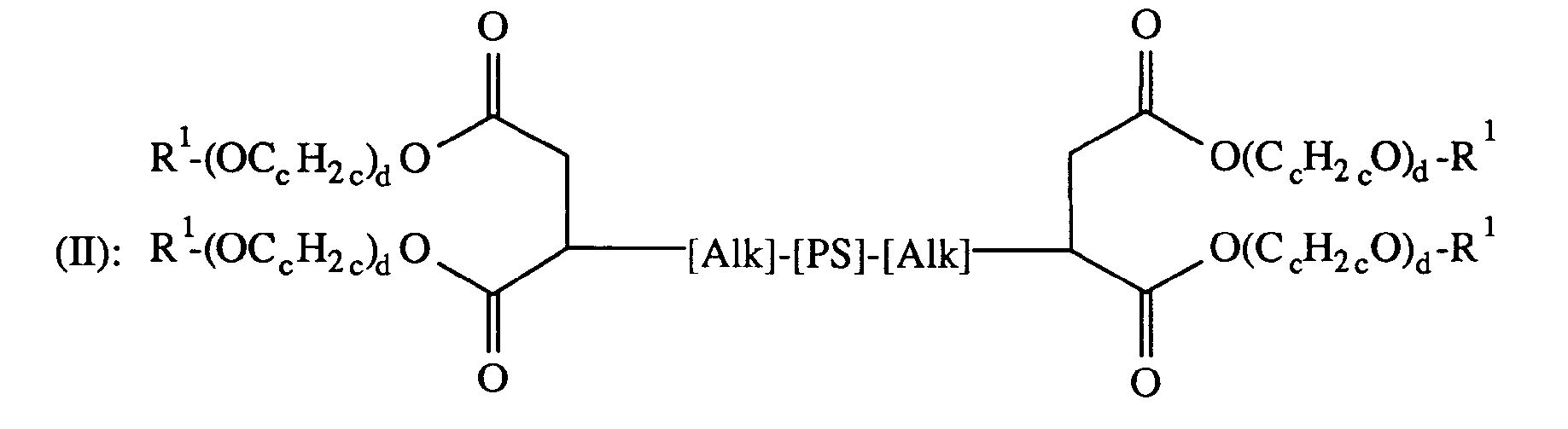
- Block copolymers of the formula (II) can be prepared starting from the desired polyoxyalkylene diols and from polysiloxanes of the formula respectively.
- the last mentioned polysiloxanes are e.g. B. by reacting hydrogen-terminated polysiloxanes with succinic acid derivatives of the formula can be produced, where a corresponds to an integer from 0 to 7, and are also commercially available.
- the particularly preferred copolymers of formula (II) in which [Alk] - (CH 2 ) 3 - means, the required allylsuccinic acid can be very elegant, for. B. from propene and maleic anhydride according to DD Phillips, TB Hill, J. Am. Chem. Soc. 1958, 80, p. 3663.
- e inse Treatable block copolymers of the formula (III) are found, for. B. use as a component of cosmetics. They are commercially available, e.g. B. under the designation DOW CORNING® 190 and 193 or Silwet0 L 7500, L-7600, L-7607 or L 77 (UNION CARBIDE).
- the polysiloxane-polyoxyalkylene block copolymers are generally present in an amount of 5 to 50 percent by weight in the compositions according to the invention, in particular in an amount of 10 to 35 percent by weight.
- Mixtures which each contain at least one representative of components (i), (ii) and (iii) above are very well suited for stereolithography.
- Suitable for component (i) are, for example, the diacrylate and dimethacrylate esters of aliphatic or cycloaliphatic diols, such as 1,3-butylene glycol, 1,4-butanediol, neopentyl glycol, 1,6-hexanediol, diethylene glycol, triethylene glycol, tetraethylene glycol, polyethylene glycol 400, Polyethylene glycol-600, tripropylene glycol, ethoxylated or propoxylated neopentyl glycol, 1,4-dihydroxymethylcyclohexane, 2,2-bis (4-hydroxycyclohexyl) propane or bis (4-hydroxycyclohexyl) methane, which may be alkoxylated, in particular ethoxylated or propoxylated, or can be glycidylated.
- diacrylate and dimethacrylate esters of aliphatic or cycloaliphatic diols such as 1,
- Some of these monomeric or oligomeric di- (meth) acrylates are also commercially available, for example under the product name SR-348 for ethoxylated bisphenol A dimethacrylate and under the product name SR-349 for ethoxylated bisphenol A diacrylate from the company SARTOMER Company.
- the compounds preferably have a molecular weight of 200 to 1000.
- component (ii) of the above-mentioned mixture for example: 1,1,1-trimethylolpropane triacrylate or methacrylate, ethoxylated 1,1,1-trimethylolpropane triacrylate or methacrylate, pentaerythritol tetraacrylate, pentaerythritol monohydroxytriacrylate or methacrylate, dipentaerythryacrylate or dipentaerythryacrylate or dipentaerythryacrylate or dipentaerythritol acrylate.
- Such compounds are known and some are commercially available, for example from SARTOMER Company under the product names SR-295, SR-350, SR-351, SR-367, SR-399, SR-444 and SR-454.
- the compounds of this type preferably have a molecular weight between approximately 200 and 500.
- the mixtures mentioned contain about 20 to 80, preferably 30 to 80, percent by weight of component (i), 5 to 25 percent by weight of component (ii) and 1 to 25 percent by weight of component (iii).
- compositions according to the invention all types of photoinitiators can be used which form free radicals when irradiated accordingly.
- Typical compounds of known photoinitiators are benzoins, such as benzoin or benzoin ethers, e.g. B.
- photoinitiators that are commonly used with argon ion lasers are the benzil ketals, such as benzil dimethyl ketal.
- benzil dimethyl ketal an a-hydroxyphenyl ketone, benzil dimethyl ketal or 2,4,6-trimethylbenzoyldiphenylphosphine oxide is used as the photoinitiator.
- ionic dye counterion compounds ionic dye-counter ion compounds
- ionic dye-counter ion compounds ionic dye counterion compounds
- Ionic dye counterion compounds and their mode of action are known, for example from EP-AO 223 587 and US Patents 4,751,102; 4,772,530 and 4,772,541.
- ionic dye-counterion compounds examples include the anionic dye-iodonium ion complexes, the anionic dye-pyryllium ion complexes and in particular the cationic dye-borate anion compounds of the formula wherein X + stands for a cationic dye and R ', R ", R'" and R “” each independently represent an alkyl, aryl, alkaryl, allyl, aralkyl, alkenyl, alkynyl, an alicyclic or saturated or unsaturated heterocyclic group.
- the photoinitiators are added in effective amounts, that is, in amounts of about 0.1 to about 10 percent by weight, based on the total amount of the mixture. If the mixtures according to the invention are used for stereolithographic processes, usually using laser beams, it is essential that the absorption capacity of the mixtures is adjusted by the type and concentration of the photoinitiator in such a way that the depth of cure at normal laser speed is approximately 0.1 to 2.5 mm is.
- the mixtures according to the invention can also contain various photoinitiators which are differently sensitive to radiation from emission lines of different wavelengths. In this way, for example, a better use is made of a UV / VIS light source which emits emission lines of different wavelengths. It is advantageous if the different photoinitiators are selected and used in such a concentration that the same optical absorption is generated in the emission lines used.
- the customary additives can be added to the mixtures according to the invention, for example stabilizers, such as UV stabilizers, polymerization inhibitors, release agents, wetting agents tel, leveling agents, sensitizers, anti-settling agents, surface-active agents, dyes, pigments or fillers.
- stabilizers such as UV stabilizers, polymerization inhibitors, release agents, wetting agents tel, leveling agents, sensitizers, anti-settling agents, surface-active agents, dyes, pigments or fillers.
- compositions according to the invention should preferably have a viscosity between 200 and 5000 mPa ⁇ a, in particular between 500 and 3500 mPas, at a temperature between 20 and 30 ° C.
- They can be produced in a known manner, for example by premixing individual components and then mixing these premixes or by mixing all components using conventional devices, such as stirred vessels, in the absence of light and, if appropriate, at a slightly elevated temperature.
- compositions according to the invention can be polymerized by irradiation with actinic light, for example by means of electron or X-rays, UV or VIS light, that is to say with rays in the wavelength range from 280-650 nm.
- Laser beams from HeCd, argon or nitrogen as well as metal vapor and NdYAG lasers with multiplied frequency are particularly suitable.
- the suitable photoinitiator must be selected and, if necessary, sensitized for each selected light source. It has been recognized that the depth of penetration of the rays into the composition to be polymerized and the working speed are directly related to the absorption coefficient and the concentration of the photoinitiator. In stereolithography, those photoinitiators are preferably used which bring about the greatest number of free radicals formed and enable the greatest depth of radiation penetration into the compositions to be polymerized.
- the invention also relates to a process for the preparation of a hardened product, in which compositions as described above are treated with actinic radiation.
- a further subject of the invention is a method for producing three-dimensional objects from the liquid mixtures according to the invention by means of stereolithographic methods, comprising a step in which the surface of a layer of the liquid mixture according to the invention is covered over the whole area or in a predetermined pattern with a UV / VIS Light source is irradiated, so that in the irradiated areas a layer solidifies in a desired layer thickness, then a new layer of the mixtures according to the invention is formed on the solidified layer, which is also irradiated over the whole area or in a predetermined pattern, and by repeated coating and irradiating three-dimensional objects from a plurality of adhering, solidified layers are obtained.
- a laser beam is preferably used as the radiation source, which is preferably computer-controlled.
- the mixtures according to the invention are used as coating compositions, clear and hard coatings are obtained on wood, paper, metal, ceramic or other surfaces.
- the coating thickness can vary widely and can be from about 1 ⁇ m to about 1 mm.
- Relief images for printed circuits or printing plates can be produced directly from the mixtures according to the invention by irradiating the mixtures, for example by means of a computer-controlled laser beam of a suitable wavelength or using a photomask and a corresponding light source.
- the mixtures according to the invention are preferably used to produce photopolymerized layers, in particular in the form of three-dimensional objects, which are composed of a plurality of solidified layers adhering to one another.
- stirring is continued at 130 ° C. until the epoxy content has disappeared (16 h).
- the clear, slightly yellowish solution is bar in a high vacuum (1,3.10- 4, 60 ° C, 2 h) dried.
- a liquid radiation sensitive mixture of the composition 90 grams are mixed with 10 grams of a commercial polyoxyalkylene-polysiloxane block copolymer (IM @ 22; commercial product from Wacker-Chemie GmbH, Kunststoff) and enough 1-hydroxycyclohexylphenylmethanone (Irgacure®184) is added once more that the concentration of this photoinitiator in the overall mixture 4 percent by weight.
- the composition with the block copolymer has a viscosity of 1500 mPas at 30 ° C.
- the mechanical properties of the object hardened by means of laser beams (green strength) and of the object obtained by post-curing are measured on the Lloyd® 500 tensile testing machine from Lloyd, the shaped bodies typically having a dimension of 50 millimeters in length and a cross section of 1.2 ⁇ 0. Have 3 millimeters.
- the green compacts are irradiated for 30 minutes (min) in the post-curing cabinet (PCA from 3D Systems, Inc.) with the maximum radiation dose.
- the moldings obtained in this way have the following properties:
- the glass transition temperature (TMA; 10 ° C / min; 0.5 N; determined with Mettler TA 4000) of the material is 92 ° C.
- composition 6A a composition is prepared from 70 grams of the radiation-sensitive mixture mentioned above and 30 grams of the block copolymer from Example 1 (composition 6B).
- composition 7A a composition is prepared from 70 grams of the above radiation sensitive mixture and 30 grams of the block copolymer from Example 3 (Composition 7B).
- composition 8A 90 grams of a liquid radiation-sensitive mixture from Example 5 are mixed with 10 grams of the polyoxyalkylene-polysiloxane block copolymer from Example 4 and enough Irgacure® 184 is added again that the concentration of this photoinitiator in the total mixture is again 4 percent by weight (composition 8A) .
- composition 8B a composition is prepared from 70 grams of the above radiation sensitive mixture and 30 grams of the block copolymer from Example 4 (Composition 8B).
Landscapes
- Physics & Mathematics (AREA)
- General Physics & Mathematics (AREA)
- Chemical & Material Sciences (AREA)
- Engineering & Computer Science (AREA)
- Manufacturing & Machinery (AREA)
- Materials Engineering (AREA)
- Spectroscopy & Molecular Physics (AREA)
- Silicon Polymers (AREA)
- Polymerisation Methods In General (AREA)
- Graft Or Block Polymers (AREA)
- Addition Polymer Or Copolymer, Post-Treatments, Or Chemical Modifications (AREA)
- Macromonomer-Based Addition Polymer (AREA)
Abstract

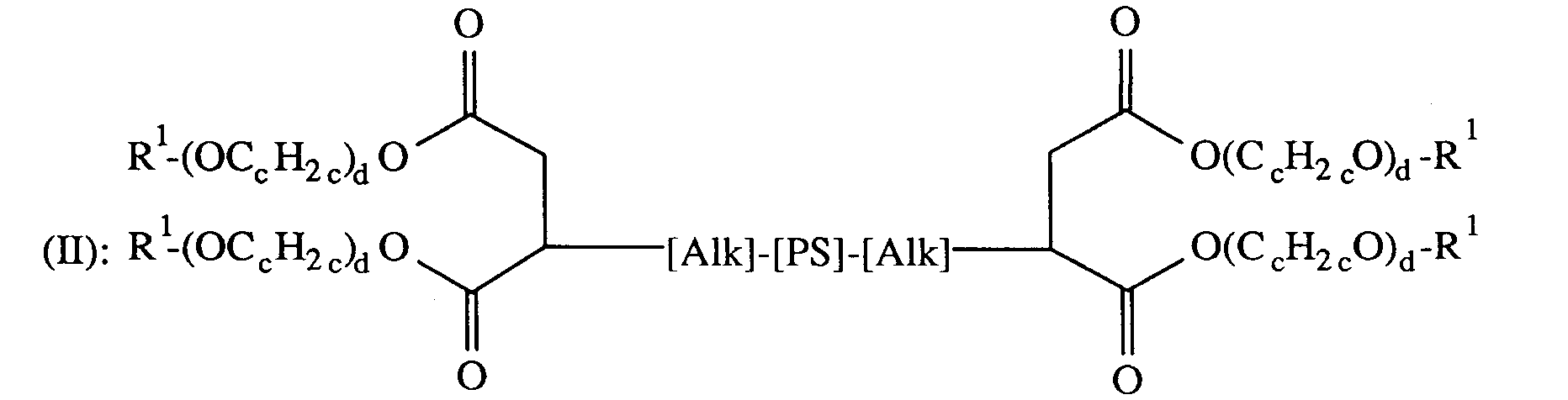

- R1 ein Wasserstoffatom oder eine C1-C8-Alkylgruppe ;
- R2 eine Methyl- oder Phenylgruppe ;
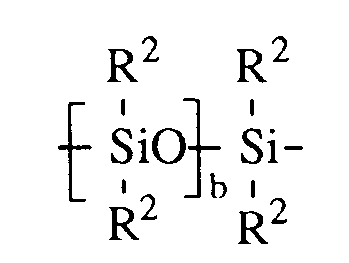
- [T] eine in bestimmter, im Text näher beschriebener Weise terminierte Polysiloxangruppe [PS] ; [PS] die Gruppe der Formel
- [Alk] eine Alkylengruppe mit 3 bis 10 Kohlenstoffatomen darstellen, sowie neue Blockcopolymere der Formeln (I) und (II). Die ausgehärteten Zusammensetzungen weisen z. B. eine hohe Schlagzähigkeit auf.
Description
- Die vorliegende Erfindung bezieht sich auf eine flüssige strahlungshärtbare Zusammensetzung, insbesondere für die Stereolithographie, auf Basis mindestens einer Verbindung, die radikalisch polymerisierbare Gruppen aufweist, und mindestens eines für die Polymerisierung der genannten Verbindungen geeigneten Photoinitiators, auf bestimmte neue Polyoxyalkylen-Polysiloxan-Blockcopolymere, die neben anderen schon bekannten Blockcopolymeren dieses Typs als eine sehr vorteilhafte Formulierungskomponente für derartige Zusammensetzungen geeignet sind, sowie auf Verfahren zur Verarbeitung dieser Zusammensetzungen.
- Beim stereolithographischen Verfahren, wie es z. B. aus dem US-Patent 4,575,330 bekannt ist, werden dreidimensionale Formkörper schichtweise aus flüssigen strahlungshärtbaren Zusammensetzungen in der Weise aufgebaut, dass man jeweils eine dünne Schicht der Zusammensetzung mit Hilfe von aktinischer Strahlung in definierter Weise so vorhärtet, dass die Schicht gerade die gewünschte Querschnittsform des Formkörpers an dieser Stelle aufweist, und dabei gleichzeitig an die im Schritt zuvor gehärtete Schicht des Formkörpers anpolymerisiert wird. Der auf diese Weise erhaltene Formkörper wird gegebenenfalls noch nachgehärtet, was z. B. thermisch erfolgen kann.
- Prinzipiell sind für die Stereolithographie flüssige Zusammensetzungen mit strahlungshärtbaren Komponenten sowie Photoinitiatoren geeignet. Will man Formkörper erhalten, die in der Praxis wirklich einsetzbar sind, so müssen im allgemeinen kompliziert abgestimmte und formulierte Zusammensetzungen eingesetzt werden. Bewährt haben sich insbesondere Systeme auf Basis von Verbindungen mit radikalisch polymerisierbaren Gruppen, insbesondere auf Basis von Polyacrylaten und/oder -methacrylaten, wie sie beispielsweise ausderEP-A-0378 144 bekannt sind. Die dort beschriebenen Gemische, die di- und polyfunktionelle Acrylate und/oder Methacrylate sowie gewisse Monomere mit einer einzigen Kohlenstoffdoppelbindung und geeignete Photoinitiatoren für die genannten Komponenten enthalten, ergeben Formkörper, die eine hohe Glasübergangstemperatur aufweisen und auch mechanische sowie verarbeitungtechnische Eigenschaften aufweisen, die für viele Anwendungsgebiete geeignet sind. Das Material ist jedoch ziemlich spröde. Daher ist eine manchmal erwünschte spanabhebende Nachbearbeitung des stereolithographisch hergestellten Formkörpers schwierig.
- Weniger sprödes Materials kann mit Stereolithographieharzformulierungen erhalten werden, denen bestimmte Polyurethanacrylate und/oder -methacrylate zugesetzt sind. Solche Gemische sind z. B. in der EP-A-0 425 441 beschrieben, ihre Verwendung hat jedoch den Nachteil, dass die Glasübergangstemperatur des ausgehärteten Materials sinkt und auch die Viskosität der Stereolithographiegemische sehr stark ansteigen kann.
- Es hat sich nunmehr gezeigt, dass Material von verbesserter Schlagzähigkeit erhalten werden kann, ohne dass der Tg-Wert und die Wärmeformbeständigkeit des Materials nennenswert erniedrigt werden, wenn man Zusammensetzungen auf Basis von Verbindungen mit radikalisch polymerisierbaren Gruppen und von Photoinitiatoren zu dessen Herstellung verwendet, denen Polyoxyalkylen-Polysiloxan-Blockcopolymere der weiter unten genannten Formeln (I), (11) oder (111) zusetzt sind. Auch die Viskosität der flüssigen Ausgangsgemische wird durch diese Modifizierung nicht nachteilig beeinfusst, wie es beispielsweise bei Einsatz anderer Copolymere anstatt der erfindungsgemässen Polyoxyalkylen-Polysiloxan-Blockcopolymeren der Fall ist, die oftmals zu einer kräftigen Erhöhung der Viskosität führen.
- Die vorliegende Erfindung betrifft daher eine flüssige strahlungshärtbare Zusammensetzung, insbesondere für die Stereolithographie, auf Basis mindestens einerVerbindung, die radikalisch polymerisierbare Gruppen aufweist, und mindestens eines für diese Polymerisierung geeigneten Photoinitiators, dadurch gekennzeichnet, dass sie zusätzlich ein Polyoxyalkylen-Polysiloxan-Blockcopolymerenthält, das aus den Copolymeren der chemischen Formeln


- R1 ein Rest ausgewählt aus einem Wasserstoffatom und einer C1-C8-Alkylgruppe;
- c eine Zahl von 1 bis 8 entsprechend der durchschnittlichen Anzahl von Kohlenstoffatomen einer Alkyleneinheit in einer Polyoxyalkylengruppe (CcH2cO)d;
- d eine ganze Zahl von 1 bis 100;
- g eine ganze Zahl von 1 bis 4;
- [T] eine Gruppe ausgewählt aus den Gruppen der Formeln T1 bis T12:


- [PS] eine Polysiloxangruppe der Formel

- R2 eine Gruppe ausgewählt aus Methyl und Phenyl;
- b eine ganze Zahl von 1 bis 100;
- [Alk] eine Alkylengruppe mit 3 bis 10 Kohlenstoffatomen;
- [Alk1] eine Alkylengruppe mit 1 bis 20 Kohlenstoffatomen;
- m eine Zahl von 1 bis 8 entsprechend der durchschnittlichen Anzahl von Kohlenstoffatomen einer Alkyleneinheit in einer Polyoxyalkylengruppe (CmH2mO)n;
- n eine ganze Zahl von 1 bis 50;
- [G] eine Gruppe der Formel

- X ein Atom ausgewählt aus Sauerstoff- und Schwefelatomen;
- [D] ein zweiwertiger organischer Rest mit mindestens 2 Kohlenstoffatomen;
- e eine ganze Zahl von 1 bis 100 und
- f eine ganze Zahl von 1 bis 50.
- Die Symbole c und m geben die Anzahl von Kohlenstoffatomen an, die sich durchschnittlich für eine Alkyleneinheit in der entsprechenden Polyoxyalkylengruppe errechnet. Die genannten Symbole müssen daher nicht unbedingt ganzzahlig sein, da es sich bei dem Polyoxyalkylenblock auch um Mischpolymerisate aus Monomeren mit unterschiedlicher Anzahl von Kohlenstoffatomen handeln kann, die zudem in unterschiedlichen Verhältnissen eingesetzt werden können. Beispiele für übliche Monomere sind hierbei Ethylenoxid, Propylenoxid oder Tetrahydrofuran.
- [D] ist vorzugsweise ausgewählt aus Alkylengruppen mit 2 bis 8 Kohlenstoffatomen und zweiwertigen Resten mit höchstens 30, insbesondere mit höchstens 20 Kohlenstoffatomen, wobei die letztgenannten Reste mindestens einen sechsgliedrigen Kohlenstoffring enthalten, der unsubstituiert ist oder einen oder mehrere geradkettige oder verzweigte C1-C4-Alkylsubstituenten aufweist.
- [Alk] ist bevorzugt eine -(CH2)3-Gruppe.
- Die vorgenannten Blockcopolymere von Formel (I) und (11) sind teilweise noch neu, insbesondere diejenigen, bei denen die Symbole die nachfolgende Bedeutung haben:
- R1 ein Rest ausgewählt aus einem Wasserstoffatom und einer C1-C8-Alkylgruppe;
- c eine Zahl von 1 bis 4 entsprechend der durchschnittlichen Anzahl von Kohlenstoffatomen einer Alkyleneinheit in einer Polyoxyalkylengruppe (CcH2cO)d;
- d eine ganze Zahl von 7 bis 25;
- g 1;
- [T] eine Gruppe der Formel

- [PS] eine Polysiloxangruppe der Formel

- R2 Methyl;
- b eine ganze Zahl von 5 bis 50;
- [Alk] eine Alkylengruppe mit 3 bis 10 Kohlenstoffatomen.
- Diese neuen Polyoxyalkylen-Polysiloxan-Blockcopolymere gehören ebenfalls zum Gegenstand der Erfindung. [Alk] ist auch hierbei bevorzugt eine -(CH2)3-Gruppe.
- Copolymere der Formel (I), bei denen [T] die Bedeutung T1 oder T2 hat, sind beispielsweise durch Umsetzung des gewünschten wasserstoffterminierten Polysiloxans mit dem gewünschten Polyoxyalkylendiol beziehungsweise -diamin gemäss folgendem Schema erhältlich:


- Die Herstellung von Blockcopolymeren der Formel (II) kann ausgehend von den gewünschten Polyoxyalkylendiolen und von Polysiloxanen der Formel


- Erfindungsgemäss e
inse tzbare Blockcopolymere der Formel (III) finden z. B. als Bestandteil von Kosmetika Verwendung. Sie sind kommerziell erhältlich, z. B. unter der Bezeichnung DOW CORNING® 190 und 193 oder Silwet0 L 7500, L-7600, L-7607 bzw. L 77 (UNION CARBIDE). - Die Polysiloxan-Polyoxyalkylen-Blockcopolymeren sind im allgemeinen in einer Menge von 5 bis 50 Gewichtsprozent in den erfindungsgemässen Zusammensetzungen enthalten, insbesondere in einer Menge von 10 bis 35 Gewichtsprozent.
- Bevorzugt sind diejenigen der zuvor angeführten Zusammensetzungen, die Polyoxyalkylen-Polysiloxan-Blockcopolymere der Formel (I), (II) oder (III) enthalten, worin
- R1 einen Rest ausgewählt aus einem Wasserstoffatom und einer C1-C4-Alkylgruppe;
- R2 eine Methylgruppe;
- [Alk] eine -(CH2)3-Gruppe;
- [Alk1] eine Alkylengruppe mit 2 bis 10, insbesondere 2 bis 4 Kohlenstoffatomen;
- X ein Sauerstoffatom;
- [D] einen zweiwertigen organischen Rest ausgewählt aus den Resten der nachstehenden Formeln:


- c eine Zahl von 2 bis 4;
- d eine ganze Zahl von 5 bis 50;
- b eine ganze Zahl von 10 bis 50;
- m eine Zahl von 2 bis 4;
- n eine ganze Zahl von 5 bis 20;
- e eine ganze Zahl von 1 bis 50 und
- f eine ganze Zahl von 1 bis 25 bedeuten.
- Ganz besonders bevorzugt sind erfindungsgemässe Zusammensetzungen mit Blockcopolymeren der Formel (I), (11) oder (III), worin
- R1 eine Methylgruppe;
- [Alk] und
- [Alk1] jeweils eine -(CH2)3-Gruppe;
- c 2;
- d im Fall einer Verbindung der Formel (I) oder (11) eine ganze Zahl von 7 bis 25 und im Fall einer Verbindung der Formel (III) eine ganze Zahl von 2 bis 20;
- g 1;
- m 2 und
- n eine ganze Zahl von 7 bis 20 bedeuten.
- Als Verbindungen, die radikalisch polymerisierbare Gruppen aufweisen, enthalten die erfindungsgemässen Zusammensetzungen bevorzugt Mischungen mit den folgenden Komponenten:
- (i) difunktionellen monomeren oder polymeren Acrylaten oder Methacrylaten;
- (ii) tri- oder polyfunktionellen Acrylaten oder Methacrylaten;
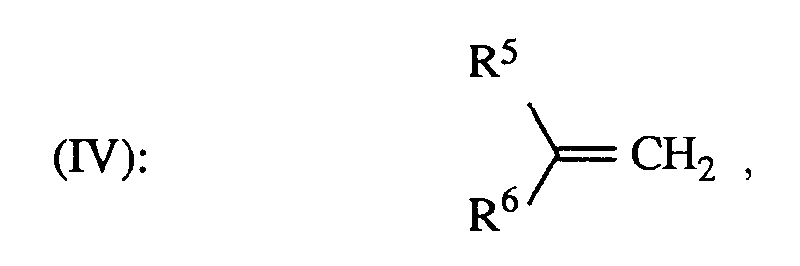
- (iii) ungesättigten monomeren Verbindungen der Formel
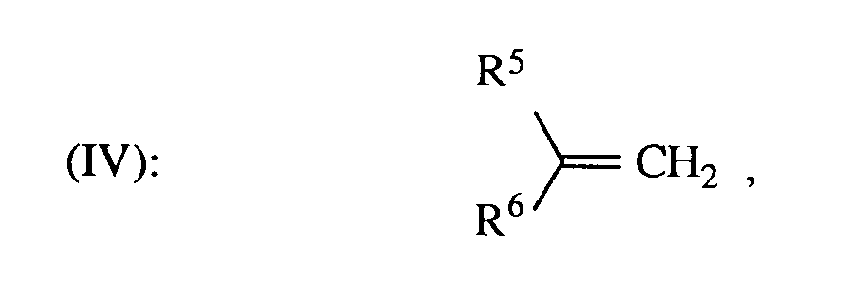
- R5 einen Rest ausgewählt aus einem Wasserstoffatom und einer Methylgruppe und
- R6 ein Rest der Formel

- R7 füreinen Rest ausgewählt aus Tetrahydrofurfuryl-, Cyclohexyl-, 2-Phenoxyethyl-, Benzyl-, Isobornyl-, Glycidyl-, Dicyclopentyl-, Morpholinoethyl-, Dimethylaminoethyl- und geradkettigen sowie verzweigten C1-C20-Alkylresten steht, und im Falle, dass R5 ein Wasserstoffatom darstellt, R6 zusätzlich zu den vorgenannten Resten auch einen Rest ausgewählt aus Pyrolidon-2-yl-, Imidazonyl-, Carbazolyl-, Anthracenyl-, Phenyl-, C5-C8-Cycloalkyl-, Naphthenyl-, 2-Norbornyl-, Pyridyl-, N-Caprolactamyl, Formamidyl-, Acetamidyl und Toluolylresten bedeuten kann.
- Sehr gut für die Stereolithographie geeignet sind hierbei Mischungen, die mindestens je einen Vertreter der oben genannten Komponenten (i), (ii) und (iii) enthalten.
- Für die Komponente (i) eignen sich beispielsweise die Diacrylat- und Dimethacrylatestervon aliphatischen oder cycloaliphatischen Diolen, wie 1,3-Butylenglykol, 1,4-Butandiol, Neopentylglykol, 1,6-Hexandiol, Diethylenglykol, Triethylenglykol, Tetraethylenglykol, Polyethylenglykol-400, Polyethylenglykol-600, Tripropylenglykol, ethoxyliertes oder propoxyliertes Neopentylglykol, 1,4-Dihydroxymethylcyclohexan, 2,2-Bis-(4-hydroxy- cyclohexyl)-propan oder Bis-(4-hydroxycyclohexyl)-methan, die gegebenenfalls alkoxyliert, insbesondere ethoxyliert oder propoxyliert, oder aber glycidylisiert sein können. Solche monomeren oder oligomeren Di-(meth)acrylate sind zum Teil auch im Handel erhältlich, beispielsweise unter der Produktbezeichnung SR-348 für ethoxyliertes Bisphenol A-dimethacrylat und unter der Produktbezeichnung SR-349 für ethoxyliertes Bisphenol A-diacrylat von der Firma SARTOMER Company. Die Verbindungen weisen bevorzugt ein Molekulargewicht von 200 bis 1000 auf.
- Für die Komponente (ii) des oben angeführten Gemisches können beispielsweise eingesetzt werden: 1,1,1-Trimethylolpropantriacrylat oder -methacrylat, ethoxyliertes 1,1,1-Trimethylolpropantriacrylat oder -methacrylat, Pentaerythritoltetraacrylat, Pentaerythritolmonohydroxytriacrylat oder -methacrylat, Dipentaerythritolmonohydroxypentaacrylat oder -methacrylat. Solche Verbindungen sind bekannt und zum Teil im Handel erhältlich, beispielsweise von der Firma SARTOMER Company unter der Produktebezeichnung SR-295, SR-350, SR-351, SR-367, SR-399, SR-444 und SR-454. Die Verbindungen dieses Typs weisen bevorzugt ein Molekulargewicht zwischen ca. 200 und 500.
- Im allgemeinen sind in den genannten Gemischen etwa 20 bis 80, bevorzugt 30 bis 80, Gewichtsprozent der Komponente (i), 5 bis 25 Gewichtprozent der Komponente (ii) sowie 1 bis 25 Gewichtsprozent der Komponente (iii) enthalten.
- Besonders bevorzugt sind erfindungsgemässe Zusammensetzungen, die als Komponente (i) zumindest eine Verbindung der Formel

- p 0 oder 1,
- t 0 oder 1 oder, wenn p den Wert 0 hat, eine ganze Zahl von 1 bis 3,
- [Z] -O-, -S-, -S02- oder -C(R10)(R11)-,
- R10 sowie
- R11 unabhängig voneinander jeweils einen Rest ausgewählt aus einem Wasserstoffatom, -CF3 und Methyl,
- R14 wenn p den Wert 0 hat, ein Wasserstoffatom oder Methyl und, wenn p den Wert 1 hat, ein Wasserstoffatom,
- R8 wenn p den Wert 0 hat, ein Wasserstoffatom und wenn p den Wert 1 hat, Hydroxyl und
- R9 ein Wasserstoffatom oder Methyl bedeuten,
- insbesondere wenn sie als Komponente (ii) ein Triacrylat oder Trimethacrylat der Formel

- R12 Methyl oder einen Rest der Formel

- R15 unabhängig voneinander jeweils ein Wasserstoffatom oder Methyl und
- R13 einen Rest der Formel

- Ganz besonders gute Ergebnisse werden schliesslich mit Zusammensetzungen erhalten, die als Komponente (i) zumindest zwei verschiedene Verbindungen der Formel (VI) enthalten, wobei
- [Z] in beiden Verbindungen eine -C(CH3)2- Gruppe bedeutet und
- p in der Formel einer der beiden Verbindungen die Bedeutung 0 und in der anderen Verbindung die Bedeutung 1 hat,
- Besonders bevorzugt sind diese Zusammensetzungen, wenn mehr als 50 Gewichtsprozent der Komponente (i) aus Verbindungen der Formel (VI) besteht, bei denen p = 1 ist.
- In den erfindungsgemässen Zusammensetzungen können alle Typen von Photoinitiatoren eingesetzt werden, welche bei der entsprechenden Bestrahlung freie Radikale bilden. Typische Verbindungen bekannter Photoinitiatoren sind Benzoine, wie Benzoin oder Benzoinether, z. B. Benzoinmethylether, Benzoinethylether und Benzoinisopropylether, Benzoinphenylether und Benzoinacetat, Acetophenone, wie Acetophenon, 2,2-Dimethoxyacetophenon, und 1,1-Dichloracetophenon, Benzil, Benzilketale, wie Benzildimethylketal und Benzildiethylketal, Anthrachinone, wie 2-Methylanthrachinon, 2-Ethylanthrachinon, 2-tert.-Butylanthrachinon, 1-Chloranthrachinon und 2-Amylanthrachinon, Triphenylphosphin, Benzoylphosphinoxide, wie beispielsweise 2,4,6-Trimethylbenzoyldiphenylphosphinoxid (Luzirin@TPO), Benzophenone, wie Benzophenon und 4,4'-Bis-(N,N'-dimethylamino)-benzophenon,Thioxanthone und Xanthone, Acridinderivate, Phenazinderivate, Quinoxalinderivate oder 1-Phenyi-1,2-propandion-2-0-benzoyioxim, 1-Aminophenylketone oder 1-Hydroxyphenylketone, wie 1-Hydroxy-cyclohexylphenylketon, Phenyl-(1-hydroxyisopropyl)-keton und 4-lsopropylphe- nyl-(1-hydroxyisopropyl)-keton, welche alle bekannte Verbindungen darstellen.
- Besonders geeignete Photoinitiatoren, welche gewöhnlich in Kombination mit einem HeCd-Laser als Strahlenquelle verwendetwerden, sind Acetophenone, wie 2,2-Dialkoxybenzophenone und a-Hydroxyphenylketone, beispielsweise 1-Hydroxycyclohexylphenylketon oder (2-Hydroxyisopropyl)-phenylketon (= 2-Hydroxy-2,2-dimethylacetophenon).
- Eine andere Klasse von Photoinitiatoren, die gewöhnlich bei Verwendung von Argonion-Lasern eingesetzt wird, sind die Benzilketale, wie beispielsweise Benzildimethylketal. Insbesondere verwendet man als Photoinitiator ein a-Hydroxyphenylketon, Benzildimethylketal oder 2,4,6-Trimethylbenzoyldiphenylphosphinoxid.
- Eine weitere Klasse von geeigneten Photoinitiatoren stellen die ionischen Farbstoff-Gegenionverbindungen (ionic dye-counter ion compounds) dar, welche in der Lage sind, aktinische Strahlen zu absorbieren und freie Radikale zu erzeugen, die die Polymerisation von Substanzen, wie (Meth)acrylaten oder Vinylverbindungen, initiieren. Die erfindungsgemässen Gemische, welche ionische Farbstoff-Gegenionverbindungen enthalten, können auf diese Weise mit sichtbarem Licht im einstellbaren Wellenlängenbereich von 400-700 nm variabler gehärtet werden. lonische Farbstoff-Gegenionverbindungen und deren Wirkungsweise sind bekannt, beispielsweise aus der EP-A-O 223 587 und den US-Patenten 4,751,102; 4,772,530 und 4,772,541. Als Beispiele für geeignete ionische Farbstoff-Gegenionverbindungen seien genannt die anionischen Farbstoff-Jodoniumionkomplexe, die anionischen Farbstoff-Pyrylliumionkomplexe und insbesondere die kationischen Farbstoff-Boratanionverbindungen der Formel

- Die Photoinitiatoren werden in wirksamen Mengen zugesetzt, das heisst, in Mengen von etwa 0,1 bis etwa 10 Gewichtsprozent, bezogen auf die Gesamtmenge des Gemisches. Wenn die erfindungsgemässen Gemische für stereolithographische Verfahren verwendet werden, wobei normalerweise Laserstrahlen eingesetzt werden, ist es wesentlich, dass die Absorptionsfähigkeit der Gemische durch Typ und Konzentration des Photoinitiators so abgestimmt wird, dass die Härtungstiefe bei normaler Lasergeschwindigkeit ungefähr 0,1 bis 2,5 mm beträgt.
- Die erfindungsgemässen Gemische können auch verschiedene Photoinitiatoren enthalten, welche gegenüber Strahlen von Emissionslinien unterschiedlicher Wellenlängen verschieden strahlungsempfindlich sind. Man erreicht dadurch beispielsweise eine bessere Ausnützung einer UV/VIS-Lichtquelle, welche Emissionslinien unterschiedlicher Wellenlänge ausstrahlt. Vorteilhaft ist es dabei, wenn die verschiedenen Photoinitiatoren so ausgewählt und in einer solchen Konzentration eingesetzt werden, dass bei den verwendeten Emissionslinien eine gleiche optische Absorption erzeugt wird.
- Falls erwünscht können den erfindungsgemässen Gemischen die üblichen Additive zugesetzt werden, beispielsweise Stabilisatoren, wie UV-Stabilisatoren, Polymerisationsinhibitoren, Trennmittel, Benetzungsmittel, Verlaufsmittel, Sensibilisatoren, Antiabsetzmittel, oberflächenaktive Mittel, Farbstoffe, Pigmente oder Füllstoffe.
- Die erfindungsgemässen Zusammensetzungen sollten bei einer Temperatur zwischen 20 und 30 °C bevorzugt eine Viskosität zwischen 200 und 5000 mPa·a aufweisen, insbesondere zwischen 500 und 3500 mPas.
- Sie können in bekannter Weise hergestellt werden, beispielsweise durch Vormischen einzelner Komponenten und anschliessendes Vermischen dieser Vormischungen oder durch Vermischen aller Komponenten mittels üblicher Vorrichtungen, wie Rührbehälter, in Abwesenheit von Licht und gegebenenfalls bei leicht erhöhter Temperatur.
- Die erfindungsgemässen Zusammensetzungen können durch Bestrahlen mit aktinischem Licht, beispielsweise mittels Elektronen- oder Röntgenstrahlen, UV- oder VIS-Licht, das heisst, mit Strahlen im Wellenlängenbereich von 280-650 nm polymerisiert werden. Besonders geeignet sind Laserstrahlen von HeCd, Argon oder Stickstoff sowie Metalldampf und NdYAG-Laser mit vervielfachter Frequenz. Es ist dem Fachmann bekannt, dass für jede gewählte Lichtquelle der geeignete Photoinitiator ausgewählt und gegebenenfalls sensibilisiert werden muss. Man hat erkannt, dass die Eindringtiefe der Strahlen in die zu polymerisierende Zusammensetzung und die Arbeitsgeschwindigkeit in direktem Zusammenhang mit dem Absorptionskoeffizienten und der Konzentration des Photoinitiators stehen. In der Stereolithographie werden vorzugsweise solche Photoinitiatoren eingesetzt, welche die höchste Anzahl von entstehenden freien Radikalen bewirken und die grösste Strahlungseindringtiefe in die zu polymerisierenden Zusammensetzungen ermöglichen.
- Gegenstand der Erfindung ist auch ein Verfahren zur Herstellung eines gehärteten Produkts, bei dem man Zusammensetzungen, wie sie oben beschrieben sind, mit aktinischer Strahlung behandelt.
- Ein weiterer Erfindungsgegenstand ist schliesslich ein Verfahren zur Herstellung von dreidimensionalen Gegenständen aus den flüssigen, erfindungsgemässen Gemischen mittels stereolithographischen Verfahren, umfassend einen Schritt, bei dem die Oberfläche einer Schicht aus dem erfindungsgemässen, flüssigen Gemisch ganzflächig oder in einem vorbestimmten Muster mit einer UV/VIS-Lichtquelle bestrahlt wird, so dass sich in den bestrahlten Bereichen eine Schicht in einer gewünschten Schichtdicke verfestigt, dann eine neue Schicht aus den erfindungsgemässen Gemischen auf der verfestigten Schicht gebildet wird, die ebenfalls ganzflächig oder in einem vorbestimmten Muster bestrahlt wird, und wobei durch wiederholtes Beschichten und Bestrahlen dreidimensionale Gegenstände aus mehreren aneinander haftenden, verfestigten Schichten erhalten werden.
- Bei diesem Verfahren wird als Strahlungsquelle vorzugsweise ein Laserstrahl verwendet, der vorzugsweise computergesteuert ist.
- Werden die erfindungsgemässen Gemische als Beschichtungsmittel eingesetzt, so erhält man klare und harte Beschichtungen auf Holz, Papier, Metall, Keramik oder anderen Oberflächen. Die Beschichtungsdicke kann dabei sehr variieren und etwa von 1 µm bis etwa 1 mm betragen. Aus den erfindungsgemässen Gemischen können Rel iefbilder für gedruckte Schaltungen oder Druckplatten direkt durch Bestrahlen der Gemische hergestellt werden, beispielsweise mittels eines computergesteuerten Laserstrahls geeigneter Wellenlänge oder unter Anwendung einer Photomaske und einer entsprechenden Lichtquelle.
- Vorzugsweise verwendet man die erfindungsgemässen Gemische zur Herstellung von photopolymerisierten Schichten, insbesondere in Form von dreidimensionalen Gegenständen, die aus mehreren aneinander haftenden, verfestigten Schichten aufgebaut sind.
- Herstellung eines Polyoxyalkylen-Polydimethylsiloxan-Blockcopolymers aus Polyethylenglycolmonomethylether und einem Polysiloxan der Formel

- Zu einer Lösung aus 0,1 Mol (110 g) des Polysiloxans (Hersteller: Wacker-Chemie GmbH, München) und 0,2 Mol (110 g) Polyethylenglycolmonomethylether (MG = 550) werden bei 100 °C eine Lösung von 1,8 g BF3.Et20 in 20 Milliliter Dioxan zugetropft. Nach beendeter Zugabe wird bei 130 °C bis zum Verschwinden des Epoxidgehaltes (16 h) weitergerührt. Die klare, leicht gelbliche Lösung wird am Hochvakuum (1,3.10-4 bar, 60 °C, 2 h) getrocknet.
- Ausbeute: 200 g leicht gelbliches Öl, welches beim Stehenlassen kristallisiert.
- Herstellung eines Polyoxyalkylen-Polydimethylsiloxan-Blockcopolymers aus Polyethylenglycolmonomethylether und einem Polysiloxan der Formel

- Eine Lösung von 0,06 Mol (120 g) des Polysiloxans (Hersteller: Wacker-Chemie GmbH, München), 0, 24 Mol (132 g) Polyethylenglycolmonomethylether (MG = 550) und 1,2 g p-Toluolsulfonsäure in 500 Milliliter Xylol wird am Wasserabscheider unter Rückfluss erhitzt, bis die theoretisch zu erwartende Wassermenge abgetrennt ist (ca. 30 h). Das Xylol wird am Rotationsverdampfer abgezogen und das entstehende gelbliche Öl am Hochvakuum (1,3·10-4 bar, 60°C, 2 h) getrocknet.
- Ausbeute: 225 g gelbliches Öl, das beim Stehenlassen zum Teil kristallisiert.
- Herstellung eines Blockcopolymers aus Toluylen-2,4-diisocyanat, Polyethylenglycolmonomethylether und einem Polysiloxan der Formel
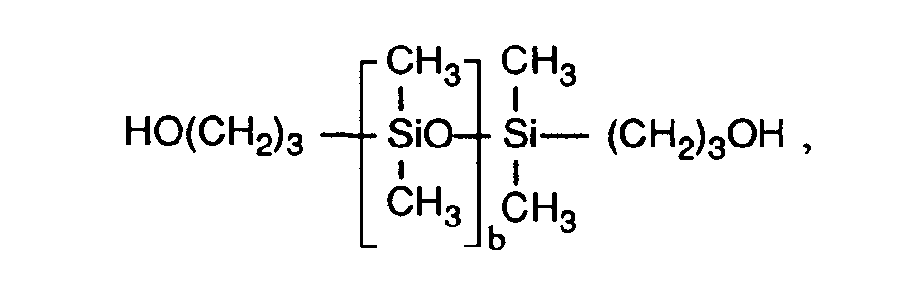
- Zu einer Mischung aus 0,15 Mol (22 Milliliter) Toluylen-2,4-Diisocyanat und 3 Tropfen Benzoylchlorid werden bei 60 °C unter Stickstoffatmosphäre 0,075 Mol (76,5 g) des Polysiloxans (IM@ 11 der Wacker-Chemie GmbH, München) während 1,5 h zugetropft. Die Reaktionslösung wird noch 4 h bei 60 °C gerührt und der Gehalt an Isocyanat mittels Titration zu 1,53 Mol/kg bestimmt (Theorie: 1,46 Mol/kg). Anschliessend wird die Reaktionslösung auf45 °C abgekühlt und 0,13 g Zinn-2-ethylhexanoat zugegeben. Unter Luftatmosphäre werden 0,16 Mol (118,9 g) Polyethylenglycolmonomethylether (MG = 750) langsam zugetropft. Es wird bis zum Verschwinden des Isocyanatgehaltes bei 45 °C gerührt (32 h).
- Ausbeute 221 g orangefarbenes Öl, das bei Stehen langsam kristallisiert. GPC: Mn = 2450, Mw/Mn = 2,33; in THF mit Polystyrol als Standard).
- Herstellung eines Blockcopolymers aus Toluylen-2,4-diisocyanat, Polyethylenglycolmonomethylether und einem Polysiloxan der Formel

- Es wird analog zu Beispiel 3 gearbeitet, wobei 0,025 Mol (40,06 g) des Polysiloxans, 0,05 Mol (7,4 Milliliter) Toluylen-2,4-diisocyanat und 0,05 Mol (97,64 g) Polyethylenglycolmonomethylether (MG = 2000) eingesetzt werden und 146 g des Produkts in Form einer gelblich orangenen kristallinen Masse erhalten werden.
- 90 Gramm eines flüssigen strahlungsempfindlichen Gemisches der Zusammensetzung

- Mit Hilfe eines He/Cd-Lasers mit einer Bestrahlungsenergie von 40 mJ/cm2 werden durch Bestrahlung der Mischung Formkörper hergestellt.
- Die mechanischen Eigenschaften des mittels Laserstrahlen gehärteten Gegenstandes (green strength) und des durch Nachhärtung erhaltenen Gegenstandes werden an der Zugtestmaschine Lloyd® 500 der Firma Lloyd gemessen, wobei die Formkörper typischerweise eine Dimension von 50 Millimetern Länge und einen Querschnitt von 1,2 x 0,3 Millimetern aufweisen.
- Die durch Laserhärtung erhaltenen Formkörper (Grünlinge) weisen folgende Eigenschaften auf: Elastizitätsmodul (E-Modul) gemäss DIN 53371 = 15 N/mm2.
- Zur vollständigen Aushärtung werden die Grünlinge 30 Minuten (min) im Nachhärtungsschrank (PCAder Firma 3D Systems, Inc.) mit maximaler Strahlungsdosis bestrahlt. Die so erhaltenen Formkörper weisen folgende Eigenschaften auf:

- Zur Bestimmung der Schlagzähigkeit wird die Zusammensetzung zwischen zwei Glasplatten im Abstand von 4 mm gegossen und 30 min lang im Nachhärtungsschrank (PCAder Firma 3D Systems, Inc.) mit maximaler Strahlungsdosis ausgehärtet. Es werden Prüfkörper der Abmessung 50 x 10 x 4 mm hergestellt. Schlagzähigkeit (DIN 52453) = 8,0 kJ/m2.
- Die Glasübergangstemperatur (TMA; 10 °C/min; 0,5 N; bestimmt mit Mettler TA 4000) des Materials beträgt 92 °C.
- Ohne Zugabe des Polyoxyalkylen-Polysiloxan-Blockcopolymers werden unter gleichen Bedingungen mit dem oben angeführten strahlungsempfindlichen Gemisch demgegenüber die folgenden Eigenschaftwerte erreicht:

- 90 Gramm eines flüssigen strahlungsempfindlichen Gemisches aus Beispiel 5 werden mit 10 Gramm des Polyoxyalkylen-Polysiloxan-Blockcopolymers aus Beispiel 1 vermischt und es wird noch einmal soviel 1-Hydroxycyclohexylphenylmethanon (Irgacure® 184) zugegeben, dass die Konzentration dieses Photoinitiators in der Gesamtmischung 4 Gewichtsprozent beträgt (Zusammensetzung 6A). In gleicher Weise wird eine Zusammensetzung aus 70 Gramm des oben angeführten strahlungsempfindlichen Gemisches und 30 Gramm des Blockcopolymers aus Beispiel 1 hergestellt (Zusammensetzung 6B).

- 90 Gramm eines flüssigen strahlungsempfindlichen Gemisches aus Beispiel 5 werden mit 10 Gramm des Polyoxyalkylen-Polysiloxan-Blockcopolymers aus Beispiel 3 vermischt und es wird noch einmal soviel 1-Hydroxycyclohexylphenylmethanon (Irgacure®184) zugegeben, dass die Konzentration dieses Photoinitiators in der Gesamtmischung 4 Gewichtsprozent beträgt (Zusammensetzung 7A). In gleicher Weise wird eine Zusammensetzung aus 70 Gramm des oben angeführten strahlungsempfindlichen Gemisches und 30 Gramm des Blockcopolymers aus Beispiel 3 hergestellt (Zusammensetzung 7B).

- 90 Gramm eines flüssigen strahlungsempfindlichen Gemisches aus Beispiel 5 werden mit 10 Gramm des Polyoxyalkylen-Polysiloxan-Blockcopolymers aus Beispiel 4 vermischt und es wird noch einmal soviel Irgacure® 184 zugegeben, dass die Konzentration dieses Photoinitiators in der Gesamtmischung wieder 4 Gewichtsprozent beträgt (Zusammensetzung 8A). In gleicher Weise wird eine Zusammensetzung aus 70 Gramm des oben angeführten strahlungsempfindlichen Gemisches und 30 Gramm des Blockcopolymers aus Beispiel 4 hergestellt (Zusammensetzung 8B).

und als Komponente (iii) entweder 1-Vinylpyrrolidon, Phenoxyethylacrylat, Phenoxyethylmethacrylat oder ein Gemisch von mindestens zwei der genannten Komponenten.
Claims (10)





Applications Claiming Priority (4)
| Application Number | Priority Date | Filing Date | Title |
|---|---|---|---|
| CH254193 | 1993-08-26 | ||
| CH2541/93 | 1993-08-26 | ||
| CH254193 | 1993-08-26 | ||
| US08/292,654 US5461088A (en) | 1993-08-26 | 1994-08-18 | Liquid radiation-curable formulation, in particular for use in stereolithography |
Publications (4)
| Publication Number | Publication Date |
|---|---|
| EP0643329A2 true EP0643329A2 (de) | 1995-03-15 |
| EP0643329A3 EP0643329A3 (de) | 1995-11-02 |
| EP0643329B1 EP0643329B1 (de) | 1998-12-23 |
| EP0643329B2 EP0643329B2 (de) | 2002-02-06 |
Family
ID=25690718
Family Applications (1)
| Application Number | Title | Priority Date | Filing Date |
|---|---|---|---|
| EP94810474A Expired - Lifetime EP0643329B2 (de) | 1993-08-26 | 1994-08-17 | Flüssige strahlungshärtbare Zusammensetzung, insbesondere für die Stereolithographie |
Country Status (8)
| Country | Link |
|---|---|
| US (2) | US5461088A (de) |
| EP (1) | EP0643329B2 (de) |
| JP (1) | JP3581936B2 (de) |
| AT (1) | ATE175034T1 (de) |
| AU (1) | AU674247B2 (de) |
| CA (1) | CA2117572C (de) |
| DE (1) | DE59407524D1 (de) |
| ES (1) | ES2127365T5 (de) |
Cited By (2)
| Publication number | Priority date | Publication date | Assignee | Title |
|---|---|---|---|---|
| US6187891B1 (en) | 1998-08-11 | 2001-02-13 | Wacker-Chemie Gmbh | Linear polyether-polysiloxane copolymers, their preparation and use |
| WO2019206739A1 (en) | 2018-04-25 | 2019-10-31 | Henkel Ag & Co. Kgaa | Process for the preparation of hydroxyl-functionalized polyetherpolysiloxane block copolymers |
Families Citing this family (57)
| Publication number | Priority date | Publication date | Assignee | Title |
|---|---|---|---|---|
| DE69725380T2 (de) * | 1996-05-16 | 2004-08-26 | Teijin Seiki Co. Ltd. | Lichthärtbare Zusammensetzung, Verfahren zur Herstellung eines lichtgehärteten geformten Gegenstands, Form und Verfahren zum Vakuumdruckgiessen und Urethanacrylat |
| US7332537B2 (en) | 1996-09-04 | 2008-02-19 | Z Corporation | Three dimensional printing material system and method |
| GB9814272D0 (en) * | 1998-07-01 | 1998-09-02 | Johnson & Son Inc S C | Silicone compounds and process for making them |
| TR200200570T2 (tr) * | 1999-09-10 | 2002-06-21 | Nargacard S.A. | Veri tabanları için mesaj iletim prosesi ve sistemi |
| JP4624626B2 (ja) | 1999-11-05 | 2011-02-02 | ズィー コーポレイション | 材料システム及び3次元印刷法 |
| US7300619B2 (en) | 2000-03-13 | 2007-11-27 | Objet Geometries Ltd. | Compositions and methods for use in three dimensional model printing |
| US20030207959A1 (en) * | 2000-03-13 | 2003-11-06 | Eduardo Napadensky | Compositions and methods for use in three dimensional model printing |
| US8481241B2 (en) | 2000-03-13 | 2013-07-09 | Stratasys Ltd. | Compositions and methods for use in three dimensional model printing |
| US6569373B2 (en) | 2000-03-13 | 2003-05-27 | Object Geometries Ltd. | Compositions and methods for use in three dimensional model printing |
| US20010050031A1 (en) | 2000-04-14 | 2001-12-13 | Z Corporation | Compositions for three-dimensional printing of solid objects |
| DE10152878B4 (de) * | 2001-10-26 | 2007-08-02 | Fraunhofer-Gesellschaft zur Förderung der angewandten Forschung e.V. | Verfahren zum Erzeugen dreidimensionaler Formkörper oder Oberflächen aus organopolysiloxanhaltigen Ausgangsmaterialien durch Laser-Bestrahlung und deren Verwendung |
| US20030198824A1 (en) * | 2002-04-19 | 2003-10-23 | Fong John W. | Photocurable compositions containing reactive polysiloxane particles |
| GB0212977D0 (en) * | 2002-06-06 | 2002-07-17 | Vantico Ag | Actinic radiation curable compositions and their use |
| US20040087687A1 (en) * | 2002-10-30 | 2004-05-06 | Vantico A&T Us Inc. | Photocurable compositions with phosphite viscosity stabilizers |
| KR101120156B1 (ko) | 2003-05-21 | 2012-02-22 | 제트 코포레이션 | 3d 인쇄 시스템으로부터의 외관 모형용 열가소성 분말물질 시스템 |
| JP4414188B2 (ja) * | 2003-09-30 | 2010-02-10 | 大日本印刷株式会社 | ハードコート層の滑り性を改善した積層体 |
| US7232850B2 (en) | 2003-10-03 | 2007-06-19 | Huntsman Advanced Materials Americas Inc. | Photocurable compositions for articles having stable tensile properties |
| JP2006092693A (ja) * | 2004-09-27 | 2006-04-06 | Fuji Photo Film Co Ltd | 磁気記録媒体 |
| US7715922B1 (en) | 2005-11-16 | 2010-05-11 | Pacesetter, Inc. | Polyethylene oxide and polyisobutylene copolymers and their usage on medical devices |
| US7553546B1 (en) * | 2005-11-16 | 2009-06-30 | Pacesetter, Inc. | Polyethylene oxide and silicone copolymers and their usage on medical devices |
| US7708774B1 (en) | 2005-11-16 | 2010-05-04 | Pacesetter, Inc. | Polyethylene oxide and silicone copolymers and their usage on medical devices |
| US7759435B2 (en) * | 2006-09-26 | 2010-07-20 | Loctite (R&D) Limited | Adducts and curable compositions using same |
| US7905951B2 (en) | 2006-12-08 | 2011-03-15 | Z Corporation | Three dimensional printing material system and method using peroxide cure |
| WO2008086033A1 (en) | 2007-01-10 | 2008-07-17 | Z Corporation | Three-dimensional printing material system with improved color, article performance, and ease of use |
| US7968626B2 (en) | 2007-02-22 | 2011-06-28 | Z Corporation | Three dimensional printing material system and method using plasticizer-assisted sintering |
| JP4549382B2 (ja) | 2007-12-14 | 2010-09-22 | 信越化学工業株式会社 | 新規シルフェニレン化合物およびその製造方法 |
| ES2659081T3 (es) * | 2008-06-20 | 2018-03-13 | Coloplast A/S | Un biomaterial |
| US8500821B2 (en) * | 2008-06-20 | 2013-08-06 | Vysera Biomedical Limited | Esophageal valve device for placing in the cardia |
| EP3360916A1 (de) * | 2009-12-18 | 2018-08-15 | Coloplast A/S | Biomaterial |
| WO2011073968A1 (en) * | 2009-12-18 | 2011-06-23 | Vysera Biomedical Limited | A drug delivery system |
| JP5653173B2 (ja) * | 2010-10-29 | 2015-01-14 | 三洋化成工業株式会社 | 感光性樹脂組成物 |
| US8703385B2 (en) | 2012-02-10 | 2014-04-22 | 3M Innovative Properties Company | Photoresist composition |
| BR112016029766A2 (pt) | 2014-06-23 | 2017-08-22 | Carbon Inc | métodos de produção de objetos tridimensionais de poliuretano a partir de materiais tendo múltiplos mecanismos de endurecimento |
| AU2016215409B2 (en) | 2015-02-05 | 2020-10-01 | Carbon, Inc. | Method of additive manufacturing by intermittent exposure |
| WO2016140886A1 (en) | 2015-03-05 | 2016-09-09 | Carbon3D, Inc. | Fabrication of three dimensional objects with multiple operating modes |
| JP7069006B2 (ja) | 2015-09-04 | 2022-05-17 | カーボン,インコーポレイテッド | 積層造形用シアネートエステル二重硬化樹脂 |
| EP3347399B1 (de) | 2015-09-09 | 2020-12-09 | Carbon, Inc. | Doppelhärtende epoxidharze zur generativen fertigung |
| FI129702B (en) | 2015-10-09 | 2022-07-15 | Inkron Ltd | Three dimensional printing materials and method for making a 3D printed article |
| US10647873B2 (en) | 2015-10-30 | 2020-05-12 | Carbon, Inc. | Dual cure article of manufacture with portions of differing solubility |
| WO2017079502A1 (en) | 2015-11-05 | 2017-05-11 | Carbon, Inc. | Silicone dual cure resins for additive manufacturing |
| US10501572B2 (en) | 2015-12-22 | 2019-12-10 | Carbon, Inc. | Cyclic ester dual cure resins for additive manufacturing |
| US10343331B2 (en) | 2015-12-22 | 2019-07-09 | Carbon, Inc. | Wash liquids for use in additive manufacturing with dual cure resins |
| US10787583B2 (en) | 2015-12-22 | 2020-09-29 | Carbon, Inc. | Method of forming a three-dimensional object comprised of a silicone polymer or co-polymer |
| CN108475008B (zh) | 2015-12-22 | 2020-11-06 | 卡本有限公司 | 一种形成三维物体的方法 |
| US10538031B2 (en) | 2015-12-22 | 2020-01-21 | Carbon, Inc. | Dual cure additive manufacturing of rigid intermediates that generate semi-rigid, flexible, or elastic final products |
| JP7189015B2 (ja) | 2015-12-22 | 2022-12-13 | カーボン,インコーポレイテッド | 二重硬化樹脂を用いた積層造形のための二重前駆体樹脂システム |
| WO2017112483A2 (en) | 2015-12-22 | 2017-06-29 | Carbon, Inc. | Accelerants for additive manufacturing with dual cure resins |
| US10500786B2 (en) | 2016-06-22 | 2019-12-10 | Carbon, Inc. | Dual cure resins containing microwave absorbing materials and methods of using the same |
| WO2018058135A1 (en) * | 2016-09-26 | 2018-03-29 | University Of Washington | Pdms resin for stereolithographic 3d-printing of pdms |
| WO2018094131A1 (en) | 2016-11-21 | 2018-05-24 | Carbon, Inc. | Method of making three-dimensional object by delivering reactive component for subsequent cure |
| US11535686B2 (en) | 2017-03-09 | 2022-12-27 | Carbon, Inc. | Tough, high temperature polymers produced by stereolithography |
| CN107936146A (zh) * | 2017-06-05 | 2018-04-20 | 宁波七诺新材料科技有限公司 | 用于3d打印技术的由可见光引发的光引发剂组合物及应用 |
| JP6894015B2 (ja) | 2017-06-21 | 2021-06-23 | カーボン,インコーポレイテッド | 積層造形の方法 |
| US11504903B2 (en) | 2018-08-28 | 2022-11-22 | Carbon, Inc. | 1K alcohol dual cure resins for additive manufacturing |
| MY204839A (en) * | 2020-11-27 | 2024-09-18 | Petroliam Nasional Berhad Petronas | Demulsifier |
| EP4574427A1 (de) * | 2023-12-18 | 2025-06-25 | Arkema France | Aktinisch härtbare zusammensetzungen und verfahren zu ihrer verwendung zur herstellung eines thermogeformten produkts |
| WO2026070772A1 (ja) * | 2024-09-27 | 2026-04-02 | 三井化学株式会社 | 光硬化性樹脂組成物、光学成型体、および光学デバイス |
Family Cites Families (24)
| Publication number | Priority date | Publication date | Assignee | Title |
|---|---|---|---|---|
| DE425441C (de) * | 1924-03-19 | 1926-02-20 | Eugen Berchtold | Selbsttaetige Schaltvorrichtung fuer elektrische Buegeleisen |
| US3471588A (en) * | 1964-12-29 | 1969-10-07 | Union Carbide Corp | Silicone ether-olefin graft copolymers and process for their production |
| US4582885A (en) * | 1978-07-20 | 1986-04-15 | Minnesota Mining And Manufacturing Company | Shaped plastic articles having replicated microstructure surfaces |
| US4443581A (en) † | 1981-08-27 | 1984-04-17 | Union Carbide Corporation | Impact modified polyarylate blends |
| US4477529A (en) * | 1983-12-29 | 1984-10-16 | General Electric Company | Photocurable polyfunctional acrylic coating and decorative articles coated therewith |
| US4575330A (en) * | 1984-08-08 | 1986-03-11 | Uvp, Inc. | Apparatus for production of three-dimensional objects by stereolithography |
| US4605712A (en) * | 1984-09-24 | 1986-08-12 | Ciba-Geigy Corporation | Unsaturated polysiloxanes and polymers thereof |
| US4833218A (en) * | 1984-12-18 | 1989-05-23 | Dow Corning Corporation | Hydrophilic silicone-organic copolymer elastomers containing bioactine agent |
| DE3517612A1 (de) * | 1985-05-15 | 1987-01-02 | Titmus Eurocon Kontaktlinsen | Modifizierter siliconkautschuk und seine verwendung als material fuer eine optische linse sowie optische linse aus diesem material |
| US4772541A (en) * | 1985-11-20 | 1988-09-20 | The Mead Corporation | Photohardenable compositions containing a dye borate complex and photosensitive materials employing the same |
| EP0389067B1 (de) * | 1985-11-20 | 1994-10-19 | The Mead Corporation | Ionische Farbstoffe |
| US4772530A (en) * | 1986-05-06 | 1988-09-20 | The Mead Corporation | Photosensitive materials containing ionic dye compounds as initiators |
| US4902724A (en) * | 1986-12-22 | 1990-02-20 | General Electric Company | Photocurable acrylic coating composition |
| US4751102A (en) * | 1987-07-27 | 1988-06-14 | The Mead Corporation | Radiation-curable ink and coating compositions containing ionic dye compounds as initiators |
| US5070169A (en) * | 1988-02-26 | 1991-12-03 | Ciba-Geigy Corporation | Wettable, flexible, oxygen permeable contact lens containing block copolymer polysiloxane-polyoxyalkylene backbone units and use thereof |
| US4942001A (en) * | 1988-03-02 | 1990-07-17 | Inc. DeSoto | Method of forming a three-dimensional object by stereolithography and composition therefore |
| DE3807247C1 (de) * | 1988-03-05 | 1989-05-24 | Th. Goldschmidt Ag, 4300 Essen, De | |
| JPH01301708A (ja) * | 1988-05-30 | 1989-12-05 | Shin Etsu Chem Co Ltd | 光硬化性オルガノポリシロキサン組成物 |
| EP0378144B1 (de) * | 1989-01-10 | 1995-03-08 | Ciba-Geigy Ag | Photohärtbare Zusammensetzungen |
| EP0425441B1 (de) † | 1989-10-27 | 1995-12-27 | Ciba-Geigy Ag | Photoempfindliches Gemisch |
| US5268256A (en) † | 1990-08-02 | 1993-12-07 | Ppg Industries, Inc. | Photoimageable electrodepositable photoresist composition for producing non-tacky films |
| JP2876161B2 (ja) † | 1990-08-16 | 1999-03-31 | ジェイエスアール株式会社 | 光学的立体造形用樹脂組成物 |
| JPH0586149A (ja) * | 1991-09-30 | 1993-04-06 | I C I Japan Kk | 光立体成形用樹脂組成物並びに立体成形体の形成方法 |
| DE69332875T2 (de) * | 1992-07-28 | 2003-12-04 | Mitsubishi Chem Corp | Haarkosmetische Zusammensetzung |
-
1994
- 1994-08-17 DE DE59407524T patent/DE59407524D1/de not_active Expired - Fee Related
- 1994-08-17 AT AT94810474T patent/ATE175034T1/de not_active IP Right Cessation
- 1994-08-17 ES ES94810474T patent/ES2127365T5/es not_active Expired - Lifetime
- 1994-08-17 EP EP94810474A patent/EP0643329B2/de not_active Expired - Lifetime
- 1994-08-18 US US08/292,654 patent/US5461088A/en not_active Expired - Lifetime
- 1994-08-24 CA CA002117572A patent/CA2117572C/en not_active Expired - Fee Related
- 1994-08-25 AU AU71490/94A patent/AU674247B2/en not_active Ceased
- 1994-08-25 JP JP22412894A patent/JP3581936B2/ja not_active Expired - Lifetime
-
1995
- 1995-05-24 US US08/449,172 patent/US5629133A/en not_active Expired - Lifetime
Cited By (2)
| Publication number | Priority date | Publication date | Assignee | Title |
|---|---|---|---|---|
| US6187891B1 (en) | 1998-08-11 | 2001-02-13 | Wacker-Chemie Gmbh | Linear polyether-polysiloxane copolymers, their preparation and use |
| WO2019206739A1 (en) | 2018-04-25 | 2019-10-31 | Henkel Ag & Co. Kgaa | Process for the preparation of hydroxyl-functionalized polyetherpolysiloxane block copolymers |
Also Published As
| Publication number | Publication date |
|---|---|
| AU7149094A (en) | 1995-03-09 |
| JP3581936B2 (ja) | 2004-10-27 |
| AU674247B2 (en) | 1996-12-12 |
| ES2127365T5 (es) | 2002-08-16 |
| CA2117572C (en) | 1998-10-13 |
| EP0643329B2 (de) | 2002-02-06 |
| JPH0797403A (ja) | 1995-04-11 |
| EP0643329B1 (de) | 1998-12-23 |
| EP0643329A3 (de) | 1995-11-02 |
| CA2117572A1 (en) | 1995-02-27 |
| DE59407524D1 (de) | 1999-02-04 |
| US5461088A (en) | 1995-10-24 |
| ATE175034T1 (de) | 1999-01-15 |
| US5629133A (en) | 1997-05-13 |
| ES2127365T3 (es) | 1999-04-16 |
Similar Documents
| Publication | Publication Date | Title |
|---|---|---|
| EP0643329B1 (de) | Flüssige strahlungshärtbare Zusammensetzung, insbesondere für die Stereolithographie | |
| EP0638547B1 (de) | Neue urethangruppenhaltige (Meth)Acrylate | |
| EP0604364B1 (de) | Neue (cyclo)aliphatische Epoxidverbindungen | |
| EP0646580B1 (de) | Vinyletherverbindungen mit zusätzlichen von Vinylethergruppen verschiedenen funktionellen Gruppen und deren Verwendung zur Formulierung härtbarer Zusammensetzungen | |
| DE69604909T2 (de) | Flüssige photohärtbare zusammensetzungen | |
| EP0822445B2 (de) | Flüssige, strahlungshärtbare Zusammensetzung, insbesondere für die Stereolithographie | |
| EP0554215B1 (de) | Diacrylate und Dimethacrylate | |
| EP1802700B1 (de) | Niedrigviskose, strahlungshärtbare formulierung zur herstellung von ohrpassstücken | |
| EP0614122B1 (de) | Tetraacrylate enthaltende polymerisierbare Gemische | |
| EP0425441B1 (de) | Photoempfindliches Gemisch | |
| EP0605361B1 (de) | Photoempfindliche Zusammensetzungen | |
| EP0506616A1 (de) | Photoempfindliches Gemisch auf Basis von Acrylaten | |
| DE2726041A1 (de) | Durch bestrahlung haertbare ueberzugskompositionen | |
| DE69017477T2 (de) | Photohärtbare Zusammensetzungen. | |
| DE3107585A1 (de) | Photoempfindliche urethanharzmassen und deren verwendung | |
| DE69027835T2 (de) | Lichtempfindliche Harzzusammensetzung zur Verwendung bei der Herstellung einer Reliefstruktur | |
| DE3604402C2 (de) | Lichtempfindliche Harzmasse und deren Verwendung zur Herstellung einer Photopolymer-Druckplatte | |
| EP0496203B1 (de) | Lagerstabile Lösung eines carboxylgruppenhaltigen Copolymerisats sowie Verfahren zur Herstellung von photoempfindlichen Lacken und Offsetdruckplatten | |
| DE19956532A1 (de) | Vernetzer für ein Photoresist und diesen enthaltende Photoresistzusammensetzung | |
| EP1636651B1 (de) | Niedrigviskose,strahlungshärtbare formulierung, insbesondere für die stereolithographische herstellung von ohrstücken | |
| DE3249708C3 (de) | Lichtempfindliches Element aus einem Träger und einer lichtempfindlichen Schicht | |
| EP0517657B1 (de) | Photoempfindliche Zusammensetzungen | |
| DE3887414T2 (de) | Strahlenhärtbare Harzzusammensetzung, enthaltend ein Pfropfcopolymer auf einer Pfropfgrundlage mit Dicyclopentadienylgruppe. | |
| DE102007017195A1 (de) | Biokompatible, strahlungshärtende Formulierung zur generativen Herstellung von medizintechnischen Produkten, insbesondere Ohrpassstücken und dentalen Formteilen, mittels Bildprojektionssystemen | |
| KR100310329B1 (ko) | 스테레오리소그래피에사용되는액체방사선-경화성배합물 |
Legal Events
| Date | Code | Title | Description |
|---|---|---|---|
| PUAI | Public reference made under article 153(3) epc to a published international application that has entered the european phase |
Free format text: ORIGINAL CODE: 0009012 |
|
| AK | Designated contracting states |
Kind code of ref document: A2 Designated state(s): AT BE CH DE ES FR GB IT LI NL SE |
|
| PUAL | Search report despatched |
Free format text: ORIGINAL CODE: 0009013 |
|
| RHK1 | Main classification (correction) |
Ipc: G03F 7/032 |
|
| AK | Designated contracting states |
Kind code of ref document: A3 Designated state(s): AT BE CH DE ES FR GB IT LI NL SE |
|
| 17P | Request for examination filed |
Effective date: 19960207 |
|
| RAP1 | Party data changed (applicant data changed or rights of an application transferred) |
Owner name: CIBA SC HOLDING AG |
|
| RAP3 | Party data changed (applicant data changed or rights of an application transferred) |
Owner name: CIBA SPECIALTY CHEMICALS HOLDING INC. |
|
| GRAG | Despatch of communication of intention to grant |
Free format text: ORIGINAL CODE: EPIDOS AGRA |
|
| 17Q | First examination report despatched |
Effective date: 19971105 |
|
| GRAG | Despatch of communication of intention to grant |
Free format text: ORIGINAL CODE: EPIDOS AGRA |
|
| GRAH | Despatch of communication of intention to grant a patent |
Free format text: ORIGINAL CODE: EPIDOS IGRA |
|
| GRAH | Despatch of communication of intention to grant a patent |
Free format text: ORIGINAL CODE: EPIDOS IGRA |
|
| GRAA | (expected) grant |
Free format text: ORIGINAL CODE: 0009210 |
|
| AK | Designated contracting states |
Kind code of ref document: B1 Designated state(s): AT BE CH DE ES FR GB IT LI NL SE |
|
| REF | Corresponds to: |
Ref document number: 175034 Country of ref document: AT Date of ref document: 19990115 Kind code of ref document: T |
|
| REG | Reference to a national code |
Ref country code: CH Ref legal event code: EP |
|
| REF | Corresponds to: |
Ref document number: 59407524 Country of ref document: DE Date of ref document: 19990204 |
|
| GBT | Gb: translation of ep patent filed (gb section 77(6)(a)/1977) |
Effective date: 19990202 |
|
| ET | Fr: translation filed | ||
| REG | Reference to a national code |
Ref country code: ES Ref legal event code: FG2A Ref document number: 2127365 Country of ref document: ES Kind code of ref document: T3 |
|
| PLBQ | Unpublished change to opponent data |
Free format text: ORIGINAL CODE: EPIDOS OPPO |
|
| PLBI | Opposition filed |
Free format text: ORIGINAL CODE: 0009260 |
|
| PLBF | Reply of patent proprietor to notice(s) of opposition |
Free format text: ORIGINAL CODE: EPIDOS OBSO |
|
| 26 | Opposition filed |
Opponent name: DSM N.V Effective date: 19990923 |
|
| NLR1 | Nl: opposition has been filed with the epo |
Opponent name: DSM N.V |
|
| PLBF | Reply of patent proprietor to notice(s) of opposition |
Free format text: ORIGINAL CODE: EPIDOS OBSO |
|
| REG | Reference to a national code |
Ref country code: CH Ref legal event code: PUE Owner name: CIBA SPECIALTY CHEMICALS HOLDING INC. TRANSFER- VA |
|
| REG | Reference to a national code |
Ref country code: GB Ref legal event code: 732E |
|
| NLS | Nl: assignments of ep-patents |
Owner name: VANTICO AG |
|
| PLAW | Interlocutory decision in opposition |
Free format text: ORIGINAL CODE: EPIDOS IDOP |
|
| PGFP | Annual fee paid to national office [announced via postgrant information from national office to epo] |
Ref country code: ES Payment date: 20010801 Year of fee payment: 8 |
|
| PLAW | Interlocutory decision in opposition |
Free format text: ORIGINAL CODE: EPIDOS IDOP |
|
| RAP2 | Party data changed (patent owner data changed or rights of a patent transferred) |
Owner name: VANTICO AG |
|
| PUAH | Patent maintained in amended form |
Free format text: ORIGINAL CODE: 0009272 |
|
| STAA | Information on the status of an ep patent application or granted ep patent |
Free format text: STATUS: PATENT MAINTAINED AS AMENDED |
|
| REG | Reference to a national code |
Ref country code: GB Ref legal event code: IF02 |
|
| NLT2 | Nl: modifications (of names), taken from the european patent patent bulletin |
Owner name: VANTICO AG |
|
| 27A | Patent maintained in amended form |
Effective date: 20020206 |
|
| AK | Designated contracting states |
Kind code of ref document: B2 Designated state(s): AT BE CH DE ES FR GB IT LI NL SE |
|
| REG | Reference to a national code |
Ref country code: CH Ref legal event code: AEN Free format text: AUFRECHTERHALTUNG DES PATENTES IN GEAENDERTER FORM |
|
| GBTA | Gb: translation of amended ep patent filed (gb section 77(6)(b)/1977) | ||
| NLR2 | Nl: decision of opposition | ||
| NLR3 | Nl: receipt of modified translations in the netherlands language after an opposition procedure | ||
| ET3 | Fr: translation filed ** decision concerning opposition | ||
| PGFP | Annual fee paid to national office [announced via postgrant information from national office to epo] |
Ref country code: SE Payment date: 20020806 Year of fee payment: 9 |
|
| PGFP | Annual fee paid to national office [announced via postgrant information from national office to epo] |
Ref country code: AT Payment date: 20020813 Year of fee payment: 9 |
|
| REG | Reference to a national code |
Ref country code: ES Ref legal event code: DC2A Kind code of ref document: T5 Effective date: 20020401 |
|
| PGFP | Annual fee paid to national office [announced via postgrant information from national office to epo] |
Ref country code: NL Payment date: 20020829 Year of fee payment: 9 |
|
| PGFP | Annual fee paid to national office [announced via postgrant information from national office to epo] |
Ref country code: BE Payment date: 20021017 Year of fee payment: 9 |
|
| REG | Reference to a national code |
Ref country code: FR Ref legal event code: TP |
|
| REG | Reference to a national code |
Ref country code: GB Ref legal event code: 746 Effective date: 20030116 |
|
| PGFP | Annual fee paid to national office [announced via postgrant information from national office to epo] |
Ref country code: FR Payment date: 20030808 Year of fee payment: 10 |
|
| PGFP | Annual fee paid to national office [announced via postgrant information from national office to epo] |
Ref country code: GB Payment date: 20030813 Year of fee payment: 10 |
|
| PG25 | Lapsed in a contracting state [announced via postgrant information from national office to epo] |
Ref country code: AT Free format text: LAPSE BECAUSE OF NON-PAYMENT OF DUE FEES Effective date: 20030817 |
|
| PG25 | Lapsed in a contracting state [announced via postgrant information from national office to epo] |
Ref country code: SE Free format text: LAPSE BECAUSE OF NON-PAYMENT OF DUE FEES Effective date: 20030818 Ref country code: ES Free format text: LAPSE BECAUSE OF NON-PAYMENT OF DUE FEES Effective date: 20030818 |
|
| PGFP | Annual fee paid to national office [announced via postgrant information from national office to epo] |
Ref country code: CH Payment date: 20030818 Year of fee payment: 10 |
|
| PGFP | Annual fee paid to national office [announced via postgrant information from national office to epo] |
Ref country code: DE Payment date: 20030828 Year of fee payment: 10 |
|
| PG25 | Lapsed in a contracting state [announced via postgrant information from national office to epo] |
Ref country code: BE Free format text: LAPSE BECAUSE OF NON-PAYMENT OF DUE FEES Effective date: 20030831 |
|
| BERE | Be: lapsed |
Owner name: *VANTICO A.G. Effective date: 20030831 |
|
| PG25 | Lapsed in a contracting state [announced via postgrant information from national office to epo] |
Ref country code: NL Free format text: LAPSE BECAUSE OF NON-PAYMENT OF DUE FEES Effective date: 20040301 |
|
| EUG | Se: european patent has lapsed | ||
| NLV4 | Nl: lapsed or anulled due to non-payment of the annual fee |
Effective date: 20040301 |
|
| PG25 | Lapsed in a contracting state [announced via postgrant information from national office to epo] |
Ref country code: GB Free format text: LAPSE BECAUSE OF NON-PAYMENT OF DUE FEES Effective date: 20040817 |
|
| PG25 | Lapsed in a contracting state [announced via postgrant information from national office to epo] |
Ref country code: LI Free format text: LAPSE BECAUSE OF NON-PAYMENT OF DUE FEES Effective date: 20040831 Ref country code: CH Free format text: LAPSE BECAUSE OF NON-PAYMENT OF DUE FEES Effective date: 20040831 |
|
| REG | Reference to a national code |
Ref country code: ES Ref legal event code: FD2A Effective date: 20030818 |
|
| PG25 | Lapsed in a contracting state [announced via postgrant information from national office to epo] |
Ref country code: DE Free format text: LAPSE BECAUSE OF NON-PAYMENT OF DUE FEES Effective date: 20050301 |
|
| GBPC | Gb: european patent ceased through non-payment of renewal fee |
Effective date: 20040817 |
|
| REG | Reference to a national code |
Ref country code: CH Ref legal event code: PL |
|
| PG25 | Lapsed in a contracting state [announced via postgrant information from national office to epo] |
Ref country code: FR Free format text: LAPSE BECAUSE OF NON-PAYMENT OF DUE FEES Effective date: 20050429 |
|
| REG | Reference to a national code |
Ref country code: FR Ref legal event code: ST |
|
| PG25 | Lapsed in a contracting state [announced via postgrant information from national office to epo] |
Ref country code: IT Free format text: LAPSE BECAUSE OF NON-PAYMENT OF DUE FEES;WARNING: LAPSES OF ITALIAN PATENTS WITH EFFECTIVE DATE BEFORE 2007 MAY HAVE OCCURRED AT ANY TIME BEFORE 2007. THE CORRECT EFFECTIVE DATE MAY BE DIFFERENT FROM THE ONE RECORDED. Effective date: 20050817 |