EP0645929A2 - Server für aufgezeichnete Videosignale, der paarweise verkoppelte Spuren verwendet - Google Patents
Server für aufgezeichnete Videosignale, der paarweise verkoppelte Spuren verwendet Download PDFInfo
- Publication number
- EP0645929A2 EP0645929A2 EP94307110A EP94307110A EP0645929A2 EP 0645929 A2 EP0645929 A2 EP 0645929A2 EP 94307110 A EP94307110 A EP 94307110A EP 94307110 A EP94307110 A EP 94307110A EP 0645929 A2 EP0645929 A2 EP 0645929A2
- Authority
- EP
- European Patent Office
- Prior art keywords
- track
- data
- tracks
- video
- disk
- Prior art date
- Legal status (The legal status is an assumption and is not a legal conclusion. Google has not performed a legal analysis and makes no representation as to the accuracy of the status listed.)
- Ceased
Links
Images


Classifications
-
- H—ELECTRICITY
- H04—ELECTRIC COMMUNICATION TECHNIQUE
- H04N—PICTORIAL COMMUNICATION, e.g. TELEVISION
- H04N5/00—Details of television systems
- H04N5/76—Television signal recording
- H04N5/91—Television signal processing therefor
- H04N5/92—Transformation of the television signal for recording, e.g. modulation, frequency changing; Inverse transformation for playback
- H04N5/926—Transformation of the television signal for recording, e.g. modulation, frequency changing; Inverse transformation for playback by pulse code modulation
-
- G—PHYSICS
- G11—INFORMATION STORAGE
- G11B—INFORMATION STORAGE BASED ON RELATIVE MOVEMENT BETWEEN RECORD CARRIER AND TRANSDUCER
- G11B19/00—Driving, starting, stopping record carriers not specifically of filamentary or web form, or of supports therefor; Control thereof; Control of operating function ; Driving both disc and head
- G11B19/02—Control of operating function, e.g. switching from recording to reproducing
-
- G—PHYSICS
- G11—INFORMATION STORAGE
- G11B—INFORMATION STORAGE BASED ON RELATIVE MOVEMENT BETWEEN RECORD CARRIER AND TRANSDUCER
- G11B20/00—Signal processing not specific to the method of recording or reproducing; Circuits therefor
- G11B20/10—Digital recording or reproducing
- G11B20/12—Formatting, e.g. arrangement of data block or words on the record carriers
- G11B20/1217—Formatting, e.g. arrangement of data block or words on the record carriers on discs
- G11B20/1258—Formatting, e.g. arrangement of data block or words on the record carriers on discs where blocks are arranged within multiple radial zones, e.g. Zone Bit Recording or Constant Density Recording discs, MCAV discs, MCLV discs
-
- G—PHYSICS
- G11—INFORMATION STORAGE
- G11B—INFORMATION STORAGE BASED ON RELATIVE MOVEMENT BETWEEN RECORD CARRIER AND TRANSDUCER
- G11B5/00—Recording by magnetisation or demagnetisation of a record carrier; Reproducing by magnetic means; Record carriers therefor
- G11B5/012—Recording on, or reproducing or erasing from, magnetic disks
-
- H—ELECTRICITY
- H04—ELECTRIC COMMUNICATION TECHNIQUE
- H04N—PICTORIAL COMMUNICATION, e.g. TELEVISION
- H04N7/00—Television systems
- H04N7/16—Analogue secrecy systems; Analogue subscription systems
- H04N7/173—Analogue secrecy systems; Analogue subscription systems with two-way working, e.g. subscriber sending a programme selection signal
- H04N7/17309—Transmission or handling of upstream communications
- H04N7/17336—Handling of requests in head-ends
Definitions
- the present invention relates to a video-on-demand storage server and, more particularly, to a method and apparatus for optimizing data retrieval performance in disk drives exploiting zone bit recording.
- video tapes may be rented at video rental stores. Typically, the video tapes are rented for one to three nights at a time.
- the subject matter of the available tapes include movies, entertainment games, and the like.
- VOD video-on-demand
- a VOD system would include a central storage server having numerous videos stored in digital form, a controller, a communication network, and customer equipment boxes.
- a customer would select an available movie (i.e., movie stored in the storage server) using the customer's equipment box.
- the controller would then transmit the selected movie over the communication network to the customer's equipment box.
- the customer views the movie on his/her television without ever having to enter a video rental store.
- file servers exist for applications such as on-line transaction processing
- the architecture of the file servers is not well suited to VOD applications.
- on-line transaction processing tends to transfer numerous unrelated small pieces of data whose identities are disclosed only when urgently needed
- VOD servers are required to concurrently provide a large number of smooth streams of data.
- the rate of each stream is currently several times lower than the sustained transfer rate of a single magnetic disk drive. For example, a typical stream rate is between 1.5 and 6 Megabits per second, whereas the sustained transfer rate of a modern disk is between 15 and 30 Megabits per second.
- VOD systems In order to cost-effectively meet customer demand, video storage servers are required to provide a large number of current streams of data.
- Each storage server consists of one or more magnetic disk drives. These magnetic disk drives must be able to retrieve the data such that the streams of data can be smoothly transmitted at an appropriate speed for customer viewing. Because of the heavy demands placed on storage servers, there is a need for optimization of storage servers. In particular, there is a need to increase the number of streams that can be concurrently sourced by a storage server.
- zone bit recording By using zone bit recording, the amount of data stored to a magnetic disk can be increased. That is, the recording density wasted is substantially reduced as compared with the classical case.
- Zone bit recording is an approximation to fixed linear recording density. More particularly, with zone bit recording, a recording surface is divided into a sequence of concentric zones, and the number of sectors per track in any given zone is equal to the number that fit into the innermost track of that zone at the highest possible linear recording density. As an example, a disk might have between 7 and 15 zones.
- zone bit recording on a magnetic disk with a fixed rotation rate is that the transfer rate will vary considerably (almost by a factor of 2) with track location. As a result, even if access time can be neglected altogether, the number of streams that can be concurrently sourced depends strongly on the reading location. This problem does not occur in magnetic disk drives not employing zone bit recording. The problem also does not occur in compact disks because data, although recorded at a constant linear density, is read at a constant data transfer rate by varying the rotation speed.
- the invention relates to a track-pairing technique that exploits zone bit recording, and yet yields a substantially constant data transfer rate independent of track position.
- the invention can be embodied as a video storage server, a disk drive, or a recording disk.
- a video storage server stores video data for a plurality of video titles, and includes a magnetic disk drive.
- the magnetic disk drive stores video data for the plurality of video titles in a zone bit recording format.
- the video data stored or recorded for each of the video titles includes successive data segments that are alternately recorded in two different tracks which form a track-pair.
- the granularity of alternation may be finer or coarser then one track, so long as the angles swept by the rotating disk to read the two the members of a pair are equal.
- a recording disk stores video information for later retrieval.
- the recording disk includes a plurality of tracks on which the video information for one or more video titles is recorded in a zone bit recording format.
- Each video title is stored as contiguous data alternately over a pair of tracks.
- the invention can be embodied as a method for storing a stream of video data to a storage system so as to obtain a nearly constant data transfer rate when reading the video data from the storage system.
- the data associated with a certain video title is partitioned into data segments.
- two different tracks of the storage system are identified.
- the data segments are recorded to the two different tracks of the storage system using zone bit recording by alternating between the two different tracks.
- the invention can also be embodied as a method for retrieving the stored video data by alternately reading from the two different tracks of the storage system.
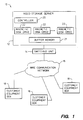
- FIG. 1 is a block diagram of a video-on-demand (VOD) system according to the invention.
- the VOD system 10 includes a video storage server 12, a switching unit 14, a wired communication network 16 and customer equipment boxes 18.
- the video storage server 12 includes a controller 20, a buffer memory 21, and several magnetic disk drives 22.
- the disk drives 22 store video data for numerous video titles (e.g., movie titles).
- the controller 20 controls the reading and writing of data to the disk drives 22.
- Video data which is read from the disk drives 22 is output from the storage server 12 to the communication network 16 via the switching unit 14.
- the video data is then received by certain customers who use their customer equipment box 18 to select the channel broadcasting the video they desire to view. Since the invention pertains to the storage and retrieval of data from the disk drives 22 of the storage server 12, the remaining detailed description will not discuss the details of the other elements of the VOD system 10 which are known in the art.
- the objective of the VOD system 10 is to provide each customer with the video data desired.
- Video data is read from the disks 22 to produce data streams which are transmitted to customers for viewing.
- the data streams are actually sequences of discrete chunks of data (data chunks) which are periodically transmitted in bursts so that over time a constant stream of data is transmitted.
- a sequence of bursts typically one data chunk per active video stream, is referred to as a schedule round.
- the data stream is smoothed out using the buffer memory 21.
- each burst of video data corresponds to about 0.5 to 1.0 second of a video title for each magnetic disk drive 22.
- the objective of the invention is to maximize worst-case disk performance, namely the amount of data that can be read per unit time with the least favorable choice of video titles to be viewed. This is achieved by making disk performance effectively independent of where on the disk it is read.
- the effective disk transfer rate must be independent of the reading location (e.g., track).
- zone bit recording intentionally (to increase disk storage) makes the disk transfer rate vary with the reading location.
- the inventive track-pairing scheme divides the data chunk to be read for any given data stream in a single schedule round into two portions, and then places each portion on a different track such that the total transfer time depends on the amount of data to be read but not on its location on the disk.
- the inventive track-pairing scheme can place the data read for any given stream in a single schedule round on different tracks by alternating between a first track on a first disk drive and a second track on a second disk drive.
- the inventive track-pairing scheme is described below for a single disk drive arrangement as well as for an arrangement with multiple disk drives in a disk array.
- each schedule round requires two disk accesses for each data stream, one access to each of the different tracks being paired together.
- the access time for each access is equal according to the invention, different amounts of data are obtained because of zone bit recording.
- the two accesses return a fixed amount of data in a fixed amount of time, irrespective of the track locations. It should be recognized that the two accesses for a given pair of tracks need not be in immediate time succession and may be separated by accesses on behalf of other streams.
- FIG. 2 is a diagram of a perspective view of a magnetic disk. Although normally such magnetic disks 24 actually contain about 2000 tracks on each of some 10-20 recording surfaces, for illustration purposes, the magnetic disk 24 is illustrated as having eight tracks t1-t8 on a single recording surface and an outer physical boundary 26. With respect to zone bit recording, it is also assumed that each track t1-t8 is in a separate zone, although normally multiple tracks would be included with each zone. In FIG. 2, the track-pairing for a few schedule rounds for two different video titles A and B is illustrated. A data chunk is recorded each schedule round.
- the inventive track-pairing scheme of the invention operates differently.
- Each schedule round a data chunk (A1, A2, ...) for video title A is first divided into two portions. Each portion is then stored to a different track. As shown in FIG. 2, a first portion of chunk Al1 is recorded on track t1, while a second part of chunk Al2 is recorded to track t8.
- the time required to read each of the portions is the same, but the amount of data varies.
- the outer most tracks store more data than inner tracks having smaller radii.
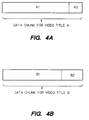
- FIG. 3 is a schematic diagram illustrating the amount of data each track stores for a given chunk. Of the two tracks being paired together, the outer track will store more information because zone bit recording is being utilized. Nevertheless, although two tracks are used, a complete data chunk is read for each schedule round regardless of which track-pair is used.
- FIGS. 4A and 4B are schematic diagrams illustrating this point. In particular, a smaller portion is placed on the inner track of the track-pair and a larger portion is placed on the outer track of the track pair.
- FIG. 3 also illustrates the pairing of tracks in the simplified eight track magnetic disk 24 shown in FIG. 2.
- tracks t1 and t8 are paired
- tracks t2 and t7 are paired
- tracks t3 and t6 are paired
- tracks t4 and t5 are paired.
- the quantity of data storable in each track differs from its neighboring track by an essentially constant amount. Therefore, the quantity of data storable in any given pair of tracks is essentially constant, even for the entire disk.
- the advantage provided by the invention is that the transfer rate of each chunk of data is now independent of the track locations. As a result, guaranteed throughput of a disk drive is approximately 40% greater than that conventionally available. Buffering requirements are also reduced by a factor of about 0.6 as compared with the conventional approach.
- Track-pairing does, however, double the overhead because two accesses are required. instead of the conventional single access. In any case, the two accesses need not occur in immediate time succession.
- a seek-efficient arm-scheduling algorithm for reading several locations on a disk in a fixed round-robin order uses a unidirectional elevator algorithm to schedule the order of track accessing. Normally, this conventional algorithm begins granting access requests at the innermost track and proceeds outward to the outermost track. Upon reaching the outermost track, the arm jumps back to the innermost track and repeats.
- the order of data accesses for the second portions is the reverse of that of the first portions.
- use of a bidirectional elevator seek algorithm partially offsets this overhead penalty.
- the bidirectional algorithm would operate just as the conventional unidirectional algorithm, but instead of jumping back to the innermost track upon reaching the outermost track, the bidirectional algorithm would simply reverse direction and operate the arm to scan back from the outermost to the innermost track reading the requested streams as it goes.
- Movie #1 on track pairs (1, 20), (2, 19), (3, 18) and (4, 17); Movie #2: on track pairs (5, 16), (6, 15) and (7, 14); Movie #3: on track pairs (8, 13), (9, 12) and (10, 11)
- the track access sequence would be: t1, t5, t8; t20, t16, t13; t2, t6, t9; t19, t15, t12; etc., with ";” indicating a reversal in sweeping direction.
- a contiguous sequence of accesses could be: t1, t8, t16; t20, t13, t6; t2, t9, t15; etc.
- An alternative approach to the use of track-pairing is to place the data such that each access lasts as long as the single access of the conventional system.
- This alternative approach can be carried out by doubling the chunk size (as compared with a conventional system) prior to partitioning chunks between a pair of tracks.
- the total transfer time of each chunk remains fixed.
- the average disk transfer rate remains independent of track location.
- the access overhead is the same as for a conventional scheme.
- the amount of buffering required increases by a factor of 1.3 in comparison to the conventional approach.
- the disk drive contains several recording surfaces which form a cylinder.
- the multiple recording surfaces increase the storage density of a single disk drive but function the same as if there is a single magnetic recording surface.
- the magnetic disk 24 is representative of either a single magnetic surface or a cylinder of such magnetic surfaces accessed in lock-step.
- the video data is normally striped across the array of disk drives. For example, a first disk drive would have a first schedule round for a video title stored in a first track, a second disk drive would have a second schedule round for the video title, and so on until all the drives have been accessed and then the cycle repeats.
- the track-pairing can be intra-drive or inter-drive.
- tracks are paired within each drive in the disk array.
- the first data chunk for a given stream is on an outer track of the first drive
- the next data chunk is on an inner track of that drive
- the next two chunks are on the second drive, and so on.
- the two data chunks on each drive can be read in immediate succession, or with additional buffering, the server can allow the controller to optimize the schedule for performance.
- the original approach can also be used.
- tracks are paired, not in one drive, but in pairs of disk drives.
- the data chunks in a data stream are divided into unequal portions and then placed on the pair of disk drives. For example, the large portion of a first data chunk would go to an outer track of a first disk drive, the small portion of the first data chunk would go to an inner track of a second disk drive, the large portion of the second chunk would go to an outer track of a third disk drive.
- any given title would occupy outer tracks on even-numbered disk drives and inner tracks on odd-numbered disk drives, or vice versa.
- each title would alternate between these two options, thereby balancing the use of the drives.
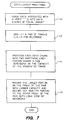
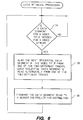
- FIGS. 5-8 are flow charts that illustrate the method according to the invention.
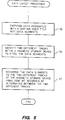
- FIGS. 5 and 6 A basic embodiment of a method according to the invention is illustrated in FIGS. 5 and 6.
- the basic embodiment of the method includes data layout processing (FIG. 5) and data retrieval processing (FIG. 6).
- the data layout processing begins by partitioning 28 data which is associated with a certain video title into data segments.
- the data segments may be of equal or unequal size.
- two different tracks within a magnetic storage device are identified 30 for storage of the data segments.
- the two different tracks form a track-pair as discussed above.
- the tracks can be on a single magnetic disk drive or on different magnetic disk drives of a storage server.
- the data segments are recorded 32 to the two different tracks of the magnetic storage device using zone bit recording by alternating between the two different tracks.
- the data layout processing facilitates the retrieval of the data with an average disk transfer rate that is independent of track position.
- the data retrieval processing begins with a decision 34 based on whether a data segment for a video title is needed for an active video stream. If a data segment is not needed, then the retrieval processing waits until a data seglnent is needed. However, when a data segment is needed, the retrieval processing proceeds to read 36 the next sequential data segment of the video title from one of the two different tracks. Each data segment is read alternately from one of the two different tracks. That is, if the previous data segment was read from a first of the two different tracks, the current data segment is read from the other of the two different tracks.
- the data segments may be equal or unequal in size. When unequal in size, their size is proportional to the circumference of the track position where they are recorded. Further, the two different tracks can be within a single disk drive or within a pair of disk drives. In any case, the data segment read is forwarded 38 to a server controller for distribution.
- data chunks which are of equal size and which make up a video stream for a given video title are stored and retrieved as two separate and unequal parts, each part being retrieved at a different transfer rate but in the same amount of time.
- the data layout process begins by dividing 40 data associated with a video title into data chunks of equal amount or size.
- a pair of tracks are identified 42.
- the paired tracks are (r, N-r+1).
- the data chunks are partitioned 44 into two portions, each portion having a size dependent on the capacity of the associated track.
- the data chunks are partitioned 44 between the two tracks according to the ratio of their capacities. For example, if the last portion of data prior to this chunk was stored in an inner track of a track pair, the current chunk will be partitioned such that the larger of the two pieces is the first one to be viewed. and vice versa.
- the two portions of the data chunks are recorded 46 on the pair of tracks.
- the larger portion is recorded 46 on the outer track (larger capacity) of the pair and the smaller portion is recorded 46 on the inner track (smaller capacity) of the pair.
- the recording makes use of zone bit recording.
- the data retrieval processing begins by a decision 48.
- This decision 48 is the same as the decision 34 in FIG. 6, except that the unit of data is a data chunk which are equally sized pieces of video data from a data stream.
- the data segments in FIG. 6 can be either a complete data chunk or some portion thereof.
- the processing continues as follows. The first portion of the next sequential data chunk for the video title is read 50 from the first track. Thereafter, the remaining portion of the next sequential data chunk of the video title is read 52 from the second track. The remaining portion need not be read immediately after reading the first portion. Finally, the data retrieval process is completed by forwarding 54 the data portions read 50, 52 from the track-pair to a server controller for distribution to customers or the like who desire to view the video title.
- a storage server is normally required to support may data streams simultaneously. Hence, data segments are retrieved for each of a plurality of data streams every schedule round.
- the invention allows the storage server to offer the data streams better performance guarantees which means better service can be offered. Further, the invention enables the storage server to support a greater number of simultaneous streams.
- the chunk sizes may be larger or smaller than a single track.
- the data to be written which is of a known size, would be allocated a range of contiguous pairs of tracks that jointly occupy two contiguous sets of tracks on the drive such that the sum of the capacities of these tracks equals the size of the data.
- the data would be written by alternating between these two contiguous regions. For example. the data could be written to the disk beginning from the outermost track of the outermost region and beginning from the innermost track of the innermost region and proceeding in contiguous locations.
- the invention also applies to a set of pairs of contiguous regions wherein the tracks in each pair of contiguous regions are paired.
- the paired contiguous regions will have the same number of tracks.
- the invention is broadly applicable to any recording device with similar mechanical characteristics and data layout, namely fixed rpm and essentially fixed linear recording density.
- additional recording devices are optical disks, magneto-optical and WORM (write once - read many).
- Hybrid operation can also be obtained. Contiguous regions containing the innermost and/or outermost tracks of a disk drive could be allocated for special purposes and the remaining tracks could be track-paired. The video title at the outermost track would enjoy optimized performance which would be useful for a popular new release movie, while the video title at the innermost track could be used for a low demand movie. The tracks in between would be optimized as a group using track pairing, with data transfer rate being independent of track location.
- any tracks in a contiguous set of tracks may be excluded from pairing, with the remaining tracks paired.
- a generalized method for excluding certain tracks from the pairing would include the steps of: excluding a contiguous region including an arbitrary number of tracks beginning with the innermost and/or the outermost track; pairing the remaining tracks as if they constituted the entire disk; removing an arbitrary subset of track pairs from the pairing; and thereafter using the remaining pairs as described above.
Landscapes
- Engineering & Computer Science (AREA)
- Signal Processing (AREA)
- Multimedia (AREA)
- Signal Processing For Digital Recording And Reproducing (AREA)
- Television Signal Processing For Recording (AREA)
Applications Claiming Priority (2)
| Application Number | Priority Date | Filing Date | Title |
|---|---|---|---|
| US08/128,418 US5510905A (en) | 1993-09-28 | 1993-09-28 | Video storage server using track-pairing |
| US128418 | 1993-09-28 |
Publications (2)
| Publication Number | Publication Date |
|---|---|
| EP0645929A2 true EP0645929A2 (de) | 1995-03-29 |
| EP0645929A3 EP0645929A3 (de) | 1995-10-04 |
Family
ID=22435284
Family Applications (1)
| Application Number | Title | Priority Date | Filing Date |
|---|---|---|---|
| EP94307110A Ceased EP0645929A3 (de) | 1993-09-28 | 1994-09-27 | Server für aufgezeichnete Videosignale, der paarweise verkoppelte Spuren verwendet. |
Country Status (3)
| Country | Link |
|---|---|
| US (1) | US5510905A (de) |
| EP (1) | EP0645929A3 (de) |
| JP (1) | JPH07168672A (de) |
Cited By (6)
| Publication number | Priority date | Publication date | Assignee | Title |
|---|---|---|---|---|
| US5592612A (en) * | 1995-04-28 | 1997-01-07 | Birk; Yitzhak | Method and apparatus for supplying data streams |
| EP0744868A3 (de) * | 1995-05-22 | 1997-05-28 | Sun Microsystems Inc | Verfahren und Gerät um durchschnittliche Plattenübertragungsbandbreite und Zugriffszeit für einen Videoserver zu gewährleisten |
| EP0738081A3 (de) * | 1995-03-27 | 1998-04-15 | Hewlett-Packard Company | Verfahren und System zum Speichern von Videoprogrammen |
| EP0748121A3 (de) * | 1995-06-07 | 2006-02-22 | International Business Machines Corporation | Speichereinheit mit direktem Zugriff für Multimedia und Formatierungsverfahren |
| US8934758B2 (en) | 2010-02-09 | 2015-01-13 | Echostar Global B.V. | Methods and apparatus for presenting supplemental content in association with recorded content |
| US9357260B2 (en) | 2008-05-30 | 2016-05-31 | Echostar Technologies L.L.C. | Methods and apparatus for presenting substitute content in an audio/video stream using text data |
Families Citing this family (33)
| Publication number | Priority date | Publication date | Assignee | Title |
|---|---|---|---|---|
| US5761417A (en) * | 1994-09-08 | 1998-06-02 | International Business Machines Corporation | Video data streamer having scheduler for scheduling read request for individual data buffers associated with output ports of communication node to one storage node |
| US5712976A (en) * | 1994-09-08 | 1998-01-27 | International Business Machines Corporation | Video data streamer for simultaneously conveying same one or different ones of data blocks stored in storage node to each of plurality of communication nodes |
| JPH08147234A (ja) * | 1994-11-17 | 1996-06-07 | Fujitsu Ltd | ストリーム処理装置及び方法 |
| US6240243B1 (en) * | 1994-12-05 | 2001-05-29 | International Business Machines Corporation | Method and apparatus for storing and retrieving scalable video data in a disk-array-based video server |
| EP0716370A3 (de) * | 1994-12-06 | 2005-02-16 | International Business Machines Corporation | Ein Plattenzugangsverfahren, um Multimedia- und Videoinformation auf Wunsch über Grossraumnetze zu liefern |
| US5719983A (en) * | 1995-12-18 | 1998-02-17 | Symbios Logic Inc. | Method and apparatus for placement of video data based on disk zones |
| JPH09186963A (ja) * | 1995-12-28 | 1997-07-15 | Sony Corp | 記録方法及び装置、再生方法及び装置、記録再生方法及び装置、並びにディスク状記録媒体 |
| JPH09233412A (ja) * | 1996-02-23 | 1997-09-05 | Mitsubishi Electric Corp | 映像データの記録再生システム |
| CA2201679A1 (en) | 1996-04-15 | 1997-10-15 | Raju C. Bopardikar | Video data storage |
| GB2312319B (en) | 1996-04-15 | 1998-12-09 | Discreet Logic Inc | Video storage |
| CA2201691C (en) * | 1996-04-15 | 2001-07-17 | Raju C. Bopardikar | Data storage |
| JPH09330178A (ja) * | 1996-06-12 | 1997-12-22 | Sony Corp | データ記録再生装置 |
| US5909693A (en) * | 1996-08-12 | 1999-06-01 | Digital Video Systems, Inc. | System and method for striping data across multiple disks for continuous data streaming and increased bus utilization |
| US5737577A (en) * | 1996-08-12 | 1998-04-07 | Digital Video Systems, Inc. | Complementary block storage for breater minimumdata transfer rate |
| US6078989A (en) * | 1996-10-04 | 2000-06-20 | Sony Corporation | Disc array control method and disc array control apparatus |
| US5926649A (en) * | 1996-10-23 | 1999-07-20 | Industrial Technology Research Institute | Media server for storage and retrieval of voluminous multimedia data |
| JPH10171607A (ja) * | 1996-12-09 | 1998-06-26 | Matsushita Electric Ind Co Ltd | データ転送システム |
| US6564009B2 (en) * | 1997-05-19 | 2003-05-13 | Sony Corporation | Apparatus for recording and/or reproducing data onto and/or from an optical disk and method thereof |
| WO1999018570A1 (en) * | 1997-10-03 | 1999-04-15 | Koninklijke Philips Electronics N.V. | A method and apparatus for providing enhanced transfer rate for a constant angular velocity storage disc |
| JP3016384B2 (ja) | 1997-11-25 | 2000-03-06 | 日本電気株式会社 | 光ディスク記録装置 |
| US6415373B1 (en) | 1997-12-24 | 2002-07-02 | Avid Technology, Inc. | Computer system and process for transferring multiple high bandwidth streams of data between multiple storage units and multiple applications in a scalable and reliable manner |
| US6374336B1 (en) * | 1997-12-24 | 2002-04-16 | Avid Technology, Inc. | Computer system and process for transferring multiple high bandwidth streams of data between multiple storage units and multiple applications in a scalable and reliable manner |
| US7196862B1 (en) | 2000-09-11 | 2007-03-27 | Maxtor Corporation | Coherent phase data segment layout in data storage device |
| GB2374749B (en) * | 2001-04-20 | 2005-04-06 | Discreet Logic Inc | Image data processing |
| US8880709B2 (en) * | 2001-09-12 | 2014-11-04 | Ericsson Television Inc. | Method and system for scheduled streaming of best effort data |
| KR20040099530A (ko) * | 2003-05-19 | 2004-12-02 | 삼성전자주식회사 | 소형 광 디스크, 소형 광 디스크에 데이터를 기록하는장치, 그 방법, 소형 광 디스크에 기록된 데이터를독출하는 장치 및 그 방법 |
| US7284087B2 (en) * | 2004-06-17 | 2007-10-16 | Hewlett-Packard Development Company, L.P. | Method and apparatus for increasing sustainable bandwidth in a multiple disk drive storage system |
| US20060259683A1 (en) * | 2005-05-16 | 2006-11-16 | Oracle International Corporation | Method and system for disk stippling |
| US8134798B1 (en) * | 2005-11-23 | 2012-03-13 | Western Digital Technologies, Inc. | Disk drive maintaining a substantially constant host transfer rate when reading data from varying data rate data tracks across multiple disk surfaces |
| US7680993B2 (en) * | 2006-12-21 | 2010-03-16 | Tandberg Television, Inc. | Local digital asset storage management technique |
| US8165450B2 (en) | 2007-11-19 | 2012-04-24 | Echostar Technologies L.L.C. | Methods and apparatus for filtering content in a video stream using text data |
| US8165451B2 (en) | 2007-11-20 | 2012-04-24 | Echostar Technologies L.L.C. | Methods and apparatus for displaying information regarding interstitials of a video stream |
| US11172269B2 (en) | 2020-03-04 | 2021-11-09 | Dish Network L.L.C. | Automated commercial content shifting in a video streaming system |
Family Cites Families (11)
| Publication number | Priority date | Publication date | Assignee | Title |
|---|---|---|---|---|
| US4205339A (en) * | 1978-07-20 | 1980-05-27 | Eastman Kodak Company | Frame storage and retrieval wherein the frame fields are quadrature amplitude modulated on a single carrier |
| US4858025A (en) * | 1986-09-03 | 1989-08-15 | Fuji Photo Film Co., Ltd. | Electronic still camera |
| NL192766C (nl) * | 1986-10-28 | 1998-01-06 | Mitsubishi Electric Corp | Registratie- en reproductieapparaat voor gesegmenteerde videorastersignalen. |
| US4873679A (en) * | 1986-12-25 | 1989-10-10 | Matsushita Electric Industrial Co., Ltd. | Optical information recording disk and optical information recording disk apparatus |
| JPH01273384A (ja) * | 1988-04-26 | 1989-11-01 | Matsushita Electric Ind Co Ltd | 集積回路装置 |
| US5224217A (en) * | 1988-12-30 | 1993-06-29 | Saied Zangenehpour | Computer system which uses a least-recently-used algorithm for manipulating data tags when performing cache replacement |
| US5087992A (en) * | 1989-05-31 | 1992-02-11 | Seagate Technology, Inc. | Method for assigning tracks on a magnetic data storage disk to different read/write frequency zones |
| JP2513901B2 (ja) * | 1990-06-01 | 1996-07-10 | パイオニア株式会社 | 複数の記録ディスクによるビデオフォ―マット信号記録再生方法 |
| US5257143A (en) * | 1991-01-15 | 1993-10-26 | Zenith Data Systems Corporation | Method and apparatus for positioning head of disk drive using zone-bit-recording |
| US5202799A (en) * | 1991-06-24 | 1993-04-13 | Ibm Corporation | Logical data tracks extending among a plurality of zones of physical tracks of one or more disk devices |
| US5301297A (en) * | 1991-07-03 | 1994-04-05 | Ibm Corp. (International Business Machines Corp.) | Method and means for managing RAID 5 DASD arrays having RAID DASD arrays as logical devices thereof |
-
1993
- 1993-09-28 US US08/128,418 patent/US5510905A/en not_active Expired - Lifetime
-
1994
- 1994-09-27 EP EP94307110A patent/EP0645929A3/de not_active Ceased
- 1994-09-28 JP JP6258705A patent/JPH07168672A/ja active Pending
Cited By (6)
| Publication number | Priority date | Publication date | Assignee | Title |
|---|---|---|---|---|
| EP0738081A3 (de) * | 1995-03-27 | 1998-04-15 | Hewlett-Packard Company | Verfahren und System zum Speichern von Videoprogrammen |
| US5592612A (en) * | 1995-04-28 | 1997-01-07 | Birk; Yitzhak | Method and apparatus for supplying data streams |
| EP0744868A3 (de) * | 1995-05-22 | 1997-05-28 | Sun Microsystems Inc | Verfahren und Gerät um durchschnittliche Plattenübertragungsbandbreite und Zugriffszeit für einen Videoserver zu gewährleisten |
| EP0748121A3 (de) * | 1995-06-07 | 2006-02-22 | International Business Machines Corporation | Speichereinheit mit direktem Zugriff für Multimedia und Formatierungsverfahren |
| US9357260B2 (en) | 2008-05-30 | 2016-05-31 | Echostar Technologies L.L.C. | Methods and apparatus for presenting substitute content in an audio/video stream using text data |
| US8934758B2 (en) | 2010-02-09 | 2015-01-13 | Echostar Global B.V. | Methods and apparatus for presenting supplemental content in association with recorded content |
Also Published As
| Publication number | Publication date |
|---|---|
| JPH07168672A (ja) | 1995-07-04 |
| US5510905A (en) | 1996-04-23 |
| EP0645929A3 (de) | 1995-10-04 |
Similar Documents
| Publication | Publication Date | Title |
|---|---|---|
| US5510905A (en) | Video storage server using track-pairing | |
| JP3308814B2 (ja) | ビデオサーバシステムに於いて平均的なシーク時間及びバンド幅を達成するための方法及びシステム | |
| JP4108121B2 (ja) | プログラム・データを記録する方法および装置 | |
| US5721950A (en) | Method for scheduling I/O transactions for video data storage unit to maintain continuity of number of video streams which is limited by number of I/O transactions | |
| US5732239A (en) | Method for operating a disk storage system which stores video data so as to maintain the continuity of a plurality of video streams | |
| US5721823A (en) | Digital layout method suitable for near video on demand system | |
| US5757415A (en) | On-demand data transmission by dividing input data into blocks and each block into sub-blocks such that the sub-blocks are re-arranged for storage to data storage means | |
| US5758151A (en) | Serial data storage for multiple access demand | |
| US7647459B2 (en) | Multi-stream access scheme for high speed access and recording using a hard disk drive | |
| JP2001067814A (ja) | 放送受信システムにおける記録媒体の記録領域分割配置方法 | |
| US5737577A (en) | Complementary block storage for breater minimumdata transfer rate | |
| US6314232B2 (en) | Data allocation method, recording medium with data recorded by the method, and data server apparatus | |
| KR20010043758A (ko) | 멀티미디어 서버 | |
| Huang et al. | An efficient data placement and retrieval scheme of zoned-disks to support interactive playout for video servers | |
| EP0777392A2 (de) | Informationsspeichersteuerverfahren | |
| US5842046A (en) | Disk drive system for storing a plurality of I frames non-interlaced with respect to B frames by storing B frames in a separate cylinder | |
| JPH09330566A (ja) | 情報記録媒体及び情報格納方法 | |
| KR100594151B1 (ko) | 방송 수신 시스템에서의 기록매체 기록영역 분할배치방법 | |
| JP3153490B2 (ja) | 記録再生装置、及びその記録再生方法 | |
| Tsao et al. | Making a cost-effective storage server for broadcasting digital video services | |
| JPH0854990A (ja) | 動画像情報提供装置 | |
| JPH0927944A (ja) | 動画像情報再生方法 | |
| KR100425488B1 (ko) | 연속매체용화일시스템의일정한읽기성능보장방법 | |
| Xiang et al. | Optical jukebox for video-on-demand system | |
| JPH0856330A (ja) | ディジタル動画番組の早送り及び逆早送り再生のための蓄積・再生制御方法とその装置 |
Legal Events
| Date | Code | Title | Description |
|---|---|---|---|
| PUAI | Public reference made under article 153(3) epc to a published international application that has entered the european phase |
Free format text: ORIGINAL CODE: 0009012 |
|
| AK | Designated contracting states |
Kind code of ref document: A2 Designated state(s): DE FR GB |
|
| PUAL | Search report despatched |
Free format text: ORIGINAL CODE: 0009013 |
|
| AK | Designated contracting states |
Kind code of ref document: A3 Designated state(s): DE FR GB |
|
| 17P | Request for examination filed |
Effective date: 19960401 |
|
| 17Q | First examination report despatched |
Effective date: 19980303 |
|
| GRAG | Despatch of communication of intention to grant |
Free format text: ORIGINAL CODE: EPIDOS AGRA |
|
| STAA | Information on the status of an ep patent application or granted ep patent |
Free format text: STATUS: THE APPLICATION HAS BEEN REFUSED |
|
| 18R | Application refused |
Effective date: 19990506 |