EP0647018A1 - Digitaler Phasenkomparator - Google Patents
Digitaler Phasenkomparator Download PDFInfo
- Publication number
- EP0647018A1 EP0647018A1 EP94410083A EP94410083A EP0647018A1 EP 0647018 A1 EP0647018 A1 EP 0647018A1 EP 94410083 A EP94410083 A EP 94410083A EP 94410083 A EP94410083 A EP 94410083A EP 0647018 A1 EP0647018 A1 EP 0647018A1
- Authority
- EP
- European Patent Office
- Prior art keywords
- signal
- counter
- phase
- fref
- signals
- Prior art date
- Legal status (The legal status is an assumption and is not a legal conclusion. Google has not performed a legal analysis and makes no representation as to the accuracy of the status listed.)
- Granted
Links
- 238000012545 processing Methods 0.000 claims description 4
- 230000000630 rising effect Effects 0.000 description 18
- 238000010586 diagram Methods 0.000 description 13
- 238000012937 correction Methods 0.000 description 8
- 238000005516 engineering process Methods 0.000 description 3
- 230000003071 parasitic effect Effects 0.000 description 3
- 238000010200 validation analysis Methods 0.000 description 3
- 238000001514 detection method Methods 0.000 description 2
- 230000007257 malfunction Effects 0.000 description 2
- 230000007704 transition Effects 0.000 description 2
- 230000002301 combined effect Effects 0.000 description 1
- 230000001934 delay Effects 0.000 description 1
- 238000013461 design Methods 0.000 description 1
- 235000021183 entrée Nutrition 0.000 description 1
- 230000007774 longterm Effects 0.000 description 1
- 238000005259 measurement Methods 0.000 description 1
- 238000000034 method Methods 0.000 description 1
- 238000012986 modification Methods 0.000 description 1
- 230000004048 modification Effects 0.000 description 1
- 230000001360 synchronised effect Effects 0.000 description 1
Images

Classifications
-
- H—ELECTRICITY
- H03—ELECTRONIC CIRCUITRY
- H03D—DEMODULATION OR TRANSFERENCE OF MODULATION FROM ONE CARRIER TO ANOTHER
- H03D13/00—Circuits for comparing the phase or frequency of two mutually-independent oscillations
-
- H—ELECTRICITY
- H03—ELECTRONIC CIRCUITRY
- H03L—AUTOMATIC CONTROL, STARTING, SYNCHRONISATION OR STABILISATION OF GENERATORS OF ELECTRONIC OSCILLATIONS OR PULSES
- H03L7/00—Automatic control of frequency or phase; Synchronisation
- H03L7/06—Automatic control of frequency or phase; Synchronisation using a reference signal applied to a frequency- or phase-locked loop
- H03L7/08—Details of the phase-locked loop
- H03L7/085—Details of the phase-locked loop concerning mainly the frequency- or phase-detection arrangement including the filtering or amplification of its output signal
-
- H—ELECTRICITY
- H03—ELECTRONIC CIRCUITRY
- H03B—GENERATION OF OSCILLATIONS, DIRECTLY OR BY FREQUENCY-CHANGING, BY CIRCUITS EMPLOYING ACTIVE ELEMENTS WHICH OPERATE IN A NON-SWITCHING MANNER; GENERATION OF NOISE BY SUCH CIRCUITS
- H03B2200/00—Indexing scheme relating to details of oscillators covered by H03B
- H03B2200/006—Functional aspects of oscillators
- H03B2200/008—Functional aspects of oscillators making use of a reference frequency
Definitions
- the present invention relates to phase locked loops (PLL), and in particular to a digital phase comparator used in a PLL of which all the elements are produced digitally.
- PLL phase locked loops
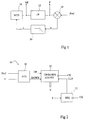
- FIG. 1 schematically represents a conventional PLL architecture.
- the PLL comprises a voltage controlled oscillator (VCO) 10 delivering a frequency NF to a divider by N 12.
- VCO voltage controlled oscillator
- a phase comparator 14 receives the output frequency F of the divider 12 and a reference frequency Fref.
- the phase comparator 14 supplies a phase error signal e to a filter 16, the output c of which controls the oscillator 10.
- the signal F is set in phase and in frequency on the signal Fref.
- the frequency F to be obtained is of the order of 15 kHz
- the frequency NF of the order of 12 MHz (N 768)
- the filter 16 is a low pass filter with a cutoff frequency of a few hundred hertz.
- FIG. 2 represents a conventional digital phase comparator 14.
- This phase comparator comprises a phase / frequency detector (PFD) 18 receiving the signals Fref and F. It supplies UP pulses of widths equal to the phase delays of the signal F relative to the Fref signal, and DOWN pulses of equal widths to the phase advances of signal F with respect to the signal Fref.
- An up / down counter 20 receives a clock signal CK of high frequency compared to that of the signals Fref and F. The counting of the up / down counter 20 is validated by UP pulses, and the down counting by the DOWN pulses.
- a sequencer 22 receiving the signals F and CK, resets the up / down counter 20 between two edges of the signal F, after the content thereof is processed by the filter.
- the up / down counter 20 contains a digital value E corresponding to the sought phase error.
- each UP or DOWN pulse correspond respectively to an edge of the signal Fref and to an edge of the signal F.
- the pulse UP or DOWN then generated is incorrectly shortened or lengthened.
- Such a phase comparator is not suitable for processing horizontal scanning signals in a television set, since the Fref signal can then comprise numerous parasitic pulses.
- the clock signal CK must be of particularly high frequency.
- the frequency of this CK signal should be around 200 megahertz.
- Current technologies do not allow such a fast up / down counter.
- An object of the present invention is to provide a digital phase comparator which can operate with a particularly high clock frequency.
- Another object of the present invention is to provide a digital phase comparator little sensitive to parasitic pulses.
- a digital phase comparator providing digital values corresponding to the phase differences between a first signal having a duty cycle close to 0.5 and a second signal.
- the phase comparator comprises a one-way counter initialized at the frequency of the first signal and clocked by a clock signal of high frequency compared to that of the first and second signals.
- a logic gate validates the counter when the first and second signals are at predetermined respective states.
- a phase difference is considered to be zero when it corresponds to approximately half the capacity of the meter.
- the comparator comprises a flip-flop cooperating with said logic gate to validate the counter only when a predetermined edge of the second signal arrives when the first signal is in its respective predetermined state.
- the comparator comprises a circuit for processing the first signal to reduce the duration of the respective predetermined state thereof by the duration corresponding to the counting by the counter to half of its capacity.
- the comparator comprises a clock generator providing several clock signals of the same frequency but phase shifted by a constant value, these clock signals being successively supplied to the counter at the frequency of the first signal.
- a digital phase comparator uses a one-way counter 30 which has the advantage, if it is asynchronous, of being able to operate with a clock signal CK of frequency as high as '' around 200 MHz in current current technologies (which is not the case for up-down counters).
- the counter 30 receives the output of an AND gate 32 receiving on one input the signal Fref and on another input the signal F inverted.
- the validation signal EN supplied by the gate 32 is sensitive to the states of the signals Fref and F and not to their edges; if one of the signals Fref and F has a spurious pulse, the validation signal EN is only active for the duration of the spurious pulse and the content of the counter 30 varies very little.
- the counter 30 is reset to zero periodically by a signal CLR supplied by a sequencer 22 receiving the signals F and CK.
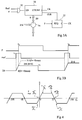
- FIG. 3B illustrates an example of the shape of the signals F and Fref and the corresponding variation of the content E0 of the counter 30.
- the signal F supplied by the divider 12 (FIG. 1) of a PLL, has a duty cycle of 0, 5.
- the Fref signal corresponds to synchronization pulses of supposedly constant width (approximately 4.7 microseconds).
- the frequency of the clock CK is chosen so that the counter counts up to its maximum value (511) for the duration of a pulse of the signal Fref.
- the counter reaches a value (256) equal to half of its capacity. This half value is chosen to match at zero phase error; the rising edges of the signal F are synchronized with the centers of the pulses of the signal Fref.
- the counter 30 initially at zero, is validated and begins to count.
- a rising edge of the signal F occurs.
- the counter 30 remains at 0, which corresponds to a positive maximum error E + Emax (phase advance of the signal F with respect to the signal Fref).
- the counter reaches its maximum value 511 which corresponds to a negative maximum phase error -Emax (phase delay of the signal F with respect to the signal Fref).
- the counter 30 is established at a value between its zero value and its maximum value, corresponding to a phase error E proportional to the actual phase error . For example, at an instant t4, a rising edge of the signal F occurs shortly before the end of a pulse of the signal Fref. The counter 30 reaches a value close to 511 corresponding to a negative phase error E and proportional to the real phase error.
- FIG. 4 represents a diagram of the phase error E provided by the phase comparator of FIG. 3A in function of the actual phase error Er. This diagram is symmetrical with respect to the origin of the diagram. Around the value 0, the error E varies in proportion to the actual error Er. Beyond this linear zone, the error E saturates at its maximum positive value or at its maximum negative value.
- the diagram presents linear ranges with negative slope around the abscissas ⁇ and - ⁇ . This is due to the fact that the counter 30 is also validated when the end of a pulse of the signal Fref occurs after a falling edge of the signal F, as shown in the diagram in FIG. 4. Ideally, the transition is abrupt on the abscissa ⁇ and - ⁇ . However, these linear zones on the abscissa ⁇ and - ⁇ do not cause any malfunction of a PLL if the pulses of the signal Fref are of constant width and correspond to the time that the counter 30 takes to count up to its maximum value (511 ).
- phase comparator If a phase comparator according to the invention is used in the PLL of a horizontal television scanning system, the linear ranges correspond only to approximately 4.7 microseconds on the 64 microseconds of a period of the signal Fref. This would suggest that the PLL cannot converge if the signal F is initially arbitrary.
- FIG. 5 is used to show that such a PLL eventually converges.
- the period of signal F is initially equal to 1.
- the signal period Fref is constant and equal to 1.25.
- the pulse centers of the Fref signal are represented by vertical bars I1, I2 ... Under each bar, the corresponding sign of the error E is represented.
- the filter 16 of a PLL is a proportional and integral correction filter.
- the filter time constant is particularly high, which means that the integral correction only works in the long term, when a large number of values of the same sign of the phase error are supplied. Thus, for simplicity, it can be assumed below that this integral correction does not occur.
- the phase error values are maximum, which is not far from reality since there is a high probability, when the signal F is arbitrary, that the centers of the pulses of the signal Fref occur in the saturation ranges of Figure 4.
- the filter 16 acts on the oscillator 10, which is a frequency synthesizer in a fully digital PLL, so as to correct the period of the signal F by a constant (low) value in the same direction as the phase error E, the correction occurring, for example, at the rising edge of signal F occurring after the measurement of the error.
- the pulses I1 and I2 occur when the signal F is at 0.
- the corresponding errors E are negative.
- the period of the signal F is set to 1 whereas it was previously slightly longer.
- the period of signal F is maintained at 1 as long as the phase error is negative.
- Pulse I3 occurs when signal F is 1.
- the corresponding error E is positive.
- This pulse I3 is fairly close to a preceding rising edge of the signal F; if the period of signal F had not been reduced, the pulse I3 could have occurred while signal F was at 0 and produce a negative error E.
- the period of signal F goes from 1 to 1.125 at the rising edge of signal F following the pulse I3.
- pulses I4 and I5 also occur when the signal F is at 1; the corresponding error is positive and the signal F keeps the period of 1.125. Pulse I5 occurs just before a falling edge of signal F. If the period of signal F had not been increased, pulse I5 could have occurred while signal F was at 0 and produce a negative error E.
- the pulses I6 and I7 occur when the signal F is at 0, the corresponding error E is negative and the period of the signal F becomes 1 at the rising edge following the pulse I6.
- the pulses I8 to I10 occur when the signal F is at 1, and the period of the signal F becomes again 1.125 on the rising edge following the pulse I8.
- FIG. 6 illustrates a situation where the pulses of the signal Fref have any width, and in any case greater than that corresponding to a counting up to the maximum value of the counter 30.
- the phase comparator of FIG. 3A in some cases works incorrectly.
- the counter of FIG. 3A is validated and starts to count.
- the counter 30 counts as long as the Fref signal is at 1. If the pulse of the Fref signal is longer than its normal value, as shown, the content E0 can reach its maximum value corresponding to an error E equal to the value negative maximum -Emax.
- the phase comparator indicates a maximum phase delay of the signal F whereas, in the case of FIG. 6, it is in phase advance. This error is due to the fact that, at the time of the falling edges of the signal F, the width of the end of a pulse of the signal Fref is measured, which is not indicative of the phase error.
- this kind of error is likely to occur when the pulses of the signal Fref are of width greater than that corresponding to a counting up to the maximum value of the counter 30.
- This error is therefore likely to occur, as shown to the right in Figure 6, in a common case (other than in a TV scan) where the F and Fref signals both have a duty cycle of 0.5.
- a phase comparator according to the invention makes it possible to synchronize the rising edges of the signal F on a predetermined position at the start of the parts at 1 of the signal Fref, and not on the center of these parts. This case is particularly unfavorable because it is possible to detect, as shown, a maximum delay of the signal F when it is only slightly ahead.
- FIG. 7 represents an embodiment of digital phase comparator according to the invention making it possible to avoid the aforementioned drawback.
- a gate 32 receives, instead of the inverse of the signal F, the output Q of a flip-flop 34.
- the data input D of this flip-flop receives the value 1, the clock input the signal Fref, and the reset input to 0 R the signal F.
- the counter 30 is validated only if a rising edge of the signal Fref occurs while the signal F is at 0. This removes the erroneous counts in FIG. 6.
- FIG. 8 represents the diagram of the error E provided as a function of the real error Er, obtained with the comparator of FIG. 7. This diagram is not symmetrical and presents an abrupt transition at the points where a falling edge of the signal F occurs at the same time as a falling edge of the signal Fref (before the abscissa - ⁇ and ⁇ ).
- the diagram is made symmetrical, as shown in dotted lines, by reducing the duration to 0 of the signal F by the duration corresponding to the counting of the counter 30 up to half its capacity. This can be achieved, for example, as shown in FIG. 7, by processing the signal F in the sequencer 22 before supplying it to the flip-flop 34 so as to delay its falling edges by 256 periods of the clock CK ( in the example where the maximum value of counter 30 is 511).
- the resolution of the phase comparator described so far is one clock period CK, that is to say that in steady state, the value of the phase error oscillates between -1 and +1.
- the average resolution of the comparator can be improved by the configuration described below.
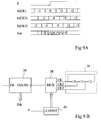
- FIG. 9A illustrates the operation of a PLL provided with a phase comparator according to the invention in steady state.
- the result E (CK) supplied by the comparator can be symbolized by a graduated rule ...- 1, 0, +1, +2 ...
- the value supplied as phase error E corresponds to the graduation opposite from which a rising edge of the Fref signal occurs.
- a rising edge of the signal Fref occurs opposite the graduation 0, which provides a phase error of 0.
- the frequency of the signal F is never exactly as it should be, and the rising edge moves around 0 along the ruler, so that the errors provided tend to oscillate between -1 and +1.
- the phase comparator it is proposed to increase on average the precision of the errors E provided by the phase comparator.
- three rules are used, the aforementioned rule E (CK) and two additional rules E (CK2) and E (CK3) offset one with respect to the previous one by one third of graduation. These rules are used cyclically to provide the error E.
- the first rule provides the value 0
- the second rule also provides the value 0
- the third rule provides the value -1.
- the phase comparator supplies the value -1 once out of three, which corresponds on average to a phase error of -1/3.
- a rule Em (CK3) is shown below the rule E (CK3) corresponding to the average phase errors which are obtained at each three periods of the signal F.
- FIG. 9B represents an embodiment of phase comparator according to the invention making it possible to increase the accuracy of the comparator according to what has been described above.
- An oscillator 36 supplies three clock signals CK, CK2, CK3 of the same frequency and phase shifted by a third of a period with respect to each other.
- the oscillator 36 is for example a ring oscillator with three inverters whose outputs provide the signals CK, CK2, CK3 respectively.
- a multiplexer 38 receives these three clock signals and supplies only one to the counter 30.
- the clock signal to be supplied is selected by a counter up to three 40 receiving the signal F as a clock signal.
Landscapes
- Engineering & Computer Science (AREA)
- Power Engineering (AREA)
- Stabilization Of Oscillater, Synchronisation, Frequency Synthesizers (AREA)
Applications Claiming Priority (2)
| Application Number | Priority Date | Filing Date | Title |
|---|---|---|---|
| FR9311864A FR2710797B1 (fr) | 1993-09-30 | 1993-09-30 | Comparateur de phase numérique. |
| FR9311864 | 1993-09-30 |
Publications (2)
| Publication Number | Publication Date |
|---|---|
| EP0647018A1 true EP0647018A1 (de) | 1995-04-05 |
| EP0647018B1 EP0647018B1 (de) | 1998-04-29 |
Family
ID=9451556
Family Applications (1)
| Application Number | Title | Priority Date | Filing Date |
|---|---|---|---|
| EP94410083A Expired - Lifetime EP0647018B1 (de) | 1993-09-30 | 1994-09-27 | Digitaler Phasenkomparator |
Country Status (5)
| Country | Link |
|---|---|
| US (1) | US5563531A (de) |
| EP (1) | EP0647018B1 (de) |
| JP (1) | JP3786440B2 (de) |
| DE (1) | DE69409903T2 (de) |
| FR (1) | FR2710797B1 (de) |
Families Citing this family (9)
| Publication number | Priority date | Publication date | Assignee | Title |
|---|---|---|---|---|
| US6121816A (en) * | 1999-04-23 | 2000-09-19 | Semtech Corporation | Slave clock generation system and method for synchronous telecommunications networks |
| JP3665512B2 (ja) * | 1999-07-12 | 2005-06-29 | 株式会社東芝 | 二値信号の比較装置及びこれを用いたpll回路 |
| US6826247B1 (en) | 2000-03-24 | 2004-11-30 | Stmicroelectronics, Inc. | Digital phase lock loop |
| US6628276B1 (en) | 2000-03-24 | 2003-09-30 | Stmicroelectronics, Inc. | System for high precision signal phase difference measurement |
| US6661295B2 (en) | 2001-04-09 | 2003-12-09 | Cts Corporation | Controllable crystal oscillator |
| US6946919B2 (en) * | 2002-01-14 | 2005-09-20 | Cts Corporation | Controllable crystal oscillator component |
| US6930516B2 (en) | 2001-05-30 | 2005-08-16 | Agere Systems Inc. | Comparator circuits having non-complementary input structures |
| US6597225B1 (en) | 2002-03-22 | 2003-07-22 | Agere Systems Inc. | Data capture circuit with series channel sampling structure |
| US6700448B1 (en) | 2002-08-30 | 2004-03-02 | Cts Corporation | High performance dual range oscillator module |
Citations (3)
| Publication number | Priority date | Publication date | Assignee | Title |
|---|---|---|---|---|
| US4351002A (en) * | 1980-01-25 | 1982-09-21 | U.S. Philips Corporation | Circuit for correcting phase deviations between the line deflection drive signals and the line synchronizing signals in a television receiver |
| US4654586A (en) * | 1985-06-10 | 1987-03-31 | The United States Of America As Represented By The Secretary Of The Air Force | Digital phase meter apparatus |
| EP0552601A2 (de) * | 1992-01-20 | 1993-07-28 | Nippon Telegraph And Telephone Corporation | Phasenkomparator |
Family Cites Families (1)
| Publication number | Priority date | Publication date | Assignee | Title |
|---|---|---|---|---|
| DE3443925C1 (de) * | 1984-12-01 | 1986-01-30 | Philips Patentverwaltung Gmbh, 2000 Hamburg | Schaltungsanordnung zum Unterscheiden der beiden Halbbilder in einem Fernsehsignal |
-
1993
- 1993-09-30 FR FR9311864A patent/FR2710797B1/fr not_active Expired - Fee Related
-
1994
- 1994-09-15 US US08/306,482 patent/US5563531A/en not_active Expired - Lifetime
- 1994-09-27 DE DE69409903T patent/DE69409903T2/de not_active Expired - Fee Related
- 1994-09-27 EP EP94410083A patent/EP0647018B1/de not_active Expired - Lifetime
- 1994-09-29 JP JP23481094A patent/JP3786440B2/ja not_active Expired - Fee Related
Patent Citations (3)
| Publication number | Priority date | Publication date | Assignee | Title |
|---|---|---|---|---|
| US4351002A (en) * | 1980-01-25 | 1982-09-21 | U.S. Philips Corporation | Circuit for correcting phase deviations between the line deflection drive signals and the line synchronizing signals in a television receiver |
| US4654586A (en) * | 1985-06-10 | 1987-03-31 | The United States Of America As Represented By The Secretary Of The Air Force | Digital phase meter apparatus |
| EP0552601A2 (de) * | 1992-01-20 | 1993-07-28 | Nippon Telegraph And Telephone Corporation | Phasenkomparator |
Also Published As
| Publication number | Publication date |
|---|---|
| DE69409903T2 (de) | 1998-08-27 |
| FR2710797A1 (fr) | 1995-04-07 |
| US5563531A (en) | 1996-10-08 |
| EP0647018B1 (de) | 1998-04-29 |
| DE69409903D1 (de) | 1998-06-04 |
| JP3786440B2 (ja) | 2006-06-14 |
| JPH07162298A (ja) | 1995-06-23 |
| FR2710797B1 (fr) | 1995-12-15 |
Similar Documents
| Publication | Publication Date | Title |
|---|---|---|
| EP0806710B1 (de) | Stabilisation einer elektronischen Schaltung zur Regelung des mechanischen Gangwerks einer Zeitmessvorrichtung | |
| FR2498032A1 (fr) | Synchroniseur de bits pour signaux numeriques | |
| EP1424774B1 (de) | Zufallszahlengenerator | |
| FR2554994A1 (fr) | Dispositif de generation d'une frequence fractionnaire d'une frequence de reference | |
| EP0647018B1 (de) | Digitaler Phasenkomparator | |
| EP0716501B1 (de) | Phasenvergleicher für ein digitales Signal und ein Taktsignal, und entsprechender Phasenregelkreis | |
| FR2790152A1 (fr) | Dispositif de suppression de decalage d'horloge | |
| EP0680170B1 (de) | Übertragungsanordnung für ein Leitungskodiertes Signal über eine Fernsprechleitung mit Frequenzsynchronisierungsschaltung | |
| EP4354279B1 (de) | Erzeugung von echten zufallszahlen mit kohärenter abtastung in fd-soi-technologie | |
| FR2734966A1 (fr) | Diviseur programmable rapide | |
| FR2732526A1 (fr) | Dispositif de faible cout et integrable pour l'acquisition de signaux electriques selon la norme arinc 429 | |
| FR2553542A1 (fr) | Circuit integre a semi-conducteurs | |
| EP0023852A1 (de) | Verfahren und Vorrichtung zur Phasenregelung eines lokalen Taktgebers | |
| FR2773925A1 (fr) | Synthetiseur de frequence a boucle d'asservissement en phase avec circuit de detection d'asservissement | |
| FR2898743A1 (fr) | Compteur avec circuit de correction | |
| EP0134374B1 (de) | Phasenverriegelter Taktgeber | |
| EP0302562B1 (de) | Frequenz-Synthetisierer mit einer Abstimm-Anzeigeeinrichtung | |
| EP0526359B1 (de) | Verfahren und Schaltungsanordnung zur Synchronisierung eines Signals | |
| EP2327160B1 (de) | Analogzähler und ein einen solchen zähler enthaltenden bildgeber | |
| FR2782387A1 (fr) | Circuit de detection de la disparition d'un signal periodique | |
| EP1073204A1 (de) | Anordnung zur Synchronisierung eines Bezugselements eines analogen Signals mit einem Taktsignal | |
| EP0092879A2 (de) | Bitsynchronisiereinrichtung für Modulator-Demodulator oder Empfänger von Datenübertragung | |
| EP0697768B1 (de) | Eine kalibrierte Impulsbreite erzeugender Detektor für den Übergang eines Logiksignals | |
| EP0689315A1 (de) | Phasenkomparator | |
| FR2459585A1 (fr) | Procede et dispositif pour l'affinage de la remise en phase d'une horloge locale |
Legal Events
| Date | Code | Title | Description |
|---|---|---|---|
| PUAI | Public reference made under article 153(3) epc to a published international application that has entered the european phase |
Free format text: ORIGINAL CODE: 0009012 |
|
| AK | Designated contracting states |
Kind code of ref document: A1 Designated state(s): DE FR GB IT |
|
| 17P | Request for examination filed |
Effective date: 19950905 |
|
| 17Q | First examination report despatched |
Effective date: 19961022 |
|
| GRAG | Despatch of communication of intention to grant |
Free format text: ORIGINAL CODE: EPIDOS AGRA |
|
| GRAG | Despatch of communication of intention to grant |
Free format text: ORIGINAL CODE: EPIDOS AGRA |
|
| GRAH | Despatch of communication of intention to grant a patent |
Free format text: ORIGINAL CODE: EPIDOS IGRA |
|
| GRAH | Despatch of communication of intention to grant a patent |
Free format text: ORIGINAL CODE: EPIDOS IGRA |
|
| GRAA | (expected) grant |
Free format text: ORIGINAL CODE: 0009210 |
|
| AK | Designated contracting states |
Kind code of ref document: B1 Designated state(s): DE FR GB IT |
|
| REF | Corresponds to: |
Ref document number: 69409903 Country of ref document: DE Date of ref document: 19980604 |
|
| GBT | Gb: translation of ep patent filed (gb section 77(6)(a)/1977) |
Effective date: 19980605 |
|
| ITF | It: translation for a ep patent filed | ||
| RAP4 | Party data changed (patent owner data changed or rights of a patent transferred) |
Owner name: STMICROELECTRONICS S.A. |
|
| PLBE | No opposition filed within time limit |
Free format text: ORIGINAL CODE: 0009261 |
|
| STAA | Information on the status of an ep patent application or granted ep patent |
Free format text: STATUS: NO OPPOSITION FILED WITHIN TIME LIMIT |
|
| 26N | No opposition filed | ||
| REG | Reference to a national code |
Ref country code: GB Ref legal event code: IF02 |
|
| PGFP | Annual fee paid to national office [announced via postgrant information from national office to epo] |
Ref country code: DE Payment date: 20031009 Year of fee payment: 10 |
|
| PG25 | Lapsed in a contracting state [announced via postgrant information from national office to epo] |
Ref country code: DE Free format text: LAPSE BECAUSE OF NON-PAYMENT OF DUE FEES Effective date: 20050401 |
|
| PGFP | Annual fee paid to national office [announced via postgrant information from national office to epo] |
Ref country code: FR Payment date: 20050823 Year of fee payment: 12 |
|
| PGFP | Annual fee paid to national office [announced via postgrant information from national office to epo] |
Ref country code: GB Payment date: 20050921 Year of fee payment: 12 |
|
| PG25 | Lapsed in a contracting state [announced via postgrant information from national office to epo] |
Ref country code: IT Free format text: LAPSE BECAUSE OF NON-PAYMENT OF DUE FEES;WARNING: LAPSES OF ITALIAN PATENTS WITH EFFECTIVE DATE BEFORE 2007 MAY HAVE OCCURRED AT ANY TIME BEFORE 2007. THE CORRECT EFFECTIVE DATE MAY BE DIFFERENT FROM THE ONE RECORDED. Effective date: 20050927 |
|
| GBPC | Gb: european patent ceased through non-payment of renewal fee |
Effective date: 20060927 |
|
| REG | Reference to a national code |
Ref country code: FR Ref legal event code: ST Effective date: 20070531 |
|
| PG25 | Lapsed in a contracting state [announced via postgrant information from national office to epo] |
Ref country code: GB Free format text: LAPSE BECAUSE OF NON-PAYMENT OF DUE FEES Effective date: 20060927 |
|
| PG25 | Lapsed in a contracting state [announced via postgrant information from national office to epo] |
Ref country code: FR Free format text: LAPSE BECAUSE OF NON-PAYMENT OF DUE FEES Effective date: 20061002 |