EP0647660B1 - Laktonmodifiziertes Polyvinylacetalharz, Verfahren zur Herstellung davon härtbare Harzzusammensetzung, und magnetisches Aufzeichnungsmedium - Google Patents
Laktonmodifiziertes Polyvinylacetalharz, Verfahren zur Herstellung davon härtbare Harzzusammensetzung, und magnetisches Aufzeichnungsmedium Download PDFInfo
- Publication number
- EP0647660B1 EP0647660B1 EP94402252A EP94402252A EP0647660B1 EP 0647660 B1 EP0647660 B1 EP 0647660B1 EP 94402252 A EP94402252 A EP 94402252A EP 94402252 A EP94402252 A EP 94402252A EP 0647660 B1 EP0647660 B1 EP 0647660B1
- Authority
- EP
- European Patent Office
- Prior art keywords
- lactone
- polyvinyl acetal
- resin
- acetal resin
- modified polyvinyl
- Prior art date
- Legal status (The legal status is an assumption and is not a legal conclusion. Google has not performed a legal analysis and makes no representation as to the accuracy of the status listed.)
- Expired - Lifetime
Links
- 229920002554 vinyl polymer Polymers 0.000 title claims description 89
- 239000011354 acetal resin Substances 0.000 title claims description 79
- 229920006324 polyoxymethylene Polymers 0.000 title claims description 79
- DHKHKXVYLBGOIT-UHFFFAOYSA-N 1,1-Diethoxyethane Chemical compound CCOC(C)OCC DHKHKXVYLBGOIT-UHFFFAOYSA-N 0.000 title claims description 78
- 238000002360 preparation method Methods 0.000 title claims description 27
- 238000000034 method Methods 0.000 title claims description 22
- 230000008569 process Effects 0.000 title claims description 16
- 239000011342 resin composition Substances 0.000 title claims description 15
- 229920005989 resin Polymers 0.000 claims description 82
- 239000011347 resin Substances 0.000 claims description 82
- -1 lactone compound Chemical class 0.000 claims description 61
- 125000002887 hydroxy group Chemical group [H]O* 0.000 claims description 49
- 238000006243 chemical reaction Methods 0.000 claims description 28
- 239000000126 substance Substances 0.000 claims description 19
- 125000002496 methyl group Chemical group [H]C([H])([H])* 0.000 claims description 18
- 238000007142 ring opening reaction Methods 0.000 claims description 18
- PAPBSGBWRJIAAV-UHFFFAOYSA-N ε-Caprolactone Chemical compound O=C1CCCCCO1 PAPBSGBWRJIAAV-UHFFFAOYSA-N 0.000 claims description 18
- 150000001875 compounds Chemical class 0.000 claims description 16
- 239000004014 plasticizer Substances 0.000 claims description 16
- JOYRKODLDBILNP-UHFFFAOYSA-N Ethyl urethane Chemical compound CCOC(N)=O JOYRKODLDBILNP-UHFFFAOYSA-N 0.000 claims description 14
- 125000004435 hydrogen atom Chemical class [H]* 0.000 claims description 13
- 239000000203 mixture Substances 0.000 claims description 13
- 125000001436 propyl group Chemical group [H]C([*])([H])C([H])([H])C([H])([H])[H] 0.000 claims description 13
- 239000001257 hydrogen Substances 0.000 claims description 12
- 229910052739 hydrogen Inorganic materials 0.000 claims description 12
- 229910052799 carbon Inorganic materials 0.000 claims description 11
- 229910052701 rubidium Inorganic materials 0.000 claims description 10
- OKTJSMMVPCPJKN-UHFFFAOYSA-N Carbon Chemical compound [C] OKTJSMMVPCPJKN-UHFFFAOYSA-N 0.000 claims description 9
- 125000000524 functional group Chemical group 0.000 claims description 9
- 229920005862 polyol Polymers 0.000 claims description 9
- 229920000877 Melamine resin Polymers 0.000 claims description 7
- 229920000180 alkyd Polymers 0.000 claims description 7
- 239000003822 epoxy resin Substances 0.000 claims description 6
- UQSXHKLRYXJYBZ-UHFFFAOYSA-N iron oxide Inorganic materials [Fe]=O UQSXHKLRYXJYBZ-UHFFFAOYSA-N 0.000 claims description 6
- 229920000647 polyepoxide Polymers 0.000 claims description 6
- 229920001225 polyester resin Polymers 0.000 claims description 6
- 239000004645 polyester resin Substances 0.000 claims description 6
- 239000005056 polyisocyanate Substances 0.000 claims description 6
- 229920001228 polyisocyanate Polymers 0.000 claims description 6
- 229910006297 γ-Fe2O3 Inorganic materials 0.000 claims description 6
- BZHJMEDXRYGGRV-UHFFFAOYSA-N Vinyl chloride Chemical compound ClC=C BZHJMEDXRYGGRV-UHFFFAOYSA-N 0.000 claims description 5
- 229920002433 Vinyl chloride-vinyl acetate copolymer Polymers 0.000 claims description 5
- 150000007974 melamines Chemical class 0.000 claims description 5
- 229920001200 poly(ethylene-vinyl acetate) Polymers 0.000 claims description 5
- 229920005906 polyester polyol Polymers 0.000 claims description 5
- 239000005038 ethylene vinyl acetate Substances 0.000 claims description 4
- SZVJSHCCFOBDDC-UHFFFAOYSA-N iron(II,III) oxide Inorganic materials O=[Fe]O[Fe]O[Fe]=O SZVJSHCCFOBDDC-UHFFFAOYSA-N 0.000 claims description 4
- 150000007524 organic acids Chemical class 0.000 claims description 4
- IQPQWNKOIGAROB-UHFFFAOYSA-N isocyanate group Chemical group [N-]=C=O IQPQWNKOIGAROB-UHFFFAOYSA-N 0.000 claims description 3
- 238000002844 melting Methods 0.000 claims description 3
- 230000008018 melting Effects 0.000 claims description 3
- 239000004640 Melamine resin Substances 0.000 claims description 2
- 229940090961 chromium dioxide Drugs 0.000 claims description 2
- IAQWMWUKBQPOIY-UHFFFAOYSA-N chromium(4+);oxygen(2-) Chemical compound [O-2].[O-2].[Cr+4] IAQWMWUKBQPOIY-UHFFFAOYSA-N 0.000 claims description 2
- AYTAKQFHWFYBMA-UHFFFAOYSA-N chromium(IV) oxide Inorganic materials O=[Cr]=O AYTAKQFHWFYBMA-UHFFFAOYSA-N 0.000 claims description 2
- AJCDFVKYMIUXCR-UHFFFAOYSA-N oxobarium;oxo(oxoferriooxy)iron Chemical compound [Ba]=O.O=[Fe]O[Fe]=O.O=[Fe]O[Fe]=O.O=[Fe]O[Fe]=O.O=[Fe]O[Fe]=O.O=[Fe]O[Fe]=O.O=[Fe]O[Fe]=O AJCDFVKYMIUXCR-UHFFFAOYSA-N 0.000 claims description 2
- 239000004215 Carbon black (E152) Substances 0.000 claims 1
- 150000001338 aliphatic hydrocarbons Chemical group 0.000 claims 1
- 150000004945 aromatic hydrocarbons Chemical class 0.000 claims 1
- 229930195733 hydrocarbon Natural products 0.000 claims 1
- 239000006247 magnetic powder Substances 0.000 claims 1
- 239000003863 metallic catalyst Substances 0.000 claims 1
- YXFVVABEGXRONW-UHFFFAOYSA-N Toluene Chemical compound CC1=CC=CC=C1 YXFVVABEGXRONW-UHFFFAOYSA-N 0.000 description 51
- QLCJOAMJPCOIDI-UHFFFAOYSA-N 1-(butoxymethoxy)butane Chemical class CCCCOCOCCCC QLCJOAMJPCOIDI-UHFFFAOYSA-N 0.000 description 32
- 238000000576 coating method Methods 0.000 description 27
- 239000000243 solution Substances 0.000 description 19
- 239000010410 layer Substances 0.000 description 15
- XLYOFNOQVPJJNP-UHFFFAOYSA-N water Substances O XLYOFNOQVPJJNP-UHFFFAOYSA-N 0.000 description 14
- 150000002596 lactones Chemical group 0.000 description 13
- 238000010521 absorption reaction Methods 0.000 description 10
- 239000003054 catalyst Substances 0.000 description 10
- 125000001570 methylene group Chemical group [H]C([H])([*:1])[*:2] 0.000 description 10
- 230000000052 comparative effect Effects 0.000 description 9
- 238000002156 mixing Methods 0.000 description 9
- 239000003795 chemical substances by application Substances 0.000 description 8
- 150000002431 hydrogen Chemical class 0.000 description 8
- 238000005299 abrasion Methods 0.000 description 7
- 239000002253 acid Substances 0.000 description 7
- 239000008199 coating composition Substances 0.000 description 7
- 230000018044 dehydration Effects 0.000 description 7
- 238000006297 dehydration reaction Methods 0.000 description 7
- RTTZISZSHSCFRH-UHFFFAOYSA-N 1,3-bis(isocyanatomethyl)benzene Chemical compound O=C=NCC1=CC=CC(CN=C=O)=C1 RTTZISZSHSCFRH-UHFFFAOYSA-N 0.000 description 6
- ZWEHNKRNPOVVGH-UHFFFAOYSA-N 2-Butanone Chemical compound CCC(C)=O ZWEHNKRNPOVVGH-UHFFFAOYSA-N 0.000 description 6
- 239000011247 coating layer Substances 0.000 description 6
- 230000004048 modification Effects 0.000 description 6
- 238000012986 modification Methods 0.000 description 6
- 238000000425 proton nuclear magnetic resonance spectrum Methods 0.000 description 6
- 230000009257 reactivity Effects 0.000 description 6
- 239000007787 solid Substances 0.000 description 6
- 239000002904 solvent Substances 0.000 description 6
- 238000004458 analytical method Methods 0.000 description 5
- 230000008859 change Effects 0.000 description 5
- LNEPOXFFQSENCJ-UHFFFAOYSA-N haloperidol Chemical compound C1CC(O)(C=2C=CC(Cl)=CC=2)CCN1CCCC(=O)C1=CC=C(F)C=C1 LNEPOXFFQSENCJ-UHFFFAOYSA-N 0.000 description 5
- 150000003077 polyols Chemical class 0.000 description 5
- PPBRXRYQALVLMV-UHFFFAOYSA-N Styrene Chemical compound C=CC1=CC=CC=C1 PPBRXRYQALVLMV-UHFFFAOYSA-N 0.000 description 4
- 239000000654 additive Substances 0.000 description 4
- 239000011248 coating agent Substances 0.000 description 4
- 238000013329 compounding Methods 0.000 description 4
- 238000010438 heat treatment Methods 0.000 description 4
- 238000002329 infrared spectrum Methods 0.000 description 4
- 239000012948 isocyanate Substances 0.000 description 4
- 239000000047 product Substances 0.000 description 4
- 230000003068 static effect Effects 0.000 description 4
- 238000012360 testing method Methods 0.000 description 4
- FALRKNHUBBKYCC-UHFFFAOYSA-N 2-(chloromethyl)pyridine-3-carbonitrile Chemical compound ClCC1=NC=CC=C1C#N FALRKNHUBBKYCC-UHFFFAOYSA-N 0.000 description 3
- 239000004721 Polyphenylene oxide Substances 0.000 description 3
- 239000004793 Polystyrene Substances 0.000 description 3
- 229910021626 Tin(II) chloride Inorganic materials 0.000 description 3
- 239000000853 adhesive Substances 0.000 description 3
- 230000001070 adhesive effect Effects 0.000 description 3
- 239000011230 binding agent Substances 0.000 description 3
- 230000015572 biosynthetic process Effects 0.000 description 3
- 238000001035 drying Methods 0.000 description 3
- 125000004185 ester group Chemical group 0.000 description 3
- 238000011156 evaluation Methods 0.000 description 3
- 239000011521 glass Substances 0.000 description 3
- 239000007788 liquid Substances 0.000 description 3
- JDSHMPZPIAZGSV-UHFFFAOYSA-N melamine Chemical compound NC1=NC(N)=NC(N)=N1 JDSHMPZPIAZGSV-UHFFFAOYSA-N 0.000 description 3
- 229910052751 metal Inorganic materials 0.000 description 3
- 239000002184 metal Substances 0.000 description 3
- 229920000570 polyether Polymers 0.000 description 3
- 229920002223 polystyrene Polymers 0.000 description 3
- 239000000376 reactant Substances 0.000 description 3
- 238000007151 ring opening polymerisation reaction Methods 0.000 description 3
- 239000007858 starting material Substances 0.000 description 3
- 238000003756 stirring Methods 0.000 description 3
- 229940014800 succinic anhydride Drugs 0.000 description 3
- 238000003786 synthesis reaction Methods 0.000 description 3
- AXZWODMDQAVCJE-UHFFFAOYSA-L tin(II) chloride (anhydrous) Chemical compound [Cl-].[Cl-].[Sn+2] AXZWODMDQAVCJE-UHFFFAOYSA-L 0.000 description 3
- HPGGPRDJHPYFRM-UHFFFAOYSA-J tin(iv) chloride Chemical compound Cl[Sn](Cl)(Cl)Cl HPGGPRDJHPYFRM-UHFFFAOYSA-J 0.000 description 3
- CSCPPACGZOOCGX-UHFFFAOYSA-N Acetone Chemical compound CC(C)=O CSCPPACGZOOCGX-UHFFFAOYSA-N 0.000 description 2
- IJGRMHOSHXDMSA-UHFFFAOYSA-N Atomic nitrogen Chemical compound N#N IJGRMHOSHXDMSA-UHFFFAOYSA-N 0.000 description 2
- SOGAXMICEFXMKE-UHFFFAOYSA-N Butylmethacrylate Chemical compound CCCCOC(=O)C(C)=C SOGAXMICEFXMKE-UHFFFAOYSA-N 0.000 description 2
- 238000005033 Fourier transform infrared spectroscopy Methods 0.000 description 2
- 238000001157 Fourier transform infrared spectrum Methods 0.000 description 2
- QAOWNCQODCNURD-UHFFFAOYSA-N Sulfuric acid Chemical compound OS(O)(=O)=O QAOWNCQODCNURD-UHFFFAOYSA-N 0.000 description 2
- HEDRZPFGACZZDS-MICDWDOJSA-N Trichloro(2H)methane Chemical compound [2H]C(Cl)(Cl)Cl HEDRZPFGACZZDS-MICDWDOJSA-N 0.000 description 2
- GVKORIDPEBYOFR-UHFFFAOYSA-K [butyl-bis(2-ethylhexanoyloxy)stannyl] 2-ethylhexanoate Chemical compound CCCCC(CC)C(=O)O[Sn](CCCC)(OC(=O)C(CC)CCCC)OC(=O)C(CC)CCCC GVKORIDPEBYOFR-UHFFFAOYSA-K 0.000 description 2
- 125000002777 acetyl group Chemical group [H]C([H])([H])C(*)=O 0.000 description 2
- 230000000996 additive effect Effects 0.000 description 2
- 230000001476 alcoholic effect Effects 0.000 description 2
- 125000002723 alicyclic group Chemical group 0.000 description 2
- 125000001931 aliphatic group Chemical group 0.000 description 2
- 150000008064 anhydrides Chemical class 0.000 description 2
- 125000002029 aromatic hydrocarbon group Chemical group 0.000 description 2
- QVGXLLKOCUKJST-UHFFFAOYSA-N atomic oxygen Chemical compound [O] QVGXLLKOCUKJST-UHFFFAOYSA-N 0.000 description 2
- BVFSYZFXJYAPQJ-UHFFFAOYSA-N butyl(oxo)tin Chemical compound CCCC[Sn]=O BVFSYZFXJYAPQJ-UHFFFAOYSA-N 0.000 description 2
- 239000001913 cellulose Substances 0.000 description 2
- 229920002678 cellulose Polymers 0.000 description 2
- 229920001577 copolymer Polymers 0.000 description 2
- 238000004132 cross linking Methods 0.000 description 2
- 238000000354 decomposition reaction Methods 0.000 description 2
- VILAVOFMIJHSJA-UHFFFAOYSA-N dicarbon monoxide Chemical compound [C]=C=O VILAVOFMIJHSJA-UHFFFAOYSA-N 0.000 description 2
- 238000000113 differential scanning calorimetry Methods 0.000 description 2
- 229910001873 dinitrogen Inorganic materials 0.000 description 2
- 239000006185 dispersion Substances 0.000 description 2
- 239000000835 fiber Substances 0.000 description 2
- 238000004817 gas chromatography Methods 0.000 description 2
- 239000000976 ink Substances 0.000 description 2
- 238000004898 kneading Methods 0.000 description 2
- 238000004519 manufacturing process Methods 0.000 description 2
- 239000000463 material Substances 0.000 description 2
- 239000012046 mixed solvent Substances 0.000 description 2
- 229920001220 nitrocellulos Polymers 0.000 description 2
- 239000001301 oxygen Substances 0.000 description 2
- 229910052760 oxygen Inorganic materials 0.000 description 2
- 239000000049 pigment Substances 0.000 description 2
- 229920000728 polyester Polymers 0.000 description 2
- 239000004814 polyurethane Substances 0.000 description 2
- 229920002635 polyurethane Polymers 0.000 description 2
- 229920002689 polyvinyl acetate Polymers 0.000 description 2
- 239000011118 polyvinyl acetate Substances 0.000 description 2
- 230000003134 recirculating effect Effects 0.000 description 2
- 238000010992 reflux Methods 0.000 description 2
- 230000004044 response Effects 0.000 description 2
- 229920006395 saturated elastomer Polymers 0.000 description 2
- 238000005406 washing Methods 0.000 description 2
- MUTGBJKUEZFXGO-OLQVQODUSA-N (3as,7ar)-3a,4,5,6,7,7a-hexahydro-2-benzofuran-1,3-dione Chemical compound C1CCC[C@@H]2C(=O)OC(=O)[C@@H]21 MUTGBJKUEZFXGO-OLQVQODUSA-N 0.000 description 1
- KMOUUZVZFBCRAM-OLQVQODUSA-N (3as,7ar)-3a,4,7,7a-tetrahydro-2-benzofuran-1,3-dione Chemical compound C1C=CC[C@@H]2C(=O)OC(=O)[C@@H]21 KMOUUZVZFBCRAM-OLQVQODUSA-N 0.000 description 1
- GOXQRTZXKQZDDN-UHFFFAOYSA-N 2-Ethylhexyl acrylate Chemical compound CCCCC(CC)COC(=O)C=C GOXQRTZXKQZDDN-UHFFFAOYSA-N 0.000 description 1
- WBIQQQGBSDOWNP-UHFFFAOYSA-N 2-dodecylbenzenesulfonic acid Chemical compound CCCCCCCCCCCCC1=CC=CC=C1S(O)(=O)=O WBIQQQGBSDOWNP-UHFFFAOYSA-N 0.000 description 1
- 229940095095 2-hydroxyethyl acrylate Drugs 0.000 description 1
- OMIGHNLMNHATMP-UHFFFAOYSA-N 2-hydroxyethyl prop-2-enoate Chemical compound OCCOC(=O)C=C OMIGHNLMNHATMP-UHFFFAOYSA-N 0.000 description 1
- NYHNVHGFPZAZGA-UHFFFAOYSA-N 2-hydroxyhexanoic acid Chemical compound CCCCC(O)C(O)=O NYHNVHGFPZAZGA-UHFFFAOYSA-N 0.000 description 1
- UPMLOUAZCHDJJD-UHFFFAOYSA-N 4,4'-Diphenylmethane Diisocyanate Chemical compound C1=CC(N=C=O)=CC=C1CC1=CC=C(N=C=O)C=C1 UPMLOUAZCHDJJD-UHFFFAOYSA-N 0.000 description 1
- SHDLPQHFZRTKBH-UHFFFAOYSA-N 4,4,6-trimethyloxepan-2-one Chemical compound CC1COC(=O)CC(C)(C)C1 SHDLPQHFZRTKBH-UHFFFAOYSA-N 0.000 description 1
- OSKVFHONCZMKCM-UHFFFAOYSA-N 4,6,6-trimethyloxepan-2-one Chemical compound CC1CC(=O)OCC(C)(C)C1 OSKVFHONCZMKCM-UHFFFAOYSA-N 0.000 description 1
- APRRQJCCBSJQOQ-UHFFFAOYSA-N 4-amino-5-hydroxynaphthalene-2,7-disulfonic acid Chemical compound OS(=O)(=O)C1=CC(O)=C2C(N)=CC(S(O)(=O)=O)=CC2=C1 APRRQJCCBSJQOQ-UHFFFAOYSA-N 0.000 description 1
- YHTLGFCVBKENTE-UHFFFAOYSA-N 4-methyloxan-2-one Chemical compound CC1CCOC(=O)C1 YHTLGFCVBKENTE-UHFFFAOYSA-N 0.000 description 1
- CHXLFXLPKLZALY-UHFFFAOYSA-N 4-methyloxepan-2-one Chemical compound CC1CCCOC(=O)C1 CHXLFXLPKLZALY-UHFFFAOYSA-N 0.000 description 1
- MWSKJDNQKGCKPA-UHFFFAOYSA-N 6-methyl-3a,4,5,7a-tetrahydro-2-benzofuran-1,3-dione Chemical compound C1CC(C)=CC2C(=O)OC(=O)C12 MWSKJDNQKGCKPA-UHFFFAOYSA-N 0.000 description 1
- NIXOWILDQLNWCW-UHFFFAOYSA-M Acrylate Chemical compound [O-]C(=O)C=C NIXOWILDQLNWCW-UHFFFAOYSA-M 0.000 description 1
- 0 CON(*)CC[N+](CCCCCCCCCO*)[O-] Chemical compound CON(*)CC[N+](CCCCCCCCCO*)[O-] 0.000 description 1
- 244000025254 Cannabis sativa Species 0.000 description 1
- VEXZGXHMUGYJMC-UHFFFAOYSA-M Chloride anion Chemical compound [Cl-] VEXZGXHMUGYJMC-UHFFFAOYSA-M 0.000 description 1
- XZMCDFZZKTWFGF-UHFFFAOYSA-N Cyanamide Chemical compound NC#N XZMCDFZZKTWFGF-UHFFFAOYSA-N 0.000 description 1
- 229920003270 Cymel® Polymers 0.000 description 1
- MQIUGAXCHLFZKX-UHFFFAOYSA-N Di-n-octyl phthalate Natural products CCCCCCCCOC(=O)C1=CC=CC=C1C(=O)OCCCCCCCC MQIUGAXCHLFZKX-UHFFFAOYSA-N 0.000 description 1
- ZNZYKNKBJPZETN-WELNAUFTSA-N Dialdehyde 11678 Chemical compound N1C2=CC=CC=C2C2=C1[C@H](C[C@H](/C(=C/O)C(=O)OC)[C@@H](C=C)C=O)NCC2 ZNZYKNKBJPZETN-WELNAUFTSA-N 0.000 description 1
- 241000196324 Embryophyta Species 0.000 description 1
- IMROMDMJAWUWLK-UHFFFAOYSA-N Ethenol Chemical group OC=C IMROMDMJAWUWLK-UHFFFAOYSA-N 0.000 description 1
- IAYPIBMASNFSPL-UHFFFAOYSA-N Ethylene oxide Chemical compound C1CO1 IAYPIBMASNFSPL-UHFFFAOYSA-N 0.000 description 1
- 239000005057 Hexamethylene diisocyanate Substances 0.000 description 1
- UFHFLCQGNIYNRP-UHFFFAOYSA-N Hydrogen Chemical compound [H][H] UFHFLCQGNIYNRP-UHFFFAOYSA-N 0.000 description 1
- WOBHKFSMXKNTIM-UHFFFAOYSA-N Hydroxyethyl methacrylate Chemical compound CC(=C)C(=O)OCCO WOBHKFSMXKNTIM-UHFFFAOYSA-N 0.000 description 1
- DGAQECJNVWCQMB-PUAWFVPOSA-M Ilexoside XXIX Chemical compound C[C@@H]1CC[C@@]2(CC[C@@]3(C(=CC[C@H]4[C@]3(CC[C@@H]5[C@@]4(CC[C@@H](C5(C)C)OS(=O)(=O)[O-])C)C)[C@@H]2[C@]1(C)O)C)C(=O)O[C@H]6[C@@H]([C@H]([C@@H]([C@H](O6)CO)O)O)O.[Na+] DGAQECJNVWCQMB-PUAWFVPOSA-M 0.000 description 1
- 239000005058 Isophorone diisocyanate Substances 0.000 description 1
- AFCARXCZXQIEQB-UHFFFAOYSA-N N-[3-oxo-3-(2,4,6,7-tetrahydrotriazolo[4,5-c]pyridin-5-yl)propyl]-2-[[3-(trifluoromethoxy)phenyl]methylamino]pyrimidine-5-carboxamide Chemical compound O=C(CCNC(=O)C=1C=NC(=NC=1)NCC1=CC(=CC=C1)OC(F)(F)F)N1CC2=C(CC1)NN=N2 AFCARXCZXQIEQB-UHFFFAOYSA-N 0.000 description 1
- 238000005481 NMR spectroscopy Methods 0.000 description 1
- LGRFSURHDFAFJT-UHFFFAOYSA-N Phthalic anhydride Natural products C1=CC=C2C(=O)OC(=O)C2=C1 LGRFSURHDFAFJT-UHFFFAOYSA-N 0.000 description 1
- 239000004372 Polyvinyl alcohol Substances 0.000 description 1
- ZLMJMSJWJFRBEC-UHFFFAOYSA-N Potassium Chemical compound [K] ZLMJMSJWJFRBEC-UHFFFAOYSA-N 0.000 description 1
- GOOHAUXETOMSMM-UHFFFAOYSA-N Propylene oxide Chemical compound CC1CO1 GOOHAUXETOMSMM-UHFFFAOYSA-N 0.000 description 1
- 229910000831 Steel Inorganic materials 0.000 description 1
- RTAQQCXQSZGOHL-UHFFFAOYSA-N Titanium Chemical compound [Ti] RTAQQCXQSZGOHL-UHFFFAOYSA-N 0.000 description 1
- BJSBGAIKEORPFG-UHFFFAOYSA-N [[6-amino-1,2,3,4-tetramethoxy-4-(methoxyamino)-1,3,5-triazin-2-yl]-methoxyamino]methanol Chemical compound CONC1(N(C(N(C(=N1)N)OC)(N(CO)OC)OC)OC)OC BJSBGAIKEORPFG-UHFFFAOYSA-N 0.000 description 1
- UKLDJPRMSDWDSL-UHFFFAOYSA-L [dibutyl(dodecanoyloxy)stannyl] dodecanoate Chemical compound CCCCCCCCCCCC(=O)O[Sn](CCCC)(CCCC)OC(=O)CCCCCCCCCCC UKLDJPRMSDWDSL-UHFFFAOYSA-L 0.000 description 1
- 150000001252 acrylic acid derivatives Chemical class 0.000 description 1
- 238000005276 aerator Methods 0.000 description 1
- 150000001298 alcohols Chemical class 0.000 description 1
- 150000001299 aldehydes Chemical class 0.000 description 1
- 229910052783 alkali metal Inorganic materials 0.000 description 1
- 150000001340 alkali metals Chemical class 0.000 description 1
- AZDRQVAHHNSJOQ-UHFFFAOYSA-N alumane Chemical class [AlH3] AZDRQVAHHNSJOQ-UHFFFAOYSA-N 0.000 description 1
- 229910052782 aluminium Inorganic materials 0.000 description 1
- XAGFODPZIPBFFR-UHFFFAOYSA-N aluminium Chemical compound [Al] XAGFODPZIPBFFR-UHFFFAOYSA-N 0.000 description 1
- 150000001412 amines Chemical class 0.000 description 1
- BJQHLKABXJIVAM-UHFFFAOYSA-N bis(2-ethylhexyl) phthalate Chemical compound CCCCC(CC)COC(=O)C1=CC=CC=C1C(=O)OCC(CC)CCCC BJQHLKABXJIVAM-UHFFFAOYSA-N 0.000 description 1
- YHWCPXVTRSHPNY-UHFFFAOYSA-N butan-1-olate;titanium(4+) Chemical compound [Ti+4].CCCC[O-].CCCC[O-].CCCC[O-].CCCC[O-] YHWCPXVTRSHPNY-UHFFFAOYSA-N 0.000 description 1
- JHIWVOJDXOSYLW-UHFFFAOYSA-N butyl 2,2-difluorocyclopropane-1-carboxylate Chemical compound CCCCOC(=O)C1CC1(F)F JHIWVOJDXOSYLW-UHFFFAOYSA-N 0.000 description 1
- 239000006227 byproduct Substances 0.000 description 1
- 238000003490 calendering Methods 0.000 description 1
- 150000001244 carboxylic acid anhydrides Chemical group 0.000 description 1
- 238000011109 contamination Methods 0.000 description 1
- 238000007334 copolymerization reaction Methods 0.000 description 1
- 238000007872 degassing Methods 0.000 description 1
- 230000006866 deterioration Effects 0.000 description 1
- JGFBRKRYDCGYKD-UHFFFAOYSA-N dibutyl(oxo)tin Chemical compound CCCC[Sn](=O)CCCC JGFBRKRYDCGYKD-UHFFFAOYSA-N 0.000 description 1
- 125000005442 diisocyanate group Chemical group 0.000 description 1
- 238000007598 dipping method Methods 0.000 description 1
- 229940060296 dodecylbenzenesulfonic acid Drugs 0.000 description 1
- 238000004070 electrodeposition Methods 0.000 description 1
- 150000002148 esters Chemical class 0.000 description 1
- QGEOKXWFGANCJL-UHFFFAOYSA-N ethenyl acetate;hydrochloride Chemical compound Cl.CC(=O)OC=C QGEOKXWFGANCJL-UHFFFAOYSA-N 0.000 description 1
- IPZIVCLZBFDXTA-UHFFFAOYSA-N ethyl n-prop-2-enoylcarbamate Chemical compound CCOC(=O)NC(=O)C=C IPZIVCLZBFDXTA-UHFFFAOYSA-N 0.000 description 1
- 238000009408 flooring Methods 0.000 description 1
- 239000006260 foam Substances 0.000 description 1
- 238000001879 gelation Methods 0.000 description 1
- 230000009477 glass transition Effects 0.000 description 1
- RRAMGCGOFNQTLD-UHFFFAOYSA-N hexamethylene diisocyanate Chemical compound O=C=NCCCCCCN=C=O RRAMGCGOFNQTLD-UHFFFAOYSA-N 0.000 description 1
- 229920001519 homopolymer Polymers 0.000 description 1
- 125000002768 hydroxyalkyl group Chemical group 0.000 description 1
- 239000011229 interlayer Substances 0.000 description 1
- 238000011835 investigation Methods 0.000 description 1
- NIMLQBUJDJZYEJ-UHFFFAOYSA-N isophorone diisocyanate Chemical compound CC1(C)CC(N=C=O)CC(C)(CN=C=O)C1 NIMLQBUJDJZYEJ-UHFFFAOYSA-N 0.000 description 1
- 239000004922 lacquer Substances 0.000 description 1
- 238000012423 maintenance Methods 0.000 description 1
- FPYJFEHAWHCUMM-UHFFFAOYSA-N maleic anhydride Chemical compound O=C1OC(=O)C=C1 FPYJFEHAWHCUMM-UHFFFAOYSA-N 0.000 description 1
- 150000002736 metal compounds Chemical class 0.000 description 1
- 229910001507 metal halide Inorganic materials 0.000 description 1
- 150000005309 metal halides Chemical class 0.000 description 1
- VYKXQOYUCMREIS-UHFFFAOYSA-N methylhexahydrophthalic anhydride Chemical compound C1CCCC2C(=O)OC(=O)C21C VYKXQOYUCMREIS-UHFFFAOYSA-N 0.000 description 1
- 239000012299 nitrogen atmosphere Substances 0.000 description 1
- WWZKQHOCKIZLMA-UHFFFAOYSA-M octanoate Chemical compound CCCCCCCC([O-])=O WWZKQHOCKIZLMA-UHFFFAOYSA-M 0.000 description 1
- 239000002245 particle Substances 0.000 description 1
- 239000005011 phenolic resin Substances 0.000 description 1
- 229920006267 polyester film Polymers 0.000 description 1
- 229920001296 polysiloxane Polymers 0.000 description 1
- 229920002451 polyvinyl alcohol Polymers 0.000 description 1
- 239000004800 polyvinyl chloride Substances 0.000 description 1
- 229920000915 polyvinyl chloride Polymers 0.000 description 1
- 229910052700 potassium Inorganic materials 0.000 description 1
- 239000011591 potassium Substances 0.000 description 1
- 239000000843 powder Substances 0.000 description 1
- 238000012545 processing Methods 0.000 description 1
- 238000005086 pumping Methods 0.000 description 1
- 150000003222 pyridines Chemical class 0.000 description 1
- 230000008439 repair process Effects 0.000 description 1
- 238000007127 saponification reaction Methods 0.000 description 1
- 229910052708 sodium Inorganic materials 0.000 description 1
- 239000011734 sodium Substances 0.000 description 1
- 239000010959 steel Substances 0.000 description 1
- 238000003860 storage Methods 0.000 description 1
- 239000000758 substrate Substances 0.000 description 1
- 150000003512 tertiary amines Chemical class 0.000 description 1
- 229920005992 thermoplastic resin Polymers 0.000 description 1
- 239000012974 tin catalyst Substances 0.000 description 1
- 230000001988 toxicity Effects 0.000 description 1
- 231100000419 toxicity Toxicity 0.000 description 1
- 230000007704 transition Effects 0.000 description 1
- VOITXYVAKOUIBA-UHFFFAOYSA-N triethylaluminium Chemical compound CC[Al](CC)CC VOITXYVAKOUIBA-UHFFFAOYSA-N 0.000 description 1
- SRPWOOOHEPICQU-UHFFFAOYSA-N trimellitic anhydride Chemical compound OC(=O)C1=CC=C2C(=O)OC(=O)C2=C1 SRPWOOOHEPICQU-UHFFFAOYSA-N 0.000 description 1
- 238000005303 weighing Methods 0.000 description 1
- 230000002087 whitening effect Effects 0.000 description 1
- 239000008096 xylene Substances 0.000 description 1
- LRXTYHSAJDENHV-UHFFFAOYSA-H zinc phosphate Chemical compound [Zn+2].[Zn+2].[Zn+2].[O-]P([O-])([O-])=O.[O-]P([O-])([O-])=O LRXTYHSAJDENHV-UHFFFAOYSA-H 0.000 description 1
- 229910000165 zinc phosphate Inorganic materials 0.000 description 1
Images


Classifications
-
- C—CHEMISTRY; METALLURGY
- C08—ORGANIC MACROMOLECULAR COMPOUNDS; THEIR PREPARATION OR CHEMICAL WORKING-UP; COMPOSITIONS BASED THEREON
- C08F—MACROMOLECULAR COMPOUNDS OBTAINED BY REACTIONS ONLY INVOLVING CARBON-TO-CARBON UNSATURATED BONDS
- C08F8/00—Chemical modification by after-treatment
- C08F8/14—Esterification
-
- C—CHEMISTRY; METALLURGY
- C08—ORGANIC MACROMOLECULAR COMPOUNDS; THEIR PREPARATION OR CHEMICAL WORKING-UP; COMPOSITIONS BASED THEREON
- C08F—MACROMOLECULAR COMPOUNDS OBTAINED BY REACTIONS ONLY INVOLVING CARBON-TO-CARBON UNSATURATED BONDS
- C08F8/00—Chemical modification by after-treatment
-
- C—CHEMISTRY; METALLURGY
- C08—ORGANIC MACROMOLECULAR COMPOUNDS; THEIR PREPARATION OR CHEMICAL WORKING-UP; COMPOSITIONS BASED THEREON
- C08F—MACROMOLECULAR COMPOUNDS OBTAINED BY REACTIONS ONLY INVOLVING CARBON-TO-CARBON UNSATURATED BONDS
- C08F8/00—Chemical modification by after-treatment
- C08F8/14—Esterification
- C08F8/16—Lactonisation
Definitions
- the present invention relates to a novel lactone-modified polyvinyl acetal resin in which the ring of a lactone compound is opened by hydroxyl groups in a polyvinyl acetal resin and a process for the preparation thereof.
- novel lactone-modified polyvinyl acetal resin of the present invention can be used as a polyol resin for coatings curable at ordinary temperatures or in heating, adhesives, binders, a processing agent for fibers, and a curable resin composition by mixing with a curing agent which can react with hydroxyl groups.
- novel lactone-modified polyvinyl acetal resin of the present invention has graft chains containing primary hydroxyl groups bonded to the ester group derived from a lactone compound.
- the present invention relates to a novel curable resin composition which comprises the lactone-modified polyvinyl acetal resin and a compound having functional groups capable of reacting with hydroxyl groups.
- the present invention relates to a composition for a magnetic recording medium which comprises (a) a lactone-modified polyvinyl acetal resin as set forth in claim 1, (b) a urethane prepolymer, (c) a polyisocyanate compound, (d) a powdered magnetic substance, and, optionally, (e) at least one selected from the group consisting of a polyester resin, an ethylene-vinyl acetate copolymer, a vinyl chloride resin having a plasticizer, and a vinyl chloride-vinyl acetate copolymer having a plasticizer.
- the present invention relates to a novel lactone-modified polyvinyl acetal resin having carboxylic groups at terminals of graft chains, a process for the preparation thereof, and a curable resin composition.
- a polyvinyl acetal resin is one of the thermoplastic resins which has been commercially used as a polyol resin for various coatings, adhesives, binders for powdered magnetic substances used for a magnetic recording media, a treatment agent for fibers, and an interlayer for multilayers glass used as windshields in cars, and which has the characteristics of an excellent resistance to light, transparency, dispersity in pigments, toughness, and adhesion.
- thermoplasticity must be further improved. Furthermore, in the case when a polyvinyl acetal resin alone is used, it does not have sufficient thermoplasticity. Accordingly, it is generally used with a plasticizer.
- plasticizer would move dispersively to other materials coming into contact with the film, resulting in the deterioration of desired properties, and further, its water resistance would become poor, depending upon the type of plasticizer, resulting in the limitation on its applications.
- resins Conventionally utilized resins have included alkyd resins, oil-free polyester resins, polyester polyols, polyether polyols, epoxy resins, and acrylpolyol resins as the resin for coatings curable at ordinary temperatures or in heating by mixing with a curing agent which can react with hydroxyl groups.
- Resins have been used by mixing with a curing agent which can react to hydroxyl groups such as polyisocyanates, blocked polyisocyanates, melamine resins, phenol resins, epoxy resins, dialdehyde resins, and further, cellulosic resins such as cellulose nitrates, cellulose acetate-butylates, polyvinyl chloride resins, polyvinyl acetate resins, etc., and pigments, solvents, additives, etc. to obtain coating compositions in various uses.
- a curing agent which can react to hydroxyl groups such as polyisocyanates, blocked polyisocyanates, melamine resins, phenol resins, epoxy resins, dialdehyde resins, and further, cellulosic resins such as cellulose nitrates, cellulose acetate-butylates, polyvinyl chloride resins, polyvinyl acetate resins, etc., and pigments, solvents, additives, etc. to obtain
- alkyd resins have secondary hydroxyl groups which are poor in reactivity to curing agents, and it is exceedingly difficult to increase the concentration and molecular weight of hydroxyl groups in the resins at the same time during preparation.
- alkyd resins have disadvantages of being poor in water resistance and weatherability. Still further, although oil-free alkyd resins and polyester polyols are used for many urethane coatings because of their primary hydroxyl groups which are high in reactivity, they have the disadvantage of poor water resistance because of the ester bonds they contain. In addition, a quick drying property and rigid coating layers cannot be readily obtained in the oil-free alkyd resins and polyester polyols.
- Polyether polyols which are prepared by the ring-opening polymerization of propylene oxide or ethylene oxide with polyfunctional alcohols are also widely used in the fields of urethane foams and flooring materials, etc., in which water resistance is required.
- polyether polyols are almost never used in the coating field because of poor weatherability and heat resistance.
- acrylpolyol resins which are prepared by the radical copolymerization of a hydroxyalkyl (meth)acrylate such as 2-hydroxyethyl methacrylate with acrylates or styrene, are becoming more widely used for urethane coatings dried at ordinary temperatures or cured by baking, and melamine coatings cured by baking.
- acrylpolyol resins are used in coatings such as acryl urethane coatings for car body repair, baking coatings for electrical home appliances, metallic coatings for car bodies, coatings for the outside walls in buildings which require weatherability, resistance to chemicals, resistance to water, resistance to contamination, and high rigidity.
- oligomers having a high molecular weight derived from epibis type epoxy resins also have hydroxyl groups, they are secondary hydroxyl groups which are poor in reactivity. Furthermore, oligomers themselves are too rigid to use for coatings without a modification thereof.
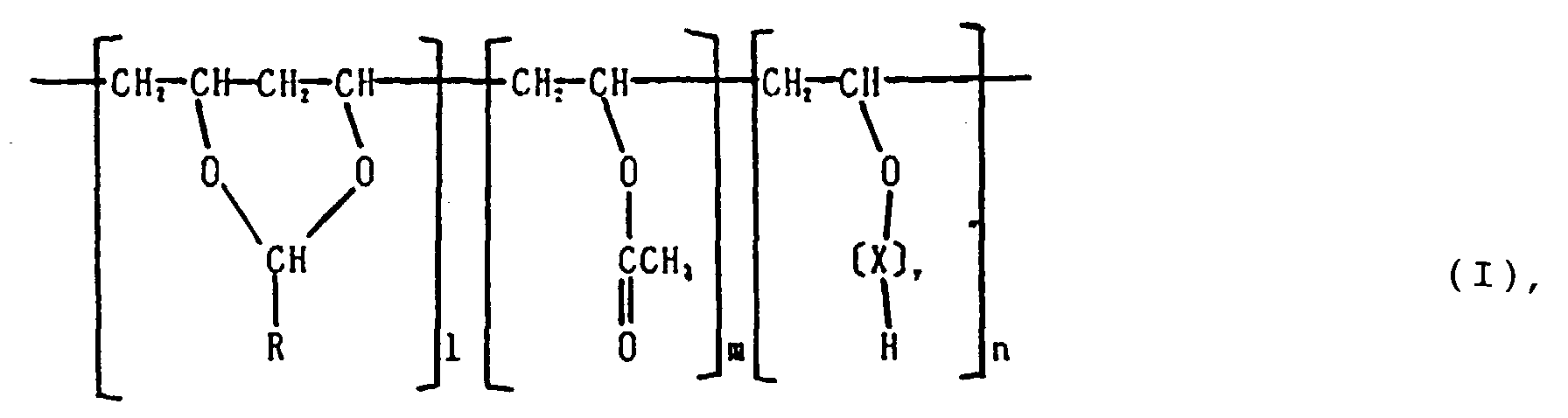
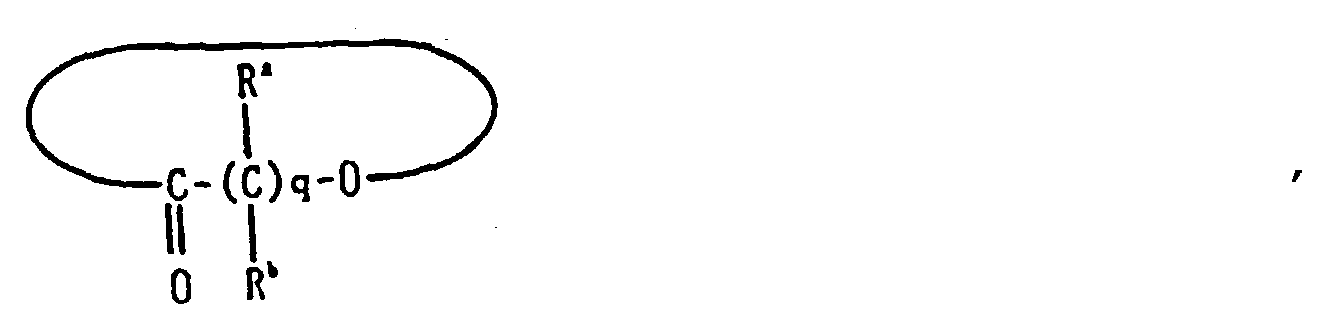
- a first aspect of the present invention relates to a lactone-modified polyvinyl acetal resin represented by the following general formula (I), wherein the molar ratio l/m/n is from 81.6 to 50 mol%/from 0 to 10 mol%/from 10 to 50 mol%, y is an integer ranging from more than 0 to 50, R is any one of hydrogen, a methyl group, and a propyl group, and X is a structural unit derived from the ring-opening reaction of a lactone compound which is represented by wherein q is an integer ranging from 4 to 8, and R a and R b is each an independent hydrogen atom or a methyl group.
- general formula (I) wherein the molar ratio l/m/n is from 81.6 to 50 mol%/from 0 to 10 mol%/from 10 to 50 mol%, y is an integer ranging from more than 0 to 50, R is any one of hydrogen, a methyl group, and a propyl
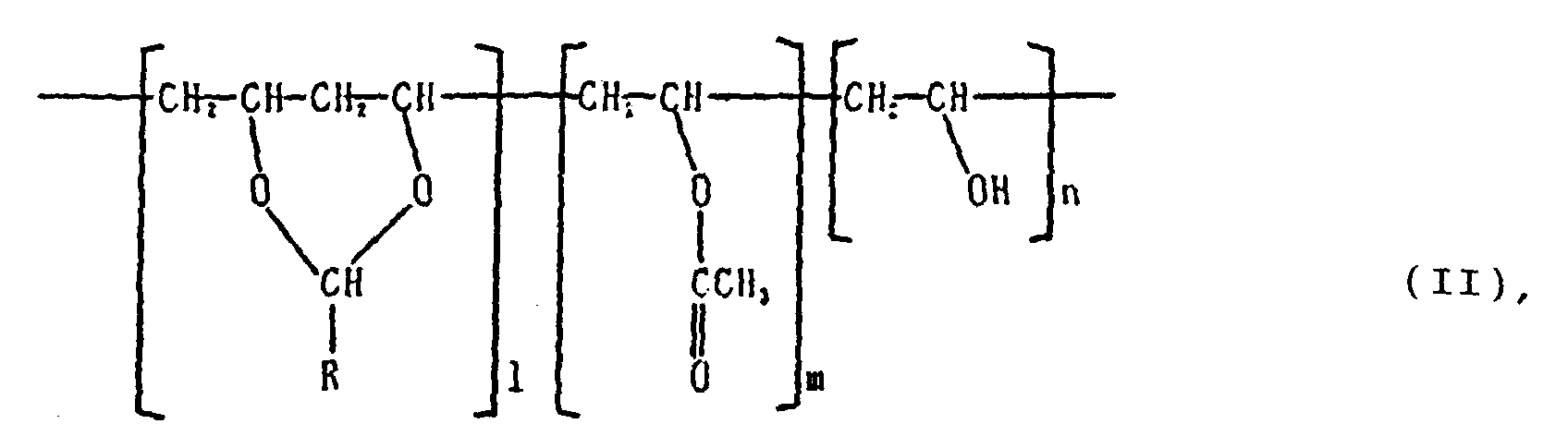
- a second aspect of the present invention relates to a process for the preparation of a lactone-modified polyvinyl acetal resin in the first aspect which comprises the reaction of a polyvinyl acetal resin represented by the following general formula (II), in the formula (II), the molar ratio l/m/n is from 81.5 to 50%/from 0 to 10%/from 10 to 50 %, and R is any one of hydrogen, a methyl group, and a propyl group, with a lactone compound.
- a polyvinyl acetal resin represented by the following general formula (II) in the formula (II), the molar ratio l/m/n is from 81.5 to 50%/from 0 to 10%/from 10 to 50 %, and R is any one of hydrogen, a methyl group, and a propyl group, with a lactone compound.
- a third aspect of the present invention relates to a curable resin composition which comprises (a) a lactone-modified polyvinyl acetal resin and (b) a compound having functional groups capable of reacting with hydroxyl groups.
- a fourth aspect of the present invention relates to a composition for a magnetic recording medium which comprises (a) a lactone-modified polyvinyl acetal resin as set forth in claim 1, (b) a urethane prepolymer, (c) a polyisocyanate compound, (d) a powdered magnetic substance, and, optionally, (e) at least one selected from the group consisting of polyester resins, ethylene-vinyl acetate copolymers, vinyl chloride resins having a plasticizer, and vinyl chloride-vinyl acetate copolymers having a plasticizer.
- a fifth aspect of the present invention relates to a lactone-modified polyvinyl acetal resin having carboxylic groups represented by the following general formula (III), wherein the molar ratio l/m/n is from 81.5 to 50%/from 0 to 10%/from 10 to 50%, y is an integer ranging from more than 0 to 50, R is any one of hydrogen, a methyl group, and a propyl group, and X is a structural unit derived from the ring-opening reaction of a lactone compound represented by the following formula, wherein q is an integer ranging from 4 to 8, R a and R b is each an independent hydrogen atom or a methyl group, and Z represents the following structural unit; or hydrogen atom, wherein Q is a residual aliphatic hydrocarbon group having a carbon number of 2 to 12, a residual alicyclic hydrocarbon group having a carbon number of 6 to 7, or a residual aromatic hydrocarbon group having a carbon number of 6 which may or may not have substituted groups.
- III general
- a sixth aspect of the present invention relates to a process for the preparation of a lactone-modified polyvinyl acetal resin having carboxylic groups in the fifth aspect which comprises the reaction of a lactone-modified polyvinyl acetal resin in the first aspect with an organic acid anhydride.
- a seventh aspect of the present invention relates to a curable resin composition which comprises (a) a lactone-modified polyvinyl acetal resin having carboxylic groups and (b) a compound having functional groups capable of reacting with hydroxyl groups.
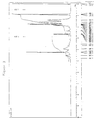
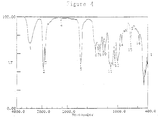
- Figure 1 is an 1 H-NMR spectra chart and Figure 2 is an IR spectra chart related to the epsilon-caprolactone-modified butylal resin obtained in Synthesis Example 1.
- Figure 3 is an 1 H-NMR spectra chart and Figure 4 is an IR spectra chart related to the epsilon-caprolactone-modified butylal resin obtained in Synthesis Example 2.
- a lactone-modified polyvinyl acetal resin represented by the general formula (I), wherein the molar ratio l/m/n is from 81.5 to 50%/from 0 to 10%/from 10 to 50%, y is an integer ranging from more than 0 to 50, R is any one of hydrogen, a methyl group, and a propyl group, and X is a structural unit derived from the ring-opening reaction of a lactone compound which represents wherein q is an integer ranging from 4 to 8, and R a and R b is each an independent hydrogen atom or a methyl group.
- the general formula (I) wherein the molar ratio l/m/n is from 81.5 to 50%/from 0 to 10%/from 10 to 50%, y is an integer ranging from more than 0 to 50, R is any one of hydrogen, a methyl group, and a propyl group, and X is a structural unit derived from the ring-opening reaction of a lactone compound which represents wherein
- a process for the preparation of a lactone modified polyvinyl acetal resin represented by the above-mentioned formula (I) which comprises the reaction of a polyvinyl acetal resin represented by the general formula (II) described hereinafter with a lactone compound.
- the lactone-modified polyvinyl acetal resin of the present invention can be prepared by the ring-opening reaction of a lactone compound with the polyvinyl acetal resin represented by the general formula (II), wherein the molar ratio l/m/n is from 81.5 to 50%/from 0 to 10%/from 10 to 50%, respectively, and R is any one of hydrogen, a methyl group and a propyl group, with a lactone compound.
- a lactone compound represented by the general formula (II), wherein the molar ratio l/m/n is from 81.5 to 50%/from 0 to 10%/from 10 to 50%, respectively, and R is any one of hydrogen, a methyl group and a propyl group, with a lactone compound.
- the reaction is carried out in an amount ratio ranging from 5 to 60 parts by weight, preferably from 20 to 50 parts by weight, of the lactone compound, and from 40 to 95 parts by weight, preferably from 50 to 80 by weight, of the polyvinyl acetal resin.
- the lactone-modified polyvinyl acetal resin obtained is not still flexible, undesirably resulting in the incapability to be modified in compatibility with other resins for coatings or solubility in various solvents.
- the lactone-modified polyvinyl acetal resin obtained becomes undesirably flexible and poor in solubility into solvents because of the crystallinity of the lactone chains.
- the remaining lactone compound may preferably act as a plasticizer for the lactone-modified polyvinyl acetal resin produced.
- y represents mol amounts of the lactone compound introduced into one mol unit of the starting polyvinyl acetal resin employed, which is an integer ranging from more than 0 to 50.
- the average mole amounts range from 0.1 to 5, preferably from 0.5 to 2, and q is an integer ranging from 4 to 8, which depends upon the lactone compound to be employed.
- R a and R b are each an independent hydrogen atom or a methyl group, respectively, which also depends upon the lactone compound to be employed.
- both R a and R b are hydrogen.
- R a and R b are independently a methyl group or hydrogen, respectively.
- R a and R b are independently a methyl group and hydrogen, respectively.
- the unit X in the formula (I) is -O-(CH 2 ) 5 -CO-, in the case of beta-methylgamma-valero-caprolactone being used as a lactone compound, the unit X in the formula (I) is in the case of 3,5,5-trimethylcaprolactone being employed as a lactone compound, the unit X in the formula (I) is in the case of 3,3,5-trimethylcaprolactone being employed as a lactone compound, the unit X in the formula (I) is
- the lactone compound can also be employed as a mixture composed of at least two types of lactones.
- hydroxycaproic acid which is a ring-opened product of caprolactone, can also be employed in place of lactone compounds.
- mixed lactones are employed, mixed lactone-derived ester-bonding units are randomly introduced into the starting polyvinyl acetal resin.
- the starting polyvinyl acetal resin represented by the above-mentioned general formula (II) can be prepared by the reaction of an aldehyde with a polyvinyl alcohol which is prepared by the saponification of a polyvinyl acetate.
- l, m, and n are from 81.6 to 50 mol%, from 0 to 10 mol% and from 10 to 50 mol%, respectively.
- the ring-opening reaction of a lactone compound to a polyvinyl acetal resin is preferably carried out under the conditions as described below.
- the polyvinyl acetal resin is melted at more than 120°C, whereby water in the resin is removed, and then the lactone compound is charged.
- the ring-opening reaction is carried out at temperatures ranging from 120 to 240°C, preferably 140 to 220°C, in the presence of catalysts in order to accelerate the ring opening reaction in a nitrogen atmosphere.
- the reaction temperature is below 120°C, the ring-opening reaction velocity of lactone compound is slow.
- undesirable coloration or decomposition of the product occurs.
- the reaction period ranges from 1 minute to 5 hours, preferably from 3 minutes to 2 hours, and more preferably from 5 minutes to 30 minutes.
- Catalysts preferably include organic metal catalysts such as organic tin catalysts, organic aluminum catalysts, and organic titanate catalysts from the viewpoint of ready handling, lower toxicity, high selectivity in reaction, and lower color hue in products.
- organic metal catalysts such as organic tin catalysts, organic aluminum catalysts, and organic titanate catalysts from the viewpoint of ready handling, lower toxicity, high selectivity in reaction, and lower color hue in products.
- alkali metals such as sodium or potassium, derivatives thereof, tertiary amines such as pyridines, metal halides such as sttanous chloride, organic metal compounds such as stannous octylate, monobutyl tin oxide, monobutyl tin tris(2-ethylhexanate), dibutyl tin oxide, dibutyl tin laurate, aluminum derivatives such as a water-based complex of triethyl aluminum, monoalkyl di(phenoxy) aluminum and alkoxy titanate compounds typified by tetrabutyl titanate, and the like.
- tertiary amines such as pyridines
- metal halides such as sttanous chloride
- organic metal compounds such as stannous octylate, monobutyl tin oxide, monobutyl tin tris(2-ethylhexanate), dibutyl tin oxide, dibutyl
- Catalysts are employed in an amount ranging from 0.005 to 0.5 parts, preferably ranging from 0.01 to 0.1 parts by weight.
- the ring-opening reaction can be carried out, for example, by a reactive compounding process using an extruder or a mixer such as a kneader type, screw type, agitator type, roll type, or static mixer type while melting.
- a reactive compounding process using an extruder or a mixer such as a kneader type, screw type, agitator type, roll type, or static mixer type while melting.
- One or more of the mixers may be preferably employed.
- a screw extruder having single screw or twin screw and/or a static mixer type extruder are preferably employed.
- an outlet for degassing may be preferably included in order to remove gasses from the mixing zone.
- an inlet for charging starting materials and additives may be also included through the mixing zone.
- the static mixer extruder mentioned above is an apparatus equipped with a driveless element for mixing therethrough, and the molten mixture is transferred while being mixed passing through the drivenless element in the apparatus by pumping.
- static mixer extruder examples include SMV or SMX manufactured by Sultzer Bros, Ltd., Etoflo mixing elements manufactured by Wymbs Engineering, Ltd., Ross elements manufactured by Transkem Plant, Ltd., Lightnin mixing elements manufactured by Lightnin Mixers and Aerators, Ltd., and a Sultzer type melting mixer manufactured by Sumitomo Heavy Industries, Ltd.
- the reactive compounding process is also carried out at temperatures ranging from 120 to 240°C, preferably 140 to 220°C, in the presence of catalysts in order to accelerate the ring-opening reaction.
- the starting polyvinyl acetal resin includes secondary hydroxyl groups derived from a vinyl alcohol moiety as shown in the general formula (I) described hereinabove.
- the lactone compound reacts to the hydroxyl groups, resulting in the production of flexible side chains containing lactone units. Secondary hydroxyl groups change to primary hydroxyl groups as the result of the ring-opening reaction of the lactone compound.
- the molar concentration of hydroxyl groups does not change in the total resin despite conversion from secondary hydroxyl groups to primary hydroxyl groups.
- a curable resin composition which comprises (a) a lactone-modified polyvinyl acetal resin represented by the above-mentioned general formula (I) and (b) a compound having functional groups capable of reacting with hydroxyl groups.
- Examples of the compound (b) having functional groups capable of reacting with hydroxyl groups include an isocyanate compound such as isophorone diisocyanate, hexamethylene diisocyanate, xylene diisocyanate, hydrogenated xylene diisocyanate, 4,4'-diphenylmethane diisocyanate, 4,4'-methylenebis(cyclohexyldiisocyanate), adducts thereof, oligomers thereof, blocked diisocyanates, prepolymers having isocyanate groups, melamine resins such as an isobutylated melamine, a n-bulylated melamine, a butylated urea-melamine resin and a methylated melamine, epoxy resins and dialdehyde compound, etc.
- an isocyanate compound such as isophorone diisocyanate, hexamethylene diisocyanate, xylene diisocyanate, hydrogenated xylene
- the mixing ratio of the component (a) a lactone-modified polyvinyl acetal resin with the compound (b) having functional groups capable of reacting with hydroxyl groups ranges from 95 to 40% by weight, preferably from 80 to 50% by weight.
- the resulting resin In the case when it exceeds 95% by weight, the resulting resin would become unnecessarily rigid, and in contrast, in the case when it is below 40% by weight, the resulting resin would become unnecessarily flexible because of the increase in lactone chains, and the solubility of the resin into various solvents would become poor because of the crystallinity of the lactone chains.
- the lactone-modified polyvinyl acetal resin of the present invention has primary hydroxyl groups at terminals of side chains which are higher in reactivity with isocyanate compounds and melamine resins.
- the higher reactivity can be optionally adjusted by partial modification from hydroxyl groups to carboxylic groups.
- the partial modification from hydroxyl groups to carboxylic groups can be attained by the reaction of hydroxyl groups with an organic polybasic anhydride, as mentioned hereinafter.
- the moderate modification from hydroxyl groups to carboxylic groups would preferably contribute to an excellent ability to cling to the substrate to be coated.
- the component (a) a lactone-modified polyvinyl acetal resin can be optionally employed together with alkyd resins, polyester polyols, acryl polyols, and epoxy resins, etc.
- a composition for a magnetic recording medium which comprises (a) a lactone-modified polyvinyl acetal resin as set forth in claim 1, (b) a urethane prepolymer, (c) a polyisocyanate compound, (d) a powdered magnetic substance, and, optionally, (e) at least one selected from the group consisting of a polyester resin, an ethylene-vinyl acetate copolymer, a vinyl chloride resin having a plasticizer, and a vinyl chloride-vinyl acetate copolymer having a plasticizer.
- the lactone-modified polyvinyl acetal resin is employed in an amount ranging from 40 to 95% by weight, preferably 50 to 80% by weight based on the total amount of the components (a), (b), and (c).
- the resulting cured magnetic media may become too soft because of the flexibility of the lactone units at side chains and may become poor in dispersion of the powdered magnetic substances because of the crystallinity of units at side chains.
- a urethane prepolymer specifically, there is preferably employed a urethane prepolymer having isocyanate groups at terminals and a molecular weight ranging from 1000 to 3000.
- the component (c) includes Coronate L manufactured by Nihon-Polyurethane Kogyo, Ltd., Desmodule L manufactured by Baeyer, AG., and Takenate D102 manufactured by Takeda Chemicals, Ltd.
- the component (c) is employed in an amount ranging from 1 to 20%, preferably from 5 to 15% by weight based on the total amount of the components (b) and (c).
- cross-linking density in the cured magnetic layer obtained may become too high, resulting in the magnetic layer becoming undesirably rigid and brittle.
- the component (d) is employed in an amount of ranging from 70 to 95% by weight, preferably 80% by weight or so based on the total amount of the composition.
- the cured magnetic layer obtained In the case when it exceeds 95% by weight, the cured magnetic layer obtained would become too rigid or brittle. In contrast, in the case when it is below 80% by weight, the cured magnetic layer obtained would become too soft and poor in abrasion resistance.
- Examples of the preferred powdered magnetic substances include gamma-FeO, gamma-Fe 2 O 3 , FeO, Fe 3 O 4 , Co-mixed gamma-FeO, Co-mixed gamma-Fe 2 O 3 , Co-mixed gamma-Fe 3 O 4 , chromium dioxide, and barium-ferrite.
- the preferred particle size of the powdered magnetic substances is less than 1 micron, preferably less than 0.5 microns.
- Optional component (e) includes a polyester resin, an ethylene-vinyl acetate copolymer, a vinyl chloride resin having a plasticizer, and a vinyl chloride-vinyl acetate copolymer having a plasticizer which are conventionally used.
- the optional component (e) is employed in an amount ranging from 0 to 80%, preferably from 20 to 60% by weight based on the total amount of the composition. In the case when it exceeds 80% by weight, the cured magnetic layer obtained would become not flexible.
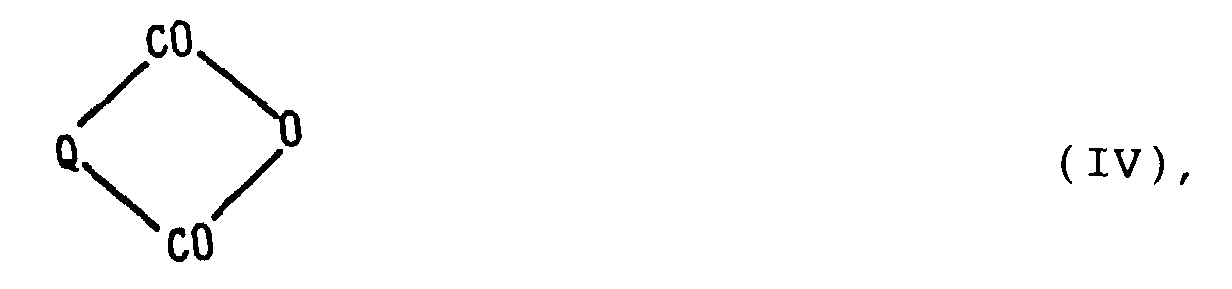
- a process for the preparation of the lactone-modified polyvinyl acetal resin having carboxylic groups which comprises the reaction of the above-mentioned lactone-modified polyvinyl acetal resin represented by the general formula (I) with an organic acid anhydride represented by the following general formula (IV), wherein Q is the same as in the general formula (III).
- the organic acid anhydride is employed in an amount of less than 10% by weight, preferably less than 5% by weight based on the lactone-modified polyvinyl acetal resin represented by the general formula (I).
- organic polybasic anhydrides thereof include phthalic anhydride, maleic anhydride, succinic anhydride, tetrahydrophthalic anhydride, hexahydrophthalic anhydride, methyltetrahydrophthalic anhydride, methylhexahydrophthalic anhydride, and trimellitic anhydride, and the like.
- one of the carboxylic groups is introduced by the ring-opening reaction of the carboxylic anhydride groups in the form of a half ester without dehydration.
- the reaction is occasionally required in the case when an isocyanate compound having higher reactivity is employed in one-liquid type urethane coatings. It is to be noted that the pot life is an important factor, particularly in one-liquid type urethane coatings.
- the reaction is carried out in temperatures ranging from 80 to 150°C, preferably 100 to 120°C. Furthermore, the reaction is carried out in the absence or presence of catalysts.
- lactone-modified polyvinyl acetal resin and the lactone-modified polyvinyl acetal resin having carboxylic groups of the present invention can be also employed together with nitrocelluloses, polyvinyl chloride-vinyl acetate resins, and cellulose acetate-butylate reins as an additive for lacquer coatings which are not curing agents.
- a sufficiently dried reaction vessel equipped with a stirrer, a thermometer, a reflux regulator and a tube for supplying nitrogen gas was charged with 278.1 g of a butylal resin [Eslek BL-1 manufactured by Sekisui Chemical Industries, Ltd. which has 3 mols of acetyl groups, 63 mols of butylal groups, and 34 mols of hydroxyl groups], 119.2 g of epsilon-caprolactone (molecular weight of 114.15) and 200 g of toluene, followed by being heated to 120°C to carry out an azeotropic dehydration while recirculating toluene. After the completion of dehydration, the temperature was raised to 140°C to remove toluene.
- a butylal resin [Eslek BL-1 manufactured by Sekisui Chemical Industries, Ltd. which has 3 mols of acetyl groups, 63 mols of butylal groups, and 34 mol
- the resin has a number average molecular weight of 2.0 X 10 4 and a weight average molecular weight of 5.2 X 10 4 based on standard Polystyrene.
- Figure 1 shows an 1 H-NMR spectra chart related to the epsilon-caprolactone-modified butylal resin.
- the NMR analysis was carried out in CDCl 3 with a JNM-EX270 analyzer manufactured by Nihon Denshi, Ltd.
- Figure 2 shows an FT-IR spectra chart related to the caprolactone-modified butylal resin.
- Glass transition temperature (Tg) by a DSC analysis was 27°C.
- the resin solution obtained was designated [A-1].
- Example 2 The same reaction vessel as used in Example 1 was charged with 210.4 g of a butylal resin [Eslek BL-S manufactured by Sekisui Chemical Industries, Ltd. which has 3 mols of acetyl groups, 72 mols of butylal groups, and 25 mols of hydroxyl groups], 90.2 g of epsilon-caprolactone and 150 g of toluene, followed by being heated to 120°C to carry out an azeotropic dehydration while recirculatin toluene. After the completion of dehydration, the temperature was raised to 140°C to remove toluene.
- a butylal resin [Eslek BL-S manufactured by Sekisui Chemical Industries, Ltd. which has 3 mols of acetyl groups, 72 mols of butylal groups, and 25 mols of hydroxyl groups]
- the resin has a number average molecular weight of 2.0 X 10 4 and a weight average molecular weight of 4.3 X 10 4 based on standard Polystyrene.
- Figure 3 exhibits 1 H-NMR spectra chart related to the epsilon-caprolactone modified butylal resin.
- Figure 4 shows an FT-IR spectra chart related to the epsilon-caprolactone-modified butylal resin.
- the FT-IR analysis was carried out by a KBr method. It was confirmed that each absorption in Figure 4 is assigned as follows.
- Tg Grass transition temperature measured by a DSC analysis was 9°C. Successively, toluene was charged into the crude epsilon-caprolactone-modified butylal resin to obtain a solution having a solid content of 50%.
- a 2 litre sufficiently dried reaction vessel equipped with a stirrer, a thermometer, a reflux regulator and a tube for supplying nitrogen gas was charged with 700.0 g of a butylal resin [Eslek BL-1], 300.0 g of epsilon-caprolactone and 500 g of toluene, followed by being heated to 120°C to carry out an azeotropic dehydration while recirculating toluene. After the completion of dehydration, the temperature was raised to 140°C to remove toluene.
- a hydroxyl value of 54.3, an acid value of 0.2, and a viscosity of 25100 cp/25°C of the crude resin were obtained.
- Example 3 The same procedures as described in Example 3 were repeated except that Eslek BL-S was employed and 0.69% by weight of epsilon-caprolactone was remained in the crude resin.
- the epsilon-caprolactone-modified butylal resin was allowed to rapidly cool after the completion of kneading, and number average molecular weight of the resin was measured by a GPC analysis to obtain the value of 52000 based on a standard Polystyrene whereas the starting butylal resin exhibited the value of 41000. It was confirmed by a gas chromatography analysis that approximately 8.0% by weight of unreacted epsilon-caprolactone was remained in the resin.
- the epsilon-caprolactone-modified butylal resin was allowed to rapidly cool after the completion of kneading. It was confirmed by a gas chromatography analysis that approximately 1.7% by weight of unreacted epsilon-caprolactone was remained in the resin.
- a reaction vessel was charged with 200 parts by weight of the lactone-modified polyvinyl butylal resin obtained in Example, and 2.21 parts by weight of succinic anhydride, and maintained at 100°C for 20 hours while stirring to obtain a lactone-modified polyvinyl butylal resin having carboxylic groups.
- a reaction vessel was charged with 200 parts by weight of the lactone-modified polyvinyl butylal resin obtained in Example and 2.25 parts by weight of succinic anhydride, and maintained at 100°C for 20 hours while stirring to obtain a lactone-modified polyvinyl butylal resin having carboxylic groups.
- the curable compositions obtained hereinabove were coated on steel plates having the thickness of 0.8 mm processed by zinc phosphate to obtain coated layers having a thickness of 20 microns, followed by baked at 170°C for 20 minutes to obtain cured layers for evaluation of properties.
- a bowl mill was charged with 80 parts by weight of gamma-Fe 2 O 3 , 10 parts by weight of the lactone-modified polyvinyl butylal resin obtained in Example 1, 8 parts by weight of Coronate 4095 which is a urethane prepolymer, 2 parts by weight of Coronate L which is an isocyanate compound, and 100 parts by weight of a 1/1 mixed solvent composed of toluene and methylethyl ketone, followed by being mixed for 70 hours to prepare a magnetic coating composition.
- composition was coated on a polyester film having a thickness of 21 microns to prepare a coating layer having a thickness of 10 microns after drying, followed by calendaring the surface of the coating layer and slitting into a fixed width to prepare magnetic tape.
- Example 7 The same procedures were repeated as described in Example 7, except that the lactone-modified polyvinyl butylal resin obtained in Example 1 was employed.
- a bowl mill was charged with 80 parts by weight of gamma-Fe 2 O 3 , 8 parts by weight of the lactone-modified polyvinyl butylal resin obtained in Example 1, 8 parts of Takenate L which is a urethane prepolymer, 2 parts by weight of Coronate L, and 100 parts by weight of a 1/1 mixed solvent composed of toluene and methylethyl ketone, followed by being mixed for 70 hours to prepare a magnetic coating composition.
- Example 7 The same procedures were repeated as described in Example 7, except that the polyvinyl butylal resin employed as a starting resin in Example 1 was employed together with 1 part of dioctyl phthalate as a plasticizer.
- the signal-to-voice ratio (SN) and abrasion amount were measured in relation to the magnetic tapes obtained in Examples 7, 8, 9, and Comparative Example 2.
- the abrasion amount was measured as described below.
- Respective magnetic tapes having a fixed length were abrasively moved at the speed of 76 cm/sec while bringing them into contact with a magnetic head in a tape recorder 300 times. It was compared to the Abrasion amount of 100 in the Comparative Example 2 tape.
- Respective magnetic tapes having a fixed length were wound on to a glass tube at an extension of 1 kg, followed by maintenance at 60°C and 80% RH for 24 hours and then maintaining at room temperature for 24 hours.
- tapes were unwound from the glass tube to observe the presence or absence of adhesion between tape layers.
Landscapes
- Chemical & Material Sciences (AREA)
- General Chemical & Material Sciences (AREA)
- Health & Medical Sciences (AREA)
- Chemical Kinetics & Catalysis (AREA)
- Medicinal Chemistry (AREA)
- Polymers & Plastics (AREA)
- Organic Chemistry (AREA)
- Addition Polymer Or Copolymer, Post-Treatments, Or Chemical Modifications (AREA)
- Paints Or Removers (AREA)
Claims (15)
- Lacton-modifiziertes Polyvinylacetal-Harz der folgenden allgemeinen Formel:worin das Molverhältnis l/m/n jeweils 81,5 bis 50 %/0 bis 10 %/10 bis 50 % beträgt, y eine ganze Zahl von mehr als Null bis 50 ist, R irgendeines von Wasserstoff, einer Methyl-Gruppe und einer Propyl-Gruppe bedeutet, und X eine Struktureinheit darstellt, die von der Ringöffnungsreaktion einer Lacton-Verbindung der folgenden Formel stammt:
 worin q eine ganze Zahl von 4 bis 8 ist, und Ra und Rb jeweils ein unabhängiges Wasserstoffatom oder eine Methyl-Gruppe bedeuten.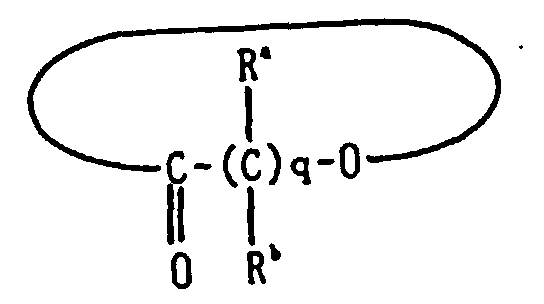
- Lacton-modifiziertes Polyvinylacetal-Harz nach Anspruch 1, worin die Lacton-Verbindung ε-Caprolacton ist.
- Lacton-modifiziertes Polyvinylacetal-Harz nach Anspruch 1, worin R in Formel (I) eine Propyl-Gruppe bedeutet.
- Verfahren zur Herstellung eines Lacton-modifizierten Polyvinylacetal-Harzes nach Anspruch 1, welches umfaßt: Umsetzen eines Polyvinylacetal-Harzes der folgenden allgemeinen Formel (II):worin das Molverhältnis l/m/n jeweils 81,5 bis 50 %/0 bis 10 %/10 bis 50 % beträgt, R irgendeines von Wasserstoff, einer Methyl-Gruppe und einer Propyl-Gruppe bedeutet, mit einer Lacton-Verbindung, wobei 40 bis 95 Masseteile des Polyvinylacetal-Harzes mit 5 bis 60 Masseteilen der Lacton-Verbindung umsetzen gelassen werden.
- Verfahren zur Herstellung eines Lacton-modifizierten Polyvinylacetal-Harzes nach Anspruch 4, wobei die Lacton-Verbindung ε-Caprolacton ist.
- Verfahren zur Herstellung eines Lacton-modifizierten Polyvinylacetal-Harzes nach Anspruch 4, wobei R in Formel (I) eine Propyl-Gruppe bedeutet.
- Verfahren zur Herstellung eines Lacton-modifizierten Polyvinylacetal-Harzes nach Anspruch 4, wobei das Polyvinylacetal-Harz mit der Lacton-Verbindung in Anwesenheit eines organischen Metallkatalysators in einem Mischer unter Schmelzen umsetzen gelassen wird.
- Aushärtbare Harz-Zusammensetzung, welche umfaßt: (a) ein Lacton-modifiziertes Polyvinylacetal-Harz nach Anspruch 1, und (b) eine Verbindung mit funktionellen Gruppen, die mit Hydroxyl-Gruppen reagieren können.
- Aushärtbare Harz-Zusammensetzung nach Anspruch 8, worin die Verbindung mit funktionellen Gruppen, die mit Hydroxyl-Gruppen reagieren können, zumindest eine ist, die ausgewählt ist aus der Gruppe bestehend aus einer Diisocyanat-Verbindung, einem Addukt hievon, einer blockierten Diisocyanat-Verbindung hievon, einem Prepolymer mit Isocyanat-Gruppen, einem isobutylierten Melamin, einem n-butylierten Melamin, einem butylierten Harnstoff-Melamin-Harz, einem methylierten Melamin, einer Dialdehyd-Verbindung und einem Epoxy-Harz.
- Aushärtbare Harz-Zusammensetzung nach Anspruch 8, worin das Lacton-modifizierte Polyvinylacetal-Harz zusammen mit zumindest einem, ausgewählt aus der Gruppe bestehend aus einem Alkyd-Harz, einem Polyesterpolyol-Harz und einem Acrylpolyol-Harz, verwendet wird.
- Zusammensetzung für ein Magnetaufzeichnungsmedium, welche umfaßt:(a) ein Lacton-modifiziertes Polyvinylacetal-Harz nach Anspruch 1,(b) ein Urethan-Prepolymer,(c) eine Polyisocyanat-Verbindung in einer Menge von 1 bis 20 %, vorzugsweise 5 bis 15 %, bezogen auf die Masse von (b) + (c),(d) eine pulverförmige magnetische Substanz in einer Menge von 70 bis 95 %, vorzugsweise 80 %, bezogen auf die Masse der Gesamtmenge der Zusammensetzung, und gegebenenfalls(e) zumindest eines, das ausgewählt ist aus der Gruppe bestehend aus einem Polyester-Harz, einem Ethylen-Vinylacetat-Copolymer, einem Vinylchlorid-Harz mit einem Weichmacher und einem Vinylchlorid-Vinylacetat-Copolymer mit einem Weichmacher, in einer Menge von 0 bis 80 %, vorzugsweise 20 bis 60 %, bezogen auf die Masse der Gesamtmenge der Zusammensetzung.
- Zusammensetzung für ein Magnetaufzeichnungsmedium nach Anspruch 11, worin das magnetische Pulver zumindest eines ist, das ausgewählt ist aus der Gruppe bestehend aus γ-FeO, y-Fe2O3, FeO, Fe2O4, Co-gemischtem γ-FeO, Co-gemischtem γ-Fe2O3, Co-gemischtem γ-Fe3O4, Chromdioxid, und Bariumferrit.
- Lacton-modifiziertes Polyvinylacetal-Harz mit Carbonsäure-Gruppen der folgenden allgemeinen Formel (III):worin das Molverhältnis l/m/n jeweils 81,5 bis 50 %/0 bis 10 %/10 bis 50 % beträgt, y eine ganze Zahl von mehr als Null bis 50 ist, R irgendeines von Wasserstoff, einer Methyl-Gruppe und einer Propyl-Gruppe bedeutet, und X eine Struktureinheit darstellt, die von der Ringöffnungsreaktion einer Lacton-Verbindung der folgenden Formel stammt:
 worin q eine ganze Zahl von 4 bis 8 ist, und Ra und Rb jeweils ein unabhängiges Wasserstoffatom oder eine Methyl-Gruppe bedeuten, und Z die folgende Struktureinheit:
 oder ein Wasserstoffatom darstellt, wobei Q eine aliphatische Kohlenwasserstoffrest-Gruppe mit einer Kohlenstoffzahl von 2 bis 12, eine alicyclische Kohlenwasserstoffrest-Gruppe mit einer Kohlenstoffzahl von 6 bis 7 oder eine aromatische Kohlenwasserstoffrest-Gruppe mit einer Kohlenstoffzahl von 6 bedeutet, die substituierte Gruppen gegebenenfalls aufweisen kann.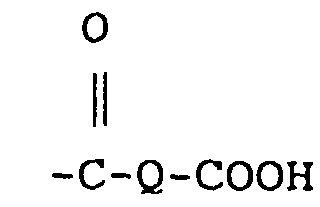
- Verfahren zur Herstellung eines Lacton-modifizierten Polyvinylacetal-Harzes mit Carbonsäure-Gruppen nach Anspruch 13, welches umfaßt: Umsetzen eines Lacton-modifizierten Polyvinylacetal-Harzes nach Anspruch 1 mit einem organischen Säureanhydrid der folgenden allgemeinen Formel (IV):worin Q gleich ist wie in der allgemeinen Formel (III).
- Aushärtbare Harz-Zusammensetzung, welche umfaßt: (a) ein Lacton-modifiziertes Polyvinylacetal-Harz mit Carbonsäure-Gruppen nach Anspruch 13, und (b) eine Verbindung mit funktionellen Gruppen, die mit Hydroxyl-Gruppen reagieren können.
Applications Claiming Priority (10)
| Application Number | Priority Date | Filing Date | Title |
|---|---|---|---|
| JP25188793 | 1993-10-07 | ||
| JP251887/93 | 1993-10-07 | ||
| JP761/94 | 1994-01-10 | ||
| JP76194 | 1994-01-10 | ||
| JP764/94 | 1994-01-10 | ||
| JP76494 | 1994-01-10 | ||
| JP18033394 | 1994-08-01 | ||
| JP180333/94 | 1994-08-01 | ||
| JP217564/94 | 1994-09-12 | ||
| JP21756494A JPH0881547A (ja) | 1994-09-12 | 1994-09-12 | カルボキシル基含有ラクトン変性ポリビニルアセタ−ル樹脂、その製造方法および硬化性樹脂組成物 |
Publications (3)
| Publication Number | Publication Date |
|---|---|
| EP0647660A2 EP0647660A2 (de) | 1995-04-12 |
| EP0647660A3 EP0647660A3 (de) | 1995-06-28 |
| EP0647660B1 true EP0647660B1 (de) | 1998-01-07 |
Family
ID=27517994
Family Applications (1)
| Application Number | Title | Priority Date | Filing Date |
|---|---|---|---|
| EP94402252A Expired - Lifetime EP0647660B1 (de) | 1993-10-07 | 1994-10-07 | Laktonmodifiziertes Polyvinylacetalharz, Verfahren zur Herstellung davon härtbare Harzzusammensetzung, und magnetisches Aufzeichnungsmedium |
Country Status (3)
| Country | Link |
|---|---|
| US (2) | US5574098A (de) |
| EP (1) | EP0647660B1 (de) |
| DE (1) | DE69407713T2 (de) |
Families Citing this family (8)
| Publication number | Priority date | Publication date | Assignee | Title |
|---|---|---|---|---|
| JP2000501136A (ja) * | 1995-11-29 | 2000-02-02 | イー・アイ・デュポン・ドウ・ヌムール・アンド・カンパニー | ポリビニルアセタールおよびそれらの製造 |
| JP2002513835A (ja) * | 1998-05-06 | 2002-05-14 | イー・アイ・デュポン・ドウ・ヌムール・アンド・カンパニー | ポリビニルブチラールのポリマーブレンド |
| JP2001284813A (ja) * | 2000-03-31 | 2001-10-12 | Mitsubishi Electric Corp | 多層配線板の製造方法 |
| MY135206A (en) * | 2002-01-11 | 2008-02-29 | Daicel Chem | Process of continuously producing polyester-based polymer |
| WO2011001661A1 (ja) * | 2009-06-29 | 2011-01-06 | パナソニック株式会社 | ディスク再生装置及びディスク再生方法 |
| KR101455481B1 (ko) * | 2009-12-04 | 2014-10-27 | 다이이치 고교 세이야쿠 가부시키가이샤 | 폴리비닐아세탈·폴리에스테르 그래프트 공중합체 및 분산제 |
| KR101390155B1 (ko) | 2013-01-08 | 2014-04-29 | 연세대학교 산학협력단 | 저온 경화형 아세탈계 에폭시 수지 조성물 및 이의 제조방법 |
| KR102450608B1 (ko) | 2016-09-30 | 2022-10-04 | 세키스이가가쿠 고교가부시키가이샤 | 에폭시 접착제 조성물 |
Family Cites Families (10)
| Publication number | Priority date | Publication date | Assignee | Title |
|---|---|---|---|---|
| US2306071A (en) * | 1938-12-30 | 1942-12-22 | Eastman Kodak Co | Resinous esters and process for preparing them |
| SU362030A1 (ru) * | 1967-05-29 | 1972-12-13 | Способ получения водонерастворимых поливинилкеталей | |
| FR2137175B1 (de) * | 1971-05-14 | 1974-03-08 | Aquitaine Total Organico | |
| US3931068A (en) * | 1972-07-28 | 1976-01-06 | Union Carbide Corporation | Blends of biodegradable thermoplastic oxyalkanoyl polymer, a naturally occurring biodegradable product, filler and plastic additive |
| GB1443073A (en) * | 1974-01-11 | 1976-07-21 | Interox Chemicals Ltd | Method of preparing copolymers |
| JPS5390282A (en) * | 1977-01-14 | 1978-08-08 | Takeda Chem Ind Ltd | Blocked isocyanate compsn. for powder coatings |
| US5171784A (en) * | 1984-08-02 | 1992-12-15 | Union Carbide Chemicals & Plastics Technology Corporation | Phosphorylated reaction products and compositions incorporating such products |
| JPH0662697B2 (ja) * | 1988-04-08 | 1994-08-17 | 宇部興産株式会社 | 反応性アセタール基を持つポリビニルアセタール |
| US4988763A (en) * | 1988-04-26 | 1991-01-29 | S. C. Johnson & Son, Inc. | Catalyzed bulk process for producing cyclic ester-modified acrylic polymers |
| DE4033165A1 (de) * | 1990-10-16 | 1992-04-23 | Stamicarbon | Verfahren zur kondensation von imiden und alkoholen oder aminen |
-
1994
- 1994-10-06 US US08/319,452 patent/US5574098A/en not_active Expired - Fee Related
- 1994-10-07 DE DE69407713T patent/DE69407713T2/de not_active Expired - Fee Related
- 1994-10-07 EP EP94402252A patent/EP0647660B1/de not_active Expired - Lifetime
-
1995
- 1995-10-30 US US08/550,025 patent/US5777027A/en not_active Expired - Fee Related
Also Published As
| Publication number | Publication date |
|---|---|
| EP0647660A2 (de) | 1995-04-12 |
| US5777027A (en) | 1998-07-07 |
| DE69407713T2 (de) | 1998-07-30 |
| US5574098A (en) | 1996-11-12 |
| EP0647660A3 (de) | 1995-06-28 |
| DE69407713D1 (de) | 1998-02-12 |
Similar Documents
| Publication | Publication Date | Title |
|---|---|---|
| US4381388A (en) | Storage stable one component urethanes and method for using same | |
| JPH0561313B2 (de) | ||
| US4101527A (en) | Moisture curing polymers prepared from polyfunctional isocyanates and a dioxazabicyclo octane | |
| EP0454219A1 (de) | Polyurethanreaktionsmischungen sowie Beschichtungszusammensetzungen daraus | |
| EP0647660B1 (de) | Laktonmodifiziertes Polyvinylacetalharz, Verfahren zur Herstellung davon härtbare Harzzusammensetzung, und magnetisches Aufzeichnungsmedium | |
| JPH02185511A (ja) | 架橋触媒としてのイソシアネート変性したブロック化スルホン酸エステル | |
| KR980009303A (ko) | 폴리우레탄 | |
| US5977246A (en) | Coating composition | |
| EP0489203B1 (de) | Strahlenhärtbare Harzzusammensetzung | |
| JP3292878B2 (ja) | ポリイソシアネート硬化剤、並びにこれを用いたポリウレタン塗料組成物およびポリウレタン接着剤組成物 | |
| JPH0457869A (ja) | 塗料用樹脂組成物 | |
| US5227451A (en) | Urethane prepolymer and polyurethane compositions comprising the prepolymer | |
| EP0755958B1 (de) | Polyamine und ihre Verwendung in Lacken und Beschichtungen | |
| CN114555721A (zh) | 交联组合物和由其形成的涂层 | |
| US5118580A (en) | Magnetic recording media prepared from polyurethane copolymers formed utilizing an interferter compound | |
| JP2890324B2 (ja) | ウレタンプレポリマー及びポリウレタン組成物 | |
| JP3417624B2 (ja) | ポリオールおよびそれを用いたポリウレタン組成物 | |
| US4278782A (en) | Allyl alcohol polymers | |
| JP3442519B2 (ja) | ポリウレタン樹脂組成物およびその用途 | |
| JP3381479B2 (ja) | ポリウレタン樹脂の製造方法 | |
| JPS5883001A (ja) | 改質硝化綿組成物及びその製造法 | |
| CA2245730C (en) | Coating composition | |
| JPH05186515A (ja) | 放射線硬化型塩化ビニル系樹脂の製造方法 | |
| JPH037719A (ja) | ポリウレタン組成物 | |
| JPH02102216A (ja) | 放射線硬化性樹脂の製造方法 |
Legal Events
| Date | Code | Title | Description |
|---|---|---|---|
| PUAI | Public reference made under article 153(3) epc to a published international application that has entered the european phase |
Free format text: ORIGINAL CODE: 0009012 |
|
| AK | Designated contracting states |
Kind code of ref document: A2 Designated state(s): DE GB |
|
| PUAL | Search report despatched |
Free format text: ORIGINAL CODE: 0009013 |
|
| AK | Designated contracting states |
Kind code of ref document: A3 Designated state(s): DE GB |
|
| 17P | Request for examination filed |
Effective date: 19950926 |
|
| GRAG | Despatch of communication of intention to grant |
Free format text: ORIGINAL CODE: EPIDOS AGRA |
|
| 17Q | First examination report despatched |
Effective date: 19970317 |
|
| GRAG | Despatch of communication of intention to grant |
Free format text: ORIGINAL CODE: EPIDOS AGRA |
|
| GRAG | Despatch of communication of intention to grant |
Free format text: ORIGINAL CODE: EPIDOS AGRA |
|
| GRAH | Despatch of communication of intention to grant a patent |
Free format text: ORIGINAL CODE: EPIDOS IGRA |
|
| GRAH | Despatch of communication of intention to grant a patent |
Free format text: ORIGINAL CODE: EPIDOS IGRA |
|
| GRAA | (expected) grant |
Free format text: ORIGINAL CODE: 0009210 |
|
| AK | Designated contracting states |
Kind code of ref document: B1 Designated state(s): DE GB |
|
| REF | Corresponds to: |
Ref document number: 69407713 Country of ref document: DE Date of ref document: 19980212 |
|
| PLBE | No opposition filed within time limit |
Free format text: ORIGINAL CODE: 0009261 |
|
| STAA | Information on the status of an ep patent application or granted ep patent |
Free format text: STATUS: NO OPPOSITION FILED WITHIN TIME LIMIT |
|
| 26N | No opposition filed | ||
| PGFP | Annual fee paid to national office [announced via postgrant information from national office to epo] |
Ref country code: GB Payment date: 19991006 Year of fee payment: 6 |
|
| PGFP | Annual fee paid to national office [announced via postgrant information from national office to epo] |
Ref country code: DE Payment date: 19991008 Year of fee payment: 6 |
|
| PG25 | Lapsed in a contracting state [announced via postgrant information from national office to epo] |
Ref country code: GB Free format text: LAPSE BECAUSE OF NON-PAYMENT OF DUE FEES Effective date: 20001007 |
|
| GBPC | Gb: european patent ceased through non-payment of renewal fee |
Effective date: 20001007 |
|
| PG25 | Lapsed in a contracting state [announced via postgrant information from national office to epo] |
Ref country code: DE Free format text: LAPSE BECAUSE OF NON-PAYMENT OF DUE FEES Effective date: 20010703 |