EP0647916B1 - Brochage pour balayage de code barré - Google Patents
Brochage pour balayage de code barré Download PDFInfo
- Publication number
- EP0647916B1 EP0647916B1 EP94114206A EP94114206A EP0647916B1 EP 0647916 B1 EP0647916 B1 EP 0647916B1 EP 94114206 A EP94114206 A EP 94114206A EP 94114206 A EP94114206 A EP 94114206A EP 0647916 B1 EP0647916 B1 EP 0647916B1
- Authority
- EP
- European Patent Office
- Prior art keywords
- characters
- sequences
- sequence
- lengths
- decoded
- Prior art date
- Legal status (The legal status is an assumption and is not a legal conclusion. Google has not performed a legal analysis and makes no representation as to the accuracy of the status listed.)
- Expired - Lifetime
Links
Images


Classifications
-
- G—PHYSICS
- G06—COMPUTING OR CALCULATING; COUNTING
- G06K—GRAPHICAL DATA READING; PRESENTATION OF DATA; RECORD CARRIERS; HANDLING RECORD CARRIERS
- G06K7/00—Methods or arrangements for sensing record carriers, e.g. for reading patterns
- G06K7/10—Methods or arrangements for sensing record carriers, e.g. for reading patterns by electromagnetic radiation, e.g. optical sensing; by corpuscular radiation
- G06K7/14—Methods or arrangements for sensing record carriers, e.g. for reading patterns by electromagnetic radiation, e.g. optical sensing; by corpuscular radiation using light without selection of wavelength, e.g. sensing reflected white light
- G06K7/1404—Methods for optical code recognition
- G06K7/146—Methods for optical code recognition the method including quality enhancement steps
- G06K7/1491—Methods for optical code recognition the method including quality enhancement steps the method including a reconstruction step, e.g. stitching two pieces of bar code together to derive the full bar code
-
- G—PHYSICS
- G06—COMPUTING OR CALCULATING; COUNTING
- G06K—GRAPHICAL DATA READING; PRESENTATION OF DATA; RECORD CARRIERS; HANDLING RECORD CARRIERS
- G06K7/00—Methods or arrangements for sensing record carriers, e.g. for reading patterns
- G06K7/10—Methods or arrangements for sensing record carriers, e.g. for reading patterns by electromagnetic radiation, e.g. optical sensing; by corpuscular radiation
- G06K7/14—Methods or arrangements for sensing record carriers, e.g. for reading patterns by electromagnetic radiation, e.g. optical sensing; by corpuscular radiation using light without selection of wavelength, e.g. sensing reflected white light
Definitions
- This invention relates to bar code scanning, and in particular to techniques for combining, or stitching, partial scans.
- a bar code symbol is a coded pattern of indicia comprising a series of bars and spaces having different light reflecting characteristics.
- Bar code scanning systems electro-optically transform the indicia into electrical signals, which are decoded into alphanumerical characters. Characters are typically represented in digital form and are provided as an input to a data processing system far applications, such as point-of-sale processing and inventory control. Scanning systems of this general type have been disclosed, for example, in U.S. Patent Nos. 4,251,798; 4,369,361; 4,387,297; 4,409,470; 4,760,248; and 4,896,026, all of which have been assigned to the same assignee as the instant application.
- Bar code symbols are formed from a series of bars and spaces, called elements, which have a variety of possible widths.
- the specific arrangement of elements defines the character represented according to a set of rules and definitions.
- groups of elements are concatenated to form a bar code symbol, with each character of the message represented by a corresponding group of elements.
- a "start” and “stop” character is used to indicate where the bar code begins and ends.
- symbologies in use for example, UPC/EAN, Code 39, Code 128, Codabar, and Interleaved 2 of 5.
- a light source such as a laser or laser diode
- the beam produces a spot on the target.
- the spot may be deflected by a mirror that is moved with an oscillating or rotating motor to produce a line or series of lines or curved paths across the symbol.
- the light may be deflected by holographic or other means.
- a portion of the light that is reflected off the symbol is detected by a sensor which may be positioned in the scanner.
- the sensor converts the reflected light into an electrical signal which is converted to a digital representation by electronic circuitry.
- an analog electrical signal from the photodetector may be converted into a pulse width modulated digital signal, with pulse widths corresponding to the physical widths of the bars and spaces.
- the decoder receives the pulse width modulated digital signal from the scanner, and attempts to decode the scan. If the start and stop characters and all of the characters between them are decoded successfully, the decoding process is finished. Otherwise, the decoder receives a next scan and attempts to decode it. Each attempt is based on the signal received during a single scan. The process continues until a scan is completely decoded or until no more scans are available.
- a scan line or series of scan lines may not always entirely cross the bar code symbol.
- a scanner may be in a fixed position next to a conveyor with containers, each of which has a bar code symbol printed on a label. If the label is skewed with respect to the scan line, there may be no single scan line which includes both the start and stop characters. These incomplete scan lines, called fragments, were discarded until techniques were developed to stitch or combine the fragments together, so that the decoding process can be completed.
- One technique known as block decoding, involves combining predefined regions or blocks in a number of scans. For example, a symbology such as UPC has start, stop, and center characters. If one fragment includes a start and a center, and another fragment includes a center and stop, these two "blocks" can be combined to form a complete scan.
- a system checks fragments for corresponding portions, and stitches by superimposing.
- the widths of elements can be measured in clock pulses for two fragments. These widths may be converted to a binary representation of widths or of ratios of widths between successive elements.
- the pulse count or other representation of the width of an element in one scan is compared to the width of an element in another scan. If these are the same or sufficiently similar, adjacent elements are compared. If a group of elements of a certain length are the same, the two groups of elements are considered to be corresponding, and the two fragments of decoded data characters are stitched by superimposing the common portions.
- bar codes are combined at the bar level, that is, at the pre-decoded level, for subsequent decoding.
- US-A-5 241 164 discloses a method for decoding bar code symbols in which a bar code reader and associated components scan a bar code symbol produce a representation of the symbol, and attempt to decode that representation in order to produce a character message.
- the method consists of the steps of storing a first representation of the bar code symbol corresponding to a first scan path through a first portion of said symbol smaller than the entire symbol, and storing a second representation of the bar code symbol corresponding to a second scan path through the symbol.
- the method then processes these representations in the event a successful decode has not taken place by utilizing the signal from a first scan with the signal from a subsequent scan to determine whether the information from successive scans can be concatenated to form a combined signal.
- the process is repeated with different subsequent scans until successful decoding of the combined signal. Specifically, timing information associated with the flying beam spot as it scans the bar code symbol in successive scan paths is used to determine where the scans will be stitched together.
- the invention features combining two decoded scan fragments of a bar code symbol using a character level technique.
- the bar code symbol is composed of bar code elements which represent an ordered sequence of data characters delimited by a "start” character on one end and a “stop” character on the other.
- the bar code is scanned and the fragments are decoded until a fragment with the "start” character and another with the "stop” character are found. Then, the two fragments are combined to form the required ordered sequence of data characters.
- the ordered sequence is of a predetermined character length.
- the character length of the fragments is compared to the predetermined character length, and the fragments are combined if the sum of the lengths of the fragments is equal to the predetermined length. If the sum of the fragment lengths is greater than the predetermined length, then the overlapping portions of the segments are compared, and, if the corresponding data characters of the overlapping portions match, then the fragments are combined by overlapping the matching portions to form the required ordered sequence of data characters.
- the predetermined character length is obtained by decoding scans containing full crossings (including the "start” and “stop” characters) of a representative bar code of the predetermined character length, and then storing and saving that character length tor subsequent use.
- scanning system 10 is used to read and interpret bar code symbols.
- Light source 12 directs a beam of light 14 at bar code 18 which is printed or affixed on target 16.
- Bar code symbol 18 reflects diffused light 20 which is received by sensor 22.
- the sensor produces an analog signal which indicates how much light is received from the reflected beam as the beam scans the bar code.
- the analog signal is digitized by digitizer 24, and the resulting digital signal is sent to a decoder 26.
- the digital signal consists of a series of pulse width values, each representative of the time it took for the scan to cross an element. The time is determined by clock 25 which counts cycles beginning on a leading or falling edge of the digital signal.
- Decoder 26 converts the digital signal to a series of alphanumeric characters according to algorithms specific to the symbology used.
- bar code symbol 38 is printed on label 36.
- the symbol includes data characters, a start character 42, and a stop character 44.
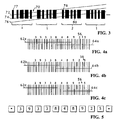
- Scan lines 40 are horizontal, but the label is skewed so that no single scan line passes through both start character 42 and stop character 44. Scan lines 40 are therefore all fragments. While no scan has all the elements, each element can be determined from at least one scan line.
- sequence of data characters represented in FIG. 5 can be represented, for example, by bar code symbol 56 shown in FIG. 4(a). (Alternatively, a correct decoding of the bar code symbol in FIG. 4(a) should produce the sequence of data characters represented in FIG. 5.)
- FIGS. 4(a)-(c) show three possible outcomes of two partial scans 62 and 64.
- the two partial scan fragments 62a and 64a in FIG. 4(a) together cross every element of bar code 56. These two scan fragments also partially overlap for some bar code elements (and for some data characters). Scan fragment 62a covers data characters "3933848", and scan fragment 64a covers data characters "848925”. These partial scans overlap on data characters "848”. It should be noted that while scan 62a covers some elements of the data character "9” at its right-most end, it does not cover enough elements to decode that character. Similarly, while scan 64a covers some elements of the data character "3" at its left-most end, it too does not cover enough elements to decode that character.
- the two partial scan fragments 62b and 64b in FIG. 4(b) also cross every element of bar code 56, and they also overlap for some elements, but they do not overlap for any data characters.
- Scan fragment 62b covers data characters "39338”
- scan fragment 64b covers data characters "48925”.
- a method for combining or stitching two decoded partial scans begins with setting various global variables, such as the required or expected predetermined length, L p , of the expected scan.
- L p is the expected or required number of data characters encoded by the bar code symbol, and not the number of elements in the symbol itself.
- the length of symbol 56 in FIG. 4(a) is ten (excluding delimiter characters).
- the sequence of data characters, S 1 corresponding to first decoded partial scan
- the length of the sequence S 1 is compared at 103 to the expected predetermined length, L p , to determine whether or not a complete scan was achieved. If so, then processing is complete at 120, otherwise a second sequence of data characters, S 2 , corresponding to a second decoded partial scan, is obtained at 104.
- both S 1 and S 2 are sequences of data characters corresponding to decoded partial scans.
- the lengths of the sequences S 1 and S 2 are the number of data characters in the sequences.
- the length of the second data character sequence S 2 is compared at 106 to the expected predetermined length, L p , to determine whether or not a complete scan was achieved. If so, then processing is complete at 120, otherwise processing continues to determine whether the two sequences can be combined.
- the next step 108 compares the combined lengths, L S1 + L S2 , of the two partial sequences S 1 and S 2 , to the expected length, L p . Since at this point neither sequence is a complete scan, one of the three situations depicted in FIGS. 4(a)-(c) has occurred.
- the system attempts to obtain another first scan at 102. If the combined lengths are the same as the expected length, corresponding to the case shown in FIG. 4(b), then the two sequences are combined at 110, for example, by concatenating them, and processing is completed at 120.
- the amount of overlap is determined at 112 and the overlapping portions of the sequences are compared at 114. If the overlapping portions match each other, then the two sequences are combined at 116 and processing is completed at 120, otherwise, the process is restarted.
- a code 39 character has nine elements, five bars and four spaces, each of which is either narrow or wide. Of the nine elements, three are wide and six are narrow.
- a Code 39 symbol starts and stops with an asterisk, and can be scanned and read in either direction. Between each character is an inter-character space 70 which can be set to some selected width (the width of which is not significant).
- FIG. 7 shows the steps 102 and 104 of obtaining the first and second scans in greater detail.
- the decoder initializes the time at 122, loads a scan at 124, and determines the elapsed time at 126. It then determines whether a delimiter character is detected at 128. If not, the decoder resets the time and loads further scans, until a delimiter character is detected. For scan 72, in FIG. 3, the asterisk start/stop character is detected, so the decoder attempts to decode the characters at 130 by loading nine elements at a time, and checking whether these elements represent a valid character. The decoder would load the next nine elements after the asterisk, and successfully decode a numeral "1". But when attempting to decode the next nine elements, the decoder would fail, as it would encounter fewer than nine elements.
- the decoder determines the expected length at the initialization step 100 by obtaining a complete scan of a representative bar code symbol and determining its length. This length is then used as the expected length for subsequent scans.
- Clock cycles are counted during the scan, so the elapsed time for the scan to reach a particular element is known. The elapsed time between two scans is also known.
- the system selects the sequence of data characters that was scanned the most times (or most recently) at 122, and combines it with the non-overlapping part of the other sequence.
- L overlap (L S1 + L S2 ) - L p
Landscapes
- Engineering & Computer Science (AREA)
- Physics & Mathematics (AREA)
- Toxicology (AREA)
- Health & Medical Sciences (AREA)
- Electromagnetism (AREA)
- General Health & Medical Sciences (AREA)
- Artificial Intelligence (AREA)
- Computer Vision & Pattern Recognition (AREA)
- General Physics & Mathematics (AREA)
- Theoretical Computer Science (AREA)
- Quality & Reliability (AREA)
- Compression, Expansion, Code Conversion, And Decoders (AREA)
- Character Input (AREA)
Claims (8)
- Méthode pour combiner des fragments de balayage décodés d'un symbole de code à barres composé d'une pluralité d'éléments de code à barres représentant une séquence ordonnée de caractères, dans laquelle la séquence ordonnée est délimitée par un premier caractère de délimitation et un second caractère de délimitation et dans laquelle la séquence ordonnée présente une longueur prédéterminée (LP), la méthode comprenant les étapes consistant à :balayer (102, 104, 124) le symbole le long d'une pluralité de trajets de balayage et décoder les éléments balayés pour obtenir des séquences décodées de caractères (S1, S2) ;déterminer (102, 104, 128) si les séquences décodées de caractères comportent l'un du premier et du second caractères de délimitation ;répéter les étapes de balayage et de détermination jusqu'à ce qu'au moins une première séquence décodée (S1) comportant le premier caractère de délimitation et une seconde séquence décodée (S2) comportant le second caractère de délimitation soient trouvées ; lesdites première et seconde séquences décodées ayant des longueurs respectives (LS1, LS2),méthode caractérisée par la comparaison (108) de la longueur prédéterminée à une somme de longueurs de la première et de la seconde séquences décodées de caractères ; et sur la base de la comparaison la combinaison (110, 116) de la première et de la seconde séquences pour produire la séquence ordonnée de caractères.
- Méthode selon la revendication 1, caractérisée en ce que l'étape de combinaison comprend la concaténation (110) des première et seconde séquences décodées pour produire la séquence ordonnée si la somme des longueurs de caractères des première et seconde séquences est égale à la longueur prédéterminée.
- Méthode selon la revendication 2, caractérisée en ce que l'étape de combinaison comprend de plus, dans le cas où la somme des longueurs des première et seconde séquences de caractères est supérieure à la longueur prédéterminée, l'exécution des étapes suivantes :comparer (114) les portions se chevauchant des première et seconde séquences de caractères ; etsur la base de la comparaison des portions se chevauchant, dans le cas où les portions se chevauchant des première et seconde séquences de caractères coïncident, combiner (116) les première et seconde séquences de caractères pour produire une séquence ordonnée.
- Méthode selon la revendication 2, caractérisée en ce qu'elle comprend, dans le cas où la somme des longueurs des première et seconde séquences de caractères est inférieure à la longueur prédéterminée, la répétition des étapes de balayage, de détermination, de répétition et de comparaison des longueurs.
- Méthode selon la revendication 3, caractérisée en ce qu'elle comprend, dans le cas où la somme des longueurs des première et seconde séquences de caractères est inférieure à la longueur prédéterminée, la répétition des étapes de balayage, de détermination, de répétition et de comparaison des longueurs.
- Méthode selon les revendications 3 ou 5, caractérisée en ce qu'elle comrpend, dans le cas où les portions se chevauchant des première et seconde séquences de caractères ne coïncident pas, la répétition des étapes de balayage, de détermination, de répétition et de comparaison des longueurs.
- Méthode selon les revendications 3 ou 5, caractérisée en ce qu'elle comprend, dans le cas où les portions se chevauchant des première et seconde séquences décodées de caractères ne coïncident pas, la combinaison des première et seconde séquences de caractères pour produire la séquence ordonnée en effectuant les étapes consistant à :(i) sélectionner une séquence des première et seconde séquences de caractères correspondant au trajet de balayage qui a été balayé le plus souvent ou au trajet de balayage le plus récent, et(ii) combiner la séquence sélectionnée avec une séquence obtenue en retranchant la portion de chevauchement de la séquence des première et seconde séquences de caractères non sélectionnées.
- Méthode selon la revendication 1, comprenant les étapes de :d'abord, détermination de la longueur fixée par les étapes consistant à :balayer un symbole de code à barres représentatif entier qui inclut les premier et second caractères de délimitation pour obtenir une série représentative d'éléments ;décoder la série représentative d'éléments pour obtenir une séquence représentative de caractères ; et compter le nombre de caractères dans la séquence représentative de caractères pour obtenir la longueur fixée.
Applications Claiming Priority (4)
| Application Number | Priority Date | Filing Date | Title |
|---|---|---|---|
| US293725 | 1981-08-17 | ||
| US08/127,900 US5457308A (en) | 1993-09-14 | 1993-09-14 | Bar code scan stitching |
| US127900 | 1993-09-14 | ||
| US29372594A | 1994-08-22 | 1994-08-22 |
Publications (2)
| Publication Number | Publication Date |
|---|---|
| EP0647916A1 EP0647916A1 (fr) | 1995-04-12 |
| EP0647916B1 true EP0647916B1 (fr) | 2000-08-02 |
Family
ID=26826070
Family Applications (1)
| Application Number | Title | Priority Date | Filing Date |
|---|---|---|---|
| EP94114206A Expired - Lifetime EP0647916B1 (fr) | 1993-09-14 | 1994-09-09 | Brochage pour balayage de code barré |
Country Status (5)
| Country | Link |
|---|---|
| US (1) | US5821519A (fr) |
| EP (1) | EP0647916B1 (fr) |
| JP (1) | JPH07200719A (fr) |
| AU (1) | AU681421B2 (fr) |
| DE (1) | DE69425404T2 (fr) |
Families Citing this family (40)
| Publication number | Priority date | Publication date | Assignee | Title |
|---|---|---|---|---|
| US5124538B1 (en) | 1988-08-26 | 1995-01-31 | Accu Sort Systems Inc | Scanner |
| US5942741A (en) * | 1994-03-04 | 1999-08-24 | Welch Allyn, Inc. | Apparatus for optimizing throughput in decoded-output scanners and method of using same |
| US7387253B1 (en) | 1996-09-03 | 2008-06-17 | Hand Held Products, Inc. | Optical reader system comprising local host processor and optical reader |
| JP3576356B2 (ja) * | 1997-08-08 | 2004-10-13 | 富士通株式会社 | バーコード読取装置,バーコード読取方法,及びコンピュータ可読媒体 |
| US6272650B1 (en) * | 1998-02-03 | 2001-08-07 | Amazing Media, Inc. | System and method for disambiguating scene graph loads |
| US6263496B1 (en) | 1998-02-03 | 2001-07-17 | Amazing Media, Inc. | Self modifying scene graph |
| US6243856B1 (en) * | 1998-02-03 | 2001-06-05 | Amazing Media, Inc. | System and method for encoding a scene graph |
| US6454168B1 (en) * | 1998-09-14 | 2002-09-24 | Psc Scanning, Inc. | Correlation and stitching techniques in a bar code scanning system |
| US6267293B1 (en) * | 1999-02-22 | 2001-07-31 | Cimatrix | Bar code scanning system and method |
| EP1096416B2 (fr) * | 1999-10-26 | 2017-11-22 | Datalogic IP TECH S.r.l. | Méthode de reconstruction de code à barre par balayages successifs |
| US20030132291A1 (en) * | 2002-01-11 | 2003-07-17 | Metrologic Instruments, Inc. | Point of sale (POS) station having bar code reading system with integrated internet-enabled customer-kiosk terminal |
| US6758400B1 (en) * | 2000-11-20 | 2004-07-06 | Hewlett-Packard Development Company, L.P. | Dual bar code reading system for a data storage system |
| US6651886B2 (en) | 2001-04-13 | 2003-11-25 | Symbol Technologies, Inc. | Optical code readers with holographic optical elements |
| US6763996B2 (en) | 2001-09-18 | 2004-07-20 | Motorola, Inc. | Method of communication in a radio frequency identification system |
| US6672510B2 (en) | 2001-12-20 | 2004-01-06 | Scannabar (3193519 Canada Inc.) | Bar code arrangement for identifying positions along an axis |
| DE102004017504A1 (de) * | 2004-04-08 | 2005-10-27 | Sick Ag | Verfahren und Vorrichtung zum Lesen eines Strichcodes |
| US7333293B2 (en) * | 2004-06-29 | 2008-02-19 | Hewlett-Packard Development Company, L.P. | Storage system having a reader with a light sensing portion inclined with respect to an axis of a label of a storage medium |
| US7344080B2 (en) * | 2006-03-31 | 2008-03-18 | Symbol Technologies, Inc. | Imaging-based bar code reader utilizing stitching method and swipe guide |
| US7314175B1 (en) * | 2006-12-20 | 2008-01-01 | Ncr Corporation | Methods and apparatus for improved use of partial bar code information to decode a complete bar code |
| DE602008006482D1 (de) * | 2007-03-27 | 2011-06-09 | Casio Computer Co Ltd | Strichcode-Lesegerät und computerlesbares Medium |
| US7996805B2 (en) | 2008-01-08 | 2011-08-09 | National Semiconductor Corporation | Method of stitching scan flipflops together to form a scan chain with a reduced wire length |
| US8083147B2 (en) | 2008-12-17 | 2011-12-27 | Symbol Technologies, Inc. | Arrangement for and method of controlling image exposure in an imaging reader |
| JP5636691B2 (ja) * | 2010-02-26 | 2014-12-10 | 富士ゼロックス株式会社 | 画像処理装置及び画像処理プログラム |
| JP5482340B2 (ja) * | 2010-03-17 | 2014-05-07 | 日本電気株式会社 | バーコード読取装置、バーコード読み取り方法およびバーコード読み取りプログラム |
| CN103339641B (zh) | 2010-12-09 | 2017-02-22 | 得利捷Ip科技有限公司 | 一种用于解码二维光学代码的方法 |
| US10681096B2 (en) | 2011-08-18 | 2020-06-09 | Comcast Cable Communications, Llc | Multicasting content |
| US8500029B2 (en) | 2011-08-27 | 2013-08-06 | Abraham Wien | Time management system and value bar code |
| US9325756B2 (en) | 2011-12-29 | 2016-04-26 | Comcast Cable Communications, Llc | Transmission of content fragments |
| US9684810B2 (en) | 2013-03-15 | 2017-06-20 | D2L Corporation | System and method for partite optically readable code |
| USD754721S1 (en) * | 2013-12-20 | 2016-04-26 | Sanford, L.P. | Display screen or portion thereof with icons |
| US9361499B2 (en) | 2014-10-09 | 2016-06-07 | Cognex Corporation | Barcode decoding |
| US10140496B2 (en) | 2014-12-02 | 2018-11-27 | Symbol Technologies, Llc | System for and method of stitching barcode fragments of a barcode symbol to be read in an imaging-based presentation workstation |
| US10198648B1 (en) | 2015-04-10 | 2019-02-05 | Digimarc Corporation | Decoding 1D-barcodes in digital capture systems |
| US10083334B2 (en) * | 2016-12-06 | 2018-09-25 | Datalogic Ip Tech S.R.L. | Barcode reconstruction utilizing a sequence alignment matrix |
| US10204284B2 (en) * | 2016-12-06 | 2019-02-12 | Datalogic Ip Tech S.R.L. | Object recognition utilizing feature alignment |
| US10013897B1 (en) | 2017-01-08 | 2018-07-03 | Abraham Wien | Time tracking labeling system and method to make it |
| US10397287B2 (en) * | 2017-03-01 | 2019-08-27 | Microsoft Technology Licensing, Llc | Audio data transmission using frequency hopping |
| CN112800796B (zh) * | 2019-11-14 | 2023-05-26 | 杭州海康机器人股份有限公司 | 读码方法和读码装置以及物流系统 |
| CN113297868B (zh) * | 2021-05-21 | 2022-06-21 | 苏州视印智能系统有限公司 | 基于边缘计算的低延时高性能工业读码设备 |
| CN114091495B (zh) * | 2021-11-29 | 2022-08-05 | 深圳市智百威科技发展有限公司 | 一种条形码识别扫描系统及方法 |
Citations (1)
| Publication number | Priority date | Publication date | Assignee | Title |
|---|---|---|---|---|
| US4488678A (en) * | 1981-06-11 | 1984-12-18 | Nippondenso Co., Ltd. | Method and apparatus for reading a bar code |
Family Cites Families (49)
| Publication number | Priority date | Publication date | Assignee | Title |
|---|---|---|---|---|
| US3723710A (en) * | 1971-06-28 | 1973-03-27 | Ibm | Method and device for reading and decoding a high density self-clocking bar code |
| US3979577A (en) * | 1973-12-05 | 1976-09-07 | Data General Corporation | Code recognition record medium and technique |
| US3938089A (en) * | 1974-02-25 | 1976-02-10 | Burroughs Corporation | Double read system for character recognition systems |
| US3949363A (en) * | 1974-06-28 | 1976-04-06 | Recognition Equipment, Incorporated | Bar-Code/MICR/OCR merge |
| US4075461A (en) * | 1976-05-03 | 1978-02-21 | Litton Business Systems, Inc. | Upc symbol decoding system |
| FR2423829A1 (fr) * | 1978-04-19 | 1979-11-16 | Telemecanique Electrique | Procede et dispositif de lecture d'un support d'une information codee selon un code a barres, applicables lorsque la direction des barres par rapport a celle du faisceau de lecture peut varier |
| US4360798A (en) * | 1978-05-31 | 1982-11-23 | Symbol Technologies, Inc. | Portable laser scanning arrangement for and method of evaluating and validating bar code symbols |
| US4251798A (en) * | 1978-05-31 | 1981-02-17 | Symbol Technologies | Portable laser scanning arrangement for and method of evaluating and validating bar code symbols |
| US4239151A (en) * | 1979-04-19 | 1980-12-16 | International Business Machines Corporation | Method and apparatus for reducing the number of rejected documents when reading bar codes |
| US4409469A (en) * | 1980-01-21 | 1983-10-11 | Sharp Kabushiki Kaisha | Optical bar code reader |
| US4496831A (en) * | 1980-02-29 | 1985-01-29 | Symbol Technologies, Inc. | Portable laser scanning system and scanning methods |
| US4387297B1 (en) * | 1980-02-29 | 1995-09-12 | Symbol Technologies Inc | Portable laser scanning system and scanning methods |
| US4593186A (en) * | 1980-02-29 | 1986-06-03 | Symbol Technologies, Inc. | Portable laser scanning system and scanning methods |
| US4369361A (en) * | 1980-03-25 | 1983-01-18 | Symbol Technologies, Inc. | Portable, stand-alone, desk-top laser scanning workstation for intelligent data acquisition terminal and method of scanning |
| US4329574A (en) * | 1980-06-25 | 1982-05-11 | International Business Machines Corp. | Bar code candidate select circuit |
| US4308455A (en) * | 1980-06-26 | 1981-12-29 | E. I. Du Pont De Nemours And Company | Method for decoding bar-coded labels |
| US4408342A (en) * | 1981-04-16 | 1983-10-04 | Ncr Corporation | Method for recognizing a machine encoded character |
| US4421978A (en) * | 1981-08-20 | 1983-12-20 | International Business Machines Corporation | Decoding method for multicharacter labels |
| US4673805A (en) * | 1982-01-25 | 1987-06-16 | Symbol Technologies, Inc. | Narrow-bodied, single- and twin-windowed portable scanning head for reading bar code symbols |
| US4758717A (en) * | 1982-01-25 | 1988-07-19 | Symbol Technologies, Inc. | Narrow-bodied, single-and twin-windowed portable laser scanning head for reading bar code symbols |
| US4409470A (en) * | 1982-01-25 | 1983-10-11 | Symbol Technologies, Inc. | Narrow-bodied, single-and twin-windowed portable laser scanning head for reading bar code symbols |
| US4460120A (en) * | 1982-01-25 | 1984-07-17 | Symbol Technologies, Inc. | Narrow bodied, single- and twin-windowed portable laser scanning head for reading bar code symbols |
| US4736095A (en) * | 1982-01-25 | 1988-04-05 | Symbol Technologies, Inc. | Narrow-bodied, single- and twin-windowed portable laser scanning head for reading bar code symbols |
| US4500776A (en) * | 1982-11-08 | 1985-02-19 | Vadim Laser | Method and apparatus for remotely reading and decoding bar codes |
| JPS6086661A (ja) * | 1983-10-18 | 1985-05-16 | Fujitsu Ltd | デ−タ読取方式 |
| NL8403323A (nl) * | 1984-11-02 | 1986-06-02 | Philips Nv | Leesinrichting voor staafkodes. |
| DE3687127T2 (de) * | 1985-02-28 | 1993-05-06 | Symbol Technologies Inc | Tragbarer abtastkopf mit einer laserdiode. |
| US4753498A (en) * | 1985-03-22 | 1988-06-28 | Tokyo Kogaku Kikai Kabushiki Kaisha | Optical reader |
| US4717818A (en) * | 1986-06-26 | 1988-01-05 | International Business Machines Corporation | Bar code label identification circuit |
| US4782220A (en) * | 1986-09-29 | 1988-11-01 | Mars, Incorporated | Method and apparatus for bar code data autodiscrimination |
| JPS63127387A (ja) * | 1986-11-17 | 1988-05-31 | Tokyo Optical Co Ltd | コ−ド読み取り装置 |
| US4901073A (en) * | 1986-12-04 | 1990-02-13 | Regent Of The University Of California | Encoder for measuring the absolute position of moving elements |
| DE3728211A1 (de) * | 1987-08-24 | 1989-03-16 | Sick Optik Elektronik Erwin | Scanner zur erfassung von strichcodes auf gegenstaenden |
| DE3854885T2 (de) * | 1987-09-28 | 1996-05-15 | Sumitomo Electric Industries | Kombinieren von gelesenen Strichcode-Daten |
| US4794239A (en) * | 1987-10-13 | 1988-12-27 | Intermec Corporation | Multitrack bar code and associated decoding method |
| JPH0814834B2 (ja) * | 1987-11-18 | 1996-02-14 | 松下電器産業株式会社 | バーコード読取装置 |
| US5124538B1 (en) * | 1988-08-26 | 1995-01-31 | Accu Sort Systems Inc | Scanner |
| US5028772A (en) * | 1988-08-26 | 1991-07-02 | Accu-Sort Systems, Inc. | Scanner to combine partial fragments of a complete code |
| US4896026A (en) * | 1988-10-31 | 1990-01-23 | Symbol Technologies, Inc. | Laser diode scanner with improved shock mounting |
| JPH02141889A (ja) * | 1988-11-22 | 1990-05-31 | Eastman Kodatsuku Japan Kk | バーコード読取方法 |
| JPH07101427B2 (ja) * | 1989-03-29 | 1995-11-01 | 富士通株式会社 | バーコード読取り方法及びその装置 |
| US5262626A (en) * | 1989-12-06 | 1993-11-16 | Symbol Technologies, Inc. | Decoding bar codes from multiple scans using element replacement |
| US5241164A (en) * | 1990-01-05 | 1993-08-31 | Symbol Technologies, Inc. | Method of decoding bar code symbols from partial scans |
| US5155343A (en) * | 1990-03-28 | 1992-10-13 | Chandler Donald G | Omnidirectional bar code reader with method and apparatus for detecting and scanning a bar code symbol |
| US5194722A (en) * | 1990-05-02 | 1993-03-16 | Ncr Corporation | Enhanced UPC bar code decoding system reconstructing complete bar code signals from partial bar code scans |
| US5124537A (en) * | 1990-10-29 | 1992-06-23 | Omniplanar, Inc. | Omnidirectional bar code reader using virtual scan of video raster scan memory |
| US5262625A (en) * | 1991-11-15 | 1993-11-16 | Ncr Corporation | Multiple bar code decoding system and method |
| KR940002697A (ko) * | 1992-07-13 | 1994-02-19 | 시모야마 도시로오 | 바 코드 주사 스티치 |
| US5296691A (en) * | 1992-09-14 | 1994-03-22 | Lazerdata Corporation | Scanning device for reconstructing a complete code from scanned segments |
-
1994
- 1994-09-08 AU AU72865/94A patent/AU681421B2/en not_active Expired
- 1994-09-09 EP EP94114206A patent/EP0647916B1/fr not_active Expired - Lifetime
- 1994-09-09 DE DE69425404T patent/DE69425404T2/de not_active Expired - Lifetime
- 1994-09-13 JP JP6218850A patent/JPH07200719A/ja active Pending
-
1997
- 1997-03-24 US US08/824,074 patent/US5821519A/en not_active Expired - Lifetime
Patent Citations (1)
| Publication number | Priority date | Publication date | Assignee | Title |
|---|---|---|---|---|
| US4488678A (en) * | 1981-06-11 | 1984-12-18 | Nippondenso Co., Ltd. | Method and apparatus for reading a bar code |
Also Published As
| Publication number | Publication date |
|---|---|
| DE69425404T2 (de) | 2001-03-15 |
| EP0647916A1 (fr) | 1995-04-12 |
| JPH07200719A (ja) | 1995-08-04 |
| AU7286594A (en) | 1995-03-30 |
| US5821519A (en) | 1998-10-13 |
| DE69425404D1 (de) | 2000-09-07 |
| AU681421B2 (en) | 1997-08-28 |
Similar Documents
| Publication | Publication Date | Title |
|---|---|---|
| EP0647916B1 (fr) | Brochage pour balayage de code barré | |
| US5457308A (en) | Bar code scan stitching | |
| US5444231A (en) | Bar code scan stitching | |
| EP0498678B1 (fr) | Lecteur de code à barres à vitesse de balayage élevée apte à lire plus d'un type de code à barres | |
| US6321987B1 (en) | Bar code reading apparatus for reading plural code systems | |
| AU597443B2 (en) | Method and apparatus for bar code data autodiscrimination | |
| US5241164A (en) | Method of decoding bar code symbols from partial scans | |
| US6669091B2 (en) | Scanner for and method of repetitively scanning a coded symbology | |
| US5900613A (en) | Optical reader having improved reprogramming features | |
| US5929418A (en) | Optical reader having improved menuing features | |
| EP0785521B1 (fr) | Méthode et appareil pour décodage de codes à barres utilisant des analyses indépendantes des barres et des espaces | |
| US5825006A (en) | Optical reader having improved autodiscrimination features | |
| US5777310A (en) | Problem reduction with low level information integration in bar code decoding | |
| CA2267892C (fr) | Procede et appareil permettant de decoder des symboles de type code a barres par l'analyse du rapport de la taille de modules | |
| US5821520A (en) | Bar code scanning system with the pre-decoding signal processing and method for bar code candidate selection for decoding | |
| US7422153B2 (en) | Decoding with data from multiple scans | |
| US5311000A (en) | Bar code scanner and method of scanning | |
| EP0896291B1 (fr) | Lecteur de code à barres | |
| US6283370B1 (en) | Bar code reader, bar code reading method and computer readable medium | |
| US5686716A (en) | Bar code void and spot discrimination | |
| KR940006119B1 (ko) | 바코드 시스템의 판독방법 | |
| US5835984A (en) | Optical scanner employing smart pixel array | |
| JP2750244B2 (ja) | バーコードデコーダのデコード方法 | |
| JPH08329174A (ja) | バーコード読取装置 | |
| JP3018702B2 (ja) | バーコード復調装置 |
Legal Events
| Date | Code | Title | Description |
|---|---|---|---|
| PUAI | Public reference made under article 153(3) epc to a published international application that has entered the european phase |
Free format text: ORIGINAL CODE: 0009012 |
|
| AK | Designated contracting states |
Kind code of ref document: A1 Designated state(s): DE FR GB IT |
|
| 17P | Request for examination filed |
Effective date: 19950923 |
|
| 17Q | First examination report despatched |
Effective date: 19980720 |
|
| GRAG | Despatch of communication of intention to grant |
Free format text: ORIGINAL CODE: EPIDOS AGRA |
|
| 17Q | First examination report despatched |
Effective date: 19980720 |
|
| GRAG | Despatch of communication of intention to grant |
Free format text: ORIGINAL CODE: EPIDOS AGRA |
|
| GRAH | Despatch of communication of intention to grant a patent |
Free format text: ORIGINAL CODE: EPIDOS IGRA |
|
| GRAH | Despatch of communication of intention to grant a patent |
Free format text: ORIGINAL CODE: EPIDOS IGRA |
|
| GRAA | (expected) grant |
Free format text: ORIGINAL CODE: 0009210 |
|
| AK | Designated contracting states |
Kind code of ref document: B1 Designated state(s): DE FR GB IT |
|
| ITF | It: translation for a ep patent filed | ||
| REF | Corresponds to: |
Ref document number: 69425404 Country of ref document: DE Date of ref document: 20000907 |
|
| ET | Fr: translation filed | ||
| PLBE | No opposition filed within time limit |
Free format text: ORIGINAL CODE: 0009261 |
|
| STAA | Information on the status of an ep patent application or granted ep patent |
Free format text: STATUS: NO OPPOSITION FILED WITHIN TIME LIMIT |
|
| 26N | No opposition filed | ||
| REG | Reference to a national code |
Ref country code: GB Ref legal event code: IF02 |
|
| REG | Reference to a national code |
Ref country code: DE Ref legal event code: R082 Ref document number: 69425404 Country of ref document: DE Representative=s name: SCHUMACHER & WILLSAU PATENTANWALTSGESELLSCHAFT, DE |
|
| PGFP | Annual fee paid to national office [announced via postgrant information from national office to epo] |
Ref country code: FR Payment date: 20130826 Year of fee payment: 20 Ref country code: GB Payment date: 20130827 Year of fee payment: 20 |
|
| PGFP | Annual fee paid to national office [announced via postgrant information from national office to epo] |
Ref country code: IT Payment date: 20130918 Year of fee payment: 20 |
|
| PGFP | Annual fee paid to national office [announced via postgrant information from national office to epo] |
Ref country code: DE Payment date: 20130930 Year of fee payment: 20 |
|
| REG | Reference to a national code |
Ref country code: DE Ref legal event code: R071 Ref document number: 69425404 Country of ref document: DE |
|
| REG | Reference to a national code |
Ref country code: GB Ref legal event code: PE20 Expiry date: 20140908 |
|
| PG25 | Lapsed in a contracting state [announced via postgrant information from national office to epo] |
Ref country code: DE Free format text: LAPSE BECAUSE OF EXPIRATION OF PROTECTION Effective date: 20140910 |
|
| PG25 | Lapsed in a contracting state [announced via postgrant information from national office to epo] |
Ref country code: GB Free format text: LAPSE BECAUSE OF EXPIRATION OF PROTECTION Effective date: 20140908 |