EP0651734B1 - Verfahren und vorrichtung zur herstellung von monocarbonsäuren von kohlenhydraten, kohlenhydratderivaten oder primären alkoholen - Google Patents
Verfahren und vorrichtung zur herstellung von monocarbonsäuren von kohlenhydraten, kohlenhydratderivaten oder primären alkoholen Download PDFInfo
- Publication number
- EP0651734B1 EP0651734B1 EP94910390A EP94910390A EP0651734B1 EP 0651734 B1 EP0651734 B1 EP 0651734B1 EP 94910390 A EP94910390 A EP 94910390A EP 94910390 A EP94910390 A EP 94910390A EP 0651734 B1 EP0651734 B1 EP 0651734B1
- Authority
- EP
- European Patent Office
- Prior art keywords
- stage
- oxidation
- electrodialysis
- catalysts
- oxygen
- Prior art date
- Legal status (The legal status is an assumption and is not a legal conclusion. Google has not performed a legal analysis and makes no representation as to the accuracy of the status listed.)
- Expired - Lifetime
Links
- 238000000034 method Methods 0.000 title claims abstract description 52
- 150000001720 carbohydrates Chemical class 0.000 title claims abstract description 28
- 150000002763 monocarboxylic acids Chemical class 0.000 title claims abstract description 28
- 235000014633 carbohydrates Nutrition 0.000 title claims abstract description 23
- 150000003138 primary alcohols Chemical class 0.000 title claims abstract description 11
- 239000003054 catalyst Substances 0.000 claims abstract description 44
- 238000000909 electrodialysis Methods 0.000 claims abstract description 33
- 239000001301 oxygen Substances 0.000 claims abstract description 17
- 229910052760 oxygen Inorganic materials 0.000 claims abstract description 17
- QVGXLLKOCUKJST-UHFFFAOYSA-N atomic oxygen Chemical compound [O] QVGXLLKOCUKJST-UHFFFAOYSA-N 0.000 claims abstract description 16
- 150000001719 carbohydrate derivatives Chemical class 0.000 claims abstract description 14
- 238000004519 manufacturing process Methods 0.000 claims abstract description 10
- 229910000510 noble metal Inorganic materials 0.000 claims abstract description 8
- 239000007789 gas Substances 0.000 claims abstract description 7
- 239000007864 aqueous solution Substances 0.000 claims abstract description 3
- 238000007254 oxidation reaction Methods 0.000 claims description 61
- 230000003647 oxidation Effects 0.000 claims description 60
- BASFCYQUMIYNBI-UHFFFAOYSA-N platinum Substances [Pt] BASFCYQUMIYNBI-UHFFFAOYSA-N 0.000 claims description 28
- 239000000203 mixture Substances 0.000 claims description 21
- 229930006000 Sucrose Natural products 0.000 claims description 14
- CZMRCDWAGMRECN-UGDNZRGBSA-N Sucrose Chemical compound O[C@H]1[C@H](O)[C@@H](CO)O[C@@]1(CO)O[C@@H]1[C@H](O)[C@@H](O)[C@H](O)[C@@H](CO)O1 CZMRCDWAGMRECN-UGDNZRGBSA-N 0.000 claims description 13
- 229910052751 metal Inorganic materials 0.000 claims description 13
- 239000002184 metal Substances 0.000 claims description 13
- PVXPPJIGRGXGCY-DJHAAKORSA-N 6-O-alpha-D-glucopyranosyl-alpha-D-fructofuranose Chemical compound O[C@@H]1[C@@H](O)[C@H](O)[C@@H](CO)O[C@@H]1OC[C@@H]1[C@@H](O)[C@H](O)[C@](O)(CO)O1 PVXPPJIGRGXGCY-DJHAAKORSA-N 0.000 claims description 11
- WQZGKKKJIJFFOK-GASJEMHNSA-N Glucose Natural products OC[C@H]1OC(O)[C@H](O)[C@@H](O)[C@@H]1O WQZGKKKJIJFFOK-GASJEMHNSA-N 0.000 claims description 11
- WQZGKKKJIJFFOK-VFUOTHLCSA-N beta-D-glucose Chemical compound OC[C@H]1O[C@@H](O)[C@H](O)[C@@H](O)[C@@H]1O WQZGKKKJIJFFOK-VFUOTHLCSA-N 0.000 claims description 11
- 239000008103 glucose Substances 0.000 claims description 11
- 229910052697 platinum Inorganic materials 0.000 claims description 11
- UIIMBOGNXHQVGW-UHFFFAOYSA-M Sodium bicarbonate Chemical compound [Na+].OC([O-])=O UIIMBOGNXHQVGW-UHFFFAOYSA-M 0.000 claims description 10
- -1 alkyl glycosides Chemical class 0.000 claims description 10
- MYMOFIZGZYHOMD-UHFFFAOYSA-N Dioxygen Chemical compound O=O MYMOFIZGZYHOMD-UHFFFAOYSA-N 0.000 claims description 7
- 239000000463 material Substances 0.000 claims description 7
- 239000000126 substance Substances 0.000 claims description 7
- XLYOFNOQVPJJNP-UHFFFAOYSA-N water Substances O XLYOFNOQVPJJNP-UHFFFAOYSA-N 0.000 claims description 7
- HEMHJVSKTPXQMS-UHFFFAOYSA-M Sodium hydroxide Chemical compound [OH-].[Na+] HEMHJVSKTPXQMS-UHFFFAOYSA-M 0.000 claims description 6
- 239000012528 membrane Substances 0.000 claims description 5
- 235000017557 sodium bicarbonate Nutrition 0.000 claims description 5
- 229910000030 sodium bicarbonate Inorganic materials 0.000 claims description 5
- CDBYLPFSWZWCQE-UHFFFAOYSA-L Sodium Carbonate Chemical compound [Na+].[Na+].[O-]C([O-])=O CDBYLPFSWZWCQE-UHFFFAOYSA-L 0.000 claims description 4
- 239000003795 chemical substances by application Substances 0.000 claims description 4
- 229930182470 glycoside Natural products 0.000 claims description 4
- PNEYBMLMFCGWSK-UHFFFAOYSA-N aluminium oxide Inorganic materials [O-2].[O-2].[O-2].[Al+3].[Al+3] PNEYBMLMFCGWSK-UHFFFAOYSA-N 0.000 claims description 3
- 229910052593 corundum Inorganic materials 0.000 claims description 3
- 239000000843 powder Substances 0.000 claims description 3
- 238000000926 separation method Methods 0.000 claims description 3
- 229910001845 yogo sapphire Inorganic materials 0.000 claims description 3
- SERLAGPUMNYUCK-DCUALPFSSA-N 1-O-alpha-D-glucopyranosyl-D-mannitol Chemical compound OC[C@@H](O)[C@@H](O)[C@H](O)[C@H](O)CO[C@H]1O[C@H](CO)[C@@H](O)[C@H](O)[C@H]1O SERLAGPUMNYUCK-DCUALPFSSA-N 0.000 claims description 2
- LKDRXBCSQODPBY-AMVSKUEXSA-N L-(-)-Sorbose Chemical compound OCC1(O)OC[C@H](O)[C@@H](O)[C@@H]1O LKDRXBCSQODPBY-AMVSKUEXSA-N 0.000 claims description 2
- 230000003113 alkalizing effect Effects 0.000 claims description 2
- 125000000217 alkyl group Chemical group 0.000 claims description 2
- 238000010979 pH adjustment Methods 0.000 claims description 2
- 235000017550 sodium carbonate Nutrition 0.000 claims description 2
- 229910000029 sodium carbonate Inorganic materials 0.000 claims description 2
- 235000011121 sodium hydroxide Nutrition 0.000 claims description 2
- 150000005846 sugar alcohols Chemical class 0.000 claims description 2
- KFZMGEQAYNKOFK-UHFFFAOYSA-N Isopropanol Chemical compound CC(C)O KFZMGEQAYNKOFK-UHFFFAOYSA-N 0.000 claims 2
- HDTRYLNUVZCQOY-UHFFFAOYSA-N α-D-glucopyranosyl-α-D-glucopyranoside Natural products OC1C(O)C(O)C(CO)OC1OC1C(O)C(O)C(O)C(CO)O1 HDTRYLNUVZCQOY-UHFFFAOYSA-N 0.000 claims 1
- FBPFZTCFMRRESA-FSIIMWSLSA-N D-Glucitol Natural products OC[C@H](O)[C@H](O)[C@@H](O)[C@H](O)CO FBPFZTCFMRRESA-FSIIMWSLSA-N 0.000 claims 1
- FBPFZTCFMRRESA-JGWLITMVSA-N D-glucitol Chemical compound OC[C@H](O)[C@@H](O)[C@H](O)[C@H](O)CO FBPFZTCFMRRESA-JGWLITMVSA-N 0.000 claims 1
- RFSUNEUAIZKAJO-ARQDHWQXSA-N Fructose Chemical compound OC[C@H]1O[C@](O)(CO)[C@@H](O)[C@@H]1O RFSUNEUAIZKAJO-ARQDHWQXSA-N 0.000 claims 1
- 229930091371 Fructose Natural products 0.000 claims 1
- 239000005715 Fructose Substances 0.000 claims 1
- HDTRYLNUVZCQOY-WSWWMNSNSA-N Trehalose Natural products O[C@@H]1[C@@H](O)[C@@H](O)[C@@H](CO)O[C@@H]1O[C@@H]1[C@H](O)[C@@H](O)[C@@H](O)[C@@H](CO)O1 HDTRYLNUVZCQOY-WSWWMNSNSA-N 0.000 claims 1
- HDTRYLNUVZCQOY-LIZSDCNHSA-N alpha,alpha-trehalose Chemical compound O[C@@H]1[C@@H](O)[C@H](O)[C@@H](CO)O[C@@H]1O[C@@H]1[C@H](O)[C@@H](O)[C@H](O)[C@@H](CO)O1 HDTRYLNUVZCQOY-LIZSDCNHSA-N 0.000 claims 1
- 235000013681 dietary sucrose Nutrition 0.000 claims 1
- 239000008246 gaseous mixture Substances 0.000 claims 1
- 238000005342 ion exchange Methods 0.000 claims 1
- 150000003333 secondary alcohols Chemical class 0.000 claims 1
- 238000007613 slurry method Methods 0.000 claims 1
- 239000002904 solvent Substances 0.000 claims 1
- 239000000600 sorbitol Substances 0.000 claims 1
- 229960004793 sucrose Drugs 0.000 claims 1
- 229910001122 Mischmetal Inorganic materials 0.000 abstract 1
- 239000000047 product Substances 0.000 description 42
- 239000005720 sucrose Substances 0.000 description 25
- 238000006243 chemical reaction Methods 0.000 description 24
- 230000008569 process Effects 0.000 description 18
- 239000002253 acid Substances 0.000 description 14
- OKTJSMMVPCPJKN-UHFFFAOYSA-N Carbon Chemical compound [C] OKTJSMMVPCPJKN-UHFFFAOYSA-N 0.000 description 11
- RGHNJXZEOKUKBD-SQOUGZDYSA-N D-gluconic acid Chemical compound OC[C@@H](O)[C@@H](O)[C@H](O)[C@@H](O)C(O)=O RGHNJXZEOKUKBD-SQOUGZDYSA-N 0.000 description 10
- 239000000243 solution Substances 0.000 description 9
- 230000015572 biosynthetic process Effects 0.000 description 8
- 238000012360 testing method Methods 0.000 description 8
- 150000007513 acids Chemical class 0.000 description 7
- 239000007858 starting material Substances 0.000 description 7
- 230000008901 benefit Effects 0.000 description 6
- 150000001875 compounds Chemical class 0.000 description 6
- 239000012141 concentrate Substances 0.000 description 6
- 238000002474 experimental method Methods 0.000 description 6
- 235000012208 gluconic acid Nutrition 0.000 description 6
- RGHNJXZEOKUKBD-UHFFFAOYSA-N D-gluconic acid Natural products OCC(O)C(O)C(O)C(O)C(O)=O RGHNJXZEOKUKBD-UHFFFAOYSA-N 0.000 description 5
- 239000000174 gluconic acid Substances 0.000 description 5
- 125000002887 hydroxy group Chemical group [H]O* 0.000 description 5
- 239000010970 precious metal Substances 0.000 description 5
- 150000001299 aldehydes Chemical group 0.000 description 4
- 230000009849 deactivation Effects 0.000 description 4
- BDAGIHXWWSANSR-UHFFFAOYSA-N Formic acid Chemical compound OC=O BDAGIHXWWSANSR-UHFFFAOYSA-N 0.000 description 3
- WNFHGZLVUQBPMA-JSCKKFHOSA-M Sodium glucuronate Chemical class [Na+].O=C[C@H](O)[C@@H](O)[C@H](O)[C@H](O)C([O-])=O WNFHGZLVUQBPMA-JSCKKFHOSA-M 0.000 description 3
- 238000010923 batch production Methods 0.000 description 3
- 230000003197 catalytic effect Effects 0.000 description 3
- 238000012545 processing Methods 0.000 description 3
- 150000003839 salts Chemical class 0.000 description 3
- MSXHSNHNTORCAW-GGLLEASOSA-M sodium;(2s,3s,4s,5r,6s)-3,4,5,6-tetrahydroxyoxane-2-carboxylate Chemical compound [Na+].O[C@H]1O[C@H](C([O-])=O)[C@@H](O)[C@H](O)[C@H]1O MSXHSNHNTORCAW-GGLLEASOSA-M 0.000 description 3
- IJGRMHOSHXDMSA-UHFFFAOYSA-N Atomic nitrogen Chemical compound N#N IJGRMHOSHXDMSA-UHFFFAOYSA-N 0.000 description 2
- PHOQVHQSTUBQQK-SQOUGZDYSA-N D-glucono-1,5-lactone Chemical compound OC[C@H]1OC(=O)[C@H](O)[C@@H](O)[C@@H]1O PHOQVHQSTUBQQK-SQOUGZDYSA-N 0.000 description 2
- AEMOLEFTQBMNLQ-AQKNRBDQSA-N D-glucopyranuronic acid Chemical compound OC1O[C@H](C(O)=O)[C@@H](O)[C@H](O)[C@H]1O AEMOLEFTQBMNLQ-AQKNRBDQSA-N 0.000 description 2
- IAJILQKETJEXLJ-UHFFFAOYSA-N Galacturonsaeure Natural products O=CC(O)C(O)C(O)C(O)C(O)=O IAJILQKETJEXLJ-UHFFFAOYSA-N 0.000 description 2
- 239000006227 byproduct Substances 0.000 description 2
- 230000000052 comparative effect Effects 0.000 description 2
- 238000010924 continuous production Methods 0.000 description 2
- SWXVUIWOUIDPGS-UHFFFAOYSA-N diacetone alcohol Chemical compound CC(=O)CC(C)(C)O SWXVUIWOUIDPGS-UHFFFAOYSA-N 0.000 description 2
- 239000012153 distilled water Substances 0.000 description 2
- 238000000855 fermentation Methods 0.000 description 2
- 230000004151 fermentation Effects 0.000 description 2
- HYBBIBNJHNGZAN-UHFFFAOYSA-N furfural Chemical compound O=CC1=CC=CO1 HYBBIBNJHNGZAN-UHFFFAOYSA-N 0.000 description 2
- 239000011521 glass Substances 0.000 description 2
- 229940097043 glucuronic acid Drugs 0.000 description 2
- 230000014759 maintenance of location Effects 0.000 description 2
- 239000002994 raw material Substances 0.000 description 2
- 230000009257 reactivity Effects 0.000 description 2
- AKIVKIDZMLQJCH-UHFFFAOYSA-N 12738-64-6 Chemical group C=1C=CC=CC=1C(=O)OCC(C(C1OC(=O)C=2C=CC=CC=2)OC(=O)C=2C=CC=CC=2)OC1(OC1C(C(OC(=O)C=2C=CC=CC=2)C(OC(=O)C=2C=CC=CC=2)C(COC(=O)C=2C=CC=CC=2)O1)OC(=O)C=1C=CC=CC=1)COC(=O)C1=CC=CC=C1 AKIVKIDZMLQJCH-UHFFFAOYSA-N 0.000 description 1
- ZQZAPFOMNGMWMR-GPTQDWHKSA-N 5-[[(2s,3r,4s,5s,6r)-3,4,5-trihydroxy-6-(hydroxymethyl)oxan-2-yl]oxymethyl]furan-2-carboxylic acid Chemical compound O[C@@H]1[C@@H](O)[C@H](O)[C@@H](CO)O[C@@H]1OCC1=CC=C(C(O)=O)O1 ZQZAPFOMNGMWMR-GPTQDWHKSA-N 0.000 description 1
- DSLZVSRJTYRBFB-LLEIAEIESA-N D-glucaric acid Chemical compound OC(=O)[C@@H](O)[C@@H](O)[C@H](O)[C@@H](O)C(O)=O DSLZVSRJTYRBFB-LLEIAEIESA-N 0.000 description 1
- RGHNJXZEOKUKBD-KKQCNMDGSA-N D-gulonic acid Chemical compound OC[C@@H](O)[C@H](O)[C@@H](O)[C@@H](O)C(O)=O RGHNJXZEOKUKBD-KKQCNMDGSA-N 0.000 description 1
- 102000004190 Enzymes Human genes 0.000 description 1
- 108090000790 Enzymes Proteins 0.000 description 1
- OFOBLEOULBTSOW-UHFFFAOYSA-N Malonic acid Chemical compound OC(=O)CC(O)=O OFOBLEOULBTSOW-UHFFFAOYSA-N 0.000 description 1
- 238000005481 NMR spectroscopy Methods 0.000 description 1
- 239000007832 Na2SO4 Substances 0.000 description 1
- PMZURENOXWZQFD-UHFFFAOYSA-L Sodium Sulfate Chemical compound [Na+].[Na+].[O-]S([O-])(=O)=O PMZURENOXWZQFD-UHFFFAOYSA-L 0.000 description 1
- OLBVUFHMDRJKTK-UHFFFAOYSA-N [N].[O] Chemical compound [N].[O] OLBVUFHMDRJKTK-UHFFFAOYSA-N 0.000 description 1
- 238000011001 backwashing Methods 0.000 description 1
- 239000011942 biocatalyst Substances 0.000 description 1
- 230000003851 biochemical process Effects 0.000 description 1
- 229910052797 bismuth Inorganic materials 0.000 description 1
- JCXGWMGPZLAOME-UHFFFAOYSA-N bismuth atom Chemical compound [Bi] JCXGWMGPZLAOME-UHFFFAOYSA-N 0.000 description 1
- 208000002352 blister Diseases 0.000 description 1
- 230000001914 calming effect Effects 0.000 description 1
- 125000003178 carboxy group Chemical group [H]OC(*)=O 0.000 description 1
- 238000006555 catalytic reaction Methods 0.000 description 1
- 239000003638 chemical reducing agent Substances 0.000 description 1
- 238000004587 chromatography analysis Methods 0.000 description 1
- 238000004140 cleaning Methods 0.000 description 1
- 238000003776 cleavage reaction Methods 0.000 description 1
- 230000007423 decrease Effects 0.000 description 1
- 230000003247 decreasing effect Effects 0.000 description 1
- 230000006735 deficit Effects 0.000 description 1
- 238000001212 derivatisation Methods 0.000 description 1
- XBDQKXXYIPTUBI-UHFFFAOYSA-N dimethylselenoniopropionate Natural products CCC(O)=O XBDQKXXYIPTUBI-UHFFFAOYSA-N 0.000 description 1
- 238000005516 engineering process Methods 0.000 description 1
- 239000004744 fabric Substances 0.000 description 1
- 239000000835 fiber Substances 0.000 description 1
- 238000007306 functionalization reaction Methods 0.000 description 1
- 238000004128 high performance liquid chromatography Methods 0.000 description 1
- 239000012535 impurity Substances 0.000 description 1
- 239000003014 ion exchange membrane Substances 0.000 description 1
- 238000002955 isolation Methods 0.000 description 1
- 239000000905 isomalt Substances 0.000 description 1
- 235000010439 isomalt Nutrition 0.000 description 1
- HPIGCVXMBGOWTF-UHFFFAOYSA-N isomaltol Natural products CC(=O)C=1OC=CC=1O HPIGCVXMBGOWTF-UHFFFAOYSA-N 0.000 description 1
- 238000004949 mass spectrometry Methods 0.000 description 1
- 238000005259 measurement Methods 0.000 description 1
- 150000002739 metals Chemical class 0.000 description 1
- 244000005700 microbiome Species 0.000 description 1
- 238000002156 mixing Methods 0.000 description 1
- DUWWHGPELOTTOE-UHFFFAOYSA-N n-(5-chloro-2,4-dimethoxyphenyl)-3-oxobutanamide Chemical compound COC1=CC(OC)=C(NC(=O)CC(C)=O)C=C1Cl DUWWHGPELOTTOE-UHFFFAOYSA-N 0.000 description 1
- 230000007935 neutral effect Effects 0.000 description 1
- 230000003472 neutralizing effect Effects 0.000 description 1
- 229910052757 nitrogen Inorganic materials 0.000 description 1
- 150000002840 non-reducing disaccharides Chemical class 0.000 description 1
- 235000015097 nutrients Nutrition 0.000 description 1
- 238000006053 organic reaction Methods 0.000 description 1
- 239000003960 organic solvent Substances 0.000 description 1
- 230000001590 oxidative effect Effects 0.000 description 1
- 238000001139 pH measurement Methods 0.000 description 1
- 239000002245 particle Substances 0.000 description 1
- 230000002572 peristaltic effect Effects 0.000 description 1
- 229920000642 polymer Polymers 0.000 description 1
- 230000008092 positive effect Effects 0.000 description 1
- 238000004886 process control Methods 0.000 description 1
- BDERNNFJNOPAEC-UHFFFAOYSA-N propan-1-ol Chemical compound CCCO BDERNNFJNOPAEC-UHFFFAOYSA-N 0.000 description 1
- XTUSEBKMEQERQV-UHFFFAOYSA-N propan-2-ol;hydrate Chemical compound O.CC(C)O XTUSEBKMEQERQV-UHFFFAOYSA-N 0.000 description 1
- 235000019260 propionic acid Nutrition 0.000 description 1
- 125000006239 protecting group Chemical group 0.000 description 1
- 239000011541 reaction mixture Substances 0.000 description 1
- 230000036632 reaction speed Effects 0.000 description 1
- 230000035484 reaction time Effects 0.000 description 1
- 230000001105 regulatory effect Effects 0.000 description 1
- 230000000717 retained effect Effects 0.000 description 1
- 230000007017 scission Effects 0.000 description 1
- 239000002002 slurry Substances 0.000 description 1
- 239000011734 sodium Substances 0.000 description 1
- 229910052938 sodium sulfate Inorganic materials 0.000 description 1
- 235000011152 sodium sulphate Nutrition 0.000 description 1
- RPACBEVZENYWOL-XFULWGLBSA-M sodium;(2r)-2-[6-(4-chlorophenoxy)hexyl]oxirane-2-carboxylate Chemical compound [Na+].C=1C=C(Cl)C=CC=1OCCCCCC[C@]1(C(=O)[O-])CO1 RPACBEVZENYWOL-XFULWGLBSA-M 0.000 description 1
- 238000001228 spectrum Methods 0.000 description 1
- 150000003445 sucroses Chemical class 0.000 description 1
- 235000000346 sugar Nutrition 0.000 description 1
- 150000008163 sugars Chemical class 0.000 description 1
- 239000004094 surface-active agent Substances 0.000 description 1
- 238000003786 synthesis reaction Methods 0.000 description 1
- 239000003826 tablet Substances 0.000 description 1
- 238000012546 transfer Methods 0.000 description 1
- 150000003627 tricarboxylic acid derivatives Chemical class 0.000 description 1
- 150000003628 tricarboxylic acids Chemical class 0.000 description 1
- 238000011144 upstream manufacturing Methods 0.000 description 1
Images


Classifications
-
- C—CHEMISTRY; METALLURGY
- C07—ORGANIC CHEMISTRY
- C07H—SUGARS; DERIVATIVES THEREOF; NUCLEOSIDES; NUCLEOTIDES; NUCLEIC ACIDS
- C07H7/00—Compounds containing non-saccharide radicals linked to saccharide radicals by a carbon-to-carbon bond
- C07H7/02—Acyclic radicals
- C07H7/033—Uronic acids
-
- C—CHEMISTRY; METALLURGY
- C07—ORGANIC CHEMISTRY
- C07C—ACYCLIC OR CARBOCYCLIC COMPOUNDS
- C07C51/00—Preparation of carboxylic acids or their salts, halides or anhydrides
- C07C51/16—Preparation of carboxylic acids or their salts, halides or anhydrides by oxidation
- C07C51/21—Preparation of carboxylic acids or their salts, halides or anhydrides by oxidation with molecular oxygen
- C07C51/23—Preparation of carboxylic acids or their salts, halides or anhydrides by oxidation with molecular oxygen of oxygen-containing groups to carboxyl groups
- C07C51/235—Preparation of carboxylic acids or their salts, halides or anhydrides by oxidation with molecular oxygen of oxygen-containing groups to carboxyl groups of —CHO groups or primary alcohol groups
-
- C—CHEMISTRY; METALLURGY
- C07—ORGANIC CHEMISTRY
- C07H—SUGARS; DERIVATIVES THEREOF; NUCLEOSIDES; NUCLEOTIDES; NUCLEIC ACIDS
- C07H3/00—Compounds containing only hydrogen atoms and saccharide radicals having only carbon, hydrogen, and oxygen atoms
- C07H3/04—Disaccharides
Definitions
- the invention relates to a method and a device for producing monocarboxylic acids from carbohydrates, carbohydrate derivatives or primary alcohols.
- the heterogeneously catalyzed oxidation with noble metals of the 8th subgroup on corresponding support materials has gained particular importance.
- the oxidation of glucose to gluconic acid with atmospheric oxygen can be chemically e.g. be carried out on Pt / C catalysts.
- a disadvantage of this procedure is the strongly decreasing selectivity of the reaction and the rapid deactivation of the catalyst, cf. Ullmann's Encyclopedia of Technical Chemistry, 4th revised edition volume 24, page 785 Verlag Chemie 1983.
- diacetone sorbose is partially oxidized and separated by means of electrodialysis; This is a batch process and the introduction of protective groups means that the starting derivative has only one oxidizable group.
- a process for the catalytic oxidation of sucrose which is described in EP 0 218 150 B1, expressly indicates that products which have been subjected to multiple processes are obtained to a high degree in batchwise process control.
- the di- and tri-carboxylic acids also occur as compounds in the product mixture.
- the described Variants formed a series of unspecified cleavage products, which lead to significant losses in yield and significantly reduce the selectivity of the reaction with respect to the formation of monocarboxy acids. (Les A. Edye, George V. Meehan, Geoffrey N. Richards, Platinum catalysed oxidation of sucrose, J. Carbohydrate Chemistry, 10 (1), 11-23 (1991)).
- the object of the invention is to propose an oxidation of carbohydrates, carbohydrate derivatives and primary alcohols with a better selectivity with regard to the monooxidized products.
- This object is achieved by continuously oxidizing carbohydrates, carbohydrate derivatives or primary alcohols in aqueous solution and a concentration between 0.1 and 60% with oxygen or oxygen-containing gases on noble metal or mixed metal catalysts, feeding the volume flow of the products thus formed to electrodialysis and the Monocarboxylic acid removes and wins.
- This process is excellently suitable for the production of mono-oxidized carbohydrates or carbohydrate derivatives and primary alcohols.
- the skillful, continuous reaction and the simultaneous separation of the oxidation products by means of electrodialysis actually leads to the retention of practically exclusively monocarboxy compounds of carbohydrates or carbohydrate derivatives or primary alcohols. At the same time, a high space-time yield is possible.
- saccharides or Saccharide derivatives which come under the starting materials, are of great industrial interest for the synthesis of hydrophilic building blocks for the polymer and surfactant sector based on carbohydrates. Due to their ecologically positive properties, these raw materials have considerable advantages over synthetic products.
- the material stream is enriched with air without bubbles before entering the catalyst bed, so that sufficient oxygen is available for the oxidation reaction.
- the present invention describes a continuous process in which carbohydrates or carbohydrate derivatives can be selectively converted into monocarboxy derivatives by combining two process steps.
- the first process stage consists of a continuously operated oxidation on precious metal or mixed metal catalysts.
- precious metal or mixed metal catalysts are also suitable, but in view of their recyclability, noble metal catalysts with a catalytically active element are preferred.
- the monocarboxylic acids formed in the oxidation are then removed from the reaction mixture, also continuously by the second process step, an electrodialysis step.
- This combination of continuously operated oxidation with subsequent continuous oxidation has not yet been described Removal of the oxidation products formed is particularly suitable for the production of the monocarboxylic acids of carbohydrates or their derivatives. In this case, higher conversions are achieved than in the previously described processes and the selectivity, based on the formation of monocarboxylic acids, is surprisingly over 95%.
- Suitable catalysts are noble metal contacts or mixed metal catalysts, which are used, for example, as extrudates (C, Oxides), fibers, tablets or powder can be used.
- the metal content should be between 0.1 and 10%. Particularly good results could be achieved with Pt catalysts, which had a platinum content of only 1% and were in powder form, but the fine fraction was removed by classification.
- the partial stream coming from the tubular reactor is then fed to the electrodialysis on the diluate side, so that the oxidized products migrate into the concentrate by applying a voltage and are subsequently discharged from the reaction system.
- the amount that is discharged from the concentrate is replenished by adding educt solution to the stirred reactor.
- Mixed metal catalysts are, for example, those as offered by Degussa AG and described in an article by K.Deller and B.Despeyroux in: “Catalysis of organic reactions” (1992).
- a particularly suitable device for carrying out the method according to the invention is characterized in that it has a gassing stage, an oxidation stage and an electrodialysis stage connected in series.
- a branch line is provided parallel to the electrodialysis stage.
- This additional parallel line creates a kind of short circuit path parallel to the electrodialysis stage. Together with appropriate flow control units or pumps, it is possible to supply quantities of material supplied from the catalytic converter or the upstream gassing stage to the electrodialysis stage only to the extent that they can be processed there and the non-processable quantities can be directly returned to the gassing stage through the short circuit path. In each of the stages, the optimal amount of fabric is processed.
- FIG. 1 shows a stirred vessel or a container 10 with a stirrer 11 and a motor 12 for the stirrer 11.
- the starting material is introduced into the container 10 at 15, a pH control is provided schematically at 17, at 18 data are output to a thermostat and entered at 19 by the latter.
- the container 10 is supplied at 21 air (N2 / O2).
- the oxygen-enriched and mixed, pH-regulated educt such as a carbohydrate
- P the oxygen-enriched and mixed, pH-regulated educt
- P a precious metal or mixed metal catalyst
- the oxidation stage 30 there is a continuous oxidation of the starting material; it is then guided to an electrodialysis stage 40 via the next of the pumps labeled P.
- an ED stack or an electrodialysis cell is also only shown schematically.
- the monocarboxylic acid is continuously removed from the partially oxidized mixture, specifically via the path designated 41, in which a conductivity measuring cell 42 is also identified, as "L".
- the non-mono-oxidized carbohydrates etc. are returned to container 10 via path 43 Processing added back to the educt 15, which they chemically correspond to anyway.
- the monocarboxylic acids After passing through the conductivity measuring cell 42, the monocarboxylic acids are passed into a container 50 and concentrated there. A pH measurement, indicated at 51, is constantly taking place in the container 50. The product is removed here at 52, at 53 a product P which has not been discharged is in turn returned to the electrodialysis stage via a pump P.
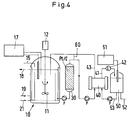
- FIG. 4 shows a representation that corresponds to almost all details with FIG. 1.
- a line 60 a short-circuit path between the output of the oxidation stage 30 and the return line 43 from the electrodialysis stage is provided in the container 10.
- This line 60 is purely schematic here; it can contain additional containers, measuring stages and devices, pumps and flow control elements.
- Sucrose as a non-reducing disaccharide which can be selectively converted to its monocarboxylic acids using the described method in the device shown, is discussed as an example.
- a further increase in the reaction rate with regard to the formation of monocarboxylic acids can be achieved by increasing the partial pressure of oxygen in the solution e.g. by introducing pure oxygen (instead of air or oxygen / nitrogen mixtures).
- Another technical advantage of this mode of operation according to the invention is that the catalyst is deactivated, as is generally the case with discontinuous Operation occurs (comparison: K.Heyns, H.Paulsen (see above); H.Puke, dissertation TU Braunschweig) is not observed. Surprisingly, even when the pure oxygen is introduced, there is no deactivation of the catalyst.
- This advantage has not yet been described in the relevant literature and is also proving to be a major step forward in technological terms in the targeted derivatization of carbohydrates.
- the process can easily be applied to reducing sugars, e.g. Palatinose and glucose.
- the selectivity to certain monooxidation products can be controlled by selecting suitable catalysts, either by using certain supports or mixed metal contacts, or by the pH.
- carbohydrate derivatives e.g. To oxidize glucopyranosylmethylfurfural, the 6'-position and the aldehyde function being converted into the corresponding monocarboxylic acid.
- Alkyl glycosides or mixtures, such as e.g. Alkyl polyglycosides can be oxidized using this method.
- the examples show that the process described here is suitable for the oxidation of aldehyde and primary hydroxy functions in order to obtain mono-oxidized products.
- the educts used which mainly come from the carbohydrate sector, must be soluble in water or in mixtures of water and organic solvents (e.g. water-isopropanol mixtures) and must not evaporate under the test conditions used.
- the process for the production of mono-oxidized products e.g. propanol to propanoic acid
- the oxidation takes place at temperatures between 0-80 ° C, but preferably between 20 and 60 ° C.
- the educt concentrations can vary between 0.1-60%, but are preferably kept in the range of 3-20%.
- the pH values can be adjusted in the range from 1-13 during the oxidation by adding Na2CO3, NaHCO3 or NaOH or other "alkalizing agents".
- Ion exchange membranes can be used in electrodialysis to isolate the monocarboxylic acids. However, the free acids can only be obtained at low pH values. In neutral operation, however, the Na salts of the monocarboxylic acids are usually isolated.
- the neutralizing agent can be recovered and the free monocarboxylic acids of the corresponding starting materials can also be obtained.
- bipolar membranes higher investment costs have to be calculated, but the cost-effectiveness with regard to further processing with regard to subsequent operations must be checked on a case-by-case basis.
- the circulation apparatus described in FIG. 1 is used to carry out the oxidation.
- the gassing takes place in a stirrable cylindrical double-wall stirred reactor (500 ml) over a frit bottom.
- a glass insert is installed as a calming zone, from which a partial flow is conveyed with a centrifugal pump through the catalyst bed, which is located in a glass column closed with 2 frits.
- this partial stream reaches the electrodialysis unit and is then returned to the stirred reactor after the oxidation products have been separated off.
- the product is discharged via the concentrate circuit of the electrodialysis and the equivalent amount of educt solution is metered into the stirred reactor using a peristaltic pump.
- the solution deficit in the concentrate cycle is replaced by distilled water.
- the substances could be separated on a preparative scale and characterized by means of NMR and mass spectrometry.
- the batch oxidation is also carried out in the circulation reactor system, but without electrodialysis and starting material metering.
- the product obtained has the following composition: C 6 ' acid: 50.6% C1 acid: 23.5% Diacid: 8.1% mono and a significant proportion of unidentified products.
- the selectivity with regard to the formation of monocarboxy acids in this case is only 74.1%.
- the oxidation of the glucose takes place in the apparatus described in Example 1, at a pH of 6.5 (addition of NaHCO3) and at a temperature of 35 ° C.
- the continuously obtained product solution has the following composition: Gluconic acid sodium salt: 92% Glucuronic acid sodium salt: 7%
- the selectivity based on the mono acids is 99%.
- the main oxidized products are:
- Gluconic acid sodium salt 60% Glucuronic acid sodium salt: 15% Glucaric acid Na salt: 10% and 15% unspecified products.
- the selectivity with regard to the mono acids is 75% here.
- gluconic acid ⁇ -lactone is formed from gluconic acid, which, however, can be converted back into gluconic acid by raising the pH.
- Gluconic acid 60% Gluconic acid ⁇ -lactone: 20% Glucuronic acid: 15%
- Mixed metal catalysts are precious metal catalysts that contain two or more catalytically active metals with promoters such as e.g. Bismuth included.
- a problem with these catalysts in the batch test is that they are no longer as selective with longer reaction times. However, these are subsequent reactions with the monocarboxylic acids, so that considerable amounts of by-products are obtained. This disadvantage can be eliminated by using the method according to the invention. The products formed are removed immediately after formation by means of electrodialysis and therefore no longer come into contact with the contact.
- the oxidation was carried out as described in Example 3, except for the use of the Pt / Pd / Bi mixed metal catalyst.
- Gluconic acid sodium salt 94%
- Glucuronic acid sodium salt 4%
- the selectivity for the monoacids is 98%.
- sucrose can also be converted into the corresponding monocarboxylic acids.
- the selectivity is over 95%.
- the selectivity to the monocarboxy compounds is approx. 70%.
- the graph in Fig. 3 shows the advantages of continuous operation in terms of reaction speed.
- the selectivity to the mono-oxidized products is 99%.
- sucrose is oxidized in the apparatus described in Example 1, at a pH of 6.5 and at a temperature of 35 ° C. Instead of the oxygen-nitrogen mixture, pure oxygen is introduced, which accelerates the formation of oxidized products accordingly (FIG. 3).
- the main oxidized products are: C 6 ' -sucrose carboxylic acid: 43.0% C6-sucrose carboxylic acid: 43.0% C1-sucrose carboxylic acid: 9.5%
- the selectivity is over 95%.
- the invention relates to a method and a device for producing mono-oxidized products from carbohydrates, carbohydrate derivatives and primary alcohols.
- the raw materials are fed to a continuously operated oxidation stage with precious metal or mixed metal catalysts.
- the stream with the monocarboxylic acids formed on the catalysts is fed to an electrodialysis stage, the monocarboxylic acids being continuously removed and recovered.
Landscapes
- Chemical & Material Sciences (AREA)
- Organic Chemistry (AREA)
- Engineering & Computer Science (AREA)
- Molecular Biology (AREA)
- Biochemistry (AREA)
- Biotechnology (AREA)
- General Health & Medical Sciences (AREA)
- Genetics & Genomics (AREA)
- Health & Medical Sciences (AREA)
- Life Sciences & Earth Sciences (AREA)
- Oil, Petroleum & Natural Gas (AREA)
- Organic Low-Molecular-Weight Compounds And Preparation Thereof (AREA)
- Low-Molecular Organic Synthesis Reactions Using Catalysts (AREA)
- Separation Using Semi-Permeable Membranes (AREA)
- Saccharide Compounds (AREA)
- Catalysts (AREA)
Priority Applications (1)
| Application Number | Priority Date | Filing Date | Title |
|---|---|---|---|
| SI9430004T SI0651734T1 (en) | 1993-03-10 | 1994-03-08 | Method and device for producing monocarboxylic acids from carbohydrates, carbohydrate derivates or primary alcohols |
Applications Claiming Priority (3)
| Application Number | Priority Date | Filing Date | Title |
|---|---|---|---|
| DE4307388 | 1993-03-10 | ||
| DE4307388A DE4307388A1 (de) | 1993-03-10 | 1993-03-10 | Verfahren und Vorrichtung zur Herstellung von monooxydierten Produkten aus Kohlenhydraten, Kohlenhydratderivaten und primären Alkoholen |
| PCT/EP1994/000695 WO1994020448A1 (de) | 1993-03-10 | 1994-03-08 | Verfahren und vorrichtung zur herstellung von monocarbonsäuren von kohlenhydraten, kohlenhydratderivaten oder primären alkoholen |
Publications (2)
| Publication Number | Publication Date |
|---|---|
| EP0651734A1 EP0651734A1 (de) | 1995-05-10 |
| EP0651734B1 true EP0651734B1 (de) | 1996-05-01 |
Family
ID=6482323
Family Applications (1)
| Application Number | Title | Priority Date | Filing Date |
|---|---|---|---|
| EP94910390A Expired - Lifetime EP0651734B1 (de) | 1993-03-10 | 1994-03-08 | Verfahren und vorrichtung zur herstellung von monocarbonsäuren von kohlenhydraten, kohlenhydratderivaten oder primären alkoholen |
Country Status (22)
| Country | Link |
|---|---|
| EP (1) | EP0651734B1 (cs) |
| JP (1) | JPH08509701A (cs) |
| AT (1) | ATE137489T1 (cs) |
| AU (1) | AU689101B2 (cs) |
| BG (1) | BG61999B1 (cs) |
| BR (1) | BR9405896A (cs) |
| CA (1) | CA2157937C (cs) |
| CZ (1) | CZ288628B6 (cs) |
| DE (2) | DE4307388A1 (cs) |
| DK (1) | DK0651734T3 (cs) |
| ES (1) | ES2086999T3 (cs) |
| FI (1) | FI110685B (cs) |
| GR (1) | GR3019822T3 (cs) |
| HU (1) | HU218594B (cs) |
| NO (1) | NO303822B1 (cs) |
| NZ (1) | NZ262903A (cs) |
| PL (1) | PL174620B1 (cs) |
| RO (1) | RO114606B1 (cs) |
| RU (1) | RU2129541C1 (cs) |
| SK (1) | SK281397B6 (cs) |
| UA (1) | UA43844C2 (cs) |
| WO (1) | WO1994020448A1 (cs) |
Families Citing this family (15)
| Publication number | Priority date | Publication date | Assignee | Title |
|---|---|---|---|---|
| DE19505957A1 (de) * | 1995-02-21 | 1996-08-22 | Huels Chemische Werke Ag | Verfahren zur Herstellung von Ketoverbindungen |
| DE19507668C2 (de) * | 1995-03-04 | 2000-01-27 | Suedzucker Ag | Waschmittelformulierungen, enthaltend eine acylierte Disaccharidcarbonsäure |
| DE19542303C2 (de) | 1995-11-14 | 1998-03-26 | Suedzucker Ag | Acylierte Saccharosemonocarbonsäuren |
| DE19542287A1 (de) * | 1995-11-14 | 1997-05-15 | Suedzucker Ag | Verfahren zur Herstellung von di- und höheroxidierten Carbonsäuren von Kohlenhydraten, Kohlenhydratderivaten oder primären Alkoholen |
| DE19619016A1 (de) * | 1996-05-10 | 1997-11-13 | Suedzucker Ag | Verfahren und Vorrichtung zur Oxidation von Kohlenhydraten, Kohlenhydratderivaten oder primären Alkoholen, bei dem eine katalysierte Oxidation stattfindet |
| DE19748195A1 (de) | 1997-10-31 | 1999-05-06 | Suedzucker Ag | Disaccharidderivate zur Behandlung von Hyperglykämien |
| US20020038051A1 (en) | 2000-02-18 | 2002-03-28 | Degussa-Huls Ag | Raney copper |
| RU2185369C1 (ru) * | 2001-04-02 | 2002-07-20 | Тверской государственный технический университет РАН | Способ получения 2-кето-l-гулоновой кислоты |
| DE10227432B4 (de) * | 2002-06-20 | 2006-11-30 | Südzucker AG Mannheim/Ochsenfurt | Verfahren zur Trennung von Kohlenhydratcarbonsäuren |
| DE10362249B4 (de) | 2003-05-05 | 2014-05-15 | Südzucker AG Mannheim/Ochsenfurt | C1-selektive Oxidation von Oligosacchariden und die Verwendung eines Kohlenstoff geträgerten Gold-Katalysators für diese Oxidation |
| RU2242456C1 (ru) * | 2003-08-13 | 2004-12-20 | Закрытое акционерное общество "Каустик" | Способ получения монокарбоновых кислот c4-c8 |
| RU2245324C1 (ru) * | 2003-09-08 | 2005-01-27 | Тверской государственный технический университет | Способ получения 2-кето-l-гулоновой кислоты |
| DE102005036890A1 (de) * | 2005-08-05 | 2007-02-08 | Südzucker AG Mannheim/Ochsenfurt | Geträgerter Goldkatalysator |
| US8383837B2 (en) * | 2007-06-05 | 2013-02-26 | Dsm Ip Assets B.V. | Reaction with a gold catalyst |
| WO2019043069A1 (en) * | 2017-08-29 | 2019-03-07 | Julius-Maximilians-Universitaet Wuerzburg | NEW CLASS OF SUCROSE ESTERS AND PREPARATION METHOD THEREOF |
Family Cites Families (8)
| Publication number | Priority date | Publication date | Assignee | Title |
|---|---|---|---|---|
| SU109712A1 (ru) * | 1949-09-30 | 1956-11-30 | С.М. Мещанинов | Способ непрерывного окислени углеводородов |
| DE3020104A1 (de) * | 1980-05-27 | 1981-12-03 | Merck Patent Gmbh, 6100 Darmstadt | Verfahren zur herstellung von diacetonketogulonsaeure |
| JPS6054338A (ja) * | 1983-09-05 | 1985-03-28 | Mitsui Toatsu Chem Inc | 2−ケト−l−グロン酸の製造法 |
| DE3446695A1 (de) * | 1984-12-21 | 1986-06-26 | Basf Ag, 6700 Ludwigshafen | Verfahren zur aufkonzentrierung waessriger loesungen von organischen verbindungen, die salze enthalten, unter gleichzeitiger verringerung des salzgehaltes |
| DE3522032A1 (de) * | 1985-06-20 | 1987-01-02 | Hoechst Ag | Verfahren zur herstellung von carbonsaeuren |
| FR2597473B1 (fr) * | 1986-01-30 | 1988-08-12 | Roquette Freres | Procede d'oxydation de di-, tri-, oligo- et polysaccharides en acides polyhydroxycarboxyliques, catalyseur mis en oeuvre et produits ainsi obtenus. |
| DE3803465A1 (de) * | 1988-02-05 | 1989-08-17 | Huels Chemische Werke Ag | Verfahren zur herstellung von oxidierten substituierten sacchariden |
| DE3916206A1 (de) * | 1989-05-18 | 1990-11-22 | Hoechst Ag | Verfahren zur herstellung von 1-fluor-glycuronsaeuren und deren salzen sowie solche neuen 1-flour-glycuronsaeuren und deren salze |
-
1993
- 1993-03-10 DE DE4307388A patent/DE4307388A1/de not_active Withdrawn
-
1994
- 1994-03-08 RO RO95-01572A patent/RO114606B1/ro unknown
- 1994-03-08 AU AU62835/94A patent/AU689101B2/en not_active Ceased
- 1994-03-08 EP EP94910390A patent/EP0651734B1/de not_active Expired - Lifetime
- 1994-03-08 PL PL94309642A patent/PL174620B1/pl not_active IP Right Cessation
- 1994-03-08 SK SK1099-95A patent/SK281397B6/sk unknown
- 1994-03-08 HU HU9501726A patent/HU218594B/hu not_active IP Right Cessation
- 1994-03-08 NZ NZ262903A patent/NZ262903A/en not_active IP Right Cessation
- 1994-03-08 RU RU95121941A patent/RU2129541C1/ru not_active IP Right Cessation
- 1994-03-08 DK DK94910390.7T patent/DK0651734T3/da active
- 1994-03-08 CA CA002157937A patent/CA2157937C/en not_active Expired - Fee Related
- 1994-03-08 CZ CZ19952310A patent/CZ288628B6/cs not_active IP Right Cessation
- 1994-03-08 BR BR9405896A patent/BR9405896A/pt not_active IP Right Cessation
- 1994-03-08 WO PCT/EP1994/000695 patent/WO1994020448A1/de not_active Ceased
- 1994-03-08 DE DE59400253T patent/DE59400253D1/de not_active Expired - Lifetime
- 1994-03-08 JP JP6519588A patent/JPH08509701A/ja active Pending
- 1994-03-08 ES ES94910390T patent/ES2086999T3/es not_active Expired - Lifetime
- 1994-03-08 AT AT94910390T patent/ATE137489T1/de not_active IP Right Cessation
- 1994-08-03 UA UA95094017A patent/UA43844C2/uk unknown
-
1995
- 1995-07-10 FI FI953372A patent/FI110685B/fi active
- 1995-09-08 NO NO953536A patent/NO303822B1/no unknown
- 1995-09-22 BG BG100021A patent/BG61999B1/bg unknown
-
1996
- 1996-05-02 GR GR960401130T patent/GR3019822T3/el unknown
Also Published As
| Publication number | Publication date |
|---|---|
| BR9405896A (pt) | 1995-12-12 |
| ATE137489T1 (de) | 1996-05-15 |
| PL174620B1 (pl) | 1998-08-31 |
| NO953536L (no) | 1995-09-08 |
| NZ262903A (en) | 1996-11-26 |
| UA43844C2 (uk) | 2002-01-15 |
| HU218594B (hu) | 2000-10-28 |
| FI953372L (fi) | 1995-07-10 |
| DE59400253D1 (de) | 1996-06-05 |
| CZ288628B6 (cs) | 2001-08-15 |
| FI953372A0 (fi) | 1995-07-10 |
| RO114606B1 (ro) | 1999-06-30 |
| SK281397B6 (sk) | 2001-03-12 |
| CZ231095A3 (en) | 1996-01-17 |
| DE4307388A1 (de) | 1994-09-15 |
| HU9501726D0 (en) | 1995-08-28 |
| BG61999B1 (bg) | 1998-12-30 |
| FI110685B (fi) | 2003-03-14 |
| SK109995A3 (en) | 1995-12-06 |
| RU2129541C1 (ru) | 1999-04-27 |
| GR3019822T3 (en) | 1996-08-31 |
| HUT73732A (en) | 1996-09-30 |
| ES2086999T3 (es) | 1996-07-01 |
| PL309642A1 (en) | 1995-10-30 |
| NO953536D0 (no) | 1995-09-08 |
| CA2157937A1 (en) | 1994-09-15 |
| BG100021A (bg) | 1996-05-31 |
| NO303822B1 (no) | 1998-09-07 |
| WO1994020448A1 (de) | 1994-09-15 |
| JPH08509701A (ja) | 1996-10-15 |
| AU689101B2 (en) | 1998-03-26 |
| AU6283594A (en) | 1994-09-26 |
| DK0651734T3 (da) | 1996-06-10 |
| CA2157937C (en) | 2003-05-06 |
| EP0651734A1 (de) | 1995-05-10 |
Similar Documents
| Publication | Publication Date | Title |
|---|---|---|
| EP0651734B1 (de) | Verfahren und vorrichtung zur herstellung von monocarbonsäuren von kohlenhydraten, kohlenhydratderivaten oder primären alkoholen | |
| EP0775709B1 (de) | Verfahren zur Herstellung von di- und höheroxidierten Carbonsäuren von Kohlenhydraten, Kohlenhydratderivaten oder primären Alkoholen | |
| EP2030680B1 (de) | Ruthenium-Katalysatoren auf einem SiO2-Träger für die katalytische Hydrierung von Sacchariden | |
| EP1631537B1 (de) | Verfahren zur selektiven kohlenhydrat-oxidation unter verwendung geträgerter gold-katalysatoren | |
| EP0288847B1 (de) | Kontinuierliches Verfahren zur Epimerisierung von Zuckern, insbesondere von D-Arabinose zu D-Ribose | |
| EP1572607A1 (de) | Kontinuierliches verfahren zur herstellung von zuckeralkoholen | |
| EP2574609A1 (de) | Verfahren zur Herstellung von Furanverbindungen aus nachwachsenden Rohstoffen | |
| DE2658223B2 (de) | Verfahren zur Herstellung von D-Mannit | |
| EP1436245A1 (de) | Verfahren zur isolierung von salzen von organischen säuren aus einer fermentationsbrühe und zur freisetzung der organischen säure | |
| DE4107987A1 (de) | Verfahren zur herstellung von 3-hydroxypropionsaeure | |
| EP0218150A2 (de) | Saccharose-tricarbonsäure und ihre Derivate, Verfahren zur Herstellung von Saccharose-tricarbonsäure und ihren Salzen und ihre Verwendung | |
| DE60219085T3 (de) | Verfahren zur herstellung alkali- und hitzebeständiger zucker-alkohol-zusammensetzungen | |
| DE3852876T2 (de) | Verfahren zur Herstellung eines Lactulosesirups mit einem hohen Reinheitsgrad und der so gewonnene Sirup. | |
| EP3849991A1 (de) | Verfahren zur verbesserten herstellung von isomalt | |
| EP0472556B1 (de) | Verfahren zur herstellung von 1-fluor-glycoronsäuren und deren salzen sowie solche neuen 1-fluor-glycuronsäuren und deren salze | |
| DE2923266A1 (de) | Verfahren zur herstellung von n-d-ribityl-3,4-xylidin | |
| EP0806430A2 (de) | Verfahren und Vorrichtung zur Oxidation von Kohlenhydraten, Kohlenhydratderivaten oder primären Alkoholen bei dem eine katalysierte Oxidation stattfindet. | |
| DE4107986A1 (de) | Verfahren zur herstellung von malonsaeure | |
| DE2224680B2 (de) | Verfahren zur herstellung von lactulosesirup |
Legal Events
| Date | Code | Title | Description |
|---|---|---|---|
| PUAI | Public reference made under article 153(3) epc to a published international application that has entered the european phase |
Free format text: ORIGINAL CODE: 0009012 |
|
| 17P | Request for examination filed |
Effective date: 19950211 |
|
| AK | Designated contracting states |
Kind code of ref document: A1 Designated state(s): AT BE CH DE DK ES FR GB GR IE IT LI LU NL PT SE |
|
| 17Q | First examination report despatched |
Effective date: 19950612 |
|
| GRAH | Despatch of communication of intention to grant a patent |
Free format text: ORIGINAL CODE: EPIDOS IGRA |
|
| GRAA | (expected) grant |
Free format text: ORIGINAL CODE: 0009210 |
|
| AK | Designated contracting states |
Kind code of ref document: B1 Designated state(s): AT BE CH DE DK ES FR GB GR IE IT LI LU NL PT SE |
|
| AX | Request for extension of the european patent |
Free format text: SI PAYMENT 950211 |
|
| RAX | Requested extension states of the european patent have changed |
Free format text: SI PAYMENT 950211 |
|
| REF | Corresponds to: |
Ref document number: 137489 Country of ref document: AT Date of ref document: 19960515 Kind code of ref document: T |
|
| ITF | It: translation for a ep patent filed | ||
| REG | Reference to a national code |
Ref country code: CH Ref legal event code: NV Representative=s name: KELLER & PARTNER PATENTANWAELTE AG |
|
| REG | Reference to a national code |
Ref country code: IE Ref legal event code: FG4D Free format text: 68210 |
|
| ET | Fr: translation filed | ||
| REF | Corresponds to: |
Ref document number: 59400253 Country of ref document: DE Date of ref document: 19960605 |
|
| REG | Reference to a national code |
Ref country code: DK Ref legal event code: T3 |
|
| REG | Reference to a national code |
Ref country code: ES Ref legal event code: FG2A Ref document number: 2086999 Country of ref document: ES Kind code of ref document: T3 |
|
| GBT | Gb: translation of ep patent filed (gb section 77(6)(a)/1977) |
Effective date: 19960603 |
|
| REG | Reference to a national code |
Ref country code: GR Ref legal event code: FG4A Free format text: 3019822 |
|
| SC4A | Pt: translation is available |
Free format text: 960502 AVAILABILITY OF NATIONAL TRANSLATION |
|
| PLBE | No opposition filed within time limit |
Free format text: ORIGINAL CODE: 0009261 |
|
| STAA | Information on the status of an ep patent application or granted ep patent |
Free format text: STATUS: NO OPPOSITION FILED WITHIN TIME LIMIT |
|
| 26N | No opposition filed | ||
| REG | Reference to a national code |
Ref country code: GB Ref legal event code: IF02 |
|
| REG | Reference to a national code |
Ref country code: SI Ref legal event code: IF |
|
| PGFP | Annual fee paid to national office [announced via postgrant information from national office to epo] |
Ref country code: ES Payment date: 20080228 Year of fee payment: 15 Ref country code: DK Payment date: 20080312 Year of fee payment: 15 Ref country code: CH Payment date: 20080320 Year of fee payment: 15 |
|
| PGFP | Annual fee paid to national office [announced via postgrant information from national office to epo] |
Ref country code: SE Payment date: 20080320 Year of fee payment: 15 Ref country code: PT Payment date: 20080219 Year of fee payment: 15 Ref country code: NL Payment date: 20080318 Year of fee payment: 15 Ref country code: LU Payment date: 20080327 Year of fee payment: 15 Ref country code: IT Payment date: 20080327 Year of fee payment: 15 Ref country code: IE Payment date: 20080307 Year of fee payment: 15 |
|
| PGFP | Annual fee paid to national office [announced via postgrant information from national office to epo] |
Ref country code: AT Payment date: 20080331 Year of fee payment: 15 |
|
| PGFP | Annual fee paid to national office [announced via postgrant information from national office to epo] |
Ref country code: BE Payment date: 20080229 Year of fee payment: 15 |
|
| PGFP | Annual fee paid to national office [announced via postgrant information from national office to epo] |
Ref country code: GR Payment date: 20080227 Year of fee payment: 15 |
|
| REG | Reference to a national code |
Ref country code: PT Ref legal event code: MM4A Free format text: LAPSE DUE TO NON-PAYMENT OF FEES Effective date: 20090908 |
|
| BERE | Be: lapsed |
Owner name: *SUDZUCKER A.G. MANNHEIM/OCHSENFURT Effective date: 20090331 |
|
| PG25 | Lapsed in a contracting state [announced via postgrant information from national office to epo] |
Ref country code: PT Free format text: LAPSE BECAUSE OF NON-PAYMENT OF DUE FEES Effective date: 20090908 Ref country code: AT Free format text: LAPSE BECAUSE OF NON-PAYMENT OF DUE FEES Effective date: 20090308 |
|
| REG | Reference to a national code |
Ref country code: CH Ref legal event code: PL |
|
| REG | Reference to a national code |
Ref country code: DK Ref legal event code: EBP |
|
| EUG | Se: european patent has lapsed | ||
| NLV4 | Nl: lapsed or anulled due to non-payment of the annual fee |
Effective date: 20091001 |
|
| REG | Reference to a national code |
Ref country code: IE Ref legal event code: MM4A |
|
| PG25 | Lapsed in a contracting state [announced via postgrant information from national office to epo] |
Ref country code: LI Free format text: LAPSE BECAUSE OF NON-PAYMENT OF DUE FEES Effective date: 20090331 Ref country code: IE Free format text: LAPSE BECAUSE OF NON-PAYMENT OF DUE FEES Effective date: 20090309 Ref country code: CH Free format text: LAPSE BECAUSE OF NON-PAYMENT OF DUE FEES Effective date: 20090331 |
|
| PG25 | Lapsed in a contracting state [announced via postgrant information from national office to epo] |
Ref country code: BE Free format text: LAPSE BECAUSE OF NON-PAYMENT OF DUE FEES Effective date: 20090331 Ref country code: NL Free format text: LAPSE BECAUSE OF NON-PAYMENT OF DUE FEES Effective date: 20091001 |
|
| PG25 | Lapsed in a contracting state [announced via postgrant information from national office to epo] |
Ref country code: DK Free format text: LAPSE BECAUSE OF NON-PAYMENT OF DUE FEES Effective date: 20090331 |
|
| REG | Reference to a national code |
Ref country code: ES Ref legal event code: FD2A Effective date: 20090309 |
|
| PG25 | Lapsed in a contracting state [announced via postgrant information from national office to epo] |
Ref country code: GR Free format text: LAPSE BECAUSE OF NON-PAYMENT OF DUE FEES Effective date: 20091002 |
|
| PG25 | Lapsed in a contracting state [announced via postgrant information from national office to epo] |
Ref country code: ES Free format text: LAPSE BECAUSE OF NON-PAYMENT OF DUE FEES Effective date: 20090309 |
|
| PG25 | Lapsed in a contracting state [announced via postgrant information from national office to epo] |
Ref country code: IT Free format text: LAPSE BECAUSE OF NON-PAYMENT OF DUE FEES Effective date: 20090308 |
|
| PG25 | Lapsed in a contracting state [announced via postgrant information from national office to epo] |
Ref country code: LU Free format text: LAPSE BECAUSE OF NON-PAYMENT OF DUE FEES Effective date: 20090308 |
|
| PG25 | Lapsed in a contracting state [announced via postgrant information from national office to epo] |
Ref country code: SE Free format text: LAPSE BECAUSE OF NON-PAYMENT OF DUE FEES Effective date: 20090309 |
|
| PGFP | Annual fee paid to national office [announced via postgrant information from national office to epo] |
Ref country code: FR Payment date: 20110316 Year of fee payment: 18 |
|
| PGFP | Annual fee paid to national office [announced via postgrant information from national office to epo] |
Ref country code: GB Payment date: 20110304 Year of fee payment: 18 Ref country code: DE Payment date: 20110329 Year of fee payment: 18 |
|
| GBPC | Gb: european patent ceased through non-payment of renewal fee |
Effective date: 20120308 |
|
| REG | Reference to a national code |
Ref country code: FR Ref legal event code: ST Effective date: 20121130 |
|
| REG | Reference to a national code |
Ref country code: DE Ref legal event code: R119 Ref document number: 59400253 Country of ref document: DE Effective date: 20121002 |
|
| PG25 | Lapsed in a contracting state [announced via postgrant information from national office to epo] |
Ref country code: FR Free format text: LAPSE BECAUSE OF NON-PAYMENT OF DUE FEES Effective date: 20120402 Ref country code: GB Free format text: LAPSE BECAUSE OF NON-PAYMENT OF DUE FEES Effective date: 20120308 |
|
| PG25 | Lapsed in a contracting state [announced via postgrant information from national office to epo] |
Ref country code: DE Free format text: LAPSE BECAUSE OF NON-PAYMENT OF DUE FEES Effective date: 20121002 |