EP0653414A1 - Verfahren zur Herstellung von Fluorbenzoesäurealkylestern durch Reaktion eines Fluorbenzoylchlorids mit einem Alkohol in Gegenwort eines Alkalimetallalkoholates - Google Patents
Verfahren zur Herstellung von Fluorbenzoesäurealkylestern durch Reaktion eines Fluorbenzoylchlorids mit einem Alkohol in Gegenwort eines Alkalimetallalkoholates Download PDFInfo
- Publication number
- EP0653414A1 EP0653414A1 EP94117329A EP94117329A EP0653414A1 EP 0653414 A1 EP0653414 A1 EP 0653414A1 EP 94117329 A EP94117329 A EP 94117329A EP 94117329 A EP94117329 A EP 94117329A EP 0653414 A1 EP0653414 A1 EP 0653414A1
- Authority
- EP
- European Patent Office
- Prior art keywords
- alcohol
- process according
- alkali metal
- reaction
- mol
- Prior art date
- Legal status (The legal status is an assumption and is not a legal conclusion. Google has not performed a legal analysis and makes no representation as to the accuracy of the status listed.)
- Granted
Links
- DTZRGPYHPYOWKK-UHFFFAOYSA-N CC(C=CC=C1)(C=C1C(OC)=O)F Chemical compound CC(C=CC=C1)(C=C1C(OC)=O)F DTZRGPYHPYOWKK-UHFFFAOYSA-N 0.000 description 1
Classifications
-
- C—CHEMISTRY; METALLURGY
- C07—ORGANIC CHEMISTRY
- C07C—ACYCLIC OR CARBOCYCLIC COMPOUNDS
- C07C67/00—Preparation of carboxylic acid esters
- C07C67/14—Preparation of carboxylic acid esters from carboxylic acid halides
Definitions
- Alkyl fluorobenzoates of the general formula (I) are important intermediates for the production of pharmaceuticals and crop protection agents.
- Several processes for the preparation of such esters are described in the literature. This gives ethyl and methyl 3-fluorobenzoate from the silver salt of the acid (Paterno et al., Gazz. Chim. Ital. 12, 90).
- this method is at best suitable for the production of quantities on a laboratory scale.
- Ethyl 4-fluorobenzoate and the corresponding methyl ester result from the reaction of 4-fluorobenzoic acid with ethanol or methanol while introducing hydrogen chloride gas (Schmitt et al., J. Prakt. Chem. 1 (2), 400; Bacon et al., J. Org. Chem. 3, 281 (1938); Bowden et al., H. Chem. Soc. 1940, 1249).
- This reaction gives only moderate yields in the case of long reaction times and is also disadvantageous owing to the formation of alkyl halides as a side reaction by reaction of hydrogen chloride gas with the alcohols (cf. Example 1).
- 2- and 4-Fluorobenzoic acid methyl and ethyl esters are also obtained by heating 2- or 4-methoxycarbonylphenyldiazonium tetrafluoroborate (Bergmann et al., Chem. Ber. 64, 1455 (1931); Schiemann et al., Org. Synth. Coll Vol. II, 299 (1943); Japanese Patent 05039233). Since the starting materials required for this are accessible only with great effort, these reactions are not technically easy to carry out and, moreover, usually only give moderate yields.
- Variants of this reaction which are only suitable for laboratory quantities are the reaction of ethyl nitrite with 4-aminobenzoic acid ethyl hexafluorosilicate (Wiley et al., J. Am. Chem. Soc. 71, 1863 (1949)) and the reaction of methyl 2-aminobenzoate with nitrosonium tetrafluoroborate (Milner et al ., Synth. Commun. 22 (1), 73 (1992)).
- 4-Fluorobenzoic acid methyl ester can also be prepared by Pd-catalyzed alkoxycarbonylation of 4-iodofluorobenzene, which is technically available at unacceptable prices (Carpentier et al., Tetrahedron Lett. 32 (36), 4705 (1991)). Here, however, about 9% of methyl 4-methoxybenzoate is obtained as a by-product.
- Variants of this reaction are the reactions of 4-iodofluorobenzene with ethanol and CO on zeolite catalyst systems or under Pd catalysis, which, however, only yield 62 or 76% (JP 04046139; JP 03197441), as well as the reaction of 4-fluorobromobenzene Methyl iodide and CO on cobalt catalysts (Itoh et al., Mol. Catal. 48 (1), 11 (1988)).
- alkyl fluorobenzoic acid esters that are only suitable on the laboratory scale are the electrochemical reduction of 2,6-difluorobenzoic acid esters (Hebri et al., Synth. Commun. 21 (22), 2377 (1991)) and the anodic oxidation of acetic acid 2- (4- fluorobenzoate) (4-F-C6H4COOCH2COOH) (Thomas et al., Chem. Ber. 118 (7), 2777 (1985)).
- the reaction is advantageously carried out in such a way that 1.0 to 5.0 mol, in particular 1.0 to 3.0, preferably 1.0 to 1.5 mol of alcoholate are used per mol of acid chloride to be reacted.
- This is advantageously introduced in solution in such an amount of the corresponding alcohol that the alcoholate content of the solution is between 1 and 60%, in particular 10 to 50%, preferably between 20 and 40%.
- the acid chloride is added dropwise, optionally with cooling, at a temperature of from -10 ° C. to the boiling point of the alcohol, in particular from 10 ° C. to the boiling point of the alcohol.
- the mixture is subsequently stirred at from -10 ° C. to the reflux temperature of the alcohol, in particular from 10 ° C.
- the fluorobenzoic acid chlorides used for the comparative examples were prepared by side chain chlorination of the corresponding fluorotoluenes and subsequent saponification.
Landscapes
- Chemical & Material Sciences (AREA)
- Organic Chemistry (AREA)
- Organic Low-Molecular-Weight Compounds And Preparation Thereof (AREA)
- Pharmaceuticals Containing Other Organic And Inorganic Compounds (AREA)
- Plural Heterocyclic Compounds (AREA)
Abstract
Description
- Fluorbenzoesäurealkylester der allgemeinen Formel (I) sind wichtige Zwischenprodukte für die Herstellung von Pharmazeutika und Pflanzenschutzmitteln.

In der Literatur sind einige Verfahren zur Herstellung solcher Ester beschrieben. So erhält man 3-Fluorbenzoesäureethyl- und -methylester aus dem Silbersalz der Säure (Paterno et al., Gazz. Chim. Ital. 12, 90). Dieses Verfahren ist aber wegen Verwendung eines teuren Silbersalzes bestenfalls zur Herstellung von Mengen im Labormaßstab geeignet. - 4-Fluorbenzoesäureethylester und der entsprechende Methylester entstehen bei der Umsetzung von 4-Fluorbenzoesäure mit Ethanol bzw. Methanol unter Einleiten von Chlorwasserstoffgas (Schmitt et al., J. Prakt. Chem. 1 (2), 400; Bacon et al., J. Org. Chem. 3, 281 (1938); Bowden et al., H. Chem. Soc. 1940, 1249). Diese Reaktion liefert bei langen Reaktionszeiten nur mäßige Ausbeuten und ist außerdem aufgrund der als Nebenreaktion ablaufenden Bildung von Alkylhalogeniden durch Reaktion von Chlorwasserstoffgas mit den Alkoholen von Nachteil (vgl. Beispiel 1).
- 2- und 4-Fluorbenzoesäuremethyl- und -ethylester erhält man weiterhin durch Erhitzen von 2- bzw. 4-Methoxycarbonylphenyldiazoniumtetrafluoroborat (Bergmann et al., Chem. Ber. 64, 1455 (1931); Schiemann et al., Org. Synth. Coll. Vol. II, 299 (1943); Jap. Patentschrift 05039233). Da die hierfür benötigten Ausgangsstoffe nur mit großem Aufwand zugänglich sind, sind diese Reaktionen technisch nicht leicht durchführbar und liefern zudem meist nur mäßige Ausbeuten.
- Nur für Labormengen geeignete Varianten dieser Reaktion sind die Umsetzung von Ethylnitrit mit 4-Aminobenzoesäureethylhexafluorosilikat (Wiley et al., J. Am. Chem. Soc. 71, 1863 (1949)) und die Umsetzung von 2-Aminobenzoesäuremethylester mit Nitrosoniumtetrafluoroborat (Milner et al., Synth. Commun. 22 (1), 73 (1992)).
- 4-Fluorbenzoesäuremethylester kann auch durch Pd-katalysierte Alkoxycarbonylierung von 4-Iodofluorbenzol, welches technisch zu nicht akzeptablen Preisen verfügbar ist, hergestellt werden (Carpentier et al., Tetrahedron Lett. 32 (36), 4705 (1991)). Hierbei erhält man aber ca. 9 % an 4-Methoxybenzoesäuremethylester als Nebenprodukt. Varianten dieser Reaktion sind die Umsetzungen von 4-Iodofluorbenzol mit Ethanol und CO an Zeolith-Katalsytoren oder under Pd-Katalyse, die aber nur 62 bzw. 76 % Ausbeute liefern (JP 04046139; JP 03197441), sowie die Reaktion von 4-Fluorbrombenzol mit Methyliodid und CO an Kobaltkatalysatoren (Itoh et al., Mol. Catal. 48 (1), 11 (1988)).
- Nur für den Labormaßstab geeignete Herstellmethoden für Fluorbenzoesäurealkylester sind die elektrochemische Reduktion von 2,6-Difluorbenzoesäureestern (Hebri et al., Synth. Commun. 21 (22), 2377 (1991)) und die anodische Oxidation von Essigsäure-2-(4-fluorbenzoat) (4-F-C₆H₄COOCH₂COOH) (Thomas et al., Chem. Ber. 118 (7), 2777 (1985)).
- In der Literatur sind ferner Verfahren zur Herstellung von 4-Fluorbenzoesäurealkylestern durch Umsetzung der entsprechenden Fluorbenzoesäurechloride mit Alkoholen beschrieben (FR 2541282; Smith et al., J. Am. Chem. Soc. 79, 875 (1957); Spratt et al., Anal. Chem. 56 (12), 2038 (1984)). Bei dieser Reaktion findet jedoch in der Regel als Nebenreaktion Alkylchlorid-Bildung statt (vgl. Beispiel 1), was die Ausbeute erniedrigt und zu ökologisch bedenklicher Prozeßabluft führt. Außerdem verläuft diese Reaktion oft langsam und erfordert höhere Temperaturen, welche die Alkylchloridbildung noch begünstigen. Die Verwendung von Aminen als Lösungsmittel als Katalysator, wie in diesen Literaturstellen beschrieben, beschleunigt zwar die Reaktion, ist aber aufgrund der Bildung von Aminhydrochloriden aus dem Amin und der entstehenden Salzsäure technisch ungünstig. Die Hydrochloride müßten aufwendig zu freiem Amin regeneriert werden. Außerdem ist die Produktqualität dann in der Regel so schlecht, daß eine aufwendige destillative Aufarbeitung notwendig wird (vgl. Beispiel 2).
- Daher bestand ein sehr hoher Bedarf nach einem neuen Verfahren zur Herstellung von Fluorbenzoesäurealkylestern, das die beschriebenen Nachteile nicht aufweist, von leicht zugänglichen Stoffen ausgeht, die gewünschten Verbindungen in hoher Ausbeute zugänglich macht und sich zudem technisch ohne großen Aufwand realisieren läßt.
- Diese Aufgabe wird gelöst durch ein Verfahren zur Herstellung von Fluorbenzoesäurealkylestern der allgemeinen Formel (I)
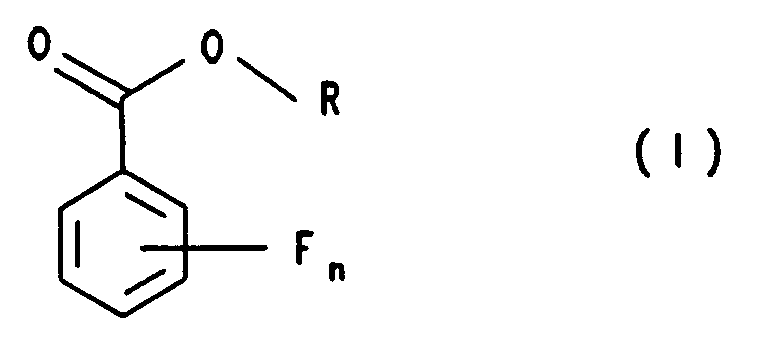
worin R für einen Alkylrest und Fn für 1 bis 4 Fluoratome, die unabhängig voneinander an den aromatischen Ring gebunden sind, steht, indem man ein Fluorbenzoylchlorid der allgemeinen Formel II
in der Fn die oben definierte Bedeutung hat mit einer mindestens stöchiometrischen Menge eines Alkalialkoholates ROM,
worin R die oben definierte Bedeutung hat und M für ein Alkalimetall der Gruppe Li, Na, K steht, in dem entsprechenden Alkohol ROH bei Temperaturen von -10°C bis 150°C umsetzt, das Lösungsmittel gegebenenfalls abdestilliert und durch Behandeln mit Wasser oder Filtration das gebildete Alkalichlorid abtrennt. - Die Reaktion wird zweckmäßig so geführt, daß man pro Mol umzusetzendes Säurechlorid 1,0 bis 5,0 Mol, insbesondere 1,0 bis 3,0, bevorzugt 1,0 bis 1,5 Mol Alkoholat einsetzt. Dies wird vorteilhaft in einer solchen Menge des entsprechenden Alkoholes gelöst vorgelegt, daß der Alkoholatgehalt der Lösung zwischen 1 und 60 %, insbesondere 10 bis 50 %, bevorzugt zwischen 20 und 40 % liegt. Das Säurechlorid wird, gegebenenfalls unter Kühlung, bei einer Temperatur von -10°C bis Siedetemperatur des Alkohols, insbesondere 10°C bis Siedetemperatur des Alkohols, zugetropft. Anschließend wird bei -10°C bis Rückflußtemperatur des Alkohols, insbesondere 10°C bis Rückflußtemperatur des Alkohols, bevorzugt bei 10°C bis 40°C nachgerührt. Es hat sich in vielen Fällen bewährt, das Reaktionsgemisch mit Wasser zu verdünnen und das Produkt durch Phasentrennung oder Filtration zu isolieren. Hierbei hat es sich als günstig erwiesen, vor der Wasserzugabe überschüssigen Alkohol abzudestillieren.
Eine weitere Möglichkeit besteht darin, das Produkt durch Abfiltrieren des Alkalisalzes und nachfolgende destillative Abtrennung des Alkohols zu isolieren. - Dieses Verfahren zeichnet sich somit gegenüber den literaturbekannten Verfahren durch hohe Ausbeuten aus, wobei ohne Reinigung der Rohprodukte hohe Reinheiten erzielt werden. Besonders überraschend bei diesem Verfahren ist, daß der befürchtete nucleophile Fluor-Methoxy-Austausch, wie er z. B. bei Williams et al., J. Org. Chem. 42, 3414 (1977), James et al., J. Fluorine Chem. 27 (N1), 91 (1985) und vielen anderen Literaturstellen beschrieben wird, nicht auftritt. Bei diesem Verfahren werden auch keine Alkylhalogenide gebildet, so daß keine besonderen Anforderungen an die Abluftreinigung gestellt werden müssen. Die Edukte sind billig und in großtechnischen Mengen verfügbar. 3-Fluorbenzoylchlorid wird z. B. durch Seitenkettenchlorierung von 3-Fluortoluol und nachfolgender Verseifung oder durch Umsetzung von 3-Fluorbenzoesäure mit Thionylchlorid hergestellt. Die Raum-Zeit-Ausbeuten sind auf allen Stufen hoch.
- Die nachfolgenden Beispiele dienen zur Erläuterung des Verfahrens, ohne es darauf zu beschränken.
- Die für die Vergleichsbeispiele verwendeten Fluorbenzoesäurechloride wurden durch Seitenkettenchlorierung der entsprechenden Fluortoluole und nachfolgende Verseifung hergestellt.
-
- a) 600,0 g (3,78 Mol) 3-Fluorbenzoylchlorid werden bei Raumtemperatur vorgelegt. Innerhalb von 3 h werden 130,0 g (4,06 Mol) Methanol zugetropft, wobei die Temperatur durch Kühlen bei 30°C gehalten wird. Nach ca. 15 Min. setzte die Entwicklung von Chlorwasserstoff ein. Während der Dosierung werden im Abgas gaschromatographisch >10 Vol.-% Methylchlorid nachgewiesen. Nach Ende der Dosierung wird 15 Min. bei 30°C und anschließend zum Erreichen eines vollständigen Umsatzes 30 Min. bei Rückflußtemperatur nachgerührt. Dann wird überschüssiges Methanol und gelöste Salzsäure abdestilliert.
Ausbeute: 537,1 g (3,48 Mol) 3-Fluorbenzoesäuremethylester ≙ 92,2 % d. Th.. - b) 638,0 g (4,02 Mol) 3-Fluorbenzoylchlorid werden bei Raumtemperatur vorgelegt. Innerhalb von 2 h werden 195,0 g (4,22 Mol) Ethanol zugetropft, wobei die Temperatur auf 52°C ansteigt. Nach ca. 15 Min. setzt die Chlorwasserstoff-Entwicklung ein. Während der Dosierung lassen sich im Abgas >0,5 Vol.-% Ethylchlorid nachweisen. Anschließend wurde 12 h bei 55°C nachgerührt, ohne daß vollständiger Umsatz an Säurechlorid erreicht wird. Nach weiteren 2 h bei 95°C ist der Umsatz quantitativ. Durch Destillation im Vakuum bei 40°C wird überschüssiger Alkohol und Chlorwasserstoff entfernt.
Ausbeute: 642,1 g (3,82 Mol) 3-Fluorbenzoesäureethylester ≙ 95 % d. Th.. - c) In weiteren Versuchen werden Methanol bzw. Ethanol vorgelegt und das Säurechlorid zudosiert, sowie Temperaturen und Zeiten variiert, wobei stets die Bildung von Methyl- bzw. Ethylchlorid beobachtet wurde. Die Ausbeute verbessert sich nicht.
- 112,0 g (3,5 Mol) Methanol und 583,0 g (3,15 Mol) Tri-n-butylamin werden bei Raumtemperatur vorgelegt. Innerhalb von 2 h werden 500,0 g (3,15 Mol) 3-Fluorbenzoylchlorid bei Raumtemperatur zugetropft. Es wird kein Abgas beobachtet. Nach beendeter Dosierung wird 20 min. bei 80°C nachgerührt. Nach dieser Zeit ist der Umsatz quantitativ. Es wird mit 1500 ml Wasser und 100 ml konz. Hcl verdünnt. Die organische Phase wird abgetrennt und mit 100 ml Wasser neutral gewaschen.
Ausbeute: 468,2 g roher 3-Fluorbenzoesäuremethylester (= 88,2 d. Th. 100 % ger.) mit einem Reingehalt von 91,5 % und einem Gehalt an Tributylamin von 6,4 %. Durch alkalisch Stellen der wäßrigen Phase und nachfolgender Phasentrennung werden 600 g wasserhaltiges Tributylamin zurückgewonnen, welches für weitere Versuche jedoch zunächst noch getrocknet werden muß. -
- a) 1427 g (7,66 Mol) einer 29 %igen Lösung von Natriummethanolat in Methanol werden bei Raumtemperatur vorgelegt und innerhalb von 3 h 1200 g (7,56 Mol) wird 3-Fluorbenzoylchlorid zugetropft, wobei die Temperatur durch Kühlen bei Raumtemperatur gehalten wird. Es bildet sich eine farblose Kristallsuspension. Es wird kein Abgas beobachtet. Der Methylchloridgehalt im Gasraum des Kolbens liegt weit unterhalb von 0,1 Vol.-%. Es wird 30 min. bei Raumtemperatur nachgerührt. Nach dieser Zeit war der Umsatz quantitativ. Anschließend wird überschüssiges Methanol bei Normaldruck abdestilliert und der verbleibende Reaktionssumpf mit 1500 g Wasser versetzt. Die organische Produktphase wird abgetrennt.
Ausbeute: 1131 g (7,33 Mol) 3-Fluorbenzoesäuremethylester = 97 % d. Th..
Reingehalt: 99,9 % (GC, org. Bestandteile), Wassergehalt 0,5 %. - b) Ein analoges Experiment bei Rückflußtemperatur ergab gleiche Ergebnisse.
-
- Analog dem Beispiel 3a) wurden folgende Umsetzungen durchgeführt:
- Die Umsetzung von 3-Fluorbenzoylchlorid mit Natriumethanolat in Ethanol analog Beispiel 3a) ergibt eine Ausbeute von 97 % d. Th. bei einem Reingehalt von 99,8 % (GC), Wassergehalt 0,4 %.
- Die Umsetzung von 3-Fluorbenzoylchlorid mit natrium-n-propanolat in n-Propanol analog Beispiel 3a) ergibt eine Ausbeute von 97 % d. Th. bei einem Reingehalt von 99, 8 % (GC), Wassergehalt 0,5 %.
- Die Umsetzung von 3-Fluorbenzoylchlorid mit Natrium-i-propanolat in i-Propanol analog Beispiel 3a) ergibt eine Ausbeute von 96 % d. Th. bei einem Reingehalt von 99,7 % (GC), Wassergehalt 0,5 %.
- Die Umsetzung von 4-Fluorbenzoylchlorid mit Natriummethanolat in Methanol analog Beispiel 3a) ergibt eine Ausbeute von 97 % d. Th. bei einem Reingehalt von 99,8 % (GC), Wassergehalt 0,4 %.
- Die Umsetzung von 3-Fluorbenzoylchlorid mit Natriummethanolat in Methanol wird analog Beispiel 3a) durchgeführt, wobei aber vor Abtrennen des überschüssigen Alkohols das Kochsalz abfiltriert wird. Nach der Abtrennung des Alkohols fällt das Produkt in gleicher Ausbeute und Qualität an.
- Die Umsetzung von 2,6-Difluorbenzoylchlorid mit Natriummethanolat in Methanol analog Beispiel 3a) ergibt eine Ausbeute von 94 % d. Th. bei einem Reingehalt von 99,7 % (GC), Wassergehalt 0,5 %.
- Die Umsetzung von 2,4-Difluorbenzoylchlorid mit Natriummethanolat in Methanol analog Beispiel 3a) ergibt eine Ausbeute von 96 % d. Th. bei einem Reingehalt von 99,5 % (GC), Wassergehalt 0,6 %.
Claims (10)
- Verfahren zur Herstellung von Fluorbenzoesäurealkylestern der allgemeinen Formel (I)


- Verfahren nach Anspruch 1, dadurch gekennzeichnet, daß R für Methyl, Ethyl, n-Propyl oder i-Propyl steht.
- Verfahren nach Anspruch 1 oder 2, dadurch gekennzeichnet, daß Fn für 1 bis 2 Fluoratome steht.
- Verfahren nach mindestens einem der Ansprüche 1 bis 3, dadurch gekennzeichnet, daß man das Alkalimetallalkoholat ROM im Alkohol ROH vorlegt und das Säurechlorid bei Temperaturen von -10°C bis Siedetemperatur des Alkohols, insbesondere 10°C bis Siedetemperatur des Alkohols zutropft.
- Verfahren nach mindestens einem der Ansprüche 1 bis 4, dadurch gekennzeichnet, daß die Konzentration des Alkalimetallakoholats im Alkohol 1 bis 60 Gew.-%, insbesondere 10 bis 50 Gew.-%, bevorzugt 20 bis 40 Gew.-%, beträgt.
- Verfahren nach mindestens einem der Ansprüche 1 bis 5, dadurch gekennzeichnet, daß man pro Mol Säurechlorid 1,0 bis 5,0 Mol, insbesondere 1,0 bis 3,0 Mol, bevorzugt 1,0 bis 1,5 Mol Alkoholat einsetzt.
- Verfahren nach mindestens einem der Ansprüche 1 bis 6, dadurch gekennzeichnet, daß man bei -10°C bis Siedetemperatur des Alkohols, insbesondere 10°C bis Siedetemperatur des Alkohols, bevorzugt 10°C bis 40°C, nachrührt.
- Verfahren nach mindestens einem der Ansprüche 1 bis 7, dadurch gekennzeichnet, daß man zur Aufarbeitung mit Wasser verdünnt und das Produkt durch Phasentrennung isoliert.
- Verfahren nach mindestens einem der Ansprüche 1 bis 8, dadurch gekennzeichnet, daß man vor der Wasserzugabe überschüssigen Alkohol abdestilliert.
- Verfahren nach mindestens einem der Ansprüche 1 bis 6, dadurch gekennzeichnet, daß man das Produkt durch Abfiltrieren des Alkalisalzes und nachfolgende destillative Abtrennung des Alkohols isoliert.
Applications Claiming Priority (2)
| Application Number | Priority Date | Filing Date | Title |
|---|---|---|---|
| DE4339208 | 1993-11-17 | ||
| DE4339208A DE4339208A1 (de) | 1993-11-17 | 1993-11-17 | Verfahren zur Herstellung von Fluorbenzoesäurealkylestern in hoher Reinheit und Ausbeute |
Publications (2)
| Publication Number | Publication Date |
|---|---|
| EP0653414A1 true EP0653414A1 (de) | 1995-05-17 |
| EP0653414B1 EP0653414B1 (de) | 1997-09-17 |
Family
ID=6502780
Family Applications (1)
| Application Number | Title | Priority Date | Filing Date |
|---|---|---|---|
| EP94117329A Expired - Lifetime EP0653414B1 (de) | 1993-11-17 | 1994-11-03 | Verfahren zur Herstellung von Fluorbenzoesäurealkylestern durch Reaktion eines Fluorbenzoylchlorids mit einem Alkohol in Gegenwart eines Alkalimetallalkoholates |
Country Status (5)
| Country | Link |
|---|---|
| US (1) | US5446190A (de) |
| EP (1) | EP0653414B1 (de) |
| JP (1) | JPH07206777A (de) |
| CZ (2) | CZ288836B6 (de) |
| DE (2) | DE4339208A1 (de) |
Families Citing this family (2)
| Publication number | Priority date | Publication date | Assignee | Title |
|---|---|---|---|---|
| US6235924B1 (en) * | 2000-08-07 | 2001-05-22 | Velsicol Chemical Corporation | Continuous process for preparing benzoic acid esters |
| JP2013028559A (ja) * | 2011-07-28 | 2013-02-07 | Nippon Light Metal Co Ltd | 3−クロロ−4−メチル安息香酸イソプロピル及びその製造方法 |
Citations (5)
| Publication number | Priority date | Publication date | Assignee | Title |
|---|---|---|---|---|
| FR2541282A1 (fr) | 1983-02-23 | 1984-08-24 | Roussel Uclaf | Nouveaux derives de l'hydroxylamine, leur procede de preparation et leur application comme facteurs de croissance des vegetaux |
| JPS63267745A (ja) * | 1987-04-24 | 1988-11-04 | Nippon Nohyaku Co Ltd | 安息香酸エステル誘導体及びその製造方法 |
| JPH0446139B2 (de) | 1987-01-13 | 1992-07-29 | Matsushita Electric Ind Co Ltd | |
| JPH0539233A (ja) | 1991-08-06 | 1993-02-19 | Otsuka Pharmaceut Co Ltd | 芳香族弗素化合物の製造法 |
| JP3197441B2 (ja) | 1994-10-28 | 2001-08-13 | 沖電気工業株式会社 | 文字認識装置 |
Family Cites Families (6)
| Publication number | Priority date | Publication date | Assignee | Title |
|---|---|---|---|---|
| US3223725A (en) * | 1956-05-17 | 1965-12-14 | Marion E Hill | Preparation of esters through the use of friedel-crafts catalysts |
| US3579577A (en) * | 1962-10-29 | 1971-05-18 | Hooker Chemical Corp | Method of preparing 4,5,6, hexachlorotoluyl chloride |
| US3317569A (en) * | 1963-03-01 | 1967-05-02 | Sterling Drug Inc | Esters of monoiodinated benzoyloxyalkanoic acids |
| US3703546A (en) * | 1968-10-24 | 1972-11-21 | Amchem Prod | Preparation of 3-amino-2,5-dichlorobenzoic acid |
| ES2074065T3 (es) * | 1988-08-26 | 1995-09-01 | Asahi Glass Co Ltd | Carboxilatos aromaticos fluorados en el nucleo y sus procedimientos de preparacion. |
| DE4003014A1 (de) * | 1990-02-02 | 1991-08-08 | Hoechst Ag | Verfahren zur umsetzung einer niedermolekularen hydroxiverbindung mit einem carbonsaeurehalogenid |
-
1993
- 1993-11-17 DE DE4339208A patent/DE4339208A1/de not_active Withdrawn
-
1994
- 1994-11-03 EP EP94117329A patent/EP0653414B1/de not_active Expired - Lifetime
- 1994-11-03 DE DE59404088T patent/DE59404088D1/de not_active Expired - Fee Related
- 1994-11-15 US US08/339,761 patent/US5446190A/en not_active Expired - Fee Related
- 1994-11-16 JP JP6282184A patent/JPH07206777A/ja not_active Withdrawn
- 1994-11-16 CZ CZ19942819A patent/CZ288836B6/cs not_active IP Right Cessation
- 1994-11-16 CZ CZ942820A patent/CZ282094A3/cs unknown
Patent Citations (5)
| Publication number | Priority date | Publication date | Assignee | Title |
|---|---|---|---|---|
| FR2541282A1 (fr) | 1983-02-23 | 1984-08-24 | Roussel Uclaf | Nouveaux derives de l'hydroxylamine, leur procede de preparation et leur application comme facteurs de croissance des vegetaux |
| JPH0446139B2 (de) | 1987-01-13 | 1992-07-29 | Matsushita Electric Ind Co Ltd | |
| JPS63267745A (ja) * | 1987-04-24 | 1988-11-04 | Nippon Nohyaku Co Ltd | 安息香酸エステル誘導体及びその製造方法 |
| JPH0539233A (ja) | 1991-08-06 | 1993-02-19 | Otsuka Pharmaceut Co Ltd | 芳香族弗素化合物の製造法 |
| JP3197441B2 (ja) | 1994-10-28 | 2001-08-13 | 沖電気工業株式会社 | 文字認識装置 |
Non-Patent Citations (17)
| Title |
|---|
| BACON ET AL., J. ORG. CHEM., vol. 3, 1938, pages 281 |
| BERGMANN ET AL., CHEM. BER., vol. 64, 1931, pages 1455 |
| BOWDEN ET AL., H. CHEM. SOC., 1940, pages 1249 |
| CARPENTIER ET AL., TETRAHEDRON LETT., vol. 32, no. 36, 1991, pages 4705 |
| DATABASE WPI Week 8850, Derwent World Patents Index; AN 88-357180 * |
| DATABASE WPI Week 9312, Derwent World Patents Index; AN 93-096743 * |
| HEBRI ET AL., SYNTH. COMMUN., vol. 21, no. 22, 1991, pages 2377 |
| ITOH ET AL., MOL. CATAL., vol. 48, no. 1, 1988, pages 11 |
| JAMES ET AL., J. FLUORINE CHEM., vol. 27, no. 1, 1985, pages 91 |
| MILNER ET AL., SYNTH. COMMUN., vol. 22, no. 1, 1992, pages 73 |
| SCHIEMANN ET AL., ORG. SYNTH. COLL., vol. 299, 1943 |
| SCHMITT ET AL., J. PRAKT. CHEM., vol. 1, no. 2, pages 400 |
| SMITH ET AL., J. AM. CHEM. SOC., vol. 79, 1957, pages 875 |
| SPRATT ET AL., ANAL. CHEM., vol. 56, no. 12, 1984, pages 2038 |
| THOMAS ET AL., CHEM. BER., vol. 118, no. 7, 1985, pages 2777 |
| WILEY ET AL., J. AM. CHEM. SOC., vol. 71, 1949, pages 1863 |
| WILLIAMS ET AL., J. ORG. CHEM., vol. 42, 1977, pages 3414 |
Also Published As
| Publication number | Publication date |
|---|---|
| CZ288836B6 (cs) | 2001-09-12 |
| JPH07206777A (ja) | 1995-08-08 |
| EP0653414B1 (de) | 1997-09-17 |
| CZ281994A3 (en) | 1995-10-18 |
| DE59404088D1 (de) | 1997-10-23 |
| DE4339208A1 (de) | 1995-05-18 |
| US5446190A (en) | 1995-08-29 |
| CZ282094A3 (en) | 1995-06-14 |
Similar Documents
| Publication | Publication Date | Title |
|---|---|---|
| EP0414274B1 (de) | Verfahren zur Herstellung von 1-Aminomethyl-1-cyclohexanessigsäure | |
| DE69015591T2 (de) | Verfahren zur Herstellung von Estern von ungesättigten Carbonsäuren. | |
| EP0025843B1 (de) | Herstellung von Monoalkylethern von Hydroxyphenolen und deren Umwandlung zu Hydroxycumaranen | |
| DE3888523T2 (de) | Verfahren zur herstellung von 4,4'-dibromdiphenylether. | |
| DE69516548T2 (de) | Verfahren zur Herstellung von Cyclopropancarboxamid | |
| EP0653414B1 (de) | Verfahren zur Herstellung von Fluorbenzoesäurealkylestern durch Reaktion eines Fluorbenzoylchlorids mit einem Alkohol in Gegenwart eines Alkalimetallalkoholates | |
| DE69803252T2 (de) | Verfahren zur Herstellung eines polyhydrischen Alkohols | |
| EP0087585A1 (de) | Verfahren zur Herstellung von 3-Alkoxi-acrylnitrilen | |
| DE60034446T2 (de) | Verfahren zur herstellung von tetrafluorbenzaldehyden und tetrafluorbenzolmethanolen | |
| DE69503106T2 (de) | Verfahren zur Herstellung von L-Ascorbinsäure | |
| EP0388870B1 (de) | Verfahren zur Herstellung von aliphatischen substituierten Fluorbenzolen | |
| EP0647614B1 (de) | Verfahren zur Herstellung von 5-Fluoranthranilsäure | |
| DE69301305T2 (de) | Herstellung von Isofluran | |
| EP1902042B1 (de) | Verfahren zur herstellung von 3,4-dichlor-isothiazolcarbonsäure | |
| DE69412094T2 (de) | Herstellung von gemischen von estern der (r)- und (s)-2-(4-alkanylphenoxy)-oder (r)- und (s)-2-(4-aroylphenoxy)propansäure | |
| EP1028105B1 (de) | Verfahren zur Herstellung von Cyanessigsäureestern | |
| EP0280936B1 (de) | Verfahren zur Herstellung von 2,3,5,6-Tetrafluorbenzoesäure | |
| EP0046193B1 (de) | 1-Hydroxypyrazol und Verfahren zu seiner Herstellung | |
| EP0028375B1 (de) | Verfahren zur Herstellung von Phenylessigsäure und von deren einfachen Derivaten | |
| DE3781376T2 (de) | Herstellungsverfahren von 2-vinylcyclopropan-1,1-dicarbonsaeure-dialkylestern. | |
| DE3877648T2 (de) | Verfahren zur herstellung von naproxen. | |
| DE69304581T2 (de) | Verfahren zur Herstellung von 1,4-Dicyano-2-Buten und ein Katalysator dafür | |
| DE3325976C2 (de) | ||
| EP1310476B1 (de) | Verfahren zur Herstellung von 2,3-Pentandion | |
| AT502144A1 (de) | Verfahren zur herstellung von hochreinem, halogenfreien o-phthalaldehyd |
Legal Events
| Date | Code | Title | Description |
|---|---|---|---|
| PUAI | Public reference made under article 153(3) epc to a published international application that has entered the european phase |
Free format text: ORIGINAL CODE: 0009012 |
|
| AK | Designated contracting states |
Kind code of ref document: A1 Designated state(s): CH DE FR GB IE LI |
|
| 17P | Request for examination filed |
Effective date: 19951117 |
|
| GRAG | Despatch of communication of intention to grant |
Free format text: ORIGINAL CODE: EPIDOS AGRA |
|
| GRAH | Despatch of communication of intention to grant a patent |
Free format text: ORIGINAL CODE: EPIDOS IGRA |
|
| 17Q | First examination report despatched |
Effective date: 19970217 |
|
| GRAH | Despatch of communication of intention to grant a patent |
Free format text: ORIGINAL CODE: EPIDOS IGRA |
|
| GRAA | (expected) grant |
Free format text: ORIGINAL CODE: 0009210 |
|
| AK | Designated contracting states |
Kind code of ref document: B1 Designated state(s): CH DE FR GB IE LI |
|
| REG | Reference to a national code |
Ref country code: CH Ref legal event code: EP |
|
| REF | Corresponds to: |
Ref document number: 59404088 Country of ref document: DE Date of ref document: 19971023 |
|
| RAP2 | Party data changed (patent owner data changed or rights of a patent transferred) |
Owner name: CLARIANT GMBH |
|
| GBT | Gb: translation of ep patent filed (gb section 77(6)(a)/1977) |
Effective date: 19971120 |
|
| ET | Fr: translation filed | ||
| REG | Reference to a national code |
Ref country code: IE Ref legal event code: FG4D Free format text: 76552 |
|
| PLBE | No opposition filed within time limit |
Free format text: ORIGINAL CODE: 0009261 |
|
| STAA | Information on the status of an ep patent application or granted ep patent |
Free format text: STATUS: NO OPPOSITION FILED WITHIN TIME LIMIT |
|
| 26N | No opposition filed | ||
| PGFP | Annual fee paid to national office [announced via postgrant information from national office to epo] |
Ref country code: IE Payment date: 19991123 Year of fee payment: 6 |
|
| PG25 | Lapsed in a contracting state [announced via postgrant information from national office to epo] |
Ref country code: IE Free format text: LAPSE BECAUSE OF NON-PAYMENT OF DUE FEES Effective date: 20001103 |
|
| REG | Reference to a national code |
Ref country code: IE Ref legal event code: MM4A |
|
| REG | Reference to a national code |
Ref country code: GB Ref legal event code: IF02 |
|
| PGFP | Annual fee paid to national office [announced via postgrant information from national office to epo] |
Ref country code: DE Payment date: 20031015 Year of fee payment: 10 |
|
| PGFP | Annual fee paid to national office [announced via postgrant information from national office to epo] |
Ref country code: CH Payment date: 20031017 Year of fee payment: 10 |
|
| PGFP | Annual fee paid to national office [announced via postgrant information from national office to epo] |
Ref country code: GB Payment date: 20031020 Year of fee payment: 10 Ref country code: FR Payment date: 20031020 Year of fee payment: 10 |
|
| PG25 | Lapsed in a contracting state [announced via postgrant information from national office to epo] |
Ref country code: GB Free format text: LAPSE BECAUSE OF NON-PAYMENT OF DUE FEES Effective date: 20041103 |
|
| PG25 | Lapsed in a contracting state [announced via postgrant information from national office to epo] |
Ref country code: LI Free format text: LAPSE BECAUSE OF NON-PAYMENT OF DUE FEES Effective date: 20041130 Ref country code: CH Free format text: LAPSE BECAUSE OF NON-PAYMENT OF DUE FEES Effective date: 20041130 |
|
| PG25 | Lapsed in a contracting state [announced via postgrant information from national office to epo] |
Ref country code: DE Free format text: LAPSE BECAUSE OF NON-PAYMENT OF DUE FEES Effective date: 20050601 |
|
| GBPC | Gb: european patent ceased through non-payment of renewal fee |
Effective date: 20041103 |
|
| REG | Reference to a national code |
Ref country code: CH Ref legal event code: PL |
|
| PG25 | Lapsed in a contracting state [announced via postgrant information from national office to epo] |
Ref country code: FR Free format text: LAPSE BECAUSE OF NON-PAYMENT OF DUE FEES Effective date: 20050729 |
|
| REG | Reference to a national code |
Ref country code: FR Ref legal event code: ST |