EP0654401B1 - Procédé de protection d'un navire contre un attaquant et dispositif de protection correspondant - Google Patents
Procédé de protection d'un navire contre un attaquant et dispositif de protection correspondant Download PDFInfo
- Publication number
- EP0654401B1 EP0654401B1 EP19940402606 EP94402606A EP0654401B1 EP 0654401 B1 EP0654401 B1 EP 0654401B1 EP 19940402606 EP19940402606 EP 19940402606 EP 94402606 A EP94402606 A EP 94402606A EP 0654401 B1 EP0654401 B1 EP 0654401B1
- Authority
- EP
- European Patent Office
- Prior art keywords
- self
- ship
- propelled
- attacker
- protecting
- Prior art date
- Legal status (The legal status is an assumption and is not a legal conclusion. Google has not performed a legal analysis and makes no representation as to the accuracy of the status listed.)
- Expired - Lifetime
Links
Images

Classifications
-
- B—PERFORMING OPERATIONS; TRANSPORTING
- B63—SHIPS OR OTHER WATERBORNE VESSELS; RELATED EQUIPMENT
- B63G—OFFENSIVE OR DEFENSIVE ARRANGEMENTS ON VESSELS; MINE-LAYING; MINE-SWEEPING; SUBMARINES; AIRCRAFT CARRIERS
- B63G9/00—Other offensive or defensive arrangements on vessels against submarines, torpedoes, or mines
- B63G9/02—Means for protecting vessels against torpedo attack
-
- F—MECHANICAL ENGINEERING; LIGHTING; HEATING; WEAPONS; BLASTING
- F41—WEAPONS
- F41J—TARGETS; TARGET RANGES; BULLET CATCHERS
- F41J2/00—Reflecting targets, e.g. radar-reflector targets; Active targets transmitting electromagnetic or acoustic waves
-
- F—MECHANICAL ENGINEERING; LIGHTING; HEATING; WEAPONS; BLASTING
- F41—WEAPONS
- F41J—TARGETS; TARGET RANGES; BULLET CATCHERS
- F41J9/00—Moving targets, i.e. moving when fired at
- F41J9/04—Seagoing targets
-
- G—PHYSICS
- G01—MEASURING; TESTING
- G01S—RADIO DIRECTION-FINDING; RADIO NAVIGATION; DETERMINING DISTANCE OR VELOCITY BY USE OF RADIO WAVES; LOCATING OR PRESENCE-DETECTING BY USE OF THE REFLECTION OR RERADIATION OF RADIO WAVES; ANALOGOUS ARRANGEMENTS USING OTHER WAVES
- G01S7/00—Details of systems according to groups G01S13/00, G01S15/00, G01S17/00
- G01S7/52—Details of systems according to groups G01S13/00, G01S15/00, G01S17/00 of systems according to group G01S15/00
- G01S7/537—Counter-measures or counter-counter-measures, e.g. jamming, anti-jamming
Definitions
- the invention relates to a method of protecting a ship against an attacker.
- the technical field of the invention is that of submersible ships or not, and that of defensive arrangements on said ships, in particular against submarines or torpedoes.
- the main application of the invention is the fight against torpedoes, more particularly by attracting them to a fictitious goal distant from the ship on which they have been learned.
- the method consists in providing a lure known with an explosive charge and a sonar to detect the passage of the torpedo near the lure. The charge is detonated when the torpedo passes closer and this explosion causes the destruction of the torpedo.
- This device has the major drawback of dragging the decoy means behind him, without performing a second release of active elements along his trajectory, which considerably limits its credibility and the masking of the target real.
- the present invention aims to protect a ship against an attacker, comprising a first drop, from said attacked ship, of a self-propelled submarine device.
- the object of the present invention is to propose a method for protecting the aforementioned type, not having the drawbacks indicated above, and which allows to give credibility to the artificial target.
- this objective is achieved because the method of protection of a vessel of the aforementioned type includes or additionally at least a second release, from said self-propelled underwater device, of at least one lure and / or jammer capable of emitting an acoustic signal of decoy and / or interference.
- the method of protecting a ship designed in accordance with the invention has a number of advantages. Thanks to the second drop step, from the self-propelled underwater device, at least one lure and / or jammer capable of emitting an acoustic decoy signal, the method of the invention allows both a scrambling effect, a sound effect, and a mask effect the real target, while giving credibility to the artificial target.
- the present invention relates not only to the method of protecting a ship mentioned above, but also an underwater self-propelled protection of a ship against an attacker, said device comprising a unit of electronic control and a self-propelled element, and further comprising at at least one element towed by said self-propelled element, at least one cable for trailer interposed between said elements, said towed element comprising at at least one releasable lure and / or jammer, which lure and / or jammer includes a acoustic decoy and / or jamming signal transmitter, said device being suitable for being used for implementing the method of the invention.
- the preferred embodiments of the invention have a certain number of advantages.
- the release of a single machine allows successive drops of several lures and / or jammers and the number of manipulations is thus reduced.
- the application of this type of protection to submarines is facilitated.
- the same device can be used by both surface vessels and submarines.
- the invention is easily combined with other conventional strategies.
- the self-propelled underwater device 1 for protecting a ship represented therein comprises a self-propelled element 6 in the form of a torpedo and a towed element 8 by said self-propelled vehicle 6, a trailer cable 10 being interposed between said self-propelled and towed components.
- the towed element 8 contains two releasable lures or jammers 9 successively. According to other embodiments of the invention, a decoy or jammer or more than two lures or jammers are used.
- the self-propelled element 6, preferably in the form of a torpedo, contains in its front part, an active acoustic transmitter 20 capable of emitting an echo of decoy in response to an acoustic detection signal emitted by the attacker and which has been received by a listening hydrophone 26 described below, so as to simulate the presence of the shell of the real target.
- the active acoustic transmitter 20 also has the function of simply transmitting an acoustic decoy signal such as noise, so as to simulate the noise emitted by the attacked ship, or the emission an acoustic interference signal such as high power noise.
- a power variator 22 disposed inside the self-propelled element 6 is intended to modulate the power of the active acoustic transmitter 20.
- the self-propelled element 6 further comprises a propulsion motor 14, a power source 16 such as a battery, and various means of propulsion and steering, such as a propeller, ailerons, and rudders 18.
- the self-propelled element 6 also comprises a control unit electronics 12.
- the electronic control unit 12 comprises three electronic elements 12a, 12b, 12c, and a fourth element 12d electronics for power control.
- the control unit electronic 12 allows in particular the programming and reception of data acoustics, control of front acoustics 20, reception of data from the towed element 8, the control of the towed body 8, and the control of the propulsion and maneuvering means of the self-propelled element 6.
- the trailer cable 10 includes a data transmission means intended to transmit various signals, such as particularly the signals of monitoring of the various functions of the decoys and / or jammers 9 and of the listening hydrophone 26. Data transmission is possible in both meaning.
- the trailer cable 10 also includes a means for supplying electrical energy of the towed element 8 and of the decoys and / or jammers 9.
- the towed element 8 has in its front part a hydrophone listening device 26 intended for listening to an acoustic detection signal emitted by a attacker 4, for example the sonar of a submarine or a torpedo.
- a hydrophone listening device 26 intended for listening to an acoustic detection signal emitted by a attacker 4, for example the sonar of a submarine or a torpedo.
- the listening hydrophone is arranged in the towed element and the active acoustic transmitter 20 is arranged in the element self-propelled 6, so as to be distant from each other.
- the listening hydrophone is placed in the element self-propelled 6 and the active acoustic transmitter is arranged in the towed element 8.
- the listening hydrophone and the active acoustic transmitter are arranged in the same item.
- Each lure or jammer 9 has an acoustic signal transmitter 24 of deception or jamming, likely to generate permanently or not acoustic noises in a frequency range corresponding to the bands of operating frequency of torpedo seekers for example.
- Each lure or jammer 9 further comprises one or more elements of electronic control 28, such as the elements 12a, 12b, 12c, 12d described above.
- the attachment means 30 releasable during the successive drops of the lures or jammers 9, allowing on the one hand the separation of lures or jammers between them, and on the other hand the actual release from the towed element 8.
- Each lure or jammer 9 has an autonomous energy capacity.
- the lures or jammers 9 are preferably constructed in such a way their buoyancy is substantially neutral, to allow them to float between two waters, substantially at the submerged level of the self-propelled submarine device 1, when he released them.
- the buoyancy and hydrodynamic characteristics of the towed element 8 are chosen so as to promote towing, the towed element 8 having substantially neutral buoyancy.
- the self-propelled element 6 its buoyancy and hydrodynamic characteristics are substantially similar to those of a known type torpedo.
- the diameters of the self-propelled element 6 and of the element towed 8 are in the range of 0.12 to 0.15 meters; the length of the element self-propelled 6 is of the order of 1.20 meters; the length of the towed element is the order of 0.80 meters in the case of the presence of two lures or jammers 9; and the trailer cable has a length substantially between 10 and 80 meters.
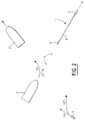
- FIG. 2 of the drawings so as to describe below a preferred method of protecting a ship 2 against a attacker 4.
- a ship 2 such as a submarine or a surface vessel, drops into firstly the self-propelled submarine device 1 of the invention, which comprises a self-propelled element 6, a tow cable 10, and a towed element 8.
- a second step in the protection process consists in dropping from the towed element 8 successively two decoys or jammers 9.
- the assembly constituted by the self-propelled submarine device 1 and the lures or jammers 9 thus constitutes a mask intended to protect the ship 2 ′ having deflected its route from an initial course x to a new course x '.
- the attacker 4 therefore no longer pursues the ship to be protected 2 in the direction y but bends its course in the direction y ', the assembly formed by the device self-propelled submarine 1 and the dropped lures or jammers 9 constituting a target credible.
- the protection method further comprises the emission of a interference of known type prior to the release of the self-propelled underwater device 1.
- the method of the invention also includes programming the calculation of acoustic emission parameters, drop parameters, and parameters piloting the attacked ship 2 and the self-propelled submarine device 1, prior to the release of the self-propelled underwater device 1.
- the self-propelled submarine device 1 To drop the self-propelled submarine device 1 from a building of surface 2, for example a device similar to the grenade launcher is used submarines.
- the self-propelled submarine device 1 of protection is adapted so as to be launched using torpedo tubes Sub 2, or using other types of pre-existing tubes.
- a device (not shown) comprises a self-propelled element 6 provided with at least one fixed fin slightly offset so that the self-propelled underwater device 1 deviates slightly from its wander and deviates from the trajectory of submarine 2, taking advantage of the speed acquired during launch.
- the duration of the vessel protection procedure is around 15 minutes and is determined to be consistent with the duration of the threat.
- a method of protecting a ship according to the invention can be applied to an attacker of the surface vessel type, the attacked objective being of submarine type.
Landscapes
- Engineering & Computer Science (AREA)
- Radar, Positioning & Navigation (AREA)
- General Engineering & Computer Science (AREA)
- Remote Sensing (AREA)
- Physics & Mathematics (AREA)
- Computer Networks & Wireless Communication (AREA)
- General Physics & Mathematics (AREA)
- Aviation & Aerospace Engineering (AREA)
- Electromagnetism (AREA)
- Measurement Of Velocity Or Position Using Acoustic Or Ultrasonic Waves (AREA)
- Catching Or Destruction (AREA)
- Control Of Position, Course, Altitude, Or Attitude Of Moving Bodies (AREA)
- Aiming, Guidance, Guns With A Light Source, Armor, Camouflage, And Targets (AREA)
Description
- ledit procédé comprend en outre l'écoute d'un signal acoustique de détection émis par ledit attaquant et l'émission d'un écho de leurrage en réponse audit signal acoustique de détection ;
- ledit procédé comprend en outre l'émission d'un brouillage préalable audit largage du dispositif automoteur sous-marin ;
- ledit procédé comprend en outre l'émission par ledit dispositif automoteur sous-marin d'un signal acoustique de leurrage et/ou de brouillage, laquelle émission est simultanée ou différée par rapport à ladite émission d'un écho de leurrage en réponse audit signal acoustique de détection ;
- ledit procédé comprend en outre la détermination des paramètres desdits largages, des paramètres d'émission dudit signal acoustique de leurrage et/ou de brouillage, et des paramètres de pilotage de l'objectif attaqué et du dispositif automoteur sous-marin, de telle sorte que l'objectif attaqué et le dispositif sous-marin s'éloignent l'un de l'autre de manière à obtenir un effet de masque ;
- ladite détermination des paramètres est programmée préalablement audit largage du dispositif automoteur sous-marin, de telle sorte que ledit dispositif automoteur est autonome.
- ledit dispositif comporte en outre au moins un hydrophone d'écoute susceptible de recevoir un signal acoustique de détection émis par ledit attaquant, et au moins un émetteur acoustique actif, susceptible d'émettre un écho de leurrage en réponse audit signal acoustique de détection ;
- ledit émetteur est aussi apte à émettre simultanément ou non audit écho de leurrage un signal acoustique ou bruit de leurrage pour sonar passif ou un bruit de brouillage ;
- ledit élément automoteur comprend ledit émetteur acoustique actif ;
- ledit élément remorqué comprend ledit hydrophone d'écoute ;
- ledit câble de remorque comprend un moyen de transmission de données, et un moyen d'alimentation en énergie ;
- ledit élément remorqué comprend au moins un moyen d'attaché dudit leurre et/ou brouilleur, lequel moyen d'attache est libérable lors du largage dudit leurre et/ou brouilleur ;
- ledit câble de remorque a une longueur sensiblement comprise entre 10 et 80 mètres.
- la figure 1 est une vue en coupe illustrant un mode de réalisation préférentiel d'un dispositif automoteur sous-marin de protection d'un navire selon l'invention ;
- la figure 2 est une vue de dessus illustrant un navire ayant mis en oeuvre le procédé de protection de l'invention, contre un attaquant.
Claims (13)
- Procédé de protection d'un navire (2, 2') contre un attaquant (4) comprenant un premier largage, depuis ledit navire attaqué (2) d'un dispositif automoteur sous-marin (1), caractérisé en ce que ledit procédé comprend en outre au moins un deuxième largage, depuis ledit dispositif automoteur sous-marin (1), d'au moins un leurre et/ou brouilleur (9) susceptible d'émettre un signal acoustique de leurrage et/ou brouillage, chaque leurre et/ou brouilleur étant déconnecté du dispositif automoteur sous-marin (1) lors du largage.
- Procédé de protection d'un navire (2, 2') contre un attaquant (4) selon la revendication 1, caractérisé en ce que ledit procédé comprend en outre l'écoute d'un signal acoustique de détection émis par ledit attaquant (4) et l'émission d'un écho de leurrage en réponse audit signal acoustique de détection.
- Procédé de protection d'un navire (2, 2') contre un attaquant (4) selon l'une quelconque des revendications 1 et 2, caractérisé en ce que ledit procédé comprend en outre l'émission d'un brouillage préalable audit largage du dispositif automoteur sous-marin (1).
- Procédé de protection d'un navire (2, 2') contre un attaquant (4) selon l'une quelconque des revendications 2 à 3, caractérisé en ce que ledit procédé comprend en outre l'émission par ledit dispositif automoteur sous-marin (1) d'un signal acoustique ou bruit de leurrage et/ou de brouillage, laquelle émission est simultanée ou différée par rapport à ladite émission d'un écho de leurrage en réponse audit signal acoustique de détection.
- Procédé de protection d'un navire (2, 2') contre un attaquant (4) selon l'une quelconque des revendications 1 à 4, caractérisé en ce que ledit procédé comprend en outre la détermination des paramètres desdits largages, des paramètres d'émission dudit signal acoustique de leurrage et/ou de brouillage, et des paramètres de pilotage du navire attaqué (2) et du dispositif automoteur sous-marin (1), de telle sorte que le navire attaqué (2') et le dispositif sous-marin (1) s'éloignent l'un de l'autre de manière à obtenir un effet de masque.
- Procédé de protection d'un navire (2, 2') contre un attaquant (4) selon la revendication 5, caractérisé en ce que ladite détermination des paramètres est programmée préalablement audit largage du dispositif automoteur sous-marin (1), de telle sorte que ledit dispositif automoteur (1) est autonome.
- Dispositif automoteur sous-marin (1) de protection d'un navire (2, 2') contre un attaquant (4), ledit dispositif comprenant une unité de commande électronique (12) et un élément automoteur (6), caractérisé en ce que ledit dispositif automoteur sous-marin (1) comprend en outre au moins un élément remorqué (8) par ledit élément automoteur (6), au moins un câble de remorque (10) interposé entre lesdits éléments (6,8), ledit élément remorqué comprenant au moins un leurre et/ou brouilleur (9), lequel leurre et/ou brouilleur (9) comporte un émetteur (24) de signal acoustique de leurrage et/ou de brouillage et peut être déconnecté par largage de l'élément remorqué (8).
- Dispositif automoteur sous-marin (1) de protection d'un navire (2, 2') contre un attaquant (4), selon la revendication 7, caractérisé en ce que ledit dispositif comporte en outre au moins un hydrophone d'écoute (26) susceptible de recevoir un signal acoustique de détection émis par ledit attaquant (4), et au moins un émetteur acoustique actif (20), susceptible d'émettre un écho de leurrage en réponse audit signal acoustique de détection, et susceptible d'émettre un signal acoustique ou bruit de leurrage et/ou de brouillage.
- Dispositif automoteur sous-marin (1) de protection d'un navire (2, 2') contre un attaquant (4), selon la revendication 8, caractérisé en ce que ledit élément automoteur (6) comprend ledit émetteur acoustique actif (20).
- Dispositif automoteur sous-marin (1) de protection d'un navire (2, 2') contre un attaquant (4), selon l'une quelconque des revendications 8 et 9, caractérisé en ce que ledit élément remorqué (8) comprend ledit hydrophone d'écoute (26).
- Dispositif automoteur sous-marin (1) de protection d'un navire (2, 2') contre un attaquant (4), selon l'une quelconque des revendications 7 à 10, caractérisé en ce que ledit câble de remorque (10) comprend un moyen de transmission de données, et un moyen d'alimentation en énergie.
- Dispositif automoteur sous-marin (1) de protection d'un navire (2, 2') contre un attaquant (4), selon l'une quelconque des revendications 7 à 11, caractérisé en ce que ledit élément remorqué (8) comprend au moins un moyen d'attache (30) dudit leurre et/ou brouilleur (9), lequel moyen d'attache est libérable lors du largage dudit leurre et/ou brouilleur.
- Dispositif selon l'une quelconque des revendications 7 à 12, caractérisé en ce que ledit câble de remorque (10) a une longueur sensiblement comprise en 10 et 80 mètres.
Applications Claiming Priority (2)
| Application Number | Priority Date | Filing Date | Title |
|---|---|---|---|
| FR9313821 | 1993-11-19 | ||
| FR9313821A FR2712560B1 (fr) | 1993-11-19 | 1993-11-19 | Procédé de protection d'un navire contre un attaquant et dispositif de protection correspondant . |
Publications (2)
| Publication Number | Publication Date |
|---|---|
| EP0654401A1 EP0654401A1 (fr) | 1995-05-24 |
| EP0654401B1 true EP0654401B1 (fr) | 1998-07-29 |
Family
ID=9453016
Family Applications (1)
| Application Number | Title | Priority Date | Filing Date |
|---|---|---|---|
| EP19940402606 Expired - Lifetime EP0654401B1 (fr) | 1993-11-19 | 1994-11-17 | Procédé de protection d'un navire contre un attaquant et dispositif de protection correspondant |
Country Status (4)
| Country | Link |
|---|---|
| EP (1) | EP0654401B1 (fr) |
| DE (1) | DE69412038T2 (fr) |
| ES (1) | ES2122191T3 (fr) |
| FR (1) | FR2712560B1 (fr) |
Cited By (2)
| Publication number | Priority date | Publication date | Assignee | Title |
|---|---|---|---|---|
| JP2001180587A (ja) * | 1999-12-28 | 2001-07-03 | Ishikawajima Harima Heavy Ind Co Ltd | 水中航走体防御装置 |
| CN110239696A (zh) * | 2019-07-25 | 2019-09-17 | 缙云多图智能科技有限公司 | 一种基于仿生的水下探测器 |
Families Citing this family (4)
| Publication number | Priority date | Publication date | Assignee | Title |
|---|---|---|---|---|
| FR2947914A1 (fr) * | 1995-07-21 | 2011-01-14 | Thomson Csf | Procede de contre-mesure anti-torpille filoguidee et bouee pour la mise en oeuvre de ce procede. |
| FR2749669B1 (fr) * | 1996-06-07 | 1998-07-31 | France Etat | Procede de conduite et de protection d'un navire |
| DE19738688C2 (de) * | 1997-09-04 | 2000-05-11 | Stn Atlas Elektronik Gmbh | Vorrichtung zum Nachbilden eines schallreflektierenden Wasserfahrzeugs |
| RU2517782C2 (ru) * | 2012-06-15 | 2014-05-27 | Открытое акционерное общество "Таганрогский научно-исследовательский институт связи" (ОАО "ТНИИС") | Способ защиты подводной лодки от широкополосной мины-торпеды |
Family Cites Families (4)
| Publication number | Priority date | Publication date | Assignee | Title |
|---|---|---|---|---|
| US3921559A (en) * | 1962-06-21 | 1975-11-25 | Us Navy | Active torpedo decoy and sonar target |
| FR2514319A1 (fr) * | 1981-10-09 | 1983-04-15 | Tournay Omer | Engin tactique sous-marin repondeur d'echo |
| DE3300067A1 (de) * | 1983-01-04 | 1984-07-05 | Hans Dr.rer.nat. 2000 Hamburg Gienapp | Vorrichtung zum stoeren der ortung von u-booten |
| US5144587A (en) * | 1991-06-27 | 1992-09-01 | The United States Of America As Represented By The Secretary Of The Navy | Expendable moving echo radiator |
-
1993
- 1993-11-19 FR FR9313821A patent/FR2712560B1/fr not_active Expired - Lifetime
-
1994
- 1994-11-17 ES ES94402606T patent/ES2122191T3/es not_active Expired - Lifetime
- 1994-11-17 DE DE1994612038 patent/DE69412038T2/de not_active Expired - Lifetime
- 1994-11-17 EP EP19940402606 patent/EP0654401B1/fr not_active Expired - Lifetime
Cited By (3)
| Publication number | Priority date | Publication date | Assignee | Title |
|---|---|---|---|---|
| JP2001180587A (ja) * | 1999-12-28 | 2001-07-03 | Ishikawajima Harima Heavy Ind Co Ltd | 水中航走体防御装置 |
| CN110239696A (zh) * | 2019-07-25 | 2019-09-17 | 缙云多图智能科技有限公司 | 一种基于仿生的水下探测器 |
| CN110239696B (zh) * | 2019-07-25 | 2021-07-13 | 南京棠邑科创服务有限公司 | 一种基于仿生的水下探测器 |
Also Published As
| Publication number | Publication date |
|---|---|
| ES2122191T3 (es) | 1998-12-16 |
| EP0654401A1 (fr) | 1995-05-24 |
| FR2712560A1 (fr) | 1995-05-24 |
| DE69412038D1 (de) | 1998-09-03 |
| FR2712560B1 (fr) | 1998-05-07 |
| DE69412038T2 (de) | 1998-12-03 |
Similar Documents
| Publication | Publication Date | Title |
|---|---|---|
| EP0787095B1 (fr) | Procede et systeme de destruction d'objets sous-marins, notamment de mines sous-marines | |
| FR2534012A1 (fr) | Arme anti-sous-marins | |
| US6766745B1 (en) | Low cost rapid mine clearance system | |
| EP0273787B1 (fr) | Mine à tir indirect d'attaque de véhicule blindé | |
| EP3559697B1 (fr) | Systeme optimise de detection acoustique de diverses menaces sous-marines sur une zone sensible | |
| EP0800054B1 (fr) | Projectile dont la charge explosive est déclenchée au moyen d'un désignateur de cible | |
| FR2477280A1 (fr) | Moteur de propulsion d'un vehicule sous-marin | |
| EP0654401B1 (fr) | Procédé de protection d'un navire contre un attaquant et dispositif de protection correspondant | |
| Armo | The relationship between a submarine's maximum speed and its evasive capability | |
| EP3559696B1 (fr) | Systeme reparti modulaire de detection acoustique des menaces sous-marines sur une zone sensible | |
| Kok | Naval survivability and susceptibility reduction study-surface ship | |
| US5267220A (en) | Target surveillance and destruct system | |
| Garwin | Will Strategic Submarines Be Vulnerable? | |
| EP0524232B1 (fr) | Procede de lutte contre les torpilles | |
| FR2518734A1 (fr) | Systeme de defense de zone a effet de saturation | |
| EP0257163B1 (fr) | Procédé et véhicule de lancement par un sous-marin en plongée d'un missile aérien | |
| EP0811853B1 (fr) | Procédé de conduite et de protection d'un navire | |
| EP0388264A1 (fr) | Marqueur d'objectif pour attirer des projectiles munis d'un autodirecteur | |
| FR2514319A1 (fr) | Engin tactique sous-marin repondeur d'echo | |
| FR2916292A1 (fr) | Procede, dispositif de protection contre des personnes penetrant sous l'eau | |
| CA2046570A1 (fr) | Procede de lutte contre les torpilles | |
| Clark | Sea Drones in the Russia-Ukraine War Inspire New Tactics: Military Strategists See a Possible Means of Defending Taiwan | |
| FR2990274A1 (fr) | Procede de leurrage angulaire, dispositif et systeme de leurrage associe | |
| RU2857905C2 (ru) | Способ поражения подводного объекта летательным аппаратом | |
| Tsipis | Anti-Submarine Warfare and Missile Submarines |
Legal Events
| Date | Code | Title | Description |
|---|---|---|---|
| PUAI | Public reference made under article 153(3) epc to a published international application that has entered the european phase |
Free format text: ORIGINAL CODE: 0009012 |
|
| 17P | Request for examination filed |
Effective date: 19941128 |
|
| AK | Designated contracting states |
Kind code of ref document: A1 Designated state(s): DE ES GB IT SE |
|
| 17Q | First examination report despatched |
Effective date: 19960531 |
|
| GRAG | Despatch of communication of intention to grant |
Free format text: ORIGINAL CODE: EPIDOS AGRA |
|
| GRAG | Despatch of communication of intention to grant |
Free format text: ORIGINAL CODE: EPIDOS AGRA |
|
| GRAH | Despatch of communication of intention to grant a patent |
Free format text: ORIGINAL CODE: EPIDOS IGRA |
|
| GRAH | Despatch of communication of intention to grant a patent |
Free format text: ORIGINAL CODE: EPIDOS IGRA |
|
| GRAA | (expected) grant |
Free format text: ORIGINAL CODE: 0009210 |
|
| ITF | It: translation for a ep patent filed | ||
| AK | Designated contracting states |
Kind code of ref document: B1 Designated state(s): DE ES GB IT SE |
|
| GBT | Gb: translation of ep patent filed (gb section 77(6)(a)/1977) |
Effective date: 19980729 |
|
| REF | Corresponds to: |
Ref document number: 69412038 Country of ref document: DE Date of ref document: 19980903 |
|
| REG | Reference to a national code |
Ref country code: ES Ref legal event code: FG2A Ref document number: 2122191 Country of ref document: ES Kind code of ref document: T3 |
|
| PLBE | No opposition filed within time limit |
Free format text: ORIGINAL CODE: 0009261 |
|
| STAA | Information on the status of an ep patent application or granted ep patent |
Free format text: STATUS: NO OPPOSITION FILED WITHIN TIME LIMIT |
|
| 26N | No opposition filed | ||
| REG | Reference to a national code |
Ref country code: GB Ref legal event code: IF02 |
|
| PGFP | Annual fee paid to national office [announced via postgrant information from national office to epo] |
Ref country code: DE Payment date: 20121113 Year of fee payment: 19 |
|
| PGFP | Annual fee paid to national office [announced via postgrant information from national office to epo] |
Ref country code: ES Payment date: 20121123 Year of fee payment: 19 Ref country code: GB Payment date: 20121127 Year of fee payment: 19 Ref country code: SE Payment date: 20121123 Year of fee payment: 19 Ref country code: IT Payment date: 20121128 Year of fee payment: 19 |
|
| REG | Reference to a national code |
Ref country code: SE Ref legal event code: EUG |
|
| GBPC | Gb: european patent ceased through non-payment of renewal fee |
Effective date: 20131117 |
|
| REG | Reference to a national code |
Ref country code: DE Ref legal event code: R119 Ref document number: 69412038 Country of ref document: DE Effective date: 20140603 |
|
| PG25 | Lapsed in a contracting state [announced via postgrant information from national office to epo] |
Ref country code: SE Free format text: LAPSE BECAUSE OF NON-PAYMENT OF DUE FEES Effective date: 20131118 Ref country code: IT Free format text: LAPSE BECAUSE OF NON-PAYMENT OF DUE FEES Effective date: 20131117 Ref country code: DE Free format text: LAPSE BECAUSE OF NON-PAYMENT OF DUE FEES Effective date: 20140603 |
|
| PG25 | Lapsed in a contracting state [announced via postgrant information from national office to epo] |
Ref country code: GB Free format text: LAPSE BECAUSE OF NON-PAYMENT OF DUE FEES Effective date: 20131117 |
|
| REG | Reference to a national code |
Ref country code: ES Ref legal event code: FD2A Effective date: 20150407 |
|
| PG25 | Lapsed in a contracting state [announced via postgrant information from national office to epo] |
Ref country code: ES Free format text: LAPSE BECAUSE OF NON-PAYMENT OF DUE FEES Effective date: 20131118 |