EP0654702B1 - Gegen Farbkontamination und Restanfärbung geschützte photographische Elemente - Google Patents
Gegen Farbkontamination und Restanfärbung geschützte photographische Elemente Download PDFInfo
- Publication number
- EP0654702B1 EP0654702B1 EP94203354A EP94203354A EP0654702B1 EP 0654702 B1 EP0654702 B1 EP 0654702B1 EP 94203354 A EP94203354 A EP 94203354A EP 94203354 A EP94203354 A EP 94203354A EP 0654702 B1 EP0654702 B1 EP 0654702B1
- Authority
- EP
- European Patent Office
- Prior art keywords
- ballasted
- carbon atoms
- amine
- group
- photographic element
- Prior art date
- Legal status (The legal status is an assumption and is not a legal conclusion. Google has not performed a legal analysis and makes no representation as to the accuracy of the status listed.)
- Expired - Lifetime
Links
- 238000011109 contamination Methods 0.000 title description 4
- 239000010410 layer Substances 0.000 claims description 94
- 150000001412 amines Chemical class 0.000 claims description 80
- 239000000839 emulsion Substances 0.000 claims description 59
- -1 silver halide Chemical class 0.000 claims description 55
- 230000001235 sensitizing effect Effects 0.000 claims description 49
- 229910052709 silver Inorganic materials 0.000 claims description 46
- 239000004332 silver Substances 0.000 claims description 46
- 239000002516 radical scavenger Substances 0.000 claims description 35
- 125000004432 carbon atom Chemical group C* 0.000 claims description 34
- 239000003795 chemical substances by application Substances 0.000 claims description 24
- 125000000217 alkyl group Chemical group 0.000 claims description 21
- 239000011229 interlayer Substances 0.000 claims description 20
- 125000003118 aryl group Chemical group 0.000 claims description 17
- 238000005192 partition Methods 0.000 claims description 17
- 239000003513 alkali Substances 0.000 claims description 11
- 125000004435 hydrogen atom Chemical class [H]* 0.000 claims description 10
- 125000003545 alkoxy group Chemical group 0.000 claims description 9
- 229910052757 nitrogen Inorganic materials 0.000 claims description 9
- 239000002243 precursor Substances 0.000 claims description 9
- 229910052717 sulfur Inorganic materials 0.000 claims description 9
- KBPLFHHGFOOTCA-UHFFFAOYSA-N caprylic alcohol Natural products CCCCCCCCO KBPLFHHGFOOTCA-UHFFFAOYSA-N 0.000 claims description 8
- 125000000623 heterocyclic group Chemical group 0.000 claims description 8
- 125000004433 nitrogen atom Chemical group N* 0.000 claims description 8
- BUGBHKTXTAQXES-UHFFFAOYSA-N Selenium Chemical group [Se] BUGBHKTXTAQXES-UHFFFAOYSA-N 0.000 claims description 7
- NINIDFKCEFEMDL-UHFFFAOYSA-N Sulfur Chemical group [S] NINIDFKCEFEMDL-UHFFFAOYSA-N 0.000 claims description 7
- 125000002887 hydroxy group Chemical group [H]O* 0.000 claims description 7
- 229910052711 selenium Chemical group 0.000 claims description 7
- 239000011593 sulfur Chemical group 0.000 claims description 7
- 125000004429 atom Chemical group 0.000 claims description 6
- 229910052739 hydrogen Inorganic materials 0.000 claims description 6
- 239000001257 hydrogen Substances 0.000 claims description 6
- 125000001424 substituent group Chemical group 0.000 claims description 6
- 125000003342 alkenyl group Chemical group 0.000 claims description 5
- 125000000547 substituted alkyl group Chemical group 0.000 claims description 4
- XLYOFNOQVPJJNP-UHFFFAOYSA-N water Substances O XLYOFNOQVPJJNP-UHFFFAOYSA-N 0.000 claims description 4
- QGKMIGUHVLGJBR-UHFFFAOYSA-M (4z)-1-(3-methylbutyl)-4-[[1-(3-methylbutyl)quinolin-1-ium-4-yl]methylidene]quinoline;iodide Chemical compound [I-].C12=CC=CC=C2N(CCC(C)C)C=CC1=CC1=CC=[N+](CCC(C)C)C2=CC=CC=C12 QGKMIGUHVLGJBR-UHFFFAOYSA-M 0.000 claims description 3
- 125000004104 aryloxy group Chemical group 0.000 claims description 3
- 229910052736 halogen Inorganic materials 0.000 claims description 3
- 150000002367 halogens Chemical class 0.000 claims description 3
- 125000004423 acyloxy group Chemical group 0.000 claims description 2
- 125000004414 alkyl thio group Chemical group 0.000 claims description 2
- 125000003277 amino group Chemical group 0.000 claims description 2
- 239000003945 anionic surfactant Substances 0.000 claims description 2
- QVGXLLKOCUKJST-UHFFFAOYSA-N atomic oxygen Chemical group [O] QVGXLLKOCUKJST-UHFFFAOYSA-N 0.000 claims description 2
- 125000004093 cyano group Chemical group *C#N 0.000 claims description 2
- 238000010494 dissociation reaction Methods 0.000 claims description 2
- 230000005593 dissociations Effects 0.000 claims description 2
- 125000005843 halogen group Chemical group 0.000 claims description 2
- 125000005842 heteroatom Chemical group 0.000 claims description 2
- TVMXDCGIABBOFY-UHFFFAOYSA-N n-Octanol Natural products CCCCCCCC TVMXDCGIABBOFY-UHFFFAOYSA-N 0.000 claims description 2
- IJGRMHOSHXDMSA-UHFFFAOYSA-N nitrogen Substances N#N IJGRMHOSHXDMSA-UHFFFAOYSA-N 0.000 claims description 2
- QJGQUHMNIGDVPM-UHFFFAOYSA-N nitrogen group Chemical group [N] QJGQUHMNIGDVPM-UHFFFAOYSA-N 0.000 claims description 2
- 239000002736 nonionic surfactant Substances 0.000 claims description 2
- 229910052760 oxygen Inorganic materials 0.000 claims description 2
- 239000001301 oxygen Chemical group 0.000 claims description 2
- 239000011669 selenium Chemical group 0.000 claims description 2
- 125000002023 trifluoromethyl group Chemical group FC(F)(F)* 0.000 claims description 2
- 239000000975 dye Substances 0.000 description 87
- 108010010803 Gelatin Proteins 0.000 description 20
- 229920000159 gelatin Polymers 0.000 description 20
- 239000008273 gelatin Substances 0.000 description 20
- 235000019322 gelatine Nutrition 0.000 description 20
- 235000011852 gelatine desserts Nutrition 0.000 description 20
- 239000000203 mixture Substances 0.000 description 12
- 238000000034 method Methods 0.000 description 11
- 230000008569 process Effects 0.000 description 11
- 150000001875 compounds Chemical class 0.000 description 10
- ZUNKMNLKJXRCDM-UHFFFAOYSA-N silver bromoiodide Chemical compound [Ag].IBr ZUNKMNLKJXRCDM-UHFFFAOYSA-N 0.000 description 9
- INVVMIXYILXINW-UHFFFAOYSA-N 5-methyl-1h-[1,2,4]triazolo[1,5-a]pyrimidin-7-one Chemical group CC1=CC(=O)N2NC=NC2=N1 INVVMIXYILXINW-UHFFFAOYSA-N 0.000 description 8
- 230000002776 aggregation Effects 0.000 description 8
- 238000004220 aggregation Methods 0.000 description 8
- 239000000463 material Substances 0.000 description 8
- 230000000717 retained effect Effects 0.000 description 8
- 239000002904 solvent Substances 0.000 description 8
- 239000004094 surface-active agent Substances 0.000 description 8
- 238000012545 processing Methods 0.000 description 6
- BQCADISMDOOEFD-UHFFFAOYSA-N Silver Chemical compound [Ag] BQCADISMDOOEFD-UHFFFAOYSA-N 0.000 description 5
- 239000006185 dispersion Substances 0.000 description 5
- XMBWDFGMSWQBCA-UHFFFAOYSA-N hydrogen iodide Chemical compound I XMBWDFGMSWQBCA-UHFFFAOYSA-N 0.000 description 5
- 238000012360 testing method Methods 0.000 description 5
- 230000015572 biosynthetic process Effects 0.000 description 4
- 239000011248 coating agent Substances 0.000 description 4
- 238000000576 coating method Methods 0.000 description 4
- 230000008878 coupling Effects 0.000 description 4
- 238000010168 coupling process Methods 0.000 description 4
- 238000005859 coupling reaction Methods 0.000 description 4
- 230000002209 hydrophobic effect Effects 0.000 description 4
- 238000010348 incorporation Methods 0.000 description 4
- 230000003381 solubilizing effect Effects 0.000 description 4
- 238000001228 spectrum Methods 0.000 description 4
- 101000767534 Arabidopsis thaliana Chorismate mutase 2 Proteins 0.000 description 3
- 101000986989 Naja kaouthia Acidic phospholipase A2 CM-II Proteins 0.000 description 3
- ZMANZCXQSJIPKH-UHFFFAOYSA-N Triethylamine Chemical class CCN(CC)CC ZMANZCXQSJIPKH-UHFFFAOYSA-N 0.000 description 3
- 239000012736 aqueous medium Substances 0.000 description 3
- 230000000694 effects Effects 0.000 description 3
- 230000000873 masking effect Effects 0.000 description 3
- 239000004848 polyfunctional curative Substances 0.000 description 3
- 230000005855 radiation Effects 0.000 description 3
- 238000011160 research Methods 0.000 description 3
- APSBXTVYXVQYAB-UHFFFAOYSA-M sodium docusate Chemical compound [Na+].CCCCC(CC)COC(=O)CC(S([O-])(=O)=O)C(=O)OCC(CC)CCCC APSBXTVYXVQYAB-UHFFFAOYSA-M 0.000 description 3
- 238000001429 visible spectrum Methods 0.000 description 3
- 239000001043 yellow dye Substances 0.000 description 3
- YNAVUWVOSKDBBP-UHFFFAOYSA-N Morpholine Chemical class C1COCCN1 YNAVUWVOSKDBBP-UHFFFAOYSA-N 0.000 description 2
- JUJWROOIHBZHMG-UHFFFAOYSA-N Pyridine Chemical class C1=CC=NC=C1 JUJWROOIHBZHMG-UHFFFAOYSA-N 0.000 description 2
- FZWLAAWBMGSTSO-UHFFFAOYSA-N Thiazole Chemical group C1=CSC=N1 FZWLAAWBMGSTSO-UHFFFAOYSA-N 0.000 description 2
- 239000002253 acid Substances 0.000 description 2
- 230000002411 adverse Effects 0.000 description 2
- 230000000903 blocking effect Effects 0.000 description 2
- 125000000484 butyl group Chemical group [H]C([*])([H])C([H])([H])C([H])([H])C([H])([H])[H] 0.000 description 2
- 125000003178 carboxy group Chemical group [H]OC(*)=O 0.000 description 2
- 238000006243 chemical reaction Methods 0.000 description 2
- 239000007795 chemical reaction product Substances 0.000 description 2
- 239000000084 colloidal system Substances 0.000 description 2
- 230000007812 deficiency Effects 0.000 description 2
- 238000011161 development Methods 0.000 description 2
- 238000006073 displacement reaction Methods 0.000 description 2
- 125000001495 ethyl group Chemical group [H]C([H])([H])C([H])([H])* 0.000 description 2
- 125000002541 furyl group Chemical group 0.000 description 2
- 230000007062 hydrolysis Effects 0.000 description 2
- 238000006460 hydrolysis reaction Methods 0.000 description 2
- 230000003993 interaction Effects 0.000 description 2
- 239000007788 liquid Substances 0.000 description 2
- 125000002496 methyl group Chemical group [H]C([H])([H])* 0.000 description 2
- AJDUTMFFZHIJEM-UHFFFAOYSA-N n-(9,10-dioxoanthracen-1-yl)-4-[4-[[4-[4-[(9,10-dioxoanthracen-1-yl)carbamoyl]phenyl]phenyl]diazenyl]phenyl]benzamide Chemical compound O=C1C2=CC=CC=C2C(=O)C2=C1C=CC=C2NC(=O)C(C=C1)=CC=C1C(C=C1)=CC=C1N=NC(C=C1)=CC=C1C(C=C1)=CC=C1C(=O)NC1=CC=CC2=C1C(=O)C1=CC=CC=C1C2=O AJDUTMFFZHIJEM-UHFFFAOYSA-N 0.000 description 2
- 230000000269 nucleophilic effect Effects 0.000 description 2
- 150000003141 primary amines Chemical class 0.000 description 2
- 125000001436 propyl group Chemical group [H]C([*])([H])C([H])([H])C([H])([H])[H] 0.000 description 2
- ADZWSOLPGZMUMY-UHFFFAOYSA-M silver bromide Chemical compound [Ag]Br ADZWSOLPGZMUMY-UHFFFAOYSA-M 0.000 description 2
- 125000000020 sulfo group Chemical group O=S(=O)([*])O[H] 0.000 description 2
- 125000004434 sulfur atom Chemical group 0.000 description 2
- GPRLSGONYQIRFK-MNYXATJNSA-N triton Chemical compound [3H+] GPRLSGONYQIRFK-MNYXATJNSA-N 0.000 description 2
- ILKZXYARHQNMEF-UHFFFAOYSA-N (4-azaniumyl-3-methylphenyl)-ethyl-(2-methoxyethyl)azanium;4-methylbenzenesulfonate Chemical compound CC1=CC=C(S(O)(=O)=O)C=C1.CC1=CC=C(S(O)(=O)=O)C=C1.COCCN(CC)C1=CC=C(N)C(C)=C1 ILKZXYARHQNMEF-UHFFFAOYSA-N 0.000 description 1
- KYVBNYUBXIEUFW-UHFFFAOYSA-N 1,1,3,3-tetramethylguanidine Chemical class CN(C)C(=N)N(C)C KYVBNYUBXIEUFW-UHFFFAOYSA-N 0.000 description 1
- KAMCBFNNGGVPPW-UHFFFAOYSA-N 1-(ethenylsulfonylmethoxymethylsulfonyl)ethene Chemical group C=CS(=O)(=O)COCS(=O)(=O)C=C KAMCBFNNGGVPPW-UHFFFAOYSA-N 0.000 description 1
- IJHIIHORMWQZRQ-UHFFFAOYSA-N 1-(ethenylsulfonylmethylsulfonyl)ethene Chemical compound C=CS(=O)(=O)CS(=O)(=O)C=C IJHIIHORMWQZRQ-UHFFFAOYSA-N 0.000 description 1
- OIDIRWZVUWCCCO-UHFFFAOYSA-N 1-ethylpyridin-1-ium Chemical class CC[N+]1=CC=CC=C1 OIDIRWZVUWCCCO-UHFFFAOYSA-N 0.000 description 1
- JKFYKCYQEWQPTM-UHFFFAOYSA-N 2-azaniumyl-2-(4-fluorophenyl)acetate Chemical compound OC(=O)C(N)C1=CC=C(F)C=C1 JKFYKCYQEWQPTM-UHFFFAOYSA-N 0.000 description 1
- 125000001340 2-chloroethyl group Chemical group [H]C([H])(Cl)C([H])([H])* 0.000 description 1
- 125000004200 2-methoxyethyl group Chemical group [H]C([H])([H])OC([H])([H])C([H])([H])* 0.000 description 1
- XRZDIHADHZSFBB-UHFFFAOYSA-N 3-oxo-n,3-diphenylpropanamide Chemical class C=1C=CC=CC=1NC(=O)CC(=O)C1=CC=CC=C1 XRZDIHADHZSFBB-UHFFFAOYSA-N 0.000 description 1
- 125000006283 4-chlorobenzyl group Chemical group [H]C1=C([H])C(=C([H])C([H])=C1Cl)C([H])([H])* 0.000 description 1
- XTBFKMDOQMQYPP-UHFFFAOYSA-N 4-n,4-n-diethylbenzene-1,4-diamine;hydron;chloride Chemical compound Cl.CCN(CC)C1=CC=C(N)C=C1 XTBFKMDOQMQYPP-UHFFFAOYSA-N 0.000 description 1
- QZHXKQKKEBXYRG-UHFFFAOYSA-N 4-n-(4-aminophenyl)benzene-1,4-diamine Chemical compound C1=CC(N)=CC=C1NC1=CC=C(N)C=C1 QZHXKQKKEBXYRG-UHFFFAOYSA-N 0.000 description 1
- 229920002284 Cellulose triacetate Polymers 0.000 description 1
- XZMCDFZZKTWFGF-UHFFFAOYSA-N Cyanamide Chemical compound NC#N XZMCDFZZKTWFGF-UHFFFAOYSA-N 0.000 description 1
- 229940090898 Desensitizer Drugs 0.000 description 1
- UFHFLCQGNIYNRP-UHFFFAOYSA-N Hydrogen Chemical compound [H][H] UFHFLCQGNIYNRP-UHFFFAOYSA-N 0.000 description 1
- DGAQECJNVWCQMB-PUAWFVPOSA-M Ilexoside XXIX Chemical class C[C@@H]1CC[C@@]2(CC[C@@]3(C(=CC[C@H]4[C@]3(CC[C@@H]5[C@@]4(CC[C@@H](C5(C)C)OS(=O)(=O)[O-])C)C)[C@@H]2[C@]1(C)O)C)C(=O)O[C@H]6[C@@H]([C@H]([C@@H]([C@H](O6)CO)O)O)O.[Na+] DGAQECJNVWCQMB-PUAWFVPOSA-M 0.000 description 1
- CWNSVVHTTQBGQB-UHFFFAOYSA-N N,N-Diethyldodecanamide Chemical compound CCCCCCCCCCCC(=O)N(CC)CC CWNSVVHTTQBGQB-UHFFFAOYSA-N 0.000 description 1
- HTLZVHNRZJPSMI-UHFFFAOYSA-N N-ethylpiperidine Chemical class CCN1CCCCC1 HTLZVHNRZJPSMI-UHFFFAOYSA-N 0.000 description 1
- 229910018828 PO3H2 Inorganic materials 0.000 description 1
- ZLMJMSJWJFRBEC-UHFFFAOYSA-N Potassium Chemical class [K] ZLMJMSJWJFRBEC-UHFFFAOYSA-N 0.000 description 1
- 229910021607 Silver chloride Inorganic materials 0.000 description 1
- 229910021612 Silver iodide Inorganic materials 0.000 description 1
- 239000004904 UV filter Substances 0.000 description 1
- NNLVGZFZQQXQNW-ADJNRHBOSA-N [(2r,3r,4s,5r,6s)-4,5-diacetyloxy-3-[(2s,3r,4s,5r,6r)-3,4,5-triacetyloxy-6-(acetyloxymethyl)oxan-2-yl]oxy-6-[(2r,3r,4s,5r,6s)-4,5,6-triacetyloxy-2-(acetyloxymethyl)oxan-3-yl]oxyoxan-2-yl]methyl acetate Chemical compound O([C@@H]1O[C@@H]([C@H]([C@H](OC(C)=O)[C@H]1OC(C)=O)O[C@H]1[C@@H]([C@@H](OC(C)=O)[C@H](OC(C)=O)[C@@H](COC(C)=O)O1)OC(C)=O)COC(=O)C)[C@@H]1[C@@H](COC(C)=O)O[C@@H](OC(C)=O)[C@H](OC(C)=O)[C@H]1OC(C)=O NNLVGZFZQQXQNW-ADJNRHBOSA-N 0.000 description 1
- MPLZNPZPPXERDA-UHFFFAOYSA-N [4-(diethylamino)-2-methylphenyl]azanium;chloride Chemical compound [Cl-].CC[NH+](CC)C1=CC=C(N)C(C)=C1 MPLZNPZPPXERDA-UHFFFAOYSA-N 0.000 description 1
- SJOOOZPMQAWAOP-UHFFFAOYSA-N [Ag].BrCl Chemical compound [Ag].BrCl SJOOOZPMQAWAOP-UHFFFAOYSA-N 0.000 description 1
- HOLVRJRSWZOAJU-UHFFFAOYSA-N [Ag].ICl Chemical compound [Ag].ICl HOLVRJRSWZOAJU-UHFFFAOYSA-N 0.000 description 1
- 239000006096 absorbing agent Substances 0.000 description 1
- 239000011358 absorbing material Substances 0.000 description 1
- 125000002252 acyl group Chemical group 0.000 description 1
- 125000001931 aliphatic group Chemical group 0.000 description 1
- 125000005090 alkenylcarbonyl group Chemical group 0.000 description 1
- 125000003302 alkenyloxy group Chemical group 0.000 description 1
- 125000005092 alkenyloxycarbonyl group Chemical group 0.000 description 1
- 125000005137 alkenylsulfonyl group Chemical group 0.000 description 1
- 125000004171 alkoxy aryl group Chemical group 0.000 description 1
- 125000004453 alkoxycarbonyl group Chemical group 0.000 description 1
- 150000003973 alkyl amines Chemical class 0.000 description 1
- 125000002877 alkyl aryl group Chemical group 0.000 description 1
- 125000004448 alkyl carbonyl group Chemical group 0.000 description 1
- 125000004390 alkyl sulfonyl group Chemical group 0.000 description 1
- 125000004397 aminosulfonyl group Chemical group NS(=O)(=O)* 0.000 description 1
- 229940051880 analgesics and antipyretics pyrazolones Drugs 0.000 description 1
- 150000001448 anilines Chemical class 0.000 description 1
- 239000008346 aqueous phase Substances 0.000 description 1
- 238000000149 argon plasma sintering Methods 0.000 description 1
- 150000004982 aromatic amines Chemical class 0.000 description 1
- 125000003710 aryl alkyl group Chemical group 0.000 description 1
- 125000005129 aryl carbonyl group Chemical group 0.000 description 1
- 125000005160 aryl oxy alkyl group Chemical group 0.000 description 1
- 125000005161 aryl oxy carbonyl group Chemical group 0.000 description 1
- 125000004391 aryl sulfonyl group Chemical group 0.000 description 1
- 239000002585 base Substances 0.000 description 1
- WZTQWXKHLAJTRC-UHFFFAOYSA-N benzyl 2-amino-6,7-dihydro-4h-[1,3]thiazolo[5,4-c]pyridine-5-carboxylate Chemical compound C1C=2SC(N)=NC=2CCN1C(=O)OCC1=CC=CC=C1 WZTQWXKHLAJTRC-UHFFFAOYSA-N 0.000 description 1
- 125000001797 benzyl group Chemical group [H]C1=C([H])C([H])=C(C([H])=C1[H])C([H])([H])* 0.000 description 1
- 238000004061 bleaching Methods 0.000 description 1
- 239000007844 bleaching agent Substances 0.000 description 1
- 239000007822 coupling agent Substances 0.000 description 1
- 239000013078 crystal Substances 0.000 description 1
- 125000004122 cyclic group Chemical group 0.000 description 1
- 238000001035 drying Methods 0.000 description 1
- 125000005745 ethoxymethyl group Chemical group [H]C([H])([H])C([H])([H])OC([H])([H])* 0.000 description 1
- 238000002474 experimental method Methods 0.000 description 1
- FPVGTPBMTFTMRT-NSKUCRDLSA-L fast yellow Chemical compound [Na+].[Na+].C1=C(S([O-])(=O)=O)C(N)=CC=C1\N=N\C1=CC=C(S([O-])(=O)=O)C=C1 FPVGTPBMTFTMRT-NSKUCRDLSA-L 0.000 description 1
- 235000019233 fast yellow AB Nutrition 0.000 description 1
- 235000011194 food seasoning agent Nutrition 0.000 description 1
- 229940083124 ganglion-blocking antiadrenergic secondary and tertiary amines Drugs 0.000 description 1
- 239000011521 glass Substances 0.000 description 1
- 150000004820 halides Chemical class 0.000 description 1
- 230000006872 improvement Effects 0.000 description 1
- 239000001013 indophenol dye Substances 0.000 description 1
- 239000003112 inhibitor Substances 0.000 description 1
- 150000002500 ions Chemical class 0.000 description 1
- 239000000314 lubricant Substances 0.000 description 1
- 125000004184 methoxymethyl group Chemical group [H]C([H])([H])OC([H])([H])* 0.000 description 1
- 150000004780 naphthols Chemical class 0.000 description 1
- 230000003472 neutralizing effect Effects 0.000 description 1
- 125000000449 nitro group Chemical group [O-][N+](*)=O 0.000 description 1
- 231100000989 no adverse effect Toxicity 0.000 description 1
- 239000012074 organic phase Substances 0.000 description 1
- 239000003960 organic solvent Substances 0.000 description 1
- 230000003647 oxidation Effects 0.000 description 1
- 238000007254 oxidation reaction Methods 0.000 description 1
- 230000001590 oxidative effect Effects 0.000 description 1
- 150000004989 p-phenylenediamines Chemical class 0.000 description 1
- 150000002989 phenols Chemical class 0.000 description 1
- 125000001997 phenyl group Chemical group [H]C1=C([H])C([H])=C(*)C([H])=C1[H] 0.000 description 1
- 125000001476 phosphono group Chemical group [H]OP(*)(=O)O[H] 0.000 description 1
- 239000004014 plasticizer Substances 0.000 description 1
- 229920000642 polymer Polymers 0.000 description 1
- 239000011591 potassium Chemical class 0.000 description 1
- 229910052700 potassium Inorganic materials 0.000 description 1
- 239000000047 product Substances 0.000 description 1
- 230000001681 protective effect Effects 0.000 description 1
- JEXVQSWXXUJEMA-UHFFFAOYSA-N pyrazol-3-one Chemical class O=C1C=CN=N1 JEXVQSWXXUJEMA-UHFFFAOYSA-N 0.000 description 1
- MCSKRVKAXABJLX-UHFFFAOYSA-N pyrazolo[3,4-d]triazole Chemical class N1=NN=C2N=NC=C21 MCSKRVKAXABJLX-UHFFFAOYSA-N 0.000 description 1
- UMJSCPRVCHMLSP-UHFFFAOYSA-N pyridine Chemical class COC1=CC=CN=C1 UMJSCPRVCHMLSP-UHFFFAOYSA-N 0.000 description 1
- 150000003222 pyridines Chemical class 0.000 description 1
- 230000009257 reactivity Effects 0.000 description 1
- 230000009467 reduction Effects 0.000 description 1
- 150000003839 salts Chemical class 0.000 description 1
- 230000002000 scavenging effect Effects 0.000 description 1
- 150000003335 secondary amines Chemical class 0.000 description 1
- 230000035945 sensitivity Effects 0.000 description 1
- 229940045105 silver iodide Drugs 0.000 description 1
- HKZLPVFGJNLROG-UHFFFAOYSA-M silver monochloride Chemical compound [Cl-].[Ag+] HKZLPVFGJNLROG-UHFFFAOYSA-M 0.000 description 1
- 239000011734 sodium Substances 0.000 description 1
- 229910052708 sodium Inorganic materials 0.000 description 1
- 125000006850 spacer group Chemical group 0.000 description 1
- 230000003595 spectral effect Effects 0.000 description 1
- 239000003381 stabilizer Substances 0.000 description 1
- 239000000126 substance Substances 0.000 description 1
- 125000000472 sulfonyl group Chemical group *S(*)(=O)=O 0.000 description 1
- 150000003512 tertiary amines Chemical class 0.000 description 1
- 239000006097 ultraviolet radiation absorber Substances 0.000 description 1
- 238000005406 washing Methods 0.000 description 1
Classifications
-
- G—PHYSICS
- G03—PHOTOGRAPHY; CINEMATOGRAPHY; ANALOGOUS TECHNIQUES USING WAVES OTHER THAN OPTICAL WAVES; ELECTROGRAPHY; HOLOGRAPHY
- G03C—PHOTOSENSITIVE MATERIALS FOR PHOTOGRAPHIC PURPOSES; PHOTOGRAPHIC PROCESSES, e.g. CINE, X-RAY, COLOUR, STEREO-PHOTOGRAPHIC PROCESSES; AUXILIARY PROCESSES IN PHOTOGRAPHY
- G03C7/00—Multicolour photographic processes or agents therefor; Regeneration of such processing agents; Photosensitive materials for multicolour processes
- G03C7/30—Colour processes using colour-coupling substances; Materials therefor; Preparing or processing such materials
- G03C7/3029—Materials characterised by a specific arrangement of layers, e.g. unit layers, or layers having a specific function
-
- G—PHYSICS
- G03—PHOTOGRAPHY; CINEMATOGRAPHY; ANALOGOUS TECHNIQUES USING WAVES OTHER THAN OPTICAL WAVES; ELECTROGRAPHY; HOLOGRAPHY
- G03C—PHOTOSENSITIVE MATERIALS FOR PHOTOGRAPHIC PURPOSES; PHOTOGRAPHIC PROCESSES, e.g. CINE, X-RAY, COLOUR, STEREO-PHOTOGRAPHIC PROCESSES; AUXILIARY PROCESSES IN PHOTOGRAPHY
- G03C1/00—Photosensitive materials
- G03C1/005—Silver halide emulsions; Preparation thereof; Physical treatment thereof; Incorporation of additives therein
- G03C1/06—Silver halide emulsions; Preparation thereof; Physical treatment thereof; Incorporation of additives therein with non-macromolecular additives
- G03C1/08—Sensitivity-increasing substances
- G03C1/10—Organic substances
- G03C1/12—Methine and polymethine dyes
- G03C1/14—Methine and polymethine dyes with an odd number of CH groups
- G03C1/18—Methine and polymethine dyes with an odd number of CH groups with three CH groups
-
- G—PHYSICS
- G03—PHOTOGRAPHY; CINEMATOGRAPHY; ANALOGOUS TECHNIQUES USING WAVES OTHER THAN OPTICAL WAVES; ELECTROGRAPHY; HOLOGRAPHY
- G03C—PHOTOSENSITIVE MATERIALS FOR PHOTOGRAPHIC PURPOSES; PHOTOGRAPHIC PROCESSES, e.g. CINE, X-RAY, COLOUR, STEREO-PHOTOGRAPHIC PROCESSES; AUXILIARY PROCESSES IN PHOTOGRAPHY
- G03C7/00—Multicolour photographic processes or agents therefor; Regeneration of such processing agents; Photosensitive materials for multicolour processes
- G03C7/30—Colour processes using colour-coupling substances; Materials therefor; Preparing or processing such materials
- G03C7/392—Additives
- G03C7/39208—Organic compounds
- G03C7/39212—Carbocyclic
- G03C7/39216—Carbocyclic with OH groups
-
- G—PHYSICS
- G03—PHOTOGRAPHY; CINEMATOGRAPHY; ANALOGOUS TECHNIQUES USING WAVES OTHER THAN OPTICAL WAVES; ELECTROGRAPHY; HOLOGRAPHY
- G03C—PHOTOSENSITIVE MATERIALS FOR PHOTOGRAPHIC PURPOSES; PHOTOGRAPHIC PROCESSES, e.g. CINE, X-RAY, COLOUR, STEREO-PHOTOGRAPHIC PROCESSES; AUXILIARY PROCESSES IN PHOTOGRAPHY
- G03C7/00—Multicolour photographic processes or agents therefor; Regeneration of such processing agents; Photosensitive materials for multicolour processes
- G03C7/30—Colour processes using colour-coupling substances; Materials therefor; Preparing or processing such materials
- G03C7/392—Additives
- G03C7/39208—Organic compounds
- G03C7/39236—Organic compounds with a function having at least two elements among nitrogen, sulfur or oxygen
Definitions
- This invention relates in general to photography and in particular to color photographic elements comprising radiation-sensitive silver halide emulsion layers. More specifically, this invention relates to an improvement in color photographic elements which contain certain scavengers which prevent oxidized developing agent generated in one layer from diffusing into another layer.
- Color images are customarily obtained in the photographic art by reaction between the oxidation product of a silver halide color developing agent (i.e., oxidized aromatic primary amino developing agent) and a dye-forming compound known as a coupler.
- a silver halide color developing agent i.e., oxidized aromatic primary amino developing agent
- the reaction between coupler and oxidized color developing agent results in coupling of the oxidized color developing agent at a reactive site on the coupler, known as the coupling position, and yields a dye.
- the dyes typically produced by coupling are indoaniline, azomethine, indamine, or indophenol dyes, depending upon the chemical composition of the coupler and the developing agent.
- the subtractive process of color image formation is ordinarily employed in multicolor photographic elements and the dyes produced by coupling are usually cyan, magenta or yellow dyes which are formed in or adjacent to silver halide emulsion layers sensitive to radiation absorbed by the image dye, i.e., silver halide emulsion layers sensitive to the red, green or blue regions of the spectrum.
- scavenger In order to prevent oxidized developing agent generated in one image-forming layer of a color photographic element from diffusing into another layer, it is common to incorporate in the element a compound, referred to as a "scavenger", which reacts with the oxidized developing agent without forming a colored reaction product. Because of their high degree of reactivity and excellent oxidative stability, 2,4-disulfonamidophenols are frequently employed as scavengers. The use of 2,4-disulfonamidophenols, or alkali labile precursors thereof, as scavengers for oxidized developing agent is disclosed, for example, in Ross et al U.S. Patent No. 4,447,523, issued May 8, 1984.
- Sensitizing dyes are ordinarily intended to be washed out or otherwise removed from the photographic element during processing. However, in many cases, sensitizing dye is not fully removed but is retained in the photographic element after processing. This leads to non-imagewise increases in D min because the retained sensitizing dyes are colored, although usually shifted in hue from when they are absorbed on the surface of the silver halide grains. In particular, red sensitizing dyes often exist in two forms in photographic elements, monomeric (magenta colored, ⁇ max ⁇ 580 nm) and aggregated (cyan colored, ⁇ max ⁇ 640 nm).
- 2,4-disulfonamidophenols tend to contribute significantly to dye stain caused by red sensitizing dye, for example, they can cause retained red sensitizing dye to aggregate.
- retained red sensitizing dye is magenta colored and leads to non-imagewise increases in green density.
- retained red sensitizing dye can aggregate and become cyan colored.
- After development there is a positive image in residual disulfonamidophenol. At no exposure, there is no oxidized developing agent to consume the disulfonamidophenol, whereas at high exposure all of the disulfonamidophenol is consumed.
- the retained red sensitizing dye will also form a corresponding positive scale of its aggregated form (cyan in color) and a positive scale of red density. This causes an undesirable increase in red D min and an effective loss in red contrast and speed when the red D min is readjusted to an aim level.
- This deficiency is a particular problem whenever high levels of red sensitizing dye are used, as is commonly the case with tabular silver halide emulsions. It is also a particular problem with sensitizing dyes that are especially prone to aggregate in the presence of a 2,4-disulfonamidophenol.
- the present invention is directed toward the objective of providing a novel photographic element in which a 2,4-disulfonamidophenol is used as a scavenger without causing excessive increases in sensitizing dye stain.
- an improved photographic element includes at least one red-sensitive silver halide emulsion layer containing a sensitizing dye and comprises both a 2,4-disulfonamidophenol, or an alkali labile precursor thereof, which acts as a scavenger for oxidized developing agent and a ballasted amine which serves to reduce dye stain caused by the sensitizing dye; the ballasted amine having a pKa greater than 4.5 and a partition coefficient of at least 5.0.
- ballasted amine to a photographic element, containing a 2,4-disulfonamidophenol as a scavenger for oxidized developing agent, minimizes the formation of stain due to the presence of sensitizing dye, and especially aggregated sensitizing dye, after processing.
- the amine is ballasted in order to retain it in the layer in which it is coated and prevent unwanted interactions between the amine and other components of the photographic element. Amines which have a relatively high level of basicity are required.
- the pKa of the ballasted amine should be greater than 4.5, preferably greater than 5.0 and most preferably greater than 5.5.
- the ballasted amine should be strongly hydrophobic in nature, as indicated by a partition coefficient, as hereinafter defined, of greater than 5.0, more preferably greater than 5.5 and most preferably greater than 6.0.
- the photographic elements of this invention typically contain dye image-forming units sensitive to each of the three primary regions of the spectrum.
- Each unit can be comprised of a single silver halide emulsion layer or of multiple emulsion layers sensitive to a given region of the spectrum.
- the layers of the element, including the layers of the image-forming units, can be arranged in various orders as is well known in the art.
- the element comprises at least one green-sensitive silver halide emulsion layer and at least one blue-sensitive halide emulsion layer.
- a preferred photographic element comprises a support bearing at least one blue-sensitive silver halide emulsion layer having associated therewith a yellow image dye-providing material, at least one green-sensitive silver halide emulsion layer having associated therewith a magenta image dye-providing material and at least one red-sensitive silver halide emulsion layer having associated therewith a cyan image dye-providing material, the element containing both a 2,4-disulfonamidophenol scavenger and a ballasted amine.
- the scavenger and ballasted amine are incorporated in an interlayer between silver halide emulsion layers sensitive to different regions of the visible spectrum, although they can be incorporated in an interlayer between silver halide emulsion layers sensitive to the same region of the visible spectrum.
- the 2,4-disulfonamidophenol and the ballasted amine can be incorporated in the same or different layers of the photographic element, as desired. They can be incorporated in layers which also have other functions, such as, for example, antihalation layers or filter layers.
- the elements of the present invention can contain auxiliary layers conventional in photographic elements, such as overcoat layers, spacer layers, filter layers, antihalation layers, pH lowering layers (sometimes referred to as acid layers and neutralizing layers), timing layers, opaque reflecting layers and opaque light-absorbing layers.
- the support can be any suitable support used with photographic elements. Typical supports include polymeric films, paper (including polymer-coated paper) and glass. Details regarding supports and other layers of the photographic elements of this invention are contained in Research Disclosure , Item 308119, December, 1989.
- the light-sensitive silver halide emulsions employed in the photographic elements of this invention can include coarse, regular or fine grain silver halide crystals or mixtures thereof and can be comprised of such silver halides as silver chloride, silver bromide, silver bromoiodide, silver chlorobromide, silver chloroiodide, silver chorobromoiodide, and mixtures thereof.
- the emulsions can be, for example, tabular grain light-sensitive silver halide emulsions.
- the emulsions can be negative-working or direct positive emulsions. They can form latent images predominantly on the surface of the silver halide grains or in the interior of the silver halide grains.
- the emulsions typically will be gelatin emulsions although other hydrophilic colloids can be used in accordance with usual practice. Details regarding the silver halide emulsions are contained in Research Disclosure , Item 308119, December, 1989, and the references listed therein.
- the photographic silver halide emulsions utilized in this invention can contain other addenda conventional in the photographic art.
- Useful addenda are described, for example, in Research Disclosure , Item 308119, December, 1989.
- Useful addenda include spectral sensitizing dyes, desensitizers, antifoggants, masking couplers, DIR couplers, DIR compounds, antistain agents, image dye stabilizers, absorbing materials such as filter dyes and UV absorbers, light-scattering materials, coating aids, plasticizers and lubricants.
- the dye-image-providing material employed in the photographic element can be incorporated in the silver halide emulsion layer or in a separate layer associated with the emulsion layer.
- the dye-image-providing material can be any of a number known in the art, such as dye-forming couplers, bleachable dyes, dye developers and redox dye-releasers, and the particular one employed will depend on the nature of the element, and the type of image desired.
- Dye-image-providing materials employed with conventional color materials designed for processing with separate solutions are preferably dye-forming couplers; i.e., compounds which couple with oxidized developing agent to form a dye.
- Preferred couplers which form cyan dye images are phenols and naphthols.
- Preferred couplers which form magenta dye images are pyrazolones and pyrazolotriazoles.
- Preferred couplers which form yellow dye images are benzoylacetanilides and pivalylacetanilides.
- 2,4-disulfonamidophenol scavengers have the structural formula: wherein:
- the moiety G can be a hydroxy group or an alkali labile precursor of a hydroxy group.
- the hydrogen atom of the hydroxy group is replaced with a blocking group which is removed upon contact with base.
- Typical blocking groups are removable by hydrolysis or by intramolecular nucleophilic displacement.
- Typical groups removable by hydrolysis are acyl groups such as aliphatic and aromatic carbonyl and sulfonyl groups.
- Typical groups removable by intramolecular nucleophilic displacement are described in Mooberry et al, U.S. Patent No. 4,310,612, issued January 12, 1982.
- alkyl, alkoxy, aryl, and aryloxy substituents described above can be further substituted.
- substituents include halogen, nitro, alkyl, aryl, alkenyl, alkoxy, aryloxy, alkenyloxy, heterocyclyl, alkylcarbonyl, arylcarbonyl, alkenylcarbonyl, alkylsulfonyl, arylsulfonyl, alkenylsulfonyl, amino, aminocarbonyl, aminosulfonyl, carboxy, alkoxycarbonyl, aryloxycarbonyl, alkenyloxycarbonyl, sulfo groups.
- alkyl is inclusive of, e.g., arylalkyl and aryloxyalkyl
- aryl is inclusive of, e.g., alkaryl and alkoxyaryl
- alkenyl is inclusive of, e.g., aralkenyl.
- the amine portions of these further substituents include primary, secondary, and tertiary amines as well as acylated amines.
- 2,4-disulfonamidophenols and precursors thereof that are usefully employed as scavengers in the photographic elements of this invention include:
- the amount of scavenger compound employed will depend upon the particular purpose for which the scavenger is to be used and the degree of scavenging desired. Typically useful results are obtained when the scavenger is employed in an amount of between 5 and 2000 mg/square meter.
- the amine which is utilized in this invention must be ballasted in order to retain it in the layer in which it is coated and prevent unwanted interactions between the amine and other components of the photographic element. Any of a very wide range of ballasted amines can be utilized for the purposes of this invention.
- ballasted amines that are used in this invention have a pKa greater than 4.5, preferably greater than 5.0 and most preferably greater than 5.5, wherein pKa represents the logarithmic value of the reciprocal of the dissociation constant measured at conditions of an ionic strength of 0.1 mols/liter at 25°C. (See, for example, section D-126 in CRC Handbook of Chemistry and Physics , 54th Ed.)
- ballasted amines have a partition coefficient of at least 5.0, more preferably greater than 5.5 and most preferably greater than 6.0.
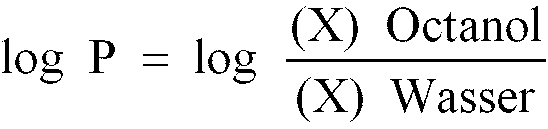
- the partition coefficient is a measure of the ability of the amine to partition between aqueous and organic phases and is calculated in the manner described in an article by A. Leo, P.Y.C. Jow, C. Silipo and C. Hansch, Journal of Medicinal Chemistry , Vol. 18, No. 9, pp. 865-868, 1975. Calculations for log P can be carried out using MedChem software, version 3.54, Pomona College, Claremont, California. The higher the value of log P the more hydrophobic the amine.
- Compounds with a log P of greater than zero are hydrophobic, i.e., they are more soluble in organic media than in aqueous media, whereas compounds with a log P of less than zero are hydrophilic.
- a compound with a log P of one is ten times more soluble in organic media than in aqueous media, and a compound with a log P of two is one hundred times more soluble in organic media than in aqueous media.
- Ballasted amines that are useful in this invention encompass compounds of widely varying structure and include aliphatic amines, aromatic amines, cyclic amines, mixed aliphatic-aromatic amines and heterocyclic amines. Primary, secondary and tertiary amines can be usefully employed.
- Preferred amines for the purposes of this invention are represented by one of the following generic formulae; it being understood in regard to each such formula that the substituents are so selected that the amine is ballasted, i.e., of sufficient bulk as to be non-diffusible in the alkali permeable layers of the element, has a pKa of greater than 4.5 and a partition coefficient of at least 5.0.
- ballasted amines that are usefully employed in this invention to minimize dye stain resulting from aggregation of sensitizing dye include:
- Additional amines that are useful in this invention include amines as described in either U.S. Patent 4,483,918 or 4,585,728 provided that such amines are so selected as to be ballasted, have a pKa of greater than 4.5 and a partition coefficient of at least 5.0.
- ballasted amine incorporated in the photographic element is not narrowly critical nor is the ratio of ballasted amine to 1,4-disulfonamidophenol narrowly critical.
- the ballasted amine is employed in this invention in an amount of from 5 to 2000 mg/m 2 . Generally, better results are obtained with the use of higher levels of ballasted amine.
- ballasted amine utilized in this invention can be described as photographically inert in the sense that it does not perform an image-forming function.
- the ballasted amine does not serve as a coupling agent.
- Ballasted amines which are oily liquids can be added as such to an interlayer or other hydrophilic colloid layer of the photographic element.
- Other ballasted amines can be incorporated with the aid of a suitable solvent such as a coupler solvent.
- the 2,4-disulfonamidophenols are also typically incorporated in the photographic element with the aid of a coupler solvent.
- the ballasted amine is an oily liquid, it can serve as a suitable organic solvent for incorporation of the 2,4-disulfonamidophenol.
- ballasted amines can complex surfactants and thereby cause surface tension changes which can adversely affect coating properties
- the surfactant is typically employed at a relatively high concentration. Preferred amounts are at least one percent by weight, based on the ballasted amine, more preferably at least ten percent by weight and most preferably at least twenty percent by weight.
- useful surfactants include nonionic surfactants such as SURFACTANT 10G from OLIN MATHIESON CORPORATION and anionic surfactants such as TRITON X-200E from ROHM AND HAAS CORPORATION or AEROSOL OT from AMERICAN CYANAMID COMPANY.
- sensitizing dye stain which is minimized or avoided by the use of a ballasted amine in accordance with this invention, is particularly severe with photographic elements utilizing tabular grain silver halide emulsions because such emulsions typically employ very high levels of sensitizing dye.
- use of tabular grain silver halide emulsions represents a particularly important embodiment of this invention.
- Emulsion tabularity increases markedly with reductions in tabular grain thickness. It is generally preferred that aim tabular grain projected areas be satisfied by thin (t ⁇ 0.2 ⁇ m) tabular grains. To achieve the lowest levels of granularity it is preferred that aim tabular grain projected areas be satisfied with ultrathin (t ⁇ 0.06 ⁇ m) tabular grains. Tabular grain thicknesses typically range down to about 0.02 ⁇ m. However, still lower tabular grain thicknesses are contemplated. For example, Daubendiek et al U.S. Patent 4,672,027 reports a 3 mole percent iodide tabular grain silver bromoiodide emulsion having a grain thickness of 0.017 micron.
- tabular grains of less than the specified thickness account for at least 50 percent of the total grain projected area of the emulsion.
- tabular grains satisfying the stated thickness criterion account for the highest conveniently attainable percentage of the total grain projected area of the emulsion.
- tabular grains satisfying the stated thickness criteria above account for at least 70 percent of the total grain projected area.
- tabular grains satisfying the thickness criteria above account for at least 90 percent of total grain projected area.
- sensitizing dye stain which is minimized or avoided by the use of a ballasted amine in accordance with this invention, is particularly severe with photographic elements which utilize a thiacyanine dye to increase the sensitivity of a silver halide emulsion to red light because such dyes are very prone to aggregate. These dyes are advantageous, however, because they have many other useful characteristics.
- thiacyanine sensitizing dyes is well known in the art and is described, for example, in U.S. Patents, 3,463,640 and 3,522,052.
- the sensitizing dye contained in at least one red-sensitive silver halide emulsion layer is preferably a thiacyanine.
- the silver halide photographic elements of this invention comprise a 2,4-disulfonamidophenol, a ballasted amine and a cyanine sensitizing dye which functions to sensitize a silver halide emulsion in a red-sensitive layer, wherein the cyanine dye is represented by the formula: wherein Z 1 represents a sulfur or a selenium atom; Z 2 represents a sulfur or selenium atom or -NR 4 ; R 1 represents a hydrogen atom or an unsubstituted or substituted alkyl group; R 2 , R 3 and R 4 each independently represent an unsubstituted or substituted alkyl or alkenyl group of less than 18 carbon atoms; V 1 , V 2 , V 3 , V 4 , V 5 , V 6 , V 7 and V 8 each represent a hydrogen atom, a halogen atom, an alkyl group, an alkyloxy group, an aryl group, a heterocyclic
- R 1 represents a hydrogen or a substituted or unsubstituted alkyl group, preferably containing 1-4 carbon atoms.
- alkyl groups include methyl, ethyl, propyl, butyl, 2-methoxyethyl, 2-ethoxyethyl, methoxymethyl, ethoxymethyl, benzyl, p-methoxybenzyl, p-chlorobenzyl and 2-chloroethyl.
- R 2 , R 3 and R 4 are each independently a substituted or unsubstituted alkyl or alkenyl group, preferably having 1-18 carbon atoms. It is preferred that at least one of R 2 , R 3 and R 4 contain an acid solubilizing group such as carboxy (-CO 2 - ), sulfo (SO 3 - ),phosphono(-PO 3 H 2 ), sulfato (-OSO 3 - ), sulfocarbonamido (-CONHSO 2 -) or imido (-CONHCO-). Further, additional solubilizing groups such as hydroxy, sulfonamido or carbonamido may be present. Preferred examples include ethyl, propyl, butyl, 3-sulfopropyl, 3-sulfobutyl, 4-sulfobutyl, and 2-hydroxy-3-sulfopropyl.
- an acid solubilizing group such as carboxy (-CO 2 -
- V 1 -V 8 groups include H, methyl, chloro, phenyl, furanyl or annuated benzene rings.
- Preferred X ions are salts of sodium, potassium, triethylamine, pyridine, tetramethyl guanidine, morpholine, N-ethylpiperidine or N-ethylpyridinium.
- Z 1 represents a sulfur atom and Z 2 represents a sulfur or selenium atom.
- each of Z 1 and Z 2 represents a sulfur atom.
- the dye molecule contains a solubilizing group attached to the nitrogen atom of one of the thiazole rings and more preferably it contains a solubilizing group attached to the nitrogen atoms of each thiazole ring.
- thiacyanine dyes which can be used as sensitizing dyes in the red-sensitive layer(s) of the photographic elements of this invention include:
- the amount of thiacyanine sensitizing dye utilized is typically from 0.1 mmol to 5mmol per mole of silver , more preferably from 0.3 mmol to 3 mmol per mole of silver.
- the present invention provides a multicolor photographic element capable of forming a dye image, which element comprises a support having thereon:
- the photographic elements of this invention can be exposed to actinic radiation, typically in the visible region of the spectrum, to form a latent image and can then be processed to form a visible dye image.
- Processing to form a visible dye image includes the step of contacting the element with a color developing agent to reduce developable silver halide and oxidize the color developing agent. Oxidized color developing agent in turn reacts with the coupler to yield a dye.
- Preferred color developing agents are p-phenylenediamines such as:
- Development is usually followed by the conventional steps of bleaching, fixing, or bleach-fixing, to remove silver or silver halide, washing, and drying.
- antihalation dyes D-1, D-2, D-3 and D-4 cyan-dye-forming couplers C-1 and C-2, magenta-dye-forming couplers M-1 and M-2, yellow-dye-forming couplers Y-1, Y-2 and Y-3, bleach-accelerator-releasing coupler B-1, masking couplers CM-1 and CM-2, developer-inhibitor-releasing couplers DIR-1, DIR-2 and DIR-3, ultraviolet absorber UV-1, red-sensitizing dyes RSD-1 and RSD-2, green-sensitizing dyes GSD-1 and GSD-2, blue-sensitizing dye YSD-1 and yellow filter dye YFD-1.
- These compounds have structures as indicated below:
- ballasted amines when used in conjunction with 2,4-disulfonamidophenols, to reduce dye stain due to aggregation of thiacyanine sensitizing dye used in the red-sensitive layer of a photographic element.
- ballasted amine A-1 has a pKa of 10.0 and a partition coefficient of 7.7
- ballasted amine A-2 has a pKa of 6.2 and a partition coefficient of 10.4
- ballasted amine A-3 has a pKa of 10.6 and a partition coefficient of 10.7
- ballasted amine A-4 has a pKa of 6.9 and a partition coefficient of 5.3
- ballasted amine A-5 has a pKa of greater than 4.5 and a partition coefficient of 7.5
- ballasted amine A-6 has a pKa of 7.0 and a partition coefficient of 7.4.
- the hardener is bis(vinylsulfonylmethyl)ether
- the silver halide grains are thin tabular silver bromoiodide grains (4.125 mole% iodide) with an average thickness of 0.065 micrometers
- the antifoggant is 4-hydroxy-6-methyl-1,3,3a,7-tetraazaindene
- the scavenger is a 2,4-disulfonamidophenol as indicated in Table I below
- the magenta coupler is M-2
- the yellow coupler is coupler Y-3
- the first sensitizing dye is DYE-11
- the second sensitizing dye is dye RSD-1.
- the causer layer which contains a yellow coupler and a red-sensitized silver halide emulsion, generates excess oxidized developing agent which diffuses through the interlayer to a receiver layer which contains a magenta coupler but no silver halide.
- the scavenger which is incorporated in the interlayer, functions to prevent oxidized developing agent from reaching the receiver layer, thus reducing the amount of magenta coupler and green density formed.
- the only source of red density in this format is aggregated red sensitizing dye.
- a ballasted amine is incorporated in the interlayer along with the scavenger.
- the couplers, scavenger and ballasted amine are incorporated in the test element using conventional coupler solvents.
- the ballasted amine was either codispersed with the scavenger or added as a separate dispersion.
- PROCESS A is a KODAK C-41 Process (as described in The British Journal of Photography Annual of 1982 , pages 209-211 and 1988, pages 191-198) which is "flooded", that is all baths are continuously renewed.
- PROCESS B is also a KODAK C-41 Process but one in which replenishment of the baths is minimized in order to allow full seasoning of film reaction products in each bath.
- fresh baths tend to maximize sensitizing dye washout and minimize dye aggregation regardless of the presence of a scavenger.
- a seasoned process like PROCESS B, tends to promote sensitizing dye aggregation.
- Interlayer compositions described in Table I specify the weight ratio of scavenger, ballasted amine and coupler solvent.
- an interlayer composition specified as 1:0.4:0.1 S-1/CS-3/A-1 refers to an interlayer comprised of gelatin having dispersed therein scavenger S-1, ballasted amine A-1 and coupler solvent CS-3 at a weight ratio of 1 part of S-1 to 0.4 parts of CS-3 to 0.1 parts of A-1.
- the ballasted amine was codispersed with the scavenger in each of examples 1 to 16 and the ballasted amine was added as a separate dispersion in each of Examples 17, 18 and 19.
- alkylamines such as A-1 and A-3
- pyridines such as A-4
- anilines such as A-2.
- Control 3 A multilayer photographic element, referred to herein as Control 3, was prepared by coating the following twelve layers on a cellulose triacetate film support. In each instance the coverage specified is in grams per square meter and the silver halide grain size reported in micrometers refers to diameter times thickness.
- Layer 1 black colloidial silver sol at 0.161; Dyes D-1 at 0.070, D-2 at 0.036, D-3 at 0.014 and D-4 and gelatin at 2.15.
- Layer 2 (First Interlayer): Oxidized developer scavenger S-1 at 0.054 and gelatin at 0.646.
- Layer 3 (Slow cyan layer): a blend of two red sensitized (both with a mixture of RSD-1 and RSD-2) silver iodobromide emulsions: (i) a large sized tabular grain emulsion (0.50 x 0.085, 1.5 mole % I) at 0.323 and (ii) a smaller tabular emulsion (1.16 x 0.052, 5.1 mole % I) at 0.570; gelatin at 2.58; cyan dye-forming coupler C-1 at 0.646; DIR coupler DIR-1 at 0.038; bleach accelerator releasing coupler B-1 at 0.054, antifoggant 4-hydroxy-6-methyl-1,3,3a,7-tetraazaindene at 0.016 and gelatin at 2.582.
- Layer 4 (Fast cyan layer): a red-sensitized (same as above) tabular silver iodobromide emulsion (1.99 x 0.063, 5.1 mole % I) at 0.4430; cyan coupler C-2 at 0.118; DIR-1 at 0.027; masking coupler CM-1 at 0.032; gelatin at 1.29 and antifoggant 4-hydroxy-6-methyl-1,3,3a,7-tetraazaindene at 0.006.
- Layer 5 (Second Interlayer): oxidized developer scavenger S-1 at 0.054 and gelatin at 0.646.
- Layer 6 (Slow magenta layer): a green sensitized (with a mixture of GSD-1 and GSD-2) tabular silver iodobromide emulsion (0.5 x 0.085, 1.5 mole % iodide) at 0.161; magenta dye forming coupler M-1 at 0.215; gelatin at 0.807 and antifoggant 4-hydroxy-6-methyl-1,3,3a,7-tetraazaindene at 0.001.
- Layer 7 (Mid magenta layer): a blend of two green sensitized (same as above) tabular silver iodobromide emulsions (i) 1.75 x 0.049, 7.05 mole % iodide and (ii) 1.20 x 0.054, 6.2 mole % I) at a total of 0.463; M-1 at 0.247; M-2 at 0.075; CM-2 at 0.129; DIR-1 at 0.032; DIR-2 at 0.005; gelatin at 1.02 and 4-hydroxy-6-methyl-1,3,3a,7-tetraazaindene at 0.003.
- Layer 8 (Fast magenta layer): a green sensitized (same as above) tabular silver iodide emulsion (1.99 x 0.063, 5.1% iodide) at 0.430; M-2 at 0.086; CM-2 at 0.043; DIR-2 at 0.001; gelatin at 1.01 and 4-hydroxy-6-methyl-1,3,3a,7-tetraazaindene at 0.006.
- Layer 9 (Yellow filter layer): gelatin at 0.646; YFD-1 at 0.108 and S-1 at 0.054.
- Layer 10 (Slow yellow layer) : a blend of three blue sensitized (all with YSD-1) tabular silver iodobromide emulsions ((i) 2.00 x 0.062, 3.15 mole % I (ii) 1.19 x 0.046, 3.0 mole % I and (iii) 0.5 x 0.080, 1.5 mole % I) at a total of 0.387; yellow dye forming coupler Y-1 at 0.215; Y-2 at 0.968; DIR-3 at 0.032; B-1 at 0.005, 4-hydroxy-6-methyl-1,3,3a,7-tetraazaindene at 0.006 and gelatin at 1.775.
- Layer 11 (Fast yellow layer): a blue sensitized (with YSD-1) tabular silver iodobromide emulsion (2.79x 0.072, 2.7 mole % I) at 0.322; Y-1 at 0.075; Y-2 at 0.344; DIR-3 at 0.064; 4-hydroxy-6-methyl-1,3,3a,7-tetraazaindene at 0.005 and gelatin at 1.08.
- Layer 12 (Protective overcoat and UV filter layer): gelatin at 1.08; silver bromide Lippman emulsion at 0.108; D-4 and UV-1 (1:1 ratio) at a total of 0.023 and bis(vinylsulfonyl)methane hardener at 1.8% of total gelatin weight.
- the scavenger was added as a dispersion of 1 part by weight of S-1 to 0.5 parts of the coupler solvent N,N-diethyllauramide.
- Surfactants a mixture of TRITON X-200E and OLIN 10G
- coating aids emulsion addenda, matte and tinting dyes were added to the appropriate layers as is common in the art.
- Example 20 An otherwise identical multilayer photographic element, referred to as Example 20, was prepared in which there was added to layers 2, 5 and 9 a dispersion of one part by weight of S-1 to 0.5 parts of N,N-dibutylauramide to 0.5 parts of ballasted amine A-4 along with 0.005 parts of surfactant AEROSOL OT.
- Example 21 An otherwise identical multilayer photographic element, referred to as Example 21, was prepared in which there was added to layers 2, 5 and 9 a dispersion of one part by weight of S-1 to 0.5 parts of N,N-dibutylauramide to 0.5 parts of ballasted amine A-3 along with 0.005 parts of surfactant AEROSOL OT.
- Example 20 and Example 21 were given a stepped exposure and processed in PROCESS B as described above. The results obtained are reported in Table II and clearly indicate that addition of the ballasted amines to be used in this invention lowers red D min and minimizes aggregation of retained sensitizing dye. Table II Example No. Scavenger Ballasted Amine Red D min Control 3 S-1 None 0.284 Example 20 S-1 A-4 0.259 Example 21 S-1 A-3 0.251
- the present invention provides novel color photographic elements protected against both color contamination and dye stain. Protection against color contamination is provided by incorporation in the element of a 2,4-disulfonamidophenol which acts as a scavenger for oxidized developing agent, thereby preventing it from diffusing from one color record into another color record and thereby causing color contamination. Protection against dye stain is provided by the additional incorporation in the element of a ballasted amine which acts to minimize stain, such as, for example, by preventing aggregation of red sensitizing dye caused by the 2,4-disulfonamidophenol. Ballasted amines which have a relatively high degree of basicity and which are highly hydrophobic in nature are most effective for this purpose.
Landscapes
- Physics & Mathematics (AREA)
- General Physics & Mathematics (AREA)
- Spectroscopy & Molecular Physics (AREA)
- Chemical & Material Sciences (AREA)
- Chemical Kinetics & Catalysis (AREA)
- Engineering & Computer Science (AREA)
- Materials Engineering (AREA)
- Silver Salt Photography Or Processing Solution Therefor (AREA)
Claims (12)
- Photographisches Element mit mindestens einer rot-empfindlichen Silberhalogenidemulsionsschicht, die einen sensibilisierenden Farbstoff enthält, wobei das Element ein 2,4-Disulfonamidophenol oder einen Alkali-labilen Vorläufer hiervon aufweist, das bzw. der als Abfänger für oxidierte Entwicklerverbindung wirkt; dadurch gekennzeichnet, daß das Element zusätzlich ein Ballast aufweisendes Amin enthält, das dazu dient, Farbschleier zu vermindern, der durch den Sensibilisierungsfarbstoff erzeugt wird, wobei das Ballast aufweisende Amin einen pKa-Wert von größer als 4,5 aufweist sowie einen Verteilungskoeffizienten von mindestens 5,0, wobei pKa den logarithmischen Wert des Umkehrwertes der Dissoziationskonstante repräsentiert, die gemessen wird unter Bedingungen einer Ionenstärke von 0,1 Mol/Liter bei 25°C, und wobei sich der Verteilungskoeffizient bezieht auf den log P-Wert des Ballast aufweisenden Amins bezüglich des Systems n-Octanol/Wasser, definiert durch die Gleichung:
- Photographisches Element nach Anspruch 1, das weiterhin mindestens eine grün-empfindliche Silberhalogenidemulsionsschicht enthält sowie mindestens eine blau-empfindliche Silberhalogenidemulsionsschicht.
- Photographisches Element nach Ansprüchen 1 oder 2, in dem der Sensibilisierungsfarbstoff ein Thiacyanin ist.
- Photographisches Element nach einem der Ansprüche 1 bis 3, in dem sowohl der Abfänger als auch das Ballast aufweisende Amin in einer Zwischenschicht des Elementes angeordnet sind, wobei die Zwischenschicht zusätzlich ein nicht-ionisches oder anionisches oberflächenaktives Mittel enthält.
- Photographisches Element nach einem der Ansprüche 1 bis 4, in dem der Abfänger dargestellt wird durch die Formel:
 G für Hydroxy oder einen Alkali-labilen Vorläufer hiervon steht;jeder Rest R1 einzeln steht für Alkyl mit 1 bis 30 Kohlenstoffatomen, Aryl mit 6 bis 30 Kohlenstoffatomen oder Heterocyclyl mit 5 bis 30 Atomen mit einem oder mehreren Ringheteroatomen, die ausgewählt sind aus Stickstoff, Sauerstoff, Schwefel und Selen; und worinR2, R3 und R4 jeweils einzeln stehen für Wasserstoff, Halogen, Alkyl mit 1 bis 30 Kohlenstoffatomen, Alkoxy mit 1 bis 30 Kohlenstoffatomen, Aryl mit 6 bis 30 Kohlenstoffatomen oder Aryloxy mit 6 bis 30 Kohlenstoffatomen, wobei der Abfänger ausreichend sperrig ist, derart, daß er in den Alkali-permeablen Schichten des Elementes nicht-diffundierend ist.
 - Photographisches Element nach einem der Ansprüche 1 bis 4, in dem der Abfänger durch die Formel dargestellt wird:
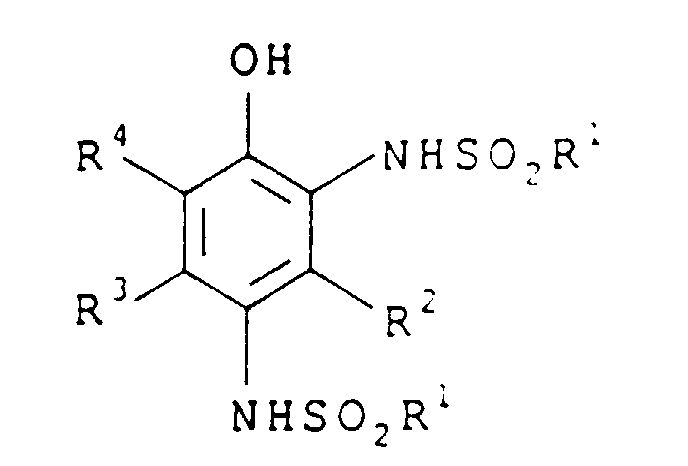 R1 jeweils steht für Alkyl mit 1 bis 30 Kohlenstoffatomen oder Aryl mit 6 bis 30 Kohlenstoffatomen; und worinR2, R3 und R4 jeweils einzeln stehen für Wasserstoff, Alkyl mit 1 bis 30 Kohlenstoffatomen oder Alkoxy mit 1 bis 30 Kohlenstoffatomen.
 - Photographisches Element nach einem der Ansprüche 1 bis 6, in dem das Ballast aufweisende Amin dargestellt wird durch eine der folgenden Formeln:
I NR1R2R3
worin R1, R2 und R3 unabhängig voneinander stehen für eine Alkylgruppe, die substituiert oder unsubstituiert und verzweigt oder linear ist und 1 bis 30 Kohlenstoffatome aufweist oder eine Arylgruppe, die substituiert oder unsubstituiert ist und 6 bis 30 Kohlenstoffatome aufweist;
II R4-N-R5R6
worin R4 steht für eine Alkylgruppe, die substituiert oder unsubstituiert und verzweigt oder linear ist und 1 bis 30 Kohlenstoffatome aufweist oder eine Arylgruppe, die substituiert oder unsubstituiert ist und 6 bis 30 Kohlenstoffatome aufweist, und
-N-R5R6 bildet ein heterocyclisches Ringsystem, das substituiert oder unsubstituiert ist und bis zu 30 Atome aufweist, wobei das Stickstoffatom an drei Substituenten gebunden ist;
III R7 - N = R8
worin R7 und R8 gemeinsam mit dem Stickstoffatom, an das sie gebunden sind, ein heterocyclisches Ringsystem bilden, das substituiert oder unsubstituiert ist und bis zu 30 Atome enthält, wobei das Stickstoffatom an zwei Substituenten gebunden ist. - Photographisches Element nach einem der Ansprüche 1 bis 7, in dem die rot-empfindliche Silberhalogenidemulsionsschicht einen sensibilisierenden Cyaninfarbstoff der Formel enthält:

- Photographisches Element nach einem der Ansprüche 1 bis 8, in dem das Ballast aufweisende Amin die Formel hat:

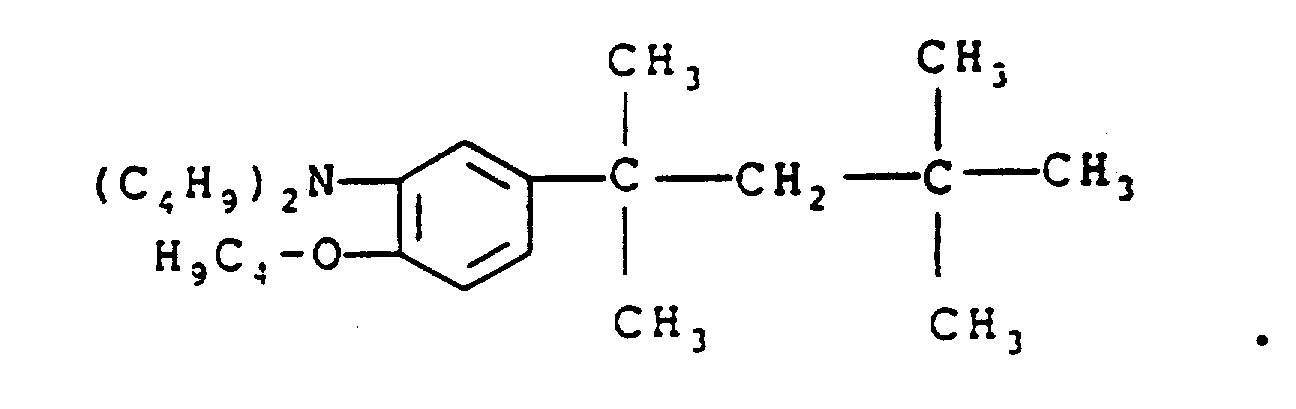
- Photographiches Element nach einem der Ansprüche 1 bis 8, in dem das Ballast aufweisende Amin die Formel hat:
- Photographisches Element nach einem der Ansprüche 1 bis 8, in dem das Ballast aufweisende Amin die Formel hat:

- Photographisches Element nach einem der Ansprüche 1 bis 8, in dem das Ballast aufweisende Amin die Formel hat:

Applications Claiming Priority (2)
| Application Number | Priority Date | Filing Date | Title |
|---|---|---|---|
| US08/156,337 US5478712A (en) | 1993-11-22 | 1993-11-22 | Photographic elements protected against color contamination and dye stain |
| US156337 | 1993-11-22 |
Publications (3)
| Publication Number | Publication Date |
|---|---|
| EP0654702A2 EP0654702A2 (de) | 1995-05-24 |
| EP0654702A3 EP0654702A3 (de) | 1995-09-13 |
| EP0654702B1 true EP0654702B1 (de) | 1997-04-09 |
Family
ID=22559140
Family Applications (1)
| Application Number | Title | Priority Date | Filing Date |
|---|---|---|---|
| EP94203354A Expired - Lifetime EP0654702B1 (de) | 1993-11-22 | 1994-11-17 | Gegen Farbkontamination und Restanfärbung geschützte photographische Elemente |
Country Status (4)
| Country | Link |
|---|---|
| US (1) | US5478712A (de) |
| EP (1) | EP0654702B1 (de) |
| JP (1) | JPH07199431A (de) |
| DE (1) | DE69402512T2 (de) |
Families Citing this family (4)
| Publication number | Priority date | Publication date | Assignee | Title |
|---|---|---|---|---|
| DE19629142A1 (de) * | 1996-07-19 | 1998-01-22 | Agfa Gevaert Ag | Farbfotografisches Aufzeichnungsmaterial mit einem 2-Äquivalent-Magentakuppler und einem Weißkuppler |
| US6255045B1 (en) | 2000-03-13 | 2001-07-03 | Eastman Kodak Company | Color photographic element containing improved polymeric disulfonamidophenol for scavenging oxidized developer |
| US7068666B2 (en) * | 2001-04-27 | 2006-06-27 | The Boeing Company | Method and system for virtual addressing in a communications network |
| US7122299B2 (en) * | 2002-11-06 | 2006-10-17 | Fuji Photo Film Co., Ltd. | Silver halide photographic light-sensitive material |
Family Cites Families (10)
| Publication number | Priority date | Publication date | Assignee | Title |
|---|---|---|---|---|
| US4205987A (en) * | 1978-11-15 | 1980-06-03 | Eastman Kodak Company | Sulfonamido phenol scavenger compounds |
| JPS58105147A (ja) * | 1981-12-16 | 1983-06-22 | Fuji Photo Film Co Ltd | カラ−写真感光材料 |
| US4447523A (en) * | 1982-06-18 | 1984-05-08 | Eastman Kodak Company | Photographic elements containing 2,4-disulfonamidophenol scavengers for oxidized developing agents |
| JPS59192246A (ja) * | 1983-04-15 | 1984-10-31 | Fuji Photo Film Co Ltd | カラ−写真感光材料 |
| JPS59202465A (ja) * | 1983-05-04 | 1984-11-16 | Fuji Photo Film Co Ltd | カラ−写真感光材料 |
| JPS59229557A (ja) * | 1983-06-13 | 1984-12-24 | Fuji Photo Film Co Ltd | カラ−写真感光材料 |
| JPS6146950A (ja) * | 1984-08-10 | 1986-03-07 | Fuji Photo Film Co Ltd | 写真感光材料 |
| JPS63153548A (ja) * | 1986-12-17 | 1988-06-25 | Konica Corp | ハロゲン化銀カラ−写真感光材料 |
| JPS63254442A (ja) * | 1987-04-13 | 1988-10-21 | Fuji Photo Film Co Ltd | 感光材料 |
| US5188926A (en) * | 1991-12-09 | 1993-02-23 | Eastman Kodak Company | Photographic elements having carbonamide coupler solvents and addenda to reduce sensitizing dye stain |
-
1993
- 1993-11-22 US US08/156,337 patent/US5478712A/en not_active Expired - Fee Related
-
1994
- 1994-11-17 DE DE69402512T patent/DE69402512T2/de not_active Expired - Fee Related
- 1994-11-17 EP EP94203354A patent/EP0654702B1/de not_active Expired - Lifetime
- 1994-11-21 JP JP6286331A patent/JPH07199431A/ja active Pending
Also Published As
| Publication number | Publication date |
|---|---|
| US5478712A (en) | 1995-12-26 |
| DE69402512D1 (de) | 1997-05-15 |
| DE69402512T2 (de) | 1997-11-06 |
| JPH07199431A (ja) | 1995-08-04 |
| EP0654702A2 (de) | 1995-05-24 |
| EP0654702A3 (de) | 1995-09-13 |
Similar Documents
| Publication | Publication Date | Title |
|---|---|---|
| EP0208502A2 (de) | Lichtempfindliches farbphotographisches Silberhalogenidmaterial | |
| US4833068A (en) | Color photographic developing solution composition and method for processing a silver halide color photographic material | |
| US5302498A (en) | Element and process for photographic developer replenishment | |
| EP0411513A1 (de) | Verarbeitungsverfahren für photographisches Silberhalogenidfarbmaterial | |
| EP0723193B1 (de) | Photographische Elemente mit Abfängern für oxidierten Entwicklerwirkstoff | |
| EP0573854B1 (de) | Farbphotographische Materialien und Verfahren mit stabilisierten Silberchloridemulsionen | |
| EP0529727B1 (de) | Farbphotographische Materialien, enthaltend einen Magenta-Kuppler, eine Carbonamid-Verbindung und eine Anilin- oder Amin-Verbindung | |
| US4518683A (en) | Silver halide color photographic light-sensitive material | |
| EP0654702B1 (de) | Gegen Farbkontamination und Restanfärbung geschützte photographische Elemente | |
| US5070003A (en) | Method for processing silver halide color photographic material | |
| EP0264083B1 (de) | Photographisches Silberhalogenidmaterial und Verfahren zur Bildung eines Farbbildes darauf | |
| US5576159A (en) | Photographic element with color enhancing layer adjacent to an emulsion layer and an oxidized developer scavenger layer | |
| EP0631182A1 (de) | Farbphotographische Elemente enthaltend eine Kombination von Pyrazoloazole-Kupplern | |
| US6416943B1 (en) | Color photographic element containing coupler useful for forming neutral silver-based image | |
| EP0327273B1 (de) | Verfahren zur Herstellung eines Farbbildes | |
| EP0545248B1 (de) | Verwendung von heterocyclischen Stickstoff-Zusätzen zur Verminderung einer fortgesetzten Kupplung von purpurrote Farbstoffe erzeugenden Kupplern | |
| US6555305B1 (en) | Photographic element with spectrally sensitized tabular grain emulsion and retained dye stain reducing compound | |
| US7175975B2 (en) | Photographic material with improved development inhibitor releases | |
| EP0193397B1 (de) | Lichtempfindliches farbphotographisches Silberhalogenidmaterial | |
| JPH08254800A (ja) | 写真要素および写真要素の生成方法 | |
| US5543277A (en) | Photographic elements containing scavengers for oxidized developing agent | |
| US6506548B1 (en) | Silver halide photographic materials containing solubilized antifoggants | |
| US7241562B2 (en) | Color photographic element having improved speed | |
| US5853968A (en) | Multilayer color photographic element | |
| US6458521B1 (en) | Color photographic element containing coupler useful for forming neutral silver-based image |
Legal Events
| Date | Code | Title | Description |
|---|---|---|---|
| PUAI | Public reference made under article 153(3) epc to a published international application that has entered the european phase |
Free format text: ORIGINAL CODE: 0009012 |
|
| AK | Designated contracting states |
Kind code of ref document: A2 Designated state(s): DE GB |
|
| PUAL | Search report despatched |
Free format text: ORIGINAL CODE: 0009013 |
|
| AK | Designated contracting states |
Kind code of ref document: A3 Designated state(s): BE DE FR GB NL |
|
| 17P | Request for examination filed |
Effective date: 19960226 |
|
| GRAG | Despatch of communication of intention to grant |
Free format text: ORIGINAL CODE: EPIDOS AGRA |
|
| 17Q | First examination report despatched |
Effective date: 19960725 |
|
| GRAH | Despatch of communication of intention to grant a patent |
Free format text: ORIGINAL CODE: EPIDOS IGRA |
|
| RBV | Designated contracting states (corrected) |
Designated state(s): DE GB |
|
| GRAH | Despatch of communication of intention to grant a patent |
Free format text: ORIGINAL CODE: EPIDOS IGRA |
|
| GRAA | (expected) grant |
Free format text: ORIGINAL CODE: 0009210 |
|
| AK | Designated contracting states |
Kind code of ref document: B1 Designated state(s): DE GB |
|
| REF | Corresponds to: |
Ref document number: 69402512 Country of ref document: DE Date of ref document: 19970515 |
|
| PLBE | No opposition filed within time limit |
Free format text: ORIGINAL CODE: 0009261 |
|
| STAA | Information on the status of an ep patent application or granted ep patent |
Free format text: STATUS: NO OPPOSITION FILED WITHIN TIME LIMIT |
|
| 26N | No opposition filed | ||
| PGFP | Annual fee paid to national office [announced via postgrant information from national office to epo] |
Ref country code: DE Payment date: 19991125 Year of fee payment: 6 |
|
| PGFP | Annual fee paid to national office [announced via postgrant information from national office to epo] |
Ref country code: GB Payment date: 20001004 Year of fee payment: 7 |
|
| PG25 | Lapsed in a contracting state [announced via postgrant information from national office to epo] |
Ref country code: DE Free format text: LAPSE BECAUSE OF NON-PAYMENT OF DUE FEES Effective date: 20010801 |
|
| PG25 | Lapsed in a contracting state [announced via postgrant information from national office to epo] |
Ref country code: GB Free format text: LAPSE BECAUSE OF NON-PAYMENT OF DUE FEES Effective date: 20011117 |
|
| REG | Reference to a national code |
Ref country code: GB Ref legal event code: IF02 |
|
| GBPC | Gb: european patent ceased through non-payment of renewal fee |
Effective date: 20011117 |