EP0655791A1 - Méthode de production de matériau actif cathodique pour batterie secondaire au lithium - Google Patents
Méthode de production de matériau actif cathodique pour batterie secondaire au lithium Download PDFInfo
- Publication number
- EP0655791A1 EP0655791A1 EP94116896A EP94116896A EP0655791A1 EP 0655791 A1 EP0655791 A1 EP 0655791A1 EP 94116896 A EP94116896 A EP 94116896A EP 94116896 A EP94116896 A EP 94116896A EP 0655791 A1 EP0655791 A1 EP 0655791A1
- Authority
- EP
- European Patent Office
- Prior art keywords
- lithium
- transition metal
- compound oxide
- metal compound
- cathode material
- Prior art date
- Legal status (The legal status is an assumption and is not a legal conclusion. Google has not performed a legal analysis and makes no representation as to the accuracy of the status listed.)
- Granted
Links
Images

Classifications
-
- C—CHEMISTRY; METALLURGY
- C01—INORGANIC CHEMISTRY
- C01G—COMPOUNDS CONTAINING METALS NOT COVERED BY SUBCLASSES C01D OR C01F
- C01G53/00—Compounds of nickel
- C01G53/40—Complex oxides containing nickel and at least one other metal element
- C01G53/42—Complex oxides containing nickel and at least one other metal element containing alkali metals, e.g. LiNiO2
-
- H—ELECTRICITY
- H01—ELECTRIC ELEMENTS
- H01M—PROCESSES OR MEANS, e.g. BATTERIES, FOR THE DIRECT CONVERSION OF CHEMICAL ENERGY INTO ELECTRICAL ENERGY
- H01M10/00—Secondary cells; Manufacture thereof
- H01M10/05—Accumulators with non-aqueous electrolyte
- H01M10/052—Li-accumulators
-
- H—ELECTRICITY
- H01—ELECTRIC ELEMENTS
- H01M—PROCESSES OR MEANS, e.g. BATTERIES, FOR THE DIRECT CONVERSION OF CHEMICAL ENERGY INTO ELECTRICAL ENERGY
- H01M4/00—Electrodes
- H01M4/02—Electrodes composed of, or comprising, active material
- H01M4/36—Selection of substances as active materials, active masses, active liquids
- H01M4/48—Selection of substances as active materials, active masses, active liquids of inorganic oxides or hydroxides
- H01M4/485—Selection of substances as active materials, active masses, active liquids of inorganic oxides or hydroxides of mixed oxides or hydroxides for inserting or intercalating light metals, e.g. LiTi2O4 or LiTi2OxFy
-
- H—ELECTRICITY
- H01—ELECTRIC ELEMENTS
- H01M—PROCESSES OR MEANS, e.g. BATTERIES, FOR THE DIRECT CONVERSION OF CHEMICAL ENERGY INTO ELECTRICAL ENERGY
- H01M4/00—Electrodes
- H01M4/02—Electrodes composed of, or comprising, active material
- H01M4/36—Selection of substances as active materials, active masses, active liquids
- H01M4/48—Selection of substances as active materials, active masses, active liquids of inorganic oxides or hydroxides
- H01M4/52—Selection of substances as active materials, active masses, active liquids of inorganic oxides or hydroxides of nickel, cobalt or iron
- H01M4/525—Selection of substances as active materials, active masses, active liquids of inorganic oxides or hydroxides of nickel, cobalt or iron of mixed oxides or hydroxides containing iron, cobalt or nickel for inserting or intercalating light metals, e.g. LiNiO2, LiCoO2 or LiCoOxFy
-
- Y—GENERAL TAGGING OF NEW TECHNOLOGICAL DEVELOPMENTS; GENERAL TAGGING OF CROSS-SECTIONAL TECHNOLOGIES SPANNING OVER SEVERAL SECTIONS OF THE IPC; TECHNICAL SUBJECTS COVERED BY FORMER USPC CROSS-REFERENCE ART COLLECTIONS [XRACs] AND DIGESTS
- Y02—TECHNOLOGIES OR APPLICATIONS FOR MITIGATION OR ADAPTATION AGAINST CLIMATE CHANGE
- Y02E—REDUCTION OF GREENHOUSE GAS [GHG] EMISSIONS, RELATED TO ENERGY GENERATION, TRANSMISSION OR DISTRIBUTION
- Y02E60/00—Enabling technologies; Technologies with a potential or indirect contribution to GHG emissions mitigation
- Y02E60/10—Energy storage using batteries
Definitions
- This invention relates to a method of producing active cathode material for lithium secondary battery having composition of Li x Ni y M 1-y O2.
- lithium secondary batteries in which material capable of doping/undoping lithium ion, such as, for example, lithium, lithium alloy or carbon material is used as active anode material; lithium compound oxide, such as, for example, lithium cobalt compound oxide, lithium nickel compound oxide or lithium nickel cobalt compound oxide, etc. is used as active cathode material; and a solution in which lithium electrolyte such as LiClO4, etc. is dissolved into non-aqueous solvent is used as electrolytic solution.
- This lithium secondary battery has high battery voltage, high energy density, less self-discharge, and excellent cycle characteristic.
- lithium secondary battery using lithium nickel compound oxide or lithium nickel cobalt compound oxide including high composition ratio of nickel component there is a tendency for battery capacity to be likely to have unevenness, thus disadvantageously failing to maintain prescribed quality.
- composition of lithium nickel compound oxide or lithium nickel cobalt compound oxide including high composition ratio of nickel component is apt to vary in dependency upon the synthetic condition at the synthetic stage, so it is difficult to obtain lithium secondary batteries having uniform characteristic. Accordingly, it is considered that, in order to allow lithium secondary battery to have higher energy and to suppress unevenness of battery capacity, it is indispensable to develop a method capable of synthesizing, by uniform composition, lithium nickel compound oxide or lithium nickel cobalt compound oxide having high composition ratio of nickel component.
- This invention has been made in view of such actual circumstances of the prior art, and its object is to provide a method of producing active cathode material for lithium secondary battery, which can synthesize active cathode material having uniform composition and characteristic and has excellent function as the cathode.
- a method of producing active cathode material for lithium secondary battery in which mixture of lithium salt and transition metal salt is baked or burned under oxygen atmosphere, and in synthesizing lithium transition metal compound oxide having composition of Li x Ni y M 1-y O2 (M is one kind of transition metal or more, and x, y are respectively expressed as 0.05 ⁇ x ⁇ 1.10, 0.5 ⁇ y ⁇ 1.0), oxygen pressure in the atmosphere in baking is set to 147. 1 kPa or more at least at a certain time of baking process.
- lithium transition metal compound oxide to be synthesized has composition of Li x Ni y Co 1-y O2 (x, y are respectively expressed as 0.05 ⁇ x ⁇ 1.10, 0.5 ⁇ y ⁇ 1.0).
- Active cathode material manufactured in this invention is lithium transition metal compound oxide having composition of Li x Ni y M 1-y O2 (M is one kind of transition metal or more, and x, y are respectively expressed as 0.05 ⁇ x ⁇ 1.10, 0.5 ⁇ y ⁇ 1.0).
- Lithium transition metal compound oxide of such composition is synthesized by baking, under oxygen atmosphere, mixture of lithium salt, nickel salt and transition metal salt corresponding to M in the composition formula.
- oxygen pressure in atmosphere is set to 147. 1 kPa (1.5 kg/cm2) or more at least at a certain time of baking process to carry out baking under pressurized oxygen atmosphere. It is considered that the reason why lithium transition metal compound oxide having uniform composition and characteristic is obtained by carrying out baking under pressurized oxygen atmosphere as stated above is as follows.
- transition metal in order to bake mixture of lithium salt and transition metal salt under oxygen atmosphere to synthesize lithium transition metal compound oxide, it is required that transition metal is sufficiently oxidized in baking so that it becomes trivalent.
- nickel is difficult to be in triatomic oxidation state as compared to, e.g., cobalt, etc.
- a large quantity of Ni would participate in the reaction. Accordingly, reaction is difficult to proceed under oxygen atmosphere of ordinary pressure. For this reason, there would take place unevenness in the oxidation state of nickel by the synthesized lithium transition metal compound oxide.
- lithium transition metal oxide having high Ni composition ratio indicated by the above-mentioned composition formula is synthesized with uniform characteristic.
- oxygen pressure of 147.1 kPa or more is maintained over the entirety of the baking process, but if oxygen pressure is 147. 1 kPa or more at least at a certain time period of baking process, lithium transition metal oxide having sufficiently uniform characteristic can be obtained.
- oxygen pressure in baking atmosphere it is not rather preferable to allow oxygen pressure in baking atmosphere to be exceedingly higher, and it is desirable to hold that oxygen pressure down to less than 980.6 kPa (10kg/cm2).
- oxygen pressure in such a range is employed is that since its effect is already saturated in the vicinity of 980.6 kPa of oxygen pressure, even if oxygen pressure is elevated to more than that value, further improvement in uniformness of characteristic cannot be made, and that expensive synthesizing system is required for allowing oxygen pressure to be 980.6 kPa or more, resulting in increased manufacturing cost, etc.
- lithium salt nickel salt and transition metal salt corresponding to M which are baked under pressurized oxygen atmosphere in a manner stated above
- salt ordinarily used as the starting material in synthesis of lithium transition metal compound oxide such as, for example, hydroxide salt or oxide salt, etc. can be all used.
- transition metal M it is desirable to select Co.
- Li x Ni x Co 1-y O2 greatly contributes to realization of battery of large capacity particularly as compared to Li x Ni y M 1-y O2 where M is transition metal except for Co.
- the cathode In order to constitute the cathode by using, as active cathode material, lithium transition metal compound oxide synthesized in this way, it is sufficient to mix, e.g., the lithium transition metal compound oxide together with conductive material or binder to prepare cathode depolarizing mix to coat the cathode depolarizing mix onto cathode collector.
- the cathode constituted in this way can exhibit excellent performance as the cathode without causing unevenness of battery capacity because the active cathode material is excellent in uniformness of composition and characteristic.
- the anode there can be used material capable of doping/undoping lithium ion, e.g., thermal decomposed carbon, coke (pitch coke, needle coke, petroleum coke, etc.), graphite, carbon in the form of glass, organic high molecular compound baked body (material obtained by baking phenol resin or furan resin, etc. at a suitable temperature to carbonize it), carbon fiber, carbonaceous material such as activated carbon, etc., metallic lithium, and lithium alloy.
- polymer such as polyacetylene, polypyrrole, etc. can be used.
- non-aqueous electrolytic solution there may be used electrolytic solution in which electrolyte, e.g., lithium salt, etc. is dissolved into an organic solvent.
- organic solvent although specifically limited, there may be used, e.g., a solvent consisting of propylene carbonate, ethylene carbonate, 1,2-dimethoxy ethane, ⁇ -butyrolactone, tetrahydrofuran, 2-methyl-tetrahydrofuran, 1,3-dioxysolan, sulforan, acetonitrile, dimethyl carbonate, diethyl carbonate, or dipropyl carbonate etc., or a mixed solvent including two kinds of the above materials or more.
- LiClO4, LiAsF6, LiPF6, LiBF4, LiB(C6H5)4, LiCl , LiBr, CH3SO3Li, CF3SO3Li, etc. may be used.
- lithium transition metal compound oxide having composition of Li x Ni y M 1-y O2 (M is one kind of transition metal or more, and x, y are respectively expressed as 0.05 ⁇ x ⁇ 1.10, 0.5 ⁇ y ⁇ 1.0)
- oxygen pressure in the atmosphere in baking is set to 147.1 kPa or more at least at a certain time of baking process, synthetic reaction smoothly proceeds.
- lithium transition metal compound oxide of the above-mentioned composition is synthesized with uniform composition and characteristic.
- cathode when cathode is constituted by using lithium transition metal compound oxide synthesized in this way as active cathode material, lithium secondary battery of uniform quality of no unevenness in battery capacity is realized.
- FIG. 1 is a schematic longitudinal cross sectional view showing the configuration of a lithium secondary battery to which active cathode material manufactured by a manufacturing method of this invention is applied.
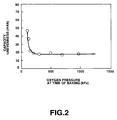
- FIG. 2 is a characteristic diagram showing the relationship between oxygen pressure in the atmosphere in baking and degree of unevenness of battery capacity.
- lithium transition metal compound oxide was synthesized.
- a cylindrical lithium secondary battery shown in FIG. 1 was prepared as follows.
- belt shaped cathode was made up.
- Synthesized lithium transition metal compound oxide of 91% by weight, graphite of 6% by weight serving as conductive material, and polyvinylidene fluoride of 3% by weight serving as binder were mixed to prepare cathode depolarizing mix.
- This cathode depolarizing mix was dispersed into N-metyl-2-pyrolidone so that cathode depolarizing mix slurry results.
- This cathode depolarizing mix slurry is coated on the both surfaces of belt-shaped aluminum foil serving as cathode collector 10 to dry it thereafter to implement compression-molding thereto by using roller press machine, thus to prepare cathode 2.
- Petroleum pitch was used as the starting material. Functional group including oxygen was introduced into petroleum pitch (oxygen bridging). Then, the petroleum pitch into which functional group including oxygen was introduced was baked at temperature of 1000°C in the atmosphere of inactive gas to obtain graphitization resistive carbon material having property similar to carbon in the firm of glass.
- graphitization resistive carbon material having property similar to carbon in the firm of glass.
- spacing of (002) plane was 0.376 nm, and true density was 1.58/cm3.
- the carbon material obtained in this way was used as the active anode material to mix the carbon material of 90% by weight and polyvinylidene fluoride of 10% by weight serving as binder to prepare anode depolarizing mix.
- This anode depolarizing mix is dispersed into N-methyl-2-pyloridone so that anode depolarizing mix slurry results.
- This anode depolarizing mix slurry was coated on the both surfaces of belt shaped copper foil serving as anode collector 9 to dry it thereafter to implement compression-molding thereto by using roller press machine to prepare anode 1.
- Cathode 2 and anode 1 which have been made up in a manner stated above are stacked in order through separator 3 comprised of micro-porous polypropylene film having thickness of 25 ⁇ m. Thereafter, such structure is wound many times of numbers in a spiral form to thereby prepare electrode winding body.
- insulating plate 4 is inserted into the bottom portion of battery can 5 of steel to which nickel plating is implemented to accommodate the electrode winding body thereinto.
- one end of anode lead 11 of nickel is pressure-connected to anode 2, and the other end thereof is welded to the battery can.
- one end of cathode lead 12 of aluminum is attached to cathode 1, and the other end is welded to battery cover 7 having current interrupting mechanism.
- electrolytic solution in which LiPF6 is dissolved into mixed solvent of propylene carbonate of 50% by volume and diethyl carbonate of 50% by volume at a rate of 1 mol is poured into the battery can 5.
- the battery 5 is caulked through insulating sealed gasket on which asphalt is coated to thereby fix battery cover 7 to prepare ten cylindrical batteries in total having diameter of 20 mm and height of 50 mm.
- the battery capacity (mean value of ten batteries) and the degree of unevenness of battery capacity are shown in Table 2, and investigation results of the degree of unevenness of battery capacities of the embodiments 1 ⁇ 6 and the comparative examples 1 and 2 caused to have the same Li:Ni:Co ratio with respect to changes of oxygen pressure at the time of baking is shown in FIG. 2.
- Table 2A BATTERY CAPACITY (mAh) UNEVENNESS R (MAX.
- the degree of unevenness of battery capacity changes in dependency upon oxygen pressure at the time of baking. Namely, in the range where oxygen pressure is less than 147.1 kPa, according as oxygen pressure becomes large, the degree of unevenness of battery capacity becomes small. In the range where oxygen pressure is 147.1 kPa or more, it maintains lower value of about 20, and does not change so as to take a value lower than that.
- oxygen pressure is set to lower value of 98.1 kPa in the beginning and is set to higher value of 490.3 kPa from the middle
- the degree of unevenness of battery capacity takes a lower value of 20 similarly to other embodiments. From this fact, it has been found that it is not required that oxygen pressure is set to 147.1 kPa or more over the entirety of baking process, it is sufficient that oxygen pressure is set to 147.1 kPa or more at least at a certain time of baking process.
- mixture of lithium salt and transition metal salt is baked under oxygen atmosphere, and in synthesizing lithium transition metal compound oxide having composition of Li x Ni y M 1-y O2 (M is one kind of transition metal or more, and x and y are respectively expressed as 0.05 ⁇ x ⁇ 1.10, 0.5 ⁇ y ⁇ 1.0), oxygen pressure in the atmosphere in baking is set to 147.1 kPa or more at a certain time of baking process. Accordingly, it is possible to obtain lithium transition metal compound oxide having uniform composition and characteristic and exhibiting excellent function as the active cathode material.
- cathode when cathode is constituted by using lithium transition metal compound oxide synthesized in this way as active cathode material, it is possible to provide a lithium secondary battery which is excellent in cycle characteristic, has high energy density and low material cost, and has uniform quality of no unevenness of battery capacity.
Landscapes
- Chemical & Material Sciences (AREA)
- Chemical Kinetics & Catalysis (AREA)
- Electrochemistry (AREA)
- General Chemical & Material Sciences (AREA)
- Inorganic Chemistry (AREA)
- Engineering & Computer Science (AREA)
- Manufacturing & Machinery (AREA)
- Organic Chemistry (AREA)
- Battery Electrode And Active Subsutance (AREA)
- Secondary Cells (AREA)
- Carbon And Carbon Compounds (AREA)
Applications Claiming Priority (2)
| Application Number | Priority Date | Filing Date | Title |
|---|---|---|---|
| JP272847/93 | 1993-10-29 | ||
| JP5272847A JPH07130367A (ja) | 1993-10-29 | 1993-10-29 | リチウム二次電池用正極活物質の製造方法 |
Publications (2)
| Publication Number | Publication Date |
|---|---|
| EP0655791A1 true EP0655791A1 (fr) | 1995-05-31 |
| EP0655791B1 EP0655791B1 (fr) | 1998-01-28 |
Family
ID=17519608
Family Applications (1)
| Application Number | Title | Priority Date | Filing Date |
|---|---|---|---|
| EP94116896A Expired - Lifetime EP0655791B1 (fr) | 1993-10-29 | 1994-10-26 | Méthode de production de matériau actif cathodique pour batterie secondaire au lithium |
Country Status (5)
| Country | Link |
|---|---|
| US (1) | US5474752A (fr) |
| EP (1) | EP0655791B1 (fr) |
| JP (1) | JPH07130367A (fr) |
| KR (1) | KR950012792A (fr) |
| DE (1) | DE69408286T2 (fr) |
Cited By (1)
| Publication number | Priority date | Publication date | Assignee | Title |
|---|---|---|---|---|
| EP0794586A1 (fr) * | 1996-03-04 | 1997-09-10 | Sharp Kabushiki Kaisha | Masse active de nickelate de lithium pour utilisation en accumulateur non aqueux |
Families Citing this family (19)
| Publication number | Priority date | Publication date | Assignee | Title |
|---|---|---|---|---|
| GB9305058D0 (en) * | 1993-03-12 | 1993-04-28 | Penn Pharm Ltd | Pharmaceutical compositions |
| EP0653797B1 (fr) * | 1993-05-31 | 1999-02-24 | Hitachi Maxell, Ltd. | Element secondaire au lithium contenant un electrolyte organique, matiere active pour l'electrode positive d'un element secondaire au lithium, et procede de fabrication de cette matiere active |
| JP3067531B2 (ja) * | 1994-07-13 | 2000-07-17 | 松下電器産業株式会社 | 非水電解液二次電池の正極活物質およびそれを用いた電池 |
| EP0714144B1 (fr) * | 1994-11-22 | 1999-09-15 | Sumitomo Chemical Company Limited | Cathode pour pile secondaire au lithium et sa méthode de production |
| JP3606290B2 (ja) * | 1995-04-28 | 2005-01-05 | 日本電池株式会社 | 非水系電池の正極活物質用コバルト含有ニッケル酸リチウムの製造方法 |
| US5630994A (en) * | 1995-08-01 | 1997-05-20 | Boyle; Timothy J. | Non-aqueous solution preparation of doped and undoped lixmnyoz |
| US6045771A (en) * | 1995-11-24 | 2000-04-04 | Fuji Chemical Industry Co., Ltd. | Lithium-nickel complex oxide, a process for preparing the same and a positive electrode active material for a secondary battery |
| US6077496A (en) * | 1996-09-12 | 2000-06-20 | Dowa Mining Co., Ltd. | Positive electrode active material for nonaqueous secondary cells and a process for producing said active material |
| JPH10106566A (ja) * | 1996-09-24 | 1998-04-24 | Japan Storage Battery Co Ltd | リチウム二次電池用正極活物質の製造法 |
| KR100393194B1 (ko) * | 1996-12-05 | 2003-11-01 | 삼성에스디아이 주식회사 | 졸-겔법을이용한리튬이차전지용양극활물질LixMn₂O₄분말의제조방법 |
| US6071489A (en) * | 1996-12-05 | 2000-06-06 | Samsung Display Device Co., Ltd. | Methods of preparing cathode active materials for lithium secondary battery |
| DE69819395T2 (de) * | 1997-04-15 | 2004-09-09 | Sanyo Electric Co., Ltd., Moriguchi | Positivelektrodenmaterialf für Verwendung nichtwässriger Elektrolyt enthaltender Batterie und Verfahren zur seiner Herstellung und nichtwässriger Elektrolyt enthaltende Batterie |
| US6045950A (en) * | 1998-06-26 | 2000-04-04 | Duracell Inc. | Solvent for electrolytic solutions |
| US6350543B2 (en) | 1999-12-29 | 2002-02-26 | Kimberly-Clark Worldwide, Inc. | Manganese-rich quaternary metal oxide materials as cathodes for lithium-ion and lithium-ion polymer batteries |
| US6844110B2 (en) * | 2000-05-24 | 2005-01-18 | Ngk Insulators, Ltd. | Lithium secondary cell and assembly thereof |
| US20040053136A1 (en) * | 2002-09-13 | 2004-03-18 | Bauman William C. | Lithium carbide composition, cathode, battery and process |
| TWI233231B (en) * | 2003-12-25 | 2005-05-21 | Ind Tech Res Inst | Cathode material with nano-oxide layer on the surface and the produce method |
| US7608332B2 (en) * | 2004-06-14 | 2009-10-27 | Industrial Technology Research Institute | Cathode material particle comprising of plurality of cores of coated grains |
| JP4213659B2 (ja) * | 2004-12-20 | 2009-01-21 | 株式会社東芝 | 非水電解質電池および正極活物質 |
Citations (2)
| Publication number | Priority date | Publication date | Assignee | Title |
|---|---|---|---|---|
| EP0391281A2 (fr) * | 1989-04-03 | 1990-10-10 | Sony Corporation | Pile secondaire à électrolyte non aqueux |
| EP0468942A2 (fr) * | 1990-07-23 | 1992-01-29 | Moli Energy (1990) Limited | Dioxyde de nickel contenant du lithium et piles secondaires préparées à partir de ceci |
Family Cites Families (2)
| Publication number | Priority date | Publication date | Assignee | Title |
|---|---|---|---|---|
| US5180574A (en) * | 1990-07-23 | 1993-01-19 | Moli Energy (1990) Limited | Hydrides of lithiated nickel dioxide and secondary cells prepared therefrom |
| JPH05299092A (ja) * | 1992-01-17 | 1993-11-12 | Matsushita Electric Ind Co Ltd | 非水電解質リチウム二次電池及びその製造方法 |
-
1993
- 1993-10-29 JP JP5272847A patent/JPH07130367A/ja not_active Withdrawn
-
1994
- 1994-10-20 KR KR1019940026795A patent/KR950012792A/ko not_active Withdrawn
- 1994-10-24 US US08/327,719 patent/US5474752A/en not_active Expired - Fee Related
- 1994-10-26 DE DE69408286T patent/DE69408286T2/de not_active Expired - Fee Related
- 1994-10-26 EP EP94116896A patent/EP0655791B1/fr not_active Expired - Lifetime
Patent Citations (2)
| Publication number | Priority date | Publication date | Assignee | Title |
|---|---|---|---|---|
| EP0391281A2 (fr) * | 1989-04-03 | 1990-10-10 | Sony Corporation | Pile secondaire à électrolyte non aqueux |
| EP0468942A2 (fr) * | 1990-07-23 | 1992-01-29 | Moli Energy (1990) Limited | Dioxyde de nickel contenant du lithium et piles secondaires préparées à partir de ceci |
Cited By (1)
| Publication number | Priority date | Publication date | Assignee | Title |
|---|---|---|---|---|
| EP0794586A1 (fr) * | 1996-03-04 | 1997-09-10 | Sharp Kabushiki Kaisha | Masse active de nickelate de lithium pour utilisation en accumulateur non aqueux |
Also Published As
| Publication number | Publication date |
|---|---|
| JPH07130367A (ja) | 1995-05-19 |
| DE69408286D1 (de) | 1998-03-05 |
| KR950012792A (ko) | 1995-05-17 |
| DE69408286T2 (de) | 1998-08-27 |
| EP0655791B1 (fr) | 1998-01-28 |
| US5474752A (en) | 1995-12-12 |
Similar Documents
| Publication | Publication Date | Title |
|---|---|---|
| EP0655791B1 (fr) | Méthode de production de matériau actif cathodique pour batterie secondaire au lithium | |
| US9219257B2 (en) | Non-aqueous electrolyte battery with gas adsorbing carbon material | |
| US5028500A (en) | Carbonaceous electrodes for lithium cells | |
| US5053297A (en) | Nonaqueous electrolyte secondary battery | |
| US5069683A (en) | Process of making a rechargeable battery | |
| KR100681988B1 (ko) | 음극 재료 및 이를 혼입한 비수성 전해질 전지 | |
| US6677080B2 (en) | Non-aqueous electrolyte secondary cell | |
| EP0627780B1 (fr) | Pile secondaire à électrolyte liquide non-aqueux | |
| KR20010098878A (ko) | 양극 활성 물질 및 비수성 전해질 전지 | |
| EP4239720A1 (fr) | Matériau actif d'anode comprenant un composite de silicium, son procédé de préparation et batterie secondaire au lithium le comprenant | |
| JP2004063422A (ja) | 正極活物質、並びに非水電解質電池 | |
| KR20030091741A (ko) | 비수성 전해질 전지 및 그 제조 방법 | |
| EP1489672A1 (fr) | Procedes permettant la production d'un materiau actif d'electrode positive et batterie a electrolyte non aqueux | |
| KR100323002B1 (ko) | 캐소드활성물질의제조방법및비수성전해액이차전지 | |
| EP1172877B1 (fr) | Pile rechargeable à électrolyte nonaqueux | |
| JPH10255844A (ja) | 非水電解液二次電池 | |
| JP4103487B2 (ja) | 正極活物質の製造方法、並びに非水電解質電池の製造方法 | |
| JP2001080914A (ja) | 炭素材料及びその製造方法、並びに非水電解質電池及びその製造方法 | |
| KR100853888B1 (ko) | 2차 전지용 음극재 및 이를 음극으로 포함하는 2차 전지 | |
| KR100855802B1 (ko) | 2차 전지용 음극재 및 이를 이용한 2차 전지 | |
| JPH08180878A (ja) | リチウム二次電池 | |
| US7172836B2 (en) | Nonaqueous electrolyte battery and method for manufacturing it, and positive active material, and method for producing it | |
| KR20080104833A (ko) | 2차 전지용 음극재 및 이를 이용한 2차 전지 | |
| JP2000285962A (ja) | 非水電解液二次電池 | |
| JPH0574494A (ja) | 非水二次電池 |
Legal Events
| Date | Code | Title | Description |
|---|---|---|---|
| PUAI | Public reference made under article 153(3) epc to a published international application that has entered the european phase |
Free format text: ORIGINAL CODE: 0009012 |
|
| AK | Designated contracting states |
Kind code of ref document: A1 Designated state(s): DE FR GB |
|
| 17P | Request for examination filed |
Effective date: 19950929 |
|
| 17Q | First examination report despatched |
Effective date: 19951211 |
|
| GRAG | Despatch of communication of intention to grant |
Free format text: ORIGINAL CODE: EPIDOS AGRA |
|
| GRAH | Despatch of communication of intention to grant a patent |
Free format text: ORIGINAL CODE: EPIDOS IGRA |
|
| GRAH | Despatch of communication of intention to grant a patent |
Free format text: ORIGINAL CODE: EPIDOS IGRA |
|
| GRAA | (expected) grant |
Free format text: ORIGINAL CODE: 0009210 |
|
| AK | Designated contracting states |
Kind code of ref document: B1 Designated state(s): DE FR GB |
|
| REF | Corresponds to: |
Ref document number: 69408286 Country of ref document: DE Date of ref document: 19980305 |
|
| ET | Fr: translation filed | ||
| PLBE | No opposition filed within time limit |
Free format text: ORIGINAL CODE: 0009261 |
|
| STAA | Information on the status of an ep patent application or granted ep patent |
Free format text: STATUS: NO OPPOSITION FILED WITHIN TIME LIMIT |
|
| 26N | No opposition filed | ||
| PGFP | Annual fee paid to national office [announced via postgrant information from national office to epo] |
Ref country code: FR Payment date: 20011010 Year of fee payment: 8 |
|
| PGFP | Annual fee paid to national office [announced via postgrant information from national office to epo] |
Ref country code: GB Payment date: 20011024 Year of fee payment: 8 |
|
| PGFP | Annual fee paid to national office [announced via postgrant information from national office to epo] |
Ref country code: DE Payment date: 20011112 Year of fee payment: 8 |
|
| REG | Reference to a national code |
Ref country code: GB Ref legal event code: IF02 |
|
| PG25 | Lapsed in a contracting state [announced via postgrant information from national office to epo] |
Ref country code: GB Free format text: LAPSE BECAUSE OF NON-PAYMENT OF DUE FEES Effective date: 20021026 |
|
| PG25 | Lapsed in a contracting state [announced via postgrant information from national office to epo] |
Ref country code: DE Free format text: LAPSE BECAUSE OF NON-PAYMENT OF DUE FEES Effective date: 20030501 |
|
| GBPC | Gb: european patent ceased through non-payment of renewal fee | ||
| PG25 | Lapsed in a contracting state [announced via postgrant information from national office to epo] |
Ref country code: FR Free format text: LAPSE BECAUSE OF NON-PAYMENT OF DUE FEES Effective date: 20030630 |
|
| REG | Reference to a national code |
Ref country code: FR Ref legal event code: ST |