EP0657448A1 - Eintopfverfahren zur Herstellung von 3-Chinoloncarbonsäurederivaten - Google Patents
Eintopfverfahren zur Herstellung von 3-Chinoloncarbonsäurederivaten Download PDFInfo
- Publication number
- EP0657448A1 EP0657448A1 EP94118676A EP94118676A EP0657448A1 EP 0657448 A1 EP0657448 A1 EP 0657448A1 EP 94118676 A EP94118676 A EP 94118676A EP 94118676 A EP94118676 A EP 94118676A EP 0657448 A1 EP0657448 A1 EP 0657448A1
- Authority
- EP
- European Patent Office
- Prior art keywords
- formula
- ester
- halogen
- cyclopropyl
- compounds
- Prior art date
- Legal status (The legal status is an assumption and is not a legal conclusion. Google has not performed a legal analysis and makes no representation as to the accuracy of the status listed.)
- Granted
Links
- 0 CO*(C=C1O)c(nc(*(CC2*(*)CC3)CC2*3=C)c(*)c2*)c2C1=O Chemical compound CO*(C=C1O)c(nc(*(CC2*(*)CC3)CC2*3=C)c(*)c2*)c2C1=O 0.000 description 2
- MYSWGUAQZAJSOK-UHFFFAOYSA-N OC(C(C(c1c2)=O)=CN(C3CC3)c1cc(N1CCNCC1)c2F)=O Chemical compound OC(C(C(c1c2)=O)=CN(C3CC3)c1cc(N1CCNCC1)c2F)=O MYSWGUAQZAJSOK-UHFFFAOYSA-N 0.000 description 1
Classifications
-
- C—CHEMISTRY; METALLURGY
- C07—ORGANIC CHEMISTRY
- C07D—HETEROCYCLIC COMPOUNDS
- C07D487/00—Heterocyclic compounds containing nitrogen atoms as the only ring hetero atoms in the condensed system, not provided for by groups C07D451/00 - C07D477/00
- C07D487/02—Heterocyclic compounds containing nitrogen atoms as the only ring hetero atoms in the condensed system, not provided for by groups C07D451/00 - C07D477/00 in which the condensed system contains two hetero rings
- C07D487/04—Ortho-condensed systems
-
- C—CHEMISTRY; METALLURGY
- C07—ORGANIC CHEMISTRY
- C07D—HETEROCYCLIC COMPOUNDS
- C07D215/00—Heterocyclic compounds containing quinoline or hydrogenated quinoline ring systems
- C07D215/02—Heterocyclic compounds containing quinoline or hydrogenated quinoline ring systems having no bond between the ring nitrogen atom and a non-ring member or having only hydrogen atoms or carbon atoms directly attached to the ring nitrogen atom
- C07D215/16—Heterocyclic compounds containing quinoline or hydrogenated quinoline ring systems having no bond between the ring nitrogen atom and a non-ring member or having only hydrogen atoms or carbon atoms directly attached to the ring nitrogen atom with hetero atoms or with carbon atoms having three bonds to hetero atoms with at the most one bond to halogen, e.g. ester or nitrile radicals, directly attached to ring carbon atoms
- C07D215/48—Carbon atoms having three bonds to hetero atoms with at the most one bond to halogen
- C07D215/54—Carbon atoms having three bonds to hetero atoms with at the most one bond to halogen attached in position 3
- C07D215/56—Carbon atoms having three bonds to hetero atoms with at the most one bond to halogen attached in position 3 with oxygen atoms in position 4
-
- C—CHEMISTRY; METALLURGY
- C07—ORGANIC CHEMISTRY
- C07D—HETEROCYCLIC COMPOUNDS
- C07D471/00—Heterocyclic compounds containing nitrogen atoms as the only ring hetero atoms in the condensed system, at least one ring being a six-membered ring with one nitrogen atom, not provided for by groups C07D451/00 - C07D463/00
- C07D471/02—Heterocyclic compounds containing nitrogen atoms as the only ring hetero atoms in the condensed system, at least one ring being a six-membered ring with one nitrogen atom, not provided for by groups C07D451/00 - C07D463/00 in which the condensed system contains two hetero rings
- C07D471/04—Ortho-condensed systems
Definitions
- the present invention relates to a one-pot process for the preparation of 7-heterocyclyl-substituted 3-quinolonecarboxylic acid derivatives.
- Such connections are known per se. They have a strong antimicrobial effect. They include active ingredients such as Ofloxacin, ciprofloxacin or enrofloxacin.
- heterocycles which contain at least one nitrogen atom as the hetero atom but which can additionally also contain oxygen, sulfur or other nitrogen atoms.
- heterocycles can also be substituted.
- monocyclic substituents are piperazinyl, N-ethylpiperazinyl, pyrrolidinyl, 3-aminopyrrolidinyl, morpholinyl or thiomorpholinyl.
- Such quinolonecarboxylic acid derivatives are valuable active pharmaceutical ingredients. They are suitable for the production of antimicrobial agents.
- the heterocycle for example the amine (XVII), is then added to this mixture and, after the formation of the 7-substitution product (XVI) has ended, the 3-ester function is saponified by the addition of a strong base.
- the reaction mixture is finally neutralized with an acid and the product (I) which precipitates is isolated.
- the following formula shows an example of the reaction sequence of this one-pot process:
- the compounds (I) which are particularly preferably to be prepared by the process according to the invention also include optically active derivatives which can be obtained by reacting (XIII) with enantiomerically pure amines (XVII ad), which are described in DE-A-4 208 789 and DE-A-4 208 792 are described.
- Examples of particularly preferred individual connections that can be produced according to the invention are 8-chloro-1-cyclopropyl-7 ([S, S] -2,8-diazabicyclo [4.3.0] non-8-yl) -6-fluoro-1,4-dihydro-4-oxo-3-quinolinecarboxylic acid (XXX) and the 1-Cyclopropyl-7 ([S, S] -2,8-diazabicyclo [4.3.0] non-8-yl) -6,8-difluoro-1,4-dihydro-4-oxo-3-quinolinecarboxylic acid (XVIII ).
- DMEU dimethylethylene urea
- DMPU dimethyl propylene urea
- N-methylcaprolactam N-methylcaprolactam
- tert-butanol tetramethyl urea
- sulfolane dimethoxyethane
- NMP N-methylpyrrolidone
- DMF dimethylformamide
- dioxane particularly preferably NMP.
- the cyclization is carried out at the lowest possible temperature. In general, temperatures from 60 ° C to 100 ° C are sufficient, which can be determined just as easily by means of preliminary tests with the selected preliminary stage (XIII) in the selected solvent / auxiliary base medium as the optimal amount of solvent.
- Acid binders which are customary in the cyclization in organic synthesis can be used as auxiliary bases.
- Potassium tert-butoxide, butyl lithium, lithium phenyl, sodium methylate, sodium hydride, sodium or potassium carbonate and potassium or sodium fluoride can be mentioned as examples of this reaction stage. It may be advantageous to use an excess of up to 10 mol% of base, possibly even higher.
- Sodium or potassium carbonate are preferably used.
- the amine (XV) or (XVII) metered e.g. the amine (XV) or (XVII) metered.
- the optimal reaction temperature depends on the reactants, but can again be easily determined in a preliminary test. Temperatures from 60 ° C to 100 ° C are generally sufficient.
- the reaction mixture is diluted by adding water and cooled. In general, about the volume of the reaction mixture of water will be used. Alkali hydroxide solution, preferably sodium hydroxide solution, is then added to saponify the ester function, in an equimolar amount or up to an excess of about 10 mol%. The saponification is preferably carried out at about 60 ° C.
- reaction mixture is then further diluted with water, generally about twice the volume of the mixture of water being added.
- mineral acid preferably hydrochloric acid or acetic acid
- the pH is adjusted to about 7.8 and, if necessary, further cooled to 0 to 5 ° C.
- the target product that fails e.g. (I) or (Ib) is finally e.g. isolated by suction.
- the oil (XXXIIa / b) is dissolved by adding 250 ml of N-methylpyrrolidone and heated to 90 to 120 ° C. with 48.4 g (0.35 mol) of potash. After 2 hours, 86 g (1 mol) of piperazine (XVa) are added. The mixture is stirred for one hour at 80 to 90 ° C and diluted with 150 ml of water.
Landscapes
- Chemical & Material Sciences (AREA)
- Organic Chemistry (AREA)
- Pharmaceuticals Containing Other Organic And Inorganic Compounds (AREA)
- Quinoline Compounds (AREA)
- Plural Heterocyclic Compounds (AREA)
- Nitrogen Condensed Heterocyclic Rings (AREA)
- Organic Low-Molecular-Weight Compounds And Preparation Thereof (AREA)
- Nitrogen And Oxygen Or Sulfur-Condensed Heterocyclic Ring Systems (AREA)
- Agricultural Chemicals And Associated Chemicals (AREA)
- Materials For Photolithography (AREA)
Abstract
Description
- Die vorliegende Erfindung betrifft ein Eintopfverfahren zur Herstellung von 7-Heterocyclyl-substituierten 3-Chinoloncarbonsäurederivaten. Derartige Verbindungen sind an sich bekannt. Sie haben eine starke antimikrobielle Wirkung. Zu ihnen gehören Wirkstoffe wie z.B. Ofloxacin, Ciprofloxacin oder Enrofloxacin.
- Erfindungsgemäß herzustellende Verbindungen aus dieser Klasse sind in 7-Position mit Heterocyclen substituiert, die als Heteroatom zumindest ein Stickstoffatom enthalten aber zusätzlich auch Sauerstoff, Schwefel oder weitere Stickstoffatome enthalten können. Diese Heterocyclen können auch substituiert sein. Als Beispiele seien für monocyclische Substituenten Piperazinyl, N-Ethylpiperazinyl, Pyrrolidinyl, 3-Aminopyrrolidinyl, Morpholinyl oder Thiomorpholinyl genannt.
- In einer Ausführungsform betrifft die vorliegende Erfindung solche 3-Chinoloncarbonsäurederivate, die in 7-Position mit einem bicyclischen Heterocyclus substituiert sind, also ein Eintopfverfahren zur Herstellung von 3-Chinoloncarbonsäurederivaten der allgemeinen Formel

in welcher - A
- für CH, CF, CCl, C-OCH₃, C-CH₃,
- X¹
- für H, Halogen, NH₂, CH₃,
- Y
- für CH₂ oder O,
- R¹
- für C₁-C₃-Alkyl, FCH₂CH₂-, Cyclopropyl, gegebenenfalls durch Halogen ein-bis dreifach substituiertes Phenyl oder Cyclopropyl steht,
- R²
- für Wasserstoff, 5-Methyl-2-oxo-1,3-dioxolen-4-yl-methyl, C₂-C₅-Oxoalkyl, CH₂-CO-C₆H₅, CH₂CH₂CO₂R⁶, R⁶O₂C-CH=C-CO₂R⁶, -CH=CH-CO₂R⁶ oder CH₂CH₂-CN,
worin - R⁶
- Wasserstoff oder C₁-C₃-Alkyl bedeutet,
- Derartige Chinoloncarbonsäurederivate sind wertvolle pharmazeutische Wirkstoffe. Sie sind zur Herstellung von antimikrobiellen Mitteln geeignet.
- Bisher sind verschiedene Verfahren zur Herstellung von Chinoloncarbonsäurederivaten bekannt geworden.
- Nach EP-A-0 167 763 werden Verbindungen der Formel (II) (Z¹,Z²,Z³ = unabhängig voneinander Fluor oder Chlor)

bei Temperaturen von 60°C bis 300°C in Gegenwart einer Base wie Alkalifluorid oder -carbonat in einem Lösungsmittel wie DMF, HMPT oder NMP cyclisiert. Der Ester (III) wird in einem nächsten Schritt zur Säure (IV) hydrolysiert. Diese wird anschließend mit gegebenenfalls cyclischen Aminen (V) vorzugsweise in Lösungsmitteln zu den substituierten Derivaten (VI) umgesetzt.
- Die Gesamtausbeute von (II) zu (VI) ist mit 56 % jedoch unbefriedigend. Zudem können bei der alkalischen Verseifung des Esters (III) Nebenprodukte auftreten, in denen Z² durch Hydroxy oder Alkoxy substituiert wurde, sowie Oligo- und Polymere, insbesondere wenn Z² für Fluor steht. Führt man die Verseifung unter sauren Bedingungen durch, wird Fluorwasserstoff freigesetzt, was zur Korrosion der Produktionsanlage und zur Verunreinigung des Produktes mit komplexen Metallfluoriden führt. Das gilt insbesondere wenn nach der Cyclisierung von (II) zu (III), bei der HF entsteht und an eine Base gebunden wird, diese Reaktionsmischung ohne vorherige Isolierung des Esters (III) zur sauren Hydrolyse eingesetzt wird, wobei zwangsläufig der zuvor an Base gebundene Fluorwasserstoff wieder freigesetzt wird.
- Gemäß EP-A-0 275 971 können Verbindungen der Formel (XI) erhalten werden, indem das Amin (V') bereits vor dem Ringschluß eingeführt wird:

- Anschließend wird die der vorstehenden Verbindung (II) entsprechende Cyclopropylaminoacrylat-Vorstufe (IX) synthetisiert:

- Die Cyclisierung von (IX) in Gegenwart von starken Basen wie z.B. NaH führt zum Ester (X):

- Durch Hydrolyse von (X) wird schließlich die Zielverbindung (XI) erhalten:

- Die Gesamtausbeute von (VII) zu (XI) beträgt jedoch nur 15 %, so daß ein derartiges Verfahren sehr unwirtschaftlich ist.
- Auch aus der EP-A-0 350 733 ist ein mehrstufiges Verfahren bekannt, nach welchem antibakteriell wirksame Chinoloncarbonsäuren durch Umsetzung der Carbonsäuren (XII, R³ = H) mit zum Teil bicyclischen Aminen erhalten werden.
- Die Ausbeute ist, ausgehend von der Aminoacrylatvorstufe, mit ca. 60% jedoch nicht zufriedenstellend. Zudem existiert auch hier das Problem der unerwünschten Substitution des 7-Halogens durch Hydroxy oder Alkoxy, speziell bei der alkalischen Hydrolyse des Esters (XII, R³ = Alkyl).

A, X¹, R¹ s. (I)
X³ = Halogen, vzgw. Fluor - Diese Nachteile - mehrstufige Synthese, niedrige Ausbeuten, Bildung korrosiver Spaltprodukte, Verunreinigung der Endprodukte - erschweren die großtechnische Produktion dieser Wirkstoffe.
- Zur Vermeidung vielstufiger Syntheseverfahren kann die Entwicklung von sogenannten Eintopfverfahren erwogen werden. Hierbei wird die Synthese ohne Isolation der Zwischenstufen in demselben Reaktionsgefäß durch aufeinander folgende Zugabe der Reaktanden durchgeführt. Ein derartiges Verfahren zur Synthese von Vorstufen des Typs (IV) von Chinoloncarbonsäurederivaten (VI) ist aus der EP-A-0 300 311 bekannt.
- Das dort beschriebene Verfahren endet jedoch auf der Stufe einer Chinoloncarbonsäure (analog IV), die anschließend mit dem in 7-Position einzuführenden Amin umgesetzt werden müßte. Die vorstehend beschriebenen Nachteile können demnach nicht vermieden werden.
- Es wurde nun ein vorteilhaftes Eintopfverfahren zur Herstellung von 7-heterocyclylsubstituierten Chinoloncarbonsäurederivaten gefunden, bei welchem nicht nur die vorstehend beschriebenen Nachteile hinsichtlich der Bildung von unerwünschten 7-Hydroxy-Nebenprodukten und Anlagenkorrosion durch freigesetzten Fluorwasserstoff absolut entfallen. Die gewünschten Wirkstoffe (I) sind zudem in hoher Reinheit mit Ausbeuten von meist über 90 %, bezogen auf die Stufe (XIII) oder (XXVI) zugänglich.
- Erfindungsgemäß wird ein Säurehalogenid der Formel (XXVI)

in welcher
Hal, X² und X³ für Fluor oder Chlor stehen und
A und X¹ die für Formel (I) angegebene Bedeutung haben,
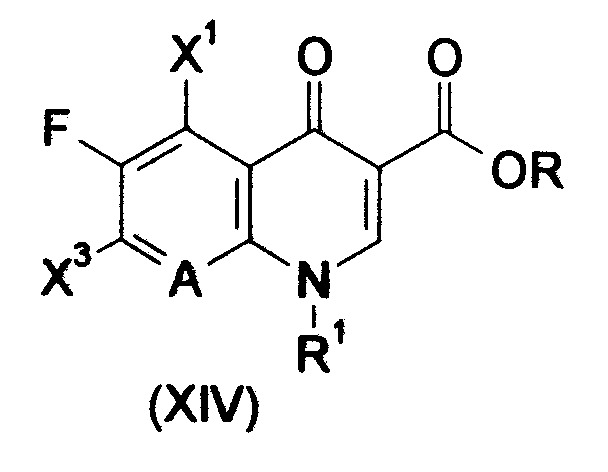
entweder mit einem Dimethylaminoacrylsäureester der Formel (CH₃)₂N-CH=CH-COOR in einem Lösungsmittel umgesetzt, wonach durch Zugabe eines Amins R¹-NH₂ unter Aminaustausch im Acrylesterteil des Primärproduktes der Aminoacrylester (XIII) erzeugt wird oder das Säurehalogenid (XXVI) wird gleich mit einem Aminoacrylester der Formel R¹NH-CH=CH-COOR umgesetzt, in welchem Fall der vorstehend beschriebene Aminaustausch entfällt und sogleich die Verbindung (XIII) erzeugt wird. - Dieser Aminoacrylester der Formel (XIII), in welcher A, X¹, R¹ die für Formel (I) angegebene Bedeutung haben, X² und X³ für Halogen und R für einen üblichen, zur Esterbildung geeigneten organischen Rest, vorzugsweise Methyl, Ethyl oder Propyl, steht, wird im selben Lösungsmittel mit einer Hilfsbase erwärmt und dabei zum Ester (XIV) cyclisiert.
- Anschließend wird der Heterocyclus, z.B. das Amin (XVII) zu dieser Mischung gegeben und nach Abschluß der Bildung des 7-Substitutionsproduktes (XVI) die 3-Esterfunktion durch die Zugabe einer starken Base verseift. Die Reaktionsmischung wird abschließend mit einer Säure neutral gestellt, und das ausfallende Produkt (I) wird isoliert. Das folgende Formelschema erläutert beispielhaft die Reaktionsfolge dieses Eintopfverfahrens:
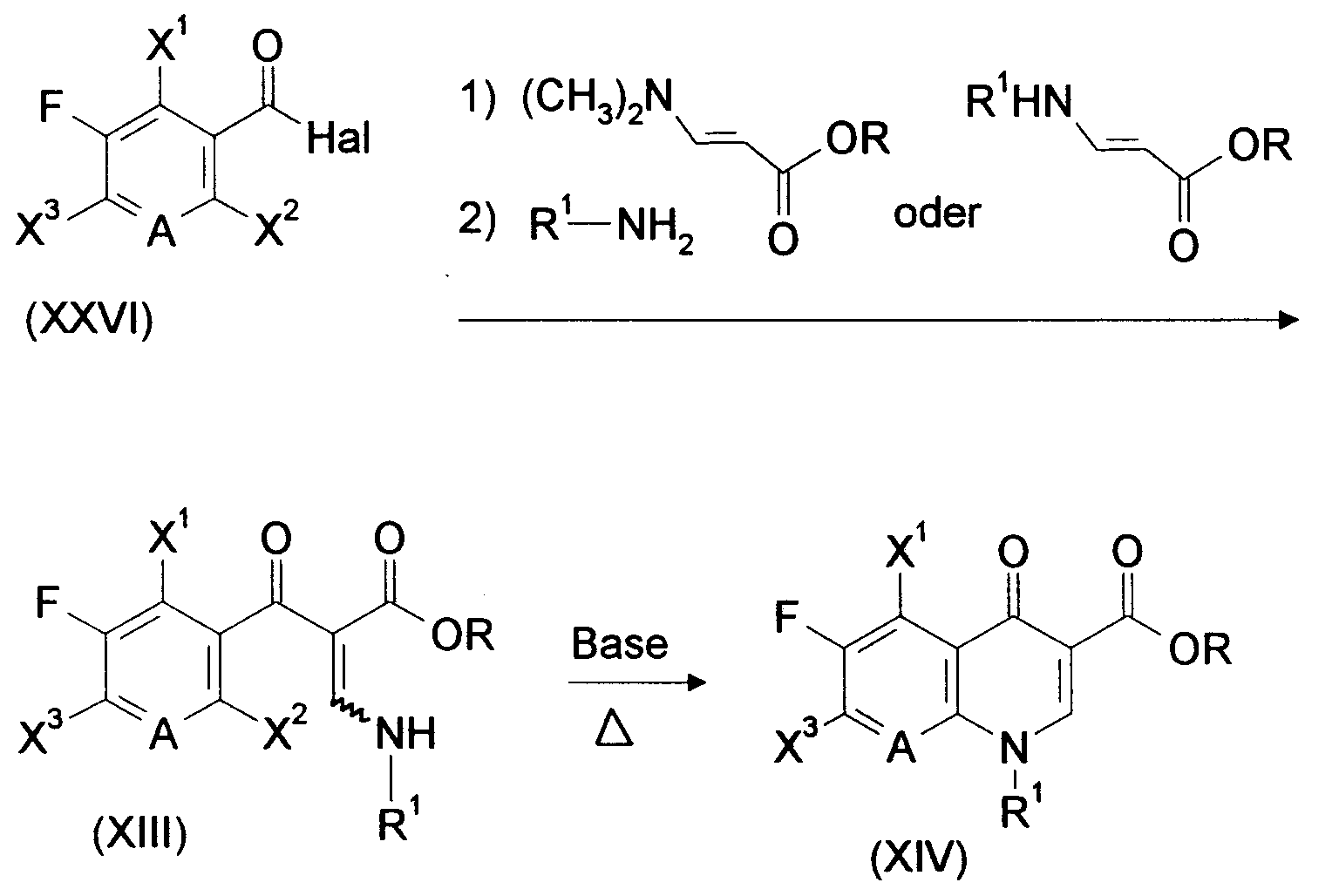

- In den Formeln (I) sowie (XIII), (XIV), (XVI) und (XVII) haben die Symbole im allgemeinen die folgende Bedeutung:
- A
- steht für CH, CF, CCl, C-OCH₃, C-CH₃,
- R
- steht für einen üblichen, zur Esterbildung geeigneten organischen Rest, vorzugsweise Ethyl, Methyl oder Propyl,
- R¹
- steht für C₁-C₃-Alkyl, FCH₂CH₂-, Cyclopropyl, gegebenenfalls durch Halogen ein- bis dreifach substituiertes Phenyl oder Cyclopropyl,
- R²
- steht für Wasserstoff, 5-Methyl-2-oxo-1,3-dioxolen-4-yl-methyl, C₂-C₅-Oxoalkyl, CH₂-CO-C₆H₅, CH₂CH₂CO₂R⁶, R'O₂C-CH=C-CO₂R⁶, -CH=CH-CO₂R⁶ oder CH₂CH₂-CN,
worin - R⁶
- Wasserstoff oder C₁-C₃-Alkyl bedeutet,
- Y
- steht für CH₂ oder O,
- X¹
- steht für H, Halogen, NH₂, CH₃ und
- X² und X³
- stehen für Halogen.
- Bevorzugt wird erfindungsgemäß die Synthese von Verbindungen (I) mit Vorstufen (XIII) und (XVII) durchgeführt in denen
- A
- für CH, CF, CCl, C-OCH₃, C-CH₃,
- R
- für C₁-C₄-Alkyl, C₆H₅, Si(CH₃)₃,
- R¹
- für C₂H₅, gegebenenfalls ein- bis dreifach durch Fluor substituiertes Cyclopropyl oder 2,4-Difluorphenyl,
- R²
- für H, CH₂-O-CH₃, CH₂-O-C₆H₅, CH₂CH₂-CO-CH₃, CH₂CH₂CO₂R⁶, R⁶O₂C-CH=C-CO₂R⁶, -CH=CO₂R⁶, CH₂CH₂CN, worin R⁶ C₁-C₃-Alkyl bedeutet,
- Y
- für CH₂ oder O,
- X¹
- für Wasserstoff oder Halogen steht und
- X² und X³
- für Chlor oder Fluor stehen.
- Besonders bevorzugt sind solche Verbindungen der obengenannten Formeln, in denen
- A
- für CCl oder CF,
- R
- für CH₃ oder C₂H₅,
- R¹
- für Cyclopropyl,
- R²
- für Wasserstoff,
- Y
- für CH₂
- X¹
- für Wasserstoff,
- X²
- für Fluor oder Chlor und
- X³
- für Fluor steht.
- Erfindungsgemäß hergestellt werden auch 3-Chinoloncarbonsäurederivate der allgemeinen Formel (Ib),

in welcher - A
- für CH, CF, CCl, C-OCH₃, C-CH₃,
- X¹
- für H, Halogen, NH₂, CH₃,
- R¹
- für C₁-C₃-Alkyl, FCH₂CH₂-, Cyclopropyl, gegebenenfalls durch Halogen ein-bis dreifach substituiertes Phenyl oder Cyclopropyl und
- R⁷
- für Wasserstoff, gegebenenfalls substituiertes Alkyl oder Phenyl oder eine übliche zum Schutz eines Stickstoffatoms geeigneten Gruppe, vorzugsweise aber Ethyl steht,
indem ohne eine Isolation der Zwischenstufen ein Säurehalogenid der Formel (XXVI)
Hal, X² und X³ für Fluor oder Chlor stehen und A und X¹ die vorstehende Bedeutung haben, mit einem Dimethylaminoacrylsäureester der Formel
(CH₃)₂N-CH=CH-COOR
in einem Lösungsmittel umgesetzt wird, wonach durch Zugabe eines Amins R¹-NH₂ unter Aminaustausch im Acrylesterteil des Primärproduktes der Aminoacrylester (XIII) erzeugt wird,


- R⁷
- die vorgenannte Bedeutung hat,
in Ester der allgemeinen Formel (XXVII)
- Zu den besonders bevorzugt mit dem erfindungsgemäßen Verfahren herzustellenden Verbindungen (I) gehören auch optisch aktive Derivate, erhältlich durch Umsetzung von (XIII) mit enantiomerenreinen Aminen (XVII a-d), die in DE-A-4 208 789 und DE-A-4 208 792 beschrieben sind.

- Besonders bevorzugte erfindungsgemäß herstellbare Einzelverbindungen sind z.B. die

8-Chlor-1-cyclopropyl-7([S,S]-2,8-diazabicyclo[4.3.0]non-8-yl)-6-fluor-1,4-dihydro-4-oxo-3-chinolincarbonsäure (XXX) und die
1-Cyclopropyl-7([S,S]-2,8-diazabicyclo[4.3.0]non-8-yl)-6,8-difluor-1,4-dihydro-4-oxo-3-chinolincarbonsäure (XVIII). - Zur Durchführung des erfindungsgemäßen Eintopfverfahrens können prinzipiell alle gängigen inerten organischen Lösungsmittel verwendet werden. Als Beispiele seien Dimethylethylenharnstoff (DMEU), Dimethylpropylenharnstoff (DMPU), N-Methylcaprolactam, tert.-Butanol, Tetramethylharnstoff, Sulfolan und Dimethoxyethan genannt. Vorzugsweise werden mit Wasser mischbare Lösungsmittel wie N-Methylpyrrolidon (NMP), Diglyme, N,N-Dimethylformamid (DMF) oder Dioxan verwendet, besonders bevorzugt NMP.
- Die Cyclisierung wird bei niedrigstmöglicher Temperatur durchgeführt. Allgemein sind Temperaturen von 60°C bis 100°C ausreichend, was an Hand orientierender Vorversuche mit der ausgewählten Vorstufe (XIII) im ausgewählten Medium Lösungsmittel/Hilfsbase ebenso leicht ermittelt werden kann wie die optimale Lösungsmittelmenge.
- Als Hilfsbasen können bei der Cyclisierung in der organischen Synthese übliche Säurebinder verwendet werden. Beispielhaft können für diese Reaktionsstufe Kalium-tert.-butanolat, Butyl-lithium, Lithium-phenyl, Natriummethylat, Natriumhydrid, Natrium- oder Kaliumcarbonat und Kalium-oder Natriumfluorid genannt werden. Es kann vorteilhaft sein, einen Überschuß von bis zu 10 Mol-% an Base einzusetzen, gegebenenfalls auch höher.
- Bevorzugt werden Natrium- oder Kaliumcarbonat eingesetzt.
- Nach Beendigung der Cyclisierung wird bei gleicher, gegebenenfalls weiter erhöhter Temperatur z.B. das Amin (XV) oder (XVII) zudosiert. Die optimale Reaktionstemperatur ist von den Reaktionspartnern abhängig, kann jedoch wiederum ohne weiteres in einem Vorversuch ermittelt werden. Im allgemeinen sind Temperaturen von 60°C bis 100°C ausreichend.
- Nach Abschluß der Substitution der 7-Position in (XIV) wird das Reaktionsgemisch durch Zugabe von Wasser verdünnt und abgekühlt. Allgemein wird man etwa das Volumen des Reaktionsgemisches an Wasser verwenden. Zur Verseifung der Esterfünktion wird dann Alkalilauge zugegeben, vorzugsweise Natronlauge, in äquimolarer Menge oder bis zu einem Überschuß von etwa 10 Mol-%. Die Verseifüng wird vorzugsweise bei ca. 60°C durchgeführt.
- Anschließend wird das Reaktionsgemisch weiter mit Wasser verdünnt, wobei man in der Regel etwa das doppelte Volumen des Gemisches an Wasser zugeben wird. Mit Mineralsäure, vorzugsweise Salzsäure, oder Essigsäure, wird der pH-Wert auf ca. 7,8 eingestellt und gegebenenfalls weiter auf 0 bis 5°C abgekühlt.
- Das hierbei ausfallende Zielprodukt z.B. (I) oder (Ib) wird abschließend z.B. durch Abnutschen isoliert.
- In der Regel erhält man das Produkt z.B. (I) oder (Ib) in einer Reinheit von >95 % in einer Ausbeute von >85 %, meist jedoch >90 % bezogen auf die Ausgangsverbindung
- Die folgenden Ausführungsbeispiele erläutern die Erfindung:
- 1.) Synthese von 8-Chlor-1-cyclopropyl-([S,S]-2,8-diazabicyclo[4.3.0]non-8-yl)-6-fluor-1,4-dihydro-4-oxo-3-chinolincarbonsäure (XXX):

- a) Via Methylester (R = CH₃)
10,2 g K₂CO₃ und 17,7g (0,053 m) XIX (Methylester) werden in 30 ml NMP 50 min auf 60°C erhitzt.
7,5 g (0,059 m) S,S-Pyrrolopiperidin (XXIXa) werden zugegeben und 90 min bei 90°C gerührt.
Der entstandene Ester (XXII) wird mit 33 g 8,5 %iger Natronlauge in 50 min bei 60°C verseift. Nach Verdünnen des Ansatzes mit 120 ml Wasser wird mit 6n Salzsäure auf pH 7.8 eingestellt.
Nach Abkühlen auf 5°C trennt man das ausgefallene Produkt (XXX) auf einer Nutsche ab, wäscht mit 3 x 100 ml Wasser nach und trocknet bei 80°C im Vakuum über Nacht.
Ausbeute: 19 g ≙ 86,1 % d. Th. (bei 97,5 Gew.-%) - b) Via Ethylester (R = C₂H₅)
20,4g K₂CO₃ und 36,8g (0,106 m) (XIX) werden in 60 ml Diglyme 2,5 Stunden auf 80°C erhitzt.
Nach Zugabe von 15 g (0,118 m) S,S-Pyrrolopiperidin (XXIXa) wird 4 Stunden bei 90 bis 100°C gerührt.
Der entstandene Ester (XXII) wird nach Zugabe von 60 ml Wasser und 22 g 45 %iger Natronlauge in 2,5 Stunden bei 80°C verseift. Der Ansatz wird mit 240 ml Wasser verdünnt und mit 6n-Salzsäure auf pH 7.8 eingestellt.
Nach Abkühlen auf 5°C wird das Produkt (XXX) abgesaugt, mit Wasser gewaschen und bei 70°C im Vakuum getrocknet.
Ausbeute: 43 g ≙ 96,5 % d. Th. (bei 96,5 Gew.-%)
- a) Via Methylester (R = CH₃)
- 2) Synthese von 1-Cyclopropyl-7([S,S]-2,8-diazabicyclo[4.3.0]non-8-yl)-6,8-difluor-1,4-dihydro-4-oxo-3-chinolincarbonsäure (XVIII).

Man gibt 15,5 g (0,12 m) S,S-Pyrrolopiperidin (XXIXa) zu. Nach 2 Stunden 80°C sind noch 0,2 % (XXIV) vorhanden (HPLC).
Nach Zugabe von 60 ml Wasser und 12 g NaOH wird der entstandene Ester (XXV) in 4 Stunden/60°C zu (XVIII) verseift.
Man verdünnt mit 240 ml Wasser und stellt mit 6n Satzsaure auf pH 7,8 ein.
Das Produkt wird abgesaugt, mit Wasser gewaschen und im Vakuum bei 70°C getrocknet.
Ausbeute: 38,1 ≙ 91,4 % d. Th. (bei 98,9 Gew.-%) - 3. Synthese von 1-Cyclopropyl-6-fluor-7-(1-piperazinyl)- und -7-(4-ethyl-1-piperazinyl)-1,4-dihydro-4-oxo-3-chinolincarbonsäure (XXXIVa, b)


Durch Zugabe von 250 ml N-Methylpyrrolidon wird das Öl (XXXII) gelöst und mit 48,4 g (0,35 m) Pottasche auf 80 bis 90°C erwärmt. Nach 1 Stunde werden 86 g (1 m) Piperazin (XVa) bzw. 114g (1 m) N-Ethylpiperazin (XVb) zugegeben. Man rührt eine Stunde bei 80 bis 90°C und verdünnt den Ansatz mit 150 ml Wasser.
Nach Zugabe von 20 g (0,5 m) NaOH hält man die Temperatur 1 Stunde bei 70°C und verdünnt anschließend weiter mit 500 ml Wasser. Geringe Verunreinigungen der Lösung werden abfiltiert und der pH-Wert mit halbkonzentrierter Salzsäure auf 7,5 eingestellt.
Nach Abkühlen auf 0 bis 5°C wird das Betain (XXXIV) nach 2 Stunden abgesaugt, mit 2 x 200 ml Wasser gewaschen und das Produkt über Nacht im Vakuum getrocknet.
Ausbeuten: XXXIVa 71,4g (98,0 Gew.-%, HPLC) ≙ 84,5 % der Theorie
XXXIVb 78,2 g (98,5 Gew.-%, HPLC) ≙ 87,0 % der Theorie - 4) Synthese von 1-Cyclopropyl-6-fluor-7(1-piperazinyl)- und -7-(4-ethyl-1-piperazinyl)-1,4-dihydro-4-oxo-3-chinolincarbonsäure (XXXIVa, XXXIVb)
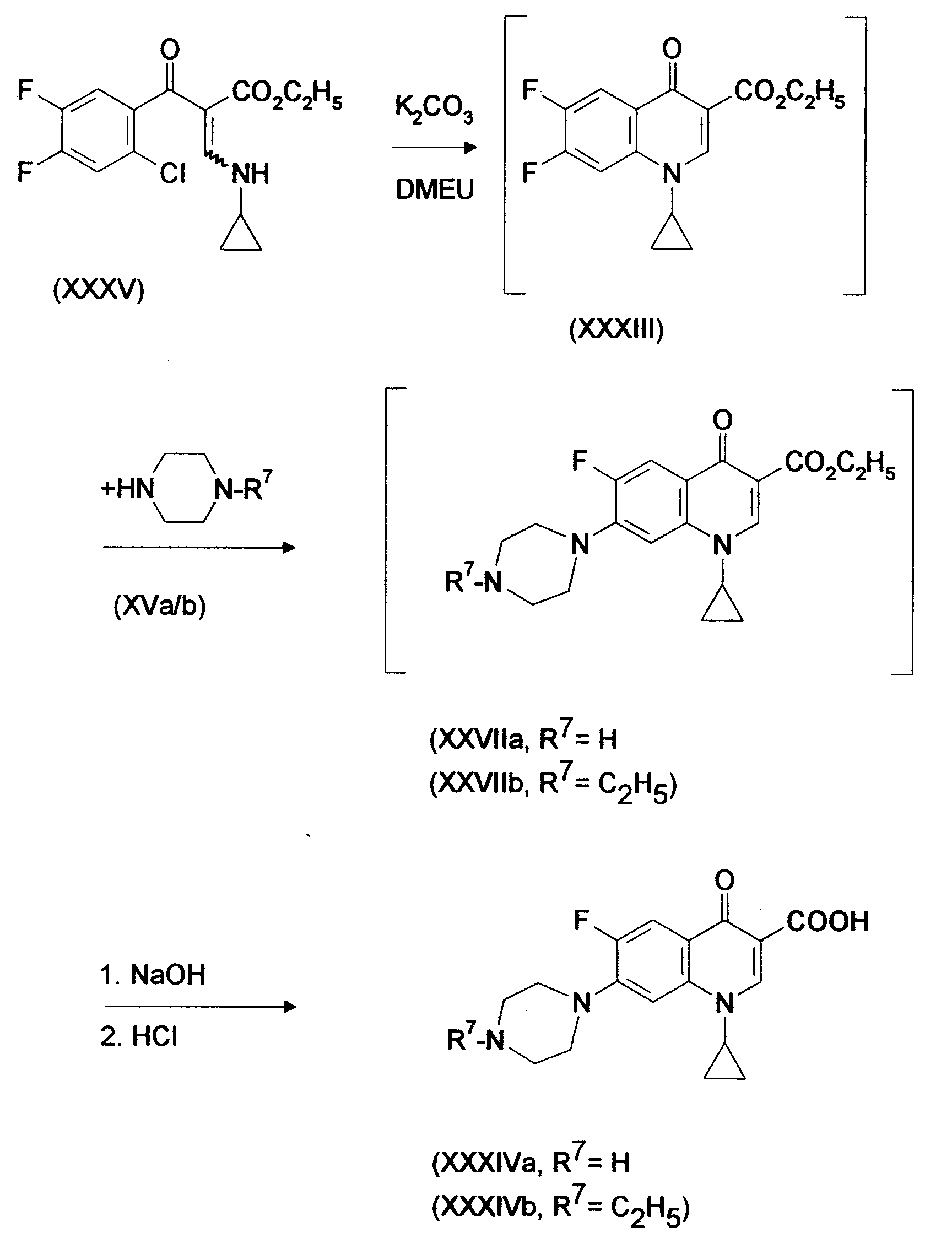
Nach 2 Stunden werden 86 g (1 m) Piperazin (XVa) bzw. 114 g (1m) N-Ethylpiperazin (XVb) zugegeben. Man rührt eine Stunde bei 80 bis 90°C und verdünnt den Ansatz mit 150 ml Wasser.
Nach Zugabe von 20 g (0,5 m) NaOH hält man die Temperatur 1 Stunde bei 70°C und verdünnt anschließend weiter mit 500 ml Wasser. Geringe Verunreinigungen der Lösung werden abfiltriert und der pH-Wert mit hälbkonzentrierter Salzsäure auf 7,5 eingestellt.
Nach Abkühlen auf 0 bis 5°C wird das Betain (XXXIV) nach 2 Stunden abgesaugt, mit 2 x 200 ml Wasser gewaschen und das Produkt über Nacht im Vakuum getrocknet.
Ausbeute (XXXIVa): 73,0 g (98,5 Gew.-%) ≙ 86,8 % d. Th.
(XXXIVb): 77,2g (99,0 Gew.-%) ≙ 85,1 % d. Th. - 5. 7-(3-Amino-1-pyrrolidinyl)-8-chlor-1-cyclopropyl-6-fluor-1,4-dihydro-4-oxo-3-chinolincarbonsäure (XI)

Man gibt 8,5 g 3-Acetamidopyrrolidin (V') zu und rührt 1 Stunde bei 80°C bis 90°C nach. Anschließend verdünnt man die Reaktionsmischung mit 40 ml Wasser und gibt 10 g NaOH zu. Nach 4 Stunden bei 90 bis 100°C wird mit weiteren 125 ml Wasser verdünnt, filtriert und mit halbkonzentrierter Salzsäure neutralisiert.
Der Feststoff wird abfiltriert, mit Wasser und Isopropanol gewaschen und über Nacht im Vakuum getrocknet.
Ausbeute: 17,3 g (XI) (98,7 Gew.-% HPLC) ≙ 83 % d. Th. - Synthese von 1-Cyclopropyl-6-fluor-7-(1-piperazinyl)-1,4-dihydro-4-oxo-3-chinolincarbonsäure (XXXIVa).


35,8 g (0.25 Mol) Dimethylaminoacrylsäureethylester und 27.3 g (0.27 Mol) Triethylamin werden in 50 ml Toluol vorgelegt und bei 50°C in 30 Minuten eine Mischung aus 24,3 g (0,125 Mol) 2,4-5-Trifluorbenzoylchorid (XXVIa) und 26,3 g (0,125 m) 2-Chlor-4,5-difluorbenzoylchlorid (XXVIb) zugetropft. Es wird 1 Stunde bei 50 bis 55°C nachgerührt und anschließend 17,3 g (0,28 Mol) Eisessig und 15,5 g (0,27 Mol) Cyclopropylamin bei 30 bis 36°C zugetropft. Nach 1 Stunde werden die Salze mit 100 ml Wasser extrahiert. Die organische Phase wird im Wasserstrahl-Vakuum bei 40°C eingedampft. Man erhält 81,5 g (XXXIIa/b) als öligen Rückstand. - Durch Zugabe von 250 ml N-Methylpyrrolidon wird das Öl (XXXIIa/b) gelöst und mit 48,4 g (0,35 Mol) Pottasche auf 90 bis 120°C erwärmt. Nach 2 Stunden werden 86 g (1 Mol) Piperazin (XVa) zugegeben. Man rührt eine Stunde bei 80 bis 90°C und verdünnt den Ansatz mit 150 ml Wasser.
- Nach Zugabe von 20 g (0,5 Mol) NaOH hält man die Temperatur 1 Stunde bei 70°C und verdünnt anschließend weiter mit 500 ml Wasser. Geringe Verunreinigungen der Lösung werden abfiltriert und der pH-Wert mit halbkonzentrierter Salzsäure auf 7,5 eingestellt.
- Nach Abkühlen auf 0 bis 5°C wird das Betain (XXXIV) nach 2 Stunden abgesaugt, mit 2 x 200 ml Wasser gewaschen und das Produkt über Nacht im Vakuum getrocknet.
Ausbeute: XXXIVa 73,4 (98,0 Gew.-%, HPLC) ≙ 86,5% der Theorie
Claims (9)
- Eintopfverfahren zur Herstellung von 3-Chinoloncarbonsäurederivaten der allgemeinen Formel (Ia)

R' und R'' zusammen mit dem Stickstoffatom, an das sie gebunden sind, einen mono- oder bicyclischen Heterocyclus bilden, der gegebenenfalls in allen Ringteilen weitere Stickstoff-, Sauerstoff- oder Schwefel-Heteroatome enthalten kann und der gegebenenfalls substituiert sein kann und
in welcherA für CH, CF, CCl, C-OCH₃, C-CH₃,X¹ für H, Halogen, NH₂, CH₃,R¹ für C₁-C₃-Alkyl, FCH₂CH₂-, Cyclopropyl, gegebenenfalls durch Halogen ein- bis dreifach substituiertes Phenyl oder Cyclopropyl steht,dadurch gekennzeichnet, daß ohne eine Isolation der Zwischenstufen Säurehalogenide der Formel (XXVI)
Hal, X² und X³ für Fluor oder Chlor stehen und A und X¹ die oben angegebene Bedeutung haben, entweder mit einem Dimethylaminoacrylsäureester der Formel (CH₃)₂N-CH=CH-COOR in einem Lösungsmittel umgesetzt wird, wonach durch Zugabe eines Amins R¹-NH₂ unter Aminaustausch im Acrylesterteil des Primärproduktes der Aminoacrylester (XIII) erzeugt wird oder das Säurehalogenid gleich mit einem Aminoacrylester der Formel R¹NH-CH=CH-COOR umgesetzt wird, in welchem Fall der vorstehend beschriebene Aminaustausch entfällt und sogleich die Verbindung (XIII) erzeugt wird,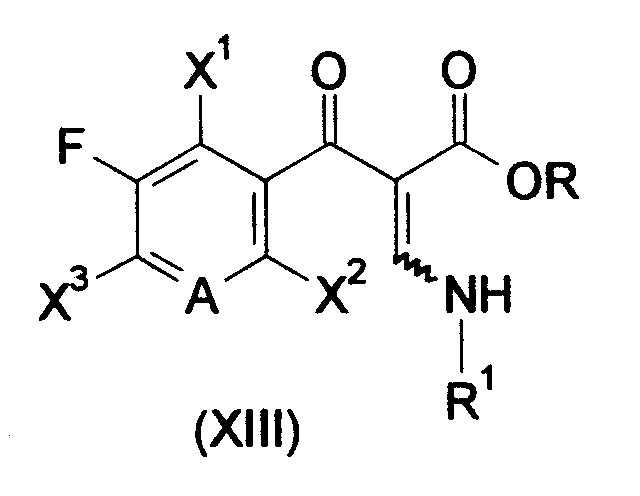

welche ohne Zwischenisolierung durch Umsetzung mit heterocyclischen Verbindungen
R' und R'' die obengenannte Bedeutung haben
in Ester der allgemeinen Formel
- Eintopfverfahren gemäß Anspruch 1, zur Herstellung von 3-Chinoloncarbonsäurederivaten der allgemeinen Formel (Ib),
 A für CH, CF, CCl, C-OCH₃, C-CH₃,X¹ für H, Halogen, NH₂, CH₃R¹ für C₁-C₃-Alkyl, FCH₂CH₂-, Cyclopropyl, gegebenenfalls durch Halogen ein- bis dreifach substituiertes Phenyl oder Cyclopropyl undR⁷ für Wasserstoff gegebenenfalls substituiertes Alkyl oder Phenyl oder eine übliche zum Schutz eines Stickstoffatoms geeigneten Gruppe, vorzugsweise aber Ethyl steht,
daduch gekennzeichnet, daß ohne eine Isolation der Zwischenstufen ein Säurehalogenid der Formel (XXVI)
Hal, X² und X³ für Fluor oder Chlor stehen und A und X¹ die Bedeutung gemäß Anspruch 1 haben, mit einem Dimethylaminoacrylsäureester der Formel
(CH₃)₂N-CH=CH-COOR
in einem Lösungsmittel umgesetzt wird, wonach durch Zugabe eines Amins R¹-NH₂ unter Aminaustausch im Acrylesterteil des Primärproduktes der Aminoacrylester (XIII) erzeugt wird,
in einem Lösungsmittel mit einer Hilfsbase erwärmt und dabei zu Verbindungen der allgemeinen Formel (XIV) cyclisiert werden,

R⁷ die vorgenannte Bedeutung hat,
in Ester der allgemeinen Formel (XXVII)
- Eintopfverfahren zur Herstellung von 3-Chinoloncarbonsäurederivaten der allgemeinen Formel (I)
 A für CH, CF, CCl, C-OCH₃, C-CH₃,X¹ für H, Halogen, NH₂, CH₃,Y für CH₂ oder O,R¹ für C₁-C₃-Alkyl, FCH₂CH₂-, Cyclopropyl, gegebenenfalls durch Halogen ein- bis dreifach substituiertes Phenyl oder Cyclopropyl steht,R² für Wasserstoff 5-Methyl-2-oxo-1,3-dioxolen-4-yl-methyl, C₂-C₅-Oxoalkyl, CH₂-CO-C₆H₅, CH₂CH₂CO₂R⁶, R⁶O₂C-CH=C-CO₂R⁶, -CH=CH-CO₂R⁶ oder CH₂CH₂-CN steht,worinR⁶ Wasserstoff oder C₁-C₃-Alkyl bedeutet,dadurch gekennzeichnet, daß ohne eine Isolation der Zwischenstufen ein Säurehalogenid der Formel
Hal, X² und X³ für Fluor oder Chlor stehen und A und X¹ die für Formel (I) angegebene Bedeutung haben, mit einem Dimethylaminoacrylsäureester der Formel (CH₃)₂N-CH=CH-COOR in einem Lösungsmittel umgesetzt wird, wonach durch Zugabe eines Amins R¹-NH₂ unter Aminaustausch im Acrylesterteil des Primärproduktes der Aminoacrylester (XIII) erzeugt wird,
welche durch Umsetzung mit Verbindungen der allgemeinen Formel (XVII) R² für Wasserstoff, 5-Methyl-2-oxo-1,3-dioxolen-4-yl-methyl, C₂-C₅-Oxoalkyl, CH₂-CO-C₆H₅, CH₂CH₂CO₂R⁶, R⁶O₂C-CH=C-CO₂R⁶, -CH=CH-CO₂R⁶ oder CH₂CH₂-CN,Y für CH₂ oder O steht,in Ester der allgemeinen Formel (XVI)
- Verfahren gemäß Anspruch 3, dadurch gekennzeichnet, daß Acrylester der Formel (XIII) eingesetzt werden, in welchenA für CH, CF, CCl, C-OCH₃, C-CH₃,R für einen üblichen, zur Esterbildung geeigneten organischen Rest,R¹ für C₁-C₃-Alkyl, FCH₂CH₂-, Cyclopropyl, gegebenenfalls durch Halogen ein- bis dreifach substituiertes Phenyl oder Cyclopropyl steht,X¹ für H, Halogen, NH₂, CH₃ undX² und X³ für Halogen stehenund als Verbindungen der Formel (XVII) solche, in welchenR² für H, CH₂-O-CH₃, CH₂-O-C₆H₅, CH₂CH₂-CO-CH₃, CH₂CH₂CO₂R⁶, R⁶O₂C-CH=C-CO₂R⁶, -CH=CO₂R⁶, CH₂CH₂CN steht,
worin
R⁶ C₁-C₃-Alkyl bedeutet undY für CH₂ oder O steht. - Verfahren gemäß Anspruch 2, dadurch gekennzeichnet, daß als Säurehalogenide der Formel (XXVI) solche eingesetzt werden, in welchenA für CH,X¹ für Wasserstoff,X² für Fluor oder Chlor undX³ für Fluor steht,und als Verbindungen der Formel (XV) solche, in welchenR⁷ für Wasserstoff oder Ethyl steht.
- Verfahren gemäß Anspruch 4, dadurch gekennzeichnet, daß Acrylester der Formel (XIII) eingesetzt werden, in welchenA für CCl oder CFR für CH₃ oder C₂H₅R¹ für CyclopropylX¹ für WasserstoffX² für Fluor oder Chlor undX³ für Fluor stehtund als Verbindungen (XVII) solche, in welchenR² für Wasserstoff undY für CH₂ steht.
- Verfahren gemäß Ansprüchen 1, 3, 4 und 6, dadurch gekennzeichnet, daß es sich bei den Verbindungen der Formel (XVII) um enantiomerenreine Stoffe handelt.
- Verfahren gemäß Anspruch 6, dadurch gekennzeichnet, daß es sich bei der Verbindung der Formel (XVII) um eine enantiomerenreine Verbindung aus der Gruppe der Verbindungen der Formeln (XXIXa) bis (XXIXd) handelt

- Verfahren gemäß Ansprüchen 1 bis 8, dadurch gekennzeichnet, daß zur Cyclisierung der Verbindungen der Formel (XIII) Kaliumcarbonat als Hilfsbase eingesetzt wird.
Priority Applications (1)
| Application Number | Priority Date | Filing Date | Title |
|---|---|---|---|
| SI9430120T SI0657448T1 (en) | 1993-12-10 | 1994-11-28 | One pot process for the preparation of 3-quinolonecarboxylic acid derivatives |
Applications Claiming Priority (2)
| Application Number | Priority Date | Filing Date | Title |
|---|---|---|---|
| DE4342186 | 1993-12-10 | ||
| DE4342186A DE4342186A1 (de) | 1993-12-10 | 1993-12-10 | Eintopfverfahren zur Herstellung von 3-Chinoloncarbonsäurederivaten |
Publications (2)
| Publication Number | Publication Date |
|---|---|
| EP0657448A1 true EP0657448A1 (de) | 1995-06-14 |
| EP0657448B1 EP0657448B1 (de) | 1998-03-04 |
Family
ID=6504693
Family Applications (1)
| Application Number | Title | Priority Date | Filing Date |
|---|---|---|---|
| EP94118676A Expired - Lifetime EP0657448B1 (de) | 1993-12-10 | 1994-11-28 | Eintopfverfahren zur Herstellung von 3-Chinoloncarbonsäurederivaten |
Country Status (35)
| Country | Link |
|---|---|
| US (1) | US5639886A (de) |
| EP (1) | EP0657448B1 (de) |
| JP (1) | JP3963490B2 (de) |
| KR (1) | KR950018008A (de) |
| CN (1) | CN1109877A (de) |
| AT (1) | ATE163645T1 (de) |
| AU (1) | AU693818B2 (de) |
| BG (1) | BG61947B1 (de) |
| CA (1) | CA2137523C (de) |
| CO (1) | CO4180607A1 (de) |
| CZ (1) | CZ288078B6 (de) |
| DE (2) | DE4342186A1 (de) |
| DK (1) | DK0657448T3 (de) |
| EE (1) | EE03215B1 (de) |
| ES (1) | ES2113040T3 (de) |
| FI (1) | FI945776L (de) |
| GR (1) | GR3026383T3 (de) |
| HR (1) | HRP940950B1 (de) |
| HU (1) | HU220597B1 (de) |
| IL (1) | IL111921A (de) |
| LV (1) | LV11470B (de) |
| MY (1) | MY113302A (de) |
| NO (1) | NO307180B1 (de) |
| NZ (1) | NZ270086A (de) |
| PE (1) | PE33795A1 (de) |
| PL (1) | PL180022B1 (de) |
| RO (1) | RO113345B1 (de) |
| RU (1) | RU2138483C1 (de) |
| SI (1) | SI0657448T1 (de) |
| SK (1) | SK279950B6 (de) |
| SV (1) | SV1994000071A (de) |
| TW (1) | TW401412B (de) |
| UA (1) | UA41323C2 (de) |
| YU (1) | YU48865B (de) |
| ZA (1) | ZA949830B (de) |
Cited By (6)
| Publication number | Priority date | Publication date | Assignee | Title |
|---|---|---|---|---|
| DE10026903A1 (de) * | 2000-06-03 | 2002-01-10 | Cpc Cellular Process Chemistry | Verfahren zur Herstellung von Chinolon-3-carbonsäuren |
| EP1992626A1 (de) * | 2007-05-10 | 2008-11-19 | Sandoz AG | Verfahren zur Herstellung von Moxifloxacin-Hydrochlorid |
| FR2916446A1 (fr) * | 2007-05-24 | 2008-11-28 | Biocodex Sa | Nouveau procede de synthese de fluoroquinolones |
| ITMI20100450A1 (it) * | 2010-03-19 | 2011-09-20 | Italiana Sint Spa | Processo di preparazione della moxifloxacina e suoi sali |
| US8198451B2 (en) | 2006-11-13 | 2012-06-12 | Cipla Limited | Process for the synthesis of moxifloxacin hydrochloride |
| WO2014087292A1 (en) | 2012-12-04 | 2014-06-12 | Mankind Research Centre | An improved process for the preparation of moxifloxacin hydrochloride |
Families Citing this family (19)
| Publication number | Priority date | Publication date | Assignee | Title |
|---|---|---|---|---|
| DE19826050A1 (de) * | 1998-06-12 | 1999-12-16 | Bayer Ag | Verfahren zur Herstellung von Chinolon- und Naphthyridoncarbonsäuren und deren Ester |
| WO2001062734A1 (en) * | 2000-02-25 | 2001-08-30 | Daiichi Pharmaceutical Co., Ltd. | Process for producing quinolonecarboxylic acids and intermediates thereof |
| US6608078B2 (en) | 2000-05-08 | 2003-08-19 | Wockhardt Limited | Antibacterial chiral 8-(substituted piperidino)-benzo [i,j] quinolizines, processes, compositions and methods of treatment |
| US7098219B2 (en) | 2000-08-01 | 2006-08-29 | Wockhart Limited | Inhibitors of cellular efflux pumps of microbes |
| US6878713B2 (en) * | 2001-04-25 | 2005-04-12 | Wockhardt Limited | Generation triple-targeting, chiral, broad-spectrum antimicrobial 7-substituted piperidino-quinolone carboxylic acid derivatives, their preparation, compositions and use as medicaments |
| US6964966B2 (en) | 2001-04-25 | 2005-11-15 | Wockhardt Limited | Generation triple-targeting, chiral, broad-spectrum antimicrobial 7-substituted piperidino-quinolone carboxylic acid derivatives, their preparation, compositions and use as medicaments |
| US6664267B1 (en) | 2002-05-28 | 2003-12-16 | Wockhardt Limited | Crystalline fluoroquinolone arginine salt form |
| KR100519158B1 (ko) * | 2002-12-21 | 2005-10-06 | 주식회사유한양행 | 퀴놀론 카르복실레이트 유도체의 제조방법 |
| WO2005023805A1 (en) * | 2003-09-04 | 2005-03-17 | Wockhardt Limited | Benzoquinolizine-2-carboxylic acid arginine salt tetrahydrate |
| WO2005026145A2 (en) * | 2003-09-12 | 2005-03-24 | Warner-Lambert Company Llc | Quinolone antibacterial agents |
| CN100412075C (zh) * | 2004-06-22 | 2008-08-20 | 浙江医药股份有限公司新昌制药厂 | 左旋氧氟沙星和氧氟沙星的制备方法 |
| EP2083010A1 (de) | 2008-01-08 | 2009-07-29 | Chemo Ibérica, S.A. | Polymorphe Moxiflocacin-Hydrochlorid-Formen und Verfahren zu ihrer Herstellung |
| CN101781299B (zh) * | 2010-01-13 | 2012-06-27 | 杭州师范大学 | 一种喹诺酮类药物关键中间体的一锅法合成方法 |
| CN102675306A (zh) * | 2011-03-17 | 2012-09-19 | 苏州中科天马肽工程中心有限公司 | 一种莫西沙星或其盐的制备方法 |
| CN102267994B (zh) * | 2011-06-17 | 2013-01-30 | 江苏正大丰海制药有限公司 | 一种盐酸莫西沙星已知杂质的制备方法 |
| WO2013157018A1 (en) | 2012-04-18 | 2013-10-24 | Indian Institute Of Technology Madras | A process for the preparation of the core structure in quinolone and napthyridone class of antibiotics |
| UA106556C2 (uk) * | 2013-05-13 | 2014-09-10 | Наталья Николаевна Деркач | СПОСІБ ОДЕРЖАННЯ (1-ЦИКЛОПРОПІЛ-6-ФТОР-1,4-ДИГІДРО-8-МЕТОКСІ-7-[(4aS,7aS)-ОКТАГІДРО-6Н-ПІРОЛО[3,4-b]-4-ОКСО-3-ХІНОЛІНКАРБОНОВОЇ КИСЛОТИ |
| WO2018231747A2 (en) * | 2017-06-12 | 2018-12-20 | Virginia Commonwealth University | Streamlined syntheses of fluoroquinolones |
| CN115385856A (zh) * | 2022-09-05 | 2022-11-25 | 常州大学 | 一锅法合成诺氟沙星中间体的方法 |
Citations (7)
| Publication number | Priority date | Publication date | Assignee | Title |
|---|---|---|---|---|
| EP0167763A1 (de) | 1984-06-04 | 1986-01-15 | Bayer Ag | 7-Amino-1-cyclopropyl-6,8-dihalogen-1,4-dihydro-4-oxo-3-chinolincarbonsäuren, Verfahren zur ihrer Herstellung sowie diese enthaltende antibakterielle Mittel |
| EP0275971A1 (de) | 1987-01-21 | 1988-07-27 | Kyorin Pharmaceutical Co., Ltd. | Verfahren und Zwischenprodukte für Chinolinon-Carbonsäure |
| EP0300311A2 (de) | 1987-07-24 | 1989-01-25 | Bayer Ag | Verfahren zur Herstellung von Chinoloncarbonsäuren |
| EP0350733A2 (de) | 1988-07-15 | 1990-01-17 | Bayer Ag | 7-(1-Pyrrolidinyl)-3-chinolon- und -naphthyridoncarbon-säure-Derivate, Verfahren zu ihrer Herstellung sowie substituierte mono-und bicyclische Pyrrolidinderivate als Zwischenprodukte zu ihrer Herstellung, und sie enthaltende antibakterielle Mittel und Futterzusatzstoffe |
| EP0550903A1 (de) * | 1992-01-10 | 1993-07-14 | Bayer Ag | Chinolon- und Naphthyridon-Carbonsäurederivate als antibakterielles Mittel |
| DE4208789A1 (de) | 1992-03-19 | 1993-09-23 | Bayer Ag | Enantiomerenreine chinolincarbonsaeure-derivate |
| DE4208792A1 (de) | 1992-03-19 | 1993-09-23 | Bayer Ag | Enantiomerenreine chinolincarbonsaeure-derivate |
Family Cites Families (6)
| Publication number | Priority date | Publication date | Assignee | Title |
|---|---|---|---|---|
| US5468861A (en) * | 1984-06-04 | 1995-11-21 | Bayer Aktiengesellschaft | 8-chloro-1-cyclopropyl-6,7-difluoro-1,4-dihydro-4-oxo-3-quinolinecarboxylic acid and alkyl esters thereof |
| JPS62215572A (ja) * | 1986-03-17 | 1987-09-22 | Kyorin Pharmaceut Co Ltd | キノロンカルボン酸誘導体 |
| US4780468A (en) * | 1987-08-07 | 1988-10-25 | Warner-Lambert Company | 8-trifluoromethyl quinolones as antibacterial agents |
| WO1989005643A1 (en) * | 1987-12-18 | 1989-06-29 | Pfizer Inc. | Heterocyclic-substituted quinoline-carboxylic acids |
| WO1994025464A1 (en) * | 1993-04-24 | 1994-11-10 | Korea Research Institute Of Chemical Technology | Novel quinolone carboxylic acid derivatives and process for preparing the same |
| AU679961B2 (en) * | 1993-08-13 | 1997-07-17 | Dong Wha Pharmaceutical Industrial Co., Ltd. | Novel quinolone carboxylic acid derivatives |
-
1993
- 1993-12-10 DE DE4342186A patent/DE4342186A1/de not_active Withdrawn
-
1994
- 1994-11-18 EE EE9400332A patent/EE03215B1/xx not_active IP Right Cessation
- 1994-11-21 TW TW083110792A patent/TW401412B/zh not_active IP Right Cessation
- 1994-11-23 HR HRP4342186.5A patent/HRP940950B1/xx not_active IP Right Cessation
- 1994-11-28 EP EP94118676A patent/EP0657448B1/de not_active Expired - Lifetime
- 1994-11-28 CO CO94054149A patent/CO4180607A1/es unknown
- 1994-11-28 SI SI9430120T patent/SI0657448T1/xx unknown
- 1994-11-28 ES ES94118676T patent/ES2113040T3/es not_active Expired - Lifetime
- 1994-11-28 DK DK94118676T patent/DK0657448T3/da active
- 1994-11-28 AT AT94118676T patent/ATE163645T1/de not_active IP Right Cessation
- 1994-11-28 DE DE59405376T patent/DE59405376D1/de not_active Expired - Lifetime
- 1994-12-02 US US08/348,400 patent/US5639886A/en not_active Expired - Lifetime
- 1994-12-05 JP JP32920694A patent/JP3963490B2/ja not_active Expired - Lifetime
- 1994-12-06 AU AU80244/94A patent/AU693818B2/en not_active Ceased
- 1994-12-06 RO RO94-01949A patent/RO113345B1/ro unknown
- 1994-12-07 NZ NZ270086A patent/NZ270086A/en unknown
- 1994-12-07 SK SK1514-94A patent/SK279950B6/sk unknown
- 1994-12-07 CA CA002137523A patent/CA2137523C/en not_active Expired - Lifetime
- 1994-12-07 PE PE1994256625A patent/PE33795A1/es not_active Application Discontinuation
- 1994-12-07 IL IL11192194A patent/IL111921A/xx not_active IP Right Cessation
- 1994-12-08 YU YU71694A patent/YU48865B/sh unknown
- 1994-12-08 SV SV1994000071A patent/SV1994000071A/es not_active Application Discontinuation
- 1994-12-08 FI FI945776A patent/FI945776L/fi unknown
- 1994-12-08 BG BG99248A patent/BG61947B1/bg unknown
- 1994-12-09 PL PL94306198A patent/PL180022B1/pl unknown
- 1994-12-09 RU RU94043645A patent/RU2138483C1/ru active
- 1994-12-09 LV LVP-94-241A patent/LV11470B/lv unknown
- 1994-12-09 HU HU9403553A patent/HU220597B1/hu not_active IP Right Cessation
- 1994-12-09 CZ CZ19943105A patent/CZ288078B6/cs not_active IP Right Cessation
- 1994-12-09 CN CN94112890A patent/CN1109877A/zh active Pending
- 1994-12-09 KR KR1019940033433A patent/KR950018008A/ko not_active Ceased
- 1994-12-09 MY MYPI94003290A patent/MY113302A/en unknown
- 1994-12-09 UA UA94129157A patent/UA41323C2/uk unknown
- 1994-12-09 ZA ZA949830A patent/ZA949830B/xx unknown
- 1994-12-09 NO NO944786A patent/NO307180B1/no not_active IP Right Cessation
-
1998
- 1998-03-17 GR GR980400579T patent/GR3026383T3/el unknown
Patent Citations (7)
| Publication number | Priority date | Publication date | Assignee | Title |
|---|---|---|---|---|
| EP0167763A1 (de) | 1984-06-04 | 1986-01-15 | Bayer Ag | 7-Amino-1-cyclopropyl-6,8-dihalogen-1,4-dihydro-4-oxo-3-chinolincarbonsäuren, Verfahren zur ihrer Herstellung sowie diese enthaltende antibakterielle Mittel |
| EP0275971A1 (de) | 1987-01-21 | 1988-07-27 | Kyorin Pharmaceutical Co., Ltd. | Verfahren und Zwischenprodukte für Chinolinon-Carbonsäure |
| EP0300311A2 (de) | 1987-07-24 | 1989-01-25 | Bayer Ag | Verfahren zur Herstellung von Chinoloncarbonsäuren |
| EP0350733A2 (de) | 1988-07-15 | 1990-01-17 | Bayer Ag | 7-(1-Pyrrolidinyl)-3-chinolon- und -naphthyridoncarbon-säure-Derivate, Verfahren zu ihrer Herstellung sowie substituierte mono-und bicyclische Pyrrolidinderivate als Zwischenprodukte zu ihrer Herstellung, und sie enthaltende antibakterielle Mittel und Futterzusatzstoffe |
| EP0550903A1 (de) * | 1992-01-10 | 1993-07-14 | Bayer Ag | Chinolon- und Naphthyridon-Carbonsäurederivate als antibakterielles Mittel |
| DE4208789A1 (de) | 1992-03-19 | 1993-09-23 | Bayer Ag | Enantiomerenreine chinolincarbonsaeure-derivate |
| DE4208792A1 (de) | 1992-03-19 | 1993-09-23 | Bayer Ag | Enantiomerenreine chinolincarbonsaeure-derivate |
Cited By (11)
| Publication number | Priority date | Publication date | Assignee | Title |
|---|---|---|---|---|
| DE10026903A1 (de) * | 2000-06-03 | 2002-01-10 | Cpc Cellular Process Chemistry | Verfahren zur Herstellung von Chinolon-3-carbonsäuren |
| EP1160241A3 (de) * | 2000-06-03 | 2002-08-14 | CPC Cellular Process Chemistry Systems GmbH | Verfahren zur Herstellung von Chinolon-3-carbonsäuren |
| US8198451B2 (en) | 2006-11-13 | 2012-06-12 | Cipla Limited | Process for the synthesis of moxifloxacin hydrochloride |
| EP2474547A2 (de) | 2006-11-13 | 2012-07-11 | Cipla Limited | Verfahren Zur Synthese Von Moxifloxacinhydrochlorid |
| EP1992626A1 (de) * | 2007-05-10 | 2008-11-19 | Sandoz AG | Verfahren zur Herstellung von Moxifloxacin-Hydrochlorid |
| WO2008138759A1 (en) * | 2007-05-10 | 2008-11-20 | Sandoz Ag | Process for the preparation of moxifloxacin hydrochloride |
| FR2916446A1 (fr) * | 2007-05-24 | 2008-11-28 | Biocodex Sa | Nouveau procede de synthese de fluoroquinolones |
| EP2138490A1 (de) * | 2007-05-24 | 2009-12-30 | Biocodex | Neues Syntheseverfahren für Fluorquinolone |
| ITMI20100450A1 (it) * | 2010-03-19 | 2011-09-20 | Italiana Sint Spa | Processo di preparazione della moxifloxacina e suoi sali |
| US8207339B2 (en) | 2010-03-19 | 2012-06-26 | F.I.S. Fabbrica Italiana Sintetici S.P.A. | Process for preparing Moxifloxacin and salts thereof |
| WO2014087292A1 (en) | 2012-12-04 | 2014-06-12 | Mankind Research Centre | An improved process for the preparation of moxifloxacin hydrochloride |
Also Published As
Similar Documents
| Publication | Publication Date | Title |
|---|---|---|
| EP0657448B1 (de) | Eintopfverfahren zur Herstellung von 3-Chinoloncarbonsäurederivaten | |
| DE3514076C2 (de) | ||
| DE69723846T2 (de) | Verfahren zur Herstellung von Sildenafil | |
| EP0520240A1 (de) | 7-Isoindolinyl-chinolon- und naphthyridoncarbonsäure-Derivate | |
| EP0607825A1 (de) | 6-H-4-Oxo-3-chinolinecarbonsäure und ihre Analoge als antibakterielle Mittel | |
| DE60311869T2 (de) | Kristalline Cefdinir-Salze | |
| DE69531305T2 (de) | Pyridoncarboxylat- derivate oder salze davon und antibakterielle zusammensetzungen die diese als aktiven bestandteil enthalten | |
| EP0187376B1 (de) | 6,7-Disubstituierte 1-Cyclopropyl-1,4-dihydro-4-oxo-1,8-naphthyridin-3-carbonsäuren | |
| EP0963977B1 (de) | Verfahren zur Herstellung von Chinolon-und Naphthyridoncarbonsäuren und deren Ester | |
| DE3135125C2 (de) | ||
| EP0251308B1 (de) | 4-Chinolon-3-carbonsäurederivate, Verfahren zu ihrer Herstellung und diese enthaltende pharmazeutische Präparate | |
| IE63654B1 (en) | Process for the preparation of quinolonecarboxylic acids | |
| EP0607826A1 (de) | Fluor-trifluormethylbenzoesäure-Derivate | |
| DE69230730T2 (de) | VERFAHREN ZUR HERSTELLUNG VON BENZO[b]NAPHTHYRIDINEN | |
| DE60314904T2 (de) | Verfahren zur herstellung von chinoloncarboxylat-derivaten | |
| AT397385B (de) | Verfahren zur herstellung von chinolincarbonsäurederivaten | |
| DE69232406T2 (de) | Verfahren zur Herstellung von Fluoro-Chinolin-3-Carbonsäurederivate | |
| EP0589318B1 (de) | Antibakterielle 7-(Aminomethyl-oxa-7-aza-bicyclo 3.3.0 oct-7-yl)chinolon- und -naphthyridoncarbonsäure-Derivate | |
| DE3721745A1 (de) | Bicyclisch substituierte chinoloncarbonsaeurederivate, verfahren zu ihrer herstellung und diese enthaltende pharmazeutische praeparate | |
| DD252602A5 (de) | Verfahren zur herstellung von 1-methylamino-chinolincarbonsaeuren | |
| DE3641661A1 (de) | Verfahren zur herstellung von chinoloncarbonsaeureestern | |
| DE4424369A1 (de) | Pyrido[3,2,1.i,j][3,1]benzoxazinderivate | |
| EP0702007A1 (de) | Verfahren zur Herstellung von Chinazolin-2,4-dionen | |
| WO1996002540A1 (de) | Heterocyclyl-1-phenyl substituierte chinoloncarbonsäuren als antivirale mittel | |
| EP0726270B1 (de) | 1,6-Naphthyridoncarbonsäurederivate |
Legal Events
| Date | Code | Title | Description |
|---|---|---|---|
| PUAI | Public reference made under article 153(3) epc to a published international application that has entered the european phase |
Free format text: ORIGINAL CODE: 0009012 |
|
| AK | Designated contracting states |
Kind code of ref document: A1 Designated state(s): AT BE CH DE DK ES FR GB GR IE IT LI LU MC NL PT SE |
|
| RAX | Requested extension states of the european patent have changed |
Free format text: LT PAYMENT 941128;SI PAYMENT 941128 |
|
| 17P | Request for examination filed |
Effective date: 19951212 |
|
| GRAG | Despatch of communication of intention to grant |
Free format text: ORIGINAL CODE: EPIDOS AGRA |
|
| 17Q | First examination report despatched |
Effective date: 19970121 |
|
| GRAH | Despatch of communication of intention to grant a patent |
Free format text: ORIGINAL CODE: EPIDOS IGRA |
|
| GRAH | Despatch of communication of intention to grant a patent |
Free format text: ORIGINAL CODE: EPIDOS IGRA |
|
| GRAA | (expected) grant |
Free format text: ORIGINAL CODE: 0009210 |
|
| AK | Designated contracting states |
Kind code of ref document: B1 Designated state(s): AT BE CH DE DK ES FR GB GR IE IT LI LU MC NL PT SE |
|
| AX | Request for extension of the european patent |
Free format text: LT PAYMENT 941128;SI PAYMENT 941128 |
|
| REF | Corresponds to: |
Ref document number: 163645 Country of ref document: AT Date of ref document: 19980315 Kind code of ref document: T |
|
| REG | Reference to a national code |
Ref country code: CH Ref legal event code: NV Representative=s name: E. BLUM & CO. PATENTANWAELTE Ref country code: CH Ref legal event code: EP |
|
| GBT | Gb: translation of ep patent filed (gb section 77(6)(a)/1977) |
Effective date: 19980305 |
|
| REF | Corresponds to: |
Ref document number: 59405376 Country of ref document: DE Date of ref document: 19980409 |
|
| REG | Reference to a national code |
Ref country code: ES Ref legal event code: FG2A Ref document number: 2113040 Country of ref document: ES Kind code of ref document: T3 |
|
| ITF | It: translation for a ep patent filed | ||
| ET | Fr: translation filed | ||
| REG | Reference to a national code |
Ref country code: IE Ref legal event code: FG4D Free format text: 79169 |
|
| REG | Reference to a national code |
Ref country code: PT Ref legal event code: SC4A Free format text: AVAILABILITY OF NATIONAL TRANSLATION Effective date: 19980518 |
|
| REG | Reference to a national code |
Ref country code: DK Ref legal event code: T3 |
|
| PLBE | No opposition filed within time limit |
Free format text: ORIGINAL CODE: 0009261 |
|
| STAA | Information on the status of an ep patent application or granted ep patent |
Free format text: STATUS: NO OPPOSITION FILED WITHIN TIME LIMIT |
|
| 26N | No opposition filed | ||
| PGFP | Annual fee paid to national office [announced via postgrant information from national office to epo] |
Ref country code: GR Payment date: 20011018 Year of fee payment: 8 |
|
| PGFP | Annual fee paid to national office [announced via postgrant information from national office to epo] |
Ref country code: SE Payment date: 20011023 Year of fee payment: 8 |
|
| PGFP | Annual fee paid to national office [announced via postgrant information from national office to epo] |
Ref country code: CH Payment date: 20011026 Year of fee payment: 8 |
|
| PGFP | Annual fee paid to national office [announced via postgrant information from national office to epo] |
Ref country code: PT Payment date: 20011030 Year of fee payment: 8 |
|
| PGFP | Annual fee paid to national office [announced via postgrant information from national office to epo] |
Ref country code: MC Payment date: 20011031 Year of fee payment: 8 |
|
| PGFP | Annual fee paid to national office [announced via postgrant information from national office to epo] |
Ref country code: IE Payment date: 20011107 Year of fee payment: 8 |
|
| PGFP | Annual fee paid to national office [announced via postgrant information from national office to epo] |
Ref country code: DK Payment date: 20011115 Year of fee payment: 8 |
|
| PGFP | Annual fee paid to national office [announced via postgrant information from national office to epo] |
Ref country code: LU Payment date: 20011123 Year of fee payment: 8 |
|
| PGFP | Annual fee paid to national office [announced via postgrant information from national office to epo] |
Ref country code: AT Payment date: 20011128 Year of fee payment: 8 |
|
| PGFP | Annual fee paid to national office [announced via postgrant information from national office to epo] |
Ref country code: NL Payment date: 20011130 Year of fee payment: 8 |
|
| PGFP | Annual fee paid to national office [announced via postgrant information from national office to epo] |
Ref country code: BE Payment date: 20011205 Year of fee payment: 8 |
|
| REG | Reference to a national code |
Ref country code: GB Ref legal event code: IF02 |
|
| PG25 | Lapsed in a contracting state [announced via postgrant information from national office to epo] |
Ref country code: LU Free format text: LAPSE BECAUSE OF NON-PAYMENT OF DUE FEES Effective date: 20021128 Ref country code: IE Free format text: LAPSE BECAUSE OF NON-PAYMENT OF DUE FEES Effective date: 20021128 Ref country code: AT Free format text: LAPSE BECAUSE OF NON-PAYMENT OF DUE FEES Effective date: 20021128 |
|
| PG25 | Lapsed in a contracting state [announced via postgrant information from national office to epo] |
Ref country code: SE Free format text: LAPSE BECAUSE OF NON-PAYMENT OF DUE FEES Effective date: 20021129 |
|
| PG25 | Lapsed in a contracting state [announced via postgrant information from national office to epo] |
Ref country code: LI Free format text: LAPSE BECAUSE OF NON-PAYMENT OF DUE FEES Effective date: 20021130 Ref country code: CH Free format text: LAPSE BECAUSE OF NON-PAYMENT OF DUE FEES Effective date: 20021130 Ref country code: BE Free format text: LAPSE BECAUSE OF NON-PAYMENT OF DUE FEES Effective date: 20021130 |
|
| PG25 | Lapsed in a contracting state [announced via postgrant information from national office to epo] |
Ref country code: DK Free format text: LAPSE BECAUSE OF NON-PAYMENT OF DUE FEES Effective date: 20021231 |
|
| BERE | Be: lapsed |
Owner name: *BAYER A.G. Effective date: 20021130 |
|
| PG25 | Lapsed in a contracting state [announced via postgrant information from national office to epo] |
Ref country code: PT Free format text: LAPSE BECAUSE OF NON-PAYMENT OF DUE FEES Effective date: 20030531 |
|
| PG25 | Lapsed in a contracting state [announced via postgrant information from national office to epo] |
Ref country code: NL Free format text: LAPSE BECAUSE OF NON-PAYMENT OF DUE FEES Effective date: 20030601 Ref country code: MC Free format text: LAPSE BECAUSE OF NON-PAYMENT OF DUE FEES Effective date: 20030601 |
|
| PG25 | Lapsed in a contracting state [announced via postgrant information from national office to epo] |
Ref country code: GR Free format text: LAPSE BECAUSE OF NON-PAYMENT OF DUE FEES Effective date: 20030609 |
|
| EUG | Se: european patent has lapsed | ||
| REG | Reference to a national code |
Ref country code: DK Ref legal event code: EBP |
|
| REG | Reference to a national code |
Ref country code: CH Ref legal event code: PL |
|
| LTLA | Lt: lapse of european patent or patent extension |
Effective date: 20021128 |
|
| NLV4 | Nl: lapsed or anulled due to non-payment of the annual fee |
Effective date: 20030601 |
|
| REG | Reference to a national code |
Ref country code: PT Ref legal event code: MM4A Free format text: LAPSE DUE TO NON-PAYMENT OF FEES Effective date: 20030531 |
|
| REG | Reference to a national code |
Ref country code: IE Ref legal event code: MM4A |
|
| REG | Reference to a national code |
Ref country code: FR Ref legal event code: TP |
|
| REG | Reference to a national code |
Ref country code: GB Ref legal event code: 732E Free format text: REGISTERED BETWEEN 20100128 AND 20100203 |
|
| REG | Reference to a national code |
Ref country code: DE Ref legal event code: R081 Ref document number: 59405376 Country of ref document: DE Owner name: BAYER INTELLECTUAL PROPERTY GMBH, DE Free format text: FORMER OWNER: BAYER SCHERING PHARMA AKTIENGESELLSCHAFT, 13353 BERLIN, DE Effective date: 20120613 |
|
| REG | Reference to a national code |
Ref country code: FR Ref legal event code: TP Owner name: BAYER INTELLECTUAL PROPERTY GMBH, DE Effective date: 20130130 Ref country code: FR Ref legal event code: CD Owner name: BAYER INTELLECTUAL PROPERTY GMBH, DE Effective date: 20130130 |
|
| REG | Reference to a national code |
Ref country code: ES Ref legal event code: PC2A Owner name: BAYER INTELLECTUAL PROPERTY GMBH Effective date: 20130319 |
|
| REG | Reference to a national code |
Ref country code: DE Ref legal event code: R081 Ref document number: 59405376 Country of ref document: DE Owner name: BAYER INTELLECTUAL PROPERTY GMBH, DE Free format text: FORMER OWNER: BAYER PHARMA AKTIENGESELLSCHAFT, 13353 BERLIN, DE Effective date: 20130410 |
|
| REG | Reference to a national code |
Ref country code: GB Ref legal event code: 732E Free format text: REGISTERED BETWEEN 20131212 AND 20131218 |
|
| PGFP | Annual fee paid to national office [announced via postgrant information from national office to epo] |
Ref country code: FR Payment date: 20131108 Year of fee payment: 20 Ref country code: GB Payment date: 20131127 Year of fee payment: 20 Ref country code: DE Payment date: 20131120 Year of fee payment: 20 |
|
| PGFP | Annual fee paid to national office [announced via postgrant information from national office to epo] |
Ref country code: ES Payment date: 20131029 Year of fee payment: 20 Ref country code: IT Payment date: 20131025 Year of fee payment: 20 |
|
| REG | Reference to a national code |
Ref country code: DE Ref legal event code: R071 Ref document number: 59405376 Country of ref document: DE |
|
| REG | Reference to a national code |
Ref country code: GB Ref legal event code: PE20 Expiry date: 20141127 |
|
| PG25 | Lapsed in a contracting state [announced via postgrant information from national office to epo] |
Ref country code: GB Free format text: LAPSE BECAUSE OF EXPIRATION OF PROTECTION Effective date: 20141127 |
|
| REG | Reference to a national code |
Ref country code: ES Ref legal event code: FD2A Effective date: 20150204 |
|
| PG25 | Lapsed in a contracting state [announced via postgrant information from national office to epo] |
Ref country code: ES Free format text: LAPSE BECAUSE OF EXPIRATION OF PROTECTION Effective date: 20141129 |