EP0658433A2 - Appareil pour l'alimentation et la correction du désalignement du papier - Google Patents
Appareil pour l'alimentation et la correction du désalignement du papier Download PDFInfo
- Publication number
- EP0658433A2 EP0658433A2 EP94119749A EP94119749A EP0658433A2 EP 0658433 A2 EP0658433 A2 EP 0658433A2 EP 94119749 A EP94119749 A EP 94119749A EP 94119749 A EP94119749 A EP 94119749A EP 0658433 A2 EP0658433 A2 EP 0658433A2
- Authority
- EP
- European Patent Office
- Prior art keywords
- sheet
- recording
- sheet supply
- spacing
- feeding apparatus
- Prior art date
- Legal status (The legal status is an assumption and is not a legal conclusion. Google has not performed a legal analysis and makes no representation as to the accuracy of the status listed.)
- Granted
Links
Images











Classifications
-
- B—PERFORMING OPERATIONS; TRANSPORTING
- B41—PRINTING; LINING MACHINES; TYPEWRITERS; STAMPS
- B41J—TYPEWRITERS; SELECTIVE PRINTING MECHANISMS, i.e. MECHANISMS PRINTING OTHERWISE THAN FROM A FORME; CORRECTION OF TYPOGRAPHICAL ERRORS
- B41J13/00—Devices or arrangements of selective printing mechanisms, e.g. ink-jet printers or thermal printers, specially adapted for supporting or handling copy material in short lengths, e.g. sheets
- B41J13/10—Sheet holders, retainers, movable guides, or stationary guides
- B41J13/103—Sheet holders, retainers, movable guides, or stationary guides for the sheet feeding section
-
- B—PERFORMING OPERATIONS; TRANSPORTING
- B65—CONVEYING; PACKING; STORING; HANDLING THIN OR FILAMENTARY MATERIAL
- B65H—HANDLING THIN OR FILAMENTARY MATERIAL, e.g. SHEETS, WEBS, CABLES
- B65H3/00—Separating articles from piles
-
- B—PERFORMING OPERATIONS; TRANSPORTING
- B41—PRINTING; LINING MACHINES; TYPEWRITERS; STAMPS
- B41J—TYPEWRITERS; SELECTIVE PRINTING MECHANISMS, i.e. MECHANISMS PRINTING OTHERWISE THAN FROM A FORME; CORRECTION OF TYPOGRAPHICAL ERRORS
- B41J11/00—Devices or arrangements of selective printing mechanisms, e.g. ink-jet printers or thermal printers, for supporting or handling copy material in sheet or web form
- B41J11/0045—Guides for printing material
- B41J11/0055—Lateral guides, e.g. guides for preventing skewed conveyance of printing material
-
- B—PERFORMING OPERATIONS; TRANSPORTING
- B41—PRINTING; LINING MACHINES; TYPEWRITERS; STAMPS
- B41J—TYPEWRITERS; SELECTIVE PRINTING MECHANISMS, i.e. MECHANISMS PRINTING OTHERWISE THAN FROM A FORME; CORRECTION OF TYPOGRAPHICAL ERRORS
- B41J13/00—Devices or arrangements of selective printing mechanisms, e.g. ink-jet printers or thermal printers, specially adapted for supporting or handling copy material in short lengths, e.g. sheets
- B41J13/02—Rollers
-
- B—PERFORMING OPERATIONS; TRANSPORTING
- B41—PRINTING; LINING MACHINES; TYPEWRITERS; STAMPS
- B41J—TYPEWRITERS; SELECTIVE PRINTING MECHANISMS, i.e. MECHANISMS PRINTING OTHERWISE THAN FROM A FORME; CORRECTION OF TYPOGRAPHICAL ERRORS
- B41J13/00—Devices or arrangements of selective printing mechanisms, e.g. ink-jet printers or thermal printers, specially adapted for supporting or handling copy material in short lengths, e.g. sheets
- B41J13/26—Registering devices
- B41J13/28—Front lays, stops, or gauges
-
- B—PERFORMING OPERATIONS; TRANSPORTING
- B65—CONVEYING; PACKING; STORING; HANDLING THIN OR FILAMENTARY MATERIAL
- B65H—HANDLING THIN OR FILAMENTARY MATERIAL, e.g. SHEETS, WEBS, CABLES
- B65H3/00—Separating articles from piles
- B65H3/02—Separating articles from piles using friction forces between articles and separator
- B65H3/06—Rollers or like rotary separators
Definitions
- the present invention relates to a sheet feeding apparatus incorporated into a recording apparatus such as a facsimile machine, a copying machine, a printer and the like, and more particularly, it relates to a sheet feeding apparatus for separating and supplying sheets one by one.
- a thick sheet such as a post card, an envelope and the like, or a special sheet such as a plastic film has been used as a recording sheet, as well as a normal sheet.
- the recording sheet is supplied by manually inserting the sheet one by one or by feeding the sheets automatically and continuously one by one by means of an automatic sheet feeding apparatus (ADF).
- ADF automatic sheet feeding apparatus
- the recording apparatus 51 includes an automatic sheet feeding apparatus 52 for separating and supplying sheets P one by one, and a recording portion 53 for recording image information on the supplied sheet.
- the recording sheets P rested on a pressure plate 54 are urged against rollers 57 arranged in coaxial with a sheet supply roller 56 by means of compression springs 55, and separation pawls 58 are arranged at front corners of the pressure plate 54.
- the recording sheets P fed out by rotation of the sheet supply roller 56 are separated one by one by the separation pawls 58, and the separated sheet is guided by a guide portion 59 to be fed between a convey roller 60 and a pinch roller 61 by a predetermined amount, as shown in Fig. 32C. Thereafter, the convey roller 60 is rotated reversely to try to return the recording sheet P.
- the sheet supply roller 56 is being stopped while contacting the recording sheet P, so that, due to resiliency of the recording sheet returned by the convey roller 60, the sheet supply roller is subjected to a force for rotating the sheet supply roller in a direction opposite to a sheet feeding direction.
- a reverse rotation preventing mechanism such as a one-way clutch (not shown)
- the recording sheet P is prevented from returning.
- a tip end of the recording sheet P reaches to a nip between the convey roller 60 and the pinch roller 61, and, as shown in Fig. 32D, a loop is formed in the recording sheet P between the convey roller 60 and the sheet supply roller 56. Due to the formation of the loop, the tip end of the recording sheet P is urged against the nip between the convey roller 60 and the pinch roller 61, so that the tip end of the recording sheet P is corrected to be aligned with a line perpendicular to a sub-scan direction (sheet feeding direction). Then, as shown in Fig. 32E, by driving the convey roller 60, the recording sheet P is sent to a recording position.
- the sheet supply roller 56 is also driven by the movement of the recording sheet and is stopped in a waiting condition that a cut-out portion of the sheet supply roller is substantially in parallel with the recording sheet P, and the rollers 57 are rotated by the movement of the recording sheet P.
- An object of the present invention is to provide a sheet feeding apparatus which is simple in construction and can be applied to various recording apparatuses by simplifying the control therefor and in which the number of parts is reduced, and a recording apparatus into which the sheet feeding apparatus can be incorporated and which can reduce a time period from after a recording sheet was supplied to before an image is recorded on the recording sheet.
- a sheet feeding apparatus comprises a sheet supporting means for supporting a sheet, a rotatable sheet supply means for feeding out the sheet supported by the sheet supporting means, and a skew-feed correction means for correcting a skew-feed of the sheet by rotating the sheet in a plane including a surface of the sheet while the sheet is being fed.
- the skew-feed correction means comprises a separating means for separating the rotatable sheet supply means from the sheet which is being fed, and the sheet is rotated by acting the separating means on the sheet at different timings.
- the skew-feed correction means may be designed so that fed amounts of the sheet fed by the rotatable sheet supply means are differentiated at left and right sides of the sheet, thereby rotating the sheet.
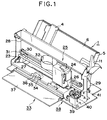
- Fig. 1 is a schematic perspective view of the ink jet recording apparatus
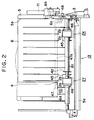
- Fig. 2 is a plan view of the sheet feeding apparatus
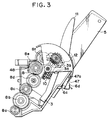
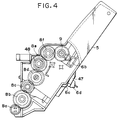
- Figs. 3 and 4 are side views of a drive transmitting mechanism of the sheet feeding apparatus
- Figs. 5 and 6 are side views of the sheet feeding apparatus
- Fig 7 is a sectional view of the ink jet recording apparatus
- Figs. 8, 9A and 9B are views showing a sheet supply roller
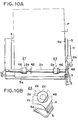
- Figs. 10A to 14B are views for explaining a sheet supplying operation
- Figs. 15A and 15B are flow charts for explaining a control operation for the ink jet recording apparatus.
- This embodiment discloses a recording apparatus incorporating an automatic sheet feeding apparatus (ADF), which recording apparatus comprises a sheet supply portion, a sheet feeding portion, a sheet discharge portion, a carriage portion, a cleaning portion and the like.
- ADF automatic sheet feeding apparatus
- the sheet supply portion 1 is attached to a body of the recording apparatus in an inclined condition (inclination angle of about 30° to 60°). Incidentally, a recording sheet P on which an image was recorded is discharged horizontally.
- the sheet supply portion 1 includes a sheet supply roller (comprising sheet supply roller portions 2X, 2Y), a separation pawl 3, a movable side guide 4, a base 5, a pressure plate 6, pressure plate springs 7 (refer to Fig.
- a driving force of a convey roller 14 (described later) is transmitted to the sheet supply roller portions 2X, 2Y and the release cam 9 through the drive gears 8a to 8e.
- the release cam 9 is separated from the pressure plate 9
- the pressure plate 9 is lifted to a position shown in Fig. 6 to contact the sheet supply roller portions 2X, 2Y with the recording sheet P.
- the sheet supply roller is rotated, the recording sheets are picked up and are separated one by one by means of the separation pawl 3.
- the separated recording sheet P is sent to the sheet feeding portion 13 which will be described later.
- the sheet supply roller portions 2X, 2Y and the release cam 9 are rotated by one revolution until the recording sheet P is sent to the sheet feeding portion 13.
- the pressure plate 6 is released from the sheet supply roller portions 2X, 2Y so that the driving force from the sheet supply roller portions 2X, 2Y is not transmitted to the recording sheet (initial condition). This initial condition is maintained until a next recording sheet is supplied.
- the sheet feeding portion 13 includes the above-mentioned convey roller 14, a pinch roller 15, a pinch roller guide 16, a pinch roller spring 17, a PE sensor lever 18, a PE sensor 19, a PE sensor spring 20, an upper guide 21, a platen 22 and the like.
- the recording sheet P sent to the sheet feeding portion 13 is guided by the platen 22, upper guide 21 and pinch roller guide 16 to be sent to a nip between the convey roller 14 and the pinch roller 15.
- the PE sensor lever 18 is disposed at an upstream side of the pair of rollers 14, 15 in a sheet feeding direction and serves to detect a tip end of the recording sheet P to provide a reference for determining a record start position.
- the pinch roller 15 is urged against the convey roller 14 by biasing the pinch roller guide 16 by means of the pinch roller spring 17, so that the pinch roller 15 is driven by rotation of the convey roller 14 to generate a conveying force for the recording sheet P.
- the recording sheet P sent to the nip between the convey roller 14 and the pinch roller 15 is sent to the record start position by a predetermined amount by rotating the convey roller 14 and the pinch roller 15 by means of an LF motor 23. Then, an image corresponding to predetermined image information is recorded on the recording sheet by a recording head 24.
- the recording head 24 serves to record an ink image on the recording sheet P fed by the convey roller 14 and the pinch roller 15.
- a recording method an ink jet recording method for recording an image by discharging ink from a recording head is used. That is to say, the recording head includes fine liquid discharge openings (orifices), liquid passages, energy acting portions arranged in the liquid passages, and an energy generating means for generating liquid droplet generating energy acting on the liquid positioned on the energy acting portion.
- Such an energy generating means may be used in a recording method wherein electro-mechanical conversion elements such as piezoelectric elements are used, a recording method wherein the liquid droplet is discharged by heating the liquid by illuminating an electromagnetic wave such as laser on the liquid, or a recording method wherein liquid is discharged by heating the liquid by heating the liquid by means of an electrothermal conversion element such as a heating element having a heating resistor.
- the ink jet recording method for discharging the liquid by utilizing the thermal energy since the liquid discharge openings (orifices) for discharging the recording liquid droplets can be arranged with high density in the recording head, the recording with high resolving power can be effected.
- a recording head utilizing the electrothermal conversion elements as the energy generating means is useful, since it can easily be made compact, can fully adopt advantages of IC techniques and/or micro-working techniques (progress of technique and reliability have been remarkably improved in the recent semi-conductor field), can be mounted with high density, and can be made inexpensive.
- the carriage portion 25 includes a carriage 26 on which the recording head 24 is mounted, a guide shaft 27 along which the carriage 26 is reciprocally shifted (scanned) in a direction perpendicular to the sheet feeding direction, a guide 28 for holding a rear end of the carriage 26 and for maintaining a predetermined distance between the recording head 24 and the recording sheet P, a timing belt 30 for transmitting a driving force of a carriage motor 29 to the carriage 26, an idle pulley 31 for tensioning the timing belt 30, and a flexible cable 32 for transmitting a drive signal from an electric substrate to the recording head 24.
- the recording head 24 is integrally formed with an ink tank to constitute an exchangeable recording head unit. By shifting the recording head together with the carriage 26, the ink image is recorded on the recording sheet P conveyed on the platen 22.
- the sheet discharge portion 33 comprises discharge rollers 34, transmission rollers 35 for transmitting the driving force of the convey roller 14 to the discharge rollers 34, spurs 36 for aiding the discharge of the recording sheet P, and a discharge tray 37.
- the discharge rollers 34 and the spurs 36 serve to discharge the recording sheet P on which the image was recorded, without smudging the recorded surface of the recording sheet.
- the cleaning portion 38 comprises a pump 39 for cleaning the recording head 24, a cap 40 for suppressing the drying of the recording head 24, and a drive switching arm 41 for switching the transmission of the driving force from the convey roller 14 between the sheet supply portion 1 and the pump 39.
- the drive switching arm 41 is positioned at a position shown in Fig. 1, except for a sheet supplying operation and a cleaning operation. In this position, since a planetary gear (not shown) capable of rotating an axis of the convey roller 14 is fixed at a predetermined position, the driving force of the convey roller 14 is not transmitted to the sheet supply portion a and the pump 39.
- the drive switching arm 41 is shifted to a direction shown by the arrow A in Fig.
- the planetary gear is rotated in response to normal or reverse rotation of the convey roller 14, so that, when the convey roller 14 is rotated in a normal direction, the driving force of the convey roller is transmitted to the sheet supply portion, and, when the convey roller is rotated in a reverse direction, the driving force of the convey roller is transmitted to the pump 39.
- the LF motor 23 for driving the convey roller 14 and the carriage motor 29 for driving the carriage 26 comprise stepping motors which are rotated by predetermined angles in response to signals sent from corresponding drivers (not shown).
- a sensor plate 42 having a radius smaller than those of roller rubber portions 2a coated around the sheet supply roller portions 2X, 2Y is attached to the sheet supply roller comprising the sheet supply roller portions 2X, 2Y.
- the sensor plate 42 has a notch so that, only when the release cam 9 is positioned at the position shown in Fig. 5 where the pressure plate 6 is released by the release cam, the notch is aligned with a roller sensor (photo-interrupter) 44 provided on an electric substrate 43 shown in Fig.
- the sheet supply portion 1 As shown in Fig. 2, in the sheet supply portion 1, various parts or elements are attached to the base 5, thereby providing a unit.
- the sheet supply portion 1 has a one-side reference for aligning the recording sheets with each other on the basis of one sides of the sheets, and the one-side reference is defined by a right side plate 5b of the base 5.
- the base 5 also has a recess through which the pressure plate 6 can be retarded as shown in Fig. 6 and within the pressure plate springs 7 are disposed in an opposed relation to the sheet supply roller portions 2X, 2Y (2b). Further, as shwon in Fig.
- the pressure plate 6 is connected to the base via pins 6a provided on both sides of the pressure plate at its upper end, so that the pressure plate can be rotated around the pins 6a. Further, as shown in Fig. 2, separation pads 45 made of material having relatively high coefficient of friction (such as synthetic leather) are adhered to the pressure plate 6 in an opposed relation to the sheet supply roller portions 2X, 2Y, thereby preventing the double-feed of the recording sheets when the number of the recording sheets rested on the pressure plate is greatly decreased. Further, the movable side guide 4 movable to the left and right is mounted on the pressure plate 6 so that the recording sheets P having various sizes can be set by abutting the sheet against the sheet reference by means of the movable guide.
- the sheet supply roller comprising the sheet supply roller portions 2X, 2Y is rotatably held, at its both ends, by the base 5.
- each of the sheet supply roller portions 2X, 2Y comprises a roller portion 2b and a shaft portions 2c which are integrally formed from plastic material, thereby providing a one-piece sheet supply roller.
- the roller rubber 2a is coated on the corresponding roller portion 2b to aid the conveyance of the recording sheet P.
- the roller portion 2b has a D-shaped (semi-circular) cross-section having a cut-out.
- Additional rollers 46 each having a radius smaller than that of the roller rubber 2a (attached to the sheet supply roller portion 2X, 2Y) by 0.5 to 3 mm are provided on outer ends of the roller portions 2b to prevent the recording sheet P from contacting with the roller portions 2a except for the sheet supplying operation, thereby preventing the smudge of the recording sheet and the out-of-position of the sheet supply roller portions 2X, 2Y.
- roller portions 2b attached to the shaft portion 2c, and these roller portions 2b are positioned at positions spaced apart from the sheet reference (right side plate 5b) by about 40 mm and 170 mm, respectively. Accordingly, the recording sheet such as A4 size sheet is conveyed by the two roller portions 2X, 2Y, and the recording sheet such as a post card is conveyed by the single roller portion 2X near the sheet reference. Further, as shown in Fig. 8, ribs 2d each having a radius greater than that of the roller rubber 2a are arranged both sides of the roller portion 2b of each sheet supply roller portion 2X, 2Y.
- a circumferential length of each rib 2d (referred to as "separation area" hereinafter) is 1 mm regarding the roller portion 2b of the sheet supply roller portion 2X near the sheet reference as shown in Fig. 9A and 3 mm regarding the roller portion 2b of the sheet supply roller portion 2Y remote from the sheet reference as shown in Fig. 9B. And, the separation areas of the roller portions 2X, 2Y have same radius as each other and the same angular position as each other ( ⁇ ° from the center of the cut-out).
- the planetary gear (not shown) is shifted to be meshed with the input gear 8a shown in Fig. 4, thereby transmitting the driving force to the sheet supply portion 1.
- the input gear 8a transmits the driving force to the sheet supply roller gear 8d through the idle gears 8b, 8c to rotate the sheet supply roller portions 2X, 2Y, thereby supplying the recording sheet P.
- the sheet supply roller gear 8d transmits the driving force to the release cam 9 through the clutch gear 8e and the idle gear 8f.
- the release cam 9 is designed so that it releases the pressure plate 6 only while the cut-outs of the sheet supply roller portions 2X, 2Y are opposed to the pressure plate (center angle of about 120 degrees) and it is abutted against the recording sheet P or the pressure plate 6 with pressure of 200 to 500 grams when portions (other than the cut-outs) of the sheet supply roller portions 2X, 2Y are opposed to the pressure plate 6. Further, as shown in Fig. 2, when a push-down portion 6b of the pressure plate 6 protruded from an opening formed in the right side plate 5b of the base 5 is urged downwardly by the release cam 9, the pressure plate 6 is released. As shown in Fig.
- a pressure plate cam 47 is attached to the base 5, and, when a cam 6c disposed near the push-down portion 6b of the pressure plate 6 is urged downwardly, the pressure plate cam 47 is rotated around a fulcrum 47a, thereby depressing a cam 6d disposed remote from the push-down portion 6b.
- a clutch spring 48 is arranged within the clutch gear 8e in such a manner that the clutch spring is tightened when the clutch gear is rotated in a direction shown by the arrow B in Fig. 3, thereby preventing the reverse rotation of the clutch gear.
- the separation pawl 3 can be rotated around a fulcrum 3a and is urged against the recording sheet P or the pressure plate 6 with pressure of 20 to 100 grams.
- the separation pawl 3 serves to separate the recording sheets P comprising so-called normal sheets during the sheet supplying operation.
- the separation pawl 3 is positioned near the sheet reference and has a triangular top surface covering one front corner of the recording sheet as shown in Fig. 2.
- the recording sheets P can be separated one by one when they are subjected to resistance from the triangular pawl. Further, the recording sheets other than normal sheets (such as thick sheets) are separated one by one by abutting the sheets against a lower guide 5a (Fig. 5) of the base 5 (without being caught by the separation pawl 3) to utilize resistance of the lower guide 5a.
- the releasing lever 11 and the releasing cam 12 arranged on a shaft coaxial with the release cam 9.
- the releasing lever 11 and the releasing cam 12 are not synchronous with the release cam 9, but are driven independently by the operator to set the recording sheets P.
- the releasing lever 11 and the releasing cam 12 are connected to each other via gears.
- the releasing lever 11 can assume one of three positions, i.e., (i) feed position, (ii) thick sheet set position, and (iii) normal sheet set position, which three positions are angularly spaced apart from each other by about 20 - 50 degrees.
- the gear ratio is selected so that the releasing cam 12 is rotated by about 90 degrees in correspondence to the three positions of the releasing lever 11.
- the above-mentioned gears (excluding the sheet supply roller gear), separation pawl 3, releasing lever 11 and releasing cam 12 are rotatably mounted on shafts secured to the right side plate 5b of the base 5.
- the ribs 2d are integrally formed with the sheet supply roller of plastic material having low friction, a friction force between the recording sheet P being supplied and the recording sheets P stacked on the pressure plate 6 becomes greater than a friction force between the recording sheet P being supplied and the sheet supply roller, with the result that the recording sheet P being supplied is stopped by the difference between the friction forces.
- the ribs 2d acts as both a separation means and a regulating means for regulating the movement of the recording sheet P.
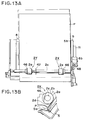
- a distance between the recording sheet P and the separation area (rib) of the separation area of the sheet supply roller portion 2Y remote from the sheet reference is greater than a distance between the recording sheet P and the separation area of the sheet supply roller portion 2X near the sheet reference, as shown in Figs. 13A and 13B, the recording sheet P being supplied is rotated around the sheet supply roller portion 2Y remote from the sheet reference, so that the edge (near the sheet reference) of the recording sheet P is abutted against the right side plate (sheet reference) 5b of the base 5.
- the recording sheet P is inclined in an anti-clockwise direction until the recording sheet is spaced apart from the sheet supply roller rubber 2a, the recording sheet P is rotated in a clockwise direction due to the difference between the length of the separation areas of the roller portions 2b.
- the edge (near the sheet reference) of the recording sheet P is abutted against the right side plate 5b of the base 5, a rotating force directing toward an anti-clockwise is generated, which rotating force overcomes the friction force between the recording sheet P being supplied and the recording sheet P stacked on the pressure plate 6, with the result that the recording sheet P is corrected to be directed in parallel to the sheet supplying direction while the roller portions 2b are being slipped.
- the recording sheet P is inclined in a clockwise direction until the recording sheet is spaced apart from the sheet supply roller rubber 2a, the recording sheet P is further rotated in a clockwise direction due to the difference between the length of the separation areas of the roller portions 2b.
- the roller portions 2b reach their separation areas to bring the recording sheet P to the slipping condition, a force for rotating the side of the recording sheet near the right side plate 5b of the base 5 in the anti-clockwise direction is generated, which force overcomes the friction force between the recording sheet P stacked on the pressure plate 6 and the recording sheet P being supplied, with the result that the recording sheet P is corrected to be directed in parallel to the sheet supplying direction.
- the side of the recording sheet P near the sheet reference is prevented from being separated from the right side plate 5b due to the rotating force generated when the recording sheet is abutted against the right side plate 5b of the base 5.
- a gap t (about 1 mm) is generated by the inclination caused by supporting the recording sheets P only at one side near the separation pawl 3.
- a rotating amount of the recording sheet stack P required for making such gap to zero is calculated on the basis of said gap and a distance between two roller portions 2b.
- a difference in slipping amount between both roller portions 2b is determined from the calculated result.
- the controlling operation for the sheet supply portion 1 will be explained with reference to a flow chart shown in Figs. 15A and 15B while referring to operating conditions shown in Figs. 14A to 14E.
- the controlling operation for the sheet supply portion 1 can be effected when the sheet supply roller is positioned at the predetermined initial position or when the sheet supply roller is not positioned at the initial position (trouble condition).
- the controlling operation effected when the sheet supply roller is positioned at the predetermined initial position will be described.
- a step S1 when the sheet supply start signal is emitted, in a step S1, the drive switching arm 41 is shifted by shifting the carriage 26 thereby to permit the transmission of the driving force of the convey roller 14 to the sheet supply portion 1 (ASF position). Then, in a step S2, it is judged whether the sheet supply roller portions 2X, 2Y are in the initial position or not by checking the condition of the roller sensor 44. If the sheet supply roller portions 2X, 2Y are in the initial position (YES), the porgram goes to a step S3; whereas, if NO, the program goes to a step S26.
- the sheet supply roller is positioned at the initial position, in the step S3, the sheet supply roller is rotated, and then, in a step S4, the edge of the sensor plate 42 is detected.
- the angular positons of the sheet supply roller portions 2X, 2Y are correctly monitored, thereby effecting the control with high accuracy.
- steps S8 and S9 it is judged that the condition is normal when (predetermined pulse X) ⁇ N2 ⁇ (predetermined pulse Y). If the condition is normal, the program goes to a step S10, where the sheet supply roller portions 2X, 2Y are rotated up to the initial position where the cut-outs of the sheet supply roller portions are opposed to the recording sheet P. During this operation, since the push-down portion 6b of the pressure plate 6 is urged downwardly again by the releasing cam 12, the pressure plate 6 is released again (refer to Fig. 14B). When the rotation of the sheet supply roller portions 2X, 2Y is finished, the tip end of the recording sheet P has passed between the convey roller 14 and the pinch roller 15. In this case, the tip end position of the recording sheet P when the sheet supply roller portions 2X, 2Y are rotated up to the initial position is calculated by the drive pulse count N2.
- a step S11 if the pulse count N2 is greater than predetermined pulse Z, it is judged that the tip end position of the recording sheet P is positioned at a downstream side of the nozzles of the recording head 24. Then, in a step S12, the carriage 26 is shifted, and, in a step S13, the LF motor 23 is rotated reversely to return the tip end of the recording sheet P to a position spaced apart from the convey roller 14 by 11.5 mm. The reverse rotation amount of the LF motor 23 is calculated from the pulse count N2. In this case, since the carriage 26 is shifted in the step S12, the drive switching arm 41 is also shifted, thereby preventing the driving force of the convey roller 14 from being transmitted to the sheet supply portion 1.
- a step S14 the convey roller 14 is rotated in the normal direction to eliminate the backlash in the gears and to convey the recording sheet P by 0.7 mm so that the recording sheet is positioned with the margin of 1.5 mm from the nozzles of the recording head 24 (refer to Fig. 14E). Then, the sheet supplying operation is ended.
- step S11 if the pulse count N2 is smaller than the predetermined pulse Z, it is judged that the tip end position of the recording sheet P is positioned at an upstream side of the nozzles of the recording head 24 (refer to Fig. 14D). Then, in a step S15, the carriage 26 is shifted. In this condition, by rotating the convey roller 14 in the reverse direction, the drive switching arm 41 is shifted, thereby preventing the driving force of the convey roller 14 from being transmitted to the sheet supply portion 1. Then, in a step S16, the convey roller 14 is rotated in the normal direction so that the recording sheet is positioned with the margin of 1.5 mm from the nozzles of the recording head 24 (refer to Fig. 14E). Then, the sheet supplying operation is ended.
- step S9 if the pulse count (N2) of the LF motor when the tip end of the recording sheet is detected is greater than the predetermined pulse Y, it is judged that there arises a trouble condition that the slip is generated between the recording sheet P and the sheet supply roller portions 2X, 2Y to an extent that the tip end of the recording sheet P cannot reach the nip between the convey roller 14 and the pinch roller 15 only by one revolution of the sheet supply roller portions 2X, 2Y. Then, the program goes to a step S17.
- step S17 the sheet supply roller portions 2X, 2Y are rotated up to the initial position, and, in a step S18, the sheet supply roller portions 2X, 2Y are further rotated by one revolution. Then, in a step S19, the carriage 26 is shifted. Then, in a step S20, the convey roller 14 is rotated in the reverse direction to return the tip end of the recording sheet P to the convey roller 14 (refer to Fig. 14C). The shifting movement of the carriage causes the drive switching arm 41 to shift, thereby preventing the driving force of the convey roller 14 from being transmitted to the sheet supply portion 1.
- a step S21 the convey roller 14 is rotated in the normal direction by a predetermined number of pulses so that the recording sheet is positioned with the margin of 1.5 mm from the nozzles of the recording head 24 (refer to Fig. 14E). Then, the sheet supplying operation is ended.
- step S9 if the pulse count (N2) of the LF motor when the tip end of the recording sheet is detected is smaller than the predetermined pulse X, it is judged that there arises a trouble condition that the recording sheet P is shifted toward the downstream side before the sheet supplying operation is started, and the ribs 2d of the sheet supply roller portions 2X, 2Y are contacted with the recording sheet P to separate the sheet supply roller rubber portions 2a from the recording sheet P, thereby preventing the correct recognition of the tip end position of the recording sheet. Then, the program goes to a step S22.
- the sheet supply roller portions 2X, 2Y are rotated up to the initial position, and, in a step S23, the carriage 26 is shifted.
- the convey roller 14 is rotated in the reverse direction to return the tip end of the recording sheet P to the convey roller 14 (refer to Fig. 14C).
- the shifting movement of the carriage causes the drive switching arm 41 to shift, thereby preventing the driving force of the convey roller 14 from being transmitted to the sheet supply portion 1.
- the convey roller 14 is rotated in the normal direction by a predetermined number of pulses so that the recording sheet is positioned with the margin of 1.5 mm from the nozzles of the recording head 24 (refer to Fig. 14E). Then, the sheet supplying operation is ended.
- step S6 if the PE sensor 19 is not turned ON, the program goes to a step S26, where the sheet supply roller portions 2X, 2Y are rotated up to the initial position, and, in a step S27, it is judged whether the roller sensor 44 is turned ON. If affirmative, the program goes to a step S28, where the sheet supply roller portions 2X, 2Y are rotated again. Then, in a step S29, if the edge of the sensor plate 42 is detected (roller sensor ON), the program goes to a step S30, where the number (N1) of the drive pulses of the LF motor 23 after the edge of the sensor plate is detected is counted, thereby correctly controlling the angular positions of the sheet supply roller portions 2X, 2Y.
- a step S31 if the tip end of the recording sheet P is detected (PE sensor ON), the program goes to the step S7. On the other hand, if the tip end is not detected, the program goes to a step S32, where the sheet supply roller portions 2X, 2Y are rotated up to the initial position and stopped there. Then, in a step S33, error display is presented. And then, the sheet supplying operation is ended.
- the control for sheet supplying operation can be simplified and the construction of the recording apparatus is not limited, the automatic sheet feeding apparatus (ADF) can be applied to various kinds of recording apparatuses. Further, since the construction of the sheet supply portion can be simplified, the number of parts can be reduced. In addition, the recording sheet can be supplied from the ADF to the recording portion for a very short time, thereby achieving the high speed recording.
- ADF automatic sheet feeding apparatus
- a cut-out 2a' may be formed on the roller rubber 2a or an arcuate portion 2b' of the roller portion 2b may be cut. In this case, the same advantage as the first embodiment can be achieved.
- a single sheet supply roller 2 comprising a single roller portion 2b formed on a shaft portion 2c and having ribs 2d at its both longitudinal ends may be used.
- the ribs 2b are protruded from the roller portion 2b in a radial direction, and circumferential lengths (L1, L2) of the ribs 2d differ from each other. Also in this case, the same advantage as the first embodiment can be achieved.
- the widths of the separation areas can be differentiated from each other, thereby achieving the same advantage as the first embodiment.
- the ribs 2d protruded from the roller portions 2b of the sheet supply roller portions 2X, 2Y are not necessarily formed on both longitudinal ends of each roller portion, but, as shown in Fig. 20, a rib 2d may be a central portion of each roller portion 2b. In this case, it is necessary to form an opening in the corresponding roller rubber 2a, through which the rib 2d can be protruded. Further, the rib or ribs 2d may be formed independently from the roller portion 2b and be attached to the roller portion.
- Figs. 21A to 21F are explanatory views when the separation area setting position of the sheet supply roller portion 2X are differentiated from that of the sheet supply roller portion 2Y.
- the separation area of the sheet supply roller portion 2Y remote from the sheet reference reaches the recording sheet P faster than the separation area of the other sheet supply roller portion 2X and leaves the recording sheet later than the separation area of the other sheet supply roller portion.
- Fig. 21B it was so designed that the separation area of the sheet supply roller portion 2Y remote from the sheet reference reaches the recording sheet P faster than the separation area of the other sheet supply roller portion 2X and leaves the recording sheet later than the separation area of the other sheet supply roller portion.
- Fig. 21E shows a case where the separation area of the sheet supply roller portion 2X near the sheet reference-reaches the recording sheet P faster than the separation area of the other sheet supply roller portion 2Y and leaves the recording sheet faster than the separation area of the other sheet supply roller portion.
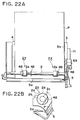
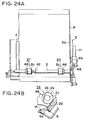
- Figs. 22A to 24B an advantage can be achieved when the recording sheets P are stacked on the pressure plate in such a condition that the sides of the recording sheets near the sheet reference are spaced apart from the right side plate 5b of the base 5. More particularly, as shown in Figs.
- the recording sheet P is rotated in the clockwise direction, thereby abutting the rear corner of the recording sheet near the sheet reference against the right side plate 5b of the base 5. In this way, the entire side edge of the recording sheet P near the sheet reference is abutted against the right side plate 5b, thereby positioning the recording sheet in parallel with the sheet supplying direction.
- Fig. 21F shows a case where there are provided two sheet supply roller portions 2X near the sheet reference and two sheet supply roller portions 2Y remote from the sheet reference.
- it is designed so that the separation area of the sheet supply roller portion 2X nearest to the sheet reference reaches the recording sheet faster than the separation area of the sheet supply roller portion 2Y furthest from the sheet reference and leaves the recording sheet simultaneously with the separation area of the sheet supply roller portion 2Y furthest from the sheet reference to rotate the recording sheet P in the anti-clockwise direction, thereby abutting the front corner of the recording sheet near the sheet reference against the right side plate 5b.
- the separation area of the other sheet supply roller portion 2Y remote from the sheet reference reaches the recording sheet faster than the separation area of the other sheet supply roller portion 2X near the sheet reference and leaves the recording sheet later than the separation area of the other sheet supply roller portion 2X near the sheet reference.
- the recording sheet is then rotated in the clockwise direction to abut the entire side edge of the recording sheet near the sheet reference against the right side plate 5b.
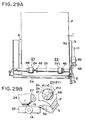
- Figs. 25A, 25B, 26A, 26B, 27A, 27B, 28A and 28B show an embodiment wherein, after the tip end of the recording sheet P was released from the separation means, the sheet supply roller portions 2X, 2Y are completely released from the recording sheet P by utilizing the separation areas of the sheet supply roller portions 2X, 2Y, and wherein there is provided a regulation means for regulating the movement of the recording sheet P toward the sheet supplying direction in the above-mentioned released condition.
- the sheet supply roller comprises two sheet supply roller portions 2X, 2Y (2b) secured to a shaft portion 2c in such a manner that the roller portions 2X, 2Y are spaced apart from a sheet reference by about 40 mm and 170 mm, respectively. Accordingly, the recording sheet P such as A4 size sheet is conveyed by the two sheet supply roller portions 2X, 2Y, and the recording sheet such as a post card is conveyed by the single roller portion 2X near the sheet reference. Further, as shown in Figs.
- a diameter ( ⁇ U + ⁇ ) of a sheet supply roller rubber 2a of the sheet supply roller portion 2X near the sheet reference is greater than a diameter ( ⁇ U) of a sheet supply roller rubber 2a of the sheet supply roller portion 2Y remote from the sheet references by ⁇ ( ⁇ /2 regarding a radius).
- the recording sheet P is conveyed from the upstream side to the downstream side, and, at the same time, the tip end of the recording sheet P is rotated in the clockwise direction. In this case, as shown in Figs.
- a rotation angle of the sheet supply roller portions 2X, 2Y required for conveying the recording sheet P by a recording sheet path length L P from a sheet supply starting point to the nip between the convey roller 14 and the pinch roller 15 is calculated, and the difference ⁇ in diameter between the sheet supply roller portions 2X, 2Y are selected so that the gap t between the recording sheet P and the right side plate 5b can be eliminated during the sheet supply roller portions 2X, 2Y are rotated by the calculated rotation angle.
- the diameter of the sheet supply roller rubber 2a near the sheet reference was set to 24.7 mm
- the diameter of the sheet supply roller rubber 2a remote from the sheet reference was set to 24.0 mm
- the difference ⁇ was set to 0.7 mm.
- a large diameter portion (L Q ) may be provided on the roller rubber 2a within the rotation angle range L P of the sheet supply roller portion 2X required for conveying the recording sheet P to the nip between the convey roller 14 and the pinch roller 15 (L P > L Q ). Also in this case, a diameter of the large diameter portion (L Q ) of the roller rubber 2a is selected to provide desired difference in diameter between the roller rubber portions 2a. Since a process for stabilizing the sheet supplying condition by utilizing the separation areas in the sheet supply portion is the same as that of the first embodiment, explanation thereof will be omitted.
- the sheet supply portion 1 is of pawl separation type wherein only one front corner of the recording sheet P is regulated by the separation pawl 3, thereby separating the recording sheets one by one was explained
- two separation pawls may be provided for regulating both front corners of the recording sheet or separation pad or pads may be provided for separating the recording sheet one by one.
- the ink jet recording head is used as the recording head was explained, a recording head wherein ink is discharged from discharge opening by growth and contraction of a bubble created in the ink due to the film boiling caused by thermal energy generated in an electrothermal conversion element energized in response to a record signal may be used.
- the typical construction and principle thereof can be realized by using the fundamental principles, for example, disclosed in U.S. Patent Nos. 4,723,129 and 5,740,796.
- this system can be applied to both a so-called “on-demand type” and “continuous type", it is more effective when the present invention is particularly applied to the on-demand type, because, by applying at least one drive signal corresponding to the record information and capable of providing the abrupt temperature increase exceeding the nucleate boiling to the electrothermal conversion elements arranged in correspondence to the paper or liquid passages including the liquid (ink) therein, it is possible to form a bubble in the liquid in corresponding to the drive signal by generating the film boiling on the heat acting surface of the recording head due to the generation of the thermal energy in the electrothermal conversion elements. Due to the growth and contraction of the bubble, the liquid is discharged from the discharge opening to form at least one ink droplet.
- the drive signal has a pulse shape, since the growth and contraction of the bubble can be quickly effected, more excellent ink discharge is achieved.
- Such pulse-shaped drive signal may be ones disclosed in U.S. Patent Nos. 4,463,359 and 4,345,262. Incidentally, by adopting the condition disclosed in U.S. Patent No. 4,313,124 providing the invention regarding the temperature increasing rate on the heat acting surface, a further excellent recording can be performed.
- the present invention includes the construction wherein the heat acting portion is disposed in an arcuate area as disclosed in U.S. Patent Nos. 4,558,333 and 4,459,600, as well as the constructions wherein the discharge openings, liquid paths and electrothermal conversion elements are combined (straight liquid paths or orthogonal liquid paths).
- each discharge opening is constituted by a slit with which a plurality of electrothermal conversion elements associated in common as disclosed in the Japanese Patent Laid-Open Application No. 59-123670 and the construction wherein openings for absorbing the pressure wave of the thermal energy are arranged in correspondence to the discharge openings as disclosed in the Japanese Patent Laid-Open Application No. 59-138461, because the recording can be correctly and effectively performed regardless of the configuration of the recording head.
- the present invention can be applied to a recording head of full-line type having a length corresponding to a maximum width of a recording medium to be recorded, as such recording head, the construction wherein such length is attained by combining a plurality of recording heads or a single recording head integrally formed may be adopted.
- the present invention is effectively applicable to a removable recording head of chip type wherein, when mounted on the recording system, electrical connection between it and the recording system and the supply of ink from the recording system can be permitted, or to a recording head of cartridge type wherein a cartridge is integrally formed with the head.
- a head recovering means and an auxiliary aiding means are added to the recording head according to the present invention, since the effect of the present invention is further improved. More concretely, these means include a capping means for capping the recording head, cleaning means, pressurizing or suction means, and an auxiliary heating means comprising electrothermal converters or other heating elements or the combination thereof. Further, it is effective for the stable recording to perform an auxiliary discharge mode wherein the ink discharge regardless of the recording ink discharge is effected.
- each recording head may correspond to each different color ink, or a plurality of recording heads can be used for a plurality of ink having different colors and/or different density. That is to say, for example, the present invention can effectively be applied not only to a recording mode with a single main color such as black, but also to a system providing a plurality of different colors and/or a full-color by mixing colors by using an integrated recording head or the combination of plural recording heads.
- the ink while the ink was liquid, the ink may be solid in a room temperature or less, or may be softened at a room temperature.
- the temperature control since the temperature control is generally effected in a temperature range from 30°C to 70°C so that the viscosity of the ink is maintained within a stable discharging range, the ink may be liquidized when the record signal is emitted.
- ink having a feature that is firstly liquidized by the thermal energy such as solid ink which serves to prevent the increase in temperature by absorbing energy in changing the ink from the solid state to the liquid state or which is in the solid state in the preserved condition to prevent the vaporization of ink and which is liquidized into ink liquid to be discharged in response to the record signal comprising the thermal energy, or ink which has already been solidified upon reaching the recording medium, can also be applied to the present invention.
- the ink can be held in the liquid state or solid state in recesses or holos in porous sheet as disclosed in the Japanese Patent Laid-Open Application Nos. 54-56847 and 60-71260, in confronting relation to the electrothermal converters.
- the above-mentioned film boiling principle is most effective for each ink.
- the aforementioned ink jet recording apparatus may be used as image output terminals of information processing systems such as computers or may be used with a copying machine incorporating a reader therein or a facsimile system having transmission/receiver function.
- the present invention is not limited to the ink jet recording head, but, a heat-transfer recording method, a heat sensitive recording method or other recording methods other than an impact recording method such as a dot wire recording method can be applied to the present invention.
- the present invention is not limited to the serial recording method, but may be applied to a so-called line recording method.
- the present invention provides a sheet feeding apparatus comprising a sheet supporting means for supporting a sheet, a rotatable sheet supply means for feeding out the sheet supported by the sheet supporting means and a skew-feed correction means for correcting a skew-feed of the sheet by rotating the sheet in a plane including a surface of the sheet while the sheet is being fed by the rotatable sheet supply means.
Landscapes
- Engineering & Computer Science (AREA)
- Mechanical Engineering (AREA)
- Sheets, Magazines, And Separation Thereof (AREA)
- Registering Or Overturning Sheets (AREA)
- Controlling Sheets Or Webs (AREA)
- Ticket-Dispensing Machines (AREA)
- Handling Of Sheets (AREA)
Applications Claiming Priority (3)
| Application Number | Priority Date | Filing Date | Title |
|---|---|---|---|
| JP315331/93 | 1993-12-15 | ||
| JP05315331A JP3098369B2 (ja) | 1993-12-15 | 1993-12-15 | シート給送装置及び記録装置 |
| JP31533193 | 1993-12-15 |
Publications (3)
| Publication Number | Publication Date |
|---|---|
| EP0658433A2 true EP0658433A2 (fr) | 1995-06-21 |
| EP0658433A3 EP0658433A3 (fr) | 1997-07-09 |
| EP0658433B1 EP0658433B1 (fr) | 2002-03-20 |
Family
ID=18064128
Family Applications (1)
| Application Number | Title | Priority Date | Filing Date |
|---|---|---|---|
| EP94119749A Expired - Lifetime EP0658433B1 (fr) | 1993-12-15 | 1994-12-14 | Appareil pour l'alimentation et la correction du désalignement du papier |
Country Status (7)
| Country | Link |
|---|---|
| US (1) | US5725319A (fr) |
| EP (1) | EP0658433B1 (fr) |
| JP (1) | JP3098369B2 (fr) |
| KR (1) | KR0181717B1 (fr) |
| CN (1) | CN1086345C (fr) |
| AT (1) | ATE214664T1 (fr) |
| DE (1) | DE69430174T2 (fr) |
Cited By (2)
| Publication number | Priority date | Publication date | Assignee | Title |
|---|---|---|---|---|
| EP1043167A3 (fr) * | 1999-04-06 | 2001-01-17 | Canon Kabushiki Kaisha | Dispositif d'enregistrement |
| CN1091691C (zh) * | 1996-09-18 | 2002-10-02 | 松下电器产业株式会社 | 图像印制装置 |
Families Citing this family (67)
| Publication number | Priority date | Publication date | Assignee | Title |
|---|---|---|---|---|
| KR100186594B1 (ko) * | 1996-05-18 | 1999-05-15 | 김광호 | 잉크젯 프린터의 용지공급 자동감지장치 |
| US5938355A (en) * | 1996-10-14 | 1999-08-17 | Brother Kogyo Kabushiki Kaisha | Sheet feeder and printer fitted with sheet feeder |
| KR100205752B1 (ko) * | 1997-01-06 | 1999-07-01 | 윤종용 | 페이퍼휨 현상에 의한 잼방지가 되는 잉크젯 프린터 |
| JP3767061B2 (ja) * | 1997-02-05 | 2006-04-19 | ブラザー工業株式会社 | 印字装置 |
| JP4181653B2 (ja) * | 1997-02-28 | 2008-11-19 | キヤノン株式会社 | 画像形成装置 |
| US5887987A (en) * | 1997-04-17 | 1999-03-30 | Minolta Co., Ltd. | Image recording device |
| JPH115664A (ja) * | 1997-04-17 | 1999-01-12 | Canon Inc | 排紙スタック装置およびこれを備えた画像形成装置 |
| JPH10329972A (ja) * | 1997-05-30 | 1998-12-15 | Canon Aptecs Kk | 記録装置 |
| KR100238585B1 (ko) * | 1997-10-29 | 2000-01-15 | 윤종용 | 잉크젯 프린터의 픽업로울러 절환장치 |
| JP2935262B1 (ja) * | 1998-03-20 | 1999-08-16 | 富士通株式会社 | シート供給装置及びそれを用いた記録装置 |
| KR100334092B1 (ko) * | 1998-08-26 | 2002-12-26 | 삼성전자 주식회사 | 화상형성장치의용지급지방법 |
| US6382857B1 (en) | 1998-08-27 | 2002-05-07 | Canon Kabushiki Kaisha | Bearing mechanism and conveying apparatus and recording apparatus |
| JP2000198581A (ja) * | 1998-12-28 | 2000-07-18 | Fujitsu Ltd | シ―ト供給装置及び記録装置 |
| US6693728B1 (en) | 1999-05-11 | 2004-02-17 | Canon Kabushiki Kaisha | Recording apparatus |
| US6331002B1 (en) | 1999-07-29 | 2001-12-18 | Canon Kabushiki Kaisha | Sheet feeding apparatus |
| JP3762164B2 (ja) | 1999-10-25 | 2006-04-05 | キヤノン株式会社 | シート搬送装置及びこれを備えた画像形成装置 |
| US7046380B2 (en) * | 2000-02-22 | 2006-05-16 | Canon Kabushiki Kaisha | Recording apparatus with feed control based on leading end margin amount |
| US6900611B2 (en) | 2000-10-16 | 2005-05-31 | Canon Kabushiki Kaisha | Recording apparatus |
| US6651974B2 (en) | 2001-02-23 | 2003-11-25 | Canon Kabushiki Kaisha | Sheet feed apparatus and recording apparatus equipped with sheet feed apparatus |
| JP2002249237A (ja) | 2001-02-23 | 2002-09-03 | Canon Inc | 給紙装置及びこれを備えた記録装置 |
| JP3720725B2 (ja) * | 2001-04-17 | 2005-11-30 | キヤノン株式会社 | 画像形成装置 |
| JP2002332123A (ja) * | 2001-05-10 | 2002-11-22 | Canon Inc | シート給送装置および画像形成装置 |
| JP2002332137A (ja) | 2001-05-10 | 2002-11-22 | Canon Inc | 画像形成装置 |
| JP4422929B2 (ja) | 2001-07-31 | 2010-03-03 | キヤノン株式会社 | 給紙装置及びこれを備えた画像形成装置並びに画像読取装置 |
| JP2003149965A (ja) | 2001-08-28 | 2003-05-21 | Canon Inc | 画像形成装置 |
| JP2003155156A (ja) * | 2001-09-07 | 2003-05-27 | Canon Inc | シート処理装置及び画像形成装置 |
| JP3679741B2 (ja) | 2001-09-07 | 2005-08-03 | キヤノン株式会社 | 画像形成装置 |
| JP3919549B2 (ja) * | 2002-01-31 | 2007-05-30 | キヤノン株式会社 | 記録装置 |
| US6637742B2 (en) | 2002-02-11 | 2003-10-28 | Lexmark International, Inc. | Multi-function media eject system in an ink jet printer |
| US6796556B2 (en) | 2002-02-11 | 2004-09-28 | Lexmark International, Inc. | Multi-function media eject system in an ink jet printer |
| JP3762315B2 (ja) | 2002-03-07 | 2006-04-05 | キヤノン株式会社 | シート処理装置 |
| JP4109899B2 (ja) | 2002-05-14 | 2008-07-02 | キヤノン株式会社 | シート処理装置 |
| JP4086706B2 (ja) * | 2003-04-18 | 2008-05-14 | キヤノン株式会社 | 記録装置 |
| US7063473B2 (en) * | 2003-04-18 | 2006-06-20 | Canon Kabushiki Kaisha | Both-side recording apparatus |
| US7222955B2 (en) * | 2003-04-18 | 2007-05-29 | Canon Kabushiki Kaisha | Both-side recording apparatus |
| JP4164422B2 (ja) * | 2003-08-29 | 2008-10-15 | キヤノン株式会社 | インクジェット記録装置 |
| JP4165450B2 (ja) * | 2004-05-14 | 2008-10-15 | ブラザー工業株式会社 | 給紙装置およびプログラム |
| JP4137008B2 (ja) | 2004-06-04 | 2008-08-20 | キヤノン株式会社 | 記録装置 |
| JP2006035802A (ja) * | 2004-07-30 | 2006-02-09 | Canon Inc | 記録装置 |
| JP4769438B2 (ja) * | 2004-08-12 | 2011-09-07 | キヤノン株式会社 | 記録装置、データ生成方法、プログラムおよび記録方法 |
| CN101194211A (zh) * | 2005-05-03 | 2008-06-04 | 弗莱克斯电子有限责任公司 | 具有单一驱动辊的自动文件馈送器 |
| KR100701323B1 (ko) * | 2005-09-29 | 2007-03-29 | 삼성전자주식회사 | 화상형성장치의 용지이송장치 |
| US7694962B2 (en) * | 2006-12-04 | 2010-04-13 | Canon Kabushiki Kaisha | Sheet conveying apparatus and image forming apparatus |
| JP4943997B2 (ja) * | 2007-11-15 | 2012-05-30 | アルプス電気株式会社 | プリンタの給紙機構およびプリンタ |
| JP5132623B2 (ja) * | 2008-05-08 | 2013-01-30 | キヤノン株式会社 | プリンタ |
| JP5197162B2 (ja) * | 2008-05-28 | 2013-05-15 | キヤノン株式会社 | シート搬送装置及び画像形成装置 |
| JP5354975B2 (ja) * | 2008-06-27 | 2013-11-27 | キヤノン株式会社 | 記録装置および搬送制御方法 |
| JP5371322B2 (ja) * | 2008-08-25 | 2013-12-18 | キヤノン株式会社 | 記録装置および搬送制御方法 |
| JP5538835B2 (ja) * | 2008-12-02 | 2014-07-02 | キヤノン株式会社 | プリント装置 |
| JP2011046492A (ja) * | 2009-08-27 | 2011-03-10 | Canon Inc | シート搬送装置及び画像形成装置 |
| JP5355306B2 (ja) * | 2009-08-31 | 2013-11-27 | キヤノン株式会社 | シート搬送装置及び画像形成装置 |
| JP5402491B2 (ja) * | 2009-10-08 | 2014-01-29 | セイコーエプソン株式会社 | 媒体送り装置、記録装置 |
| JP2012046312A (ja) | 2010-08-26 | 2012-03-08 | Canon Inc | 記録装置 |
| DE202011109794U1 (de) | 2011-01-28 | 2012-04-03 | 3T Supplies Ag | Blattzuführgerät für einen Shredder |
| JP5911217B2 (ja) | 2011-06-30 | 2016-04-27 | キヤノン株式会社 | 記録装置 |
| JP6029335B2 (ja) | 2012-06-07 | 2016-11-24 | キヤノン株式会社 | 画像形成装置 |
| CN102849475A (zh) * | 2012-08-14 | 2013-01-02 | 苏州佳世达光电有限公司 | 一种偏置取纸轮的进纸机构 |
| TWI499513B (zh) * | 2012-12-17 | 2015-09-11 | Microjet Technology Co Ltd | 列印裝置 |
| JP5855141B2 (ja) | 2013-01-31 | 2016-02-09 | キヤノン株式会社 | 画像形成装置 |
| JP6270364B2 (ja) * | 2013-07-19 | 2018-01-31 | キヤノン株式会社 | 給送装置および記録装置 |
| JP6413565B2 (ja) * | 2014-09-30 | 2018-10-31 | セイコーエプソン株式会社 | 印刷装置 |
| US20200130968A1 (en) * | 2017-04-19 | 2020-04-30 | Hewlett-Packard Development Company, L.P. | Angled lift plates in media trays |
| CN107323109A (zh) * | 2017-07-17 | 2017-11-07 | 滁州市状元郎电子科技有限公司 | 一种便于添加打印纸的小型打印机 |
| CN110936710B (zh) * | 2019-12-30 | 2022-01-18 | 重庆华丰迪杰特印刷材料有限公司 | 一种印刷设备 |
| JP7504640B2 (ja) | 2020-03-25 | 2024-06-24 | キヤノン株式会社 | シート搬送装置及び画像形成装置 |
| JP7512060B2 (ja) | 2020-03-25 | 2024-07-08 | キヤノン株式会社 | 画像形成装置 |
| CN118876614B (zh) * | 2024-09-30 | 2024-12-10 | 珠海恒茂电子科技有限公司 | 一种侧滑式纸张拨块导向装置 |
Family Cites Families (27)
| Publication number | Priority date | Publication date | Assignee | Title |
|---|---|---|---|---|
| CA1127227A (fr) * | 1977-10-03 | 1982-07-06 | Ichiro Endo | Procede d'enregistrement a jet liquide et appareil d'enregistrement |
| JPS5936879B2 (ja) * | 1977-10-14 | 1984-09-06 | キヤノン株式会社 | 熱転写記録用媒体 |
| US4330787A (en) * | 1978-10-31 | 1982-05-18 | Canon Kabushiki Kaisha | Liquid jet recording device |
| US4345262A (en) * | 1979-02-19 | 1982-08-17 | Canon Kabushiki Kaisha | Ink jet recording method |
| US4463359A (en) * | 1979-04-02 | 1984-07-31 | Canon Kabushiki Kaisha | Droplet generating method and apparatus thereof |
| US4313124A (en) * | 1979-05-18 | 1982-01-26 | Canon Kabushiki Kaisha | Liquid jet recording process and liquid jet recording head |
| JPS57112258A (en) * | 1980-12-29 | 1982-07-13 | Fujitsu Ltd | Paper feed mechanism |
| US4558333A (en) * | 1981-07-09 | 1985-12-10 | Canon Kabushiki Kaisha | Liquid jet recording head |
| JPS59123670A (ja) * | 1982-12-28 | 1984-07-17 | Canon Inc | インクジエツトヘツド |
| JPS59138461A (ja) * | 1983-01-28 | 1984-08-08 | Canon Inc | 液体噴射記録装置 |
| JPS6071260A (ja) * | 1983-09-28 | 1985-04-23 | Erumu:Kk | 記録装置 |
| US4600929A (en) * | 1984-06-01 | 1986-07-15 | At&T Teletype Corporation | Apparatus for handling paper in a printer |
| JPS61203036A (ja) * | 1985-03-01 | 1986-09-08 | Hitachi Ltd | 自動給紙機構 |
| JPS63127952A (ja) * | 1986-11-14 | 1988-05-31 | Fujitsu Ltd | 媒体搬送機構 |
| JPS63171749A (ja) * | 1987-01-08 | 1988-07-15 | Canon Inc | シ−ト搬送装置 |
| JP2565984B2 (ja) * | 1988-06-17 | 1996-12-18 | 株式会社テック | 給紙機構 |
| JPH0243136A (ja) * | 1988-07-30 | 1990-02-13 | Mita Ind Co Ltd | 片側基準給紙装置 |
| JPH03200653A (ja) * | 1989-08-05 | 1991-09-02 | Ricoh Co Ltd | 自動原稿送り装置における原稿スケール |
| US5129748A (en) * | 1989-11-13 | 1992-07-14 | Eastman Kodak Company | Compact printer having sheet and tractor media selections |
| IT1240137B (it) * | 1990-03-20 | 1993-11-27 | Olivetti & Co Spa | Dispositivo di avanzamento e allineamento di fogli per una stampante |
| JPH0439247A (ja) * | 1990-06-04 | 1992-02-10 | Mitsubishi Electric Corp | 給送装置 |
| US5238235A (en) * | 1990-08-10 | 1993-08-24 | Canon Kabushiki Kaisha | Sheet feeding apparatus |
| JP2903796B2 (ja) * | 1990-10-31 | 1999-06-14 | キヤノン株式会社 | シート材給送装置及び画像形成装置 |
| JPH04175179A (ja) * | 1990-11-09 | 1992-06-23 | Nec Data Terminal Ltd | 帳票送り装置 |
| JPH04323148A (ja) * | 1991-04-22 | 1992-11-12 | Canon Inc | シート搬送装置 |
| US5480247A (en) * | 1992-05-29 | 1996-01-02 | Canon Kabushiki Kaisha | Sheet supplying apparatus |
| US5326184A (en) * | 1992-10-26 | 1994-07-05 | Hewlett-Packard Company | Apparatus and method for picking paper from a stack |
-
1993
- 1993-12-15 JP JP05315331A patent/JP3098369B2/ja not_active Expired - Fee Related
-
1994
- 1994-12-14 DE DE69430174T patent/DE69430174T2/de not_active Expired - Fee Related
- 1994-12-14 EP EP94119749A patent/EP0658433B1/fr not_active Expired - Lifetime
- 1994-12-14 AT AT94119749T patent/ATE214664T1/de not_active IP Right Cessation
- 1994-12-15 KR KR1019940034394A patent/KR0181717B1/ko not_active Expired - Fee Related
- 1994-12-15 CN CN94113478A patent/CN1086345C/zh not_active Expired - Fee Related
-
1997
- 1997-07-02 US US08/886,890 patent/US5725319A/en not_active Expired - Fee Related
Cited By (3)
| Publication number | Priority date | Publication date | Assignee | Title |
|---|---|---|---|---|
| CN1091691C (zh) * | 1996-09-18 | 2002-10-02 | 松下电器产业株式会社 | 图像印制装置 |
| EP1043167A3 (fr) * | 1999-04-06 | 2001-01-17 | Canon Kabushiki Kaisha | Dispositif d'enregistrement |
| US6341905B1 (en) | 1999-04-06 | 2002-01-29 | Canon Kabushiki Kaisha | Recording apparatus |
Also Published As
| Publication number | Publication date |
|---|---|
| DE69430174D1 (de) | 2002-04-25 |
| ATE214664T1 (de) | 2002-04-15 |
| KR950017693A (ko) | 1995-07-20 |
| CN1115720A (zh) | 1996-01-31 |
| CN1086345C (zh) | 2002-06-19 |
| HK1011644A1 (en) | 1999-07-16 |
| JP3098369B2 (ja) | 2000-10-16 |
| KR0181717B1 (ko) | 1999-04-15 |
| EP0658433B1 (fr) | 2002-03-20 |
| DE69430174T2 (de) | 2002-08-14 |
| US5725319A (en) | 1998-03-10 |
| JPH07165338A (ja) | 1995-06-27 |
| EP0658433A3 (fr) | 1997-07-09 |
Similar Documents
| Publication | Publication Date | Title |
|---|---|---|
| US5725319A (en) | Sheet feeding apparatus | |
| US5982400A (en) | Sheet feeding apparatus and image forming system | |
| US5793399A (en) | Sheet supplying apparatus | |
| US5918873A (en) | Sheet supplying apparatus which regulates tip end of sheet by first and second abutment means | |
| EP0590642B1 (fr) | Appareil pour l'alimentation en papier | |
| US5480247A (en) | Sheet supplying apparatus | |
| US5738453A (en) | Sheet supplying apparatus | |
| US7165765B2 (en) | Sheet feeding apparatus and recording apparatus | |
| EP0818320B1 (fr) | Appareil d'enregistrement | |
| US5710587A (en) | Printhead carriage movement triggering system for sheet conveyance in a recording apparatus | |
| US6152561A (en) | Recording apparatus | |
| US20020175461A1 (en) | Image forming apparatus | |
| US6655865B2 (en) | Printing apparatus and method | |
| EP0473167B1 (fr) | Appareil pour l'alimentation de feuilles | |
| HK1011644B (en) | Sheet feeding and skew-feed correction apparatus | |
| US6318855B1 (en) | Sheet material feeding apparatus and recording apparatus | |
| EP0539156B1 (fr) | Mécanisme d'alimentation en feuilles pour appareil d'enregistrement | |
| EP0862314B1 (fr) | Appareil d'enregistrement et procédé de commande d'un tel appareil d'enregistrement | |
| JPH1035930A (ja) | シート給送装置及び記録装置 | |
| JPH0958877A (ja) | 記録装置 | |
| JPH0848431A (ja) | シート給送装置及び記録装置 | |
| JPH0299365A (ja) | 記録装置 | |
| JPH0299370A (ja) | 給紙装置 |
Legal Events
| Date | Code | Title | Description |
|---|---|---|---|
| PUAI | Public reference made under article 153(3) epc to a published international application that has entered the european phase |
Free format text: ORIGINAL CODE: 0009012 |
|
| AK | Designated contracting states |
Kind code of ref document: A2 Designated state(s): AT BE CH DE DK ES FR GB GR IE IT LI LU NL PT SE |
|
| PUAL | Search report despatched |
Free format text: ORIGINAL CODE: 0009013 |
|
| AK | Designated contracting states |
Kind code of ref document: A3 Designated state(s): AT BE CH DE DK ES FR GB GR IE IT LI LU NL PT SE |
|
| 17P | Request for examination filed |
Effective date: 19971125 |
|
| 17Q | First examination report despatched |
Effective date: 19990527 |
|
| GRAG | Despatch of communication of intention to grant |
Free format text: ORIGINAL CODE: EPIDOS AGRA |
|
| GRAG | Despatch of communication of intention to grant |
Free format text: ORIGINAL CODE: EPIDOS AGRA |
|
| GRAH | Despatch of communication of intention to grant a patent |
Free format text: ORIGINAL CODE: EPIDOS IGRA |
|
| GRAH | Despatch of communication of intention to grant a patent |
Free format text: ORIGINAL CODE: EPIDOS IGRA |
|
| REG | Reference to a national code |
Ref country code: GB Ref legal event code: IF02 |
|
| GRAA | (expected) grant |
Free format text: ORIGINAL CODE: 0009210 |
|
| AK | Designated contracting states |
Kind code of ref document: B1 Designated state(s): AT BE CH DE DK ES FR GB GR IE IT LI LU NL PT SE |
|
| PG25 | Lapsed in a contracting state [announced via postgrant information from national office to epo] |
Ref country code: NL Free format text: LAPSE BECAUSE OF FAILURE TO SUBMIT A TRANSLATION OF THE DESCRIPTION OR TO PAY THE FEE WITHIN THE PRESCRIBED TIME-LIMIT Effective date: 20020320 Ref country code: LI Free format text: LAPSE BECAUSE OF FAILURE TO SUBMIT A TRANSLATION OF THE DESCRIPTION OR TO PAY THE FEE WITHIN THE PRESCRIBED TIME-LIMIT Effective date: 20020320 Ref country code: GR Free format text: LAPSE BECAUSE OF FAILURE TO SUBMIT A TRANSLATION OF THE DESCRIPTION OR TO PAY THE FEE WITHIN THE PRESCRIBED TIME-LIMIT Effective date: 20020320 Ref country code: CH Free format text: LAPSE BECAUSE OF FAILURE TO SUBMIT A TRANSLATION OF THE DESCRIPTION OR TO PAY THE FEE WITHIN THE PRESCRIBED TIME-LIMIT Effective date: 20020320 Ref country code: BE Free format text: LAPSE BECAUSE OF FAILURE TO SUBMIT A TRANSLATION OF THE DESCRIPTION OR TO PAY THE FEE WITHIN THE PRESCRIBED TIME-LIMIT Effective date: 20020320 Ref country code: AT Free format text: LAPSE BECAUSE OF FAILURE TO SUBMIT A TRANSLATION OF THE DESCRIPTION OR TO PAY THE FEE WITHIN THE PRESCRIBED TIME-LIMIT Effective date: 20020320 |
|
| REF | Corresponds to: |
Ref document number: 214664 Country of ref document: AT Date of ref document: 20020415 Kind code of ref document: T |
|
| REG | Reference to a national code |
Ref country code: CH Ref legal event code: EP |
|
| REF | Corresponds to: |
Ref document number: 69430174 Country of ref document: DE Date of ref document: 20020425 |
|
| PG25 | Lapsed in a contracting state [announced via postgrant information from national office to epo] |
Ref country code: SE Free format text: LAPSE BECAUSE OF FAILURE TO SUBMIT A TRANSLATION OF THE DESCRIPTION OR TO PAY THE FEE WITHIN THE PRESCRIBED TIME-LIMIT Effective date: 20020620 Ref country code: PT Free format text: LAPSE BECAUSE OF FAILURE TO SUBMIT A TRANSLATION OF THE DESCRIPTION OR TO PAY THE FEE WITHIN THE PRESCRIBED TIME-LIMIT Effective date: 20020620 Ref country code: DK Free format text: LAPSE BECAUSE OF FAILURE TO SUBMIT A TRANSLATION OF THE DESCRIPTION OR TO PAY THE FEE WITHIN THE PRESCRIBED TIME-LIMIT Effective date: 20020620 |
|
| RIN2 | Information on inventor provided after grant (corrected) |
Free format text: SAITO, HIROYUKI, C/O CANON KABUSHIKI KAISHA * SUZUKI, TETSUO, C/O CANON KABUSHIKI KAISHA * KASHIMURA, MAKOTO, C/O CANON KABUSHIKI KAISHA * TANIGURO, MASAHIRO, C/O CANON KABUSHIKI KAISHA * TANNO, KOICHI, C/O CANON KABUSHIKI KAISHA * YANAGI, HARUYUKI, C/O CANON KABUSHIKI KAISHA * NITTA, TETSUHIRO, C/O CANON KABUSHIKI KAISHA * KAWARAMA, MAKOTO, C/O CANON KABUSHIKI KAISHA * KINOSHITA, HIROYUKI, C/O CANON KABUSHIKI KAISHA * SHINMACHI, MASAYA, C/O CANON KABUSHIKI KAISHA * AT MING, TAN, C/O CANON KABUSHIKI KAISHA * OHNUMA, KENTARO, C/O CANON |
|
| ET | Fr: translation filed | ||
| NLV1 | Nl: lapsed or annulled due to failure to fulfill the requirements of art. 29p and 29m of the patents act | ||
| PG25 | Lapsed in a contracting state [announced via postgrant information from national office to epo] |
Ref country code: ES Free format text: LAPSE BECAUSE OF FAILURE TO SUBMIT A TRANSLATION OF THE DESCRIPTION OR TO PAY THE FEE WITHIN THE PRESCRIBED TIME-LIMIT Effective date: 20020925 |
|
| REG | Reference to a national code |
Ref country code: CH Ref legal event code: PL |
|
| PG25 | Lapsed in a contracting state [announced via postgrant information from national office to epo] |
Ref country code: LU Free format text: LAPSE BECAUSE OF NON-PAYMENT OF DUE FEES Effective date: 20021214 |
|
| PG25 | Lapsed in a contracting state [announced via postgrant information from national office to epo] |
Ref country code: IE Free format text: LAPSE BECAUSE OF NON-PAYMENT OF DUE FEES Effective date: 20021216 |
|
| PLBE | No opposition filed within time limit |
Free format text: ORIGINAL CODE: 0009261 |
|
| STAA | Information on the status of an ep patent application or granted ep patent |
Free format text: STATUS: NO OPPOSITION FILED WITHIN TIME LIMIT |
|
| 26N | No opposition filed |
Effective date: 20021223 |
|
| REG | Reference to a national code |
Ref country code: IE Ref legal event code: MM4A |
|
| PGFP | Annual fee paid to national office [announced via postgrant information from national office to epo] |
Ref country code: GB Payment date: 20071212 Year of fee payment: 14 Ref country code: FR Payment date: 20071210 Year of fee payment: 14 |
|
| PGFP | Annual fee paid to national office [announced via postgrant information from national office to epo] |
Ref country code: IT Payment date: 20071229 Year of fee payment: 14 Ref country code: DE Payment date: 20071206 Year of fee payment: 14 |
|
| GBPC | Gb: european patent ceased through non-payment of renewal fee |
Effective date: 20081214 |
|
| REG | Reference to a national code |
Ref country code: FR Ref legal event code: ST Effective date: 20090831 |
|
| PG25 | Lapsed in a contracting state [announced via postgrant information from national office to epo] |
Ref country code: DE Free format text: LAPSE BECAUSE OF NON-PAYMENT OF DUE FEES Effective date: 20090701 |
|
| PG25 | Lapsed in a contracting state [announced via postgrant information from national office to epo] |
Ref country code: GB Free format text: LAPSE BECAUSE OF NON-PAYMENT OF DUE FEES Effective date: 20081214 |
|
| PG25 | Lapsed in a contracting state [announced via postgrant information from national office to epo] |
Ref country code: FR Free format text: LAPSE BECAUSE OF NON-PAYMENT OF DUE FEES Effective date: 20081231 |
|
| PG25 | Lapsed in a contracting state [announced via postgrant information from national office to epo] |
Ref country code: IT Free format text: LAPSE BECAUSE OF NON-PAYMENT OF DUE FEES Effective date: 20081214 |