EP0659741A1 - Procédé de préparation de lactame - Google Patents
Procédé de préparation de lactame Download PDFInfo
- Publication number
- EP0659741A1 EP0659741A1 EP94420341A EP94420341A EP0659741A1 EP 0659741 A1 EP0659741 A1 EP 0659741A1 EP 94420341 A EP94420341 A EP 94420341A EP 94420341 A EP94420341 A EP 94420341A EP 0659741 A1 EP0659741 A1 EP 0659741A1
- Authority
- EP
- European Patent Office
- Prior art keywords
- phosphate
- metals
- imp
- compound
- rubidium
- Prior art date
- Legal status (The legal status is an assumption and is not a legal conclusion. Google has not performed a legal analysis and makes no representation as to the accuracy of the status listed.)
- Granted
Links
- 238000000034 method Methods 0.000 title claims abstract description 26
- 150000003951 lactams Chemical class 0.000 title claims abstract description 11
- 238000002360 preparation method Methods 0.000 title claims abstract description 11
- 239000003054 catalyst Substances 0.000 claims abstract description 23
- 150000001875 compounds Chemical class 0.000 claims abstract description 18
- 229910019142 PO4 Inorganic materials 0.000 claims abstract description 17
- 229910052751 metal Inorganic materials 0.000 claims abstract description 14
- 239000002184 metal Substances 0.000 claims abstract description 14
- XLYOFNOQVPJJNP-UHFFFAOYSA-N water Substances O XLYOFNOQVPJJNP-UHFFFAOYSA-N 0.000 claims abstract description 14
- 150000002739 metals Chemical class 0.000 claims abstract description 13
- 239000000203 mixture Substances 0.000 claims abstract description 13
- 238000006243 chemical reaction Methods 0.000 claims abstract description 10
- 229910052784 alkaline earth metal Inorganic materials 0.000 claims abstract description 9
- 229910001463 metal phosphate Inorganic materials 0.000 claims abstract description 7
- 238000005470 impregnation Methods 0.000 claims abstract description 6
- 150000001342 alkaline earth metals Chemical class 0.000 claims abstract description 5
- 230000000737 periodic effect Effects 0.000 claims abstract description 5
- 239000011949 solid catalyst Substances 0.000 claims abstract description 4
- 235000021317 phosphate Nutrition 0.000 claims description 13
- TVFDJXOCXUVLDH-UHFFFAOYSA-N caesium atom Chemical class [Cs] TVFDJXOCXUVLDH-UHFFFAOYSA-N 0.000 claims description 12
- 229910052701 rubidium Inorganic materials 0.000 claims description 12
- IGLNJRXAVVLDKE-UHFFFAOYSA-N rubidium atom Chemical compound [Rb] IGLNJRXAVVLDKE-UHFFFAOYSA-N 0.000 claims description 12
- 125000005219 aminonitrile group Chemical group 0.000 claims description 10
- 229910052792 caesium Inorganic materials 0.000 claims description 10
- 150000003013 phosphoric acid derivatives Chemical class 0.000 claims description 10
- ZLMJMSJWJFRBEC-UHFFFAOYSA-N Potassium Chemical compound [K] ZLMJMSJWJFRBEC-UHFFFAOYSA-N 0.000 claims description 9
- 229910052700 potassium Inorganic materials 0.000 claims description 9
- 239000011591 potassium Substances 0.000 claims description 9
- KBMSFJFLSXLIDJ-UHFFFAOYSA-N 6-aminohexanenitrile Chemical compound NCCCCCC#N KBMSFJFLSXLIDJ-UHFFFAOYSA-N 0.000 claims description 6
- LQFNMFDUAPEJRY-UHFFFAOYSA-K lanthanum(3+);phosphate Chemical compound [La+3].[O-]P([O-])([O-])=O LQFNMFDUAPEJRY-UHFFFAOYSA-K 0.000 claims description 6
- 238000001354 calcination Methods 0.000 claims description 5
- 239000012808 vapor phase Substances 0.000 claims description 5
- XEEYBQQBJWHFJM-UHFFFAOYSA-N Iron Chemical compound [Fe] XEEYBQQBJWHFJM-UHFFFAOYSA-N 0.000 claims description 4
- 239000003513 alkali Substances 0.000 claims description 4
- ILRRQNADMUWWFW-UHFFFAOYSA-K aluminium phosphate Chemical compound O1[Al]2OP1(=O)O2 ILRRQNADMUWWFW-UHFFFAOYSA-K 0.000 claims description 4
- 150000001450 anions Chemical class 0.000 claims description 4
- TYAVIWGEVOBWDZ-UHFFFAOYSA-K cerium(3+);phosphate Chemical compound [Ce+3].[O-]P([O-])([O-])=O TYAVIWGEVOBWDZ-UHFFFAOYSA-K 0.000 claims description 4
- QOKYJGZIKILTCY-UHFFFAOYSA-J hydrogen phosphate;zirconium(4+) Chemical compound [Zr+4].OP([O-])([O-])=O.OP([O-])([O-])=O QOKYJGZIKILTCY-UHFFFAOYSA-J 0.000 claims description 4
- CNHRNMLCYGFITG-UHFFFAOYSA-A niobium(5+);pentaphosphate Chemical compound [Nb+5].[Nb+5].[Nb+5].[O-]P([O-])([O-])=O.[O-]P([O-])([O-])=O.[O-]P([O-])([O-])=O.[O-]P([O-])([O-])=O.[O-]P([O-])([O-])=O CNHRNMLCYGFITG-UHFFFAOYSA-A 0.000 claims description 4
- 229910052684 Cerium Inorganic materials 0.000 claims description 3
- VEXZGXHMUGYJMC-UHFFFAOYSA-M Chloride anion Chemical compound [Cl-] VEXZGXHMUGYJMC-UHFFFAOYSA-M 0.000 claims description 3
- 229910052691 Erbium Inorganic materials 0.000 claims description 3
- 229910052693 Europium Inorganic materials 0.000 claims description 3
- 229910052688 Gadolinium Inorganic materials 0.000 claims description 3
- 229910052689 Holmium Inorganic materials 0.000 claims description 3
- 229910052765 Lutetium Inorganic materials 0.000 claims description 3
- 229910002651 NO3 Inorganic materials 0.000 claims description 3
- 229910052779 Neodymium Inorganic materials 0.000 claims description 3
- NHNBFGGVMKEFGY-UHFFFAOYSA-N Nitrate Chemical compound [O-][N+]([O-])=O NHNBFGGVMKEFGY-UHFFFAOYSA-N 0.000 claims description 3
- 229910052777 Praseodymium Inorganic materials 0.000 claims description 3
- 229910052772 Samarium Inorganic materials 0.000 claims description 3
- 229910052771 Terbium Inorganic materials 0.000 claims description 3
- 229910052775 Thulium Inorganic materials 0.000 claims description 3
- RTAQQCXQSZGOHL-UHFFFAOYSA-N Titanium Chemical compound [Ti] RTAQQCXQSZGOHL-UHFFFAOYSA-N 0.000 claims description 3
- 229910052769 Ytterbium Inorganic materials 0.000 claims description 3
- 125000004432 carbon atom Chemical group C* 0.000 claims description 3
- ZMIGMASIKSOYAM-UHFFFAOYSA-N cerium Chemical compound [Ce][Ce][Ce][Ce][Ce][Ce][Ce][Ce][Ce][Ce][Ce][Ce][Ce][Ce][Ce][Ce][Ce][Ce][Ce][Ce][Ce][Ce][Ce][Ce][Ce][Ce][Ce][Ce][Ce][Ce][Ce][Ce][Ce][Ce][Ce][Ce][Ce][Ce] ZMIGMASIKSOYAM-UHFFFAOYSA-N 0.000 claims description 3
- UYAHIZSMUZPPFV-UHFFFAOYSA-N erbium Chemical compound [Er] UYAHIZSMUZPPFV-UHFFFAOYSA-N 0.000 claims description 3
- OGPBJKLSAFTDLK-UHFFFAOYSA-N europium atom Chemical compound [Eu] OGPBJKLSAFTDLK-UHFFFAOYSA-N 0.000 claims description 3
- UIWYJDYFSGRHKR-UHFFFAOYSA-N gadolinium atom Chemical compound [Gd] UIWYJDYFSGRHKR-UHFFFAOYSA-N 0.000 claims description 3
- KJZYNXUDTRRSPN-UHFFFAOYSA-N holmium atom Chemical compound [Ho] KJZYNXUDTRRSPN-UHFFFAOYSA-N 0.000 claims description 3
- 229910052746 lanthanum Inorganic materials 0.000 claims description 3
- FZLIPJUXYLNCLC-UHFFFAOYSA-N lanthanum atom Chemical compound [La] FZLIPJUXYLNCLC-UHFFFAOYSA-N 0.000 claims description 3
- OHSVLFRHMCKCQY-UHFFFAOYSA-N lutetium atom Chemical compound [Lu] OHSVLFRHMCKCQY-UHFFFAOYSA-N 0.000 claims description 3
- QEFYFXOXNSNQGX-UHFFFAOYSA-N neodymium atom Chemical compound [Nd] QEFYFXOXNSNQGX-UHFFFAOYSA-N 0.000 claims description 3
- NBIIXXVUZAFLBC-UHFFFAOYSA-K phosphate Chemical compound [O-]P([O-])([O-])=O NBIIXXVUZAFLBC-UHFFFAOYSA-K 0.000 claims description 3
- 239000010452 phosphate Substances 0.000 claims description 3
- 150000003112 potassium compounds Chemical class 0.000 claims description 3
- PUDIUYLPXJFUGB-UHFFFAOYSA-N praseodymium atom Chemical compound [Pr] PUDIUYLPXJFUGB-UHFFFAOYSA-N 0.000 claims description 3
- KZUNJOHGWZRPMI-UHFFFAOYSA-N samarium atom Chemical compound [Sm] KZUNJOHGWZRPMI-UHFFFAOYSA-N 0.000 claims description 3
- GZCRRIHWUXGPOV-UHFFFAOYSA-N terbium atom Chemical compound [Tb] GZCRRIHWUXGPOV-UHFFFAOYSA-N 0.000 claims description 3
- 229910052719 titanium Inorganic materials 0.000 claims description 3
- 239000010936 titanium Substances 0.000 claims description 3
- NAWDYIZEMPQZHO-UHFFFAOYSA-N ytterbium Chemical compound [Yb] NAWDYIZEMPQZHO-UHFFFAOYSA-N 0.000 claims description 3
- 229910052727 yttrium Inorganic materials 0.000 claims description 3
- VWQVUPCCIRVNHF-UHFFFAOYSA-N yttrium atom Chemical compound [Y] VWQVUPCCIRVNHF-UHFFFAOYSA-N 0.000 claims description 3
- 229910000166 zirconium phosphate Inorganic materials 0.000 claims description 3
- ZOXJGFHDIHLPTG-UHFFFAOYSA-N Boron Chemical compound [B] ZOXJGFHDIHLPTG-UHFFFAOYSA-N 0.000 claims description 2
- OYPRJOBELJOOCE-UHFFFAOYSA-N Calcium Chemical compound [Ca] OYPRJOBELJOOCE-UHFFFAOYSA-N 0.000 claims description 2
- 229910052692 Dysprosium Inorganic materials 0.000 claims description 2
- KRHYYFGTRYWZRS-UHFFFAOYSA-M Fluoride anion Chemical compound [F-] KRHYYFGTRYWZRS-UHFFFAOYSA-M 0.000 claims description 2
- GYHNNYVSQQEPJS-UHFFFAOYSA-N Gallium Chemical compound [Ga] GYHNNYVSQQEPJS-UHFFFAOYSA-N 0.000 claims description 2
- FYYHWMGAXLPEAU-UHFFFAOYSA-N Magnesium Chemical compound [Mg] FYYHWMGAXLPEAU-UHFFFAOYSA-N 0.000 claims description 2
- NBIIXXVUZAFLBC-UHFFFAOYSA-L Phosphate ion(2-) Chemical compound OP([O-])([O-])=O NBIIXXVUZAFLBC-UHFFFAOYSA-L 0.000 claims description 2
- ATJFFYVFTNAWJD-UHFFFAOYSA-N Tin Chemical compound [Sn] ATJFFYVFTNAWJD-UHFFFAOYSA-N 0.000 claims description 2
- QCWXUUIWCKQGHC-UHFFFAOYSA-N Zirconium Chemical compound [Zr] QCWXUUIWCKQGHC-UHFFFAOYSA-N 0.000 claims description 2
- 229910052782 aluminium Inorganic materials 0.000 claims description 2
- XAGFODPZIPBFFR-UHFFFAOYSA-N aluminium Chemical compound [Al] XAGFODPZIPBFFR-UHFFFAOYSA-N 0.000 claims description 2
- 229910052788 barium Inorganic materials 0.000 claims description 2
- DSAJWYNOEDNPEQ-UHFFFAOYSA-N barium atom Chemical compound [Ba] DSAJWYNOEDNPEQ-UHFFFAOYSA-N 0.000 claims description 2
- WPYMKLBDIGXBTP-UHFFFAOYSA-N benzoic acid Chemical compound OC(=O)C1=CC=CC=C1 WPYMKLBDIGXBTP-UHFFFAOYSA-N 0.000 claims description 2
- 229910052790 beryllium Inorganic materials 0.000 claims description 2
- ATBAMAFKBVZNFJ-UHFFFAOYSA-N beryllium atom Chemical compound [Be] ATBAMAFKBVZNFJ-UHFFFAOYSA-N 0.000 claims description 2
- 229910052797 bismuth Inorganic materials 0.000 claims description 2
- JCXGWMGPZLAOME-UHFFFAOYSA-N bismuth atom Chemical compound [Bi] JCXGWMGPZLAOME-UHFFFAOYSA-N 0.000 claims description 2
- 229910052796 boron Inorganic materials 0.000 claims description 2
- 229910052791 calcium Inorganic materials 0.000 claims description 2
- 239000011575 calcium Substances 0.000 claims description 2
- NBIIXXVUZAFLBC-UHFFFAOYSA-M dihydrogenphosphate Chemical compound OP(O)([O-])=O NBIIXXVUZAFLBC-UHFFFAOYSA-M 0.000 claims description 2
- KBQHZAAAGSGFKK-UHFFFAOYSA-N dysprosium atom Chemical compound [Dy] KBQHZAAAGSGFKK-UHFFFAOYSA-N 0.000 claims description 2
- 229910052733 gallium Inorganic materials 0.000 claims description 2
- 229910052732 germanium Inorganic materials 0.000 claims description 2
- GNPVGFCGXDBREM-UHFFFAOYSA-N germanium atom Chemical compound [Ge] GNPVGFCGXDBREM-UHFFFAOYSA-N 0.000 claims description 2
- XLYOFNOQVPJJNP-UHFFFAOYSA-M hydroxide Chemical compound [OH-] XLYOFNOQVPJJNP-UHFFFAOYSA-M 0.000 claims description 2
- 229910052738 indium Inorganic materials 0.000 claims description 2
- APFVFJFRJDLVQX-UHFFFAOYSA-N indium atom Chemical compound [In] APFVFJFRJDLVQX-UHFFFAOYSA-N 0.000 claims description 2
- 229910052742 iron Inorganic materials 0.000 claims description 2
- 229910052747 lanthanoid Inorganic materials 0.000 claims description 2
- 150000002602 lanthanoids Chemical class 0.000 claims description 2
- 229910052749 magnesium Inorganic materials 0.000 claims description 2
- 239000011777 magnesium Substances 0.000 claims description 2
- 229910052758 niobium Inorganic materials 0.000 claims description 2
- 239000010955 niobium Substances 0.000 claims description 2
- GUCVJGMIXFAOAE-UHFFFAOYSA-N niobium atom Chemical compound [Nb] GUCVJGMIXFAOAE-UHFFFAOYSA-N 0.000 claims description 2
- BJRVEOKYZKROCC-UHFFFAOYSA-K samarium(3+);phosphate Chemical compound [Sm+3].[O-]P([O-])([O-])=O BJRVEOKYZKROCC-UHFFFAOYSA-K 0.000 claims description 2
- 229910052712 strontium Inorganic materials 0.000 claims description 2
- CIOAGBVUUVVLOB-UHFFFAOYSA-N strontium atom Chemical compound [Sr] CIOAGBVUUVVLOB-UHFFFAOYSA-N 0.000 claims description 2
- 229910052718 tin Inorganic materials 0.000 claims description 2
- 229910052720 vanadium Inorganic materials 0.000 claims description 2
- GPPXJZIENCGNKB-UHFFFAOYSA-N vanadium Chemical compound [V]#[V] GPPXJZIENCGNKB-UHFFFAOYSA-N 0.000 claims description 2
- 229910052726 zirconium Inorganic materials 0.000 claims description 2
- MUBZPKHOEPUJKR-UHFFFAOYSA-N Oxalic acid Chemical compound OC(=O)C(O)=O MUBZPKHOEPUJKR-UHFFFAOYSA-N 0.000 claims 1
- JBKVHLHDHHXQEQ-UHFFFAOYSA-N epsilon-caprolactam Chemical compound O=C1CCCCCN1 JBKVHLHDHHXQEQ-UHFFFAOYSA-N 0.000 abstract description 24
- -1 aliphatic lactams Chemical class 0.000 abstract description 4
- 229920002292 Nylon 6 Polymers 0.000 abstract description 3
- 239000004952 Polyamide Substances 0.000 abstract description 3
- 229920002647 polyamide Polymers 0.000 abstract description 3
- 239000003795 chemical substances by application Substances 0.000 abstract description 2
- 229910052783 alkali metal Inorganic materials 0.000 abstract 1
- 150000001340 alkali metals Chemical class 0.000 abstract 1
- 239000002585 base Substances 0.000 abstract 1
- VYPSYNLAJGMNEJ-UHFFFAOYSA-N Silicium dioxide Chemical compound O=[Si]=O VYPSYNLAJGMNEJ-UHFFFAOYSA-N 0.000 description 11
- 230000000694 effects Effects 0.000 description 7
- 229910052761 rare earth metal Inorganic materials 0.000 description 5
- QGZKDVFQNNGYKY-UHFFFAOYSA-N Ammonia Chemical compound N QGZKDVFQNNGYKY-UHFFFAOYSA-N 0.000 description 4
- IJGRMHOSHXDMSA-UHFFFAOYSA-N Atomic nitrogen Chemical compound N#N IJGRMHOSHXDMSA-UHFFFAOYSA-N 0.000 description 4
- NBIIXXVUZAFLBC-UHFFFAOYSA-N Phosphoric acid Chemical compound OP(O)(O)=O NBIIXXVUZAFLBC-UHFFFAOYSA-N 0.000 description 4
- 238000006460 hydrolysis reaction Methods 0.000 description 4
- 150000002910 rare earth metals Chemical class 0.000 description 4
- 229910001477 LaPO4 Inorganic materials 0.000 description 3
- 229910001476 lanthanide phosphate Inorganic materials 0.000 description 3
- 239000010453 quartz Substances 0.000 description 3
- 239000000377 silicon dioxide Substances 0.000 description 3
- FHKPTEOFUHYQFY-UHFFFAOYSA-N 2-aminohexanenitrile Chemical compound CCCCC(N)C#N FHKPTEOFUHYQFY-UHFFFAOYSA-N 0.000 description 2
- XKRFYHLGVUSROY-UHFFFAOYSA-N Argon Chemical compound [Ar] XKRFYHLGVUSROY-UHFFFAOYSA-N 0.000 description 2
- 229910000147 aluminium phosphate Inorganic materials 0.000 description 2
- 229910021529 ammonia Inorganic materials 0.000 description 2
- 239000003153 chemical reaction reagent Substances 0.000 description 2
- 230000009849 deactivation Effects 0.000 description 2
- 239000011521 glass Substances 0.000 description 2
- 230000007062 hydrolysis Effects 0.000 description 2
- 238000002347 injection Methods 0.000 description 2
- 239000007924 injection Substances 0.000 description 2
- 229910052500 inorganic mineral Inorganic materials 0.000 description 2
- 239000011707 mineral Substances 0.000 description 2
- 229910052757 nitrogen Inorganic materials 0.000 description 2
- 239000000843 powder Substances 0.000 description 2
- 239000000376 reactant Substances 0.000 description 2
- 239000012429 reaction media Substances 0.000 description 2
- 239000011541 reaction mixture Substances 0.000 description 2
- 239000007787 solid Substances 0.000 description 2
- RZVAJINKPMORJF-UHFFFAOYSA-N Acetaminophen Chemical compound CC(=O)NC1=CC=C(O)C=C1 RZVAJINKPMORJF-UHFFFAOYSA-N 0.000 description 1
- 229910002016 Aerosil® 200 Inorganic materials 0.000 description 1
- BVKZGUZCCUSVTD-UHFFFAOYSA-L Carbonate Chemical compound [O-]C([O-])=O BVKZGUZCCUSVTD-UHFFFAOYSA-L 0.000 description 1
- UFHFLCQGNIYNRP-UHFFFAOYSA-N Hydrogen Chemical compound [H][H] UFHFLCQGNIYNRP-UHFFFAOYSA-N 0.000 description 1
- 239000002253 acid Substances 0.000 description 1
- 150000001335 aliphatic alkanes Chemical class 0.000 description 1
- 125000001931 aliphatic group Chemical group 0.000 description 1
- 150000008044 alkali metal hydroxides Chemical class 0.000 description 1
- PNEYBMLMFCGWSK-UHFFFAOYSA-N aluminium oxide Inorganic materials [O-2].[O-2].[O-2].[Al+3].[Al+3] PNEYBMLMFCGWSK-UHFFFAOYSA-N 0.000 description 1
- 229910052786 argon Inorganic materials 0.000 description 1
- 150000004945 aromatic hydrocarbons Chemical class 0.000 description 1
- 150000007514 bases Chemical class 0.000 description 1
- 239000011324 bead Substances 0.000 description 1
- 239000011230 binding agent Substances 0.000 description 1
- 230000015572 biosynthetic process Effects 0.000 description 1
- 230000000052 comparative effect Effects 0.000 description 1
- 150000001924 cycloalkanes Chemical class 0.000 description 1
- 230000018044 dehydration Effects 0.000 description 1
- 238000006297 dehydration reaction Methods 0.000 description 1
- MNNHAPBLZZVQHP-UHFFFAOYSA-N diammonium hydrogen phosphate Chemical compound [NH4+].[NH4+].OP([O-])([O-])=O MNNHAPBLZZVQHP-UHFFFAOYSA-N 0.000 description 1
- 239000006185 dispersion Substances 0.000 description 1
- 238000004090 dissolution Methods 0.000 description 1
- UIUJMPLGCICBOO-UHFFFAOYSA-K dysprosium(3+);phosphate Chemical class [Dy+3].[O-]P([O-])([O-])=O UIUJMPLGCICBOO-UHFFFAOYSA-K 0.000 description 1
- 239000007789 gas Substances 0.000 description 1
- 150000008282 halocarbons Chemical class 0.000 description 1
- 238000010438 heat treatment Methods 0.000 description 1
- 239000001307 helium Substances 0.000 description 1
- 229910052734 helium Inorganic materials 0.000 description 1
- SWQJXJOGLNCZEY-UHFFFAOYSA-N helium atom Chemical compound [He] SWQJXJOGLNCZEY-UHFFFAOYSA-N 0.000 description 1
- AILKHAQXUAOOFU-UHFFFAOYSA-N hexanenitrile Chemical compound CCCCCC#N AILKHAQXUAOOFU-UHFFFAOYSA-N 0.000 description 1
- 239000001257 hydrogen Substances 0.000 description 1
- 229910052739 hydrogen Inorganic materials 0.000 description 1
- 239000011261 inert gas Substances 0.000 description 1
- 239000012442 inert solvent Substances 0.000 description 1
- 239000007788 liquid Substances 0.000 description 1
- 239000007791 liquid phase Substances 0.000 description 1
- 238000004519 manufacturing process Methods 0.000 description 1
- 229910044991 metal oxide Inorganic materials 0.000 description 1
- 150000004706 metal oxides Chemical class 0.000 description 1
- 238000002156 mixing Methods 0.000 description 1
- 150000007530 organic bases Chemical class 0.000 description 1
- 239000008188 pellet Substances 0.000 description 1
- 239000012071 phase Substances 0.000 description 1
- 125000002467 phosphate group Chemical group [H]OP(=O)(O[H])O[*] 0.000 description 1
- 238000006116 polymerization reaction Methods 0.000 description 1
- 239000011148 porous material Substances 0.000 description 1
- 238000001556 precipitation Methods 0.000 description 1
- 238000003822 preparative gas chromatography Methods 0.000 description 1
- 239000005297 pyrex Substances 0.000 description 1
- 239000002994 raw material Substances 0.000 description 1
- 230000035484 reaction time Effects 0.000 description 1
- 238000004064 recycling Methods 0.000 description 1
- 230000008929 regeneration Effects 0.000 description 1
- 238000011069 regeneration method Methods 0.000 description 1
- 238000001226 reprecipitation Methods 0.000 description 1
- 150000003839 salts Chemical class 0.000 description 1
- 238000000926 separation method Methods 0.000 description 1
- 238000007493 shaping process Methods 0.000 description 1
- 239000000741 silica gel Substances 0.000 description 1
- 229910002027 silica gel Inorganic materials 0.000 description 1
- 239000000243 solution Substances 0.000 description 1
- 239000002904 solvent Substances 0.000 description 1
- 239000012798 spherical particle Substances 0.000 description 1
- 239000000725 suspension Substances 0.000 description 1
- 238000003786 synthesis reaction Methods 0.000 description 1
- 238000009834 vaporization Methods 0.000 description 1
- 230000008016 vaporization Effects 0.000 description 1
Classifications
-
- C—CHEMISTRY; METALLURGY
- C07—ORGANIC CHEMISTRY
- C07D—HETEROCYCLIC COMPOUNDS
- C07D201/00—Preparation, separation, purification or stabilisation of unsubstituted lactams
- C07D201/02—Preparation of lactams
- C07D201/08—Preparation of lactams from carboxylic acids or derivatives thereof, e.g. hydroxy carboxylic acids, lactones or nitriles
-
- Y—GENERAL TAGGING OF NEW TECHNOLOGICAL DEVELOPMENTS; GENERAL TAGGING OF CROSS-SECTIONAL TECHNOLOGIES SPANNING OVER SEVERAL SECTIONS OF THE IPC; TECHNICAL SUBJECTS COVERED BY FORMER USPC CROSS-REFERENCE ART COLLECTIONS [XRACs] AND DIGESTS
- Y02—TECHNOLOGIES OR APPLICATIONS FOR MITIGATION OR ADAPTATION AGAINST CLIMATE CHANGE
- Y02P—CLIMATE CHANGE MITIGATION TECHNOLOGIES IN THE PRODUCTION OR PROCESSING OF GOODS
- Y02P20/00—Technologies relating to chemical industry
- Y02P20/50—Improvements relating to the production of bulk chemicals
- Y02P20/52—Improvements relating to the production of bulk chemicals using catalysts, e.g. selective catalysts
Definitions
- the present invention relates to the preparation of lactam by cyclizing hydrolysis of corresponding aminonitrile.
- Aliphatic lactams such as in particular epsilon-caprolactam, are basic compounds for the preparation of polyamides (polyamide 6 from caprolactam).
- One of the known means of preparing these lactams consists in carrying out a cyclizing hydrolysis of the corresponding aminonitriles, more particularly of the unbranched aliphatic aminonitriles, by passage in the vapor phase with water over a solid catalyst.
- US Pat. No. 2,357,484 describes a process for the preparation in the vapor phase of lactam, consisting in passing a mixture of water and aminonitrile over a dehydration catalyst, such as activated alumina, silica gel and oxide. titanium or borophosphoric acid.
- a dehydration catalyst such as activated alumina, silica gel and oxide. titanium or borophosphoric acid.
- US Pat. No. 4,628,085 has proposed a process for the preparation of lactams in the vapor phase, consisting in bringing an aliphatic or aromatic aminonitrile into contact with water with a silica-based catalyst, in the form of spherical particles having a BET surface. greater than 250m2 / g and an average pore diameter less than 20 nm, and generally in the presence of hydrogen and ammonia.
- the present invention provides new catalysts which, while leading to a good selectivity of the reaction for converting aminonitriles into lactams, have a longer lifespan and therefore require less frequent regeneration.
- aminonitriles of formula (I) the most important are those which lead to lactams serving as raw material for the preparation of polyamides 4, 5, 6 and 10, that is to say those in the formula of which the symbol R represents a linear alkylene radical having 3, 4, 5 or 9 carbon atoms.
- the preferred compound of formula (I) is amino-6 capronitrile (or epsilon-capronitrile), which leads to caprolactam, the polymerization of which provides polyamide 6.
- metals of groups 2a, 3b, 4b, 5b, 6b, 7b, 8, 2b, 3a, 4a and 5a of the periodic table of the elements there may be mentioned in particular beryllium, magnesium, calcium, strontium, barium, aluminum, boron, gallium, indium, yttrium, lanthanides such as lanthanum, cerium, praseodymium, neodymium, samarium, europium, gadolinium, terbium, dysprosium, holmium, erbium, thulium, ytterbium and lutetium, zirconium, titanium, vanadium, niobium, iron, germanium, tin, bismuth.
- beryllium magnesium, calcium, strontium, barium, aluminum, boron, gallium, indium, yttrium, lanthanides such as lanthanum, cerium, praseodymium, neodymium,
- lanthanide phosphates a first family can be distinguished which groups the light rare earth orphophosphates, also called ceric rare earths, including lanthanum, cerium, praseodymium, neodymium, samarium and europium. These orthophosphates are dimorphic. They have a hexagonal structure and evolve towards a monoclinic structure, when they are heated to a temperature of 600 to 800 ° C.
- a second family of lanthanide phosphates groups the gadolinium, terbium and dysprosium orthophosphates. These orthophosphates have the same structure as the ceric rare earth orthophosphates, but also have a third crystalline phase of quadratic structure at high temperature (around 1700 ° C).
- a third family of lanthanide phosphates includes heavy rare earth orthophosphates, also called yttric rare earths, including yttrium, holmium, erbium, thulium, ytterbium. And lutetium. These compounds crystallize only in the quadratic form.
- ceric rare earth orthophosphate preferential use is made of ceric rare earth orthophosphate.
- metal phosphates of formula (II) which are mixtures of phosphates of several of the metals indicated previously or mixed phosphates of several of the metals indicated previously or alternatively mixed phosphates containing one or more of the metals indicated previously and a or several other metals such as alkali or alkaline earth metals.
- the counter anions entering the formula of the impregnation compound Imp are basic. It is possible in particular to use the hydroxide, phosphate, hydrogen phosphate, dihydrogen phosphate, chloride, fluoride, nitrate, benzoate, oxalate ions, without these citations being limiting.
- the molar ratio p is preferably between 0.02 and 0.2.
- the precipitated phosphates obtained according to one of the indicated routes can be dried, treated with an organic base (such as ammonia) or mineral (such as an alkali metal hydroxide) and be subjected to calcination, these three operations being able to be performed in the order indicated or in a different order.
- an organic base such as ammonia
- mineral such as an alkali metal hydroxide
- the metal phosphates of formula (II) for which the symbol p is greater than 0, can be prepared by impregnation of the compound (PO4) n H n M prepared according to one of the techniques described above, with a solution or a suspension of Imp in a volatile solvent, such as water preferably.
- the performance of the catalyst of formula (II) and in particular its resistance to deactivation can be further improved by calcination.
- the calcination temperature will advantageously be between 300 ° C and 1000 ° C and preferably between 400 ° C and 900 ° C.
- the duration of the calcination can vary within wide limits. As an indication, it is generally between 1 hour and 24 hours.
- lanthanum phosphate calcined lanthanum phosphate, lanthanum phosphate associated with a derivative of cesium, rubidium or potassium
- cerium phosphate cerium phosphate associated with a compound of cesium, rubidium or potassium
- aluminum phosphate phosphate aluminum associated with a cesium, rubidium or potassium compound
- calcined niobium phosphate, niobium phosphate associated with a cesium, rubidium or potassium compound calcined zirconium hydrogen phosphate, associated zirconium hydrogen phosphate to a compound of cesium, rubidium or potassium.
- the catalyst is used in the form of powder, pellets, beads or extrudates, said shaping possibly being possible using a binder. It may in certain cases be advantageous for at least part of the free volume of the reactor to be occupied by an inert solid, such as for example quartz, in order to promote the vaporization and the dispersion of the reactants.
- an inert solid such as for example quartz
- the cyclizing hydrolysis reaction requires the presence of water.
- the molar ratio between the water and the aminonitrile used is usually between 0.5 and 50 and preferably between 1 and 20.
- the aminonitrile and the water can be used in the form of their mixtures in the vapor state or can be introduced separately into the reactor.
- the reagents can be pre-evaporated, which then circulate in a mixing chamber.
- Any inert gas can be used without disadvantage as a carrier, such as nitrogen, helium or argon.
- the temperature at which the process of the invention is carried out must be sufficient for the reactants to be in the vapor state. It is generally between 200 ° C and 450 ° C and preferably between 250 ° C and 400 ° C.
- the contact time between the aminonitrile and the catalyst is not critical. It can vary depending on the apparatus used in particular. Contact times from 1 to 200 seconds are preferred and even more preferably from 50 to 100 seconds.
- Pressure is not a critical process parameter. Thus one can operate under pressures from 10 ⁇ 3 bar to 200 bars. Preferably, the process will be carried out under a pressure of 0.1 to 20 bars.
- an inert solvent under the reaction conditions such as for example an alkane, a cycloalkane, an aromatic hydrocarbon or one of these preceding halogenated hydrocarbons, and thus to have a liquid phase in the reaction flow.
- a 20 ml cylindrical Pyrex glass reactor arranged vertically and provided with heating means, openings for the inlet and outlet of the gas streams and a reagent injection system, 10 ml of quartz, 1 ml of the catalyst in powder form from 0.8 to 1.25 microns (nature of the catalyst indicated in table 1 below) and again 10 ml of quartz.
- the reactor thus loaded is heated to 400 ° C. under a stream of air (with a flow rate of 1.5 liters / hour) for 2 hours. Then the reactor is cooled to 320 ° C (reaction temperature chosen) and placed under a stream of nitrogen (flow rate of 1 liter / hour).
- a mixture of 6-amino-capronitrile (ACN) and water (weight ratio 50/50, ie a water / ACN molar ratio of 6.2) is then injected using a pump.
- the injection speed of the mixture is 1.2 ml / h.
- the vapors are condensed in a glass trap at room temperature, over a period of 2 hours.
- the final reaction mixture is assayed by vapor phase chromatography.
- the conversion rate (TT) of the aminocapronitrile, the yield (RT) of caprolactam (CPL) relative to the transformed aminocapronitrile and the activity of the catalyst measured in grams of caprolactam formed / milliliter of catalyst are determined.
- Examples 1 to 3 are repeated, following the evolution of the activity of the various catalysts over periods of up to 35 hours.
- Example 7 LaPO4 0.45 0.40 0.35 ND ND ND ND
- Example 8 LaPO4 / Cs 0.60 0.55 0.60 0.68 0.60 0.55 0.63
- Example 1 is repeated under the same conditions, but operating the cyclizing hydrolysis reaction at different temperatures.
- Example 3 below collates the results obtained and also recalls the results of Example 1 for comparison.
- Example 10 280 ° C 44% 90% 0.4
- Example 11 300 ° C 46% 100% 0.5
- Example 1 320 ° C 63% 91% 0.5
- Table 3 below collates the results obtained and also recalls the results of Example 1 for comparison.
- Example 1 is repeated, replacing the La phosphate with silica (sold under the brand Aerosil 200), calcined for 16 h at 600 ° C.
- Example 1 The operating conditions are the same as for Example 1 (temperature of 320 ° C; water / ACN molar ratio of 6.2; duration of 2 h).
- Silica leads to a low yield of caprolactam and has an extremely low activity.
Landscapes
- Chemical & Material Sciences (AREA)
- Organic Chemistry (AREA)
- Catalysts (AREA)
- Polyamides (AREA)
- Organic Low-Molecular-Weight Compounds And Preparation Thereof (AREA)
- Low-Molecular Organic Synthesis Reactions Using Catalysts (AREA)
Abstract
Description
- La présente invention concerne la préparation de lactame par hydrolyse cyclisante d'aminonitrile correspondant.
- Les lactames aliphatiques, tels que notamment l'epsilon-caprolactame, sont des composés de base pour la préparation des polyamides (polyamide 6 à partir du caprolactame).
- Un des moyens connus de préparer ces lactames consiste à effectuer une hydrolyse cyclisante des aminonitriles correspondants, plus particulièrement des aminonitriles aliphatiques non ramifiés, par passage en phase vapeur avec de l'eau sur un catalyseur solide.
- Ainsi le brevet US 2 357 484 décrit un procédé de préparation en phase vapeur de lactame, consistant à faire passer un mélange d'eau et d'aminonitrile sur un catalyseur de déshydratation, tel qu'alumine activée, gel de silice et d'oxyde de titane ou acide borophosphorique.
- Le brevet US 4 628 085 a proposé un procédé de préparation de lactames en phase vapeur, consistant à mettre en contact un aminonitrile aliphatique ou aromatique et de l'eau avec un catalyseur à base de silice, sous forme de particules sphériques ayant une surface BET supérieure à 250m²/g et un diamètre moyen de pores inférieur à 20 nm, et généralement en présence d'hydrogène et d'ammoniac.
- En général, les catalyseurs utilisés dans les procédés de l'art antérieur permettent d'obtenir de bonnes sélectivités en lactame. Par contre, il s'avère souvent que leur désactivation est rapide, ce qui constitue un très gros handicap pour une mise en oeuvre industrielle desdits procédés.
- En outre, le procédé selon US 4 628 085 met en oeuvre un mélange réactionnel très complexe, nécessitant en fin de réaction des opérations de séparation et des recyclages qui compliquent beaucoup ledit procédé.
- La présente invention propose de nouveaux catalyseurs qui, tout en conduisant à un bonne sélectivité de la réaction de transformation des aminonitriles en lactames, ont une durée de vie plus grande et nécessitent donc une régénération moins fréquente.
- Plus précisément, l'invention consiste en un procédé de préparation de lactame par réaction en phase vapeur d'un aminonitrile aliphatique de formule générale (I) :
N≡C-R-NH₂ (I)
dans laquelle R représente un radical alkylène ayant de 3 à 12 atomes de carbone, avec de l'eau, en présence d'un catalyseur solide, caractérisé en ce que le catalyseur est un phosphate métallique de formule générale (II) :
(PO₄)n Hh M, (Imp)p (II)
dans laquelle : - M représente un élément divalent, trivalent, tétravalent ou pentavalent choisi dans les groupes 2a, 3b, 4b ,5b, 6b, 7b, 8, 2b, 3a, 4a et 5a de la classification périodique des éléments ou un mélange de plusieurs de ces éléments ou M=O,
- Imp représente un composé d'imprégnation basique constitué d'un métal alcalin ou alcalino-terreux, ou de mélanges de plusieurs de ces métaux, associé à un contre-anion pour assurer la neutralité électrique,
- n représente 1, 2 ou 3,
- h représente 0, 1 ou 2,
- p représente un nombre compris entre 0 et 1/3 et correspond à un rapport molaire entre l'imprégnant Imp et l'imprégné (PO₄)n Hh M.
- Parmi les aminonitriles de formule (I) les plus importants sont ceux qui conduisent aux lactames servant de matière première pour la préparation des polyamides 4, 5, 6 et 10, c'est-à-dire ceux dans la formule desquels le symbole R représente un radical alkylène linéaire ayant 3, 4, 5 ou 9 atomes de carbone. Le composé de formule (I) préféré est l'amino-6 capronitrile (ou epsilon-capronitrile), qui conduit au caprolactame dont la polymérisation fournit le polyamide 6.
- Parmi les métaux des groupes 2a, 3b, 4b ,5b, 6b, 7b, 8, 2b, 3a, 4a et 5a de la classification périodique des éléments, on peut citer notamment le béryllium, le magnésium, le calcium, le strontium, le baryum, l'aluminium, le bore, le gallium, l'indium, l'yttrium, les lanthanides tels que le lanthane, le cérium, le praséodyme, le néodyme, le samarium, l'europium, le gadolinium, le terbium, le dysprosium, l'holmium, l'erbium, le thulium, l'ytterbium et le lutécium, le zirconium, le titane, le vanadium, le niobium, le fer, le germanium, I'étain, le bismuth.
- Parmi les phosphates de lanthanides, on peut distinguer une première famille qui regroupe les orhophosphates de terres rares légères, également dénommées terres rares cériques, incluant le lanthane, le cérium, le praséodyme, le néodyme, le samarium et l'europium. Ces orthophosphates sont dimorphiques. lls présentent une structure hexagonale et évoluent vers une structure monoclinique, lorsqu'ils sont chauffés à une température de 600 à 800°C.
- Une deuxième famille de phosphates de lanthanides regroupe les orthophosphates de gadolinium, de terbium et de dysprosium. Ces orthophosphates présentent la même structure que les orthophosphates de terres rares cériques, mais présentent en plus une troisième phase cristalline de structure quadratique à haute température (vers 1700°C).
- Une troisième famille de phosphates de lanthanides regroupe les orthophosphates de terres rares lourdes, appelées également terres rares yttriques, incluant l'yttrium, l'holmium, l'erbium, le thulium, l'ytterbium.et le lutécium. Ces composés cristallisent uniquement sous la forme quadratique.
- Parmi les différentes familles d'orthophosphates de terres rares précitées, on fait appel préférentiellement aux orthophosphate de terres rares cériques.
- On peut mettre en oeuvre des phosphates métalliques de formule (II) qui sont des mélanges de phosphates de plusieurs des métaux indiqués précédemment ou des phosphates mixtes de plusieurs des métaux indiqués précédemment ou encore des phosphates mixtes contenant un ou plusieurs des métaux indiqués précédemment et un ou plusieurs autres métaux tels que les métaux alcalins ou alcalino-terreux.
- Les contre-anions entrant dans la formule du composé d'imprégnation Imp sont basiques. On peut notamment utiliser les ions hydroxyde, phosphate, hydrogénophosphate, dihydrogénophosphate, chlorure, fluorure, nitrate, benzoate, oxalate, sans que ces citations soient limitatives.
- Le rapport molaire p est de préférence compris entre 0,02 et 0,2.
- Si l'on se réfère aux techniques générales de préparation de phosphates (telles que décrites notamment dans "PASCAL P. Nouveau traité de chimie minérale" tome X (1956), pages 821-823 et dans "GMELINS Handbuch der anorganischen Chemie" (8ème édition) volume 16 (C), pages 202-206 (1965), on peut distinguer deux voies principales d'accès aux phosphates. D'une part, la précipitation d'un sel soluble du métal (chlorure, nitrate) par l'hydrogénophosphate d'ammonium ou l'acide phosphorique.D'autre part, la dissolution de l'oxyde ou du carbonate du métal (insolubles) avec de l'acide phosphorique, généralement à chaud, suivie d'une reprécipitation.
- Les phosphates précipités obtenus selon l'une des voies indiquées peut être séché, traité par une base organique (telle que l'ammoniaque) ou minérale (telle qu'un hydroxyde de métal alcalin) et être soumis à une calcination, ces trois opérations pouvant être réalisées dans l'ordre indiqué ou dans un ordre différent.
- Les phosphates métalliques de formule (II) pour lesquels le symbole p est supérieur à 0, peuvent être préparés par imprégnation du composé (PO₄)n Hn M préparé selon l'une des techniques décrites précédemment, avec une solution ou une suspension de Imp dans un solvant volatil, tel que l'eau de préférence.
- Les résultats sont d'autant meilleurs que Imp est plus soluble et que le composé (PO₄)n Hh M est plus fraîchement fabriqué.
- Ainsi un procédé avantageux de préparation des phosphates de formule (II) consiste :
- a) à réaliser la synthèse du composé (PO₄)n Hh M; puis de préférence sans séparer (PO₄)n Hh M du milieu réactionnel ;
- b) à introduire l'imprégnant Imp dans le milieu réactionnel ;
- c) à séparer l'éventuel liquide résiduel d'avec le solide réactionnel ;
- d) à sécher et éventuellement à calciner.
- Les performances du catalyseur de formule (II) et notamment sa résistance à la désactivation peuvent être encore améliorées par une calcination. La température de calcination sera avantageusement comprise entre 300°C et 1000°C et de préférence entre 400°C et 900°C. La durée de la calcination peut varier dans de larges limites. A titre indicatif, elle se situe généralement entre 1 heure et 24 heures.
- Parmi les catalyseurs de formule (II) préférés dans le procédé de l'invention, on peut citer plus particulièrement le phosphate de lanthane, le phosphate de lanthane calciné, le phosphate de lanthane associé à un dérivé du césium, du rubidium ou du potassium, le phosphate de cérium calciné, le phosphate de cérium associé à un composé du césium, du rubidium ou du potassium, le phosphate de samarium associé à un composé du césium, du rubidium ou du potassium, le phosphate d'aluminium, le phosphate d'aluminium associé à un composé du césium, du rubidium ou du potassium, le phosphate de niobium calciné, le phosphate de niobium associé à un composé du césium, du rubidium ou du potassium, I'hydrogénophosphate de zirconium calciné, I'hydrogénophosphate de zirconium associé à un composé du césium, du rubidium ou du potassium.
- Généralement le catalyseur est mis en oeuvre sous forme de poudre, de pastilles, de billes ou d'extrudés, ladite mise en forme pouvant éventuellement être réalisée à l'aide d'un liant. Il peut dans certain cas être avantageux qu'au moins une partie du volume libre du réacteur soit occupé par un solide inerte, tel que par exemple du quartz, afin de favoriser la vaporisation et la dispersion des réactifs.
- La réaction d'hydrolyse cyclisante nécessite la présence d'eau. Le rapport molaire entre l'eau et l'aminonitrile engagés se situe habituellement entre 0,5 et 50 et de préférence entre 1 et 20.
- L'aminonitrile et l'eau peuvent être engagés sous forme de leurs mélanges à l'état de vapeurs ou être introduits séparément dans le réacteur. On peut réaliser une prévaporisation des réactifs qui circulent ensuite dans une chambre de mélange.
- On peut sans inconvénient utiliser tout gaz inerte comme vecteur, tel que l'azote, I'hélium ou l'argon.
- La température à laquelle est mis en oeuvre le procédé de l'invention doit être suffisante pour que les réactifs soient bien à l'état de vapeurs. Elle se situe généralement entre 200°C et 450°C et de préférence entre 250°C et 400°C.
- Le temps de contact entre l'aminonitrile et le catalyseur n'est pas critique. II peut varier selon l'appareillage utilisé notamment. Des temps de contact de 1 à 200 secondes sont préférés et encore plus préférentiellement de 50 à 100 secondes.
- La pression n'est pas un paramètre critique du procédé. Ainsi on peut opérer sous des pressions de 10⁻³ bar à 200 bars. De préférence on mettra en oeuvre le procédé sous une pression de 0,1 à 20 bars.
- Il n'est pas exclu d'utiliser un solvant inerte dans les conditions réactionnelles, tel que par exemple un alcane, un cycloalcane, un hydrocarbure aromatique ou l'un de ces hydrocarbures précédents halogéné, et d'avoir ainsi une phase liquide dans le flux réactionnel.
- Dans un réacteur cylindrique de 20 ml en verre Pyrex, disposé verticalement et muni de moyens de chauffage, d'ouvertures pour l'arrivée et la sortie des flux gazeux et d'un système d'injection des réactifs, on charge successivement 10 ml de quartz, 1ml du catalyseur sous forme de poudre de 0,8 à 1,25 micromètre (nature du catalyseur indiquée dans le tableau 1 ci-après) et à nouveau 10 ml de quartz.
- Le réacteur ainsi chargé est chauffé à 400°C sous courant d'air (avec un débit de 1,5 litre/heure) pendant 2 heures. Ensuite le réacteur est refroidi à 320°C (température de réaction choisie) et mis sous courant d'azote (débit de 1 litre/heure).
- On injecte alors, à l'aide d'une pompe, un mélange d'amino-6 capronitrile (ACN) et d'eau (rapport pondéral 50/50, soit un rapport molaire eau/ACN de 6,2). La vitesse d'injection du mélange est de 1,2 ml/h.
- A la sortie du réacteur, les vapeurs sont condensées dans un piége en verre à température ambiante, sur une durée de 2 heures.
- Le mélange réactionnel final est dosé en chromatographie en phase vapeur.
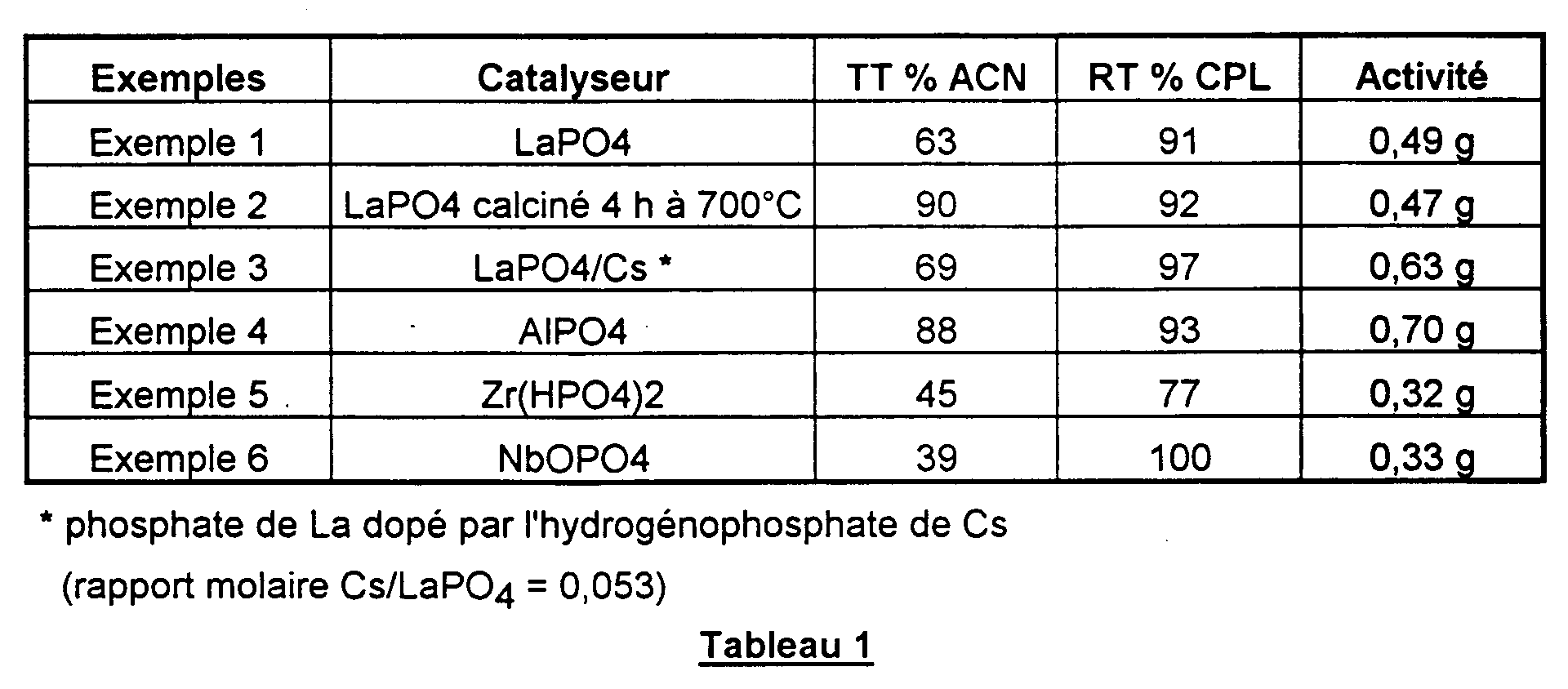
- On détermine le taux de transformation (TT) de l'aminocapronitrile, le rendement (RT) en caprolactame (CPL) par rapport à l'aminocapronitrile transformé et l'activité du catalyseur mesurée en grammes de caprolactame formé/millilitre de catalyseur.heure.
- Le tableau 1 ci-après rassemble les résultats obtenus.
- On répète les exemples 1 à 3, en suivant l'évolution de l'activité des différents catalyseurs sur des durées allant jusqu'à 35 heures.
- Le tableau 2 ci-après rassemble les valeurs de l'activité pour chaque catalyseur et pour des durées croissantes de réaction (ND = valeur non déterminée).
Exemples Catalyseur Activité du catalyseur pour des durées de 4 h 6 h 8 h 10 h 25 h 30 h 35 h Exemple 7 LaPO4 0,45 0,40 0,35 ND ND ND ND Exemple 8 LaPO4/Cs 0,60 0,55 0,60 0,68 0,60 0,55 0,63 Exemple 9 LaPO4 calciné 0,62 0,70 0,63 0,50 0,35 0,37 0,42 Tableau 2 - On répète l'exemple 1 dans les mêmes conditions, mais en opérant la réaction d'hydrolyse cyclisante à des températures différentes.
- Le tableau 3 ci-après rassemble les résultats obtenus et rappelle également les résultats de l'exemple 1 à titre comparatif.
Exemples Température TT % ACN RT % CPL Activité Exemple 10 280°C 44 % 90 % 0,4 Exemple 11 300°C 46 % 100 % 0,5 Exemple 1 320°C 63 % 91 % 0,5 Tableau 3 - On répète l'exemple 1, en remplaçant le phosphate de La par de la silice (commercialisée sous la marque Aerosil 200), calcinée pendant 16 h à 600°C.
- Les conditions opératoires sont les mêmes que pour l'exemple 1 (température de 320°C; rapport molaire eau/ACN de 6,2; durée de 2 h).
- On a obtenu les résultats suivants :
- TT de l'ACN : 17,6 % - RT en CPL : 53 % - Activité du catalyseur : 0,04 g CPL/ml catalyseur.h - La silice conduit à un faible rendement en caprolactame et présente une activité extrêmement basse.
Claims (10)
N≡C-R-NH₂ (I)
dans laquelle R représente un radical alkylène ayant de 3 à 12 atomes de carbone, avec de l'eau, en présence d'un catalyseur solide, caractérisé en ce que le catalyseur est un phosphate métallique de formule générale (II) :
(PO₄)n Hh M, (Imp)p (II)
dans laquelle :
Applications Claiming Priority (2)
| Application Number | Priority Date | Filing Date | Title |
|---|---|---|---|
| FR9315775 | 1993-12-23 | ||
| FR9315775A FR2714379B1 (fr) | 1993-12-23 | 1993-12-23 | Procédé de préparation de lactame. |
Publications (2)
| Publication Number | Publication Date |
|---|---|
| EP0659741A1 true EP0659741A1 (fr) | 1995-06-28 |
| EP0659741B1 EP0659741B1 (fr) | 2000-04-19 |
Family
ID=9454499
Family Applications (1)
| Application Number | Title | Priority Date | Filing Date |
|---|---|---|---|
| EP94420341A Expired - Lifetime EP0659741B1 (fr) | 1993-12-23 | 1994-12-06 | Procédé de préparation de lactame |
Country Status (12)
| Country | Link |
|---|---|
| US (1) | US5493021A (fr) |
| EP (1) | EP0659741B1 (fr) |
| JP (1) | JP2769983B2 (fr) |
| KR (1) | KR100333569B1 (fr) |
| CN (1) | CN1057084C (fr) |
| CA (1) | CA2138884C (fr) |
| DE (1) | DE69424024T2 (fr) |
| ES (1) | ES2147775T3 (fr) |
| FR (1) | FR2714379B1 (fr) |
| RU (1) | RU2118315C1 (fr) |
| SG (1) | SG43113A1 (fr) |
| TW (1) | TW472040B (fr) |
Cited By (15)
| Publication number | Priority date | Publication date | Assignee | Title |
|---|---|---|---|---|
| WO1996017826A1 (fr) * | 1994-12-03 | 1996-06-13 | Basf Aktiengesellschaft | Procede de production de caprolactame |
| WO1996020923A1 (fr) * | 1995-01-03 | 1996-07-11 | Basf Aktiengesellschaft | Procede de purification continue de caprolactame brut prepare a partir de 6-aminocapronitrile |
| WO1996022974A1 (fr) * | 1995-01-27 | 1996-08-01 | Rhone-Poulenc Fiber And Resin Intermediates | Procede de preparation de lactame |
| WO1998003481A1 (fr) * | 1996-07-17 | 1998-01-29 | Basf Aktiengesellschaft | Procede de preparation de caprolactame a partir de 6-aminocapronitrile |
| WO1998006693A1 (fr) * | 1996-08-08 | 1998-02-19 | Bayer Aktiengesellschaft | Procede de preparation de lactames |
| WO1998017641A1 (fr) * | 1996-10-24 | 1998-04-30 | Rhodia Fiber And Resin Intermediates | Procede de traitement de lactames |
| WO1998050355A1 (fr) * | 1997-05-02 | 1998-11-12 | Basf Aktiengesellschaft | Procede de fabrication de lactames cycliques |
| WO1999028296A1 (fr) * | 1997-12-01 | 1999-06-10 | Basf Aktiengesellschaft | Procede de production de lactames |
| WO1999047500A1 (fr) * | 1998-03-18 | 1999-09-23 | Basf Aktiengesellschaft | Procede de production de lactames en presence d'un oligophosphate comme catalyseur |
| WO1999067214A1 (fr) * | 1998-06-25 | 1999-12-29 | Rhodia Fiber And Resin Intermediates | Procede de vaporisation d'aminonitrile |
| FR2781796A1 (fr) * | 1998-07-28 | 2000-02-04 | Rhone Poulenc Fibres | Procede de deshydratation de lactame |
| WO2001083444A1 (fr) * | 2000-05-03 | 2001-11-08 | Basf Aktiengesellschaft | Procede de preparation de lactames cycliques |
| US6579979B2 (en) | 1998-11-19 | 2003-06-17 | Rhodia Polyamide Intermediates | Treatment/purification of lactam media of reaction |
| FR2833946A1 (fr) * | 2001-12-21 | 2003-06-27 | Rhodia Polyamide Intermediates | Procede de preparation de lactame |
| US8772477B2 (en) | 2009-04-27 | 2014-07-08 | Rhodia Operations | Process for preparing lactams |
Families Citing this family (6)
| Publication number | Priority date | Publication date | Assignee | Title |
|---|---|---|---|---|
| DE19517823A1 (de) * | 1995-05-18 | 1996-11-21 | Basf Ag | Verfahren zur Herstellung von Caprolactam |
| DE19623662A1 (de) * | 1996-06-13 | 1997-12-18 | Basf Ag | Verfahren zur Reinigung von epsilon-Caprolactam |
| US6686465B2 (en) | 2000-05-03 | 2004-02-03 | Basf Aktiengesellschaft | Preparation of cyclic lactams |
| DE10021192A1 (de) | 2000-05-03 | 2001-11-08 | Basf Ag | Verfahren zur Herstellung von Caprolactam |
| CN105218398B (zh) * | 2015-11-11 | 2017-03-22 | 河北工业大学 | 一种环己酮液相氨肟化制备环己酮肟的方法 |
| CN113651955A (zh) * | 2021-08-16 | 2021-11-16 | 中仑塑业(福建)有限公司 | 一种具有较好加工性能的半芳香族聚酰胺树脂及其制备方法和应用 |
Citations (5)
| Publication number | Priority date | Publication date | Assignee | Title |
|---|---|---|---|---|
| US2357484A (en) * | 1941-09-12 | 1944-09-05 | Du Pont | Process for producing compounds containing an n-substituted amide group |
| FR2029540A1 (en) * | 1969-01-28 | 1970-10-23 | Asahi Chemical Ind | Epsilon caprolactam by one step synthesis |
| EP0150295A2 (fr) * | 1983-12-19 | 1985-08-07 | Allied Corporation | Préparation sélective d'amides N-substitués utilisant de compositions de catalyseurs de Cu(O)/oxides métalliques |
| US4628085A (en) * | 1985-09-03 | 1986-12-09 | Allied Corporation | Use of silica catalyst for selective production of lactams |
| JPH0726847A (ja) * | 1993-07-15 | 1995-01-27 | Act:Kk | 扉の構造 |
Family Cites Families (3)
| Publication number | Priority date | Publication date | Assignee | Title |
|---|---|---|---|---|
| US237484A (en) * | 1881-02-08 | Broughei | ||
| US2301964A (en) * | 1941-09-12 | 1942-11-17 | Du Pont | Method of preparing lactams |
| US4625023A (en) * | 1985-09-03 | 1986-11-25 | Allied Corporation | Selective conversion of aliphatic and aromatic aminonitriles and/or dinitriles into lactams |
-
1993
- 1993-12-23 FR FR9315775A patent/FR2714379B1/fr not_active Expired - Fee Related
-
1994
- 1994-12-06 ES ES94420341T patent/ES2147775T3/es not_active Expired - Lifetime
- 1994-12-06 EP EP94420341A patent/EP0659741B1/fr not_active Expired - Lifetime
- 1994-12-06 SG SG1996003839A patent/SG43113A1/en unknown
- 1994-12-06 DE DE69424024T patent/DE69424024T2/de not_active Expired - Fee Related
- 1994-12-21 US US08/360,623 patent/US5493021A/en not_active Expired - Lifetime
- 1994-12-22 CN CN94119191A patent/CN1057084C/zh not_active Expired - Fee Related
- 1994-12-22 RU RU94044354A patent/RU2118315C1/ru active
- 1994-12-22 CA CA002138884A patent/CA2138884C/fr not_active Expired - Fee Related
- 1994-12-22 JP JP6335446A patent/JP2769983B2/ja not_active Expired - Fee Related
- 1994-12-23 KR KR1019940036469A patent/KR100333569B1/ko not_active Expired - Fee Related
-
1995
- 1995-05-18 TW TW084104933A patent/TW472040B/zh not_active IP Right Cessation
Patent Citations (5)
| Publication number | Priority date | Publication date | Assignee | Title |
|---|---|---|---|---|
| US2357484A (en) * | 1941-09-12 | 1944-09-05 | Du Pont | Process for producing compounds containing an n-substituted amide group |
| FR2029540A1 (en) * | 1969-01-28 | 1970-10-23 | Asahi Chemical Ind | Epsilon caprolactam by one step synthesis |
| EP0150295A2 (fr) * | 1983-12-19 | 1985-08-07 | Allied Corporation | Préparation sélective d'amides N-substitués utilisant de compositions de catalyseurs de Cu(O)/oxides métalliques |
| US4628085A (en) * | 1985-09-03 | 1986-12-09 | Allied Corporation | Use of silica catalyst for selective production of lactams |
| JPH0726847A (ja) * | 1993-07-15 | 1995-01-27 | Act:Kk | 扉の構造 |
Non-Patent Citations (1)
| Title |
|---|
| CHEMICAL ABSTRACTS, vol. 74, no. 18, 3 May 1971, Columbus, Ohio, US; abstract no. 91756t, page 271; column 1; * |
Cited By (27)
| Publication number | Priority date | Publication date | Assignee | Title |
|---|---|---|---|---|
| WO1996017826A1 (fr) * | 1994-12-03 | 1996-06-13 | Basf Aktiengesellschaft | Procede de production de caprolactame |
| WO1996020923A1 (fr) * | 1995-01-03 | 1996-07-11 | Basf Aktiengesellschaft | Procede de purification continue de caprolactame brut prepare a partir de 6-aminocapronitrile |
| WO1996022974A1 (fr) * | 1995-01-27 | 1996-08-01 | Rhone-Poulenc Fiber And Resin Intermediates | Procede de preparation de lactame |
| US6262259B1 (en) | 1995-01-27 | 2001-07-17 | Rhoneapoulenc Fiber & Resin Intermediates | Method for preparing lactam |
| CN1113864C (zh) * | 1996-07-17 | 2003-07-09 | Basf公司 | 利用6-氨基己腈制备己内酰胺的方法 |
| WO1998003481A1 (fr) * | 1996-07-17 | 1998-01-29 | Basf Aktiengesellschaft | Procede de preparation de caprolactame a partir de 6-aminocapronitrile |
| WO1998006693A1 (fr) * | 1996-08-08 | 1998-02-19 | Bayer Aktiengesellschaft | Procede de preparation de lactames |
| WO1998017641A1 (fr) * | 1996-10-24 | 1998-04-30 | Rhodia Fiber And Resin Intermediates | Procede de traitement de lactames |
| FR2755132A1 (fr) * | 1996-10-24 | 1998-04-30 | Rhone Poulenc Fibres | Procede de traitement de lactames |
| US6069246A (en) * | 1996-10-24 | 2000-05-30 | Rhodia Fiber & Resin Intermediates | Method for treating lactams |
| RU2180900C2 (ru) * | 1996-10-24 | 2002-03-27 | Родья Фибер Э Резэн Энтермедиат | Способ обработки реакционного потока при выделении лактамов |
| WO1998050355A1 (fr) * | 1997-05-02 | 1998-11-12 | Basf Aktiengesellschaft | Procede de fabrication de lactames cycliques |
| CN1113865C (zh) * | 1997-05-02 | 2003-07-09 | Basf公司 | 制备环状内酰胺的方法 |
| WO1999028296A1 (fr) * | 1997-12-01 | 1999-06-10 | Basf Aktiengesellschaft | Procede de production de lactames |
| US6407230B1 (en) | 1998-03-18 | 2002-06-18 | Basf Aktiengesellschaft | Method for producing lactams using oligophosphate catalysts |
| WO1999047500A1 (fr) * | 1998-03-18 | 1999-09-23 | Basf Aktiengesellschaft | Procede de production de lactames en presence d'un oligophosphate comme catalyseur |
| FR2780401A1 (fr) * | 1998-06-25 | 1999-12-31 | Rhone Poulenc Fibres | Procede de vaporisation d'aminonitrile |
| WO1999067214A1 (fr) * | 1998-06-25 | 1999-12-29 | Rhodia Fiber And Resin Intermediates | Procede de vaporisation d'aminonitrile |
| RU2229474C2 (ru) * | 1998-06-25 | 2004-05-27 | Родиа Файбер Энд Резин Интермедиэйтс | Способ выпаривания аминонитрила |
| WO2000006540A1 (fr) * | 1998-07-28 | 2000-02-10 | Rhodia Fiber And Resin Intermediates | Procede de deshydratation de lactame |
| FR2781796A1 (fr) * | 1998-07-28 | 2000-02-04 | Rhone Poulenc Fibres | Procede de deshydratation de lactame |
| US6635151B1 (en) | 1998-07-28 | 2003-10-21 | Rhodia Fiber & Resin Intermediates | Lactam dehydration method |
| US6579979B2 (en) | 1998-11-19 | 2003-06-17 | Rhodia Polyamide Intermediates | Treatment/purification of lactam media of reaction |
| WO2001083444A1 (fr) * | 2000-05-03 | 2001-11-08 | Basf Aktiengesellschaft | Procede de preparation de lactames cycliques |
| FR2833946A1 (fr) * | 2001-12-21 | 2003-06-27 | Rhodia Polyamide Intermediates | Procede de preparation de lactame |
| WO2003053935A1 (fr) * | 2001-12-21 | 2003-07-03 | Rhodia Polyamide Intermediates | Procede de preparation de lactame |
| US8772477B2 (en) | 2009-04-27 | 2014-07-08 | Rhodia Operations | Process for preparing lactams |
Also Published As
| Publication number | Publication date |
|---|---|
| JP2769983B2 (ja) | 1998-06-25 |
| TW472040B (en) | 2002-01-11 |
| CN1107841A (zh) | 1995-09-06 |
| CA2138884A1 (fr) | 1995-06-24 |
| US5493021A (en) | 1996-02-20 |
| EP0659741B1 (fr) | 2000-04-19 |
| ES2147775T3 (es) | 2000-10-01 |
| CN1057084C (zh) | 2000-10-04 |
| FR2714379B1 (fr) | 1996-02-02 |
| KR100333569B1 (ko) | 2002-11-29 |
| KR950017950A (ko) | 1995-07-22 |
| FR2714379A1 (fr) | 1995-06-30 |
| CA2138884C (fr) | 2001-02-06 |
| RU2118315C1 (ru) | 1998-08-27 |
| DE69424024T2 (de) | 2000-09-28 |
| RU94044354A (ru) | 1996-10-27 |
| SG43113A1 (en) | 1997-10-17 |
| DE69424024D1 (de) | 2000-05-25 |
| JPH0834772A (ja) | 1996-02-06 |
Similar Documents
| Publication | Publication Date | Title |
|---|---|---|
| EP0659741B1 (fr) | Procédé de préparation de lactame | |
| JP3824321B2 (ja) | カプロラクタムの製造方法 | |
| KR100463971B1 (ko) | 6-아미노카프로니트릴로부터 카프롤락탐의 제조 방법 | |
| FR2729949A1 (fr) | Procede de preparation de lactame | |
| EP2061746A1 (fr) | Procede de fabrication de diesters | |
| EP0748797B2 (fr) | Procédé de préparation de caprolactame à partir d'aminocapronitrile | |
| FI115907B (fi) | Menetelmä kaprolaktaamin valmistamiseksi | |
| CA2311668A1 (fr) | Procede de production de lactames | |
| US5227482A (en) | Method for producing a lactam | |
| US3154539A (en) | Production of lactams by rearrange- | |
| RU2199528C2 (ru) | Способ циклизирующего гидролиза аминонитрила в лактам | |
| EP1594832A2 (fr) | Procede de preparation du dimethylcetene puis du polydimethylcetene a partir de l'anhydride isobutyrique | |
| ES2224623T3 (es) | Procedimiento para la lactamas mediante la ayuda de catalizadores de oligofosfato. | |
| CN1660786B (zh) | 环烷酮肟的稳定方法 | |
| US3154540A (en) | Purification of lactams | |
| EP1456177A1 (fr) | Procede de preparation de lactame | |
| KR20240032477A (ko) | 고체 촉매 슬러리의 제조방법 및 5-에틸리덴-2-노보넨의 제조방법 |
Legal Events
| Date | Code | Title | Description |
|---|---|---|---|
| PUAI | Public reference made under article 153(3) epc to a published international application that has entered the european phase |
Free format text: ORIGINAL CODE: 0009012 |
|
| AK | Designated contracting states |
Kind code of ref document: A1 Designated state(s): BE DE ES FR GB IT NL |
|
| 17P | Request for examination filed |
Effective date: 19950928 |
|
| RAP1 | Party data changed (applicant data changed or rights of an application transferred) |
Owner name: RHONE-POULENC FIBER & RESIN INTERMEDIATES |
|
| RAP1 | Party data changed (applicant data changed or rights of an application transferred) |
Owner name: RHODIA FIBER & RESIN INTERMEDIATES |
|
| GRAG | Despatch of communication of intention to grant |
Free format text: ORIGINAL CODE: EPIDOS AGRA |
|
| 17Q | First examination report despatched |
Effective date: 19990611 |
|
| GRAG | Despatch of communication of intention to grant |
Free format text: ORIGINAL CODE: EPIDOS AGRA |
|
| GRAH | Despatch of communication of intention to grant a patent |
Free format text: ORIGINAL CODE: EPIDOS IGRA |
|
| GRAH | Despatch of communication of intention to grant a patent |
Free format text: ORIGINAL CODE: EPIDOS IGRA |
|
| GRAA | (expected) grant |
Free format text: ORIGINAL CODE: 0009210 |
|
| AK | Designated contracting states |
Kind code of ref document: B1 Designated state(s): BE DE ES FR GB IT NL |
|
| ITF | It: translation for a ep patent filed | ||
| REF | Corresponds to: |
Ref document number: 69424024 Country of ref document: DE Date of ref document: 20000525 |
|
| GBT | Gb: translation of ep patent filed (gb section 77(6)(a)/1977) |
Effective date: 20000629 |
|
| REG | Reference to a national code |
Ref country code: ES Ref legal event code: FG2A Ref document number: 2147775 Country of ref document: ES Kind code of ref document: T3 |
|
| PLBE | No opposition filed within time limit |
Free format text: ORIGINAL CODE: 0009261 |
|
| STAA | Information on the status of an ep patent application or granted ep patent |
Free format text: STATUS: NO OPPOSITION FILED WITHIN TIME LIMIT |
|
| 26N | No opposition filed | ||
| REG | Reference to a national code |
Ref country code: GB Ref legal event code: IF02 |
|
| PGFP | Annual fee paid to national office [announced via postgrant information from national office to epo] |
Ref country code: ES Payment date: 20031230 Year of fee payment: 10 |
|
| PGFP | Annual fee paid to national office [announced via postgrant information from national office to epo] |
Ref country code: BE Payment date: 20040212 Year of fee payment: 10 |
|
| PG25 | Lapsed in a contracting state [announced via postgrant information from national office to epo] |
Ref country code: ES Free format text: LAPSE BECAUSE OF NON-PAYMENT OF DUE FEES Effective date: 20041207 |
|
| PG25 | Lapsed in a contracting state [announced via postgrant information from national office to epo] |
Ref country code: BE Free format text: LAPSE BECAUSE OF NON-PAYMENT OF DUE FEES Effective date: 20041231 |
|
| BERE | Be: lapsed |
Owner name: *RHODIA FIBER & RESIN INTERMEDIATES Effective date: 20041231 |
|
| PG25 | Lapsed in a contracting state [announced via postgrant information from national office to epo] |
Ref country code: IT Free format text: LAPSE BECAUSE OF NON-PAYMENT OF DUE FEES Effective date: 20051206 |
|
| REG | Reference to a national code |
Ref country code: ES Ref legal event code: FD2A Effective date: 20041207 |
|
| BERE | Be: lapsed |
Owner name: *RHODIA FIBER & RESIN INTERMEDIATES Effective date: 20041231 |
|
| PGFP | Annual fee paid to national office [announced via postgrant information from national office to epo] |
Ref country code: NL Payment date: 20081203 Year of fee payment: 15 |
|
| PGFP | Annual fee paid to national office [announced via postgrant information from national office to epo] |
Ref country code: FR Payment date: 20081212 Year of fee payment: 15 |
|
| PGFP | Annual fee paid to national office [announced via postgrant information from national office to epo] |
Ref country code: DE Payment date: 20081205 Year of fee payment: 15 |
|
| PGFP | Annual fee paid to national office [announced via postgrant information from national office to epo] |
Ref country code: GB Payment date: 20081203 Year of fee payment: 15 |
|
| REG | Reference to a national code |
Ref country code: NL Ref legal event code: V1 Effective date: 20100701 |
|
| GBPC | Gb: european patent ceased through non-payment of renewal fee |
Effective date: 20091206 |
|
| REG | Reference to a national code |
Ref country code: FR Ref legal event code: ST Effective date: 20100831 |
|
| PG25 | Lapsed in a contracting state [announced via postgrant information from national office to epo] |
Ref country code: NL Free format text: LAPSE BECAUSE OF NON-PAYMENT OF DUE FEES Effective date: 20100701 Ref country code: FR Free format text: LAPSE BECAUSE OF NON-PAYMENT OF DUE FEES Effective date: 20091231 |
|
| PG25 | Lapsed in a contracting state [announced via postgrant information from national office to epo] |
Ref country code: DE Free format text: LAPSE BECAUSE OF NON-PAYMENT OF DUE FEES Effective date: 20100701 |
|
| PG25 | Lapsed in a contracting state [announced via postgrant information from national office to epo] |
Ref country code: GB Free format text: LAPSE BECAUSE OF NON-PAYMENT OF DUE FEES Effective date: 20091206 |