EP0661310A2 - Cycloolefincopolymere und Verfahren zu ihrer Herstellung - Google Patents
Cycloolefincopolymere und Verfahren zu ihrer Herstellung Download PDFInfo
- Publication number
- EP0661310A2 EP0661310A2 EP94119951A EP94119951A EP0661310A2 EP 0661310 A2 EP0661310 A2 EP 0661310A2 EP 94119951 A EP94119951 A EP 94119951A EP 94119951 A EP94119951 A EP 94119951A EP 0661310 A2 EP0661310 A2 EP 0661310A2
- Authority
- EP
- European Patent Office
- Prior art keywords
- polymerized units
- cycloolefin copolymer
- weight
- total mass
- olefin
- Prior art date
- Legal status (The legal status is an assumption and is not a legal conclusion. Google has not performed a legal analysis and makes no representation as to the accuracy of the status listed.)
- Granted
Links
Classifications
-
- C—CHEMISTRY; METALLURGY
- C08—ORGANIC MACROMOLECULAR COMPOUNDS; THEIR PREPARATION OR CHEMICAL WORKING-UP; COMPOSITIONS BASED THEREON
- C08F—MACROMOLECULAR COMPOUNDS OBTAINED BY REACTIONS ONLY INVOLVING CARBON-TO-CARBON UNSATURATED BONDS
- C08F8/00—Chemical modification by after-treatment
- C08F8/46—Reaction with unsaturated dicarboxylic acids or anhydrides thereof, e.g. maleinisation
-
- C—CHEMISTRY; METALLURGY
- C08—ORGANIC MACROMOLECULAR COMPOUNDS; THEIR PREPARATION OR CHEMICAL WORKING-UP; COMPOSITIONS BASED THEREON
- C08F—MACROMOLECULAR COMPOUNDS OBTAINED BY REACTIONS ONLY INVOLVING CARBON-TO-CARBON UNSATURATED BONDS
- C08F210/00—Copolymers of unsaturated aliphatic hydrocarbons having only one carbon-to-carbon double bond
-
- C—CHEMISTRY; METALLURGY
- C08—ORGANIC MACROMOLECULAR COMPOUNDS; THEIR PREPARATION OR CHEMICAL WORKING-UP; COMPOSITIONS BASED THEREON
- C08F—MACROMOLECULAR COMPOUNDS OBTAINED BY REACTIONS ONLY INVOLVING CARBON-TO-CARBON UNSATURATED BONDS
- C08F232/00—Copolymers of cyclic compounds containing no unsaturated aliphatic radicals in a side chain, and having one or more carbon-to-carbon double bonds in a carbocyclic ring system
- C08F232/08—Copolymers of cyclic compounds containing no unsaturated aliphatic radicals in a side chain, and having one or more carbon-to-carbon double bonds in a carbocyclic ring system having condensed rings
-
- C—CHEMISTRY; METALLURGY
- C08—ORGANIC MACROMOLECULAR COMPOUNDS; THEIR PREPARATION OR CHEMICAL WORKING-UP; COMPOSITIONS BASED THEREON
- C08G—MACROMOLECULAR COMPOUNDS OBTAINED OTHERWISE THAN BY REACTIONS ONLY INVOLVING UNSATURATED CARBON-TO-CARBON BONDS
- C08G61/00—Macromolecular compounds obtained by reactions forming a carbon-to-carbon link in the main chain of the macromolecule
- C08G61/02—Macromolecular compounds containing only carbon atoms in the main chain of the macromolecule, e.g. polyxylylenes
- C08G61/04—Macromolecular compounds containing only carbon atoms in the main chain of the macromolecule, e.g. polyxylylenes only aliphatic carbon atoms
- C08G61/06—Macromolecular compounds containing only carbon atoms in the main chain of the macromolecule, e.g. polyxylylenes only aliphatic carbon atoms prepared by ring-opening of carbocyclic compounds
- C08G61/08—Macromolecular compounds containing only carbon atoms in the main chain of the macromolecule, e.g. polyxylylenes only aliphatic carbon atoms prepared by ring-opening of carbocyclic compounds of carbocyclic compounds containing one or more carbon-to-carbon double bonds in the ring
Definitions
- the invention relates to en-functionalized cycloolefin copolymers (COC) with a solution viscosity (eta) ⁇ 0.25 dl / g and a process for their preparation.
- COC cycloolefin copolymers
- Unfunctionalized COCs are known (EP 156 464, EP 407 870) which do not contain any double bonds. These have a high degree of transparency and hardness as well as a low density. In addition, they are chemically almost inert and very heat-resistant. However, unfunctionalized COC are difficult to mix with other substances, especially polymers, and have poor adhesive properties. In addition, they are poorly functional.
- EP copolymers are also known, which may also contain one or more diene monomers (EPDM), ("Recent Advances in the Chemical Modification of Unsaturated Polymers” in Rubber Chemistry and Technology 55, 809 (1982)).
- EPDM diene monomers
- JP 54-017,931 describes that EPDM copolymers which contain vinyl norbornene as the diene monomer are reacted with maleic anhydride.
- a colored surface coating is obtained by subsequent reaction with a dye.
- the reaction of an EPDM, which contains ethylidene norbornene as the diene monomer, with sulfomaleic anhydride is described analogously (Macromolecules, 20, 258 (1987)). However, these materials are elastomers with glass transition temperatures below room temperature.
- EP 466 279 A2 describes that maleic anhydride can be grafted on to polyolefins which contain bicyclic monomer units by radical reaction.
- This route is technically uninteresting for a number of reasons: on the one hand, the use of radical-decomposing compounds such as peroxides is undesirable because of their explosiveness, and on the other hand it is known that such radical reactions on polyolefins tend to cause side reactions that can lead to uncontrolled crosslinking, gelation and ultimately uselessness. In addition, only low levels of functional groups are available.
- the object was therefore to provide a polymer which is readily miscible with other substances, in particular polymers, and has good adhesive properties, which at the same time has high transparency, dimensional stability under heat and hardness, and a chemically inert and hydrolysis-stable polymer backbone and can be crosslinked in a controlled manner.
- polymers should be provided which, in addition to the abovementioned favorable properties, can be stored practically indefinitely, in particular also at temperatures above room temperature.
- the en-functionalized COC according to the invention contain polymerized units which contain functional groups introduced via a polymer-analogous en reaction (for example J.March, Advanced Organic Chemistry, Wiley, New York, 1985, page 711, to which reference is hereby expressly made) and differ from the previously known COC by better miscibility with other substances, in particular polymers, improved adhesion properties and easier functionalization, as a result of which foreign molecules such as Dyes, peptides, enzymes or biocides can be bound to the otherwise inert COC and can be cross-linked in a controlled manner.
- a polymer-analogous en reaction for example J.March, Advanced Organic Chemistry, Wiley, New York, 1985, page 711, to which reference is hereby expressly made
- the present invention relates to a process for the production of en-functionalized COC, which works under technically interesting conditions.
- the invention thus relates to a controlled crosslinkable, en-functionalized cycloolefin copolymer with a solution viscosity (eta) ⁇ 0.25 dl / g (according to DIN 51562 in decalin at 60 ° C.), containing A) polymerized units of at least one polycyclic olefin, B) polymerized units at least an olefin which contain at least one double bond and optionally C) polymerized units of one or more acyclic olefins, characterized in that the equivalent weight with respect to olefinic double bonds is equal to or less than the number average molecular weight and additionally contains at least one repeating unit which has at least two has electron-withdrawing groups.
- eta solution viscosity
- the polymerized units A) are preferably derived from cyclolefins of the formulas I, II, III, IV, V, VI or VII wherein the radicals R1, R2, R3, R4, R5, R6, R7 and R8 are the same or different and represent a hydrogen atom, or a C1-C20 hydrocarbon radical such as a C1-C8 alkyl radical or C6-C14 aryl radical, or one Form a ring, the same radicals in the different formulas I-VI can have a different meaning, and n is a number from 2 to 10.
- Norbornene and tetracyclododecene are particularly preferred.
- the polymerized units B) are preferably derived from cyclic and acyclic polyenes, in particular dienes with 4-20 C atoms, which contain conjugated and / or non-conjugated double bonds.
- the double bonds can be terminal in a chain, in a ring (endocyclic) or exocyclic.
- Mono-, di-, tri- and tetracyclic dienes in particular non-conjugated di- and tricyclic dienes, and linear or branched acyclic dienes, in particular acyclic dienes with terminal double bonds, are particularly preferred.
- olefins from which the polymerized units B) are derived are cyclodienes such as norbornadiene-2,5, 5-vinylnorbornene-2, 5-ethylidene norbornene-2, 5-methylene norbornene-2, dicyclopentadiene, 5-isopropylidene norbornene-2, tricyclopentadiene and 1 , 4,5,8-dimethano-1,4,4a, 5,8,8a-hexahydronaphthalene, cyclopentadiene, cyclohexadiene-1,4, cyclohexadiene-1,3, cycloocta-1,5-diene, vinylcyclohexene-1, vinylcyclohexene -2, vinylcyclohexene-3, alkyl-tetrahydroindenes such as 4,5,7,8-tetrahydroindenes, 4-methyl-tetrahydroindenes, 6-methyl-tetra
- Diels-Alder reaction products mixtures of cyclodiene and / or diene can be used like the by-products of the norbornene or Tetracyclododecene production, which contain a high proportion of di- and tricyclodiene, or di- and tricyclodiene in the mixture.
- acyclic dienes such as 1,5-hexadiene, 1,4-hexadiene, 1,3-hexadiene, 1,9-decadiene, butadiene and isoprene are preferred.
- the polymerized units C) are preferably derived from acyclic mono-olefins, e.g. Alpha olefins, with 2 - 20 C atoms, especially ethylene and propylene.
- Preferred polymerized units D) have electron-withdrawing groups which exert an -M effect (J. March, Adv. Org. Chem., P. 238, Table 1, to which reference is hereby expressly made), in particular carbonyl and nitrile , particularly preferably carbonyl.
- Salts of inorganic bases are, for example, alkali, alkaline earth and zinc salts, in particular Na, K, Ca and Mg salts.
- Salts of organic bases such as primary and secondary aliphatic amines, e.g. As diethylamine, triethylamine, diethanolamine or triethanolamine.
- the polymerized units D can also be derived from compounds of the formula XVIII , in which the radicals R9, R10, R11 and R12 are identical or different and are a hydrogen atom or a C1-C20 hydrocarbon radical such as C1-C8-alkyl, C6-C14-aryl or C3-C15-alkenyl, and m is a number of Is 0 to 10 and R13 is the meaning 2,5-dioxotetrahydrofuran-3-yl, 1,2-dicyanoethyl, 1-alkyloxy carbonyl-2-cyano-ethyl, 1-aryloxy carbonyl-2-cyano-ethyl, 1-cyano-2-alkyloxy carbonyl-ethyl, 1-cyano-2-aryloxy carbonyl-ethyl, 1,2-bis (alkyloxy carbonyl) ethyl, 1,2-bis (aryloxy carbonyl) ethyl, 1-aryloxy carbony
- Salts of inorganic bases are, for example, alkali, alkaline earth and zinc salts, in particular Na, K, Ca and Mg salts.
- Salts of organic bases such as primary and secondary aliphatic amines, e.g. As diethylamine, triethylamine, diethanolamine or triethanolamine.
- the alkyl radicals in the polymerized units D) can be linear, branched or cyclic, saturated or partially unsaturated, with 1-18 C atoms.
- the aryl radicals in the polymerized units D) can contain 6-30 C atoms and carry additional substituents, preferably C1-C18 alkyl substituents, which are independently linear, branched or cyclic.
- the polymerized units D) are preferably derived from compound mixtures whose components have alkyl or aryl radicals with different numbers of carbon atoms.
- the residues are derived from homologous series that are technically available or can be obtained from biological sources without further purification.
- a preferred source is e.g. B. the beef tallow-alcohol or beef tallow-amine mixture, which can vary in its composition depending on the place of origin, race and season.
- Cycloolefin copolymers whose polymerized units B) contain at least 0.1% by weight, in particular 20-80% by weight, based on the total mass of the cycloolefin copolymer, of an acyclic C4-C20-polyene, in particular C4-C20-diene, are particularly preferred.
- the COC according to the invention has a proportion of polymerized units A) (cycloolefin content) of 0.1-99.89% by weight, preferably 1-99% by weight, particularly preferably 10-90% by weight, based in each case on the Total mass of the cycloolefin copolymer.
- the proportion of polymerized units B) is 0.1-99.89% by weight, preferably 1-50% by weight, particularly preferably 2-30% by weight, in each case based on the total mass of the cycloolefin copolymer.
- the proportion of polymerized units C) is 0-80% by weight, preferably 1-60% by weight, particularly preferably 2-50% by weight, in each case based on the total mass of the cycloolefin copolymer.
- the proportion of polymerized units D) which have at least two electron-withdrawing groups is 0.01-50% by weight, preferably 0.05-20% by weight, particularly preferably 0.1-10% by weight, in each case based on the total mass of the cycloolefin copolymer.
- the COC according to the invention have a solution viscosity (eta) ⁇ 0.25 dl / g (measured in decalin, at 60 ° C., in accordance with DIN 51562).
- the molecular weight M w is preferably ⁇ 13,000 g / mol and the polydispersity M w / M n is preferably ⁇ 4.
- the glass transition temperature is preferably from -20 to 200 ° C., particularly preferably from 0 to 200 ° C.
- the iodine number (JZ) is 0.5-200, preferably 0.5-50.
- the COC according to the invention have good miscibility with other substances.
- the mixing partners can be low molecular weight or high molecular weight.
- An example of low molecular weight mixture partners is the use of the polymers according to the invention as an oil additive.
- Examples of high-molecular substances are polymers, in particular polyamides and polyacrylates.
- the chemical reactivity of the functional group can be used industrially by, for example, dyes or biocides being firmly bound to the otherwise inert polyolefin.
- the COC according to the invention show very good adhesive properties and are suitable as coating agents, which is of great technical importance, e.g. in the lamination of plastic films.
- they can be used as additives in waxes, adhesives, adhesion promoters, plasticizers, sizes, finishes or as hardeners, e.g. can be used in reactive repair compounds.
- the invention also relates to a process for the preparation of controlled, crosslinkable, en-functionalized COC with a solution viscosity (eta) ⁇ 0.25 dl / g, characterized in that COC containing double bonds is reacted with at least one enophile.
- Preferred enophiles are a, ⁇ -unsaturated carboxylic acids or ⁇ , ⁇ -unsaturated carboxylic acid derivatives such as maleic anhydride, maleic acid esters (e.g. such as di-n-butyl maleate and bisoctadecyl maleate), maleimides, which can also be substituted (e.g. N-phenyl maleimide), bromomaleic anhydride, Sulfomaleic acid anhydride or diethyl azodicarboxylate.
- maleic anhydride maleic acid esters (e.g. such as di-n-butyl maleate and bisoctadecyl maleate)
- maleimides which can also be substituted (e.g. N-phenyl maleimide), bromomaleic anhydride, Sulfomaleic acid anhydride or diethyl azodicarboxylate.
- the molar ratio of enophile to double bonds on the polymer is not critical. A deficit may be appropriate if the aim is to have as little unbound enophile as possible at the end of the reaction. In order to achieve the highest possible proportion of polymer-bound enophile, however, it has proven to be advantageous to use an excess of the enophile relative to the double bond, the upper limit being given by economic considerations and any problems that may arise when separating off the excess component.
- the components are preferably reacted in a molar ratio of 2-8, particularly preferably in a molar ratio of 3-5.
- the ene reaction can be catalyzed by Lewis acids.
- the reaction can be carried out heterogeneously or homogeneously.
- Heterogeneous means that the low molecular weight enophile as a vapor onto the polymer particles, for example in the fluidized bed, or that the polymer particles are suspended in a solution of the enophile.
- Homogeneous reaction control involves carrying out in melt or solution.
- the reaction is carried out homogeneously in a solvent for COC, which also dissolves the enophile.
- Aromatic solvents such as benzene, toluene, xylenes, chlorobenzene and other chlorinated organic solvents such as chloroform or tetrachlorethylene are suitable. Mixtures of solvents can often also be advantageous.
- the reaction can advantageously be carried out under pressure. High boilers such as cis / trans-decalin and isomers of dichlorobenzene are particularly suitable.
- the reaction is carried out at temperatures between 150 ° C. and 220 ° C. in 1,2-dichlorobenzene or decalin.
- the pressure is worked at the boiling point of the solution without pressure.
- the concentration of the solution is determined by stirrability, i.e. the upper limit of viscosity.
- the lower concentration limit results from economic considerations and the impurities possibly introduced by the solvent, which experience has shown can increasingly lead to undesirable side reactions.
- the range from 4-30% is preferred, particularly preferably from 5-20%.
- the addition of a suitable inhibitor which does not chemically react under the selected conditions can be advantageous.
- Phenothiazine, nitroaromatics such as nitrobenzene and dinitrobenzene, 2-mercaptobenzothiazole, 2-mercaptoimidazole and diphenylguanidine (US Pat. No. 4,080,493) have proven to be suitable.
- the COC according to the invention is preferably produced in the absence of radical initiators, for example peroxo compounds or azoisobutyronitrile.
- Method 3 is preferred if the excess enophile, e.g. Maleic anhydride, to be largely removed.
- Drying can take place at normal pressure or reduced pressure, preferably with an inert gas blanket, the temperature below T g having to be selected in order to avoid sintering. Drying in a stream of nitrogen is preferred.
- the cycloolefin copolymers containing double bonds used in the process according to the invention preferably contain 0.1-99.9% by weight, based on the total mass of the cycloolefin copolymer, of polymerized units of a cycloolefin of the formula I, II, III, IV, V, VI or VII , wherein the radicals R1, R2, R3, R4, R5, R6, R7 and R8 are the same or different and a hydrogen atom or a C1-C20 hydrocarbon radical such as one C1-C8-alkyl radical or C6-C14 aryl radical, or form a ring, the same radicals in the different formulas I-VI can have a different meaning, and n is a number from 2 to 10, and 0.1-99.9% by weight, based on the total mass of the cycloolefin copolymer, of polymerized units of at least one olefin which have at least one double bond, preferably at least one ole
- the cycloolefin copolymers containing double bonds used in the process according to the invention are prepared at temperatures of -78 ° -200 ° C. and a pressure of 0.01-64 bar, in the presence of a catalyst containing an aluminoxane and at least one metallocene, preferably a metallocene, of the formula (I) or (II) , wherein M1 is a metal from the group titanium, zirconium, hafnium, vanadium, niobium and tantalum, R1 and R2 are the same or different and are a hydrogen atom, a halogen atom or a C1-C20 hydrocarbon group such as a C1-C10 alkyl group Are C6-C10 aryl group, a C2-C10 alkenyl group, a C7-C40 arylalkyl group, a C7-C40 alkylaryl group or a C8-C40 arylalkenyl group, R
- Mononuclear or polynuclear hydrocarbon radicals are preferably unsubstituted or substituted cyclopentadienyl groups such as cyclopentadienyl, methylcyclopentadienyl, methylcyclopentadiyl, indenyl, 2-methyl-indenyl, 4,5-benzoindenyl, 2-methyl-4,5-benzoindenyl, fluorenyl or 4,7-tert. -Butyl-fluorenyl.
- Metallocenes of the formulas (I) and (II) in which M 1 is zircon are preferably used, R1 and R2 are the same and are a halogen atom, in particular chlorine, or a C1-C10 alkyl group, in particular methyl, R3 and R4 are identical or different and are cyclopentadienyl, indenyl or fluorenyl, which can be substituted by C1-C20 hydrocarbon radicals, R5 is where R8, R9 and R11 are the same or different and are a C1-C10 alkyl group, especially methyl, or a C6-C10 aryl group, especially phenyl.
- a clean and dry 1.5 dm3 polymerization reactor with stirrer was purged with nitrogen and then with ethylene and filled with 0.6 dm3 of an 85% solution of norbornene in toluene.
- 60 ml of 5-vinylnorbornene-2 were added.
- the ethylene pressure was set to 6 bar gauge pressure.
- 360 cm3 of hydrogen were added and the temperature was set to 70 ° C.
- the solution was mixed with 10 g Celite 545 (LuV, Hamburg) and 5 cm3 water and stirred at 60 ° C for 30 min.
- the polymer solution was filtered through a pressure filter, whereby a nitrogen pressure of approx. 1 bar was built up.
- the clear solution was introduced into 5 dm3 of acetone with the aid of a dispersant (from Kotthoff).
- the solid was isolated by filtration, dispersed twice more in acetone and then dried at 100 ° C. and reduced pressure (0.2 bar) for 15 hours.
- a maleated COC (from Example 2) was dissolved in methylene chloride (20% w / v) and knife-coated onto a glass surface. After evaporation of the solvent overnight, a was obtained on the polymer film obtained Contact angles of 85 ° (water), 75 ° (glycerol) and 66 ° (glycol) measured (contact angle measuring device G1, from Krüss, Hamburg).
- a contact angle of 92 ° (water), 78 ° (glycerol) and 62 ° (glycol) could be measured on a film which was produced under the conditions of example 4 from the COC of example 1.
- the polymer film from Example 4 was treated with a saturated solution of the dye 1,2-diaminoanthraquinone in N-methylpyrrolidone (NMP), which contained 1% (v / v) pyridine. The temperature was raised from room temperature to 100 ° C. within 60 minutes. The film was rinsed first with cold NMP, then with hot water and showed a clear red color. The color could not be removed even by exposure to dimethylformamide (DMF) at room temperature.
- NMP N-methylpyrrolidone
- the polymer film from comparative example B was subjected to the dyeing process described in example 5.
- the weak red color obtained was completely removed when rinsing with NMP.
- the COC from Example 3 was prepared as a 0.5, 5 and 10% by weight solution in decalin and dissolved overnight with stirring. Half of each solution obtained was carefully degassed and saturated with nitrogen. The second half of each solution was left in its original state. Now all solutions in sealed glass vessels were hung in a thermostat with an oil bath temperature of 135 ° C and the time until the first appearance of gel particles was observed. The highly concentrated degassed solution began to gel after 3 minutes. The medium concentration solution took 8 minutes, while the 0.5% sample showed gel particles after 13 minutes. Samples that that had not been degassed showed a period of about 5 minutes longer before the first gels appeared.
Landscapes
- Chemical & Material Sciences (AREA)
- Health & Medical Sciences (AREA)
- Chemical Kinetics & Catalysis (AREA)
- Medicinal Chemistry (AREA)
- Polymers & Plastics (AREA)
- Organic Chemistry (AREA)
- General Chemical & Material Sciences (AREA)
- Addition Polymer Or Copolymer, Post-Treatments, Or Chemical Modifications (AREA)
- Paints Or Removers (AREA)
- Transition And Organic Metals Composition Catalysts For Addition Polymerization (AREA)
Abstract
Description
- Die Erfindung bezieht sich auf en-funktionalisierte Cycloolefincopolymere (COC) mit einer Lösungsviskosität (eta) < 0,25 dl/g und ein Verfahren zu ihrer Herstellung.
- Es sind unfunktionalisierte COC bekannt (EP 156 464, EP 407 870), die keinerlei Doppelbindungen enthalten. Diese weisen eine hohe Transparenz und Härte sowie eine geringe Dichte auf. Außerdem sind sie chemisch nahezu inert und sehr wärmeformbeständig. Allerdings sind unfunktionalisierte COC nur schlecht mit anderen Stoffen, insbesondere Polymeren, mischbar und weisen schlechte Hafteigenschaften auf. Darüber hinaus sind sie nur schlecht funktionalisierbar.
- Da diese Polymeren nur über eine Metallkomplex-katalysierte Polymerisation zugänglich sind, die bekanntermaßen intolerant gegen polare/reaktive Gruppen ist, ist der formal denkbare Weg zur Herstellung funktionalisierter COC über Copolymerisation von Monomeren, die reaktive Gruppen tragen, nicht möglich.
- Aus EP 283 164 sind COC bekannt, die cyclische Polyene enthalten. Diese Polymere weisen keine Gelteilchen auf und sind bei 135 °C in Dekalin vollständig löslich, was darauf hindeutet, daß sie im wesentlichen linear aufgebaut und unvernetzt sind. Diese Polymeren lassen sich mit Maleinsäureanhydrid umsetzen.
- Durch radikalische Copolymerisation von Ethylen mit Acrylsäure, erhält man Ionomere, die unter dem Namen SURLYN™ (DuPont) vermarktet werden. Diese Copolymere weisen jedoch nur eine geringe Transparenz auf. Außerdem weisen sie eine relativ geringe Härte auf.
- Weiterhin sind funktionelle Gruppen tragende Ethylen-Propylen (EP)-Copolymere bekannt, die gegebenenfalls noch ein oder mehrere Dien-Monomere enthalten können (EPDM), ("Recent Advances in the Chemical Modification of Unsaturated Polymers" in Rubber Chemistry and Technology 55, 809 (1982)). In JP 54-017,931 wird beschrieben, daß EPDM-Copolymere, die Vinylnorbornen als Dienmonomer enthalten, mit Maleinsäureanhydrid umgesetzt werden. Durch nachfolgende Reaktion mit einem Farbstoff wird eine farbige Oberflächenbeschichtung erhalten. Analog wird die Umsetzung eines EPDM, welches Ethylidennorbornen als Dienmonomer enthält, mit Sulfomaleinsäureanhydrid beschrieben (Macromolecules, 20, 258 (1987)). Diese Materialien sind jedoch Elastomere mit Glastemperaturen unterhalb Raumtemperatur.
- In EP 466 279 A2 wird beschrieben, daß Maleinsäureanhydrid durch radikalische Reaktion auf Polyolefine, die bicyclische Monomerbausteine enthalten, aufgepropft werden kann. Dieser Weg ist aus mehreren Gründen technisch uninteressant: Einerseits ist der Umgang mit radikalisch zerfallenden Verbindungen wie Peroxiden wegen ihrer Explosionsfähigkeit nicht wünschenswert und andererseits ist bekannt, daß solche Radikalreaktionen an Polyolefinen zu Nebenreaktionen neigen, die zu unkontrollierten Vernetzungen, Vergelungen und letztendlich Unbrauchbarkeit führen können. Darüberhinaus sind nur geringe Gehalte an funktionellen Gruppen erhältlich.
- Es bestand somit die Aufgabe ein mit anderen Stoffen, insbesondere Polymeren, gut mischbares Polymer mit guten Hafteigenschaften zur Verfügung zu stellen, das gleichzeitig eine hohe Transparenz, Wärmeformbeständigkeit und Härte sowie ein chemisch inertes und hydrolysestabiles Polymerrückgrat aufweist und kontrolliert vernetzbar ist. Darüberhinaus sollten Polymere bereitgestellt werden, die über die oben genannten günstigen Eigenschaften hinaus auch praktisch unbegrenzt lagerfähig sind, insbesondere auch bei Temperaturen oberhalb Raumtemperatur.
- Es wurde nun gefunden, daß diese Aufgabe durch die Bereitstellung von en-funktionalisierten COC gelöst wird, deren COC-Grundgerüst durch Polymerisation in Gegenwart bestimmter Metallocen-Katalysatoren aufgebaut wird. Die erfindungsgemäßen, en-funktionalisierten COC enthalten polymerisierte Einheiten, die über eine polymeranaloge En-Reaktion (z.B. J.March, Advanced Organic Chemistry, Wiley, New York, 1985, Seite 711, auf die hiermit ausdrücklich Bezug genommen wird) eingeführte funktionelle Gruppen enthalten und unterscheiden sich von den bisher bekannten COC durch eine bessere Mischbarkeit mit anderen Stoffen, insbesondere Polymeren, verbesserte Haftungseigenschaften und leichtere Funktionalisierbarkeit, wodurch Fremdmoleküle wie z.B. Farbstoffe, Peptide, Enzyme oder Biocide an das ansonsten inerte COC gebunden werden können, und lassen sich kontrolliert vernetzen.
- Darüber hinaus bezieht sich die vorliegende Erfindung auf ein Verfahren zur Herstellung von en-funktionalisierten COC, das unter technisch interessanten Bedingungen arbeitet.
- Die Erfindung betrifft somit ein kontrolliert vernetzbares, en-funktionalisiertes Cycloolefincopolymer mit einer Lösungsviskosität (eta) < 0,25 dl/g (gemäß DIN 51562 in Dekalin bei 60⁰C), enthaltend A) polymerisierte Einheiten mindestens eines polycyclischen Olefins, B) polymerisierte Einheiten mindestens eines Olefins, die mindestens eine Doppelbindung enthalten, und gegebenenfalls C) polymerisierte Einheiten eines oder mehrerer acyclischer Olefine, dadurch gekennzeichnet, daß das Äquivalentgewicht bezüglich olefinischer Doppelbindungen gleich oder kleiner ist als das Zahlenmittel des Molekulargewichts und zusätzlich mindestens eine Wiederholeinheit enthalten ist, welche mindestens zwei elektronenziehende Gruppen aufweist.
- Das erfindungsgemäße Cycloolefincopolymer enthält vorzugsweise
- A) 0,1 - 99,89 Gew.-%, bezogen auf die Gesamtmasse des Cycloolefincopolymers, polymerisierte Einheiten mindestens eines Cycloolefins,
- B) 0,1 - 99,89 Gew.-%, bezogen auf die Gesamtmasse des Cycloolefincopolymers, polymerisierte Einheiten mindestens eines Olefins, die mindestens eine Doppelbindung aufweisen,
- C) 0 - 80 Gew.-%, bezogen auf die Gesamtmasse des Cycloolefincopolymers, polymerisierte Einheiten mindestens eines acyclischen Mono-Olefins und
- D) 0,01 bis 50 % Gew., bezogen auf die Gesamtmasse des Cycloolefincopolymers, polymerisierte Einheiten, welche mindestens zwei elektronenziehende Gruppen aufweisen.
- Die polymerisierten Einheiten A) leiten sich bevorzugt ab von Cyclolefinen der Formeln I, II, III, IV, V, VI oder VII


worin die Reste R¹, R², R³, R⁴, R⁵, R⁶, R⁷ und R⁸ gleich oder verschieden sind und ein Wasserstoffatom, oder einen C₁-C₂₀-Kohlenwasserstoffrest wie einen C₁-C₈-Alkylrest oder C₆-C₁₄-Arylrest bedeuten, oder einen Ring bilden, wobei gleiche Reste in den verschiedenen Formeln I-VI eine unterschiedliche Bedeutung haben können, und n eine Zahl von 2 bis 10 ist. - Besonders bevorzugt sind Norbornen und Tetracyclododecen.
- Die polymerisierten Einheiten B) leiten sich bevorzugt ab von cyclischen und acyclischen Polyenen, insbesondere Dienen mit 4-20 C-Atomen, die konjugierte und/oder nicht-konjugierte Doppelbindungen enthalten. Die Doppelbindungen können endständig in einer Kette, in einem Ring (endo-cyclisch) oder exo-cyclisch sein.
- Besonders bevorzugt sind mono-, di-, tri- und tetracyclische Diene, insbesondere nicht-konjugierte di- und tricyclische Diene sowie lineare oder verzweigte acyclische Diene, insbesondere acyclische Diene mit endständigen Doppelbindungen.
- Besonders bevorzugt sind polymerisierte Einheiten B), die sich von Verbindungen der Formeln VIII, IX, X, XI, XII und XIII ableiten


, worin R⁹, R¹⁰, R¹¹, R¹², R¹³, R¹⁴ und R¹⁵ gleich oder verschieden sind und ein Wasserstoffatom, C₁-C₈-Alkyl, C₆-C₁₄-Aryl oder C₃-C₁₅-Alkenyl bedeuten, wobei gleiche Reste in den verschiedenen Formeln VIII-XIII unterschiedliche Bedeutung haben können und mindestens einer der Reste R⁹, R¹⁰, R¹¹, R¹², R¹³ und R¹⁶ in Formel VIII sowie R⁹, R¹⁰, R¹¹ und R¹² in Formel XII ein C₃-C₁₅-Alkenylrest ist und m eine Zahl von 0 bis 10 ist und n, l eine Zahl von 0 bis 10 ist, mit der Maßgabe, daß nicht n=l=0 ist. - Beispiele für Olefine von denen sich die polymerisierten Einheiten B) ableiten sind Cyclodiene wie Norbornadien-2,5, 5-Vinylnorbornen-2, 5-Ethylidennorbornen-2, 5-Methylennorbornen-2, Dicyclopentadien, 5-Isopropylidennorbornen-2, Tricyclopentadien und 1,4,5,8-Dimethano-1,4,4a,5,8,8a-hexahydronaphtalin, Cyclopentadien, Cyclohexadien-1,4, Cyclohexadien-1,3, Cycloocta-1,5-dien, Vinylcyclohexen-1, Vinylcyclohexen-2, Vinylcyclohexen-3, Alkyl-tetrahydroindene wie 4,5,7,8-Tetrahydroindene, 4-Methyl-tetrahydroindene, 6-Methyl-tetrahydroindene oder 6-Ethyltetrahydroindene und acyclische Diene wie Hexadien-1,5, Hexadien-1,4, Hexadien-1,3, Decadien-1,9, Butadien und Isopren.
- Es können Diels-Alder-Reaktionsprodukte, Gemische von Cyclodien und/oder Dien verwendet werden wie die Nebenprodukte der Norbornen-, bzw. Tetracyclododecenherstellung, die einen hohen Anteil Di- und Tricyclodien, bzw. Di- und Tricyclodien im Gemisch enthalten.
- Generell sind acyclische Diene wie Hexadien-1,5, Hexadien-1,4, Hexadien-1,3, Decadien-1,9, Butadien und Isopren bevorzugt.
- Die polymerisierten Einheiten C) leiten sich bevorzugt ab von acyclischen Mono-Olefinen, z.B. Alpha-Olefinen, mit 2 - 20 C-Atomen, insbesondere Ethylen und Propylen.
- Bevorzugte polymerisierte Einheiten D) weisen elektronenziehende Gruppen auf, die einen -M-Effekt ausüben (J. March, Adv. Org. Chem., S. 238, Tab. 1, auf die hiermit ausdrücklich Bezug genommen wird), insbesondere Carbonyl und Nitril, besonders bevorzugt Carbonyl.
- Die polymerisierten Einheiten D) leiten sich bevorzugt ab von Verbindungen der Formeln,


, worin die Reste R⁹, R¹⁰, R¹¹, R¹², R¹³, R¹⁴ und R¹⁵ gleich oder verschieden sind und ein Wasserstoffatom, oder einen C₁-C₂₀-Kohlenwasserstoffrest wie C₁-C₈-Alkyl, C₆-C₁₄-Aryl oder C₃-C₁₅-Alkenyl bedeuten, wobei gleiche Reste in den verschiedenen Formeln XIV-XVII unterschiedliche Bedeutung haben können, m eine Zahl von 0 bis 10 ist und n, l eine Zahl von 0 bis 10 ist, mit der Maßgabe, daß nicht n=l=0 ist, und mindestens einer der Reste
R⁹ und R¹⁰ die Bedeutung
2,5-Dioxotetrahydrofuran-3-yl-methyl,
2,3-Dicyanopropyl,
2-Alkyloxy carbonyl-3-cyano-propyl,
2-Aryloxy carbonyl-3-cyano-propyl,
2-Cyano-3-alkyloxy carbonyl-propyl,
2-Cyano-3-aryloxy carbonyl-propyl,
2,3-Bis(alkyloxy carbonyl)propyl,
2,3-Bis(aryloxy carbonyl)propyl,
2-Aryloxycarbonyl-3-alkyloxycarbonyl-propyl,
2-Alkyloxy carbonyl-3-aryloxycarbonyl-propyl,
2-Alkyloxy carbonyl-3-(N,N-bisalkyliminocarbonyl)-propyl,
2-Aryloxy carbonyl-3-(N-alkyl-N-aryl-imino-carbonyl)-propyl,
2-Carboxy-3-(N,N-bisalkyliminocarbonyl)-propyl,
2-Carboxy-3-(N-alkyl-N-aryl-imino-carbonyl)-propyl,
3-Alkyloxy carbonyl-2-(N,N-bisalkyliminocarbonyl)-propyl,
3-Aryloxy carbonyl-2-(N-alkyl-N-aryl-imino-carbonyl)-propyl,
3-Carboxy-2-(N,N-bisalkyliminocarbonyl)-propyl,
3-Carboxy-2-(N-alkyl-N-aryl-imino-carbonyl)-propyl,
2,5-Dioxotetrahydropyrrol-3-yl-methylen,
N-Alkyl-2,5-dioxotetrahydropyrrol-3-yl-methyl,
N-Aryl-2,5-dioxotetrahydropyrrol-3-yl-methyl,
N,N'-Bis(alkyloxycarbonyl)-2,3-diaza-propyl,
4-Sulfo-2,5-dioxotetrahydrofuran-3-yl-methyl,
4-Brom-2,5-dioxotetrahydrofuran-3-yl-methyl,
4-Chlor-2,5-dioxotetrahydrofuran-3-yl-methyl oder
3-Sulfo-2,3-bis(alkyloxy carbonyl)propyl hat bzw. das Salz einer dieser Verbindungen mit anorganischen oder organischen Basen darstellte. Salze anorganischer Basen sind z.B. Alkali-, Erdalkali-, und Zinksalze, insbesondere Na-, K-, Ca- und Mg-Salze. Bevorzugt sind Salze organischer Basen wie primäre und sekundäre aliphatische Amine, z. B. Diethylamin, Triethylamin, Diethanolamin oder Triethanolamin. - Darüber hinaus können sich die polymerisierte Einheiten D auch Verbindungen der Formel XVIII ableiten

, worin die Reste R⁹, R¹⁰, R¹¹ und R¹² gleich oder verschieden sind und ein Wasserstoffatom oder ein C₁-C₂₀-Kohlenwasserstoffrest wie C₁-C₈-Alkyl, C₆-C₁₄-Aryl oder C₃-C₁₅-Alkenyl bedeuten, und m eine Zahl von 0 bis 10 ist und R¹³ die Bedeutung
2,5-Dioxotetrahydrofuran-3-yl,
1,2-Dicyanoethyl,
1-Alkyloxy carbonyl-2-cyano-ethyl,
1-Aryloxy carbonyl-2-cyano-ethyl,
1-Cyano-2-alkyloxy carbonyl-ethyl,
1-Cyano-2-aryloxy carbonyl-ethyl,
1,2-Bis(alkyloxy carbonyl)ethyl,
1,2-Bis(aryloxy carbonyl)ethyl,
1-Aryloxycarbonyl-2-alkyloxycarbonyl-ethyl,
1-Alkyloxy carbonyl-2-aryloxycarbonyl-ethyl,
1-Alkyloxy carbonyl-2-(N,N-bisalkyliminocarbonyl)-ethyl,
1-Aryloxy carbonyl-2-(N-alkyl-N-aryl-imino-carbonyl)-ethyl,
1-Carboxy-2-(N,N-bisalkyliminocarbonyl)-ethyl,
1-Carboxy-2-(N-alkyl-N-aryl-imino-carbonyl)-ethyl,
2-Alkyloxy carbonyl-1-(N,N-bisalkyliminocarbonyl)-ethyl,
2-Aryloxy carbonyl-1-(N-alkyl-N-aryl-imino-carbonyl)-ethyl,
2-Carboxy-1-(N,N-bisalkyliminocarbonyl)-ethyl,
2-Carboxy-1-(N-alkyl-N-aryl-imino-carbonyl)-ethyl
2,5-Dioxotetrahydropyrrol-3-yl,
N-Alkyl-2,5-dioxotetrahydropyrrol-3-yl,
N-Aryl-2,5-dioxotetrahydropyrrol-3-yl,
N,N'-Bis(alkyloxycarbonyl)-1,2-diaza-ethyl,
4-Sulfo-2,5-dioxotetrahydrofuran-3-yl,
4-Brom-2,5-dioxotetrahydrofuran-3-yl,
4-Chlor-2,5-dioxotetrahydrofuran-3-yl oder
2-Sulfo-1,2-bis(alkyloxy carbonyl)ethyl hat bzw. das Salz einer dieser Verbindungen mit anorganischen oder organischen Basen darstellt. Salze anorganischer Basen sind z.B. Alkali-, Erdalkali-, und Zinksalze, insbesondere Na-, K-, Ca- und Mg-Salze. Bevorzugt sind Salze organischer Basen wie primäre und sekundäre aliphatische Amine, z. B. Diethylamin, Triethylamin, Diethanolamin oder Triethanolamin. - Die Alkylreste in den polymerisierten Einheiten D) können linear, verzweigt oder cyclisch, gesättigt oder partiell ungesättigt, mit 1-18 C-Atomen sein. Die Arylreste in den polymerisierten Einheiten D) können 6 - 30 C-Atome enthalten und zusätzliche Substituenten tragen, bevorzugt C₁-C₁₈-Alkylsubstituenten, die unabhängig voneinander linear, verzweigt oder cyclisch sind. Bevorzugt leiten sich die polymerisierten Einheiten D) von Verbindungsgemischen ab, deren Komponenten Alkyl- bzw. Arylreste mit unterschiedlichen C-Atom-Anzahlen aufweisen. Die Reste leiten sich ab von homologen Reihen, die technisch verfügbar sind bzw. aus biologischen Quellen ohne weitere Reinigung erhältlich sind. Eine bevorzugte Quelle ist z. B. das Rindertalg-Alkohol- bzw. Rindertalg-Amin-Gemisch, das je nach Herkunftsort, Rasse und Saison in seiner Zusammensetzung schwanken kann.
- Insbesondere bevorzugt sind Cycloolefincopolymere, deren polymerisierte Einheiten B) mindestens 0,1 Gew.-%, insbesondere 20 - 80 Gew.-%, bezogen auf die Gesamtmasse des Cycloolefincopolymers, eines acyclischen C₄-C₂₀-Polyens, insbesondere C₄-C₂₀Diens, enthalten.
- Das erfindungsgemäße COC weist einen Anteil polymerisierter Einheiten A) (Cycloolefinanteil) auf von 0,1-99,89 Gew.-%, bevorzugt 1-99 Gew.-%, besonders bevorzugt 10-90 Gew.-%, jeweils bezogen auf die Gesamtmasse des Cycloolefincopolymers.
- Der Anteil polymerisierter Einheiten B) beträgt 0,1-99,89 Gew.-%, bevorzugt 1-50 Gew.-%, besonders bevorzugt 2-30 Gew.-%, jeweils bezogen auf die Gesamtmasse des Cycloolefincopolymers.
- Der Anteil polymerisierter Einheiten C) beträgt 0-80 Gew.-%, bevorzugt 1-60 Gew.-%, besonders bevorzugt 2-50 Gew.-%, jeweils bezogen auf die Gesamtmasse des Cycloolefincopolymers.
- Der Anteil polymerisierter Einheiten D), welche mindestens zwei elektronenziehende Gruppen aufweisen beträgt 0,01-50 Gew.-%, bevorzugt 0,05-20 Gew.-%, besonders bevorzugt 0,1-10 Gew.-%, jeweils bezogen auf die Gesamtmasse des Cycloolefincopolymeren.
- Die erfindungsgemäßen COC weisen eine Lösungsviskosität (eta) < 0,25 dl/g (gemessen in Decalin, bei 60⁰C, gemäß DIN 51562) auf. Das Molekulargewicht Mw ist bevorzugt < 13.000 g/mol und die Polydispersität Mw/Mn ist bevorzugt < 4. Die Glastemperatur beträgt bevorzugt -20 - 200⁰C, besonders bevorzugt 0 - 200⁰C. Die Jodzahl (JZ) beträgt 0,5 - 200, bevorzugt 0,5 - 50.
- Die erfindungsgemäßen COC weisen eine gute Mischbarkeit mit anderen Stoffen auf. Die Mischungspartner können niedermolekular oder hochmolekular sein. Ein Beispiel für niedermolekulare Mischungspartner ist die Verwendung der erfindungsgemäßen Polymere als Öladditiv. Beispiel für hochmolekulare Stoffe sind Polymere, insbesondere Polyamide und Polyacrylate.
Die chemische Reaktivität der funktionellen Gruppe läßt sich technisch nutzen, indem z.B. Farbstoffe oder Biocide an das ansonsten inerte Polyolefin fest gebunden werden können. - Die erfindungsgemäßen COC zeigen sehr gute Hafteigenschaften und eignen sich als Beschichtungsmittel, was von großer technischer Bedeutung, z.B. bei der Laminierung von Kunststoffolien ist. Darüber hinaus können sie als Additive in Wachsen, Klebstoffen, Haftvermittlern, Weichmacher, Schlichten, Appreturen oder als Härter, z.B. in reaktiven Reparaturmassen verwendet werden.
- Die Erfindung betrifft außerdem ein Verfahren zur Herstellung von kontrolliert vernetzbarem, en-funktionalisierten COC mit einer Lösungsviskosität (eta) < 0,25 dl/g, dadurch gekennzeichnet, daß doppelbindungshaltiges COC mit mindestens einem Enophil zur Reaktion gebracht wird.
- Als Enophile dienen bevorzugt a,β-ungesättigte Carbonsäuren oder α,β-ungesättigte Carbonsäurederivate wie Maleinsäureanhydrid, Maleinsäureestern (z.B. wie Di-n-butylmaleat und Bisoctadecylmaleat), Maleinimide, die auch substituiert sein können (z.B. wie N-Phenylmaleimid), Brommaleinsäureanhydrid, Sulfomaleinsäureanhyrid oder Azodicarbonsäurediethylester.
- Das Molverhältnis Enophil zu Doppelbindungen am Polymeren ist unkritisch. Ein Unterschuß kann geeignet sein, wenn angestrebt wird, möglichst wenig ungebundenes Enophil am Ende der Reaktion vorliegen zu haben. Um möglichst hohe Anteile an polymergebundenem Enophil zu erzielen, hat es sich jedoch als vorteilhaft erwiesen einen Überschuß des Enophils relativ zur Doppelbindung einzusetzen, wobei die Obergrenze durch Wirtschaftlichsüberlegungen und eventuell auftretende Probleme beim Abtrennen der Überschußkomponente gegeben ist. Bevorzugt werden die Komponenten im Molverhältnis 2-8, besonders bevorzugt im Molverhältnis 3-5 zur Reaktion gebracht.
- Durch Lewis-Säuren kann die En-Reaktion katalysiert werden.
- Die Reaktion kann heterogen oder homogen ausgeführt werden. Heterogen bedeutet, daß das niedermolekulare Enophil als Dampf auf die Polymerpartikel, z.B. in der Wirbelschicht, einwirkt, oder auch, daß sich die Polymerpartikel suspendiert in einer Lösung des Enophils befinden.
- Homogene Reaktionsführung umfaßt die Durchführung in Schmelze oder Lösung. In einer bevorzugten Ausführungsform wird die Reaktion homogen in einem Lösungsmittel für COC durchgeführt, das zugleich auch das Enophil löst. Hierbei eignen sich aromatische Lösungsmittel wie Benzol, Toluol, Xylole, Chlorbenzol und andere chlorierte organische Lösungsmittel wie Chloroform oder Tetrachlorethylen. Auch Lösungsmittelgemische können oft vorteilhaft sein. Die Reaktion kann vorteilhaft unter Druck ausgeführt werden. Besonders geeignet sind Hochsieder wie cis/trans-Decalin und Isomere des Dichlorbenzol. In einer bevorzugten Ausführungsform wird die Reaktion bei Temperaturen zwischen 150 °C und 220 °C in 1,2-Dichlorbenzol oder Decalin durchgeführt. In einer besonders bevorzugten Ausführungsform wird am Siedepunkt der Lösung drucklos gearbeitet.
- Die Konzentration der Lösung wird durch Rührbarkeit, d.h. die Viskosität nach oben beschränkt. Die untere Konzentrationsgrenze ergibt sich aus Wirtschaftlichkeitserwägungen und den eventuell durch das Lösungsmittel eingeschleppten Verunreinigungen, die erfahrungsgemäß vermehrt zu unerwünschten Nebenreaktionen führen können. Als geeignet hat sich der Konzentrationsbereich von 2-50 % (w/v = Polymer/Lösungsmittel) erwiesen. Bevorzugt ist der Bereich von 4-30 %, besonders bevorzugt von 5-20 %.
- Bei der Herstellung des erfindungsgemäßen COC kann der Zusatz eines geeigneten, unter den gewählten Bedingungen nicht chemisch reagierenden Inhibitors vorteilhaft sein. Als geeignet haben sich erwiesen z.B. Phenothiazin, Nitroaromaten, wie Nitrobenzol und Dinitrobenzol, 2-Mercaptobenzothiazol,2-Mercaptoimidazol und Diphenylguanidin (US 4,080,493). Bevorzugt wird das erfindungsgemäße COC in Abwesenheit von Radikalstartern, z.B. Peroxoverbindungen oder Azoisobutyronitril, hergestellt.
- Die erhaltene Polymerlösung kann direkt weiterverwendet werden. Soll das Polymere als solches isoliert werden, kann dies nach den bekannten Verfahren vom Lösungsmittel befreit werden:
- 1. Abstrippen des Lösungsmittels, z.B. durch Wasserdampfdestillation,
- 2. Verdampfen des Lösungsmittels, z.B. durch Sprühtrocknung oder Eindicken im Fallfilmverdampfer, der ggf. im Vakuum betrieben wird, und bevorzugt durch
- 3. Ausfällung in einem mit dem Polymerlösungmittel mischbaren Nichtlösungsmittel, z.B. Methanol oder besonders bevorzugt Aceton.
- Methode 3 ist bevorzugt wenn aus der Reaktionsmischung das im Überschuß vorhandene Enophil, z.B. Maleinsäureanhydrid, weitestgehend entfernt werden soll.
- Durch Waschen mit Lösungsmitteln, die das Polymere nicht auflösen, können Fremdstoffe, z.B. Nebenprodukte leicht entfernt werden. Die Trocknung kann bei Normaldruck oder vermindertem Druck, bevorzugt mit Inertgas-Überlagerung erfolgen, wobei die Temperatur unterhalb Tg gewählt werden muß, um Sintern zu vermeiden. Bevorzugt ist die Trocknung im Stickstoffstrom.
- Die in dem erfindungsgemäßen Verfahren eingesetzten doppelbindungshaltigen Cycloolefincopolymere enthalten bevorzugt
0,1-99,9 Gew.-%, bezogen auf die Gesamtmasse des Cycloolefincopolymers, polymerisierten Einheiten eines Cycloolefins der Formel I, II, III, IV, V, VI oder VII
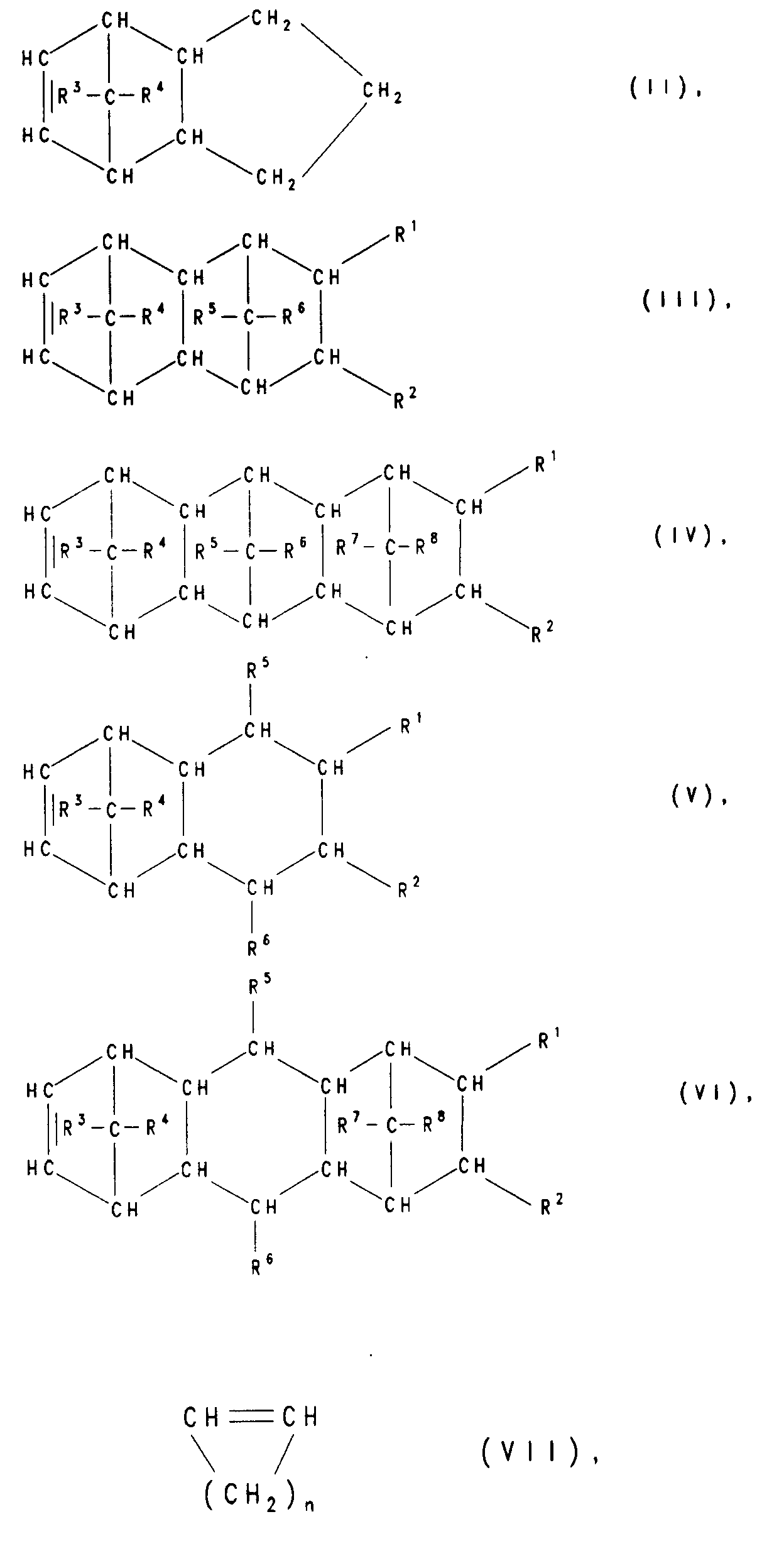
, worin die Reste R¹, R², R³, R⁴, R⁵, R⁶, R⁷ und R⁸ gleich oder verschieden sind und ein Wasserstoffatom oder einen C₁-C₂₀-Kohlenwasserstoffrest wie einen C₁-C₈-Alkylrest oder C₆-C₁₄-Arylrest bedeuten, oder einen Ring bilden, wobei gleiche Reste in den verschiedenen Formeln I-VI eine unterschiedliche Bedeutung haben können, und n eine Zahl von 2 bis 10 ist, und
0,1-99,9 Gew.-%, bezogen auf die Gesamtmasse des Cycloolefincopolymers, polymerisierte Einheiten mindestens eines Olefins, die mindestens eine Doppelbindung aufweisen, bevorzugt mindestens eines Olefins der Formeln VIII, IX, X, XI, XII und XII

, worin die Reste R⁹, R¹⁰, R¹¹, R¹², R¹³, R¹⁴ und R¹⁵ gleich oder verschieden sind und ein Wasserstoffatom oder einen C₁-C₂₀-Kohlenwasserstoffrest, C₁-C₈-Alkyl, C₆-C₁₄-Aryl oder C₃-C₁₅-Alkenyl bedeuten, wobei gleiche Reste in den verschiedenen Formeln VIII-XIII unterschiedliche Bedeutung haben können und mindestens einer der Reste R⁹, R¹⁰, R¹¹, R¹², R¹³ und R¹⁶ in Formel VIII sowie R⁹, R¹⁰, R¹¹ und R¹² in Formel XII ein Alkenylrest ist und m eine Zahl von 0 bis 10 ist und n, l eine Zahl von 0 bis 10 ist mit der Maßgabe, daß nicht n=l=0 ist, und
0-80 Gew.-%, bezogen auf die Gesamtmasse des Cycloolefinpolymers, polymerisierte Einheiten mindestens eines cyclischen Mono-Olefins, bevorzugt eines Alpha-Olefins mit 2-20 C-Atomen, besonders bevorzugt Ethylen. - Die in dem erfindungsgemäßen Verfahren eingesetzten doppelbindungshaltigen Cycloolefincopolymere werden hergestellt bei Temperaturen von -78°-200° C und einem Druck von 0,01-64 bar, in Gegenwart eines Katalysators, enthaltend ein Aluminoxan und mindestens ein Metallocen, bevorzugt ein Metallocen, der Formel (I) oder (II)

, worin M¹ ein Metall aus der Gruppe Titan, Zirkon, Hafnium, Vanadium, Niob und Tantal ist, R¹ und R² gleich oder verschieden sind und ein Wasserstoffatom, ein Halogenatom oder eine C₁-C₂₀-Kohlenwasserstoffgruppe wie eine C₁-C₁₀-Alkylgruppe, eine C₆-C₁₀-Arylgruppe, eine C₂-C₁₀-Alkenylgruppe, eine C₇-C₄₀-Arylalkylgruppe, eine C₇-C₄₀-Alkylarylgruppe oder eine C₈-C₄₀-Arylalkenylgruppe bedeuten,
R³ und R⁴ gleich oder verschieden sind und einen ein- oder mehrkernigen Kohlenwasserstoffrest, welcher mit dem Zentralatom eine Sandwichstruktur bilden kann, bedeuten,
R⁵
, =BR⁸, =AlR⁸, -Ge-, -Sn-, -O-, -S-, =S=O, =SO₂, =NR⁸, =PR⁸ oder =P(O)R⁸ bedeutet, wobei l = 1, 2 oder 3 ist,
R⁸ und R⁹ gleich oder verschieden sind und ein Wasserstoffatom, ein Halogenatom oder eine C₁-C₂₀-Kohlenwasserstoffgruppe wie eine C₁-C₁₀-Alkylgruppe, eine C₆-C₁₀-Arylgruppe, eine C₂-C₁₀-Alkenylgruppe, eine C₇-C₄₀-Arylalkylgruppe, eine C₈-C₄₀-Arylalkenylgruppe oder eine C₇-C₄₀-Alkylarylgruppe bedeuten oder R⁸ und R⁹ jeweils zusammen mit den sie verbindenden Atomen ein Ringsystem bilden,
R¹¹ ein Halogenatom oder eine C₁-C₂₀-Kohlenwasserstoffgruppe wie eine C₁-C₁₀-Alkylgruppe, eine C₆-C₁₀-Arylgruppe, eine C₂-C₁₀-Alkenylgruppe, eine C₇-C₄₀-Arylalkylgruppe, eine C₈-C₄₀-Arylalkenylgruppe oder eine C₇-C₄₀-Alkylarylgruppe bedeuten oder R⁸ und R¹¹ jeweils zusammen mit den sie verbindenden Atomen ein Ringsystem bilden, und M² Silizium, Germanium oder Zinn ist. - Ein- oder mehrkernige Kohlenwasserstoffreste sind bevorzugt unsubstituierte oder substitutierter Cyclopentadienylgruppen wie Cyclopentadienyl, Methylcyclopentadienyl, Methylcyclopentadiyl, Indenyl, 2-Methyl-Indenyl, 4,5-Benzoindenyl, 2-Methyl-4,5-Benzoindenyl, Fluorenyl oder 4,7-tert.-Butyl-Fluorenyl.
- Bevorzugt werden Metallocene der Formeln (I) und (II) eingesetzt, worin M¹ Zirkon ist,
R¹ und R² gleich sind und ein Halogenatom, insbesondere Chlor, oder eine C₁-C₁₀-Alkylgruppe, insbesondere Methyl sind,
R³ und R⁴ gleich oder verschieden sind und Cyclopentadienyl, Indenyl oder Fluorenyl sind, die mit C₁-C₂₀-Kohlenwasserstoffresten substituiert sein können,
R⁵
ist, worin R⁸, R⁹ und R¹¹ gleich oder verschieden sind und eine C₁-C₁₀-Alkylgruppe, insbesondere Methyl, oder eine C₆-C₁₀-Arylgruppe, insbesondere Phenyl sind. - Es bedeuten:
eta = Lösungsviskosität (Decalin, 60°C, gemäß DIN 51562) in dl/g,
Mw = Molekulargewicht in g/mol,
Mw/Mn = Polydispersität, gemessen mit Gelpermeationschromatographie (o-Dichlorbenzol, 135°C, Polystyrolstandard),
Äquivalentgewicht (ÄG) = g Polymer/mol funktionelle Gruppe (titrimetrisch bestimmt)
JZ = Jodzahl (titrimetrisch bestimmt) - Ein sauberer und trockener 1,5 dm³ Polymerisationsreaktor mit Rührer wurde mit Stickstoff und dann mit Ethylen gespült und mit 0,6 dm³ einer 85 %igen Lösung von Norbornen in Toluol gefüllt. Es wurden 60 ml 5-Vinylnorbornen-2 zugegeben. Der Ethylendruck wurde auf 6 bar Überdruck eingestellt. Weiterhin wurden 360 cm³ Wasserstoff zugegeben und die Temperatur auf 70 °C eingestellt. 12 mg Diphenylmethylen(cyclopentadienyl)(9-fluorenyl)zirkondichlorid wurden in 20 cm³ einer toluolischen Methylaluminoxanlösung (10 Gew.- % Methylaluminoxan mit Molmasse 1300 g/mol nach kryoskopischer Bestimmung) gelöst und anschließend in den Reaktor dosiert. Der Ethylendruck wurde durch Nachdosieren bei 6 bar gehalten. Nach einer Stunde Polymerisationszeit wurde der Reaktorinhalt in ein Gefäß abgelassen und mit 5 cm³ Isopropanol versetzt.
- Die Lösung wurde mit 10 g Celite 545 (LuV, Hamburg) und 5 cm³ Wasser versetzt und 30 min bei 60 °C gerührt. Auf dem Filtergewebe einer 2 l Drucknutsche wurde ein Filterkuchen aus 10 g Celite, suspendiert in 0,5 dm³ Toluol, aufgebaut. Die Polymerlösung wurde über die Drucknutsche filtriert, wobei ca. 1 bar Stickstoffdruck aufgebaut wurden. Die klare Lösung wurde in 5 dm³ Aceton mit Hilfe eines Dispergators (Fa. Kotthoff) eingetragen. Der Feststoff wurde durch Filtration isoliert, noch zweimal in Aceton dispergiert und anschließend bei 100 °C und reduziertem Druck (0,2 bar) 15 Stunden getrocknet. Es wurden 90 g Polymer erhalten, das 50 mol-% Ethylen-, 45 mol-% Norbornen- und 5 mol-%-Vinylnorbornen-Repetiereinheiten enthält. Die Glastemperatur war 151 °C, eta betrug 0,15 dl/g (DIN 51562), Mw = 9700 g/mol und Mw/Mn = 2,2. Es wurde eine Jodzahl von 15,5 bestimmt (ÄG = 1640 g/mol C=C).
- 9,0 g des Cycloolefincopolymeren aus Beispiel 1, wird unter Stickstoff zusammen mit 3,488 g Maleinsäureanhydrid in 57 ml Decalin (cis/trans-Gemisch) und 5,7 ml Nitrobenzol bei Raumtemperatur gelöst. Unter Rühren wird die Lösung auf 190 °C erwärmt. Nach 16 h wird durch Eingießen in 600 ml Aceton aufgearbeitet. Das ausgefallene, farblose maleinierte Polymere wird abgesaugt und mehrmals mit Aceton gewaschen. Das erhaltene Polymere wird bei 80 °C in 350 ml Toluol, dem 3,5 ml Acetanhydrid zugesetzt wurden, gelöst und in 1500 ml Aceton umgefällt. Nach Trocknung bei 60 °C im Vakuum werden 8,413 g Polymer mit einem Ãquivalentgewicht von 1370 g/mol C=C und eta = 0,16 dl/g erhalten. Acidimetrisch wird ein Äquivalentgewicht von 1940 g/mol Anhydrid gefunden. Diese Bestimmungsmethode wird beschrieben in: Polym. Eng. & Sci. 32, 467 (1992). Die IR-spektroskopische Anhydridbestimmung zeigte den gleichen Gehalt an gebundenem Maleinsäureanhydrid.
- Das COC aus Beispiel 1 wurde unter den in Beispiel 2 beschriebenen Bedingungen en-maleiniert, jedoch wurde Nitrobenzol durch 300 mg 2,6-Di-tert-butyl-4-methylphenol ersetzt. Aus 9,09 g wurden 9,00 g maleiniertes COC erhalten mit einem Äquivalentgewicht von 1150 g/mol C=C (JZ = 22), Äquivalentgewicht von 2500 g/mol Anhydrid, eta = 0,13 dl/g.
- Es wurde gemäß Beispiel 2 verfahren, jedoch wurden 20,0 g des COC zusammen mit 18,7 g (190 mmol) Maleinsäureanhydrid in 314 ml Toluol gelöst und 1,06 g (6,46 mmol, 3,2 mol-% bez. Doppelbindung) Azoisobutyronitril zugesetzt. Innerhalb von 80 min wurde von 20 auf 80 °C erwärmt, wobei ein Gel erhalten wurde.
- Ein en-maleiniertes COC (aus Beispiel 2) wurde in Methylenchlorid gelöst (20 % w/v) und auf eine Glasoberfläche aufgerakelt. Nach Abdunsten des Lösungsmittels über Nacht wurde an dem erhaltenen Polymerfilm ein Kontaktwinkel von 85 ° (Wasser), 75 ° (Glycerin) und 66 ° (Glykol) gemessen (Randwinkelmeßgerät G1, Fa. Krüss, Hamburg).
- An einem Film, der unter den Bedingungen von Beispiel 4 aus dem COC von Beispiel 1 hergestellt wurde, konnte ein Kontaktwinkel von 92 ° (Wasser), 78 ° (Glycerin) und 62 ° (Glykol) gemessen werden.
- Der Polymerfilm aus Beispiel 4 wurde mit einer gesättigten Lösung des Farbstoffs 1,2-Diaminoanthrachinon in N-Methylpyrrolidon (NMP), das 1 % (v/v) Pyridin enthielt, behandelt. Innerhalb von 60 min wurde von Raumtemperatur auf 100 °C erwärmt. Der Film wurde zunächst mit kaltem NMP, anschließend mit heißem Wasser klargespült und zeigte eine deutliche Rotfärbung. Auch durch Einwirken von Dimethylformamid (DMF) bei Raumtemperatur ließ sich die Färbung nicht entfernen.
- Die Polymerfolie aus Vergleichsbeispiel B wurde dem in Beispiel 5 beschriebenen Färbevorgang unterzogen. Die erhaltene schwache Rotfärbung ließ sich beim Spülen mit NMP restlos entfernen.
- Das COC aus Beispiel 3 wurde als 0,5, 5 und 10 Gew.-%ige Lösung in Decalin angesetzt und über Nacht unter Rühren gelöst. Jeweils die Hälfte jeder erhaltenen Lösung wurde sorgfältig entgast und mit Stickstoff gesättigt. Die zweite Hälfte jeder Lösung wurde im ursprünglichen Zustand belassen. Nun wurden alle Lösungen in verschlossenen Glasgefäßen in einen Thermostaten mit 135 °C Ölbadtemperatur eingehängt und die Zeit bis zum ersten Auftreten von Gelteilchen beobachtet. Die hochkonzentrierte entgaste Lösung begann nach 3 Minuten zu gelieren. Die mittelkonzentrierte Lösung benötigte 8 Minuten, während die 0,5 %-ige Probe nach 13 Minuten Gelteilchen zeigte. Proben, die nicht entgast worden waren, zeigten eine etwa 5 Minuten längere Zeitspanne bis zum Auftreten erster Gele.
Claims (6)
- Cycloolefincopolymer mit einer Lösungsviskosität (eta) < 0,25 dl/g, enthaltend A) polymerisierte Einheiten, mindestens eines polycyclischen Olefins, B) polymerisierte Einheiten mindestens eines Olefins, die mindestens eine Doppelbindung enthalten, und gegebenenfalls C) polymerisierte Einheiten eines oder mehrerer acyclischer Mono-Olefine, dadurch gekennzeichnet, daß das Äquivalentgewicht bezüglich olefinischer Doppelbindungen gleich oder kleiner ist als das Zahlenmittel des Molekulargewichts und zusätzlich mindestens eine Wiederholeinheit enthalten ist, welche mindestens zwei elektronenziehende Gruppen aufweist.
- Cycloolefincopolymer gemäß Anspruch 1, dadurch gekennzeichnet, daß es enthält:A) 0,1 - 99,89 Gew.-%, bezogen auf die Gesamtmasse des Cycloolefincopolymers, polymerisierte Einheiten mindestens eines Cycloolefins,B) 0,1 - 99,89 Gew.-%, bezogen auf die Gesamtmasse des Cycloolefincopolymers, polymerisierte Einheiten mindestens eines Olefins, die mindestens eine Doppelbindung aufweisen,C) 0 - 80 Gew.-%, bezogen auf die Gesamtmasse des Cycloolefincopolymers, polymerisierte Einheiten mindestens eines acyclischen Mono-Olefins undD) 0,01 bis 50 % Gew., bezogen auf die Gesamtmasse des Cycloolefincopolymers, polymerisierte Einheiten, welche mindestens zwei elektronenziehende Gruppen aufweisen.
- Cycloolefincopolymer gemäß Anspruch 2, dadurch gekennzeichnet, daß die polymerisierten Einheiten B), mindestens 0,1 Gew.-%, bezogen auf die Gesamtmasse des Cycloolefincopolymers, an polymerisierten Einheiten enthalten, die sich von mindestens einem acyclischen C₄-C₂₀-Polyen ableiten.
- Verfahren zur Herstellung eines kontrolliert vernetzbaren, enfunktionalisierten Cycloolefincopolymers mit einer Lösungsviskosität (eta) 0,25 < dl/g, dadurch gekennzeichnet, daß ein doppelbindungshaltiges Cycloolefincopolymer mit mindestens einem Enophil zur Reaktion gebracht wird.
- Beschichtungsmittel, enthaltend mindestens ein Cycloolefincopolymer gemäß einem oder mehreren der Ansprüche 1 bis 3.
- Verwendung eines Cyclolefincopolymers, gemäß einem oder mehreren der Ansprüche 1 bis 3, als Beschichtungsmittel oder Additiv.
Applications Claiming Priority (2)
| Application Number | Priority Date | Filing Date | Title |
|---|---|---|---|
| DE4344514A DE4344514A1 (de) | 1993-12-24 | 1993-12-24 | Cycloolefincopolymere und Verfahren zu ihrer Herstellung |
| DE4344514 | 1993-12-24 |
Publications (3)
| Publication Number | Publication Date |
|---|---|
| EP0661310A2 true EP0661310A2 (de) | 1995-07-05 |
| EP0661310A3 EP0661310A3 (de) | 1995-07-12 |
| EP0661310B1 EP0661310B1 (de) | 1999-07-21 |
Family
ID=6506250
Family Applications (1)
| Application Number | Title | Priority Date | Filing Date |
|---|---|---|---|
| EP94119951A Expired - Lifetime EP0661310B1 (de) | 1993-12-24 | 1994-12-16 | Cycloolefincopolymere und Verfahren zu ihrer Herstellung |
Country Status (5)
| Country | Link |
|---|---|
| EP (1) | EP0661310B1 (de) |
| JP (1) | JPH07216029A (de) |
| KR (1) | KR950018082A (de) |
| CN (1) | CN1108264A (de) |
| DE (2) | DE4344514A1 (de) |
Cited By (3)
| Publication number | Priority date | Publication date | Assignee | Title |
|---|---|---|---|---|
| EP0661308B1 (de) * | 1993-12-24 | 1999-06-02 | Ticona GmbH | Cycloolefincopolymere und Verfahren zu ihrer Herstellung |
| EP0997482A4 (de) * | 1997-07-18 | 2004-11-24 | Nippon Zeon Co | Modifiziertes cycloolefin-additionspolymer und härtbare harzzusammensetzung die dieses enthält |
| EP3971237A4 (de) * | 2019-05-14 | 2023-04-19 | Mitsui Chemicals, Inc. | Harzzusammensetzung für optische komponente, geformter gegenstand und optische komponente |
Families Citing this family (5)
| Publication number | Priority date | Publication date | Assignee | Title |
|---|---|---|---|---|
| US6713582B2 (en) | 2001-12-14 | 2004-03-30 | Uniroyal Chemical Company, Inc. | Process for the oligomerization of α-olefins having low unsaturation, the resulting polymers, and lubricants containing same |
| KR101609524B1 (ko) * | 2010-10-06 | 2016-04-05 | 미쓰이 가가쿠 가부시키가이샤 | 환상 올레핀 공중합체 및 그의 가교체 |
| JP7218176B2 (ja) * | 2018-12-27 | 2023-02-06 | 三井化学株式会社 | 環状オレフィン系共重合体、環状オレフィン系共重合体組成物および架橋体 |
| JP7824328B2 (ja) * | 2022-02-04 | 2026-03-04 | 三井化学株式会社 | 環状オレフィン系共重合体、環状オレフィン系共重合体組成物、ワニス、架橋体、フィルムまたはシート、積層体、回路基板、電子機器およびプリプレグ |
| CN117903372A (zh) * | 2024-03-19 | 2024-04-19 | 拓烯科技(衢州)有限公司 | 一种极性环烯烃共聚物和复合膜及其制备方法 |
Family Cites Families (5)
| Publication number | Priority date | Publication date | Assignee | Title |
|---|---|---|---|---|
| US3240762A (en) * | 1965-04-09 | 1966-03-15 | Velsicol Chemical Corp | Maleic anhydride hydrogenated polycyclopentadiene reaction products |
| JPS5842610A (ja) * | 1981-09-07 | 1983-03-12 | Mitsui Petrochem Ind Ltd | 炭化水素樹脂の製造法 |
| JPS6381103A (ja) * | 1986-09-24 | 1988-04-12 | Yasuhara Yushi Kogyo Kk | 淡色な変性炭化水素樹脂の製造方法 |
| IT1226575B (it) * | 1988-08-02 | 1991-01-24 | Ausimont Spa | Procedimento per effettuare l'innesto di anidride maleica su elastomeri poliolefinici insaturi mediante reazione in massa. |
| EP0661308B1 (de) * | 1993-12-24 | 1999-06-02 | Ticona GmbH | Cycloolefincopolymere und Verfahren zu ihrer Herstellung |
-
1993
- 1993-12-24 DE DE4344514A patent/DE4344514A1/de not_active Withdrawn
-
1994
- 1994-12-16 DE DE59408516T patent/DE59408516D1/de not_active Expired - Lifetime
- 1994-12-16 EP EP94119951A patent/EP0661310B1/de not_active Expired - Lifetime
- 1994-12-23 CN CN94119252A patent/CN1108264A/zh active Pending
- 1994-12-24 KR KR1019940036499A patent/KR950018082A/ko not_active Withdrawn
- 1994-12-26 JP JP6323067A patent/JPH07216029A/ja active Pending
Cited By (4)
| Publication number | Priority date | Publication date | Assignee | Title |
|---|---|---|---|---|
| EP0661308B1 (de) * | 1993-12-24 | 1999-06-02 | Ticona GmbH | Cycloolefincopolymere und Verfahren zu ihrer Herstellung |
| EP0997482A4 (de) * | 1997-07-18 | 2004-11-24 | Nippon Zeon Co | Modifiziertes cycloolefin-additionspolymer und härtbare harzzusammensetzung die dieses enthält |
| EP3971237A4 (de) * | 2019-05-14 | 2023-04-19 | Mitsui Chemicals, Inc. | Harzzusammensetzung für optische komponente, geformter gegenstand und optische komponente |
| US12595359B2 (en) | 2019-05-14 | 2026-04-07 | Mitsui Chemicals, Inc. | Resin composition for forming optical component, molded product, and optical component |
Also Published As
| Publication number | Publication date |
|---|---|
| DE4344514A1 (de) | 1995-06-29 |
| KR950018082A (ko) | 1995-07-22 |
| CN1108264A (zh) | 1995-09-13 |
| JPH07216029A (ja) | 1995-08-15 |
| EP0661310B1 (de) | 1999-07-21 |
| DE59408516D1 (de) | 1999-08-26 |
| EP0661310A3 (de) | 1995-07-12 |
Similar Documents
| Publication | Publication Date | Title |
|---|---|---|
| EP0661308B1 (de) | Cycloolefincopolymere und Verfahren zu ihrer Herstellung | |
| DE19654074C2 (de) | Verfahren zur Herstellung hydrierter ringgeöffneter Metathesepolymeren | |
| DE3853843T2 (de) | Zyklisch-olefinische statische Copolymere, olefinische statische Copolymere und Verfahren zur Herstellung von zyklisch-olefinischen statischen Copolymeren. | |
| DE4425408A1 (de) | Cycloolefinpolymere | |
| DE69417598T2 (de) | Cycloolefin-Polymerzusammensetzung | |
| DE68912143T2 (de) | Modifizierte chlorierte polyolefine. | |
| JP7592623B2 (ja) | ペンダントイミダゾール官能基を担持するグラフト化ポリマー | |
| EP0661310B1 (de) | Cycloolefincopolymere und Verfahren zu ihrer Herstellung | |
| US5623039A (en) | Cycloolefin polymers | |
| EP0694568A2 (de) | Cycloolefincopolymere und ein Verfahren zu ihrer Herstellung | |
| DE60024682T2 (de) | Durch ringöffnende polymerisation hergestellte copolymere, hydrierungsprodukt durch ringöffnende polymerisation hergestellter copolymere und verfahren zur herstellung derselben | |
| EP0694567A2 (de) | Cycloolefincopolymere und ein Verfahren zu ihrer Herstellung | |
| DE2026189A1 (de) | Terpolymere und Tetrapolymere mit funktioneilen Substituenten und Verfahren zu ihrer Herstellung | |
| EP1268499B1 (de) | Verfahren zur polymerisation von polar substituierten cycloalkenen | |
| EP0661309B1 (de) | Verwendung von peroxogenierten Cycloolefincopolymeren | |
| WO1998046614A1 (de) | Katalysator und verwendung des katalysators für die polymerisation | |
| WO1992016585A1 (de) | Legierungen aus cycloolefinpolymeren und flüssigkristallinen polyestern | |
| DE2164022C3 (de) | Verfahren zur Herstellung thermoplastischer Kunststoffe | |
| DE10102086A1 (de) | Synthese und Anwendungen von extrem quellbaren, funktionalisierten quervernetzten Polymeren durch Ringöffnungs-Metathese-Copolymerisation (ROMC) | |
| DE2143803C3 (de) | Verfahren zur Herstellung von Polymerisaten und Mischpolymerisaten unter Verwendung von polycyclischen Polyenen | |
| DE1953898C3 (de) | Polymere organische Charge-Transfer-Komplexe | |
| DE2532115A1 (de) | Hochmolekulare teilkristalline gesaettigte terpolymere mit verbesserten roheigenschaften | |
| EP0263939A2 (de) | Verfahren zur Herstellung von Polymaleinsäureanhydridpulver | |
| DD252378A1 (de) | Verfahren zur herstellung polymerer percarboxyverbindungen | |
| CA1163739A (en) | Process for producing a polymerized, heat-resistant lacquer |
Legal Events
| Date | Code | Title | Description |
|---|---|---|---|
| PUAI | Public reference made under article 153(3) epc to a published international application that has entered the european phase |
Free format text: ORIGINAL CODE: 0009012 |
|
| PUAL | Search report despatched |
Free format text: ORIGINAL CODE: 0009013 |
|
| AK | Designated contracting states |
Kind code of ref document: A2 Designated state(s): DE FR GB IT NL |
|
| AK | Designated contracting states |
Kind code of ref document: A3 Designated state(s): DE FR GB IT NL |
|
| 17P | Request for examination filed |
Effective date: 19960112 |
|
| 17Q | First examination report despatched |
Effective date: 19960925 |
|
| RAP1 | Party data changed (applicant data changed or rights of an application transferred) |
Owner name: TICONA GMBH |
|
| GRAG | Despatch of communication of intention to grant |
Free format text: ORIGINAL CODE: EPIDOS AGRA |
|
| RAP1 | Party data changed (applicant data changed or rights of an application transferred) |
Owner name: TICONA GMBH |
|
| GRAG | Despatch of communication of intention to grant |
Free format text: ORIGINAL CODE: EPIDOS AGRA |
|
| GRAH | Despatch of communication of intention to grant a patent |
Free format text: ORIGINAL CODE: EPIDOS IGRA |
|
| GRAH | Despatch of communication of intention to grant a patent |
Free format text: ORIGINAL CODE: EPIDOS IGRA |
|
| GRAA | (expected) grant |
Free format text: ORIGINAL CODE: 0009210 |
|
| AK | Designated contracting states |
Kind code of ref document: B1 Designated state(s): DE FR GB IT NL |
|
| REF | Corresponds to: |
Ref document number: 59408516 Country of ref document: DE Date of ref document: 19990826 |
|
| ITF | It: translation for a ep patent filed | ||
| GBT | Gb: translation of ep patent filed (gb section 77(6)(a)/1977) |
Effective date: 19990929 |
|
| ET | Fr: translation filed | ||
| PLBE | No opposition filed within time limit |
Free format text: ORIGINAL CODE: 0009261 |
|
| STAA | Information on the status of an ep patent application or granted ep patent |
Free format text: STATUS: NO OPPOSITION FILED WITHIN TIME LIMIT |
|
| PG25 | Lapsed in a contracting state [announced via postgrant information from national office to epo] |
Ref country code: NL Free format text: LAPSE BECAUSE OF NON-PAYMENT OF DUE FEES Effective date: 20000701 |
|
| 26N | No opposition filed | ||
| NLV4 | Nl: lapsed or anulled due to non-payment of the annual fee |
Effective date: 20000701 |
|
| REG | Reference to a national code |
Ref country code: GB Ref legal event code: IF02 |
|
| PGFP | Annual fee paid to national office [announced via postgrant information from national office to epo] |
Ref country code: IT Payment date: 20091218 Year of fee payment: 16 Ref country code: GB Payment date: 20091218 Year of fee payment: 16 Ref country code: FR Payment date: 20100108 Year of fee payment: 16 |
|
| PGFP | Annual fee paid to national office [announced via postgrant information from national office to epo] |
Ref country code: DE Payment date: 20091222 Year of fee payment: 16 |
|
| GBPC | Gb: european patent ceased through non-payment of renewal fee |
Effective date: 20101216 |
|
| REG | Reference to a national code |
Ref country code: FR Ref legal event code: ST Effective date: 20110831 |
|
| PG25 | Lapsed in a contracting state [announced via postgrant information from national office to epo] |
Ref country code: FR Free format text: LAPSE BECAUSE OF NON-PAYMENT OF DUE FEES Effective date: 20110103 |
|
| REG | Reference to a national code |
Ref country code: DE Ref legal event code: R119 Ref document number: 59408516 Country of ref document: DE Effective date: 20110701 |
|
| PG25 | Lapsed in a contracting state [announced via postgrant information from national office to epo] |
Ref country code: DE Free format text: LAPSE BECAUSE OF NON-PAYMENT OF DUE FEES Effective date: 20110701 Ref country code: GB Free format text: LAPSE BECAUSE OF NON-PAYMENT OF DUE FEES Effective date: 20101216 |
|
| PG25 | Lapsed in a contracting state [announced via postgrant information from national office to epo] |
Ref country code: IT Free format text: LAPSE BECAUSE OF NON-PAYMENT OF DUE FEES Effective date: 20101216 |