EP0663158A2 - Etui avec dispositif de renforcement - Google Patents
Etui avec dispositif de renforcement Download PDFInfo
- Publication number
- EP0663158A2 EP0663158A2 EP94119863A EP94119863A EP0663158A2 EP 0663158 A2 EP0663158 A2 EP 0663158A2 EP 94119863 A EP94119863 A EP 94119863A EP 94119863 A EP94119863 A EP 94119863A EP 0663158 A2 EP0663158 A2 EP 0663158A2
- Authority
- EP
- European Patent Office
- Prior art keywords
- case
- case according
- halves
- cavity
- reinforcing device
- Prior art date
- Legal status (The legal status is an assumption and is not a legal conclusion. Google has not performed a legal analysis and makes no representation as to the accuracy of the status listed.)
- Withdrawn
Links
- 230000003014 reinforcing effect Effects 0.000 title claims description 21
- 229920002678 cellulose Polymers 0.000 claims abstract description 21
- 239000001913 cellulose Substances 0.000 claims abstract description 21
- 239000000463 material Substances 0.000 claims abstract description 13
- 230000002787 reinforcement Effects 0.000 claims abstract description 12
- 239000011521 glass Substances 0.000 claims abstract description 8
- 229910052751 metal Inorganic materials 0.000 claims description 23
- 239000002184 metal Substances 0.000 claims description 23
- 230000005294 ferromagnetic effect Effects 0.000 claims description 12
- 239000004922 lacquer Substances 0.000 claims description 7
- XLYOFNOQVPJJNP-UHFFFAOYSA-N water Substances O XLYOFNOQVPJJNP-UHFFFAOYSA-N 0.000 claims description 7
- 239000003973 paint Substances 0.000 claims description 5
- 239000004753 textile Substances 0.000 claims description 5
- 239000011248 coating agent Substances 0.000 claims description 4
- 239000004519 grease Substances 0.000 claims description 4
- 239000000126 substance Substances 0.000 claims description 4
- 239000005871 repellent Substances 0.000 claims description 3
- 239000003302 ferromagnetic material Substances 0.000 claims description 2
- 230000002940 repellent Effects 0.000 claims 1
- 238000004519 manufacturing process Methods 0.000 abstract description 9
- 230000008901 benefit Effects 0.000 description 7
- 230000005291 magnetic effect Effects 0.000 description 5
- 239000003086 colorant Substances 0.000 description 2
- 235000009508 confectionery Nutrition 0.000 description 2
- 238000011109 contamination Methods 0.000 description 2
- 230000003287 optical effect Effects 0.000 description 2
- 239000006187 pill Substances 0.000 description 2
- 238000004064 recycling Methods 0.000 description 2
- 238000004026 adhesive bonding Methods 0.000 description 1
- 229910052782 aluminium Inorganic materials 0.000 description 1
- XAGFODPZIPBFFR-UHFFFAOYSA-N aluminium Chemical compound [Al] XAGFODPZIPBFFR-UHFFFAOYSA-N 0.000 description 1
- 238000000576 coating method Methods 0.000 description 1
- 238000010276 construction Methods 0.000 description 1
- 230000000694 effects Effects 0.000 description 1
- 230000007613 environmental effect Effects 0.000 description 1
- 239000011888 foil Substances 0.000 description 1
- 235000013305 food Nutrition 0.000 description 1
- 238000004806 packaging method and process Methods 0.000 description 1
- 239000010893 paper waste Substances 0.000 description 1
- 230000002028 premature Effects 0.000 description 1
- 239000005028 tinplate Substances 0.000 description 1
- 230000000007 visual effect Effects 0.000 description 1
- 239000002699 waste material Substances 0.000 description 1
Images

Classifications
-
- A—HUMAN NECESSITIES
- A47—FURNITURE; DOMESTIC ARTICLES OR APPLIANCES; COFFEE MILLS; SPICE MILLS; SUCTION CLEANERS IN GENERAL
- A47F—SPECIAL FURNITURE, FITTINGS, OR ACCESSORIES FOR SHOPS, STOREHOUSES, BARS, RESTAURANTS OR THE LIKE; PAYING COUNTERS
- A47F5/00—Show stands, hangers, or shelves characterised by their constructional features
- A47F5/08—Show stands, hangers, or shelves characterised by their constructional features secured to the wall, ceiling, or the like; Wall-bracket display devices
-
- A—HUMAN NECESSITIES
- A45—HAND OR TRAVELLING ARTICLES
- A45C—PURSES; LUGGAGE; HAND CARRIED BAGS
- A45C11/00—Receptacles for purposes not provided for in groups A45C1/00-A45C9/00
- A45C11/04—Spectacle cases; Pince-nez cases
-
- A—HUMAN NECESSITIES
- A45—HAND OR TRAVELLING ARTICLES
- A45C—PURSES; LUGGAGE; HAND CARRIED BAGS
- A45C11/00—Receptacles for purposes not provided for in groups A45C1/00-A45C9/00
- A45C11/34—Pencil boxes; Pencil etuis or the like
Definitions
- the invention relates to a case made of cellulose or similar recyclable materials, in particular for storing glasses, writing and drawing utensils and / or other essentially elongated objects, consisting of two interconnectable, essentially identical halves that enclose a cavity. wherein the first half has a shoulder formed at least in partial areas, which is preferably formed in one piece with the first half and can be inserted into the part of the cavity of the second half in such a way that a frictional connection is created between the shoulder of the first half and the inner surface of the second half .
- Such cases made of cellulose have long been available on the market. They are particularly suitable as storage containers for glasses. However, it has also been shown that other, primarily elongated objects can be stored in such cases. This is particularly true of writing and drawing utensils to think, so that a generic case can also be used as a pen case, for example for schoolchildren.
- the advantage of these known cases is that, in addition to the benefits mentioned above, they are very environmentally friendly, since they consist exclusively of cellulose or a similarly recyclable material. Waste paper in particular can be used in the manufacture of such cases from cellulose.
- the cases also have presentation areas that can be provided with caricatures or well-known cartoon characters, so that a certain, incentive effect can be achieved with such cases.
- the images or the like applied to the presentation surfaces are preferably applied with water colors or other environmentally friendly, water-based colors.
- Cases of this type have proven to be particularly suitable for the above-mentioned purpose. Nevertheless, the above-mentioned construction of the cases made of pure cellulose or other recyclable material has the disadvantage that in particular the end regions of the case have insufficient stability, so that there is a risk of damage if objects are stored in the case, the length of which is slightly greater than is the inside length of the cavity so that these objects can pierce the end areas if improperly handled.
- the invention has for its object to provide a generic case that is inexpensive, environmentally friendly to manufacture and in particular in its end areas has increased stability against damage and can be presented in a simple and effective form.
- both halves are designed with at least one reinforcing device covering partial areas of the inner surfaces in the end area of the case.
- this reinforcing device which is arranged on the inner surface in the end region of the halves, a substantial improvement in the stability of the case is achieved without the outer appearance of the case having to be changed.
- such an addition to the case represents a cost-effective improvement in the quality of the case, so that damage caused by objects of a correspondingly large length and stored in the cavity is avoided.
- the constructional and manufacturing expenditure is low due to this inventive design of the generic case, so that an inexpensive and environmentally friendly manufacture of the case is still guaranteed.
- An alternative second solution provides in a generic case that the end regions of the two halves are provided on the outside with a coating agent which strengthens the cellulose layers in these regions, in particular a water-based clear lacquer, a film or the like.
- Another alternative third solution provides that an insert in the form of an essentially in the cavity the contour of the cavity adapted receiving device is arranged, which has at least four side walls and a base plate.
- an insert is provided in the form of a receiving device, in particular a box or the like, which is modeled on the inner contour of the case and essentially bears against the inner walls of the case in the closed state.
- This insert has the advantage that the end regions of the case are reinforced in that the wall of the insert is also arranged there in addition to the wall of the case, so that the total wall thickness is composed of the wall thickness of the case and the wall thickness of the insert.
- glasses or writing utensils or the like can be inserted, the insert being able to be pulled out of the halves after pulling apart the two halves of the case, so that the object stored in the insert can be removed.
- the entire inner surfaces of the two halves are completely lined with the reinforcing device.
- this further improves the overall stability of the case.
- Not only the end areas of the two halves are reinforced, but rather the entire wall area of the case.
- the manufacture of the case is facilitated by the fact that the reinforcement devices can be inserted in a simple manner with a precise fit in the halves of the case, since they extend into the edge region of the respective half, so that the reinforcement device can be easily positioned manually or mechanically in the respective half is possible.
- the reinforcement device is designed as a metal or plastic shell.
- a metal shell preferably a tinplate or aluminum shell
- the above-mentioned environmental protection aspect is ensured, since this metal insert can be easily removed from the cavity of the case during the recycling of such cases, so that only two substances, namely the cellulose of the case and the metal of the reinforcement device is present, which can then be processed and reused.
- a plastic shell which in particular has weight advantages compared to the use of a metal shell, easy recycling is possible without any problems, since in this case the two substances can also be separated by pulling the plastic shell out of the cellulose casing of the case.
- the case to be recycled can be cut open for this purpose, so that further simplification of the removal of the reinforcing device is achieved.
- a predetermined breaking point or the like can already be provided in the halves of the case during the production of the case, which facilitates the opening of the case and the removal of the reinforcing device.
- the reinforcing device consists of a textile material, in particular of velvet.
- this also achieves an optical quality enhancement of the case, since the lining of the case with textile material of appropriate quality creates a high-quality impression.
- connection of the reinforcing device made of textile material and the two halves of the Cases are preferably made by gluing, whereas the metal or plastic shell is held in the halves by friction, ie by friction. But it is also conceivable that the metal or plastic shell is glued to one half of the case or connected in some other way.
- the reinforcement device is embedded in the end region of the two halves between two layers of cellulose or the like.
- the reinforcement device prefferably designed such that its end protruding from one half of the case forms the shoulder of this half, onto which the second half of the case can be pushed in such a way that between the shoulder of the first Half and the inner surface of the second half creates a frictional connection.
- the insert is divided into individual compartments in its longitudinal or transverse direction.
- the case according to the invention has a further function, namely the storage of various objects in individually divided compartments.
- Such a case is therefore particularly suitable for storing small parts.
- Use of the case can therefore be used as a pill storage, screw storage or other case for other small parts.
- Such cases can also be marketed as cases filled with no parts, so that the case can be used for other purposes after the small parts have been used up. Accordingly, a sales-promoting packaging for small parts is created which, after the small parts have been used up, does not immediately arise as waste material, but can be reused.
- At least one half has ferromagnetic properties in at least one partial area and is releasably attached to a holder which is at least in Partial areas are made of metal and cooperate with ferromagnetic substances.
- a case designed according to this teaching can be attached to the holder in a simple manner by the action of the ferromagnetic materials, giving the impression that the case is arranged floating on the holder.
- the holder does not have to be specially designed for this purpose.
- a metal surface serves as a holder, for example metal surfaces in motor vehicles or the outer surface of kitchen appliances, such as refrigerators, microwave ovens or electric ovens.
- the case can be attached to any metal surface, provided that at least one half has a magnet that is arranged at least in partial areas of the half.
- at least half of the case has an element made of metal interacting with ferromagnetic elements, so that the case can be attached to magnetic surfaces.
- At least one half has a magnet which is preferably arranged within the wall of the half.
- the magnet inside the case which is preferably made of cellulose, has no optical influence on the outer contour of the case. Rather, the magnet is in the wall, i. H. it is embedded in this wall.
- the magnet is part of the reinforcement device designed as a metal shell. In this way, an inexpensive and simple manufacture of such a case can be carried out, since with the reinforcement device designed as a metal shell, the magnet is also arranged inside the case.
- the holder preferably consists of a plate, preferably of metal, and holding elements arranged thereon. These holding elements can be projections or arms, on the free ends of which ferromagnetic elements are arranged which cooperate with the ferromagnetic partial regions of the halves.
- the case can either be attached directly to the metal plate or in the area of the projections or arms, which also carry ferromagnetic elements for this purpose.
- the embodiment of the holder described above with projections or arms and the ferromagnetic elements arranged thereon has the advantage that the visual impression of a floating case is further enhanced. As a result, the case is presented in a particularly effective form.
- the preceding and following explanations are, however, not only suitable for the presentation of such cases in companies selling these cases, but rather also for the private sector, since in this way an impressive decorative object for walls or the like is achieved.
- the plate has a plurality of holding elements which are arranged above or below one another and / or next to one another for accommodating several cases. Furthermore, it is advantageous for this purpose that the holder, as provided according to a further feature of the invention, has a presentation surface which is suitable, for example, for arranging the product name, price tags or instructions for use.
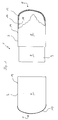
- a case 1 made of cellulose which consists of two halves 2 and 3, which encase a cavity, not shown, in its interior.
- the half 3 of the case 1 has a shoulder 4 which is designed such that it can be inserted into the cavity in the half 2 in such a way that a frictional connection is formed between the shoulder 4 of the half 3 and the inner surface of the half 2 when half 3 is plugged together with half 2.
- the paragraph 4 is firmly connected to the half 3, preferably glued.
- the case 1 and the paragraph 4 and therefore also the cavity of the case 1 have an essentially oval shape in cross section.
- the case 1 is formed in the end regions 5 and 6 of the halves 2 and 3 in the form of a segment of a circular arc, so that when the halves 2 and 3 are fitted together, the case 1 has an essentially edgeless and cornerless appearance.
- the case 1 has halves 2 and 3 for presentation surfaces 7 and 8 for arranging caricatures, pictures, drawings, writing symbols or the like.
- Another presentation surface 9 can be arranged in the area of the heel 4, which becomes visible when the two halves 2 and 3 are pulled apart, around the case 1, for example with glasses, with writing and drawing utensils, or with other objects with substantially elongated objects is filled or if these items are to be removed from the case 1.
- Fig. 1 the half 3 is shown in a partially sectioned side view, so that the wall 10 can be seen from cellulose.
- a reinforcing device 12 is arranged in the end region 6, which consists of a metal shell, which is inserted non-positively in the end region 6 of the half 3.
- This reinforcing device 12 reinforces the case 1 in the region of the end region 6 of the half 3 in such a way that damage to the end region 6 of the half 3 of the case 1 by elongated objects, the length of which is greater than the cavity in the case 1, is avoided when the halves 2 and 3 of the case 1 are plugged together and a force is applied in their longitudinal direction.
- the reinforcing device 12 shown in FIG. 1 in half 3 which here consists of a metal shell
- a plastic shell can also be used here.
- the reinforcement device 12 it is possible for the reinforcement device 12 to be arranged over the entire inner surface 11 of the half 3 of the case 1, so that not only the end region 6 of the half 3 but also the wall 10 of the case 1, which runs essentially parallel to the longitudinal direction of the half 3, is also reinforced.
- the end area 5 is reinforced by a coat of paint which strengthens this area, in particular in the form of a clear lacquer on a water basis.
- the paint is identified by reference number 13 and represented by a thicker line.
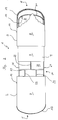
- FIG. 2 Another embodiment of the case according to the invention is shown in FIG. 2.
- This embodiment of the case 1 differs from the embodiment of the case 1 according to FIG. 1 in that an insert 20 is arranged in the cavity of the two halves 2, 3 of the case 1 in the form of a receiving device which is essentially matched to the contour of the cavity has at least four side walls 21 and a base plate 22.
- the insert 20 is divided into individual compartments in its longitudinal and transverse directions by a plurality of webs 23.
- the case 1 according to the invention is particularly suitable for storing small parts such as pills or tablets, screws or nails or even foods such as candies or the like. Confectionery.
- the case 1 is coated with a grease and water-repellent lacquer in the area of its surface and in particular in its end areas 5, 6.
- this lacquer also contributes to increasing the stability of the case 1 according to the invention if it is made from cellulose, in particular from recycled paper.
- the device shown in FIG. 3 with the reference number 31 consists of a holder 32 and a case 1, which is formed from two halves 2 and 3 of essentially the same size, the two halves 2 and 3 being designed such that they can be plugged together or are detachable from one another.
- the case 1 is made of cellulose and has a wall 10 which encloses a cavity.
- ferromagnetic elements Inside the cavity, in two halves 2 and 3 on the wall 10 are arranged ferromagnetic elements, namely magnets 40, which can preferably be glued to the wall 10. But it is also conceivable that the magnets 40 are embedded in the wall 10.
- the holder 32 consists of a plate 33, which is cuboid and has at least one bore 34 at its opposite ends in the region of its narrow sides.
- the holes 34 are used to hold fasteners, not shown, preferably screws, with which the plate 33 can be fastened, preferably to flat surfaces, for example a wall of masonry.
- each magnetic element has a curved surface 38, which faces the outer surface of the case 1 connected to the holder 32, and whose radius of curvature essentially corresponds to the radius of curvature of the outer surface of the case 1, so that the largest possible contact surface between each magnetic element 37 and the outer surface of the case 1 is achieved.
Landscapes
- Purses, Travelling Bags, Baskets, Or Suitcases (AREA)
Applications Claiming Priority (6)
| Application Number | Priority Date | Filing Date | Title |
|---|---|---|---|
| DE4342875 | 1993-12-16 | ||
| DE4342875 | 1993-12-16 | ||
| DE19944401522 DE4401522C1 (de) | 1993-12-16 | 1994-01-20 | Etui mit Verstärkungseinrichtung |
| DE4401522 | 1994-01-20 | ||
| DE4434438 | 1994-09-27 | ||
| DE4434438A DE4434438C2 (de) | 1994-01-20 | 1994-09-27 | Etui mit Verstärkungseinrichtung |
Publications (2)
| Publication Number | Publication Date |
|---|---|
| EP0663158A2 true EP0663158A2 (fr) | 1995-07-19 |
| EP0663158A3 EP0663158A3 (fr) | 1996-03-20 |
Family
ID=27205868
Family Applications (1)
| Application Number | Title | Priority Date | Filing Date |
|---|---|---|---|
| EP94119863A Withdrawn EP0663158A3 (fr) | 1993-12-16 | 1994-12-15 | Etui avec dispositif de renforcement. |
Country Status (1)
| Country | Link |
|---|---|
| EP (1) | EP0663158A3 (fr) |
Family Cites Families (11)
| Publication number | Priority date | Publication date | Assignee | Title |
|---|---|---|---|---|
| DE654244C (de) * | 1937-12-15 | Paul Bach | Brillenetui mit ueberschiebbarer Verschlusskappe | |
| US1699712A (en) * | 1925-08-21 | 1929-01-22 | American Optical Corp | Process for producing receptacles |
| CH127410A (de) * | 1927-08-12 | 1928-09-01 | Hans Bendig | Buchattrappe. |
| DE1696235U (de) * | 1955-02-03 | 1955-04-07 | Johann Gramann | Behaelter aus pappe und schnitt fuer solche behaelter. |
| US3050181A (en) * | 1961-01-27 | 1962-08-21 | Opticase Co | Spectacle case |
| FR1296732A (fr) * | 1961-05-12 | 1962-06-22 | étui à usages multiples, et ses applications | |
| CA856627A (en) * | 1967-05-05 | 1970-11-24 | Bathurst Paper Limited | Reinforced containers |
| DE2528506A1 (de) * | 1975-06-26 | 1977-01-13 | Amtenbrink Paul | Brillenetui mit einer befestigungsvorrichtung |
| GB2170030A (en) * | 1985-01-17 | 1986-07-23 | Michael France | Magnetic display system |
| JP2532717Y2 (ja) * | 1989-04-07 | 1997-04-16 | レック 株式会社 | 磁気止着具 |
| DE9105431U1 (de) * | 1991-05-02 | 1991-06-27 | Optik Paradies Suchy GmbH, 8000 München | Behältnis, insbesondere Brillenetui |
-
1994
- 1994-12-15 EP EP94119863A patent/EP0663158A3/fr not_active Withdrawn
Also Published As
| Publication number | Publication date |
|---|---|
| EP0663158A3 (fr) | 1996-03-20 |
Similar Documents
| Publication | Publication Date | Title |
|---|---|---|
| DE4401522C1 (de) | Etui mit Verstärkungseinrichtung | |
| EP0802747B1 (fr) | Etui a dispositif de renforcement | |
| EP0663158A2 (fr) | Etui avec dispositif de renforcement | |
| EP3770081B1 (fr) | Doublure interne pour un emballage et emballage | |
| CH593651A5 (en) | Display case for watches or jewellery - has two engaging boxes connected by flexible hinge strap with transparent face in one box top | |
| DE3105762C2 (de) | Verkleidung für einen etuiartigen oder kästchenförmigen Behälter | |
| DE19500770A1 (de) | Etui mit Verstärkungseinrichtung | |
| DE9003400U1 (de) | Karton od.dgl. Verpackung | |
| DE19633261A1 (de) | Vorrichtung zur Darbietung und Lagerung von Werkzeugen | |
| DE264052C (fr) | ||
| DE102019108785B3 (de) | Behälterteil für einen Behälter zur Aufnahme von Lebensmitteln und Behälter zur Aufnahme von Lebensmitteln | |
| DE2034981C3 (de) | Schiebeschachtel | |
| DE1554330C (de) | Behälter für Verpackungszwecke | |
| DE4210683A1 (de) | Warenpräsentationskarte | |
| DE8808592U1 (de) | Vorratsbehälter für Speisen, Lebensmittel o.dgl. | |
| DE3830698A1 (de) | Verpackung, insbesondere geschenkverpackung | |
| DE8905246U1 (de) | Kofferhülle | |
| DE19628115C2 (de) | Etui mit Schutzeinrichtung | |
| DE29706950U1 (de) | Bauteile- und Verpackungssatz für Griffe, insbesondere Tür- und Fenstergriffe | |
| DE8715938U1 (de) | Verpackung, insbesondere Geschenkverpackung | |
| DE29719831U1 (de) | Etui oder Schachtel | |
| DE9015817U1 (de) | Verpackung für insbesondere kleine Verpackungsgegenstände | |
| DE2152042A1 (de) | Packbehaelter,insbesondere fuer Tonbaender,Tonbandkassetten,-spulen od.dgl. | |
| DE7108204U (de) | Prasentations und Aufbewahrungs behalter fur Edelsteine | |
| DE9301599U1 (de) | Präsentations-Verpackung für Kleinwerkzeuge, insbesondere Schraubendrehereinsätze |
Legal Events
| Date | Code | Title | Description |
|---|---|---|---|
| PUAI | Public reference made under article 153(3) epc to a published international application that has entered the european phase |
Free format text: ORIGINAL CODE: 0009012 |
|
| AK | Designated contracting states |
Kind code of ref document: A2 Designated state(s): AT BE CH DE ES FR IT LI NL |
|
| PUAL | Search report despatched |
Free format text: ORIGINAL CODE: 0009013 |
|
| AK | Designated contracting states |
Kind code of ref document: A3 Designated state(s): AT BE CH DE ES FR IT LI NL |
|
| 17P | Request for examination filed |
Effective date: 19960731 |
|
| 17Q | First examination report despatched |
Effective date: 19961016 |
|
| GRAG | Despatch of communication of intention to grant |
Free format text: ORIGINAL CODE: EPIDOS AGRA |
|
| GRAG | Despatch of communication of intention to grant |
Free format text: ORIGINAL CODE: EPIDOS AGRA |
|
| GRAH | Despatch of communication of intention to grant a patent |
Free format text: ORIGINAL CODE: EPIDOS IGRA |
|
| GRAH | Despatch of communication of intention to grant a patent |
Free format text: ORIGINAL CODE: EPIDOS IGRA |
|
| RAP1 | Party data changed (applicant data changed or rights of an application transferred) |
Owner name: WOEHRSTEIN, ROLF |
|
| RIN1 | Information on inventor provided before grant (corrected) |
Inventor name: WOEHRSTEIN, ROLF |
|
| STAA | Information on the status of an ep patent application or granted ep patent |
Free format text: STATUS: THE APPLICATION IS DEEMED TO BE WITHDRAWN |
|
| 18D | Application deemed to be withdrawn |
Effective date: 20010703 |