EP0664314A1 - Polymerkreislaufwiedergewinnung durch selektive Auflösung - Google Patents
Polymerkreislaufwiedergewinnung durch selektive Auflösung Download PDFInfo
- Publication number
- EP0664314A1 EP0664314A1 EP19950200535 EP95200535A EP0664314A1 EP 0664314 A1 EP0664314 A1 EP 0664314A1 EP 19950200535 EP19950200535 EP 19950200535 EP 95200535 A EP95200535 A EP 95200535A EP 0664314 A1 EP0664314 A1 EP 0664314A1
- Authority
- EP
- European Patent Office
- Prior art keywords
- solvent
- polymer
- solution
- polymers
- temperature
- Prior art date
- Legal status (The legal status is an assumption and is not a legal conclusion. Google has not performed a legal analysis and makes no representation as to the accuracy of the status listed.)
- Granted
Links
- 229920000642 polymer Polymers 0.000 title claims abstract description 107
- 238000004090 dissolution Methods 0.000 title claims description 41
- 238000004064 recycling Methods 0.000 title description 6
- 239000002904 solvent Substances 0.000 claims abstract description 61
- 238000000034 method Methods 0.000 claims abstract description 43
- 239000007787 solid Substances 0.000 claims abstract description 11
- 238000001704 evaporation Methods 0.000 claims abstract description 7
- 230000008020 evaporation Effects 0.000 claims abstract description 5
- 239000008247 solid mixture Substances 0.000 claims abstract description 5
- 238000010438 heat treatment Methods 0.000 claims abstract 3
- 239000000203 mixture Substances 0.000 claims description 24
- 229920000098 polyolefin Polymers 0.000 claims description 12
- 239000011159 matrix material Substances 0.000 claims 1
- 238000007796 conventional method Methods 0.000 abstract 1
- 229920003023 plastic Polymers 0.000 description 32
- 239000004033 plastic Substances 0.000 description 32
- 239000004793 Polystyrene Substances 0.000 description 31
- 229920002223 polystyrene Polymers 0.000 description 29
- 239000004800 polyvinyl chloride Substances 0.000 description 28
- 229920000915 polyvinyl chloride Polymers 0.000 description 26
- WYURNTSHIVDZCO-UHFFFAOYSA-N Tetrahydrofuran Chemical compound C1CCOC1 WYURNTSHIVDZCO-UHFFFAOYSA-N 0.000 description 24
- 239000004743 Polypropylene Substances 0.000 description 15
- 229920001155 polypropylene Polymers 0.000 description 15
- 239000005020 polyethylene terephthalate Substances 0.000 description 14
- 229920000139 polyethylene terephthalate Polymers 0.000 description 14
- 229920001903 high density polyethylene Polymers 0.000 description 13
- 239000004700 high-density polyethylene Substances 0.000 description 13
- 229920001684 low density polyethylene Polymers 0.000 description 13
- 239000004702 low-density polyethylene Substances 0.000 description 13
- 239000012071 phase Substances 0.000 description 13
- YLQBMQCUIZJEEH-UHFFFAOYSA-N tetrahydrofuran Natural products C=1C=COC=1 YLQBMQCUIZJEEH-UHFFFAOYSA-N 0.000 description 13
- YMWUJEATGCHHMB-UHFFFAOYSA-N Dichloromethane Chemical compound ClCCl YMWUJEATGCHHMB-UHFFFAOYSA-N 0.000 description 9
- 238000000926 separation method Methods 0.000 description 9
- 238000010791 quenching Methods 0.000 description 8
- 230000000171 quenching effect Effects 0.000 description 8
- -1 polypropylene Polymers 0.000 description 6
- CTQNGGLPUBDAKN-UHFFFAOYSA-N O-Xylene Chemical group CC1=CC=CC=C1C CTQNGGLPUBDAKN-UHFFFAOYSA-N 0.000 description 5
- YXFVVABEGXRONW-UHFFFAOYSA-N Toluene Natural products CC1=CC=CC=C1 YXFVVABEGXRONW-UHFFFAOYSA-N 0.000 description 5
- 239000007788 liquid Substances 0.000 description 5
- 239000007791 liquid phase Substances 0.000 description 5
- 230000000704 physical effect Effects 0.000 description 5
- 239000008096 xylene Substances 0.000 description 5
- 239000002184 metal Substances 0.000 description 4
- 229910052751 metal Inorganic materials 0.000 description 4
- 150000002739 metals Chemical class 0.000 description 4
- 238000004806 packaging method and process Methods 0.000 description 4
- 229920002959 polymer blend Polymers 0.000 description 4
- 239000002699 waste material Substances 0.000 description 4
- LYCAIKOWRPUZTN-UHFFFAOYSA-N Ethylene glycol Chemical compound OCCO LYCAIKOWRPUZTN-UHFFFAOYSA-N 0.000 description 3
- OKKJLVBELUTLKV-UHFFFAOYSA-N Methanol Chemical compound OC OKKJLVBELUTLKV-UHFFFAOYSA-N 0.000 description 3
- 238000003556 assay Methods 0.000 description 3
- 239000002131 composite material Substances 0.000 description 3
- 239000010791 domestic waste Substances 0.000 description 3
- 239000011521 glass Substances 0.000 description 3
- 238000004519 manufacturing process Methods 0.000 description 3
- 239000000463 material Substances 0.000 description 3
- 239000005022 packaging material Substances 0.000 description 3
- 239000002245 particle Substances 0.000 description 3
- 238000005191 phase separation Methods 0.000 description 3
- 239000004609 Impact Modifier Substances 0.000 description 2
- 230000015556 catabolic process Effects 0.000 description 2
- 229920001577 copolymer Polymers 0.000 description 2
- 238000010908 decantation Methods 0.000 description 2
- 238000006731 degradation reaction Methods 0.000 description 2
- 238000010586 diagram Methods 0.000 description 2
- 238000000605 extraction Methods 0.000 description 2
- 238000001914 filtration Methods 0.000 description 2
- 239000011872 intimate mixture Substances 0.000 description 2
- 238000002156 mixing Methods 0.000 description 2
- 238000012986 modification Methods 0.000 description 2
- 230000004048 modification Effects 0.000 description 2
- 239000010813 municipal solid waste Substances 0.000 description 2
- 239000000123 paper Substances 0.000 description 2
- 238000011084 recovery Methods 0.000 description 2
- 239000002983 wood substitute Substances 0.000 description 2
- 239000004698 Polyethylene Substances 0.000 description 1
- PPBRXRYQALVLMV-UHFFFAOYSA-N Styrene Chemical group C=CC1=CC=CC=C1 PPBRXRYQALVLMV-UHFFFAOYSA-N 0.000 description 1
- 150000001336 alkenes Chemical class 0.000 description 1
- 238000011021 bench scale process Methods 0.000 description 1
- 229920001400 block copolymer Polymers 0.000 description 1
- 238000009835 boiling Methods 0.000 description 1
- 239000001913 cellulose Substances 0.000 description 1
- 229920002678 cellulose Polymers 0.000 description 1
- 238000005119 centrifugation Methods 0.000 description 1
- 238000005345 coagulation Methods 0.000 description 1
- 230000015271 coagulation Effects 0.000 description 1
- 150000001875 compounds Chemical class 0.000 description 1
- 238000013461 design Methods 0.000 description 1
- 239000006185 dispersion Substances 0.000 description 1
- 238000006073 displacement reaction Methods 0.000 description 1
- 230000000694 effects Effects 0.000 description 1
- 238000005516 engineering process Methods 0.000 description 1
- 230000007613 environmental effect Effects 0.000 description 1
- 238000002474 experimental method Methods 0.000 description 1
- 239000000284 extract Substances 0.000 description 1
- 238000005188 flotation Methods 0.000 description 1
- 239000000446 fuel Substances 0.000 description 1
- 239000007789 gas Substances 0.000 description 1
- 230000005484 gravity Effects 0.000 description 1
- 238000000227 grinding Methods 0.000 description 1
- 239000012535 impurity Substances 0.000 description 1
- IVSZLXZYQVIEFR-UHFFFAOYSA-N m-xylene Chemical group CC1=CC=CC(C)=C1 IVSZLXZYQVIEFR-UHFFFAOYSA-N 0.000 description 1
- 238000005259 measurement Methods 0.000 description 1
- 239000010812 mixed waste Substances 0.000 description 1
- GNWXVOQHLPBSSR-UHFFFAOYSA-N oxolane;toluene Chemical compound C1CCOC1.CC1=CC=CC=C1 GNWXVOQHLPBSSR-UHFFFAOYSA-N 0.000 description 1
- 239000008188 pellet Substances 0.000 description 1
- 239000000049 pigment Substances 0.000 description 1
- 239000013502 plastic waste Substances 0.000 description 1
- 229920000573 polyethylene Polymers 0.000 description 1
- 238000012545 processing Methods 0.000 description 1
- 238000009877 rendering Methods 0.000 description 1
- 229920005989 resin Polymers 0.000 description 1
- 239000011347 resin Substances 0.000 description 1
- 235000014214 soft drink Nutrition 0.000 description 1
- 238000007614 solvation Methods 0.000 description 1
- 238000000638 solvent extraction Methods 0.000 description 1
- 239000011877 solvent mixture Substances 0.000 description 1
- 238000001330 spinodal decomposition reaction Methods 0.000 description 1
- 239000003381 stabilizer Substances 0.000 description 1
- 239000000126 substance Substances 0.000 description 1
- 238000006467 substitution reaction Methods 0.000 description 1
Images

Classifications
-
- C—CHEMISTRY; METALLURGY
- C08—ORGANIC MACROMOLECULAR COMPOUNDS; THEIR PREPARATION OR CHEMICAL WORKING-UP; COMPOSITIONS BASED THEREON
- C08J—WORKING-UP; GENERAL PROCESSES OF COMPOUNDING; AFTER-TREATMENT NOT COVERED BY SUBCLASSES C08B, C08C, C08F, C08G or C08H
- C08J11/00—Recovery or working-up of waste materials
- C08J11/04—Recovery or working-up of waste materials of polymers
- C08J11/06—Recovery or working-up of waste materials of polymers without chemical reactions
- C08J11/08—Recovery or working-up of waste materials of polymers without chemical reactions using selective solvents for polymer components
-
- B—PERFORMING OPERATIONS; TRANSPORTING
- B29—WORKING OF PLASTICS; WORKING OF SUBSTANCES IN A PLASTIC STATE IN GENERAL
- B29B—PREPARATION OR PRETREATMENT OF THE MATERIAL TO BE SHAPED; MAKING GRANULES OR PREFORMS; RECOVERY OF PLASTICS OR OTHER CONSTITUENTS OF WASTE MATERIAL CONTAINING PLASTICS
- B29B17/00—Recovery of plastics or other constituents of waste material containing plastics
- B29B17/02—Separating plastics from other materials
-
- B—PERFORMING OPERATIONS; TRANSPORTING
- B29—WORKING OF PLASTICS; WORKING OF SUBSTANCES IN A PLASTIC STATE IN GENERAL
- B29B—PREPARATION OR PRETREATMENT OF THE MATERIAL TO BE SHAPED; MAKING GRANULES OR PREFORMS; RECOVERY OF PLASTICS OR OTHER CONSTITUENTS OF WASTE MATERIAL CONTAINING PLASTICS
- B29B7/00—Mixing; Kneading
- B29B7/002—Methods
-
- B—PERFORMING OPERATIONS; TRANSPORTING
- B29—WORKING OF PLASTICS; WORKING OF SUBSTANCES IN A PLASTIC STATE IN GENERAL
- B29B—PREPARATION OR PRETREATMENT OF THE MATERIAL TO BE SHAPED; MAKING GRANULES OR PREFORMS; RECOVERY OF PLASTICS OR OTHER CONSTITUENTS OF WASTE MATERIAL CONTAINING PLASTICS
- B29B7/00—Mixing; Kneading
- B29B7/74—Mixing; Kneading using other mixers or combinations of mixers, e.g. of dissimilar mixers ; Plant
- B29B7/7476—Systems, i.e. flow charts or diagrams; Plants
- B29B7/748—Plants
-
- B—PERFORMING OPERATIONS; TRANSPORTING
- B29—WORKING OF PLASTICS; WORKING OF SUBSTANCES IN A PLASTIC STATE IN GENERAL
- B29B—PREPARATION OR PRETREATMENT OF THE MATERIAL TO BE SHAPED; MAKING GRANULES OR PREFORMS; RECOVERY OF PLASTICS OR OTHER CONSTITUENTS OF WASTE MATERIAL CONTAINING PLASTICS
- B29B7/00—Mixing; Kneading
- B29B7/80—Component parts, details or accessories; Auxiliary operations
- B29B7/88—Adding charges, i.e. additives
- B29B7/94—Liquid charges
-
- B—PERFORMING OPERATIONS; TRANSPORTING
- B29—WORKING OF PLASTICS; WORKING OF SUBSTANCES IN A PLASTIC STATE IN GENERAL
- B29B—PREPARATION OR PRETREATMENT OF THE MATERIAL TO BE SHAPED; MAKING GRANULES OR PREFORMS; RECOVERY OF PLASTICS OR OTHER CONSTITUENTS OF WASTE MATERIAL CONTAINING PLASTICS
- B29B17/00—Recovery of plastics or other constituents of waste material containing plastics
- B29B17/02—Separating plastics from other materials
- B29B2017/0203—Separating plastics from plastics
-
- B—PERFORMING OPERATIONS; TRANSPORTING
- B29—WORKING OF PLASTICS; WORKING OF SUBSTANCES IN A PLASTIC STATE IN GENERAL
- B29B—PREPARATION OR PRETREATMENT OF THE MATERIAL TO BE SHAPED; MAKING GRANULES OR PREFORMS; RECOVERY OF PLASTICS OR OTHER CONSTITUENTS OF WASTE MATERIAL CONTAINING PLASTICS
- B29B17/00—Recovery of plastics or other constituents of waste material containing plastics
- B29B17/02—Separating plastics from other materials
- B29B2017/0213—Specific separating techniques
- B29B2017/0293—Dissolving the materials in gases or liquids
-
- B—PERFORMING OPERATIONS; TRANSPORTING
- B29—WORKING OF PLASTICS; WORKING OF SUBSTANCES IN A PLASTIC STATE IN GENERAL
- B29K—INDEXING SCHEME ASSOCIATED WITH SUBCLASSES B29B, B29C OR B29D, RELATING TO MOULDING MATERIALS OR TO MATERIALS FOR MOULDS, REINFORCEMENTS, FILLERS OR PREFORMED PARTS, e.g. INSERTS
- B29K2023/00—Use of polyalkenes or derivatives thereof as moulding material
-
- B—PERFORMING OPERATIONS; TRANSPORTING
- B29—WORKING OF PLASTICS; WORKING OF SUBSTANCES IN A PLASTIC STATE IN GENERAL
- B29K—INDEXING SCHEME ASSOCIATED WITH SUBCLASSES B29B, B29C OR B29D, RELATING TO MOULDING MATERIALS OR TO MATERIALS FOR MOULDS, REINFORCEMENTS, FILLERS OR PREFORMED PARTS, e.g. INSERTS
- B29K2023/00—Use of polyalkenes or derivatives thereof as moulding material
- B29K2023/04—Polymers of ethylene
- B29K2023/06—PE, i.e. polyethylene
- B29K2023/0608—PE, i.e. polyethylene characterised by its density
- B29K2023/0633—LDPE, i.e. low density polyethylene
-
- B—PERFORMING OPERATIONS; TRANSPORTING
- B29—WORKING OF PLASTICS; WORKING OF SUBSTANCES IN A PLASTIC STATE IN GENERAL
- B29K—INDEXING SCHEME ASSOCIATED WITH SUBCLASSES B29B, B29C OR B29D, RELATING TO MOULDING MATERIALS OR TO MATERIALS FOR MOULDS, REINFORCEMENTS, FILLERS OR PREFORMED PARTS, e.g. INSERTS
- B29K2023/00—Use of polyalkenes or derivatives thereof as moulding material
- B29K2023/04—Polymers of ethylene
- B29K2023/06—PE, i.e. polyethylene
- B29K2023/0608—PE, i.e. polyethylene characterised by its density
- B29K2023/065—HDPE, i.e. high density polyethylene
-
- B—PERFORMING OPERATIONS; TRANSPORTING
- B29—WORKING OF PLASTICS; WORKING OF SUBSTANCES IN A PLASTIC STATE IN GENERAL
- B29K—INDEXING SCHEME ASSOCIATED WITH SUBCLASSES B29B, B29C OR B29D, RELATING TO MOULDING MATERIALS OR TO MATERIALS FOR MOULDS, REINFORCEMENTS, FILLERS OR PREFORMED PARTS, e.g. INSERTS
- B29K2023/00—Use of polyalkenes or derivatives thereof as moulding material
- B29K2023/10—Polymers of propylene
- B29K2023/12—PP, i.e. polypropylene
-
- B—PERFORMING OPERATIONS; TRANSPORTING
- B29—WORKING OF PLASTICS; WORKING OF SUBSTANCES IN A PLASTIC STATE IN GENERAL
- B29K—INDEXING SCHEME ASSOCIATED WITH SUBCLASSES B29B, B29C OR B29D, RELATING TO MOULDING MATERIALS OR TO MATERIALS FOR MOULDS, REINFORCEMENTS, FILLERS OR PREFORMED PARTS, e.g. INSERTS
- B29K2025/00—Use of polymers of vinyl-aromatic compounds or derivatives thereof as moulding material
- B29K2025/04—Polymers of styrene
- B29K2025/06—PS, i.e. polystyrene
-
- B—PERFORMING OPERATIONS; TRANSPORTING
- B29—WORKING OF PLASTICS; WORKING OF SUBSTANCES IN A PLASTIC STATE IN GENERAL
- B29K—INDEXING SCHEME ASSOCIATED WITH SUBCLASSES B29B, B29C OR B29D, RELATING TO MOULDING MATERIALS OR TO MATERIALS FOR MOULDS, REINFORCEMENTS, FILLERS OR PREFORMED PARTS, e.g. INSERTS
- B29K2027/00—Use of polyvinylhalogenides or derivatives thereof as moulding material
- B29K2027/06—PVC, i.e. polyvinylchloride
-
- B—PERFORMING OPERATIONS; TRANSPORTING
- B29—WORKING OF PLASTICS; WORKING OF SUBSTANCES IN A PLASTIC STATE IN GENERAL
- B29K—INDEXING SCHEME ASSOCIATED WITH SUBCLASSES B29B, B29C OR B29D, RELATING TO MOULDING MATERIALS OR TO MATERIALS FOR MOULDS, REINFORCEMENTS, FILLERS OR PREFORMED PARTS, e.g. INSERTS
- B29K2067/00—Use of polyesters or derivatives thereof, as moulding material
- B29K2067/003—PET, i.e. poylethylene terephthalate
-
- Y—GENERAL TAGGING OF NEW TECHNOLOGICAL DEVELOPMENTS; GENERAL TAGGING OF CROSS-SECTIONAL TECHNOLOGIES SPANNING OVER SEVERAL SECTIONS OF THE IPC; TECHNICAL SUBJECTS COVERED BY FORMER USPC CROSS-REFERENCE ART COLLECTIONS [XRACs] AND DIGESTS
- Y02—TECHNOLOGIES OR APPLICATIONS FOR MITIGATION OR ADAPTATION AGAINST CLIMATE CHANGE
- Y02W—CLIMATE CHANGE MITIGATION TECHNOLOGIES RELATED TO WASTEWATER TREATMENT OR WASTE MANAGEMENT
- Y02W30/00—Technologies for solid waste management
- Y02W30/50—Reuse, recycling or recovery technologies
- Y02W30/62—Plastics recycling; Rubber recycling
Definitions
- the present invention relates in general to a technique for separating or recycling plastics, and in particular, to a new and useful method and apparatus for dealing with streams of physically commingled plastics, such plastic streams arising in any of a variety of reclaiming or recycling operations.
- commingled plastics mean a mixture of chemically different plastics, wherein particles in the mixture consist primarily of single types of plastics, as might result when a variety of plastic packaging materials are mixed together and coarsely ground.
- plastic mixtures may also include minor amounts of paper, metals, glass and other substances.
- the mixture may also contain particles consisting of more than one kind of plastic, as for example when multiwall films or bottles are the source of the plastic particles.
- composite materials, including impact-modified plastics may also be treated by the present invention.
- Commingled plastics in particular those in household waste, have more commonly been land-filled or burned.
- the typical household waste is substantially composed of the following plastics: polyvinyl chloride (PVC), polystyrene (PS), low density polyethylene (LDPE), high density polyethylene (HDPE), polypropylene (PP) and polyethylene terephthalate (PET).
- PVC polyvinyl chloride
- PS polystyrene
- LDPE low density polyethylene
- HDPE high density polyethylene
- PP polypropylene
- PET polyethylene terephthalate
- Some technology primarily of European origin, extrudes commingled plastics into low-value articles, such as wood substitutes.
- the various techniques for directly utilizing commingled plastics reclaim at best a small portion of the value of the original component plastics. Typically, the value as a fuel or as a wood-substitute will be less than ten percent of the value of the original plastics. Incentive thus exists to
- thermodynamic differences which reduce the strength of products made from commingled plastics, provide an opportunity for separation by selective dissolution according to the present invention.
- One novel aspect of this invention is the selective dissolution of individual polymeric species from a commingled mixture by using a number of solvents which is small compared to the number of polymeric components. This can be accomplished by contacting the commingled mixtures with the solvent at one temperature and pressure to dissolve one or more components, removing the solvent together with, the dissolved polymer, contacting the remaining plastics mixture with fresh solvent at a higher temperature and pressure, dissolving additional polymeric components, and so on; This procedure continues through a set of temperatures and pressures until a maximum temperature and pressure is reached. Remaining at this point will be residual insolubles such as glass, metals, cellulosics and possibly some polymers which remained insoluble even at the highest dissolution temperatures.
- the dissolution process of the present invention is subject to a number of constraints and limitations which are not apparent in view of the simplicity of the process.
- the temperature and pressure at dissolution conditions are constrained by the vapor-liquid behavior of the pure solvent for example.
- the dissolved polymer concentrations in the process are maintained at less than about 20% by weight. This means that the polymer will have little effect on the vapor-liquid equilibrium behavior of the solvent.
- the minimum pressure at dissolution conditions is the vapor pressure of the solvent. Higher pressures are possible through the addition of other gases but they offer no special advantages except coincidently for atmospheric dissolutions using solvents with a vapor pressure that is less than atmospheric pressure.
- the normal temperature range suitable for the dissolution step is from room temperature to about 250°C.
- a refrigerated solvent could allow separation of two polymers which are both soluble at room temperature. Given the variety of process options that exist for the invention, however, this possibility has not yet been explored.
- the upper temperature limit is the temperature at which the most difficult to dissolve polymers begin to degrade. Degradation becomes significant for most polymers at about 250°C. If a thermally sensitive polymer such as polyvinylchloride is the last to dissolve, the upper temperature limit will be considerably reduced. There is no method for reliably predicting incipient polymer solubilities in a given solvent. Solubility must be measured experimentally for each polymer of interest.
- the usual lower limit for pressure is one atmosphere. Subatmospheric pressures could be used with low volatility solvents.
- the high pressure limit will normally be imposed by equipment limitations, but for low volatility solvents, could be imposed by the degradation temperature of the polymer. Dissolution at supercritical conditions is possible.
- the normal operating range for the weight percent polymer in the solution is from about 5% to about 20%.
- the overall range is the result of an economic trade-off.
- Low concentrations mean low solution viscosities and fast dissolution times but relatively high recovery costs. Additional constraints may exist for particular applications.
- THF tetrahydrofuran
- PS polystyrene
- PVC polyvinylchloride
- the first dissolution fraction will contain both PS and PVC in solution. If this liquid fraction is recovered directly, then a mixture or PS and PVC will result.
- the relative PS and PVC concentrations are inside the 9 to 1 range, (e.g., 70% PS and 30% PVC).
- a microdispersion of the minor component (e.g., the PVC) in the major component (e.g., the PS) might not be possible according to the teaching of U.S. Patent 4,594,371 and the directly recovered mixture would be expected to have poor physical properties.
- One possibility which, however, has not been established by actual experiment, would be to refrigerate the THF in the hope that a temperature could be found for dissolving one polymer and not the other.
- a second possibility is to use another solvent. For example, methylene chloride will dissolve PS at room temperature but not PVC.
- a lower limit on the polymer concentration in the commingled mass is imposed by the difficultly of contacting the entire mass with solvent and then removing most of the resulting solution while still maintaining a minimum polymer concentration in the solvent of 5% by weight.
- This lower limit is about 5% of the total mass of commingled plastics still remaining at the given stage of dissolution.
- the minimum content in the starting mixture can be well less than 5% since the relative content of this component increases as the other components are dissolved.
- an object of the present invention is to provide a method which is capable of separating a plurality of generally incompatible polymers, from a physically commingled solid mixture of the polymers.
- Another object of the present invention is to provide an economically feasible technique for recycling commingled polymer mixtures, such as those found in household waste.
- a still further object of the present invention is to provide a method for separating polymers from a physically commingled solid mixture containing a plurality of polymers, by selective dissolution using one or more solvents at different temperatures for selectively dissolving single or paired polymers from the mixture.
- a further object of the present invention is to subsequently separate the paired polymers from single phase solutions containing the polymers using a flash evaporation or compositional quenching technique.
- Fig. 1 is a flow diagram of the polymer reclamation process of the present invention.
- a mixed waste stream of plastics 10 is collected for example using known techniques.
- the stream is subjected to shredding in a shredder 12 of known design.
- the commingled polymers 14 thus formed are then separated using a controlled sequence of solvents and solvation temperatures according to the present invention at 16. Dissolution is fast at the low polymer concentrations used in the process. At these low concentrations, viscosity is low making filtration feasible.
- the filtration step 18 is used to remove insoluble contaminates such as metals, glass, cellulose and some pigments. Since the polymers are in solution this affords an opportune time to add stabilizers and impact modifiers 22 in a blending step 20.
- flash devolatilization combined with conventional devolatilization techniques 24 are used to produce solvent free polymers. Flash devolatilization and compositional quenching will also microdisperse minor components and impurities rendering them innocuous. When selective dissolution is used in conjunction with flash devolatilization and compositional quenching, the resulting polymers are pelletized at 26 and exhibit near first pass physical properties for marketing 28. The solvent is recycled at 30 to alleviate both economical and environmental concerns of a solvent based process.
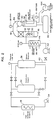
- Fig. 2 illustrates an example of a bench scale dissolution apparatus for the present invention.
- Commingled plastic waste e.g. at 14 in Fig. 1, typically 25 kg, is placed in the dissolution column 32 with screen packs at both ends.
- a stirred vessel would be preferred in a larger scale system but a column is a suitable substitution on this scale due to its ease of fabrication.
- a gear pump 34 is used to circulate solvent, typically 20 liters, from a reservoir 36 through a heat exchanger 38 and the dissolution column 32. Selective dissolution is performed in a sequential batch mode.
- a unique temperature for a given solvent is set in heat exchanger 38 and is used to selectively extract a single polymer group from the commingled stream at 40.
- the polymer obtained from a single extraction is isolated via flash devolatilization in a flash chamber 48 as will be explained in detail below.
- the recovered polymer is pelletized, while the recovered solvent is returned to the reservoir 36 to extract the next polymer group at a higher temperature.
- the equipment used for the compositional quenching or flash evaporation step according to the present invention is schematically shown at the right in Fig. 2.
- the single phase polymer solution 40 from reservior 36 is first metered by a positive displacement pump 42 through a second heat exchanger 44 in order to accept heat which will ultimately be used to vaporize the solvent.
- the polymer solution is typically heated to 200 to 300°C. This temperature is one of the independent variables that govern the devolatilization step.
- the heated solution is kept under relatively high pressure, typical from 10 to 40 atm.
- This heated, pressurized solution is then flashed across a flash valve 50 into an evacuated chamber 52 in flash chamber 48.
- Most of the solvent rapidly vaporizes and exits through the top 54 of the flash chamber 48, leaving behind a single polymer or a two phase polymer blend at 46.
- the solvent vapors are then supplied to and condensed in a condenser 58 by a blower 60, collected in a collection tank 62, and recycled.
- the polymer blend 46 is collected at the bottom of the flash chamber 48 for further processing.
- phase separation occurs when the solvent is rapidly removed by flash devolatilization.
- the devolatilization step is fast and it plunges the residual, polymer/polymer/ solvent mixture deep into a region of two phases.
- Phase separation occurs by spinodal decomposition and generates a microdispersion with a characteristic and small phase separation distance. If one of the phase volumes is small, a uniformly sized dispersion will result.
- the low solids flash devolatilization of Fig. 2 is a relatively simple process which is readily scalable.
- the dissolution step at the left is typically batch, but the flash devolatilization process at the right is continuous thereafter.
- the flash chamber pressure typically 5-100 torr, is the other independent variable that governs devolatilization along with temperature. Together temperature and pressure determine the polymer concentration after the flash, typically 50-95%, and the after flash temperature, typically 0-100°C. To a first approximation, the flash achieves vapor-liquid equilibrium.
- Codissolve PS and PVC at room temperature and subsequently separate by decantation. Two liquid phases exist at 10% total dissolved polymer provided the relative PS concentration is in the range of about 10% to about 90%.
- the maximum pressure achieved in this process was approximately 17 atm.
- This fraction can be purified by a separation dissolution step, e.g. , by using THF at 190°C.
- the maximum pressure achieved in this process was 1 atm, excluding the separate PET dissolution step.
- the maximum pressure achieved in this process was 1 atm.
- the polymer can be recovered by any conventional means.
- steam stripping or coagulation with a nonsolvent e.g., methanol
- a nonsolvent e.g., methanol
- the preferred embodiment of this invention is to use flash devolatilization for at least the first step in the recovery process.
- flash devolatilization is to use flash devolatilization for at least the first step in the recovery process.
- flash conditions are adjusted to give about 50% polymer after the flash, the art in U.S. patent 4,594,371 may be followed to obtain a microdispersion or in U.S. patent 4,666,961 to obtain a cocontinuous network. Even when the starting solution contains only one polymer, the same flash conditions will generally be suitable.
- Commingled plastic mixtures may contain a great variety of polyolefins including LDPE, HDPE, PP, plus copolymers of ethylene, propylene, and higher olefins.
- polyolefins including LDPE, HDPE, PP, plus copolymers of ethylene, propylene, and higher olefins.
- they may contain linear, low density polyethylene (LLDPE) made by the low pressure process. Clean splits of all components cannot be expected in this case. Instead, there will be partial codissolution of the various copolymers such as LLDPE. The three fractions in Example 2 (xylene) may still be taken.
- the dissolution temperatures represent nominal lower limits for the indicated cut.
- the upper limit is the next highest temperature in the sequence.
- the PS dissolution in Example 5 could be conducted at temperatures up to about 118°C.
- Use of higher than minimum temperatures may be advantageous to decrease dissolution times or to improve drainage of the solution from the residual mass. In this sense, all the room temperature dissolution steps are done at temperatures higher than the theoretical minimum.
- Some packaging materials are multilayer coextrusions or other forms of physical blend containing two or more different polymers.
- the selective dissolution process described herein will work for bilayer materials since both polymers will be in contact with the solvent. It will not work, or at least not as well, in multicomponent materials when an inner-layer or dispersed phase would normally dissolve at a lower temperature than the outer material. In this case, the entire composite would dissolve at the higher temperature and a cosolution would result.
- the need to control the polymer solution concentration implies a need to know the relative polymer amounts in the original commingled mass.
- the relative amounts can be determined using selective dissolution as an assay method.
- the above assay method might also be practiced as a recycling process. However, it is unlikely to be economical due to the large number of solvents.
- Table 1 shows dissolution temperatures for the various polymers and solvents of the foregoing example.
- the present invention is seen as being one of the key answers to polymer reclamation.
- the invention demonstrates a four way split of the six major packaging plastics. Preliminary indications are that solvents exist to separate cleanly all six major plastic groups. With greater than 99% separation efficiencies, compositional quenching will microdisperse the minor components and render them innocuous. It is considered that a split which contains the PP and HDPE will exhibit good physical properties.
- a second solvent e.g. methylene chloride
- methylene chloride can even be used to extract the PS prior to the room temperature THF extraction for example.
- the invention is capable of yielding slightly contaminated polymers which have near virgin polymer properties for re-use and re-sale.
Landscapes
- Engineering & Computer Science (AREA)
- Chemical & Material Sciences (AREA)
- Mechanical Engineering (AREA)
- Medicinal Chemistry (AREA)
- Sustainable Development (AREA)
- Health & Medical Sciences (AREA)
- Life Sciences & Earth Sciences (AREA)
- Chemical Kinetics & Catalysis (AREA)
- Polymers & Plastics (AREA)
- Organic Chemistry (AREA)
- Environmental & Geological Engineering (AREA)
- Separation, Recovery Or Treatment Of Waste Materials Containing Plastics (AREA)
- Addition Polymer Or Copolymer, Post-Treatments, Or Chemical Modifications (AREA)
- Processing Of Solid Wastes (AREA)
- Extraction Or Liquid Replacement (AREA)
- Manufacture Of Porous Articles, And Recovery And Treatment Of Waste Products (AREA)
Applications Claiming Priority (3)
| Application Number | Priority Date | Filing Date | Title |
|---|---|---|---|
| US07/406,087 US5198471A (en) | 1989-09-11 | 1989-09-11 | Polymer recycling by selective dissolution |
| US406087 | 1989-09-11 | ||
| EP90914451A EP0491836B1 (de) | 1989-09-11 | 1990-08-29 | Polymerrecycling durch selektive auflösung |
Related Parent Applications (2)
| Application Number | Title | Priority Date | Filing Date |
|---|---|---|---|
| EP90914451.1 Division | 1990-08-29 | ||
| EP90914451A Division EP0491836B1 (de) | 1989-09-11 | 1990-08-29 | Polymerrecycling durch selektive auflösung |
Publications (2)
| Publication Number | Publication Date |
|---|---|
| EP0664314A1 true EP0664314A1 (de) | 1995-07-26 |
| EP0664314B1 EP0664314B1 (de) | 2002-01-02 |
Family
ID=23606492
Family Applications (2)
| Application Number | Title | Priority Date | Filing Date |
|---|---|---|---|
| EP19950200535 Expired - Lifetime EP0664314B1 (de) | 1989-09-11 | 1990-08-29 | Polymerwiedergewinnung durch selektive Auflösung |
| EP90914451A Expired - Lifetime EP0491836B1 (de) | 1989-09-11 | 1990-08-29 | Polymerrecycling durch selektive auflösung |
Family Applications After (1)
| Application Number | Title | Priority Date | Filing Date |
|---|---|---|---|
| EP90914451A Expired - Lifetime EP0491836B1 (de) | 1989-09-11 | 1990-08-29 | Polymerrecycling durch selektive auflösung |
Country Status (8)
| Country | Link |
|---|---|
| US (2) | US5198471A (de) |
| EP (2) | EP0664314B1 (de) |
| JP (1) | JP2968998B2 (de) |
| AU (1) | AU6420490A (de) |
| BR (1) | BR9007650A (de) |
| CA (1) | CA2065046C (de) |
| DE (2) | DE69026829T2 (de) |
| WO (1) | WO1991003515A1 (de) |
Cited By (3)
| Publication number | Priority date | Publication date | Assignee | Title |
|---|---|---|---|---|
| GR1002446B (el) * | 1995-12-19 | 1996-10-01 | Μια νεα μεθοδος για την ανακυκλωση πλαστικων απορριμματων με συνδυασμο τεχνολογιας διαχωρισμου λογω διαφορετικης πυκνοτητας και τεχνολογιας διαλυσης/επανακαταβυθισης. | |
| EP0790277A1 (de) * | 1996-02-19 | 1997-08-20 | Fina Research S.A. | Verfahren zum Sortieren von Polymerisaten |
| WO2017118975A1 (en) | 2016-01-05 | 2017-07-13 | Yissum Research Development Company Of The Hebrew University Of Jerusalem Ltd. | A process for treating plastic waste |
Families Citing this family (165)
| Publication number | Priority date | Publication date | Assignee | Title |
|---|---|---|---|---|
| BR9106175A (pt) * | 1990-09-13 | 1993-03-16 | Rwe Entsorgung Ag | Processo para a recuperacao de metais e materiais de revestimento a partir de materiais de composito |
| DE4104573A1 (de) * | 1991-02-14 | 1992-08-20 | Pluss Stauffer Ag | Verfahren und vorrichtung zur technischen fraktionierung von polymeren |
| US5840774A (en) * | 1991-02-28 | 1998-11-24 | Research Foundation Of State University Of New York | Low density microporous polymers and process |
| JPH0593976A (ja) * | 1991-10-01 | 1993-04-16 | Fuji Photo Film Co Ltd | 写真感光材料用支持体及びその製造方法 |
| GB2264209B (en) * | 1992-02-06 | 1995-11-08 | Technophone Ltd | Cordless telephone arrangement |
| FR2693388B1 (fr) * | 1992-07-10 | 1994-10-07 | Gradient Rech Royallieu | Procédé de traitement de déchets contaminés, notamment de déchets hospitaliers, et installation de mise en Óoeuvre dudit procédé. |
| IT1255233B (it) * | 1992-07-17 | 1995-10-20 | Himont Inc | Procedimento per la stabilizzazione di polimeri olefinici |
| JP3381240B2 (ja) * | 1992-08-10 | 2003-02-24 | 旭化成株式会社 | 発泡粒子を回収する方法 |
| WO1994009064A1 (en) * | 1992-10-15 | 1994-04-28 | Sven Ljungbo | Way to regain polythene and polypropylene and other polyolefines from return material, especially such of composite type |
| US6329436B1 (en) * | 1992-11-05 | 2001-12-11 | The University Of Chicago | Process to recycle shredder residue |
| AP633A (en) * | 1993-03-03 | 1998-03-31 | Evergreen Global Resources Inc | Method of treating solid waste. |
| US5430068A (en) * | 1993-11-24 | 1995-07-04 | E. I. Du Pont De Nemours And Company | Recovery of polyamide using a solution process |
| US5462973A (en) | 1994-07-13 | 1995-10-31 | Hoechst Celanese Corporation | Separation of polyethylene terephthalate and polyvinyl chloride using supercritical carbon dioxide |
| JP3494707B2 (ja) * | 1994-08-24 | 2004-02-09 | 三菱レイヨン株式会社 | 新規溶剤組成物を用いた非架橋合成樹脂廃棄物の回収方法 |
| US5629352A (en) * | 1995-04-24 | 1997-05-13 | Matsushita Electric Industrial Co., Ltd. | Solvent for polystyrene, method for reducing volume of polystyrene foam and method for recycling polystyrene foam |
| US5554657A (en) * | 1995-05-08 | 1996-09-10 | Shell Oil Company | Process for recycling mixed polymer containing polyethylene terephthalate |
| US6036726A (en) * | 1995-10-27 | 2000-03-14 | Solutia Inc. | Process for separating polyamide from colorant |
| US5882432A (en) * | 1996-07-30 | 1999-03-16 | The University Of Chicago | Efficient continuous dryer for flexible polyurethane foam and cleaning apparatus |
| US6083283A (en) * | 1996-10-24 | 2000-07-04 | Solutia Inc. | Method for removing color from ionically dyeable polymeric materials |
| DE69727650T2 (de) * | 1996-12-31 | 2004-07-29 | M&G Polimeri Italia S.P.A., Patrica | Verfahren zur Rückgewinnung von festem mikroporösem Polyester aus einem Recyclingstrom und Produkte daraus |
| US5898063A (en) * | 1997-02-18 | 1999-04-27 | Stefandl; Roland E. | Carpet recycling process for nylon containing carpeting |
| US6140463A (en) * | 1997-02-18 | 2000-10-31 | Stefandl; Roland E. | Process for recycling and recovery of purified nylon polymer |
| DE19714063A1 (de) * | 1997-04-05 | 1998-10-08 | Wolfgang Arlt | Thermisches Trennverfahren für Polymere |
| US5977294A (en) * | 1997-05-13 | 1999-11-02 | Prs, Llc | Polymer deformulation by solvent solution filtration |
| DE19806355C2 (de) | 1998-02-10 | 2003-04-03 | Der Gruene Punkt Duales Syst | Thermisches Trennverfahren für vermischte Polymere |
| KR19980065055A (ko) * | 1998-06-20 | 1998-10-07 | 김성문 | 폴리에틸렌 복합수지 성형물에서 폴리에틸렌과 타 수지를 분리회수하는 시스템 및 방법 |
| DE19927523A1 (de) * | 1999-06-16 | 2000-12-21 | Wolfgang Lindner | Verfahren zur Trennung von polyolefinischen Kunststoffgemischen |
| WO2001004184A1 (en) * | 1999-07-09 | 2001-01-18 | The Dow Chemical Company | Method for fractionating poly(ethylene oxide) formed using a metallic cyanide catalyst |
| DE60121948T2 (de) * | 2000-06-08 | 2007-03-15 | E.I. Du Pont De Nemours And Co., Wilmington | Auf lösungsmittel basierende rückgewinnung und wiederverwertung eines polyamidmaterials |
| US6270330B1 (en) * | 2000-07-06 | 2001-08-07 | Shao-Szu Cheng | Waste foamed polystyrene material reclaiming system |
| DE10032918C2 (de) * | 2000-07-06 | 2002-06-20 | Siemens Axiva Gmbh & Co Kg | Verfahren zur Bestimmung des Anteils von HDPE und LDPE in Polyolefingemischen |
| DE10039363A1 (de) * | 2000-08-11 | 2002-03-07 | Fraunhofer Ges Forschung | Verfahren zur Trennung und Rückgewinnung von Zielpolymeren und deren Additiven aus einem polymerhaltigen Material |
| DE60108513T2 (de) | 2000-10-11 | 2006-01-12 | Resource Recovery Technologies, Inc. | Rückgewinnungsverfahren für polystyrol |
| AU2002246886A1 (en) * | 2000-11-08 | 2002-08-06 | E. I. Du Pont De Nemours And Company | Method for separating polystyrene and polyethylene terephthalate |
| DE10062437A1 (de) * | 2000-12-15 | 2002-06-20 | Der Gruene Punkt Duales Syst | Verfahren zum Aufbereiten eines Kunststoffgemisches |
| DE10062432A1 (de) * | 2000-12-15 | 2002-06-20 | Der Gruene Punkt Duales Syst | Verfahren zum Abtrennen mindestens eines ausgewählten Polymers aus einem Polymergemisch |
| KR100411947B1 (ko) * | 2001-06-18 | 2003-12-18 | (주)그린폴 | 폐 pvc/pe계 고분자 혼합물 |
| JP4224314B2 (ja) * | 2003-01-29 | 2009-02-12 | 芝浦メカトロニクス株式会社 | 溶液の塗布装置及び塗布方法 |
| US7757863B2 (en) | 2003-11-17 | 2010-07-20 | Casella Waste Systems, Inc. | Systems and methods for glass recycling at a beneficiator and/or a material recovery facility |
| US7264124B2 (en) | 2003-11-17 | 2007-09-04 | Casella Waste Systems, Inc. | Systems and methods for sorting recyclables at a material recovery facility |
| US20060069170A1 (en) * | 2004-09-27 | 2006-03-30 | Chemical Products Corporation | Decomposition of Polyester |
| US7067613B2 (en) * | 2004-06-04 | 2006-06-27 | Chemical Products Corporation | Separation of polyolefins from nylons |
| US20060070188A1 (en) * | 2004-09-27 | 2006-04-06 | Chemical Products Corporation | Colorant Removal from Polymeric Fibers |
| JP2008519753A (ja) | 2004-11-12 | 2008-06-12 | カセラ ウェイスト システムズ インコーポレーティッド | 混色カレットの特長づけおよび確認を行い、一様に着色された混入物のない混色カレットを提供するためのシステムおよび方法 |
| KR100528646B1 (ko) * | 2005-01-24 | 2005-11-15 | 한국생산기술연구원 | 포장용 다층 폐필름의 재활용방법 |
| US8459466B2 (en) | 2007-05-23 | 2013-06-11 | Re Community Energy, Llc | Systems and methods for optimizing a single-stream materials recovery facility |
| US7729870B2 (en) * | 2007-09-05 | 2010-06-01 | Yizhong Sun | Methods for detecting oil deterioration and oil level |
| US8057666B2 (en) * | 2008-03-11 | 2011-11-15 | Xtrudx Technologies, Inc. | Biomass and waste plastics to neodiesel and valuable chemicals via supercritical water |
| US7955508B2 (en) * | 2008-03-11 | 2011-06-07 | Xtrudx Technologies, Inc. | Supercritical fluid biomass conversion systems |
| US8980143B2 (en) | 2008-03-11 | 2015-03-17 | Thomas E. Loop | Biomass and waste plastics depolymerization machine and methods via supercritical water |
| US8127519B2 (en) * | 2008-07-14 | 2012-03-06 | Stravitz David M | Method of inserting and storing waste for disposal |
| US8215089B2 (en) * | 2008-07-14 | 2012-07-10 | David Stravitz | Waste disposal devices |
| US20100005762A1 (en) * | 2008-07-14 | 2010-01-14 | Stravitz David M | Waste Disposal Devices |
| AU2009319890B2 (en) | 2008-11-26 | 2015-09-10 | Swimc Llc | Polyester-carbamate polymer and coating compositions thereof |
| US20100260954A1 (en) * | 2008-11-26 | 2010-10-14 | Valspar Sourcing, Inc. | Polymer having polycyclic groups and coating compositions thereof |
| US8367171B2 (en) | 2008-11-26 | 2013-02-05 | Valspar Sourcing, Inc. | Polymer having polycyclic groups and coating compositions thereof |
| US8071656B2 (en) * | 2009-03-03 | 2011-12-06 | Dynasep Llc | Nylon extraction from commingled materials |
| BRPI1014962B1 (pt) | 2009-04-09 | 2020-03-03 | Swimc Llc | Composição de revestimento, método, e, artigo revestido |
| EP3156228B1 (de) | 2009-04-09 | 2023-11-29 | Swimc Llc | Polymer mit ungesättigter zykloaliphatischer funktionalität und beschichtungszusammensetzungen daraus |
| MX2012001837A (es) * | 2009-08-10 | 2012-02-29 | Dow Global Technologies Llc | Ldpe para utilizarse como un componente de mezcla en aplicaciones de contraccion de pelicula. |
| WO2011019840A1 (en) | 2009-08-11 | 2011-02-17 | Valspar Sourcing, Inc. | Polymer particles and coating compositions formulated from the polymer particles |
| US10343842B2 (en) * | 2009-10-30 | 2019-07-09 | Munchkin, Inc. | System and method for disposing waste packages such as diapers |
| US8635838B2 (en) * | 2009-10-30 | 2014-01-28 | Munchkin, Inc. | System for disposing waste packages such as diapers |
| US20110099950A1 (en) * | 2009-10-30 | 2011-05-05 | Munchkin, Inc. | System and method for disposing waste packages such as diapers |
| US20110099945A1 (en) * | 2009-10-30 | 2011-05-05 | Munchkin, Inc. | System and method for disposing waste packages such as diapers |
| US8833592B2 (en) * | 2009-10-30 | 2014-09-16 | Munchkin, Inc. | System and method for disposing waste packages such as diapers |
| USD639002S1 (en) | 2009-10-30 | 2011-05-31 | Munchkin, Inc. | Diaper pail bag |
| US8567157B2 (en) * | 2009-10-30 | 2013-10-29 | Munchkin, Inc. | System for disposing waste packages such as diapers |
| US20110099956A1 (en) * | 2009-10-30 | 2011-05-05 | Munchkin, Inc. | System and method for disposing waste packages such as diapers |
| US8739501B2 (en) * | 2009-10-30 | 2014-06-03 | Munchkin, Inc. | System for disposing waste packages such as diapers |
| US8690017B2 (en) | 2009-10-30 | 2014-04-08 | Munchkin, Inc. | Powder dispensing assembly for a waste container |
| US8647587B2 (en) * | 2009-10-30 | 2014-02-11 | Munchkin, Inc | Powder dispensing assembly for a waste container |
| USD639004S1 (en) | 2009-10-30 | 2011-05-31 | Munchkin, Inc. | Diaper pail bag |
| USD639003S1 (en) | 2009-10-30 | 2011-05-31 | Munchkin, Inc. | Diaper pail bag |
| EP2513212B2 (de) | 2009-12-17 | 2026-07-15 | Fraunhofer-Gesellschaft zur Förderung der angewandten Forschung e.V. | Verfahren zum behandeln von kunststoffhaltigen abfällen |
| US9187624B2 (en) * | 2010-08-20 | 2015-11-17 | The University Of North Carolina At Charlotte | Hemp fiber reinforced composite with recycled high density polyethylene and production thereof |
| AR082900A1 (es) | 2010-09-10 | 2013-01-16 | Green Source Energy Llc | Composiciones y metodos para reciclar plasticos que comprenden polimeros mediante el tratamiento de solvente |
| US8969638B2 (en) | 2010-11-02 | 2015-03-03 | Fina Technology, Inc. | Depolymerizatin of plastic materials |
| US9284431B2 (en) | 2012-02-14 | 2016-03-15 | Clariant International Ltd. | Method for recycling floor coverings |
| DE102013212813A1 (de) * | 2013-07-01 | 2015-01-08 | Fraunhofer-Gesellschaft zur Förderung der angewandten Forschung e.V. | Verfahren zur Anreicherung von mindestens einem Polymer aus einem Polymer-haltigen Abfall und Polymer-Recyclat |
| CN105916926A (zh) * | 2013-11-19 | 2016-08-31 | 普渡研究基金会 | 可用于从电子废物和其它废物中回收聚合物的方法 |
| EP3575353A1 (de) | 2014-10-03 | 2019-12-04 | Polystyvert Inc. | Aus einem verfahren zur verwertung von polystyrolabfällen gewonnenes recyceltes polystyrol |
| DE102014114831B4 (de) * | 2014-10-13 | 2020-12-10 | Domo Engineering Plastics Gmbh | Verfahren zur Herstellung von körnigen oder pulverförmigen Zielpolymerprodukten aus kunststoffhaltigen Materialien |
| US9994393B2 (en) | 2014-12-11 | 2018-06-12 | Munchkin, Inc. | Container for receiving multiple flexible bag assemblies |
| PL412820A1 (pl) * | 2015-06-23 | 2017-01-02 | 23 Rs Coras Spółka Z Ograniczoną Odpowiedzialnością | Sposób i aparat do rozdzielania składników opakowań kompozytowych |
| US20170002117A1 (en) | 2015-06-30 | 2017-01-05 | The Procter & Gamble Company | Articles of Reclaimed Polypropylene Composition |
| US20170002169A1 (en) | 2015-06-30 | 2017-01-05 | The Procter & Gamble Company | Reclaimed Polyethylene Composition |
| ES2970800T3 (es) * | 2015-06-30 | 2024-05-30 | Procter & Gamble | Método para purificar polímeros contaminados |
| WO2017003802A1 (en) | 2015-06-30 | 2017-01-05 | The Procter & Gamble Company | Articles of reclaimed polypropylene compositions |
| RU2673886C1 (ru) | 2015-06-30 | 2018-12-03 | Дзе Проктер Энд Гэмбл Компани | Способ очистки загрязненных полимеров |
| WO2017003799A1 (en) | 2015-06-30 | 2017-01-05 | The Procter & Gamble Company | Method for purifying contaminated polymers |
| US20170002119A1 (en) | 2015-06-30 | 2017-01-05 | The Procter & Gamble Company | Reclaimed Polypropylene Composition |
| EP3112406A1 (de) | 2015-06-30 | 2017-01-04 | The Procter and Gamble Company | Verfahren zur reinigung von kontaminierten polyolefinen |
| WO2018006090A1 (en) * | 2016-07-01 | 2018-01-04 | Georgia Tech Research Corporation | Methods of recycling and reshaping thermosetting polymers and composites thereof |
| ES3067788T3 (en) | 2016-10-10 | 2026-05-25 | Fraunhofer Ges Forschung | Recycled polymer composition |
| EP3305839A1 (de) | 2016-10-10 | 2018-04-11 | Fraunhofer Gesellschaft zur Förderung der Angewand | Verfahren zur wiederverwertung von polyolefinhaltigem abfallmaterial |
| RU2721317C1 (ru) | 2016-12-20 | 2020-05-18 | Дзе Проктер Энд Гэмбл Компани | Способ очистки регенерированного полипропилена |
| US10442912B2 (en) | 2016-12-20 | 2019-10-15 | The Procter & Gamble Company | Method for purifying reclaimed polyethylene |
| US10435532B2 (en) | 2016-12-20 | 2019-10-08 | The Procter & Gamble Company | Method for separating and purifying materials from a reclaimed product |
| CA3045910C (en) | 2016-12-20 | 2022-12-06 | The Procter & Gamble Company | Method for purifying reclaimed polymers |
| US10450436B2 (en) | 2016-12-20 | 2019-10-22 | The Procter & Gamble Company | Method for purifying reclaimed polypropylene |
| CN110072929B (zh) | 2016-12-20 | 2022-02-11 | 宝洁公司 | 用于从再生产品中分离和纯化聚合物的方法 |
| US10465058B2 (en) | 2016-12-20 | 2019-11-05 | The Procter & Gamble Company | Method for purifying reclaimed polymers |
| MX2019007026A (es) | 2016-12-20 | 2019-11-08 | Procter & Gamble | Metodo para purificar polietileno recuperado. |
| DE102016015199A1 (de) * | 2016-12-21 | 2018-06-21 | Apk Ag | Lösungsmittel sowie Verfahren zum Lösen wenigstens zweier Kunststoffe von einem Feststoff innerhalb einer Suspension |
| US10961367B2 (en) | 2017-11-20 | 2021-03-30 | Polystyvert Inc. | Processes for recycling polystyrene waste |
| EP3511451A1 (de) * | 2018-01-15 | 2019-07-17 | Lenzing Aktiengesellschaft | Verfahren zum wiederverwenden eines cellulose und synthetischen kunststoff aufweisenden mischtextils |
| DE102018102811A1 (de) | 2018-02-08 | 2019-08-08 | Cleyond AG | Extruder, Anlage mit einem Extruder, Verfahren zur Herstellung von Zielpolymerprodukten aus einem kunststoffhaltigen Material aus einer Lösung unter Verwendung eines solchen Extruders |
| US10941269B2 (en) | 2018-06-20 | 2021-03-09 | The Procter & Gamble Company | Method for purifying reclaimed polyethylene |
| US10899906B2 (en) | 2018-06-20 | 2021-01-26 | The Procter & Gamble Company | Method for purifying reclaimed polypropylene |
| US11008433B2 (en) | 2018-06-20 | 2021-05-18 | The Procter & Gamble Company | Method for separating and purifying polymers from reclaimed product |
| US10961366B2 (en) | 2018-06-20 | 2021-03-30 | The Procter & Gamble Company | Method for purifying reclaimed polymers |
| RS63974B1 (sr) | 2018-08-01 | 2023-03-31 | Repetco Innovations S L | Postupak za razdvajanje slojeva višeslojne plastiкe |
| ES2994474T3 (en) | 2018-10-26 | 2025-01-24 | Polystyvert Inc | Processes for recycling polystyrene waste and/or polystyrene copolymer waste |
| US11408098B2 (en) | 2019-03-22 | 2022-08-09 | Global Materials Development, LLC | Methods for producing polymer fibers and polymer fiber products from multicomponent fibers |
| FI20195582A1 (en) | 2019-06-28 | 2020-12-29 | Finnfoam Oy | Process for recycling polystyrene and solvents for dissolving polystyrene |
| WO2021021031A1 (en) * | 2019-07-30 | 2021-02-04 | Lai Trillion | Process for separating and recovering polymers and/or fibers from solid composite materials or liquid mixtures |
| ES2823926B2 (es) | 2019-11-07 | 2021-10-15 | Univ Alicante | Procedimiento para la eliminacion de adhesivos y/o tintas interlaminares en material plastico laminado |
| US20210324170A1 (en) | 2020-04-15 | 2021-10-21 | The Procter & Gamble Company | Reducing surface and bulk contamination in plastic |
| US12129343B2 (en) | 2020-07-28 | 2024-10-29 | The Procter & Gamble Company | Method for producing recycled high-density polyethylene with natural-like optical properties |
| US11674012B2 (en) | 2020-07-28 | 2023-06-13 | The Procter & Gamble Company | Method for producing recycled polyethylene with virgin-like optical properties |
| US11180618B1 (en) * | 2020-08-05 | 2021-11-23 | Timeplast, Llc | Process of transforming a plastic extrusion system into a dynamic depolymerization reactor |
| KR20230062827A (ko) * | 2020-08-07 | 2023-05-09 | 아페카 아게 | 플라스틱 전처리 및 용매-기반 플라스틱 리사이클링을 위한 방법 |
| US10954354B1 (en) * | 2020-10-16 | 2021-03-23 | Timeplast, Llc | Upcycling process for unsorted waste stream |
| EP4019576A1 (de) | 2020-12-28 | 2022-06-29 | Trinseo Europe GmbH | Recyclingverfahren für elastomergehärtete thermoplastische polymere |
| WO2022157928A1 (ja) * | 2021-01-22 | 2022-07-28 | 共栄社化学株式会社 | Evoh抽出剤及びそれを用いたevoh抽出方法、evoh回収方法、evoh抽出剤再生方法 |
| WO2022245764A1 (en) | 2021-05-17 | 2022-11-24 | The University Of Toledo | Sustainable methods to separate and recover polyethylene and polypropylene from mixed plastic waste streams |
| EP4098689A1 (de) | 2021-06-01 | 2022-12-07 | Nederlandse Organisatie voor toegepast- natuurwetenschappelijk onderzoek TNO | Energieeffiziente trennung von polyolefinen |
| US20230007899A1 (en) | 2021-07-08 | 2023-01-12 | The Procter & Gamble Company | Method for Producing Recycled Polyethylene Having Low b* Value |
| US20240287274A1 (en) * | 2021-08-03 | 2024-08-29 | Pyrowave Inc. | Method and system for extracting contaminants from waste polymers |
| CN116061341A (zh) * | 2021-10-29 | 2023-05-05 | 中国石油化工股份有限公司 | 一种废塑料的分离方法 |
| WO2023082009A1 (en) | 2021-11-11 | 2023-05-19 | Polystyvert Inc. | Methods of recycling polystyrene material comprising brominated contaminants |
| CA3233547A1 (en) | 2021-11-18 | 2023-05-25 | George Huber | Recycling of plastics by solvent-targeted recovery and precipitation ("strap") |
| JP2023129262A (ja) * | 2022-03-03 | 2023-09-14 | グンゼ株式会社 | 樹脂材料の分離回収方法 |
| US20260084347A1 (en) * | 2022-05-12 | 2026-03-26 | Alpla Werke Alwin Lehner Gmbh & Co. Kg | Purification method for producing a polyolefin regenerate |
| CH719688A1 (de) * | 2022-05-12 | 2023-11-30 | Alpla Werke Alwin Lehner Gmbh & Co Kg | Aufreinigungsverfahren zur Herstellung eines Polyolefin-Regenerates. |
| GB202207809D0 (en) * | 2022-05-26 | 2022-07-13 | Addible Ltd | A process for separating a mixed waste stream |
| US20230392297A1 (en) * | 2022-06-07 | 2023-12-07 | Sanko Tekstil Isletmeleri San. Ve Tic. A.S. | Process and plant for recycling fabrics |
| JP7171003B1 (ja) | 2022-07-04 | 2022-11-15 | 國立台灣大學 | プラスチック回収方法 |
| EP4306587A1 (de) * | 2022-07-12 | 2024-01-17 | Trinseo Europe GmbH | Verfahren zum recycling von schlagzähmodifizierten polymeren nach dem gebrauch durch verbraucher und/oder die industrie |
| WO2024034514A1 (ja) * | 2022-08-10 | 2024-02-15 | グンゼ株式会社 | 樹脂材料の回収方法 |
| US12503564B2 (en) * | 2022-08-22 | 2025-12-23 | Wisconsin Alumni Research Foundation | Plastic recycling system using solvent-targeted recovery and precipitation (STRAP) |
| GB202212897D0 (en) * | 2022-09-05 | 2022-10-19 | Provost Fellows Found Scholars And The Other Members Of Board Of The College Of The Holy And Undivid | Separation of multilayer structures |
| US20240092992A1 (en) | 2022-09-21 | 2024-03-21 | The Procter & Gamble Company | Method for purifying reclaimed polymers |
| KR102757121B1 (ko) * | 2022-11-02 | 2025-01-21 | 한화토탈에너지스 주식회사 | 플라스틱의 선별 방법 |
| FR3142191B1 (fr) * | 2022-11-21 | 2026-02-20 | Ifp Energies Now | Procede de recyclage et traitement de plastiques usages par dissolution dans un solvant avec introduction etagee du solvant |
| KR102743571B1 (ko) * | 2022-11-29 | 2024-12-17 | 롯데케미칼 주식회사 | 고분자 혼합물의 분리 방법 |
| WO2024157917A1 (ja) * | 2023-01-24 | 2024-08-02 | アースリサイクル株式会社 | 材料再生方法、及び、材料再生装置 |
| WO2024211326A1 (en) | 2023-04-03 | 2024-10-10 | The Procter & Gamble Company | Method for purifying reclaimed polymers |
| WO2024211327A1 (en) | 2023-04-03 | 2024-10-10 | The Procter & Gamble Company | Method for purifying reclaimed polymers |
| NL2035061B1 (en) * | 2023-06-09 | 2024-12-19 | Ioniqa Tech B V | A method of removing ethylene vinyl alcohol copolymer from a waste polymer material |
| IT202300014199A1 (it) | 2023-07-06 | 2025-01-06 | M G Lavorazione Materie Plastiche S P A | Film barriera e confezione per prodotti alimentari e metodo per la realizzazione di detto film barriera |
| EP4491662A1 (de) | 2023-07-14 | 2025-01-15 | Trinseo Europe GmbH | Recycling-verfahren für elastomerverstärkte thermoplastische polymere |
| EP4491661A1 (de) | 2023-07-14 | 2025-01-15 | Trinseo Europe GmbH | Recycling-verfahren für elastomerverstärkte thermoplastische polymere |
| KR20260070211A (ko) | 2023-09-19 | 2026-05-18 | 솔루티아인코포레이티드 | 다층 중간층의 분리를 위한 플로잉 방법 |
| KR20260070483A (ko) | 2023-09-19 | 2026-05-19 | 솔루티아인코포레이티드 | 다층 중간층의 분리를 위한 화학적 방법 및 디바이스 |
| WO2025064384A1 (en) | 2023-09-19 | 2025-03-27 | Solutia Inc. | Scraping methods for separation of multilayer interlayers |
| CN122094809A (zh) | 2023-09-19 | 2026-05-26 | 首诺公司 | 用于分离多层夹层的剥离方法和装置 |
| KR20260072596A (ko) | 2023-09-19 | 2026-05-20 | 솔루티아인코포레이티드 | 다층 중간층의 분리를 위한 분사 방법 |
| IT202300019437A1 (it) | 2023-09-21 | 2025-03-21 | Re Sport S R L | Procedimento per la produzione di fibre tessili |
| WO2025151880A1 (en) * | 2024-01-12 | 2025-07-17 | Auburn University | Polymer reclamation from multilayer polymeric materials having barrier structures |
| KR20250176477A (ko) * | 2024-06-12 | 2025-12-19 | 한국화학연구원 | 실리콘계 고분자와 아미드 작용기를 가진 고분자가 포함된 혼합재질의 고분자로부터 실리콘계 고분자를 분리하기 위한 조성물 및 이를 활용한 분리방법 |
| KR20260011522A (ko) * | 2024-07-16 | 2026-01-23 | 한국화학연구원 | 실리콘계 고분자와 에스테르 작용기를 가진 고분자를 포함하는 혼합재질의 고분자로부터 실리콘계 고분자를 분리하기 위한 조성물 및 이를 활용한 분리방법 |
| WO2026088232A1 (en) | 2024-10-22 | 2026-04-30 | Re-Sport S.R.L. | Method for reusing polyurethane materials |
| US12679947B1 (en) * | 2025-09-17 | 2026-07-14 | Mangalore Refinery & Petrochemical Ltd. | Process for the recovery of polymers from mixed plastic waste |
Citations (8)
| Publication number | Priority date | Publication date | Assignee | Title |
|---|---|---|---|---|
| JPS49107070A (de) * | 1973-02-13 | 1974-10-11 | ||
| JPS5070480A (de) * | 1973-10-24 | 1975-06-11 | ||
| JPS5120976A (de) * | 1974-08-16 | 1976-02-19 | Mitsubishi Heavy Ind Ltd | |
| DD121328A1 (de) * | 1975-09-12 | 1976-07-20 | ||
| US4031039A (en) * | 1975-09-02 | 1977-06-21 | Mitsubishi Jukogyo Kabushiki Kaisha | Method for treating waste high-polymer mixture |
| GB1592212A (en) * | 1978-01-13 | 1981-07-01 | Agency Ind Science Techn | Recovery of plastics from plastics-containing waste |
| DD207628A3 (de) * | 1982-05-20 | 1984-03-07 | Hans Ch Schreiber | Verfahren zur rueckgewinnung von reinen polystyrol-, polyolefin- und polyvinylchloridartigen polymeren |
| US4594371A (en) * | 1984-08-31 | 1986-06-10 | Rensselaer Polytechnic Institute | Fine particle dispersions of incompatible polymers in polymer matrices |
Family Cites Families (2)
| Publication number | Priority date | Publication date | Assignee | Title |
|---|---|---|---|---|
| DE207628C (de) * | ||||
| HU206372B (en) * | 1990-09-03 | 1992-10-28 | Richter Gedeon Vegyeszet | Process for producing new oligopeptides which selectively inhibit proliferation of haemopoietic cells and pharmaceutical compositions comprising same |
-
1989
- 1989-09-11 US US07/406,087 patent/US5198471A/en not_active Expired - Fee Related
-
1990
- 1990-08-29 WO PCT/US1990/004904 patent/WO1991003515A1/en not_active Ceased
- 1990-08-29 DE DE69026829T patent/DE69026829T2/de not_active Expired - Fee Related
- 1990-08-29 EP EP19950200535 patent/EP0664314B1/de not_active Expired - Lifetime
- 1990-08-29 CA CA 2065046 patent/CA2065046C/en not_active Expired - Fee Related
- 1990-08-29 EP EP90914451A patent/EP0491836B1/de not_active Expired - Lifetime
- 1990-08-29 JP JP51317890A patent/JP2968998B2/ja not_active Expired - Fee Related
- 1990-08-29 BR BR9007650A patent/BR9007650A/pt not_active Application Discontinuation
- 1990-08-29 DE DE69033888T patent/DE69033888T2/de not_active Expired - Fee Related
- 1990-08-29 AU AU64204/90A patent/AU6420490A/en not_active Abandoned
-
1992
- 1992-05-28 US US07/890,533 patent/US5278282A/en not_active Expired - Fee Related
Patent Citations (8)
| Publication number | Priority date | Publication date | Assignee | Title |
|---|---|---|---|---|
| JPS49107070A (de) * | 1973-02-13 | 1974-10-11 | ||
| JPS5070480A (de) * | 1973-10-24 | 1975-06-11 | ||
| JPS5120976A (de) * | 1974-08-16 | 1976-02-19 | Mitsubishi Heavy Ind Ltd | |
| US4031039A (en) * | 1975-09-02 | 1977-06-21 | Mitsubishi Jukogyo Kabushiki Kaisha | Method for treating waste high-polymer mixture |
| DD121328A1 (de) * | 1975-09-12 | 1976-07-20 | ||
| GB1592212A (en) * | 1978-01-13 | 1981-07-01 | Agency Ind Science Techn | Recovery of plastics from plastics-containing waste |
| DD207628A3 (de) * | 1982-05-20 | 1984-03-07 | Hans Ch Schreiber | Verfahren zur rueckgewinnung von reinen polystyrol-, polyolefin- und polyvinylchloridartigen polymeren |
| US4594371A (en) * | 1984-08-31 | 1986-06-10 | Rensselaer Polytechnic Institute | Fine particle dispersions of incompatible polymers in polymer matrices |
Non-Patent Citations (3)
| Title |
|---|
| CHEMICAL ABSTRACTS, vol. 83, no. 22, 1 December 1975, Columbus, Ohio, US; abstract no. 180630a, NISHIMOTO Y. ET AL: "Treatment of Waste Plastics" page 80; column L; * |
| CHEMICAL ABSTRACTS, vol. 84, no. 26, 28 June 1976, Columbus, Ohio, US; abstract no. 181270r, NISHIMOTO Y. ET AL: "Treatment of Waste Plastic Laminates with Aluminum Foils and Cellophane" page 44; column R; * |
| DATABASE WPI Derwent World Patents Index; AN 75-39965W[24] * |
Cited By (4)
| Publication number | Priority date | Publication date | Assignee | Title |
|---|---|---|---|---|
| GR1002446B (el) * | 1995-12-19 | 1996-10-01 | Μια νεα μεθοδος για την ανακυκλωση πλαστικων απορριμματων με συνδυασμο τεχνολογιας διαχωρισμου λογω διαφορετικης πυκνοτητας και τεχνολογιας διαλυσης/επανακαταβυθισης. | |
| EP0790277A1 (de) * | 1996-02-19 | 1997-08-20 | Fina Research S.A. | Verfahren zum Sortieren von Polymerisaten |
| WO2017118975A1 (en) | 2016-01-05 | 2017-07-13 | Yissum Research Development Company Of The Hebrew University Of Jerusalem Ltd. | A process for treating plastic waste |
| US10961368B2 (en) | 2016-01-05 | 2021-03-30 | Yissum Research Development Company Of The Hebrew University Of Jerusalem Ltd. | Process for treating plastic waste |
Also Published As
| Publication number | Publication date |
|---|---|
| BR9007650A (pt) | 1992-08-18 |
| EP0491836B1 (de) | 1996-05-01 |
| WO1991003515A1 (en) | 1991-03-21 |
| US5198471A (en) | 1993-03-30 |
| DE69033888D1 (de) | 2002-02-07 |
| CA2065046A1 (en) | 1991-03-12 |
| DE69026829T2 (de) | 1996-11-21 |
| JPH05500186A (ja) | 1993-01-21 |
| AU6420490A (en) | 1991-04-08 |
| US5278282A (en) | 1994-01-11 |
| DE69026829D1 (de) | 1996-06-05 |
| CA2065046C (en) | 2001-03-27 |
| DE69033888T2 (de) | 2002-10-31 |
| EP0491836A4 (en) | 1992-08-26 |
| EP0491836A1 (de) | 1992-07-01 |
| JP2968998B2 (ja) | 1999-11-02 |
| EP0664314B1 (de) | 2002-01-02 |
Similar Documents
| Publication | Publication Date | Title |
|---|---|---|
| US5198471A (en) | Polymer recycling by selective dissolution | |
| US6369192B1 (en) | Methods for removing contaminants from polymers | |
| US5739270A (en) | Method and apparatus for separating polymer from a plastic, and the resulting separated polymer | |
| EP1084171B1 (de) | Wiederverwertung von polyester mit nahrungsmittelqualität | |
| US6720467B2 (en) | Polystyrene reclamation process | |
| US20030191202A1 (en) | Method for separating and recovering target polymers and their additives from a material containing polymers | |
| KR100711682B1 (ko) | 스티렌 수지 폐재의 재생 방법 | |
| EP3950796A1 (de) | Verfahren zur entfernung von lösungsmitteln aus einer polymerlösung durch integriertes klassieren und extrudieren in einem kunststoffextruder | |
| PL204015B1 (pl) | Sposób recyklingu poli(chlorku winylu) | |
| EP0808339B1 (de) | Auslaugung von verunreinigungen aus verbrauchtem polyester | |
| US5232954A (en) | Process for recovering thermoplastic resins using esters | |
| US6919383B2 (en) | CO2-assisted deploymerization, purification and recycling of step-growth polymers | |
| US3975208A (en) | Method of selectively recovering vinyl halide insulation from insulated wire scrap | |
| JP2000514865A (ja) | 重合体の不揮発化 | |
| US20040229965A1 (en) | Method for separating and recovering target polymers and their additives from a material containing polymers | |
| JPH0924293A (ja) | 廃プラスチックの分別方法 | |
| CN114106412B (zh) | 一种用于分离提纯聚烯烃的复配溶剂和应用 | |
| RU2787361C1 (ru) | Способ переработки легкой фракции твердых бытовых и промышленных отходов с отделением полиолефинов | |
| CA2041398C (en) | Process for recycling of supported or contaminated pvc | |
| WO2002059189A2 (en) | Method for separating polystyrene and polyethylene terephthalate | |
| CN121511270A (zh) | 用于纯化再生聚合物的方法 | |
| KR20000010466A (ko) | 용제를 이용한 페트병의 자원 재활용 방법 | |
| GR1002446B (el) | Μια νεα μεθοδος για την ανακυκλωση πλαστικων απορριμματων με συνδυασμο τεχνολογιας διαχωρισμου λογω διαφορετικης πυκνοτητας και τεχνολογιας διαλυσης/επανακαταβυθισης. | |
| HK1049493A (en) | Process for preparing polypropylene blends |
Legal Events
| Date | Code | Title | Description |
|---|---|---|---|
| PUAI | Public reference made under article 153(3) epc to a published international application that has entered the european phase |
Free format text: ORIGINAL CODE: 0009012 |
|
| AC | Divisional application: reference to earlier application |
Ref document number: 491836 Country of ref document: EP |
|
| AK | Designated contracting states |
Kind code of ref document: A1 Designated state(s): BE DE FR GB IT NL |
|
| 17P | Request for examination filed |
Effective date: 19960111 |
|
| 17Q | First examination report despatched |
Effective date: 19971023 |
|
| GRAG | Despatch of communication of intention to grant |
Free format text: ORIGINAL CODE: EPIDOS AGRA |
|
| GRAG | Despatch of communication of intention to grant |
Free format text: ORIGINAL CODE: EPIDOS AGRA |
|
| GRAH | Despatch of communication of intention to grant a patent |
Free format text: ORIGINAL CODE: EPIDOS IGRA |
|
| GRAH | Despatch of communication of intention to grant a patent |
Free format text: ORIGINAL CODE: EPIDOS IGRA |
|
| GRAH | Despatch of communication of intention to grant a patent |
Free format text: ORIGINAL CODE: EPIDOS IGRA |
|
| GRAA | (expected) grant |
Free format text: ORIGINAL CODE: 0009210 |
|
| REG | Reference to a national code |
Ref country code: GB Ref legal event code: IF02 |
|
| AC | Divisional application: reference to earlier application |
Ref document number: 491836 Country of ref document: EP |
|
| AK | Designated contracting states |
Kind code of ref document: B1 Designated state(s): BE DE FR GB IT NL |
|
| REF | Corresponds to: |
Ref document number: 69033888 Country of ref document: DE Date of ref document: 20020207 |
|
| ET | Fr: translation filed | ||
| PLBE | No opposition filed within time limit |
Free format text: ORIGINAL CODE: 0009261 |
|
| STAA | Information on the status of an ep patent application or granted ep patent |
Free format text: STATUS: NO OPPOSITION FILED WITHIN TIME LIMIT |
|
| 26N | No opposition filed | ||
| PGFP | Annual fee paid to national office [announced via postgrant information from national office to epo] |
Ref country code: GB Payment date: 20030827 Year of fee payment: 14 Ref country code: FR Payment date: 20030827 Year of fee payment: 14 |
|
| PGFP | Annual fee paid to national office [announced via postgrant information from national office to epo] |
Ref country code: NL Payment date: 20030831 Year of fee payment: 14 |
|
| PGFP | Annual fee paid to national office [announced via postgrant information from national office to epo] |
Ref country code: DE Payment date: 20030911 Year of fee payment: 14 |
|
| PGFP | Annual fee paid to national office [announced via postgrant information from national office to epo] |
Ref country code: BE Payment date: 20031010 Year of fee payment: 14 |
|
| PG25 | Lapsed in a contracting state [announced via postgrant information from national office to epo] |
Ref country code: GB Free format text: LAPSE BECAUSE OF NON-PAYMENT OF DUE FEES Effective date: 20040829 |
|
| PG25 | Lapsed in a contracting state [announced via postgrant information from national office to epo] |
Ref country code: BE Free format text: LAPSE BECAUSE OF NON-PAYMENT OF DUE FEES Effective date: 20040831 |
|
| BERE | Be: lapsed |
Owner name: *RENSSELAER POLYTECHNIC INSTITUTE Effective date: 20040831 |
|
| PG25 | Lapsed in a contracting state [announced via postgrant information from national office to epo] |
Ref country code: NL Free format text: LAPSE BECAUSE OF NON-PAYMENT OF DUE FEES Effective date: 20050301 Ref country code: DE Free format text: LAPSE BECAUSE OF NON-PAYMENT OF DUE FEES Effective date: 20050301 |
|
| GBPC | Gb: european patent ceased through non-payment of renewal fee |
Effective date: 20040829 |
|
| PG25 | Lapsed in a contracting state [announced via postgrant information from national office to epo] |
Ref country code: FR Free format text: LAPSE BECAUSE OF NON-PAYMENT OF DUE FEES Effective date: 20050429 |
|
| NLV4 | Nl: lapsed or anulled due to non-payment of the annual fee |
Effective date: 20050301 |
|
| REG | Reference to a national code |
Ref country code: FR Ref legal event code: ST |
|
| PG25 | Lapsed in a contracting state [announced via postgrant information from national office to epo] |
Ref country code: IT Free format text: LAPSE BECAUSE OF NON-PAYMENT OF DUE FEES Effective date: 20050829 |
|
| BERE | Be: lapsed |
Owner name: *RENSSELAER POLYTECHNIC INSTITUTE Effective date: 20040831 |