EP0664454A2 - Verfahren und Reagenz zur Bestimmung von Eisen - Google Patents
Verfahren und Reagenz zur Bestimmung von Eisen Download PDFInfo
- Publication number
- EP0664454A2 EP0664454A2 EP95100521A EP95100521A EP0664454A2 EP 0664454 A2 EP0664454 A2 EP 0664454A2 EP 95100521 A EP95100521 A EP 95100521A EP 95100521 A EP95100521 A EP 95100521A EP 0664454 A2 EP0664454 A2 EP 0664454A2
- Authority
- EP
- European Patent Office
- Prior art keywords
- iron
- reagent
- fatty alcohol
- alcohol polyglycol
- polyglycol ether
- Prior art date
- Legal status (The legal status is an assumption and is not a legal conclusion. Google has not performed a legal analysis and makes no representation as to the accuracy of the status listed.)
- Granted
Links
Images


Classifications
-
- G—PHYSICS
- G01—MEASURING; TESTING
- G01N—INVESTIGATING OR ANALYSING MATERIALS BY DETERMINING THEIR CHEMICAL OR PHYSICAL PROPERTIES
- G01N33/00—Investigating or analysing materials by specific methods not covered by groups G01N1/00 - G01N31/00
- G01N33/48—Biological material, e.g. blood, urine; Haemocytometers
- G01N33/50—Chemical analysis of biological material, e.g. blood, urine; Testing involving biospecific ligand binding methods; Immunological testing
- G01N33/90—Chemical analysis of biological material, e.g. blood, urine; Testing involving biospecific ligand binding methods; Immunological testing involving iron binding capacity of blood
-
- G—PHYSICS
- G01—MEASURING; TESTING
- G01N—INVESTIGATING OR ANALYSING MATERIALS BY DETERMINING THEIR CHEMICAL OR PHYSICAL PROPERTIES
- G01N33/00—Investigating or analysing materials by specific methods not covered by groups G01N1/00 - G01N31/00
- G01N33/48—Biological material, e.g. blood, urine; Haemocytometers
- G01N33/50—Chemical analysis of biological material, e.g. blood, urine; Testing involving biospecific ligand binding methods; Immunological testing
- G01N33/52—Use of compounds or compositions for colorimetric, spectrophotometric or fluorometric investigation, e.g. use of reagent paper and including single- and multilayer analytical elements
-
- G—PHYSICS
- G01—MEASURING; TESTING
- G01N—INVESTIGATING OR ANALYSING MATERIALS BY DETERMINING THEIR CHEMICAL OR PHYSICAL PROPERTIES
- G01N33/00—Investigating or analysing materials by specific methods not covered by groups G01N1/00 - G01N31/00
- G01N33/48—Biological material, e.g. blood, urine; Haemocytometers
- G01N33/50—Chemical analysis of biological material, e.g. blood, urine; Testing involving biospecific ligand binding methods; Immunological testing
- G01N33/84—Chemical analysis of biological material, e.g. blood, urine; Testing involving biospecific ligand binding methods; Immunological testing involving inorganic compounds or pH
-
- Y—GENERAL TAGGING OF NEW TECHNOLOGICAL DEVELOPMENTS; GENERAL TAGGING OF CROSS-SECTIONAL TECHNOLOGIES SPANNING OVER SEVERAL SECTIONS OF THE IPC; TECHNICAL SUBJECTS COVERED BY FORMER USPC CROSS-REFERENCE ART COLLECTIONS [XRACs] AND DIGESTS
- Y10—TECHNICAL SUBJECTS COVERED BY FORMER USPC
- Y10T—TECHNICAL SUBJECTS COVERED BY FORMER US CLASSIFICATION
- Y10T436/00—Chemistry: analytical and immunological testing
- Y10T436/11—Automated chemical analysis
-
- Y—GENERAL TAGGING OF NEW TECHNOLOGICAL DEVELOPMENTS; GENERAL TAGGING OF CROSS-SECTIONAL TECHNOLOGIES SPANNING OVER SEVERAL SECTIONS OF THE IPC; TECHNICAL SUBJECTS COVERED BY FORMER USPC CROSS-REFERENCE ART COLLECTIONS [XRACs] AND DIGESTS
- Y10—TECHNICAL SUBJECTS COVERED BY FORMER USPC
- Y10T—TECHNICAL SUBJECTS COVERED BY FORMER US CLASSIFICATION
- Y10T436/00—Chemistry: analytical and immunological testing
- Y10T436/25—Chemistry: analytical and immunological testing including sample preparation
-
- Y—GENERAL TAGGING OF NEW TECHNOLOGICAL DEVELOPMENTS; GENERAL TAGGING OF CROSS-SECTIONAL TECHNOLOGIES SPANNING OVER SEVERAL SECTIONS OF THE IPC; TECHNICAL SUBJECTS COVERED BY FORMER USPC CROSS-REFERENCE ART COLLECTIONS [XRACs] AND DIGESTS
- Y10—TECHNICAL SUBJECTS COVERED BY FORMER USPC
- Y10T—TECHNICAL SUBJECTS COVERED BY FORMER US CLASSIFICATION
- Y10T436/00—Chemistry: analytical and immunological testing
- Y10T436/25—Chemistry: analytical and immunological testing including sample preparation
- Y10T436/25125—Digestion or removing interfering materials
Definitions
- the invention relates to a method for the determination of iron in the serum with the release of the bound iron by adding a protein denaturing agent, reducing the released iron to Fe2+, adding a color reagent solution and photometric measurement of the color complex formed and a reagent combination, which also without the addition of brightening Surfactant mixtures for the measurement of lipemic sera is suitable.
- Iron metabolism disorders especially iron deficiency and iron absorption disorders, are particularly widespread in the female population.
- the detection of iron in body fluids, especially in serum, is therefore one of the standard determinations in medical analysis.
- Iron is supplied with food and absorbed through the intestinal mucosa. Bound to transferrin in the trivalent state, it is then transported to the bone marrow, where it is mainly incorporated into the hemoglobin. If too little iron is ingested, anemic phenomena occur.
- EP-A-0 130 537 To solve this problem it was proposed in EP-A-0 130 537 to use a mixture of non-ionic and anionic detergents to release the iron in the weakly acidic medium. It was found, however, that when these detergents are used, lipaemic sera are cleared up quickly and completely, but a clouding is observed for sera with an increased immunoglobulin content (gammopathy sera), which can falsify the measurement result. In addition, the recovery of highly hemolytic sera is not entirely satisfactory.
- EP-A-0 343 592 proposes that the serum be mixed with a first solution of a denaturing agent in a concentration of 1-8 mol / l, after the first solution has been added, a turbidity measurement is carried out and then a second Add solution that contains the color reagent and also a denaturing agent in a concentration of 1-8 mol / l, and then determines the color complex and subtracts the turbidity measurement from the measured value of the color complex solution to determine the amount of iron.
- the second solution may precipitate, which is likely to be a complex of the dye and the denaturing agent. Therefore, the concentration of the dye in this solution must be reduced, which can lead to disturbances due to EDTA contamination and incorrect measurements due to a non-linear reaction course in samples with a low iron content.
- the object was therefore to create a method and a reagent for the determination of iron in a biological sample, in which on the one hand no aggressive constituents have to be used and on the other hand a disturbance by lipaemic sera can be avoided without the measurement by hemolytic samples or Sera with an increased immunoglobulin content is disturbed. For reasons of automation and rationalization, it is also desirable that no previous de-proteinization of the sample is required.
- This object is achieved according to the invention by a method for determining iron in a biological sample with release of the bound iron by adding a protein denaturing agent, reducing the released iron to Fe2+, adding a color reagent solution and photometric measurement of the color complex formed, which is characterized in that that the biological sample is mixed with a urea or urea derivative-containing denaturing agent and a fatty alcohol polyglycol ether.
- Blood serum is preferably used as the biological sample.
- plasma preferably heparin plasma, can also be used.
- the invention is based on the finding that the combination of a urea or urea derivative-containing denaturing agent and a single, very specific detergent - a fatty alcohol polyglycol ether - prevents clouding when the color reagent is added. This enables interference-free measurement of both lipemic sera and gammopathy sera. In order to avoid cloudiness, which occurs with lipemic sera, it is no longer necessary to use detergent combinations, as described in EP-A-0 130 537, DE-A-27 24 757 or DE-A-37 29 502.
- Urea or urea derivatives such as, for example, salts of the cation guanidinium are suitable for protein denaturation within the scope of the invention, particularly preferably the salts guanidinium chloride, acetate, thiocyanate or sulfate.
- the denaturing agent is used in a first solution of the iron test according to the invention in combination with the fatty alcohol polyglycol ether.
- the concentration of the denaturing agent in the first solution of the iron test according to the invention must be relatively high and between 1 and 8 mol / l. Concentrations between 4 and 6 mol / l provide the best results. At concentrations below 1 mol / l, the release of iron from transferrin becomes increasingly slow.
- the preferred concentration range is between 1 to 6 mol / l, particularly preferably between 4 and 5 mol / l.
- the fatty alcohol polyglycol ethers used are those whose degree of ethoxylation has more than 4 and up to 7 ethoxy units and for which a branched or unbranched fatty alcohol has been used.
- a fatty alcohol with an average of 9-11 carbon atoms is preferably used.
- Particularly preferred fatty alcohol polyglycol ethers are, for example, Lutensol® ON 50 (decyl polyethylene glycol ether with an average of 5 ethoxy units), Lutensol® ON 60 (decyl polyethylene glycol ether with an average of 6 ethoxy units), Imbentin®-C / 91/35 (alkyl polyethylene glycol ether with 9 to 11 C atoms) in the alkyl residue and 5 ethoxy units in the polyethylene glycol residue), Imbentin®-AG / 100/050 (decyl polyethylene glycol ether with an average of 5 ethoxy units).
- the indication of the degree of ethoxylation means the average degree of ethoxylation of a batch, since the fatty alcohol polyglycol ethers are mostly mixtures of substances with a slightly different degree of ethoxylation.
- the concentration of the fatty alcohol polyglycol ether in the first solution of the iron test according to the invention must be at least 10 g / l.
- the concentration is preferably at least 30 g / l, since a faster clearing-up of lipemic samples occurs here.
- the upper concentration of the fatty alcohol polyglycol ether results from the technical upper limit, that is, the concentration at which the detergent no longer completely dissolves.
- a concentration of the detergent of 50 to 100 g / l is particularly preferred.
- Surfactants with a lower or higher degree of toxicity than the fatty alcohol polyglycol ethers used according to the invention such as Tween®20, Genapol X-080, Oxetal ID 104, Thesit®, Lutensol®ON 30, Triton®X-100, are used to clarify lipemic samples in a urea or reagent containing urea derivative is not suitable.
- the sample solution is preferably buffered in a weakly acidic range, particularly preferably in the range between pH 3.5 and pH 6.
- a weakly acidic range particularly preferably in the range between pH 3.5 and pH 6.
- Compounds which have a pK value of 3.5 to 6 and which do not complex iron are suitable as buffer substances.
- Acetate, phosphate or succinate buffers are suitable, for example.
- a further preferred variant consists in firstly setting an acidic pH value for the release of the iron, particularly preferably pH 2 to pH 6, and then buffering to a pH value which gives an optimal color yield with the color system chosen for the detection of the iron.
- the pH values suitable for this are known per se to the person skilled in the art, for example from Fielding, Methods in Hematology 1 (Iron), 15-49 (1980).
- Acetate buffer is preferably used as the buffer substance.
- the buffer is preferably used in a concentration of 20 to 500 mmol / l, particularly preferably 50 to 150 mmol / l.
- the buffer substance can be contained in the first solution of the iron test according to the invention, which contains the denaturing agent and the fatty alcohol polyglycol ether.
- the further solutions or the further solution of the iron test according to the invention can also be buffered.
- a reducing agent such as, for example, ascorbic acid, dithionite or hydroxylamine, is added to the sample solution in a manner known per se, in order to convert the released iron into the trivalent form Reduce 2-valued form.
- the reducing agent can be added both in the first solution together with the denaturing agent and in the second solution, which also contains the color system suitable for the detection of iron.
- the reducing agent is preferably added in the second solution.
- Another object of the invention is therefore the use of a mixture of a denaturing agent containing urea or urea derivative and a fatty alcohol polyglycol ether to prevent lipemia and gammopathy disorders in the photometric determination of iron in a sample.
- the effectiveness of the reagent for clarifying lipemic samples can be checked photometrically at a sample / reagent ratio of 1: 5 to 1:25, preferably 1:10 to 1:15. It is defined as complete clarification if a solution made of Intralipid®20% (Kabi Pharmacia GmbH, Germany), a fat emulsion based on soybean oil, which was further diluted 1:20 with water, at 37 ° C, a wavelength of 578 nm and a layer thickness of 1 cm measured against the reagent solution as a blank, after five minutes gives an extinction of at most 5 mE.
- the clarification can also be checked on lipemic biological samples by measuring the absorbance / time (E / t) curve, whereby it is defined as complete if the absorbance measured after five minutes differs from the absorbance measured after 10 minutes less than 5 mE, preferably less than 2 mE, differs.
- the iron content of a biological sample spiked with Intralipid®20% is compared with that of the same sample, but with water added (analog Glick, Clin. Chem. 32 (1986), 470-475).
- a lipemia disorder occurs when the measured iron content of a mixture of one volume of Intralipid®20% and 19 volumes of serum and the measured iron content of a mixture of one volume of water and 19 volumes of the same serum differ by more than 5 ⁇ g / dl .
- Another object of the invention is a reagent combination for the determination of iron in serum, characterized by a first reagent containing 1 to 8 mol / l denaturing agent and at least 10 g / l fatty alcohol polyglycol ether and separately a second reagent containing 0.5 to 50 mmol / l dye in the form of aqueous solutions or suitable dry mixtures for their preparation. Both reagents or only the first reagent can additionally contain 20 to 500 mmol / l buffer substance.
- the second reagent can additionally already contain a reducing agent, for example ascorbic acid, dithionite or hydroxylamine, in a concentration of 40 to 200 mmol / l.
- the reducing agent can also be present in a higher concentration (for example 1000 mmol / l).
- poorly soluble degradation products e.g. oxalate from ascorbic acid
- the reducing agent in the second reagent is stable in the form of an aqueous solution.
- the reducing agent usually had to be added to the liquid reagent shortly before use.
- the lightening with different detergents in reagent 1 was determined using E / t diagrams using the example of a human serum which had been replenished with Intralipid®20.
- the triglyceride content of the spiked human serum sample was approx. 2000 mg / dl.
- Fatty alcohol polyglycol ethers with 3 ethoxy units (Lutensol®ON 30), 5 ethoxy units (Lutensol®ON 50) and 8 ethoxy units (Genapol X-080) were used as detergents.
- Reagent 1 without detergent was used as a control. The results are shown in FIG. 1.
- Lutensol® ON 50 the influence of the concentration of the detergent on the lightening of human serum, which was increased with intralipid up to a triglyceride content of approx. 2000 mg / dl, was determined. The results are shown in FIG. 3. A concentration of 4% Lutensol® ON 50 leads to complete clarification of the sample after approx. Three minutes, 5% Lutensol® ON 50 leads to complete clarification after only two minutes and 10% Lutensol® ON 50 already after 1 minute for a complete clarification of the sample.
- the addition of the reagent 1 leads to a complete clearing of the lipemic human serum after only two minutes.
Landscapes
- Health & Medical Sciences (AREA)
- Life Sciences & Earth Sciences (AREA)
- Engineering & Computer Science (AREA)
- Hematology (AREA)
- Chemical & Material Sciences (AREA)
- Immunology (AREA)
- Molecular Biology (AREA)
- Biomedical Technology (AREA)
- Urology & Nephrology (AREA)
- Food Science & Technology (AREA)
- Biochemistry (AREA)
- Cell Biology (AREA)
- Biotechnology (AREA)
- Medicinal Chemistry (AREA)
- Physics & Mathematics (AREA)
- Analytical Chemistry (AREA)
- Microbiology (AREA)
- General Health & Medical Sciences (AREA)
- General Physics & Mathematics (AREA)
- Pathology (AREA)
- Inorganic Chemistry (AREA)
- Investigating Or Analysing Biological Materials (AREA)
- Investigating Or Analyzing Non-Biological Materials By The Use Of Chemical Means (AREA)
- Measuring Or Testing Involving Enzymes Or Micro-Organisms (AREA)
Abstract
Description
- Die Erfindung betrifft ein Verfahren zur Bestimmung von Eisen im Serum unter Freisetzung des gebundenen Eisens durch Zusatz eines Protein-Denaturierungsmittels, Reduktion des freigesetzten Eisens zu Fe²⁺, Zugabe einer Farbreagenzlösung und photometrische Messung des gebildeten Farbkomplexes sowie eine Reagenzkombination, die auch ohne Zusatz von aufhellenden Tensidmischungen für die Messung von lipämischen Seren geeignet ist.
- Eisenstoffwechselstörungen, insbesondere Eisenmangel und Eisenresorptionsstörungen sind vor allem in der weiblichen Bevölkerung weit verbreitet. Der Nachweis von Eisen in Körperflüssigkeiten, insbesondere im Serum gehört daher zu den Standardbestimmungen in der medizinischen Analytik. Eisen wird mit der Nahrung zugeführt und über die Schleimhaut des Darmes aufgenommen. An Transferrin in 3-wertigem Zustand gebunden wird es dann zum Knochenmark transportiert, wo es hauptsächlich in das Hämoglobin eingebaut wird. Wird zu wenig Eisen aufgenommen, so kommt es zu anämischen Erscheinungen.
- Die Bestimmung des Eisens im Serum gehört zu den am häufigsten durchgeführten Spurenelementanalysen in der klinischen Diagnostik. Hierzu sind verschiedene Verfahren bekannt. So ist in Clin. Chem. 26 (1980) 327 - 331 ein Verfahren beschrieben, bei dem das an Transferrin in Form eines Carbonatkomplexes gebundene 3-wertige Eisen in stark saurem Milieu freigesetzt wird. Nachteil dieses Verfahrens ist es, daß die stark sauren Reagenzien ätzende und korrodierende Eigenschaften aufweisen. Um diesen Nachteil auszuräumen, ist es beispielsweise aus Clin. Chem. 23 (1977) 237 - 240 und aus Z. Clin. Chem. 3 (1965) 96 - 99 bekannt, proteindenaturierende Agenzien, wie konzentriertes Guanidiniumchlorid oder anionische Detergenzien, zur Freisetzung des Eisens zu verwenden.
- In den bekannten Ausführungsformen dieser Verfahren treten bei der Bestimmung von Eisen in trüben lipämischen Seren Fehlmessungen auf. Weder Guanidiniumchlorid noch die anionischen Detergenzien besitzen eine ausreichende Aufklarungskraft, um eine vollständige Beseitigung der Trübung zu erreichen.
- Zur Lösung dieses Problems wurde in der EP-A-0 130 537 vorgeschlagen, eine Mischung aus nicht-ionischen und anionischen Detergenzien zur Freisetzung des Eisens im schwach sauren Medium zu verwenden. Es wurde jedoch gefunden, daß bei Verwendung dieser Detergenzien zwar rasch und vollständig eine Aufklarung von lipämischen Seren erfolgt, aber für Seren mit einem erhöhten Gehalt an Immunglobulin (Gammopathie-Seren) eine Eintrübung beobachtet wird, die das Meßergebnis verfälschen kann. Zudem ist die Wiederfindung bei stark hämolytischen Seren nicht völlig befriedigend.
- In der EP-A-0 343 592 wird zur Lösung dieses Problems vorgeschlagen, daß man das Serum mit einer ersten Lösung eines Denaturierungsmittels in einer Konzentration von 1 - 8 mol/l versetzt, nach Zugabe der ersten Lösung eine Trübungsmessung vornimmt, danach eine zweite Lösung zusetzt, die das Farbreagenz und ebenfalls ein Denaturierungsmittel in einer Konzentration von 1 - 8 mol/l enthält, und danach den Farbkomplex bestimmt und zur Ermittlung der Eisenmenge den Trübungsmeßwert vom Meßwert der Farbkomplexlösung subtrahiert. Ein Nachteil dieser Methode ist, daß es in der zweiten Lösung zu Ausfällungen, die wahrscheinlich aus einem Komplex des Farbstoffes und des Denaturierungsmittels bestehen, kommen kann. Daher muß die Konzentration des Farbstoffes in dieser Lösung abgesenkt werden, wodurch es zu Störungen durch EDTA-Kontaminationen und Falschmessungen durch einen nicht linearen Reaktionsverlauf bei Proben mit niedrigem Eisengehalt kommen kann.
- Es bestand daher die Aufgabe, ein Verfahren und ein Reagenz zur Bestimmung von Eisen in einer biologischen Probe zu schaffen, bei dem einerseits keine aggressiven Bestandteile verwendet werden müssen und andererseits eine Störung durch lipämische Seren vermieden werden kann, ohne daß die Messung durch hämolytische Proben oder Seren mit erhöhtem Immunglobulingehalt gestört wird. Aus Gründen der Automatisierbarkeit und Rationalisierung ist es ferner wünschenswert, daß keine vorhergehende Enteiweißung der Probe erforderlich ist.
- Diese Aufgabe wird erfindungsgemäß gelöst durch ein Verfahren zur Bestimmung von Eisen in einer biologischen Probe unter Freisetzung des gebundenen Eisens durch Zusatz eines Protein-Denaturierungsmittels, Reduktion des freigesetzten Eisens zu Fe²⁺, Zugabe einer Farbreagenzlösung und photometrische Messung des gebildeten Farbkomplexes, das dadurch gekennzeichnet ist, daß man die biologische Probe mit einem Harnstoff- oder Härnstoffderivat-haltigem Denaturierungsmittel und einem Fettalkoholpolyglykolether versetzt. Als biologische Probe wird bevorzugt Blutserum eingesetzt. Neben Serum kann auch Plasma, vorzugsweise Heparin-Plasma, eingesetzt werden.
- Die Erfindung beruht auf der Feststellung daß durch die Kombination eines Harnstoff- oder Harnstoffderivat-haltigen Denaturierungsmittels und einem einzigen, ganz bestimmten Detergenz - einem Fettalkoholpolyglykolether - eine Eintrübung beim Zusatz des Farbreagenzes vermieden werden kann. Damit ist eine störungsfreie Messung sowohl von lipämischen Seren als auch von Gammopathie-Seren möglich. Zur Vermeidung von Eintrübungen, die bei lipämischen Seren auftreten, ist es nicht mehr notwendig, Detergenzkombinationen, wie in der EP-A-0 130 537, DE-A-27 24 757 oder DE-A-37 29 502 beschrieben, zu verwenden.
- Zur Ablösung des Eisens von Bindeproteinen, insbesondere von Ferritin, ist der Zusatz von verschiedenen Protein-Denaturierungsreagenzien bekannt. Zur Proteindenaturierung im Rahmen der Erfindung geeignet sind Harnstoff oder Harnstoffderivate wie beispielsweise Salze des Kations Guanidinium, besonders bevorzugt die Salze Guanidiniumchlorid-, -acetat, -thiocyanat oder -sulfat.
- Das Denaturierungsmittel wird in einer ersten Lösung des erfindungsgemäßen Eisentest m Kombination mit dem Fettalkoholpolyglykolether verwendet. Die Konzentration des Denaturierungsmittels in der ersten Lösung des erfindungsgemäßen Eisentests muß relativ hoch sein und zwischen 1 und 8 mol/l liegen. Beste Ergebnisse liefern Konzentrationen zwischen 4 und 6 mol/l. Bei Konzentrationen von unter 1 mol/l wird die Ablösung des Eisens von Transferrin zunehmend langsamer. Für das besonders bevorzugte Guanidiniumchlorid liegt der bevorzugte Konzentrationsbereich zwischen 1 bis 6 mol/l, besonders bevorzugt zwischen 4 und 5 mol/l.
- Als Fettalkoholpolyglykolether werden solche verwendet, deren Ethoxylierungsgrad mehr als 4 und bis zu 7 Ethoxy-Einheiten aufweisen und zu deren Herstellung ein verzweigter oder unverzweigter Fettalkohol verwendet wurde. Bevorzugt wird ein Fettalkohol mit im Mittel 9 - 11 Kohlenstoffatomen verwendet. Besonders bevorzugte Fettalkoholpolyglykolether sind beispielsweise Lutensol® ON 50 (Decylpolyethylenglykolether mit durchschnittlich 5 Ethoxy-Einheiten), Lutensol® ON 60 (Decylpolyethylenglykolether mit durchschnittlich 6 Ethoxy-Einheiten), Imbentin®-C/91/35 (Alkylpolyethylenglykolether mit 9 bis 11 C-Atomen im Alkylrest und 5 Ethoxy-Einheiten im Polyethylenglykol-Rest), Imbentin®-AG/100/050 (Decylpolyethylenglykolether mit durchschnittlich 5 Ethoxy-Einheiten). Unter der Angabe des Ethoxylierungsgrades wird der durchschnittliche Ethoxylierungsgrad einer Charge verstanden, da es sich bei den Fettalkoholpolyglykolethern meist um Gemische aus Substanzen mit leicht unterschiedlichem Ethoxylierungsgrad handelt.
- Die Konzentration des Fettalkoholpolyglykolethers in der ersten Lösung des erfindungsgemäßen Eisentests muß mindestens 10 g/l betragen. Bevorzugt beträgt die Konzentration mindestens 30 g/l, da hierbei eine schnellere Aufklarung lipämischer Proben auftritt. Die obere Konzentration des Fettalkoholpolyglykolethers ergibt sich durch die technisch bedingte Obergrenze, das heißt, die Konzentration, bei der das Detergenz nicht mehr vollständig in Lösung geht. Besonders bevorzugt ist eine Konzentration des Detergenz von 50 bis 100 g/l. Durch die Verwendung der genannten Fettalkoholpolyglykolether ist es möglich, eine vollständige Aufklarung lipämischer Proben innerhalb weniger Minuten zu erreichen. Meist reichen fünf Minuten zur Aufklarung aus. Damit ist das Reagenz auch für schnell messende Analysenautomaten verwendbar.
- Tenside mit niedrigerem oder höherem Etoxylierungsgrad als die erfindungsgemäß verwendeten Fettalkoholpolyglykolether, wie beispielsweise Tween®20, Genapol X-080, Oxetal ID 104, Thesit®, Lutensol®ON 30, Triton®X-100, sind zur Aufklarung lipämischer Proben in einem Harnstoff- oder Harnstoffderivathaltigen Reagenz nicht geeignet.
- Zur Durchführung des erfindungsgemäßen Verfahrens wird die Probelösung bevorzugt in einem schwach sauren Bereich, besonders bevorzugt im Bereich zwischen pH 3,5 und pH 6 gepuffert. Als Puffersubstanzen sind Verbindungen geeignet, die einen pK-Wert von 3,5 bis 6 aufweisen und Eisen nicht komplexieren. Geeignet sind beispielsweise Acetat-, Phosphat- oder Succinatpuffer. Eine weitere bevorzugte Variante besteht darin, zur Freisetzung des Eisens zunächst einen sauren pH-Wert einzustellen, besonders bevorzugt pH 2 bis pH 6, und danach auf einen pH-Wert umzupuffern, der mit dem zum Nachweis des Eisens gewählten Farbsystem eine optimale Farbausbeute ergibt. Die hierzu geeigneten pH-Werte sind dem Fachmann an sich bekannt beispielsweise aus Fielding, Methods in Hematology 1(Iron), 15-49 (1980).
- Bevorzugt wird als Puffersubstanz Acetatpuffer eingesetzt. Der Puffer wird bevorzugt in einer Konzentration von 20 bis 500 mmol/l, insbesonders bevorzugt 50 bis 150 mmol/l, verwendet. Die Puffersubstanz kann in der ersten Lösung des erfindungsgemäßen Eisentest, die das Denaturierungsmittel und den Fettalkoholpolyglykolether enthält, enthalten sein. Zusätzlich können auch die weiteren Lösungen oder die weitere Lösung des erfindungsgemäßen Eisentests gepuffert sein.
- Zur Bestimmung des Eisens wird in an sich bekannter Weise der Probelösung ein Reduktionsmittel, wie zum Beispiel Ascorbinsäure, Dithionit oder Hydroxylamin, zugesetzt, um das in 3-wertiger Form vorliegende freigesetzte Eisen in die 2-wertige Form zu reduzieren. Das Reduktionsmittel kann sowohl in der ersten Lösung zusammen mit dem Denaturierungsmittel als auch in der zweiten Lösung, die weiterhin das für den Nachweis von Eisen geeignete Farbsystem enthält, zugesetzt werden. Bevorzugt wird das Reduktionsmittel in der zweiten Lösung zugesetzt.
- Farbsysteme zum Nachweis von Eisen sind zum Beispiel beschrieben in der EP-A-0 228 060, Clin. Biochem. 14 (1981), 311 - 315 und Clin. Chem. 23 (1979), 237 - 240. Besonders sind Komplexbildner vom Ferrointyp geeignet, die mit Eisen einen Farbstoff liefern, der photometrisch ausgewertet werden kann. Als geeignete Substanzen sind zum Beispiel Bathophenanthrolin, Feren (3-(2-pyridyl)-5,6-bis(2-[furylsulfonsäure])-1,2,4-triazin-dinatriumsalz) und Ferrozin (3'(2'-Pyridyl)-5,6-diphenyl-1,2,4-triazin-sulfonsäure-dinatriumsalz) zu nennen. Die Farbstoffbildung erfolgt dabei proportional zum Eisengehalt der Probe und kann in an sich bekannter Weise photometrisch ausgewertet werden.
- Mit dieser Erfindung ist es erstmals gelungen, unter Verzicht auf ein ganzes Detergenzsystem und durch Verwendung nur eines einzigen Tensides ein Reagenz herzustellen, das für die photometrische Bestimmung von Eisen auch in stark lipämischen biologischen Proben geeignet ist.
- Ein weiterer Gegenstand der Erfindung ist daher die Verwendung eines Gemisches eines Harnstoff- oder Harnstoffderivat-haltigen Denaturierungsmittels und eines Fettalkoholpolyglykolethers zur Verhinderung von Lipämie- und Gammopathie-Störungen bei der photometrischen Bestimmung von Eisen in einer Probe.
- Die Überprüfung der Wirksamkeit des Reagenzes zur Aufklarung lipämischer Proben kann photometrisch bei einem Probe-/Reagenzverhältnis von 1:5 bis 1:25, bevorzugt 1:10 bis 1:15, erfolgen. Dabei wird als vollständige Aufklarung definiert, wenn eine Lösung aus Intralipid®20% (Kabi Pharmacia GmbH, Deutschland), eine Fettemulsion auf Sojabohnenölbasis, die mit Wasser im Verhältnis 1:20 weiter verdünnt wurde, bei 37°C, einer Wellenlänge von 578 nm und einer Schichtdicke von 1 cm gegen die Reagenzlösung als Leerwert gemessen, nach fünf Minuten eine Extinktion von maximal 5 mE ergibt.
- Die Aufklarung kann aber auch an lipämischen biologischen Proben durch Messung des Extinktion/Zeit (E/t)-Verlaufes geprüft werden, wobei sie dann definitionsgemäß als vollständig bezeichnet wird, wenn die nach fünf Minuten gemessene Extinktion sich von der nach 10 Minuten gemessenen Extinktion um weniger als 5 mE, bevorzugt kleiner 2 mE, unterscheidet.
- Für die Beurteilung der Lipämie-Störung wird der Eisengehalt einer mit Intralipid ®20 % aufgestockten biologischen Probe mit dem der gleichen, jedoch mit Wasser versetzten Probe verglichen (analog Glick, Clin. Chem. 32 (1986), 470 - 475). Eine Lipämie-Störung liegt dann vor, wenn sich der gemessene Eisengehalt einer Mischung aus einem Volumenteil Intralipid®20 % und 19 Volumenteilen Serum und der gemessene Eisengehalt einer Mischung aus einem Volumenteil Wasser und 19 Volumenteilen des gleichen Serums um mehr als 5 µg/dl unterscheidet.
- Ein weiterer Gegenstand der Erfindung ist eine Reagenzienkombination zur Bestimmung von Eisen im Serum, gekennzeichnet durch ein erstes Reagenz, enthaltend 1 bis 8 mol/l Denaturierungsmittel und mindestens 10 g/l Fettalkoholpolyglykolether und getrennt davon ein zweites Reagenz, enthaltend 0,5 bis 50 mmol/l Farbstoff in Form wässriger Lösungen oder zu deren Herstellung geeignete Trockengemische. Beide Reagenzien oder auch nur das erste Reagenz können zusätzlich 20 bis 500 mmol/l Puffersubstanz enthalten.
- Das zweite Reagenz kann zusätzlich bereits ein Reduktionsmittel, beispielsweise Ascorbinsäure, Dithionit oder Hydroxylamin, in einer Konzentration von 40 bis 200 mmol/l enthalten Das Reduktionsmittel kann auch in höherer Konzentration (z. B. 1000 mmol/l) enthalten sein. Jedoch besteht dann die Gefahr, daß bei Langzeitlagerung schwerlösliche Abbauprodukte (z. B. Oxalat aus Ascorbinsäure) gebildet werden, die zu Reagenztrübungen führen können. Überraschenderweise hat sich herausgestellt, daß das Reduktionsmittel in dem zweiten Reagenz in Form einer wässrigen Lösung stabil ist. In den bisher üblichen Reagenzienkombinationen zur Bestimmung von Eisen im Serum mußte das Reduktionsmittel meist kurz vor der Verwendung dem Flüssigreagenz zugefügt werden.
- Die folgenden Beispiele erläutern die Erfindung näher.
- Zur Eisenbestimmung in Serum werden folgende Reagenzien eingesetzt:
- 4 mol/l Guanidiniumhydrochlorid
0,15 mol/l Acetatpuffer pH 5,0
0,100 mol/l Thioharnstoff
Fettalkoholpolyglykolether in der jeweils weiter unten angegebenen Konzentration - 15 mmol/l Ferrozin
0,1 mol/l Ascorbinsäure
Die Versuchsdurchführungen wurden an einem Hitachi 717, Boehringer Mannheim GmbH durchgeführt. - 20 µl Probe wurden mit 250 µl Reagenz 1 gemischt. Nach 4,6 Minuten Inkubation bei 37°C wurden 50 µl Reagenz 2 hinzupipettiert. Die Extinktion 1 wurde kurz vor Zugabe des Reagenzes 2 bestimmt. Die Messung der Extinktion 2 erfolgte nach 6 Minuten. Hieraus kann die Extinktionsdifferenz

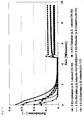
- Im ersten Beispiel wurde die Aufhellung mit verschiedenen Detergenzien im Reagenz 1 am Beispiel eines Humanserums, das mit Intralipid®20 aufgestockt war, anhand von E/t-Diagrammen ermittelt. Der Triglycerid-Gehalt der aufgestockten Humanserumprobe betrug ca. 2000 mg/dl. Als Detergenzien wurden Fettalkoholpolyglykolether mit 3 Ethoxy-Einheiten (Lutensol®ON 30), 5 Ethoxy-Einheiten (Lutensol®ON 50) und 8 Ethoxy-Einheiten (Genapol X-080) eingesetzt. Als Kontrolle wurde Reagenz 1 ohne Detergenz verwendet. Die Ergebnisse sind in der Figur 1 dargestellt. Es ist klar zu erkennen, daß lediglich das erfindungsgemäße Reagenz mit einem Fettalkoholpolyglykolether von 5 Ethoxy-Einheiten zu einer Aufhellung der lipämischen Probe führt. Bereits nach ca. zwei Minuten ist die Extinktion auf den Nullwert abgesunken. Ein Fettalkoholpolyglykolether mit 8 Ethoxy-Einheiten führt zu keiner Aufhellung der Probe. Der Fettalkoholpolyglykolether mit 3 Ethoxy-Einheiten führt sogar zu einer verstärkten Eintrübung der Probe.
- Die Versuchsdurchführung wurde analog dem Beispiel 1 durchgeführt. Es wurden verschiedene erfindungsgemäße Fettalkoholpolyglykolether mit 4,5 bis 6 Ethoxy-Einheiten eingesetzt (Imbentin-E/V-177: 4,5 Ethoxy-Einheiten; Lutensol® ON 50: 5 Ethoxy-Einheiten; Imbentin-AG/100/50: 5 Ethoxy-Einheiten; Imbentin-C/91/35: 5 Ethoxy-Einheiten; Lutensol® ON60: 6 Ethoxy-Einheiten).
- Die Ergebnisse sind in der Figur 2 dargestellt. Wie deutlich zu erkennen ist, führen alle erfindungsgemäßen Fettalkoholpolyglykolether bei einem Humanserum, das mit Intralipid aufgestockt wurde (Triglycerid-Gehalt ca. 2000 mg/dl), zu einer schnellen Aufhellung der Probe. Alle Proben waren nach ca. zwei Minuten aufgehellt. Imbentin E/V-177 und Imbentin-AG/100/50 führten bereits nach einer Minute zu einer vollständigen Aufhellung der Probe.
- Am Beispiel Lutensol® ON 50 wurde der Einfluß der Konzentration des Detergenz auf die Aufhellung von Humanserum, welches mit Intralipid bis zu einem Triglycerid-Gehalt von ca. 2000 mg/dl aufgestockt war, ermittelt. Die Ergebnisse sind in der Figur 3 dargestellt. Eine Konzentration von 4 % Lutensol® ON 50 fährt nach ca. drei Minuten zu einer vollständigen Aufklarung der Probe, 5 % Lutensol® ON 50 führen bereits nach ca. zwei Minuten zu einer vollständigen Aufklarung und 10 % Lutensol® ON 50 bereits nach 1 Minute zu einer vollständigen Aufklarung der Probe.
- Wie deutlich zu erkennen ist, führt auch die sehr hohe Konzentration von 10 % zu keiner Beeinflussung der Farbentwicklung nach Zusatz des Reagenz 2.
- Die Versuchsdurchführung erfolgte analog dem Beispiel 1.
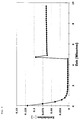
- An diesem Beispiel wurde gezeigt, daß nicht nur artifizielle mit Intralipid aufgestockte Proben mit dem erfindungsgemäßen Reagenz aufgeklart werden können, sondern auch natürlich vorkommende lipämische Humanseren. In diesem Beispiel wurde lipämisches Humanserum verwendet, das einen Triglycerid-Gehalt von ca. 1000 mg/dl enthielt. Die Versuchsdurchführung erfolgte analog dem Beispiel 1. Im Reagenz 1 waren als Detergenz 5 % Lutensol® ON 50 enthalten.
- Wie aus der Figur 4 eindeutig zu erkennen ist, führt die Zugabe des Reagenzes 1 bereits nach zwei Minuten zu einer vollständigen Aufklarung des lipämischen Humanserums.
Claims (10)
- Verfahren zur Bestimmung von Eisen in Serum unter Freisetzung des gebundenen Eisens durch Zusatz eines Protein-Denaturierungsmittels, Reduktions des freigesetzten Eisen zu Fe²⁺, Zugabe einer Farbreagenzlösung und photometrische Messung des gebildeten Farbkomplexes, dadurch gekennzeichnet, daß man das Serum mit einem Harnstoff- oder harnstoffderivathaltigem Denaturierungsmittel und einem Fettalkoholpolyglykolether versetzt.
- Verfahren nach Anspruch 1, dadurch gekennzeichnet, daß der Fettalkoholpolyglykolether mehr als 4 und weniger als 7 Ethoxy-Einheiten, insbesondere 5 bis 6 Ethoxy-Einheiten enthält.
- Verfahren nach einem der vorhergehenden Ansprüchen, dadurch gekennzeicnet, daß der Fettalkoholpolyglykolether einen verzweigten oder unverzweigten Fettalkoholrest mit bevorzugt 9 - 11 Kohlenstoffatomen enthält.
- Verfahren nach einem der vorhergehenden Ansprüche, dadurch gekennzeichnet, daß der Fettalkoholpolyglykolether in einer Konzentration von mindestens 10, insbesondere 50 bis 100 g/l, verwendet wird.
- Verfahren nach einem der vorhergehenden Ansprüche, dadurch gekennzeichnet, daß als Denaturierungsmittel ein Guanidiniumsalz verwendet wird.
- Verfahren nach einem der vorhergehenden Ansprüche, dadurch gekennzeichnet, daß man zur Reduktion des Eisens Ascorbinsäure, Dithionit oder Hydroxylamin verwendet.
- Verfahren nach einem der vorhergehenden Ansprüche, dadurch gekennzeichnet, daß man als Farbreagenz Bathophenanthrolin, Feren oder Ferrozin verwendet.
- Verwendung eines Gemisches eines Harnstoff- oder Harnstoffderivathaltigen Denaturierungsmittels und eines Fettalkoholpolyglykolethers zur Vermeidung von Lipämie- und Gammopathie-Störungen bei der photometrischen Bestimmung von Eisen in einer Probe.
- Reagenzienkombination zur Bestimmung von Eisen in Serum, gekennzeichnet durch
ein erstes Reagenz, enthaltend 1 bis 8 mol/l Denaturierungsmittel und mindestens 10 g/l Fettalkoholpolyglykolether und getrennt davon
ein zweites Reagenz, enthaltend 0,5 bis 50 mmol/l Farbstoff
in Form wässriger Lösungen oder zu deren Herstellung geeigneter Trockengemische. - Reagenzienkombination nach Anspruch 8, dadurch gekennzeichnet, daß in dem zweiten Reagenz 40 bis 200 mmol/l Reduktionsmittel enthalten sind.
Priority Applications (1)
| Application Number | Priority Date | Filing Date | Title |
|---|---|---|---|
| EP00115514A EP1052512B1 (de) | 1994-01-21 | 1995-01-17 | Verfahren und Teilreagenz zur Bestimmung von Eisen in Serum |
Applications Claiming Priority (2)
| Application Number | Priority Date | Filing Date | Title |
|---|---|---|---|
| DE4401754 | 1994-01-21 | ||
| DE4401754A DE4401754A1 (de) | 1994-01-21 | 1994-01-21 | Verfahren und Reagenz zur Bestimmung von Eisen |
Related Child Applications (1)
| Application Number | Title | Priority Date | Filing Date |
|---|---|---|---|
| EP00115514.2 Division-Into | 2000-07-19 |
Publications (3)
| Publication Number | Publication Date |
|---|---|
| EP0664454A2 true EP0664454A2 (de) | 1995-07-26 |
| EP0664454A3 EP0664454A3 (de) | 1996-06-26 |
| EP0664454B1 EP0664454B1 (de) | 2001-04-04 |
Family
ID=6508418
Family Applications (2)
| Application Number | Title | Priority Date | Filing Date |
|---|---|---|---|
| EP95100521A Expired - Lifetime EP0664454B1 (de) | 1994-01-21 | 1995-01-17 | Verfahren und Reagenz zur Bestimmung von Eisen |
| EP00115514A Expired - Lifetime EP1052512B1 (de) | 1994-01-21 | 1995-01-17 | Verfahren und Teilreagenz zur Bestimmung von Eisen in Serum |
Family Applications After (1)
| Application Number | Title | Priority Date | Filing Date |
|---|---|---|---|
| EP00115514A Expired - Lifetime EP1052512B1 (de) | 1994-01-21 | 1995-01-17 | Verfahren und Teilreagenz zur Bestimmung von Eisen in Serum |
Country Status (8)
| Country | Link |
|---|---|
| US (1) | US5763281A (de) |
| EP (2) | EP0664454B1 (de) |
| JP (1) | JP2603452B2 (de) |
| AT (2) | ATE200354T1 (de) |
| CA (1) | CA2140738A1 (de) |
| DE (3) | DE4401754A1 (de) |
| ES (2) | ES2157267T3 (de) |
| NO (1) | NO950222L (de) |
Cited By (1)
| Publication number | Priority date | Publication date | Assignee | Title |
|---|---|---|---|---|
| RU2216019C1 (ru) * | 2002-08-06 | 2003-11-10 | Научно-исследовательский институт высоких напряжений при Томском политехническом университете | Способ определения железа в воде |
Families Citing this family (10)
| Publication number | Priority date | Publication date | Assignee | Title |
|---|---|---|---|---|
| US5925318A (en) * | 1993-08-26 | 1999-07-20 | Ferro Sensor, Inc. | Iron detecting sensors |
| DE19622089A1 (de) * | 1996-05-31 | 1997-12-04 | Boehringer Mannheim Gmbh | Verfahren zur Analyse Hämoglobin enthaltender medizinischer Proben |
| US6177260B1 (en) * | 1997-07-11 | 2001-01-23 | The Hong Kong Polytechnic University | Measurement of antioxidant (reducing) power and/or antioxidant concentration |
| DE19817963A1 (de) * | 1998-04-22 | 1999-10-28 | Roche Diagnostics Gmbh | Verfahren und Reagenz zur störungsfreien Bestimmung von Eisen |
| US20060270050A1 (en) * | 2005-05-24 | 2006-11-30 | Texaco Development Corporation | Method and test kit for the determination of iron content of in-use lubricants |
| JP4655969B2 (ja) * | 2006-03-10 | 2011-03-23 | 三浦工業株式会社 | 鉄の定量方法 |
| JP4831371B2 (ja) * | 2006-03-10 | 2011-12-07 | 三浦工業株式会社 | 鉄の定量方法 |
| CN101629960A (zh) * | 2008-07-18 | 2010-01-20 | 中生北控生物科技股份有限公司 | 铁测定试剂组合、试剂盒及其应用 |
| CN107748161B (zh) * | 2017-08-23 | 2020-02-18 | 曲阜师范大学 | 一种多波长比色区分痕量Fe2+和Fe3+的方法 |
| US12416570B2 (en) | 2023-03-29 | 2025-09-16 | Saudi Arabian Oil Company | Measurement of iron in glycol and amine in natural gas processing |
Family Cites Families (10)
| Publication number | Priority date | Publication date | Assignee | Title |
|---|---|---|---|---|
| US3943954A (en) * | 1974-04-29 | 1976-03-16 | Texaco Inc. | Pipeline transportation of viscous hydrocarbons |
| DE3323949A1 (de) * | 1983-07-02 | 1985-01-03 | Boehringer Mannheim Gmbh, 6800 Mannheim | Verfahren und mittel zur raschen und vollstaendigen beseitigung einer truebung in einer biologischen fluessigkeit |
| DE3567280D1 (en) * | 1984-04-27 | 1989-02-09 | Lawrence Kass | Identification of myeloblasts and other immature granulocytic cells |
| JPS6195247A (ja) * | 1984-10-16 | 1986-05-14 | Yatoron:Kk | 血液試料の濁りを減らす方法 |
| DE3729502A1 (de) * | 1987-09-03 | 1989-03-23 | Boehringer Mannheim Gmbh | Verfahren und reagenz zur bestimmung von eisen |
| DE3732688A1 (de) * | 1987-09-29 | 1989-04-13 | Boehringer Mannheim Gmbh | Verfahren zur spezifischen bestimmung des serumfructosamingehalts sowie hierfuer geeignetes reagenzgemisch |
| DE3817907A1 (de) * | 1988-05-26 | 1989-11-30 | Boehringer Mannheim Gmbh | Verfahren und reagenz zur bestimmung von eisen |
| US5219760A (en) * | 1988-05-26 | 1993-06-15 | Boehringer Mannheim Gmbh | Process for the determination of iron |
| DE3920364A1 (de) * | 1989-06-22 | 1991-01-10 | Technicon Gmbh | Verfahren und reagenz zur verhinderung von truebungen |
| JPH06195247A (ja) * | 1992-12-24 | 1994-07-15 | Nec Corp | ファイル差分出力方式 |
-
1994
- 1994-01-21 DE DE4401754A patent/DE4401754A1/de not_active Withdrawn
-
1995
- 1995-01-17 AT AT95100521T patent/ATE200354T1/de active
- 1995-01-17 DE DE59509139T patent/DE59509139D1/de not_active Expired - Lifetime
- 1995-01-17 EP EP95100521A patent/EP0664454B1/de not_active Expired - Lifetime
- 1995-01-17 ES ES95100521T patent/ES2157267T3/es not_active Expired - Lifetime
- 1995-01-17 ES ES00115514T patent/ES2253163T3/es not_active Expired - Lifetime
- 1995-01-17 DE DE59511030T patent/DE59511030D1/de not_active Expired - Lifetime
- 1995-01-17 EP EP00115514A patent/EP1052512B1/de not_active Expired - Lifetime
- 1995-01-17 AT AT00115514T patent/ATE313080T1/de active
- 1995-01-20 CA CA002140738A patent/CA2140738A1/en not_active Abandoned
- 1995-01-20 JP JP7007533A patent/JP2603452B2/ja not_active Expired - Lifetime
- 1995-01-20 NO NO950222A patent/NO950222L/no not_active Application Discontinuation
-
1996
- 1996-07-11 US US08/680,255 patent/US5763281A/en not_active Expired - Lifetime
Cited By (1)
| Publication number | Priority date | Publication date | Assignee | Title |
|---|---|---|---|---|
| RU2216019C1 (ru) * | 2002-08-06 | 2003-11-10 | Научно-исследовательский институт высоких напряжений при Томском политехническом университете | Способ определения железа в воде |
Also Published As
| Publication number | Publication date |
|---|---|
| CA2140738A1 (en) | 1995-07-22 |
| JPH07218511A (ja) | 1995-08-18 |
| US5763281A (en) | 1998-06-09 |
| EP1052512B1 (de) | 2005-12-14 |
| ATE313080T1 (de) | 2005-12-15 |
| JP2603452B2 (ja) | 1997-04-23 |
| NO950222L (no) | 1995-07-24 |
| EP0664454A3 (de) | 1996-06-26 |
| ATE200354T1 (de) | 2001-04-15 |
| EP1052512A2 (de) | 2000-11-15 |
| ES2253163T3 (es) | 2006-06-01 |
| NO950222D0 (no) | 1995-01-20 |
| DE59509139D1 (de) | 2001-05-10 |
| EP1052512A3 (de) | 2000-11-29 |
| EP0664454B1 (de) | 2001-04-04 |
| DE4401754A1 (de) | 1995-07-27 |
| DE59511030D1 (de) | 2006-01-19 |
| ES2157267T3 (es) | 2001-08-16 |
Similar Documents
| Publication | Publication Date | Title |
|---|---|---|
| DE3854983T2 (de) | System zur isolierung und identifizierung von leukozyten | |
| DE60224287T2 (de) | Lytische reagenszusammensetzung zur bestimmung zellkernhaltiger roter blutkörperchen | |
| DE69032422T2 (de) | Reagenzzusammensetzung, Verfahren und Kits zur Quantifizierung von Magnesium oder Calcium und Magnesium | |
| DE69629938T2 (de) | Reagent-system und verfahren für differentiation und identifikation von retikulocyten | |
| EP0130537B1 (de) | Verfahren und Mittel zur raschen und vollständigen Beseitigung einer Trübung in einer biologischen Flüssigkeit | |
| DE3854326T2 (de) | Aufbereitungstechnik für vollblutmuster. | |
| DE69119410T2 (de) | Reagenz und verfahren zur kalziumbestimmung | |
| EP0664454B1 (de) | Verfahren und Reagenz zur Bestimmung von Eisen | |
| DE1648999B2 (de) | Verfahren zur immunochemischen Bestimmung von Antigenen und Antikörpern | |
| DE69625581T2 (de) | Cyanidfreies Reagenz und Verfahren zur Bestimmung von Hämoglobin und Leukozytendifferenzierung | |
| DE2149763B2 (de) | Verfahren zur bestimmung des haemoglobingehalts im blut | |
| DE3729502A1 (de) | Verfahren und reagenz zur bestimmung von eisen | |
| EP0952453B1 (de) | Verfahren und Reagenz zur störungsfreien Bestimmung von Eisen | |
| DE69014512T2 (de) | Reagens zum Nachweis von Bilirubin in Urin. | |
| DE69321520T2 (de) | Verfahren und Reagenz zur Bestimmung von Fructosamin | |
| DE2256331A1 (de) | Verfahren zur harnsaeurebestimmung | |
| DE3046526A1 (de) | Bestimmung von harnstoff | |
| EP0340511B1 (de) | Trägergebundenes mehrkomponentiges Nachweissystem zur kolorimetrischen Bestimmung esterolytisch oder/und proteolytisch aktiver Inhaltsstoffe von Körperflüssigkeiten | |
| DE69332764T2 (de) | Hydroxylamin enthaltendes kontrollreagenz | |
| DE3103612C2 (de) | Verfahren und Reagens zur direkten quantitativen Bestimmung von Chlorid im Blutserum | |
| DE69430410T2 (de) | Methode zum Nachweis von Fructosamin | |
| DE3920364C2 (de) | ||
| EP0343592B1 (de) | Verfahren und Reagenz zur Bestimmung von Eisen | |
| DE2504994A1 (de) | Verfahren zur kreatininbestimmung | |
| DE19739120A1 (de) | Verfahren zur Bestimmung der Antioxidanzkapazität von Proben |
Legal Events
| Date | Code | Title | Description |
|---|---|---|---|
| PUAI | Public reference made under article 153(3) epc to a published international application that has entered the european phase |
Free format text: ORIGINAL CODE: 0009012 |
|
| AK | Designated contracting states |
Kind code of ref document: A2 Designated state(s): AT BE CH DE ES FR GB IT LI NL PT |
|
| PUAL | Search report despatched |
Free format text: ORIGINAL CODE: 0009013 |
|
| AK | Designated contracting states |
Kind code of ref document: A3 Designated state(s): AT BE CH DE ES FR GB IT LI NL PT |
|
| 17P | Request for examination filed |
Effective date: 19961227 |
|
| RAP3 | Party data changed (applicant data changed or rights of an application transferred) |
Owner name: ROCHE DIAGNOSTICS GMBH |
|
| 17Q | First examination report despatched |
Effective date: 19990930 |
|
| GRAG | Despatch of communication of intention to grant |
Free format text: ORIGINAL CODE: EPIDOS AGRA |
|
| GRAG | Despatch of communication of intention to grant |
Free format text: ORIGINAL CODE: EPIDOS AGRA |
|
| GRAG | Despatch of communication of intention to grant |
Free format text: ORIGINAL CODE: EPIDOS AGRA |
|
| GRAH | Despatch of communication of intention to grant a patent |
Free format text: ORIGINAL CODE: EPIDOS IGRA |
|
| GRAH | Despatch of communication of intention to grant a patent |
Free format text: ORIGINAL CODE: EPIDOS IGRA |
|
| GRAA | (expected) grant |
Free format text: ORIGINAL CODE: 0009210 |
|
| AK | Designated contracting states |
Kind code of ref document: B1 Designated state(s): AT BE CH DE ES FR GB IT LI NL PT |
|
| REF | Corresponds to: |
Ref document number: 200354 Country of ref document: AT Date of ref document: 20010415 Kind code of ref document: T |
|
| REG | Reference to a national code |
Ref country code: CH Ref legal event code: EP |
|
| REF | Corresponds to: |
Ref document number: 59509139 Country of ref document: DE Date of ref document: 20010510 |
|
| REG | Reference to a national code |
Ref country code: CH Ref legal event code: NV Representative=s name: F. HOFFMANN-LA ROCHE AG |
|
| ITF | It: translation for a ep patent filed | ||
| PG25 | Lapsed in a contracting state [announced via postgrant information from national office to epo] |
Ref country code: PT Free format text: LAPSE BECAUSE OF FAILURE TO SUBMIT A TRANSLATION OF THE DESCRIPTION OR TO PAY THE FEE WITHIN THE PRESCRIBED TIME-LIMIT Effective date: 20010704 |
|
| GBT | Gb: translation of ep patent filed (gb section 77(6)(a)/1977) |
Effective date: 20010622 |
|
| ET | Fr: translation filed | ||
| REG | Reference to a national code |
Ref country code: ES Ref legal event code: FG2A Ref document number: 2157267 Country of ref document: ES Kind code of ref document: T3 |
|
| REG | Reference to a national code |
Ref country code: GB Ref legal event code: IF02 |
|
| PG25 | Lapsed in a contracting state [announced via postgrant information from national office to epo] |
Ref country code: BE Free format text: LAPSE BECAUSE OF NON-PAYMENT OF DUE FEES Effective date: 20020131 |
|
| PGFP | Annual fee paid to national office [announced via postgrant information from national office to epo] |
Ref country code: NL Payment date: 20020131 Year of fee payment: 8 |
|
| PLBE | No opposition filed within time limit |
Free format text: ORIGINAL CODE: 0009261 |
|
| STAA | Information on the status of an ep patent application or granted ep patent |
Free format text: STATUS: NO OPPOSITION FILED WITHIN TIME LIMIT |
|
| 26N | No opposition filed | ||
| BERE | Be: lapsed |
Owner name: ROCHE DIAGNOSTICS G.M.B.H. Effective date: 20020131 |
|
| PG25 | Lapsed in a contracting state [announced via postgrant information from national office to epo] |
Ref country code: NL Free format text: LAPSE BECAUSE OF NON-PAYMENT OF DUE FEES Effective date: 20030801 |
|
| NLV4 | Nl: lapsed or anulled due to non-payment of the annual fee |
Effective date: 20030801 |
|
| PGFP | Annual fee paid to national office [announced via postgrant information from national office to epo] |
Ref country code: GB Payment date: 20131227 Year of fee payment: 20 |
|
| PGFP | Annual fee paid to national office [announced via postgrant information from national office to epo] |
Ref country code: DE Payment date: 20140131 Year of fee payment: 20 Ref country code: CH Payment date: 20140127 Year of fee payment: 20 |
|
| PGFP | Annual fee paid to national office [announced via postgrant information from national office to epo] |
Ref country code: IT Payment date: 20140116 Year of fee payment: 20 Ref country code: FR Payment date: 20131223 Year of fee payment: 20 Ref country code: ES Payment date: 20140117 Year of fee payment: 20 Ref country code: AT Payment date: 20131227 Year of fee payment: 20 |
|
| REG | Reference to a national code |
Ref country code: DE Ref legal event code: R071 Ref document number: 59509139 Country of ref document: DE |
|
| REG | Reference to a national code |
Ref country code: DE Ref legal event code: R071 Ref document number: 59509139 Country of ref document: DE |
|
| REG | Reference to a national code |
Ref country code: CH Ref legal event code: PL |
|
| REG | Reference to a national code |
Ref country code: GB Ref legal event code: PE20 Expiry date: 20150116 |
|
| REG | Reference to a national code |
Ref country code: AT Ref legal event code: MK07 Ref document number: 200354 Country of ref document: AT Kind code of ref document: T Effective date: 20150117 |
|
| REG | Reference to a national code |
Ref country code: ES Ref legal event code: FD2A Effective date: 20150330 |
|
| PG25 | Lapsed in a contracting state [announced via postgrant information from national office to epo] |
Ref country code: ES Free format text: LAPSE BECAUSE OF EXPIRATION OF PROTECTION Effective date: 20150118 |
|
| PG25 | Lapsed in a contracting state [announced via postgrant information from national office to epo] |
Ref country code: GB Free format text: LAPSE BECAUSE OF EXPIRATION OF PROTECTION Effective date: 20150116 |