EP0664817B1 - Hilfsmittel zur verarbeitung von kunststoffen, verfahren zur herstellung von diesem hilfsmittel und verfahren zur herstellung von reduzierte monomeremission aufweisendem polyesterharz - Google Patents
Hilfsmittel zur verarbeitung von kunststoffen, verfahren zur herstellung von diesem hilfsmittel und verfahren zur herstellung von reduzierte monomeremission aufweisendem polyesterharz Download PDFInfo
- Publication number
- EP0664817B1 EP0664817B1 EP94923838A EP94923838A EP0664817B1 EP 0664817 B1 EP0664817 B1 EP 0664817B1 EP 94923838 A EP94923838 A EP 94923838A EP 94923838 A EP94923838 A EP 94923838A EP 0664817 B1 EP0664817 B1 EP 0664817B1
- Authority
- EP
- European Patent Office
- Prior art keywords
- auxiliary agent
- resin
- weight
- parts
- mixture
- Prior art date
- Legal status (The legal status is an assumption and is not a legal conclusion. Google has not performed a legal analysis and makes no representation as to the accuracy of the status listed.)
- Expired - Lifetime
Links
- 0 C*(C)*(CC1)=CC=C1C(C)(C=C)c(cc1)ccc1OC*(N)O Chemical compound C*(C)*(CC1)=CC=C1C(C)(C=C)c(cc1)ccc1OC*(N)O 0.000 description 1
Classifications
-
- C—CHEMISTRY; METALLURGY
- C08—ORGANIC MACROMOLECULAR COMPOUNDS; THEIR PREPARATION OR CHEMICAL WORKING-UP; COMPOSITIONS BASED THEREON
- C08G—MACROMOLECULAR COMPOUNDS OBTAINED OTHERWISE THAN BY REACTIONS ONLY INVOLVING UNSATURATED CARBON-TO-CARBON BONDS
- C08G59/00—Polycondensates containing more than one epoxy group per molecule; Macromolecules obtained by polymerising compounds containing more than one epoxy group per molecule using curing agents or catalysts which react with the epoxy groups
- C08G59/14—Polycondensates modified by chemical after-treatment
-
- C—CHEMISTRY; METALLURGY
- C08—ORGANIC MACROMOLECULAR COMPOUNDS; THEIR PREPARATION OR CHEMICAL WORKING-UP; COMPOSITIONS BASED THEREON
- C08L—COMPOSITIONS OF MACROMOLECULAR COMPOUNDS
- C08L63/00—Compositions of epoxy resins; Compositions of derivatives of epoxy resins
- C08L63/10—Epoxy resins modified by unsaturated compounds
-
- C—CHEMISTRY; METALLURGY
- C08—ORGANIC MACROMOLECULAR COMPOUNDS; THEIR PREPARATION OR CHEMICAL WORKING-UP; COMPOSITIONS BASED THEREON
- C08G—MACROMOLECULAR COMPOUNDS OBTAINED OTHERWISE THAN BY REACTIONS ONLY INVOLVING UNSATURATED CARBON-TO-CARBON BONDS
- C08G59/00—Polycondensates containing more than one epoxy group per molecule; Macromolecules obtained by polymerising compounds containing more than one epoxy group per molecule using curing agents or catalysts which react with the epoxy groups
- C08G59/14—Polycondensates modified by chemical after-treatment
- C08G59/1433—Polycondensates modified by chemical after-treatment with organic low-molecular-weight compounds
- C08G59/1438—Polycondensates modified by chemical after-treatment with organic low-molecular-weight compounds containing oxygen
- C08G59/1444—Monoalcohols
-
- C—CHEMISTRY; METALLURGY
- C08—ORGANIC MACROMOLECULAR COMPOUNDS; THEIR PREPARATION OR CHEMICAL WORKING-UP; COMPOSITIONS BASED THEREON
- C08G—MACROMOLECULAR COMPOUNDS OBTAINED OTHERWISE THAN BY REACTIONS ONLY INVOLVING UNSATURATED CARBON-TO-CARBON BONDS
- C08G59/00—Polycondensates containing more than one epoxy group per molecule; Macromolecules obtained by polymerising compounds containing more than one epoxy group per molecule using curing agents or catalysts which react with the epoxy groups
- C08G59/14—Polycondensates modified by chemical after-treatment
- C08G59/1433—Polycondensates modified by chemical after-treatment with organic low-molecular-weight compounds
- C08G59/1438—Polycondensates modified by chemical after-treatment with organic low-molecular-weight compounds containing oxygen
- C08G59/1455—Monocarboxylic acids, anhydrides, halides, or low-molecular-weight esters thereof
-
- C—CHEMISTRY; METALLURGY
- C08—ORGANIC MACROMOLECULAR COMPOUNDS; THEIR PREPARATION OR CHEMICAL WORKING-UP; COMPOSITIONS BASED THEREON
- C08L—COMPOSITIONS OF MACROMOLECULAR COMPOUNDS
- C08L67/00—Compositions of polyesters obtained by reactions forming a carboxylic ester link in the main chain; Compositions of derivatives of such polymers
- C08L67/06—Unsaturated polyesters
Definitions
- the invention relates to tools for processing Plastics, process for the production of this auxiliary, used in plastics and manufacturing processes polyester resin with reduced monomer emission.
- the invention also includes chemical synthesis of Auxiliary component and composition of the mixture of this ingredient with long chain fatty acid amides and / or salts of divalent metals and optionally Fatty acid esters and / or polyethylene waxes and methods for Manufacture of polyester resin, which in the introduction of the Aid as a modifier exists.
- paraffin melting temperature 45-60 ° C.
- styrene emission from unsaturated polyester resins can be reduced by using auxiliaries according to claim 1 or 2 or their use according to one of claims 3 to 7.
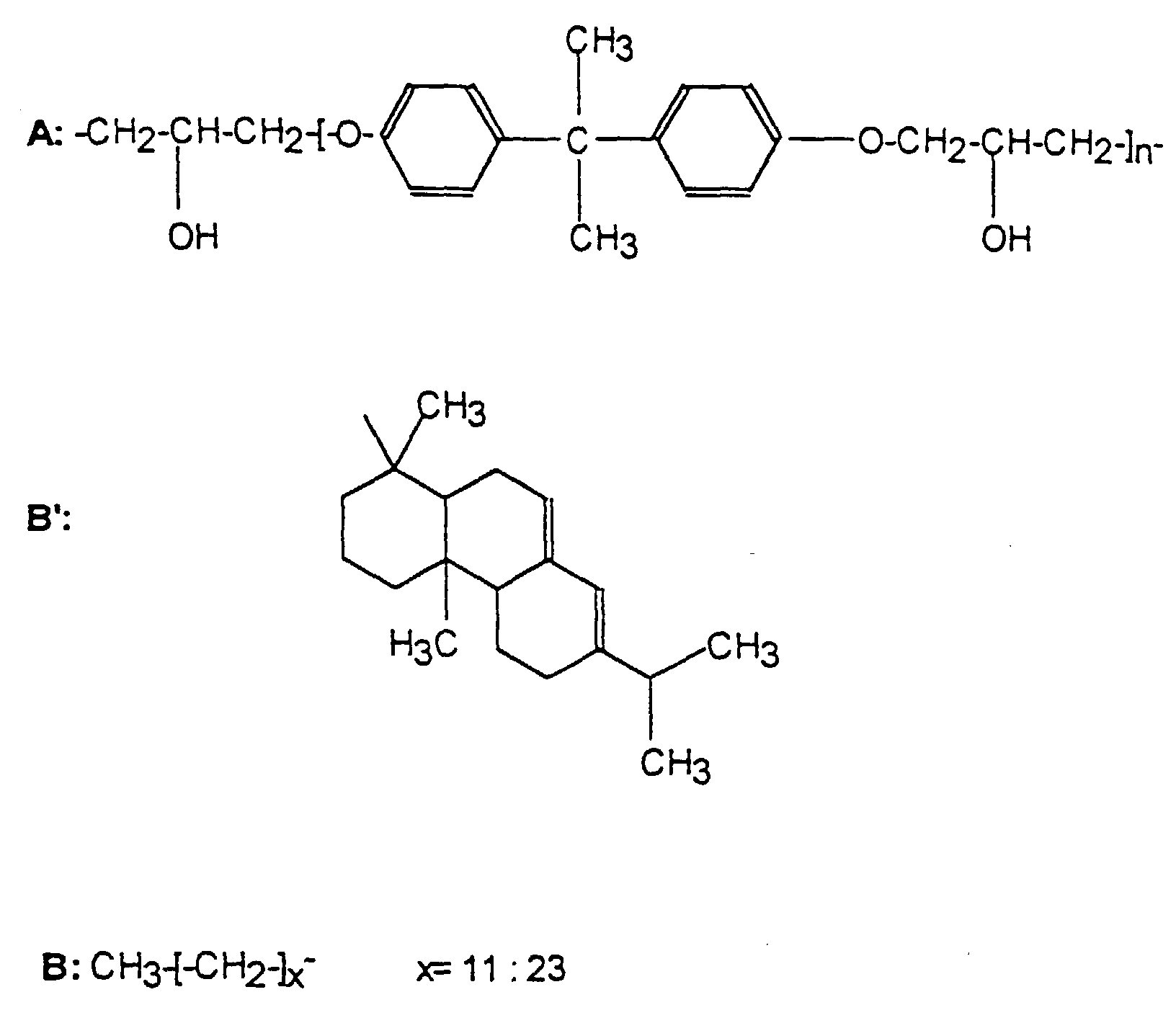
- the auxiliary is a mixture of a compound of the general formula BCOO-A-OOCB ', in which A is a group of the general formula 1, B is a group of the formula CH 3 (CH 2 ) x , where x is from 11 to 23, B 'is a group formed by the removal of hydrogen from the rosin molecule, the rosin being a mixture of abietic acid, levopimaric acid, neoabietic acid and palustric acid, with the addition of fatty acid amide and / or salts of divalent metals and optionally fatty acid esters and / or Polyethylene waxes (molecular weight 300-5000) in an amount of 2 to 50 parts of long-chain fatty acid mide and / or salts of divalent metals and optionally fatty acid esters and / or polyethylene waxes, per 100 parts of compound of the general formula BCOO-A-OOCB ', in which A, B, B 'have the meaning given above.
- Aids according to the invention dissolve very well in unsaturated polyester resins as well as in organic solvents. They reduce and have styrene emissions very effectively no negative influence on the mechanical properties of Polyester glass laminates, especially no negative impact on the Interlayer adhesion of these laminates.
- Aids according to the invention are at elevated temperature and in the presence of amine catalyst by addition reaction of compounds of the formula CH 3 (CH 2 ) x COOH, where x is from 11 to 23, and rosin to epoxy resin and then by adding the fatty acid amides and / or - salts of divalent metals (fatty acid chain C 11-18 ) and optionally polyethylene waxes of molecular mass 300-5000.
- Saturated fatty acids advantageously stearic acid and lauric acid, are mostly used as compounds of the general formula CH 3 (CH 2 ) x COOH.
- unsaturated fatty acids can be used, advantageously oleic acid.
- Bisphenol-A epoxy resins in particular are used as epoxy resins from epoxy value 0.21-0.51 used.
- the main fatty acid amide used is ethylenedistearinamide used.
- As derivatives of fatty acids and salts of divalent Metals are mostly salts of lead, calcium, zinc and Stearic acid used.
- hydrocarbons from Molecular mass from 300 to 5000 used.
- reactions can take place in any order are introduced, compounds of the general formula BCOO-A-OOCB 'at a fatty acid / rosin weight ratio of 0.1: 1.0 to 5.0: 1.0.
- Quantity ratio of epoxy resin / total amount of fatty acids + Rosin is maintained at ratio: epoxy value of Carboxylic acid / carboxyl groups: from 0.50: 1.0 to 1.5: 1.0.
- Aids that have advantageous properties are made by mixing and melting the compound of general formula BCOO-A-OOCB 'with 2-50 parts by weight Fatty acid amide and salts of divalent metals and / or Fatty acid esters and / or polyethylene waxes (of molecular weight 300-5000).
- the above mixture shows good long-term stability on and in contrast to the previous solutions - no tendency to remove modifiers from the solution. Moreover can the mixture in the case of both unsaturated orthophthalic polyester acids as well as isophthalic and vinyl ester resins be used.
- additives in organic solvents including in xylene, toluene, white spirit
- their Mixtures are very soluble and therefore they can be mixed in Polyester resins as a high content of modifiers (up to Paste containing 90% by weight) are introduced.
- the proposed Additives also dissolve in all of the well-known ones Polyester resins good, with no tendency to excrete Additives from the solution.
- the additives introduced into polyester resins are added at elevated temperature and in the presence of an amine catalyst by addition reaction of compounds of the formula CH 3 (CH 2 ) x COOH, where x is from 11 to 23, and rosin to epoxy resin and then addition of fatty acid amide and / or - salt of divalent metal (fatty acid chain C 11-18 ) and optionally of fatty acid esters and / or polyethylene waxes (molecular weight 300-5000).
- Polyester resins mainly include styrene as a cross-linking agent Monomer, however, the above additives can also be used in the case of unsaturated polyester resins that crosslink such Monomers such as Styrene derivatives, acrylic or Metacryloligoester, individually or in a mixture, be used.
- the unsaturated polyesters belonging to these resins consist of maleic acid or fumaric acid residues, residues of Glycol, such as ethylene glycol, diethylene glycol, 1,2-propylene glycol, Dipropylene glycol, 1,3-butylene glycol, Neopentyl glycol, dibromoneopentyl glycol and chloromethylethylene glycol and 2,2-di- (p-hydroxypropoxyphenyl) propane, Epichlorohydrins and residues of dicarboxylic acids such as phthalic acid, Isophthalic acid, terephthalic acid, adipic acid and sebacic acid and acid derivatives of diene adducts of maleic anhydride with cyclopentadiene, hexachlorocyclopentadiene, Naphthol or anthracene and from maleopimaric acid residues.
- Glycol such as ethylene glycol, diethylene glycol, 1,2-propylene glycol, Dipropylene glycol, 1,3
- Unsaturated polyester resins according to the invention can also known additives such as inhibitors, e.g. Hydroquinone, thixotropic Additives e.g. active silicate, antipyrene, e.g. Pentabromoethylbenzene, mineral fillers e.g. Chalk, Kaolin, talc or chopped glass fiber and thickener e.g. Magnesium oxide and flame retardants.
- inhibitors e.g. Hydroquinone, thixotropic Additives e.g. active silicate, antipyrene, e.g. Pentabromoethylbenzene, mineral fillers e.g. Chalk, Kaolin, talc or chopped glass fiber and thickener e.g. Magnesium oxide and flame retardants.
- Hardening can also be done with known methods with the help of UV radiation or radiation in the visual area by using suitable sensitizers or with the help of gamma rays or electron current be performed.
- a mixture of 100.0 g bisphenol-A-epichlorohydrin resin (epoxy value 0.40), 75.2 g stearic acid and 42.2 g rosin is heated in the presence of 0.3 g triethanoloamine at 120 ° C. for 3 hours.
- 32.0 g of ethylene distearinamide and 16.5 g of polyethylene micro wax are added to the molten reaction product.
- the product obtained dissolves (10.3 g in 1000 g) in malein-fumar-phthalopropylene polyester resin containing 33% styrene.
- the solution is poured into a Petri dish (surface: 95 cm 2 ; side wall height: 10 mm) and placed in a place with a constant air flow speed (0.4 m / s) at 22 ° C.
- the petri dish with the resin is weighed immediately before the start of the evaporation test and then after 60 minutes. A sample with the same resin but no additive is used for comparison.
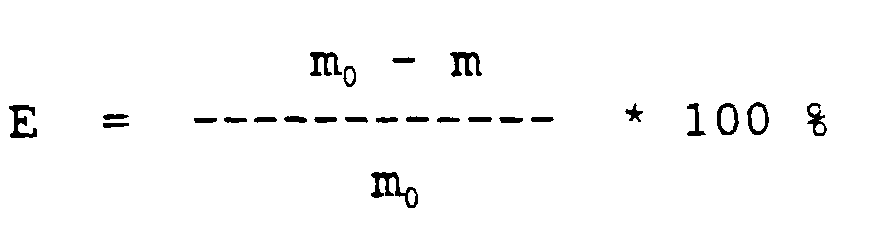
- the effectiveness of additive effect E [%] is calculated using the following formula: where: m 0 - loss of mass (due to styrene evaporation) of resin without additive. m - mean loss of mass of resin with additive.
- the interlayer adhesion can in the present case as can be described very well: on the entire surface of "Dry” glass fibers and none can be torn Delamination, leaving the smooth spots on the separation surface would watch. With the method used, the highest grade "3" achieved (rating scale from 1 to 3); the second laminate layer was applied 7 days after the first layer hung up.
- the paste obtained (15.5 g) dissolves in 1000 g of malein-fumar-propoxyl-bisphenol-A-polyester resin (50% styrene). Effectiveness of additive action is investigated as in Example 6. The effectiveness is 99.5%.
- the interlayer adhesion of resin modified in this way is investigated using the impact method with the aid of modified DuPont apparatus. In this method, the delamination surface on the laminate (7 day break) is measured with a planimeter. The delamination surface is 178 mm 2 (the delamination surface of laminate made with unmodified resin measured using the same method is 175 mm 2 ).
Landscapes
- Chemical & Material Sciences (AREA)
- Health & Medical Sciences (AREA)
- Chemical Kinetics & Catalysis (AREA)
- Medicinal Chemistry (AREA)
- Polymers & Plastics (AREA)
- Organic Chemistry (AREA)
- General Chemical & Material Sciences (AREA)
- Emergency Medicine (AREA)
- Compositions Of Macromolecular Compounds (AREA)
- Laminated Bodies (AREA)
- Macromonomer-Based Addition Polymer (AREA)
Description
m - Massenverlust von Harz mit Additiv bedeuten.
Claims (7)
- Hilfsmittel zur Kunststoffverarbeitung, das ein Gemisch von Additionsprodukten von Fettsäuren und Kolophoniumharzsäuren an Epoxidharz enthält, das der Formelist, B eine Gruppe der Formel CH3(CH2)x (x = 11 - 23) darstellt und B' für eine durch Abspalten von Wasserstoff aus Kolophonium entstandene Gruppe steht, dadurch gekennzeichnet, daß es (bezogen auf 100 Gew.-Teile Additionsprodukt) 2 bis 50 Gew.-Teile Fettsäureamid und/oder Fettsäuresalze von zweiwertigen Metallen enthält.

- Hilfsmittel nach Anspruch 1, das zusätzlich langkettige Fettsäureester und/oder Polyethylenwachse (Molekülmasse 300 - 5000) und gegebenenfalls 0,1 bis 7,0 Gew.-Teile Paraffin enthält.
- Verfahren zur Herstellung von ungesättigten Polyesterharzen, bei dem man das Harz mit einem Hilfsmittel gemäß Anspruch 1 oder 2 modifiziert, wobei auf 100 Gew.-Teile ungesättigtes Polyesterharz 0,05 bis 5,0 Gew.-Teile des Hilfsmittels eingeführt werden.
- Verfahren nach Anspruch 3, bei dem 0,5 bis 2,0 Gew.-Teile des Hilfsmittels eingeführt werden.
- Verfahren nach Anspruch 3 oder 4, bei dem die Bestandteile des Hilfsmittels als zusammengeschmolzene Mischung in das Harz eingeführt werden.
- Verfahren nach Anspruch 3 oder 4, bei dem die Bestandteile des Hilfsmittels nach Auflösen in einem organischen Lösungsmittel(gemisch) in das Harz eingeführt werden.
- Verfahren nach Anspruch 3 oder 4, bei dem die Bestandteile des Hilfsmittels einzeln in das Harz eingeführt werden.
Applications Claiming Priority (5)
| Application Number | Priority Date | Filing Date | Title |
|---|---|---|---|
| PL30013093 | 1993-08-18 | ||
| PL30013093A PL172079B1 (pl) | 1993-08-18 | 1993-08-18 | Środek pomocniczy do przetwórstwa tworzyw sztucznych |
| PL30048493 | 1993-09-24 | ||
| PL30048493A PL172081B1 (pl) | 1993-09-24 | 1993-09-24 | Sposób wytwarzania nienasyconych żywic poliestrowych o zmniejszonej emisji monomeru, zwłaszcza do laminatów poliestrowo-szklanych |
| PCT/PL1994/000017 WO1995005410A1 (de) | 1993-08-18 | 1994-08-18 | Hilfsmittel zur verarbeitung von kunststoffen, verfahren zur herstellung von diesem hilfsmittel und verfahren zur herstellung von reduzierte monomeremission aufweisendem polyesterharz |
Publications (2)
| Publication Number | Publication Date |
|---|---|
| EP0664817A1 EP0664817A1 (de) | 1995-08-02 |
| EP0664817B1 true EP0664817B1 (de) | 2000-04-26 |
Family
ID=26653094
Family Applications (1)
| Application Number | Title | Priority Date | Filing Date |
|---|---|---|---|
| EP94923838A Expired - Lifetime EP0664817B1 (de) | 1993-08-18 | 1994-08-18 | Hilfsmittel zur verarbeitung von kunststoffen, verfahren zur herstellung von diesem hilfsmittel und verfahren zur herstellung von reduzierte monomeremission aufweisendem polyesterharz |
Country Status (6)
| Country | Link |
|---|---|
| US (1) | US5719213A (de) |
| EP (1) | EP0664817B1 (de) |
| KR (1) | KR100340131B1 (de) |
| CN (1) | CN1062876C (de) |
| DE (1) | DE59409310D1 (de) |
| WO (1) | WO1995005410A1 (de) |
Families Citing this family (7)
| Publication number | Priority date | Publication date | Assignee | Title |
|---|---|---|---|---|
| DE19902403A1 (de) * | 1999-01-22 | 2000-08-03 | Bayer Ag | UV-härtende Bindemittel, sowie deren Verwendung zur Erzeugung hochglänzender Beschichtungen |
| US6348270B1 (en) | 1999-09-01 | 2002-02-19 | Reichhold Inc. | High performance polyetherester containing laminating resin compositions |
| DE102004059883A1 (de) * | 2004-12-10 | 2006-06-14 | Brandenburger Patentverwertung Gbr (Vertretungsberechtigte Gesellschafter Herr Joachim Brandenburger | Herstellung eines harzgetränkten Faserschlauches zur Innenauskleidung von Kanälen und Rohrleitungen |
| CN102731729B (zh) * | 2012-07-10 | 2014-11-26 | 常州华日新材有限公司 | 二次粘结不饱和聚酯树脂的制备方法 |
| CN103408792A (zh) * | 2013-08-15 | 2013-11-27 | 常州市华润复合材料有限公司 | 一种苯乙烯挥发抑制剂及含有其的不饱和聚酯 |
| CN107903601A (zh) * | 2017-12-21 | 2018-04-13 | 吴江市强塑阀门管件厂 | 一种抗老化塑料管材的制备方法及其应用 |
| CN108659603A (zh) * | 2018-06-12 | 2018-10-16 | 淮北宇鑫新型材料有限公司 | 一种不饱和树脂挥发性单体的挥发抑制剂及其制备方法 |
Family Cites Families (3)
| Publication number | Priority date | Publication date | Assignee | Title |
|---|---|---|---|---|
| PL141771B1 (en) * | 1984-10-01 | 1987-08-31 | Inst Chemii Przemyslowej | Auxiliary agent for processing plastics and method of obtaining it |
| PL141789B1 (en) * | 1984-10-01 | 1987-08-31 | Inst Chemii Przemyslowej | Auxiliary agent for processing plastics and method of obtaining it |
| DE4028628A1 (de) * | 1990-09-08 | 1992-03-12 | Hoechst Ag | Ungesaettigte haertbare polyesterharzmassen mit verringerter styrolemission und verbesserter eigenhaftung auf ihrer ausgehaerteten masse |
-
1994
- 1994-08-18 EP EP94923838A patent/EP0664817B1/de not_active Expired - Lifetime
- 1994-08-18 CN CN94190615A patent/CN1062876C/zh not_active Expired - Fee Related
- 1994-08-18 KR KR1019950701479A patent/KR100340131B1/ko not_active Expired - Fee Related
- 1994-08-18 DE DE59409310T patent/DE59409310D1/de not_active Expired - Fee Related
- 1994-08-18 WO PCT/PL1994/000017 patent/WO1995005410A1/de not_active Ceased
-
1997
- 1997-01-23 US US08/788,052 patent/US5719213A/en not_active Expired - Fee Related
Also Published As
| Publication number | Publication date |
|---|---|
| KR100340131B1 (ko) | 2002-10-31 |
| CN1062876C (zh) | 2001-03-07 |
| KR950703591A (ko) | 1995-09-20 |
| WO1995005410A1 (de) | 1995-02-23 |
| CN1113657A (zh) | 1995-12-20 |
| US5719213A (en) | 1998-02-17 |
| DE59409310D1 (de) | 2000-05-31 |
| EP0664817A1 (de) | 1995-08-02 |
Similar Documents
| Publication | Publication Date | Title |
|---|---|---|
| DE1520725C3 (de) | Verfahren zur Herstellung von Alkydharzen | |
| EP0664817B1 (de) | Hilfsmittel zur verarbeitung von kunststoffen, verfahren zur herstellung von diesem hilfsmittel und verfahren zur herstellung von reduzierte monomeremission aufweisendem polyesterharz | |
| DE60007152T2 (de) | Verfahren zur herstellung von olefinharz | |
| DE1645379B2 (de) | Anaerob haertbare massen | |
| DE1943695B2 (de) | Mischung aus einem Epoxydharz mit 1,2-Epoxydgruppen und einem Härtungsmittel | |
| DE2058294B2 (de) | Verfahren zur herstellung von ueberzuegen | |
| DE1768112A1 (de) | Haertbares Praeparat | |
| DE2347680B2 (de) | Harzzusammensetzung für Pulverlacke | |
| EP0158238B1 (de) | Ungesättigte Polyesterharze | |
| EP0017798A1 (de) | Durch energiereiche Strahlung härtbare modifizierte Polyesterimide, Verfahren zu ihrer Herstellung und deren Verwendung zur Isolierung von elektrischen Drähten | |
| DE1294665B (de) | Verfahren zur Herstellung eines Polyesters | |
| DE2204106C3 (de) | Klebstoffmasse auf Basis eines Gemisches von Polyesterharz und Epoxyharz | |
| EP0133949A1 (de) | Wasserverdünnbare Beschichtungsmittel für mineralische und bituminöse Untergründe und Verfahren zur Herstellung der Beschichtungsmittel | |
| DE1956409B2 (de) | Drahtüberzugslösung auf Polyesterimidbasis | |
| DE602004007295T2 (de) | Verfahren zur herstellung von thermisch gehärteten überzügen | |
| DE1900964A1 (de) | Verfahren zur Herstellung von Alkydharzen | |
| EP0260686A2 (de) | Lagerstabile Formmassen auf Basis von härtbaren ungesättigten Polyesterharzen | |
| PL172081B1 (pl) | Sposób wytwarzania nienasyconych żywic poliestrowych o zmniejszonej emisji monomeru, zwłaszcza do laminatów poliestrowo-szklanych | |
| DE1105160B (de) | Verfahren zur Herstellung von Polymerisationsprodukten durch Auspolymerisieren ungesaettigter Polyesterharze | |
| DE19922032A1 (de) | Verfahren zur Herstellung von bei Raumtemperatur festen, modifizierten cycloaliphatischen Epoxidharzen und ihre Verwendung | |
| DE4039029C2 (de) | Verwendung von vernetzbaren Poly-2-oxazolinetheramiden in wärmehärtbaren organischen Beschichtungsmassen | |
| DE852300C (de) | Verfahren zur Herstellung von trocknenden Polyestern | |
| EP0936236A2 (de) | Epoxidharz- und Hybridpulverbeschichtungszusammensetzungen | |
| DE2607326A1 (de) | Klebmittel und dessen verwendung | |
| DE1645379C (de) | Anaerob härtbare Massen |
Legal Events
| Date | Code | Title | Description |
|---|---|---|---|
| PUAI | Public reference made under article 153(3) epc to a published international application that has entered the european phase |
Free format text: ORIGINAL CODE: 0009012 |
|
| 17P | Request for examination filed |
Effective date: 19950517 |
|
| AK | Designated contracting states |
Kind code of ref document: A1 Designated state(s): DE FR GB |
|
| 17Q | First examination report despatched |
Effective date: 19970123 |
|
| GRAG | Despatch of communication of intention to grant |
Free format text: ORIGINAL CODE: EPIDOS AGRA |
|
| GRAG | Despatch of communication of intention to grant |
Free format text: ORIGINAL CODE: EPIDOS AGRA |
|
| GRAG | Despatch of communication of intention to grant |
Free format text: ORIGINAL CODE: EPIDOS AGRA |
|
| GRAH | Despatch of communication of intention to grant a patent |
Free format text: ORIGINAL CODE: EPIDOS IGRA |
|
| GRAH | Despatch of communication of intention to grant a patent |
Free format text: ORIGINAL CODE: EPIDOS IGRA |
|
| GRAA | (expected) grant |
Free format text: ORIGINAL CODE: 0009210 |
|
| AK | Designated contracting states |
Kind code of ref document: B1 Designated state(s): DE FR GB |
|
| GBT | Gb: translation of ep patent filed (gb section 77(6)(a)/1977) |
Effective date: 20000426 |
|
| REF | Corresponds to: |
Ref document number: 59409310 Country of ref document: DE Date of ref document: 20000531 |
|
| ET | Fr: translation filed | ||
| PLBE | No opposition filed within time limit |
Free format text: ORIGINAL CODE: 0009261 |
|
| STAA | Information on the status of an ep patent application or granted ep patent |
Free format text: STATUS: NO OPPOSITION FILED WITHIN TIME LIMIT |
|
| 26N | No opposition filed | ||
| PGFP | Annual fee paid to national office [announced via postgrant information from national office to epo] |
Ref country code: GB Payment date: 20010724 Year of fee payment: 8 |
|
| PGFP | Annual fee paid to national office [announced via postgrant information from national office to epo] |
Ref country code: FR Payment date: 20010726 Year of fee payment: 8 |
|
| PGFP | Annual fee paid to national office [announced via postgrant information from national office to epo] |
Ref country code: DE Payment date: 20010801 Year of fee payment: 8 |
|
| REG | Reference to a national code |
Ref country code: GB Ref legal event code: IF02 |
|
| PG25 | Lapsed in a contracting state [announced via postgrant information from national office to epo] |
Ref country code: GB Free format text: LAPSE BECAUSE OF NON-PAYMENT OF DUE FEES Effective date: 20020818 |
|
| PG25 | Lapsed in a contracting state [announced via postgrant information from national office to epo] |
Ref country code: DE Free format text: LAPSE BECAUSE OF NON-PAYMENT OF DUE FEES Effective date: 20030301 |
|
| GBPC | Gb: european patent ceased through non-payment of renewal fee |
Effective date: 20020818 |
|
| PG25 | Lapsed in a contracting state [announced via postgrant information from national office to epo] |
Ref country code: FR Free format text: LAPSE BECAUSE OF NON-PAYMENT OF DUE FEES Effective date: 20030430 |
|
| REG | Reference to a national code |
Ref country code: FR Ref legal event code: ST |