EP0665264A1 - Matériau multicouche barrière au gaz et procédé de sa production - Google Patents
Matériau multicouche barrière au gaz et procédé de sa production Download PDFInfo
- Publication number
- EP0665264A1 EP0665264A1 EP95100693A EP95100693A EP0665264A1 EP 0665264 A1 EP0665264 A1 EP 0665264A1 EP 95100693 A EP95100693 A EP 95100693A EP 95100693 A EP95100693 A EP 95100693A EP 0665264 A1 EP0665264 A1 EP 0665264A1
- Authority
- EP
- European Patent Office
- Prior art keywords
- gas barrier
- film
- heat
- acrylic acid
- meth
- Prior art date
- Legal status (The legal status is an assumption and is not a legal conclusion. Google has not performed a legal analysis and makes no representation as to the accuracy of the status listed.)
- Granted
Links
- 230000004888 barrier function Effects 0.000 title claims abstract description 143
- 238000004519 manufacturing process Methods 0.000 title claims abstract description 11
- 239000007789 gas Substances 0.000 claims abstract description 126
- 229920002451 polyvinyl alcohol Polymers 0.000 claims abstract description 76
- 239000004372 Polyvinyl alcohol Substances 0.000 claims abstract description 74
- 229920002845 Poly(methacrylic acid) Polymers 0.000 claims abstract description 64
- 239000001301 oxygen Substances 0.000 claims abstract description 52
- 229910052760 oxygen Inorganic materials 0.000 claims abstract description 52
- 230000035699 permeability Effects 0.000 claims abstract description 52
- QVGXLLKOCUKJST-UHFFFAOYSA-N atomic oxygen Chemical compound [O] QVGXLLKOCUKJST-UHFFFAOYSA-N 0.000 claims abstract description 51
- 239000000203 mixture Substances 0.000 claims abstract description 46
- 238000000034 method Methods 0.000 claims abstract description 44
- 229920005992 thermoplastic resin Polymers 0.000 claims abstract description 38
- 230000008569 process Effects 0.000 claims abstract description 30
- 238000010438 heat treatment Methods 0.000 claims abstract description 29
- 239000010410 layer Substances 0.000 claims description 91
- 238000007789 sealing Methods 0.000 claims description 55
- XLYOFNOQVPJJNP-UHFFFAOYSA-N water Substances O XLYOFNOQVPJJNP-UHFFFAOYSA-N 0.000 claims description 34
- 238000006386 neutralization reaction Methods 0.000 claims description 23
- 229920002125 Sokalan® Polymers 0.000 claims description 22
- 239000004584 polyacrylic acid Substances 0.000 claims description 19
- 238000002844 melting Methods 0.000 claims description 12
- 230000008018 melting Effects 0.000 claims description 12
- 229920001577 copolymer Polymers 0.000 claims description 10
- 229920000642 polymer Polymers 0.000 claims description 10
- 125000003178 carboxy group Chemical group [H]OC(*)=O 0.000 claims description 9
- 239000012790 adhesive layer Substances 0.000 claims description 8
- CERQOIWHTDAKMF-UHFFFAOYSA-N Methacrylic acid Chemical compound CC(=C)C(O)=O CERQOIWHTDAKMF-UHFFFAOYSA-N 0.000 claims description 7
- 239000003513 alkali Substances 0.000 claims description 7
- 239000012298 atmosphere Substances 0.000 claims description 6
- 238000009835 boiling Methods 0.000 claims description 6
- 238000007127 saponification reaction Methods 0.000 claims description 6
- 239000007858 starting material Substances 0.000 claims description 6
- NIXOWILDQLNWCW-UHFFFAOYSA-N 2-Propenoic acid Natural products OC(=O)C=C NIXOWILDQLNWCW-UHFFFAOYSA-N 0.000 claims description 5
- 238000006116 polymerization reaction Methods 0.000 claims description 5
- SMZOUWXMTYCWNB-UHFFFAOYSA-N 2-(2-methoxy-5-methylphenyl)ethanamine Chemical compound COC1=CC=C(C)C=C1CCN SMZOUWXMTYCWNB-UHFFFAOYSA-N 0.000 claims description 4
- 230000003472 neutralizing effect Effects 0.000 claims description 4
- 238000010030 laminating Methods 0.000 claims description 3
- 239000007864 aqueous solution Substances 0.000 description 19
- 229920002799 BoPET Polymers 0.000 description 16
- MYMOFIZGZYHOMD-UHFFFAOYSA-N Dioxygen Chemical compound O=O MYMOFIZGZYHOMD-UHFFFAOYSA-N 0.000 description 16
- 229910001882 dioxygen Inorganic materials 0.000 description 16
- HEMHJVSKTPXQMS-UHFFFAOYSA-M Sodium hydroxide Chemical compound [OH-].[Na+] HEMHJVSKTPXQMS-UHFFFAOYSA-M 0.000 description 15
- 239000000243 solution Substances 0.000 description 11
- 229920002292 Nylon 6 Polymers 0.000 description 8
- -1 aqueous ammonia) Chemical compound 0.000 description 8
- 239000005022 packaging material Substances 0.000 description 8
- 239000005020 polyethylene terephthalate Substances 0.000 description 7
- 238000002156 mixing Methods 0.000 description 6
- 229920000139 polyethylene terephthalate Polymers 0.000 description 6
- 238000000807 solvent casting Methods 0.000 description 6
- 239000011521 glass Substances 0.000 description 5
- 239000004743 Polypropylene Substances 0.000 description 4
- 239000000853 adhesive Substances 0.000 description 4
- 230000001070 adhesive effect Effects 0.000 description 4
- 230000000052 comparative effect Effects 0.000 description 4
- 238000009820 dry lamination Methods 0.000 description 4
- 230000001747 exhibiting effect Effects 0.000 description 4
- 238000012417 linear regression Methods 0.000 description 4
- 229920001155 polypropylene Polymers 0.000 description 4
- 239000005033 polyvinylidene chloride Substances 0.000 description 4
- 239000000126 substance Substances 0.000 description 4
- 238000012360 testing method Methods 0.000 description 4
- QGZKDVFQNNGYKY-UHFFFAOYSA-N Ammonia Chemical compound N QGZKDVFQNNGYKY-UHFFFAOYSA-N 0.000 description 3
- WMFOQBRAJBCJND-UHFFFAOYSA-M Lithium hydroxide Chemical compound [Li+].[OH-] WMFOQBRAJBCJND-UHFFFAOYSA-M 0.000 description 3
- 229920001328 Polyvinylidene chloride Polymers 0.000 description 3
- KWYUFKZDYYNOTN-UHFFFAOYSA-M Potassium hydroxide Chemical compound [OH-].[K+] KWYUFKZDYYNOTN-UHFFFAOYSA-M 0.000 description 3
- 238000005266 casting Methods 0.000 description 3
- 230000006866 deterioration Effects 0.000 description 3
- 229920000092 linear low density polyethylene Polymers 0.000 description 3
- 239000004707 linear low-density polyethylene Substances 0.000 description 3
- 239000000178 monomer Substances 0.000 description 3
- 229920001200 poly(ethylene-vinyl acetate) Polymers 0.000 description 3
- 229920000098 polyolefin Polymers 0.000 description 3
- 239000002904 solvent Substances 0.000 description 3
- IMROMDMJAWUWLK-UHFFFAOYSA-N Ethenol Chemical compound OC=C IMROMDMJAWUWLK-UHFFFAOYSA-N 0.000 description 2
- 229920000219 Ethylene vinyl alcohol Polymers 0.000 description 2
- 229920002302 Nylon 6,6 Polymers 0.000 description 2
- 238000010521 absorption reaction Methods 0.000 description 2
- 239000002253 acid Substances 0.000 description 2
- 230000015572 biosynthetic process Effects 0.000 description 2
- 238000000576 coating method Methods 0.000 description 2
- UFRKOOWSQGXVKV-UHFFFAOYSA-N ethene;ethenol Chemical compound C=C.OC=C UFRKOOWSQGXVKV-UHFFFAOYSA-N 0.000 description 2
- 229920006242 ethylene acrylic acid copolymer Polymers 0.000 description 2
- 239000004715 ethylene vinyl alcohol Substances 0.000 description 2
- 229920006226 ethylene-acrylic acid Polymers 0.000 description 2
- 229920006244 ethylene-ethyl acrylate Polymers 0.000 description 2
- 238000007765 extrusion coating Methods 0.000 description 2
- 239000005003 food packaging material Substances 0.000 description 2
- 229920001903 high density polyethylene Polymers 0.000 description 2
- 239000004700 high-density polyethylene Substances 0.000 description 2
- 230000006872 improvement Effects 0.000 description 2
- 238000011835 investigation Methods 0.000 description 2
- 238000003475 lamination Methods 0.000 description 2
- 239000007788 liquid Substances 0.000 description 2
- 229920001684 low density polyethylene Polymers 0.000 description 2
- 239000004702 low-density polyethylene Substances 0.000 description 2
- 239000002985 plastic film Substances 0.000 description 2
- 229920000728 polyester Polymers 0.000 description 2
- 239000004800 polyvinyl chloride Substances 0.000 description 2
- 229920000915 polyvinyl chloride Polymers 0.000 description 2
- 238000012545 processing Methods 0.000 description 2
- 238000000611 regression analysis Methods 0.000 description 2
- 150000003839 salts Chemical class 0.000 description 2
- VHUUQVKOLVNVRT-UHFFFAOYSA-N Ammonium hydroxide Chemical compound [NH4+].[OH-] VHUUQVKOLVNVRT-UHFFFAOYSA-N 0.000 description 1
- KZBUYRJDOAKODT-UHFFFAOYSA-N Chlorine Chemical compound ClCl KZBUYRJDOAKODT-UHFFFAOYSA-N 0.000 description 1
- LFQSCWFLJHTTHZ-UHFFFAOYSA-N Ethanol Chemical compound CCO LFQSCWFLJHTTHZ-UHFFFAOYSA-N 0.000 description 1
- JOYRKODLDBILNP-UHFFFAOYSA-N Ethyl urethane Chemical compound CCOC(N)=O JOYRKODLDBILNP-UHFFFAOYSA-N 0.000 description 1
- JHWNWJKBPDFINM-UHFFFAOYSA-N Laurolactam Chemical compound O=C1CCCCCCCCCCCN1 JHWNWJKBPDFINM-UHFFFAOYSA-N 0.000 description 1
- 229920010126 Linear Low Density Polyethylene (LLDPE) Polymers 0.000 description 1
- 229920000299 Nylon 12 Polymers 0.000 description 1
- 239000004687 Nylon copolymer Substances 0.000 description 1
- 239000004952 Polyamide Substances 0.000 description 1
- 239000004734 Polyphenylene sulfide Substances 0.000 description 1
- CDBYLPFSWZWCQE-UHFFFAOYSA-L Sodium Carbonate Chemical compound [Na+].[Na+].[O-]C([O-])=O CDBYLPFSWZWCQE-UHFFFAOYSA-L 0.000 description 1
- 235000010724 Wisteria floribunda Nutrition 0.000 description 1
- 230000002745 absorbent Effects 0.000 description 1
- 239000002250 absorbent Substances 0.000 description 1
- 239000000654 additive Substances 0.000 description 1
- 229910021529 ammonia Inorganic materials 0.000 description 1
- 239000003963 antioxidant agent Substances 0.000 description 1
- 230000003078 antioxidant effect Effects 0.000 description 1
- 239000002216 antistatic agent Substances 0.000 description 1
- 238000007664 blowing Methods 0.000 description 1
- 150000007942 carboxylates Chemical class 0.000 description 1
- 229910052801 chlorine Inorganic materials 0.000 description 1
- 125000001309 chloro group Chemical group Cl* 0.000 description 1
- 239000011247 coating layer Substances 0.000 description 1
- 238000004040 coloring Methods 0.000 description 1
- 150000001875 compounds Chemical class 0.000 description 1
- 238000000354 decomposition reaction Methods 0.000 description 1
- 230000003247 decreasing effect Effects 0.000 description 1
- 238000002845 discoloration Methods 0.000 description 1
- 238000001035 drying Methods 0.000 description 1
- BXKDSDJJOVIHMX-UHFFFAOYSA-N edrophonium chloride Chemical compound [Cl-].CC[N+](C)(C)C1=CC=CC(O)=C1 BXKDSDJJOVIHMX-UHFFFAOYSA-N 0.000 description 1
- 230000000694 effects Effects 0.000 description 1
- 230000007613 environmental effect Effects 0.000 description 1
- 239000005038 ethylene vinyl acetate Substances 0.000 description 1
- 238000001125 extrusion Methods 0.000 description 1
- 239000000835 fiber Substances 0.000 description 1
- 239000000945 filler Substances 0.000 description 1
- 235000013305 food Nutrition 0.000 description 1
- 235000011389 fruit/vegetable juice Nutrition 0.000 description 1
- 229920001519 homopolymer Polymers 0.000 description 1
- 230000001771 impaired effect Effects 0.000 description 1
- 238000001802 infusion Methods 0.000 description 1
- 239000011872 intimate mixture Substances 0.000 description 1
- 239000005001 laminate film Substances 0.000 description 1
- 239000000314 lubricant Substances 0.000 description 1
- 238000005259 measurement Methods 0.000 description 1
- 235000013372 meat Nutrition 0.000 description 1
- 235000013622 meat product Nutrition 0.000 description 1
- 229940127554 medical product Drugs 0.000 description 1
- 229920006284 nylon film Polymers 0.000 description 1
- 230000003647 oxidation Effects 0.000 description 1
- 238000007254 oxidation reaction Methods 0.000 description 1
- 150000002926 oxygen Chemical class 0.000 description 1
- 239000012785 packaging film Substances 0.000 description 1
- 229920006280 packaging film Polymers 0.000 description 1
- 239000000049 pigment Substances 0.000 description 1
- 229920006255 plastic film Polymers 0.000 description 1
- 229920002647 polyamide Polymers 0.000 description 1
- 239000004848 polyfunctional curative Substances 0.000 description 1
- 229920002959 polymer blend Polymers 0.000 description 1
- 229920000069 polyphenylene sulfide Polymers 0.000 description 1
- 230000002265 prevention Effects 0.000 description 1
- 239000011541 reaction mixture Substances 0.000 description 1
- 230000009467 reduction Effects 0.000 description 1
- 235000013580 sausages Nutrition 0.000 description 1
- 229920003002 synthetic resin Polymers 0.000 description 1
- 239000000057 synthetic resin Substances 0.000 description 1
- 229920003169 water-soluble polymer Polymers 0.000 description 1
Images
Classifications
-
- C—CHEMISTRY; METALLURGY
- C08—ORGANIC MACROMOLECULAR COMPOUNDS; THEIR PREPARATION OR CHEMICAL WORKING-UP; COMPOSITIONS BASED THEREON
- C08L—COMPOSITIONS OF MACROMOLECULAR COMPOUNDS
- C08L29/00—Compositions of homopolymers or copolymers of compounds having one or more unsaturated aliphatic radicals, each having only one carbon-to-carbon double bond, and at least one being terminated by an alcohol, ether, aldehydo, ketonic, acetal or ketal radical; Compositions of hydrolysed polymers of esters of unsaturated alcohols with saturated carboxylic acids; Compositions of derivatives of such polymers
- C08L29/02—Homopolymers or copolymers of unsaturated alcohols
- C08L29/04—Polyvinyl alcohol; Partially hydrolysed homopolymers or copolymers of esters of unsaturated alcohols with saturated carboxylic acids
-
- B—PERFORMING OPERATIONS; TRANSPORTING
- B32—LAYERED PRODUCTS
- B32B—LAYERED PRODUCTS, i.e. PRODUCTS BUILT-UP OF STRATA OF FLAT OR NON-FLAT, e.g. CELLULAR OR HONEYCOMB, FORM
- B32B7/00—Layered products characterised by the relation between layers; Layered products characterised by the relative orientation of features between layers, or by the relative values of a measurable parameter between layers, i.e. products comprising layers having different physical, chemical or physicochemical properties; Layered products characterised by the interconnection of layers
- B32B7/02—Physical, chemical or physicochemical properties
-
- B—PERFORMING OPERATIONS; TRANSPORTING
- B32—LAYERED PRODUCTS
- B32B—LAYERED PRODUCTS, i.e. PRODUCTS BUILT-UP OF STRATA OF FLAT OR NON-FLAT, e.g. CELLULAR OR HONEYCOMB, FORM
- B32B27/00—Layered products comprising a layer of synthetic resin
- B32B27/06—Layered products comprising a layer of synthetic resin as the main or only constituent of a layer, which is next to another layer of the same or of a different material
- B32B27/08—Layered products comprising a layer of synthetic resin as the main or only constituent of a layer, which is next to another layer of the same or of a different material of synthetic resin
-
- B—PERFORMING OPERATIONS; TRANSPORTING
- B32—LAYERED PRODUCTS
- B32B—LAYERED PRODUCTS, i.e. PRODUCTS BUILT-UP OF STRATA OF FLAT OR NON-FLAT, e.g. CELLULAR OR HONEYCOMB, FORM
- B32B27/00—Layered products comprising a layer of synthetic resin
- B32B27/30—Layered products comprising a layer of synthetic resin comprising vinyl (co)polymers; comprising acrylic (co)polymers
- B32B27/308—Layered products comprising a layer of synthetic resin comprising vinyl (co)polymers; comprising acrylic (co)polymers comprising acrylic (co)polymers
-
- C—CHEMISTRY; METALLURGY
- C08—ORGANIC MACROMOLECULAR COMPOUNDS; THEIR PREPARATION OR CHEMICAL WORKING-UP; COMPOSITIONS BASED THEREON
- C08J—WORKING-UP; GENERAL PROCESSES OF COMPOUNDING; AFTER-TREATMENT NOT COVERED BY SUBCLASSES C08B, C08C, C08F, C08G or C08H
- C08J7/00—Chemical treatment or coating of shaped articles made of macromolecular substances
- C08J7/04—Coating
- C08J7/0427—Coating with only one layer of a composition containing a polymer binder
-
- C—CHEMISTRY; METALLURGY
- C08—ORGANIC MACROMOLECULAR COMPOUNDS; THEIR PREPARATION OR CHEMICAL WORKING-UP; COMPOSITIONS BASED THEREON
- C08J—WORKING-UP; GENERAL PROCESSES OF COMPOUNDING; AFTER-TREATMENT NOT COVERED BY SUBCLASSES C08B, C08C, C08F, C08G or C08H
- C08J7/00—Chemical treatment or coating of shaped articles made of macromolecular substances
- C08J7/04—Coating
- C08J7/048—Forming gas barrier coatings
-
- C—CHEMISTRY; METALLURGY
- C08—ORGANIC MACROMOLECULAR COMPOUNDS; THEIR PREPARATION OR CHEMICAL WORKING-UP; COMPOSITIONS BASED THEREON
- C08J—WORKING-UP; GENERAL PROCESSES OF COMPOUNDING; AFTER-TREATMENT NOT COVERED BY SUBCLASSES C08B, C08C, C08F, C08G or C08H
- C08J7/00—Chemical treatment or coating of shaped articles made of macromolecular substances
- C08J7/04—Coating
- C08J7/054—Forming anti-misting or drip-proofing coatings
-
- C—CHEMISTRY; METALLURGY
- C08—ORGANIC MACROMOLECULAR COMPOUNDS; THEIR PREPARATION OR CHEMICAL WORKING-UP; COMPOSITIONS BASED THEREON
- C08L—COMPOSITIONS OF MACROMOLECULAR COMPOUNDS
- C08L33/00—Compositions of homopolymers or copolymers of compounds having one or more unsaturated aliphatic radicals, each having only one carbon-to-carbon double bond, and only one being terminated by only one carboxyl radical, or of salts, anhydrides, esters, amides, imides or nitriles thereof; Compositions of derivatives of such polymers
- C08L33/02—Homopolymers or copolymers of acids; Metal or ammonium salts thereof
-
- B—PERFORMING OPERATIONS; TRANSPORTING
- B32—LAYERED PRODUCTS
- B32B—LAYERED PRODUCTS, i.e. PRODUCTS BUILT-UP OF STRATA OF FLAT OR NON-FLAT, e.g. CELLULAR OR HONEYCOMB, FORM
- B32B2307/00—Properties of the layers or laminate
- B32B2307/30—Properties of the layers or laminate having particular thermal properties
- B32B2307/306—Resistant to heat
-
- B—PERFORMING OPERATIONS; TRANSPORTING
- B32—LAYERED PRODUCTS
- B32B—LAYERED PRODUCTS, i.e. PRODUCTS BUILT-UP OF STRATA OF FLAT OR NON-FLAT, e.g. CELLULAR OR HONEYCOMB, FORM
- B32B2307/00—Properties of the layers or laminate
- B32B2307/70—Other properties
- B32B2307/724—Permeability to gases, adsorption
- B32B2307/7242—Non-permeable
- B32B2307/7244—Oxygen barrier
-
- C—CHEMISTRY; METALLURGY
- C08—ORGANIC MACROMOLECULAR COMPOUNDS; THEIR PREPARATION OR CHEMICAL WORKING-UP; COMPOSITIONS BASED THEREON
- C08J—WORKING-UP; GENERAL PROCESSES OF COMPOUNDING; AFTER-TREATMENT NOT COVERED BY SUBCLASSES C08B, C08C, C08F, C08G or C08H
- C08J2429/00—Characterised by the use of homopolymers or copolymers of compounds having one or more unsaturated aliphatic radicals, each having only one carbon-to-carbon double bond, and at least one being terminated by an alcohol, ether, aldehydo, ketonic, acetal, or ketal radical; Hydrolysed polymers of esters of unsaturated alcohols with saturated carboxylic acids; Derivatives of such polymer
-
- C—CHEMISTRY; METALLURGY
- C08—ORGANIC MACROMOLECULAR COMPOUNDS; THEIR PREPARATION OR CHEMICAL WORKING-UP; COMPOSITIONS BASED THEREON
- C08J—WORKING-UP; GENERAL PROCESSES OF COMPOUNDING; AFTER-TREATMENT NOT COVERED BY SUBCLASSES C08B, C08C, C08F, C08G or C08H
- C08J2433/00—Characterised by the use of homopolymers or copolymers of compounds having one or more unsaturated aliphatic radicals, each having only one carbon-to-carbon double bond, and only one being terminated by only one carboxyl radical, or of salts, anhydrides, esters, amides, imides, or nitriles thereof; Derivatives of such polymers
-
- Y—GENERAL TAGGING OF NEW TECHNOLOGICAL DEVELOPMENTS; GENERAL TAGGING OF CROSS-SECTIONAL TECHNOLOGIES SPANNING OVER SEVERAL SECTIONS OF THE IPC; TECHNICAL SUBJECTS COVERED BY FORMER USPC CROSS-REFERENCE ART COLLECTIONS [XRACs] AND DIGESTS
- Y10—TECHNICAL SUBJECTS COVERED BY FORMER USPC
- Y10T—TECHNICAL SUBJECTS COVERED BY FORMER US CLASSIFICATION
- Y10T428/00—Stock material or miscellaneous articles
- Y10T428/29—Coated or structually defined flake, particle, cell, strand, strand portion, rod, filament, macroscopic fiber or mass thereof
- Y10T428/2913—Rod, strand, filament or fiber
- Y10T428/2933—Coated or with bond, impregnation or core
- Y10T428/294—Coated or with bond, impregnation or core including metal or compound thereof [excluding glass, ceramic and asbestos]
- Y10T428/2958—Metal or metal compound in coating
-
- Y—GENERAL TAGGING OF NEW TECHNOLOGICAL DEVELOPMENTS; GENERAL TAGGING OF CROSS-SECTIONAL TECHNOLOGIES SPANNING OVER SEVERAL SECTIONS OF THE IPC; TECHNICAL SUBJECTS COVERED BY FORMER USPC CROSS-REFERENCE ART COLLECTIONS [XRACs] AND DIGESTS
- Y10—TECHNICAL SUBJECTS COVERED BY FORMER USPC
- Y10T—TECHNICAL SUBJECTS COVERED BY FORMER US CLASSIFICATION
- Y10T428/00—Stock material or miscellaneous articles
- Y10T428/31504—Composite [nonstructural laminate]
- Y10T428/31855—Of addition polymer from unsaturated monomers
- Y10T428/31909—Next to second addition polymer from unsaturated monomers
- Y10T428/31913—Monoolefin polymer
- Y10T428/3192—Next to vinyl or vinylidene chloride polymer
-
- Y—GENERAL TAGGING OF NEW TECHNOLOGICAL DEVELOPMENTS; GENERAL TAGGING OF CROSS-SECTIONAL TECHNOLOGIES SPANNING OVER SEVERAL SECTIONS OF THE IPC; TECHNICAL SUBJECTS COVERED BY FORMER USPC CROSS-REFERENCE ART COLLECTIONS [XRACs] AND DIGESTS
- Y10—TECHNICAL SUBJECTS COVERED BY FORMER USPC
- Y10T—TECHNICAL SUBJECTS COVERED BY FORMER US CLASSIFICATION
- Y10T428/00—Stock material or miscellaneous articles
- Y10T428/31504—Composite [nonstructural laminate]
- Y10T428/31855—Of addition polymer from unsaturated monomers
- Y10T428/31909—Next to second addition polymer from unsaturated monomers
- Y10T428/31928—Ester, halide or nitrile of addition polymer
Definitions
- the present invention relates to gas barrier laminates and a production process thereof, and more particularly to multi-layer gas barrier laminates comprising, as a gas barrier layer, a film which is formed from a mixture containing polyvinyl alcohol (PVA) and poly(meth)acrylic acid or a partially neutralized product thereof, insoluble in water and excellent in oxygen gas barrier property, and a production process thereof.
- PVA polyvinyl alcohol
- the gas barrier laminates according to the present invention are suitable for use as food packaging materials and the like because the layer of the gas barrier film contains no chlorine atom, and heat resistance, moisture resistance, mechanical strength, sealing property and the like are imparted by one or more other layers.
- packaging materials In general, a function of preventing deterioration in the quality of contents is required of packaging materials. Particularly, in a field of food packaging materials and the like, in which contents are susceptible to deterioration by oxidation, the packaging materials are required to have excellent oxygen gas barrier property.
- PVDC films films formed of a partially saponified product (EVOH) of an ethylene-vinyl acetate copolymer, polyvinylidene chloride (PVDC) films and the like are commonly used as films excellent in oxygen gas barrier property in the field of the packaging materials.
- the PVDC films have a feature that their gas barrier property scarcely depends on humidity unlike the PVA films and EVOH films.
- chlorine gas is generated, and so they involve an environmental problem.
- the PVA films have a feature that they have good flexibility, antistatic property and oxygen gas barrier property, and moreover are best in oxygen gas barrier property among general synthetic resin films in a dry state.
- They involve a drawback that their oxygen gas barrier property is impaired to a great extent due to moisture absorption under high-humidity conditions, and moreover they are easy to dissolve in boiling water. Therefore, films enhanced in crystallinity by a heat treatment or improved in crystallinity and mechanical strength by biaxial stretching in a final stage of film processing are marketed as general-purpose PVA films.
- some PVA films are provided in the form of a laminate film having a multi-layer structure.
- the PVA films according to the conventional processes are however still insufficient in the prevention of deterioration in gas barrier property due to moisture absorption and improving effect as to water resistance.
- films and sheets making use of a mixture of PVA and polyacrylic acid for example, Japanese Patent Application Laid-Open No. 47743/1988, and Japanese Patent Publication Nos. 14376/1990 and 27941/1990. All these films and sheets are water-soluble or water-absorbable and not films having good water resistance and oxygen gas barrier property.
- Poly(meth)acrylic acid i.e., polyacrylic acid or polymethacrylic acid
- a partially neutralized salt thereof is a water-soluble polymer and may be formed into a film from its solution by a casting process.
- the resultant film is good in oxygen gas barrier property under dry conditions.
- this film is unsuitable for use as a packaging material for food or the like containing a great amount of water because it shows strong hydrophilic nature.
- the present inventors repeatedly carried out an investigation with a view toward producing a film which can exhibit excellent oxygen gas barrier property inherent in a PVA film even under high-humidity conditions and moreover has excellent water resistance.
- a film is formed from a mixture containing PVA and poly(meth)acrylic acid or a partially neutralized salt thereof in a specific proportion, and the resultant film is subjected to a heat treatment under specific conditions, these objects can be achieved (U.S. Patent Application Nos. 08/185,353 and 08/310,749).
- the simple film thus obtained is insufficient in sealing property, mechanical strength, moisture resistance, etc., which are required of packaging materials. There has thus been a demand for a further improvement.
- It is an object of the present invention to provide a multi-layer gas barrier laminate comprising, as a gas barrier layer, a film having high water insolubility and exhibiting excellent oxygen gas barrier property even under high-humidity conditions, and a production process thereof.
- the object of the present invention is to provide a gas barrier laminate comprising, as a gas barrier layer, a film which is formed from a mixture containing PVA and poly(meth)acrylic acid or a partially neutralized product thereof, insoluble in water and excellent in oxygen gas barrier property, and a production process thereof.
- a multi-layer laminate having a laminated structure of at least two layers which comprises, as a gas barrier layer, a film obtained by forming a film from a mixture containing PVA and poly(meth)acrylic acid or a partially neutralized product thereof and subjecting the resultant film to a heat treatment under specific conditions, and having high water insolubility and excellent oxygen gas barrier property, and is provided with a layer formed from a thermoplastic resin contiguously to the gas barrier layer, is fit for the above object.
- thermoplastic resin When one or more films having various performance characteristics and functions such as high toughness, heat resistance, chemical resistance, oil resistance and sealing property are provided as the layer of the thermoplastic resin, a laminate combining good gas barrier property with these various properties can be obtained.
- the gas barrier film is lacking in sealing property. Therefore, good sealing property can be imparted thereto by laminating a thermoplastic resin having sealing property such as heat-sealing property on the gas barrier film.
- the present invention has been led to completion on the basis of these findings.
- a gas barrier laminate having a laminated structure of at least two layers, which comprises a gas barrier film (A) formed from a mixture containing polyvinyl alcohol and poly(meth)acrylic acid or a partially neutralized product thereof in a weight ratio ranging from 95:5 to 10:90, and having an oxygen permeability constant of 1.25 x 10 ⁇ 3 ml(STP) ⁇ cm/m2 ⁇ h ⁇ atm ⁇ Pa ⁇ or smaller as measured under conditions of 30°C and 80% relative humidity, and a layer (B) formed from a thermoplastic resin, said film (A) and layer (B) being laminated contiguously to each other.
- a gas barrier film (A) formed from a mixture containing polyvinyl alcohol and poly(meth)acrylic acid or a partially neutralized product thereof in a weight ratio ranging from 95:5 to 10:90, and having an oxygen permeability constant of 1.25 x 10 ⁇ 3 ml(STP) ⁇ cm/m2 ⁇ h ⁇ atm ⁇ Pa
- a process for the production of a gas barrier laminate having a laminated structure of at least two layers which comprises a step of forming a gas barrier film (A) having an oxygen permeability constant of 1.25 x 10 ⁇ 3 ml(STP) ⁇ cm/m2 ⁇ h ⁇ atm ⁇ Pa ⁇ or smaller as measured under conditions of 30°C and 80% relative humidity, wherein a solution containing polyvinyl alcohol and poly(meth)acrylic acid or a partially neutralized product thereof in a weight ratio ranging from 95:5 to 10:90 is cast on a layer (B) formed from a thermoplastic resin, the solution cast is dried to form a film, and the dry film is then subjected to a heat treatment at a temperature of at least 100°C (373K), said film (A) and layer (B) being contiguous to each other.
- the PVA useful in the practice of the present invention desirably has a saponification degree of generally at least 95%, preferably at least 98%, and an average polymerization degree of generally 300-2,500, preferably 300-1,500.
- the poly(meth)acrylic acid useful in the practice of the present invention is a compound having at least two carboxylic groups in its molecule. Specific examples thereof include polyacrylic acid, polymethacrylic acid, copolymers of acrylic acid and methacrylic acid, and mixtures of at least two polymers thereof. As preferable examples thereof, may be mentioned homopolymers of acrylic acid or methacrylic acid, and copolymers thereof.
- the number average molecular weight of the poly(meth)acrylic acid preferably falls within a range of from 2,000 to 250,000.
- the partially neutralized product of the poly(meth)acrylic acid useful in the practice of the present invention can be obtained by partially neutralizing the carboxyl groups of the above-described poly(meth)acrylic acid with an alkali (namely, forming a carboxylate).
- an alkali namely, forming a carboxylate
- the alkali may be mentioned sodium hydroxide, lithium hydroxide, potassium hydroxide, ammonia (including aqueous ammonia), etc.
- the partially neutralized product is generally prepared by adding the alkali to an aqueous solution of the poly(meth)acrylic acid.
- the desired degree of neutralization can be achieved by controlling the quantitative ratio of the poly(meth)acrylic acid to the alkali.
- the degree of neutralization of the partially neutralized product of the poly(meth)acrylic acid is preferably 20% or lower, more preferably 1-20%, most preferably 3-15%.
- a mixed system of the PVA having a high saponification degree and the poly(meth)acrylic acid or the partially neutralized product thereof is excellent in compatibility, and can provide an intimate mixture solution, for example, when dissolved in water.
- Processes for forming a film from a mixture of these components include a process (solvent casting) in which an aqueous solution of the mixture is cast (coated) on a support such as a glass plate or plastic film, and the mixture is dried to form a film, a process (extrusion) in which a liquid with the mixture dissolved in water in a high concentration is cast (coated) on a rotating drum or belt in the form of a film by an extruder through a thin slit while applying a discharge pressure, and the resulting water-containing film is dried on the rotating drum or belt, and the like.
- the solvent casting process is particularly preferred because a dry film excellent in transparency can be obtained with ease.
- the mixture of the PVA and the poly(meth)acrylic acid or the partially neutralized product thereof can be prepared by a method in which the respective polymers are dissolved in water, a method in which aqueous solutions of the respective polymers are mixed with each other, a method in which a (meth)acrylic acid monomer is polymerized in an aqueous solution of the PVA, a method in which a (meth)acrylic acid monomer is polymerized in an aqueous solution of the PVA, and the resulting polymer is then neutralized with an alkali, or the like.
- the mixture may be prepared by using solvents other than water. In the case where the solvent casting process is used, the concentration of the polymer mixture is generally adjusted to about 5-30 wt.%.
- solvents other than water such as alcohol, flexibilizers, and the like may suitably be added if desired.
- the thickness of the film may be generally of the order of 0.1-500 ⁇ m, preferably 0.5-100 ⁇ m, more preferably 0.5-50 ⁇ m.
- the mixing ratio by weight of the PVA to the poly(meth)acrylic acid or the partially neutralized product thereof must be controlled to 95:5 to 10:90 from the viewpoint of the improvement in gas barrier property under high-humidity conditions. If the mixing ratio is outside the above range, any film exhibiting good gas barrier property under high-humidity conditions compared with a film formed of PVA alone cannot be provided.
- the mixing ratio may preferably be 90:10 to 10:90, more preferably from 80:20 to 20:80.
- the film formed of the mixture of the PVA and the poly(meth)acrylic acid or the partially neutralized product thereof is heat-treated, the film may be provided as a film having gas barrier property superior to that of the film formed of the PVA alone.
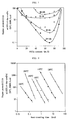
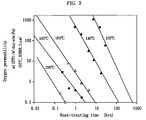
- the gas barrier film can be provided as a film having an oxygen permeability constant of 1.25 x 10 ⁇ 3 ml(STP) ⁇ cm/m2 ⁇ h ⁇ atm ⁇ Pa ⁇ or smaller as measured under conditions of 30°C and 80% RH when a film formed is heat-treated in a dry heat atmosphere, such as in an oven, under conditions satisfying the following relationships (a) and (b): (a) 373 ⁇ T ⁇ 573 (b) log t ⁇ -0.0282 x T + 14.14 wherein T denotes a heat-treating temperature (K) and t means heat-treating time (min).
- the gas barrier film can be provided as a film having an oxygen permeability constant of 1.25 x 10 ⁇ 3 ml(STP) ⁇ cm/m2 ⁇ h ⁇ atm ⁇ Pa ⁇ or smaller as measured under conditions of 30°C and 80% RH when a film formed is heat-treated under conditions satisfying the following relationships (a) and (d): (a) 373 ⁇ T ⁇ 573 (d) log t ⁇ -0.0582 x T + 26.06 wherein T denotes a heat-treating temperature (K) and t means heat-treating time (min).
- the heat-treating temperature is selected from a range of from 373K (100°C) to 573K (300°C).
- a heating temperature of 120°C requires heat-treating time as long as at least 30 hours.
- a film having high gas barrier property can be obtained in shorter heat-treating time as the heat-treating temperature becomes high.
- the temperature is too high, there is a possibility that discoloration and/or decomposition may occur on the film. Accordingly, it is preferable to conduct the heat treatment within a range of from 433K (160°C) to 503K (230°C) or so.
- a method in which a film is brought into contact with a heating member for example, a heated roll or the like may also be used as heat-treating means.
- the heat-treating time can be shortened. For example, when a dry film is brought into contact with a heated roll controlled at 433-523K (160-250°C) for 180-3 seconds, a gas barrier film having the desired water resistance and gas barrier property can be obtained.
- Such a heat treatment can provide a gas barrier film formed from the mixture of the PVA and the poly(meth)acrylic acid or the partially neutralized product thereof, and having excellent gas barrier property as demonstrated by an oxygen permeability constant of 1.25 x 10 ⁇ 3 ml(STP) ⁇ cm/m2 ⁇ h ⁇ atm ⁇ Pa ⁇ or smaller as measured under conditions of 30°C and 80% RH.
- This gas barrier property is identical to or better than that of a heat-treated film formed of the PVA alone.
- the heat treatment can impart water resistance to the film formed from the mixture, and such a film is hence insoluble even in boiling water.
- the gas barrier laminates according to the present invention have a laminated structure of at least two layers, in which the above-described gas barrier film (A) formed from the mixture of the PVA and the poly(meth)acrylic acid or the partially neutralized product thereof is laminated contiguously to a layer (B) formed from a thermoplastic resin.
- thermoplastic resin No particular limitation is imposed on the thermoplastic resin to be used.
- polyesters such as polyethylene terephthalate (PET), polyamides such as nylon 6, nylon 66, nylon 12, nylon 6 ⁇ 66 copolymers and nylon 6 ⁇ 12 copolymers; polyolefins such as low-density polyethylene, high-density polyethylene, linear low-density polyethylene, ethylene-vinyl acetate copolymers, polypropylene, ethylene-acrylic acid copolymers, ethylene-acrylic acid salt copolymers and ethylene-ethyl acrylate copolymers; polyvinyl chloride; polyvinylidene chloride; and polyphenylene sulfide.
- the lamination of the layer (B) of these various thermoplastic resins on the gas barrier film (A) can provide a gas barrier laminate combining excellent gas barrier properties with various performance characteristics and functions, for example, high heat resistance, chemical resistance, oil resistance, mechanical strength, sealing property, weathering resistance and moisture resistance, protection of the gas barrier film, and good machinability in secondary processing.
- a gas barrier laminate combining excellent gas barrier properties with various performance characteristics and functions, for example, high heat resistance, chemical resistance, oil resistance, mechanical strength, sealing property, weathering resistance and moisture resistance, protection of the gas barrier film, and good machinability in secondary processing.
- a thermoplastic resin having good heat-sealing property such as a polyolefin
- a laminate combining high gas barrier property with good heat-sealing property can be obtained.
- a laminate to which high heat resistance and toughness, and the like are imparted can be obtained.
- the lamination of the gas barrier film (A) with the layer (B) formed from the thermoplastic resin can be performed through an adhesive layer or without need of any adhesive layer by any known laminating process such as a coating process, dry lamination process or extrusion-coating process.
- a mixture solution of the PVA and the poly(meth)acrylic acid or the partially neutralized product thereof is coated on a layer of the thermoplastic resin to a predetermined thickness by means of, for example, an air-knife coater, kiss-roll coater, metering bar coater, gravure-roll coater, reverse-roll coater, dip coater or die coater, or a combination thereof.
- Water in the solution thus coated is then evaporated by blowing of heated air, infrared irradiation or the like using an arch dryer, straight bath dryer, tower dryer or drum dryer, or a combination thereof, thereby forming a film. Thereafter, the film is heat-treated.
- the gas barrier film and a film or sheet formed from the thermoplastic resin are laminated on each other.
- the thermoplastic resin is melt-extruded on the gas barrier film to form a layer.
- the layer of the gas barrier film (A) is generally formed by casting a solution of the mixture on a support by the solvent casting process, drying the solution to form a film and then heat-treating the dry film at a high temperature, and the simple gas barrier film (A) is insufficient in toughness
- a heat-resistant film such as a stretched PET film, stretched nylon film or stretched polypropylene film as a support, and form the gas barrier film (A) on the support by the solvent casting process and the subsequent heat treatment.
- heat-resistant films formed from a thermoplastic resin such as PET or nylon 6, the melting point or Vicat softening point of which is at least 180°C, are particularly preferred because they are good in dimensional stability and permit the provision of laminates with the gas barrier film (A) closely bonded to the heat-resistant film.
- the melting point and Vicat softening point can be measured in accordance with JIS K-7121 and JIS K-7206, respectively.
- the laminates according to the present invention are not limited to those having a two-layer structure of the gas barrier film (A) and the thermoplastic resin layer (B), and one or more other layers may hence be laminated.
- the gas barrier film (A) can be sandwiched between thermoplastic resin layers identical to or different from each other to obtain a laminate improved in dependence of the gas barrier property on humidity, mechanical strength, water resistance and the like.
- various films and coating layers may be provided to impart functions such as gloss, fog resistance and ultraviolet barrier property to the laminate.
- an additional layer of a thermoplastic resin having good sealing property may be laminated on the laminate to impart the good sealing property to the laminate.
- Sealing methods of packaging materials generally include heat sealing, impulse heat sealing, high-frequency sealing, ultrasonic sealing and the like. Therefore, the sealing layer may desirably be formed from a thermoplastic resin fit for the sealing method used.
- the heat sealing is generally used.
- the sealing layer capable of heat-sealing include layers formed from polyolefins such as low-density polyethylene, linear low-density polyethylene, high-density polyethylene, ethylene-vinyl acetate copolymers, polypropylene, ethylene-acrylic acid copolymers, ethylene-acrylic acid salt copolymers and ethylene-ethyl acrylate copolymers, nylon copolymers such as nylon 6 ⁇ 66 copolymers and nylon 6 ⁇ 12 copolymers, etc.
- polyolefins such as low-density polyethylene, linear low-density polyethylene, high-density polyethylene, ethylene-vinyl acetate copolymers, polypropylene, ethylene-acrylic acid copolymers, ethylene-acrylic acid salt copolymers and ethylene-ethyl acrylate copolymers, nylon copolymers such as nylon 6 ⁇ 66 copolymers and nylon 6 ⁇ 12 cop
- the high-frequency sealing may also be often used.
- the sealing layer capable of high-frequency-sealing include layers formed from polyvinyl chloride, polyvinylidene chloride, nylon 6 and nylon 66.
- thermoplastic resin having sealing property may be suitably selected as necessary for the end application intended. It is however preferable to use a thermoplastic resin having a melting point or Vicat softening point lower than 180°C in that a laminate having sealing strength of at least 2 kg ⁇ f (15 mm wide) is generally easy to be obtained.
- the sealing layer is laminated contiguously to either the gas barrier film or the heat-resistant film through an adhesive layer or without need of any adhesive layer.
- a further layer may be laminated on the side not laminated with the sealing layer if desired.
- an adhesive layer may be provided therebetween.
- adhesives used for it may be mentioned various kinds of adhesives such as urethane-based, acrylic-based and polyester-based adhesives, which are commonly used for dry lamination and the like of various films.
- additives such as an antioxidant, lubricant, ultraviolet absorbent, pigment, filler and antistatic agent may be added to the individual layers according to the present invention if desired.
- the thickness of the gas barrier film (A) is as described above.
- the thickness of the layer (B) formed from the thermoplastic resin is generally 5-1,000 ⁇ m, preferably 10-100 ⁇ m from the viewpoint of mechanical strength, flexibility, economy and the like.
- the layer (B) formed from the thermoplastic resin serves as the sealing layer, or where a sealing layer is provided separately from the layer (B) formed from the thermoplastic resin, no particular limitation is imposed on the thickness of the sealing layer.
- it is generally 5-1,000 ⁇ m, preferably 10-100 ⁇ m from the viewpoint of sealing strength, flexibility, economy and the like.
- the laminated structures of the laminates according to the present invention are as described above. As typical structures thereof, may be mentioned (1) gas barrier film/thermoplastic resin layer, (2) heat-resistant film/gas barrier film/sealing layer and (3) sealing layer/heat-resistant film/gas barrier film.
- the laminates are not limited to these structures only.
- a process for the production of a gas barrier laminate having a laminated structure of at least two layers which comprises a step of forming a gas barrier film (A) having an oxygen permeability constant of 1.25 x 10 ⁇ 3 ml(STP) ⁇ cm/m2 ⁇ h ⁇ atm ⁇ Pa ⁇ or smaller as measured under conditions of 30°C and 80% relative humidity, wherein a solution containing polyvinyl alcohol and poly(meth)acrylic acid or a partially neutralized product thereof in a weight ratio ranging from 95:5 to 10:90 is cast on a layer (B) formed from a thermoplastic resin, the solution cast is dried to form a film, and the dry film is then subjected to a heat treatment at a temperature of at least 100°C (373K), said film (A) and layer (B) being contiguous to each other.
- the heat-treating conditions are as described above. It is also preferable to use the heat-resistant film as the layer (B) formed from the thermoplastic resin for the purpose of rapidly conducting the heat treatment. If the layer (B) formed from the thermoplastic resin is lacking or insufficient in sealing property, a layer having good sealing property may be additionally laminated on the thus-obtained laminate composed of the gas barrier film (A) and the layer (B) formed from the thermoplastic resin, thereby producing a laminate having a three-layer structure.
- the sealing layer is laminated contiguously to either the gas barrier film (A) or the layer (B) through an adhesive layer or without need of any adhesive layer by the dry lamination process or the like. It goes without saying that one or more other layers may be laminated together with the sealing layer or in place of the sealing layer.
- gas barrier laminates comprising, as a gas barrier layer, a film insoluble in water and excellent in oxygen gas barrier property even under high-humidity conditions, and a production process thereof.
- the gas barrier film useful in the practice of the present invention has gas barrier property identical to or better than that of a PVA film and is low in dependence of the gas barrier property on humidity and good in water resistance.
- the laminates comprising this gas barrier film combine the gas barrier property with good sealing property and high toughness and are suitable for use as packaging materials for goods and products liable to be deteriorated by oxygen gas, for example, meat products such as meat, hams and sausages, drinks such as juices and soda pop, medical products such as infusions, etc.
- Poval 105 product of Kuraray Co., Ltd.; saponification degree: 98.5%; average polymerization degree: 500
- a 25 wt.% aqueous solution of polyacrylic acid product of Wako Pure Chemical Industries, Ltd., number average molecular weight: 150,000
- PVA polyacrylic acid
- PAA polyacrylic acid
- the film formed of the PVA alone, and the films obtained by singly using PAANas which varied in degree of neutralization were soluble in boiling water. All the heat-treated films other than these films were however insoluble in boiling water. More specifically, these heat-treated films were immersed for 10 minutes in boiling water (95°C), but were insoluble therein.
- a dry film 3 ⁇ m thick, which had a composition of PVA:PAA 60:40 by weight, was formed on a stretched PET film in the same manner as in Referential Example 1. Portions of the stretched PET film on which this dry film had been formed were separately subjected to a heat treatment in an oven with heat-treating temperature and heat-treating time varied as shown in Table 2. The oxygen permeability of each of the heat-treated films thus obtained was measured at 30°C and 80% RH by the same method as in Referential Example 1. The results are shown in Table 2.
- Poval 105 product of Kuraray Co., Ltd.; saponification degree: 98.5%; average polymerization degree: 500
- a 25 wt.% aqueous solution of polyacrylic acid product of Wako Pure Chemical Industries, Ltd., number average molecular weight: 150,000
- PVA polyacrylic acid
- An aqueous solution (polymer concentration: 10 wt.%) of a mixture containing PVA and PAANa in a weight ratio of 30:70 was then prepared.
- This aqueous solution was coated by a Meyer bar on a stretched PET film (melting point: 264°C) or a stretched nylon 6 (ONy) film (melting point: 220°C), and water was then evaporated by a dryer, thereby obtaining dry films 3 ⁇ m thick.
- the stretched PET film and ONy film on which these dry films had been respectively formed were subjected to a heat treatment in an oven.
- an aqueous solution of a mixture containing PVA and PAA in a weight ratio of 50:50 was prepared, and a dry film was formed on a stretched PET film in the same manner as described above, and then subjected to a heat treatment.
- a 20 wt.% aqueous solution of polymethacrylic acid (AC-30H, product of NIHON JUNYAKU Co., Ltd., number average molecular weight: 50,000) was used as polymethacrylic acid (PMAA) to prepare a partially neutralized product (PMAANa) having a degree of neutralization of 10% with NaOH.
- An aqueous solution (polymer concentration: 10 wt.%) of a mixture containing PVA and PMAANa in a weight ratio of 80:20 was then prepared.
- This aqueous solution was coated by a Meyer bar on an ONy film, and water was then evaporated by a dryer, thereby obtaining a dry film 3 ⁇ m thick.
- the ONy film on which the dry film had been formed was subjected to a heat treatment.
- LLDPE linear low-density polyethylene
- CPP unstretched polypropylene
- Each sample was heat-sealed by means of a deaerating sealer, V-300 (manufactured by Fuji Impulse K.K.).
- a sealing surface was formed by the third layer (Examples 1-5), the first layer (Examples 6-9) or the second layer (Comparative Example 2).
- the sealing strength was determined by measuring the tensile strength of a piece of film cut out into a width of 15 mm by means of a Tensilon RTM100 manufactured by Toyo Baldwin K.K. The pulling rate was 500 mm/min.
- a sample piece was flexed 10 times at 25°C and 50% RH by means of a Gerbo flex tester manufactured by Rigaku Kogyo K.K., and its oxygen permeability was then measured.
- the laminated films according to the present invention in which PET, ONy, CPP and/or LLDPE were laminated on one side or both sides of the gas barrier film, had high oxygen gas barrier property even after the Gerbo test in which a sample was flexed 10 times.
- the laminated films, particularly, the polyolefin-laminated films (Examples 1-5) were good in heat-sealing property and hence had performance suitable for packaging films.
- the layer (the second layer) of the gas barrier film was heat-sealed, sealing was unsuccessful.
- this simple layer of the gas barrier film (Comparative Example 2) was fragile and hence broken by the Gerbo test.
Landscapes
- Chemical & Material Sciences (AREA)
- Health & Medical Sciences (AREA)
- Chemical Kinetics & Catalysis (AREA)
- Medicinal Chemistry (AREA)
- Polymers & Plastics (AREA)
- Organic Chemistry (AREA)
- Laminated Bodies (AREA)
- Processing And Handling Of Plastics And Other Materials For Molding In General (AREA)
- Compositions Of Macromolecular Compounds (AREA)
- Wrappers (AREA)
Applications Claiming Priority (2)
| Application Number | Priority Date | Filing Date | Title |
|---|---|---|---|
| JP23735/94 | 1994-01-26 | ||
| JP02373594A JP3203287B2 (ja) | 1994-01-26 | 1994-01-26 | ガスバリヤー性積層体及びその製造方法 |
Publications (2)
| Publication Number | Publication Date |
|---|---|
| EP0665264A1 true EP0665264A1 (fr) | 1995-08-02 |
| EP0665264B1 EP0665264B1 (fr) | 1998-10-07 |
Family
ID=12118573
Family Applications (1)
| Application Number | Title | Priority Date | Filing Date |
|---|---|---|---|
| EP95100693A Expired - Lifetime EP0665264B1 (fr) | 1994-01-26 | 1995-01-19 | Matériau multicouche barrière au gaz et procédé de sa production |
Country Status (7)
| Country | Link |
|---|---|
| US (1) | US5560988A (fr) |
| EP (1) | EP0665264B1 (fr) |
| JP (1) | JP3203287B2 (fr) |
| KR (1) | KR950023518A (fr) |
| CN (1) | CN1077032C (fr) |
| AU (1) | AU690165B2 (fr) |
| DE (1) | DE69505160T2 (fr) |
Cited By (4)
| Publication number | Priority date | Publication date | Assignee | Title |
|---|---|---|---|---|
| WO2003041955A1 (fr) * | 2001-11-14 | 2003-05-22 | Mitsubishi Polyester Film, Llc | Revetement formant barriere a l'oxygene et film revetu |
| EP1464480A1 (fr) * | 2003-03-31 | 2004-10-06 | Tohcello Co., Ltd. | Matériau multicouche barrière au gaz et procédé de sa production |
| EP2008808A4 (fr) * | 2006-04-14 | 2010-06-02 | Mitsubishi Plastics Inc | Stratifie faisant barriere aux gas |
| CN117626703A (zh) * | 2023-12-04 | 2024-03-01 | 东营博邦泰晟新材料科技有限公司 | 一种应用于纸基材料上的可降解复合阻隔涂料 |
Families Citing this family (27)
| Publication number | Priority date | Publication date | Assignee | Title |
|---|---|---|---|---|
| JP3007012B2 (ja) * | 1994-01-26 | 2000-02-07 | 呉羽化学工業株式会社 | 積層体及びその製造方法 |
| DE69735272T2 (de) * | 1996-09-06 | 2006-11-16 | Kureha Corporation | Autoklaveverfahren, Harzzusammensetzung, Gassperrfilm und Verfahren zu seiner Herstellung |
| JPH11334000A (ja) * | 1998-05-22 | 1999-12-07 | Ajinomoto Co Inc | 調理食品包装用積層材料 |
| US6783857B2 (en) * | 2000-12-12 | 2004-08-31 | Unitika Ltd. | Gas barrier resin composition, gas barrier coating material, and gas-barrier molding |
| US6911255B2 (en) | 2001-05-08 | 2005-06-28 | Mitsubishi Polyester Film, Llc | Clear barrier coating and coated film |
| JP2002332054A (ja) * | 2001-05-09 | 2002-11-22 | Kureha Chem Ind Co Ltd | 注出具、容器及びガスバリア性フィルム |
| SE520187C2 (sv) * | 2001-10-09 | 2003-06-10 | Tetra Laval Holdings & Finance | Laminerat förpackningsmaterial, metod för dess framställning samt förpackningsbehållare framställd av förpackningsmaterialet |
| DE10302036A1 (de) * | 2003-01-21 | 2004-07-29 | Mitsubishi Polyester Film Gmbh | Polyesterfolie mit verbesserter Sauerstoffbarriere, enthaltend Poly(m-xylol-adipinamid) und eine Barrierebeschichtung, Verfahren zu ihrer Herstellung und ihre Verwendung |
| DE10302035A1 (de) * | 2003-01-21 | 2004-07-29 | Mitsubishi Polyester Film Gmbh | Polyesterfolie mit verbesserter Sauerstoffbarriere, enthaltend Poly(m-xylol-adipinamid) sowie eine Deckschicht und eine Barrierebeschichtung, Verfahren zu ihrer Herstellung und ihre Verwendung |
| JP4428931B2 (ja) * | 2003-02-20 | 2010-03-10 | 東セロ株式会社 | 二軸延伸ポリプロピレン複合フィルムの製造方法 |
| US7435446B2 (en) | 2003-04-09 | 2008-10-14 | Toyo Ink Mfg. Co., Ltd. | Method of producing gas barrier multilayer body |
| WO2005032813A1 (fr) * | 2003-10-03 | 2005-04-14 | Kureha Corporation | Contenant multicouche realise par formage par etirage et son procede de production |
| US7569267B2 (en) * | 2003-10-22 | 2009-08-04 | Kureha Corporation | Laminate and production process thereof |
| KR20060092252A (ko) * | 2003-10-22 | 2006-08-22 | 가부시끼가이샤 구레하 | 다층 필름 |
| JP4335049B2 (ja) * | 2004-03-29 | 2009-09-30 | 中本パックス株式会社 | 輸液バッグ用積層フイルム |
| CN100357374C (zh) * | 2004-04-12 | 2007-12-26 | 刘建林 | 一种不溶于水的改性聚乙烯醇涂布液及其制作工艺 |
| JP4888119B2 (ja) * | 2004-09-13 | 2012-02-29 | 住友金属鉱山株式会社 | 透明導電膜及びその製造方法、並びに透明導電性基材、発光デバイス |
| JP5081416B2 (ja) | 2005-09-26 | 2012-11-28 | ユニチカ株式会社 | ガスバリア性積層体 |
| CN101065240B (zh) * | 2005-09-27 | 2011-12-14 | 凸版印刷株式会社 | 气体阻挡性层叠薄膜 |
| ATE511526T1 (de) | 2006-08-30 | 2011-06-15 | Unitika Ltd | Beschichtungsstoff zur bildung einer gasbarriereschicht und gasbarrieremehrschichtkörper |
| WO2008068948A1 (fr) * | 2006-12-01 | 2008-06-12 | Kureha Corporation | Solution de revêtement, stratifié barrière aux gaz et article moulé barrière aux gaz chacun obtenu à l'aide de la solution de revêtement, et procédé de fabrication d'un stratifié barrière aux gaz |
| US20140227515A1 (en) | 2011-09-05 | 2014-08-14 | Mitsui Chemicals Tohcello, Inc. | Gas barrier film |
| US20150030829A1 (en) * | 2012-03-06 | 2015-01-29 | Lintec Corporation | Gas barrier film laminate, adhesive film, and electronic component |
| WO2014034627A1 (fr) * | 2012-08-28 | 2014-03-06 | ユニチカ株式会社 | Stratifié barrière contre les gaz, complexe de barrière contre les gaz comprenant ledit stratifié et matériau d'emballage comprenant ledit stratifié ou ledit complexe |
| JP6326740B2 (ja) * | 2013-08-28 | 2018-05-23 | 凸版印刷株式会社 | グラビア印刷用水系コーティング剤およびガスバリア性フィルム |
| WO2019077746A1 (fr) * | 2017-10-20 | 2019-04-25 | 東洋製罐グループホールディングス株式会社 | Tôle métallique traitée en surface revêtue de résine organique |
| JP7115515B2 (ja) * | 2020-06-19 | 2022-08-09 | 大日本印刷株式会社 | プリフォーム及びボトル |
Citations (4)
| Publication number | Priority date | Publication date | Assignee | Title |
|---|---|---|---|---|
| GB2090603A (en) * | 1980-12-15 | 1982-07-14 | Colgate Palmolive Co | Water Soluble Films of Polyvinyl Alcohol and Polyacrylic Acid |
| EP0152180A2 (fr) * | 1984-02-08 | 1985-08-21 | QUANTUM CHEMICAL CORPORATION (a Virginia corp.) | Alliages polymères à base d'alcool polyvinylique |
| EP0541273A1 (fr) * | 1991-11-05 | 1993-05-12 | Mobil Oil Corporation | Structure feuilletée métallisée et procédé |
| EP0608808A1 (fr) * | 1993-01-27 | 1994-08-03 | Kureha Kagaku Kogyo Kabushiki Kaisha | Film de barrière aux gaz et sa production |
Family Cites Families (8)
| Publication number | Priority date | Publication date | Assignee | Title |
|---|---|---|---|---|
| US2169250A (en) * | 1937-05-27 | 1939-08-15 | Du Pont | Process of forming films, threads, and the like |
| US4048428A (en) * | 1961-12-05 | 1977-09-13 | W. R. Grace & Co. | Method for preparing a film of vinylidene chloride polymer |
| JPS6347743A (ja) * | 1986-08-15 | 1988-02-29 | Casio Comput Co Ltd | 表示装置付カメラ |
| JPH0214376A (ja) * | 1988-03-18 | 1990-01-18 | Fuji Photo Film Co Ltd | 放射線画像読取装置 |
| JP2716464B2 (ja) * | 1988-07-18 | 1998-02-18 | 不二製油株式会社 | フレッシュチーズ様食品とその製造方法 |
| WO1993012924A1 (fr) * | 1991-12-20 | 1993-07-08 | Mobil Oil Corporation | Film multicouche pouvant etre imprime et offrant une bonne resistance au passage de l'oxygene |
| CA2113137A1 (fr) * | 1993-05-20 | 1994-11-21 | Cryovac, Inc. | Preparation de terpolymeres d'ethylene, d'alcool vinylique et d'ester acrylate et produits resultants |
| JP2736600B2 (ja) * | 1993-09-27 | 1998-04-02 | 呉羽化学工業株式会社 | ガスバリヤー性フィルム及びその製造方法 |
-
1994
- 1994-01-26 JP JP02373594A patent/JP3203287B2/ja not_active Expired - Fee Related
-
1995
- 1995-01-18 AU AU10242/95A patent/AU690165B2/en not_active Ceased
- 1995-01-19 DE DE69505160T patent/DE69505160T2/de not_active Expired - Lifetime
- 1995-01-19 EP EP95100693A patent/EP0665264B1/fr not_active Expired - Lifetime
- 1995-01-25 KR KR1019950001323A patent/KR950023518A/ko not_active Abandoned
- 1995-01-25 CN CN95101790A patent/CN1077032C/zh not_active Expired - Lifetime
- 1995-01-25 US US08/378,215 patent/US5560988A/en not_active Expired - Lifetime
Patent Citations (4)
| Publication number | Priority date | Publication date | Assignee | Title |
|---|---|---|---|---|
| GB2090603A (en) * | 1980-12-15 | 1982-07-14 | Colgate Palmolive Co | Water Soluble Films of Polyvinyl Alcohol and Polyacrylic Acid |
| EP0152180A2 (fr) * | 1984-02-08 | 1985-08-21 | QUANTUM CHEMICAL CORPORATION (a Virginia corp.) | Alliages polymères à base d'alcool polyvinylique |
| EP0541273A1 (fr) * | 1991-11-05 | 1993-05-12 | Mobil Oil Corporation | Structure feuilletée métallisée et procédé |
| EP0608808A1 (fr) * | 1993-01-27 | 1994-08-03 | Kureha Kagaku Kogyo Kabushiki Kaisha | Film de barrière aux gaz et sa production |
Cited By (6)
| Publication number | Priority date | Publication date | Assignee | Title |
|---|---|---|---|---|
| WO2003041955A1 (fr) * | 2001-11-14 | 2003-05-22 | Mitsubishi Polyester Film, Llc | Revetement formant barriere a l'oxygene et film revetu |
| US6709735B2 (en) | 2001-11-14 | 2004-03-23 | Mitsubishi Polyester Film, Llc | Oxygen barrier coating and coated film |
| EP1464480A1 (fr) * | 2003-03-31 | 2004-10-06 | Tohcello Co., Ltd. | Matériau multicouche barrière au gaz et procédé de sa production |
| CN100429073C (zh) * | 2003-03-31 | 2008-10-29 | 东赛璐株式会社 | 阻透性层积膜及其制造方法 |
| EP2008808A4 (fr) * | 2006-04-14 | 2010-06-02 | Mitsubishi Plastics Inc | Stratifie faisant barriere aux gas |
| CN117626703A (zh) * | 2023-12-04 | 2024-03-01 | 东营博邦泰晟新材料科技有限公司 | 一种应用于纸基材料上的可降解复合阻隔涂料 |
Also Published As
| Publication number | Publication date |
|---|---|
| AU690165B2 (en) | 1998-04-23 |
| AU1024295A (en) | 1995-08-03 |
| EP0665264B1 (fr) | 1998-10-07 |
| JP3203287B2 (ja) | 2001-08-27 |
| CN1077032C (zh) | 2002-01-02 |
| DE69505160D1 (de) | 1998-11-12 |
| JPH07205379A (ja) | 1995-08-08 |
| DE69505160T2 (de) | 1999-02-25 |
| KR950023518A (ko) | 1995-08-18 |
| CN1112878A (zh) | 1995-12-06 |
| US5560988A (en) | 1996-10-01 |
Similar Documents
| Publication | Publication Date | Title |
|---|---|---|
| EP0665264B1 (fr) | Matériau multicouche barrière au gaz et procédé de sa production | |
| JP2736600B2 (ja) | ガスバリヤー性フィルム及びその製造方法 | |
| EP0608808A1 (fr) | Film de barrière aux gaz et sa production | |
| EP0665263A1 (fr) | Matériau multicouche barrière au gaz et procédé de sa production | |
| EP0698634B1 (fr) | Film composite déposé et procédé pour sa production | |
| KR20040026704A (ko) | 단일층 또는 다층 생성물내의 evoh 및 evm | |
| JP4573959B2 (ja) | ガスバリア性コート剤、それを用いたガスバリア性フィルム、およびその製造方法 | |
| EP1179557B1 (fr) | Péllicule de résine multicouche ayant d'excellentes propriétés de barrière à l'oxygène et procédé pour sa préparation | |
| JP2002240207A (ja) | ガスバリア性フィルム | |
| JPH07266441A (ja) | ガスバリヤー性フイルムの製造方法 | |
| JP4302260B2 (ja) | ガスバリア性フィルム | |
| DE69029671T2 (de) | Mehrschicht-Struktur | |
| JP4683251B2 (ja) | 酸素ガスバリア性を有する多層樹脂フィルムの製造方法 | |
| JP4168629B2 (ja) | 酸素ガスバリア性フィルム及びその製造方法 | |
| JP2509769B2 (ja) | 多層積層体 | |
| JP4651783B2 (ja) | ガスバリア性フィルムの製造方法 | |
| JPH04107138A (ja) | ガスバリヤ性の優れた透明プラスチックフィルム | |
| JP2951492B2 (ja) | 多層積層体 | |
| JPH08142255A (ja) | 防湿複合フィルム | |
| JP4019696B2 (ja) | 酸素ガスバリア性フィルム及びその製造方法 | |
| JP2001088250A (ja) | ガスバリア性フィルム | |
| JPH03164249A (ja) | 積層フィルムおよびその製造方法 | |
| JPH08216221A (ja) | 多層構成フィルムの製造方法 | |
| JPH0410930A (ja) | 被覆プラスチックフイルム | |
| JPH02307749A (ja) | 被覆プラスチックフイルム |
Legal Events
| Date | Code | Title | Description |
|---|---|---|---|
| PUAI | Public reference made under article 153(3) epc to a published international application that has entered the european phase |
Free format text: ORIGINAL CODE: 0009012 |
|
| 17P | Request for examination filed |
Effective date: 19950119 |
|
| AK | Designated contracting states |
Kind code of ref document: A1 Designated state(s): DE FR GB IT NL |
|
| 17Q | First examination report despatched |
Effective date: 19970211 |
|
| GRAG | Despatch of communication of intention to grant |
Free format text: ORIGINAL CODE: EPIDOS AGRA |
|
| GRAG | Despatch of communication of intention to grant |
Free format text: ORIGINAL CODE: EPIDOS AGRA |
|
| GRAH | Despatch of communication of intention to grant a patent |
Free format text: ORIGINAL CODE: EPIDOS IGRA |
|
| GRAH | Despatch of communication of intention to grant a patent |
Free format text: ORIGINAL CODE: EPIDOS IGRA |
|
| GRAA | (expected) grant |
Free format text: ORIGINAL CODE: 0009210 |
|
| AK | Designated contracting states |
Kind code of ref document: B1 Designated state(s): DE FR GB IT NL |
|
| REF | Corresponds to: |
Ref document number: 69505160 Country of ref document: DE Date of ref document: 19981112 |
|
| ET | Fr: translation filed | ||
| PLBE | No opposition filed within time limit |
Free format text: ORIGINAL CODE: 0009261 |
|
| STAA | Information on the status of an ep patent application or granted ep patent |
Free format text: STATUS: NO OPPOSITION FILED WITHIN TIME LIMIT |
|
| 26N | No opposition filed | ||
| REG | Reference to a national code |
Ref country code: GB Ref legal event code: IF02 |
|
| PGFP | Annual fee paid to national office [announced via postgrant information from national office to epo] |
Ref country code: NL Payment date: 20060115 Year of fee payment: 12 |
|
| NLT1 | Nl: modifications of names registered in virtue of documents presented to the patent office pursuant to art. 16 a, paragraph 1 |
Owner name: KUREHA CORPORATION |
|
| REG | Reference to a national code |
Ref country code: FR Ref legal event code: CD Ref country code: FR Ref legal event code: CA |
|
| NLV4 | Nl: lapsed or anulled due to non-payment of the annual fee |
Effective date: 20070801 |
|
| PGFP | Annual fee paid to national office [announced via postgrant information from national office to epo] |
Ref country code: IT Payment date: 20070601 Year of fee payment: 13 |
|
| PG25 | Lapsed in a contracting state [announced via postgrant information from national office to epo] |
Ref country code: NL Free format text: LAPSE BECAUSE OF NON-PAYMENT OF DUE FEES Effective date: 20070801 |
|
| PGFP | Annual fee paid to national office [announced via postgrant information from national office to epo] |
Ref country code: FR Payment date: 20070109 Year of fee payment: 13 |
|
| PGFP | Annual fee paid to national office [announced via postgrant information from national office to epo] |
Ref country code: GB Payment date: 20080116 Year of fee payment: 14 |
|
| REG | Reference to a national code |
Ref country code: FR Ref legal event code: ST Effective date: 20081029 |
|
| PG25 | Lapsed in a contracting state [announced via postgrant information from national office to epo] |
Ref country code: FR Free format text: LAPSE BECAUSE OF NON-PAYMENT OF DUE FEES Effective date: 20080131 |
|
| PG25 | Lapsed in a contracting state [announced via postgrant information from national office to epo] |
Ref country code: IT Free format text: LAPSE BECAUSE OF NON-PAYMENT OF DUE FEES Effective date: 20080119 |
|
| GBPC | Gb: european patent ceased through non-payment of renewal fee |
Effective date: 20090119 |
|
| PG25 | Lapsed in a contracting state [announced via postgrant information from national office to epo] |
Ref country code: GB Free format text: LAPSE BECAUSE OF NON-PAYMENT OF DUE FEES Effective date: 20090119 |
|
| REG | Reference to a national code |
Ref country code: DE Ref legal event code: R082 Ref document number: 69505160 Country of ref document: DE Representative=s name: PATENT- UND RECHTSANWAELTE KRAUS & WEISERT, DE Effective date: 20110829 Ref country code: DE Ref legal event code: R082 Ref document number: 69505160 Country of ref document: DE Representative=s name: KRAUS & WEISERT PATENTANWAELTE PARTGMBB, DE Effective date: 20110829 Ref country code: DE Ref legal event code: R081 Ref document number: 69505160 Country of ref document: DE Owner name: TOPPAN PRINTING CO., LTD., JP Free format text: FORMER OWNER: KUREHA CORP., TOKYO/TOKIO, JP Effective date: 20110829 |
|
| PGFP | Annual fee paid to national office [announced via postgrant information from national office to epo] |
Ref country code: DE Payment date: 20140115 Year of fee payment: 20 |
|
| REG | Reference to a national code |
Ref country code: DE Ref legal event code: R071 Ref document number: 69505160 Country of ref document: DE |