EP0670346A1 - Protonleitender Elektrolytstoff - Google Patents
Protonleitender Elektrolytstoff Download PDFInfo
- Publication number
- EP0670346A1 EP0670346A1 EP95400355A EP95400355A EP0670346A1 EP 0670346 A1 EP0670346 A1 EP 0670346A1 EP 95400355 A EP95400355 A EP 95400355A EP 95400355 A EP95400355 A EP 95400355A EP 0670346 A1 EP0670346 A1 EP 0670346A1
- Authority
- EP
- European Patent Office
- Prior art keywords
- macromolecular material
- material according
- polyoxyethylene
- polymer
- thixotropic agent
- Prior art date
- Legal status (The legal status is an assumption and is not a legal conclusion. Google has not performed a legal analysis and makes no representation as to the accuracy of the status listed.)
- Ceased
Links
- 239000000463 material Substances 0.000 title claims abstract description 28
- 239000012078 proton-conducting electrolyte Substances 0.000 title description 4
- 229920003171 Poly (ethylene oxide) Polymers 0.000 claims abstract description 24
- NBIIXXVUZAFLBC-UHFFFAOYSA-N Phosphoric acid Chemical compound OP(O)(O)=O NBIIXXVUZAFLBC-UHFFFAOYSA-N 0.000 claims abstract description 23
- RIOQSEWOXXDEQQ-UHFFFAOYSA-N triphenylphosphine Chemical compound C1=CC=CC=C1P(C=1C=CC=CC=1)C1=CC=CC=C1 RIOQSEWOXXDEQQ-UHFFFAOYSA-N 0.000 claims abstract description 18
- 239000013008 thixotropic agent Substances 0.000 claims abstract description 17
- 235000011007 phosphoric acid Nutrition 0.000 claims abstract description 12
- 239000007787 solid Substances 0.000 claims abstract description 11
- 239000003963 antioxidant agent Substances 0.000 claims abstract description 10
- -1 polyoxyethylene Polymers 0.000 claims abstract description 10
- 230000003078 antioxidant effect Effects 0.000 claims abstract description 4
- 230000002209 hydrophobic effect Effects 0.000 claims description 18
- VYPSYNLAJGMNEJ-UHFFFAOYSA-N Silicium dioxide Chemical compound O=[Si]=O VYPSYNLAJGMNEJ-UHFFFAOYSA-N 0.000 claims description 15
- 238000001035 drying Methods 0.000 claims description 8
- 229910021485 fumed silica Inorganic materials 0.000 claims description 8
- 239000003795 chemical substances by application Substances 0.000 claims description 5
- 239000003792 electrolyte Substances 0.000 claims description 4
- 238000000034 method Methods 0.000 claims description 4
- 229910000147 aluminium phosphate Inorganic materials 0.000 claims description 3
- 150000004756 silanes Chemical group 0.000 claims description 2
- 230000002378 acidificating effect Effects 0.000 claims 1
- 239000007800 oxidant agent Substances 0.000 claims 1
- 230000001681 protective effect Effects 0.000 claims 1
- 229920000642 polymer Polymers 0.000 description 52
- 239000000654 additive Substances 0.000 description 17
- 230000000996 additive effect Effects 0.000 description 14
- 230000005540 biological transmission Effects 0.000 description 11
- WYURNTSHIVDZCO-UHFFFAOYSA-N Tetrahydrofuran Chemical compound C1CCOC1 WYURNTSHIVDZCO-UHFFFAOYSA-N 0.000 description 10
- WEVYAHXRMPXWCK-UHFFFAOYSA-N Acetonitrile Chemical compound CC#N WEVYAHXRMPXWCK-UHFFFAOYSA-N 0.000 description 9
- 238000007872 degassing Methods 0.000 description 9
- 230000000694 effects Effects 0.000 description 9
- 230000000052 comparative effect Effects 0.000 description 8
- 238000004383 yellowing Methods 0.000 description 7
- 230000015572 biosynthetic process Effects 0.000 description 6
- 238000002360 preparation method Methods 0.000 description 6
- 230000015556 catabolic process Effects 0.000 description 5
- 238000006731 degradation reaction Methods 0.000 description 5
- YLQBMQCUIZJEEH-UHFFFAOYSA-N tetrahydrofuran Natural products C=1C=COC=1 YLQBMQCUIZJEEH-UHFFFAOYSA-N 0.000 description 5
- 229910002012 Aerosil® Inorganic materials 0.000 description 4
- 238000004040 coloring Methods 0.000 description 4
- 239000011521 glass Substances 0.000 description 4
- 238000010438 heat treatment Methods 0.000 description 4
- 230000003287 optical effect Effects 0.000 description 4
- 239000002904 solvent Substances 0.000 description 4
- 239000002253 acid Substances 0.000 description 3
- 230000009471 action Effects 0.000 description 3
- 230000032683 aging Effects 0.000 description 3
- XYFCBTPGUUZFHI-UHFFFAOYSA-N Phosphine Chemical compound P XYFCBTPGUUZFHI-UHFFFAOYSA-N 0.000 description 2
- WFAULHLDTDDABL-UHFFFAOYSA-N Proxazole citrate Chemical compound OC(=O)CC(O)(C(O)=O)CC(O)=O.C=1C=CC=CC=1C(CC)C1=NOC(CCN(CC)CC)=N1 WFAULHLDTDDABL-UHFFFAOYSA-N 0.000 description 2
- GWEVSGVZZGPLCZ-UHFFFAOYSA-N Titan oxide Chemical compound O=[Ti]=O GWEVSGVZZGPLCZ-UHFFFAOYSA-N 0.000 description 2
- 239000000853 adhesive Substances 0.000 description 2
- 230000001070 adhesive effect Effects 0.000 description 2
- 238000005336 cracking Methods 0.000 description 2
- 230000002349 favourable effect Effects 0.000 description 2
- 239000000203 mixture Substances 0.000 description 2
- 239000002245 particle Substances 0.000 description 2
- 230000008447 perception Effects 0.000 description 2
- 230000005855 radiation Effects 0.000 description 2
- 230000009467 reduction Effects 0.000 description 2
- 125000005372 silanol group Chemical group 0.000 description 2
- 238000003756 stirring Methods 0.000 description 2
- ZNOKGRXACCSDPY-UHFFFAOYSA-N tungsten trioxide Chemical compound O=[W](=O)=O ZNOKGRXACCSDPY-UHFFFAOYSA-N 0.000 description 2
- 229910002016 Aerosil® 200 Inorganic materials 0.000 description 1
- 229910002019 Aerosil® 380 Inorganic materials 0.000 description 1
- OKTJSMMVPCPJKN-UHFFFAOYSA-N Carbon Chemical compound [C] OKTJSMMVPCPJKN-UHFFFAOYSA-N 0.000 description 1
- BLRPTPMANUNPDV-UHFFFAOYSA-N Silane Chemical group [SiH4] BLRPTPMANUNPDV-UHFFFAOYSA-N 0.000 description 1
- PNEYBMLMFCGWSK-UHFFFAOYSA-N aluminium oxide Inorganic materials [O-2].[O-2].[O-2].[Al+3].[Al+3] PNEYBMLMFCGWSK-UHFFFAOYSA-N 0.000 description 1
- 150000001412 amines Chemical class 0.000 description 1
- 238000004458 analytical method Methods 0.000 description 1
- 230000003064 anti-oxidating effect Effects 0.000 description 1
- 238000000149 argon plasma sintering Methods 0.000 description 1
- 230000008901 benefit Effects 0.000 description 1
- 230000005587 bubbling Effects 0.000 description 1
- 125000000484 butyl group Chemical group [H]C([*])([H])C([H])([H])C([H])([H])C([H])([H])[H] 0.000 description 1
- 238000007385 chemical modification Methods 0.000 description 1
- 230000002301 combined effect Effects 0.000 description 1
- 239000002322 conducting polymer Substances 0.000 description 1
- 229920001940 conductive polymer Polymers 0.000 description 1
- 239000000470 constituent Substances 0.000 description 1
- 239000002537 cosmetic Substances 0.000 description 1
- 230000007547 defect Effects 0.000 description 1
- 230000003111 delayed effect Effects 0.000 description 1
- 238000002845 discoloration Methods 0.000 description 1
- 238000001125 extrusion Methods 0.000 description 1
- 230000006870 function Effects 0.000 description 1
- 239000003292 glue Substances 0.000 description 1
- 238000011065 in-situ storage Methods 0.000 description 1
- 238000003780 insertion Methods 0.000 description 1
- 230000037431 insertion Effects 0.000 description 1
- 238000009434 installation Methods 0.000 description 1
- UQSXHKLRYXJYBZ-UHFFFAOYSA-N iron oxide Inorganic materials [Fe]=O UQSXHKLRYXJYBZ-UHFFFAOYSA-N 0.000 description 1
- 238000004519 manufacturing process Methods 0.000 description 1
- 239000002674 ointment Substances 0.000 description 1
- NDLPOXTZKUMGOV-UHFFFAOYSA-N oxo(oxoferriooxy)iron hydrate Chemical compound O.O=[Fe]O[Fe]=O NDLPOXTZKUMGOV-UHFFFAOYSA-N 0.000 description 1
- 150000002978 peroxides Chemical class 0.000 description 1
- ISWSIDIOOBJBQZ-UHFFFAOYSA-N phenol group Chemical group C1(=CC=CC=C1)O ISWSIDIOOBJBQZ-UHFFFAOYSA-N 0.000 description 1
- OJMIONKXNSYLSR-UHFFFAOYSA-N phosphorous acid Chemical compound OP(O)O OJMIONKXNSYLSR-UHFFFAOYSA-N 0.000 description 1
- 229910000073 phosphorus hydride Inorganic materials 0.000 description 1
- 239000004033 plastic Substances 0.000 description 1
- 229920003023 plastic Polymers 0.000 description 1
- 239000002244 precipitate Substances 0.000 description 1
- 238000001556 precipitation Methods 0.000 description 1
- 239000000047 product Substances 0.000 description 1
- 230000002035 prolonged effect Effects 0.000 description 1
- 230000001698 pyrogenic effect Effects 0.000 description 1
- 230000002787 reinforcement Effects 0.000 description 1
- 239000000377 silicon dioxide Substances 0.000 description 1
- 125000005373 siloxane group Chemical group [SiH2](O*)* 0.000 description 1
- 239000007784 solid electrolyte Substances 0.000 description 1
- 239000012265 solid product Substances 0.000 description 1
- 230000035882 stress Effects 0.000 description 1
- 239000000126 substance Substances 0.000 description 1
- 239000000725 suspension Substances 0.000 description 1
- 239000002562 thickening agent Substances 0.000 description 1
- 239000004408 titanium dioxide Substances 0.000 description 1
- 229910052723 transition metal Inorganic materials 0.000 description 1
- 150000003624 transition metals Chemical class 0.000 description 1
- 230000003313 weakening effect Effects 0.000 description 1
Images


Classifications
-
- H—ELECTRICITY
- H01—ELECTRIC ELEMENTS
- H01M—PROCESSES OR MEANS, e.g. BATTERIES, FOR THE DIRECT CONVERSION OF CHEMICAL ENERGY INTO ELECTRICAL ENERGY
- H01M6/00—Primary cells; Manufacture thereof
- H01M6/14—Cells with non-aqueous electrolyte
- H01M6/18—Cells with non-aqueous electrolyte with solid electrolyte
- H01M6/181—Cells with non-aqueous electrolyte with solid electrolyte with polymeric electrolytes
-
- C—CHEMISTRY; METALLURGY
- C08—ORGANIC MACROMOLECULAR COMPOUNDS; THEIR PREPARATION OR CHEMICAL WORKING-UP; COMPOSITIONS BASED THEREON
- C08G—MACROMOLECULAR COMPOUNDS OBTAINED OTHERWISE THAN BY REACTIONS ONLY INVOLVING UNSATURATED CARBON-TO-CARBON BONDS
- C08G65/00—Macromolecular compounds obtained by reactions forming an ether link in the main chain of the macromolecule
- C08G65/02—Macromolecular compounds obtained by reactions forming an ether link in the main chain of the macromolecule from cyclic ethers by opening of the heterocyclic ring
- C08G65/32—Polymers modified by chemical after-treatment
- C08G65/321—Polymers modified by chemical after-treatment with inorganic compounds
- C08G65/327—Polymers modified by chemical after-treatment with inorganic compounds containing phosphorus
-
- C—CHEMISTRY; METALLURGY
- C08—ORGANIC MACROMOLECULAR COMPOUNDS; THEIR PREPARATION OR CHEMICAL WORKING-UP; COMPOSITIONS BASED THEREON
- C08K—Use of inorganic or non-macromolecular organic substances as compounding ingredients
- C08K3/00—Use of inorganic substances as compounding ingredients
- C08K3/32—Phosphorus-containing compounds
-
- C—CHEMISTRY; METALLURGY
- C08—ORGANIC MACROMOLECULAR COMPOUNDS; THEIR PREPARATION OR CHEMICAL WORKING-UP; COMPOSITIONS BASED THEREON
- C08K—Use of inorganic or non-macromolecular organic substances as compounding ingredients
- C08K3/00—Use of inorganic substances as compounding ingredients
- C08K3/34—Silicon-containing compounds
- C08K3/36—Silica
-
- C—CHEMISTRY; METALLURGY
- C08—ORGANIC MACROMOLECULAR COMPOUNDS; THEIR PREPARATION OR CHEMICAL WORKING-UP; COMPOSITIONS BASED THEREON
- C08K—Use of inorganic or non-macromolecular organic substances as compounding ingredients
- C08K5/00—Use of organic ingredients
- C08K5/49—Phosphorus-containing compounds
- C08K5/50—Phosphorus bound to carbon only
-
- G—PHYSICS
- G02—OPTICS
- G02F—OPTICAL DEVICES OR ARRANGEMENTS FOR THE CONTROL OF LIGHT BY MODIFICATION OF THE OPTICAL PROPERTIES OF THE MEDIA OF THE ELEMENTS INVOLVED THEREIN; NON-LINEAR OPTICS; FREQUENCY-CHANGING OF LIGHT; OPTICAL LOGIC ELEMENTS; OPTICAL ANALOGUE/DIGITAL CONVERTERS
- G02F1/00—Devices or arrangements for the control of the intensity, colour, phase, polarisation or direction of light arriving from an independent light source, e.g. switching, gating or modulating; Non-linear optics
- G02F1/01—Devices or arrangements for the control of the intensity, colour, phase, polarisation or direction of light arriving from an independent light source, e.g. switching, gating or modulating; Non-linear optics for the control of the intensity, phase, polarisation or colour
- G02F1/15—Devices or arrangements for the control of the intensity, colour, phase, polarisation or direction of light arriving from an independent light source, e.g. switching, gating or modulating; Non-linear optics for the control of the intensity, phase, polarisation or colour based on an electrochromic effect
- G02F1/1514—Devices or arrangements for the control of the intensity, colour, phase, polarisation or direction of light arriving from an independent light source, e.g. switching, gating or modulating; Non-linear optics for the control of the intensity, phase, polarisation or colour based on an electrochromic effect characterised by the electrochromic material, e.g. by the electrodeposited material
- G02F1/1523—Devices or arrangements for the control of the intensity, colour, phase, polarisation or direction of light arriving from an independent light source, e.g. switching, gating or modulating; Non-linear optics for the control of the intensity, phase, polarisation or colour based on an electrochromic effect characterised by the electrochromic material, e.g. by the electrodeposited material comprising inorganic material
- G02F1/1525—Devices or arrangements for the control of the intensity, colour, phase, polarisation or direction of light arriving from an independent light source, e.g. switching, gating or modulating; Non-linear optics for the control of the intensity, phase, polarisation or colour based on an electrochromic effect characterised by the electrochromic material, e.g. by the electrodeposited material comprising inorganic material characterised by a particular ion transporting layer, e.g. electrolyte
Definitions
- the present invention relates to a new proton-conducting electrolyte material. It applies more particularly to the production of electrochromic systems operating mainly in transmission, such as in particular building or automobile glazing.
- an electrochromic system which operates by insertion / disinsertion of protons in a layer of an oxide of a transition metal such as tungsten trioxide in contact with a solid electrolyte such as a macromolecular material proton conducting electrolyte formed by a polyoxyethylene-phosphoric acid complex (POE-H3PO4).
- This material must be prepared under anhydrous conditions - taking care in particular of the choice of solvents - to avoid rapid degradation of the other layers of the system associated with this electrolyte and in particular of the layers of electrochromic material and of the electronically conductive layers called electrodes, between which the difference in potential required for coloring or discoloration is applied.
- patent application EP-A-477 065 recommends a thorough degassing of the electrolyte - under vacuum and preferably hot - so as to avoid trapping air during the assembly of the glazing but also to evacuate air - or any traces of solvent - trapped in the first phases of polymer preparation.
- This treatment is particularly effective in that it removes the bubbles which usually appear after a few tens of hours of operation. In addition, it attenuates the phenomenon of blurring, or in other words the proportion of light scattered through the glazing; blurring, which, when it becomes too large, no longer allows correct vision through the glazing.
- the degassing operation or more exactly the heating operated during this degassing does not eliminate or even tends to increase the yellowing of the polymer and purity in yellow, the latter essentially reflecting the perception of color by the eye.
- this coloring of the glazing, in the discolored state is not desirable and in any case, yellow is a relatively little appreciated color for glazing buildings.
- this hot degassing treatment acts exactly like a thermal test and reflects the degradation of the polymer subjected to high temperatures.
- an electrochromic system used as exterior glazing can reach or exceed a temperature close to 80 ° C under the combined effect of solar radiation and the effect of black body when the glazing is in the state colored. Regardless of any hot degassing treatment, there is thus anyway a problem of aging by yellowing of the polymer at temperatures of this order of magnitude.
- triphenylphosphine anti-yellowing additive used mainly during the extrusion of plastics, has given satisfaction, no precipitate or milky forming, even at high concentrations, for example of the order of 1, 5% (based on the weight by weight of the polymer without additive).
- the first object of the invention is thus a macromolecular material proton-conducting electrolyte of the solid complex type of anhydrous orthophosphoric acid in polyoxyethylene comprising an additive of the triphenylphosphine type (TPP).
- TPP triphenylphosphine type
- This additive is for example added in a proportion of between 0.5 and 3% and preferably between 1 and 1.25% based on the weight mass of the H3PO4-POE polymer, for a POE polymer whose molecular mass is approximately 5,000,000.
- a POE of slightly different molecular mass can also be used, in particular a higher molecular mass; it is thus possible in particular to choose a POE with a molecular mass of 6,000,000, 7,000,000 or 8,000,000.
- triphenylphosphine not only has a favorable effect on thermal tests but also on ultraviolet aging tests by delaying the action of the peroxides formed under the action of radiation, even if, however, the formation of those -this is not completely avoided.
- a second object of the present invention is to obtain a macromolecular material with proton conduction whose viscosity at a temperature of the order of 100 ° C. remains compatible with a vertical positioning of the system in which this material is incorporated as a 'electrolyte.
- this object is achieved by adding to a proton conducting polymer of the solid complex type anhydrous phosphoric acid in polyoxyethylene, a thixotropic agent such as fumed silica, in a proportion generally between 3 and 20%, related to the weight mass of the orthophosphoric acid-polyoxyethylene complex, excluding other additives; these percentages being given for a polyoxyethylene whose molecular mass is approximately 5,000,000.
- a thixotropic agent such as fumed silica
- Pyrogenic silica known as a thickening agent, in particular for glues, pharmaceutical or cosmetic ointments - allows a very significant reduction in creep, thus allowing installation in vertical position without problem.
- Hydrophilic pyrogenic silicas not chemically modified, on the surface of which there are siloxane groups and, in a smaller amount, silanol groups, give satisfaction on the condition, however, of being used in relatively large amounts, of the order of 12%. or more, especially between 8 and 16%.
- the polymer remains fragile and in particular quite sensitive to tearing, an unexpected effect because hydrophilic fumed silicas are recommended for the reinforcement of elastomeric materials.
- hydrophobic fumed silicas obtained by a chemical modification of their surface by means of silanes so as to replace the silanol groups by silane groups.
- the desired increase in viscosity is obtained for proportions generally between 4 and 10%, that is to say approximately two times lower than those required in the case of hydrophilic fumed silicas.
- Very good results have been obtained with a hydrophobic fumed silica added at a rate of 6 to 8% by weight, these proportions being as in the case of the antioxidant additive, given relative to the mass of the polymer H3PO4-POE, without additive, for a POE whose molecular mass is approximately 5,000,000.
- hydrophobic fumed silicas lead to a non-sticky macromolecular material, not very sensitive to tearing, self-supporting at room temperature.
- the material can thus be prepared in advance, stored in sheets and cut to the desired dimensions, with a view to assembling the electrochromic system, thus taking up operating conditions close to those practiced for laminated glazing such as windshields.
- Hydrophobic thixotropic agents however, have a defect, that of "cracking" on their edges, a phenomenon probably due to their hardness. But very advantageously, this phenomenon disappears for the preferred polymers according to the invention, having undergone heating for degassing.
- the temperature during the hot heating treatment can be reduced by 10/20 ° C, for an identical treatment duration and without limiting the anti-bubbling effect or the "anti-cracking" effect.
- the optimal temperature of the hot treatment is then around 100 ° C. which is favorable both for the aging of the polymer itself and for that of the other layers of the system.
- the invention also relates to a method of treatment by drying of the macromolecular material previously defined. This drying can be carried out at a temperature between 90 and 120 ° C, preferably 100 to 110 ° C. Its duration can be approximately 1 to 3 hours.
- H3PO4 anhydrous orthophosphoric acid
- THF tetrahydrofuran
- ACN acetonitrile
- the polymer in solution is then placed in a tank, the bottom of which has a calibrated slot of 1.1 mm, located 5 cm from the support to be covered. With the slot released, the polymer flows to form a curtain of uniform thickness.
- the speed of the support is adjusted so that the angle formed between the curtain and the vertical is at most 30 °, so that the film is not subjected to stress by stretching.
- the film is then dried under a circulation of dry air, at room temperature, for 8 hours. Its thickness is then 80 microns. It is then subjected to prolonged drying for 72 hours at ambient temperature (reference) or 3 hours in an oven at a temperature of 100 ° C. (test No. 1) or even 120 ° C. (Test No. 2), under a pressure of 0.05 millibars. It is also possible to carry out this degassing phase in two stages, a first stage hot, under atmospheric pressure and a second stage under vacuum, at ambient temperature. The laminated assembly is carried out at 120 ° C., under a pressure of 6 bars, for 60 minutes.
- Triphenylphosphine (available under the reference 60404 from RIEDEL de HAEN) solid product at room temperature, soluble in THF, thus added to the preparation at the same stage as orthophosphoric acid.
- the tests were carried out using fumed silicas sold under the registered trademark AEROSIL from the company DEGUSSA ALLEMAGNE.
- the silica content of these silicas is greater than 99.8% (relative to the substance calcined for two hours at 1000 ° C), the other residual constituents being essentially alumina ( ⁇ 0.05%), ferric oxide ( ⁇ 0.003% for the two hydrophilic variants and 0.01% for the hydrophobic variant), titanium dioxide ( ⁇ 0.03%).
- AEROSIL 200 TX1
- AEROSIL 380 TX2
- the first having particles whose average size is 12 nanometers BET surface according to DIN 66131 standard of 200 ⁇ 25
- the seconds of approximately 7 nanometers BET surface of 380 ⁇ 30
- the hydrophobic variant is available under the reference AEROSIL R 974 (TX3).
- the average size of its particles is 12 nanometers (BET surface of 170 ⁇ 20).
- the thixotropic agent is added to the polymer, to THF, in suspension, to avoid the formation of lumps.
- the percentages are calculated relative to the weight mass of the H3PO4-POE complex
- polymer with an additive a hydrophobic thixotropic agent is advantageously less tacky and more resistant.
- the polymer is poured onto a 100 x 100 mm2 glass covered with transparent adhesive paper except for a 50 mm disc in the center. By removing the adhesive after drying, a polymer disc 50 mm in diameter and 80 ⁇ m thick is obtained.
- the degassing treatment at 120 ° C. has a very negative effect on the mechanical strength of the polymer.
- the three additives tested make it possible to find the mechanical strength of the reference polymer and even to improve it very significantly - in particular with the hydrophobic additive TX3.
- the creep at 120 ° C. is less than 10%.
- This objective is achieved with the additive TX3 for a percentage of additive of approximately 8%, for the additive TX2, this percentage must be raised to approximately 14% and 18% in the case of the additive TX1 which has given the least satisfactory results - at least if one wishes for financial reasons to stick to reduced additive contents.
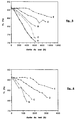
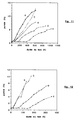
- Blurring is conventionally defined as equal to the proportion of scattered light compared to incident light. Beyond 1%, it begins to become troublesome, the eye then perceiving a slight distortion of the images.
- curves A and A ' are combined. To be effective, heating must be carried out at a minimum of 110 ° C. Curve B shows this efficiency, but with a blurring of more than 1% after approximately 800 hours.
- polymers A to E are practically the same as in the previous case, except that the polymer C has an almost identical behavior to the polymer B. Also note that the degradation of the light transmission is delayed by more than 500 hours for polymer E (weakening after ⁇ 1500 hours, compare to ⁇ 600 hours for polymer D, 200 hours for polymers C and B and from the start of the test for polymer A). As before, the tests at 110 ° C and 120 ° C confirm this classification, the polymer D being the only one not to show any degradation of the light transmission from the start of the test at 120 ° C, the curve having on the contrary a plateau for about the first 150 hours.
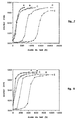
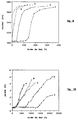
- Figures 7 to 9 show the evolution of the dominant color (dominant wavelength in transmission) as a function of the duration of the test, it being recalled that wavelengths of 500-530 nanometers correspond to green hues and 550 -570 nanometers in yellow - orange yellow hues, generally much less appreciated for glazing.
- wavelengths of 500-530 nanometers correspond to green hues and 550 -570 nanometers in yellow - orange yellow hues, generally much less appreciated for glazing.
- yellowing appears after about 250 hours.
- the duration of the test is doubled for polymer D and is further extended by almost 540% for polymer E.
Landscapes
- Chemical & Material Sciences (AREA)
- Chemical Kinetics & Catalysis (AREA)
- Health & Medical Sciences (AREA)
- Medicinal Chemistry (AREA)
- Polymers & Plastics (AREA)
- Organic Chemistry (AREA)
- Physics & Mathematics (AREA)
- Inorganic Chemistry (AREA)
- Electrochemistry (AREA)
- Nonlinear Science (AREA)
- General Chemical & Material Sciences (AREA)
- General Physics & Mathematics (AREA)
- Optics & Photonics (AREA)
- Engineering & Computer Science (AREA)
- Manufacturing & Machinery (AREA)
- Compositions Of Macromolecular Compounds (AREA)
- Surface Treatment Of Glass (AREA)
Applications Claiming Priority (2)
| Application Number | Priority Date | Filing Date | Title |
|---|---|---|---|
| FR9402048A FR2716457B1 (fr) | 1994-02-23 | 1994-02-23 | Matériau électrolyte conducteur protonique. |
| FR9402048 | 1994-02-23 |
Publications (1)
| Publication Number | Publication Date |
|---|---|
| EP0670346A1 true EP0670346A1 (de) | 1995-09-06 |
Family
ID=9460347
Family Applications (1)
| Application Number | Title | Priority Date | Filing Date |
|---|---|---|---|
| EP95400355A Ceased EP0670346A1 (de) | 1994-02-23 | 1995-02-21 | Protonleitender Elektrolytstoff |
Country Status (7)
| Country | Link |
|---|---|
| US (1) | US5507965A (de) |
| EP (1) | EP0670346A1 (de) |
| JP (1) | JPH0853614A (de) |
| CA (1) | CA2143149A1 (de) |
| CZ (1) | CZ46495A3 (de) |
| FR (1) | FR2716457B1 (de) |
| PL (1) | PL307391A1 (de) |
Cited By (21)
| Publication number | Priority date | Publication date | Assignee | Title |
|---|---|---|---|---|
| EP0770900A1 (de) | 1995-10-26 | 1997-05-02 | Saint-Gobain Vitrage | Elektrochrome Verglasung |
| WO2002006889A1 (fr) | 2000-07-13 | 2002-01-24 | Saint-Gobain Glass France | Dispositif electrochimique du type electrochrome ou dispositif photovoltaïque et ses moyens de connexion electrique |
| FR2815374A1 (fr) | 2000-10-18 | 2002-04-19 | Saint Gobain | Vitrage feuillete et ses moyens d'etancheification peripherique |
| WO2005006071A2 (fr) | 2003-07-09 | 2005-01-20 | Saint-Gobain Glass France | Dispositif electrocommandable a proprietes optiques et/ou energetiques variables |
| US6937380B2 (en) | 2001-03-07 | 2005-08-30 | Saint-Gobain Glass France | Electrically controllable device with variable optical and/or energy properties |
| EP1211552A3 (de) * | 1996-03-29 | 2005-11-23 | Basf Aktiengesellschaft | Für elektochrome Fenster geeignete Mischungen |
| WO2011010067A2 (fr) | 2009-07-22 | 2011-01-27 | Saint-Gobain Glass France | Dispositif electrochrome |
| WO2011161110A1 (en) | 2010-06-21 | 2011-12-29 | Saint-Gobain Glass France | Electrochromic device with anti-iridescent coating |
| WO2012007335A1 (en) | 2010-07-16 | 2012-01-19 | Saint-Gobain Glass France | Electrochemical glazing having electrically controllable optical and energy-related properties |
| WO2012076799A1 (fr) | 2010-12-06 | 2012-06-14 | Saint-Gobain Glass France | Dipositif electrochimique a proprietes de transmission optique et/ou energetique electrococommandables |
| WO2012076800A1 (fr) | 2010-12-06 | 2012-06-14 | Saint-Gobain Glass France | Dispositif electrochimique a proprietes de transmission optique et/ou energetique electrocommandables |
| WO2012080657A1 (fr) | 2010-12-16 | 2012-06-21 | Saint-Gobain Glass France | Systeme de commande de vitrages actifs comprenant un capteur d' eblouissement |
| WO2012080656A1 (fr) | 2010-12-16 | 2012-06-21 | Saint-Gobain Glass France | Systeme de commande de vitrages actifs gerant la couleur de la lumiere dans un batiment |
| US9182644B2 (en) | 2010-03-05 | 2015-11-10 | Sage Electrochromics, Inc. | Lamination of electrochromic device to glass substrates |
| US9272941B2 (en) | 2012-04-05 | 2016-03-01 | Sage Electrochromics, Inc. | Method of cutting a panel using a starter crack and a glass panel including a starter crack |
| US9482921B2 (en) | 2010-07-13 | 2016-11-01 | Sage Electrochromics, Inc. | Electrochromic device |
| US10509291B2 (en) | 2017-02-27 | 2019-12-17 | Sage Electrochromics, Inc. | Electrical device including a substrate and a transparent conductive layer and a process of forming the same |
| FR3088850A1 (fr) | 2018-11-28 | 2020-05-29 | Saint-Gobain Glass France | Procede de fabrication d’un vitrage electrochrome |
| WO2020183019A1 (fr) | 2019-03-14 | 2020-09-17 | Saint-Gobain Glass France | Procede de protection d'un substrat en verre revetu d'un empilement electrochrome et procede de fabrication d'un vitrage isolant |
| WO2021136914A1 (fr) | 2020-01-02 | 2021-07-08 | Saint-Gobain Glass France | Système optique, vitrage isolant comportant un tel système optique, procédé de fabrication de ce vitrage isolant et procédé de protection d'un système optique |
| US11442325B2 (en) | 2017-11-06 | 2022-09-13 | Sage Electrochromics, Inc. | Article including a non-light-emitting variable transmission device and a coating |
Families Citing this family (24)
| Publication number | Priority date | Publication date | Assignee | Title |
|---|---|---|---|---|
| US6933331B2 (en) * | 1998-05-22 | 2005-08-23 | Nanoproducts Corporation | Nanotechnology for drug delivery, contrast agents and biomedical implants |
| US5905000A (en) * | 1996-09-03 | 1999-05-18 | Nanomaterials Research Corporation | Nanostructured ion conducting solid electrolytes |
| US6652967B2 (en) * | 2001-08-08 | 2003-11-25 | Nanoproducts Corporation | Nano-dispersed powders and methods for their manufacture |
| JP4460078B2 (ja) * | 1996-10-17 | 2010-05-12 | サン−ゴバン グラス フランス | グレージング集成体 |
| US5723231A (en) * | 1996-12-09 | 1998-03-03 | Motorola, Inc. | Polymer electrolyte and an electrochemical cell containing the electrolyte |
| DE19851717A1 (de) | 1998-11-10 | 2000-06-15 | Magna Reflex Holding Gmbh | Elektrochrome Glasbaugruppe |
| GB9925439D0 (en) * | 1999-10-27 | 1999-12-29 | Unilever Plc | Hair treatment compositions |
| FR2808622B1 (fr) * | 2000-05-04 | 2006-09-08 | Bollore | Generateur electrochimique a electrolyte polymerique comprenant des polymeres fluores |
| US6855426B2 (en) * | 2001-08-08 | 2005-02-15 | Nanoproducts Corporation | Methods for producing composite nanoparticles |
| TW589760B (en) * | 2001-08-09 | 2004-06-01 | Sumitomo Chemical Co | Polymer electrolyte composition and fuel cell |
| US7708974B2 (en) * | 2002-12-10 | 2010-05-04 | Ppg Industries Ohio, Inc. | Tungsten comprising nanomaterials and related nanotechnology |
| US7220509B2 (en) * | 2004-08-30 | 2007-05-22 | General Motors Corporation | Constituents and methods for protecting fuel cell components, including PEMs |
| US20060178500A1 (en) | 2005-02-07 | 2006-08-10 | Fuji Photo Film Co., Ltd. | Solid electrolyte, method for producing solid electrolyte, membrane and electrode assembly, and fuel cell |
| JP5044132B2 (ja) | 2005-07-07 | 2012-10-10 | 富士フイルム株式会社 | 固体電解質フィルムの製造方法及び製造設備 |
| JP5093870B2 (ja) | 2005-07-07 | 2012-12-12 | 富士フイルム株式会社 | 固体電解質複層フィルムの製造方法 |
| CN101517800B (zh) | 2006-09-29 | 2011-10-12 | 富士胶片株式会社 | 膜电极接合体及其制造方法 |
| JP5094295B2 (ja) | 2007-09-10 | 2012-12-12 | 富士フイルム株式会社 | 膜電極接合体および燃料電池 |
| JP2009070631A (ja) | 2007-09-11 | 2009-04-02 | Fujifilm Corp | 電解質膜、膜電極接合体および膜電極接合体を用いた燃料電池 |
| JP5068610B2 (ja) | 2007-09-11 | 2012-11-07 | 富士フイルム株式会社 | イオン性ポリマー粒子分散液およびその製造方法 |
| WO2009063714A1 (ja) * | 2007-11-12 | 2009-05-22 | Konica Minolta Holdings, Inc. | 表示素子 |
| EP2796511B1 (de) * | 2011-12-20 | 2020-03-04 | Toray Industries, Inc. | Polymerelektrolytzusammensetzung sowie polymerelektrolytmembran, membranelektrodenanordnung und festpolymerbrennstoffzelle damit |
| US9502734B1 (en) | 2014-03-24 | 2016-11-22 | Amazon Technologies, Inc. | Flexible battery |
| US9496582B1 (en) * | 2014-03-24 | 2016-11-15 | Amazon Technologies, Inc. | Flexible battery |
| CN111653430B (zh) * | 2020-04-28 | 2021-10-08 | 安徽诚越电子科技有限公司 | 一种高闪火电压高电导率铝电解电容器用电解液以及铝电解电容器 |
Citations (6)
| Publication number | Priority date | Publication date | Assignee | Title |
|---|---|---|---|---|
| FR2277142A1 (fr) * | 1974-07-04 | 1976-01-30 | Snam Progetti | Polyglycol stabilise capable de resister a des temperatures elevees |
| FR2293486A1 (fr) * | 1974-12-04 | 1976-07-02 | Dunlop Ltd | Gel lubrifiant convenant a la lubrification interieure d'un bandage pneumatique utilise a l'etat degonfle |
| US4007123A (en) * | 1972-02-28 | 1977-02-08 | Mcdonnell Douglas Corporation | Fire resistant functional fluid compositions |
| DE2935165A1 (de) * | 1979-08-31 | 1981-03-19 | Basf Ag, 6700 Ludwigshafen | Verwendung von phosphoriger saeure als farbstabilisator fuer polyaether |
| EP0076468A2 (de) * | 1981-10-01 | 1983-04-13 | Hoechst Aktiengesellschaft | Verfahren zur Stabilisierung von Ethylenoxidpolyethern |
| FR2547309A1 (fr) * | 1983-06-10 | 1984-12-14 | Kao Corp | Composition d'huile pour le travail des metaux, comportant un polyetherpolyol |
Family Cites Families (2)
| Publication number | Priority date | Publication date | Assignee | Title |
|---|---|---|---|---|
| FR2601150B1 (fr) * | 1986-07-04 | 1991-05-31 | Saint Gobain Vitrage | Vitrage a transmission variable du type electrochrome |
| FR2695131B1 (fr) * | 1992-09-01 | 1994-09-30 | Alsthom Cge Alcatel | Electrolyte solide polymère conducteur protonique. |
-
1994
- 1994-02-23 FR FR9402048A patent/FR2716457B1/fr not_active Expired - Fee Related
-
1995
- 1995-02-21 EP EP95400355A patent/EP0670346A1/de not_active Ceased
- 1995-02-21 PL PL95307391A patent/PL307391A1/xx unknown
- 1995-02-22 CZ CZ95464A patent/CZ46495A3/cs unknown
- 1995-02-22 CA CA002143149A patent/CA2143149A1/fr not_active Abandoned
- 1995-02-23 JP JP7035525A patent/JPH0853614A/ja active Pending
- 1995-02-23 US US08/393,364 patent/US5507965A/en not_active Expired - Fee Related
Patent Citations (6)
| Publication number | Priority date | Publication date | Assignee | Title |
|---|---|---|---|---|
| US4007123A (en) * | 1972-02-28 | 1977-02-08 | Mcdonnell Douglas Corporation | Fire resistant functional fluid compositions |
| FR2277142A1 (fr) * | 1974-07-04 | 1976-01-30 | Snam Progetti | Polyglycol stabilise capable de resister a des temperatures elevees |
| FR2293486A1 (fr) * | 1974-12-04 | 1976-07-02 | Dunlop Ltd | Gel lubrifiant convenant a la lubrification interieure d'un bandage pneumatique utilise a l'etat degonfle |
| DE2935165A1 (de) * | 1979-08-31 | 1981-03-19 | Basf Ag, 6700 Ludwigshafen | Verwendung von phosphoriger saeure als farbstabilisator fuer polyaether |
| EP0076468A2 (de) * | 1981-10-01 | 1983-04-13 | Hoechst Aktiengesellschaft | Verfahren zur Stabilisierung von Ethylenoxidpolyethern |
| FR2547309A1 (fr) * | 1983-06-10 | 1984-12-14 | Kao Corp | Composition d'huile pour le travail des metaux, comportant un polyetherpolyol |
Non-Patent Citations (1)
| Title |
|---|
| PRZYHUSKI J. ET AL: "proton polymeric electrolytes -a review", SYNTHETIC METALS, vol. 45, 1991, pages 323 - 333 * |
Cited By (32)
| Publication number | Priority date | Publication date | Assignee | Title |
|---|---|---|---|---|
| EP0770900A1 (de) | 1995-10-26 | 1997-05-02 | Saint-Gobain Vitrage | Elektrochrome Verglasung |
| EP1211552A3 (de) * | 1996-03-29 | 2005-11-23 | Basf Aktiengesellschaft | Für elektochrome Fenster geeignete Mischungen |
| WO2002006889A1 (fr) | 2000-07-13 | 2002-01-24 | Saint-Gobain Glass France | Dispositif electrochimique du type electrochrome ou dispositif photovoltaïque et ses moyens de connexion electrique |
| FR2815374A1 (fr) | 2000-10-18 | 2002-04-19 | Saint Gobain | Vitrage feuillete et ses moyens d'etancheification peripherique |
| US6937380B2 (en) | 2001-03-07 | 2005-08-30 | Saint-Gobain Glass France | Electrically controllable device with variable optical and/or energy properties |
| US6995892B2 (en) | 2001-03-07 | 2006-02-07 | Saint-Gobain Glass France | Electrically controllable device having variable optical and/or energy properties |
| WO2005006071A2 (fr) | 2003-07-09 | 2005-01-20 | Saint-Gobain Glass France | Dispositif electrocommandable a proprietes optiques et/ou energetiques variables |
| WO2011010067A2 (fr) | 2009-07-22 | 2011-01-27 | Saint-Gobain Glass France | Dispositif electrochrome |
| US9182644B2 (en) | 2010-03-05 | 2015-11-10 | Sage Electrochromics, Inc. | Lamination of electrochromic device to glass substrates |
| US11241865B2 (en) | 2010-03-05 | 2022-02-08 | Sage Electrochromics, Inc. | Lamination of electrochromic device to glass substrates |
| US11890835B2 (en) | 2010-03-05 | 2024-02-06 | Sage Electrochromics, Inc. | Lamination of electrochromic device to glass substrates |
| US9316883B2 (en) | 2010-03-05 | 2016-04-19 | Sage Electrochromics, Inc. | Lamination of electrochromic device to glass substrates |
| WO2011161110A1 (en) | 2010-06-21 | 2011-12-29 | Saint-Gobain Glass France | Electrochromic device with anti-iridescent coating |
| US9091896B2 (en) | 2010-06-21 | 2015-07-28 | Sage Electrochromics, Inc. | Electrochromic device with anti-iridescent coating |
| US9482921B2 (en) | 2010-07-13 | 2016-11-01 | Sage Electrochromics, Inc. | Electrochromic device |
| US10718937B2 (en) | 2010-07-16 | 2020-07-21 | Sage Electrochromics, Inc. | Electrochemical glazing having electrically controllable optical and energy-related properties |
| WO2012007335A1 (en) | 2010-07-16 | 2012-01-19 | Saint-Gobain Glass France | Electrochemical glazing having electrically controllable optical and energy-related properties |
| US11650410B2 (en) | 2010-07-16 | 2023-05-16 | Sage Electrochromics, Inc. | Electrochemical glazing having electrically controllable optical and energy-related properties |
| WO2012076800A1 (fr) | 2010-12-06 | 2012-06-14 | Saint-Gobain Glass France | Dispositif electrochimique a proprietes de transmission optique et/ou energetique electrocommandables |
| WO2012076799A1 (fr) | 2010-12-06 | 2012-06-14 | Saint-Gobain Glass France | Dipositif electrochimique a proprietes de transmission optique et/ou energetique electrococommandables |
| WO2012080656A1 (fr) | 2010-12-16 | 2012-06-21 | Saint-Gobain Glass France | Systeme de commande de vitrages actifs gerant la couleur de la lumiere dans un batiment |
| WO2012080657A1 (fr) | 2010-12-16 | 2012-06-21 | Saint-Gobain Glass France | Systeme de commande de vitrages actifs comprenant un capteur d' eblouissement |
| US9272941B2 (en) | 2012-04-05 | 2016-03-01 | Sage Electrochromics, Inc. | Method of cutting a panel using a starter crack and a glass panel including a starter crack |
| US10509291B2 (en) | 2017-02-27 | 2019-12-17 | Sage Electrochromics, Inc. | Electrical device including a substrate and a transparent conductive layer and a process of forming the same |
| US11442325B2 (en) | 2017-11-06 | 2022-09-13 | Sage Electrochromics, Inc. | Article including a non-light-emitting variable transmission device and a coating |
| WO2020109725A1 (fr) | 2018-11-28 | 2020-06-04 | Saint-Gobain Glass France | Procédé de fabrication d'un vitrage électrochrome |
| FR3088850A1 (fr) | 2018-11-28 | 2020-05-29 | Saint-Gobain Glass France | Procede de fabrication d’un vitrage electrochrome |
| WO2020183019A1 (fr) | 2019-03-14 | 2020-09-17 | Saint-Gobain Glass France | Procede de protection d'un substrat en verre revetu d'un empilement electrochrome et procede de fabrication d'un vitrage isolant |
| FR3093720A1 (fr) | 2019-03-14 | 2020-09-18 | Saint-Gobain Glass France | Procédé de protection d’un substrat en verre revêtu d’un empilement électrochrome et procédé de fabrication d’un vitrage isolant |
| US12007658B2 (en) | 2019-03-14 | 2024-06-11 | Saint-Gobain Glass France | Method for protecting a glass substrate coated with an electrochromic stack and method for producing an insulating glazing |
| WO2021136914A1 (fr) | 2020-01-02 | 2021-07-08 | Saint-Gobain Glass France | Système optique, vitrage isolant comportant un tel système optique, procédé de fabrication de ce vitrage isolant et procédé de protection d'un système optique |
| FR3106006A1 (fr) | 2020-01-02 | 2021-07-09 | Saint-Gobain Glass France | Système optique, vitrage isolant comportant un tel système optique, procédé de fabrication de ce vitrage isolant et procédé de protection d’un système optique |
Also Published As
| Publication number | Publication date |
|---|---|
| FR2716457A1 (fr) | 1995-08-25 |
| JPH0853614A (ja) | 1996-02-27 |
| US5507965A (en) | 1996-04-16 |
| CZ46495A3 (en) | 1995-11-15 |
| CA2143149A1 (fr) | 1995-08-24 |
| FR2716457B1 (fr) | 1996-05-24 |
| PL307391A1 (en) | 1995-09-04 |
Similar Documents
| Publication | Publication Date | Title |
|---|---|---|
| FR2716457A1 (fr) | Matériau électrolyte conducteur protonique. | |
| EP2150404B1 (de) | Feuerfeste verglasung | |
| EP0604314A1 (de) | Glaszusammensetzungen zur Herstellung von Verglasungen | |
| FR2607491A1 (fr) | Vitrage coupe-feu transparent | |
| EP2723808B1 (de) | Polymermaterial auf der basis von poly(milchsäure) | |
| WO2013004470A2 (fr) | Feuille de verre flotte a haute transmission energetique | |
| FR3064528A1 (fr) | Vitrage feuillete avec empilement de couches. | |
| EP0569299A1 (de) | Verbundglasscheibe | |
| CA3005765A1 (fr) | Vitrage de controle thermique muni d'un film polymere protecteur | |
| EP0728810A2 (de) | Wässrige Zusammensetzung zum Schutz von Reifen vor Ozon und ausschwitzenden Verbindungen | |
| EP2010382B1 (de) | Brandschutzverglasung | |
| FR2751660A1 (fr) | Composition pour la fabrication d'un materiau composite conducteur contenant une polyaniline et materiau composite obtenu a partir de cette composition | |
| EP3732140A1 (de) | Verfahren zum biegen von glasscheiben | |
| EP3911515B1 (de) | Hybride akustische zwischenschicht bestehend aus einer haftkernschicht, die aus polymer-matrix-nanokompositen hergestellt ist | |
| BE1019472A3 (fr) | Vitrage ant-feu. | |
| EP1230081B1 (de) | Transparente brandschutzverglasung | |
| JP2002505210A (ja) | 耐層剥離性積層ガラス構造体 | |
| EP2747996B1 (de) | Feuerfeste verglasungseinheit | |
| EP2694287B1 (de) | Feuerfeste verglasung | |
| EP0714964A1 (de) | Mehrscheibenisolierglas mit Geradverbinder aus Kunststoff | |
| FR2720683A1 (fr) | Film intercalaire résistant au feu et son utilisation dans un verre feuilleté. | |
| EP2010383A1 (de) | Brandschutzverglasung | |
| EP4526267A1 (de) | Monolithische dachverglasung für ein kraftfahrzeug | |
| US20230139823A1 (en) | Optical coating having a low refractive index | |
| EP2305756A1 (de) | Farbiges Verbundmaterial, das Nanopartikel enthält |
Legal Events
| Date | Code | Title | Description |
|---|---|---|---|
| PUAI | Public reference made under article 153(3) epc to a published international application that has entered the european phase |
Free format text: ORIGINAL CODE: 0009012 |
|
| AK | Designated contracting states |
Kind code of ref document: A1 Designated state(s): AT BE CH DE DK ES FR GB IT LI NL SE |
|
| 17P | Request for examination filed |
Effective date: 19960227 |
|
| 17Q | First examination report despatched |
Effective date: 19990813 |
|
| GRAG | Despatch of communication of intention to grant |
Free format text: ORIGINAL CODE: EPIDOS AGRA |
|
| RAP1 | Party data changed (applicant data changed or rights of an application transferred) |
Owner name: SAINT-GOBAIN GLASS FRANCE |
|
| STAA | Information on the status of an ep patent application or granted ep patent |
Free format text: STATUS: THE APPLICATION HAS BEEN REFUSED |
|
| 18R | Application refused |
Effective date: 20010403 |