EP0670660B1 - Teletext-Decoder - Google Patents
Teletext-Decoder Download PDFInfo
- Publication number
- EP0670660B1 EP0670660B1 EP95103159A EP95103159A EP0670660B1 EP 0670660 B1 EP0670660 B1 EP 0670660B1 EP 95103159 A EP95103159 A EP 95103159A EP 95103159 A EP95103159 A EP 95103159A EP 0670660 B1 EP0670660 B1 EP 0670660B1
- Authority
- EP
- European Patent Office
- Prior art keywords
- page
- teletext
- subtitle
- transmitted
- information
- Prior art date
- Legal status (The legal status is an assumption and is not a legal conclusion. Google has not performed a legal analysis and makes no representation as to the accuracy of the status listed.)
- Expired - Lifetime
Links
Images

Classifications
-
- H—ELECTRICITY
- H04—ELECTRIC COMMUNICATION TECHNIQUE
- H04N—PICTORIAL COMMUNICATION, e.g. TELEVISION
- H04N7/00—Television systems
- H04N7/08—Systems for the simultaneous or sequential transmission of more than one television signal, e.g. additional information signals, the signals occupying wholly or partially the same frequency band, e.g. by time division
- H04N7/087—Systems for the simultaneous or sequential transmission of more than one television signal, e.g. additional information signals, the signals occupying wholly or partially the same frequency band, e.g. by time division with signal insertion during the vertical blanking interval only
- H04N7/088—Systems for the simultaneous or sequential transmission of more than one television signal, e.g. additional information signals, the signals occupying wholly or partially the same frequency band, e.g. by time division with signal insertion during the vertical blanking interval only the inserted signal being digital
- H04N7/0884—Systems for the simultaneous or sequential transmission of more than one television signal, e.g. additional information signals, the signals occupying wholly or partially the same frequency band, e.g. by time division with signal insertion during the vertical blanking interval only the inserted signal being digital for the transmission of additional display-information, e.g. menu for programme or channel selection
- H04N7/0885—Systems for the simultaneous or sequential transmission of more than one television signal, e.g. additional information signals, the signals occupying wholly or partially the same frequency band, e.g. by time division with signal insertion during the vertical blanking interval only the inserted signal being digital for the transmission of additional display-information, e.g. menu for programme or channel selection for the transmission of subtitles
-
- H—ELECTRICITY
- H04—ELECTRIC COMMUNICATION TECHNIQUE
- H04N—PICTORIAL COMMUNICATION, e.g. TELEVISION
- H04N7/00—Television systems
- H04N7/08—Systems for the simultaneous or sequential transmission of more than one television signal, e.g. additional information signals, the signals occupying wholly or partially the same frequency band, e.g. by time division
-
- H—ELECTRICITY
- H04—ELECTRIC COMMUNICATION TECHNIQUE
- H04N—PICTORIAL COMMUNICATION, e.g. TELEVISION
- H04N7/00—Television systems
- H04N7/08—Systems for the simultaneous or sequential transmission of more than one television signal, e.g. additional information signals, the signals occupying wholly or partially the same frequency band, e.g. by time division
- H04N7/087—Systems for the simultaneous or sequential transmission of more than one television signal, e.g. additional information signals, the signals occupying wholly or partially the same frequency band, e.g. by time division with signal insertion during the vertical blanking interval only
- H04N7/088—Systems for the simultaneous or sequential transmission of more than one television signal, e.g. additional information signals, the signals occupying wholly or partially the same frequency band, e.g. by time division with signal insertion during the vertical blanking interval only the inserted signal being digital
- H04N7/0882—Systems for the simultaneous or sequential transmission of more than one television signal, e.g. additional information signals, the signals occupying wholly or partially the same frequency band, e.g. by time division with signal insertion during the vertical blanking interval only the inserted signal being digital for the transmission of character code signals, e.g. for teletext
Definitions
- the invention relates to a teletext decoder for the processing of teletext and subtitle information transmitted serially, in the vertical blanking interval in a television signal, in the form of pages to be displayed on a television screen, each transmitted page being composed of a header line with information concerning the type and number of the respective page and of a varying number of data lines, comprising a memory for the incoming information, a control unit to receive the incoming information and, dependent on the content of the header line to control the storage of the information belonging to a page in the memory.
- Most advanced television receivers are fitted with a teletext decoder, with the aid of which the information transmitted in the vertical blanking intervals of the television signal may be displayed on the television receiver screen.
- This information may for instance be current daily news in the form of headlines, sporting news, weather reports and the like.
- a significant part of such information is however furthermore subtitle information which in the form of subtitle lines may be included in a television program being shown.
- the structure of the transmitted information is defined in the "World Systems Teletext Specification", abbreviated as WST.
- WST World Systems Teletext Specification
- the information is transmitted in the form of pages, which comprise at the most 25 lines of 40 columns each.
- the line with the 0 is a special line, i. e. a so-called header line, which comprises information concerning the type and content of the following data lines of the page.
- the header for example comprises the number of the respective page and it is to be seen from the header line whether the page is a normal information page or a subtitle page.
- the header line has three purposes:
- the page acquiring circuitry comprised in a teletext decoder which as desired by the viewer is responsible for storage of the teletext page to be displayed on the screen, cannot be reset for searching for another page as long as the current page is still in the process of being transmitted. Any premature resetting, that is to say prior to termination of the current page, would consequently lead to loss of data. Furthermore in the case of programming video-recorders with the aid of program information contained in certain teletext page, it is in each case necessary to await the complete transmission of a page; it is only then that the received page may be further processed.
- a further reason for not being able to interpret the reception of a header line as the end of the previously transmitted page is that then in the case of a state of the art teletext transmission method two header lines are transmitted immediately one after the other, that is to say the header line of the next page to be transmitted and the header line of the next page following this page.
- This method termed in the literature "page advanced header” (PAH) has the purpose of giving an early warning to the teletext decoder that a further page is on the way so that preparations for such page may be made even before the first lines of such page have been transmitted.
- Such preparations may inter alia contain an allocation of memory capacity for the new page which is to arrive.
- One object of the present invention is to provide a teletext decoder of the sort noted initially which renders it possible to produce a cue indicating the end of a transmitted page.
- the invention provides for storage of page numbers by an additional memory, the control unit being so designed that on recognizing a page as a subtitle page the storage of the previously received page number is caused to take place in the additional memory and a previously received page is marked as being terminated, if the last received page is not a subtitle page and the additional memory is not storing a valid page number or a page number differing from the last received page number.
- the special design renders possible a comparison of page and an evaluation of the additional information comprised in the header line to produce a cue with the aid of which a received page may be marked as being previously terminated.
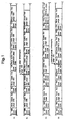
- Teletext pages comprise information, which is displayed over the full area of the picture screen, whereas subtitle pages contain information, which is can be displayed as subtitles in a current television program.
- Each information page consists of a header line and of data lines following the header line, each page containing up to 25 lines in accordance with the said Standard in force.
- the header line of page 100 is transmitted, which is followed by the data lines.
- the next block contains the header line of page 101 and following this the data lines for the page 101.
- the data lines for page 101 are directly followed by a header line of page 150, which is to be a header line of a subtitle page.
- This header line is followed by the data lines for the subtitle page 150.
- the header line of page 150 is joined to the last data line of page 101 so that there has been no interruption of a teletext page.
- the header line for page 102 is transmitted, which is then followed by the respective data lines.
- Figure 1B shows the case in which a subtitle page interrupts a teletext page.
- a subtitle page interrupts a teletext page.
- the header line of the subtitle page 101 is transmitted the data lines for the teletext page 101 have not yet been completely transmitted. This interruption means that the teletext decoder page 101 could not be completely displayed on the screen, if steps were not taken to see that after the end of the subtitle page the rest of the entire page 101 is transmitted as well.
- FIG 1C a further mode of transmission is depicted, which is termed the method with pre-header lines.
- This particular method of transmission means that prior to the transmission of the header line of a page currently to be transmitted the header line of the next page to be transmitted is transmitted. Once the data lines of the current page have been transmitted, the header line of the next but one page, and then the header line of the next page with the respective data are transmitted.
- This method offers the advantage that the decoder always knows in advance which page is to be transmitted as the next one. It is consequently possible to make sufficient memory capacity available by erasure of information no longer required in the decoder. The memory in the decoder is in fact not so large that the entire transmitted information can be constantly written into it and stored.
- FIG. 1C shows that after the transmission of the header line for the page 101 the header line for the page 100 and following this the respective data lines are transmitted. Following this the header line of page 102, the header line of page 101 and the data lines belonging thereto are transmitted. Furthermore advance notice of a subtitle page, in the present example page 150, is given by transmission of the corresponding header line. as figure 1C shows. In the case of figure 1C there is during the transmission of the header line 150, no interruption of the transmission of a teletext page, since the header line of page 150 is only transmitted after the complete transmission of the data lines of page 101.
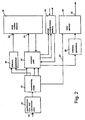
- serially transmitted digital teletext data are supplied to an input 10 of a synchronizing and converting unit 12.
- a sync code comprised in the data flow is recognized by this synchronizing and converting unit 12 and processed for synchronization purposes.
- serially arriving bytes are converted into parallel bytes and passed on to a separating stage 14.
- control information is separated from the actual teletext information, such control information comprising inter alia the page number and the line number of the transmitted teletext pages.
- a special mode of transmission is employed, which is termed magazine transmission.
- the individual teletext page are respectively associated with certain magazines.
- there are two different transmission modes i. e. a transmission mode, in which the magazines are serially transmitted, and a transmission mode, in which the magazines are transmitted in parallel.
- serial transmission only one teletext page is open at a time, whereas during parallel transmission of the magazines up to eight teletext pages may be open at a time.
- the control information, which is transmitted for each page hence also contains the magazine number, that is to say, an indication as to which magazine the respectively transmitted teletext page belongs.
- the control information also contains a cue indicating whether parallel or serial magazine transmission is being employed. This information is made available by the separating stage and supplied to a control unit 16 and furthermore an address generator 18. The information relating to the magazines is employed by the control unit 16 and the address generator 18 to place in a page number memory 20 that address, at which the page numbers of the open teletext page are stored. At an input 22 the number memory receives the address produced by the address generator 18 and at an input 24 the control unit 16 transmits the page numbers of the teletext pages which have just been opened to the page number memory 20.
- the information belonging to the individual pages is stored together with line numbers of the transmitted lines in a data memory 26.
- This data memory 26 receives the data via the line 25 from the separating stage 14, and storage takes place at an address produced by the address generator 28 under the control of the control unit 16. Since the control unit 16 coordinates the storage of the page numbers in the page number memory 20 with the storage of the data in the data memory 26, proper association between the page numbers and the associated data lines is always ensured.
- an additionally provided page acquisition memory 30 receives those page numbers, which are to be sought by the decoder so that the same may be displayed on the television screen.
- the control unit 16 determines where such page numbers are to be stored, said unit 16 being informed respectively about the sought page numbers.
- the cue for the end of a page is also stored in this page acquisition memory 30 in a manner associated with the respective page.
- the teletext data to be displayed of the television screen are provided at the output 32 of the data memory 26 and supplied to means for processing them.
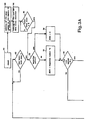
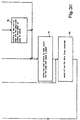
- steps 40 through 46 an initialization process (steps 40 through 46) is performed, in which invalid page numbers (step 42) are stored in the memory 20 at the address ADR1 to ADR6; furthermore during such initialization procedure the cue for received data lines is set for all pages which indicates that since the reception of the last header line data lines have been received (step 44).
- the system waits for a header line in order to ensure identical start conditions.
- the sequence of operations performed in the control unit 16 starts at the step 50 with an examination to see whether a new teletext line has been received. As long as no new line is received, the system dwells in a wait loop. On the reception of a new line the loop is abandoned and in the step 52 a check is performed to see whether serial or parallel magazine transmission is taking place. If serial magazine transmission is being carried out, an address pointer ADR1 for the page number memory 20 is set at the value of "0". If on the contrary parallel transmission is detected, then for the production of the memory address in the page number memory 20 the magazine number is multiplied by 2. Accordingly it is possible to ensure that in the case of serial transmission in all cases only one page can be opened in the eight magazines conventionally present.
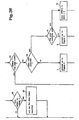
- step 58 After the calculation of the memory addresses for the memory 20 in the steps 54 and, respectively, 56 a check is made in step 58 to see whether the newly received data line has the line number 0. Should the new line number possess a value other than 0, then in the step 60 (figure 3B) a check is made to see whether the line number is between 1 and 24. If this is not the case, then there is no valid line number and the system goes back to the step 50. If a valid line number is present in the range 1 through 24, then in the step 62 a cue is set to indicate that data lines have already been received for the page indicated by the received page number.
- step 64 a check is now made to see whether the page number stored in the memory 20 at the address ADR1 is the same as the currently received new page number. The first time the system goes through the sequence of operations indicated in the flow chart there is an invalid page number at the address ADR1 of the memory 20 so that checking in step 64 will lead to a negative result.
- this header line will be treated as a so-called full header line which does not cause any storing operations but rather has the effect of returning the system to step 50, after, in step 66, the cue for the data lines already received has been reset.
- Full header lines that is to say directly sequential header lines with the same page number, are transmitted for reasons of compatibility to enable older types of teletext decoders to operate correctly.
- Such older types of teletext decoder in fact require a certain interval to elapse between the reception of a header line and the following data lines in order to clear the memory part in which the data lines are to be written.
- step 68 a check is made in step 68 to see whether data lines have already been received for this page. Since, as noted supra, during initialization the cue for the received data lines has been set, there is now in a step 70 a check as to whether the new page received is a subtitle page. This may be detected on the basis of a bit comprised in the header line. Since in the case assumed the new page is not marked as a subtitle page, there is then a further sequence of operations B, which is depicted in figure 4.
- step 72 a check is made in step 72 to see whether a valid page number has been stored in the address ADR1 + 1 in the memory 20. Owing to the preceding initialization there is no valid page number at this address so that the number of the currently received page is stored at the address ADR1 in the memory 20 and the cue which marks the end of a page, is reset, this meaning that the page belonging to the received page number is marked as being opened.
- step 74 (figure 3C).
- step 66 the cue for received data lines is reset and there is a return to step 50 (figure 3A).
- step 58 When now data lines are received a check is made in step 58 as to whether the respectively received line number has the value of 0. Since this is not the case with data lines, a check is made in step 60 firstly to see whether the line number is within the valid range of 1 through 24. Should this apply, the cue is set for data lines received. The storage of the received data lines in the memory 30 may now take place.
- step 50 When now in the serial sequence of data, which are received by the teletext decoder, in step 50 the start of a new page is detected, the system goes through the steps 52, 54 or 56 and 58. On the reception of a new header line the check in step 58 is answered affirmatively, and the sequence of operations noted above is performed over again, as takes place if the newly received page number is not the same as the page number stored at the address ADR1.
- step 68 In the case of a normal transmission without inserted subtitle pages, it will be found in step 68 that data lines have already been received so that there is a transition to step 70.
- the check performed in this step 70 has a negative result and there is a transition to the sequence B of operations, which is depicted in figure 4.
- step 72 In this sequence of operations a check is made in step 72 as to whether a valid page number is stored in the memory 20 at the address ADR1 + 1. Should this not be the case, there is a transition to step 76, in which the page end cue for the previously received page is set, whose page number is stored at the address ADR1. Following this the new page number is stored at the address ADR1 and the page cue for this new page is reset, this meaning that this page is deemed to be opened. After resetting of the cue for the data lines received in step 66 there is a return to the step 50 in figure 3A.
- step 64 Performing a check on the basis of the received page number in step 58 will show that the received line is a header line.
- step 64 it will be seen that the page number comprised in the header line is not the same as the page number stored at the address ADR1. Since the cue for data lines received is set, the check in step 68 will have a positive result so that a check is made in step 70 to see whether the new page is a subtitle page. The respective question will be answered affirmatively, since, as indicated supra, the received header line is to be the header line of a subtitle page.
- step 76 the page number stored at the address ADR1 in the memory 20 will be copied to the address ADR1 + 1.
- the newly received page number that is to say the pump number 150
- the page end cue for the page 150 will be reset, this corresponding to the opening of this page (step 74).
- the cue for data lines received is reset again and the sequence of operations then reverts to the step 50. There will then be such the state that both the subtitle page with the page number 150 and also the teletext page with the page number 101 are marked as being opened.
- the branch of the flow chart comprising the steps 60 and 62 is run through, something which leads to the setting of the cue for data lines received.
- step 58 the header line of the teletext page 102 is received.
- step 64 it will be seen that the newly received page number 102 is not the same as the page number 150, which was stored at the address ADR1. Since the cue for received data lines is set, after the finding that the new page is not a subtitle page (step 70) there will be a transition to the sequence of operations illustrated in figure 4.
- step 72 it will be detected that a valid page number, that is to say in this case the page number 101, is stored at the address ADR1 + 1. This is always the case, if the previously received page was a subtitle page.
- step 78 A check is made in step 78 as to whether the page number 101 at the address ADR1 + 1 is the same as the new page number 102. Since this is not the case, it is then possible in step 80 to set the page end cue for the page indicated by the page number at the address ADR1 + 1, that is to say for the page 101, and this page can therefore be marked as being closed. In step 82 an invalid page number is written at the address ADR1 + 1. In step 76 the end cue of the page is set, whose number is stored at the address ADR1, i. e. of the page 150.
- step 74 (figure 3C) the new page number (the number 102) is stored at the address ADR1 and the page end cue of this page is reset, something corresponding to the opening of this page.
- step 66 the cue for data lines received is reset and there is a return to the step 50.
- step 78 it will be detected that the page number stored at the address ADR1 + 1 is the same as the newly received page number, that is to say also the page number 101. The consequence of this is that the step 80 is skipped, that is to say the page end cue for the page with the number 101 is not set.
- step 76 the page end code cue for the page will be set at the address ADR1 + 1, that is to say the subtitle page with the number 150.
- the new page number i. e.
- step 66 This cue will however always be set again, if lines are received, which have a line number different than 0, this being recognized in step 58.
- the setting of the cue for data lines received respectively takes place in step 62, if the line number is within the valid range of 1 to 24.
- figure 1C shows a transmission sequence in accordance with the pre-header line method.
- this method - before a complete teletext page with the associated header line and the data lines - a further header line without the associated data lines is transmitted, which possesses the page number of that teletext page, which as transmitted following the completely transmitted teletext page.
- the particular feature of this manner of transmission is to be seen in that two header lines always follow each other directly without data lines being transmitted between them. This fact is taken into account in the sequence of operations depicted in figures 3A, 3B, 3C and 4 since there is a respective interrogation as to whether data lines are contained between two header lines.
- step 70 After the reception of the second of the two directly following, adjacent header lines, data lines are received so that the question in step 68 must be answered affirmatively. If now in the step 70 it is found that the new page is not a subtitle page, events take place as in figure 4, which are directly followed by step 76, in the case of which the end of page cue is set for the page with the number at the address ADR1. If for example the transmission section with the header line of the page 102, of the header line with the page 101 and with the following data lines for the page 101 are examined it will be seen that after reception of the data lines for the page 101 in step 76 the page 100 will be marked as being terminated.
- the reception of a subtitle page is just like the reception of a normal teletext page but with the difference that no page previously transmitted page is marked as being terminated, since owing to the affirmative reply in step 70 the path via the step 76 is taken leaving out the step, in which the setting of the end of page cue took place.
- Page 100 is only marked as being terminated when after transmission of the subtitle page a header line is received again, in the present example the header line of the page 102 is received. Following this header line the header line of the page 101 is received, which is followed by the data lines of this page so that the previously interrupted teletext page is now transmitted in full.
Landscapes
- Engineering & Computer Science (AREA)
- Multimedia (AREA)
- Signal Processing (AREA)
- Human Computer Interaction (AREA)
- Television Systems (AREA)
- Facsimiles In General (AREA)
Claims (9)
- Teletext-Decoder für die Verarbeitung von Teletext- und Untertitelinformationen, die in einem vertikalen Austastintervall eines Fernsehsignals in Form von auf einem Bildschirm anzuzeigenden Seiten gesendet werden, wobei jede gesendete Seite eine Seitenkopfzeile, die Informationen enthält, die den Typ und die Nummer der jeweiligen Seite betreffen, und eine veränderliche Anzahl von Datenzeilen besitzt, wobei der Teletext-Decoder umfaßt:dadurch gekennzeichnet, daß der Teletext-Decoder ferner umfaßt:eine Steuereinheit (16), die die ankommenden Informationen empfängt und in Abhängigkeit vom Inhalt der Kopfzeile die Speicherung der zu einer Seite gehörenden Informationen in einem Speicher (20; 30; 26) steuert; undeinen zusätzlichen Speicher (20) zum Speichern von Seitennummern, die auf die gesendeten Informationsseiten bezogen sind, wobei die Steuereinheit (16) so betreibbar ist, daß sie bewirkt, daß eine früher empfangene Seitennummer in dem zusätzlichen Speicher (20) gespeichert wird, wenn sie feststellt, daß eine gesendete Seite eine Untertitelseite ist, wobei die Steuereinheit (16) ferner so betreibbar ist, daß sie eine früher empfangene Seite als beendet markiert, wenn eine früher empfangene Seite keine Untertitelseite ist und der zusätzliche Speicher (20) keine gültige Seitennummer speichert oder eine von der zuletzt empfangenen verschiedene Seitennummer speichert.
- Teletext-Decoder nach Anspruch 1, der ferner umfaßt:eine Synchronisations- und Umsetzungseinheit (12).
- Teletext-Decoder nach Anspruch 1 oder Anspruch 2, der ferner umfaßt:einen Adressengenerator (28) zum Adressieren des Speichers (26).
- Teletext-Decoder nach einem vorhergehenden Anspruch, der ferner umfaßt:einen zweiten Adressengenerator (18) zum Adressieren des zusätzlichen Speichers (20).
- Teletext-Decoder nach einem der Ansprüche 1 bis 4, der Mittel umfaßt, die ein Fernsehbild erzeugen, das Teletext- und Untertitelinformationen enthält.
- Verfahren zum Verarbeiten von Teletext- und Untertitelinformationen, die in einem vertikalen Austastintervall eines Fernsehsignals in Form von auf einem Fernsehschirm anzuzeigenden Seiten gesendet werden, wobei das Verfahren umfaßt:und dadurch gekennzeichnet, daß das Verfahren ferner die folgenden Schritte umfaßt:Empfangen einer Seite, die einen Seitenkopf, der Informationen bezüglich des Typs und der Nummer der jeweiligen Seite enthält, sowie eine veränderliche Anzahl von Datenzeilen umfaßt, bei einer Steuereinheit (16);Speichern der Informationen in einem Speicher (20; 30; 26) in Abhängigkeit vom Seitenkopf;Bestimmen, ob die Seite eine Untertitelseite ist;Speichern einer früher empfangenen Seitennummer in einem zusätzlichen Speicher (20), wenn während des Bestimmungsschrittes bezüglich der früher empfangenen Seite festgestellt worden ist, daß sie eine Untertitelseite ist; undMarkieren einer früher empfangenen Seite als beendet, falls die früher empfangene Seite keine Untertitelseite ist und der zusätzliche Speicher keine gültige Seitennummer speichert oder eine von der zuletzt empfangenen verschiedene Seitennummer speichert.
- Verfahren nach Anspruch 6, das ferner umfaßt:Synchronisieren und Umsetzen der empfangenen ankommenden Informationen mit Synchronisations- und Umsetzungsmitteln (12) vor der Ausführung des Schrittes des Empfangens der ankommenden Informationen bei der Steuereinheit (16).
- Verfahren nach Anspruch 6 oder Anspruch 7, das ferner umfaßt:Adressieren des oder jedes Speichers (20; 30; 26).
- Verfahren nach einem der Ansprüche 6 bis 8, das ferner umfaßt:Erzeugen eines Fernsehsignals, das Teletext- und Untertitelinformationen enthält.
Applications Claiming Priority (2)
| Application Number | Priority Date | Filing Date | Title |
|---|---|---|---|
| DE4407237 | 1994-03-04 | ||
| DE4407237A DE4407237A1 (de) | 1994-03-04 | 1994-03-04 | Teletext-Decoder |
Publications (3)
| Publication Number | Publication Date |
|---|---|
| EP0670660A2 EP0670660A2 (de) | 1995-09-06 |
| EP0670660A3 EP0670660A3 (de) | 1998-01-07 |
| EP0670660B1 true EP0670660B1 (de) | 2002-06-19 |
Family
ID=6511869
Family Applications (1)
| Application Number | Title | Priority Date | Filing Date |
|---|---|---|---|
| EP95103159A Expired - Lifetime EP0670660B1 (de) | 1994-03-04 | 1995-03-06 | Teletext-Decoder |
Country Status (5)
| Country | Link |
|---|---|
| EP (1) | EP0670660B1 (de) |
| JP (1) | JPH0837653A (de) |
| KR (1) | KR950035393A (de) |
| DE (2) | DE4407237A1 (de) |
| TW (1) | TW268177B (de) |
Family Cites Families (1)
| Publication number | Priority date | Publication date | Assignee | Title |
|---|---|---|---|---|
| ES2115718T5 (es) * | 1992-06-29 | 2001-09-16 | Koninkl Philips Electronics Nv | Receptor de television que comprende un descodificador de teletexto. |
-
1994
- 1994-03-04 DE DE4407237A patent/DE4407237A1/de not_active Ceased
-
1995
- 1995-03-03 JP JP7044372A patent/JPH0837653A/ja active Pending
- 1995-03-04 KR KR1019950004661A patent/KR950035393A/ko not_active Withdrawn
- 1995-03-06 EP EP95103159A patent/EP0670660B1/de not_active Expired - Lifetime
- 1995-03-06 DE DE69527105T patent/DE69527105T2/de not_active Expired - Fee Related
- 1995-03-31 TW TW084103097A patent/TW268177B/zh active
Also Published As
| Publication number | Publication date |
|---|---|
| DE69527105T2 (de) | 2002-11-28 |
| TW268177B (de) | 1996-01-11 |
| DE4407237A1 (de) | 1995-09-14 |
| EP0670660A3 (de) | 1998-01-07 |
| KR950035393A (ko) | 1995-12-30 |
| JPH0837653A (ja) | 1996-02-06 |
| DE69527105D1 (de) | 2002-07-25 |
| EP0670660A2 (de) | 1995-09-06 |
Similar Documents
| Publication | Publication Date | Title |
|---|---|---|
| US4595951A (en) | Teletext decoder using a common memory | |
| US4953022A (en) | Teletext decoders | |
| US5038212A (en) | Teletext decoder and receiver for television signals for receiving cyclically transmitted teletext pages | |
| JP2587931Y2 (ja) | テレテキスト信号中の識別信号の処理装置 | |
| EP0488454B1 (de) | Videotextdecoderanordnung | |
| EP0744866A2 (de) | Verfahren zur Untertitelung eines Videofilms | |
| US4719510A (en) | Teletext decoders | |
| EP0362940B1 (de) | Teletext-Decodierer | |
| EP0671106B1 (de) | Zusatz-fernsehinformationssystem mit erweiterten datendiensten | |
| EP0670660B1 (de) | Teletext-Decoder | |
| US4963968A (en) | Method and apparatus for validating teletext data | |
| US6445424B1 (en) | Method and apparatus for multistandard video data acquisition | |
| US5353064A (en) | Multipage teletext decoder for capturing a requested page during a single cycle | |
| JPS6248955B2 (de) | ||
| US4910595A (en) | Teletext decoders | |
| EP0439854B1 (de) | Teletext-Dekoder | |
| JP3244698B2 (ja) | テレビ走査線におけるデータの伝送方法 | |
| JPS6244474B2 (de) | ||
| JPH05344486A (ja) | テレテックストのディジタル処理装置及びその制御方法 | |
| JPS6014585A (ja) | 番組予約機能付文字放送受信機 | |
| JPH10271462A (ja) | テレビジョン信号処理装置用のバスシステム | |
| JP2000050219A (ja) | 文字放送受信装置 | |
| KR100279631B1 (ko) | 영상신호처리기의 자막 및 문자정보 처리 방법 및 장치 | |
| JPS625504B2 (de) | ||
| EP0785684A2 (de) | Verfahren zum Empfangen von Teletextübertragungen |
Legal Events
| Date | Code | Title | Description |
|---|---|---|---|
| PUAI | Public reference made under article 153(3) epc to a published international application that has entered the european phase |
Free format text: ORIGINAL CODE: 0009012 |
|
| AK | Designated contracting states |
Kind code of ref document: A2 Designated state(s): DE FR GB IT |
|
| PUAL | Search report despatched |
Free format text: ORIGINAL CODE: 0009013 |
|
| AK | Designated contracting states |
Kind code of ref document: A3 Designated state(s): DE FR GB IT |
|
| 17P | Request for examination filed |
Effective date: 19980707 |
|
| 17Q | First examination report despatched |
Effective date: 19991117 |
|
| GRAG | Despatch of communication of intention to grant |
Free format text: ORIGINAL CODE: EPIDOS AGRA |
|
| GRAG | Despatch of communication of intention to grant |
Free format text: ORIGINAL CODE: EPIDOS AGRA |
|
| GRAG | Despatch of communication of intention to grant |
Free format text: ORIGINAL CODE: EPIDOS AGRA |
|
| GRAH | Despatch of communication of intention to grant a patent |
Free format text: ORIGINAL CODE: EPIDOS IGRA |
|
| GRAH | Despatch of communication of intention to grant a patent |
Free format text: ORIGINAL CODE: EPIDOS IGRA |
|
| GRAA | (expected) grant |
Free format text: ORIGINAL CODE: 0009210 |
|
| AK | Designated contracting states |
Kind code of ref document: B1 Designated state(s): DE FR GB IT |
|
| PG25 | Lapsed in a contracting state [announced via postgrant information from national office to epo] |
Ref country code: IT Free format text: LAPSE BECAUSE OF FAILURE TO SUBMIT A TRANSLATION OF THE DESCRIPTION OR TO PAY THE FEE WITHIN THE PRE;WARNING: LAPSES OF ITALIAN PATENTS WITH EFFECTIVE DATE BEFORE 2007 MAY HAVE OCCURRED AT ANY TIME BEFORE 2007. THE CORRECT EFFECTIVE DATE MAY BE DIFFERENT FROM THE ONE RECORDED.SCRIBED TIME-LIMIT Effective date: 20020619 |
|
| REG | Reference to a national code |
Ref country code: GB Ref legal event code: FG4D |
|
| REF | Corresponds to: |
Ref document number: 69527105 Country of ref document: DE Date of ref document: 20020725 |
|
| ET | Fr: translation filed | ||
| PLBE | No opposition filed within time limit |
Free format text: ORIGINAL CODE: 0009261 |
|
| STAA | Information on the status of an ep patent application or granted ep patent |
Free format text: STATUS: NO OPPOSITION FILED WITHIN TIME LIMIT |
|
| 26N | No opposition filed |
Effective date: 20030320 |
|
| PGFP | Annual fee paid to national office [announced via postgrant information from national office to epo] |
Ref country code: DE Payment date: 20040331 Year of fee payment: 10 |
|
| PG25 | Lapsed in a contracting state [announced via postgrant information from national office to epo] |
Ref country code: DE Free format text: LAPSE BECAUSE OF NON-PAYMENT OF DUE FEES Effective date: 20051001 |
|
| PGFP | Annual fee paid to national office [announced via postgrant information from national office to epo] |
Ref country code: FR Payment date: 20080307 Year of fee payment: 14 |
|
| REG | Reference to a national code |
Ref country code: FR Ref legal event code: ST Effective date: 20091130 |
|
| PG25 | Lapsed in a contracting state [announced via postgrant information from national office to epo] |
Ref country code: FR Free format text: LAPSE BECAUSE OF NON-PAYMENT OF DUE FEES Effective date: 20091123 |
|
| PGFP | Annual fee paid to national office [announced via postgrant information from national office to epo] |
Ref country code: GB Payment date: 20100208 Year of fee payment: 16 |
|
| GBPC | Gb: european patent ceased through non-payment of renewal fee |
Effective date: 20110306 |
|
| PG25 | Lapsed in a contracting state [announced via postgrant information from national office to epo] |
Ref country code: GB Free format text: LAPSE BECAUSE OF NON-PAYMENT OF DUE FEES Effective date: 20110306 |