EP0671472B1 - Anticorps de recombinaison dirige contre l'herpes-virus felin de type 1, et fragment genique codant pour un tel anticorps - Google Patents
Anticorps de recombinaison dirige contre l'herpes-virus felin de type 1, et fragment genique codant pour un tel anticorps Download PDFInfo
- Publication number
- EP0671472B1 EP0671472B1 EP94901002A EP94901002A EP0671472B1 EP 0671472 B1 EP0671472 B1 EP 0671472B1 EP 94901002 A EP94901002 A EP 94901002A EP 94901002 A EP94901002 A EP 94901002A EP 0671472 B1 EP0671472 B1 EP 0671472B1
- Authority
- EP
- European Patent Office
- Prior art keywords
- antibody
- gene fragment
- coding
- amino acid
- feline
- Prior art date
- Legal status (The legal status is an assumption and is not a legal conclusion. Google has not performed a legal analysis and makes no representation as to the accuracy of the status listed.)
- Expired - Lifetime
Links
Images




Classifications
-
- C—CHEMISTRY; METALLURGY
- C07—ORGANIC CHEMISTRY
- C07K—PEPTIDES
- C07K16/00—Immunoglobulins [IG], e.g. monoclonal or polyclonal antibodies
- C07K16/08—Immunoglobulins [IG], e.g. monoclonal or polyclonal antibodies against material from viruses
- C07K16/081—DNA viruses
- C07K16/085—Orthoherpesviridae (F), e.g. pseudorabies virus or Epstein-Barr virus
-
- A—HUMAN NECESSITIES
- A61—MEDICAL OR VETERINARY SCIENCE; HYGIENE
- A61P—SPECIFIC THERAPEUTIC ACTIVITY OF CHEMICAL COMPOUNDS OR MEDICINAL PREPARATIONS
- A61P31/00—Antiinfectives, i.e. antibiotics, antiseptics, chemotherapeutics
- A61P31/12—Antivirals
-
- A—HUMAN NECESSITIES
- A61—MEDICAL OR VETERINARY SCIENCE; HYGIENE
- A61K—PREPARATIONS FOR MEDICAL, DENTAL OR TOILETRY PURPOSES
- A61K38/00—Medicinal preparations containing peptides
-
- C—CHEMISTRY; METALLURGY
- C07—ORGANIC CHEMISTRY
- C07K—PEPTIDES
- C07K2317/00—Immunoglobulins specific features
- C07K2317/20—Immunoglobulins specific features characterized by taxonomic origin
- C07K2317/24—Immunoglobulins specific features characterized by taxonomic origin containing regions, domains or residues from different species, e.g. chimeric, humanized or veneered
-
- C—CHEMISTRY; METALLURGY
- C07—ORGANIC CHEMISTRY
- C07K—PEPTIDES
- C07K2319/00—Fusion polypeptide
-
- Y—GENERAL TAGGING OF NEW TECHNOLOGICAL DEVELOPMENTS; GENERAL TAGGING OF CROSS-SECTIONAL TECHNOLOGIES SPANNING OVER SEVERAL SECTIONS OF THE IPC; TECHNICAL SUBJECTS COVERED BY FORMER USPC CROSS-REFERENCE ART COLLECTIONS [XRACs] AND DIGESTS
- Y10—TECHNICAL SUBJECTS COVERED BY FORMER USPC
- Y10S—TECHNICAL SUBJECTS COVERED BY FORMER USPC CROSS-REFERENCE ART COLLECTIONS [XRACs] AND DIGESTS
- Y10S424/00—Drug, bio-affecting and body treating compositions
- Y10S424/80—Antibody or fragment thereof whose amino acid sequence is disclosed in whole or in part
-
- Y—GENERAL TAGGING OF NEW TECHNOLOGICAL DEVELOPMENTS; GENERAL TAGGING OF CROSS-SECTIONAL TECHNOLOGIES SPANNING OVER SEVERAL SECTIONS OF THE IPC; TECHNICAL SUBJECTS COVERED BY FORMER USPC CROSS-REFERENCE ART COLLECTIONS [XRACs] AND DIGESTS
- Y10—TECHNICAL SUBJECTS COVERED BY FORMER USPC
- Y10S—TECHNICAL SUBJECTS COVERED BY FORMER USPC CROSS-REFERENCE ART COLLECTIONS [XRACs] AND DIGESTS
- Y10S424/00—Drug, bio-affecting and body treating compositions
- Y10S424/801—Drug, bio-affecting and body treating compositions involving antibody or fragment thereof produced by recombinant dna technology
-
- Y—GENERAL TAGGING OF NEW TECHNOLOGICAL DEVELOPMENTS; GENERAL TAGGING OF CROSS-SECTIONAL TECHNOLOGIES SPANNING OVER SEVERAL SECTIONS OF THE IPC; TECHNICAL SUBJECTS COVERED BY FORMER USPC CROSS-REFERENCE ART COLLECTIONS [XRACs] AND DIGESTS
- Y10—TECHNICAL SUBJECTS COVERED BY FORMER USPC
- Y10S—TECHNICAL SUBJECTS COVERED BY FORMER USPC CROSS-REFERENCE ART COLLECTIONS [XRACs] AND DIGESTS
- Y10S424/00—Drug, bio-affecting and body treating compositions
- Y10S424/809—Drug, bio-affecting and body treating compositions involving immunoglobulin or antibody fragment, e.g. fab', fv, fc, heavy chain or light chain
Definitions
- the present invention relates to a novel feline monoclonal antibody for use in the diagnosis, treatment and prevention of feline herpes virus-1 (FHV-1) infection. More particularly, the invention relates to a felinized anti-FHV-1 recombinant antibody wherein a constant region of a mouse-type -FHV-1-neutralizing monoclonal antibody is replaced with a feline antibody constant region, and a gene fragment encoding said antibody.
- FHV-1 feline herpes virus-1
- a cat is an animal that has been loved by humans as a pet from ancient times and, in modern times, called as Companion species, is becoming a member of a human society.
- cats have hitherto greatly contributed to humans as an experimental animal in various fields such as medicine, pharmaceutics, animal husbandry veterinary and psychology, and in recent years, the contribution of cats has further increased by the use of SPF Cats in an effectiveness assay or safety test for drugs.
- SPF Cats in an effectiveness assay or safety test for drugs.
- a hyperimmune serum or a serum-derived immunoglobulin have been used as a medicament for the treatment of viral diseases and have shown satisfactory results.
- feline serum materials are hardly available due to promotion of Be-Kind-to-Animals thought, and hence, we are in a situation that this treating method cannot be used in spite of desire to use this method.
- a monoclonal antibody X capable of neutralizing FHV-1 will possibly greatly contribute to the treatment of FHV-1 infection.
- the mouse antibodies recognized as a heterologous protein cause side effects such as anaphylactic shock or serum diseases or show a shortened half-life, resulting in a decreased efficacy in treatment. Accordingly, when administered, the conventional mouse monoclonal antibodies have never been satisfactory but a felinized monoclonal antibody should have been used.
- the present inventors have established a mouse monoclonal antibody, JH2, which neutralizes a FHV-1 viral strain, have identified the nucleotide sequence of a gene encoding a variable region (V region) of said antibody, and have found a specific amino acid sequence in the V region of said antibody which is deeply involved in the neutralization of FHV-1.
- the present inventors have constructed a vector expressing an anti-FHV-1 chimeric antibody having an FHV-1 neutralizing activity by ligating the antibody V region gene coding for the -FHV-1 neutralizing antibody with a gene fragment coding for a constant region of a feline antibody which the present inventors have previously found EP 0 417 986 A1.
- the inventors have expressed said vector, and have successfully obtained the anti-FHV-1 chimeric antibody.
- an object of the present invention is to provide an anti-FHV-1 felinized chimeric antibody which has hitherto never been reported and is prepared by utilizing a genetic engineering technique by replacing the constant region of the mouse-type antibody with a constant region of a feline antibody, and to provide a gene fragment coding for said antibody useful for production of the same.
- an anti-FHV-1 antibody as diagnostic, treating and preventing agent which is effective against FHV-1 infection without side effects.
- Figure 1 illustrates the results of an agarose gel electrophoresis of the VH and V ⁇ genes of the anti-FHV-1 antibody JH2 amplified by PCR.
- Figure 2 shows the nucleotide sequence of the VH gene obtained in Example (3) and the amino acid sequence encoded by said gene.
- Figure 3 shows the nucleotide sequence of the V ⁇ gene obtained in Example (4) and the amino acid sequence encoded by said gene.
- Figure 4 shows the results of a homologous comparison of the VH region between JH2 and other antibodies at the amino acid level.
- Figure 5 shows the results of a homologous comparison of the V ⁇ region between JH2 and other antibodies at the amino acid level.
- Figure 6 shows a restriction enzyme map of a vector expressing the H chain of an anti-FHV-1 chimeric antibody.
- Figure 7 shows a restriction enzyme map of a vector expressing the L chain of an anti-FHV-1 chimeric antibody.
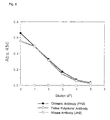
- Figure 8 shows the reactivity of the chimeric antibody of the present invention with an anti-feline antibody.
- Figure 9 shows the binding of the chimeric antibody of the present invention to FHV-1.
- Figure 10 shows the effectiveness of the chimeric antibody of the present invention for cats compulsorily infected with FHV-1 K1 strain.
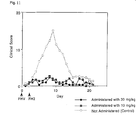
- Figure 11 shows the effectiveness of the chimeric antibody of the present invention for SPF cats compulsorily infected with FHV-1 K1 strain.
- the present inventors have conducted a cell fusion between lymphocytes of mice immunized with FHV-1-K1 viral particles and mouse myeloma cells in accordance with the conventional manner to prepare hybridomas.
- the present inventors have successfully established an antibody-producing cell, JH2, which produces a monoclonal antibody being quite excellent in FHV-1 neutralizing activity.
- V region of an antibody It is generally known that the specificity of an antibody against an antigen is based on amino acids in the variable (V) region of an antibody.
- the present inventors have studied the amino acids which constitute the V region of JH2.
- the amino acid sequence was determined by cloning a gene coding for the V region of said antibody and studying the nucleotide sequence thereof.
- the V region was found to have the amino acid sequence as shown in Figs. 3 and 4.
- each one gene is selected from these V(D)J gene fragments and rearranged to form a gene coding for an amino acid sequence of a whole variable region.
- the addition of a N sequence and somatic mutations give a great number of varieties of an antibody variable region.
- the variable region gene of JH2 of the present invention is a unique one selected among such varieties.
- the CDR shown in the Figures is an important region for binding with an antigen. Also in case of JH2, it appears that the amino acid sequence of these six CDR regions binds with FHV to induce a neutralizing reaction. Especially, "Asp Gly Ala Trp Phe Pro Phe" in the H chain CDR3 was found to be an unique amino acid sequence by a homologous comparison with variable regions of other antibodies.
- the amino acids of the H chain CDR3 as well as other CDR regions of the H and L chains are considered to be closely related to the binding and neutralizing reactions with FHV-1.
- An antibody or a peptide having such amino acid sequence is conjectured to be useful for the treatment, diagnosis and prevention of FHV-1 infection.
- the gene fragment coding for the V region of the antibody having a neutralizing activity against FHV-1 as provided according to the present invention has the following characteristics.
- the nucleotide sequence coding for CDR3 of said antibody is coding for the following amino acid sequence:
- a prefered gene fragment of VH having a nucleotide sequence coding for such sequence includes a gene fragment wherein the nucleotide sequences coding for CDRs 1 to 3 of said antibody are coding for the following amino acid sequences:
- a prefered sequence of the above VH gene fragment includes a nucleotide sequence coding for the amino acid sequence described in Sequence Listing as SEQ ID NO:1, preferably amino acid positions 20 to 143 of SEQ ID NO1.
- a specific nucleotide sequence includes, for example, the nucleotide sequence described in the Sequence Listing as SEQ ID NO:1.
- a gene fragment coding for VL or a part thereof of the antibody which specifically reacts with feline herpes virus-1 includes a gene fragment wherein the nucleotide sequences coding for CDRs 1 to 3 of said antibody are coding for the following amino acid sequences:
- a prefered sequence of the above VL gene fragment includes a nucleotide sequence coding for the amino acid sequence described in the Sequence Listing as SEQ ID NO:2, preferably amino acid positions 21 to 127 of SEQ ID NO:2.
- a specific nucleotide sequence includes, for example, the nucleotide sequence described in the Sequence Listing as SEQ ID NO:2.
- the antibody exhibits immunogenicity as a heterogenous protein within the living body, it is possibly cleared away quickly from the living body, which shortens the half-life or it may provoke side effects such as a serum disease. It is said that the immunogenicity of an antibody molecule is localized in the Fc region.
- the Fc region preferably has an amino acid sequence of an antibody molecule derived from cats as a homologous protein.
- the present inventors have successfully prepared a felinized JH2 antibody by replacing the constant region of the JH2 antibody with that derived from cats using genetic engineering techniques.
- Such a felinized antibody i.e. an anti-FHV-1 chimeric antibody
- a nucleotide sequence of the gene coding for such feline antibody constant region includes, as a gene fragment coding for CH, that of a gene fragment coding for the amino acid sequence described in the Sequence Listing as SEQ ID NO:3.
- a specific nucleotide sequence of said gene includes the nucleotide sequence described in the Sequence Listing as SEQ ID NO:3.
- a nucleotide sequence of a gene coding for C ⁇ includes that of a gene fragment coding for the amino acid sequence described in the Sequence Listing as SEQ ID NO:4.
- a specific nucleotide sequence of said gene includes the nucleotide sequence described in the Sequence Listing as SEQ ID NO:4.
- a nucleotide sequence of a gene coding for C ⁇ , a of said gene includes that of a gene fragment coding for the amino acid sequence described in the Sequence Listing as SEQ ID NO:5.
- a specific nucleotide sequence of said gene includes the nucleotide sequence described in the Sequence Listing as SEQ ID NO:5.
- the gene fragment coding for the V region of the antibody having a neutralizing activity against FHV-1 of the present invention in addition to the production of the chimeric antibody comprising the mouse-derived V region and the cat-derived C region as mentioned above, can also be used for preparing a reshaped antibody in which a frame (FR) region of the V region is also replaced with that derived from an antibody of animals other than mice (in case of the present invention, derived from a feline antibody).
- FR frame
- a reshaped antibody can be prepared basically in accordance with known techniques (for example, Japanese Patent First Publication No. 62-296890).
- the gene fragment of the present invention used therefor contains, as a part of a gene coding for the VH chain and the VL chain, at least a nucleotide sequence coding for the following amino acid sequence:
- nucleic acid sequences coding for CDRs in the V region of said reshaped antibody are coding for the following amino acid sequences of the VH chain and VL chain, respectively:
- an antibody having the excellent specificity of an original mouse monoclonal antibody can sometimes be prepared by replacing a portion of the FR region of the V region adjacent to the CDRs with that derived from mice in addition to replacement of CDRs in the V region with those derived from mice rather than replacement of CDRs alone in the V region with those derived from mice in accordance with conventional techniques. That is, by replacing a portion of the FR region of the V region as well with that derived from mice, where by reference is made to the amino acid sequence described in Fig. 2 for the VH chain and the amino acid sequence described in Fig. 3 for the VL chain, a reshaped antibody can possibly be prepared which is more excellent than the reshaped antibody in which only CDRs are replaced with those derived from mice.
- the structural gene coding for the felinized anti-FHV-1 recombinant antibody is prepared by constructing a V region structural gene for a chimeric antibody or a reshaped antibody by the use of the gene coding for the variable region of the anti-FHV-1 antibody of the present invention and ligating this structural gene with the gene coding for the constant region of feline antibody which the present inventors have previously found.
- the recombinant antibody of the present invention obtained by ligating this structural gene to the downstream of a suitable promotor sequence and expressing the resulting gene in an animal cell in accordance with known techniques retained an excellent neutralizing activity like the mouse-type antibody JH2.
- the recombinant antibody of the present invention alleviated the disease state without any significant side effect.
- E. A. Emini et al. have studied the preventive effect of a monoclonal antibody against HIV infection in chimpanzees. As a result, it was found that a humanized chimeric antibody could prevent HIV infection (E. A. Emini et al., Nature, 355, p728, 1992) but the original mouse-type antibody could not (E. A. Emini et al., J. Virol., 64, p3674, 1990). It appears that this is because the latter could not induce Fc region-dependent ADCC or CDC activities and showed a shortened half-life.
- the anti-FHV-1 chimeric antibody FH2 of the present invention can be used as a substantial medicament for the treatment and prevention of FHV-1 infection.
- a culture supernatant of FL cells (feline lung cells) infected with FHV-1 was precipitated with ammonium sulfate. After dialysis, the precipitate was resuspended in phosphate buffer and administered peritoneally to a BALB/c mouse for immunization together with Freund's complete adjuvant. After two weeks, mouse lymphocytes and mouse myeloma cells (P3U1) were fused by the polyethylene glycol method to prepare hybridomas. Cloning was conducted regarding the virus neutralizing activity of culture supernatants of the hydridomas and thereby four FHV-1 neutralizing monoclonal antibody producing cells were established.
- Table 1 shows the minimum effective concentration of each monoclonal antibody necessary for neutralizing 10 TCID 50 of FHV-1.
- JH2 antibody most strongly neutralized the FHV-1-K1 strain.
- Oligonucleotides as 5' primers and as 3' primers at the J region (MHJ3, MKJ124) at the leader region (MHL34, MKL104) were synthesized.
- the nucleotide sequences of these primers are as follows:
- VH, V ⁇ variable region gene flanked by both primers.
- Fig. 1 shows an agarose electrophoresis pattern of the amplified gene fragments. The size of the VH (H chain) and V ⁇ (L chain) genes was about 400 bp and about 400 bp, respectively, and virtually corresponded to the bands as expected.
- the nucleotide sequence of each gene fragment amplified in (2) was determined by the dideoxy method.
- the VH and V ⁇ gene fragments were cloned into pUC18 and the nucleotide sequences thereof was determined by the dideoxy method using Sequenase ver. 2 (manufactured by USB.).
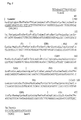
- Fig. 2 shows the nucleotide sequence of the VH gene of the JH2 antibody and the amino acid sequence encoded by said gene.
- This gene had an open reading frame (ORF) and preserved Cys for forming a domain structure, and hence, was found to be suitable for expression. It was also found that rearrangement occurred at JH3. Then, a homology comparison was conducted for the amino acid sequence coded by this gene using GENETYX-CD (Software) as software and the data base of Gene Bank. As a result, antibodies 1 to 4 belonging to the VHIII/J606 family were found to have highly homologous VH sequences (Fig. 4). In Fig.
- the mark (*) shows an amino acid homologous to that of other VHs and the unmarked region represents an amino acid sequence found only in JH2.
- the underlined portion represents a novel amino acid sequence which has hitherto never been reported and is characteristic for the JH2 antibody.
- Fig. 3 shows a nucleotide sequence of the V ⁇ gene of the JH2 antibody and the amino acid sequence encoded by said gene. Like in the case of the H chain, this gene had an ORF and preserved Cys for forming a domain structure, and hence, was found to be suitable for expression. It was also found that a rearrangement occurred at J ⁇ 1.
- Fig. 5 shows the results of a homology comparison. V ⁇ of JH2 also showed homology with other V ⁇ .
- the underlined portion in the VH chain is specific for the JH2 antibody and is an important amino acid sequence responsible for the antigen binding activity.
- variable region genes amplified by PCR were ligated to the gene coding for the ⁇ chain constant region of feline antibody CB25 ⁇ (Japanese Patent First Publication No. 3-201986) or to the gene coding for the ⁇ chain constant region of feline antibody CEK (Japanese Patent First Publication No. 3-123488).
- the chicken ⁇ -actin promoter Japanese Patent Application No. 1-309785 was used as expression promoter and the neo (Southern P.J. J. Mol. Appl. Genet., 1, 327, 1982) or dhfr gene (Stark, G. R. and Wahl, G. M., Annu. Rev. Biochem., 53, p447, 1984) as selection markers.
- Fig. 6 and Fig. 7 show restriction enzyme maps of the chimeric antibody H chain and L chain expression vectors prepared, respectively.
- Each 10 ⁇ g of the gene coding for the chimeric antibody H chain and L( ⁇ ) chain as shown in Fig. 6 and Fig. 7 were digested with PvuI and 2 x 10 6 mouse myeloma cells P3-X63-Ag8-6.5.3 (ATCC CRL1580) were co-transfected with the digested products by using lipofectin (manufactured by BRL).
- the transfected cells were cultured in 5% FCS/RPMI1640 selection medium containing 0.25 x 10 -7 M methotrexate (MTX) to select drug-resistant strains (transformants).
- Chimeric antibody producing cells were cloned by a limiting dilution method regarding the feline IgG expressed in culture supernatant to establish an expression cell, FH2. The properties of this cell were analyzed as follows.
- the chimeric antibody was purified from the culture supernatant with Protein A (manufactured by Bio Rad, MAPS-II). The purified chimeric antibody was subjected to 12.5% SDS-PAGE and compared with a feline IgG sample (polyclonal antibody). The molecular weight of the purified antibody was determined with a prestained marker manufactured by Bio Rad.
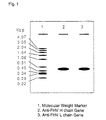
- the chimeric antibody displayed bands at 5 x 10 4 for the H chain and at 2.5 x 10 4 for the L chain under reducing conditions and a band at around 1.5 x 10 5 under non-reducing conditions. This revealed that the H and L chains form a dimer of H2L2 which has the same form as that of IgG present in the cat body.
- the culture supernatant (from FH2 and JH2) was added to a microtiter plate immobilized with FHV-1-K1 (crude product obtained by ammonium sulfate precipitation). After washing the plate, it was reacted with either HRP-anti-feline antibody or HRP-anti-mouse antibody. Color was developed with TMBZ and the reactivity with FHV-1 viral particle was studied. Like the mouse antibody JH2, FE2 antibody specifically reacted with FHV-1-K1. However, the recombinant chimeric antibodies specific for other viruses (antibodies having the same feline constant region and different mouse variable regions) did not react (Fig. 9).
- the culture supernatant (from FH2 and JH2) was reacted with 100 TCID 50 of FHV-1 virus at 4°C for 6 hours. Thereto were added 0.25 x 10 5 CRFK cells and cultured at 37°C for 2 days. CPE (Cell Rounding) was observed and a minimum effective concentration for neutralization was determined.
- the FH2 antibody can be applied as diagnostic, treating and preventing agent effective against FHV-1 infection with no side effects.
- feline monoclonal antibody of the present invention is effective against feline herpes virus-1 infection and is applicable as diagnostic, treating and preventing agent against said disease.
Landscapes
- Health & Medical Sciences (AREA)
- Chemical & Material Sciences (AREA)
- Life Sciences & Earth Sciences (AREA)
- Organic Chemistry (AREA)
- Medicinal Chemistry (AREA)
- Virology (AREA)
- General Health & Medical Sciences (AREA)
- Proteomics, Peptides & Aminoacids (AREA)
- Genetics & Genomics (AREA)
- Biophysics (AREA)
- Molecular Biology (AREA)
- Biochemistry (AREA)
- Immunology (AREA)
- Tropical Medicine & Parasitology (AREA)
- Chemical Kinetics & Catalysis (AREA)
- Veterinary Medicine (AREA)
- Public Health (AREA)
- Animal Behavior & Ethology (AREA)
- Pharmacology & Pharmacy (AREA)
- Nuclear Medicine, Radiotherapy & Molecular Imaging (AREA)
- General Chemical & Material Sciences (AREA)
- Oncology (AREA)
- Communicable Diseases (AREA)
- Peptides Or Proteins (AREA)
- Preparation Of Compounds By Using Micro-Organisms (AREA)
- Medicines Containing Antibodies Or Antigens For Use As Internal Diagnostic Agents (AREA)
- Micro-Organisms Or Cultivation Processes Thereof (AREA)
Claims (21)
- Anticorps recombiné préparé par une technique de génie génétique qui réagit spécifiquement avec l'herpèsvirus félin 1 (FHV-1) où une partie de la séquence d'acides aminés de la région déterminant la complémentarité 3 (CDR3) de VH a la séquence d'acides aminés suivante :

- Anticorps selon la revendication 1 où les CDR dans ladite VH et dans VL ont les séquences d'acides aminés suivantes :
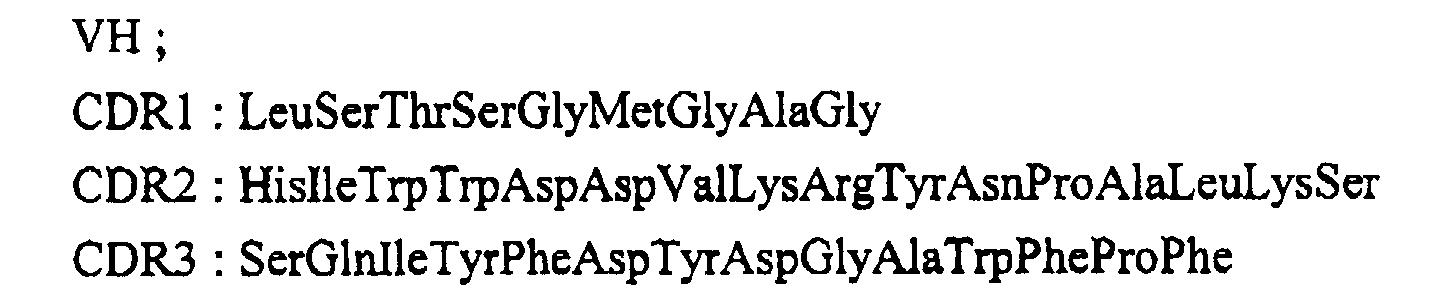
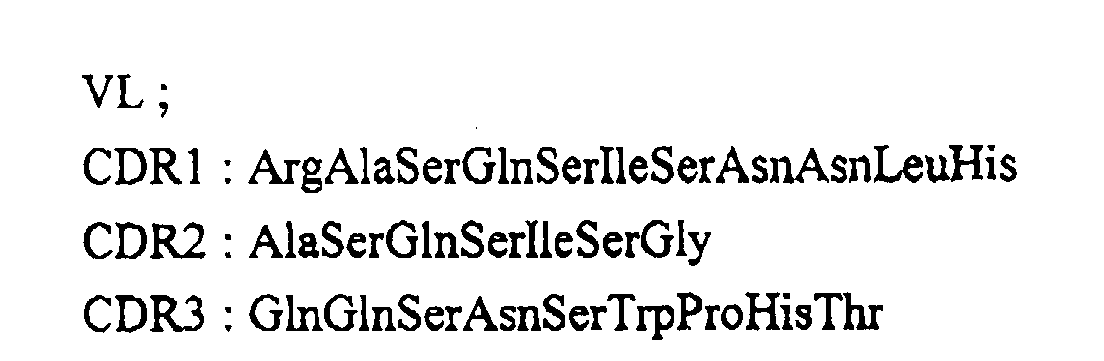
- Anticorps selon la revendication 1 où ladite VH et la VL ont les séquences d'acides aminés des 20ème à 143ème positions d'acides aminés dans SEQ ID NO :1 de la liste de séquences et des 21ème à 127ème positions d'acides aminés dans SEQ ID NO :2, respectivement.
- Anticorps selon la revendication 1 où la séquence d'acides aminés de la région constante dudit anticorps est celle issue d'un anticorps félin.
- Anticorps selon la revendication 4 où la séquence d'acides aminés de la région constante de chaíne H dudit anticorps est celle décrite dans SEQ ID NO :3 de la liste de séquences et la séquence d'acides aminés de la région constante de chaíne L dudit anticorps est celle décrite dans SEQ ID NO :4 ou dans SEQ ID NO :5 de la liste de séquences.
- Fragment de gène codant VH ou une partie de celle-ci d'un anticorps qui réagit spécifiquement avec FVH-1 où une partie de la séquence nucléotidique codant CDR3 est une séquence nucléotidique codant la séquence d'acides aminés suivante :

- Fragment de gène selon la revendication 6 où les séquences nucléotidiques codant les CDR 1 à 3 sont des séquences nucléotidiques codant les séquences d'acides aminés suivantes, respectivement :

- Fragment de gène selon la revendication 6 où la séquence nucléotidique codant VH de l'anticorps est une séquence nucléotidique codant la séquence d'acides aminés décrite dans SEQ ID NO :1 de la liste de séquences.
- Fragment de gène selon la revendication 6 où la séquence nucléotidique codant VH de l'anticorps est la séquence nucléotidique décrite dans SEQ ID NO :1 de la liste de séquences.
- Fragment de gène codant VL de l'anticorps où les séquences nucléotidiques codant les CDR 1 à 3 sont des séquences nucléotidiques codant les séquences d'acides aminés suivantes, respectivement :

- Fragment de gène selon la revendication 10 où la séquence nucléotidique codant VL de l'anticorps est une séquence nucléotidique codant la séquence d'acides aminés décrite dans SEQ ID NO :2 de la liste de séquences.
- Fragment de gène selon la revendication 10 où la séquence nucléotidique codant VL de l'anticorps est la séquence nucléotidique décrite dans SEQ ID NO :2 de la liste de séquences.
- Fragment de gène recombiné codant la chaíne H d'un anticorps chimère félin qui réagit spécifiquement avec l'herpèsvirus félin 1 (FHV-1), ledit fragment de gène comprenant le fragment de gène selon la revendication 6 en aval (site 3') duquel est lié un fragment de gène codant la région constante de chaíne H d'un anticorps félin.
- Fragment de gène recombiné selon la revendication 13 où ledit fragment de gène codant la région constante de chaíne H d'un anticorps félin a une séquence nucléotidique codant la séquence d'acides aminés décrite dans SEQ ID NO :3 de la liste de séquences.
- Fragment de gène recombiné codant la chaíne L d'un anticorps chimère félin qui réagit spécifiquement avec l'herpèsvirus félin 1 (FHV-1), ledit fragment de gène comprenant le fragment de gène selon la revendication 10 en aval (site 3') duquel est lié un fragment de gène codant la région constante de chaíne κ d'un anticorps félin.
- Fragment de gène recombiné selon la revendication 15 où ledit fragment de gène codant la région constante de chaíne κ d'un anticorps félin a une séquence nucléotidique codant la séquence d'acides aminés décrite dans SEQ ID NO :4 de la liste de séquences.
- Fragment de gène recombiné codant la chaíne L d'un anticorps chimère félin qui réagit spécifiquement avec l'herpèsvirus félin 1 (FHV-1), ledit fragment de gène comprenant le fragment de gène selon la revendication 10 en aval (site 3') duquel est lié un fragment de gène codant la région constante de chaíne λ d'un anticorps félin.
- Fragment de gène recombiné selon la revendication 17 où ledit fragment de gène codant la région constante de chaíne λ d'un anticorps félin a une séquence nucléotidique codant la séquence d'acides aminés décrite dans SEQ ID NO :5 de la liste de séquences.
- Anticorps selon l'une quelconque des revendications 1 à 5 destiné à être utilisé comme substance thérapeutique active.
- Utilisation d'un anticorps selon l'une quelconque des revendications 1 à 5 pour la préparation d'une composition pour le diagnostic ou le traitement des infections à herpèsvirus félin 1 (FHV-1).
- Utilisation d'un fragment de gène selon l'une quelconque des revendications 6 à 18 pour la préparation d'anticorps monoclonaux qui réagissent spécifiquement avec l'herpèsvirus félin 1 (FHV-1).
Applications Claiming Priority (4)
| Application Number | Priority Date | Filing Date | Title |
|---|---|---|---|
| JP34125592A JP3919830B2 (ja) | 1992-11-28 | 1992-11-28 | 抗ネコヘルペスウイルス−1組換え抗体および該抗体をコードする遺伝子断片 |
| JP341255/92 | 1992-11-28 | ||
| JP34125592 | 1992-11-28 | ||
| PCT/JP1993/001724 WO1994012661A1 (fr) | 1992-11-28 | 1993-11-25 | Anticorps de recombinaison dirige contre l'herpes-virus felin de type 1, et fragment genique codant pour un tel anticorps |
Publications (3)
| Publication Number | Publication Date |
|---|---|
| EP0671472A1 EP0671472A1 (fr) | 1995-09-13 |
| EP0671472A4 EP0671472A4 (fr) | 1997-11-19 |
| EP0671472B1 true EP0671472B1 (fr) | 2001-03-14 |
Family
ID=18344623
Family Applications (1)
| Application Number | Title | Priority Date | Filing Date |
|---|---|---|---|
| EP94901002A Expired - Lifetime EP0671472B1 (fr) | 1992-11-28 | 1993-11-25 | Anticorps de recombinaison dirige contre l'herpes-virus felin de type 1, et fragment genique codant pour un tel anticorps |
Country Status (9)
| Country | Link |
|---|---|
| US (1) | US5760185A (fr) |
| EP (1) | EP0671472B1 (fr) |
| JP (1) | JP3919830B2 (fr) |
| AT (1) | ATE199745T1 (fr) |
| AU (1) | AU674043B2 (fr) |
| CA (1) | CA2150346C (fr) |
| DE (1) | DE69330031T2 (fr) |
| ES (1) | ES2160115T3 (fr) |
| WO (1) | WO1994012661A1 (fr) |
Families Citing this family (33)
| Publication number | Priority date | Publication date | Assignee | Title |
|---|---|---|---|---|
| US7148038B2 (en) * | 2001-10-16 | 2006-12-12 | Raven Biotechnologies, Inc. | Antibodies that bind to cancer-associated antigen CD46 and methods of use thereof |
| BR122015016384B8 (pt) | 2001-11-08 | 2021-07-27 | Beijing Wantai Biological Pharmacy Entpr Co Ltd | polipeptídio recombinante ou isolado, molécula de ácido nucléico, kit de diagnóstico para detectar a infecção pelo vírus da hepatite e, composição de vacina, composição farmacêutica, vetor de expressão recombinante, célula hospedeira transformada e uso do polipeptídeo recombinante ou isolado |
| US7405061B2 (en) * | 2002-11-13 | 2008-07-29 | Raven Biotechnologies, Inc. | Antigen PIPA and antibodies that bind thereto |
| EP1907001B1 (fr) | 2005-06-17 | 2015-07-15 | Merck Sharp & Dohme Corp. | Molecules de liaison ilt3 et leurs utilisations |
| CA2655903A1 (fr) * | 2006-06-19 | 2008-08-07 | Tolerx, Inc. | Molecules se liant a l'ilt3 et leurs utilisations |
| MX2009003306A (es) | 2006-10-02 | 2009-04-23 | Medarex Inc | Anticuerpos humanos que se unen a cxcr4 y sus usos. |
| US8481683B2 (en) | 2006-12-01 | 2013-07-09 | Medarex, Inc. | Human antibodies that bind CD22 and uses thereof |
| CL2007003622A1 (es) | 2006-12-13 | 2009-08-07 | Medarex Inc | Anticuerpo monoclonal humano anti-cd19; composicion que lo comprende; y metodo de inhibicion del crecimiento de celulas tumorales. |
| MX2009006277A (es) | 2006-12-14 | 2009-07-24 | Medarex Inc | Anticuerpos humanos que se enlazan a cd70 y usos de los mismos. |
| EP2258843B1 (fr) | 2008-02-27 | 2016-11-16 | National University Corporation Hokkaido University | Vecteur d'expression pour la production en masse d'une protéine dérivée d'un gène étranger utilisant une cellule animale et son utilisation |
| AR072999A1 (es) | 2008-08-11 | 2010-10-06 | Medarex Inc | Anticuerpos humanos que se unen al gen 3 de activacion linfocitaria (lag-3) y los usos de estos |
| CN102325881B (zh) | 2008-12-22 | 2014-08-20 | 国立大学法人北海道大学 | 用于用动物细胞大量生产源自外源基因的蛋白质的表达载体及其应用 |
| WO2011109108A1 (fr) * | 2010-03-04 | 2011-09-09 | Vet Therapeutics Inc. | Anticorps monoclonaux dirigés contre cd20 |
| EP2542258A4 (fr) * | 2010-03-04 | 2013-08-21 | Vet Therapeutics Inc | Anticorps monoclonaux dirigés contre le cd52 |
| US9616120B2 (en) | 2010-03-04 | 2017-04-11 | Vet Therapeutics, Inc. | Monoclonal antibodies directed to CD20 |
| WO2013119419A1 (fr) | 2012-02-08 | 2013-08-15 | North Carolina State University | Traitement de maladies allergiques avec des anticorps recombinants |
| UY34887A (es) | 2012-07-02 | 2013-12-31 | Bristol Myers Squibb Company Una Corporacion Del Estado De Delaware | Optimización de anticuerpos que se fijan al gen de activación de linfocitos 3 (lag-3) y sus usos |
| US9499621B2 (en) * | 2013-04-08 | 2016-11-22 | Cytodyn, Inc. | Felinized antibodies and methods of treating retroviral infections in felines |
| WO2018089335A1 (fr) | 2016-11-09 | 2018-05-17 | North Carolina State University | Traitement de maladies allergiques au moyen d'une protéine chimérique |
| US10093731B2 (en) | 2017-02-24 | 2018-10-09 | Kindred Biosciences, Inc. | Anti-IL31 antibodies for veterinary use |
| US12060437B2 (en) | 2018-03-23 | 2024-08-13 | North Carolina State University | Methods and compositions for antibody to high affinity receptor for IgE |
| US11781146B2 (en) | 2018-05-24 | 2023-10-10 | National University Corporation Hokkaido University | Vector including a translation-impaired dihydrofolate reductase gene cassette and ubiquitously acting chromatin opening element |
| WO2020020281A1 (fr) | 2018-07-25 | 2020-01-30 | 信达生物制药(苏州)有限公司 | Anticorps anti-tigit et ses utilisations |
| CN109762067B (zh) | 2019-01-17 | 2020-02-28 | 北京天广实生物技术股份有限公司 | 结合人Claudin 18.2的抗体及其用途 |
| US10570210B1 (en) | 2019-03-04 | 2020-02-25 | Beijing Mabworks Biotech Co.Ltd | Antibodies binding CD40 and uses thereof |
| BR112022017174A2 (pt) | 2020-02-27 | 2022-10-18 | Chia Tai Tianqing Pharmaceutical Group Co Ltd | Anticorpo monoclonal isolado, ou uma porção de ligação ao antígeno do mesmo, nucleotídeo, vetor de expressão, célula hospedeira, composição farmacêutica e métodos de tratamento de uma doença alérgica e de um tumor |
| CN121851171A (zh) | 2020-05-12 | 2026-04-14 | 正大天晴药业集团股份有限公司 | St2抗原结合蛋白 |
| TW202330617A (zh) | 2021-11-25 | 2023-08-01 | 大陸商正大天晴藥業集團股份有限公司 | 抗Siglec-15抗體及其應用 |
| WO2023173393A1 (fr) | 2022-03-18 | 2023-09-21 | 北京天广实生物技术股份有限公司 | Anticorps se liant à b7-h3 et son utilisation |
| CN115850453B (zh) * | 2022-12-16 | 2024-09-10 | 北京纳百生物科技有限公司 | 针对猫疱疹病毒1型gD蛋白的特异性抗体及用途 |
| CN116284350B (zh) * | 2023-05-06 | 2023-08-04 | 泰州博莱得利生物科技有限公司 | 一种猫疱疹病毒单克隆抗体及其制备方法和应用 |
| CN117607431B (zh) * | 2023-06-30 | 2024-10-25 | 深圳赫兹生命科学技术有限公司 | 猫疱疹病毒的elisa检测试剂 |
| CN118599004B (zh) * | 2024-06-11 | 2024-11-26 | 中国农业科学院上海兽医研究所(中国动物卫生与流行病学中心上海分中心) | 一种抗猫IgG单克隆抗体或其抗原结合片段及其应用 |
Family Cites Families (7)
| Publication number | Priority date | Publication date | Assignee | Title |
|---|---|---|---|---|
| GB8607679D0 (en) | 1986-03-27 | 1986-04-30 | Winter G P | Recombinant dna product |
| JPH01309785A (ja) | 1988-06-06 | 1989-12-14 | Babcock Hitachi Kk | ミドルパルスtig溶接装置 |
| JP2811086B2 (ja) * | 1989-08-10 | 1998-10-15 | 財団法人化学及血清療法研究所 | ネコ×マウスヘテロハイブリドーマおよびネコ免疫グロブリンλ鎖の定常領域をコードする遺伝子断片 |
| JP2811095B2 (ja) * | 1989-09-30 | 1998-10-15 | 財団法人化学及血清療法研究所 | ネコ免疫グロブリンκ鎖の定常領域をコードする遺伝子断片およびマウス×ネコキメラ抗体 |
| JP2811102B2 (ja) * | 1989-12-28 | 1998-10-15 | 財団法人化学及血清療法研究所 | ネコ免疫グロブリンγ鎖の定常領域をコードする遺伝子断片およびマウス×ネコキメラ抗体 |
| AU632843B2 (en) * | 1989-08-10 | 1993-01-14 | Juridical Foundation The Chemo-Sero-Therapeutic Research Institute | Cat-mouse heterohybridoma and gene fragment coding for constant region of feline immunoglobulin |
| JPH03123486A (ja) * | 1989-10-06 | 1991-05-27 | Hitachi Ltd | 膜蛋白質の遺伝子工学的生産方法 |
-
1992
- 1992-11-28 JP JP34125592A patent/JP3919830B2/ja not_active Expired - Fee Related
-
1993
- 1993-11-25 AT AT94901002T patent/ATE199745T1/de not_active IP Right Cessation
- 1993-11-25 ES ES94901002T patent/ES2160115T3/es not_active Expired - Lifetime
- 1993-11-25 US US08/436,463 patent/US5760185A/en not_active Expired - Fee Related
- 1993-11-25 WO PCT/JP1993/001724 patent/WO1994012661A1/fr not_active Ceased
- 1993-11-25 CA CA002150346A patent/CA2150346C/fr not_active Expired - Fee Related
- 1993-11-25 EP EP94901002A patent/EP0671472B1/fr not_active Expired - Lifetime
- 1993-11-25 DE DE69330031T patent/DE69330031T2/de not_active Expired - Fee Related
- 1993-11-25 AU AU55961/94A patent/AU674043B2/en not_active Ceased
Also Published As
| Publication number | Publication date |
|---|---|
| CA2150346A1 (fr) | 1994-06-09 |
| CA2150346C (fr) | 2005-08-09 |
| ATE199745T1 (de) | 2001-03-15 |
| US5760185A (en) | 1998-06-02 |
| JP3919830B2 (ja) | 2007-05-30 |
| DE69330031D1 (de) | 2001-04-19 |
| EP0671472A1 (fr) | 1995-09-13 |
| JPH06217786A (ja) | 1994-08-09 |
| EP0671472A4 (fr) | 1997-11-19 |
| WO1994012661A1 (fr) | 1994-06-09 |
| ES2160115T3 (es) | 2001-11-01 |
| DE69330031T2 (de) | 2001-07-19 |
| AU674043B2 (en) | 1996-12-05 |
| AU5596194A (en) | 1994-06-22 |
Similar Documents
| Publication | Publication Date | Title |
|---|---|---|
| EP0671472B1 (fr) | Anticorps de recombinaison dirige contre l'herpes-virus felin de type 1, et fragment genique codant pour un tel anticorps | |
| US6982321B2 (en) | Altered antibodies | |
| US7151159B2 (en) | Amino acid sequences for therapeutic and prophylactic use against diseases due to clostridium difficile toxins | |
| CA1340879C (fr) | Adn recombine et methodes d'obtention | |
| ES2052027T5 (es) | Clonacion de secuencias de dominio variable de inmunoglobulina. | |
| JP3854306B2 (ja) | ヒト化及びキメラモノクローナル抗体 | |
| CA2491864C (fr) | Anticorps super humanises | |
| CA2023894C (fr) | Heterohybridome chien-souris et fragment de gene codant pour une region constante d'immunoglobulines canines | |
| US20020034765A1 (en) | Method for reducing the immunogenicity of antibody variable domains | |
| EP0519596A1 (fr) | Procédé pour réduire l'immunogénécité des domaines variables d'anticorps | |
| Matsuda et al. | Variable region cDNA sequences and antigen binding specificity of mouse monoclonal antibodies to isomaltosyl oligosaccharides coupled to proteins. T-dependent analogues of alpha (1----6) dextran. | |
| JPH07508401A (ja) | 動物およびヒトにおける呼吸器合胞体ウイルス感染治療ならびに予防用新規抗体 | |
| EP0678523B1 (fr) | Anticorps anti-vih recombine et sa preparation | |
| CA2048178A1 (fr) | Anticorps obtenus par recombinaison genetique | |
| EP0417486A1 (fr) | Hétérohybridome chat-souris et fragment génomique codant pour la région constante des immunoglobulines félines | |
| EP0561194B1 (fr) | Anticorps recombinant dirigé contre le calicivirus félin et fragments de gènes de cet anticorps | |
| EP0516135B1 (fr) | Préparation immunitaire liée au virus immunodéficient humain | |
| JPH07203974A (ja) | 癌特異的ムチンを認識する抗体の遺伝子断片等 | |
| JP3514482B2 (ja) | 抗ネコカリシウイルス組換え抗体および該抗体からなる治療剤 | |
| Sikder et al. | Amino acid substitutions in VH CDR2 change the idiotype but not the antigen-binding of monoclonal antibodies to alpha (1----6) dextrans. | |
| JPH06125783A (ja) | 組換え抗hiv抗体およびその調製方法 | |
| JPH06503956A (ja) | 腫瘍細胞に対する標的決定IgEエフェクター細胞 | |
| US7914790B2 (en) | Human IgM antibody lysing activated lymphocytes under mediation by homologous complement | |
| Al-Ghamedi | Developing of antibody therapy for Streptococcus oralis infection | |
| JPH03201986A (ja) | ネコ免疫グロブリンγ鎖の定常領域をコードする遺伝子断片およびマウス×ネコキメラ抗体 |
Legal Events
| Date | Code | Title | Description |
|---|---|---|---|
| PUAI | Public reference made under article 153(3) epc to a published international application that has entered the european phase |
Free format text: ORIGINAL CODE: 0009012 |
|
| 17P | Request for examination filed |
Effective date: 19950526 |
|
| AK | Designated contracting states |
Kind code of ref document: A1 Designated state(s): AT BE CH DE DK ES FR GB GR IE IT LI LU MC NL PT SE |
|
| A4 | Supplementary search report drawn up and despatched | ||
| AK | Designated contracting states |
Kind code of ref document: A4 Designated state(s): AT BE CH DE DK ES FR GB GR IE IT LI LU MC NL PT SE |
|
| 17Q | First examination report despatched |
Effective date: 19990617 |
|
| GRAG | Despatch of communication of intention to grant |
Free format text: ORIGINAL CODE: EPIDOS AGRA |
|
| 17Q | First examination report despatched |
Effective date: 19990617 |
|
| GRAG | Despatch of communication of intention to grant |
Free format text: ORIGINAL CODE: EPIDOS AGRA |
|
| GRAG | Despatch of communication of intention to grant |
Free format text: ORIGINAL CODE: EPIDOS AGRA |
|
| GRAH | Despatch of communication of intention to grant a patent |
Free format text: ORIGINAL CODE: EPIDOS IGRA |
|
| GRAH | Despatch of communication of intention to grant a patent |
Free format text: ORIGINAL CODE: EPIDOS IGRA |
|
| RAP1 | Party data changed (applicant data changed or rights of an application transferred) |
Owner name: JURIDICAL FOUNDATION THE CHEMO-SERO-THERAPEUTIC RE |
|
| GRAA | (expected) grant |
Free format text: ORIGINAL CODE: 0009210 |
|
| AK | Designated contracting states |
Kind code of ref document: B1 Designated state(s): AT BE CH DE DK ES FR GB GR IE IT LI LU MC NL PT SE |
|
| PG25 | Lapsed in a contracting state [announced via postgrant information from national office to epo] |
Ref country code: LI Free format text: LAPSE BECAUSE OF FAILURE TO SUBMIT A TRANSLATION OF THE DESCRIPTION OR TO PAY THE FEE WITHIN THE PRESCRIBED TIME-LIMIT Effective date: 20010314 Ref country code: GR Free format text: LAPSE BECAUSE OF NON-PAYMENT OF DUE FEES Effective date: 20010314 Ref country code: CH Free format text: LAPSE BECAUSE OF FAILURE TO SUBMIT A TRANSLATION OF THE DESCRIPTION OR TO PAY THE FEE WITHIN THE PRESCRIBED TIME-LIMIT Effective date: 20010314 Ref country code: BE Free format text: LAPSE BECAUSE OF FAILURE TO SUBMIT A TRANSLATION OF THE DESCRIPTION OR TO PAY THE FEE WITHIN THE PRESCRIBED TIME-LIMIT Effective date: 20010314 Ref country code: AT Free format text: LAPSE BECAUSE OF FAILURE TO SUBMIT A TRANSLATION OF THE DESCRIPTION OR TO PAY THE FEE WITHIN THE PRESCRIBED TIME-LIMIT Effective date: 20010314 |
|
| REF | Corresponds to: |
Ref document number: 199745 Country of ref document: AT Date of ref document: 20010315 Kind code of ref document: T |
|
| REG | Reference to a national code |
Ref country code: CH Ref legal event code: EP |
|
| REG | Reference to a national code |
Ref country code: IE Ref legal event code: FG4D |
|
| REF | Corresponds to: |
Ref document number: 69330031 Country of ref document: DE Date of ref document: 20010419 |
|
| ITF | It: translation for a ep patent filed | ||
| PG25 | Lapsed in a contracting state [announced via postgrant information from national office to epo] |
Ref country code: SE Free format text: LAPSE BECAUSE OF FAILURE TO SUBMIT A TRANSLATION OF THE DESCRIPTION OR TO PAY THE FEE WITHIN THE PRESCRIBED TIME-LIMIT Effective date: 20010614 Ref country code: DK Free format text: LAPSE BECAUSE OF FAILURE TO SUBMIT A TRANSLATION OF THE DESCRIPTION OR TO PAY THE FEE WITHIN THE PRESCRIBED TIME-LIMIT Effective date: 20010614 |
|
| PG25 | Lapsed in a contracting state [announced via postgrant information from national office to epo] |
Ref country code: PT Free format text: LAPSE BECAUSE OF FAILURE TO SUBMIT A TRANSLATION OF THE DESCRIPTION OR TO PAY THE FEE WITHIN THE PRESCRIBED TIME-LIMIT Effective date: 20010615 |
|
| ET | Fr: translation filed | ||
| REG | Reference to a national code |
Ref country code: CH Ref legal event code: PL |
|
| REG | Reference to a national code |
Ref country code: ES Ref legal event code: FG2A Ref document number: 2160115 Country of ref document: ES Kind code of ref document: T3 |
|
| REG | Reference to a national code |
Ref country code: IE Ref legal event code: FD4D |
|
| PG25 | Lapsed in a contracting state [announced via postgrant information from national office to epo] |
Ref country code: MC Free format text: LAPSE BECAUSE OF NON-PAYMENT OF DUE FEES Effective date: 20011125 Ref country code: LU Free format text: LAPSE BECAUSE OF NON-PAYMENT OF DUE FEES Effective date: 20011125 |
|
| PG25 | Lapsed in a contracting state [announced via postgrant information from national office to epo] |
Ref country code: IE Free format text: LAPSE BECAUSE OF FAILURE TO SUBMIT A TRANSLATION OF THE DESCRIPTION OR TO PAY THE FEE WITHIN THE PRESCRIBED TIME-LIMIT Effective date: 20011126 |
|
| REG | Reference to a national code |
Ref country code: GB Ref legal event code: IF02 |
|
| PLBE | No opposition filed within time limit |
Free format text: ORIGINAL CODE: 0009261 |
|
| STAA | Information on the status of an ep patent application or granted ep patent |
Free format text: STATUS: NO OPPOSITION FILED WITHIN TIME LIMIT |
|
| 26N | No opposition filed | ||
| REG | Reference to a national code |
Ref country code: IE Ref legal event code: MM4A |
|
| PGFP | Annual fee paid to national office [announced via postgrant information from national office to epo] |
Ref country code: NL Payment date: 20071130 Year of fee payment: 15 Ref country code: ES Payment date: 20071130 Year of fee payment: 15 Ref country code: DE Payment date: 20071128 Year of fee payment: 15 |
|
| PGFP | Annual fee paid to national office [announced via postgrant information from national office to epo] |
Ref country code: IT Payment date: 20071113 Year of fee payment: 15 |
|
| PGFP | Annual fee paid to national office [announced via postgrant information from national office to epo] |
Ref country code: GB Payment date: 20071120 Year of fee payment: 15 Ref country code: FR Payment date: 20071126 Year of fee payment: 15 |
|
| GBPC | Gb: european patent ceased through non-payment of renewal fee |
Effective date: 20081125 |
|
| PG25 | Lapsed in a contracting state [announced via postgrant information from national office to epo] |
Ref country code: NL Free format text: LAPSE BECAUSE OF NON-PAYMENT OF DUE FEES Effective date: 20090601 |
|
| NLV4 | Nl: lapsed or anulled due to non-payment of the annual fee |
Effective date: 20090601 |
|
| PG25 | Lapsed in a contracting state [announced via postgrant information from national office to epo] |
Ref country code: IT Free format text: LAPSE BECAUSE OF NON-PAYMENT OF DUE FEES Effective date: 20081125 |
|
| REG | Reference to a national code |
Ref country code: FR Ref legal event code: ST Effective date: 20090731 |
|
| PG25 | Lapsed in a contracting state [announced via postgrant information from national office to epo] |
Ref country code: DE Free format text: LAPSE BECAUSE OF NON-PAYMENT OF DUE FEES Effective date: 20090603 |
|
| PG25 | Lapsed in a contracting state [announced via postgrant information from national office to epo] |
Ref country code: GB Free format text: LAPSE BECAUSE OF NON-PAYMENT OF DUE FEES Effective date: 20081125 |
|
| REG | Reference to a national code |
Ref country code: ES Ref legal event code: FD2A Effective date: 20081126 |
|
| PG25 | Lapsed in a contracting state [announced via postgrant information from national office to epo] |
Ref country code: ES Free format text: LAPSE BECAUSE OF NON-PAYMENT OF DUE FEES Effective date: 20081126 |
|
| PG25 | Lapsed in a contracting state [announced via postgrant information from national office to epo] |
Ref country code: FR Free format text: LAPSE BECAUSE OF NON-PAYMENT OF DUE FEES Effective date: 20081130 |