EP0673923B1 - Dérivés substitués de phénoxyméthyle-phényle, procédé pour leur préparation et leur usage comme parasiticides et fongicides - Google Patents
Dérivés substitués de phénoxyméthyle-phényle, procédé pour leur préparation et leur usage comme parasiticides et fongicides Download PDFInfo
- Publication number
- EP0673923B1 EP0673923B1 EP95103942A EP95103942A EP0673923B1 EP 0673923 B1 EP0673923 B1 EP 0673923B1 EP 95103942 A EP95103942 A EP 95103942A EP 95103942 A EP95103942 A EP 95103942A EP 0673923 B1 EP0673923 B1 EP 0673923B1
- Authority
- EP
- European Patent Office
- Prior art keywords
- alkyl
- alkoxy
- cyano
- methyl
- haloalkyl
- Prior art date
- Legal status (The legal status is an assumption and is not a legal conclusion. Google has not performed a legal analysis and makes no representation as to the accuracy of the status listed.)
- Expired - Lifetime
Links
- 0 COC(*C[C@@](*)/C=C1)=C[*@@](*)C=C1C(*)=NO Chemical compound COC(*C[C@@](*)/C=C1)=C[*@@](*)C=C1C(*)=NO 0.000 description 2
Classifications
-
- C—CHEMISTRY; METALLURGY
- C07—ORGANIC CHEMISTRY
- C07C—ACYCLIC OR CARBOCYCLIC COMPOUNDS
- C07C251/00—Compounds containing nitrogen atoms doubly-bound to a carbon skeleton
- C07C251/32—Oximes
- C07C251/34—Oximes with oxygen atoms of oxyimino groups bound to hydrogen atoms or to carbon atoms of unsubstituted hydrocarbon radicals
- C07C251/48—Oximes with oxygen atoms of oxyimino groups bound to hydrogen atoms or to carbon atoms of unsubstituted hydrocarbon radicals with the carbon atom of at least one of the oxyimino groups bound to a carbon atom of a six-membered aromatic ring
-
- C—CHEMISTRY; METALLURGY
- C07—ORGANIC CHEMISTRY
- C07D—HETEROCYCLIC COMPOUNDS
- C07D231/00—Heterocyclic compounds containing 1,2-diazole or hydrogenated 1,2-diazole rings
- C07D231/02—Heterocyclic compounds containing 1,2-diazole or hydrogenated 1,2-diazole rings not condensed with other rings
- C07D231/10—Heterocyclic compounds containing 1,2-diazole or hydrogenated 1,2-diazole rings not condensed with other rings having two or three double bonds between ring members or between ring members and non-ring members
- C07D231/12—Heterocyclic compounds containing 1,2-diazole or hydrogenated 1,2-diazole rings not condensed with other rings having two or three double bonds between ring members or between ring members and non-ring members with only hydrogen atoms, hydrocarbon or substituted hydrocarbon radicals, directly attached to ring carbon atoms
-
- A—HUMAN NECESSITIES
- A01—AGRICULTURE; FORESTRY; ANIMAL HUSBANDRY; HUNTING; TRAPPING; FISHING
- A01N—PRESERVATION OF BODIES OF HUMANS OR ANIMALS OR PLANTS OR PARTS THEREOF; BIOCIDES, e.g. AS DISINFECTANTS, AS PESTICIDES OR AS HERBICIDES; PEST REPELLANTS OR ATTRACTANTS; PLANT GROWTH REGULATORS
- A01N37/00—Biocides, pest repellants or attractants, or plant growth regulators containing organic compounds containing a carbon atom having three bonds to hetero atoms with at the most two bonds to halogen, e.g. carboxylic acids
- A01N37/44—Biocides, pest repellants or attractants, or plant growth regulators containing organic compounds containing a carbon atom having three bonds to hetero atoms with at the most two bonds to halogen, e.g. carboxylic acids containing at least one carboxylic group or a thio analogue, or a derivative thereof, and a nitrogen atom attached to the same carbon skeleton by a single or double bond, this nitrogen atom not being a member of a derivative or of a thio analogue of a carboxylic group, e.g. amino-carboxylic acids
- A01N37/50—Biocides, pest repellants or attractants, or plant growth regulators containing organic compounds containing a carbon atom having three bonds to hetero atoms with at the most two bonds to halogen, e.g. carboxylic acids containing at least one carboxylic group or a thio analogue, or a derivative thereof, and a nitrogen atom attached to the same carbon skeleton by a single or double bond, this nitrogen atom not being a member of a derivative or of a thio analogue of a carboxylic group, e.g. amino-carboxylic acids the nitrogen atom being doubly bound to the carbon skeleton
-
- A—HUMAN NECESSITIES
- A01—AGRICULTURE; FORESTRY; ANIMAL HUSBANDRY; HUNTING; TRAPPING; FISHING
- A01N—PRESERVATION OF BODIES OF HUMANS OR ANIMALS OR PLANTS OR PARTS THEREOF; BIOCIDES, e.g. AS DISINFECTANTS, AS PESTICIDES OR AS HERBICIDES; PEST REPELLANTS OR ATTRACTANTS; PLANT GROWTH REGULATORS
- A01N37/00—Biocides, pest repellants or attractants, or plant growth regulators containing organic compounds containing a carbon atom having three bonds to hetero atoms with at the most two bonds to halogen, e.g. carboxylic acids
- A01N37/52—Biocides, pest repellants or attractants, or plant growth regulators containing organic compounds containing a carbon atom having three bonds to hetero atoms with at the most two bonds to halogen, e.g. carboxylic acids containing groups, e.g. carboxylic acid amidines
-
- C—CHEMISTRY; METALLURGY
- C07—ORGANIC CHEMISTRY
- C07C—ACYCLIC OR CARBOCYCLIC COMPOUNDS
- C07C255/00—Carboxylic acid nitriles
- C07C255/63—Carboxylic acid nitriles containing cyano groups and nitrogen atoms further bound to other hetero atoms, other than oxygen atoms of nitro or nitroso groups, bound to the same carbon skeleton
- C07C255/64—Carboxylic acid nitriles containing cyano groups and nitrogen atoms further bound to other hetero atoms, other than oxygen atoms of nitro or nitroso groups, bound to the same carbon skeleton with the nitrogen atoms further bound to oxygen atoms
-
- C—CHEMISTRY; METALLURGY
- C07—ORGANIC CHEMISTRY
- C07C—ACYCLIC OR CARBOCYCLIC COMPOUNDS
- C07C259/00—Compounds containing carboxyl groups, an oxygen atom of a carboxyl group being replaced by a nitrogen atom, this nitrogen atom being further bound to an oxygen atom and not being part of nitro or nitroso groups
- C07C259/02—Compounds containing carboxyl groups, an oxygen atom of a carboxyl group being replaced by a nitrogen atom, this nitrogen atom being further bound to an oxygen atom and not being part of nitro or nitroso groups with replacement of the other oxygen atom of the carboxyl group by halogen atoms
-
- C—CHEMISTRY; METALLURGY
- C07—ORGANIC CHEMISTRY
- C07C—ACYCLIC OR CARBOCYCLIC COMPOUNDS
- C07C259/00—Compounds containing carboxyl groups, an oxygen atom of a carboxyl group being replaced by a nitrogen atom, this nitrogen atom being further bound to an oxygen atom and not being part of nitro or nitroso groups
- C07C259/04—Compounds containing carboxyl groups, an oxygen atom of a carboxyl group being replaced by a nitrogen atom, this nitrogen atom being further bound to an oxygen atom and not being part of nitro or nitroso groups without replacement of the other oxygen atom of the carboxyl group, e.g. hydroxamic acids
- C07C259/10—Compounds containing carboxyl groups, an oxygen atom of a carboxyl group being replaced by a nitrogen atom, this nitrogen atom being further bound to an oxygen atom and not being part of nitro or nitroso groups without replacement of the other oxygen atom of the carboxyl group, e.g. hydroxamic acids having carbon atoms of hydroxamic groups bound to carbon atoms of six-membered aromatic rings
-
- C—CHEMISTRY; METALLURGY
- C07—ORGANIC CHEMISTRY
- C07C—ACYCLIC OR CARBOCYCLIC COMPOUNDS
- C07C259/00—Compounds containing carboxyl groups, an oxygen atom of a carboxyl group being replaced by a nitrogen atom, this nitrogen atom being further bound to an oxygen atom and not being part of nitro or nitroso groups
- C07C259/12—Compounds containing carboxyl groups, an oxygen atom of a carboxyl group being replaced by a nitrogen atom, this nitrogen atom being further bound to an oxygen atom and not being part of nitro or nitroso groups with replacement of the other oxygen atom of the carboxyl group by nitrogen atoms, e.g. N-hydroxyamidines
- C07C259/18—Compounds containing carboxyl groups, an oxygen atom of a carboxyl group being replaced by a nitrogen atom, this nitrogen atom being further bound to an oxygen atom and not being part of nitro or nitroso groups with replacement of the other oxygen atom of the carboxyl group by nitrogen atoms, e.g. N-hydroxyamidines having carbon atoms of hydroxamidine groups bound to carbon atoms of six-membered aromatic rings
-
- C—CHEMISTRY; METALLURGY
- C07—ORGANIC CHEMISTRY
- C07C—ACYCLIC OR CARBOCYCLIC COMPOUNDS
- C07C327/00—Thiocarboxylic acids
- C07C327/58—Derivatives of thiocarboxylic acids, the doubly-bound oxygen atoms being replaced by nitrogen atoms, e.g. imino-thio ethers
-
- C—CHEMISTRY; METALLURGY
- C07—ORGANIC CHEMISTRY
- C07D—HETEROCYCLIC COMPOUNDS
- C07D233/00—Heterocyclic compounds containing 1,3-diazole or hydrogenated 1,3-diazole rings, not condensed with other rings
- C07D233/54—Heterocyclic compounds containing 1,3-diazole or hydrogenated 1,3-diazole rings, not condensed with other rings having two double bonds between ring members or between ring members and non-ring members
- C07D233/56—Heterocyclic compounds containing 1,3-diazole or hydrogenated 1,3-diazole rings, not condensed with other rings having two double bonds between ring members or between ring members and non-ring members with only hydrogen atoms or radicals containing only hydrogen and carbon atoms, attached to ring carbon atoms
-
- C—CHEMISTRY; METALLURGY
- C07—ORGANIC CHEMISTRY
- C07D—HETEROCYCLIC COMPOUNDS
- C07D249/00—Heterocyclic compounds containing five-membered rings having three nitrogen atoms as the only ring hetero atoms
- C07D249/02—Heterocyclic compounds containing five-membered rings having three nitrogen atoms as the only ring hetero atoms not condensed with other rings
- C07D249/08—1,2,4-Triazoles; Hydrogenated 1,2,4-triazoles
-
- C—CHEMISTRY; METALLURGY
- C07—ORGANIC CHEMISTRY
- C07D—HETEROCYCLIC COMPOUNDS
- C07D317/00—Heterocyclic compounds containing five-membered rings having two oxygen atoms as the only ring hetero atoms
- C07D317/08—Heterocyclic compounds containing five-membered rings having two oxygen atoms as the only ring hetero atoms having the hetero atoms in positions 1 and 3
- C07D317/10—Heterocyclic compounds containing five-membered rings having two oxygen atoms as the only ring hetero atoms having the hetero atoms in positions 1 and 3 not condensed with other rings
- C07D317/14—Heterocyclic compounds containing five-membered rings having two oxygen atoms as the only ring hetero atoms having the hetero atoms in positions 1 and 3 not condensed with other rings with substituted hydrocarbon radicals attached to ring carbon atoms
- C07D317/18—Radicals substituted by singly bound oxygen or sulfur atoms
-
- C—CHEMISTRY; METALLURGY
- C07—ORGANIC CHEMISTRY
- C07D—HETEROCYCLIC COMPOUNDS
- C07D333/00—Heterocyclic compounds containing five-membered rings having one sulfur atom as the only ring hetero atom
- C07D333/02—Heterocyclic compounds containing five-membered rings having one sulfur atom as the only ring hetero atom not condensed with other rings
- C07D333/04—Heterocyclic compounds containing five-membered rings having one sulfur atom as the only ring hetero atom not condensed with other rings not substituted on the ring sulphur atom
- C07D333/26—Heterocyclic compounds containing five-membered rings having one sulfur atom as the only ring hetero atom not condensed with other rings not substituted on the ring sulphur atom with hetero atoms or with carbon atoms having three bonds to hetero atoms with at the most one bond to halogen, e.g. ester or nitrile radicals, directly attached to ring carbon atoms
- C07D333/28—Halogen atoms
-
- C—CHEMISTRY; METALLURGY
- C07—ORGANIC CHEMISTRY
- C07C—ACYCLIC OR CARBOCYCLIC COMPOUNDS
- C07C2601/00—Systems containing only non-condensed rings
- C07C2601/02—Systems containing only non-condensed rings with a three-membered ring
-
- C—CHEMISTRY; METALLURGY
- C07—ORGANIC CHEMISTRY
- C07C—ACYCLIC OR CARBOCYCLIC COMPOUNDS
- C07C2601/00—Systems containing only non-condensed rings
- C07C2601/06—Systems containing only non-condensed rings with a five-membered ring
- C07C2601/08—Systems containing only non-condensed rings with a five-membered ring the ring being saturated
Definitions
- the invention also relates to processes and intermediates for the preparation of the compounds I, their use as fungicides and for pest control, fungicidal agents and Pest control agents containing these compounds contain as effective substances, and methods of combating of harmful fungi and pests.
- EP-A 386 561 describes [(iminoalkyl) phenoxymethyl] phenylacetic ester derivatives of the formula I 'with fungicidal and pesticidal properties, where R a is hydrogen, alkyl or aryl.
- EP-A 579 124 also shows that 2 - [(iminoalkyl) phenoxymethyl] phenylacetic acid amides of the formula I '' where R b is hydrogen, alkyl, cycloalkyl, haloalkyl or aryl and and Z is amino, alkylamino or dialkylamino, are suitable for combating fungi and pests. Compounds in which Z represents alkoxy are additionally considered suitable for controlling pests.
- EP-A 398 692 et al. substituted 2- [2- (phenoxymethyl) phenyl] -2-alkoxyimino-acetamides with fungicides Characteristics.
- the object of the present invention was to develop new compounds improved fungicidal and / or pesticidal properties.
- substituents R 1 to R 6 are collective terms for individual lists of the individual group members. All carbon chains, that is to say all alkyl, alkenyl, alkynyl, haloalkyl, haloalkenyl, alkoxy, haloalkoxy, alkenyloxy , Alkynyloxy, alkoxycarbonyl, alkylthio and alkylamino parts can be straight-chain or branched. Halogenated substituents preferably carry one to five identical or different halogen atoms.
- saturated or unsaturated 4- to 6-membered heterocycles each of which has one or two ring members in addition to carbon atoms, selected from the group consisting of an oxygen or sulfur atom and one or two nitrogen atoms and one or two groups -N (CH 3 ) - the following rings are particularly preferred: oxetanyl, tetrahydrofuranyl, tetrahydrothienyl, pyrrolidinyl, isoxazolidinyl, isothiazolidinyl, pyrazolidinyl, oxazolidinyl, thiazolidinyl, imidazolidinyl, 1,2,4-oxadiazolidinyl, 1,3,4-oxadiazolidinyl, 1,2, 4-thiadiazolidinyl, 1,3,4-thiadiazolidinyl, 1,2,4-triazolidinyl, 1,3,4-triazolidinyl, 2,3-dihydrofuryl, 2,4-dihydrof
- the aryl rings and the heterocycles are preferably unsubstituted or carry 1 to 3 of the radicals mentioned above.
- two adjacent radicals R 5 can also together form a fused 1,3-butadiene-1,4-diyl bridge or a mono- or dihalogenated 1,3-butadiene-1, Form a 4-diyl bridge, fluorine, chlorine and bromine being particularly preferred among the halogen atoms.
- the isomer mixtures can be prepared in a conventional manner, e.g. B. by crystallization or chromatography, are separated into the largely pure isomers.
- Both the pure isomers and all mixtures of the different Isomers are included in the invention and are fungicides or usable as a pesticide.
- the carbonylation is preferably carried out in a mixture of water and e.g. Tetramethylurea, toluene or dimethylformamide made.
- Palladium (II) compounds such as PdCl 2 , Pd (O-COCH 3 ) 2 and Pd [P (C 6 H 5 ) 3 ] 2 Cl 2 have been found as catalysts, if appropriate with the addition of P (C 6 H 5 ) 3 , proven suitable, normally a catalytic amount of catalyst, for example 0.01 to 0.1 mol, preferably 0.01 to 0.05 mol per mol XII, is sufficient for the reaction.
- the reaction is usually carried out in the presence of a Base, e.g. an alkaline earth metal carbonate such as potassium carbonate, or an organic base such as triethylamine and pyridine, where the amount of base is preferably about 1 to 10, especially 2 to 4 moles per mole of XII.
- a Base e.g. an alkaline earth metal carbonate such as potassium carbonate, or an organic base such as triethylamine and pyridine, where the amount of base is preferably about 1 to 10, especially 2 to 4 moles per mole of XII.
- the reaction temperature is generally 30 to 200 ° C, especially at 100 to 150 ° C.
- the carbonylation is particularly advantageous in the case of a carbon monoxide overpressure from 2 to 200 bar, in particular from about 50 bar.
- Table 1 below contains further substituted benzoxyphenyl derivatives I which were prepared or can be prepared in the same way.
- the substituted benzoxyphenyl derivatives I are suitable for combating of harmful fungi and pests from the class of Insects, arachnids and nematodes. You can in crop protection as well as in the hygiene, storage protection and veterinary sector can be used as fungicides and as pesticides.
- the harmful arachnids include, for example Amblyomma americanum, Amblyomma variegatum, Argas persicus, Boophilus annulatus, Boophilus decoloratus, Boophilus microplus, Brevipalpus phoenicis, Bryobia praetiosa, Dermacentor silvarum, Eotetranychus carpini, Eriophyes sheldoni, Hyalomma truncatum, Ixodes ricinus, Ixodes rubicundus, Ornithodorus moubata, Otobins magnini, Paratetranychus pilosus, Permanyssus gallinae, Phyllocaptrata oleivora, Polyphagotarsonemus latus, Psoroptes ovis, Rhipicephalus appendiculatus, Rhipicephalus evertsi, Saccoptes scabiei, Tetranychus cinn
- Examples of harmful nematodes are root bile nematodes, e.g. Meloidogyne hapla, Meloidogyne incognita, Meloidogyne javanica, Cyst-forming nematodes, e.g. Globodera rostochiensis, Heterodera avenae, Heterodera glycinae, Heterodera schatii, Heterodera trifolii, stick and leaf flakes, e.g.
- Belonolaimus longicaudatus Ditylenchus destructor, Ditylenchus dipsaci, Heliocotylenchus multicinctus, longidorus elongatus, radopholus similis, Rotylenchus robustus, Trichodorus primitivus, Tylenchorhynchus claytoni, Tylenchorhynchus dubius, Pratylenchus neglectus, Pratylenchus penetrans, Pratylenchus curvitatus, Pratylenchus goodeyi.
- the substituted benzoxyphenyl derivatives I are fungicides partly systemically effective. They can be used as leaf and soil fungicides against a wide range of phytopathogenic fungi, in particular from the class of Ascomycetes, Deuteromycetes, Phycomycetes and Basidiomycetes can be used.
- the new connections can also be used in material protection (wood protection) be used, e.g. against Paecilomyces variotii.
- the formulations are prepared in a known manner, e.g. by stretching the active ingredient with solvents and / or Carriers, if desired using emulsifiers and dispersants, in the case of water as a diluent also other organic solvents as auxiliary solvents can be used.
- alkali, alkaline earth, Ammonium salts of aromatic sulfonic acids e.g. Lignin-, Phenolic, naphthalene and dibutylnaphthalenesulfonic acid, as well as from Fatty acids, alkyl and alkylarylsulfonates, alkyl, lauryl ether and Fatty alcohol sulfates, and salts of sulfated hexa-, hepta- and Octadecanols, as well as fatty alcohol glycol ethers, condensation products of sulfonated naphthalene and its derivatives Formaldehyde, condensation products of naphthalene or Naphthalenesulfonic acids with phenol and formaldehyde, polyoxyethylene octylphenol ether, ethoxylated isooctyl, octyl or Nonylphenol, alkylphenol, tributylphenyl polyglycol
- Aqueous use forms can be made from emulsion concentrates, Dispersions, pastes, wettable powders or water-dispersible Granules can be prepared by adding water.
- emulsions, pastes or oil dispersions Substrates as such or dissolved in an oil or solvent, using wetting agents, adhesives, dispersants or emulsifiers in water be homogenized. But it can also be made from an active substance, Wetting, adhesive, dispersing or emulsifying agents and possibly Concentrates containing solvents or oil are produced, which are suitable for dilution with water.
- Powders, materials for spreading and dusts can be mixed or combined Grinding the active substances with a solid Carrier are manufactured.
- Granules e.g. Coating, impregnation and homogeneous granules can be produced by binding the active ingredients to solid carriers will.
- Solid carriers are mineral earths such as silica gel, silicas, Silica gels, silicates, talc, kaolin, limestone, lime, chalk, Bolus, loess, clay, dolomite, diatomaceous earth, calcium and magnesium sulfate, Magnesium oxide, ground plastics, fertilizers, such as Ammonium sulfate, ammonium phosphate, ammonium nitrate, ureas and vegetable products such as flour, tree bark, wood and Nutshell flour, cellulose powder or other solid carriers.
- the active substance concentrations in the ready-to-use preparations can be varied in larger areas.
- the agents contain between 0.0001 and 95% by weight. Active ingredient.
- Formulations with more than 95 wt .-% active ingredient can with good Success in the ultra-low-volume process (ULV) are applied, whereby even the active substance can be used without additives.
- UUV ultra-low-volume process
- Concentrations are recommended for use as fungicides between 0.01 and 95% by weight, preferably between 0.5 and 90 % By weight, active ingredient.
- Formulations come for use as insecticides with 0.0001 to 10% by weight, preferably 0.01 to 1% by weight Active ingredient, into consideration.
- the active ingredients are normally in a purity of 90% up to 100%, preferably 95% to 100% (according to the NMR spectrum).
- the compounds are applied by using the mushrooms or the Seeds, plants, materials to be protected from fungal attack or the soil with a fungicidally effective amount of the active ingredients treated.
- the application takes place before or after the infection of the materials, Plants or seeds through the mushrooms.
- the application rates depend on the type of effect desired between 0.02 and 3 kg of active ingredient per ha, preferably 0.1 to 1 kg / ha.
- amounts of active ingredient are generally used from 0.001 to 50 g, preferably 0.01 to 10 g per kilogram of seed needed.
- the amount of active ingredient used to control pests under field conditions is 0.02 to 10, preferably 0.1 up to 2.0 kg / ha of active ingredient.
- the compounds I alone or in combination with herbicides or fungicides, can also be used with other crop protection products mixed together, for example with Growth regulators or with means for controlling pests or bacteria. Miscibility is also of interest with fertilizers or with mineral salt solutions, which can be remedied of nutritional and trace element deficiencies.
- the crop protection agents and fertilizers can be added to those according to the invention Agents in a weight ratio of 1:10 to 10: 1 added be, if necessary, only immediately before use (Tank mix). When mixed with fungicides or insecticides in many cases an enlargement of the fungicidal Spectrum of action.
- the active ingredients were administered as a 10% by weight emulsion in a mixture of 70% by weight cyclohexanol and 20% by weight Nekanil® LN and 10% by weight Emulphor® EL prepared and diluted with water according to the desired concentration. After the end of the tests, the lowest concentration was determined at which the compounds I still caused 80-100% mortality in comparison to untreated control tests (threshold of action or minimum concentration).
- the action threshold of connections no. 1.01, 1.02, 1.03, 1.04, 1.08, 1.09, 1.10, 1.11, 1.14, 1.15 and 1.16 was at a maximum 0.4 mg per round filter.
Landscapes
- Chemical & Material Sciences (AREA)
- Organic Chemistry (AREA)
- Life Sciences & Earth Sciences (AREA)
- Agronomy & Crop Science (AREA)
- Pest Control & Pesticides (AREA)
- Plant Pathology (AREA)
- Health & Medical Sciences (AREA)
- Engineering & Computer Science (AREA)
- Dentistry (AREA)
- General Health & Medical Sciences (AREA)
- Wood Science & Technology (AREA)
- Zoology (AREA)
- Environmental Sciences (AREA)
- Organic Low-Molecular-Weight Compounds And Preparation Thereof (AREA)
- Agricultural Chemicals And Associated Chemicals (AREA)
- Heterocyclic Carbon Compounds Containing A Hetero Ring Having Nitrogen And Oxygen As The Only Ring Hetero Atoms (AREA)
Claims (14)
- Dérivés phénoxyméthylphényliques substitués de formule Idans laquelle les symboles ont les significations suivantes :

- X
- =CH-OCH3, =CH-CH3 ou =N-OCH3 ;
- R1
- un groupe alkyle en C1-C6, alcényle en C2-C6, alcynyle en C3-C6,
halogénoalkyle en C1-C6, halogénoalcényle en C3-C6, (alcoxy en C1-C4)alkyle
en C1-C6, cyano-alkyle en C1-C6, (alcoxy en C1-C6)carbonyle-alkyle
en C1-C6, un groupe cycloalkyle en C3-C6 ou
(cycloalkyle en C3-C6)alkyle en C1-C4, un groupe aryl-alkyle en C1-C6
ou aryl-alcényle en C3-C6 ou aryloxy-alkyle en C1-C6, un groupe
hétérocycle ou hétérocyclyl-alkyle en C1-C4, saturé ou insaturé, de
quatre à six chaínons, ou un groupe hétéroaryl-alkyle en C1-C6, les
hétérocycles pouvant contenir chacun, en plus des atomes de carbone,
un ou deux chaínons cycliques choisis dans le groupe consistant en un
atome d'oxygène ou de soufre et un ou deux atomes d'azote et un ou
deux groupes -N(CH3)-,
les noyaux carbocycliques et hétérocycliques pouvant porter chacun un ou plusieurs substituants choisis parmi les suivants : halogéno, alkyle en C1-C4, halogénoalkyle en C1-C2, cycloalkyle en C3-C6, alcoxy en C1-C4, halogénoalcoxy en C1-C2, halogéno, aryle et aryloxy ; - R2, R3
- l'hydrogène, un halogène, un groupe cyano, nitro, alkyle en C1-C4, halogénoalkyle en C1-C2, alcoxy en C1-C4, halogénoalcoxy en C1-C2 ou bien, lorsque R2 et R3 sont voisins, ils représentent ensemble un pont oxyméthylidène-oxy ou oxyéthylidène-oxy, chaque atome de carbone de ces ponts pouvant porter, si on le désire, un ou deux atomes d'halogènes et/ou un ou deux groupes méthyle ;
- R4
- un groupe cyano, le chlore, le brome, un groupe alcoxy en C1-C6, alkylthio en C1-C6, halogénoalcoxy en C1-C4, (alcoxy en C1-C4)-alcoxy en C1-C4, (cycloalkyle en C3-C6)alcoxy en C1-C2, alkylamino en C1-C6, di-(alkyle en C1-C6)amino, alcényloxy en C3-C6, alcynyloxy en C3-C6, aryloxy, arylthio, les noyaux aromatiques pouvant porter un à trois substituants choisis parmi les groupes alkyle en C1-C4, halogénoalkyle en C1-C4, alcoxy en C1-C4, halogénoalcoxy en C1-C4 et alkylthio en C1-C4, et les noyaux aromatiques pouvant encore porter des atomes d'halogènes en quantité telle que le nombre total des substituants soit de 4 ou 5 ;
- R5
- un groupe nitro, cyano, un halogène, un groupe alkyle en C1-C4, halogénoalkyle en C1-C4, alcoxy en C1-C4, halogénoalcoxy en C1-C4, alkylthio en C1-C4, phényle ou phénoxy, les noyaux aromatiques pouvant porter un à trois substituants choisis parmi les groupes alkyle en C1-C4, halogénoalkyle en C1-C4, alcoxy en C1-C4, halogénoalcoxy en C1-C4 et alkylthio en C1-C4, et les noyaux aromatiques pouvant encore porter des atomes d'halogènes en quantité telle que le nombre total des substituants soit de 4 ou 5 ; ou bien, lorsque n est égal à 2, 3 ou 4, un groupe 1,3-butandièn-1,4-diyle ou un groupe 1,3-butandièn-1,4-diyle mono- ou di-halogéné, condensé sur deux atomes de carbone voisins du corps fondamental, ces cycles condensés pouvant eux-mêmes porter un ou deux substituants choisis parmi les groupes nitro, cyano, les halogènes, les groupes halogénoalkyle en C1-C4, alcoxy en C1-C4, halogénoalcoxy en C1-C4 et alkylthio en C1-C4 ;
- n
- est égal à 0, 1, 2, 3 ou 4, les symboles R5 pouvant avoir des significations identiques ou différentes lorsque n est égal à 2, 3 ou 4 ;
- Y
- représente l'oxygène, un groupe -NH- ou -N(CH3)- ;
- R6
- représente l'hydrogène ou un groupe alkyle en C1-C4.
- Procédé de préparation des dérivés phénoxyméthylphényliques substitués de formule I selon la revendication 1 dans laquelle Y représente l'oxygène, caractérisé par le fait que l'on fait réagir des phénols de formule IIavec des dérivés phényliques de formule III
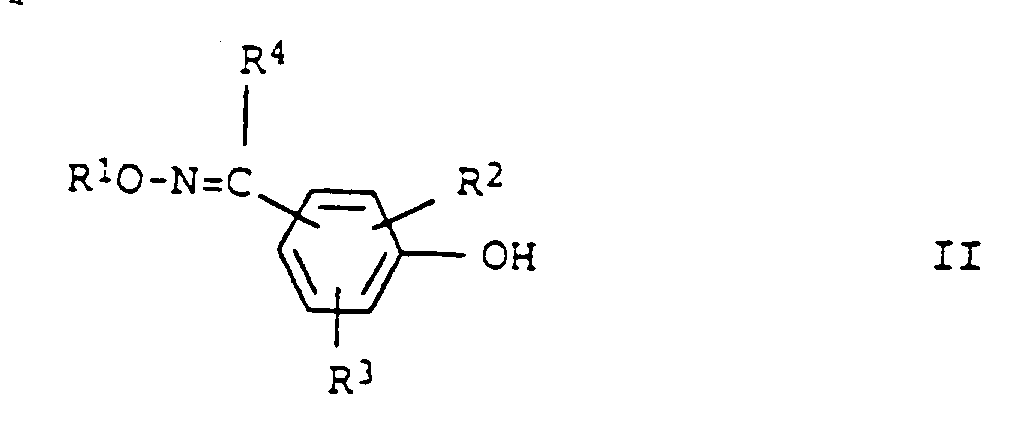 dans laquelle L représente un groupe éliminable.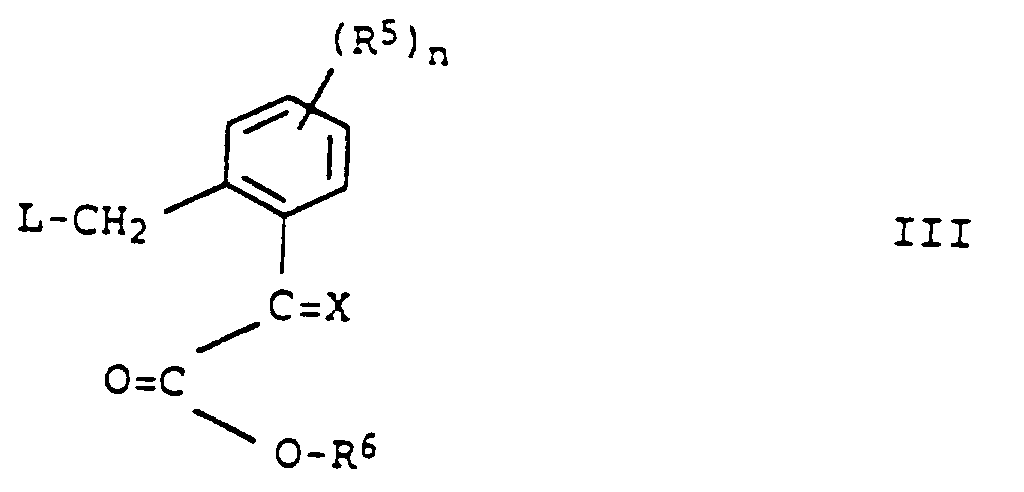
- Procédé de préparation des dérivés phénoxyméthylphényliques substitués de formule I selon la revendication 1 dans laquelle Y représente -NH- ou -N(CH3)-, caractérisé par le fait que l'on fait réagir des dérivés phénoxyméthylphényliques de formule I dans laquelle Y représente l'oxygène, ou des éthers phénylbenzyliques de formule VIdans laquelle R7 représente un substituant activant le groupe carbonyle, avec une amine de formule H2N-R6 ou HN(CH3)-R6.

- Procédé de préparation des dérivés de l'acide phénylglyoxylique de formule générale XI'dans laquelle Y' représente -HN- ou -N(CH3)-,
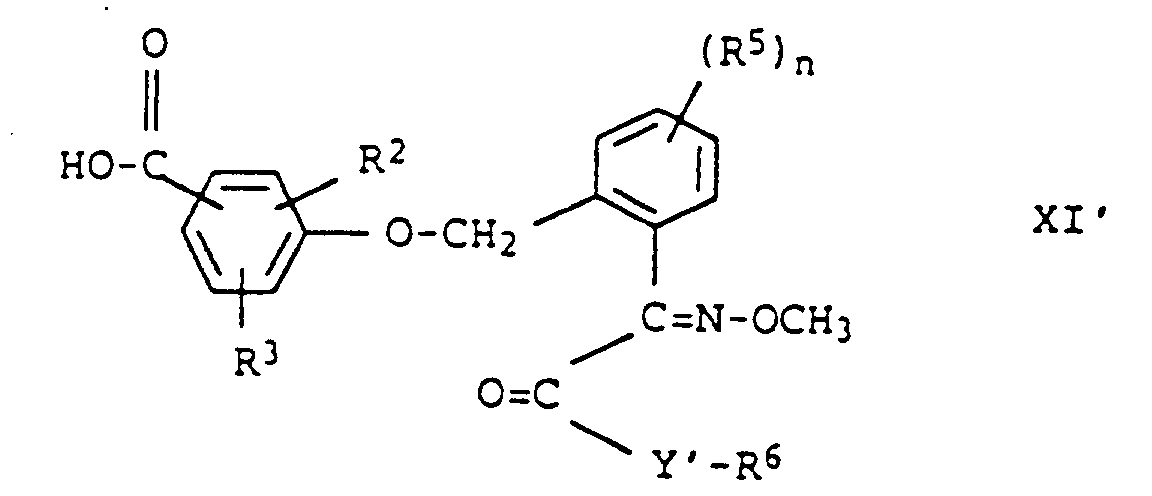
caractérisé par le fait que l'on soumet des acétophénones de formule générale X'à la réaction d'halogénoformation.
- Alpha-méthoxyimino-phénylacétométhylamides de formule XI'dans laquelle les symboles ont les significations suivantes :
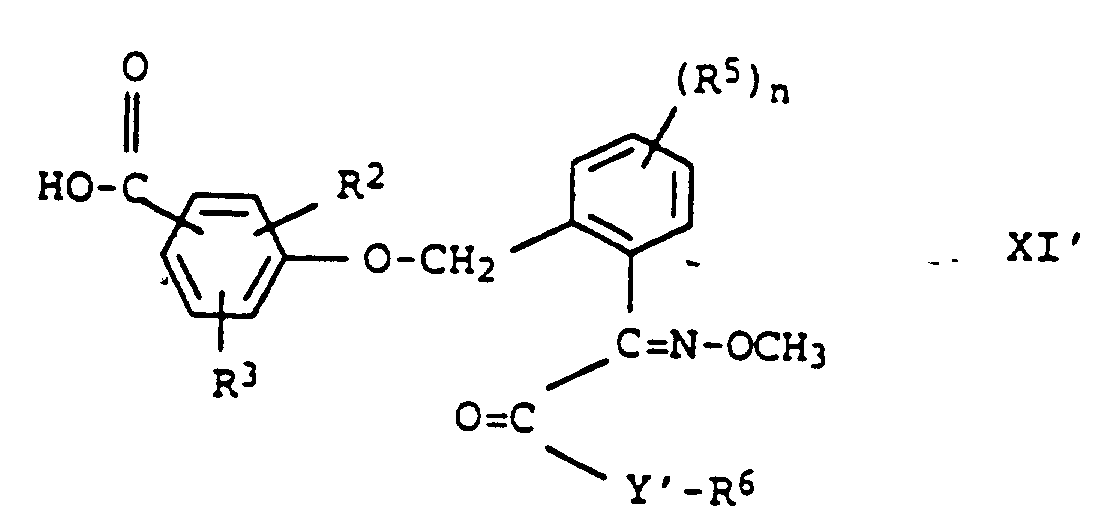
- Y'
- représente -HN- ou -N(CH3)- ;
- R2 et R3
- représentent chacun, indépendamment l'un de l'autre,
l'hydrogène, un halogène, un groupe cyano, nitro, alkyle en C1-C4, halogénoalkyle en C1-C2, alcoxy en C1-C4, halogénoalcoxy en C1-C2 ; - R5 représente
- un groupe nitro, cyano, un halogène, un groupe alkyle en C1-C4, halogénoalkyle en C1-C4, alcoxy en C1-C4, halogénoalcoxy en C1-C4, alkylthio en C1-C4, phényle ou phénoxy dont les cycles aromatiques peuvent porter un à trois substituants choisis parmi les groupes alkyle en C1-C4, halogénoalkyle en C1-C4, alcoxy en C1-C4, halogénoalcoxy en C1-C4 et alkylthio en C1-C4, les noyaux aromatiques pouvant en outre porter des atomes d'halogènes en quantité telle que le nombre total des substituants soit de 4 ou 5 ; ou bien, lorsque n est égal à 2, 3 ou 4, un groupe 1,3-butadièn-1,4-diyle ou un groupe 1,3-butadièn-1,4-diyle mono- ou di-chloré, condensé sur deux atomes de carbone voisins du corps fondamental, ces cycles condensés pouvant eux-mêmes porter un ou deux substituants choisis parmi les groupes nitro, halogénoalkyle en C1-C4, alcoxy en C1-C4, halogénoalcoxy en C1-C4 et alkylthio en C1-C4 ;
- n
- est égal à 0, 1, 2, 3, 4, les symboles R5 pouvant avoir des significations identiques ou différentes lorsque n est égal à 1, 2, 3 ou 4 ;
- R6
- représente l'hydrogène ou un groupe alkyle en C1-C4.
- Dérivés de l'acide 2-(phénoxyméthyl)phénylacétique de formule IV'bdans laquelle les symboles ont les significations suivantes :
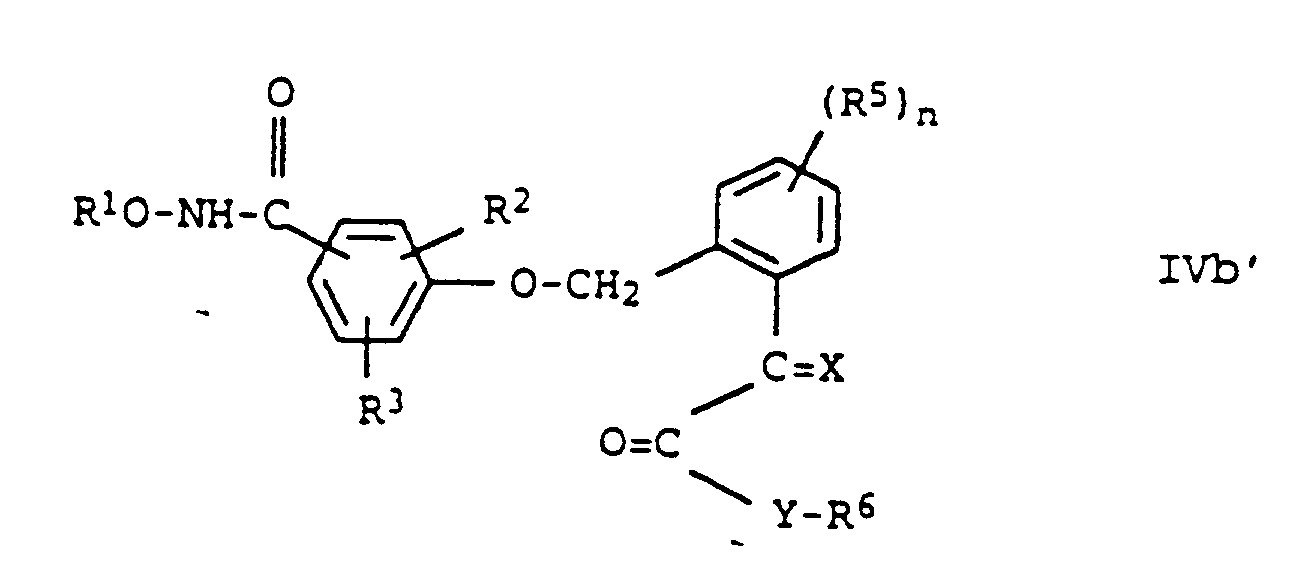
- X
- représente =CH-OCH3, =CH-CH3 ou =N-OCH3 ;
- Y
- représente l'oxygène, un groupe -NH- ou -N(CH3)- ;
- R1 représente
- un groupe alkyle en C1-C6, alcényle en C2-C6, alcynyle en C3-C6, halogénoalkyle en C1-C6, halogénoalcényle en C3-C6, (alcoxy en C1-C4)alkyle en C1-C6, cyano-alkyle en C1-C6, (alcoxy en C1-C6)-carbonyl-alkyle en C1-C6, un groupe cycloalkyle en C3-C6 ou (cycloalkyle en C3-C6)alkyle en C1-C4, un groupe aryl-alkyle en C1-C6 ou aryl-alcényle en C3-C6 ou aryloxy-alkyle en C1-C6, un groupe hétérocyclyle ou hétérocyclyl-alkyle en C1-C4 saturé ou insaturé de quatre à six chaínons ou un groupe hétéroaryl-alkyle en C1-C6, les noyaux hétérocycliques pouvant contenir chacun, en plus des atomes de carbone, un ou deux chaínons cycliques choisis dans le groupe consistant en un atome d'oxygène ou de soufre et un ou deux atomes d'azote et un ou deux groupes -N(CH3)-, les noyaux carbocycliques et hétérocycliques pouvant eux-mêmes porter un ou plusieurs substituants choisis parmi les halogènes, les groupes alkyle en C1-C4, halogénoalkyle en C1-C2, cycloalkyle en C3-C6, alcoxy en C1-C4, halogénoalcoxy en C1-C2, les halogènes, les groupes aryle et aryloxy ;
- R2, R3 représentent
- l'hydrogène, un halogène, un groupe cyano, nitro, alkyle en C1-C4, halogénoalkyle en C1-C2, alcoxy en C1-C4, halogénoalcoxy en C1-C2, ou bien, lorsque R2 et R3 sont voisins, ils représentent ensemble un pont oxyméthylidène-oxy ou oxyéthylidène-oxy, chaque atome de carbone de ces ponts pouvant porter, si on le désire, un ou deux atomes d'halogènes et/ou groupes méthyle ;
- R5 représente
- un groupe nitro, cyano, un halogène, un groupe alkyle en C1-C4,
halogénoalkyle en C1-C4, alcoxy en C1-C4, halogénoalcoxy en C1-C4,
alkylthio en C1-C4, phényle ou phénoxy, les noyaux aromatiques
pouvant porter un à trois substituants choisis parmi les groupes alkyle
en C1-C4, halogénoalkyle en C1-C4, alcoxy en C1-C4, halogénoalcoxy
en C1-C4 et alkylthio en C1-C4, les noyaux aromatiques pouvant en
outre porter des atomes d'halogènes en nombre tel que le nombre total
des substituants soit de 4 ou 5 ;
ou bien, lorsque n est égal à 2, 3 ou 4, un groupe 1,3-butadièn-1,4-diyle ou un groupe 1,3-butadièn-1,4-diyle mono- ou di-halogéné, condensé sur deux atomes de carbone voisins du corps fondamental, ces noyaux condensés pouvant eux-mêmes porter un ou deux substituants choisis parmi les groupes nitro, cyano, halogénoalkyle en C1-C4, alcoxy en C1-C4, halogénoalcoxy en C1-C4 et alkylthio en C1-C4 ; - n
- est égal à 0, 1, 2, 3 ou 4, les symboles R5 pouvant avoir des significations identiques ou différentes lorsque n est égal à 1, 2, 3 ou 4 ;
- R6
- représente l'hydrogène ou un groupe alkyle en C1-C4.
- Dérivés phénoxyméthylphényliques de formule I selon la revendication 1 dans laquelle
- n
- est égal à 0 ou 1
- X
- représente =CH-OCH3, =CH-CH3 ou =N-OCH3 ;
- Y
- représente l'oxygène ou -NH- ;
- R1
- représente un groupe alkyle en C1-C6, alcényle en C2-C6, alcynyle en C3-C6, halogénoalkyle en C1-C6 ou halogénoalcényle en C3-C6 ;
- R2
- représente un groupe cyano, le chlore, le fluor, un groupe méthyle, trifluorométhyle ou méthoxy ;
- R3
- représente l'hydrogène, un groupe cyano, le chlore, le fluor, un groupe méthyle ou méthoxy ;
- R4
- représente un groupe cyano, le chlore, le brome, un groupe alcoxy en C1-C6, alkylthio en C1-C6, alcényloxy en C3-C6, aryloxy ou arylthio et
- R5
- représente un groupe cyano, un halogène, un groupe alkyle en C1-C6, halogénoalkyle en C1-C6, alcoxy en C1-C6 ou phényle.
- Dérivés phénoxyméthylphényliques de formule I selon la revendication 1, dans laquelle
- n
- est égal à 0 ou 1 ;
- X
- représente =NO-CH3 ;
- Y
- représente -HN- ;
- R1
- représente un groupe alkyle en C1-C6, alcényle en C2-C6, alcynyle en C3-C6, halogénoalkyle en C1-C6 ou halogénoalcényle en C3-C6 ;
- R2
- représente un groupe cyano, le chlore, le fluor, un groupe méthyle, trifluorométhyle ou méthoxy ;
- R3
- représente l'hydrogène, un groupe cyano, le chlore, le fluor, un groupe méthyle ou méthoxy ;
- R4
- représente un groupe cyano, le chlore, le brome, un groupe alcoxy en C1-C6, alkylthio en C1-C6, alcényloxy en C3-C6, phényloxy ou phénylthio ; et
- R5
- représente un groupe cyano, le chlore, le fluor, un groupe méthyle, trifluorométhyle, méthoxy ou phényle.
- Utilisation des dérivés phénoxyméthylphényliques de formule I selon la revendication 1 en tant que fongicides.
- Utilisation des dérivés phénoxyméthylphényliques de formule I selon la revendication 1 pour la lutte contre les parasites.
- Produit fongicide contenant des véhicules solides et/ou liquides et une quantité fongicide efficace d'au moins un dérivé phénoxyméthylphénylique substitué de formule I selon la revendication 1.
- Procédé pour combattre les mycètes, caractérisé par le fait que l'on traite les mycètes ou les matériaux, végétaux, semences ou sols menacés d'une attaque par les mycètes par une quantité fongicide efficace d'au moins un dérivé phénoxyméthylphénylique substitué de formule I selon la revendication 1.
- Produit pour combattre les parasites, contenant des additifs inertes et une quantité parasiticide efficace d'au moins un dérivé phénoxyméthylphénylique substitué de formule I selon la revendication 1.
- Procédé pour combattre les parasites, caractérisé par le fait que l'on traite les parasites et/ou leur habitat par une quantité parasiticide efficace d'au moins un dérivé phénoxyméthylphénylique substitué de formule I selon la revendication 1.
Applications Claiming Priority (2)
| Application Number | Priority Date | Filing Date | Title |
|---|---|---|---|
| DE4410424 | 1994-03-25 | ||
| DE4410424 | 1994-03-25 |
Publications (2)
| Publication Number | Publication Date |
|---|---|
| EP0673923A1 EP0673923A1 (fr) | 1995-09-27 |
| EP0673923B1 true EP0673923B1 (fr) | 1998-05-20 |
Family
ID=6513864
Family Applications (1)
| Application Number | Title | Priority Date | Filing Date |
|---|---|---|---|
| EP95103942A Expired - Lifetime EP0673923B1 (fr) | 1994-03-25 | 1995-03-17 | Dérivés substitués de phénoxyméthyle-phényle, procédé pour leur préparation et leur usage comme parasiticides et fongicides |
Country Status (10)
| Country | Link |
|---|---|
| US (2) | US5545664A (fr) |
| EP (1) | EP0673923B1 (fr) |
| JP (1) | JPH07278084A (fr) |
| KR (1) | KR950032091A (fr) |
| CN (1) | CN1121510A (fr) |
| AT (1) | ATE166341T1 (fr) |
| AU (1) | AU680718B2 (fr) |
| CA (1) | CA2145234A1 (fr) |
| DE (1) | DE59502205D1 (fr) |
| NZ (1) | NZ270787A (fr) |
Families Citing this family (8)
| Publication number | Priority date | Publication date | Assignee | Title |
|---|---|---|---|---|
| JP3591743B2 (ja) * | 1996-02-02 | 2004-11-24 | 東京応化工業株式会社 | 化学増幅型レジスト組成物 |
| AU2153297A (en) * | 1996-03-08 | 1997-09-22 | Basf Aktiengesellschaft | Diphenylethers, process and intermediate products for their preparation, and their use |
| AR007293A1 (es) * | 1996-06-06 | 1999-10-27 | Rohm & Haas | Compuestos aromaticos benciloxi sustituidos y su uso como fungicidas e insecticidas. |
| WO1998033772A1 (fr) * | 1997-02-03 | 1998-08-06 | Dow Agrosciences Llc | 2-methoxyimino-2-(pyridinyloxymethyl)phenyle acetamides avec derives d'acide carboxylique sur le noyau de pyridine, utilises comme fongicides |
| TW577866B (en) * | 1999-05-05 | 2004-03-01 | Dow Agrosciences Llc | Fungicidal and insecticidal benzyloxy cyclopropyl substituted aromatic compounds |
| ITMI20020814A1 (it) | 2002-04-17 | 2003-10-17 | Isagro Ricerca Srl | Nuovi analoghi delle strobilurine e loro uso quali acaricidi e insetticidi |
| TW201429401A (zh) * | 2013-01-25 | 2014-08-01 | Univ Nat Taiwan | 斜紋夜盜蛾幼蟲誘引取食劑與其使用方法 |
| CN115215761A (zh) * | 2021-04-15 | 2022-10-21 | 湖南大学 | 二苯肟醚衍生物及其作为杀菌剂和杀虫剂的用途 |
Family Cites Families (5)
| Publication number | Priority date | Publication date | Assignee | Title |
|---|---|---|---|---|
| CZ281007B6 (cs) * | 1989-03-09 | 1996-05-15 | Basf Aktiengesellschaft | Fungicidní prostředek a způsob výroby jeho účinné složky |
| ATE141589T1 (de) * | 1989-05-17 | 1996-09-15 | Shionogi & Co | Alkoxyiminoacetamid-derivate und ihre verwendung als pilztötendes mittel |
| DE4116090A1 (de) * | 1991-05-17 | 1992-11-19 | Basf Ag | (alpha)-phenylacrylsaeurederivate, verfahren zu ihrer herstellung und ihre verwendung zur bekaempfung von schaedlingen und schadpilzen |
| DE4117371A1 (de) * | 1991-05-28 | 1992-12-03 | Basf Ag | Antimykotische mittel, die phenylessigsaeurederivate enthalten |
| EP0579124B1 (fr) * | 1992-07-15 | 1996-10-16 | BASF Aktiengesellschaft | Ethers d'oximes substitués, procédé pour leur préparation et leur application comme pesticides |
-
1995
- 1995-03-17 DE DE59502205T patent/DE59502205D1/de not_active Expired - Lifetime
- 1995-03-17 EP EP95103942A patent/EP0673923B1/fr not_active Expired - Lifetime
- 1995-03-17 AT AT95103942T patent/ATE166341T1/de not_active IP Right Cessation
- 1995-03-22 CA CA002145234A patent/CA2145234A1/fr not_active Abandoned
- 1995-03-23 NZ NZ270787A patent/NZ270787A/en unknown
- 1995-03-23 US US08/409,039 patent/US5545664A/en not_active Expired - Fee Related
- 1995-03-23 AU AU15040/95A patent/AU680718B2/en not_active Ceased
- 1995-03-25 KR KR1019950006464A patent/KR950032091A/ko not_active Withdrawn
- 1995-03-25 CN CN95105106A patent/CN1121510A/zh active Pending
- 1995-03-27 JP JP7068424A patent/JPH07278084A/ja not_active Withdrawn
-
1996
- 1996-05-13 US US08/645,428 patent/US5696161A/en not_active Expired - Fee Related
Also Published As
| Publication number | Publication date |
|---|---|
| DE59502205D1 (de) | 1998-06-25 |
| KR950032091A (ko) | 1995-12-20 |
| ATE166341T1 (de) | 1998-06-15 |
| US5545664A (en) | 1996-08-13 |
| US5696161A (en) | 1997-12-09 |
| JPH07278084A (ja) | 1995-10-24 |
| AU1504095A (en) | 1995-10-05 |
| AU680718B2 (en) | 1997-08-07 |
| CN1121510A (zh) | 1996-05-01 |
| CA2145234A1 (fr) | 1995-09-26 |
| EP0673923A1 (fr) | 1995-09-27 |
| NZ270787A (en) | 1996-05-28 |
Similar Documents
| Publication | Publication Date | Title |
|---|---|---|
| EP0741694B1 (fr) | Derives d'acide acetique phenylique, leur procede de preparation, produits intermediaires a cet effet et agents les contenant | |
| EP0738259A1 (fr) | Derives d'acide phenylacetique, leur procede de preparation et produits intermediaires utilises a cet effet, et agents les contenant | |
| EP0793645B1 (fr) | Anilides d'iminooxymethylene, procede et produits intermediaires de preparation de celles-ci, et pesticides les contenant | |
| EP0842144B1 (fr) | Derives d'acide acetique phenylique, procedes et produits intermediaires permettant de les produire et utilisation comme agents de lutte contre les parasites et comme fongicides | |
| EP0673923B1 (fr) | Dérivés substitués de phénoxyméthyle-phényle, procédé pour leur préparation et leur usage comme parasiticides et fongicides | |
| EP0873316A1 (fr) | Derives d'acide 2-(o- pyrimidin-4-yl]methylenoxy)phenylacetique et leur utilisation pour lutter contre les champignons nocifs et les parasites animaux | |
| EP0885194B1 (fr) | Ethers de pyridyle, de phenyle et de benzyle, procedes et produits intermediaires permettant de les preparer, et leur utilisation comme fongicides et pour lutter contre des parasites animaux | |
| EP1172362A1 (fr) | Azadioxacycloalcènes et leur utilisation comme fongicides et pesticides animaux | |
| EP0975616B1 (fr) | Composes du type benzylo-oxymino substitues | |
| EP0873305B1 (fr) | Azinooximethers, procede de production et produits intermediaires utilises, utilisation de ces ethers dans la lutte contre les champignons et animaux nuisibles | |
| EP0812317B1 (fr) | 2-[2-(hetaryloxymethylene)phenyl]-crotonates utilises comme pesticides et fongicides | |
| EP0858446B1 (fr) | Phenylcarbamates, procedes et produits intermediaires permettant de les preparer, et leur utilisation pour lutter contre des parasites et des champignons nuisibles | |
| EP0988293B1 (fr) | Composes phenyle substitues par bisimino et leur utilisation comme agents de lutte contre les parasites | |
| EP0912524B1 (fr) | Derives d'acide de 2-(o- pyrimidin-4-yl]methylenoxy)phenylacetique et leur utilisation pour lutter contre les champignons nuisibles et les parasites animaux | |
| EP1140926B1 (fr) | Azadioxacycloalkenes et leur utilisation pour lutter contre des champignons nuisibles et des parasites animaux | |
| EP0873307B1 (fr) | Ethers d'oxime cyanimino et produits intermediaires utilises pour les preparer et leur utilisation pour lutter contre des champignons nocifs et des parasites animaux | |
| EP0861229B1 (fr) | Derives d'acide phenylacetique, procedes et produits intermediaires permettant de les preparer, et leur utilisation pour lutter contre les parasites animaux et les champignons nuisibles | |
| DE19548370A1 (de) | Iminoxysubstituierte Phenylessigsäurederivate | |
| EP0873333B1 (fr) | Ethers phenylbenzyliques, leur procede de production et leur utilisation comme pesticide et fongicide | |
| EP0876344B1 (fr) | Derives d'acide acetique pyridylique, procede de preparation correspondant, produits intermediaires utilises et substances les contenant | |
| EP0876334B1 (fr) | Derives d'acide phenylacetique, procedes de preparation et utilisation comme pesticides et comme fongicides | |
| EP0873313B1 (fr) | Derives d'acide pyridylacetique, procedes et produits intermediaires permettant de les preparer et utilisation | |
| EP1054883B1 (fr) | Derives de 2-(pyrazolyloxy)-pyridine-3-yle-acide acetique, agents les contenant et leur utilisation pour lutter contre des champignons nuisibles et des parasites animaux | |
| EP1121348B1 (fr) | Derives d'azadioxacycloalkene, procedes permettant de les preparer et leur utilisation comme fongicides et comme agents de lutte contre les parasites | |
| EP0854861B1 (fr) | Ethers d'oxyamino-oxime, procedes et produits intermediaires utilises pour leur production et agent les contenant servant a lutter contre les champignons parasites et les parasites animaux |
Legal Events
| Date | Code | Title | Description |
|---|---|---|---|
| PUAI | Public reference made under article 153(3) epc to a published international application that has entered the european phase |
Free format text: ORIGINAL CODE: 0009012 |
|
| AK | Designated contracting states |
Kind code of ref document: A1 Designated state(s): AT BE CH DE DK ES FR GB GR IE IT LI NL PT SE |
|
| 17P | Request for examination filed |
Effective date: 19950809 |
|
| 17Q | First examination report despatched |
Effective date: 19961203 |
|
| GRAG | Despatch of communication of intention to grant |
Free format text: ORIGINAL CODE: EPIDOS AGRA |
|
| GRAG | Despatch of communication of intention to grant |
Free format text: ORIGINAL CODE: EPIDOS AGRA |
|
| GRAH | Despatch of communication of intention to grant a patent |
Free format text: ORIGINAL CODE: EPIDOS IGRA |
|
| GRAH | Despatch of communication of intention to grant a patent |
Free format text: ORIGINAL CODE: EPIDOS IGRA |
|
| GRAA | (expected) grant |
Free format text: ORIGINAL CODE: 0009210 |
|
| AK | Designated contracting states |
Kind code of ref document: B1 Designated state(s): AT BE CH DE DK ES FR GB GR IE IT LI NL PT SE |
|
| PG25 | Lapsed in a contracting state [announced via postgrant information from national office to epo] |
Ref country code: IT Free format text: LAPSE BECAUSE OF FAILURE TO SUBMIT A TRANSLATION OF THE DESCRIPTION OR TO PAY THE FEE WITHIN THE PRE;WARNING: LAPSES OF ITALIAN PATENTS WITH EFFECTIVE DATE BEFORE 2007 MAY HAVE OCCURRED AT ANY TIME BEFORE 2007. THE CORRECT EFFECTIVE DATE MAY BE DIFFERENT FROM THE ONE RECORDED.SCRIBED TIME-LIMIT Effective date: 19980520 Ref country code: GR Free format text: LAPSE BECAUSE OF NON-PAYMENT OF DUE FEES Effective date: 19980520 Ref country code: ES Free format text: THE PATENT HAS BEEN ANNULLED BY A DECISION OF A NATIONAL AUTHORITY Effective date: 19980520 |
|
| REF | Corresponds to: |
Ref document number: 166341 Country of ref document: AT Date of ref document: 19980615 Kind code of ref document: T |
|
| REG | Reference to a national code |
Ref country code: CH Ref legal event code: EP |
|
| REF | Corresponds to: |
Ref document number: 59502205 Country of ref document: DE Date of ref document: 19980625 |
|
| GBT | Gb: translation of ep patent filed (gb section 77(6)(a)/1977) |
Effective date: 19980619 |
|
| PG25 | Lapsed in a contracting state [announced via postgrant information from national office to epo] |
Ref country code: SE Free format text: LAPSE BECAUSE OF FAILURE TO SUBMIT A TRANSLATION OF THE DESCRIPTION OR TO PAY THE FEE WITHIN THE PRESCRIBED TIME-LIMIT Effective date: 19980820 Ref country code: PT Free format text: LAPSE BECAUSE OF FAILURE TO SUBMIT A TRANSLATION OF THE DESCRIPTION OR TO PAY THE FEE WITHIN THE PRESCRIBED TIME-LIMIT Effective date: 19980820 Ref country code: DK Free format text: LAPSE BECAUSE OF FAILURE TO SUBMIT A TRANSLATION OF THE DESCRIPTION OR TO PAY THE FEE WITHIN THE PRESCRIBED TIME-LIMIT Effective date: 19980820 |
|
| REG | Reference to a national code |
Ref country code: IE Ref legal event code: FG4D Free format text: GERMAN |
|
| ET | Fr: translation filed | ||
| PG25 | Lapsed in a contracting state [announced via postgrant information from national office to epo] |
Ref country code: IE Free format text: LAPSE BECAUSE OF NON-PAYMENT OF DUE FEES Effective date: 19981211 |
|
| REG | Reference to a national code |
Ref country code: IE Ref legal event code: FD4D |
|
| PG25 | Lapsed in a contracting state [announced via postgrant information from national office to epo] |
Ref country code: AT Free format text: LAPSE BECAUSE OF NON-PAYMENT OF DUE FEES Effective date: 19990317 |
|
| PLBE | No opposition filed within time limit |
Free format text: ORIGINAL CODE: 0009261 |
|
| STAA | Information on the status of an ep patent application or granted ep patent |
Free format text: STATUS: NO OPPOSITION FILED WITHIN TIME LIMIT |
|
| PG25 | Lapsed in a contracting state [announced via postgrant information from national office to epo] |
Ref country code: LI Free format text: LAPSE BECAUSE OF NON-PAYMENT OF DUE FEES Effective date: 19990331 Ref country code: CH Free format text: LAPSE BECAUSE OF NON-PAYMENT OF DUE FEES Effective date: 19990331 Ref country code: BE Free format text: LAPSE BECAUSE OF NON-PAYMENT OF DUE FEES Effective date: 19990331 |
|
| 26N | No opposition filed | ||
| BERE | Be: lapsed |
Owner name: BASF A.G. Effective date: 19990331 |
|
| REG | Reference to a national code |
Ref country code: CH Ref legal event code: PL |
|
| REG | Reference to a national code |
Ref country code: GB Ref legal event code: IF02 |
|
| PGFP | Annual fee paid to national office [announced via postgrant information from national office to epo] |
Ref country code: NL Payment date: 20030214 Year of fee payment: 9 |
|
| PGFP | Annual fee paid to national office [announced via postgrant information from national office to epo] |
Ref country code: FR Payment date: 20040309 Year of fee payment: 10 |
|
| PGFP | Annual fee paid to national office [announced via postgrant information from national office to epo] |
Ref country code: GB Payment date: 20040317 Year of fee payment: 10 |
|
| PGFP | Annual fee paid to national office [announced via postgrant information from national office to epo] |
Ref country code: DE Payment date: 20040325 Year of fee payment: 10 |
|
| PG25 | Lapsed in a contracting state [announced via postgrant information from national office to epo] |
Ref country code: NL Free format text: LAPSE BECAUSE OF NON-PAYMENT OF DUE FEES Effective date: 20041001 |
|
| NLV4 | Nl: lapsed or anulled due to non-payment of the annual fee |
Effective date: 20041001 |
|
| PG25 | Lapsed in a contracting state [announced via postgrant information from national office to epo] |
Ref country code: GB Free format text: LAPSE BECAUSE OF NON-PAYMENT OF DUE FEES Effective date: 20050317 |
|
| PG25 | Lapsed in a contracting state [announced via postgrant information from national office to epo] |
Ref country code: DE Free format text: LAPSE BECAUSE OF THE APPLICANT RENOUNCES Effective date: 20050525 |
|
| GBPC | Gb: european patent ceased through non-payment of renewal fee |
Effective date: 20050317 |
|
| PG25 | Lapsed in a contracting state [announced via postgrant information from national office to epo] |
Ref country code: FR Free format text: LAPSE BECAUSE OF NON-PAYMENT OF DUE FEES Effective date: 20051130 |
|
| REG | Reference to a national code |
Ref country code: FR Ref legal event code: ST Effective date: 20051130 |