EP0674530B1 - Composes radiomarques de phenols polyhydriques - Google Patents
Composes radiomarques de phenols polyhydriques Download PDFInfo
- Publication number
- EP0674530B1 EP0674530B1 EP94904849A EP94904849A EP0674530B1 EP 0674530 B1 EP0674530 B1 EP 0674530B1 EP 94904849 A EP94904849 A EP 94904849A EP 94904849 A EP94904849 A EP 94904849A EP 0674530 B1 EP0674530 B1 EP 0674530B1
- Authority
- EP
- European Patent Office
- Prior art keywords
- compound
- general formula
- polyhydric phenol
- group
- phloretin
- Prior art date
- Legal status (The legal status is an assumption and is not a legal conclusion. Google has not performed a legal analysis and makes no representation as to the accuracy of the status listed.)
- Expired - Lifetime
Links
- 150000002989 phenols Chemical class 0.000 title claims abstract description 19
- 150000002367 halogens Chemical class 0.000 claims abstract description 24
- 229910052736 halogen Inorganic materials 0.000 claims abstract description 23
- 230000002285 radioactive effect Effects 0.000 claims abstract description 19
- 125000002887 hydroxy group Chemical group [H]O* 0.000 claims abstract description 11
- 125000004435 hydrogen atom Chemical group [H]* 0.000 claims abstract description 9
- 125000003178 carboxy group Chemical group [H]OC(*)=O 0.000 claims abstract description 7
- 125000003277 amino group Chemical group 0.000 claims abstract description 6
- 125000004430 oxygen atom Chemical group O* 0.000 claims abstract description 6
- 150000001875 compounds Chemical class 0.000 claims description 60
- -1 N-(carboxymethyl)carbamoyl group Chemical group 0.000 claims description 34
- 238000000034 method Methods 0.000 claims description 21
- 238000006243 chemical reaction Methods 0.000 claims description 20
- 239000000203 mixture Substances 0.000 claims description 18
- 206010028980 Neoplasm Diseases 0.000 claims description 13
- 230000000694 effects Effects 0.000 claims description 12
- 238000002360 preparation method Methods 0.000 claims description 12
- 239000007858 starting material Substances 0.000 claims description 11
- 210000004369 blood Anatomy 0.000 claims description 10
- 239000008280 blood Substances 0.000 claims description 10
- 239000002253 acid Substances 0.000 claims description 9
- 102000004022 Protein-Tyrosine Kinases Human genes 0.000 claims description 8
- 108090000412 Protein-Tyrosine Kinases Proteins 0.000 claims description 8
- 238000010511 deprotection reaction Methods 0.000 claims description 7
- 230000004153 glucose metabolism Effects 0.000 claims description 7
- 239000003638 chemical reducing agent Substances 0.000 claims description 6
- 238000001514 detection method Methods 0.000 claims description 6
- 150000001989 diazonium salts Chemical class 0.000 claims description 6
- 230000004190 glucose uptake Effects 0.000 claims description 6
- 229910052740 iodine Inorganic materials 0.000 claims description 6
- 239000000523 sample Substances 0.000 claims description 6
- ZCYVEMRRCGMTRW-UHFFFAOYSA-N 7553-56-2 Chemical group [I] ZCYVEMRRCGMTRW-UHFFFAOYSA-N 0.000 claims description 4
- 239000013543 active substance Substances 0.000 claims description 4
- 125000001246 bromo group Chemical group Br* 0.000 claims description 4
- 150000001720 carbohydrates Chemical group 0.000 claims description 4
- 239000012954 diazonium Substances 0.000 claims description 4
- 238000003384 imaging method Methods 0.000 claims description 4
- 230000008569 process Effects 0.000 claims description 4
- 230000001225 therapeutic effect Effects 0.000 claims description 4
- WKBOTKDWSSQWDR-UHFFFAOYSA-N Bromine atom Chemical group [Br] WKBOTKDWSSQWDR-UHFFFAOYSA-N 0.000 claims description 3
- DGAQECJNVWCQMB-PUAWFVPOSA-M Ilexoside XXIX Chemical compound C[C@@H]1CC[C@@]2(CC[C@@]3(C(=CC[C@H]4[C@]3(CC[C@@H]5[C@@]4(CC[C@@H](C5(C)C)OS(=O)(=O)[O-])C)C)[C@@H]2[C@]1(C)O)C)C(=O)O[C@H]6[C@@H]([C@H]([C@@H]([C@H](O6)CO)O)O)O.[Na+] DGAQECJNVWCQMB-PUAWFVPOSA-M 0.000 claims description 3
- XBDQKXXYIPTUBI-UHFFFAOYSA-M Propionate Chemical compound CCC([O-])=O XBDQKXXYIPTUBI-UHFFFAOYSA-M 0.000 claims description 3
- 238000007256 debromination reaction Methods 0.000 claims description 3
- WBJINCZRORDGAQ-UHFFFAOYSA-N formic acid ethyl ester Natural products CCOC=O WBJINCZRORDGAQ-UHFFFAOYSA-N 0.000 claims description 3
- 239000008194 pharmaceutical composition Substances 0.000 claims description 3
- 229910052708 sodium Inorganic materials 0.000 claims description 3
- 239000011734 sodium Substances 0.000 claims description 3
- 239000002671 adjuvant Substances 0.000 claims description 2
- 238000006473 carboxylation reaction Methods 0.000 claims description 2
- 239000003937 drug carrier Substances 0.000 claims description 2
- 125000002346 iodo group Chemical group I* 0.000 claims description 2
- 239000000463 material Substances 0.000 claims description 2
- 125000001424 substituent group Chemical group 0.000 claims description 2
- 238000002560 therapeutic procedure Methods 0.000 abstract description 3
- 238000003745 diagnosis Methods 0.000 abstract description 2
- 125000000837 carbohydrate group Chemical group 0.000 abstract 1
- VGEREEWJJVICBM-UHFFFAOYSA-N phloretin Chemical compound C1=CC(O)=CC=C1CCC(=O)C1=C(O)C=C(O)C=C1O VGEREEWJJVICBM-UHFFFAOYSA-N 0.000 description 34
- 239000000243 solution Substances 0.000 description 32
- 230000027455 binding Effects 0.000 description 25
- 239000000047 product Substances 0.000 description 25
- RTZKZFJDLAIYFH-UHFFFAOYSA-N Diethyl ether Chemical compound CCOCC RTZKZFJDLAIYFH-UHFFFAOYSA-N 0.000 description 24
- 210000004027 cell Anatomy 0.000 description 20
- 210000003743 erythrocyte Anatomy 0.000 description 17
- ZWTDXYUDJYDHJR-UHFFFAOYSA-N (E)-1-(2,4-dihydroxyphenyl)-3-(2,4-dihydroxyphenyl)-2-propen-1-one Natural products OC1=CC(O)=CC=C1C=CC(=O)C1=CC=C(O)C=C1O ZWTDXYUDJYDHJR-UHFFFAOYSA-N 0.000 description 16
- YQHMWTPYORBCMF-UHFFFAOYSA-N Naringenin chalcone Natural products C1=CC(O)=CC=C1C=CC(=O)C1=C(O)C=C(O)C=C1O YQHMWTPYORBCMF-UHFFFAOYSA-N 0.000 description 16
- FVAUCKIRQBBSSJ-UHFFFAOYSA-M sodium iodide Chemical compound [Na+].[I-] FVAUCKIRQBBSSJ-UHFFFAOYSA-M 0.000 description 16
- YMWUJEATGCHHMB-UHFFFAOYSA-N Dichloromethane Chemical compound ClCCl YMWUJEATGCHHMB-UHFFFAOYSA-N 0.000 description 15
- OKKJLVBELUTLKV-UHFFFAOYSA-N Methanol Chemical compound OC OKKJLVBELUTLKV-UHFFFAOYSA-N 0.000 description 15
- XLYOFNOQVPJJNP-UHFFFAOYSA-N water Substances O XLYOFNOQVPJJNP-UHFFFAOYSA-N 0.000 description 14
- ISWSIDIOOBJBQZ-UHFFFAOYSA-N Phenol Natural products OC1=CC=CC=C1 ISWSIDIOOBJBQZ-UHFFFAOYSA-N 0.000 description 12
- 210000001519 tissue Anatomy 0.000 description 11
- 239000011541 reaction mixture Substances 0.000 description 10
- 238000001816 cooling Methods 0.000 description 9
- 230000005764 inhibitory process Effects 0.000 description 9
- WQZGKKKJIJFFOK-GASJEMHNSA-N Glucose Natural products OC[C@H]1OC(O)[C@H](O)[C@@H](O)[C@@H]1O WQZGKKKJIJFFOK-GASJEMHNSA-N 0.000 description 8
- VEXZGXHMUGYJMC-UHFFFAOYSA-N Hydrochloric acid Chemical compound Cl VEXZGXHMUGYJMC-UHFFFAOYSA-N 0.000 description 8
- 239000000872 buffer Substances 0.000 description 8
- 229960004132 diethyl ether Drugs 0.000 description 8
- 239000008103 glucose Substances 0.000 description 8
- 238000011534 incubation Methods 0.000 description 8
- QTBSBXVTEAMEQO-UHFFFAOYSA-N Acetic acid Chemical compound CC(O)=O QTBSBXVTEAMEQO-UHFFFAOYSA-N 0.000 description 7
- 0 CC*(CC(c(c(*)c(c(*)c1S)S)c1O)=O)C1=CC=C(*C)C(*)C1 Chemical compound CC*(CC(c(c(*)c(c(*)c1S)S)c1O)=O)C1=CC=C(*C)C(*)C1 0.000 description 7
- FAPWRFPIFSIZLT-UHFFFAOYSA-M Sodium chloride Chemical compound [Na+].[Cl-] FAPWRFPIFSIZLT-UHFFFAOYSA-M 0.000 description 7
- 230000006377 glucose transport Effects 0.000 description 7
- WEVYAHXRMPXWCK-UHFFFAOYSA-N Acetonitrile Chemical compound CC#N WEVYAHXRMPXWCK-UHFFFAOYSA-N 0.000 description 6
- DHMQDGOQFOQNFH-UHFFFAOYSA-N Glycine Chemical compound NCC(O)=O DHMQDGOQFOQNFH-UHFFFAOYSA-N 0.000 description 6
- HEMHJVSKTPXQMS-UHFFFAOYSA-M Sodium hydroxide Chemical compound [OH-].[Na+] HEMHJVSKTPXQMS-UHFFFAOYSA-M 0.000 description 6
- CIWBSHSKHKDKBQ-JLAZNSOCSA-N Ascorbic acid Chemical compound OC[C@H](O)[C@H]1OC(=O)C(O)=C1O CIWBSHSKHKDKBQ-JLAZNSOCSA-N 0.000 description 5
- LFQSCWFLJHTTHZ-UHFFFAOYSA-N Ethanol Chemical compound CCO LFQSCWFLJHTTHZ-UHFFFAOYSA-N 0.000 description 5
- 102000005548 Hexokinase Human genes 0.000 description 5
- 108700040460 Hexokinases Proteins 0.000 description 5
- 102100032826 Homeodomain-interacting protein kinase 3 Human genes 0.000 description 5
- 101001066389 Homo sapiens Homeodomain-interacting protein kinase 3 Proteins 0.000 description 5
- 238000001727 in vivo Methods 0.000 description 5
- 239000012074 organic phase Substances 0.000 description 5
- 239000002244 precipitate Substances 0.000 description 5
- VRYALKFFQXWPIH-PBXRRBTRSA-N (3r,4s,5r)-3,4,5,6-tetrahydroxyhexanal Chemical compound OC[C@@H](O)[C@@H](O)[C@H](O)CC=O VRYALKFFQXWPIH-PBXRRBTRSA-N 0.000 description 4
- WXTMDXOMEHJXQO-UHFFFAOYSA-N 2,5-dihydroxybenzoic acid Chemical compound OC(=O)C1=CC(O)=CC=C1O WXTMDXOMEHJXQO-UHFFFAOYSA-N 0.000 description 4
- 102000004506 Blood Proteins Human genes 0.000 description 4
- 108010017384 Blood Proteins Proteins 0.000 description 4
- 229910004373 HOAc Inorganic materials 0.000 description 4
- KFZMGEQAYNKOFK-UHFFFAOYSA-N Isopropanol Chemical compound CC(C)O KFZMGEQAYNKOFK-UHFFFAOYSA-N 0.000 description 4
- JPYHHZQJCSQRJY-UHFFFAOYSA-N Phloroglucinol Natural products CCC=CCC=CCC=CCC=CCCCCC(=O)C1=C(O)C=C(O)C=C1O JPYHHZQJCSQRJY-UHFFFAOYSA-N 0.000 description 4
- 239000006146 Roswell Park Memorial Institute medium Substances 0.000 description 4
- 230000015572 biosynthetic process Effects 0.000 description 4
- 201000011510 cancer Diseases 0.000 description 4
- 150000002148 esters Chemical class 0.000 description 4
- 238000001704 evaporation Methods 0.000 description 4
- 230000008020 evaporation Effects 0.000 description 4
- 238000002474 experimental method Methods 0.000 description 4
- 150000002303 glucose derivatives Chemical class 0.000 description 4
- 239000003112 inhibitor Substances 0.000 description 4
- 230000003993 interaction Effects 0.000 description 4
- QCDYQQDYXPDABM-UHFFFAOYSA-N phloroglucinol Chemical compound OC1=CC(O)=CC(O)=C1 QCDYQQDYXPDABM-UHFFFAOYSA-N 0.000 description 4
- 229960001553 phloroglucinol Drugs 0.000 description 4
- 235000009518 sodium iodide Nutrition 0.000 description 4
- 238000003786 synthesis reaction Methods 0.000 description 4
- 238000012360 testing method Methods 0.000 description 4
- 210000004881 tumor cell Anatomy 0.000 description 4
- JIAARYAFYJHUJI-UHFFFAOYSA-L zinc dichloride Chemical compound [Cl-].[Cl-].[Zn+2] JIAARYAFYJHUJI-UHFFFAOYSA-L 0.000 description 4
- UGFAIRIUMAVXCW-UHFFFAOYSA-N Carbon monoxide Chemical compound [O+]#[C-] UGFAIRIUMAVXCW-UHFFFAOYSA-N 0.000 description 3
- 239000004471 Glycine Substances 0.000 description 3
- 241001465754 Metazoa Species 0.000 description 3
- 238000005893 bromination reaction Methods 0.000 description 3
- GDTBXPJZTBHREO-UHFFFAOYSA-N bromine Substances BrBr GDTBXPJZTBHREO-UHFFFAOYSA-N 0.000 description 3
- 229910052794 bromium Inorganic materials 0.000 description 3
- 229910002091 carbon monoxide Inorganic materials 0.000 description 3
- 238000005119 centrifugation Methods 0.000 description 3
- KRKNYBCHXYNGOX-UHFFFAOYSA-N citric acid Chemical compound OC(=O)CC(O)(C(O)=O)CC(O)=O KRKNYBCHXYNGOX-UHFFFAOYSA-N 0.000 description 3
- 238000000605 extraction Methods 0.000 description 3
- TZBJGXHYKVUXJN-UHFFFAOYSA-N genistein Natural products C1=CC(O)=CC=C1C1=COC2=CC(O)=CC(O)=C2C1=O TZBJGXHYKVUXJN-UHFFFAOYSA-N 0.000 description 3
- 238000004128 high performance liquid chromatography Methods 0.000 description 3
- 239000012216 imaging agent Substances 0.000 description 3
- 238000002347 injection Methods 0.000 description 3
- 239000007924 injection Substances 0.000 description 3
- 210000003205 muscle Anatomy 0.000 description 3
- SYSQUGFVNFXIIT-UHFFFAOYSA-N n-[4-(1,3-benzoxazol-2-yl)phenyl]-4-nitrobenzenesulfonamide Chemical class C1=CC([N+](=O)[O-])=CC=C1S(=O)(=O)NC1=CC=C(C=2OC3=CC=CC=C3N=2)C=C1 SYSQUGFVNFXIIT-UHFFFAOYSA-N 0.000 description 3
- 238000011533 pre-incubation Methods 0.000 description 3
- 239000000700 radioactive tracer Substances 0.000 description 3
- 210000002966 serum Anatomy 0.000 description 3
- 239000011780 sodium chloride Substances 0.000 description 3
- 239000002904 solvent Substances 0.000 description 3
- 238000003756 stirring Methods 0.000 description 3
- 230000032258 transport Effects 0.000 description 3
- CRUILBNAQILVHZ-UHFFFAOYSA-N 1,2,3-trimethoxybenzene Chemical compound COC1=CC=CC(OC)=C1OC CRUILBNAQILVHZ-UHFFFAOYSA-N 0.000 description 2
- AOYNUTHNTBLRMT-SLPGGIOYSA-N 2-deoxy-2-fluoro-aldehydo-D-glucose Chemical compound OC[C@@H](O)[C@@H](O)[C@H](O)[C@@H](F)C=O AOYNUTHNTBLRMT-SLPGGIOYSA-N 0.000 description 2
- PAYRUJLWNCNPSJ-UHFFFAOYSA-N Aniline Chemical compound NC1=CC=CC=C1 PAYRUJLWNCNPSJ-UHFFFAOYSA-N 0.000 description 2
- IJGRMHOSHXDMSA-UHFFFAOYSA-N Atomic nitrogen Chemical compound N#N IJGRMHOSHXDMSA-UHFFFAOYSA-N 0.000 description 2
- CURLTUGMZLYLDI-UHFFFAOYSA-N Carbon dioxide Chemical compound O=C=O CURLTUGMZLYLDI-UHFFFAOYSA-N 0.000 description 2
- 102000014914 Carrier Proteins Human genes 0.000 description 2
- 108010078791 Carrier Proteins Proteins 0.000 description 2
- XTHFKEDIFFGKHM-UHFFFAOYSA-N Dimethoxyethane Chemical compound COCCOC XTHFKEDIFFGKHM-UHFFFAOYSA-N 0.000 description 2
- 102000018711 Facilitative Glucose Transport Proteins Human genes 0.000 description 2
- 108010027279 Facilitative Glucose Transport Proteins Proteins 0.000 description 2
- KRHYYFGTRYWZRS-UHFFFAOYSA-M Fluoride anion Chemical compound [F-] KRHYYFGTRYWZRS-UHFFFAOYSA-M 0.000 description 2
- 238000012404 In vitro experiment Methods 0.000 description 2
- 206010025323 Lymphomas Diseases 0.000 description 2
- IMNFDUFMRHMDMM-UHFFFAOYSA-N N-Heptane Chemical compound CCCCCCC IMNFDUFMRHMDMM-UHFFFAOYSA-N 0.000 description 2
- VMHLLURERBWHNL-UHFFFAOYSA-M Sodium acetate Chemical compound [Na+].CC([O-])=O VMHLLURERBWHNL-UHFFFAOYSA-M 0.000 description 2
- 239000008351 acetate buffer Substances 0.000 description 2
- 150000005215 alkyl ethers Chemical class 0.000 description 2
- VSCWAEJMTAWNJL-UHFFFAOYSA-K aluminium trichloride Chemical compound Cl[Al](Cl)Cl VSCWAEJMTAWNJL-UHFFFAOYSA-K 0.000 description 2
- 235000010323 ascorbic acid Nutrition 0.000 description 2
- 229960005070 ascorbic acid Drugs 0.000 description 2
- 239000011668 ascorbic acid Substances 0.000 description 2
- 239000012298 atmosphere Substances 0.000 description 2
- 230000031709 bromination Effects 0.000 description 2
- 235000014633 carbohydrates Nutrition 0.000 description 2
- 235000011089 carbon dioxide Nutrition 0.000 description 2
- 210000000170 cell membrane Anatomy 0.000 description 2
- 239000003795 chemical substances by application Substances 0.000 description 2
- 230000002860 competitive effect Effects 0.000 description 2
- 238000005859 coupling reaction Methods 0.000 description 2
- 230000007423 decrease Effects 0.000 description 2
- 230000003247 decreasing effect Effects 0.000 description 2
- 230000003292 diminished effect Effects 0.000 description 2
- KPUWHANPEXNPJT-UHFFFAOYSA-N disiloxane Chemical class [SiH3]O[SiH3] KPUWHANPEXNPJT-UHFFFAOYSA-N 0.000 description 2
- 239000000706 filtrate Substances 0.000 description 2
- 239000012467 final product Substances 0.000 description 2
- 150000002272 genistein Chemical class 0.000 description 2
- 229940045109 genistein Drugs 0.000 description 2
- 235000006539 genistein Nutrition 0.000 description 2
- ZCOLJUOHXJRHDI-CMWLGVBASA-N genistein 7-O-beta-D-glucoside Chemical compound O[C@@H]1[C@@H](O)[C@H](O)[C@@H](CO)O[C@H]1OC1=CC(O)=C2C(=O)C(C=3C=CC(O)=CC=3)=COC2=C1 ZCOLJUOHXJRHDI-CMWLGVBASA-N 0.000 description 2
- 229960005219 gentisic acid Drugs 0.000 description 2
- 238000000338 in vitro Methods 0.000 description 2
- 230000000977 initiatory effect Effects 0.000 description 2
- 230000026045 iodination Effects 0.000 description 2
- 238000006192 iodination reaction Methods 0.000 description 2
- 239000011630 iodine Substances 0.000 description 2
- 238000002372 labelling Methods 0.000 description 2
- 210000004072 lung Anatomy 0.000 description 2
- 239000002609 medium Substances 0.000 description 2
- 230000002107 myocardial effect Effects 0.000 description 2
- 239000012299 nitrogen atmosphere Substances 0.000 description 2
- 230000009871 nonspecific binding Effects 0.000 description 2
- YJVFFLUZDVXJQI-UHFFFAOYSA-L palladium(ii) acetate Chemical compound [Pd+2].CC([O-])=O.CC([O-])=O YJVFFLUZDVXJQI-UHFFFAOYSA-L 0.000 description 2
- 230000007170 pathology Effects 0.000 description 2
- 125000001997 phenyl group Chemical group [H]C1=C([H])C([H])=C(*)C([H])=C1[H] 0.000 description 2
- IOUVKUPGCMBWBT-GHRYLNIYSA-N phlorizin Chemical class O[C@@H]1[C@H](O)[C@H](O)[C@@H](CO)O[C@H]1OC1=CC(O)=CC(O)=C1C(=O)CCC1=CC=C(O)C=C1 IOUVKUPGCMBWBT-GHRYLNIYSA-N 0.000 description 2
- 230000002441 reversible effect Effects 0.000 description 2
- 238000002603 single-photon emission computed tomography Methods 0.000 description 2
- 239000001632 sodium acetate Substances 0.000 description 2
- 235000017281 sodium acetate Nutrition 0.000 description 2
- LPXPTNMVRIOKMN-UHFFFAOYSA-M sodium nitrite Chemical compound [Na+].[O-]N=O LPXPTNMVRIOKMN-UHFFFAOYSA-M 0.000 description 2
- GEHJYWRUCIMESM-UHFFFAOYSA-L sodium sulfite Chemical class [Na+].[Na+].[O-]S([O-])=O GEHJYWRUCIMESM-UHFFFAOYSA-L 0.000 description 2
- 239000011550 stock solution Substances 0.000 description 2
- 239000000725 suspension Substances 0.000 description 2
- 239000011592 zinc chloride Substances 0.000 description 2
- 235000005074 zinc chloride Nutrition 0.000 description 2
- FTVWIRXFELQLPI-ZDUSSCGKSA-N (S)-naringenin Chemical compound C1=CC(O)=CC=C1[C@H]1OC2=CC(O)=CC(O)=C2C(=O)C1 FTVWIRXFELQLPI-ZDUSSCGKSA-N 0.000 description 1
- RZSVLKAIDMAXLB-UHFFFAOYSA-N 2-(4-aminophenyl)propanenitrile Chemical compound N#CC(C)C1=CC=C(N)C=C1 RZSVLKAIDMAXLB-UHFFFAOYSA-N 0.000 description 1
- KHACTJLEHLBFNL-UHFFFAOYSA-N 2-bromo-4-[3-oxo-3-(2,4,6-trimethoxyphenyl)propyl]benzoic acid Chemical compound COC1=CC(OC)=CC(OC)=C1C(=O)CCC1=CC=C(C(O)=O)C(Br)=C1 KHACTJLEHLBFNL-UHFFFAOYSA-N 0.000 description 1
- NLHHRLWOUZZQLW-UHFFFAOYSA-N Acrylonitrile Chemical compound C=CC#N NLHHRLWOUZZQLW-UHFFFAOYSA-N 0.000 description 1
- CIWBSHSKHKDKBQ-DUZGATOHSA-N D-isoascorbic acid Chemical compound OC[C@@H](O)[C@H]1OC(=O)C(O)=C1O CIWBSHSKHKDKBQ-DUZGATOHSA-N 0.000 description 1
- ZAFNJMIOTHYJRJ-UHFFFAOYSA-N Diisopropyl ether Chemical compound CC(C)OC(C)C ZAFNJMIOTHYJRJ-UHFFFAOYSA-N 0.000 description 1
- 101000610640 Homo sapiens U4/U6 small nuclear ribonucleoprotein Prp3 Proteins 0.000 description 1
- 241000699670 Mus sp. Species 0.000 description 1
- NQTADLQHYWFPDB-UHFFFAOYSA-N N-Hydroxysuccinimide Chemical compound ON1C(=O)CCC1=O NQTADLQHYWFPDB-UHFFFAOYSA-N 0.000 description 1
- 238000012879 PET imaging Methods 0.000 description 1
- 229940126902 Phlorizin Drugs 0.000 description 1
- 241000700159 Rattus Species 0.000 description 1
- 101001110823 Saccharomyces cerevisiae (strain ATCC 204508 / S288c) 60S ribosomal protein L6-A Proteins 0.000 description 1
- 101000712176 Saccharomyces cerevisiae (strain ATCC 204508 / S288c) 60S ribosomal protein L6-B Proteins 0.000 description 1
- QAOWNCQODCNURD-UHFFFAOYSA-N Sulfuric acid Chemical compound OS(O)(=O)=O QAOWNCQODCNURD-UHFFFAOYSA-N 0.000 description 1
- LSNNMFCWUKXFEE-UHFFFAOYSA-N Sulfurous acid Chemical compound OS(O)=O LSNNMFCWUKXFEE-UHFFFAOYSA-N 0.000 description 1
- 239000007983 Tris buffer Substances 0.000 description 1
- 102100040374 U4/U6 small nuclear ribonucleoprotein Prp3 Human genes 0.000 description 1
- 230000002411 adverse Effects 0.000 description 1
- 239000012670 alkaline solution Substances 0.000 description 1
- 229940003214 aluminium chloride Drugs 0.000 description 1
- 239000003242 anti bacterial agent Substances 0.000 description 1
- 229940088710 antibiotic agent Drugs 0.000 description 1
- 239000008346 aqueous phase Substances 0.000 description 1
- 230000008901 benefit Effects 0.000 description 1
- OTAFHZMPRISVEM-UHFFFAOYSA-N benzo-gamma-pyrone Natural products C1=CC=C2C(=O)C=COC2=C1 OTAFHZMPRISVEM-UHFFFAOYSA-N 0.000 description 1
- 239000012503 blood component Substances 0.000 description 1
- 244000309466 calf Species 0.000 description 1
- 239000003054 catalyst Substances 0.000 description 1
- 238000004113 cell culture Methods 0.000 description 1
- 238000012512 characterization method Methods 0.000 description 1
- 239000003610 charcoal Substances 0.000 description 1
- 150000004777 chromones Chemical class 0.000 description 1
- 238000004440 column chromatography Methods 0.000 description 1
- 230000006957 competitive inhibition Effects 0.000 description 1
- JZCCFEFSEZPSOG-UHFFFAOYSA-L copper(II) sulfate pentahydrate Chemical compound O.O.O.O.O.[Cu+2].[O-]S([O-])(=O)=O JZCCFEFSEZPSOG-UHFFFAOYSA-L 0.000 description 1
- 230000008878 coupling Effects 0.000 description 1
- 238000010168 coupling process Methods 0.000 description 1
- 230000002380 cytological effect Effects 0.000 description 1
- 239000012067 demethylated product Substances 0.000 description 1
- 238000011161 development Methods 0.000 description 1
- 239000000032 diagnostic agent Substances 0.000 description 1
- 229940039227 diagnostic agent Drugs 0.000 description 1
- 238000010790 dilution Methods 0.000 description 1
- 239000012895 dilution Substances 0.000 description 1
- 208000037765 diseases and disorders Diseases 0.000 description 1
- 238000010494 dissociation reaction Methods 0.000 description 1
- 230000005593 dissociations Effects 0.000 description 1
- 239000003814 drug Substances 0.000 description 1
- 238000001035 drying Methods 0.000 description 1
- 238000007336 electrophilic substitution reaction Methods 0.000 description 1
- 210000002889 endothelial cell Anatomy 0.000 description 1
- 238000011067 equilibration Methods 0.000 description 1
- 235000010350 erythorbic acid Nutrition 0.000 description 1
- 229940052303 ethers for general anesthesia Drugs 0.000 description 1
- 238000011156 evaluation Methods 0.000 description 1
- 238000001914 filtration Methods 0.000 description 1
- 239000011521 glass Substances 0.000 description 1
- 125000003630 glycyl group Chemical group [H]N([H])C([H])([H])C(*)=O 0.000 description 1
- 239000005457 ice water Substances 0.000 description 1
- 238000010874 in vitro model Methods 0.000 description 1
- 239000000543 intermediate Substances 0.000 description 1
- 229940026239 isoascorbic acid Drugs 0.000 description 1
- 230000003902 lesion Effects 0.000 description 1
- 230000007246 mechanism Effects 0.000 description 1
- 150000005217 methyl ethers Chemical class 0.000 description 1
- 150000002772 monosaccharides Chemical class 0.000 description 1
- 150000002794 naringenin Chemical class 0.000 description 1
- 229940117954 naringenin Drugs 0.000 description 1
- WGEYAGZBLYNDFV-UHFFFAOYSA-N naringenin Natural products C1(=O)C2=C(O)C=C(O)C=C2OC(C1)C1=CC=C(CC1)O WGEYAGZBLYNDFV-UHFFFAOYSA-N 0.000 description 1
- 235000007625 naringenin Nutrition 0.000 description 1
- 150000002825 nitriles Chemical class 0.000 description 1
- 229910052757 nitrogen Inorganic materials 0.000 description 1
- 229910000510 noble metal Inorganic materials 0.000 description 1
- 210000000056 organ Anatomy 0.000 description 1
- 239000012071 phase Substances 0.000 description 1
- IOUVKUPGCMBWBT-UHFFFAOYSA-N phloridzosid Natural products OC1C(O)C(O)C(CO)OC1OC1=CC(O)=CC(O)=C1C(=O)CCC1=CC=C(O)C=C1 IOUVKUPGCMBWBT-UHFFFAOYSA-N 0.000 description 1
- 235000019139 phlorizin Nutrition 0.000 description 1
- 238000012636 positron electron tomography Methods 0.000 description 1
- 230000003389 potentiating effect Effects 0.000 description 1
- 125000006239 protecting group Chemical group 0.000 description 1
- 238000001953 recrystallisation Methods 0.000 description 1
- 230000002829 reductive effect Effects 0.000 description 1
- 238000010992 reflux Methods 0.000 description 1
- 150000003839 salts Chemical class 0.000 description 1
- 229920006395 saturated elastomer Polymers 0.000 description 1
- 238000003345 scintillation counting Methods 0.000 description 1
- 235000010288 sodium nitrite Nutrition 0.000 description 1
- 239000000126 substance Substances 0.000 description 1
- 238000006467 substitution reaction Methods 0.000 description 1
- 239000000758 substrate Substances 0.000 description 1
- LSNNMFCWUKXFEE-UHFFFAOYSA-L sulfite Chemical compound [O-]S([O-])=O LSNNMFCWUKXFEE-UHFFFAOYSA-L 0.000 description 1
- 229910052717 sulfur Inorganic materials 0.000 description 1
- DHCDFWKWKRSZHF-UHFFFAOYSA-N sulfurothioic S-acid Chemical compound OS(O)(=O)=S DHCDFWKWKRSZHF-UHFFFAOYSA-N 0.000 description 1
- 239000001117 sulphuric acid Substances 0.000 description 1
- 235000011149 sulphuric acid Nutrition 0.000 description 1
- 239000006228 supernatant Substances 0.000 description 1
- 238000001356 surgical procedure Methods 0.000 description 1
- 230000003407 synthetizing effect Effects 0.000 description 1
- 125000005207 tetraalkylammonium group Chemical group 0.000 description 1
- 229940124597 therapeutic agent Drugs 0.000 description 1
- FAKFSJNVVCGEEI-UHFFFAOYSA-J tin(4+);disulfate Chemical compound [Sn+4].[O-]S([O-])(=O)=O.[O-]S([O-])(=O)=O FAKFSJNVVCGEEI-UHFFFAOYSA-J 0.000 description 1
- 239000006163 transport media Substances 0.000 description 1
- 229940030010 trimethoxybenzene Drugs 0.000 description 1
- LENZDBCJOHFCAS-UHFFFAOYSA-N tris Chemical compound OCC(N)(CO)CO LENZDBCJOHFCAS-UHFFFAOYSA-N 0.000 description 1
- 210000003462 vein Anatomy 0.000 description 1
- 230000035899 viability Effects 0.000 description 1
- 229910052727 yttrium Inorganic materials 0.000 description 1
Images


Classifications
-
- C—CHEMISTRY; METALLURGY
- C07—ORGANIC CHEMISTRY
- C07H—SUGARS; DERIVATIVES THEREOF; NUCLEOSIDES; NUCLEOTIDES; NUCLEIC ACIDS
- C07H15/00—Compounds containing hydrocarbon or substituted hydrocarbon radicals directly attached to hetero atoms of saccharide radicals
- C07H15/20—Carbocyclic rings
- C07H15/203—Monocyclic carbocyclic rings other than cyclohexane rings; Bicyclic carbocyclic ring systems
-
- A—HUMAN NECESSITIES
- A61—MEDICAL OR VETERINARY SCIENCE; HYGIENE
- A61K—PREPARATIONS FOR MEDICAL, DENTAL OR TOILETRY PURPOSES
- A61K51/00—Preparations containing radioactive substances for use in therapy or testing in vivo
- A61K51/02—Preparations containing radioactive substances for use in therapy or testing in vivo characterised by the carrier, i.e. characterised by the agent or material covalently linked or complexing the radioactive nucleus
- A61K51/04—Organic compounds
- A61K51/0402—Organic compounds carboxylic acid carriers, fatty acids
-
- C—CHEMISTRY; METALLURGY
- C07—ORGANIC CHEMISTRY
- C07B—GENERAL METHODS OF ORGANIC CHEMISTRY; APPARATUS THEREFOR
- C07B59/00—Introduction of isotopes of elements into organic compounds ; Labelled organic compounds per se
- C07B59/001—Acyclic or carbocyclic compounds
-
- C—CHEMISTRY; METALLURGY
- C07—ORGANIC CHEMISTRY
- C07B—GENERAL METHODS OF ORGANIC CHEMISTRY; APPARATUS THEREFOR
- C07B59/00—Introduction of isotopes of elements into organic compounds ; Labelled organic compounds per se
- C07B59/002—Heterocyclic compounds
-
- C—CHEMISTRY; METALLURGY
- C07—ORGANIC CHEMISTRY
- C07B—GENERAL METHODS OF ORGANIC CHEMISTRY; APPARATUS THEREFOR
- C07B59/00—Introduction of isotopes of elements into organic compounds ; Labelled organic compounds per se
- C07B59/005—Sugars; Derivatives thereof; Nucleosides; Nucleotides; Nucleic acids
-
- C—CHEMISTRY; METALLURGY
- C07—ORGANIC CHEMISTRY
- C07C—ACYCLIC OR CARBOCYCLIC COMPOUNDS
- C07C45/00—Preparation of compounds having >C = O groups bound only to carbon or hydrogen atoms; Preparation of chelates of such compounds
- C07C45/61—Preparation of compounds having >C = O groups bound only to carbon or hydrogen atoms; Preparation of chelates of such compounds by reactions not involving the formation of >C = O groups
- C07C45/63—Preparation of compounds having >C = O groups bound only to carbon or hydrogen atoms; Preparation of chelates of such compounds by reactions not involving the formation of >C = O groups by introduction of halogen; by substitution of halogen atoms by other halogen atoms
-
- C—CHEMISTRY; METALLURGY
- C07—ORGANIC CHEMISTRY
- C07C—ACYCLIC OR CARBOCYCLIC COMPOUNDS
- C07C45/00—Preparation of compounds having >C = O groups bound only to carbon or hydrogen atoms; Preparation of chelates of such compounds
- C07C45/61—Preparation of compounds having >C = O groups bound only to carbon or hydrogen atoms; Preparation of chelates of such compounds by reactions not involving the formation of >C = O groups
- C07C45/65—Preparation of compounds having >C = O groups bound only to carbon or hydrogen atoms; Preparation of chelates of such compounds by reactions not involving the formation of >C = O groups by splitting-off hydrogen atoms or functional groups; by hydrogenolysis of functional groups
-
- C—CHEMISTRY; METALLURGY
- C07—ORGANIC CHEMISTRY
- C07C—ACYCLIC OR CARBOCYCLIC COMPOUNDS
- C07C49/00—Ketones; Ketenes; Dimeric ketenes; Ketonic chelates
- C07C49/76—Ketones containing a keto group bound to a six-membered aromatic ring
- C07C49/82—Ketones containing a keto group bound to a six-membered aromatic ring containing hydroxy groups
- C07C49/83—Ketones containing a keto group bound to a six-membered aromatic ring containing hydroxy groups polycyclic
-
- C—CHEMISTRY; METALLURGY
- C07—ORGANIC CHEMISTRY
- C07C—ACYCLIC OR CARBOCYCLIC COMPOUNDS
- C07C49/00—Ketones; Ketenes; Dimeric ketenes; Ketonic chelates
- C07C49/76—Ketones containing a keto group bound to a six-membered aromatic ring
- C07C49/84—Ketones containing a keto group bound to a six-membered aromatic ring containing ether groups, groups, groups, or groups
-
- C—CHEMISTRY; METALLURGY
- C07—ORGANIC CHEMISTRY
- C07D—HETEROCYCLIC COMPOUNDS
- C07D311/00—Heterocyclic compounds containing six-membered rings having one oxygen atom as the only hetero atom, condensed with other rings
- C07D311/02—Heterocyclic compounds containing six-membered rings having one oxygen atom as the only hetero atom, condensed with other rings ortho- or peri-condensed with carbocyclic rings or ring systems
- C07D311/04—Benzo[b]pyrans, not hydrogenated in the carbocyclic ring
- C07D311/22—Benzo[b]pyrans, not hydrogenated in the carbocyclic ring with oxygen or sulfur atoms directly attached in position 4
- C07D311/26—Benzo[b]pyrans, not hydrogenated in the carbocyclic ring with oxygen or sulfur atoms directly attached in position 4 with aromatic rings attached in position 2 or 3
- C07D311/34—Benzo[b]pyrans, not hydrogenated in the carbocyclic ring with oxygen or sulfur atoms directly attached in position 4 with aromatic rings attached in position 2 or 3 with aromatic rings attached in position 3 only
- C07D311/36—Benzo[b]pyrans, not hydrogenated in the carbocyclic ring with oxygen or sulfur atoms directly attached in position 4 with aromatic rings attached in position 2 or 3 with aromatic rings attached in position 3 only not hydrogenated in the hetero ring, e.g. isoflavones
Definitions
- the present invention relates to polyhydric phenol compounds, to a method of preparing these compounds, to a pharmaceutical composition comprising these compounds and to their application in diagnosis and therapy.
- FDG fluorodeoxyglucose
- R is a hydrogen atom or a saccharide moiety
- a and B are hydrogen atoms or form together a C-C bond
- R 1 is a hydroxy group and R 2 is a hydrogen atom, or R 1 and R 2 form together an oxygen atom
- Z is a hydroxy group, an amino group, a carboxy group or a N-(carboxymethyl)carbamoyl group
- X* is a radioactive halogen isotope
- m and n are 0 or 1, with the proviso, that m is 1 if n is 0, and that m is 0 if n is 1.
- radiohalogenated polyhydric phenol compounds of the present invention in particular labelled with radioisotopes of Br and I, are easily transported by plasma proteins to the relevant tissues, and consequently show an identical behaviour to the acceptor sites in the tissues as the corresponding unlabelled compounds, for example, unlabelled phloretin, the properties of which are described by LeFevre et al. (see above).
- radiohalogenated polyhydric phenol compounds of the invention are:
- R, R 1 , R 2 , Z, A and B have the meanings given above; and Y* is a radioactive halogen isotope selected from 123 I, 124 I, 125 I, 131 I, 75 Br, 76 Br, 77 Br and 82 Br.
- Pre-eminently suitable compounds of the invention are radiolabelled phloretin and its carbohydrates, which can be represented by the general formula wherein R, Z and Y* have the meanings given above.
- the new radiohalogenated polyhydric phenol compounds of the invention can be prepared in a manner known per se for related compounds. So the invention also relates to a method of preparing a radiohalogenated polyhydric phenol compound, as defined hereinbefore, of high specific radioactivity, characterized in that a compound of the general formula wherein R, R 1 , R 2 , Z, A, B, Y*, m and n have the meanings given above; is prepared by reacting a compound of the general formula wherein Y is a non-radioactive bromine atom or iodine atom; with a water-soluble halogenide, selected from 123 I - , 124 I - , 125 I - , 131 I - , 75 Br - , 76 Br - , 77 Br - and 82 Br - , in the presence of copper(I) ions, a water-soluble acid and a reducing agent.
- Such a halogen exchange reaction is described in European patent no. 165630.
- An example of a suitable water-soluble acid is ascorbic acid; examples of suitable reducing agents are Sn(II) salts, ascorbic acid, gentisic acid, isoascorbic acid, a monosaccharide and a sulphite.
- polyhydric phenols such as phloretin, genistein, naringenin, phlorizin, and the like, are available for producing the starting compounds for the above halogen exchange reaction.
- These polyhydric phenols contain two benzene rings, one of which is provided with three (hydr)oxy substituents. This latter benzene ring is therefore more activated and is preferentially substituted in an electrophilic substitution, e.g. an iodination, radioiodination, bromination or radiobromination reaction.
- the invention also relates to a method of preparing a compound to be used as a starting compound for the above-defined halogen exchange reaction, characterized in that a halo-substituted polyhydric phenol compound of the general formula wherein Z' is a hydroxy group or an aminogroup, and the other symbols have the meanings given above; is prepared by:
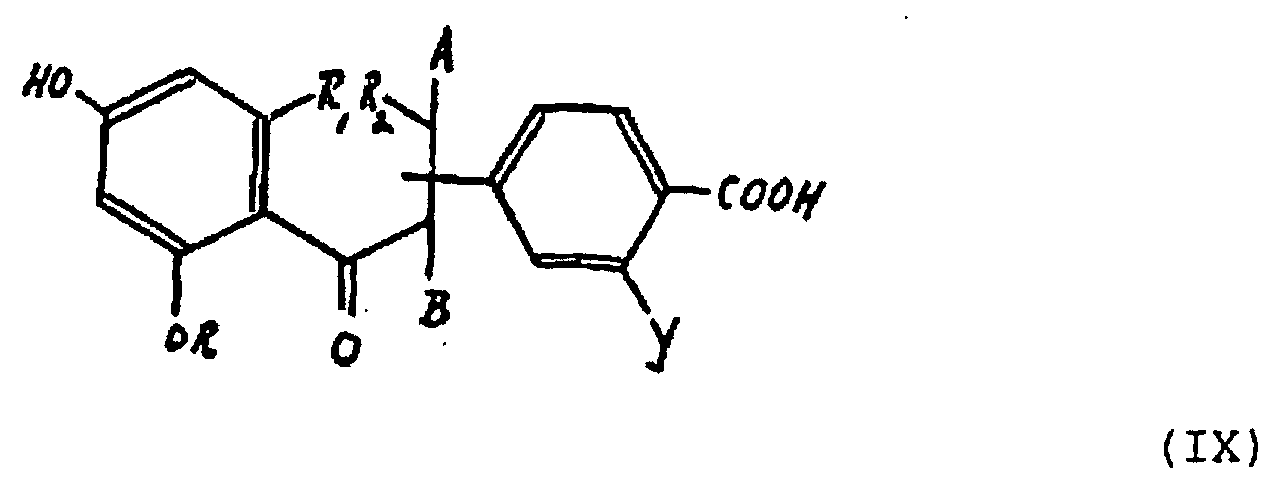
- the compound of formula IX can be prepared in a manner known per se for related compounds from a compound of the general formula obtained a described above.
- the formula X compound is converted to its diazonium salt, which compound is then carboxylated to substitute a -COOH group for the -N 2 + substituent.
- the carboxylation reaction can conveniently be carried out with carbon monoxide and sodium acetate in the presence of a noble-metal catalyst such as palladium acetate.
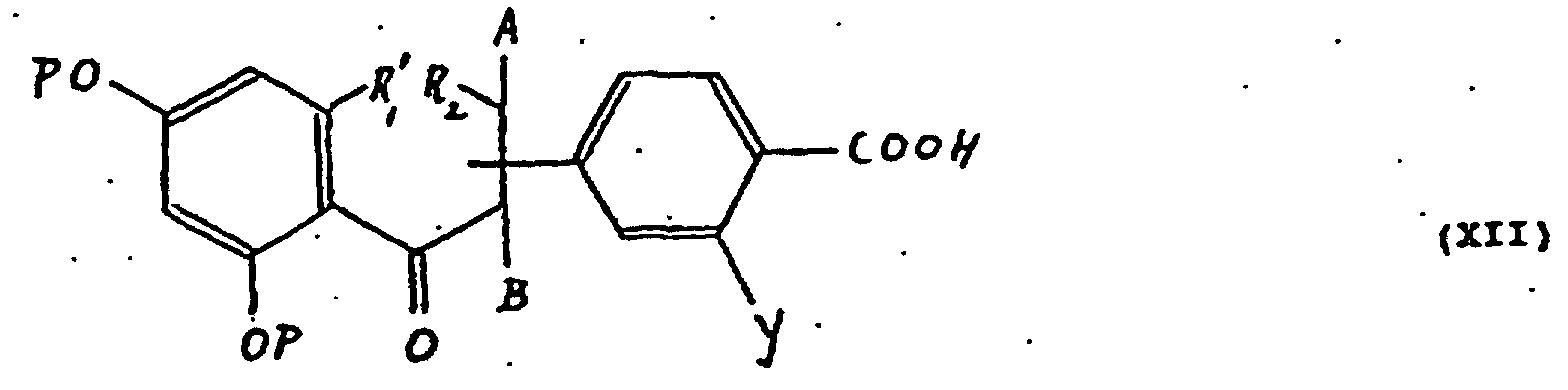
- the compound of formula XI can be prepared in a manner known per for related compounds from a hydroxy-protected derivative of compound IX, viz. from a compound of the general formula wherein P is a hydroxy-protecting group, R 1 ' is a protected hydroxy group or forms together with R 2 an oxygen atom, and which compound can be obtained in a corresponding manner as said formula IX compound.
- the carboxy group of the formula XII compound is first derivatized to allow reaction with glycine.
- a suitable derivatizing agent is N-hydroxyauccinimide to produce the N-succinimidyl ester of the formula XII compound, which smoothly reacts with glycine to produce, after deprotection of the phenolic hydroxy groups, the desired compound of formula XI.
- the phenolic hydroxy groups may be protected in the form of alkyl ethers, e.g. methyl ethers, or as silyl ethers, e.g. trialkylsilyl ethers. Deprotection depends on the type of the protecting group: deprotection of alkyl ethers may occur e.g. with a borium trihalogenide, deprotection of silyl ethers e.g. with a fluoride, e.g. a tetraalkylammonium fluoride.
- Certain substituted 4H-1-benzopyran-4-ones are also suitable starting compounds for the above halogen exchange reaction.
- These compounds having the general formula wherein Y and Z' have the above-defined meanings, are prepared by converting a compound of the general formula wherein P is a hydroxy-protecting group, and which compound can be obtained in a corresponding manner as the above formula VI compound, with sodium and ethyl formate, followed by deprotection of the phenolic hydroxy groups.
- the invention further relates to a pharmaceutical composition, comprising in addition to a pharmaceutically acceptable carrier material and, if desired, at least one pharmaceutically acceptable adjuvant, as the active substance a radiohalogenated polyhydric phenol compound as defined above.
- the invention also relates to the use of a radiolabeled polyhydric phenol compound as defined hereinbefore, wherein the radioactive halogen isotope is selected from 123 I, 131 I, 75 Br, 76 Br and 77 Br, for the preparation of a diagnostic composition for detecting and locating tissues and/or processes, having a disturbed glucose metabolism and/or an increased tyrosine kinase activity, in the body of a warm-blooded living being by (i) administering to said being said composition in a quantity sufficient for external imaging, and thereupon (ii) subjecting said being to external imaging to determine the targeted sites in the body of said being in relation to the background activity.
- a radiolabeled polyhydric phenol compound as defined hereinbefore, wherein the radioactive halogen isotope is selected from 123 I, 131 I, 75 Br, 76 Br and 77 Br
- the above-defined halogen isotopes are particularly suitable for diagnostic purposes.
- the such-labelled polyhydric phenol compounds are promising tools in the detection and location of tissues and/or , processes, having a disturbed glucose metabolism and/or an increased tyrosine kinase activity, already in an early stage of their development, so that a therapeutic treatment can be chosen which is most effective for the patient in question.
- the invention also relates to the use of a radiolabeled polyhydric phenol compound as defined hereinbefore, wherein the radioactive halogen isotope is 123 I or 125 I, preferably 125 I, for the preparation of a diagnostic composition for intraoperatively detecting and locating tissues, having a disturbed glucose metabolism and/or an increased tyrosine kinase activity, in the body of a warm-blooded living being, by (1) administering to said being a composition comprising, in a quantity sufficient for detection by a gamma detecting probe, the said composition, and thereupon (ii), after allowing the active substance to be taken up in said tissues and after blood clearance of radioactivity, subjecting said being to a radioimmunodetection technique in the relevant area of the body of said being, by using a gamma detecting probe.
- the above iodine-isotope viz. in particular 125 I, allows the use of a such-labelled polyhydric phenol compound in the technique of radioguided surgery, wherein relevant tissues in the body of a patient can be detected and located intraoperatively by means of a gamma detecting probe.
- the surgeon can, intraoperatively, use this probe to find the lesions in which uptake of the compound labelled with 123 I or 125 I, preferably with 125 I, which is a low-energy gamma photon emittor, has taken place.
- the polyhydric phenol compounds of the invention can be used for the therapeutic treatment of these tumours, so the invention finally relates to a method of therapeutically treating tumours, having an increased glucose uptake and/or an increased tyrosine kinase activity, in the body of a warm-blooded living being, which comprises administering to said being a composition comprising, in a quantity effective for combating or controlling tumours, a radiolabelled polyhydric phenol compound as defined hereinbefore, wherein the radioactive halogen isotope is selected from 124 I, 125 I,and 131 I.
- the debromination is carried out by adding successively 5 ml bidistillated water and 1 ml saturated sodium sulphite solution to the residue.
- the obtained suspension is adjusted to pH 9 by 0.3 N NaOH solution and allowed to stand for 15 min.
- After adjusting the pH to 1.5 with diluted sulphuric acid the solution is filtered and dried.
- the desired product (7) is obtained after successive recrystallization from MeOH/H 2 O and extraction with diisopropylether in a yield of 49 mg.
- the product obtained is identified by HPLC (see above) and appeared to be 99% pure compound (7). The identity of this final product is confirmed by NMR and MS.
- the halogen exchange reaction is carried out by dissolving 1.2 mg 3-bromophloretin, obtained according to (a) above, into 5 ⁇ l 100% HOAc, and adding 450 ⁇ l stock solution and 60 ⁇ l Cu-solution to this solution of the phloretin compound.
- the obtained solution is flushed with nitrogen for 5 min.
- 2.2 mCi 131 I (as sodium iodide solution)
- the reaction mixture is kept at 140°C for 60 min.
- the labelling yield is 65%.
- the obtained solution is purified by HPLC (see above).
- the separated 3- 131 I-phloretin solution is collected, preconcentrated and eluted with 250 ⁇ l EtOH, yielding the desired product with an activity of 0.92 mCi.
- 3- 125 I-phloretin and 3- 123 I-phloretin are prepared from 3-bromophloretin, using 125 I-sodium iodide and 123 I-sodium iodide, respectively.
- hexokinase-model is used as a model system for the glucose-transport proteins, which play a paramount role in the glucose metabolism.
- 3-I-phloretin is approx. 2 times a more potent inhibitor for hexokinase than the original phloretin.
- halogenated phloretin is a potentially promising tool in the therapeutic treatment of tumours.
- the order of magnitude of the Ki values will be lower, but the relative potency will remain.
- Binding to certain cancer cells viz. YAk1 mice lymphoma cells (10 6 cells/ml incubation medium) is compared with binding to erythrocytes of a young healthy man (10 6 cells/ml incubation medium), because erythocytes are typical reference cells for glucose transport studies.
- the incubation media are respectively:
- Each 1 ml essay contains 5% of foetal calf serum and is spiked (50 ⁇ l) with 3- 125 I-phloretin (initial activity is measured). After 15 min incubation at 37°C, the suspension is centrifuged and the precipitate is resuspended with 1 ml cold buffer which is discarded after a second centrifugation. The final radioactive precipitate is suspended in 1 ml water and measured. The bound radioactivity is related to the initial activity. Saturation binding of 3- 125 I-phloretin to 5.10 6 erythrocytes is performed in RPMI-buffer and Tris-buffer of pH 8.
- the binding experiments are performed at pH 8, because this is the pH of the RPMI buffer needed for optimum YAK1 cells growth. Incubation for 15 min at 37°C. Inhibition is studied by pre-incubation (15 min, 37°C) of the erythrocytes in buffer containing 2.10 -4 M 3-Br-phloretin. After centrifugation, the Br-phloretin - containing solution is discarded and the precipitate washed with ice-cooled buffer. After a second centrifugation, the supernatant is discarded and the cells are resuspended in buffer containing 3- 125 I-phloretin. After incubation for 15 min at 37°C, the same above procedure is applied.
- Phloretin is a weak acid (pK is approx. 7.3); only the uncharged (non-dissociated) form inhibits red cell glucose transport (Jennings et al., see above). Therefore the values mentioned hereinafter are corrected for dissociation.
- N.C.A. 3- 125 I-phloretin up to higher concentrations and C.A. conditions (3-Br-phloretin used as analogue) two types of binding are obseved:
- the in vivo distribution in rats is determined by injecting approx. 10 ⁇ Ci of the compound to be evaluated into the tail vein of the test animals.
- the test animals are sacrificed at appropriate time intervals after injection and the radioactivity of the organs of interest is measured by gamma scintillation counting.
- the observed high uptake in the lungs points to a high uptake in the endothelial cells.
- the uptake of N.C.A. and C.A. 3-*I-phloretin in lung versus blood (L/B) is presented as a function of the time. Glucose uptake in myocardial cells and in myoblaste are known to be rate limited.
- Figures 4 and 5 present the uptake of N.C.A. and C.A. 3-*I-phloretin in heart and muscle, respectively, in relation to the uptake in blood ((H/B and M/B, respectively), as a function of the time.
- the uptake in the heart and muscle reaching a maximum value around respectively 15 min and 30 min post-injection, is apparently saturable, as appears from the decreased uptake in the presence of Br-phloretin. This points to a high affinity site uptake. From the results obtained, the conclusion can be drawn, that 3-*I-phloretin, in particular 3- 123 I-phloretin, is potentially a promising tracer to study early myocardial uptake and pathologies related to muscle.
Landscapes
- Chemical & Material Sciences (AREA)
- Organic Chemistry (AREA)
- Health & Medical Sciences (AREA)
- Life Sciences & Earth Sciences (AREA)
- General Health & Medical Sciences (AREA)
- Epidemiology (AREA)
- Pharmacology & Pharmacy (AREA)
- Chemical Kinetics & Catalysis (AREA)
- Molecular Biology (AREA)
- Biochemistry (AREA)
- Proteomics, Peptides & Aminoacids (AREA)
- Physics & Mathematics (AREA)
- Medicinal Chemistry (AREA)
- Optics & Photonics (AREA)
- Veterinary Medicine (AREA)
- Public Health (AREA)
- Animal Behavior & Ethology (AREA)
- Engineering & Computer Science (AREA)
- Biotechnology (AREA)
- Genetics & Genomics (AREA)
- Medicines Containing Antibodies Or Antigens For Use As Internal Diagnostic Agents (AREA)
- Organic Low-Molecular-Weight Compounds And Preparation Thereof (AREA)
Abstract
Claims (14)
- Composés phénoliques polyhydriques ayant la formule généraledans laquelle
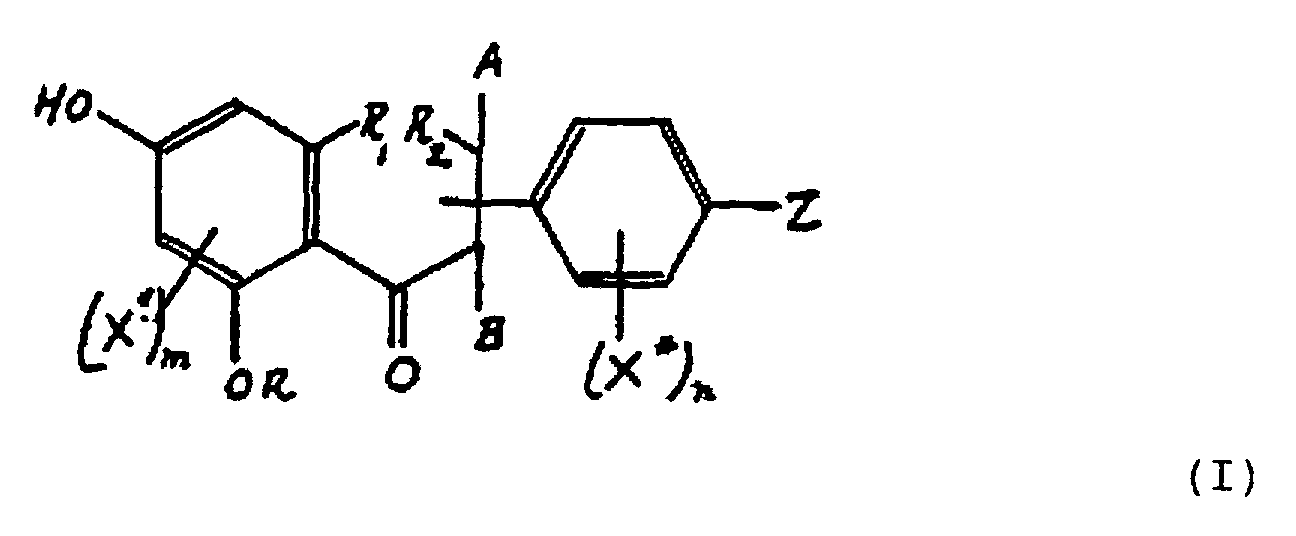
R est un atome d'hydrogène ou un groupe saccharide ;
A et B sont des atomes d'hydrogène ou forment ensembles une liaison C-C ;
R1 est un groupe hydroxyle et R2 est un atome d'hydrogène, ou
R1 et R2 forment ensembles un atome d'oxygène ;
Z est un groupe hydroxyle, un groupe amino, un groupe carboxyle ou un groupe N-(carboxyméthyl) carbamoyle ;
X* est un isotope halogène radioactif; et
m et n sont 0 ou 1, sous réserve que m est 1 si n est 0, et que m est 0 si n est 1. - Composés phénoliques selon la revendication 1, ayant la formule généraledans laquelle

R, R1, R2, Z, A et B ont les significations indiquées dans la revendication 1 ; et
Y* est un isotope halogène radioactif choisi parmi 123I, 124I, 125I, 131I, 75Br, 76Br, 77Br et 82Br. - Composés phénoliques selon la revendication 2, ayant la formule généraledans laquelle

R et Z ont les significations indiquées dans la revendication 1 ; et
Y* a la signification donnée dans la revendication 2. - Procédé de préparation d'un composé phénolique polyhydrique radio-halogéné selon la revendication 1,
caractérisé en ce qu'un composé ayant la formule généraledans laquelle
R, R1, R2, Z, A, B, m et n ont les significations indiquées dans la revendication 1 ; et
Y* a la signification donnée dans la revendication 2 ;
est préparé en faisant réagir un composé ayant la formule généraledans laquelle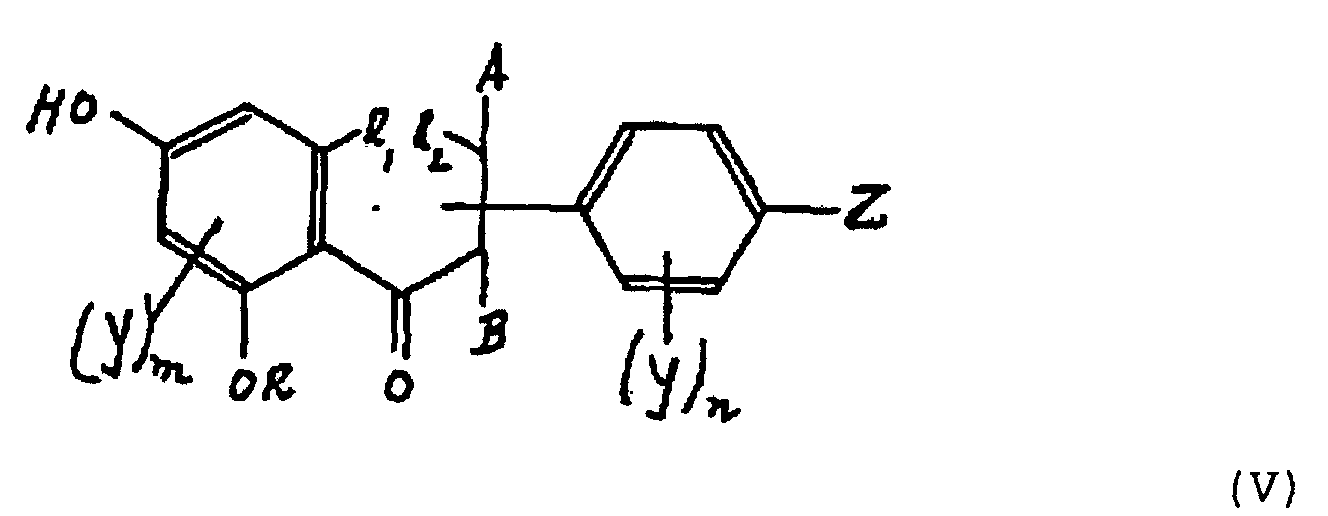
Y est un atome de brome un atome d'iode non radioactif ;
avec un halogénure hydrosoluble, choisi parmi 123I-, 124I-, 125I-, 131I-, 75Br-, 76Br-, 77Br- et 82Br-, en présence d'ions de cuivre (I), d'un acide hydrosoluble et d'un agent réducteur. - Procédé de préparation d'un composé destiné à être utilisé en tant que composé de départ pour la réaction selon la revendication 4, caractérisé en ce qu'un composé phénolique polyhydrique substitué par un halogène ayant la formule généraledans laquelle Y a la signification donnée dans la revendication 4,
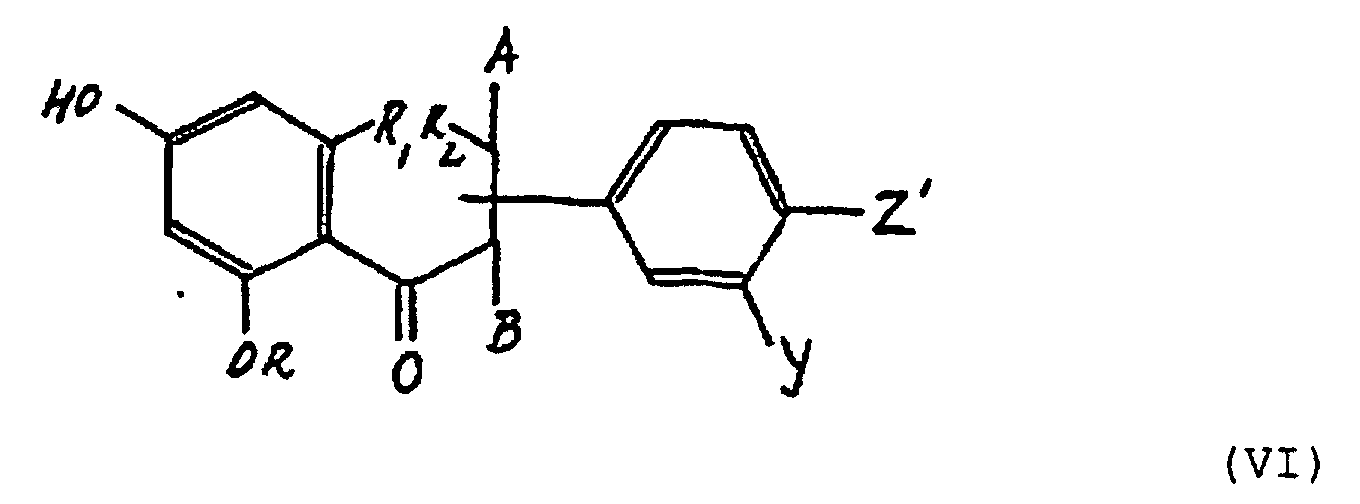
Z'est un groupe hydroxyle ou un groupe amino, et
les autres symboles ont les significations données dans la revendication 1 ;
est préparé par:(a) bromation d'un composé ayant la formule généraleen présence d'un acide hydrosoluble, produisant un composé ayant la formule générale suivie
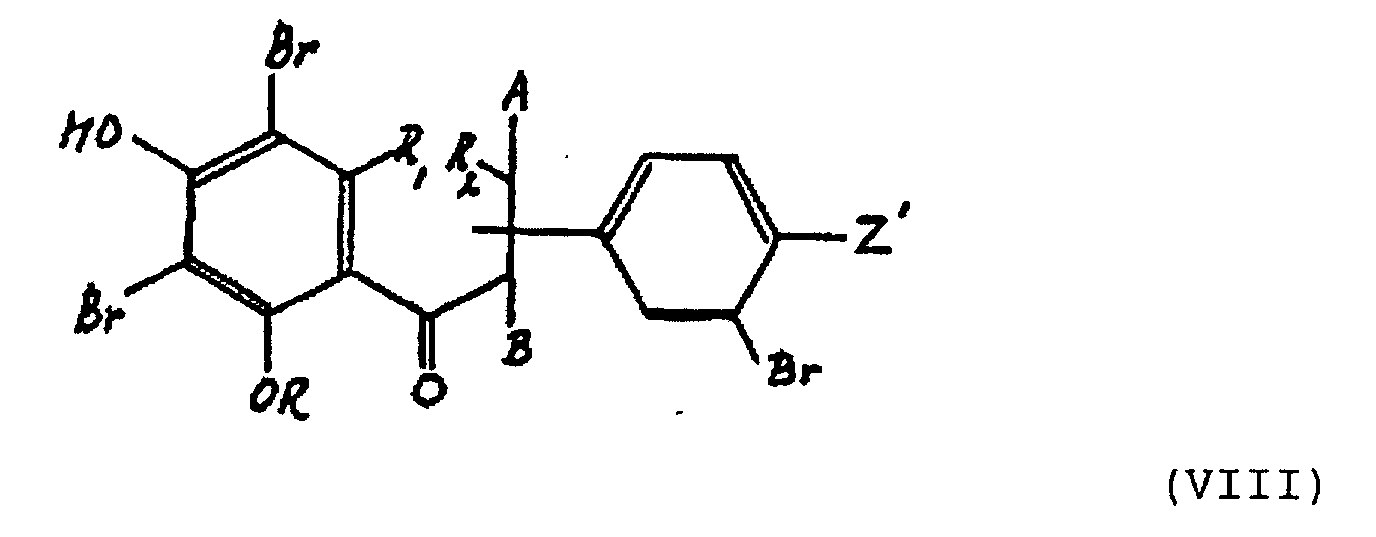 (b) d'une réaction de débromation sous l'influence d'un agent réducteur approprié et d'une base hydrosoluble forte, produisant un composé ayant la formule générale VI, dans laquelle Y est un substituant bromo ; et, si désiré, suivie(c) d'une réaction d'échange d'halogène afin de substituer le substituant bromo par un substituant iodo dans ledit composé de formule VI.
- Procédé de préparation d'un composé destiné à être utilisé en tant que composé de départ pour la réaction selon la revendication 4, caractérisé en ce qu'un composé phénolique polyhydrique substitué par un halogène ayant la formule généraledans laquelle Y a la signification donnée dans la revendication 4, et les autres symboles ont les significations données dans la revendication 1,
est préparé en convertissant un composé ayant la formule généraleobtenu selon le procédé selon la revendication 5,
en le sel de diazonium correspondant,
suivi d'une réaction de carboxylation pour substituer le substituant -N2 + par un groupe -COOH. - Procédé de préparation d'un composé destiné à être utilisé en tant que composé de départ pour la réaction selon la revendication 4, caractérisé en ce qu'un composé phénolique polyhydrique substitué par un halogène ayant la formule généraledans laquelle Y a la signification donnée dans la revendication 4, et les autres symboles ont les significations données dans la revendication 1,

est préparé en convertissant un composé ayant la formule généraledans laquelle P est un groupe protecteur du groupe hydroxyle, et
R1 est un groupe hydroxyle protégé ou forme avec R2 un atome d'oxygène,
obtenu d'une manière correspondante à celle décrite dans la revendication 6 pour la préparation du composé de formule IX,
en un dérivé du composé XI ayant le groupe hydroxyle protégé,
suivi d'une déprotection. - Procédé de préparation d'un composé destiné à être utilisé en tant que composé de départ pour la réaction selon la revendication 4, caractérisé en ce qu'un composé phénolique polyhydrique substitué par un halogène ayant la formule généraledans laquelle Y a la signification donnée dans la revendication 4, et

Z' a la signification donnée dans la revendication 5, est préparé en convertissant un composé ayant la formule généraledans laquelle P est un groupe protecteur du groupe hydroxyle,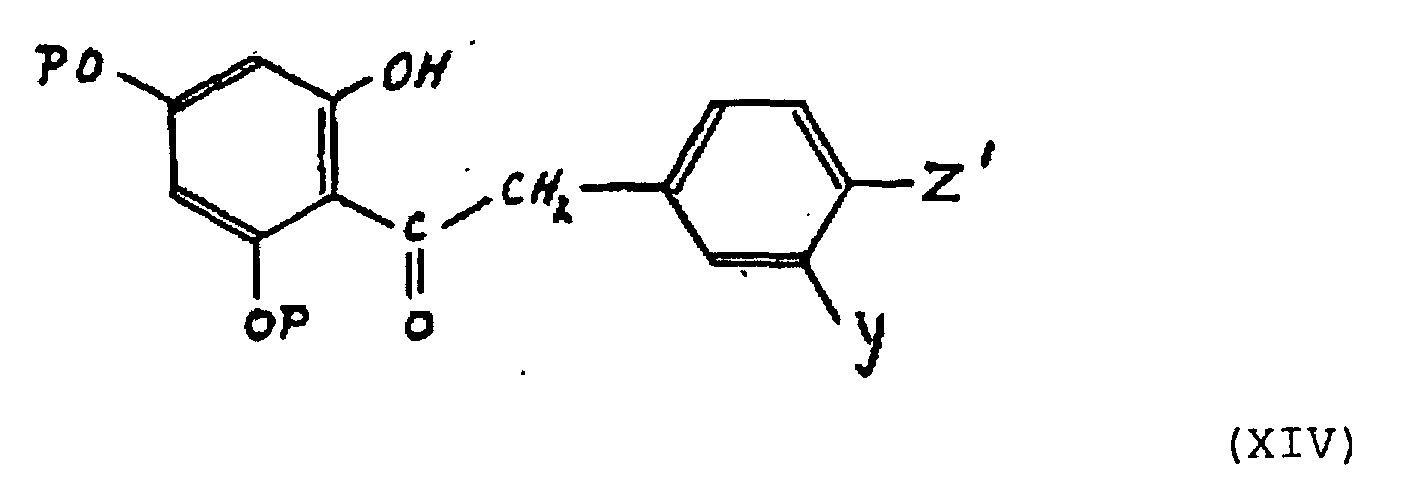
obtenu d'une manière correspondante à celle décrite dans la revendication 5 pour la préparation du composé de formule VI,
avec du sodium et du formiate d'éthyle,
suivi d'une déprotection. - Composés phénoliques polyhydriques substitué par un halogène ayant la formule généraledans laquelle Y a la signification donnée dans la revendication 4, et
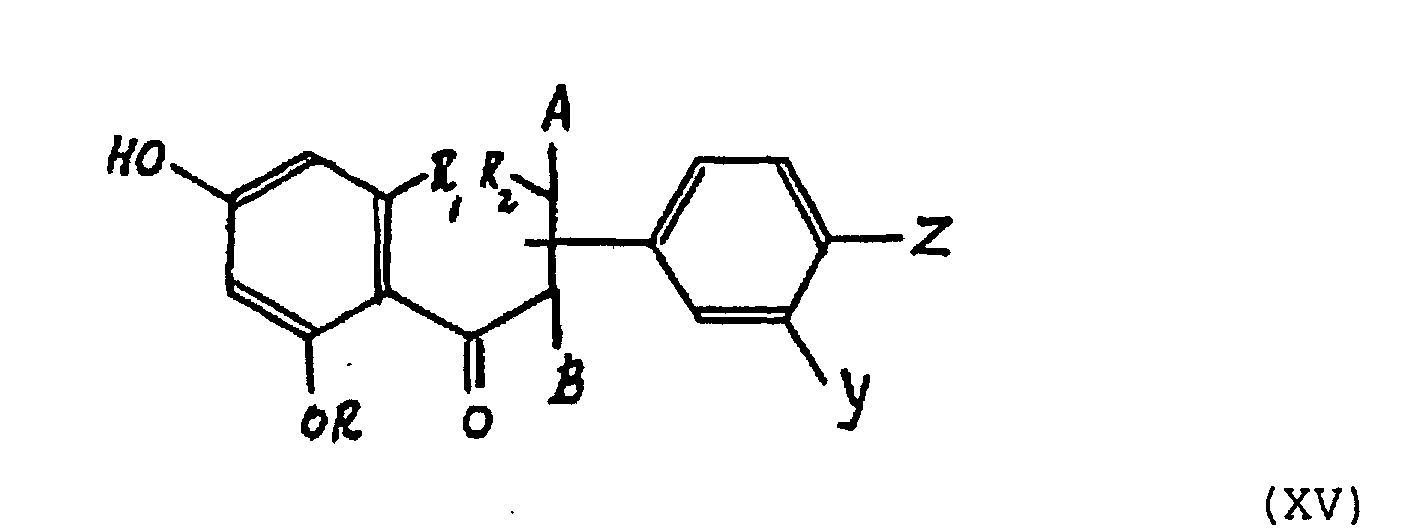
les autres symboles ont les significations données dans la revendication 1. - Composition pharmaceutique, comprenant en plus d'un matériau support pharmaceutiquement acceptable et, si désiré, au moins un adjuvant pharmaceutiquement acceptable, en tant que substance active un composé phénolique polyhydrique radio-halogéné selon la revendication 1, 2 ou 3.
- Utilisation d'un composé phénolique polyhydrique radio-marqué selon l'une quelconque des revendications 1 à 3, dans laquelle l'isotope halogène radioactif est choisi parmi 123I, 131I, 75Br, 76Br, 77Br, pour la préparation d'une composition de diagnostic permettant de détecter et de localiser des tissus et/ou des procédés, ayant des troubles du métabolisme du glucose et/ou une activité de la tyrosine kinase augmentée, dans le corps d'un être vivant à sang chaud, par (i) administration audit être vivant de ladite composition en une quantité suffisante pour permettre une imagerie externe, puis (ii) soumission dudit être vivant à une imagerie externe pour déterminer les sites ciblés dans le corps dudit être vivant par rapport à l'activité du bruit de fond.
- Utilisation d'un composé phénolique polyhydrique radio-marqué selon l'une quelconque des revendications 1 à 3, dans laquelle l'isotope halogène radioactif est 123I, ou 125I, de préférence 125I, pour la préparation d'une composition de diagnostic permettant de détecter et de localiser en période peropératoire des tissus ayant des troubles du métabolisme du glucose et/ou une activité de la tyrosine kinase augmentée, dans le corps d'un être vivant à sang chaud, par (i) administration audit être vivant d'une composition comprenant ladite composition en une quantité suffisante pour permettre une détection par une sonde de détection gamma, puis (ii), après avoir attendu l'absorption de la substance active dans lesdits tissus et après avoir éliminé la radioactivité dans le sang, soumission dudit être vivant à une technique de radio-immunodétection dans la zone appropriée du corps dudit être vivant, en utilisant une sonde de détection gamma.
- Utilisation d'un composé phénolique polyhydrique radio-marqué selon l'une quelconque des revendications 1 à 3, dans laquelle l'isotope halogène radioactif est choisi parmi 124I, 125I et 131I, pour la préparation d'une composition thérapeutique pour traiter des tumeurs, ayant une assimilation de glucose augmentée et/ou une activité de la tyrosine kinase augmentée, dans le corps d'un être vivant à sang chaud, laquelle comprend l'administration audit être vivant d'une composition en une quantité efficace pour combattre ou contrôler les tumeurs.
- Composé ayant la formule généraledans laquelle P est un groupe protecteur de groupe hydroxyle, et R1 est un groupe hydroxyle protégé ou forme avec R2 un atome d'oxygène.
Priority Applications (1)
| Application Number | Priority Date | Filing Date | Title |
|---|---|---|---|
| EP94904849A EP0674530B1 (fr) | 1992-12-21 | 1993-12-16 | Composes radiomarques de phenols polyhydriques |
Applications Claiming Priority (4)
| Application Number | Priority Date | Filing Date | Title |
|---|---|---|---|
| EP92204044 | 1992-12-21 | ||
| EP92204044 | 1992-12-21 | ||
| EP94904849A EP0674530B1 (fr) | 1992-12-21 | 1993-12-16 | Composes radiomarques de phenols polyhydriques |
| PCT/US1993/012272 WO1994014477A1 (fr) | 1992-12-21 | 1993-12-16 | Composes de phenol polyhydriques |
Publications (3)
| Publication Number | Publication Date |
|---|---|
| EP0674530A1 EP0674530A1 (fr) | 1995-10-04 |
| EP0674530A4 EP0674530A4 (fr) | 1996-08-21 |
| EP0674530B1 true EP0674530B1 (fr) | 2004-09-01 |
Family
ID=8211160
Family Applications (1)
| Application Number | Title | Priority Date | Filing Date |
|---|---|---|---|
| EP94904849A Expired - Lifetime EP0674530B1 (fr) | 1992-12-21 | 1993-12-16 | Composes radiomarques de phenols polyhydriques |
Country Status (5)
| Country | Link |
|---|---|
| US (1) | US5741476A (fr) |
| EP (1) | EP0674530B1 (fr) |
| AU (1) | AU5871894A (fr) |
| DE (1) | DE69333611T2 (fr) |
| WO (1) | WO1994014477A1 (fr) |
Families Citing this family (9)
| Publication number | Priority date | Publication date | Assignee | Title |
|---|---|---|---|---|
| US5780008A (en) * | 1995-06-20 | 1998-07-14 | Mallinckrodt Medical, Inc. | Polyhdric phenol compounds |
| GB9621757D0 (en) * | 1996-10-18 | 1996-12-11 | Ciba Geigy Ag | Phenyl-substituted bicyclic heterocyclyl derivatives and their use |
| KR100270410B1 (ko) * | 1997-03-06 | 2000-11-01 | 성재갑 | 타이로시네이즈 활성 저해능을 갖는 신규 1,3-디페닐프로판 유도체 및 그의 제조방법 |
| US8932557B2 (en) | 2008-02-14 | 2015-01-13 | Eli Lilly And Company | Imaging agents for detecting neurological dysfunction |
| EP2599763A1 (fr) * | 2008-02-14 | 2013-06-05 | Siemens Molecular Imaging, Inc. | Nouveaux agents d'imagerie pour la détection d'un dysfonctionnement neurologique |
| WO2010011964A2 (fr) | 2008-07-24 | 2010-01-28 | Siemens Medical Solutions Usa, Inc. | Agents d'imagerie utiles pour identifier une pathologie |
| WO2010039815A1 (fr) * | 2008-09-30 | 2010-04-08 | Case Western Reserve University | Sondes moléculaires pour l’imagerie de la myéline |
| CN102438660A (zh) | 2009-03-23 | 2012-05-02 | 美国西门子医疗解决公司 | 用于检测神经障碍的显像剂 |
| US8691187B2 (en) | 2009-03-23 | 2014-04-08 | Eli Lilly And Company | Imaging agents for detecting neurological disorders |
Family Cites Families (14)
| Publication number | Priority date | Publication date | Assignee | Title |
|---|---|---|---|---|
| FR5443M (fr) * | 1966-04-26 | 1967-10-09 | ||
| US3949085A (en) * | 1970-05-27 | 1976-04-06 | Chinoin Gyogyszer-Es Vegyeszeti Termakek Gyara Rt | Anabolic-weight-gain promoting compositions containing isoflavone derivatives and method using same |
| US4151179A (en) * | 1975-03-12 | 1979-04-24 | Fisons Limited | 2-(4H-1-Benzopyran-6-yl)propionic acids |
| JPS58225083A (ja) * | 1982-06-23 | 1983-12-27 | Nippon Shinyaku Co Ltd | メチルフラボン誘導体 |
| JPS5967281A (ja) * | 1982-09-30 | 1984-04-16 | Yamamoto Kagaku Kogyo Kk | 3−メチルフラボン−8−カルボン酸誘導体及びその製造法 |
| CA1289077C (fr) * | 1984-08-13 | 1991-09-17 | Harry H. Leveen | Traitement du cancer a l'aide de la phlorizine et de ses derives |
| US4760135A (en) * | 1984-09-06 | 1988-07-26 | University Of Kentucky Research Foundation | Phloretin and phlorizin derivative containing compounds |
| US5030417A (en) * | 1984-09-19 | 1991-07-09 | Mayo Foundation For Medical Education And Research | Method and kit to assay for steroid receptor functionality in cancerous cells |
| DE3505611A1 (de) * | 1984-11-26 | 1986-05-28 | Merck Patent Gmbh, 6100 Darmstadt | Halogen-hydroxy-flavone |
| JPS62201882A (ja) * | 1985-11-18 | 1987-09-05 | Yamanouchi Pharmaceut Co Ltd | イソフラボン誘導体 |
| ZA873745B (en) * | 1986-06-04 | 1988-10-26 | Daiichi Seiyaku Co | Benzopyran derivatives |
| DE3715779A1 (de) * | 1987-05-12 | 1988-11-24 | Kali Chemie Pharma Gmbh | Flavon-3-carbonsaeure-verbindungen sowie verfahren, zwischenprodukte zu ihrer herstellung und diese verbindungen enthaltende arzneimittel |
| FR2633182B1 (fr) * | 1988-06-23 | 1993-07-23 | Beljanski Mirko | Composition pharmaceutique anticancereuse et methode d'utilisation de l'invention |
| DE4011187A1 (de) * | 1990-04-06 | 1991-10-10 | Hoechst Ag | Substituierte 3-thia- bzw. 3-oxa-alkyl-flavone, verfahren zu ihrer herstellung, verwendung derselben, arzneimittel auf basis dieser verbindungen sowie zwischenprodukte |
-
1993
- 1993-12-16 EP EP94904849A patent/EP0674530B1/fr not_active Expired - Lifetime
- 1993-12-16 US US08/491,841 patent/US5741476A/en not_active Expired - Fee Related
- 1993-12-16 WO PCT/US1993/012272 patent/WO1994014477A1/fr not_active Ceased
- 1993-12-16 DE DE69333611T patent/DE69333611T2/de not_active Expired - Fee Related
- 1993-12-16 AU AU58718/94A patent/AU5871894A/en not_active Abandoned
Also Published As
| Publication number | Publication date |
|---|---|
| DE69333611T2 (de) | 2005-09-15 |
| US5741476A (en) | 1998-04-21 |
| DE69333611D1 (de) | 2004-10-07 |
| AU5871894A (en) | 1994-07-19 |
| EP0674530A4 (fr) | 1996-08-21 |
| WO1994014477A1 (fr) | 1994-07-07 |
| EP0674530A1 (fr) | 1995-10-04 |
Similar Documents
| Publication | Publication Date | Title |
|---|---|---|
| US5219548A (en) | High affinity halogenated-tamoxifen derivatives and uses thereof | |
| US5302370A (en) | Chelating agents for forming complexes with radioactive isotopes, metal complexes thereof and use thereof in diagnosis and therapy | |
| EP4215523A1 (fr) | Composé d'isochromane | |
| CA2715390A1 (fr) | Agents d'imagerie pour la detection d'une dysfonction neurologique | |
| US5741476A (en) | Polyhydric phenol compounds | |
| EP1119356B1 (fr) | Antagonistes radiomarques du recepteur de la neurokinine 1 | |
| WO2022077923A1 (fr) | Dérivé de glucose contenant un noyau benzénique et son application | |
| HUT73665A (en) | Bifunctional-chelating agents braked with calcogene atoms, pharmaceutical compositions containing them , and use of these compositions in radio- diagnosis and radiotherapy | |
| CA2454228C (fr) | Antagonistes radiomarques du recepteur y5 du neuropeptide y | |
| CN110183493B (zh) | 一种99m锝标记配合物及其在诊断非小细胞肺癌中的应用 | |
| EP0853488A2 (fr) | Agents de chelation amidosulfoniques sulfures bifonctionnels du type xsns pour isotopes radioactifs | |
| WO1992019274A1 (fr) | Chelates de technetium utilisables pour l'examen de la fonction renale | |
| CA2665494C (fr) | 2-nitroimidazoles faiblement basiques pour la detection non invasive d'une hypoxie tissulaire | |
| US5534497A (en) | Technetium chelates to be used for determining the renal function | |
| JP4116793B2 (ja) | 新規ニトロイミダゾール誘導体及びこれを含む画像診断薬 | |
| EP4299569A1 (fr) | Composé de thiénopyrimidinedione d'acide 5-carboxylique substitué polycyclique fusionné et son utilisation | |
| US5780008A (en) | Polyhdric phenol compounds | |
| EP3721907B1 (fr) | Dérivés d'inhibiteur de psma pour l'étiquetage au 99mtc via hynic, kit radiopharmaceutique, préparations radiopharmaceutiques et leur utilisation dans le diagnostic du cancer de la prostate | |
| EP3216796B1 (fr) | Composé de phosphonium et son procédé de production | |
| JP3522754B2 (ja) | 多価フェノール化合物類 | |
| CN114605450B (zh) | 一种含硼苄胍类化合物及其合成与其在制备诊疗一体化药物中的应用 | |
| JP3190615B2 (ja) | 放射性医薬品の製造方法及びキット | |
| WO2007096194A1 (fr) | Dérivés radiomarqués d'isoxazole pouvant être employés dans le marquage et le diagnostic de la fonctionnalité de hsp90 | |
| Lutz et al. | The effect of iodine position on uptake in the mouse using an isomeric series of 2‐deoxy‐2‐O‐([123I]‐iodobenzyl) glucoses | |
| EP0391554B1 (fr) | Ligands pour récepteurs de dopamine et agents de visualisation |
Legal Events
| Date | Code | Title | Description |
|---|---|---|---|
| PUAI | Public reference made under article 153(3) epc to a published international application that has entered the european phase |
Free format text: ORIGINAL CODE: 0009012 |
|
| 17P | Request for examination filed |
Effective date: 19950608 |
|
| AK | Designated contracting states |
Kind code of ref document: A1 Designated state(s): DE FR |
|
| A4 | Supplementary search report drawn up and despatched |
Effective date: 19960709 |
|
| AK | Designated contracting states |
Kind code of ref document: A4 Designated state(s): DE FR |
|
| RAP1 | Party data changed (applicant data changed or rights of an application transferred) |
Owner name: MALLINCKRODT INC. |
|
| 17Q | First examination report despatched |
Effective date: 20020710 |
|
| GRAP | Despatch of communication of intention to grant a patent |
Free format text: ORIGINAL CODE: EPIDOSNIGR1 |
|
| RTI1 | Title (correction) |
Free format text: RADIOLABELED POLYHYDRIC PHENOL COMPOUNDS |
|
| GRAS | Grant fee paid |
Free format text: ORIGINAL CODE: EPIDOSNIGR3 |
|
| GRAA | (expected) grant |
Free format text: ORIGINAL CODE: 0009210 |
|
| RIC1 | Information provided on ipc code assigned before grant |
Ipc: 7C 07B 59/00 B Ipc: 7C 07H 15/00 B Ipc: 7C 07D 311/04 B Ipc: 7C 07C 211/00 B Ipc: 7C 07C 49/00 B Ipc: 7A 61K 51/00 A |
|
| AK | Designated contracting states |
Kind code of ref document: B1 Designated state(s): DE FR |
|
| REF | Corresponds to: |
Ref document number: 69333611 Country of ref document: DE Date of ref document: 20041007 Kind code of ref document: P |
|
| ET | Fr: translation filed | ||
| PLBE | No opposition filed within time limit |
Free format text: ORIGINAL CODE: 0009261 |
|
| STAA | Information on the status of an ep patent application or granted ep patent |
Free format text: STATUS: NO OPPOSITION FILED WITHIN TIME LIMIT |
|
| 26N | No opposition filed |
Effective date: 20050602 |
|
| PGFP | Annual fee paid to national office [announced via postgrant information from national office to epo] |
Ref country code: FR Payment date: 20061220 Year of fee payment: 14 |
|
| PGFP | Annual fee paid to national office [announced via postgrant information from national office to epo] |
Ref country code: DE Payment date: 20070131 Year of fee payment: 14 |
|
| PG25 | Lapsed in a contracting state [announced via postgrant information from national office to epo] |
Ref country code: DE Free format text: LAPSE BECAUSE OF NON-PAYMENT OF DUE FEES Effective date: 20080701 |
|
| REG | Reference to a national code |
Ref country code: FR Ref legal event code: ST Effective date: 20081020 |
|
| PG25 | Lapsed in a contracting state [announced via postgrant information from national office to epo] |
Ref country code: FR Free format text: LAPSE BECAUSE OF NON-PAYMENT OF DUE FEES Effective date: 20071231 |