EP0676771B1 - Cycle du combustible nucleaire - Google Patents
Cycle du combustible nucleaire Download PDFInfo
- Publication number
- EP0676771B1 EP0676771B1 EP19940929675 EP94929675A EP0676771B1 EP 0676771 B1 EP0676771 B1 EP 0676771B1 EP 19940929675 EP19940929675 EP 19940929675 EP 94929675 A EP94929675 A EP 94929675A EP 0676771 B1 EP0676771 B1 EP 0676771B1
- Authority
- EP
- European Patent Office
- Prior art keywords
- fuel
- nitride
- uranium
- fuels
- plutonium
- Prior art date
- Legal status (The legal status is an assumption and is not a legal conclusion. Google has not performed a legal analysis and makes no representation as to the accuracy of the status listed.)
- Expired - Lifetime
Links
Images

Classifications
-
- C—CHEMISTRY; METALLURGY
- C22—METALLURGY; FERROUS OR NON-FERROUS ALLOYS; TREATMENT OF ALLOYS OR NON-FERROUS METALS
- C22B—PRODUCTION AND REFINING OF METALS; PRETREATMENT OF RAW MATERIALS
- C22B60/00—Obtaining metals of atomic number 87 or higher, i.e. radioactive metals
- C22B60/02—Obtaining thorium, uranium, or other actinides
-
- G—PHYSICS
- G21—NUCLEAR PHYSICS; NUCLEAR ENGINEERING
- G21C—NUCLEAR REACTORS
- G21C1/00—Reactor types
- G21C1/02—Fast fission reactors, i.e. reactors not using a moderator ; Metal cooled reactors; Fast breeders
- G21C1/022—Fast fission reactors, i.e. reactors not using a moderator ; Metal cooled reactors; Fast breeders characterised by the design or properties of the core
-
- G—PHYSICS
- G21—NUCLEAR PHYSICS; NUCLEAR ENGINEERING
- G21C—NUCLEAR REACTORS
- G21C19/00—Arrangements for treating, for handling, or for facilitating the handling of, fuel or other materials which are used within the reactor, e.g. within its pressure vessel
- G21C19/42—Reprocessing of irradiated fuel
- G21C19/44—Reprocessing of irradiated fuel of irradiated solid fuel
-
- G—PHYSICS
- G21—NUCLEAR PHYSICS; NUCLEAR ENGINEERING
- G21C—NUCLEAR REACTORS
- G21C3/00—Reactor fuel elements and their assemblies; Selection of substances for use as reactor fuel elements
- G21C3/02—Fuel elements
- G21C3/04—Constructional details
- G21C3/16—Details of the construction within the casing
-
- G—PHYSICS
- G21—NUCLEAR PHYSICS; NUCLEAR ENGINEERING
- G21C—NUCLEAR REACTORS
- G21C3/00—Reactor fuel elements and their assemblies; Selection of substances for use as reactor fuel elements
- G21C3/42—Selection of substances for use as reactor fuel
- G21C3/58—Solid reactor fuel Pellets made of fissile material
- G21C3/62—Ceramic fuel
-
- Y—GENERAL TAGGING OF NEW TECHNOLOGICAL DEVELOPMENTS; GENERAL TAGGING OF CROSS-SECTIONAL TECHNOLOGIES SPANNING OVER SEVERAL SECTIONS OF THE IPC; TECHNICAL SUBJECTS COVERED BY FORMER USPC CROSS-REFERENCE ART COLLECTIONS [XRACs] AND DIGESTS
- Y02—TECHNOLOGIES OR APPLICATIONS FOR MITIGATION OR ADAPTATION AGAINST CLIMATE CHANGE
- Y02E—REDUCTION OF GREENHOUSE GAS [GHG] EMISSIONS, RELATED TO ENERGY GENERATION, TRANSMISSION OR DISTRIBUTION
- Y02E30/00—Energy generation of nuclear origin
- Y02E30/30—Nuclear fission reactors
-
- Y—GENERAL TAGGING OF NEW TECHNOLOGICAL DEVELOPMENTS; GENERAL TAGGING OF CROSS-SECTIONAL TECHNOLOGIES SPANNING OVER SEVERAL SECTIONS OF THE IPC; TECHNICAL SUBJECTS COVERED BY FORMER USPC CROSS-REFERENCE ART COLLECTIONS [XRACs] AND DIGESTS
- Y02—TECHNOLOGIES OR APPLICATIONS FOR MITIGATION OR ADAPTATION AGAINST CLIMATE CHANGE
- Y02W—CLIMATE CHANGE MITIGATION TECHNOLOGIES RELATED TO WASTEWATER TREATMENT OR WASTE MANAGEMENT
- Y02W30/00—Technologies for solid waste management
- Y02W30/50—Reuse, recycling or recovery technologies
Definitions
- This invention relates to the nuclear fuel cycle and, more particularly, to a nuclear fuel cycle for fast reactors and minor actinoids transmutation reactors that use nitride fuels and molten-salt hot pyrochemical reprocessing and group partitioning technology.
- the only nuclear fuel cycle that is commercially used today in nuclear power generation is the combination of a light-water reactor and the wet Purex process.
- the minor actinoids hereunder sometimes abbreviated as MA
- FPs nuclear fission products
- neptunium-237 which is a typical MA has a very long half life (ca. 2 ⁇ 10 6 yr) and involves many problems that need be solved, including the securement of a site for geological disposal, public acceptance (PA) considerations and the establishment of downstream technologies.
- the light-water reactor has a conversion ratio of ca. 0.6 - 0.5.
- the nuclear fuel cycle depending on the combination of the light-water reactor and the Purex process has an inherent limitation on the effective utilization of uranium resources, which is held to be no more than ca 1%.
- a new fuel cycle that is under development is one based on the combination of a uranium-plutonium mixed oxide fueled fast reactor and the Purex process.
- the purpose of its development is to reduce the fuel-cycle costs by enabling the reactor to be constructed at a cost not exceeding 1.5 times the cost for the light-water reactor and by achieving a higher burnup (10 - 15%).
- MOX uranium-plutonium mixed oxide
- MOX uranium-plutonium mixed oxide
- the new fuel cycle requires a fuel doubling time of 50 - 90 yr and the MOX fueled fast reactor which is theoretically a breeder reactor is not anticipated to perform as such in practical applications.
- the smear density is the weight of a unit length of fuel pin as divided by the volumes of the fuel and the thermal bonding agent and expressed in the percentage of the fuel's theoretical density, T.D.
- the studied metal-fueled breeder reactor has a very hard neutron spectrum and is promising as a MA transmutation reactor since it is capable of efficient MA transmutation.
- the metal-fueled breeder reactor has also been demonstrated to have inherent stability. For details of this aspect, see Nucl. Eng. Design, 991, 287 (1986).
- the fuel-cycle cost is calculated to be about 60% of the total MOX fuel-cycle cost and hence is anticipated to be economically competitive with the fuel cycle of the light-water reactor.
- the estimated fuel doubling time in the fuel cycle is 10 - 20 yr which is satisfactory for its use in breeder reactors, providing for a higher utilization of uranium resources that is calculated to be about 60 times the value as achieved in the fuel cycle of the light-water reactor.
- metal fuels, especially the plutonium metal powders are more prone to burn by themselves than uranium metal and will catch fire upon contact with the air atmosphere even at room temperature.
- Another fuel recycle that has been proposed to date is one for the high-temperature gas-cooled reactor.
- the temperature at the outlet for the helium gas coolant can be increased to as high as ca. 1000°C, thereby providing a potential heat efficiency of about 50 % and, at the same time, the heat produced can be utilized in chemical engineering fields other than power generation.
- the coated particulate fuels have uranium dioxide particles (ca. 0.6 mm in diameter) clad, in quadruplicate, with pyrolytic graphite and silicon carbide cladding layers so as to effect FP confinement. This mechanism of confinement is very rugged and provides an excellent style for the preservation and storage of once-through spent fuels. However, the efforts to develop an effective technology for reprocessing spent fuels have not so far proved successful. Therefore, the fuel cycle for the high-temperature gas-cooled reactor is yet to be established at the present stage.
- the present invention has been accomplished under these circumstances and has as an object providing a nuclear fuel cycle that is improved in the technical and economic aspects as exemplified by the inherent safety of nuclear reactors, the short doubling time of fuels and the high utilization of uranium resources.
- Another object of the invention is to insure a high level for the inherent safety of the overall nuclear fuel cycle including fuel processing facilities, nuclear reactor, and reprocessing and partitioning facilities.
- the present inventors conducted intensive studies with a view to attaining these objects of the invention and found that the first object could be achieved by replacing metal fuels with uranium-plutonium mixed nitride and minor actinoid nitride fuels which were by far chemically stabler than metals.
- the present inventors also found that by adopting a reactor design that enabled the nitride fuels to exhibit their advantageous characteristics (e.g., large fuel element density, high melting point and high heat conductivity) to the fullest extent, not only could the fuel-cycle cost be reduced compared to those of MOX and metal fuels but better inherent safety could also be ensured for the overall fuel cycle.
- advantageous characteristics e.g., large fuel element density, high melting point and high heat conductivity
- the present inventors further found by thermodynamic analyses that the pyrochemical reprocessing and partitioning technology that used molten salts in chloride form and which was especially developed for application to metal fuels could also be applied to nitride fuels in such a way as to perform molten-salt electrolysis on uranium nitrides.
- the present invention provides a nuclear fuel containing an uranium-plutonium mixed nitride and characterized in that it further comprises at least a minor actinoid essentially in the form of a nitride.
- the invention provides a sphere packed fuel pin that comprises a nuclear fuel containing an uranium-plutonium mixed nitride and characterized in that it further comprises at least a minor actinoid in the form of a nitride, as well as a sodium thermal bonding agent.
- the invention provides a method of cycling nuclear fuels for use in fast reactors and minor actinoid transmutation reactors, which comprises the steps of :
- minor actinoids means those products that form as a result of the nuclear reaction between uranium-238 and the neutrons that are the fission products of uranium-235 and plutonium-239. Such minor actinoids are produced in only minor amounts but have extremely long half lives as in the case of transuranium elements including neptunium-237, americium-243 and curium-247. It should be noted that uranium and plutonium which are fuels are called “major actinoids" and not included in the category of MA.
- Uranium-plutonium mixed nitride and minor actinoid (MA) nitride fuels can be handled not only in inert atmospheres such as argon gas but also within ordinary air-filled glove boxes in their solid state and, hence, are advantageous from both safety and economy viewpoints. It should also be stressed that by adopting a reactor design that enables the nitride fuels to exhibit their advantageous characteristics (e.g., large fuel element density, high melting point and high conductivity) to the fullest extent, not only can the fuel-cycle cost be reduced compared to those of MOX and metal fuels but better inherent safety can also be ensured for the overall fuel cycle.
- advantageous characteristics e.g., large fuel element density, high melting point and high conductivity
- burnups of about 10% have been achieved with fuel pins that consist of mixed nitride fuel pellets packed in stainless steel cladding tubes using helium or sodium as a thermal bonding agent (Nucl. Technol., 63, 9, 1983).
- the mixed nitride fuel pellets currently used in Japan are heat-stabilized pellets having large pores (ca. 100 ⁇ m in diameter) in the interior.
- the fuel processing costs will increase to values that are estimated to be about four times as high as in the case of uranium dioxide fuels for use in light-water reactors. Therefore, it is generally held that in the foreseeable future the nitride fuel pins will not be economically competitive with metal fuel pins which are fabricated by injection molding.
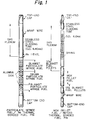
- the present invention uses a new sphere packed fuel pin of the type shown in the left-hand side of Fig. 1, in which nitride particles of two different diameters, one being in the range from about 0.05 to about 0.1 mm and the other in the range from about 0.5 to about 1.0 mm, are packed in a stainless steel cladding tube, with sodium being used as a thermal bonding agent (this type of fuel pin is hereunder designated as a "particulate nitride fuel-sodium bonded fuel pin").
- a standard MOX fuel pin for use in fast reactors is shown in the right-hand side of Fig. 1.
- the nitride particles are spheres of a homogeneous fuel, which are not coated or otherwise treated.
- the fuel composition varies with the reactor in which the fuel is to be used and the purpose of its use but the following two cases are recognizable.
- the first case is where MA are mixed homogeneously throughout the fuel, typically in amounts of about 2 - 4%. This is not a very economical approach since all fuels have to be fabricated by remote and fully automated manipulation but, on the other hand, it is said to permit easy operation of reactors.
- the second case is that of a heterogeneous core fuel, in which a fuel containing 20 - 30% of MA is loaded to a fraction of the core of a reactor, with the remainder being loaded with the (U,Pu) N fuel.
- the Pu/Pu+U ratio is about 0.2 with large reactors but ranges from 20 to 70% with small-power reactors.
- the small number of MA containing fuel pins that have to be fabricated by remote manipulation provides a corresponding economic merit but, on the other hand, special considerations must accordingly be given to core design.
- nitrides will be elaborated later in this specification under section (7) and here the description is limited to the gelling process which is not touched upon in that section.
- aqueous solutions of U, Pu and MA nitrates, ethylenetetramine and a carbon powder are mixed to form a gel solution having the respective ingredients dispersed therein and the thus prepared gel solution is dripped through a capillary tube to form liquid spheres.
- the dropping liquid spheres are heated to about 500°C by the application of radio-frequency waves or microwaves, ethylenetetramine is decomposed to generate ammonia.
- the generated ammonia reacts with the fuel nitrates to form a mixture of solid ammonium biuranate, hydroxide, etc., thus producing solid spheres.
- Heating the solid spheres at 1700°C in a nitrogen stream yields the spheres of homogeneous mixed (U,Pu,MA) nitrides.
- the process for fabricating the particulate nitride fuel-sodium bonded fuel pin to be used in the invention will proceed as follows, with all steps performed within a helium gas filled glove box.
- a stainless steel cladding tube having a stopper welded at the lower end is packed with a specified amount of sodium in the bottom.
- an anti-alpha contamination jig (not shown) is fitted at the inlet of the cladding tube and, thereafter, a blanket particulate nitride fuel, an alumina disk, a driver particulate nitride fuel, an alumina disk, and a blanket particulate nitride fuel are packed successively.
- the fuel pin After welding a stopper at the upper end, the fuel pin is wholly heated to a temperature of at least the melting point of sodium (90°C) as it is held in the erect position.
- the alumina disks serve to prevent the mixing of the blanket particulate nitride fuel with the driver particulate nitride fuel. To facilitate waste disposal, the alumina disks may be replaced with molybdenum disks.
- This production process is very simple and suitable for remote manipulation. It is also characterized by not producing mold and other process wastes such as the quartz glass which occurs in large quantities in the injection molding process which is used to fabricate metal fuels. Therefore, the economy of fuel production by the process described above is anticipated to be comparable to or even better than that of the injection molding process which is adopted in the manufacture of metal fuels.
- the center of the fuel can be held at 1300°C or below during irradiation.
- the pin is classified to fall in the category of "cold fuels" (which are so designed that their maximum temperature will not exceed about one third of their melting point so that the percent release of FP gases, the migration of FP through the fuel and other unwanted phenomena will be held to low levels) and, hence, a stable behavior under irradiation can be expected.
- the fuel cost is greatly influenced by economics of particulate nitride fuel fabrication, which is dependent on various factors including the chemical form and shape of the fuel and MA that are recovered in the reprocessing and partitioning processes. Therefore, the discussion of an economical method for fabricating nitride fuel particles will be made after the description of those processes.
- the fuel cost which is part of the nuclear fuel-cycle cost is divided into materials cost, processing cost and inspection cost.
- the MOX fuels have high melting points but low thermal conductivities whereas the metal fuels have high thermal conductivities but low melting points and, therefore, an optimal pin diameter is evaluated to be 5 - 6 mm for both fuel types.
- the French demonstration fast reactor, Superphenix is exceptional and the outside diameter of the MOX fuel pins it uses is as large as 8.5 mm. However, this is a value for hollow fuel pellets and cannot be directly compared with the first mentioned values.
- the nitride fuels have not only high melting points but also large heat conductivities and, hence, they permit the adoption of large fuel pins with diameters of 9 - 10 mm.
- An optimal linear power is 400 - 500 W/cm for both MOX and metal fuel pins and it is 800 - 1000 W/cm for nitride fuel pins.
- the ultimate burnups that can be achieved are in the range from 10 to 15% for the three kinds of fuels.
- the processing cost of metal fuels which adopt injection molding in fabrication has been estimated to be about 60% of the processing cost of MOX fuels (Genshiryoku Kogyo (Nuclear Engineering), vol. 33, No. 7, 1987).
- the nitride fuels produce a linear power that is about twice the values achieved by the MOX and metal fuel pins, the number of nitride fuel pins that have to be loaded in the reactor core can be reduced to about one half the values required of the MOX and metal fuel pins and, therefore, the processing and inspection costs of the nitride fuel pins can accordingly be reduced to about one half the values for the MOX and metal fuel pins; 2) the three kinds of fuels can achieve substantially the same burnup and the nitride fuel pin has the fuel material packed in amounts about 2 - 2.5 times as large as in the case of MOX and metal fuel pins (in terms of the cross-sectional ratio of fuel pins; the burnup is expressed in MWD/T) and, hence, the energy that can be drawn from one nitride fuel pin is about 2 - 2.5 times as large as the value from one MOX or metal fuel pin; 3) the nitride fuel pin produces a linear power about
- the results of the study are as follows: a maximum fuel temperature during steady-state operation, the chemical and mechanical interactions between the fuel and the cladding tube, the melting point of fuel, and the margin of safety at a tolerable operating limit are much higher or greater in the nitride-fueled fast reactor than in the metal-fueled fast reactor; according to the results of accident analyses, the coolant peak temperature at unexpected low coolant flow with scram (ULOFWS) has a margin for safety that is the greatest with the nitride-fueled core, followed by the metal- and MOX-fueled core in the decreasing order, whereas the coolant peak temperature at unexpected top power with scram (UTOPWS) has a margin for safety that is the greatest with the MOX-fueled core, followed by the nitride- and metal-fueled core in the decreasing order; the overall rating, therefore is estimated to be the highest for the nitride-fueled core.
- UEOFWS coolant peak temperature at unexpected low coolant flow with scram
- UTOPWS coolant peak temperature at unexpected top
- the doubling time of the nitride fuel is somewhat longer than that of the metal fuel if naturally occurring nitrogen is used (compared to the MOX fuel, the doubling time of the nitride fuel is much closer to that of the metal fuel) but a 15 N enriched fuel has a shorter doubling time almost comparable to that of the metal fuel.
- the 15 N enriched fuel is capable of about 60% utilization of uranium resources which is comparable to the value achievable by the metal fuel.
- the uranium-plutonium mixed nitride fuels are almost the same as metals in terms of electric conductivity. Therefore, spent U-Pu mixed nitride fuels may be chopped, placed in a metallic basket and immediately used as anode.
- Table 1 lists only the FPs that are produced in quantities of 0.09 at.% or more.
- the rare gas, alkali metals, technetium and tellurium exist in either the metallic, iodide or telluride form. In the following analyses, these FPs are assumed to be in the metallic form. Palladium, ruthenium and rhodium form alloys with uranium and plutonium. The alkaline earth elements, rare earth elements, zirconium and niobium exist in the form of stable nitrides.
- Chlorides are preferred molten salts since they have high solubilities in the salts of U, Pu and MA.
- the chlorides may be composed of alkali metals such as Li, Na and K, or alkaline earth metals such as Ca, Mg and Ba, and the chlorides of these elements may be mixed in various proportions. The preferred proportions are determined in view of such factors as the required melting point and compatibility with the container of molten salts.
- a useful example is a mixture of 41% KCl and 69% LiCl.
- Equation (1) is expressed in terms of the free energy of formation for the reaction involving one gram equivalent of chlorine (which is thermodynamically equal to the chlorine potential), various FPs, fuels such as uranium and plutonium, MAs and elements associated with pyrochemical treatments can be directly compared with one another as regards the progress or non-progress of electrolysis.
- the values of the free energy of formation ⁇ G f (kcal/g-at.eq. Cl) at 1000K are listed in Table 2 below.
- cadmium metal is used as anode; therefore, if a voltage is applied in such an amount that the electrolysis of curium chloride will proceed, FPs that have larger values of the free energy of formation than cadmium chloride will deposit at the anode whereas chlorides ranging from curium chloride to zirconium chloride will deposit at the cathode. Those FPs which have smaller values of the free energy of formation than yttrium chloride will remain in the molten salt electrolyte. Thus, the three kinds of species can be partitioned.
- Equation (3) The reaction that provides a basis for the partitioning process is expressed by equation (3) below.
- the free energies of formation at 1000K were calculated by equation (3) for the chemical forms of U and Pu fuels, MAs and FPs in the irradiated nitride fuels which are listed in Table 1. Similar calculations were conducted by equation (4) for uranium-rhodium, uranium-palladium and uranium-ruthenium alloys.
- cadmium metal is not used as the anode and, therefore, if electrolysis is conducted at a voltage that allows plutonium metal to be deposited, those elements which have larger values of the free energy of reaction (3) than plutonium chloride will deposit together with uranium and plutonium fuels by the thermodynamic mechanism.
- palladium has a very small value of the free energy of reaction (4) and, hence, the free energy of formation expressed by equation (4) will so much increase that the reaction of interest might not proceed.
- these elements will dissolve only slightly in the electrolyte salt so that they will migrate from the anode to the cathode as slowly as palladium and ruthenium. Similar results are predictable with molybdenum and other elements that have large energies of reaction and formation. Zirconium has a small value of the free energy of the formation of nitrides as expressed by equation (5), so the free energy of formation of chlorides as expressed by equation (3) will increase to a comparable value to niobium; hence, both elements are assumed to behave in substantially the same fashion.
- the electrolyte conditions may be 450°C ⁇ 24 hr ⁇ 0.5 A/cm 2 ⁇ 2 V if the electrolyte consists of 41% KCl and 69% LiCl.
- One characteristic feature of the present invention is to insure the inherent safety of the fuel processing scheme by reducing the chance of handling fuels in the metallic form as much as possible compared to the metal fuel cycle.
- a spherical cathode having an orifice at the tip is used in molten salt electrolysis and nitrogen gas is constantly supplied into the system through a tubular cathode rod, whereby the metal fuel and MA that have been recovered on the electrode surface will be immediately converted to higher nitrides (uranium sesquinitride, plutonium sesquinitride and MA sesquinitrides).
- the powders of the resulting higher nitrides will settle on the bottom of the electrolytic cell and can be recovered together with the small amount of electrolyte salt by a batch process.
- the mixture of powdered (U,Pu,MA) higher nitrides and electrolyte salt that has been recovered from the electrolytic cell at 700°C is charged into an alumina crucible and the higher nitrides are roughly separated from the electrolyte salt by a gradient method. After adding water, the contents of the crucible are stirred so that the electrolyte salt dissolves out to separate from the U, Pu and MA higher nitrides. An alcohol is added to the salt-free nitride powder and the mixture is dehydrated by heating in vacuum at a temperature of about 100°C.
- particulate fuels of the type under consideration can be produced by any known methods such as the process for producing the kernel of particulate uranium dioxide fuels for use in high-temperature gas-cooled reactors and the process for fabricating particulate nitride sphere-packed fuel pins for use in fast reactors.
- the exemplary process starts with dripping the fuel sol down the tip of a capillary tube to form sol particles, which are subjected to high-frequency heating so that the additive is decomposed and evaporated away while, at the same time, the particles will gel.
- the resulting low-density sesquinitride particles are heated to 1300°C so that the higher nitrides will be converted to a particulate mononitride fuel (since the nitride fuels are used in the form of mononitride, all nitrides that have been discussed hereinabove shall be taken to mean "mononitrides" unless otherwise noted).
- the particulate mononitride fuel is then sintered by heating at a temperature of ca.
- nitride fuels to be initially loaded in nuclear reactors are produced from oxides but as for the conversion of oxides to nitrides, a technology has already been established that is capable of low-cost production on an industrial scale by a one-stage reaction involving thermal reduction with carbon [see J. Nucl. Mater., 168, 280 (1989)].
- an oxide powder is mixed with a graphite powder and the mixture is compressed to form green pellets, which are then heated for several hours at ca. 1700°C in a nitrogen gas stream.
- Uranium nitrides were subjected to electrolysis with a molten salt being used as electrolyte.
- the apparatus used in the experiment is shown in Fig. 2.
- the electrolysis was conducted in an alumina electrolytic cell container 3 installed within a quartz glass vessel 2.
- the cell 3 was heated with an electric furnace 1, which was temperature-controlled by means of a thermocouple 5.
- the anode was a graphite rod 6 connected to a metal rod 8 and the part of the graphite rod that was submerged in the molten salt was protected with a ceramic tube 4.
- the anode was a molybdenum rod 7.
- the quartz glass vessel 2 was fitted with an inlet 10 through which an inert gas would be supplied for bubbling the inner space of the vessel 2 and the molten salt in it, as well as with an outlet 11 through which the inert gas would be discharged.
- Argon was used as the inert gas.
- the anode, the cathode and the inlet for the inert bubbling gas were rendered airtight by means of rubber stoppers 9. Shown by 15 is the ground portion that serves to assure hermetic seal for the upper and lower parts of the quartz glass vessel 2.
- the alumina cell container 3 was charged with 5 g of uranium nitride 12 and an electrolyte consisting of 41% KCl, 69% LiCl and 10 wt% UCl 3 and the temperature in the cell 3 was raised to 800°C under bubbling with the inert gas.
- an electrolyte consisting of 41% KCl, 69% LiCl and 10 wt% UCl 3
- the temperature in the cell 3 was raised to 800°C under bubbling with the inert gas.
- nitrogen gas evolved at the anode whereas uranium metal deposited at the cathode. It was therefore demonstrated that the pyrochemical reprocessing and partitioning of nitride fuels could be accomplished by engineering methods.
- the present invention proposes a new fuel cycle that relies upon the pyrochemical reprocessing and partitioning of particular nitride fuels and this is based on the following various achievements: the adoption of nitride fuels that can be handled in the air atmosphere; the provision of particulate U,Pu-mixed nitride and MA fuel pins that can be fabricated by a simple process adapted for remote manipulation and which use sodium as a thermal bonding agent; the preparation of fuels that achieve burnups about three times as high as the values that can be achieved by uranium dioxide fuels used in light-water reactors; the reduction in the number of fuel pins to one half the value required under the same conditions of reactor design as the conventional MOX and metal fuels for use in fast reactors; the demonstration of the possibility that the pyrochemical reprocessing and partitioning technology in a mini-facility that has been developed for the metal fuels can be applied to nitride fuels; and the results of recent studies on the inherent safety of n
- the present invention enables inherent safety to be assured not only for nuclear reactors but also for the overall fuel cycle. If the fuel fabrication facilities, the nuclear reactor and the reprocessing facilities are installed at the same site, the fuel transportation can be reduced markedly and the efficiency of anti-proliferation measures can also be significantly improved.
- the fuel-cycle cost of the pyrochemical reprocessing and partitioning of metal fuels from fast reactors is about 60% of the cost of reprocessing MOX fuels from fast reactors by the Purex process and the fuel-cycle cost of the present invention is even more competitive since the number of fuel pins that have to be loaded in the reactor is reduced by half and because the fuels can be processed in the air atmosphere.
- the fuel-cycle cost of the invention can be held below the level for light-water reactors and, consequently, one may as well say that practically all of the problems that prevent the commercial adoption of fast reactors and MA transmutation reactors have been solved.
Landscapes
- Engineering & Computer Science (AREA)
- Physics & Mathematics (AREA)
- High Energy & Nuclear Physics (AREA)
- General Engineering & Computer Science (AREA)
- Plasma & Fusion (AREA)
- Chemical & Material Sciences (AREA)
- Organic Chemistry (AREA)
- General Life Sciences & Earth Sciences (AREA)
- Materials Engineering (AREA)
- Metallurgy (AREA)
- Mechanical Engineering (AREA)
- Ceramic Engineering (AREA)
- Life Sciences & Earth Sciences (AREA)
- Manufacturing & Machinery (AREA)
- Environmental & Geological Engineering (AREA)
- Geology (AREA)
- Inorganic Compounds Of Heavy Metals (AREA)
Abstract
Claims (4)
- Combustible nucléaire contenant un nitrure mixte d'uranium et de plutonium, caractérisé en ce qu'il comprend en outre au moins un actinoïde mineur essentiellement sous la forme d'un nitrure.
- Aiguille combustible à empilement de sphères, comprenant un combustible nucléaire contenant un nitrure mixte d'uranium et de plutonium, caractérisée en ce que ledit combustible nucléaire comprend en outre au moins un actinoïde mineur essentiellement sous la forme d'un nitrure, ainsi qu'un agent thermoconducteur de type sodium.
- Procédé de recyclage de combustibles nucléaires destinés à être employés dans des réacteurs rapides et des réacteurs de transmutation d'actinoïde mineur, comprenant les étapes consistant :à préparer une aiguille combustible à empilement de sphères, comprenant un combustible nucléaire composé d'un nitrure mixte d'uranium et de plutonium, et d'un nitrure d'actinoïde mineur, ainsi qu'un agent thermoconducteur de type sodium ;à charger ladite aiguille combustible dans le coeur d'un réacteur, et à brûler ledit combustible ;à effectuer une électrolyse en sel fondu du combustible usé ;à convertir en nitrures, l'uranium, le plutonium et les actinoïdes mineurs qui se sont déposés à la cathode ;à récupérer lesdits nitrures ;à convertir les nitrures récupérés en mononitrures ; età préparer, à partir desdits mononitrures, un combustible nucléaire comprenant un nitrure mixte d'uranium et de plutonium, et un nitrure d'actinoïde mineur.
- Procédé selon la revendication 3, caractérisé en ce que l'on fournit de l'azote gazeux à travers une cathode tubulaire de telle façon que l'uranium, le plutonium et les actinoïdes mineurs qui se sont déposés sur la cathode, soient convertis en nitrures.
Applications Claiming Priority (3)
| Application Number | Priority Date | Filing Date | Title |
|---|---|---|---|
| JP265268/93 | 1993-10-22 | ||
| JP26526893A JPH07120580A (ja) | 1993-10-22 | 1993-10-22 | 核燃料サイクル |
| PCT/JP1994/001745 WO1995011509A1 (fr) | 1993-10-22 | 1994-10-18 | Cycle du combustible nucleaire |
Publications (3)
| Publication Number | Publication Date |
|---|---|
| EP0676771A4 EP0676771A4 (fr) | 1995-08-07 |
| EP0676771A1 EP0676771A1 (fr) | 1995-10-11 |
| EP0676771B1 true EP0676771B1 (fr) | 1997-09-10 |
Family
ID=17414873
Family Applications (1)
| Application Number | Title | Priority Date | Filing Date |
|---|---|---|---|
| EP19940929675 Expired - Lifetime EP0676771B1 (fr) | 1993-10-22 | 1994-10-18 | Cycle du combustible nucleaire |
Country Status (3)
| Country | Link |
|---|---|
| EP (1) | EP0676771B1 (fr) |
| JP (1) | JPH07120580A (fr) |
| WO (1) | WO1995011509A1 (fr) |
Cited By (1)
| Publication number | Priority date | Publication date | Assignee | Title |
|---|---|---|---|---|
| US20230395269A1 (en) * | 2015-08-27 | 2023-12-07 | Terrapower, Llc | Fuel element with multi-smear density fuel |
Families Citing this family (10)
| Publication number | Priority date | Publication date | Assignee | Title |
|---|---|---|---|---|
| JPH1010285A (ja) * | 1996-06-25 | 1998-01-16 | Japan Atom Energy Res Inst | 核燃料の再処理方法 |
| WO2000004557A1 (fr) * | 1998-07-15 | 2000-01-27 | Nauchno-Issledovatelsky I Konstruktorsky Institut Energotekhniki | Procede d'exploitation d'un reacteur nucleaire homogene a neutrons rapides |
| EP1805769B1 (fr) * | 2004-10-22 | 2009-12-30 | The Regents of the University of California | Combustible a base de nitrure modifie pour reacteurs compacts et a longue duree de vie |
| RU2501101C1 (ru) * | 2012-11-06 | 2013-12-10 | Российская Федерация, от имени которой выступает Государственная корпорация по атомной энергии "Росатом" | Способ эксплуатации ядерного реактора на быстрых нейтронах с жидкометаллическим теплоносителем |
| RU2549829C1 (ru) * | 2014-01-31 | 2015-04-27 | Российская Федерация, от имени которой выступает Государственная корпорация по атомной энергии "Росатом" | Активная зона реактора на быстрых нейтронах со свинцовым теплоносителем, твэл и тепловыделяющая сборка для ее создания |
| FR3025650A1 (fr) * | 2014-09-10 | 2016-03-11 | Commissariat Energie Atomique | Reacteur a neutrons rapides, a cœur contenant des elements combustibles a basse temperature de fonctionnement nominal, et preferablement de faible diametre, et un materiau moderateur |
| CN109994235B (zh) * | 2017-12-29 | 2022-03-22 | 中国核动力研究设计院 | 一种uo2燃料芯块的制备方法 |
| CN110134906B (zh) * | 2019-03-06 | 2024-07-12 | 中国核电工程有限公司 | 一种非对称功率分布下堆芯dnbr计算方法 |
| JP7138082B2 (ja) * | 2019-06-12 | 2022-09-15 | 日立Geニュークリア・エナジー株式会社 | 高速炉の燃料集合体および高速炉の炉心 |
| ES3048168T3 (en) * | 2019-09-10 | 2025-12-09 | Westinghouse Electric Co Llc | Electrochemical uranium nitride production |
Family Cites Families (5)
| Publication number | Priority date | Publication date | Assignee | Title |
|---|---|---|---|---|
| JPS61286788A (ja) * | 1985-06-13 | 1986-12-17 | 動力炉・核燃料開発事業団 | 高速増殖炉用燃料要素 |
| FR2620438B1 (fr) * | 1987-09-11 | 1989-12-01 | Commissariat Energie Atomique | Procede de preparation de nitrure d'uranium et/ou de plutonium utilisable comme combustible nucleaire |
| JPH04140694A (ja) * | 1990-09-29 | 1992-05-14 | Toshiba Corp | 超ウラン元素の消滅処理炉心 |
| JPH04319699A (ja) * | 1991-04-19 | 1992-11-10 | Toshiba Corp | 溶融塩電解精製装置 |
| JPH0552981A (ja) * | 1991-08-26 | 1993-03-02 | Hitachi Ltd | 燃料集合体及び原子炉の炉心 |
-
1993
- 1993-10-22 JP JP26526893A patent/JPH07120580A/ja active Pending
-
1994
- 1994-10-18 WO PCT/JP1994/001745 patent/WO1995011509A1/fr not_active Ceased
- 1994-10-18 EP EP19940929675 patent/EP0676771B1/fr not_active Expired - Lifetime
Cited By (1)
| Publication number | Priority date | Publication date | Assignee | Title |
|---|---|---|---|---|
| US20230395269A1 (en) * | 2015-08-27 | 2023-12-07 | Terrapower, Llc | Fuel element with multi-smear density fuel |
Also Published As
| Publication number | Publication date |
|---|---|
| EP0676771A4 (fr) | 1995-08-07 |
| JPH07120580A (ja) | 1995-05-12 |
| EP0676771A1 (fr) | 1995-10-11 |
| WO1995011509A1 (fr) | 1995-04-27 |
Similar Documents
| Publication | Publication Date | Title |
|---|---|---|
| Lee et al. | Pyroprocessing technology development at KAERI | |
| Lee et al. | Nuclear applications for ultra‐high temperature ceramics and MAX phases | |
| Oversby et al. | Control of civilian plutonium inventories using burning in a non-fertile fuel | |
| EP0676771B1 (fr) | Cycle du combustible nucleaire | |
| JP2019508703A (ja) | 使用済み酸化ウラン燃料の溶融塩原子炉燃料への転換 | |
| US12260967B2 (en) | Modular, integrated, automated, compact, and proliferation-hardened method to chemically recycle used nuclear fuel (UNF) originating from nuclear reactors to recover a mixture of transuranic (TRU) elements for advanced reactor fuel to recycle uranium and zirconium | |
| Simnad | Nuclear reactor materials and fuels | |
| CA2020601A1 (fr) | Recuperation d'actinides | |
| Konings | Advanced Fuel Cycles for Accelerator-Driven Systems: Fuel Fabrication and Reprocessing. | |
| Burris et al. | Proposed pyrometallurgical process for rapid recycle of discharged fuel materials from the integral fast reactor | |
| KR102694352B1 (ko) | 사용후핵연료의 고준위 방사성 폐기물 저감 방법 | |
| KR102791933B1 (ko) | 사용후핵연료로부터 고방열성 핵종을 분리하는 방법 및 사용후핵연료 고방열 핵종 분리장치 | |
| Laidler | Pyrochemical processing of DOE spent nuclear fuel | |
| Roy et al. | Plutonium metallurgy in India | |
| Raj et al. | Advanced ceramic fuels for sodium-cooled fast reactors | |
| den Exter et al. | Immobilization and behavior of technetium in a magnesium titanate matrix for final disposal | |
| JPH0943391A (ja) | 核燃料リサイクルシステム | |
| US20240120120A1 (en) | Modular, integrated, automated, compact, and proliferation-hardened method to chemically recycle used nuclear fuel (unf) originating from nuclear reactors to recover a mixture of transuranic (tru) elements for advanced reactor fuel, and to recycle uranium and zirconium | |
| KR20250051555A (ko) | 개량형 원자로 연료용 초우라늄(tru) 원소의 혼합물을 회수하기 위한 원자로로부터 유래된 사용후 핵연료(unf)를 화학적으로 재활용하고 우라늄 및 지르코늄을 재활용하기 위한 모듈식, 통합, 자동화, 콤팩트 및 확산-경화 방법 | |
| Chen et al. | Composite fuels and transmutation targets | |
| Konings et al. | Evaluation of thorium based nuclear fuel. Chemical aspects | |
| Suzuki et al. | Research and development of nitride fuel cycle for TRU burning | |
| Mardon | Powder metallurgy techniques in nuclear technology | |
| Yang et al. | DUPIC nuclear fuel manufacturing and process technology development | |
| Thoeming | DOE Patents Available for Licensing: A Bibliography for the Period 1966-1974 (Supplement 1) |
Legal Events
| Date | Code | Title | Description |
|---|---|---|---|
| A4 | Supplementary search report drawn up and despatched | ||
| AK | Designated contracting states |
Kind code of ref document: A4 Designated state(s): FR |
|
| PUAI | Public reference made under article 153(3) epc to a published international application that has entered the european phase |
Free format text: ORIGINAL CODE: 0009012 |
|
| 17P | Request for examination filed |
Effective date: 19950227 |
|
| AK | Designated contracting states |
Kind code of ref document: A1 Designated state(s): FR |
|
| 17Q | First examination report despatched |
Effective date: 19960517 |
|
| GRAG | Despatch of communication of intention to grant |
Free format text: ORIGINAL CODE: EPIDOS AGRA |
|
| GRAH | Despatch of communication of intention to grant a patent |
Free format text: ORIGINAL CODE: EPIDOS IGRA |
|
| GRAH | Despatch of communication of intention to grant a patent |
Free format text: ORIGINAL CODE: EPIDOS IGRA |
|
| GRAA | (expected) grant |
Free format text: ORIGINAL CODE: 0009210 |
|
| AK | Designated contracting states |
Kind code of ref document: B1 Designated state(s): FR |
|
| ET | Fr: translation filed | ||
| PLBE | No opposition filed within time limit |
Free format text: ORIGINAL CODE: 0009261 |
|
| STAA | Information on the status of an ep patent application or granted ep patent |
Free format text: STATUS: NO OPPOSITION FILED WITHIN TIME LIMIT |
|
| 26N | No opposition filed | ||
| PGFP | Annual fee paid to national office [announced via postgrant information from national office to epo] |
Ref country code: FR Payment date: 20020917 Year of fee payment: 9 |
|
| PG25 | Lapsed in a contracting state [announced via postgrant information from national office to epo] |
Ref country code: FR Free format text: LAPSE BECAUSE OF NON-PAYMENT OF DUE FEES Effective date: 20040630 |
|
| REG | Reference to a national code |
Ref country code: FR Ref legal event code: ST |