EP0679938A2 - Procédé de préparation d'un matériau photographique à l'halogénure d'argent sensible à la lumière - Google Patents
Procédé de préparation d'un matériau photographique à l'halogénure d'argent sensible à la lumière Download PDFInfo
- Publication number
- EP0679938A2 EP0679938A2 EP95106366A EP95106366A EP0679938A2 EP 0679938 A2 EP0679938 A2 EP 0679938A2 EP 95106366 A EP95106366 A EP 95106366A EP 95106366 A EP95106366 A EP 95106366A EP 0679938 A2 EP0679938 A2 EP 0679938A2
- Authority
- EP
- European Patent Office
- Prior art keywords
- group
- silver halide
- gelatin
- layer
- hydrophilic colloid
- Prior art date
- Legal status (The legal status is an assumption and is not a legal conclusion. Google has not performed a legal analysis and makes no representation as to the accuracy of the status listed.)
- Granted
Links
Images
Classifications
-
- G—PHYSICS
- G03—PHOTOGRAPHY; CINEMATOGRAPHY; ANALOGOUS TECHNIQUES USING WAVES OTHER THAN OPTICAL WAVES; ELECTROGRAPHY; HOLOGRAPHY
- G03C—PHOTOSENSITIVE MATERIALS FOR PHOTOGRAPHIC PURPOSES; PHOTOGRAPHIC PROCESSES, e.g. CINE, X-RAY, COLOUR, STEREO-PHOTOGRAPHIC PROCESSES; AUXILIARY PROCESSES IN PHOTOGRAPHY
- G03C1/00—Photosensitive materials
- G03C1/76—Photosensitive materials characterised by the base or auxiliary layers
- G03C1/95—Photosensitive materials characterised by the base or auxiliary layers rendered opaque or writable, e.g. with inert particulate additives
-
- G—PHYSICS
- G03—PHOTOGRAPHY; CINEMATOGRAPHY; ANALOGOUS TECHNIQUES USING WAVES OTHER THAN OPTICAL WAVES; ELECTROGRAPHY; HOLOGRAPHY
- G03C—PHOTOSENSITIVE MATERIALS FOR PHOTOGRAPHIC PURPOSES; PHOTOGRAPHIC PROCESSES, e.g. CINE, X-RAY, COLOUR, STEREO-PHOTOGRAPHIC PROCESSES; AUXILIARY PROCESSES IN PHOTOGRAPHY
- G03C1/00—Photosensitive materials
- G03C1/74—Applying photosensitive compositions to the base; Drying processes therefor
-
- G—PHYSICS
- G03—PHOTOGRAPHY; CINEMATOGRAPHY; ANALOGOUS TECHNIQUES USING WAVES OTHER THAN OPTICAL WAVES; ELECTROGRAPHY; HOLOGRAPHY
- G03C—PHOTOSENSITIVE MATERIALS FOR PHOTOGRAPHIC PURPOSES; PHOTOGRAPHIC PROCESSES, e.g. CINE, X-RAY, COLOUR, STEREO-PHOTOGRAPHIC PROCESSES; AUXILIARY PROCESSES IN PHOTOGRAPHY
- G03C1/00—Photosensitive materials
- G03C1/005—Silver halide emulsions; Preparation thereof; Physical treatment thereof; Incorporation of additives therein
- G03C1/06—Silver halide emulsions; Preparation thereof; Physical treatment thereof; Incorporation of additives therein with non-macromolecular additives
- G03C1/061—Hydrazine compounds
-
- G—PHYSICS
- G03—PHOTOGRAPHY; CINEMATOGRAPHY; ANALOGOUS TECHNIQUES USING WAVES OTHER THAN OPTICAL WAVES; ELECTROGRAPHY; HOLOGRAPHY
- G03C—PHOTOSENSITIVE MATERIALS FOR PHOTOGRAPHIC PURPOSES; PHOTOGRAPHIC PROCESSES, e.g. CINE, X-RAY, COLOUR, STEREO-PHOTOGRAPHIC PROCESSES; AUXILIARY PROCESSES IN PHOTOGRAPHY
- G03C1/00—Photosensitive materials
- G03C1/005—Silver halide emulsions; Preparation thereof; Physical treatment thereof; Incorporation of additives therein
- G03C1/06—Silver halide emulsions; Preparation thereof; Physical treatment thereof; Incorporation of additives therein with non-macromolecular additives
- G03C1/067—Additives for high contrast images, other than hydrazine compounds
-
- Y—GENERAL TAGGING OF NEW TECHNOLOGICAL DEVELOPMENTS; GENERAL TAGGING OF CROSS-SECTIONAL TECHNOLOGIES SPANNING OVER SEVERAL SECTIONS OF THE IPC; TECHNICAL SUBJECTS COVERED BY FORMER USPC CROSS-REFERENCE ART COLLECTIONS [XRACs] AND DIGESTS
- Y10—TECHNICAL SUBJECTS COVERED BY FORMER USPC
- Y10S—TECHNICAL SUBJECTS COVERED BY FORMER USPC CROSS-REFERENCE ART COLLECTIONS [XRACs] AND DIGESTS
- Y10S430/00—Radiation imagery chemistry: process, composition, or product thereof
- Y10S430/151—Matting or other surface reflectivity altering material
Definitions
- the present invention relates to a method for producing a silver halide photographic light-sensitive material for graphic arts use (hereinafter called merely a light-sensitive material), and more particularly to a method for producing a light-sensitive material which is excellent in the touchableness in vacuum contacting and which is free from pinhole trouble.
- JP O.P.I. Japanese Patent Publication Open to Public Inspection
- Nos. 91738/1991 and 127049/1991 propose techniques to improve the light-sensitive material's touchableness in vacuum contacting by the combination of having the light-sensitive material substantially contain a relatively large particle size matting agent and drying it under slow drying conditions.
- the above objects of the invention are accomplished by the following:
- the above object of the invention are accomplished by a method for producing a silver halide photographic light-sensitive material, which comprises a support and photographic layers including a silver halide emulsion layer, a first hydrophilic colloid layer and an outermost second hydrophilic colloid layer provided on the support in this order from the support, comprising steps of forming the photographic layers by coating a silver halide emulsion coating liquid comprising silver halide grains, gelatin and water to form the silver halide emulsion layer; a first hydrophilic colloid coating liquid comprising gelatin and water to form the first hydrophilic colloid layer; and a second hydrophilic colloid coating liquid comprising gelatin, particles of matting agent having a size of not more than 4 ⁇ m in an amount of 4 mg/m2 to 50 mg/m2 and water to form the outermost second hydrophilic colloid layer; on a support, and drying the photographic layers under a condition satisfying the following requirements:
- the method further satisfy the following conditions:
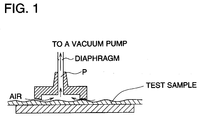
- the surface roughness of the above light-sensitive material is preferably not less than 25mmHg when it is measured by a measuring instrument SMOOSTER SM-6.
- Fig. 1 is a schematic drawing of a measuring instrument for surface roughness.
- At least one of the hydrophilic colloid layers constituting the light-sensitive material contains a regular- and/or irregular-form matting agent.
- the topmost layer on the silver halide emulsion-containing side of the support contains a regular- and/or irregular-form matting agent having a particle size of not less than 4 ⁇ m, preferably 4 ⁇ m to 20 ⁇ m, in an amount of 4mg/m2 to 50mg/m2, and more preferably also contains in combination a regular and/or irregular matting agent having a particle size of less than 4 ⁇ m.
- each of the emulsion layer and the first and second layers contains gelatin as a binder.
- These layers may further contain other hydrophilic colloid materials; for example, various synthetic hydrophilic polymer materials including gelatin derivatives; graft polymers of gelatin with other high polymer materials; proteins such as albumin and casein; cellulose derivatives such as hydroxyethyl cellulose, carboxymethyl cellulose, cellulose sulfates; sugar derivatives such as sodium alginate, starch derivatives; and homo- or copolymers such as polyvinyl alcohol, polyvinyl alcohol-partial acetal, poly-N-vinylpyrolidone, polyacrylic acid, polymethacrylic acid, polyacrylamide, polyvinylimidazole, polyvinylpyrazole, and the like.
- gelatin there may be used lime-treated gelatin, acid-treated gelatin, and hydrolyzed or hydrolased product of gelatin.
- the component layers of the silver halide photographic light-sensitive material of the invention may contain a dispersion of synthetic polymers insoluble or less-soluble in water for the purpose of dimensional stability improvement.
- synthetic polymers insoluble or less-soluble in water for the purpose of dimensional stability improvement.
- matting agent for the invention there may be used any one of known matting agents, including the silica described in Swiss Patent No. 330,158; the glass powder described in French Patent No. 1,296,995; the inorganic particles such as of alkaline earth metals, zinc carbonate, etc.; the starch described in U.S. Patent No. 2,322,037; the starch derivatives described in Belgian Patent No. 625,451 and British Patent No. 981,198; the polyvinyl alcohol described in Japanese Patent Examined Publication (hereinafter abbreviated to JP E.P.) No. 3643/1969; the polystyrene or polymethylmethacrylate described in Swiss Patent No. 330,158; the polyacrylonitrile described in U.S. Patent No. 3,079,257; and organic particles such as the polycarbonate described in U.S. Patent No. 3,022,169.
- JP E.P. Japanese Patent Examined Publication
- matting agents may be used alone or in combination.
- the regular form matting agent takes preferably a spherical form, but may take other forms such as a tabular or cubic form.
- the size of the matting agent particle is expressed in terms of the diameter of a sphere equivalent in the volume to the particle.
- the term 'matting agent's particle size' herein means this sphere-equivalent diameter.
- the matting agent is preferably partially exposed on the surface of the light-sensitive material.
- the exposed matting agent on the surface may be either part of or the whole of the matting agent added.
- the addition of the matting agent may be made in the manner of coating a coating liquid prepared by in advance dispersing the matting agent thereinto. Where plural different matting agents are to be added, both the above methods may be used in combination.
- the gelatin concentration of the layer adjacent to the topmost layer of the lightsensitive material is higher than the gelatin concentration of the topmost layer. Reducing the total amount of gelatin in the photographic layers to be coated on the silver halide emulsion side to 0.5g/m2 to 2.5g/m2 is effective in getting rid of the pinhole trouble. More preferably, when the amount of gelatin is reduced to 0.5g/m2 to 2.0g/m2, larger improving effect can be obtained.
- the gelatin concentration means the percentage of the amount of gelatin accounting for of the coating liquid, and expressed in a gelatin/water ratio.
- the gelatin concentration of the coating liquid is normally 1.0 to 8.0%.
- a coating liquid of a composition comprising a hydrophilic colloid like gelatin as the binder is coated on a support, then generally cooled to be set in a low-temperature air at a drybulb temperature of -10° to -15°C, and then the temperature is raised to evaporate the moisture from the coated layer.
- the gelatin/water content ratio by weight immediately after the coating is normally around 2000%.
- a coating liquid of a composition comprised mainly of gelatin as a binder is coated on a support, and thereupon the coated layer is cooled to be set in a low-temperature air at a dry-bulb temperature of from -5° to -15°C, but in this instance, it has been found that the improvement can be attained by using the following combination:
- at least two hydrophilic colloid layers are provided on the silver halide emulsion layer; the lower hydrophilic colloid layer adjacent to the topmost layer has a gelatin concentration of not less than 3.0%, which is 0.5% higher, preferably 1.0% higher than the gelatin concentration of the matting agent-containing topmost hydrophilic colloid layer; and the coated surface temperature on the silver halide emulsion layer-containing side during the time when its water/binder ratio by weight reduces from 800% to 200% is not more than 19°C, and the drying time required for the ratio
- the coated surface average temperature when the water/gelatin ratio by weight is in the range of 800% to 200% is expressed by the wet-bulb temperature of the drying air, preferably 4°C to 19°C, more preferably 4°C to 17°C.
- the drying time required for the ratio to reduce from 800% to 200% is preferably 35 seconds to 300 seconds, more preferably 40 seconds to 300 seconds.
- an antistatic layer as described in JP O.P.I. No. 91739/1991.
- the surface resistivity on the antistatic layer-provided side is preferably not more than 1.0x10¹¹ ⁇ , and more preferably 8x10¹¹ ⁇ .
- the above antistatic layer is preferably an antistatic layer comprising water-soluble conductive polymer particles, hydrophobic polymer particles and a reaction product of a hardening agent or an antistatic layer comprising a powdery metal oxide.
- the above water-soluble conductive polymer is a polymer having at least one conductive group selected from the class consisting of a sulfo group, a sulfate group, a quaternary ammonium salt group, a tertiary ammonium salt group, a carboxyl group and a polyethyleneoxido group.
- the preferred among these groups are the sulfo group, sulfate group and quaternary ammonium salt group.
- the conductive group is required to be in an amount of not less than 5% by weight per molecule of the water-soluble conductive polymer.
- the water-soluble conductive polymer can contain a carboxyl group, a hydroxyl group, an amino group, an epoxy group, an aziridine group, an active methylene group, a sulfinic acid group, an aldehyde group, a vinylsulfone group, etc.
- the preferred among them are the carboxyl, hydroxyl, amino, epoxy, aziridine and aldehyde groups. Any of these groups need to be contained in an amount of not less than 5% by weight per molecule of the polymer.
- the average molecular weight of the water-soluble conductive polymer is 3000 to 100000, preferably 3500 to 50000.
- tin oxid, indium oxide, antimony oxide, zinc oxide, and those produced by doping these metalic oxides with metallic phosphorus or metallic indium are tin oxid, indium oxide, antimony oxide, zinc oxide, and those produced by doping these metalic oxides with metallic phosphorus or metallic indium.
- the average particle size of these metallic oxides is preferably 1 ⁇ m to 0.01 ⁇ m.
- the silver halide emulsion for the light-sensitive material of the invention may be of any arbitrary silver halide usable for ordinary silver halide emulsions, such as silver bromide, silver iodobromide, silver chloride, silver chlorobromide, silver chloroiodobromide.
- the preferred among these silver halides is silver chlorobromide containing 50 mol% or above silver chloride.
- the silver halide grain may be produced according to any one of the acidic method, neutral method and ammoniacal method.
- the silver halide emulsion used in the invention may comprise grains of a single composition or plural different compositions contained in a single layer or separately contained in plural layers.
- the configuration of the silver halide crystal grain according to the invention is arbitrary; a suitable example is a cube having ⁇ 100 ⁇ planes as its crystal faces.
- crystal grains such as octahedral, tetradecahedral or dodecahedral crystal grains prepared according to appropriate methods as described in U.S. Patent Nos. 4,183,756 and 4,225,666; JP O.P.I. No. 26589/1980; and JP E.P. No. 42737/1980; and J. Photgr. Sci., 21 , 39 (1973).
- twin planes-having crystal grains may also be used.
- the silver halide grain in the invention may be a grain of a single form or a composite form comprising various different crystal forms.
- the silver halide grains used in the invention are allowed to be of any grain diameter distribution; they may be of either a broad grain diameter distribution called polydisperse emulsions or a narrow grain diameter distribution called monodisperse emulsions; they may be used alone of in combination. Both the polydisperse emulsion and the monodisperse emulsion may be used in a mixture.
- the silver halide emulsion used in the invention may be a mixture of two or more different silver halide emulsions separately prepared.
- the monodisperse emulsion is preferred.
- the monodisperse silver halide grains in the monodisperse silver halide emulsion are such that the weight of the silver halide contained within the average grain diameter r ⁇ +20% range accounts for preferably not less than 60%, more preferably not less than 70%, and most preferably not less than 80% of the whole silver halide grains.
- the above average grain diameter r ⁇ is defined as the grain diameter ri in the case where ni x ri3, the product of the frequency ni of grains having a grain diameter ri and ri3, becomes maximum (rounded off to three decimal places).
- the grain diameter herein in the case of a spherical silver halide grain, is its diameter, and in the case of a nonspherical grain, is the diameter of a circular image equivalent in the area to its projection image.
- the grain diameter can be obtained by actually measuring the diameter of a 10,000-fold to 50,000-fold electron-photo-micrographically enlarged grain image print or the area of a projected grain image enlarged likewise, the number of grains to be measured shall be 1,000 at random.
- the most preferred highly monodisperse emulsion of the invention is one having a grain diameter distribution broadness of preferably not more than 20%, more preferably not more than 15%, said distribution broadness being defined by:
- the light-sensitive silver halide emulsion may be used as it is (primitive emulsion) without being chemically sensitized, but in most cases, it is chemically sensitized.
- chemical sensitization there are a sulfur sensitization method which uses a compound containing sulfur that is capable of reacting with silver ions or uses an active gelatin; a reduction sensitization method which uses a reductive material; and a noble metal sensitization method which uses a gold compound or other noble metal compound; these sensitization methods may be used in combination.
- the sulfur sensitizer there may be used thiosulfates, thioureas, thiazoles, rhodanines and other compounds.
- Examples of the reduction sensitizer include stannous salts, amines, hydrazine derivatives, formamidinesulfinic acid, silane compounds, and the like.
- Examples of the noble metal sensitizer include gold complex salts and complex salts of the metals belonging to Group VIII of the periodic table, such as platinum, iridium, palladium, etc.
- pH value is preferably 4 to 9, more preferably 5 to 8; pAg value is preferably 5 to 11, more preferably 8 to 10; and temperature is preferably 40° to 90°C, and more preferably 45° to 75°C.
- the above emulsions may be used alone or in a mixture of two or more kinds thereof.
- the sensitized emulsion 4-hydroxy-6-methyl-1,3,3a,7-tetrazaindene, 5-mercaptol-phenyltetrazole, 2-mercaptobenzothiazole, or various other stabilizers.
- a silver halide solvent such as thioether
- a crystal habit control agent such as a mercapto group-containing compound or a sensitizing dye
- the silver halide grain used in the emulsion of the invention may, in the course of forming and/or growing the grain, have metallic ions added thereto by using a cadmium salt, a zinc salt, a lead salt, a thalium salt, an iridium salt or complex salt, a rhodium salt or complex salt, or an iron salt or complex salt, thereby having metallic ions contained inside the grain and/or on the grain surface.
- the emulsion of the invention after completion of growing its silver halide grains, may have its useless water-soluble salts either removed therefrom or remain contained therein. In the case of removing the salts, the removal can be carried out according to the relevant method described in Research Disclosure 17643.
- its photographic emulsion may be spectrally sensitized to a relatively long-wavelength blue light, a green light and a red or infrared light.
- the dyes used for spectral sensitization include cyanine dyes, merocyanine dyes, complex cyanine dyes, complex merocyanine dyes, holopolar-cyanine dyes, hemicyanine dyes, styryl dyes and hemioxonol dyes.
- the sensitizing dye in the invention is used in the same concentration as used for ordinary negative-type silver halide emulsions. It is advantageous to use the sensitizing dye particularly in such a dye concentration range as substantially not deteriorate the silver halide emulsion's intrinsic sensitivity; the sensitizing dye is used in an amount of preferably about 1.0x10 ⁇ 5 to 5x10 ⁇ 4 mol, more preferably about 4x10 ⁇ 5 to 2x10 ⁇ 4 mol per mol of silver halide.
- the sensitizing dye of the invention may be used alone or in combination of two or more kinds thereof.
- the surface roughness value used in the invention is a value obtained by measurement with an instrument Smooster SM-6B, manufactured by Toei Denshi Kogyo K.K.
- the surface roughness can be measured by the following method.
- the surface roughness is defined as a value of suction pressure represented by mmHg measured under a constant condition with respect to a unexposed and not processed photographic material (so-called a raw film) sample.
- the surface roughness is evaluated with the aid of SMOOSTER, manufactured by Toei Denshi Kogyo K.K..
- SMOOSTER manufactured by Toei Denshi Kogyo K.K.
- the surface roughness is defined as a pressure value expressed in mmHg. The larger the value is, the greater the surface roughness.
- the light-sensitive material of the invention prefferably contains at least one of tetrazolium compounds or at least one of hydrazine compounds for the purpose of its contrast increase necessary for graphic arts use.
- R1, R2 and R3 each represent an alkyl group such as methyl, ethyl, cyclopropyl, propyl, isopropyl, cyclobutyl, butyl, isobutyl, pentyl or cyclohexyl; an amino group; an acylamino group such as acetylamino; a hydroxyl group; an alkoxy group such as methoxy ethoxy, propoxy, butoxy or pentoxy; an acyloxy group such as acetyloxy; a halogen atom such as fluorine, chlorine or bromine; a carbamoyl group; an acylthio group such as acetylthio; an alkoxycarbonyl group such as ethoxycarbonyl; a carboxyl group; an acyl group such as acetyl;
- X ⁇ is an anion which includes a halide ion such as a chloride ion, a bromide ion, an iodide ion; an inorganic acid group such as of nitric acid, sulfuric acid or perchloric acid; an organic acid group such as of sulfonic acid or carboxylic acid; an anionic activator including a lower alkylbenzenesulfonic acid anion such as p-toluenesulfonic acid anion, a higher alkylbenzenesulfonic acid ion such as p-dodecylbenzenesulfonic acid anion, a higher alkylsulfate anion such as laurylsulfate anion, a boric acid anion such as tetraphenylboron, a dialkylsulfosuccinate anion such as di-2-ethylhexylsulfosuccinate anion, a polyether-
- the tetrazolium compound of Formula I of the invention may be used alone or in combination of 2 or more kinds thereof. Further, the tetrazolium compound of the invention may be used in combination in a discretionary ratio with other non-invention tetrazolium compounds.
- the tetrazolium compound of the invention is used together with an anion that combines with the tetrazolium compound of the invention to thereby lower its hydrophilicity.
- anion include inorganic acid groups such as of perchloric acid; organic acid groups such as of sulfonic acid and carboxylic acid; anionic activators including lower alkylbenzenesulfonate anions such as p-toluenesulfonic acid anion, p-dodecylbenzenesulfonic acid anions, alkylnaphthalenesulfonic, laurylsulfate anions, tetraphenylboron anions, dialkylsulfosuccinate anions such as di-2-ethylhexylsulfosuccinate anions, polyether-alcohol-sulfate aions such as cetylpolyethenoxysulfate anions, stea
- any of the above anions may, after being previously mixed with the tetrazolium compound of the invention, be added to the hydrophilic colloid layer, or may be added alone to the silver halide emulsion layer or hydrophilic colloid layer containing or not containing the tetrazolium compound of the invention.
- the tetrazolium compound used in the invention can be easily synthesized according to appropriate one of the methods described in Chemical Reviews, vol.55, pp.335-483.
- the tetrazolium compound in the invention may be used in the amount range of preferably about 1mg to 10g, more preferably about 10mg to 2g per mol of the silver halide contained in the silver halide photographic light-sensitive material of the invention.
- the tetrazolium compound may be used alone or in arbitrary combination of two or more kinds thereof.
- the hydrazine compound used in the invention is preferably a compound represented by the following Formula II: wherein R1 represents a monovalent organic residue; R2 represents a hydrogen atom or a monovalent organic residue; Q1 and Q2 each represent a hydrogen atom, an alkylsulfonyl group, including one having a substituent, or an arylsulfonyl group, including one having a substituent; X1 is an oxygen atom or a sulfur atom. More preferred among those represented by Formula II are compounds in which X1 is an oxygen atom and R2 is a hydrogen atom.
- Examples of the monovalent organic residue represented by R1 or R2 include aromatic residues, heterocyclic residues and aliphatic residues.
- aromatic residue examples include a phenyl group, a naphthyl group, and these groups having substituents, such as an alkyl group, an alkoxy group, an acylhydrazino group, a dialkylamino group, an alkoxycarbonyl group, a cyano group, a carboxy group, a nitro group, an alkylthio group, a hydroxy group, a sulfonyl group, a carbamoyl group, a halogen atom, an acylamino group, a sulfonamido group, and thiourea group.
- substituents such as an alkyl group, an alkoxy group, an acylhydrazino group, a dialkylamino group, an alkoxycarbonyl group, a cyano group, a carboxy group, a nitro group, an alkylthio group, a hydroxy group, a sulfonyl group, a carb
- substituent-having residue examples include a 4-methyl-phenyl group, a 4-ethylphenyl group, a 4-oxyethylphenyl group, a 4-dodecylphenyl group, a 4-carboxyphenyl group, a 4-diethylaminophenyl group, a 4-octylaminophenyl group, a 4-benzylaminophenyl group, a 4-acetamido-2-methylphenyl group, a 4-(3-ethyl-thioureido)phenyl group, a 4-[2-(2,4-di-tert-butylphenoxy)but-ylamido]phenyl group, and a 4-[2-(2,4-di-tert-butylphenoxy)but-ylamido]phenyl group.
- the heterocyclic residue is a 5- or 6-member single or condensed ring having at least one out of oxygen, nitrogen, sulfur and selenium atoms, which ring may have a substituent.
- the heterocyclic residue include those of rings such as a pyrroline ring, a pyridine ring, a quinoline ring, an indol ring, an oxazole ring, a benzooxazole ring, a naphthooxazole ring, an imidazole ring, a benzimidazole ring, a thiazoline ring, a thiazole ring, a benzothiazole ring, a naphthothiazole ring, a selenazole ring, a benzoselenazole ring, and a naphthoselenazole ring.
- heterocyclic groups may have substituents including an alkyl group having 1 to 4 carbon atoms such as methyl or ethyl; an alkoxy group having 1 to 4 carbon atoms such methoxy or ethoxy; an aryl group having 6 to 18 carbon atoms such as phenyl; a halogen atom such as chlorine or bromine; an alkoxycarbonyl group, a cyano group, an amino group, and the like.
- Examples of the aliphatic residue include a straight-chain or branched-chain alkyl group, a cycloalkyl group and these groups having substituents, an alkenyl group and an alkynyl group.
- the straight-chain or branched-chain alkyl group is, e.g.. an alkyl group having preferably 1 to 18 carbon atoms, more preferably 1 to 8 carbon atoms, and examples thereof include a methyl group, an ethyl group, an isobutyl group, a 1-octyl group, and the like.
- the cycloalkyl group is. e.g., one having 3 to 10 carbon atoms, and examples thereof include a cyclopropyl group, a cyclohexyl group and an adamantyl group.
- Substituents to these alkyl and cycloalkyl groups include an alkoxy group such as methoxy, ethoxy, propoxy or butoxy; an alkoxycarbonyl group, a carbamoyl group, a hydroxy group, an alkylthio group, an amido group, an acyloxy group, a cyano group, a sulfonyl group; a halogen atom such as chlorine, bromine, fluorine or iodine; an aryl group such as phenyl, halogen-substituted phenyl or alkyl-substituted phenyl; and the like.
- cycloalkyl group examples include a 3-methoxypropyl group, an ethoxycarbonylmethyl group, a 4-chlorocyclohexyl group, a benzyl group, a p-methylbenzyl group and a p-chlorobenzyl group.
- the alkenyl group includes an allyl group.
- the alkynyl group includes a propargyl group.
- R3 represents an aliphatic group such as octyl or decyl; an aromatic group such as phenyl, 2-hydroxyphenyl or chlorophenyl; or a heterocyclic group such as pyridyl, thienyl or furyl. Any of these groups may have further an appropriate substituent.
- R3 preferably contains at least one nondiffusible group or silver halide adsorption accelerating group. It is particularly preferably that R3 contain a silicon halide adsorption accelerating group.
- the non-diffusible group is preferably a ballast group that is usually used for the immobile photographic additive such as a coupler, and examples of the ballast group include relatively photographically inactive groups having 8 or more carbon atoms such as an alkyl group, an alkenyl group, an alkoxy group, a phenyl group, a phenoxy group, and an alkylphenoxy group.
- Examples of the silver halide adsorption accelerating group include a thiourea group, a thiourethane group, a mercapto group, a thioether group, a thione group, a heterocyclic group, a thioamido heterocyclic group, a mercapto heterocyclic group, and the adsorption groups described in JP O.P.I. No. 90439/1989.
- X represents a group substitutable to a phenyl group
- m is an integer of 0 to 4, provided that when m is 2 or more, the two or more Xs may be either the same as or different from each other.
- A3 and A4 are as defined for Q1 and Q2, respectively, in Formula II, and are each preferably a hydrogen atom.
- G represents a carbonyl group, a sulfonyl group or a sulfoxy group, but is preferably a carbonyl group.
- R4 represents a hydrogen atom, an alkyl group, an alkenyl group, an alkynyl group, an allyl group, a heterocyclic group, an alkoxy group, a hydroxyl group, an amino group, a carbamoyl group or an oxycarbonyl group.
- R4 are a -COOR5 group and a -CON(R6)(R7) group, wherein R5 represents an alkynyl group or a saturated heterocyclic group; R6 represents a hydrogen atom, an alkyl group, an alkenyl group, an alkynyl group, an aryl group or a heterocyclic group; and R7 is an alkenyl group, an alkynyl group, a saturated heterocyclic group, a hydroxy group or an alkoxy group.
- hydrazine compound examples include compound No.1 to No.252 described in Columns 4 through 60 of U.S. Patent No. 5,229,248.
- the hydrazine derivative of the invention can be synthesized according to known methods; for example, according to appropriate one of the methods described in Columns 59 through 80 of U.S. Patent No. 5,229,248.
- the place to which the hydrazine compound is added is the silver halide emulsion layer and/or a non-light-sensitive layer on the silver halide emulsion layer side of the support, and is preferably the silver halide emulsion layer and/or a layer located thereunderneath.
- the amount of the compound to be added is preferably 10 ⁇ 5 to 10 ⁇ 1 mol, more preferably 10 ⁇ 4 to 10 ⁇ 2 mol per mol of silver.
- the dye or UV absorbent may be mordanted by a cationic polymer or the like.
- various compounds in order to prevent the emulsion from being desensitized or fogged during the manufacture, storage or processing of the silver halide photographic light-sensitive material; said various compounds, known as stabilizers, including azoles, heterocyclic mercapto compounds, mercaptopyridines, heterocyclic mercapto compounds having a water-soluble group such as a carboxyl or sulfo group; stabilizers such as thioketo compounds, azaindenes, benzenethiosulfonic acids, and the like.
- stabilizers including azoles, heterocyclic mercapto compounds, mercaptopyridines, heterocyclic mercapto compounds having a water-soluble group such as a carboxyl or sulfo group; stabilizers such as thioketo compounds, azaindenes, benzenethiosulfonic acids, and the like.
- the silver halide photographic light-sensitive material of the invention may contain the following additives: A thickener or plasticizer such as a styrene-sodium maleate copolymer or dextran sulfate; a hardener such as an aldehyde, epoxy, ethyleneimine, active halogen, vinylsulfone, isocyanate, sulfonate, carbodimide, mucochloric acid or acyloyl compound; and a UV absorbent such as 2-(2'-hydroxy-5-tertiary butylphenyl)benzotriazole or 2-(2'-hydroxy-3',5'-di-tertiary butylphenyl)benzotriazole.
- a thickener or plasticizer such as a styrene-sodium maleate copolymer or dextran sulfate
- a hardener such as an aldehyde, epoxy, ethyleneimine, active halogen, vinyls
- surfactants usable as a coating aid, emulsifier, permeation-improving agent to processing solutions or defoaming agent or usable for controlling various physical properties of the light-sensitive material include anionic, cationic, nonionic and amphoteric compounds, but the preferred among these are sulfonic group-having anionic surfactants such as a succinate-sulfonated compound, alkylnapththalene-sulfonated compound and alkylbenzene-sulfonated compound.
- antistatic agent there are the compounds described in JP E.P. Nos. 24159/1971, 39312/1971 and 43809/1973; JP O.P.I. Nos. 89979/1973, 20785/1973, 43130/1973, 90391/1973 and 33627/1972; U.S. Patent Nos. 2,882,157 and 2,972,535.
- pH of the coating liquid be in the range of 5.3 to 7.5.
- a mixture of the respective layer-coating liquids mixed in the ratio of their respective coating amounts should preferably be in the above range of 5.3 to 7.5.
- its component layers may contain a aliding agent such as a higher alcohol ester of a higher fatty acid, casein, a calcium salt of a higher fatty acid, a silicon compound, etc.
- a liquid paraffin dispersion may also be used for this purpose.
- the brightening agent there may be suitably used a stilbene, triazine, pyrazoline, coumarin or acetylene compound.
- These compounds may be water-soluble ones.
- The may also be ones insoluble in water, which can be used in the dispersion form.
- anionic surfactant are those having an acid group such as a carboxyl, sulfo, sulfate or phosphate group, including alkylcarboxylates, alkylsulfonates, alkylbenzenesulfonates, alkylnaphthalenesulfonates, alkylsulfates, alkylphosphates, N-acyl-alkyltaurines, sulfosuccinates, sulfoalkylpolyoxyethylene-alkylphenyl ethers, and polyoxyethylenealkylphosphates.
- an acid group such as a carboxyl, sulfo, sulfate or phosphate group
- alkylcarboxylates alkylsulfonates, alkylbenzenesulfonates, alkylnaphthalenesulfonates, alkylsulfates, alkylphosphates, N-acyl-alkyltaurines
- amphoteric surfactant examples include amino acids, aminoalkylsulfonic acid, aminoalkylsulfates, aminoalkylphosphates, alkylbetaines, and amine oxides.
- cationic surfactant examples include alkylamine salts, aliphatic or aromatic quaternary ammonium salts, heterocyclic quaternary ammonium salts such as ones of pyridium, imidazolium, etc., and aliphatic or heterocyclic phosphonium or sulfonium salts.
- nonionic surfactant examples include saponin, alkylene oxide derivatives, glycide derivatives, fatty acid esters of polyhydric alcohols, and alkyl esters of sugar.
- a technique to improve the dimensional stability of the light-sensitive material by incorporating a polymer latex into the silver halide emulsion layer or backing layer thereof may also be used in the invention.
- Additive RD17643 RD18716 1. Chemical sensitizers p.23 p.648, right 2. Sensitivity increasing agents " 3. Spectral sensitizers Supersensitizers p.23-24 p.648, right p.649, right 4. Brightening agents p.24 5. Antifoggants, stabilizers p.24-25 p.649, right 6.
- Materials usable as the support of the light-sensitive material of the invention include elastic reflection supports such as paper or synthetic paper laminated with an ⁇ -olefinpolymer such as polyethylene, polypropylene, ethylene/butene copolymer, etc.; semisynthetic or synthetic polymer films such as of cellulose acetate, cellulose nitrate, polystyrene, polyvinyl chloride, polyethylene terephthalate, polycarbonate, polyamide, etc.; elastic supports prepared by providing these films with a reflection layer; and metals.
- elastic reflection supports such as paper or synthetic paper laminated with an ⁇ -olefinpolymer such as polyethylene, polypropylene, ethylene/butene copolymer, etc.
- semisynthetic or synthetic polymer films such as of cellulose acetate, cellulose nitrate, polystyrene, polyvinyl chloride, polyethylene terephthalate, polycarbonate, polyamide, etc.
- the subbing layer applicable to the invention is formed with an organic solvent containing a polyhydroxybenzene, an aqueous latex, vinilidene chloride or polyolefine, which subbing layer is provided on a polyethylene terephthalate film base.
- the subbing treatment of the support can be made by chemically or physically treating the surface of the support, said treatment including surface-activation treatments such as chemicals treatment, mechanical treatment, corona-discharge treatment, flame treatment, UV treatment, high-frequency treatment, glow-discharge treatment, active plasma treatment, laser treatment, mixed acid treatment and ozone oxidation treatment.
- surface-activation treatments such as chemicals treatment, mechanical treatment, corona-discharge treatment, flame treatment, UV treatment, high-frequency treatment, glow-discharge treatment, active plasma treatment, laser treatment, mixed acid treatment and ozone oxidation treatment.
- the subbing layer is distinguished from the component layers according to the invention and is not subjected to any restrictions on coating time and conditions.
- filter dyes for various purposes may be used.
- the dyes used include triallyl dyes, oxanol dyes, hemioxanol dyes, merocyanine dyes, cyanine dyes, styryl dyes and azo dyes. Above all, the oxanol dyes, hemioxanol dyes and merocyanine dyes are useful.
- these dyes which are preferably used so as to make the sensitivity to 400nm light not more than 1/30 of the sensitivity to 360nm light.
- an organic desensitizer of which the sum of the polarographic anode potential and cathode potential is positive as described in JP O.P.I. No. 26041/1986.
- Exposure of the light-sensitive material of the invention can be made by using electromagnetic waves in the spectral region to which the emulsion layer constituting the light-sensitive material is sensitive.
- the light source therefor there can be used any known light-sources such as natural light (sunlight), tungsten lamp light, fluorescent lamp light, iodoquartz lamp light, mercury-arc lamp light, micro wave-emitting UV light, xenon arc light, carbon arc light, xenon flash light, cathode ray tube flying spot light, various laser lights, light-emission diode light, and lights released from phosphors excited by electron beam, X-rays, ⁇ -rays and ⁇ -rays.
- Preferred results can be obtained also by attaching an absorption filter that absorbs the wavelength region of 370nm and downward to a UV light source or by the use of a UV light source comprised mainly of an emitting light wavelength region of 370 to 420nm.
- the exposure time used include an exposure time shorter than 1 microsecond such as, e.g., 100 nanosecond to 1 microsecond as in the case of a cathode ray tube or xenon flash tube, not to speak of the exposure time range of 1 millisecond to 1 second normally used in ordinary camera exposures, and it is of course possible to use an exposure time longer than one second.
- the exposure may be either continuously or intermittently given to the light-sensitive material.
- the invention may be applicable to various light-sensitive materials for graphic arts use, radiographic use, general negative use, general reversal use, general positive use and direct positive use, but the invention can exhibit its significant effect particularly when applied to a light-sensitive material for graphic arts use that requires a high adaptability for a rapid processing.
- the processing of the light-sensitive material there may apply conventionally known black-and-white, color and reversal developing methods, but the processing method for giving a high contrast to graphic arts light-sensitive material is most effective.
- Examples of the developing agent usable in the invention include dihydroxybenzenes such as hydroquinone, chlorohydroquinone, bromohydroquinone, 2,3-dichlorohydroquinone, methylhydroquinone, isopropylhydroquinone, 2,5-dimethylhydroquinone; 3-pyrazolones such as 1-phenyl-3-pyrazolidone, 1-phenyl-4-methyl-3-pyrazolidone, 1-phenyl-4,4-dimethyl-3-pyrazolidone, 1-phenyl-4-ethyl-3-pyrazolidone, 1-phenyl-5-methyl-3-pyrazolidone; aminophenols such as o-aminophenol, p-aminophenol, N-methyl-o-aminophenol, N-methyl-p-aminophenol, 2,4-diaminophenol; pyrogallol, ascorbic acid; 1-aryl-3-pyrazolines such as 1-(p-hydroxyphenyl)-3-a
- the preservative used in the invention is a sulfite or metabisulfite such as sodium sulfite, potassium sulfite, ammonium sulfite, sodium metabisulfite.
- the sulfite is used in an amount of preferably not less than 0.25 mol/liter, and more preferably not less than 0.4 mol/liter.
- the developer solution may, if necessary, contain an alkali agent such as sodium hydroxide, potassium hydroxide; an anti-silver-sludge agent such as the related compounds described in JP E.P. No. 4702/1987, JP O.P.I. Nos.
- an alkali agent such as sodium hydroxide, potassium hydroxide
- an anti-silver-sludge agent such as the related compounds described in JP E.P. No. 4702/1987, JP O.P.I. Nos.
- a pH buffer such as a carbonate, a phosphate, a borate, boric acid, acetic acid, citric acid, an alkanolamine
- a dissolution assistant such as a polyethylene glycol, an ester thereof, an alkanolamine
- a sensitizer such as a nonionic surfactant containing a polyoxyethylene, a quaternary ammonium compound
- a surfactant such as potassium bromide, sodium bromide, nitrobenzindazole, nitrobenzimidazole, benzotriazole, benzothiazole, a tetrazole, a thiazole
- a chelating agent such as ethylenediaminetetraacetic acid or an alkali metal salt thereof, a nitrilotriacetate, a polyphosphate
- a development accelerator such as
- the developer solution is used at pH of less than 11.0, and preferably 9.5 to 10.5.
- an activator processing method in which a light-sensitive material containing a developing agent, e.g., in its emulsion layer, is developed in an aqueous alkaline solution.
- a developing method in combination with a silver halide stabilization process that uses a thiocyanate, is often utilized as one of rapid processing methods of light-sensitive materials.
- the invention can exhibits its effect even in the case where the light-sensitive material of the invention is subjected to rapid processing by use of such an activator solution.
- the developer solution may be in the form of a mixture of solid components, of an organic aqueous solution containing a glycol or an amine, or of a highly viscous pasty liquid; it may be prepared so as to be diluted before use or so as to be used as it is.
- the developing may be conducted either at a normal temperature of from 20 to 30°C or at a higher temperature of from 30 to 40°C.
- the fixing solution for use in processing the light-sensitive material of the invention may contain various additives such as an acid, salt, fixing accelerator, wetting agent, surfactant, chelating agent, hardener and the like in addition to a thiosulfate and sulfite.
- the thiosulfate and sulfite include the potassium, sodium and ammonium salts thereof, the acid includes sulfuric acid, hydrochloric acid, boric acid, formic acid, acetic acid, propionic acid, oxalic acid, tartaric acid, citric acid, malic acid and phthalic acid.
- the salt includes potassium salts, sodium salts and ammonium salts of these acids.
- the fixing accelerator includes thiourea derivatives, intramolecular triple bond-having alcohols and thioethers or anion-liberating cyclodextran ethers, crown ethers, diazobicycloundecene and di(hydroxyethyl)butanolamine.
- the wetting agent includes alkanolamine and alkylene glycol.
- the chelating agent includes nitrilotriacetic acid and amino acid of EDTA.
- the hardener includes chrome alum, potassium alum and other aluminum compounds.
- the fixing solution in the invention preferably contains an aluminum compound to increase the hardening of the light-sensitive material.
- the alminum compound content of the fixing solution is preferably 0.1 to 3g/liter in terms of aluminum.
- the sulfite concentration in the fixing solution is preferably 0.03 to 0.4 mol/liter, more preferably 0.04 to 0.3 mol/liter.
- the pH range of the fixing solution is preferably 3.9 to 6.5, most preferably 4.2 to 5.3.
- the overall processing (dry-to-dry) time required for the leading end of the film to travel the course from its insertion up to its ejection from the drying section is preferably within 45 seconds.
- the overall processing time herein includes the total time necessary for processing a black-and-white silver halide photographic light-sensitive material, such as all the periods necessary for developing, fixing, bleaching, washing, stabilizing and drying steps in the autoprocessor processing, i.e., dry-to-dry time. If the overall processing time is shorter than 15 seconds, satisfactory photographic performance characteristics can hardly be obtained, accompanyed with desensitization and contrast-deterioration trouble.
- the overall processing time (dry-to-dry) is more preferably 15 seconds to 45 seconds.
- An aqueous silver nitrate solution and an aqueous sodium chloride/potassium bromide solution prepared by adding rhodium hexachloride complex in an amount of 8x10 ⁇ 5 mol per mol of silver thereto were simultaneously added under a flow rate control to an aqueous gelatin solution, and the thus produced emulsion was desalted, whereby a monodisperse cubic silver chloride emulsion containing 1 mol% silver bromide, having an average grain diameter of 0.13 ⁇ m, was obtained.
- the obtained emulsion was subjected to sulfur sensitization in the usual manner, and to this were added a stabilizer 6-methyl-4-hydroxy-1,3,3a,7-tetrazaindene and then the following additives to thereby prepare an emulsion coating liquid.
- an intermediate layer or a first hydrophilic colloid layer coating liquid M-O, an emulsion-protective layer or a second hydrophilic colloid layer coating liquid P-O, a backing layer coating liquid B-O and a backing-protective layer coating liquid BP-O of the following compositions were prepared.
- a polyethylene terephthalate base of 100 ⁇ m in thickness subbed as shown in JP O.P.I. No. 19941/1984 was subjected to 10W/(m2.min) corona discharge treatment, and then coated thereon with the following composition by the use of a roll fit coating pan and an air-knife coater.
- the layer was dried at 90°C for 30 minutes under parallel air flow drying conditions with overall heat transfer coefficient of 25kcal (m2.hr.°C), and further dried for 90 seconds at 140°C.
- the layer had a dry thickness of 1 ⁇ m, and a surface resistivity at 23°C/55% of 1x10⁸ ⁇ .
- the coating silver weight in the coating was 3.5g/m2.
- an instrument SM-6B manufactured by Toei Denshi Kogyo Co., was used to make measurements under the same condition of each sample twice; one at the time after the sample remaining unexposed was processed under the hereinafter described conditions, and the other after the sample was allowed to stand for two hours in an atmospheric condition of 23°C/48%RH.
- a 40cm x 40cm-size 10% screen tint of 175 lines/inch as an original with its layer side facing the light source was placed on a contact printer P-627MF, manufactured by Dai-Nippon Screen Co.
- a 5cm x 5cm-size transparent polyethylene terephthalate film of 200 ⁇ m in thickness was placed as a spacer in the central part on this original, and further on this was placed a 50cm x 50cm-size light-sensitive material sample so that its emulsion side touches the original. Both was brought into close contact with each other by vacuumizing for 8 seconds, and the light-sensitive material sample was exposed and then processed under the condition hereinafter described.
- a Daylight Printer P-627FM manufactured by Dai-Nippon Screen Co.
- the obtained sample's solid blackened area (non-halftone-dot transpared area turned into black) was measured with a Macbeth densitometer.
- Composition A Pure water (demineralized water) 150 ml Disodium ethylenediaminetetraacetate 2 g Diethylene glycol 50 g Potassium sulfite (55% W/V aqueous solution) 100 ml Potassium carbonate 50 g Hydroquinone 15 g 5-methylbenzotriazole 200 mg 1-Phenyl-5-mercaptotetrazole 30 mg Potassium hydroxide for adjusting pH to 10.4 Potassium bromide 4.5g
- Composition B Pure water (demineralized water) 3 ml Diethylene glycol 50 mg Disodium ethylenediaminetetraacetate 25 mg Acetic acid (90% aqueous solution) 0.3ml 5-Nitroindazole 110 mg 1-Phenyl-3-pyrazolidone 500 mg
- Composition A Ammonium thiosulfate (72.5%W/V aqueous solution) 230 ml Sodium sulfite 9.5g Sodium acetate, trihydrate 15.9g Boric acid 6.7g Sodium citrate, dihydrate 2 g Acetic acid (90%W/W aqueous solution) 8.1 ml
- Composition B Pure water (deminaralized water) 17 ml Sulfuric acid (50%W/W aqueous solution) 5.8g
- fixer solution For preparing a fixer solution, dissolve the chemicals of Composition A and Composition B in the order given, and add water to make the whole one liter.
- the fixer solution had a pH of about 4.88.
- the samples of the invention have much smaller mat-pin trouble even when the amount of gelatin is reduced, and the vacuumizing time necessary for the contact printing thereof is much shorter than the comparative samples.
- Example 2 Samples were prepared in the same manner as in Example 1 except that the coating of each sample was made using the amount of gelatin shown in Table 1 and the coating silver weight used was 2.8g/m2. The obtained samples were evaluated in the same manner as in Example 1. The results are as shown in Table 2.
- the samples of the invention have much smaller pinhole trouble caused by the matting agent even when the amount of gelatin and the coating silver weight are reduced, and the vacuumizing time necessary for the contact printing thereof is much shorter than the comparative samples.
- a double-jet precipitation process was used, and in the course of the process there were added K3Os(H2O)Cl5 in an amount of 8x10 ⁇ 5 mol per mol of silver and K2IrCl6 in an amount of 3x10 ⁇ 7 mol per mol of silver to the produced emulsion, and after desalting the emulsion in the usual manner, a silver chloride emulsion of monodisperse cubic grains (coefficient of variation: 10%) having an average grain diameter of 0.10 ⁇ m was obtained.
- a double-jet precipitation process was used, and in the course of the process there was added K3Os(H2O)Cl5 in an amount of 5x10 ⁇ 5 mol per mol of silver to the produced emulsion, and after desalting the emulsion in the usual manner, a silver chlorobromide emulsion (silver chloride: 99 mol%, the rest: silver bromide) of monodisperse (coefficient of variation: 10%) ⁇ 100 ⁇ faces-having tabular grains (aspect ratio: 3) (coefficient of variation: 10%) having an average grain diameter of 0.12 ⁇ m was obtained.
- Example 1 The support of Example 1 was used, on the emulsion-coating side of the support a silver halide emulsion of Prescription 11 was coated so as to have a coated silver weight of 1.2g/m2, then on the coated emulsion layer a silver halide emulsion layer 2 of Prescription 12 was coated so as to have a coated silver weight of 1.2g/m2, further on this an emulsion-protective layer coating liquid of Prescription 13 was coated, and on this an emulsion-protective layer coating liquid of Prescription 14 was coated and then dried in the same manner as in Example 1.
- the amounts of gelatin contained in the respective layers in this instance are shown in Table 3.
- the side opposite to the emulsion-coating side of the support was subjected to the same antistatic subbing treatment as in Example 1, and on this a backing layer and a backing-protective layer were coated and dried in the same manner as in Example 1.
- Silver halide emulsion C to make Ag coating wt of 1.2g/m2 Hydrazine compound H-1 30 mg/m2 Amino compound Na-1 30 mg/m2 Sodium dodecylbenzenesulfonate 10 mg/m2 5-Methylbenzotriazole 10 mg/m2 Compound m 6 mg/m2 Latex polymer f 1.0g/m2 Hardener g 40 mg/m2 S-1 (sodium iso-amyl-n-decylsulfosuccinate) 0.7mg/m2 Thickener (hydrophilic styrene-maleic acid copolymer) 20 mg/m2 Colloidal silica (average particle diameter: 0.05 ⁇ m) 10 mg/m2
- Prescription 12 (silver halide emulsion layer 2 composition)
- Silver halide emulsion D to make coating Ag wt of 1.2g/m2 Hydrazine compound H-1 25 mg/m2 Amino compound Na-1 25 mg/m2 Redox compound RE-1 30 mg/m2 S-1 1.7g/m2
- the surface resistivity on the backing layer side after the coating/drying treatment was 1x10¹¹ at 23°C/20%RH, while the surface pH value on the emulsion-coated side was 5.4.
- the backing layer side's surface resistivity after the processing was 5x10¹¹ at 23°C/20%RH.
- Concentrated developer solution Prescription A: Pentasodium diethylaminepentaacetate 9 g/liter Isoascorbic acid 0.6 mol/liter Sodium sulfite 0.45mol/liter 1-Phenyl-4-methyl-4-hydroxymethyl-3-pyrazolidone 7 g/liter Potassium carbonate 2.4 mol/liter 5-Methylbenzotriazole 0.75g/liter Potassium bromide 22 g/liter Boric acid 6 g/liter Diethylene glycol 80 g/liter Compound 11 0.3g/liter Potassium hydroxide for adjusting pH to 10.2
- An automatic processor SRX-1001 with its drying section provided with a far-infrared heater, manufactured by KONICA Corp., which was improved to enable 25-second processing and had its processing baths filled with the above developer solution 11 and the same fixing solution as was used in Example 1, was used to process the above exposed samples under the following conditions:
Landscapes
- Chemical & Material Sciences (AREA)
- Engineering & Computer Science (AREA)
- Materials Engineering (AREA)
- Physics & Mathematics (AREA)
- General Physics & Mathematics (AREA)
- Silver Salt Photography Or Processing Solution Therefor (AREA)
Applications Claiming Priority (2)
| Application Number | Priority Date | Filing Date | Title |
|---|---|---|---|
| JP9004494 | 1994-04-27 | ||
| JP90044/94 | 1994-04-27 |
Publications (3)
| Publication Number | Publication Date |
|---|---|
| EP0679938A2 true EP0679938A2 (fr) | 1995-11-02 |
| EP0679938A3 EP0679938A3 (fr) | 1996-03-13 |
| EP0679938B1 EP0679938B1 (fr) | 1998-03-25 |
Family
ID=13987645
Family Applications (1)
| Application Number | Title | Priority Date | Filing Date |
|---|---|---|---|
| EP95106366A Expired - Lifetime EP0679938B1 (fr) | 1994-04-27 | 1995-04-27 | Procédé de préparation d'un matériau photographique à l'halogénure d'argent sensible à la lumière |
Country Status (3)
| Country | Link |
|---|---|
| US (1) | US5582966A (fr) |
| EP (1) | EP0679938B1 (fr) |
| DE (1) | DE69501846T2 (fr) |
Cited By (6)
| Publication number | Priority date | Publication date | Assignee | Title |
|---|---|---|---|---|
| EP0773472A1 (fr) * | 1995-11-11 | 1997-05-14 | Kodak Limited | Méthode pour augmenter la vitesse de couchage |
| EP0800109A1 (fr) * | 1996-04-04 | 1997-10-08 | Konica Corporation | Matériau photographique noir-et-blanc à l'halogénure d'argent sensible à la lumière |
| EP0816924A1 (fr) * | 1996-07-04 | 1998-01-07 | Agfa-Gevaert N.V. | Elément formateur d'image pour la fabrication d'une plaque d'impression par le procédé de diffusion-transfert de sel d'argent |
| EP0908764A1 (fr) * | 1997-10-06 | 1999-04-14 | Agfa-Gevaert N.V. | Méthode de traitement d'un matériau photographique noir et blanc à l'halogénure d'argent |
| US6083672A (en) * | 1997-10-06 | 2000-07-04 | Agfa-Gevaert, N.V. | Method of processing a black-and-white silver halide photographic material |
| EP1260858A3 (fr) * | 2001-05-25 | 2003-11-12 | Fuji Photo Film Co., Ltd. | Procédé de formation d'images |
Families Citing this family (4)
| Publication number | Priority date | Publication date | Assignee | Title |
|---|---|---|---|---|
| JP3747651B2 (ja) * | 1998-09-29 | 2006-02-22 | コニカミノルタホールディングス株式会社 | 熱現像感光材料 |
| US6541190B1 (en) * | 2001-10-30 | 2003-04-01 | Eastman Kodak Company | Odorless photographic fixing composition and method of use |
| US7325445B1 (en) * | 2004-11-03 | 2008-02-05 | Robert Bosch Gmbh | Air test to determine surface roughness |
| US12612953B2 (en) | 2022-12-13 | 2026-04-28 | Advanced Suspension Technology Llc | Hydraulic port protection plugs for shock absorbers |
Family Cites Families (9)
| Publication number | Priority date | Publication date | Assignee | Title |
|---|---|---|---|---|
| JPS6291936A (ja) * | 1985-10-18 | 1987-04-27 | Fuji Photo Film Co Ltd | ハロゲン化銀写真感光材料 |
| JPS6389842A (ja) * | 1986-10-02 | 1988-04-20 | Konica Corp | 減力処理特性にすぐれた製版用ハロゲン化銀写真感光材料 |
| JPH03127049A (ja) * | 1989-10-13 | 1991-05-30 | Konica Corp | ハロゲン化銀写真感光材料及び製造方法 |
| US5258275A (en) * | 1989-10-13 | 1993-11-02 | Konica Corporation | Silver halide photographic light-sensitive material and the process of preparing the same |
| JPH03168637A (ja) * | 1989-11-28 | 1991-07-22 | Fuji Photo Film Co Ltd | ハロゲン化銀写真感光材料 |
| JP2821506B2 (ja) * | 1990-04-05 | 1998-11-05 | コニカ株式会社 | ハロゲン化銀写真感光材料の製造方法 |
| JP2805521B2 (ja) * | 1990-04-11 | 1998-09-30 | コニカ株式会社 | 包装されたハロゲン化銀写真感光材料及びその製造方法 |
| US5061595A (en) * | 1990-09-24 | 1991-10-29 | Eastman Kodak Company | Contact film for use in graphic arts with two overcoat layers |
| US5175073A (en) * | 1991-03-26 | 1992-12-29 | Eastman Kodak Company | Nucleated contact film for use in graphic arts |
-
1995
- 1995-04-05 US US08/417,035 patent/US5582966A/en not_active Expired - Fee Related
- 1995-04-27 EP EP95106366A patent/EP0679938B1/fr not_active Expired - Lifetime
- 1995-04-27 DE DE69501846T patent/DE69501846T2/de not_active Expired - Fee Related
Cited By (7)
| Publication number | Priority date | Publication date | Assignee | Title |
|---|---|---|---|---|
| EP0773472A1 (fr) * | 1995-11-11 | 1997-05-14 | Kodak Limited | Méthode pour augmenter la vitesse de couchage |
| EP0800109A1 (fr) * | 1996-04-04 | 1997-10-08 | Konica Corporation | Matériau photographique noir-et-blanc à l'halogénure d'argent sensible à la lumière |
| US5766821A (en) * | 1996-04-04 | 1998-06-16 | Konica Corporation | Black-and-white silver halide photographic light-sensitive material |
| EP0816924A1 (fr) * | 1996-07-04 | 1998-01-07 | Agfa-Gevaert N.V. | Elément formateur d'image pour la fabrication d'une plaque d'impression par le procédé de diffusion-transfert de sel d'argent |
| EP0908764A1 (fr) * | 1997-10-06 | 1999-04-14 | Agfa-Gevaert N.V. | Méthode de traitement d'un matériau photographique noir et blanc à l'halogénure d'argent |
| US6083672A (en) * | 1997-10-06 | 2000-07-04 | Agfa-Gevaert, N.V. | Method of processing a black-and-white silver halide photographic material |
| EP1260858A3 (fr) * | 2001-05-25 | 2003-11-12 | Fuji Photo Film Co., Ltd. | Procédé de formation d'images |
Also Published As
| Publication number | Publication date |
|---|---|
| DE69501846T2 (de) | 1998-08-20 |
| DE69501846D1 (de) | 1998-04-30 |
| EP0679938A3 (fr) | 1996-03-13 |
| EP0679938B1 (fr) | 1998-03-25 |
| US5582966A (en) | 1996-12-10 |
Similar Documents
| Publication | Publication Date | Title |
|---|---|---|
| US5126227A (en) | High contrast photographic elements containing ballasted hydrophobic isothioureas | |
| JPH0571927B2 (fr) | ||
| JPH0374813B2 (fr) | ||
| EP0679938B1 (fr) | Procédé de préparation d'un matériau photographique à l'halogénure d'argent sensible à la lumière | |
| US5385811A (en) | Method for processing silver halide photographic materials | |
| JPS6291939A (ja) | 現像処理方法 | |
| US4755449A (en) | Silver halide photographic material and method for forming super high contrast negative images therewith | |
| JPH0668615B2 (ja) | 超硬調ネガ型写真感光材料 | |
| JP2565767B2 (ja) | ハロゲン化銀写真感光材料の処理方法 | |
| JP3781200B2 (ja) | ハロゲン化銀写真感光材料の処理方法 | |
| JPH01266536A (ja) | 赤外感光性ハロゲン化銀感光材料 | |
| JP2522644B2 (ja) | ハロゲン化銀写真感光材料 | |
| US5017463A (en) | Development processing method for silver halide photographic materials | |
| US5229262A (en) | Silver halide photographic material and method for processing the same | |
| EP0556845A1 (fr) | Procédé de traitement d'un produit photographique à l'halogénure d'argent | |
| EP0752614A2 (fr) | Matériau photographique à l'halogénure d'argent sensible à la lumière | |
| JPH0815811A (ja) | ハロゲン化銀写真感光材料の製造方法及びその現像処理方法 | |
| US6153366A (en) | Silver halide photographic light-sensitive material | |
| JP2684257B2 (ja) | ハロゲン化銀写真感光材料の現像処理方法 | |
| EP0422961A1 (fr) | Matériau photographique à l'halogénure d'argent sensible à la lumière et son procédé de préparation | |
| JPH08278608A (ja) | ハロゲン化銀写真感光材料の処理方法 | |
| EP0647880A1 (fr) | Procédé de traitement de matériau d'halogénure d'argent photographique sensible à la lumière | |
| JPH09281628A (ja) | ハロゲン化銀写真感光材料及び処理方法 | |
| JPH08122959A (ja) | ハロゲン化銀写真感光材料 | |
| JPH02214850A (ja) | ネガ型ハロゲン化銀写真感光材料 |
Legal Events
| Date | Code | Title | Description |
|---|---|---|---|
| PUAI | Public reference made under article 153(3) epc to a published international application that has entered the european phase |
Free format text: ORIGINAL CODE: 0009012 |
|
| AK | Designated contracting states |
Kind code of ref document: A2 Designated state(s): DE FR GB |
|
| PUAL | Search report despatched |
Free format text: ORIGINAL CODE: 0009013 |
|
| AK | Designated contracting states |
Kind code of ref document: A3 Designated state(s): DE FR GB IT NL |
|
| 17P | Request for examination filed |
Effective date: 19960222 |
|
| 17Q | First examination report despatched |
Effective date: 19960712 |
|
| GRAG | Despatch of communication of intention to grant |
Free format text: ORIGINAL CODE: EPIDOS AGRA |
|
| GRAG | Despatch of communication of intention to grant |
Free format text: ORIGINAL CODE: EPIDOS AGRA |
|
| GRAH | Despatch of communication of intention to grant a patent |
Free format text: ORIGINAL CODE: EPIDOS IGRA |
|
| RBV | Designated contracting states (corrected) |
Designated state(s): DE FR GB |
|
| GRAH | Despatch of communication of intention to grant a patent |
Free format text: ORIGINAL CODE: EPIDOS IGRA |
|
| GRAA | (expected) grant |
Free format text: ORIGINAL CODE: 0009210 |
|
| AK | Designated contracting states |
Kind code of ref document: B1 Designated state(s): DE FR GB |
|
| PGFP | Annual fee paid to national office [announced via postgrant information from national office to epo] |
Ref country code: FR Payment date: 19980409 Year of fee payment: 4 |
|
| REF | Corresponds to: |
Ref document number: 69501846 Country of ref document: DE Date of ref document: 19980430 |
|
| ET | Fr: translation filed | ||
| PLBE | No opposition filed within time limit |
Free format text: ORIGINAL CODE: 0009261 |
|
| STAA | Information on the status of an ep patent application or granted ep patent |
Free format text: STATUS: NO OPPOSITION FILED WITHIN TIME LIMIT |
|
| 26N | No opposition filed | ||
| PG25 | Lapsed in a contracting state [announced via postgrant information from national office to epo] |
Ref country code: FR Free format text: LAPSE BECAUSE OF NON-PAYMENT OF DUE FEES Effective date: 19991231 |
|
| REG | Reference to a national code |
Ref country code: FR Ref legal event code: ST |
|
| PGFP | Annual fee paid to national office [announced via postgrant information from national office to epo] |
Ref country code: DE Payment date: 20010423 Year of fee payment: 7 |
|
| PGFP | Annual fee paid to national office [announced via postgrant information from national office to epo] |
Ref country code: GB Payment date: 20010425 Year of fee payment: 7 |
|
| REG | Reference to a national code |
Ref country code: GB Ref legal event code: IF02 |
|
| PG25 | Lapsed in a contracting state [announced via postgrant information from national office to epo] |
Ref country code: GB Free format text: LAPSE BECAUSE OF NON-PAYMENT OF DUE FEES Effective date: 20020427 |
|
| PG25 | Lapsed in a contracting state [announced via postgrant information from national office to epo] |
Ref country code: DE Free format text: LAPSE BECAUSE OF NON-PAYMENT OF DUE FEES Effective date: 20021101 |
|
| GBPC | Gb: european patent ceased through non-payment of renewal fee |
Effective date: 20020427 |