EP0680084A1 - Selbstjustierende Loch unter Verwendung von Dielektricum mit niedriger Dielektrizitätskonstante - Google Patents
Selbstjustierende Loch unter Verwendung von Dielektricum mit niedriger Dielektrizitätskonstante Download PDFInfo
- Publication number
- EP0680084A1 EP0680084A1 EP95106395A EP95106395A EP0680084A1 EP 0680084 A1 EP0680084 A1 EP 0680084A1 EP 95106395 A EP95106395 A EP 95106395A EP 95106395 A EP95106395 A EP 95106395A EP 0680084 A1 EP0680084 A1 EP 0680084A1
- Authority
- EP
- European Patent Office
- Prior art keywords
- organic
- layer
- conductors
- dielectric layer
- patterned conductors
- Prior art date
- Legal status (The legal status is an assumption and is not a legal conclusion. Google has not performed a legal analysis and makes no representation as to the accuracy of the status listed.)
- Granted
Links
Images


Classifications
-
- H—ELECTRICITY
- H10—SEMICONDUCTOR DEVICES; ELECTRIC SOLID-STATE DEVICES NOT OTHERWISE PROVIDED FOR
- H10W—GENERIC PACKAGES, INTERCONNECTIONS, CONNECTORS OR OTHER CONSTRUCTIONAL DETAILS OF DEVICES COVERED BY CLASS H10
- H10W20/00—Interconnections in chips, wafers or substrates
- H10W20/01—Manufacture or treatment
- H10W20/071—Manufacture or treatment of dielectric parts thereof
- H10W20/081—Manufacture or treatment of dielectric parts thereof by forming openings in the dielectric parts
-
- H—ELECTRICITY
- H10—SEMICONDUCTOR DEVICES; ELECTRIC SOLID-STATE DEVICES NOT OTHERWISE PROVIDED FOR
- H10W—GENERIC PACKAGES, INTERCONNECTIONS, CONNECTORS OR OTHER CONSTRUCTIONAL DETAILS OF DEVICES COVERED BY CLASS H10
- H10W20/00—Interconnections in chips, wafers or substrates
- H10W20/01—Manufacture or treatment
- H10W20/031—Manufacture or treatment of conductive parts of the interconnections
- H10W20/069—Manufacture or treatment of conductive parts of the interconnections by forming self-aligned vias or self-aligned contact plugs
-
- H—ELECTRICITY
- H10—SEMICONDUCTOR DEVICES; ELECTRIC SOLID-STATE DEVICES NOT OTHERWISE PROVIDED FOR
- H10W—GENERIC PACKAGES, INTERCONNECTIONS, CONNECTORS OR OTHER CONSTRUCTIONAL DETAILS OF DEVICES COVERED BY CLASS H10
- H10W20/00—Interconnections in chips, wafers or substrates
- H10W20/01—Manufacture or treatment
- H10W20/071—Manufacture or treatment of dielectric parts thereof
-
- H—ELECTRICITY
- H10—SEMICONDUCTOR DEVICES; ELECTRIC SOLID-STATE DEVICES NOT OTHERWISE PROVIDED FOR
- H10W—GENERIC PACKAGES, INTERCONNECTIONS, CONNECTORS OR OTHER CONSTRUCTIONAL DETAILS OF DEVICES COVERED BY CLASS H10
- H10W20/00—Interconnections in chips, wafers or substrates
- H10W20/01—Manufacture or treatment
- H10W20/071—Manufacture or treatment of dielectric parts thereof
- H10W20/074—Manufacture or treatment of dielectric parts thereof of dielectric parts comprising thin functional dielectric layers, e.g. dielectric etch-stop, barrier, capping or liner layers
- H10W20/077—Manufacture or treatment of dielectric parts thereof of dielectric parts comprising thin functional dielectric layers, e.g. dielectric etch-stop, barrier, capping or liner layers on sidewalls or on top surfaces of conductors
-
- H—ELECTRICITY
- H10—SEMICONDUCTOR DEVICES; ELECTRIC SOLID-STATE DEVICES NOT OTHERWISE PROVIDED FOR
- H10P—GENERIC PROCESSES OR APPARATUS FOR THE MANUFACTURE OR TREATMENT OF DEVICES COVERED BY CLASS H10
- H10P14/00—Formation of materials, e.g. in the shape of layers or pillars
- H10P14/60—Formation of materials, e.g. in the shape of layers or pillars of insulating materials
- H10P14/66—Formation of materials, e.g. in the shape of layers or pillars of insulating materials characterised by the type of materials
- H10P14/668—Formation of materials, e.g. in the shape of layers or pillars of insulating materials characterised by the type of materials the materials being characterised by the deposition precursor materials
- H10P14/6681—Formation of materials, e.g. in the shape of layers or pillars of insulating materials characterised by the type of materials the materials being characterised by the deposition precursor materials the precursor containing a compound comprising Si
-
- H—ELECTRICITY
- H10—SEMICONDUCTOR DEVICES; ELECTRIC SOLID-STATE DEVICES NOT OTHERWISE PROVIDED FOR
- H10P—GENERIC PROCESSES OR APPARATUS FOR THE MANUFACTURE OR TREATMENT OF DEVICES COVERED BY CLASS H10
- H10P14/00—Formation of materials, e.g. in the shape of layers or pillars
- H10P14/60—Formation of materials, e.g. in the shape of layers or pillars of insulating materials
- H10P14/69—Inorganic materials
- H10P14/692—Inorganic materials composed of oxides, glassy oxides or oxide-based glasses
- H10P14/6921—Inorganic materials composed of oxides, glassy oxides or oxide-based glasses containing silicon
- H10P14/69215—Inorganic materials composed of oxides, glassy oxides or oxide-based glasses containing silicon the material being a silicon oxide, e.g. SiO2
-
- Y—GENERAL TAGGING OF NEW TECHNOLOGICAL DEVELOPMENTS; GENERAL TAGGING OF CROSS-SECTIONAL TECHNOLOGIES SPANNING OVER SEVERAL SECTIONS OF THE IPC; TECHNICAL SUBJECTS COVERED BY FORMER USPC CROSS-REFERENCE ART COLLECTIONS [XRACs] AND DIGESTS
- Y10—TECHNICAL SUBJECTS COVERED BY FORMER USPC
- Y10S—TECHNICAL SUBJECTS COVERED BY FORMER USPC CROSS-REFERENCE ART COLLECTIONS [XRACs] AND DIGESTS
- Y10S148/00—Metal treatment
- Y10S148/051—Etching
Definitions
- This invention relates generally to the fabrication of semiconductor devices, and more particularly to self-aligned connections between layers of conductors on semiconductor devices and processes for making the same.
- Semiconductors are widely used in integrated circuits for electronic devices such as computers and televisions. These integrated circuits typically combine many transistors on a single crystal silicon chip to perform complex functions and store data. Increasing the functionality or capacity of a given circuit generally requires a corresponding increase in the number of transistors which must be integrated on a single chip. This increase is often accomplished by decreasing the size of transistors and other devices contained on a chip. As the size and distance between individual devices on a chip diminish, the technical challenges related to design and production of the circuit multiply.
- VLSI very large scale integration
- Devices on a typical circuit are connected by two or more patterned layers of conductors, each separated from the others by insulating layers, or interlayer dielectrics.
- Vias are holes formed in an interlayer dielectric to allow electrical connections to the conductors or devices below the insulator.
- Masks are used to create a pattern for each layer of conductors and to create a pattern for the vias passing through the interlayer dielectric. If the masks are not aligned to each other, the vias may only partially expose the desired conductor or device. If the misalignment is severe, some connections will be shorted to other conductors or left open, and the circuit will not operate. Conventionally, this problem is solved by designing tolerance into the via connections, which requires more space on the chip, or by use of more elaborate mask alignment procedures and equipment.
- capacitance is a measure of the ability of a signal travelling along one conductor to produce an undesirable signal (crosstalk) in a neighboring conductor. This may result in a limitation on the ultimate speed of the device, among other things.
- crosstalk undesirable signal
- a capacitance effect exists between any two conducting regions separated by an insulator. The capacitance is directly related to the common area of the conducting regions, as well as to the dielectric constant of the insulator between them. The capacitance also increases as the distance between the two conducting regions is decreased.
- Silicon dioxide has a dielectric constant of about 3.9. This constant is based on a scale where 1.0 represents the dielectric constant of a vacuum. Various materials exhibit dielectric constants from very near 1.0 to values in the hundreds. As used herein, the term low-k will refer to a material with a dielectric constant less than 3.5.
- Another proposed technique uses various porous materials, including porous oxides.
- the etching of such materials is very hard to control because of their inherent permeability. Furthermore, they tend to possess poor structural characteristics.
- Dielectrics formed from polymers or organics have several drawbacks, including low temperature constraints which can limit further processing steps, lack of structural rigidity, poor heat transfer, and etching problems. In particular, several candidates which appear promising have been affected by uncontrollability of the etching process.
- the present invention is the first semiconductor fabrication procedure to combine solutions to many of these problems simultaneously: organic-containing low-k dielectric materials are used as a gap filler between horizontally adjacent conductors, thereby decreasing line-to-line capacitance; the same organic-containing layer possesses etch-stopping properties which may be utilized to compensate for via misalignment problems; and the majority of the interlayer dielectric is constructed from oxide or other common dielectrics which possess good heat transfer and structural characteristics.
- the present invention is a method of fabricating vias for electrical connections between layers on semiconductor devices.
- the method can comprise the forming of a layer of patterned conductors, and the forming of an organic-containing dielectric layer spanning at least 50% of the space between at least two of the patterned conductors, with the organic-containing layer having a thickness between 50% and 150% the thickness of the patterned conductors, and a dielectric constant less than 3.5.
- the method can further comprise depositing an inorganic dielectric layer covering the organic-containing dielectric layer and any exposed portions of the patterned conductors, and etching vias through the inorganic dielectric with an etchant which is selective to the organic-containing layer.
- the organic-containing dielectric layer acts as an etch stop, preventing overetching due to either misalignment between the vias and the patterned conductors, or uneven topography across the semiconductor device while reducing line-to-line capacitance as compared to a silicon dioxide dielectric.
- the method of this invention can be applied to any interconnection layer of patterned conductors on a semiconductor device. It can also be applied where the patterned conductors are part of the polysilicon layer which also forms the gate top plates of field effect transistors integrated into the semiconductor device.
- the inorganic dielectric layer is composed of more than 95% silicon dioxide, silicon nitride, or combinations thereof.
- the organic-containing layer is composed of a material containing 10% to 100% organic material by weight, and the organic material is a polymer, such as polyimide.
- the organic-containing layer may be comprised of at least two sublayers, including an organic sublayer over a low-k inorganic sublayer, where the low-k inorganic layer is, e.g., a porous silicide.
- this invention provides a method for fabricating self-aligned vias between interconnection layers of patterned conductors on a semiconductor device, using a layer of organic-containing material which fills the space between and completely covers the conductors.
- the method of this embodiment is illustrated in Figure 1 .
- a conducting layer 12 is deposited on an insulating layer 10 .
- Conducting layer 12 may be connected through insulating layer 10 to an underlying structure (not shown).
- a thin layer of photoresist 14 is spun on over conducting layer 12 , exposed through a mask pattern and developed, such that the photoresist layer 14 contains gaps 16 where conducting layer 12 is to be removed.
- FIG. 1B conducting material has been removed using an etching process which removes material below gaps in the photoresist layer to create patterned conductors 18 separated by gaps 20 .
- the photoresist 14 of Figure 1A has also been stripped and does not appear in Figure 1B .
- Figure 1C shows additional layers added to the structure.
- An organic-containing dielectric layer 22 fills the gaps 20 of Figure 1B , as well as covering patterned conductors 18 to a thickness about 10% of their height.
- This organic-containing dielectric layer may be made out of a spun-on glass (SOG) which contains a polymer (Allied Signal 500 Series, for example), which is annealed at a temperature of approximately 400 degrees C for 30 minutes
- SOG spun-on glass
- An inorganic dielectric layer 24 made of silicon dioxide for instance, is deposited over the organic-containing dielectric layer 22 , and then planarized, e.g. using a chemical-mechanical polisher.
- a new layer of photoresist 26 is then deposited over the inorganic dielectric layer 24 .
- a via 28 is shown after mask patterning and developing of photoresist layer 26 , and after anisotropic etch of inorganic dielectric layer 24 .
- etch process which will not appreciably etch the organic-containing dielectric layer 22 , such as fluorocarbon etchants in a high density plasma for the organic-containing example Allied Signal 500 Series.
- a short anisotropic etch of the organic-containing dielectric layer 22 extends the via 28 down to the patterned conductor 18 .
- the via 28 is purposely drawn misaligned slightly to the left of the conductor 18 to illustrate one of the advantages of this invention. Without the organic-containing dielectric layer 22 acting as an etch stop, the etch through the relatively thick inorganic dielectric layer 24 generally would have created a large void extending down the side of conductor 18 .
- This void can not only cause mechanical problems, but also, if subsequently filled with metal, decrease the distance (and therefore increase the capacitance) between the conductor and its adjacent neighbor.
- the dielectric constant of the inorganic dielectric layer is not as critical as that maintained between conductors on the same level.
- the inorganic dielectric layer can be made relatively thick compared to the spacing between conductors on the same level.
- two layers of conductors can generally be fabricated such that conductors which over or underly each other do not run parallel for large distances.
- the inorganic dielectric layer which can be essentially all of the interlayer dielectric, can be composed of a material which is not low-k (silicon dioxide, for example) to provide excellent heat transfer and structural rigidity while still maintaining adequate electrical isolation between the layers of conductors.
- Figure 2 shows an alternate embodiment in which the process steps have been altered to produce a different structure.
- the organic-containing layer 22 after the organic-containing layer 22 has been deposited and annealed, it is etched back such that the tops of the conductors 18 are exposed.
- the thickness of the organic-containing layer 22 preferably remains close to the thickness of the conductors 18 , perhaps 90%, to keep the capacitance between the conductors low.
- the inorganic dielectric layer 24 is deposited and etched as in the first embodiment, except now the etch of the inorganic dielectric layer will be stopped by both the organic-containing layer 22 and the conductors 18 .
- the advantages of the first embodiment are retained, but no anisotropic etching of the organic-containing layer is needed to complete the vias.
- Figure 3 illustrates another embodiment in which an inorganic low-k dielectric 32 (e.g. a porous silicide) is deposited between patterned conductors 18 .
- An organic-containing cap layer 34 which could be relatively thin, is deposited over this structure.
- An inorganic dielectric layer 36 is deposited over the organic-containing cap layer 34 to complete the interlayer dielectric.
- the organic-containing cap layer 34 acts as an etch stop for the etch of inorganic dielectric layer 36 .
- the inorganic dielectric 32 may also act as an etch stop for the cap layer 34 (although this may not be necessary if cap layer 34 is thin enough).
- the additional advantages of this embodiment may include an even lower intralayer dielectric constant and a relaxation on the etching properties of an inorganic low-k dielectric layer 32 , while maintaining other previously described advantages.
- Figure 4 shows still another embodiment of the invention, wherein the conductors 18 and insulating layer 10 are covered by a relatively thin passivation layer 38 .
- Deposition of remaining materials and formation of via 30 are completed as in the embodiment of Figure 2 .
- organic-containing layer 22 may span only a portion of the horizontal gap between conductors 18 , since passivation layer 38 is shown covering the sides of the conductors.
- a short etch of the passivation layer 38 may be required to dear the bottom of the vias and expose the conductors 18 .
- FIG. 5 shows another embodiment in which the invention is applied to form vias and contact holes to device features at the substrate/polysilicon level.
- Transistors are formed conventionally on a substrate 40 , which is shown with field oxide 42 , gate oxide 47 , a polysilicon gate 44 with sidewall oxide 46 , and with a self-aligned silicide 48 such as titanium silicide formed over the source/drain and gate regions of the device.
- a thin barrier layer 50 of a material such as TEOS (tetraethoxysilane) and a gettering layer 52 of a material such as BPSG (borophosphosilicate glass) are constructed.
- an organic-containing layer 54 is deposited conformally, preferably to a thickness which will adequately fill the space between adjacent polysilicon conductors.
- An inorganic dielectric layer 56 is deposited over the whole structure and planarized.
- a partially constructed source/drain contact hole 60 and polysilicon contact hole 58 are depicted to illustrate further advantages of this embodiment
- the gate contact would normally be made over the field oxide, although contacts to bipolar polysilicon emitters ar often made directly over the active device region.
- the etch stop property of organic-containing layer 54 enables the etch of the inorganic dielectric layer 56 to form contact holes of unequal length (as is typically the case due to the inherent device topography).
- the poly contact 58 will reach the organic-containing layer 54 well before source/drain contact hole 60 does, and yet the etching of poly contact 58 will stop instead of overetching deeply layer 54 (or even into the poly gate).
- a subsequent etch through substantially equal thicknesses of organic-containing layer 54 can then proceed to complete the contact holes.
- This embodiment extends the method to illustrate another advantage, a reduction in capacitance between neighboring polysilicon conductors at the gate level.
- Figure 6 shows the structure of Figure 5 , with via 58 and contact hole 60 etched through the organic-containing layer 54 , the gettering layer 52 , and the barrier layer 50 to expose the contact layer silicide 48 .
- a conducting material (a Ti/TiN/AlCu alloy, for example) is deposited in the contact holes, electrically connecting the silicide contacts 48 to patterned conductors 18 which are formed overlaying inorganic dielectric layer 56 .
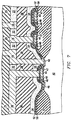
- Figure 7 shows an embodiment of the invention which illustrates how the various features and advantages of the invention may be employed on multiple layers of patterned conductors.
- Figure 7 On the left side of Figure 7 is a structure similar to that of Figure 6 .
- two additional polysilicon conductors 44 are shown on top of the field oxide 42 , with a conformal organic-containing layer 54 substantially filling the space between the two conductors.
- the inorganic dielectric layer 56 is depicted with contacts of several different lengths passing through it
- the patterned conductors 18 of an interconnection layer are shown overlaying the inorganic dielectric layer 56 , with filled contacts connecting the patterned conductors 18 downwards to silicided contacts 48 and filled vias connecting conductors 18 upwards to a third layer of patterned conductors (not shown).
- the gaps between the patterned conductors 18 are substantially filled with an organic-containing dielectric layer 22 , and capped with an inorganic interlayer dielectric 24 .
Landscapes
- Internal Circuitry In Semiconductor Integrated Circuit Devices (AREA)
Applications Claiming Priority (2)
| Application Number | Priority Date | Filing Date | Title |
|---|---|---|---|
| US08/234,100 US5565384A (en) | 1994-04-28 | 1994-04-28 | Self-aligned via using low permittivity dielectric |
| US234100 | 1994-04-28 |
Publications (2)
| Publication Number | Publication Date |
|---|---|
| EP0680084A1 true EP0680084A1 (de) | 1995-11-02 |
| EP0680084B1 EP0680084B1 (de) | 2002-10-02 |
Family
ID=22879931
Family Applications (1)
| Application Number | Title | Priority Date | Filing Date |
|---|---|---|---|
| EP95106395A Expired - Lifetime EP0680084B1 (de) | 1994-04-28 | 1995-04-28 | Verfahren zur Herstellung von Löchern in einer dielektrischen Schicht mit niedriger Dielektrizitätskonstante auf einer Halbleitervorrichtung |
Country Status (6)
| Country | Link |
|---|---|
| US (1) | US5565384A (de) |
| EP (1) | EP0680084B1 (de) |
| JP (1) | JPH0851154A (de) |
| KR (1) | KR950034532A (de) |
| DE (1) | DE69528409T2 (de) |
| TW (1) | TW299484B (de) |
Cited By (13)
| Publication number | Priority date | Publication date | Assignee | Title |
|---|---|---|---|---|
| EP0688052A3 (de) * | 1994-05-20 | 1996-08-28 | Texas Instruments Inc | Verbesserungen in der oder in Bezug auf die Herstellung einer Halbleiteranordnung |
| GB2326765A (en) * | 1997-06-27 | 1998-12-30 | Nec Corp | Multilayer wiring |
| EP0849785A3 (de) * | 1996-12-20 | 1998-12-30 | Texas Instruments Incorporated | Herstellungsverfahren für einen selbstjustierten Kontakt |
| WO2000022671A1 (en) * | 1998-10-14 | 2000-04-20 | Advanced Micro Devices, Inc. | Method of making dual damascene conductive interconnections and integrated circuit device comprising same |
| GB2350931A (en) * | 1997-06-27 | 2000-12-13 | Nec Corp | Forming vias in low-k dielectric materials using metallic masks |
| WO2001018861A1 (en) * | 1999-09-08 | 2001-03-15 | Alliedsignal Inc. | Low dielectric-constant etch stop layer in dual damascene process |
| US6352943B2 (en) * | 1998-05-20 | 2002-03-05 | Semiconductor Process Laboratory Co., Ltd. | Method of film formation and method for manufacturing semiconductor device |
| US6376365B1 (en) * | 1999-06-22 | 2002-04-23 | Sony Corporation | Method for fabricating semiconductor devices |
| US6432833B1 (en) | 1999-12-20 | 2002-08-13 | Micron Technology, Inc. | Method of forming a self aligned contact opening |
| US6458685B2 (en) | 2000-01-03 | 2002-10-01 | Micron Technology, Inc. | Method of forming a self-aligned contact opening |
| US6522008B2 (en) | 2000-08-31 | 2003-02-18 | Micron Technology, Inc. | Subtractive metallization structure with low dielectric constant insulating layers |
| US6967408B1 (en) | 1997-04-30 | 2005-11-22 | Micron Technology, Inc. | Gate stack structure |
| US6989108B2 (en) | 2001-08-30 | 2006-01-24 | Micron Technology, Inc. | Etchant gas composition |
Families Citing this family (57)
| Publication number | Priority date | Publication date | Assignee | Title |
|---|---|---|---|---|
| US6278174B1 (en) * | 1994-04-28 | 2001-08-21 | Texas Instruments Incorporated | Integrated circuit insulator and structure using low dielectric insulator material including HSQ and fluorinated oxide |
| US6716769B1 (en) | 1995-06-02 | 2004-04-06 | Micron Technology, Inc. | Use of a plasma source to form a layer during the formation of a semiconductor device |
| US7294578B1 (en) * | 1995-06-02 | 2007-11-13 | Micron Technology, Inc. | Use of a plasma source to form a layer during the formation of a semiconductor device |
| JPH0936226A (ja) * | 1995-07-18 | 1997-02-07 | Nec Corp | 半導体装置およびその製造方法 |
| TW439003B (en) * | 1995-11-17 | 2001-06-07 | Semiconductor Energy Lab | Display device |
| JPH1041382A (ja) * | 1996-04-29 | 1998-02-13 | Texas Instr Inc <Ti> | 集積回路レベル間絶縁構造 |
| US5854131A (en) * | 1996-06-05 | 1998-12-29 | Advanced Micro Devices, Inc. | Integrated circuit having horizontally and vertically offset interconnect lines |
| KR100192589B1 (ko) * | 1996-08-08 | 1999-06-15 | 윤종용 | 반도체 장치 및 그 제조방법 |
| US6303488B1 (en) | 1997-02-12 | 2001-10-16 | Micron Technology, Inc. | Semiconductor processing methods of forming openings to devices and substrates, exposing material from which photoresist cannot be substantially selectively removed |
| US6010957A (en) * | 1997-06-25 | 2000-01-04 | Advanced Micro Devices | Semiconductor device having tapered conductive lines and fabrication thereof |
| US6048803A (en) * | 1997-08-19 | 2000-04-11 | Advanced Microdevices, Inc. | Method of fabricating a semiconductor device having fluorine bearing oxide between conductive lines |
| US6875681B1 (en) * | 1997-12-31 | 2005-04-05 | Intel Corporation | Wafer passivation structure and method of fabrication |
| US6143649A (en) * | 1998-02-05 | 2000-11-07 | Micron Technology, Inc. | Method for making semiconductor devices having gradual slope contacts |
| KR100283028B1 (ko) * | 1998-03-19 | 2001-03-02 | 윤종용 | 디램 셀 캐패시터의 제조 방법 |
| JP2002510878A (ja) | 1998-04-02 | 2002-04-09 | アプライド マテリアルズ インコーポレイテッド | 低k誘電体をエッチングする方法 |
| US6287751B2 (en) * | 1998-05-12 | 2001-09-11 | United Microelectronics Corp. | Method of fabricating contact window |
| US6175147B1 (en) * | 1998-05-14 | 2001-01-16 | Micron Technology Inc. | Device isolation for semiconductor devices |
| TW389988B (en) * | 1998-05-22 | 2000-05-11 | United Microelectronics Corp | Method for forming metal interconnect in dielectric layer with low dielectric constant |
| US6019906A (en) * | 1998-05-29 | 2000-02-01 | Taiwan Semiconductor Manufacturing Company | Hard masking method for forming patterned oxygen containing plasma etchable layer |
| US6492276B1 (en) | 1998-05-29 | 2002-12-10 | Taiwan Semiconductor Manufacturing Company | Hard masking method for forming residue free oxygen containing plasma etched layer |
| US6007733A (en) * | 1998-05-29 | 1999-12-28 | Taiwan Semiconductor Manufacturing Company | Hard masking method for forming oxygen containing plasma etchable layer |
| US6232235B1 (en) | 1998-06-03 | 2001-05-15 | Motorola, Inc. | Method of forming a semiconductor device |
| US6323118B1 (en) | 1998-07-13 | 2001-11-27 | Taiwan Semiconductor For Manufacturing Company | Borderless dual damascene contact |
| US6440863B1 (en) * | 1998-09-04 | 2002-08-27 | Taiwan Semiconductor Manufacturing Company | Plasma etch method for forming patterned oxygen containing plasma etchable layer |
| US6174800B1 (en) | 1998-09-08 | 2001-01-16 | Taiwan Semiconductor Manufacturing Company | Via formation in a poly(arylene ether) inter metal dielectric layer |
| US6187672B1 (en) * | 1998-09-22 | 2001-02-13 | Conexant Systems, Inc. | Interconnect with low dielectric constant insulators for semiconductor integrated circuit manufacturing |
| US6245663B1 (en) * | 1998-09-30 | 2001-06-12 | Conexant Systems, Inc. | IC interconnect structures and methods for making same |
| US6004883A (en) * | 1998-10-23 | 1999-12-21 | Taiwan Semiconductor Manufacturing Company, Ltd. | Dual damascene patterned conductor layer formation method without etch stop layer |
| US6165898A (en) * | 1998-10-23 | 2000-12-26 | Taiwan Semiconductor Manufacturing Company | Dual damascene patterned conductor layer formation method without etch stop layer |
| US6265308B1 (en) | 1998-11-30 | 2001-07-24 | International Business Machines Corporation | Slotted damascene lines for low resistive wiring lines for integrated circuit |
| US6495468B2 (en) | 1998-12-22 | 2002-12-17 | Micron Technology, Inc. | Laser ablative removal of photoresist |
| US6417090B1 (en) * | 1999-01-04 | 2002-07-09 | Advanced Micro Devices, Inc. | Damascene arrangement for metal interconnection using low k dielectric constant materials for etch stop layer |
| US6255232B1 (en) | 1999-02-11 | 2001-07-03 | Taiwan Semiconductor Manufacturing Company | Method for forming low dielectric constant spin-on-polymer (SOP) dielectric layer |
| US6114253A (en) * | 1999-03-15 | 2000-09-05 | Taiwan Semiconductor Manufacturing Company | Via patterning for poly(arylene ether) used as an inter-metal dielectric |
| US6211063B1 (en) | 1999-05-25 | 2001-04-03 | Taiwan Semiconductor Manufacturing Company | Method to fabricate self-aligned dual damascene structures |
| US20030205815A1 (en) * | 1999-06-09 | 2003-11-06 | Henry Chung | Fabrication method of integrated circuits with borderless vias and low dielectric constant inter-metal dielectrics |
| JP3430091B2 (ja) * | 1999-12-01 | 2003-07-28 | Necエレクトロニクス株式会社 | エッチングマスク及びエッチングマスクを用いたコンタクトホールの形成方法並びにその方法で形成した半導体装置 |
| US6531389B1 (en) | 1999-12-20 | 2003-03-11 | Taiwan Semiconductor Manufacturing Company | Method for forming incompletely landed via with attenuated contact resistance |
| US6348706B1 (en) * | 2000-03-20 | 2002-02-19 | Micron Technology, Inc. | Method to form etch and/or CMP stop layers |
| JP4149644B2 (ja) * | 2000-08-11 | 2008-09-10 | 株式会社東芝 | 不揮発性半導体記憶装置 |
| KR100795714B1 (ko) * | 2000-08-21 | 2008-01-21 | 다우 글로벌 테크놀로지스 인크. | 마이크로일렉트로닉 장치의 제조에 있어서 유기 중합체유전체용 하드마스크로서의 유기 규산염 수지 |
| US7172960B2 (en) * | 2000-12-27 | 2007-02-06 | Intel Corporation | Multi-layer film stack for extinction of substrate reflections during patterning |
| US6803314B2 (en) * | 2001-04-30 | 2004-10-12 | Chartered Semiconductor Manufacturing Ltd. | Double-layered low dielectric constant dielectric dual damascene method |
| US20030096090A1 (en) * | 2001-10-22 | 2003-05-22 | Boisvert Ronald Paul | Etch-stop resins |
| KR100704469B1 (ko) * | 2001-12-14 | 2007-04-09 | 주식회사 하이닉스반도체 | 반도체 소자 제조 방법 |
| JP2004071705A (ja) * | 2002-08-02 | 2004-03-04 | Fujitsu Ltd | 半導体装置及び半導体装置の製造方法 |
| JP2004274020A (ja) * | 2002-09-24 | 2004-09-30 | Rohm & Haas Electronic Materials Llc | 電子デバイス製造 |
| KR100480636B1 (ko) * | 2002-11-22 | 2005-03-31 | 삼성전자주식회사 | 반도체 장치의 제조방법 |
| US7026650B2 (en) | 2003-01-15 | 2006-04-11 | Cree, Inc. | Multiple floating guard ring edge termination for silicon carbide devices |
| US9515135B2 (en) * | 2003-01-15 | 2016-12-06 | Cree, Inc. | Edge termination structures for silicon carbide devices |
| US7109092B2 (en) | 2003-05-19 | 2006-09-19 | Ziptronix, Inc. | Method of room temperature covalent bonding |
| US7183187B2 (en) * | 2004-05-20 | 2007-02-27 | Texas Instruments Incorporated | Integration scheme for using silicided dual work function metal gates |
| US7235489B2 (en) * | 2004-05-21 | 2007-06-26 | Agere Systems Inc. | Device and method to eliminate shorting induced by via to metal misalignment |
| JP5134193B2 (ja) * | 2005-07-15 | 2013-01-30 | 株式会社東芝 | 半導体装置及びその製造方法 |
| KR100685735B1 (ko) * | 2005-08-11 | 2007-02-26 | 삼성전자주식회사 | 폴리실리콘 제거용 조성물, 이를 이용한 폴리실리콘 제거방법 및 반도체 장치의 제조 방법 |
| EP3217425B1 (de) | 2016-03-07 | 2021-09-15 | IMEC vzw | Selbstjustierte interconnects und zugehöriges verfahren |
| KR20230097121A (ko) | 2020-10-29 | 2023-06-30 | 아데이아 세미컨덕터 본딩 테크놀로지스 인코포레이티드 | 직접 접합 방법 및 구조체 |
Citations (3)
| Publication number | Priority date | Publication date | Assignee | Title |
|---|---|---|---|---|
| DE3345040A1 (de) * | 1983-12-13 | 1985-06-13 | Siemens AG, 1000 Berlin und 8000 München | Verfahren zur herstellung einer eingeebneten, die zwei metallisierungen trennenden anorganischen isolationsschicht unter verwendung von polyimid |
| JPS63208248A (ja) * | 1987-02-24 | 1988-08-29 | Nec Corp | 半導体装置 |
| EP0296707A1 (de) * | 1987-06-12 | 1988-12-28 | Hewlett-Packard Company | Einbau einer dielektrischen Schicht in eine Halbleiterstruktur |
Family Cites Families (23)
| Publication number | Priority date | Publication date | Assignee | Title |
|---|---|---|---|---|
| DE3345C (de) * | HÜSMERT & CO. in Wald bei Solingen | Bügelverschlufs an Handtaschen etc | ||
| US3985597A (en) * | 1975-05-01 | 1976-10-12 | International Business Machines Corporation | Process for forming passivated metal interconnection system with a planar surface |
| US4367119A (en) * | 1980-08-18 | 1983-01-04 | International Business Machines Corporation | Planar multi-level metal process with built-in etch stop |
| US4576900A (en) * | 1981-10-09 | 1986-03-18 | Amdahl Corporation | Integrated circuit multilevel interconnect system and method |
| US4432035A (en) * | 1982-06-11 | 1984-02-14 | International Business Machines Corp. | Method of making high dielectric constant insulators and capacitors using same |
| DE3234907A1 (de) * | 1982-09-21 | 1984-03-22 | Siemens AG, 1000 Berlin und 8000 München | Verfahren zum herstellen einer monolithisch integrierten schaltung |
| US4683024A (en) * | 1985-02-04 | 1987-07-28 | American Telephone And Telegraph Company, At&T Bell Laboratories | Device fabrication method using spin-on glass resins |
| JPH0715938B2 (ja) * | 1985-05-23 | 1995-02-22 | 日本電信電話株式会社 | 半導体装置およびその製造方法 |
| US4789648A (en) * | 1985-10-28 | 1988-12-06 | International Business Machines Corporation | Method for producing coplanar multi-level metal/insulator films on a substrate and for forming patterned conductive lines simultaneously with stud vias |
| US4723978A (en) * | 1985-10-31 | 1988-02-09 | International Business Machines Corporation | Method for a plasma-treated polysiloxane coating |
| JPS63276246A (ja) * | 1987-05-08 | 1988-11-14 | Nec Corp | 半導体装置 |
| US5110712A (en) * | 1987-06-12 | 1992-05-05 | Hewlett-Packard Company | Incorporation of dielectric layers in a semiconductor |
| JPH01235254A (ja) * | 1988-03-15 | 1989-09-20 | Nec Corp | 半導体装置及びその製造方法 |
| US5141817A (en) * | 1989-06-13 | 1992-08-25 | International Business Machines Corporation | Dielectric structures having embedded gap filling RIE etch stop polymeric materials of high thermal stability |
| JP2556146B2 (ja) * | 1989-09-19 | 1996-11-20 | 日本電気株式会社 | 多層配線 |
| US5198298A (en) * | 1989-10-24 | 1993-03-30 | Advanced Micro Devices, Inc. | Etch stop layer using polymers |
| US5143820A (en) * | 1989-10-31 | 1992-09-01 | International Business Machines Corporation | Method for fabricating high circuit density, self-aligned metal linens to contact windows |
| JPH04174541A (ja) * | 1990-03-28 | 1992-06-22 | Nec Corp | 半導体集積回路及びその製造方法 |
| JPH04127454A (ja) * | 1990-09-18 | 1992-04-28 | Nec Corp | 半導体装置 |
| JPH04311059A (ja) * | 1991-04-09 | 1992-11-02 | Oki Electric Ind Co Ltd | 配線容量の低減方法 |
| US5246883A (en) * | 1992-02-06 | 1993-09-21 | Sgs-Thomson Microelectronics, Inc. | Semiconductor contact via structure and method |
| US5371047A (en) * | 1992-10-30 | 1994-12-06 | International Business Machines Corporation | Chip interconnection having a breathable etch stop layer |
| US5393712A (en) * | 1993-06-28 | 1995-02-28 | Lsi Logic Corporation | Process for forming low dielectric constant insulation layer on integrated circuit structure |
-
1994
- 1994-04-28 US US08/234,100 patent/US5565384A/en not_active Expired - Lifetime
-
1995
- 1995-04-27 JP JP7104296A patent/JPH0851154A/ja active Pending
- 1995-04-27 KR KR19950010065A patent/KR950034532A/ko not_active Abandoned
- 1995-04-28 DE DE69528409T patent/DE69528409T2/de not_active Expired - Fee Related
- 1995-04-28 EP EP95106395A patent/EP0680084B1/de not_active Expired - Lifetime
- 1995-06-08 TW TW084105790A patent/TW299484B/zh not_active IP Right Cessation
Patent Citations (3)
| Publication number | Priority date | Publication date | Assignee | Title |
|---|---|---|---|---|
| DE3345040A1 (de) * | 1983-12-13 | 1985-06-13 | Siemens AG, 1000 Berlin und 8000 München | Verfahren zur herstellung einer eingeebneten, die zwei metallisierungen trennenden anorganischen isolationsschicht unter verwendung von polyimid |
| JPS63208248A (ja) * | 1987-02-24 | 1988-08-29 | Nec Corp | 半導体装置 |
| EP0296707A1 (de) * | 1987-06-12 | 1988-12-28 | Hewlett-Packard Company | Einbau einer dielektrischen Schicht in eine Halbleiterstruktur |
Non-Patent Citations (1)
| Title |
|---|
| PATENT ABSTRACTS OF JAPAN vol. 012, no. 498 (E - 698) 24 December 1988 (1988-12-24) * |
Cited By (25)
| Publication number | Priority date | Publication date | Assignee | Title |
|---|---|---|---|---|
| US5747880A (en) * | 1994-05-20 | 1998-05-05 | Texas Instruments Incorporated | Interconnect structure with an integrated low density dielectric |
| EP0688052A3 (de) * | 1994-05-20 | 1996-08-28 | Texas Instruments Inc | Verbesserungen in der oder in Bezug auf die Herstellung einer Halbleiteranordnung |
| US6136700A (en) * | 1996-12-20 | 2000-10-24 | Texas Instruments Incorporated | Method for enhancing the performance of a contact |
| EP0849785A3 (de) * | 1996-12-20 | 1998-12-30 | Texas Instruments Incorporated | Herstellungsverfahren für einen selbstjustierten Kontakt |
| US6967408B1 (en) | 1997-04-30 | 2005-11-22 | Micron Technology, Inc. | Gate stack structure |
| US6140225A (en) * | 1997-06-27 | 2000-10-31 | Nec Corporation | Method of manufacturing semiconductor device having multilayer wiring |
| GB2326765B (en) * | 1997-06-27 | 2000-11-15 | Nec Corp | Method of manufacturing semiconductor device having multilayer wiring |
| GB2350931A (en) * | 1997-06-27 | 2000-12-13 | Nec Corp | Forming vias in low-k dielectric materials using metallic masks |
| GB2350931B (en) * | 1997-06-27 | 2001-03-14 | Nec Corp | Method of manufacturing semiconductor device having multilayer wiring |
| KR100321571B1 (ko) * | 1997-06-27 | 2002-03-08 | 가네꼬 히사시 | 다중층배선을갖는반도체장치의제조방법 |
| US6225217B1 (en) | 1997-06-27 | 2001-05-01 | Nec Corporation | Method of manufacturing semiconductor device having multilayer wiring |
| GB2326765A (en) * | 1997-06-27 | 1998-12-30 | Nec Corp | Multilayer wiring |
| US6352943B2 (en) * | 1998-05-20 | 2002-03-05 | Semiconductor Process Laboratory Co., Ltd. | Method of film formation and method for manufacturing semiconductor device |
| US6228758B1 (en) | 1998-10-14 | 2001-05-08 | Advanced Micro Devices, Inc. | Method of making dual damascene conductive interconnections and integrated circuit device comprising same |
| WO2000022671A1 (en) * | 1998-10-14 | 2000-04-20 | Advanced Micro Devices, Inc. | Method of making dual damascene conductive interconnections and integrated circuit device comprising same |
| US6376365B1 (en) * | 1999-06-22 | 2002-04-23 | Sony Corporation | Method for fabricating semiconductor devices |
| WO2001018861A1 (en) * | 1999-09-08 | 2001-03-15 | Alliedsignal Inc. | Low dielectric-constant etch stop layer in dual damascene process |
| US6432833B1 (en) | 1999-12-20 | 2002-08-13 | Micron Technology, Inc. | Method of forming a self aligned contact opening |
| US6458685B2 (en) | 2000-01-03 | 2002-10-01 | Micron Technology, Inc. | Method of forming a self-aligned contact opening |
| US6522008B2 (en) | 2000-08-31 | 2003-02-18 | Micron Technology, Inc. | Subtractive metallization structure with low dielectric constant insulating layers |
| WO2002019419A3 (en) * | 2000-08-31 | 2003-02-27 | Micron Technology Inc | Substractive metallization structure and method of making |
| US6617239B1 (en) | 2000-08-31 | 2003-09-09 | Micron Technology, Inc. | Subtractive metallization structure and method of making |
| US6989108B2 (en) | 2001-08-30 | 2006-01-24 | Micron Technology, Inc. | Etchant gas composition |
| US7273566B2 (en) | 2001-08-30 | 2007-09-25 | Micron Technology, Inc. | Gas compositions |
| US7470628B2 (en) | 2001-08-30 | 2008-12-30 | Micron Technology, Inc. | Etching methods |
Also Published As
| Publication number | Publication date |
|---|---|
| JPH0851154A (ja) | 1996-02-20 |
| TW299484B (de) | 1997-03-01 |
| US5565384A (en) | 1996-10-15 |
| DE69528409D1 (de) | 2002-11-07 |
| EP0680084B1 (de) | 2002-10-02 |
| KR950034532A (de) | 1995-12-28 |
| DE69528409T2 (de) | 2003-08-21 |
Similar Documents
| Publication | Publication Date | Title |
|---|---|---|
| EP0680084B1 (de) | Verfahren zur Herstellung von Löchern in einer dielektrischen Schicht mit niedriger Dielektrizitätskonstante auf einer Halbleitervorrichtung | |
| KR100372467B1 (ko) | 반도체장치형성방법및집적회로구조형성방법 | |
| US5847464A (en) | Method for forming controlled voids in interlevel dielectric | |
| JP4118029B2 (ja) | 半導体集積回路装置とその製造方法 | |
| US6177329B1 (en) | Integrated circuit structures having gas pockets and method for forming integrated circuit structures having gas pockets | |
| KR101476544B1 (ko) | 개선된 비아 랜딩 프로파일을 위한 신규한 패터닝 방법 | |
| US8461692B2 (en) | Semiconductor device structures including damascene trenches with conductive structures and related method | |
| US5482894A (en) | Method of fabricating a self-aligned contact using organic dielectric materials | |
| US6509623B2 (en) | Microelectronic air-gap structures and methods of forming the same | |
| US6188125B1 (en) | Via formation in polymeric materials | |
| EP0687005B1 (de) | Herstellungsverfahren von Verbindungen über Halbleitervorrichtungen | |
| US8390038B2 (en) | MIM capacitor and method of making same | |
| US20020113317A1 (en) | A semiconductor device having hydogen diffusion and barrier layers and a method of producing the same | |
| US6348734B1 (en) | Self-aligned copper interconnect architecture with enhanced copper diffusion barrier | |
| US5856707A (en) | Vias and contact plugs with an aspect ratio lower than the aspect ratio of the structure in which they are formed | |
| US5880030A (en) | Unlanded via structure and method for making same | |
| KR100294755B1 (ko) | 반도체장치및그제조방법 | |
| CN112838048B (zh) | 互连结构以及其制作方法 | |
| KR20030093912A (ko) | 다층 배선 구조를 갖는 반도체 장치 및 그 제조 방법 | |
| US20010016413A1 (en) | Semiconductor device and method of manufacturing a semiconductor device with reduced contact failures | |
| EP1378935A2 (de) | Verfahren zum Herstellen von Materialien mit hoher und niedriger Dielektrizitätskonstante in einer Ebene auf einem Substrat, und ihre Verwendung in Mischmodus-Schaltkreisen | |
| JP4717972B2 (ja) | 集積回路の製造方法 | |
| JP2000299377A (ja) | 多層配線およびその形成方法 | |
| JPH1187498A (ja) | 半導体装置およびその製造方法 | |
| US20020068437A1 (en) | Method of forming unlanded via |
Legal Events
| Date | Code | Title | Description |
|---|---|---|---|
| PUAI | Public reference made under article 153(3) epc to a published international application that has entered the european phase |
Free format text: ORIGINAL CODE: 0009012 |
|
| AK | Designated contracting states |
Kind code of ref document: A1 Designated state(s): DE FR GB IT NL |
|
| 17P | Request for examination filed |
Effective date: 19960502 |
|
| 17Q | First examination report despatched |
Effective date: 19971024 |
|
| RIC1 | Information provided on ipc code assigned before grant |
Free format text: 7H 01L 21/768 A |
|
| RTI1 | Title (correction) |
Free format text: METHOD OF FORMING VIAS IN A SEMICONDUCTOR DEVICE HAVING A LOW PERMITTIVITY DIELECTRIC LAYER THEREON |
|
| GRAG | Despatch of communication of intention to grant |
Free format text: ORIGINAL CODE: EPIDOS AGRA |
|
| GRAG | Despatch of communication of intention to grant |
Free format text: ORIGINAL CODE: EPIDOS AGRA |
|
| GRAH | Despatch of communication of intention to grant a patent |
Free format text: ORIGINAL CODE: EPIDOS IGRA |
|
| GRAH | Despatch of communication of intention to grant a patent |
Free format text: ORIGINAL CODE: EPIDOS IGRA |
|
| GRAA | (expected) grant |
Free format text: ORIGINAL CODE: 0009210 |
|
| AK | Designated contracting states |
Kind code of ref document: B1 Designated state(s): DE FR GB IT NL |
|
| PG25 | Lapsed in a contracting state [announced via postgrant information from national office to epo] |
Ref country code: NL Free format text: LAPSE BECAUSE OF FAILURE TO SUBMIT A TRANSLATION OF THE DESCRIPTION OR TO PAY THE FEE WITHIN THE PRESCRIBED TIME-LIMIT Effective date: 20021002 Ref country code: IT Free format text: LAPSE BECAUSE OF FAILURE TO SUBMIT A TRANSLATION OF THE DESCRIPTION OR TO PAY THE FEE WITHIN THE PRE;WARNING: LAPSES OF ITALIAN PATENTS WITH EFFECTIVE DATE BEFORE 2007 MAY HAVE OCCURRED AT ANY TIME BEFORE 2007. THE CORRECT EFFECTIVE DATE MAY BE DIFFERENT FROM THE ONE RECORDED.SCRIBED TIME-LIMIT Effective date: 20021002 |
|
| REG | Reference to a national code |
Ref country code: GB Ref legal event code: FG4D |
|
| REF | Corresponds to: |
Ref document number: 69528409 Country of ref document: DE Date of ref document: 20021107 |
|
| NLV1 | Nl: lapsed or annulled due to failure to fulfill the requirements of art. 29p and 29m of the patents act | ||
| ET | Fr: translation filed | ||
| PLBE | No opposition filed within time limit |
Free format text: ORIGINAL CODE: 0009261 |
|
| STAA | Information on the status of an ep patent application or granted ep patent |
Free format text: STATUS: NO OPPOSITION FILED WITHIN TIME LIMIT |
|
| 26N | No opposition filed |
Effective date: 20030703 |
|
| PGFP | Annual fee paid to national office [announced via postgrant information from national office to epo] |
Ref country code: FR Payment date: 20090406 Year of fee payment: 15 Ref country code: DE Payment date: 20090430 Year of fee payment: 15 |
|
| PGFP | Annual fee paid to national office [announced via postgrant information from national office to epo] |
Ref country code: GB Payment date: 20100312 Year of fee payment: 16 |
|
| REG | Reference to a national code |
Ref country code: FR Ref legal event code: ST Effective date: 20101230 |
|
| PG25 | Lapsed in a contracting state [announced via postgrant information from national office to epo] |
Ref country code: DE Free format text: LAPSE BECAUSE OF NON-PAYMENT OF DUE FEES Effective date: 20101103 |
|
| GBPC | Gb: european patent ceased through non-payment of renewal fee |
Effective date: 20110428 |
|
| PG25 | Lapsed in a contracting state [announced via postgrant information from national office to epo] |
Ref country code: GB Free format text: LAPSE BECAUSE OF NON-PAYMENT OF DUE FEES Effective date: 20110428 |
|
| PG25 | Lapsed in a contracting state [announced via postgrant information from national office to epo] |
Ref country code: FR Free format text: LAPSE BECAUSE OF NON-PAYMENT OF DUE FEES Effective date: 20100430 |